
Fashion Trends Using Data Analytics

The fashion industry is one of the biggest sectors globally. In India alone, the textile industry was estimated to be worth around $100 billion in 2019. It attracted Foreign Direct Investment worth $3.68 billion between April 2020 and December 2020.

Like any industry, companies in the fashion sector use technology to advance further and enhance their performance. That’s why the demand for data analytics professionals is rising steadily in this field.

The following article will throw light on what do data scientists do in the fashion sector and how they are helping this industry grow.

How Data Analytics Helps the Fashion Industry

Understanding the customers

Data analytics helps fashion companies in getting better insight into their customers. They can collect data from reliable sources, optimize it and analyze it to find unique patterns in their purchase behavior and modify their marketing strategies accordingly.

Data scientists handle the gathering of the data because the source can influence the quality of data significantly. When a brand has a better understanding of what its customers want, it can create products accordingly and get ahead of its peers.

Analyzing the competitors

Competitive analysis is a major aspect of any industry. Knowing what your competition is doing and the reasons why it’s making progress can help you chart out a better future plan.

Data scientists are capable of finding patterns and factors that affect certain outcomes. They assist fashion brands in analyzing the industry and thus, help them beat their competition.

Optimizing the sales process

The sales process should be smooth and hassle-free for every customer. It shouldn’t be difficult for a client to find the product he/she wants. However, in many cases, the customer doesn’t know what he/she wants. This is where data scientists come in.

They create recommender systems that analyze a customer’s past interactions with the brand, the available data on him/her, and predict his/her most preferred choices. Recommender systems also predict user behavior based on what other users with similar interests like. By using recommender systems, fashion companies can easily sell more products and retain more clients.
Data Science Course

Predicting future performance

Forecasting how the current industry trends will behave can help a company greatly. Data Analytics and Machine Learning Training allow fashion companies to perform predictive analysis. It assists them in making better-informed decisions about their current and future products.

For example, it can help them decide the right time to launch new offers. Similarly, it can help them determine how their existing campaigns will perform so they can rectify any errors.

Starting a career in data analytics

Now that you know what do data scientists do in the fashion industry, you might be interested in pursuing a career in this field. Becoming a data analytics professional is quite simple if you have the right knowledge. Data scientists are experts in machine learning, artificial intelligence, mathematics, and statistics. Hence, you must learn these subjects and get familiar with the relevant tools used in this field.

The most effective way to do so is by joining data analytics courses in India. Joining data analytics courses online will help you in learning the necessary concepts and get certified as a data science professional.

Conclusion

Data analytics has become an integral part of many industries, and fashion is one of them. You should start looking for data analytics courses in India if you want to make use of this opportunity. It would be best to join data analytics courses online because it would ensure you can study safely and from the comfort of your home.


Magic off the Pitch: Role of Data Analytics in Cricket!

Cricket with 1.5 billion followers makes it one of the most followed sports in the world. Many followers of the sport have their favorite team, and they always try to predict the outcome of the match, considering some factors they know.

Various factors like a home ground advantage, experience of the players, performance at the specific avenue, performance in the past matches, the current form of the team and the players, and performance against a particular team decide the game’s result.

With some minimal imagination and minute calculations, we can’t predict the outcome successfully. But research has grown beyond our imagination. Many data science courses have been designed to predict the results based on previous data.

best Data Analytics courses in IndiaArtificial intelligence and the best data analytics courses with placement in India have become trendy and started presenting their significance in many sectors. Sports are also included in those sectors. NBA, Soccer, Baseball, and Cricket are such sports that use data analytics to make informed decisions.

Cricket is a game that generates enormous data because it is the game played by 106 member nations of the ICC, and many players are involved in it. This data is helpful for the teams to make the most out of the matches.

Selection of the players, order of batting, order of the bowling, field placements, and many more decisions taken by the experts or captains of the team depends on the analysis of the data generated. Followers may not know that there is an expert team of data analysts behind every successful match. The perfect combination to win a game is technology integrated with 100% effort of the players on the ground.

We need to remember an exciting line that ‘Data Never Lies’. We can definitely get some valuable inputs by analyzing the data. Data analysts consider many different stats to predict the fate of the tournament. This predictive analysis helps the team to strategize and plan the game accordingly. Sponsors too depend upon the data analysis. Search for how to become a data analyst now and build your career in the sports industry.


Here we are addressing some essentials of data analysis.

  • Captains can make crucial decisions with ease

Cricket is a dynamic sport, and many critical situations would arise during the game. A captain can then rely on data science to make a perfect decision in those moments. Data analytics can help the bowlers and batsmen increase their performance. Data science focuses on implementing machine learning and predictive modeling in the sport. These applications can turn losing matches into wins. We can analyze the performance of the batsmen and the effectiveness of the batsman against a bowler.

  • Improving the performance of the player

We can analyze the player performance using past data. We can see the number of dot balls, the number of yorkers bowled by a bowler, how effective they are against batsmen, etc. With regards to batsmen, we can watch previous deliveries and where he fails to connect. All these types of analysis can be helpful in building training modules for the players.

  • Keeping cricket fans engaged

We have to accept that without fans, no sport would survive. Spectators and fans keep the heat high with the data available with them. Fans get engaged with cricket because of the data analytics tools and knowledge. There are instances where final scores are predicted with the help of data analytics.

How to become a data analyst?

  • A bachelor’s degree in an area that emphasizes statistical and analytical skills, such as math or computer science, is an excellent place to start.
  • Learn how to solve problems by registering for data science courses or a data analytics course.
  • Consider certification.
  • Get your first work as a data analyst at an entry-level position.
  • A master’s degree in data analytics is a great way to advance your career.

Artificial Intelligence: Futuristic Career Options

Artificial Intelligence has been defined as the area of computer science that aims at creating intelligent machines that can think and behave like humans. In reality, AI software has widespread applications in today’s age of digital media. From chatbots, Voice-assistant software to self-driving cars, AI and Machine Learning (ML) has become the way to go.
A study by McKinsey in 2017 suggested that by 2030 one third of the total jobs would be related to AI. However, the pandemic situation has intensified this change as more and more companies have started to revamp their strategies to become more technology-centric in their approaches.

Artificial Intelligence, thus, can provide huge opportunities and has great scope for the future. Let us look at some of the jobs that Artificial Intelligence will create

  1. User Experience (UX): Products that incorporate AI at the core will be hard to use. It would be mostly because of the fact people are not very well accustomed to AI products. Thus, the need for a User Experience specialist will grow in the coming years. These professionals would mainly be responsible to understand how people are employing the various machines and equipment so that scientists can develop even more advanced software. Thus, a UX specialist would be required to understand the functionalities of an AI-tech that would help in filling up of more need gaps in the due course.
  2. Computer Science and Artificial Intelligence Research: Every technology needs to be upgraded to keep it relevant, in the due course. A Computer Science and AI researcher’s job would be just that. Based upon the area of their specialization, an AI researcher would be mostly responsible for upgrading AI-based data systems and unlock new potential in the existing avenues by curating AI software. There might also be a need for researchers to overlook the ethical aspects of adopting AI technologies in any industry. For instance, an ethical specialist handling the trolley problem relating to the self-driving car.
  3. Software Engineering: The traditional role of software engineers would remain highly relevant to AI-related fields. The software engineers would be responsible to design the technical functionalities of a product that would help in better utilization of machine learning schemas to perform diverse operations. Existing software engineers who want to leverage this trend change are looking for more Artificial Intelligence courses. It is predicted that the job role of a software engineer would grow 28 per cent faster than the average in the upcoming future owing to the growth of AI.
  4. Data Scientists: Data Scientists are responsible for the meaningful analysis of data. The Artificial Intelligence systems run on huge databases, from which important information needs to be extracted to support a business in its ordinary course. A data scientist would be expected to be adept in maths and statistics so that it can transform numeric information into simpler terms that would be helpful to make key inferences and decisions.
  5. Big Data Engineer: A Big Data engineer is entrusted with the task of building an entire ecosystem that would help the AI frameworks of different businesses to interact with each other. The job role of big data scientists would mostly revolve around designing, planning, and building up the big data environment. It is a highly challenging task and it is expected to mostly involve individuals with PhD in mathematics, statistics, or computer science.
  6. Natural Language Processing Experts: Most of the AI tools are used revolve around converting or rather translating virtual languages to natural language that are understandable by human beings. This has seen widespread applications in chatbots, virtual voice assistants, etc. The key responsibility of the individual experts in these fields would be to create systems through which computers can communicate with humans. Thus, these individuals must have good language and technology skills.

Also Read: 10 Interesting Facts About Artificial Intelligence

What is Differential Deep Learning?

Introduction

The world today has changed drastically. Therefore, it is important to change according to the environment in which we function. One such major change has been brought about by the advent caused by Artificial Intelligence.

Deep learning is a concept which has come around from artificial intelligence. It has been adopted by a lot of companies who want to automate their processes and make things easy. Also, people have started transitioning to deep learning to cut their losses and maximise profits. Therefore, deep learning is creating a lot of jobs in the market.

So, you can take up a Deep Learning course to increase your employability.

Understanding Differential Deep Learning

Deep learning is a way of implementing mathematical methods in the day to day working of a company. Numbers change every day. In most cases, we have to do these changes manually. With deep learning, you can keep a tap on the numbers without any additional effort.

With Deep Learning, you can formulate different algorithms to make your job easy. Deep Learning provides you with the ease of making predictions about future rates and prices based on the past and current trends and also on the market situations at different points of time. It provides ease of calculating and predicting values even if the market is volatile. Deep learning increases the analytic speed and efficiency of any company.

With proper Machine Learning training, you can design different algorithms for a different set of problems with which the company deals. Application of Deep Learning brings in automation which drastically improves the performance of any system is it calculating the sales value, keeping a tap on the generated leads, making a financial analysis, etc.

Differential Learning principals can be applied to different machine learning algorithms. Also, once you are well versed with the working of differential learning, you can try your hands on any machine learning language. It is going to be easy for you to understand.

You can apply Differential learning in models like regression, Principal component analysis, etc to get the best results. Also, differential deep learning is effectively used in the field of Finance. This can be used to develop a mechanism on pricing.

You can also use this to manage and assess various risks. Differential deep learning is effectively used to produce different models for closed-form solutions. Various Risk management metrics like hedge strategies, etc can be easily generated with the help of deep learning.

Uses of Differential Deep Learning

  1. It is used for developing different machine learning models where these algorithms are built to give results on different sets of inputs.
  2. Differential deep learning is being widely used in the field of risk management. With the use of different models, you can assess the situation at different values,
  3. It makes use of Automatic Adjoint Differentiation which can calculate changes and derivative sensitives quite easily.
  4. With Differential deep learning various fast pricing analytics can be formed which can be used to compute the metrics of risk management at different sets of information
  5. It is used to extract important estimations and values even when small data sets are available. Using differential deep learning can bring you to a conclusion very easily.
  6. It replaces the frequent interference of humans which was a prerequisite earlier. Differential Deep learning creates a system which is automated and reduces the cost of labour to a great extent. This system reduces the chances of errors drastically.

Conclusion

Differential Deep learning has changed the way we use our data. It has made the application of Machine learning possible. Also, with the help of this, companies are moving towards a fully automated world.

Top Big Data Analytics Challenges in Health Insurance!

Have you ever wondered that by the end of 2025 there will be more than 200 Zettabytes of data available in global cloud storage?

This ever-increasing data is either available in an unstructured or semi-structured form. The health insurance sector is one of the major contributors to this global data.

The rapid digital transformation of the insurance sector is powered by artificial intelligence, machine learning and predictive analysis. Big data in the field of health insurance has started playing a crucial role.

In order to transform the unstructured data into a structured one, organizations need detailed algorithms. Trained professionals from the field of data analytics can build and apply these algorithms in a strategic way to make the best use of the data.

Big Data Analytics Courses in India

There are no two ways that data analytics is transforming the insurance sector at a much faster pace, yet the unique nature of the health insurance market poses many challenges to meeting the requirements. If you are looking to make your career as a data analyst in the health insurance sector, you should first understand some major data-related challenges existing in the health insurance sector.

In order to facilitate flawless services, two major challenges faced by the health insurance sector are Regulatory compliance and data integrity.

Regulatory Compliance

Most of the challenges in any process which is governed by rules and regulations majorly set by the state are the matter of regulatory compliance. Even the slight shift in the set of the state and the federal regulators may result in a major shift in terms of execution and thus always having a close eye on the latest developments has become the need of the hour.

One such regulatory Act in the health insurance sector is the Health Insurance Probability and Accountability Act (HIPAA). Despite the understanding of HIPPA’s privacy policies, very few insurers are aware of its data security and protection.

For example, e-PHI contains the electronic records of personal health information as guided by HIPAA’s security rule book. These guidelines ensure the insurer will maintain the confidentiality of the data they receive through e-PHI.

In order to safeguard crucial and confidential data, insurers need to identify and protect the data from potential threats and need to ensure that the entire workforce during execution follows all the compliance.

Data Integrity

Data integrity is not a very new challenge, many solutions to it exist, but the lower standards in terms of quality can cause major issues.

The main challenges related to data integrity lie in the health reports of patients. To deal with these challenges, special data understanding is required. In addition to this, the nature and scope of the patient-provider relationship lie in precisely capturing the events such as illness, diagnosis, prescription, claims, etc.

The problem lies in identifying the policyholders who are not in active engagement with the insurers. Another related problem lies in identifying the policyholders who stop filing prescription-related claims.

What would a Data Analyst do to overcome these challenges?

Big Data Analytics Course in IndiaIf you are looking for some data analytics courses in India, to build your career as a data analyst in the health insurance sector, you can contribute at every stage, right from data mining to data architecting to statistics.

Data analysts design the required infrastructure that suits the organizational requirement of data integrity and compliance dynamics. Data analysts play a crucial role in designing independent systems which help them analyze the data, engineer the data and eventually get the best out of the data.

To get a clear sense of what data analysts do, we should see data analysts as data architects, data scientists, data engineers, and statisticians at different phases of the project.

If all this information regarding big data in health insurance has piqued your interest, you must research more about the data analytics courses in India which would provide you with the next steps to get that much closer to becoming a full-fledged data analyst yourself.

Join the latest webinar on this for FREE

https://imarticus.org/Learn-Data-Analytics/

How Imarticus Helps The Young Adults Towards ‘on the job’ Learning With Their Future Education Plans?

Imarticus Learning is a privately held education company located all over India, holding expertise in technical learning. This education company offers classes on various domains through both physical classrooms and virtual online mediums.

In today’s technology-driven world, holding onto a job with hectic timings and updating yourself through education to achieve career growth has become a necessity.

What Imarticus has to offer:

Imarticus offers ‘On the job’ learning with various benefits. For professionals with full-time jobs, this education company provides well-organized sessions through E-learning. The education programs aim to train learners to gain in-demand skills, extract insights, and improve decision making.

The courses are tailored by experts to give hands-on knowledge and experience via industry-specific projects and a cutting-edge curriculum developed following current trends that meet the organization’s and employee’s needs.

With over 3000 hours of developed E-learning classes, they offer a variety of E-learning solutions to educate anyone on a variety of expert fields. They have a capable team equipped with the experience to provide solutions through E-learning classes.

Program features:

The course consists of skill retraining and upskilling, keeping in mind the current requirements of the industry. It comes with a legion of program features like mentorship, integrated LMS (learning management system) which promotes self-paced learning, delivery of learning hours with a team of E-learning professionals, high learning engagement, and post-training evaluation.

These programs help in developing critical thinking, retraining, knowledge enhancement, and strategic development.

Data Science CourseThey also conduct skill assessments and competency mapping so as to create a comprehensive learning framework to prepare the new employees and also the existing employees with relevant future skills, dedicated delivery analysts, and account managers to ensure seamless delivery of training.

Other benefits:

‘On the job’ learning through specialized Imarticus E-learning also promotes various other benefits to the learners.

  • Flexibility:

It is far easier for the students to hold on to online learning than traditional classroom learning, especially for professionals with hectic schedules. A stable internet connection and a computer are the only requirements to turn any place into a classroom.

  • Accessibility:

These E-learning courses are accessible from all around the country, so even if you are out of the city for work purposes, you will still have continuous access to classes, which would not be possible otherwise.

  • Range of specializations:

For the job holders who are looking to improve their skill set through online learning, thousands of hours of useful content that can strengthen their knowledge and skill base is always available. They can choose the best suited to their domains.

  • Cost-effectiveness:

The options of E-learning are much more economical than classroom training methods. In today’s economy, where job losses and pay cuts are normal, the students can still be assured that their education will not be affected and, in turn, their careers.

Conclusion:

The global demand for online training programs has increased a lot in recent times. The field of online education has been observing fast growth because of the need to upskill or retrain skills. It’s a boon for anyone looking to progress in their career.

How the Indian Government’s AI Website Will Help the Country’s Artificial Intelligence Industry?

Collaboratively developed by the National Association of Software and Service Companies (Nasscom) and the National e-Governance Division of the Ministry of Electronics and Information Technology (MeitY), the portal is intended to be a one-stop-shop for all AI-related developments to happen in India.

The portal will also distribute documents, case studies, research reports and more relating to AI, and will also become a repository for AI-related learning job roles.

Noteworthy Resources On the Website

  • AI Courses

In order to help professionals and fresh graduates upskill, a variety of AI-related and machine learning courses are being offered through this government portal. The course providers range from IIT Bombay to companies such as IBM.

  • Editorial content

In order to collect all related information in one place, the website publishes editorial content and news as well as case studies and resources for budding AI entrepreneurs.

  • Highlighting successes

The portal also aims to highlight the country’s successes in AI in the recent past, spanning industries and use cases.

How the Website Will Help India’s AI Industry

The website is a distinctive step forward in recognizing the potential and scope of AI in India. Here are some ways in which the website can benefit the AI landscape at national and grassroots levels:

  • Democratising AI

Sanjay Dhotre, the MoS for E&IT, Communications, and HRD, said that digital innovation, including AI, has been a massive equaliser among the Indian population despite the diversity of the country. AI has already penetrated several homes; in the future, this website hopes to bring AI to virtually every part of the country and expound on its benefits in a growing economy.

  • Cementing India’s Place in the World

This public declaration of support towards Artificial Intelligence developments is a solid way of confirming to the world that India is investing in the technologies of the future. India has already supplied global leaders in technology to different parts of the world. By funding this AI website and encouraging its use, the country is making its way up the list of countries with one eye on the foreseeable future.

  • Encouraging Innovation

By making case studies, courses and resources accessible to the masses, the AI website is, in effect, encouraging each and every citizen to experiment in the field. There is no dearth of innovation and ideation in the country; this website becomes a place for resources to support the realization of AI-related dreams and the furthering of the country’s technological goals.

  • Building Networks

The website is touted as a convergence point for students, fresh graduates, AI experts, experimental businesses and new-age entrepreneurs to share and transact over revolutionary AI-driven ideas and proposals. The website also becomes a launching pad for innovation and a networking platform for those with ideas and those with the power to fund them. The departments are also working on creating investor pitch events to link ideators and funders alike.

  • Preparing the Future Generation

Alongside the website, the departments also announced the Responsible AI for Youth Program which is targeted at imparting AI education in government schools. The different phases of the programme aim to train teachers and gather groundbreaking ideas from the students themselves. Keeping in mind that India is one of the most populous countries in the world, instilling an understanding of AI and a passion for innovation at a young age is critical to the growth of the country internationally.

Conclusion

The AI website can be looked at as a show of support towards futuristic technologies that emerge from the grassroots level. By attempting to democratize AI, this government website is also creating a conducive atmosphere for technological growth on par with the rest of the world.

RPA Lifecycle – Everything About Different Stages of Bot Development!

Robotic Process Automation (RPA) in Machine Learning is a hot topic right now. Aspiring learners are looking to amass knowledge in it while IT professionals are looking to gain hands-on experience. In this quest, you are bound to come across the RFA lifecycle which is how bots are built from scratch.

Let’s take a look at the critical stages of bot development.

RPA Lifecycle

robotics programming automation course

Before we get into the stages of bot development, let’s first understand what Robotic Process Automation in Machine Learning really is. In laymen terms, RPA allows a process to be automated using software, robots, or any type of bots so that human intervention can be minimized.

Ever contacted the customer support of Amazon.in and a chatbot suddenly appeared on your screen? That is RPA in motion. It involves mimicking a human activity so that basic actions (like responding to a customer’s query about a recent purchase) can be automated. This helps reduce costs and human resources.

Let’s move on to the different stages of bot development.

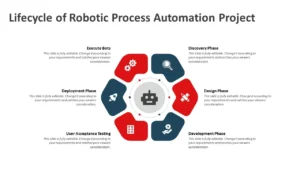
Discovery

In this phase, the brief provided by the client is analyzed.

Can the process be automated? Can a bot for the said process be built? What are the challenges and advantages of building it?

Answers to these questions will give the entire RPA development team a clear understanding of the project. Thorough coordination with the client is essential in this phase.

Solution Design

In this phase of RPA in Machine Learning, a Process Definition Document (PPD) is created which provides detailed information about the process. A flowchart is then created that will act as a blueprint to the bot creation. What actions will trigger the bot? How many elements should it include? Such questions are asked.

data analytics course

This is perhaps the most important phase of Robotic Process Automation in Machine Learning as the information gathered here will heavily influence the final product: the bot.

Development

Once all processes are established, the next step is development. This is the longest phase in RPA in Machine Learning and can extend depending upon the scope and volume of the project.

Different RPA tools are used to develop bot. High levels of coding are executed in addition to automated tools and templates. This is where skilled and experienced individuals in the ML field is required.

The key element of the Development phase is to test how extensive the build of the bot is. Have all scenarios and outcomes been tested and there is no gap in the development? Will there be a situation when the bot goes live and it fails to act? Proper coordination with the research done in the initial phases is extremely important. This will ensure the bot is a success.

Testing

As the name suggests, this stage involves all types of testing. From the user interface to the backend, all elements are rigorously tested to ensure there are no loopholes.

In a way, Robotic Process Automation in Machine Learning is a complex procedure. Testing, therefore, is the second-most important phase because the findings in this stage can make or break the project.

Deployment

Last on the RPA lifecycle is the deployment stage. Here the bot goes live on the frontend and is ready for user interaction. Maintenance and bot execution are generally part of this stage.

That is the RPA lifecycle in a nutshell for you. Of course, when you go deep into each of the stages discussed above, you will understand the complexity of RPA in Machine Learning. It’s an interesting concept but one where the lifecycle has to be religiously followed to avoid mistakes.

Python Developer Salary in Terms of Job Roles

What is Python?

The second most liked Programming language in the world, Python is one of the widely used term in the web-development world.

Who are Python Developers?

The web-developers who design and code the software applications with the help of Python language are referred to as Python Developers.

Roles and responsibilities of Python Developers

 Python Developers as Data Scientists

Major businesses in today’s world require tools and skilled people for the data-related tasks such as data collection, data cleaning and processing.

Python Programming Course with Data ScienceData Scientists are the programmers who do these tasks for the organizations. Data Scientists gather a large quantity of data and convert it into a useful form, followed by recognizing data-analytics solutions for organizational growth.

Data Scientists encourage the data-driven approach in organizations to deal with complex business problems.

 Artificial Intelligence

In AI Python Developers create and implement the required Machine Language algorithms. They analyze the success and failure of the algorithm and rank them according to their performance for future use. Training and Retraining ML algorithms is one of the key tasks performed by Python Developers.

Salaries of Python Developers in India

The changing focus of the organizations on data-driven solutions is resulting in a manifold increase in the salaries of the Python Developers. In the coming years the demand for AI-skilled people will increase, and hence the salaries.

Major IT giants like Google, YouTube, Amazon etc. are adopting Python-driven systems and hence, manifold increases in the salaries of the Python Developers.

Python Programming Course with Data scienceThe entry level salary of a Data Scientist is approximately INR 500,000 per annum (Source: payscale.com) Data scientists with 5-9 years of work experience gets +100% more salary in India. With the experience and refinement of the skill, the salary of Data scientists shows exponential growth.

 An entry-level engineer who develops the ML Algorithms earns the average salary of approximately INR 700,000 annually. With further experience and refinement of the skills, the average salary of the Data Scientist shows exponential growth.

Factors affecting the Salaries of Python Developers

Job location: Considering the increasing demand of Python Developers, not only in India, the faster salary growth is visible in UK and in US.

Location

Approximate Average Salary in INR

Gurgaon

700,717

Bangalore

669,787

Delhi

600,000

Mumbai

579,728

Chennai

540,131

Hyderabad

475,000

UK Python Developer annual salary

£67,000

US Python Developer annual salary

$117,000

Experience:

Python Developer

Approximate Salaries in INR

Entry Level Python Developer

427,293

Med-Level Python Developer

909,818

Experienced Python Developer

1,150,000

Refined Skills:

Mere understanding of the Python is of no use, till is integrated with the problems and solutions. How one uses the well-known Python tools define the person’s skill set, which is a determiner of the salary.

Job Role:

Python Developer

Approximate Average Salary in INR

Data Scientists

700,000

ML Engineer

670,000

DevOps Engineer

660,000

Software Engineer

500,000

Web Developer

300,000


Python Programming Course with Data ScienceShould know more interesting things about Python programming training and Python career.

 

Artificial Intelligence in Fintech: Understanding Robo-advisors Adoption Among Customers

The influence of Artificial Intelligence (AI) and its application in various industries have brought about a positive outlook on how operations are done in many sectors. In direct contrast to traditional methods, AI is making processes more smooth, beneficial to businesses by reducing overhead costs on labor and human error.

AI in financial technology (Fintech) has also seen vast applications and not just in banking and financial management but also in catering to the advisory portion of it. With AI in the mix, Fintech companies can now offer customers 24/7 support along with and reduce operational fees levied for their services.

Fintech Courses in India

Fintech isn’t just for financial institutions but also for businesses that employ financial services as part of their operations. Thus, despite the field of operations, fintech is useful in all businesses to make the process automated and smooth. Thus, many fintech startups are seeing rapid growth in the field.

Fintech courses in India have seen great exposure as the applications of this course don’t just stop at giving businesses backend solutions but also make customer-facing services smoother. Wealth management, better banking and investment management services, and more, this field has financial technology courses that give students a chance to get into great positions in the field.

Some of the courses that rank high in India include:

  • Data Science Analysis
  • Data Science Visualization
  • Artificial Intelligence in Fintech
  • Machine Learning in Fintech
  • Wealthtech
  • Robo-advisors and their applications
  • Cyber Security and more

Adoption of Robo-Advisors Among Customers

The scope of this financial technology course studies the application and adoption of Robo-advisors in the banking and investment sector. Businesses including financial institutions save a lot of costs involved in manpower and support by adopting Robo-advisors in their business to deal with customer-facing queries.

With this course, you understand the challenges involved in AI in financial services, the history of Robo-advisors and customer feedback on them, and measures involved in the successful implementation of Robo-advisors for business.

As with any new innovation, customers and even businesses are slow to adapt and test the use case of Robo-advisors. However, the course is aimed at understanding user behavior and how to overcome traditional beliefs involved in its implementation.

Careers in Fintech

There is no doubt that fintech has brought about a huge change in financial services. It is not just about the digitalization of banking and investment services but also includes cryptocurrencies, blockchain management, and more.

The prospects of a career in fintech have high demand. Fintech is the upcoming innovation that has led many financial products and their management smoother and more profitable for businesses. Entry into one of the fintech companies requires a course or a degree in financial technology and the knowledge of AI, machine learning, and its applications.

As a fintech student, you can push your career path as a data analyst, blockchain developer, cybersecurity specialist, mobile app development, and other positions. Many organizations are looking forward to hiring candidates with the right skills to help them develop the necessary IT infrastructure or monitor and analyze data secured by AI functions.

Working in a fintech company has a lot of benefits as AI in finance is a disruptive force taking over several operations in the financial sector. It can soon replace many traditional methods of banking, investment, and handling financial services. The growth in your career and the monetary benefits are worth pursuing a course in fintech.