What are Capital Markets? And how do they work?

The capital market plays an important role in the economy of any country. The investors and the businesses they invest in, both benefit from capital markets.

Investment banking also plays a very important role as it facilitates transactions between the supply and demand in the capital markets. Here are some answers you may seek to understand the capital markets better. 

What is Capital Market?

In the simplest of terms, capital markets are platforms that facilitate the transfer of capital or savings from investors who want to employ their investments to businesses that need the excess capital to finance various projects.

How is Capital Market related to Investment Banking?

Investment banking goes hand in hand with capital markets. Capital markets consist of a lot of technicalities like debt capital markets, leveraged finance and equity capital markets that only an investment banker can understand and deal with.

Investment bankers know the market of their products inside out; and if you’re interested in becoming one of them, then you can apply for any investment banking course after graduation.

How do Capital Markets work?

Capital markets allow the free exchange of wealth and are the basis of a free-market economy. They work by bringing buyers and sellers together so that they can trade in currencies, bonds, stocks and other financial assets. 

Who benefits from Capital Markets?

The capital market helps small businesses and entrepreneurs to grow into big companies. It also helps people to save and invest to secure their future. The capital market training allows individuals to make personal gains by leveraging the profit-generating potential of larger entities. 

Capital Market coursesWhat is the difference between a primary market and a secondary market?

The capital market is divided into two categories – primary market and secondary market. The primary market deals with new stocks and securities whereas the secondary market deals with existing securities which have been previously issued.

What Financial Instruments are used in Capital Markets?

The different financial instruments that can be used in capital markets include –

  • Stocks
  • Bonds
  • Forex (Foreign Exchange)
  • Commodities
  • Derivatives

How to make a career in Capital Markets?

There are many investment banking courses online that one can pursue to make a successful investment banker and work right in the capital markets. To pursue one of the best investment banking courses after graduation, you can apply for the Post Graduate Program in New Age Banking and effectively start or boost your career prospects in the domain. You can check out this certificate in investment banking course details here.

Capital Market courseWhat is the difference between capital markets and financial markets?

Although they may seem the same and there are overlaps, capital markets and financial markets are fundamentally distinctive. Financial markets are broader in range and encompass various businesses and organizations exchanging contracts, securities and assets with each other.

On the contrary, capital markets are primarily used to raise and increase funding for projects and operations of a company. To understand this distinction better, you can check out the certificate in investment banking course details and enrol.

Conclusion

Capital markets help businesses, investors and the government, and they need investment bankers to guide them. Investment banking courses can be pursued online to understand the dynamic of capital markets and make a lucrative career in the domain.

Related Article:

https://imarticus.org/trade-life-cycle/

Become a Financial Analyst with NMIMS PGP IN NEW AGE BANKING – Batch Launch!

In today’s date, knowing every aspect of finance is a necessity, not a luxury. From running a financially stable household to running a huge company of your own, everyone needs to be able to understand at least a bit of finance. And on top of it, if someone is an expert at the subject, a successful banking career is waiting for them just around the corner.

Who is a Financial Analyst?

If we say it in an easy way, financial analysts are the forecasters and advisors of the financial services industry. Financial analysts have a strong base in financial accounting, and on a regular basis, they go through tons of financial data of the companies they work for, predict financial findings of the market and the company, and help them make the proper financial decisions.


It includes decisions about investing their money in the right place, selling or buying stocks of the company, certain marketing decisions within the company, and more.

Why Choose a Career Being Financial Analyst?

We all know that getting a satisfying job after your graduation is not an easy task. But the financial industry is ever-growing and one of the most lucrative jobs here is being a financial analyst. With more and more companies and products launching in the market every day, they all require analysts to recommend them the right way to go financially and that’s why the job opportunities are vast in this area, and opportunities to grow in the job are there too.

It also helps to think that being a financial analyst means they are almost at the center of all the financial decision-making in the industry, or in the market. Also, as a bonus, financial analysts earn quite a satisfying amount of money whether they’re in a senior or junior position. You can get promising job opportunities at investment banks, insurance companies, sell and buy-side firms, and even banks.

About the NMIMS PGP in New Age Banking Course

NMIMS, along with Imarticus, have come up with an excellent course model which looks absolutely perfect for whosoever is opting for a banking career or wants to become a financial analyst. They are providing a dual certification just within 24 months with the course.

First, there is a course of 11 months PGP in New Age Banking and second, there is a 2-year course of Global Access PGDBM in Banking & Finance Management.

New Age Banking Course

In the New Age Banking course, students will not only learn the technical side, such as Financial Accounting, Marketing, Business Law, Commercial Banking System, Foreign Management, or Strategic Management but also they’ll be able to put their theory learnings to practicality with real-life problem-solving maneuvers. The course also assures great placements.

Conclusion

People studying for a career in the BFSI (Banking, Financial Services, and Insurance) industry should definitely opt for a job as a financial analyst. The job might not be easy but it certainly can be satisfactory for the finance-loving people out there and nothing can prepare them better for the world out there in the market than the course provided by NMIMS PGP in New Age Banking.

Who Earns More, A Stockbroker or an Investment Banker

The terms- investment bankers and stockbrokers are often used interchangeably used, however, they are starkly different from one another in terms of functions, responsibilities, and salaries. These job roles are both similar in terms of quite a few aspects like teamwork, attention to detail, proficiency in accounts or mathematics, and efficient customer service.

However, in terms of services provided, a stockbroker is different from that of an investment banker. While a banker provides services that range from loans, opening accounts, credit lines, enabling seamless payments for banking clients and more, a stockbroker is in charge of investments, executing taxes on behalf of their clients, recommends portfolios and more.

Investment Banker- roles and responsibilities

An investment banker is a person responsible for various duties that include, helping clients in raising in the capital market by selling equity or issuing debt. They also often advise clients on various opportunities for investments, helping them with M&As (mergers and acquisitions) and more.
Home – Purebulk dmg, bulking workouts bodybuilding – APC Ogun Chapier how long should i cycle off testosterone bodybuilding fitness workouts health & fitness
The two most important jobs they perform are, selling equity in a company and issuing debt. The whole idea is to raise money for clients. Selling equity in a company includes the involvement of an investment banker courses since he is the person, clients approach when a company holds an IPO (initial public offering), which means the company opens up for selling stocks to the public.

best investment banking course

Since a lot of companies are actually judged on the basis of their IPO performances, companies seek the assistance of investment bankers, who in turn help them line investors and more.

The second most important duty includes issuing debt, which means the process of selling bonds to interested investors. Companies looking to raise capital often have difficulty in finding the right investor who has a lot of money to invest. They often resort to an investment banker, to help them with the structure of the bonds, and also look up and prepare a potential list of investors to approach.

A couple of other heavy-duty functions investment bankers have to perform are, helping clients with investment ideas and opportunities, helping broker M&As and more.

Stockbroker- roles, and responsibilities

A stockbroker is the liaise between various stock traders, investors, and brokerage firms to sell stocks or conveying orders that need to be bought. He also is responsible for managing and servicing his client portfolios, developing new business, or even trading for a client. In certain situations, a stockbroker may also act as a financial advisor since he is in charge of buying and selling stocks on behalf of his clients.

It helps if a stockbroker has a friendly and outgoing personality as his job involves a lot of interaction with clients or other public. A marketing or sales persona usually helps.

Education and earnings of a stockbroker
To pursue a career in this venue requires a college degree, preferably in the field of business or finance. There are also certain other requirements to qualify as a professional stockbroker which includes passing relevant examinations.
The earnings of a stockbroker are largely dependent on commissions that he earns from the tradings. The overall income of a stockbroker may go up to six or seven figures for larger pension fund accounts or institutional portfolios.

Education and earnings of an investment banker

An Investment Banking Courses, it is highly essential to have a graduation degree in finance, accounting, economics or mathematics. While the education requirement does not essentially entail an MBA, a management degree in finance or other related fields actually help.

While a degree in finance, economics, and accounting help in forming an academic base, an investment banker needs other skills to excel, which include hunger for hard work, persuading capabilities, and a great sense of work ethic. The first few years may often be difficult, in terms of finding newer clients, forming connections with them or even from the financial aspect.

An investment banker can earn anywhere up to $96,000 in a year. Bonuses, commissions, and cuts can of course increase this figure to a certain extent.

An investment banker may earn somewhat more than a stockbroker, however, this also depends on the number of years of experience, his educational qualifications and more.

Top 5 Courses From Imarticus That Empowers Women!

The 21st century is all about progressiveness; and one of the most important ways, by which this is ensured, is by women empowerment. Throughout history, we have seen the oppression of women. However, in this new age, we strive for equality. Education is an integral part of advancement; and thus, we will venture into the top 5 courses provided by Imarticus which empowers women.

Post Graduate Program in New Age Banking


Banking and Finance CareerCurrently, job trends in the market are thriving in the field of banking. Hence, comprehensive Banking and Finance Courses can be extremely beneficial for women.

The Post Graduate Program in New Age Banking course of Imaticus in the banking sector ticks all the boxes as it provides two great courses – an 11-month PGP in new-age banking and a 2-year NMIMS PGDBM course in Banking and Finance Management. Added benefits from Imaticus involve a dual certification along with excellent placement with lucrative increments.

Professional Certificate in Fintech 

Finance and Technology go hand in hand; and in this modern age, this integration of technology with finance plays a major role in the Finance industry.

Fintech CoursesHence, a great opportunity for any woman would be to take a course in Fintech online training. Going forward, this comprehensive FinTech course of Imaticus can open new horizons in one’s life by involving one with Cloud Computing, Blockchain, Machine learning, etc.

Post Graduate Program in Data Analytics

This fast-paced world relies on data; and hence, one of the major subjects which is currently in the limelight is Data Science.

Career in AnalyticsImarticus provides a PGP Data Analytics course that can help one to join a leading MNC and hold the company’s helm. With a huge job demand in the field of data science, this can be an excellent opportunity for someone who is a fresher or has a nominal experience of three years to learn tools like Python, SQL, PowerBI, and Hadoop.

Post Graduate Program in Analytics & Artificial Intelligence

With the world revolutionizing at a fast rate, Artificial Intelligence is going to the new normal in the coming years.

Data Analytics and Artificial Intelligence Courses We have already seen the use of AI in computers and mobiles so why not study something which will be mainstream in the coming years? A comprehensive Analytics and Artificial Intelligence course provided by Imaticus along with dual certification can bring lucrative opportunities to your doorstep.

Post Graduate Program in Digital Marketing

The modern age deals comprehensively in digital media like social media platforms, and owing to the rise in social media outreach, digital marketing has taken the job market by storm.

Digital MarketingFor a woman who is determined to take a step forward towards success, a Digital Marketing Training course provided by Imarticus Learning will be perfect. It will not only provide a good and secure job but will also take one’s Digital Marketing Career to new heights.

Conclusion

This new fast-paced world waits for none. In these present times, a woman must be very tactful in correctly choosing her goals so that she can chase her dreams. Women empowerment can only be possible by proper education and only if women take up more jobs in high places and thus be an inspiration for other fellow women.

Career as Investment Banker

An investment bank stands as the intermediary between businesses that need to raise funds and investors who can invest. Therefore, companies need to issue securities, and investors decide to provide money in exchange. The work of an investment banker is to handle all the transactions happening between both the parties. Here, we will take you through the basics of how to start an investment banker career.

What is Investment Banking?

Investment banking is a part of the finance industry where the target is increasing and managing clients’ financial assets. The investment bankers assist organizations in investing their assets to increase the value of their profiles. If you choose the investment banker career, you will become an advisor to help clients capitalize on credible opportunities.
You must know that investment banking falls under a special division in the finance industry at a basic level. It serves the central government, state government, commercial banks, non-commercial banks, corporations, institutions, etc.
Investment banks offer complete guidelines about mutual funds and stock. Thus, it acts as an advisor and guides investors to put their money in the most profitable place.

Functions of Investment Banks

Before you join an investment banking course, know the kind of work you will be responsible for. These are the main functions of an investment bank:

  • Securities research: Investment bankers use the “Hold,” “Sell,” and “Buy” rating system to research and provide detailed reports. They find out the status of a company, investments they made, and other necessary details to check their credibility.
  • Investment management: Investment bankers help companies by giving them the correct suggestions regarding their investment. Since they take over the research and analysis, they have a sound method of understanding what would benefit their clients the most. They help businesses that need financial aid and also enable investors to choose the best organizations for investment.
  • Proprietary trading activities: Bankers in this financial institution help in selling and buying of assets to bring profit in every trade. These financial products are bonds, stocks, derivatives, and more.

Why become an investment banker?

Investment bankers are highly respected professionals in the finance sector. They help companies get the necessary funds to achieve their goals. They are also responsible for helping companies attract investors and determine what is the best way to solve their financial issues. A career in investment banking can be highly lucrative and rewarding. The statistics are the best proof for this claim.

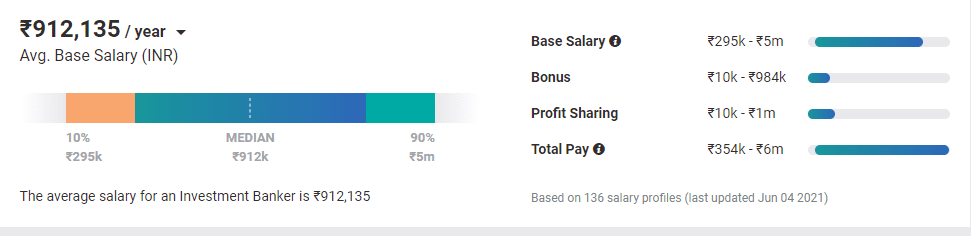
In India, the average pay of an investment banker is ₹9.04 lakhs per year. Their salary starts from ₹2.86 lakhs per annum and goes up to ₹50 lakhs, depending on their experience, skills, and employer.

Investment Banking Course with placement in IndiaYou can easily bag a high-paying salary in this field as you gain experience. The average salary of an investment banker with five to nine years of professional experience is ₹20 lakhs per year. Apart from the lucrative pay package, you will also have the opportunity to work with senior executives, investors, venture capitalists, and other highly esteemed individuals when you will be working as an investment banker.
Investment Banker Course with placement in IndiaFurther, becoming an investment banker would provide you with a stable and secure career path. Investment bankers are regarded as one of the best-paying jobs globally, so it is certainly worth the effort and time.



How to start a career as an investment banker?

To become an investment banker, you will need to be well-acquainted in management, statistical analysis, finance, financial law, and other relevant subjects. Investment bankers have to create fully detailed financial models to facilitate M&A (merger and acquisitions) transactions, and financial planning and analysis.

They also have to evaluate companies for investments and use different methodologies, such as LBO (leveraged buyout) and transaction comparisons, for the same.

Due to such complexity of this role, companies look for certified and highly skilled professionals. That is why it is best to get an investment banking certification to become a professional in this sector.

There are many courses for investment banking in India. You should choose the ones that teach you the necessary concepts most efficiently.

It is best to look for online courses for investment banking as they teach you financial modeling, statistical analysis, and other important concepts safely without requiring you to leave home or go anywhere.

Investment Banker Career Positions

The investment banker career grows along a straight path. Here are the positions from juniors to seniors as investment bankers:

  • Analyst: Your career will start as an analyst as you can become one as soon as you’re out of college. Prior knowledge of 1-2 years in the financial sector is even better to add credibility.
    Your job profile will be collecting data, creating presentations, and analyzing financial data. Thus, as an aspirant, you must go through this process to understand how the world of investment banking works.
  • Associate: You need around three years of experience as an analyst to get promoted as an associate. At this point, you interact with clients, manage teams of analysts, and more.
  • Vice President: A vice president in an investment bank has years of experience in the field. They build and maintain client relationships and ensure operational efficiency at each level under them.
  • Managing Director: It takes around 15 to 20 years to become an MD in the field of investment banking. MD’s primary focus is getting more work into the business and converting potential clients into real deals.

Final thoughts

The first step to investment banking is to have a bachelor’s degree in finance and accounting. If you have a master’s degree, your credibility will be higher. Many aspirants complete their MBA before joining an investment bank. You need to be well aware of subjects like marketing, economics, accounting, mathematics, and more. Lastly, you need to have a license for several stock exchange programs to get through as an investment banker.

What Finance Job is Right for Me?

Finding a finance job that fits your education, skillset, and career aspirations can be challenging. Especially if you are forced to make a decision early in your life. This is because finance is a vast field and there are a lot of different professions associated with it. You could be a stockbroker if you know about stocks, a banker if you are into accountancy, or a chartered account if you are strong in mathematics.
There are a lot of professions to choose from in the banking, financial services, and insurance (BFSI) fields. Which one you go for should depend on your interests, your current education, and your desire.
Here are three questions to ask yourself to determine which finance job is right for you.

What are You Studying Right Now?

This question should be asked during the final months of or after your graduation. That period is apt for you to explore the various professions and choose the right one.

If you are from a non-financial background, you may need a bit more understanding of the BFSI field. Basic online financial courses might help in this regard. In case you are still in college, it would be a great time to explore online finance courses and start learning.
If you are from a finance background (if you studied in the commerce stream in college, for instance) or are studying finance, choosing the right track will be easier. Since you may already know some of the subfields, you can pick the one that most interests you. This could be in banking, insurance, financial analysis, mutual funds, wealth management, or stocks.

Where Do Your Interests Lie?

This is the most critical question. You need to be sure what your interests are. Here are some common examples:

  • Regular banking – accountancy and bookkeeping
  • Investment banking – knowledge of investment instruments, accountancy, taxation
  • Stockbroking – knowledge of markets, industries, economy
  • Insurance – knowledge of insurance concepts, their rules and regulations
  • Loans – knowledge of loans and associated concepts
  • Financial analysis – finance maths, microeconomics and macroeconomics, tech tools
  • Mutual funds – accountancy, stock market, taxation

Along with this, it is also important to clearly understand what your chosen subfield is all about. For example, many students in India choose stockbroking as their career option because of its high earning potential. However, they fail to understand that it’s a complicated field and one that requires in-depth knowledge about the markets. They fail to perform and eventually branch out.
To avoid such a situation, it is important to one, list out your interests, and two, study them in detail. There are a lot of free and affordable finance courses available online which will give you a good start.

What Do You Want to Do?

It all finally comes down to your bearings. Do you want to be a regular branch banker at a government bank? An investment banker who helps HNI clients manage their wealth? Or a stockbroker who helps individuals make their money work?

Here’s a list of some of the most common finance jobs in India:

  • Financial planner and advisor – help clients manage their money (and taxes) well
  • Corporate finance – help larger companies manage their finances
  • Banking (teller, manager, loan officer) – provide and advise on banking services like savings accounts, credit cards, etc.
  • Insurance – help clients understand insurance policies and sell them
  • Accounting – help companies maintain their finances and manage their books

A good understanding of what each job entails will help you make a better decision. Start by enrolling in finance courses of your interests and shortlist topics. The field that you both enjoy and are knowledgeable in will bring the right finance job for you.

Also Read: 5 Trending Career Profiles in Finance

Is Investment Banking Glamorous?

The answer depends on how you define the word ‘glamorous’. In the most basic sense of the word, investment banking does come off as a professional field that is restricted to big corporations, high net worth individuals (HNIs), or those who are at higher social strata. And thinking about them does invoke a sense of being glamorous, posh, and attractive. Right?

This is also because investment banking deals with high-level mergers and acquisitions, high-profile corporate deals, and takeovers that can impact whole industries as well as the economy of the country.

Professionals working in the investment banking field may also be called glamorous owing to their daily tasks and meetings with VIPs and business leaders. Here’s a bit more information about the field from a social lens.

Investment Banking Itself is a High-Profile Profession

Today, aspiring finance students in India take investment banking courses with the hope to earn a good package and set their life. It is one of the most sought-after and popular fields in the world of finance. A part of this attraction can be attributed to the glamorous day-to-day work.
Take the case of Saket who works at the Delhi office of a multinational conglomerate. The company majorly focuses on investment banking, wealth management, and corporate consultation. Some of his most common daily tasks are:

  • Scheduled meetings with corporate lawyers, CEOs, analysts, and business leaders at 5-star offices
  • Attending industry seminars, sessions, and talks that are organized in 5-star hotels/resorts
  • After-hour parties at 5-star clubs and lounges where he talks shop with her peers and other business leaders

Even after work, the role of an investment banker demands that he maintain the high culture image so as to convert potential clients into customers. This is why Saket owns an iPhone X, a Macbook Pro, and AirPods. The good thing is that they all were paid for by his company.
This is perhaps the most appropriate answer to the question. The job provides you with a social life that is not possible in many of the other finance jobs such as branch banking, loan officer, and insurance agent. One profession that comes close is that of a stockbroker.

High Earnings

Enrolling for an investment banking course may be cheap, but the returns are too high. The average salary of an investment banker at an analyst position is INR 10,00,000. Those with experience go on to earn up to 3x depending upon the level and company.
With such high salary packages, investment banking professionals are able to lead a glamorous lifestyle. The bit about iPhone and Macbook was about the professional side of things, which are just some of the perks for working at a reputed company. Investment bankers in India can also afford to splurge on the good things in life. The average salary is higher than that of many other professions.
This is why finance graduates and postgraduates who get hired by companies like Indiabulls, JP Morgan Chase, and Goldman Sachs, and Barclays start with an impressive package. The earning potential gives them a free hand at splurging, which in turn makes their professional and personal lives glamorous.

In short, the answer to the question is yes. If you have what it takes and can master all the necessary skills for an investment banking job, then you too can lead a glamorous life. The same is true for most high-profile finance and computer science jobs. Learn a bit of management too and you can really climb the corporate ladder faster than the average Indian professional.

Sign up for an investment banking course today and enter the world of glamour, wealth, and corporate fame.

Functions of Investment Banking

Today investment banking is one of the most lucrative career options for finance students in India. It involves keeping a track of the economy and the markets, having knowledge of critical financial concepts, and understanding of technology tools. It is one of the very few subfields in the world of finance which requires an end-to-end approach in finance for professionals to qualify and make it big.
While an investment banking course will set you up with the basics and take you deeper, this intro guide will come in handy as you sit down to plan.

Core of Investment Banking

The core function of investment banking lies in advice. Here, a team of experts assess the financial situation (historic) of a company and provide counsel in all associated affairs, help leaders make decisions in terms of mergers and acquisitions (M&As), and ensure that the financial infrastructure of the company is well-maintained and future-proof. For example, a conglomerate (Walmart) looking to acquire a startup (Flipkart) will turn to investment banking to understand the pros and cons of such an acquisition.
An investment banking professional typically undertakes the following tasks:

  • Assessment of historical financial framework of the company
  • Underwriting stock issues and other portfolios
  • Examination financial statements, books, and all related materials
  • Projecting the company as a safe, growing investment and attract investors

Apart from these tasks, investment banking majorly has to do with improving the projected state of a company. If it is a listed company, all the dealings that it does will impact its share price, and further influence the investors’ stance on it. Today, most corporations and organizations use investment banking professionals to assist them in their day-to-day financial decisions.

Skills Required for Investment Banking Career

Investment banking is a great choice for students who are interested in the stock market and the economy. Having a natural interest as well as knowhow of how the economy works will give an upper hand when it comes to landing jobs in the field.
This is why a natural interest in trading, stocks, mutual funds, taxation, and the global economy is the default requirement. Other than that, this is the list of select skills that are in demand:

  • Strong mathematical and analytical skills
  • Accountancy, bookkeeping, taxation
  • Knowledge of the global economy
  • Understanding of economics and key concepts such as markets, mutual funds

Another important skill is communication and relationship building. Experts have rightly suggested that the companies that have wide hands and an extensive client network perform the best. This is because they are capable of improving the prospects for any company by providing better financial counsel. And for all these, the ability to communicate well and maintain relationships is important.
For students, the focus should be on understanding basic concepts. Enrolling in an investment banking course can help you get started. Whether you want to proceed or not will depend on how you fell when you start studying.

Hard Skills Needed for Investment Banking Jobs

Considering that technology is continuously helping us improve our work, there are a set of tools and skills that you should master:

  • Debt and equity finance
  • Derivatives
  • Traditional trading
  • Corporate bonds
  • Trend analysis
  • Comparative Finance
    • Fund flow analysis
    This is not an exhaustive list but only the most common skills. The key would be to learn the basics of investment banking and then focus on individual concepts.

Investment banking aids corporations to make better financial decisions and thereby help in their growth and development. If you are a student who is interested in exploring the field as a career option, you can easily do it by joining an investment banking course. Understanding the concepts will set you up for a career path that is one of the best in India.

What GPA do You Need for Investment Banking?

Investment Banking helps companies/firms in raising capital by issuing securities via debt or equity. Investment bankers also advise their clients throughout their financial career. They also help in managing mergers and acquisitions. To become a good investment banker, one needs to have a good GPA (Grade Point Average) so that grades never become a hindrance to one’s career growth.

A GPA is the average value of all the accumulated grades by a person in different courses in his studying career. The accumulated grades are added up and are divided by earned grades to find the value of GPA. Let us see how important a good GPA in an Investment Banking career is.

What GPA is Good in Investment Banking?


Investment Banking course

The standard rating of GPA across different schools and colleges is done out of 4.0. However, in weighted-grade systems followed by some institutions, GPA is rated out of 5. It is preferred that a student should have a GPA of 3.5 or above throughout his education career if he/she wants grades to never be a thorn in their career roadmap. Investment Banking companies/recruiters do consider the GPA of any candidate before hiring him/her. In the case of recruits who do not have working experience in the past, recruiters cannot judge them on work experience.

The GPA comes in handy at those times; the recruiters get a grasp of the candidate’s performance capability with the help of GPA. For Investment Banking, you need to be confident with numbers and must have good analytical skills. Your performance in school and professional courses will reflect your skills.

It is not necessary that GPA fully defines the skills of a person, anyone can grow later in his career too. But, having a good GPA will give you more chances to build a sound Investment Banking career.

Is good GPA only way to boost an Investment Banking career?

A candidate who is involved in activities besides having a good GPA is preferred by companies/recruiters. For example, if someone has a GPA of 3.9 but hasn’t done any internships or workshops may be preferred later in comparison to a candidate who has scored a GPA of 3.5 and has done internships/workshops under good banners in the field of Investment Banking. You need to have a blend of good GPA and internships to boost your skills and chances of getting recruited.

If you haven’t got a good GPA in your school or courses till now, you can still do any course in finance or any Investment Banking Course and can perform well in that to boost your GPA. Many big companies hire employees directly if they have a good GPA from any elite university because they know that any particular employee having an excellent GPA will perform better. GPA is not the only thing required to grow, but it is surely one of the most important things.

It reflects your journey as a learner and your overall performance. A lot of companies set GPA limits for the recruiting process and the candidate who doesn’t fulfil the criteria of minimum GPA cannot even sit in the recruiting process.

Conclusion

Investment Banking has a lot of opportunities and responsibilities. A good investment banker can help a company/firm to make better financial decisions and can raise capital quickly whenever required. He has good communication, analytical skills.

One should take his/her ongoing course seriously and should try to score well to get benefits in the future. There are no limits in gaining knowledge/experience but it would be best if your GPA throughout your education career is 3.5 or above. This article was all about a suitable GPA to grow as an investment banker.

Ways to Get the First Job at an Investment Bank

What are investment banks

An investment bank is a specialised bank that is involved in different financial services. These are large companies who aid other companies with complex financial transactions. An investment bank takes care of all the processes like mergers and acquisitions, security transactions, Forex trading, etc.

An investment bank is also seen as an organisation that acts as a financial advisor. The investment bankers working in these companies are the agents of the bank who lead major financial transactions across all companies. Investment banks also provide these services to different individuals who need help with their finances.

What is Investment Banking?

Investment banking is related to the creation of capital for different functional needs of different entities. Investment bankers help their clients in underwriting debt and in also managing the purchase and sale of different securities.

Investment banking can only be taken up as a profession if you have a required knowledge base. One of the major aspects of investment banking is the formulation of different deals and helping companies in raising capital. A lot of companies also take the help of investment bankers to aid their investment decisions. It acts as a middleman between potential investors of the company who are interested in purchasing the stocks of the company and the company itself.

Types of activities managed by an Investment Bank

An investment bank performs a different set of functions. Some of these important functions are listed below:

  1.  Acts as a financial advisor: Investment banks act as financial advisors who aid companies in looking for potential investors. On the other hand, they also aid several potential investors in finding the right investment. They act as a bridge between a company and the investors. They formulate financial strategies for all of their clients helping them in making major financial decisions
  2. Mergers and acquisitions: Investment banking plays a major role in the case of different mergers and acquisitions. They perform calculations to ascertain the net worth of the company which is to be taken over by some other company. These banks structure a fair deal which is agreed to by both the parties.
  3. Financial Research: Research plays a very important role in investment banking. Researches are being conducted daily to evaluate the financial positions of different companies. These banks manage major financial transactions therefore they must stay in touch with the ongoing market trends.

Getting your first job at an investment bank

Investment Banking is a specialised area of working. Therefore, before applying to any investment banking companies, make sure that you have the required technical skills which are required by the bank.
In case you are still in college and you want to go into the field of investment banking, make up your mind. You can opt for different investment banking courses which are available both online and offline. Given below are some of the important steps that will help you land in and investment bank.

  • Start networking and build a resume: Networking and talking with people who are already in the investment banking industry helps a lot. Use this network to get yourself a job interview. You can use different platforms to connect with these professionals.
  • Prepare yourself for the interview process: Your interview will cover different aspects of Finance. Therefore, make sure to brush-up all your concepts. Different technical questions might be asked.
  • Master all the technical skills: Investment banking requires extensive knowledge about the technical aspects of the job. Therefore, make sure to train yourself and become proficient with some of the popular software like Excel

Conclusion

Investment banks hire in a very structural way. Try maintaining a good GPA and build your resume keeping in mind the skills which are needed to become a successful investment banker.

Also Read: Different Types of Investment Banking Jobs