Here’s How Creating a Data Analytics Culture Can Start Changing the Conversation About Data

A data analytics culture is beneficial in the current times. Data is generated in every business and when rightly used, it can benefit the entire company. The change in the conversation around data can start from PGA programs. A well-rounded data analytics course with placement ensures that students are able to make data-driven decisions. It also encourages a data analytics culture from a very early stage.

How to Create a Data Analytics Culture

Candidates with data analytics certification can use their expertise to introduce this in companies that are yet to embrace data analytics. To create a data analytics culture, one can use the following points.

  • Ask Team Leaders to Use and Promote the Data Analytics Culture

Team leaders need to understand the use of data analytics and promote the culture among their team members. The stakeholders of a company also need to assess how a data analytics culture will enable business development based on data-driven decisions. Once the employees see the leaders promoting this culture, they will be more inclined towards following the same.

  • Introduce Data Democratization

Data democratization enables inexperienced employees to analyze data for their own use. It makes data more accessible and when introduced, it can help employees become more productive.

  • Set Achievable Goals

When the data analytics culture is set up in a company, it should focus on showing what usable and available data looks like and how the company can benefit from the analysis of that data. These are the basic goals that should be set. As stakeholders and employees start understanding the culture, other goals can be set that is based on the utilization of data analytics in different departments.

  • Organize Data Literacy Workshops for All Team Members

Data literacy involves teaching teams to utilize and analyze data for the benefit of the business. Companies can conduct sessions or hands-on workshops so that employees become more comfortable in applying the available insights for the overall improvement of the company. Data scientists can be asked to conduct these sessions and help departments benefit from the use of data analytics.

  • Obtain Constructive Criticism and Positive Feedbacks

Positive responses to a new culture can make it easier for employees to transition, especially if there has been a pre-established method of working. Constructive criticism can also help to build the culture and optimize business processes that benefit from data analytics.

  • Boost Employee Morale and Get More Benefits

While data analytics can help with business development, it needs to focus on the employee community as well. Employee performances can be analyzed. The insights generated can be used to improve interactions and optimize their daily tasks. This will boost morale and encourage them to work better.

Bringing Change in Conversation About Data

To introduce the use and analysis of data in every sector, the conversation needs to change. The best way to ensure that more people are aware of the impact of data analytics, one can encourage students to engage in the study of data science and analytics.

Imarticus Learning offers data analytics certification for graduate students who wish to learn about the implementation of analytics. The curriculum of the postgraduate program in Data Analytics and Machine Learning is created and monitored by industry experts. Therefore, students can work on several industry case studies that allow them to understand the practical uses of data analytics.

Imarticus Learning’s data analytics course with placement is a great way to start one’s career and open up the conversation around data. It is ideal for freshers as well as professionals who wish to advance their careers.


How Successful Modern Assortment Planning Strategies in Retail Point Towards Data Analytics?

With the increased competition and customer demands, retailers have to toil hard for merchandise planning. Retailers are facing challenges in stocking their stores according to customer demands. Data analytics is used in the retail industry to know more about customers. Data analytics is used for numerous other processes in the retail industry. One such process is assortment planning. With assortment planning for numerous stores, a retail agency can boost its ROI (Return on Investment). Retailers that know data science will be in huge demand for better assortment planning and increased customer conversions. Read on to know more about the role of data analytics for better assortment planning in the retail industry. 

Understanding assortment planning

With assortment planning, a store decides the ideal store layout and visual merchandising that can attract customers. Product placements in a store are decided via assortment planning to maximise conversions. Retail companies usually conduct assortment planning at fixed intervals like weekly, monthly, or daily. Assortment planning decides which products should be highlighted at a given time. For example, a store can highlight its umbrellas and raincoats during the rainy season. The store can highlight its sweaters during the winter season. 

If a retail company has multiple stores, assortment planning can differ for each store. Assortment planning is also done based on the preferences of the local or daily customers. Many young retailers are looking for data analytics courses online to get a raise by offering assortment planning services to their stores. 

What makes assortment analytics important? 

It is hard to determine the preferences of customers and perfect product placements manually. It is why you need data analytics to fine-tune assortment planning. A retail company can know about the driving factors that compel the customers to make a purchase. The driving factors can then be implemented in physical stores to boost sales. The processes involved in assortment planning are as follows: 

  • Customer/sales data is collected and cleaned for advanced analytics. Redundancies in the customer data are removed for better assortment planning. 
  • Walk-in rates are determined via high-end data analytics. Sensors and cameras are used to determine how many pedestrians passed through your shop and how many entered. Based on the walk-in rate, you can modify product placements. 
  • Assortment analytics can help retailers in identifying customer loyalty. You can know which products are preferred by customers again and again. 
  • You can rank products based on their sales with assortment analytics. Retail companies use data analytics to identify which products are not generating substantial revenue. 
  • Assortment analytics also includes identifying the space productivity index of different stores. The space productivity index helps in knowing how much selling space is occupied by different products. 

How to learn data analytics for better assortment planning? 

Due to the numerous benefits of assortment analytics, retail firms are recruiting professionals who have a data analytics certification. To learn more about assortment analytics, you can go for the PG Program in Data Analytics & Machine Learning offered by Imarticus Learning. This course will cover all aspects of data learning along with 25 real-world projects. Various programming languages like SQL, R, and Python will be covered in this data analytics course. Imarticus is well-known in India for its data/business analytics courses that follow an industry-designed curriculum. At the end of the data analytics course, Imarticus will help you in getting a job offer. 

Conclusion 

With better assortment planning, stores can maximise their revenue. Assortment analytics can be the key to determine customer demands and optimise stores accordingly. The online course of Imarticus can make you job-ready by teaching several data analytics skills. Start learning assortment planning now!  

Understanding Occam’s Razor principle in Machine Learning

One of the most important and hot topics in Machine Learning nowadays is Occam’s razor principle. Does it sound unclear to you? Do not worry at all! Imarticus’s AIML program offers various Machine Learning courses which provide the basic study and understanding of the Occam’s Razor principle. Stay tuned to this article to kickstart your Machine Learning career

Categories of Machine Learning algorithms

The Machine Learning algorithms have mainly two different categories: supervised and unsupervised. When we talk about supervised learning, the model is trained with the labelled data taken from the previous sets for future predictions. On the other hand, with unsupervised learning, the process is applied exclusively to unlabeled data only. This is mainly used to identify well the patterns and structures in the data sets that were unexplored and unknown (sometimes referred to as ‘discovery analysis’. 

Occam’s Razor Principle: What does it mean? 

In simple words, Occam’s Razor advises using simple ML-based models and algorithms with fewer coefficients as compared to the complex ones (Eg. ensembles). The use of Occam’s Razor can be traced back to the 1200s by William of Ockham, who suggested using the simplest, efficient and most direct solution with the least number of assumptions and variables. There are certain applications and considerations to make based on Occam’s Razor as enlisted below:

Choosing the right model

Selecting the model from different available ML models to create a predictive project is termed model selection. Usually, a model is selected based on its performance like low prediction error and high accuracy. One should also consider the fact that a simple model should be preferred over complex ones as they have fewer coefficients during evaluation. 

Simplifying the model

Dimensionality reduction and feature selection are some of the simplification procedures which make use of Occam’s Razor. This results in improved results with less investment of time and energy. 

Modern state of art applications

One of the most useful applications of Occam’s Razor principle is in the state of art technologies, especially the direct application to Machine Learning. The programmers and engineers work collectively to train computers with data sets and extend their limitations of the already existing codebase data structure programming. This allows the computer systems to produce astonishing and favourable results in no time. 

Other applications

Some various other applications of Occam’s Razor principle is the setting of the parameters for specific Machine Learning concepts like Bayesian Logic. The programmers make use of this principle to make the model simpler and highly efficient. One of the important things to take care of is the correct application of Occam’s Razor. Incorrect usage and application can decrease the efficiency and credibility of Machine Learning programming. Interestingly Albert Einstein was Occam’s greatest disciple who said “Everything should be made as simple as possible, but not simpler”.

Key takeaways

If you want to start any project based on Machine Learning, it should always address the essential business question and problem that you intend to resolve. With the assumptions of other criteria remaining the same, Occam’s Razor can be applied successfully to chose a model which is simple to implement, interpret, understand, explain and maintain in the long run. In simpler words, choose the model that gives accurate results using this principle. The main idea lies in examining the project scope to a deep level, analysing the inputs, data sets and parameters to get the desired outcomes. A proper and well-defined machine learning training can result in a better understanding and implementation of the Occam’s Razor principle in solving real-life problems and deal with challenges.

How Can Artificial Intelligence and Machine Learning Make Software Development More Efficient?

Artificial Intelligence and Machine Learning are on everyone’s lips alongside the usual buzzwords such as ‘Big Data’, ‘Industry 4.0’ and ‘BlockChain’. However, similar to the other terms, it is often not easy to decipher the exact meaning behind it. Both AI and ML are developing at a rapid rate in various sectors. AI helps debuggers and programmers to work efficiently and quickly. They will make intense use of many machine-learning algorithms to create more user-friendly functional programs at the software level. Read on to find more on how the AIML program from Imarticus can facilitate the software development process to optimize the technologies. 

AI and ML: Transformation of Software Development

Artificial Intelligence and Machine Learning courses have both proven to be successful to increase efficiency in tasks related to software development. The programmers must understand their benefits on the whole. The already existing technology helps the new developers and programmers in identifying and fixing the program errors and bugs. Intelligent coding platforms, cloud-based IDEs, and easy control of deployment are also provided by the technologies. Some of them are mentioned below: 

  • Intelligent Coding

Programmers may make certain typing errors or code duplication errors in their code. To avoid these mistakes, powerful coding tools with the latest ML algorithms can be employed. Based on the methodology, language in use, or programming, there is also a code editor to format the code whenever needed. 

  • Rapid Prototyping

A prototype represents a development process of the company which needs to be delivered well in time to the clients for a review. With Machine Learning, it is possible to chart a business’s functionality with a technical prototype. The potential outcomes can be predicted very efficiently and quickly making the task of modifying the development process easy for the developers. 

  • Generate unique software designs

Most of the time, the clients look for unique and out-of-box designs for their projects. With advancements in AI, the digital assistants conduct a thorough analysis of project requirements, make recommendations for improvement and highlight the inconsistencies. Moreover, these tools work with natural language processing and use referenced guidelines for training. 

  • Help nurture young coders

Artificial Intelligence course gives the young programmers a unique opportunity to gain a deep insight on developing good software programs. These smart tools give them the convenience to share insights between young and experienced programmers to ensure efficient communications and learning between the two. These AI-powered tools help the developers to collaborate on software projects and have a bright career kick-off. 

  • Deployment control

Deployment control refers to that development phase in which the developers upscale their applications or programs to the latest versions in the software development realm. AI and ML promise to increase the efficiency in deployment control activities without being worrying about failed attempts or risks. 

  • Enhanced Data Security

The AI system usually collects data from network servers and software from the customer side. With AI, the data is investigated using ML to differentiate irregularities, avoid delayed warnings, false alerts, and notifications. 

Conclusion

Overall, Artificial Intelligence and Machine Learning will have a significant impact on the creation and design of the software. AI aims to help developers and testers to work efficiently with high productivity. Also, the integration of both of these into software development does not mean that the developers would lose their jobs in the future. It required extensive technical skills and experience to develop such advanced algorithms and programs. AI and ML will undoubtedly prove to be game-changers in software development. Learn AI today and boost your career performance. 

What is a supply chain analytics certification all about?

A supply chain is a network that connects a firm and its suppliers in order to manufacture and deliver a certain product to the end user. This network consists of many activities, individuals, entities, information and resources. The supply chain also symbolizes the steps involved in getting a product or service from its initial state to the customer.

Companies create supply chains in order to minimize costs and remain competitive in the business world.

A supply chain is a series of processes that must be followed in order to provide a product or service to a consumer. Moving and processing raw resources into finished products, transporting those items and distributing them to end users are among the procedures. Producers, vendors, warehouses, transportation companies, distribution hubs and retailers are all part of the supply chain.

 What is supply chain analytics?

 It is the study of data from a range of supply chain applications, such as supply chain execution systems for sourcing, inventory management, order management, warehouse management and fulfilment, and transportation management, known as supply chain analytics. A supply chain is like a domino effect: each step in the network impacts the one after it, and any faults at any point might have an influence on the ability to satisfy consumer needs.

Companies can use supply chain analytics to collect, analyse and act on data created by their supply networks. It enables them to make not only short-term adjustments but also long-term strategic improvements that will provide the company with a competitive advantage. A supply chain management certification online can be a saviour if you want to pursue this as your career.

 What is a supply chain analytics certification all about?

 A supply chain analytics certification is all about learning the nitty-gritty of how a supply chain functions. Keep reading to know the benefits of enrolling in a certificate course in supply chain management.

 This six-month certificate course in supply chain management has been specially prepared by IIT faculty and industry professionals to assist you in learning. During this era of the trend of e-commerce, the number of products in transit has also increased. The number of SCM employees has increased disproportionately across industries. This training will prepare you to capitalise on this opportunity.

 Areas that a good supply chain analytics certification cover:

  1. It must teach you real-world examples of how analytics may be applied to many domains of a supply chain, such as selling, logistics, production and sourcing, to have a major social or economic effect.
  1. You should also be taught about the employment market, job requirements and preparation.
  1. It should teach you about supply chain analytics employment options, qualifications and how to go about with its preparation.
  1. CVs should be taught to be redesigned and updated with the expertise of an insider to help you bag your desired job.
  1. Role-playing interviews and model interview responses should be provided so that you succeed in any technical interview round.
  1. It should cover technologies like Big Data, AI and IoT. These technologies are dominating the world and must be taught.
  1. It should teach you programming languages like R and Python.
  1. It should teach you how to manage uncertainties in the supply chain.
  1. It should teach you to design the supply chain and the distribution network.

Conclusion:

The IIT Supply chain management course is one of the most desired courses. This

IIT Supply chain management is one of the best courses available and teaches you most of the important skills and prepares you for the industry. If you want to save some money, yet want to learn the relevant skills required to have a fulfilling and successful career, then go for a supply chain management certification online.

What Is A Cluster Analysis With R? How Can You Learn It From A Scratch?

What is Cluster analysis?

Cluster means a group, and a cluster of data means a group of data that are similar in type. This type of analysis is described more like discovery than a prediction, in which the machine searches for similarities within the data.

Cluster analysis in the data science career can be used in customer segmentation, stock market clustering, and to reduce dimensionality. It is done by grouping data with similar values. This analysis is good for business.

Supervised and Unsupervised Learning-

The simple difference between both types of learning is that the supervised method predicts the outcome, while the unsupervised method produces a new variable.

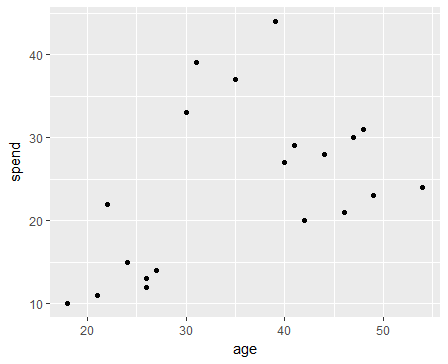
Here is an example. A dataset of the total expenditure of the customers and their age is provided. Now the company wants to send more ad emails to its customers.

library(ggplot2)

df <- data.frame(age = c(18, 21, 22, 24, 26, 26, 27, 30, 31, 35, 39, 40, 41, 42, 44, 46, 47, 48, 49, 54),

spend = c(10, 11, 22, 15, 12, 13, 14, 33, 39, 37, 44, 27, 29, 20, 28, 21, 30, 31, 23, 24)

)

ggplot(df, aes(x = age, y = spend)) +

geom_point()

In the graph, there will be certain groups of points. In the bottom, the group of dots represents the group of young people with less money.

The topmost group represents the middle age people with higher budgets, and the rightmost group represents the old people with a lower budget.

This is one of the straightforward examples of cluster analysis. 

K-means algorithm

It is a common clustering method. This algorithm reduces the distance between the observations to easily find the cluster of data. This is also known as a local optimal solutions algorithm. The distances of the observations can be measured through their coordinates.

How does the algorithm work?

  1. Chooses groups randomly
  2. The distance between the cluster center (centroid) and other observations are calculated.
  3. This results in a group of observations. K new clusters are formed and the observations are clustered with the closest centroid.
  4. The centroid is shifted to the mean coordinates of the group.
  5. Distances according to the new centroids are calculated. New boundaries are created, and the observations move from one group to another as they are clustered with the nearest new centroid.
  6. Repeat the process until no observations change their group.

The distance along x and y-axis is defined as-

D(x,y)= √ Summation of (Σ) square of (Xi-Yi). This is known as the Euclidean distance and is commonly used in the k-means algorithm. Other methods that can be used to find the distance between observations are Manhattan and Minkowski.

Select the number of clusters

The difficulty of K-means is choosing the number of clusters (k). A high k-value selected will have a large number of groups and can increase stability, but can overfit data. Overfitting is the process in which the performance of the model decreases for new data because the model has learned just the training data and this learning cannot be generalized.

The formula for choosing the number of clusters-

Cluster= √ (2/n)

Import data

K means is not suitable for factor variables. It is because the discrete values do not produce accurate predictions and it is based on the distance.

library(dplyr)

PATH <-“https://raw.githubusercontent.com/guru99-edu/R-Programming/master/computers.csv”

df <- read.csv(PATH) %>%

select(-c(X, cd, multi, premium))

glimpse(df)

Output:

Observations: 6,259

Variables: 7

$ price  <int> 1499, 1795, 1595, 1849, 3295, 3695, 1720, 1995, 2225, 2575, 2195, 2605, 2045, 2295, 2699…

$ speed  <int> 25, 33, 25, 25, 33, 66, 25, 50, 50, 50, 33, 66, 50, 25, 50, 50, 33, 33, 33, 66, 33, 66, …

$ hd     <int> 80, 85, 170, 170, 340, 340, 170, 85, 210, 210, 170, 210, 130, 245, 212, 130, 85, 210, 25…

$ ram    <int> 4, 2, 4, 8, 16, 16, 4, 2, 8, 4, 8, 8, 4, 8, 8, 4, 2, 4, 4, 8, 4, 4, 16, 4, 8, 2, 4, 8, 1…

$ screen <int> 14, 14, 15, 14, 14, 14, 14, 14, 14, 15, 15, 14, 14, 14, 14, 14, 14, 15, 15, 14, 14, 14, …

$ ads    <int> 94, 94, 94, 94, 94, 94, 94, 94, 94, 94, 94, 94, 94, 94, 94, 94, 94, 94, 94, 94, 94, 94, …

$ trend  <int> 1, 1, 1, 1, 1, 1, 1, 1, 1, 1, 1, 1, 1, 1, 1, 1, 1, 1, 1, 1, 1, 1, 1, 1, 1, 1, 1, 1, 1, 1…

Optimal k

Elbow method is one of the methods to choose the best k value (the number of clusters). It uses in-group similarity or dissimilarity to determine the variability. Elbow graph can be constructed in the following way-

1. Create a function that computes the sum of squares of the cluster. 

kmean_withinss <- function(k) {

cluster <- kmeans(rescale_df, k)

return (cluster$tot.withinss)

}

2. Run it n times

# Set maximum cluster

max_k <-20

# Run algorithm over a range of k

wss <- sapply(2:max_k, kmean_withinss)

3. Use the results to create a data frame

# Create a data frame to plot the graph

elbow <-data.frame(2:max_k, wss)

4. Plot the results

# Plot the graph with gglop

ggplot(elbow, aes(x = X2.max_k, y = wss)) +

geom_point() +

geom_line() +

scale_x_continuous(breaks = seq(1, 20, by = 1))

What is a Scrum Master Course?

Almost 75% of companies are reported to use Agile methodology and approaches one way or the other. These companies successfully adopted agile methods to drive profits and save time. It is essential to learn, understand and implement agile approach wherever necessary.

Scrum:
Scrum is one of the ways how the agile approach can be taken forward. Scrum is a framework that helps teams to work efficiently and collaborate freely. Scrum helps in encouraging groups to self-organize while working on an issue, learn through new experiences and continuously improve efficiency. Scrum is not only useful in software development, but the ideas of Scrum can be implemented in other industries as well.

What is Scrum?
In the Scrum framework, the critical aspect is speed; hence there is Backlog of implementable product/service enhancements. In each Sprint planning (generally 14 days) the upgrades that are on priority and need are taken forward and worked on. Each day of that sprint “Daily Scrum” meetings take place where the project updates are discussed, and issues are addressed. This is continued in every sprint, and the cycle continues.

To handle all these efficiently, a Scrum Master is needed who will contribute, promote and support the team.

Scrum Master:
Scrum Master is the member of a Scrum Team who is responsible for the team to follow the scrum framework. Scrum Masters help them pursue this by training them on the Scrum theory, practices, rules and values. The Scrum Master works in servant-leadership style where it is necessary to provide service to others, promote community behavior, holistic work approach, shared decision-making power.
Scrum Master also helps in communicating the information that is needed in the daily scrums to the people outside the Scrum. They are also responsible for driving the conversations to maximize the impact during the scrum meetings.

There are various roles a scrum master usually plays. They provide services to the
1. Product Owner: Scrum Master helps the product owner by ensuring that the team understands the product owner’s goals, product domain scope. They will help in understanding product planning, ensure product owner to arrange product backlog for efficiency. They will also help in providing the addition of new enhancements in the Backlog.
2. Development Team: Scrum Master helps the development team to produce high-value products, removing any obstacles in team’s progress, facilitating failed scrum events and rescheduling the same. They are also helpful in coaching the team to self-organize and cross-function. They are also useful in deploying the Scrum Framework in teams that don’t follow the same.
3. Organization: A Scrum Master plays a significant role in coaching and training organizations to adopt Scrum. They help in planning Scrum adoption within the organization, helping individual employees to understand/implement Scrum, Increasing efficiency through meaningful changes in the process.

Scrum Master Course:
A Scrum Master has umpteen responsibilities, which we have seen above when it comes to an efficient application of the Scrum Framework. A Scrum Master Course is essential to achieve this training to be an effective Scrum Master. This course will help you get the holistic approach on how to implement the Scrum Framework Effectively. Scrum Master Course opens up avenues to new job opportunities not only in the IT industry but also in many diverse sectors. A Scrum Master course is helpful for any employee/Professional who is interested in working in an agile environment.
Scrum Master Course also helps in becoming an Agile Coach which opens up more opportunities. A Scrum Master Certification is useful not only for new career opportunities but also to boost the growth in the career trajectory.

What Are The Resources to Learn Data Science Online?

What is Data Science?
In the modern digital era, data is at the heart of every business that relies on the use of technological solutions to boost customer experience and increase revenue. The decision-making process has changed after the advent of data science. Businesses no longer work on assumption; they are using complex data analysis to obtain valuable insights about the market and consumers. So what exactly is data science and how does it work to further business objectives?

Well, data science can be simply explained as a discipline that deals with data collection, structuring and analysis. It involves the use of the scientific process and algorithms to obtain valuable insights from seemingly irrelevant pieces of information. Big data is at the centre of data science. Let’s delve deeper into why you should consider learning data science.

Why Learn Data Science?

The demand for data science professionals is ever increasing as more and more companies are deploying data science to obtain deeper insights.

Data Science Course OnlineThe demand for data science course online is also growing as more individuals are lured in towards the lucrative career prospects offered by this industry. There are numerous reasons to learn data science in the contemporary landscape.

The first and foremost is the outstanding remuneration offered to data science professionals. This is partly because data science is still in its nascent stage and there is a scarcity of trained professionals in this industry.

However, the demand for data science professionals by companies is on an upward trend.


In addition to this, the role played by data science professionals is very crucial for businesses as it involves analysing valuable company data to obtain insights and make predictions regarding the market.

Let’s explore how you can easily get trained for data science online.

Resources to Learn Data Science Online
Online learning is the new norm, the benefits of this method of learning is enormous. Moreover, the online courses are designed in such a way that it caters to specific training needs of individuals and there is no irrelevant content included in the courses. It is also feasible for people who are already working at a job and have limited time to learn a new subject. Here are a few resources that can help you learn data science online with ease and in a limited budget.

Google’s Machine Learning Crash Course

The machine learning technology is being extensively used by companies to cater to a growing audience base. Google’s Machine Learning Crash Course is designed for everyone; it doesn’t require you to have any prerequisite knowledge regarding the subject. Even people who have some knowledge in the field can opt for this course as it focuses on important concepts like loss functions, gradient descent, etc.

In addition to this, you will also learn about presenting algorithms from linear regression models to neural networks. The course learning materials include exercises, readings, and notebooks with actual code implementation using Tensorflow.

In addition to this crash course, you will also have access to a plethora of learning materials on data science and AI. These learning materials include courses, Practica, Guides and Glossary.

Imarticus Learning’s Data Science Prodegree

If you are looking to make a professional career in the field of data science then the data science course offered by Imarticus Learning is surely the best way to learn data science. The best thing about this course by Imarticus is that the knowledge partner for this course is KPMG.

This data science course takes a comprehensive approach towards learning data science and covers topics such as R, Python, SAS Programming, Data visualisation with Tableau, etc.

Data Science And Machine Learning Course with iHUB DivyaSampark @IIT Roorkee

Data science is a competitive field and to be successful you need to master the foundational concepts of data science. Imarticus Learning has created a 5-month data science program with iHUB DivyaSampark @IIT Roorkee. It will equip you with the most in-demand data science skills and knowledge that will help you to pursue a career as a data scientist, business analyst, data analyst and data manager. It features a 2-day campus immersion program at iHUB Divyasampark @IIT Roorkee and is delivered by top IIT faculty through live online training. Through this program, you will also get an opportunity to showcase your startup idea and get funding support.

In addition to this, the course trains individuals using industry sneak peeks, case studies and projects. The capstone projects allow individuals to work on real-world business problems in the guidance of expert project mentors. Upon the successful completion of this course, you will also receive a certification by Imarticus learning in association with Genpact. In addition to all this, you will receive interview preparation guidance and placement assistance.


What Business Problems Do Agile Analysts Solve?

Analysts play an important role in solving business problems and ensuring business continuity. From choosing the right investment opportunity to the right marketing strategy, analysts help in making strategic business decisions. There are many types of analysts that work in the industry like financial analysts, agile analysts, sales analysts, etc.

Each type of analyst has its roles and responsibilities that help in the growth of a business. Young enthusiasts always look for business analyst certification courses that can help them in becoming successful analysts. Let us know about the role of agile analysts and how to become one.

Role of agile analysts 

The primary aim of an agile analyst is to solve any problem faced by the business that can hamper its continuity. However, let us delve deeper to find out the specific job responsibilities of an agile analyst. The roles of agile analysts are as follows:

  • An agile analyst evaluates the current IT system and infrastructure in the organisation. Most organizations are digitally transforming and it is necessary to have the right technology to complete business processes.
  • An agile analyst is not only concerned with the technology used within the organisation. It also tries to enhance the communication between shareholders and the production teams. Businesses should produce services and goods as per the demands of customers and investors. Agile analysts help businesses in meeting the expectations of customers and shareholders.
  • Agile analysts focus on the result of a project or a venture. They are not worried about maintaining every single detail about the project as they see the project as a whole. Agile analysts make sure that the employees have the suitable resource to complete a project on time.
  • Whenever market disruptions occur, a company has to adjust to the changes for maintaining continuity. Agile analysts help companies in adjusting to changes and steering through market challenges. For example, the recent COVID pandemic fuelled the demand for expert agile analysts that could ensure business continuity.

How to become an agile analyst?

How to start a business analyst career when you have no idea of the industry practices? Well, business analyst certification courses can help in learning the job skills of an agile analyst. Unfortunately, physical institutions do not offer a certification course for business analysts.

They offer a complete degree program in which agile analysis can be a subject. If someone has no time to go through the entire degree program, they cannot learn agile analysis. Also, the recent pandemic has led to the suspension of physical classrooms.

In these times, students are choosing EdTech platforms to learn business analytics. You will have to choose an industry-oriented online course to learn business analytics.

Imarticus Learning offers a complete PG Program for Agile Business Analysts that can help you in learning industry skills. The benefits of opting for the PG program by Imarticus are as follows:

  • Imarticus will provide strong placement support to kickstart your career as an agile analyst. You can choose to pay for the PG program after being placed.
  • The PG program is endorsed by IIBA (International Institute of Business Analysis). Not only will you gain a globally recognizable certificate but also learn from industry experts.
  • You will work on numerous practical projects and business role-plays during the PG program for a better learning curve.
  • You will learn quickly via case studies and peer-to-peer discussion in this PG program.

Conclusion

Business analysis is essential in the current scenario when market disruptions are hard to predict. Besides searching ‘how to start a business analyst career’ on the internet, start learning job-relevant skills. Start your PG program with Imarticus now!

Must-haves of an Average Machine Learning Certification to Become a Machine Learning Architect

ML (Machine Learning) is one of the most popular modern-day technologies. You must be aware of the applications of data science in retail, e-commerce, education, and many other industries. New-age technologies like ML and AI (Artificial Intelligence) form the base of data science operations. Many companies around the world have invested in adopting an ML strategy for their organization.

ML job roles like machine learning architect are widely popular among young enthusiasts. Young enthusiasts look for artificial intelligence and machine learning courses that can help them in launching a successful career. Read on to know about the must-haves of an ML certification course.

Importance of learning machine learning

The importance of learning machine learning in 2021 are as follows:

  • More and more businesses are inducing automation in their daily operations. Manual labor is being replaced by automated machines in the industry. However, for designing intelligent machines and algorithms, ML skills are required. The demand for skilled ML engineers is expected to increase exponentially in the coming years.
  • ML is a versatile modern-day technology used by many public sectors and industries. Smart ML algorithms are used in the regulation of public services like transportation, legal, healthcare, and education.
  • Since ML is a modern-day technology, there is a shortage of skilled ML architects/engineers in the industry. ML job roles in the industry offer lucrative salaries to ML professionals because of the expertise they bring to the table.
  • Machine learning is usually not used alone for industrial processes. Machine learning is coupled with other technologies like AI and deep learning to enhance productivity. You can also learn other new-age technologies by choosing a machine learning certification course.

Where to look for a machine learning certification course?

Colleges in India don’t provide a machine learning certification course. Generally, machine learning is a subject in any particular semester of a traditional degree program. Students cannot go through the entire college degree program if they just want to learn ML.

artificial intelligence and machine learning coursesOnline training is the best means of learning machine learning and AI. Also, online training is more accessible considering the scenario of the COVID pandemic.

Must-haves of an ML certification course

Want to become an ML architect? Choose an ML course that offers the following:

  • Machine learning is implemented for industry processes with the aid of several tools and technologies. Choose a machine learning/artificial intelligence course that covers tools/technologies like Pandas, Spyder, Colab, TensorFlow, NumPy, OpenCV, Python, and Jupyterhub.
  • The machine learning/artificial intelligence course should be endorsed by a reputed institution or EdTech platform. There is no point in wasting your money on an ML certification that is not recognized globally.
  • Besides covering the basics of machine learning and artificial intelligence, the online course should also cover other technologies that are used together. For example, technologies like deep learning and NLP are used with AI/ML.
  • Besides offering theoretical classes, a machine learning course should also provide an opportunity to work on real-life projects. Artificial intelligence and machine learning courses should also offer practical learning to enthusiasts.

 Which is the perfect course for ML enthusiasts?

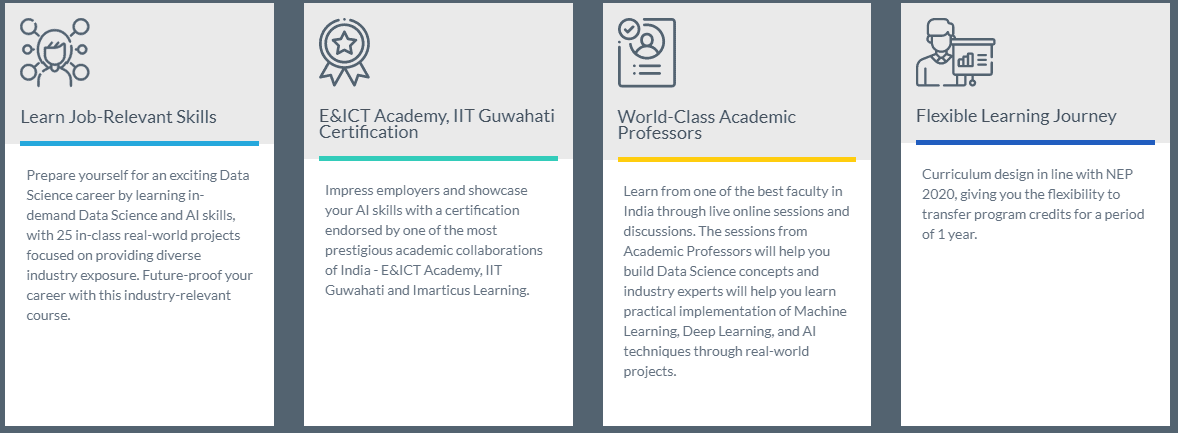
 The Certification in Artificial Intelligence and Machine Learning by Imarticus Learning is the perfect ML course in 2021. This course is endorsed by IIT Guwahati, one of the top institutes in the country. This course will follow an industry-oriented syllabus that will help in knowing about the common industry practices. You can also opt for a demo class before choosing the ML certification course.

best artificial intelligence and machine learning courses from E&ICT Academy, IIT GuwahatiIn a nutshell

Getting an ML certification can boost your chances of getting placed in some of the top companies. You will also be in demand for the coming years by gaining an ML certification. Start your ML/AI certification program now!