Management may make data-driven decisions at the strategic and operational levels with the use of supply chain analytics. The role of supply chain analyst is to keep tabs on how the chain operates and performs, recognise current trends and hazards, and attempt to come up with practical solutions to reduce losses and improve the process. Individuals can aim for a high supply chain analyst salary as it is one of the most in-demand profiles nowadays. To understand how to become a supply chain analyst, one should improve their skill set and pick up the necessary knowledge and experience.
The creation and execution of supply chain operation plans and activities are part of what does a supply chain analyst do. To achieve the business goals, he will be involved in the creation and implementation of supply chains, including demand planning and inventory management.
What Does a Supply Chain Analyst Do – Skills & Competencies
1) Skills in Data Analysis –
This is an essential ability because the main role of supply chain analyst is to analyse data, maximise supply chain efficiency and keep costs low using enterprise resource planning (ERP) tools like SAP or Salesforce to manage all the data and process it in a way that is beneficial to the business.
2) Mathematical Competence –
Supply chain analysts need to be solid mathematicians to precisely calculate costs and savings data costs and savings data. This will help in creating and carrying out logistical plans, adapting to unforeseen problems, and finding ways that help reduce costs and increase efficiency. To gain knowledge on how to become a supply chain analyst, one needs to have a solid understanding of statistics and quantitative methods in order to analyse huge data sets and provide analytical support for projects.
3) Interpersonal Competence –
The supply chain experts collaborate with various other parties. As a result, interpersonal abilities like empathy and active listening help them form strong bonds.
4) Skills in Communication –
Strong written and spoken communication abilities make it easier to share thoughts and conclusions with the internal team and stakeholders. This will enable one to work well with multicultural teams and coworkers, including clients and suppliers.
5) Organising Techniques –
For supply chain analysts to do their jobs efficiently and to manage their workload and the speed of many projects, they must have great organisational abilities. To manage several concurrent tasks and keep data across various tools and platforms, this skill is an absolute requirement.
6) Teamwork Techniques –
The role of supply chain analyst necessitates collaboration with several teams. Thus, they must be able to perform well under pressure. In addition to this, time management is also required to keep up with the fast-paced world with clashing deadlines and priorities.
7) Understanding Market Dynamics and Economics –
Rapid transformations in customer and consumer buying behaviour are having an impact on numerous businesses. Many markets that were once only local or regional have expanded globally, and the supply chains that support them have done the same. One will need to concentrate on the future and, to some extent, foresee it as a supply chain leader. Only by having a solid grasp of the market dynamics affecting your sector and business can that be accomplished.
8) Learning to be flexible –
Your capacity to be flexible allows you to let other people participate in creative ideas. Because they know that they would accept their suggestions if it makes sense to do so, your adaptability will give those innovative thinkers the courage to share their ideas. One of the soft talents that is needed while determining how to become a supply chain analyst effectively is flexibility. This is not just because supply chain operations are evolving but also because things do not always go as planned — far from it, to be honest.
9) The Art of Negotiation –
In order to understand how to become a supply chain analyst, you’ll need to connect expertly and efficiently with people inside and outside of your company, in addition to your reports and coworkers. Supply chain analysts must frequently engage in negotiations. Even if you’re not doing so one-on-one, you’ll likely encounter situations where you’re a member of a group of individuals seeking to broker a deal or arrangement. Therefore, it is essential.
10) Leadership Qualities –
Leadership qualities help professionals in managing operations and in directing teams toward the accomplishment of objectives. Leadership capabilities also help in allocating resources effectively in order to fulfil the mission and goals of their firm, and for making meaningful decisions, supply chain analysts must possess strong leadership qualities.
Conclusion
The work of supply chain analysts is now simple yet complex, thanks to the availability of data-driven and technological solutions. The role of supply chain analyst involves possessing a variety of software abilities that may be used in their daily work to improve production and support the expansion of the business.
The SCM programme (Professional Certification in Supply Chain Management and Analytics) by Imarticus is an IIT Roorkee supply chain analyst course for someone who wants to continue this career path and earn an attractive supply chain analyst salary. This six-month programme offers live classes from qualified instructors and business professionals, as well as IIT Roorkee-recognised credentials and online supply chain management training. At the end of the training, it will provide certifications for supply chain professionals.
The capital market plays a significant role in the economic development of a nation. It serves as a critical component of the financial system, facilitating the efficient allocation of resources and fostering economic growth.
By providing a platform for raising capital, the capital market enables businesses to expand, innovate, and create jobs while offering investors opportunities to earn returns on their investments.
If you’ve ever wondered how the economy grows or how businesses get the money they need to expand, then you’re in the right place. We’re diving into the functions of the capital market and how they play a crucial role in driving economic growth. But first, let’s start with the basics.
What Is A Capital Market?
A capital market is a financial market where buyers and sellers can easily engage in the trade of financial securities like stocks, bonds, and other long-term investments. It also provides a platform for companies to raise funds for expansion and for investors to purchase securities, potentially earning a return on their investments.
How Does A Capital Market Work?
A capital market works by facilitating the movement of money between investors who have capital and businesses that need capital.
Here’s a step-by-step look at how it operates:
Issuance of Securities: Companies issue stocks or bonds to raise money. This is known as the primary market.
Buying and Selling: Investors buy these securities with the hope of earning a return. The buying and selling of these securities happen in the secondary market.
Market Regulation: Regulatory bodies like the Securities and Exchange Board of India (SEBI) ensure the market operates smoothly and transparently, protecting investors from fraud.
Types Of Capital Market
There are two types of capital markets:
Primary Market
This is where new securities are issued. When a company goes public through an Initial Public Offering, it’s participating in the primary market. The funds raised go directly to the company.
Secondary Market
Here, existing securities are traded among investors. The company does not receive any money from these transactions. Stock exchanges like the Bombay Stock Exchange & the National Stock Exchange are examples of secondary markets.
What are the Features Of the Capital Market?
The capital market has several distinct features that make it vital for economic growth:
Long-Term Financing: It provides businesses with long-term funds, which are essential for expansion and development.
Liquidity: Investors can quickly buy and sell securities, making the market liquid.
Transparency: Regulatory bodies ensure that all transactions are transparent and fair, boosting investor confidence.
Price Determination: Through the forces of supply & demand, the capital market helps in determining the prices of securities, reflecting their true market value.
Diverse Investment Opportunities: Investors can choose from a wide range of securities, depending on their risk tolerance and investment goals.
What are the Key Functions of the Capital Market?
Now, let’s understand the core functions of the capital market and how they drive economic growth:
Mobilization of Savings
One of the primary functions is to channel savings from households and institutions into productive investments. Instead of letting money sit idle in savings accounts, the capital market enables individuals to invest in businesses, leading to higher returns and more robust economic activity.
Facilitating Investment
By providing a platform for the issuance of new securities, the capital market helps businesses raise the funds they need for expansion. This, in turn, leads to the creation of jobs, the development of new products, and overall economic growth.
Promoting Economic Efficiency
Capital markets help allocate resources efficiently by directing funds to businesses with the most promising growth prospects. This ensures that capital is used productively, leading to better economic outcomes.
Enhancing Liquidity
The secondary market aspect of the capital market provides liquidity to investors. They can easily sell their securities if they need cash, making investments less risky and more attractive.
Risk Management
Capital markets offer various financial instruments that help in managing and mitigating risks. Derivatives, for example, allow investors to hedge against price fluctuations, making the financial system more stable.
Why Understanding the Capital Market Matters?
Understanding the functions of the capital market is essential for anyone interested in finance or economics. Whether you’re an investor looking to grow your wealth or a business seeking to raise funds, knowing how the capital market operates can provide advantages.
The capital market is more than just a place for buying and selling securities. It’s a system that plays a crucial role. By facilitating investment, ensuring efficient resource allocation, and providing liquidity, the capital market drives economic growth and stability.
Opportunities for Growth
The capital market provides a platform where companies can raise funds by issuing stocks and bonds. For businesses, this means access to capital that can be used to expand operations, expand new products, or invest in innovation.
Investment Diversification
For individual investors, the capital market also offers a distinct range of investment opportunities beyond traditional savings accounts. Stocks, bonds, mutual funds, and exchange-traded funds allow investors to spread their portfolios, spreading risk across different asset classes and potentially increasing returns. Knowing how to navigate the capital market enables investors to build wealth over the long term.
Economic Indicators
The capital market serves as a barometer of economic health. Trends in stock prices, bond yields, and investor sentiment reflect broader economic conditions and can influence consumer confidence, corporate spending decisions, and government policy. By understanding these indicators, policymakers, economists, and business leaders can anticipate economic trends, mitigate risks, and formulate effective strategies to support sustainable growth.
Innovation and Entrepreneurship
Innovation thrives in an environment where capital is readily available to fund new ideas and ventures. Startups and entrepreneurs rely on the capital market to secure financing for groundbreaking technologies and disruptive business models. Understanding the capital market encourages entrepreneurship by providing insights into fundraising strategies, investor expectations, and market trends that can shape the success of new ventures.
Global Connectivity
The capital market transcends geographical boundaries, connecting investors and businesses on a global scale. International capital flows facilitate cross-border investments, mergers, and acquisitions, fostering economic integration and driving global economic growth. By understanding the interconnectedness of the capital market, individuals and businesses can leverage opportunities in international markets, diversify risks, and access a broader pool of investors.
The Final Words
The functions of the capital market are indispensable for a thriving economy. They mobilize savings, facilitate investments, enhance liquidity, promote economic efficiency, and help manage risks. Understanding these functions can empower you to make informed investment decisions and appreciate the broader economic landscape.
So, next time you hear about stock markets or bond markets, remember that they are not just about trading. They are powerful engines of economic growth, shaping the financial future of individuals and nations alike. Exploring a financial services course might be your next step toward a deeper understanding of this vital sector.
Elevate Your Career with Imarticus Learning’s Advanced Financial Services and Capital Markets Program in Collaboration with IIM Lucknow
The Advanced Management Programme in Financial Services & Capital Markets, in collaboration with Imarticus Learning, offers a comprehensive understanding of digital banking, capital markets, risk management, and fintech domains. This program covers key areas such as corporate finance, valuation, fundraising, treasury operations, and financial analytics.
Learn the fundamentals of financial services and capital markets, including corporate banking, risk management, investment banking, and financial planning. Experience a five-day campus immersion, where you can attend classes on campus, learn from some of the best faculty in the nation, and network with peers.
You trusted the numbers and missed the risk. Financial statement analysis is a fundamental aspect of business management and investment decision-making. It involves scrutinising a company’s financial statements to understand its financial health and performance.
However, while this analysis can provide valuable insights, it also comes with its own set of challenges and limitations. In this blog post, we’ll explore the limitations of financial statement analysis and delve into some examples and types of financial analysis, as well as the tools and techniques used in this process.
Understanding Financial Statement Analysis
Before diving into the challenges, let’s briefly outline what financial statement analysis entails. This process typically involves examining three primary financial statements: the income statement, the balance sheet, & the cash flow statement. Analysts use various tools and techniques of financial statement analysis to interpret the data and make informed decisions. These tools include ratio analysis, trend analysis, and comparative analysis.
Despite its importance, financial statement analysis is not without its flaws. A Financial Analyst plays a vital role in connecting business needs with financial strategies. This role involves conducting investment research, performing financial analysis, ensuring regulatory compliance, managing risks, and engaging in strategic planning.
Here are some key limitations to be aware of:
Historical Data
Financial statements are primarily based on historical data. They provide a snapshot of a company’s past performance but don’t necessarily predict future performance. This reliance on historical information can be a significant limitation, especially in dynamic industries where conditions change rapidly.
Subjectivity in Accounting Practices
Accounting practices and standards can vary widely between companies and industries. This subjectivity can lead to inconsistencies in financial reporting, making it challenging to compare financial statements across different entities. For instance, different companies might use different depreciation methods, which can significantly affect their reported profits.
Lack of Non-Financial Information
Financial statements focus on quantitative data and often overlook qualitative aspects that can influence a company’s performance. Factors like management quality, brand reputation, and employee satisfaction are crucial but aren’t reflected in the financial statements.
Inflation and Economic Changes
Money value fluctuations are not taken into account in financial statements. The true worth of assets and liabilities can be distorted by inflation, which can provide false conclusions. Moreover, broader economic changes and market conditions are not directly captured in financial statements.
Window Dressing
Companies might engage in “window dressing” to present their financial statements in a more favourable light. This practice involves using accounting tricks to make financial statements look better than they are, which can mislead analysts and investors.
Real-World Examples of Financial Statement Limitations
Let’s look at some real-world examples of limitations in financial analysis to illustrate these points:
Historical Data Example:A company may show strong profits in FY2025, but declining demand in 2026 won’t appear immediately in reports.
Accounting Practices Example: Two manufacturing companies may use different inventory valuation methods – FIFO (First In, First Out) and LIFO (Last In, First Out). This difference can result in significantly different cost of goods sold and profit figures, complicating direct comparisons.
Inflation Example: Financial statements are usually based on historical costs, which means they don’t account for inflation. So, if a company bought an asset 10 years ago, it will still be recorded at that old price – even though replacing it today would cost much more. This can make assets look undervalued and give a slightly distorted picture of profitability.
Types of Financial Statement Analysis
There are various types of financial statement analysis that analysts use to gain insights into a company’s performance:
Horizontal Analysis: This involves comparing financial data over multiple periods to identify trends and growth patterns.
Vertical Analysis: This method looks at financial statements as a percentage of a base figure.
Ratio Analysis: This is perhaps the most common type of analysis involving the calculation of various financial ratios to assess liquidity, profitability, and solvency.
Trend Analysis:Using past data, this strategy forecasts future performance by looking at patterns across time.
Tools and Techniques of Financial Statement Analysis
To conduct thorough financial statement analysis, analysts use a variety of tools and techniques:
Horizontal analysis looks at financial statements over multiple years to spot trends. For example, you might compare sales figures from one year to the next to see if they’re going up or down. This method helps you understand how a company’s performance is changing over time by comparing its past performance.
In a financial statement, vertical analysis displays each item as a percentage of a base amount. You can see what percentage of sales are operating expenses, taxes, or profits. This method helps you compare a company’s internal performance and also benchmark it against other companies in the same industry.
Ratio Analysis
Ratio analysis is a popular tool for examining the relationships between different numbers in financial statements. Ratios can tell you about a company’s profitability, liquidity, and efficiency. Profitability ratios show how well the company is at making profits. Ratios make it easy to compare a company’s performance with others.
Graphical Analysis
Graphs and charts provide a visual way to look at a company’s performance over time. Line graphs, bar charts, & pie charts can help you quickly see trends & patterns in the data. This visual representation makes it easier to understand and compare financial information.
Trend Analysis
Trend analysis involves looking at how financial items change over time. By identifying trends, you can spot patterns and make predictions about future performance. This method is often used alongside ratio, horizontal, andvertical analyses to give a fuller picture of financial health.
Regression Analysis
It is a statistical tool used to understand the relationship between different factors. In financial statement analysis, it might involve looking at how sales are affected by other factors like the overall economy. This helps in making more informed predictions about future performance.
How to Overcome Limitations of Financial Statement Analysis
Key Takeaways on Financial Statement Analysis Limitations
While financial statement analysis is a tool for evaluating a company’s performance and making informed decisions, it is essential to understand its limitations. The reliance on historical data, subjectivity in accounting practices, lack of non-financial information, effects of inflation, and potential for window dressing are all significant challenges that analysts must navigate.
By being aware of these limitations of financial statement analysis and using a variety of tools and techniques, analysts can make more accurate and insightful evaluations. Additionally, pursuing advanced education like the CFA course can further enhance one’s ability to perform sophisticated financial analyses.
Understanding these limitations helps in making more informed decisions and recognising that financial statements are just one piece of evaluating a company’s overall health and prospects.
Define Your Career as a CFA with Imarticus Learning
A Chartered Financial Analyst (CFA) charter is a highly respected credential in finance, showcasing deep expertise in finance and investments. This globally recognised qualification opens doors to diverse opportunities in finance careers. After completing the program, you can explore various paths in the finance sector.
The CFA program covers key topics like economics, investment analysis, accounting, and ethics. With its well-structured curriculum, the CFA course can significantly boost your career prospects. Imarticus Learning offers comprehensive training to help you achieve this prestigious designation.
Why Choose the CFA Program with Imarticus Learning?
Digital Practical Skill Modules: Gain hands-on experience with practical skill modules.
Better Career Choices: Unlock a range of career opportunities in the finance sector.
Connect with Industry Experts: Network with top professionals in the industry.
High-Paying Global Careers: Aim for high-paying jobs around the world.
Impressive Salaries: The average salary of a CFA charter holder is Rs. 20 Lakhs per annum.
Ready to elevate your finance career?Join Imarticus Learning today and start your journey towards becoming a Chartered Financial Analyst (CFA).
Navigating the world of financial accounting can be daunting, especially for beginners. However, understanding its core objectives can provide clarity and confidence. Financial accounting is the process of recording and reporting the numerous transactions resulting from business operations. This field is vital for businesses, investors, and regulatory bodies alike.
In this post, we will study the fundamental objectives of financial accounting, shedding light on its importance & how it serves as the backbone of informed financial decision-making. Let’s dive in and demystify the key goals that drive this crucial aspect of business finance.
What is Financial Accounting?
Financial accounting deals with summarizing, reporting, and analyzing financial transactions of a business. The main goal is to provide stakeholders, such as investors, creditors, and management, with clear and accurate financial information. This helps them make informed decisions about the company’s financial health and prospects.
Financial accounting follows a set of established principles that vary based on a business’s regulatory and reporting needs. Companies often have an accounting manual outlining these rules. In the U.S., public companies must adhere to generally accepted accounting principles (GAAP). These principles ensure consistent information is provided to investors, creditors, regulators, and tax authorities.
Financial accounting involves statements that cover five main types of financial data:
Revenues: This includes income from sales of products and services, as well as other sources.
Expenses: These are the costs involved in producing goods and services, including research and development, marketing, and payroll.
Assets: These are the properties owned by the company, both tangible (like buildings and computers) and intangible (like patents and trademarks).
Liabilities: These are the company’s debts, such as loans and rent.
Equity: This represents the company’s value if all debts were paid off & its assets were liquidated.
Nature and Scope of Financial Accounting
In simple terms, financial accounting is about keeping track of a company’s financial activities. This means identifying, organizing, summarizing, and systematically analyzing all financial transactions. It’s not just about keeping records; it’s also about explaining the business results to various interested parties.
The American Accounting Association (AAA) defines accounting as the process of identifying, measuring, and sharing economic information so that people can make informed decisions.
Financial accounting specifically deals with creating financial statements. These statements are used by decision-makers such as stockholders, suppliers, banks, employees, and government agencies.
Imagine you are running a business and keeping track of your money. There are five important rules that accountants follow to make sure all businesses do it the same way. These rules are important financial statements, which are reports that show how much money your business has coming in and going out.
The Objectives of Financial Accounting
Financial accounting serves several core objectives that are crucial for any business. Here are the primary goals:
Recording Financial Transactions
The first objective is to record all financial transactions systematically. This includes everything from sales & purchases to expenses and revenues. Proper recording ensures that all financial data is accurate and up-to-date, which is essential for preparing financial statements.
Summarizing Financial Information
Once transactions are recorded, the next step is to summarize this information into useful reports. Financial accounting helps create comprehensive financial statements, such as the balance sheet, income statement, and cash flow statement. These documents provide a snapshot of the company’s financial position at any given time.
Ensuring Legal Compliance
Businesses must adhere to various accounting standards and regulations. Financial accounting ensures that all financial reports comply with these legal requirements. This not only helps avoid legal issues but also builds trust with stakeholders.
Aiding in Decision Making
One of the most important objectives of financial accounting is to aid in decision-making. By providing accurate & timely financial information, it helps managers, investors, & other stakeholders make informed decisions. This can range from day-to-day operational decisions to long-term strategic planning.
Facilitating Financial Planning and Control
Financial accounting plays a crucial role in planning and controlling business activities. By analyzing financial statements, businesses can set budgets, forecast future financial performance, and implement controls to ensure that financial goals are met.
Protecting Business Assets
Proper financial accounting helps protect business assets. By keeping track of financial transactions, it ensures that assets are not misused or misappropriated. This is necessary for maintaining the financial health and integrity of the business.
What are the Advantages of Financial Accounting?
A shareholders’ equity statement shows how a company’s equity changes over some time, unlike a balance sheet, which shows equity at a specific moment. This statement explains why the value of the company has increased or decreased.
Financial accountants are like helpers who can show you how to use this rulebook and make these reports. They can help you understand your finances better and make good decisions!
Understanding the advantages of financial accounting can further highlight its importance. Here are some benefits that are important to understand:
Transparency and Accountability
Financial accounting brings transparency and accountability to business operations. It provides clear and accurate financial information that stakeholders can trust.
Better Financial Management
With detailed financial reports, businesses can manage their finances more effectively. This includes monitoring cash flows, controlling expenses, and optimizing revenues.
Improved Decision Making
Accurate financial information is crucial for making informed decisions. Financial accounting provides the data needed to evaluate business performance and make strategic choices.
Legal Compliance
Adhering to accounting standards and regulations is essential for avoiding legal issues. Financial accounting ensures that all financial reports meet the required legal criteria.
What is the importance of Financial Accounting?
The importance of financial accounting cannot be excessive. It forms the backbone of any business’s financial management. Here’s why it matters:
Providing Financial Information
Financial accounting provides vital information about a company’s financial performance. This information is crucial for stakeholders who need to understand how well the business is doing.
Assisting in Financial Planning
By analyzing past financial data, businesses can plan for the future. This includes setting budgets, forecasting revenues, and planning for growth.
Ensuring Operational Efficiency
Efficient financial accounting helps businesses operate more smoothly. It ensures that financial transactions are recorded accurately, which helps in maintaining operational efficiency.
Supporting External Reporting
Businesses need to report their financial performance to external parties such as investors, creditors, and regulatory bodies. Financial accounting ensures that these reports are accurate and reliable.
Facilitating Business Growth
Accurate financial accounting supports business growth by providing the data needed to make strategic decisions. This can include expanding operations, entering new markets, or investing in new products.
The Final Words
Understanding the objectives of financial accounting is essential for anyone involved in managing a business or personal finances. It’s not just about keeping track of money; it’s about ensuring transparency, aiding in decision-making, and planning for the future. By providing accurate & reliable financial information, financial accounting helps businesses thrive and grow.
Master Your Future in Finance with Imarticus Learning’s Postgraduate Program in Financial accounting and management
Are you aspiring to work within a leading financial institution, collaborating closely with a Chief Financial Officer to drive strategic initiatives and contribute to the organization’s success?
Imarticus Learning’s Postgraduate Financial Accounting and Management Program is your gateway to achieving these goals. Our program is tailored for commerce graduates with up to 3 years of experience or individuals from arts backgrounds seeking to pivot towards a finance career. This comprehensive Financial Management course offers practical, hands-on training and covers essential tools and key aspects to help you excel in a leading financial institution.
Benefit from dynamic teaching methods led by industry specialists, ensuring a thorough grasp of critical financial concepts and the ability to excel in their application, propelling your financial success. Engage in realistic finance and accounting simulations for hands-on experience, enhancing your skills and job market readiness.
Take the next step towards a successful career in finance with Imarticus Learning.
Enrol Today and Unlock Your Path to Financial Excellence!
In the world of finance, understanding how to interpret financial statements is crucial. One useful technique is vertical analysis. This method helps you look at the bigger picture and identify trends over time. Whether you’re a seasoned finance professional or just starting, mastering vertical analysis can provide significant insights into a company’s financial health.
In the income statement, the base figure is usually total sales or revenue. For the balance sheet, the base could be total assets or total liabilities and equity. By converting absolute numbers into percentages, vertical analysis helps highlight the relative proportions of each item.
What Is Vertical Analysis?
Vertical analysis is a technique used in financial reporting where each line item is expressed as a percentage of another item in a financial statement. Each line item in an income statement, for instance, might be represented as a percentage of overall sales. This facilitates the comparison of financial accounts between organizations of all sizes and over different periods.
How Vertical Analysis Works
Vertical analysis simplifies comparing financial statements between companies and industries by showing the relative proportions of account balances. It’s also great for comparing different periods, making it easier to see if performance is getting better or worse over time.
Here’s how it works:
Comparing Companies: By converting each item on a financial statement to a percentage of a base figure (like total sales), you can easily compare one company to another, regardless of their size.
Time Series Analysis: This method lets you look at financial data over several years. You can compare quarterly or annual figures to see trends and determine if the company’s performance is improving or declining.
Profit Margins: For example, in an income statement, if you show various expenses as a percentage of total sales, you can see how much each expense contributes to the profit margin. This helps in comparing profitability over time and against other companies.
Financial statements using vertical analysis clearly show the percentages in a separate column. These are also known as common-size financial statements. Many companies use these to give a detailed view of their financial position.
Common-size financial statements often include comparative data, showing each line item compared to previous periods. This provides a clear picture of changes and trends over time.
What are the Benefits of Vertical Analysis?
There are several benefits ofvertical analysis in financial reporting:
Simplified Comparison: It allows for easy comparison across different periods or companies by standardizing financial data.
Trend Identification: By looking at percentage changes over time, you can identify trends and see how certain costs or revenues are evolving.
Highlighting Significant Changes: Significant changes in percentages can quickly draw attention to areas that need further investigation.
Better Decision-Making: With a clearer understanding of where money is coming from and where it’s going, better financial decisions can be made.
How to Conduct Vertical Analysis?
Choose a Base Figure: For an income statement, this is typically total sales. For a balance sheet, it could be total assets or total liabilities and equity.
Convert to Percentages: Divide each line item by the base figure and multiply by 100 to get a percentage.
Analyze the Results: Look at the percentages to understand the relative size of each item.
Vertical Analysis vs. Horizontal Analysis
Vertical analysis and horizontal analysis are two key methods for evaluating financial statements. Here’s a simple breakdown of how they differ and what each one is used for.
Key Differences
Vertical Analysis: This method shows each line item as a percentage of a base figure (like total sales or total assets). It helps in understanding the relative size of each item.
Horizontal Analysis: This method looks at the percentage change of each line item from one period to the next (quarter over quarter or year over year). It helps in spotting trends over time.
Even though vertical analysis doesn’t show changes over time directly, you can still compare the percentages of line items from different periods to see trends.
Vertical Analysis Examples
Let’s look at how vertical analysis works using an income statement with expenses over two years.
Analysis:
Sales Increase: Total sales increased from $850,000 to $1,000,000.
Profit Margins: The gross profit percentage dropped from 75% to 70%, and the net profit percentage decreased from 34.70% to 28.65%.
Cost of Goods Sold: The cost of products sold went up from 25% to 30% of total sales.
Even though the company made more money in sales in Year 2, the increased cost of goods sold led to lower profit margins.
Vertical Analysis in Different Financial Statements
Vertical analysis is a useful method for examining different types of financial statements. Here’s how it works for various financial documents:
Income Statement
In an income statement, vertical analysis shows each line item as a percentage of total sales. This helps you see how much of the sales revenue is being spent on costs like the cost of goods sold, salaries, rent, & other expenses. For example, if COGS is 30% of sales, you know that 30 cents of every dollar earned goes to producing goods.
Balance Sheet
For a balance sheet, vertical analysis shows each item as a percentage of total assets or total liabilities & equity. This helps you understand the composition of a company’s assets and how they are financed. For instance, you can see what percentage of total assets are current assets (like cash & inventory) versus long-term assets (like property and equipment).
Cash Flow Statement
Though less common, vertical analysis can also be applied to a cash flow statement. Here, each line item is shown as a percentage of total cash inflows or outflows. This helps you see where the money is coming from and how it is being spent. For example, you can see what percentage of total cash outflows is used for operating activities versus investing or financing activities.
The Final Words
Vertical analysis is a powerful tool for interpreting financial statements. By converting numbers into percentages, it provides a clear picture of a company’s financial structure and trends over time. Whether comparing different periods or different companies, this technique simplifies the process and highlights key areas for further analysis.
Mastering vertical analysis is a valuable skill for anyone pursuing a career in finance. It’s commonly used in various roles, such as financial analysts, accountants, auditors, and finance managers. Understanding techniques can improve your ability to analyze financial statements, make informed decisions, and communicate financial health to stakeholders.
Transform Your Career with Imarticus Learning’s Postgraduate Financial Analysis Program
With a track record of over 45,000 successful career transitions, Imarticus Learning offers an illustrious 200+ hour Postgraduate Financial Analysis Program. This program is designed to help graduates with less than three years of experience in the finance domain transform their professional careers. It also prepares learners for CFA Level 1 jobs that are highly sought after in the industry.
Imarticus Learning’s financial analysis course guarantees you 7 interviews with leading finance organizations, ensuring a robust start to your career.
Equip yourself with essential skills like financial statement analysis, modelling, valuation, equity research, and transaction execution. You will also master Excel and PowerPoint, which are crucial tools in the finance sector.
Enhance your professional presence through the personal branding project and LinkedIn challenge, giving you a competitive edge in today’s job market. Learn fresh perspectives and expand your network by learning from thought leaders in the finance industry. Propel your professional growth to new heights with expert guidance.
Immerse yourself in real-time financial decision-making with cutting-edge simulations. Acquire hands-on expertise in practical financial modelling for valuable real-world insights.
Take the next step in your career in finance. Enrol in Imarticus Learning’s Postgraduate Financial Analysis Program today and unlock your potential!
Enrol Now and Transform Your Career with Imarticus Learning!
Financial forecasting is a crucial skill for anyone involved in managing finances, whether it’s for a business, a non-profit organization, or personal financial planning. By accurately predicting future financial conditions, you can make informed decisions, avoid potential pitfalls, and seize opportunities for growth.
Financial forecasting relies heavily on data analysis. By examining past financial data, businesses can find valuable insights and trends to guide their budget planning and financial projections. Predictive modeling, which uses machine learning algorithms, enhances this by predicting future outcomes with statistical techniques.
AI-driven forecasting platforms make the process even easier by providing real-time data and collaborative tools. This post will help you understand what financial forecasting is, why it’s important, the various methods available, and how you can build a career in finance.
What is Financial Forecasting?
Financial forecasting is the method of predicting a company’s future financial performance. This involves estimating future revenue, expenses, and capital needs. By analyzing historical data & market trends, financial forecasting helps organizations plan their budgets, manage cash flow, and strategize for the future. Essentially, it’s like looking into a financial crystal ball to see what lies ahead.
Key Concepts in Financial Forecasting
Financial forecasting involves predicting future financial conditions to help make better business decisions. There are several important aspects to consider:
Time Horizons: Forecasts can be short-term (days to months), medium-term (months to a few years), or long-term (several years to decades). The time frame depends on the specific purpose of the forecast.
Revenue Forecasting: This involves predicting future sales by looking at past sales data, market trends, and potential changes such as new pricing strategies or shifts in customer behavior.
Expense Forecasting: Here, the focus is on estimating future costs, including salaries, material costs, overhead, and other operational expenses.
Cash Flow Forecasting: This predicts the money coming in and going out of the business. It helps ensure the business has enough cash to operate and avoids liquidity problems.
Importance of Financial Forecasting
The importance of financial forecasting can’t be overstated.
Here are a few reasons why it is essential:
Informed Decision Making: Forecasts provide a foundation for making strategic decisions about investments, expansions, and cost-cutting measures.
Budgeting: Accurate forecasts help create realistic budgets, ensuring that resources are allocated efficiently.
Risk Management: By anticipating potential financial challenges, businesses can develop contingency plans to mitigate risks.
Investor Relations: Reliable forecasts build investor confidence by demonstrating a transparent understanding of future financial prospects.
Performance Tracking: Comparing forecasts with actual performance helps identify areas needing improvement.
Financial Forecasting Methods
There are several financial forecasting methods, each with its strengths and weaknesses. Choosing the right method depends on the specific needs and context of your organization. Here are some common methods:
Qualitative Forecasting
Expert Opinion: This method involves consulting industry experts to gain insights into future financial trends. It’s useful when historical data is scarce.
Market Research: Surveys & focus groups can provide valuable information about consumer behavior and market conditions.
Quantitative Forecasting
Time Series Analysis: This method uses historical data to identify patterns and trends. Common techniques include moving averages & exponential smoothing.
Econometric Models: These models use statistical methods to forecast future financial performance based on the relationships between economic variables.
Regression Analysis: This technique predicts future values by analyzing the relationships between dependent & independent variables.
Causal Models
Cause and Effect Analysis: This method examines the cause-and-effect relationships between different variables. For example, an increase in advertising spending may lead to higher sales.
Monte Carlo Simulation: This method uses random sampling & statistical modeling to estimate the prospect of different outcomes. It’s particularly useful for assessing risk and uncertainty.
Steps to Create a Financial Forecast
Creating an accurate financial forecast involves several steps:
Define Objectives: Determine the purpose of the forecast. Are you planning for short-term needs or long-term growth?
Gather Data: Collect historical financial data, market trends, and other relevant information.
Choose a Method: Select the most appropriate forecasting method based on your objectives and data availability.
Make Assumptions: Clearly define the assumptions underlying your forecast. These include market growth rates, inflation rates, and changes in consumer behavior.
Develop the Forecast: Use the chosen method to generate the forecast. This may involve complex calculations or statistical modeling.
Review and Revise: Regularly compare forecasts with actual performance and adjust as necessary. Forecasting is an iterative process.
The Power of Predictive Analytics in Personal Finance
Predictive analytics is a game-changer in personal finance. It uses historical data and advanced statistical methods to forecast future financial events and trends. By looking at past financial behavior, individuals can make smarter decisions and manage their budgets more effectively. This means better cash flow forecasting, improved budgeting, and clearer goal setting.
With predictive analytics, people can also gain valuable investment insights. By analyzing historical market trends and other factors, it provides useful information for making investment decisions. This helps individuals take control of their financial future, aiming for a more secure and prosperous life.
Debt management benefits greatly from predictive analytics, too. By studying past financial behavior and current debt levels, individuals can create effective strategies to pay off debt and improve their financial health. Predictive analytics can spot patterns in spending habits, leading to smarter debt management choices.
However, using predictive analytics effectively requires careful collection and organization of financial data. Choosing the right tools for data analysis is essential to generate useful insights. Continuous monitoring and adjusting of financial strategies are also necessary to keep up with the changing financial landscape. Combining predictive analytics with financial knowledge and discipline is key to achieving long-term financial success.
Career in Finance
A career in finance can be rewarding & challenging. Financial forecasting is a valuable skill that can open doors to various roles in the industry.
Here are a few career paths where financial forecasting plays a key role:
Financial Analyst: Analyze financial data to take decision-making processes. Prepare reports, create models, and provide insights on financial performance.
Budget Analyst: Develop and manage budgets for organizations. Ensure that resources are allocated effectively and monitor budget compliance.
Investment Banker: Assist companies in raising capital & advising on mergers and acquisitions. Financial forecasting is crucial for evaluating investment opportunities.
Corporate Financial Planner: Help organizations develop long-term financial strategies. Forecast future financial conditions to guide business planning.
Risk Manager: Identify and mitigate financial risks. Use forecasting techniques to anticipate potential challenges and develop risk management strategies.
The Final Words
Financial forecasting is an indispensable tool for managing finances effectively. By understanding its importance, mastering various financial forecasting methods, and following a structured approach, you can make better financial decisions and enhance your organization’s financial health.
Moreover, developing expertise in financial forecasting can pave the way for a successful career in finance. Start practicing these techniques today to navigate your financial future with confidence.
Transform your Career with Imarticus Learning’s Postgraduate Financial Analysis Program
Having created an impressive 200+ hour Postgraduate Financial Analysis Program, Imarticus Learning has over 45k+ successful career transfers under its belt. Graduates of this program can change their professional professions if they have less than three years of experience in the banking industry. This financial analysis course also prepares learners for CFA L1 jobs that are accessible in the industry market.
Our financial analysis course comes with job assurance, offering you 7 guaranteed interviews with leading finance organizations. Equip yourself with crucial skills such as financial statement analysis, modeling, valuation, equity research, and transaction execution, along with Excel and PowerPoint.
This financial planning and analysis course uses the latest learning engagement solutions, such as simulation tools, allowing learners to experience live workplace scenarios.
Chasing the CPA certification? You’re not just adding letters after your name – you’re stepping into a world where your financial expertise drives smarter decisions and defines leadership.
But before you dive in, one question probably stands out – What is the CPA eligibility, and am I qualified to apply? If that’s what you’re wondering, you’re not alone – every CPA journey begins exactly there.
Becoming a Certified Public Accountant (CPA) means positioning yourself as a trusted global finance leader – someone who doesn’t just crunch numbers but shapes business strategy and advises top organisations. For anyone serious about rising in the finance world, ready to go global, the CPA is a badge of credibility and mastery. It sets you apart, opens global opportunities, and changes not just where you work but how you work.
This guide simplifies everything you need to know:
What education do you need? How does your work experience count? The step-by-step application process And how Indian students and professionals can meet the CPA eligibility requirements smoothly.
🎫Think of CPA eligibility as your boarding pass. It tells that you’re qualified to take the CPA exam without unexpected hurdles.
What is CPA?
If you’ve ever wondered what is CPA and what it truly means to be a Certified Public Accountant. You can think of it as an elite designation of global finance professionals trusted to keep businesses financially sound and strategically sharp.
The CPA certification is awarded and governed by the American Institute of Certified Public Accountants (AICPA). It is considered the gold standard in accounting and finance. It’s not just another certification – it’s proof that you understand the language of business at the highest level.
As a CPA, you’re not limited to audit and tax roles. You’re a strategic advisor, helping organisations make smarter financial decisions, ensure compliance, and plan for long-term growth. From global firms like Deloitte and EY to Fortune 500 companies, CPAs are at the heart of every major financial conversation.
In simple terms, if you’re someone who loves numbers but wants to go beyond them – to influence business outcomes, shape financial policies, and lead teams across borders – the CPA course is your passport to a global accounting career.
CPA Eligibility Requirements: Your Golden Ticket to Certification
Before you begin with your CPA journey, it’s important to know what CPA eligibility really means. Simply put, it’s the set of educational and professional requirements you need to meet before you can sit for the CPA exam or earn your license.
Think of it as your starting checklist – ensuring you have the right academic foundation, relevant work experience, and necessary documentation before you leap.
While the exact CPA eligibility criteria can vary depending on the state board you apply through, the essentials remain the same everywhere:
Education: A recognised bachelor’s degree in accounting, finance, or a related field
Credit Hours: A certain number of credit hours (usually 150) in accounting and business subjects
Experience: And in some cases, a few years of verified professional experience under a licensed CPA.
Meeting these CPA qualifications is your first step toward unlocking worldwide opportunities in finance.
Why Work Experience Matters?
Think of it like learning to drive. You can read the traffic rules and watch “how to drive” videos all day – that’s your theory. The instructor is right there beside you – guiding your hands on the wheel, helping you understand what to do in real situations, pointing out where you can improve, and building your confidence one drive at a time. Only after that real practice can you go and take the driving test to earn your license.
The CPA works the same way. You don’t just study and pass exams – you need real, hands-on work experience under a licensed CPA. This ensures you’re not just good at theory, but confident in handling real financial decisions in the workplace.
A Quick Analogy for Credit Hours
Think of the CPA credit hour requirement like training for a marathon. Your bachelor’s degree has already given you that solid foundation – just like being reasonably fit before you start serious training. But to be fully race-ready, you need some focused preparation. In this case, it means taking a few extra accounting and business courses.
Just like those last training runs help you cross the finish line, those additional credits make sure you’re fully prepared and eligible to take the CPA exam.
Core CPA Eligibility Criteria: A Detailed Look
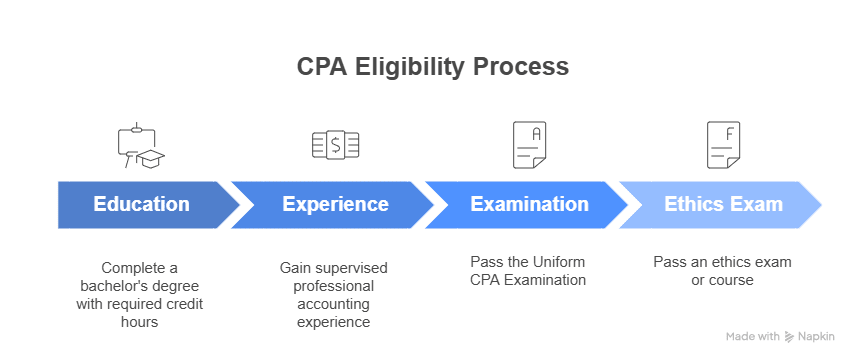
Here’s a quick look at the core eligibility requirements most CPA candidates must meet:
Education
You’ll typically need 150 semester hours of education. This is usually around a bachelor’s degree plus additional coursework.
Most candidates meet this through a B.Com + M.Com, B.Com + MBA, or a CA/CMA qualification from India.
Your degree should include 24-30 semester hours of accounting and business-related subjects.
Experience
Some U.S. states also require 1-2 years of supervised professional experience under a licensed CPA.
This ensures you have real-world accounting exposure alongside academic knowledge in areas like public accounting, government, or industry, involving financial analysis, auditing, tax, or management accounting.
Examination All candidates must clear the Uniform CPA Examination, which consists of four sections:
Auditing and Attestation (AUD)
Financial Accounting and Reporting (FAR)
Regulation (REG)
Discipline Section: This is a choice-based specialisation, allowing you to focus on your career path – Business Analysis and Reporting (BAR), Information Systems and Controls (ISC), or Tax Compliance and Planning (TCP).
Ethics Exam (in select states)
A few jurisdictions also require an ethics exam or course to confirm your understanding of professional integrity and ethical practice.
US CPA Eligibility for Indian Students: What You Need to Know
Coming from India, you have some unique considerations, but rest assured, thousands of Indian candidates are in the same boat – and they’re sailing through just fine.
Here’s what usually happens for Indian students pursuing CPA:
Degree Equivalence: Your Indian degree – be it B.Com, MBA, CA, or CMA – can meet the educational requirements. However, depending on the U.S. state, you might need to add extra credit hours through coursework or certifications to reach the 150-semester-hour mark. Many Indian students pursue a Master of Commerce (M.Com) or a Chartered Accountancy (CA) qualification to fulfil this.
Credential Evaluation: You’ll need to get your academic credentials evaluated by an authorised agency (e.g., NASBA International Evaluation Services, WES) to verify their equivalence to U.S. standards. This step is routine and supported by most states to which Indian candidates apply.
Examination Centres in India: Great news: you can take the CPA exams right here in India at approved testing centres (such as Prometric Centres). No need for an expensive trip abroad, unless you want to!
Experience for Licensure: For licensing, you’ll need relevant experience – usually one to two years – under the supervision of a licensed CPA. This experience can be tracked alongside your studies or even after passing your exams, often from India.
📍Flexible Exam Centres:
Picture booking a movie ticket at your local theatre instead of having to travel to another city. CPA exams can be taken at approved centres in India, so you don’t have to fly halfway across the world – making the whole eligibility and exam process much more convenient.
Step-by-Step CPA Application Explained
Getting started is often the hardest part, so here’s a simple checklist you can follow for your CPA application process:
Verify Your Eligibility – Check if your education background and experience align with your target state’s requirements.
Submit Your Application – Apply through the state board and submit your academic transcripts and credential evaluations.
Get your Authorisation to Test – Once approved, you’ll receive an Authorisation to Test (ATT) so you can schedule exams.
Prepare for and pass the Exams – Pass all four exam parts within 18 months with the use of study guides, coaching, and practice tests.
Complete Required Experience – Fulfil your supervised work experience as per state requirements.
Apply for the CPA License – After exams and experience, apply for licensure and start your global career as a CPA.
This process looks daunting on paper, but breaking it down like this reveals it’s totally doable.
Note– Missing or misinterpreting even one requirement can delay your progress significantly – something no one wants after putting in hours of hard work and exam preparation.
CPA Exam Pattern & Modules 2025: What to Expect
Let’s talk about the CPA exam- and no, it’s not a daunting test. It is a well-designed challenge that really puts your skills to work in scenarios you’ll face in the real world. After all, the CPA isn’t about memorising endless rules; it’s about proving you know how to apply them when the stakes are high.
CPA 2025 Exam Structure
The CPA 2025 exam structure tests how well you can apply accounting and business concepts in real-world scenarios – not just how much you can memorise.
Category
Details
Exam Format (2025)
3 Core sections (mandatory for all) + 1 Discipline section (choose based on your career path).
Exam Duration
Each section lasts 4 hours, giving you enough time to showcase your knowledge and judgment.
Passing Score
You need a minimum score of 75 on each section.
Exam Window
You must pass all four sections within an 18-month rolling period.
Question Types
Multiple-Choice Questions (MCQs) and Task-Based Simulations (TBSs) that mimic real-world scenarios.
For a comprehensive guide on the most challenging CPA exam section and strategies to conquer it, explore this detailed blog post on the hardest CPA exam section.
The CPA Exam modules are listed below:
Section
Focus Area
What It Covers
Auditing and Attestation (AUD)
Auditing, Risk & Ethics
Audit procedures, Reviewing Financial Records, Assessing Risks, Ensuring Internal Controls are strong, and Professional Ethics.
Financial Accounting and Reporting (FAR)
Financial Reporting
Preparing and Interpreting Financial Statements under frameworks like US GAAP and IFRS.
Regulation (REG)
Taxation & Compliance
Tax Laws, Business Regulations, and Professional Ethics.
Discipline Section
Specialisation
Business Analysis and Reporting (BAR): Financial reporting, analysis, and technical accounting. Information Systems and Controls (ISC): IT governance, security, and internal controls. Tax Compliance and Planning (TCP): Advanced tax planning and compliance.
What’s interesting is that the exam blends traditional multiple-choice questions with task-based simulations. These simulations throw real-life scenarios your way – you’ll be analysing data, making calls, and writing up communications just like you would on the job.
If you’re serious about laying a strong foundation for your accounting career, this blog can help you ace your CPA exam preparation and achieve career readiness in just 12-18 months.
Why Getting CPA Eligibility Right Matters
When you earn your CPA license, it isn’t just a career milestone; it is a transformation. You won’t be seen as someone who knows only accounting; you will be a trusted financial advisor whose insights drive growth and shape strategy.
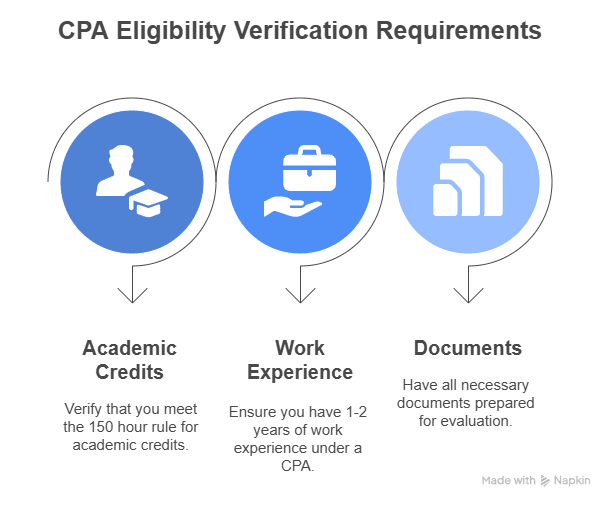
If you’re serious about making the CPA certification your next big career milestone, understanding your eligibility isn’t just a formality – it’s absolutely critical. Getting this step right up front sets the entire stage for your success and ensures your CPA journey is smooth and focused.
So take a moment. Verify your academic credits. Check your work experience records. Get those documents in order. Because this isn’t just preparation – it’s your first smart move toward a career where you’re recognised not just for what you know, but for the impact you create.
Discover the earning potential of a US CPA in India and abroad, as this video reveals the top career paths, salaries, and global opportunities available to CPA-qualified professionals.
CPA Eligibility vs CA, ACCA & CFA – Quick Comparison
Choosing the right professional qualification starts with understanding who can apply. Here’s a quick eligibility comparison for top global certifications:
Criteria
CPA (US)
CA (India)
ACCA
CFA
Minimum Qualification
✅ Bachelor’s Degree
✅ 10+2
✅ 10+2
✅ Bachelor’s / Final Year
Commerce Background Needed
❌
✅ Useful
❌
❌
Extra Credit Requirement
✅ 150 Credits (Bridge Possible)
❌
❌
❌
Work Experience Before Exam
❌
❌
❌
✅ Required for Charter
Global Recognition
✅ Very High
❌ Limited
✅ Good
✅ High
CPA stands out because its eligibility is straightforward, globally recognised, and flexible for both students and working professionals.
Is CPA worth it?
Absolutely – and not just on paper. But beyond the numbers and requirements, what truly matters is how the CPA can change your career journey in real life.
As a B.Com graduate in India, who always dreamed of working in a global finance environment but felt unsure where to begin. Once you have learned all that was needed with a few additional accounting credits, a credential evaluation, and the right guidance, the path suddenly becomes much clearer.
You can work as an Audit Associate at a leading Big Four firm. The CPA doesn’t just upgrade your qualification – it expands your opportunities, confidence, and career direction.
Why Choose Imarticus for Your CPA Journey
I’ve seen how daunting this whole process can be, and that’s where Imarticus Learning steps in. They don’t just teach CPA content; they guide you through eligibility, application, and exam preparation with care and expertise. Join Imarticus Learning’s CPA program to fast-track your journey with:
Expert instructors who know the CPA rules inside and out.
Flexible study options that suit your pace.
Tailored support for Indian students navigating the US CPA system.
High-quality study materials with premium access and mock exams to build confidence.
If you’re unsure where to start, guided coaching can make the process clearer.
Imarticus Learning helps learners understand eligibility, complete evaluations, prepare for exams, and build confidence with mentor-led support.
Key Takeaways
✅CPA eligibility means meeting education (bachelor’s + credits), experience (1-2 years supervised), and exam requirements specific to your jurisdiction.
✅Indian degrees such as B.Com, M.Com, MBA Finance, CA, or CMA can fulfil educational criteria, but be ready for variations state-by-state.
✅CPA is accessible with the right guidance and preparation, even if you’re not a CA or don’t have an accounting background.
✅With focused effort, clearing the CPA in 1 year is achievable.
Discover how you can transition from CPA to CFO with expert guidance, real-world learning, and the essential leadership skills to excel at the top of your finance career.
FAQs on CPA Eligibility
If you’re thinking about the CPA eligibility, you probably might have a few more questions buzzing in your head. Here are a few frequently asked questions to clear things up about CPA eligibility.
Who is eligible for CPA?
Anyone with a recognised bachelor’s degree (or equivalent) with around 120-150 semester credit hours in accounting and business-related subjects is eligible for CPA. Most US states also expect 1-2 years of professional experience under a licensed CPA before granting your license.
If you’ve done a B.Com, M.Com, MBA (Finance), or hold professional qualifications like CA or CMA, you’re already on the right track – though the exact requirements vary by state.
Can I do CPA directly after 12th?
Not yet – you can’t jump into the CPA right after Class 12. You’ll first need to complete your bachelor’s degree with the required accounting credits.
Some states may allow you to sit for the exam in your final year, but you must finish your degree before applying for the license.
Is CPA harder than CA?
CPA and CA have different focuses and difficulty levels; CA is intensive in Indian tax laws, audit, and accounting, renowned for its low pass rates. CPA is rigorous with a global outlook, emphasising U.S. GAAP, auditing, and regulations, but is often seen as more accessible with structured preparation. Which is “harder” depends on your background and exam preparation approach.
Can I become a CPA without being a CA?
Absolutely! You don’t need to be a CA to become a CPA. As long as you meet the education, exam, and experience criteria set by your state board, you’re eligible – no prior certification required. Imarticus Learning guides students through the evaluation and state selection process so you can choose the right state board based on your educational background.
What is the minimum educational requirement to be eligible for the CPA exam in the US?
Most U.S. states require candidates to have 150 semester hours of education. This typically means a bachelor’s degree (around 120 hours) plus an additional 30 semester hours of coursework in accounting and business-related subjects.
Can Indian students take the CPA exam?
Yes, Indian students are eligible to take the CPA exam. They must meet the educational requirements – usually 150 semester hours, which is often achieved through a combination of Indian degrees like B.Com + M.Com, B.Com + CA, or B.Com + MBA and have their academic credentials evaluated by an authorised agency for U.S. equivalency.
Is an M.Com or CA qualification sufficient for CPA eligibility?
Yes, B.Com + M.Com, B.Com + CA, or B.Com + MBA typically help meet the 150-hour requirement.
However, it’s smart to get your credits pre-checked. Imarticus Learning helps you assess whether your degree combination meets the credit hour and subject-specific criteria for your target CPA state board.
Your CPA Eligibility: The First Step Toward Global Success
Getting your CPA eligibility sorted is more than just a requirement – it’s your entry pass to a global finance career. The CPA isn’t just about knowing numbers. It’s the ability to think like a leader, making strategic decisions, and becoming the professional companies trust at the highest level.
And the best part?
With the right guidance, the journey is absolutely achievable. You don’t require a commerce background or years of experience to begin your CPA certification journey. Take that first small step with clarity, a simple plan, and confidence.
So take a moment – check where you stand, see what’s required, and start at your own pace.
You’re closer than you think. Your future as a globally recognised CPA is waiting.
In the vast world of cybersecurity threats, Trojan Horse malware stands out as one of the most insidious. Named after the Greek strategy used during the Trojan War, these malicious programs sneak into your system disguised as legitimate software, only to wreak havoc once inside.
A Trojan horse (or just Trojan) is a type of malicious software that trick clients into thinking it’s a harmless program. It gets its name from the ancient Greek tale of the Trojan Horse that led to the downfall of Troy.
Trojans usually spread through tricks called social engineering. Understanding what is Trojan Horse and learning how to protect yourself from Trojan viruses are crucial steps in safeguarding your digital life.
What is Trojan Horse?
A Trojan Horse is a type of malware that deceives users by masquerading as benign or useful software. Unlike viruses and worms, which replicate and spread autonomously, Trojans rely on social engineering tactics to trick users into executing them.
The term “Trojan Horse” derives from the ancient Greek tale where Greek soldiers hid inside a giant wooden horse presented as a gift to the city of Troy. Similarly, Trojan malware hides its malicious intent under the guise of a seemingly harmless program or file.
This story gives its name to modern “Trojan horse” cyber attacks for a few reasons:
The Trojan horse was a clever way to bypass Troy’s defenses after years of trying unsuccessfully to breach them. Similarly, a Trojan virus can bypass strong cybersecurity measures.
The Trojan horse looked like a harmless gift, just as a Trojan virus disguises itself as legitimate software.
Once inside, the Greek soldiers controlled Troy’s defenses. Similarly, a Trojan virus can take over your computer, making it vulnerable to other malicious attacks.
In simple terms, just as the Trojan horse was a sneaky way to conquer Troy, a Trojan virus is a sneaky way for cyber attackers to take control of your computer.
How Trojans Work?
Understanding how Trojans work is essential for recognizing and defending against them. Trojans typically infect systems through:
Phishing emails: Disguised as legitimate messages, these emails contain malicious attachments or links.
Software downloads: Trojans are often bundled with free software downloads from untrusted sources.
Exploiting vulnerabilities: Some Trojans take advantage of security flaws in software or operating systems.
Types of Trojan Malware
Trojans come in various forms, each with specific targets and methods. Here are some of the most common types of Trojan Malware:
Backdoor Trojans
Backdoor Trojans create unauthorized access points on infected systems, allowing attackers to control the device remotely. This type of Trojan is particularly dangerous as it can facilitate further attacks and espionage.
Banking Trojans
Banking Trojans specifically target financial information. They often intercept online banking transactions, capturing login credentials and other sensitive data.
Remote Access Trojans (RATs)
Remote Access Trojans (RATs) grant attackers complete control over the infected system. This access can be used for surveillance, data theft, or launching additional attacks.
Rootkit Trojans
Rootkit Trojans are designed to hide their presence and the presence of other malicious software on the system. They modify system settings and processes to evade detection by antivirus programs.
Other Notable Types
Other types of Trojans include DDoS Trojans, which facilitate distributed denial-of-service attacks, and Ransomware Trojans, which encrypt files & demand ransom payments for decryption.
How to Recognize a Trojan Virus?
Spotting a Trojan infection early can mitigate damage. Here are some common signs to watch for:
System slowdowns: Unexplained sluggishness can indicate the presence of a Trojan consuming resources.
Unexpected pop-ups: Frequent, unsolicited pop-ups are a red flag.
Unfamiliar programs: Unknown software appearing on your system is a cause for concern.
Unusual network activity: High levels of network traffic or unexpected data transfers can signal a Trojan.
Changes in system settings: Unauthorized modifications to settings or security configurations can also be indicative of an infection.
How to Protect Yourself from Trojan Viruses?
Prevention is always better than cure. Here are some effective strategies to protect against Trojan infections:
Protecting yourself from Trojan viruses is essential to keep your computer and personal information safe. Here are some easy steps you can take:
Be cautious with emails and links: Avoid email opening from unknown or suspicious sources. Sometimes, Trojans come disguised as emails from friends or legitimate businesses.
Download from trusted sources: Only download software and apps from well-known and reputable websites. Avoid downloading from pop-up ads or unfamiliar sites, as they may contain Trojans.
Keep your software updated: Regularly update your operating system, antivirus software, and all programs on your computer.
Use strong passwords: Create strong passwords for your accounts. Avoid using easily guessable passwords like “123456” or “password.”
Be careful with removable devices: Scan USB drives, external hard drives, and other removable devices for viruses before opening any files or transferring data.
Use a reliable antivirus program: Install updated antivirus software. It can detect and remove Trojans before they cause harm to your computer.
Importance of Antivirus Software
Using reputable antivirus software is crucial. These programs can detect and remove Trojans before they cause significant harm. Make sure that your antivirus software is always up to date to combat the latest threats.
Regular System Updates
Keeping your operating system & all software up to date is another important defense strategy. Software updates frequently include fixes for security flaws that Trojans exploit.
Conclusion
In the digital age, the threat of Trojan Horse malware is ever-present. By understanding what is Trojan horse, recognizing the signs of an infection, & taking proactive steps to protect yourself, you can easily reduce the risk of falling victim to these malicious programs. Additionally, investing in cyber security courses online can further arm you with the knowledge needed to safeguard your digital assets.
Master Cybersecurity, Cryptography, and Blockchain with Imarticus Learning
Explore the dynamic domains of cybersecurity, cryptography, and blockchain through Imarticus Learning, where cyber security courses online mirror real-world industry practices. Our curriculum and teaching approach serve as your guide to mastering essential skills, preparing you for a secure and innovative future. You’ll learn to defend against cyber threats, implement encryption for data security, and understand blockchain’s transformative impact across industries. Additionally, students benefit from EC-Council-aligned content, hands-on experience on EC-Council iLabs, and an exam voucher for the EC-Council CEH certification.
Designed in collaboration with IIT Guwahati and industry experts, our curriculum emphasizes networking fundamentals, ethical hacking, vulnerability analysis, and blockchain technology. Engage in immersive lab sessions where you’ll work with industry-standard tools like VMware, Kali Linux, Wireshark, Nessus, and Nmap, demonstrating practical proficiency in cybersecurity techniques.
Interact live with cybersecurity experts from IIT Guwahati and industry leaders in interactive sessions covering networking, ethical hacking principles, vulnerability assessment, and blockchain concepts. Prepare yourself for a rewarding career in cybersecurity with Imarticus Learning.
Join us to fortify your skills and prepare for the future of cybersecurity with Imarticus Learning.
Financial planning is creating a roadmap for the financial future. It’s about making sure you know where you’re going and how you’re going to get there. Whether you’re just starting your career, planning for a family, or gearing up for retirement, understanding the objectives of financial planning is essential for achieving financial security.
It’s not just about saving money; it’s about making informed decisions that help you achieve your life’s aspirations.
Short-Term Financial Goals
Setting short-term financial goals helps build a strong foundation and boosts confidence for tackling bigger, long-term goals. These simpler objectives can often be achieved within a year. Examples include:
Creating a budget and sticking to it.
Building an emergency fund.
Paying down credit card debt.
Examples of Financial Goals
People can set various financial goals depending on their needs and aspirations. Common goals include:
Paying off debt.
Saving for retirement.
Building an emergency fund.
Saving for a down payment on a home.
Saving for a child’s college education.
Feeling financially secure.
Being able to help a friend or family member financially.
How to Start Setting Your Financial Goals?
A practical way to set financial goals is to use the SMART method. SMART stands for Specific, Measurable, Achievable, Relevant, and Time-based. This means you should clearly define your goals, determine how to measure progress, ensure the goals are realistic, confirm they are important to you, and set a deadline for achieving them. For example, if you’re planning for retirement, specify the age you want to retire and the amount of money you want to have saved by that time. Make sure this goal is realistic and create a plan to reach it within a set timeframe.
Should You Make a Budget?
Creating a budget is an essential part of financial planning. A budget is a financial plan for a specific period, often short-term, that helps you track your finances, adjust your spending, and achieve your financial goals, such as saving money or reducing debt.
Importance of Financial Planning
The significance of financial planning can’t be overstated. Here’s why:
Clarity and Direction: Financial planning provides a clear direction for your financial decisions, helping you prioritize your spending, savings, and investments.
Preparedness: It prepares you for emergencies and unexpected expenses, ensuring you’re not caught off guard.
Peace of Mind: Knowing that you have a plan in place reduces financial stress and allows you to focus on other important aspects of life.
Types of Financial Planning
There are various financial planning types tailored to different aspects of your financial life. Here are a few key ones:
Retirement Planning: Ensuring you have enough saved and invested to maintain your lifestyle in retirement.
Estate Planning: Making arrangements for your assets to be managed and distributed after your death.
Tax Planning: Minimizing your tax liabilities through strategic planning.
Investment Planning: Building and managing a portfolio to grow your wealth over time.
Objectives of Financial Planning
The objectives of financial planning are specific targets that guide your financial decisions. Let’s explore some crucial objectives:
Setting Financial Goals
Setting clear, achievable financial goals is the cornerstone of financial planning. These goals could be short-term, like saving for a vacation, or long-term, like buying a house or retirement. The key is to be specific and realistic.
Budgeting
A budget helps you track your expenses & income, ensuring you live within your means. It’s the foundation of financial discipline, preventing overspending and encouraging saving.
Saving for Emergencies
An emergency fund is essential. It also acts as a safety net for finances, supplying money for unforeseen costs like urgent medical attention, auto repairs, or job loss. Save enough money to cover your living expenses for at least three or six months.
Debt Management
Managing debt effectively is crucial. Prioritize paying off high-interest debts first and also avoid accumulating new debts. This helps improve your credit score and frees up more money for savings and investments.
Investment Planning
The goal of investing is to increase your wealth over time. Recognize your risk tolerance and make investing decisions in line with your financial objectives. The secret to reducing risks and optimizing returns is diversification.
Retirement Planning
Plan early for retirement. Make consistent contributions to retirement accounts. Over time, the compounding effect can help you save a larger amount for retirement.
Tax Planning
Effective tax planning can save you a significant amount of money. Utilize tax-advantaged accounts, take advantage of deductions and credits, and consider the tax implications of your investment choices.
Benefits of Financial Planning
The benefit of financial planning extends beyond just monetary gains. Here are a few:
Financial Security: A well-structured financial plan ensures you have enough resources to meet your needs and goals.
Improved Standard of Living: With proper planning, you can maintain or improve your lifestyle without financial stress.
Achieving Goals: Whether it’s buying a home, starting a business, or traveling the world, financial planning helps you achieve your life goals.
Stress Reduction: Knowing you have a plan in place to handle financial uncertainties brings peace of mind.
The Final Words
Understanding the objectives of financial planning is crucial for financial security and success. By setting clear goals, managing your budget, saving for emergencies, and investing wisely, you can build a solid financial foundation. The importance of financial planning can’t be overlooked, as it brings clarity, security, and peace of mind. Whether you’re just starting or looking to refine your financial strategy, financial planning is a journey worth embarking on.
CFO Leadership Development Program: Transforming Aspiring Leaders into Financial Visionaries
A CFO course (Chief Financial Officer course) can be incredibly beneficial for those looking to deepen their financial knowledge and skills. These courses provide advanced training in financial management, strategic planning, and decision-making. For anyone serious about mastering the details of financial planning, a CFO course can be a valuable investment in their education and career.Imarticus Learning offers an exceptional program designed to elevate promising business leaders into the coveted C-Suite role in finance. This program equips aspiring CFOs with the skills to craft visionary financial strategies, overcome obstacles, make informed decisions, and drive exceptional performance. It serves as your gateway to a transformative future, leading you to the CFO’s chair with inviolable confidence & competence.This CFO course provides participants with an insider’s perspective on the day-to-day operations of a CFO. It comprehensively covers the strategic and tactical dimensions intrinsic to the Chief Finance Officer role.The highlight of this CFO specialization is its experiential learning. Through practical simulations offered by Imarticus Game Studio, participants can apply their expertise in a secure setting, tackling genuine issues and developing the capabilities of a C-Suite Business Leader.It involves more than just understanding theories—it involves combining them with practical applications. Through a series of six masterclasses, the GSLP’s CFO Specialization Certificate provides an unrivaled opportunity to learn from some of the most successful and prominent business leaders in the world.Embark on your journey to the C-Suite with Imarticus Learning. Become the visionary CFO you aspire to be.
In the world of digital marketing, two terms that often cause confusion among beginners are SEO (Search Engine Optimization) & SEM (Search Engine Marketing). While they both aim to increase visibility in search engine results, they differ significantly in approach and execution.
Since Google Search launched in 1997, the company has dominated the search engine market, far outpacing its competitors. Most of Google’s revenue comes from advertising. Its parent company, Alphabet, became one of the largest internet firms globally by 2023, valued at $1.6 trillion.
Google has expanded into email, productivity tools, business solutions, mobile devices, and more. In 2023, Google earned one of the highest revenues among tech companies, totaling approximately $305.6 billion. Let’s delve into each concept to clarify their roles and how they can benefit your online presence.
What is SEO?
SEO stands for Search Engine Optimization. It includes the practice of optimizing the website to increase organic (non-paid) traffic from search engine results pages (SERPs).
SEO involves various strategies, both on-page and off-page, to improve your website’s visibility and authority. On-page SEO focuses on optimizing individual web pages with content, HTML tags (like title tags and meta descriptions), and technical aspects (such as site speed and mobile-friendliness). Off-page SEO includes building backlinks from other websites and improving your site’s reputation through social media and online communities.
Types of SEO
There are broadly two types of SEO:
On-Page SEO: This includes optimizing content, meta tags, headings, and internal linking to improve the relevancy of your web pages for specific keywords.
Off-Page SEO: This involves activities outside your website, such as link building, social media marketing, & influencer outreach, to enhance your site’s authority and reputation.
When to Use SEO:
Building Authority and Credibility: Use SEO when you want to establish your website as a trustworthy source in your industry. High-quality content that ranks well organically can enhance your brand’s credibility.
Long-term Growth: If you’re looking for sustainable growth, invest in SEO. It helps build a strong foundation that can generate continuous traffic over time without ongoing ad costs.
Cost-Effective Marketing: SEO is ideal for businesses with limited advertising budgets. It offers a cost-effective way to increase visibility and attract traffic without paying for ads.
What is SEM?
SEM stands for Search Engine Marketing. Unlike SEO, which focuses solely on organic traffic, SEM encompasses both organic & paid strategies to enhance visibility in search engines. In other words, SEM includes SEO as well as paid search activities.
Pay-per-click (PPC) advertising is the mainstay of search engine marketing (SEM). Advertisers bid on keywords that you may enter into search engines when looking for a product or service; they then pay the search engine a fee when a user clicks on that particular ad. The most widely used SEM platform is Google Ads, which lets advertisers display their ads in the results section of the search engine results page.
Types of SEM
SEM can be categorized into:
PPC (Pay-Per-Click): This involves bidding on keywords & paying each time a user clicks on your ad. It’s a targeted approach to drive immediate traffic to your website.
Display Advertising: This also includes banner ads and other visual advertisements that appear on websites within the Google Display Network or other ad networks.
Remarketing: This strategy targets those users who have visited your website previously with customized ads as they also browse other sites or social media platforms.
When to Use SEM:
Immediate Visibility: Use SEM when you need instant visibility, like for a product launch or promotion. It places your ads at the top of search results, ensuring immediate exposure.
Highly Targeted Advertising: SEM allows precise targeting based on keywords, location, device, and more. This also helps you reach the most relevant audience for your products or services.
Competitive Markets: In industries where established competitors dominate organic search results, SEM can level the playing field. It ensures your business gets noticed quickly.
Key Difference between SEO and SEM
Visibility: SEO focuses on improving your website’s visibility in search results naturally, without paying. SEM also involves paying for ads that appear at the top of search results, providing quicker visibility.
Cost: SEO is cost-effective in the long run because it doesn’t require payments for clicks or views. However, it needs ongoing effort and time. SEM delivers instant results but requires a budget for ad expenses.
Time for Results: SEO involves a long-term strategy where significant improvements in rankings and traffic can take months. SEM provides immediate visibility and traffic, suitable for short-term campaigns or boosting ongoing SEO efforts.
Click-through Rates (CTRs): Organic search results often have higher click-through rates than paid ads because some users prefer skipping ads. However, SEM allows for targeted ads, which can be very effective if optimized well.
Integrating SEO (Search Engine Optimization) with SEM (Search Engine Marketing) is a potent tactic to boost online visibility and overall marketing effectiveness. While SEO emphasizes organic search traffic, SEM utilizes paid advertising.
By combining these strategies, businesses can expand their audience reach, strengthen brand visibility, and enhance performance. SEM campaigns offer valuable keyword data that can optimize SEO content, while A/B testing through SEM informs improvements in landing pages beneficial for both approaches.
Conclusion
While SEO and SEM share the common goal of increasing visibility in search engines, they employ different tactics to achieve this objective. SEO focuses on optimizing your website organically through content and technical enhancements, while SEM incorporates paid advertising like PPC to drive immediate results.
Understanding the difference between SEO and SEM is important for developing a digital marketing strategy. Depending on your goals, budget, and timeline, you can leverage SEO for sustainable, long-term growth and SEM for immediate visibility and traffic.
By mastering these concepts and pursuing certifications in digital marketing, you can effectively navigate the dynamic landscape of online marketing, ensuring your efforts yield maximum results and ROI.
Professional Certification in Digital Marketing and MarTech with Imarticus Learning
In today’s digital age, businesses increasingly rely on technology and digital platforms to engage with their target audiences effectively. The rapid evolution of technology necessitates skilled professionals who are adept at digital marketing and capable of adapting to constant industry changes.
Imarticus Learning has collaborated with IIT Roorkee to offer a comprehensive digital marketing and MarTech course designed for aspiring marketers. This program equips participants with essential skills in social media strategies, SEO techniques, affiliate marketing, and more, all from a prestigious institution.
Embark on a career in digital marketing and MarTech by acquiring the latest tools, mastering emerging trends algorithms, and gaining practical experience through real-world projects.
You’ll earn a certification in digital marketing from IIT Roorkee, enhancing your resume and positioning you as a top candidate in job interviews. Benefit from the expertise of India’s finest trainers and faculty members through interactive online sessions and enriching discussions. Throughout your learning journey, our dedicated program mentors, seasoned in the field, will guide you, motivating you to achieve your career aspirations in digital marketing and MarTech.
Enquire Now to Secure Your Future in Digital Marketing and MarTech!