Microsoft’s CEO, Satya Nadella diagnosed a core issue with our modern world: “…the true scarce commodity is increasingly human attention.” So how do digital marketers, whose primary job is to grab eyeballs and hold human attention, circumvent this problem?
You only have to look up Dave Chapelle’s meme to know the answer: “Modern problems require modern solutions.” And the modern solution for digital marketers is: Memes!
If you want to leave a mark in your career in digital marketing, you must know the ins and outs of meme marketing. Read on to establish your footing in the digital marketing space by harnessing the power of memes.
What is Meme Marketing?
Memes are everywhere! Whether it’s the Disaster Girl, the Distracted Boyfriend, or Spiderman pointing at Spiderman meme- you have definitely seen, shared or been sent these memes. But what are memes?
The phrase ‘meme’ was initially used by the evolutionary biologist Richard Dawkins in his book, ‘The Selfish Gene,’ published in 1976. The author simply saw memes as the counterpart of genes in the cultural domain: a “unit of cultural transmission.”
Today, memes mean any content (images, GIFs, videos, texts) that is humorous and spreads online, often with slight variations. Memes have taken over the digital marketing space by storm, and how! From box office clashes of mega-budget movies and rebranding of social networking giants to people’s movements, memes have taken over our screens (and lives).
Marketers have also realised that getting on the bandwagon is the best way to leverage meme power to increase the reach and popularity of brands. Meme marketing is a form of viral marketing to spread a brand’s narrative through memes. Through meme marketing, brands can combine value, quick consumption, and humour through social media to increase visibility and organic engagement.
A career in digital marketing necessitates you have your meme game on. Don’t become archaic. Here’s what makes meme marketing essential.
Why You Need Meme Marketing?
Meme marketing as a digital marketing strategy is marketing gold. The biggest brands have come to play, and here’s why.
Easy to create:
Memes are easy to create since the foundations (content and format) are already there. All you need to do is work your creative magic and seamlessly tie your brand’s narrative to memes. You will never run out of (often free) material to build on. And the audience will never run out of content to engage with your brand.
Boosts engagement:
Memes have become the language of the internet. They make brand promotion organic and eliminate the forced quality of other forms of marketing. Likes, shares, and comments are sure to follow if you play your cards right, increasing audience engagement.
Relevant:
Every meme has its time and place. The context of the meme guarantees that the audience will relate to it because it is connected to the here and now. From their everyday lives and workplace experiences to political events and social structures- memes help people communicate about their worlds.
High recall value:
If you brought your A-game to meme marketing, you are sure to have made yourself memorable. If your meme was able to make someone laugh or worthy enough to be shared (the MVP of memes), they will remember your name. It contributes positively to your brand recall and awareness.
A Winning Meme Marketing Strategy
The recipe for success is to get the ingredients and strategy right. Take a look at what goes into the making of a successful meme marketing strategy.
Know your target audience:
Identify your target audience to cook up a meme that directly speaks to them. Demographics play a huge role in how your audience will receive the meme.
Establish your brand voice:
Consistency is key. Floundering around and speaking in many voices will only confuse the audience. Find your brand voice and stick to it. Be consistent with your brand’s values.
Simplify and personalise:
Memes are not meant to be complicated. Keep it simple. More importantly, the meme should not be random. Personalise it to your brand (and its products and services) and be creative. Don’t lose track of the main objective: brand awareness.
Timeliness:
Don’t get left behind the times. Be quick to action and use trends to build traction for your brand. Draw on viral content to leverage your content.
Understand context:
Be careful what you wish for: your offensive meme can go viral. So, researching the socio-cultural context of your audience is important to avoid any hurt feelings and sentiments. Context matters for memes.
Conclusion
To meme or not to meme, asked a marketer.
The answer is always: to meme!
With an overload of content, grabbing attention can be exhausting. Memes are just the way out for marketers to make your brand meme-orable. Memes can make you a part of the conversation using humour and gain traction through organic engagement. Want to learn the tricks of the trade?
We have found the best certification in digital marketing course to give wings to your career in digital marketing! Imarticus brings to you the Advanced Certification In Digital Marketing And MarTech. The 4.5-month program by IIT Roorkee, India’s premier institute, will drive your career growth through an intensive immersion into digital marketing to make you industry-ready. Enrol today and jumpstart your career.
As businesses continue adapting to the cut-throat digital landscape, investing in cost-effective and efficient marketing strategies has become the need of the hour.
One of the most effective digital marketing approaches is the use of paid advertisements to maximise ROI (return on investment). ROI evaluates an investment’s profitability. It implies that your investment is growing efficiently and quickly.
Paid advertising implies a digital marketing approach where advertisers reimburse a fee whenever they get clicks on their ads. It is the fastest digital marketing technique to help prospective customers discover your brands and services/products.
In a 2022 survey,64% of responding brand marketers globally mentioned that they were quite confident in their company’s competence to measure ROI (return on investment) for social media marketing. Optimising your website and Google ads is an excellent resort to boost ROI.
Let’s go through various approaches that can help maximise ROI with paid advertising and boost your career as digital marketer.
1) Specify your objectives and target audience
You must be clear with your objectives and the audience to target before using a paid ad campaign. Determine whether you want to drive business traffic, increase brand awareness, or generate leads. Specifying your objectives will let you choose the most suitable ad platforms and prepare customised ad content that meets the need of your target audience.
2) Select the right platforms
Various ad platforms such as Google Ads, Instagram Ads, Facebook Ads, and LinkedIn Ads are available. Make sure to research each platform’s reach, user demographics, and advertising features to decide which ones will offer the maximum ROI. Pursuing a digital marketing course with job placement familiarises you with how to maximise ROI, including how to choose the right platforms.
3) Conduct keyword research
Conducting keyword research makes a paid ad campaign more effective. It helps you determine the right phrases and keywords that your targeted audience primarily uses to search for relevant products. Keyword research helps you incorporate the appropriate keywords in ads. Consequently, you can enhance elements like Click-through rate (CTR), Ad position, Quality score, and Ad relevance.
4) Product listings’ optimisation
Make sure the product listing provides precise details about your products/services. You can incorporate key details like product descriptions, images, and specifications. Your products’ images must be high quality to showcase products from various angles and underline their unique features.
The product descriptions must be easy to understand and keyword-rich. You can explain the benefits and features using concise sentences and bullet points to boost readability.
5) Optimise landing pages and ad creatives
To maximise ROI through paid advertising, it is inevitable to create captivating ad creatives that grab your target audience’s attention. Use compelling videos, images, and ad copy that address your potential customers’ requirements and interests. Your landing pages must be optimised for conversions. You can do this by incorporating clear calls to action and making them pertinent and easy to manage.
6) Track the statistics on your ads and optimise
Google Ads tracks information to help you make intelligent advertising decisions. You can customise various metrics to adapt your paid advertising campaigns to boost ROI. Here are the briefs of a few of the most significant metrics to improve quality scores and save money.
Click-through rate (CTR): It denotes the percentage of people who view your ad and click on it.
Cost per conversion (CPC): It is the average amount of money you invest in ads to obtain one conversion.
Conversion rate: It denotes the percentage of people who click your ads and transform into customers.
These metrics suggest the performance and effectiveness of your paid advertising campaigns. You may need to incorporate some changes if your CPC is high and also in case it is below average.
7) Test and optimise
Your paid advertising campaign needs continuous testing and optimisation to maximise ROI. You need to test various ad formats, keywords, messaging, landing pages, and targeting options to determine what works best for your audience and business.
You can conduct A/B testing on ad copy, ad creatives, targeting, and bidding strategies. Consequently, you can determine your campaigns’ top-performing elements. Moreover, you can use data-controlled insights to boost ROI. After conducting testing, feel free to iterate and make the required adjustments.
8) Intelligently allocate budget
You must wisely allocate your paid advertising budget to maximise ROI. It is advisable to begin with a small budget, and as you attain more insights into your campaign’s performance, you can accordingly adjust your budget.
You may have to redistribute funds to the best-performing campaigns and platforms. You can invest in retargeting attempts to reconnect potential customers interested in your products/services.
Conclusion
Maximising ROI using paid ads demands a tactical approach that involves defining objectives, ad optimisation, targeting, performance monitoring, testing, and all related aspects. Implementing the discussed strategies can help businesses gain the best benefits out of your paid advertising campaign. Also, you can pick a suitable digital marketing certification course to learn strategies that help you gain valuable insights on optimising a paid advertising campaign.
Post Graduate Program In Digital Marketing course offered by Imarticus is an impeccable choice to kickstart a rewarding digital marketing career. It makes you a certified digital marketing professional and helps your resume appear to stand out from the crowd!
Businesses rely on demands to modify and establish their supply planning. While this sounds like an easy one-step process, in reality, sales and operations planning or S&OP merges a variety of different facets of business in order to streamline the overall functioning of the enterprise.
In this blog, we dive into the intricacies of sales and operations planning and why it is important for you to know about it.
What is Sales and Operations Planning (S&OP)?
Sales and operations planning (S&OP) refers to an integrated business management process designed to balance supply and demand. The S&OP process involves the integration of several areas, such as marketing, product development, sales, procurement, manufacturing, accounting, and finance, in order to meet the organisational and financial goals of the company. Essentially, S&OP helps businesses align their daily operations with their broader corporate strategy.
Generally, the S&OP process occurs every month and could involve artificial intelligence and S&OP software tools for better execution.
Top Supply Chain Analytics Courses
Process of Sales and Operations Planning
Sales and operations planning processes vary from company to company. However, they almost always contain the following steps:
Data gathering: Needless to say, the first step involves gathering existing data such as inventory level, cash on hand, sales, and so on. This is also the ideal time to analyse and assess these data.
Demand planning: Once all the essential data is gathered, updated statistical forecasts can be generated. Therefore, by bringing together new market trends, one-time sale events, price changes, and so on, consensus-based demand planning can be done.
Supply planning: This step involves creating a blueprint that will help meet customer expectations like increased demands, on-time delivery, hassle-free returns process, etc. Supply planning also helps understand any kind of financial or operational constraint a company might be facing that will lead to them not being able to fulfil their objectives.
Review and reconciliation: Once both the demand and supply plans are generated, key decision-makers review the plans and finalise every detail. Furthermore, simulation tools are also used in order to fine-tune the blueprint and make them more reproducible in real-time.
Finalisation: The last step is sending the S&OP process to higher management for final approval and subsequent implementation.
Top 5 Benefits of Sales and Operations Planning
Sales and operations planning provides substantial stability to a business. The top benefits of S&OP are:
Improved decision-making: With the help of AI and various other software tools, business owners can run simulations to check the viability of their demand and supply plans. This will help with better decision-making since individuals will be more aware of the consequences of their planning.
Higher profits: With good S&OP, companies can minimise waste, excessive inventory, and warehousing space wastage, all of which will result in higher profits. Furthermore, S&OP also helps meet customer expectations increasing the profitability of a company.
Better collaboration: Since sales and operation planning involves an integrated approach, different departments under the same business collaborate in a fruitful way and work towards the same goal.
Continual improvement: S&OP usually takes place on a monthly basis. Hence, companies can continuously modify and improve based on the latest data and statistics. This helps businesses scale up while building a reliable foundation for themselves.
Shorter planning duration: Due to the advancement of technology, S&OP has now become much shorter as most of the data gathering, analysis, and assessment is done by software tools in a very quick time. This greatly reduces the time required to plan for the next upcoming demand and supply chain.
Current Trends in S&OP
Just like any other aspect of business, even sales and operations planning have been evolving pretty fast. Some of the current trends in S&OP are:
Improving planning and execution timings to support more frequent S&OP.
Integrating AI and the Internet of Things (IoT) with sales and operation planning.
Enhancing multi-tier collaborations and visibility through technology.
Investing in systems that can conduct rapid supply chain plan analysis, like products with similar demand profiles, supply sources, and so on.
Conclusion
In conclusion, the success of a business depends on a balanced demand and supply chain. This chain, in turn, can be balanced through efficient sales and operations planning (S&OP). Hence, knowing about S&OP processes is essential for both business owners and those who want to build expertise in this field.
This is where Imarticus comes in. The platform provides a comprehensive professional certification course on Sales and Operations Planning (S&OP) taught by the esteemed faculty at IIT Roorkee. In addition to being taught by experts, the students will also have hands-on learning with real-world supply chain management projects, which will further grow their exposure and knowledge. At the end of the course, an official certification will be provided by IIT Roorkee, which will help candidates enter the operations and supply chain industries with ease.
Procurement managers are a crucial part of any organisation. To put it broadly, the responsibility of a procurement manager is to build and maintain supplier relations and oversee transactions when it comes to company purchases.
The role of a procurement manager or purchasing manager demands strong negotiation and analytical skills. It involves devising effective procurement strategies and policies, assessing supplier performance, negotiating contracts with these providers, and dealing with quality issues that arise as a result.
The best way to build a career as a procurement manager is to take a procurement management course that pushes aspirants in the right direction with expert guidance and a charted-out syllabus with relevant coursework.
Who is a Procurement Manager?
A procurement manager is a professional who oversees the “procurement” or purchasing of equipment on the company’s behalf. They are in charge of navigating and drawing contracts with the network of stakeholders, suppliers, manufacturers, and vendors.
Being a procurement manager in an organisation is a position of utmost responsibility. They have to purchase the best quality goods and services at the most competitive prices. Their duty is to enable a company to operate successfully.
Roles and Responsibilities of a Procurement Manager
The responsibilities of a procurement manager involve contacting the manufacturer or supplier, managing vendor relations and drawing contracts. Here are some crucial roles and responsibilities of a procurement manager:-
Supplier and cost evaluation
A procurement manager should always conduct thorough supplier research and interviews before signing a contract. They are also responsible for amassing all the information about current market trends regarding the pricing of the products the company is about to purchase. Based on the conclusion of these reports, they finalise a deal with the most reliable supplier and cost-effective service.
Field research
A procurement manager is also in charge of continued field research. They must stay in contact with the vendors and stakeholders and build long-term relationships to keep abreast of all market trends. They must also attend product promotions, meetings, trade shows, and conferences.
Finalising contracts
Procurement managers also have to assist the legal and financial teams while drawing up the final contract. They must provide all necessary documentation and information to carry out the deal smoothly. They also have to submit a brief or a report of their findings and the whole decision-making process to the company to justify their choice of supplier or deal.
Managing technical systems
A procurement manager is responsible for tracking and monitoring product shipments, deliveries, and inventory stocking. To do this, they must be technologically sound and master the use of the systems involved in the process. They must also be in constant communication with the team, from delivery executives to the inventory staff.
How Do I Become a Procurement Manager?
To become a procurement manager, one must fulfill the following criteria
a post-graduation degree in either Business Administration, Finance, or Economics
Strong research and analytical skills are another aspect of a procurement manager’s personality. From looking into supplier details and records to studying contracts, a procurement manager’s job requires dealing with several intricate details. With these skills, one can excel in the role of a procurement manager.
Certification Courses to Help Build a Career as a Procurement Manager
There are several procurement management courses that seek to impart the necessary skills and knowledge to aspirants wanting to build their careers as procurement managers. Most courses also involve a brief training period with reputed organisations to gain more hands-on experience in the role. Some of these courses are:-
CIPS Diploma Course
The Chartered Institute of Purchasing and Supply (CIPS) Diploma offers six levels of certification for anyone seeking a career in procurement. These six levels are designed to start at the grassroots level- building the base of a beginner and go up to honing the skills of a seasoned professional in the domain. Working professionals who are looking to upskill also have the option of starting directly at the fourth level.
Certification in Supply Chain Management
A certification course in supply chain management involves learning about the different supply chain management topics and amassing the skillset to become a manager. It is a globally recognised certification highlighting your expertise in various procurement functions.
Certification in Strategic Procurement
In India, this course is provided by the Institute of Supply Chain Management to suit aspirants with a career choice in government procurement. It delves into the different strategies and concepts of purchasing management and involves studying legal frameworks to keep abreast of all the relevant laws and by-laws.
Future Prospects in Procurement Management
The future of procurement management is expected to undergo significant transformations due to various factors. Here are a few key trends shaping the procurement future:-
Technology integration
The integration of emerging technologies such as artificial intelligence (AI), machine learning (ML), robotic process automation (RPA), and blockchain is revolutionising procurement processes. These technologies enable better risk assessment, enhance data analysis, automate routine tasks, improve supplier management, and increase overall efficiency.
Data-driven decision-making
The increasing availability of data and advanced analytics capabilities enable procurement professionals to make data-driven decisions. By analysing vast amounts of data related to supplier performance, market trends, and customer demand, procurement managers can optimise sourcing strategies, negotiate better contracts, and identify cost-saving opportunities.
Sustainability and ethical sourcing
With growing awareness and concern for sustainability and ethical practises, procurement management is shifting towards responsible sourcing. Organisations are emphasising environmentally friendly procurement practices, reducing carbon footprints, ensuring fair trade, and promoting social responsibility throughout the supply chain.
Conclusion
Being a procurement manager is not easy. With recent technological innovations and businesses rapidly digitising themselves, the major top skills in demand for a procurement manager are business ethics, stakeholder and supply chain management, and communication skills.
A certified procurement management course not only helps you build these skills but also lays out a viable roadmap for you to achieve your career goals. To keep up with the recent trends in procurement, it is necessary to also learn about the various digital technologies and platforms that are relevant to the job role.
Before you can master strategy and leadership, you first need to build the core skills that define a world-class finance professional. The 9 ACCA exams form this foundation; they’re where every ACCA journey begins. Covering areas like business technology, performance management, taxation, and financial reporting, these papers shape your understanding of how organisations operate, make decisions, and maintain financial integrity.
Together, the 9 ACCA exams under the Applied Knowledge and Applied Skills levels act as the building blocks of the qualification. They ensure that before you move to the strategic stage, you’ve already developed the analytical, technical, and ethical mindset that the ACCA qualification is known for.
In this guide, I’ll walk you through each of these ACCA exams: what they cover, how they connect to real-world finance, and how you can prepare effectively to clear them with confidence.
What Is ACCA? How Do ACCA Exams Build the Foundation for a Global Finance Career?
Whenever someone asks me, “What is ACCA?” I tell them to picture a skyscraper. You can’t build something tall and enduring without a solid base, and that’s exactly what the Association of Chartered Certified Accountants (ACCA) gives you in your finance career. Each of the ACCA exams acts like a floor in that structure: carefully planned, skillfully layered, and designed to take you higher, one level at a time.
The ACCA course is one of the most respected global credentials in accounting and finance. It’s recognised in over 180 countries, trusted by top employers, and valued by professionals who want to go beyond bookkeeping to real financial leadership. Through its structured pathway, from Applied Knowledge to Strategic Professional, ACCA trains you to understand how businesses actually work: how money moves, how value is created, and how ethical decisions shape organisations.
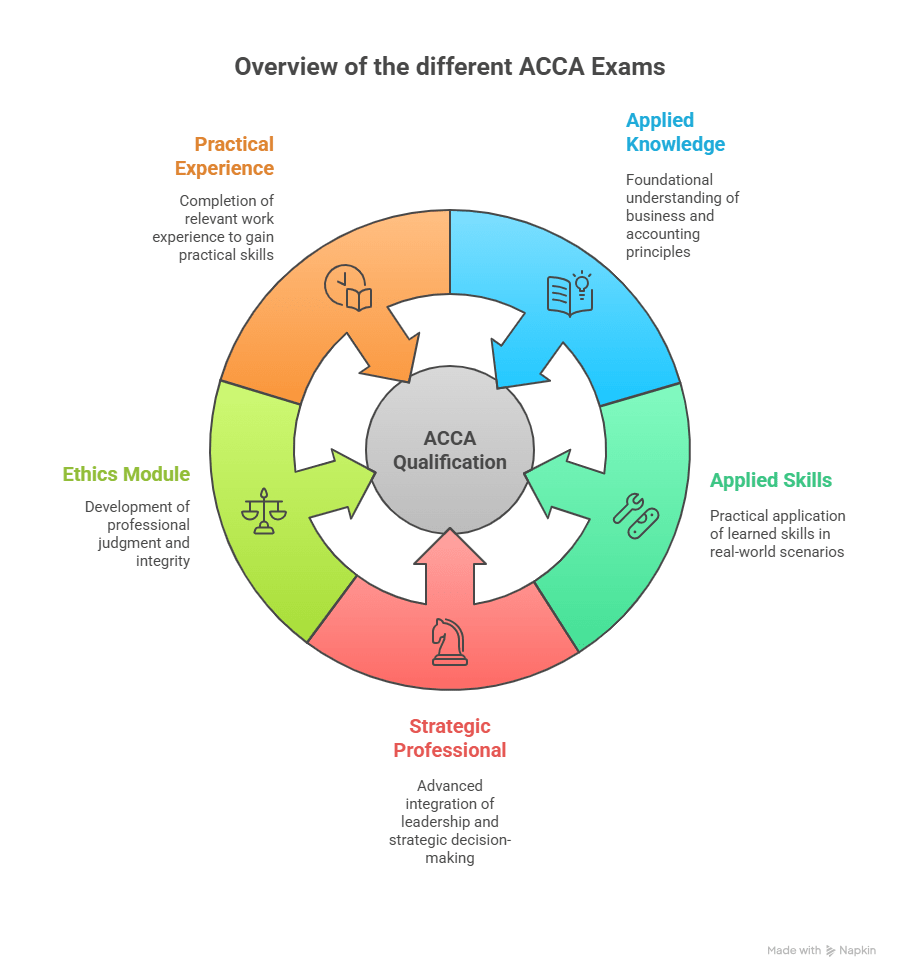
Here is a visual overview of the various ACCA exams that you have to master as you sign up for this credential. Each of these is discussed in detail as we move ahead in this blog.
The foundation begins with concepts like business and technology, performance management, and financial reporting. As you move up, you reach the strategic levels, where you’re learning to think like a CFO, design global strategies, and advise on financial decisions that can transform entire companies.
To simplify, imagine building a skyscraper in a fast-growing city. You need architects, engineers, planners, and strong materials. In the same way, the ACCA exams equip you with technical knowledge, analytical tools, and ethical grounding, the essential materials to build a career that stands tall in any economy.
But what makes ACCA special is how universal it is. Whether you study in Mumbai or Manchester, the standards are the same. It prepares you not just to do accounting, but to understand business; a language that every global organisation speaks.
Watch this video to get a thorough understanding of what the ACCA qualification means for a global finance career:
Structure of ACCA Exams
The structure of ACCA exams is designed to take you from mastering the fundamentals of accounting to becoming a strategic finance leader. Instead of overwhelming students with theory, ACCA builds knowledge in progressive layers, starting with core business concepts and gradually moving into complex analysis, reporting, and decision-making.
The qualification is divided into three key levels:
Applied Knowledge
Applied Skills
Strategic Professional
Each serves a specific purpose in shaping your professional capability. The early levels focus on understanding how businesses function and how financial systems work, while the later ones prepare you to interpret, advise, and lead with financial insight.
Level
No. of Papers
Exam Mode
Focus Area
Applied Knowledge
3
Computer-Based
Core business & financial literacy
Applied Skills
6
Computer-Based / Paper-Based
Practical accounting and financial management
Strategic Professional
4
Computer-Based
Advanced strategy, leadership, and reporting
The first 9 ACCA exams cover everything from business technology to taxation and audit. These aren’t just subjects; they’re simulations of real-world decision-making.
Breakdown of the Applied Knowledge Level
The Applied Knowledge Level is where every ACCA journey begins, covering the fundamentals of business, management accounting, and financial reporting. These initial ACCA exams build the conceptual base for everything that follows.
While there are some challenging ACCA subjects, consistent practice, smart time management, and guided mentoring make mastering this level completely achievable.
Paper F1 (BT): Business and Technology
This paper introduces you to the modern business ecosystem. You learn not just accounting systems, but how technology, governance, and ethics shape a company’s financial behaviour.
For example, understanding how automation changes auditing standards isn’t theoretical; it’s a real scenario many ACCA candidates face in their first roles.
Skills built:
Understanding business structures
Recognising ethical dilemmas
Using digital tools for finance
Paper F2 (MA): Management Accounting
This one turns you into the “numbers whisperer.” You’ll build models to help managers plan budgets, analyse costs, and optimise performance.
To visualise it: if a company produces 10,000 units and wants to find its break-even point, you’ll be the one designing that cost model.
What you’ll master:
Budgeting and variance analysis
Decision-making with cost behaviour
Short-term vs long-term financial planning
Paper F3 (FA): Financial Accounting
You’ll dive into the language of business and accounting standards. This ACCA exam trains you to prepare and interpret financial statements that investors and auditors rely on.
Core Concepts
Practical Use Case
Double-entry bookkeeping
Maintaining general ledgers
IFRS and IAS compliance
Corporate reporting
Trial balance and adjustments
Financial accuracy
Takeaway → If you’ve ever looked at a balance sheet and wondered, “How does this all connect?”, F3 is where you learn that logic.
Breakdown of the Applied Skills Level
Once you’ve laid your foundation, the next six ACCA exams (F4–F9) focus on decision-making, ethics, taxation, and reporting.
Paper F4: Corporate and Business Law (LW)
Law is the invisible skeleton of every business. In this paper, you’ll understand contracts, company structures, and liabilities. Knowing when a company director is legally accountable or how to interpret regulatory updates is key for global accountants.
💡 Fun fact: Over 70% of corporate disputes involve contract ambiguity; ACCA equips you to prevent those before they happen. Source: IFAC Legal Insights Report
Paper F5: Performance Management (PM)
Imagine running a business unit. How do you know if your team is performing efficiently? F5 trains you to measure that using quantitative and qualitative performance indicators.
You’ll build metrics, interpret variances, and link performance outcomes to business strategy.
What makes this ACCA exam important:
Real-world case analysis
Use of key performance ratios
Scenario-based decision frameworks
Paper F6: Taxation (TX)
If finance is a body, taxation is its circulatory system. This paper takes you through how tax systems operate: personal, corporate, and international.
You’ll learn:
Income tax computations
VAT and corporate tax planning
Ethical considerations in tax management
For example, when advising an SME on depreciation or allowable expenses, the principles from F6 decide the financial strategy.
Paper F7: Financial Reporting (FR)
The FR paper is where you become fluent in IFRS. You’ll learn to consolidate statements, interpret financial disclosures, and apply international accounting standards.
ACCA Subject Highlights:
Frameworks for financial reporting
Consolidated accounts and disclosures
Interpretation of statements for decision-making
Paper F8: Audit and Assurance (AA)
In today’s data-driven world, auditors are the gatekeepers of trust. This paper teaches you how to evaluate evidence, understand audit risks, and build internal control systems.
Exam focus:
Audit procedures and sampling
Internal control evaluation
Auditor’s ethical responsibilities
Paper F9: Financial Management (FM)
This ACCA exam is the bridge between theory and boardroom decisions. You’ll learn how to make financing, investment, and dividend decisions under uncertainty.
Key Concepts
Application in Business
Cost of capital
Deciding between debt vs equity
Investment appraisal
Evaluating new projects
Risk management
Hedging and sensitivity analysis
Real-World Application: From Classroom to Career
Here’s a practical example: Imagine you’re analysing whether your company should acquire a new warehouse.
F2 helps you model the cost.
F4 ensures your contract is legally sound.
F7 lets you account for the asset correctly.
F9 tells you if the investment is worth it financially.
That’s how the ACCA exam papers connect theory with strategy; one reason global employers trust this qualification.
Breakdown of the Professional Level of ACCA Exams
If the first nine ACCA papers build your technical foundation, the Strategic Professional Level is where your skills meet leadership. This level has four ACCA exams: two compulsory and two optional. Every ACCA candidate must complete these to earn the full certification.
Unlike the foundational levels that focus on what and how, this stage asks why. Why does a business pursue a certain strategy? Why does one reporting decision change investor perception? That’s the maturity ACCA expects at this level.
If you could sit in a CEO’s chair for four hours, that’s what this paper feels like. It evaluates your ability to lead, make decisions under pressure, and communicate with clarity.
Instead of theoretical questions, you’ll be given a 20-page business case study with multiple exhibits like financial reports, news clippings, emails, and board notes. You must respond as if you’re a senior manager presenting to stakeholders.
You’ll be tested on:
Integrating strategy, leadership, and risk
Corporate governance and ethics
Business communication and stakeholder management
Strategic Business Reporting (SBR)
SBR is the evolution of the earlier Financial Reporting paper. But now, you don’t just prepare reports: you interpret, analyse, and justify reporting choices.
For example, you might need to explain how a company’s fair value adjustments impact investor decisions. That’s why employers value SBR; it shows your ability to defend financial logic at a leadership level.
Skill Tested
Example Scenario
Ethical application of IFRS
Reporting mergers or asset impairment
Professional judgment
Advising the board on disclosure impacts
Analytical communication
Writing investor reports or audit summaries
💡 Expert Tip for Learners:
When you plan your ACCA papers list, never attempt SBL and SBR together if you’re working full-time. Their integrated nature demands separate mental bandwidth. Instead, pair one core paper with one optional (like SBR + AFM).
Breakdown of the Optional ACCA Papers
Every business needs different kinds of financial minds: strategists, auditors, tax planners, or performance consultants. The optional ACCA exams let you specialise accordingly.
AFM: Advanced Financial Management
Think of this as the paper for aspiring CFOs. You’ll learn capital structure planning, foreign exchange risk management, and advanced investment appraisal. Real-world application? Evaluating whether your firm should issue bonds, seek equity funding, or hedge against currency exposure.
APM: Advanced Performance Management
This is for those who enjoy connecting numbers with strategy. You’ll study performance evaluation frameworks like Balanced Scorecards, strategic KPIs, and behavioural performance management.
🎓 In global corporates, APM-qualified professionals often move into Business Analyst or Management Consultant roles, bridging finance and strategy.
ATX: Advanced Taxation
Designed for tax specialists, this ACCA exam deep-dives into cross-border tax issues, inheritance tax, and group taxation. You’ll develop advisory skills to guide clients or employers on complex tax implications.
AAA: Advanced Audit and Assurance
If you’re drawn to risk, ethics, and forensic detail, this one’s for you. AAA tests how you handle complex audits, group audits, and assurance engagements beyond financial audits, such as ESG or sustainability assurance.
Global Career Paths After Each Optional ACCA Exam
The optional ACCA exams at the Strategic Professional level let you shape your career based on your interests: whether it’s financial management, auditing & taxation, or performance strategy. Each paper opens distinct global career paths, helping you specialise in the areas most valued by multinational firms and Big 4 employers.
ACCA Paper
Top Global Career Roles
AFM
Corporate Finance, Treasury, Investment Banking
APM
Performance Analyst, Strategy Consultant
ATX
Tax Consultant, International Tax Planner
AAA
Audit Partner, Risk Advisory, Compliance Lead
Watch this video to explore free resources to help boost your ACCA preparations:
ACCA Exam Exemptions Explained: Who Can Skip Which Papers
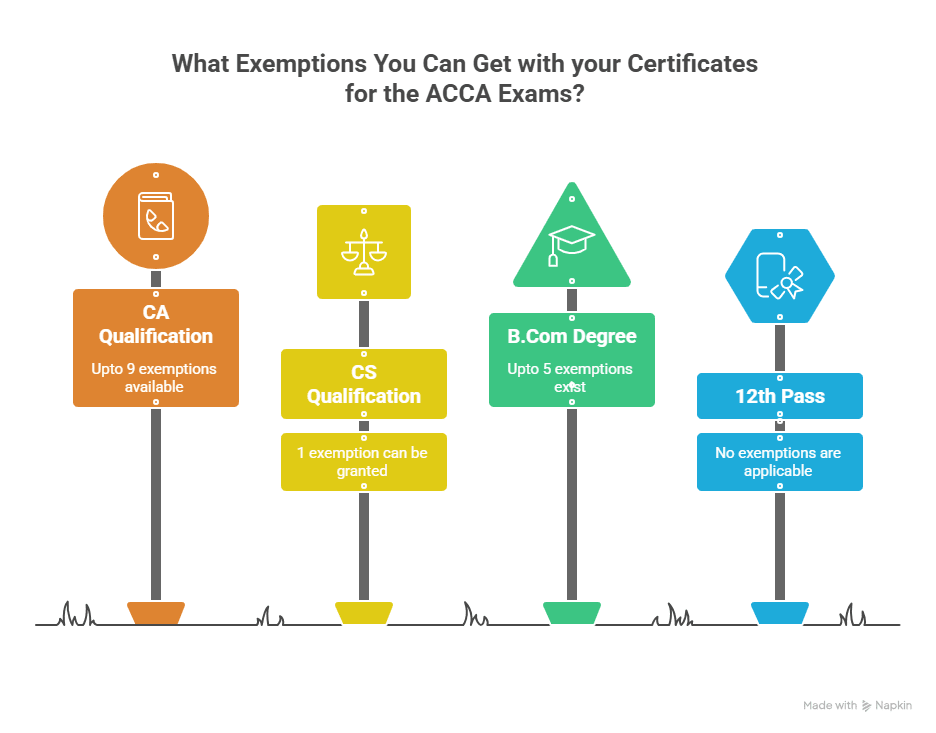
One of the biggest advantages of the ACCA exams is that they recognise your prior qualifications. Depending on your background, you may be exempted from some or all of the nine Applied Knowledge and Applied Skills papers.
If you’re a Chartered Accountant (CA), Company Secretary (CS), or B.Com graduate, you could skip multiple foundational papers like Business and Technology (BT) or Financial Accounting (FA). Even certain postgraduate degrees in commerce or finance can grant exemptions, meaning you can fast-track your ACCA journey.
You can check your eligibility through the official ACCA Exemption Calculator, which matches your existing qualifications with applicable exemptions.
This system saves time, reduces costs, and lets experienced learners focus directly on higher-level ACCA exams that strengthen their global finance credentials.
Explore through this visual which ACCA exams you can get exempted from if you hold certain certifications:
All ACCA exams are conducted four times a year in March, June, September, and December, and can be attempted through both computer-based testing and session-based exams, depending on location.
ACCA Exam Type
Format
Passing Marks
Duration
Applied Knowledge
Objective + Case
50%
2 hours
Applied Skills
Scenario + Short Questions
50%
3 hours
Strategic Professional
Case-Based
50%
3–4 hours
Key Takeaway → You can attempt a maximum of 8 papers a year, with up to 4 in one session.(Source)
Watch this video to explore the ACCA Exam Structure in depth:
Life After ACCA Exams
Today, the finance world is evolving faster than ever: automation, ESG reporting, fintech, and cross-border compliance are reshaping what it means to “work in finance.” And that’s where ACCA professionals stand out. With their deep grounding in international standards and practical decision-making, they aren’t just keeping pace, they’re driving the change.
Whether you see yourself decoding complex mergers, leading a risk advisory team at a Big 4 firm, or shaping financial strategy for a tech startup, your ACCA qualification gives you the flexibility and credibility to do it anywhere, from Mumbai to London to Dubai. According to the ACCA Global Talent Trends 2025, salaries reflect that global premium, with ACCA members often commanding higher packages for their analytical and cross-functional expertise.
But let’s go beyond the usual narrative of “career opportunities.” Here’s what the real landscape looks like today:
Top Career Roles After Completing ACCA Exams
Clearing your ACCA exams opens doors to some of the most rewarding roles in global finance. From auditing and taxation to financial strategy and consulting, here’s a look at the top career paths you can pursue after becoming ACCA-qualified.
Career Path
Core ACCA Papers Linked
Typical Job Titles
Financial Reporting & Analysis
F3, F7, SBR
Financial Analyst, Reporting Manager
Audit & Assurance
F8, AAA
Auditor, Internal Control Specialist
Tax & Compliance
F6, ATX
Tax Consultant, Compliance Officer
Investment & Risk
F9, AFM
Treasury Analyst, Risk Consultant
Strategy & Performance
F5, APM, SBL
Business Analyst, Strategy Lead
These roles often become stepping stones to Finance Controller, CFO, or Partner-level positions within 8–10 years.
ACCA Salary Trends in India and Abroad
One of the most common questions students ask after completing their ACCA exams is, “What kind of salary can I expect?” The truth is, your earning potential as an ACCA-qualified professional is shaped by a mix of factors like where you work, the industry you enter, and the experience you build.
In India, ACCA members often start with roles such as Financial Analyst, Statutory Auditor, or Tax Associate, earning competitive salaries comparable to Indian CAs.
Abroad, ACCA-qualified professionals are recognised across 180+ countries, including the UK, UAE, Singapore, and Canada. This international recognition translates into higher compensation bands and accelerated career mobility, particularly in finance hubs where global reporting and IFRS expertise are valued.
Below is a quick look at the average ACCA salary range after clearing ACCA exams:
Country
Average Salary Range
Top Employers
India
₹6 LPA – ₹25 LPA
KPMG, Deloitte, EY, PwC
UK
£35,000 – £70,000
Barclays, BDO, HSBC
UAE
AED 120,000 – AED 280,000
EY, Mashreq, Emirates NBD
Singapore
SGD 45,000 – SGD 100,000
DBS, OCBC, Accenture
Canada
CAD 60,000 – CAD 120,000
RBC, TD, KPMG
Did you know? In 2025, almost 51% of people who took the ACCA Exams were mid-level management professionals. (Source)
Global Mobility and Demand for ACCA Professionals
The biggest value of the ACCA qualification isn’t just its depth, it’s its passport. Unlike local certifications (such as CA or CPA, limited by geography), ACCA exams give you recognition with high-paying global finance jobs.
Countries where ACCA professionals are in high demand:
United Kingdom
India
Singapore
UAE
Canada
Malaysia
South Africa
Each of these markets values ACCA for one key reason: it aligns with International Financial Reporting Standards (IFRS), which are used by over 140 nations.
💬 “The digital landscape presents significant opportunities for accountancy and finance professionals to achieve meaningful work experiences – ones that are driven by purpose and which afford the potential to stretch oneself in new and fulfilling ways.”
Mark Millar, Head of Education Partnerships, ACCA Global (Source)
Why Choose Imarticus Learning for Your ACCA Journey
As you work through the phases of the ACCA course, you’ll quickly realise two things: one, that the exams demand more than rote learning; and two, that the environment you prepare in makes a huge difference.
Imarticus Learning helps you prepare not just for the papers, but for the role, and the fact that we partner with KPMG in India and integrate globally-recognised content adds real strength.
Imarticus ACCA Program Highlights:
Live mentorship by industry experts
AI-powered performance tracking
Kaplan-published content and mocks
Job assurance with top-tier firms
Option for full or hybrid learning
100% Pass Guarantee and 100% Job Guarantee
FAQs About ACCA Exams
The following section answers some of the most searched and frequently asked questions about ACCA exams: from exam structure and eligibility to exemptions, costs, and career scope. Whether you’re just beginning your ACCA journey or planning your next level, these FAQs cover everything you need to understand how the ACCA qualification works
What are the 13 exams in ACCA?
The ACCA Exams consist of 13 papers divided into three levels: Applied Knowledge, Applied Skills, and Strategic Professional.
Applied Knowledge: Business and Technology (BT), Management Accounting (MA), Financial Accounting (FA)
Applied Skills: Corporate and Business Law (LW), Performance Management (PM), Taxation (TX), Financial Reporting (FR), Audit and Assurance (AA), Financial Management (FM)
Strategic Professional: Strategic Business Leader (SBL), Strategic Business Reporting (SBR), and two optional papers from Advanced Financial Management (AFM), Advanced Performance Management (APM), Advanced Taxation (ATX), and Advanced Audit and Assurance (AAA).
Each paper is designed to progressively develop your technical and strategic expertise in accounting and finance. With Imarticus Learning, you get structured guidance, mentor-led sessions, and access to Kaplan study materials that help you master each of these 13 exams efficiently.
How many exams are there for ACCA?
There are 13 ACCA Exams in total, spread across foundational and advanced levels. However, depending on your prior qualifications (like a B.Com, CA, or CS), you may be eligible for exemptions for some ACCA papers. This flexibility allows professionals and students to fast-track their certification journey. To navigate these exemptions and design a smart study plan.
What are the 9 ACCA exams?
The 9 ACCA exams at the fundamentals level form the backbone of your accounting and business acumen. They include BT, MA, FA, LW, PM, TX, FR, AA, and FM. These exams test your grasp of concepts like management accounting, taxation, financial reporting, and business law. Scoring well at this stage requires consistency and clarity, both of which Imarticus Learning helps you build through live sessions, mock tests, and performance analytics.
What is an ACCA exam?
An ACCA exam is a globally recognised assessment conducted by the Association of Chartered Certified Accountants (UK). Each exam evaluates your theoretical understanding, analytical reasoning, and practical problem-solving abilities in accounting, audit, taxation, and finance. The exams are conducted quarterly, offering flexibility for working professionals. With Imarticus Learning’s online classes, you can prepare strategically for each exam cycle through a blend of live teaching, self-paced learning, and Kaplan’s adaptive resources.
Is ACCA costlier than CA?
The total cost of pursuing the ACCA qualification can range between ₹3–4 lakhs, depending on exemptions and exam attempt frequency. While this is generally higher than the initial CA registration costs, ACCA provides global recognition, access to international roles, and flexible scheduling. Imarticus Learning offers cost-effective ACCA training with EMI options and placement support, making international accounting education more accessible without compromising on quality.
What is the 7-year rule in ACCA?
The 7-year rule in ACCA Exams applies to the Strategic Professional Level, meaning you must pass all four professional papers within seven years of your first pass at that level. This ensures that your knowledge remains current and relevant to the evolving global accounting standards.
Can ACCA earn 1 crore?
Yes, ACCA-qualified professionals can earn ₹1 crore or more annually, especially in senior finance, investment banking, and international audit roles. Salaries depend on experience, location, and domain specialisation. Firms like Big 4s (KPMG, Deloitte, PwC, EY) and multinational banks often seek ACCAs for leadership roles.
Can I finish ACCA in 2 years?
Yes, it’s possible to complete the ACCA Exams in two years if you plan effectively and qualify for a few exemptions. Most students, however, complete it in 2.5 to 3 years. A disciplined study plan and access to the right study material are key. Imarticus Learning’s structured training enables accelerated completion through expert mentorship, performance tracking, and focused revision cycles tailored for quick progression.
Is ACCA closing in 2026?
No, ACCA is not closing in 2026. The ACCA qualification continues to grow in global demand, with employers worldwide recognising its value. The association regularly updates its syllabus to reflect emerging trends in finance, technology, and sustainability. Imarticus Learning keeps its ACCA course aligned with these updates, ensuring students prepare for the most current exam structure and industry expectations.
Will ACCA be replaced by AI?
While AI and automation are transforming the accounting landscape, the ACCA qualification is evolving to include technology, data analytics, and sustainability reporting in its syllabus. This ensures ACCA professionals remain indispensable for strategic decision-making.
How many attempts for ACCA in a year?
Students can attempt ACCA Exams four times a year: March, June, September, and December. You can appear for up to four papers in one session and eight papers in a year, giving enough flexibility to manage your workload and goals. With Imarticus Learning’s expert support, students receive personalised guidance on when to appear for which paper to balance efficiency and exam readiness.
Is ACCA losing its value?
Absolutely not. The ACCA qualification continues to be one of the most globally respected accounting credentials, recognised in over 180 countries. As global financial systems become more complex, ACCA’s emphasis on ethics, technology, and strategic analysis makes it even more valuable today.
Summing Up the ACCA Exams
The ACCA qualification isn’t just a set of exams; it’s a global benchmark that shapes accountants into strategic decision-makers. Each of the 9 ACCA exams builds essential skills in reporting, taxation, performance management, and leadership, creating professionals who can adapt to global standards and digital finance.
In today’s world of automation and analytics, ACCA-qualified professionals are valued for their ability to combine financial insight with ethical and technological awareness. It’s not just about passing exams; it’s about mastering a mindset built for the future of finance.
If you’re ready to take this step, the ACCA course offered by Imarticus Learning in collaboration with KPMG in India, with expert mentorship from industry leaders, is built to help you clear every paper confidently and launch a career that spans borders.
Accounting and finance degrees provide you with expert knowledge in commerce, finance, accounting practices etc. You will also learn about the business environment and the role of technology in accounting and finance today. A career in accounting and finance means you can work as an accountant, financial analyst, tax advisor, chartered accountant etc.
Technology has a significant role to play in the way modern accounting practices are carried out. The arrival of technological solutions brought changes in the process of collecting, processing and analyzing financial data. With the advancement in technology, accounting practices have become more efficient, secure and accurate.
Technology has freed up the time of accounting professionals that was otherwise spent on doing routine tasks. Now, you get the freedom to concentrate on more complex tasks. This has resulted in improved financial reporting and better decision-making.
How has Software Impacted the Career in Accounting and Finance?
New technology has changed the way we do accounting a lot. Back in the old days, people used to write everything down on paper and use calculators to do the math. But then, in the second half of the 1900s, companies created special computer programs called spreadsheets.
With spreadsheets, accountants didn’t have to do as much math because the computer could do it for them. This meant they had more time to think about harder problems and find solutions.
Since then, more new technologies have come along that make accounting easier. There’s a type of software that can automatically fill in important info from financial documents. This means we don’t have to type in all the details by hand anymore.
Another great technology is software that makes it easier to do payroll and taxes. It can automatically figure out how much to pay people and what taxes they owe. It also keeps their tax info safe and secure.
Other Technological Changes in Accounting
Accounting in Cloud
Big data used to be stored securely in an on-premise database. With the invention of cloud computing, you can now rent server space in off-premises locations. That is to say, you can now access stored information over the internet.
This system will free up space in your internal hard drives. It also allows for the collaboration of multiple users to perform financial tasks. That is possible even if they are in different locations.
Data Analytics
Data analytics is the process of cleaning, analyzing and modelling data to draw insights. When you are handling big data, you need these insights to make sound decisions. Today, there are a number of analytical tools available that provide useful and accurate financial reports.
Artificial Intelligence (AI)
Artificial Intelligence is mostly used for automating routine tasks now. This will allow you to focus more on complex financial tasks. As of now, AI can perform basic tasks and answer client enquiries outside of work hours. However, AI has the potential for automating more complex tasks in future.
Blockchain Technology
This is currently used in cryptocurrency and has not entered the accounting world yet. It generates an accurate virtual ledger of accounting information using a network of computers. This can change the way you analyze and store financial data.
What is the future of a career in accounting and finance?
The varied roles of technology in accounting and finance suggest that the roles and responsibilities of accounting professionals are evolving. Thus, the required skill set for a career in accounting and finance is undergoing changes too. The following are some of the skills that can help you while working in the accounting industry:
Soft skills- Automation helps fulfil most of the technical needs. Thus, accountants can work on managing communications with the internal and external environment of the organization. For this, you have to work on your soft skills.
Operations management- Analytics tools give clearer insights into an organization’s financial standing. You can make use of this information to design processes that will increase the organization’s profits.
Change management- The role of technology in accounting and finance will continue to grow. The ability to adapt to technological changes quickly will open a lot of job opportunities for you in the accounting field.
Business acumen- These days the number of accountants becoming strategic advisors is increasing. Having a deep understanding of the business environment can be beneficial for you while building a career in accounting and finance.
Why invest in Imarticus Learning for a Career in Accounting and Finance?
Imarticus Learning can help you in developing the above-mentioned skills, keeping in mind the ever-changing role of technology in the accounting and finance field. Our experts will help you learn complex topics in simplified ways.
We understand the role of technology in accounting and finance and our courses are designed based on the latest technological advancements in the field. Imarticus Learning has collaborated with top companies like Gleim and Kaplan to provide you with the best learning material.
At Imarticus, we teach students how to work with and make the best use of financial tools. We will help you develop technical knowledge and soft skills for passing exams and interviews.
Placements are guaranteed by joining Imarticus Learning. Our students work at Tiger Analytics, Capgemini, HCL, IBM etc. We provide a variety of courses like ACCA, CA, CMA etc. Invest in a career in accounting and finance now. Visit Imarticus Learning to explore the variety of courses available in accounting and finance.
Supply chain management (SCM) is becoming increasingly vital in today’s globalised and complex corporate environment. Many professionals are pursuing supply chain management courses to acquire a competitive advantage and effectively sail through the obstacles of supply chain operations. These courses provide a variety of benefits, ranging from improving employment opportunities to having a thorough understanding of supply chain dynamics.
This post will examine the advantages of taking a supply chain management course.
8 advantages of taking up a supply chain management course
A course in supply chain management can help prospective candidates learn how supply chain management works and rise to leadership positions. Here are some other benefits of pursuing the course.
Improved understanding of supply chain dynamics
A supply chain management course teaches students about the complicated workings of supply chains. Through a comprehensive study, students gain the information and skills needed to effectively manage the end-to-end procedures involved in the flow of goods and services. Logistics, procurement, inventory management, demand forecasting, and supply chain optimisation are among the topics covered in the course curriculum.
Competitive advantage across diverse sectors
Effective supply chain management has emerged as a substantial competitive advantage across a wide range of sectors. By taking a supply chain management course, professionals gain the knowledge needed to streamline processes, cut costs, improve customer satisfaction, and achieve operational excellence. Graduates will benefit from this advantage in areas such as manufacturing, retail, healthcare, logistics, and others.
Top Supply Chain Analytics Courses
Improved career prospects
The demand for qualified supply chain management specialists is growing. Completing a supply chain management course will greatly improve your career prospects and offer up a variety of job alternatives. Companies looking to optimise their supply chain operations, cut costs, and increase overall efficiency seek graduates with supply chain knowledge. Career opportunities range from Supply Chain Analyst to Logistics Manager, Procurement Specialist, to Operations Manager.
Capability to address the growing complexity
As a result of factors such as globalisation, technical improvements, and customer demands, modern supply chains are becoming increasingly complex. Enrolling in a supply chain management programme gives learners the knowledge and tools they need to address this complexity effectively. Graduates with a solid understanding of supply chain principles can negotiate problems such as demand fluctuation, supplier relationship management, risk reduction, and sustainable practices.
Collaboration and coordination skills
Supply chain management courses frequently underline the necessity of collaboration and coordination among various supply chain stakeholders. Improved efficiency, higher client satisfaction, market growth, and increased competitive market share can all result from effective supply chain collaboration. Students gain crucial interpersonal and communication skills for successful supply chain management through coursework and real-world case studies.
Keep up with industry trends
Supply chain management is a dynamic subject that is constantly changing. Taking a supply chain management certification course keeps professionals up-to-date on industry developments, innovations, and best practices. Individuals with this understanding may apply new strategies and harness emerging technologies such as blockchain, artificial intelligence, and data analytics to generate operational excellence and gain a competitive advantage.
Opportunities for networking and collaboration
Enrolling in a supply chain management program provides a fantastic opportunity to network with experts from a variety of industries. Interacting with peers, instructors, and industry experts allows people to broaden their professional network, exchange ideas, and learn from seasoned practitioners. These relationships can be useful for future collaborations, career prospects, and remaining current on industry trends and best practices.
Access to industry-recognised certifications
Some supply chain management courses offer students industry-recognised credentials. These credentials, such as Certified Supply Chain Professional (CSCP) or Certified Professional in Supply Management (CPSM), boost credibility and reflect a high level of supply chain management experience. Employers often value these certifications, and they can considerably boost one’s résumé and increase employability.
Conclusion
Individuals who want to thrive in the field of supply chain management can benefit greatly from taking a supply chain management course. The benefits range from fully understanding supply chain dynamics to enhancing employment opportunities. Professionals may significantly influence supply chain operations and contribute to the success of organisations in an increasingly competitive business landscape by arming themselves with the information, skills, and industry insights provided by these courses.
Imarticus’s Professional Certification in Supply Chain Management and Analytics is offered in collaboration with IIT Roorkee. The programme provides candidates with the know-how of supply chain along with knowledge of cutting-edge technology. It can help prospective learners land high-demand job roles such as Data Scientist, Supply and Operations Planner, Demand Planner, and Supply Planner.
The effective movement of goods and services from suppliers to customers is ensured by supply chain management. Keeping pace with the ongoing technological advancements and their applications in supply chain management might be difficult for Supply Chain Managers and business owners. However, staying abreast of the latest technologies is imperative to keep businesses current and increase their probability of success.
Emerging trends in supply chain management are transforming how firms operate and optimise their supply chains as they adapt to a fast-changing global landscape.
In this post, we will look at some of these developments and their possible future impact on supply chain management.
Supply chain management – what is it?
Before we delve into the evolving trends in supply chain management, let’s briefly look at what supply chain as a service means.
The supervision and coordination of the whole process entailing the creation and delivery of goods or services, from the acquisition of raw materials through the final delivery to the end user, is referred to as supply chain management. It includes the planning, execution, control, and tracking of all supply chain activities to ensure efficient and effective operations.
A supply chain connects multiple businesses, forming a network of vendors, producers, distributors, merchants, and customers. Every connection in the chain influences the flow of information, resources, and funds, eventually leading to the creation and delivery of the final product. The purpose of supply chain management is to optimise these operations in order to save money, increase efficiency, improve customer happiness, and gain a competitive edge.
Top 8 supply chain management trends
Here is a non-exhaustive list of trends in supply chain management that are shaping the future of SCM.
Digitalisation and Data Analytics: The development of digital technologies and data analytics has transformed supply chain management. Companies are rapidly using the Internet of Things (IoT), artificial intelligence (AI), and big data analytics to collect and analyse massive amounts of supply chain data. This allows for real-time visibility, predictive analytics, and better decision-making across the supply chain.
Supply Chain Resilience: The COVID-19 pandemic emphasised the significance of developing resilient supply chains. Resilient supply chains are better prepared to handle unforeseen incidents and guarantee operational continuity. To avoid disruptions, businesses are now working on diversifying their supplier base, developing dual-sourcing techniques, and applying risk management practices.
Sustainable and Ethical Supply Chains: Environmental and ethical concerns have gained relevance in supply chain management. With growing awareness about environment-friendly products and services, customers and stakeholders increasingly demand transparency and responsible supply chain practices. This trend has resulted in adopting programmes such as sustainable sourcing, carbon footprint reduction, ethical labour practices, and circular economy ideas.
Moreover, businesses can identify sustainability risk actors within their business line, change packaging designs, and switch to alternative energy resources for transportation and production (hydrogen fuel, solar energy).
E-commerce and Omnichannel Distribution: As e-commerce has grown in popularity, it has altered client expectations and supply chain requirements. Customers want seamless experiences across numerous channels. Therefore, supply chains must increasingly respond to omnichannel distribution methods. This needs strong inventory management, versatile fulfilment capabilities, and effective last-minute delivery options.
Supply Chain Collaboration and Visibility: Coordination and visibility in the supply chain are critical for effective supply chain management. Emerging technologies allow supply chain partners to collaborate more effectively, allowing them to share real-time information, optimise inventory levels, and synchronise demand and supply. Supply chain visibility technologies enable proactive decision-making and increased responsiveness by providing end-to-end information.
Circular Economy and Reverse Logistics: The circular economy seeks to reduce waste while increasing resource utilisation. Businesses can lower their environmental impact and build a more sustainable supply chain by closing the loop and recycling products. Supply chains are adopting reverse logistics techniques to manage product returns, refurbishing, recycling, and remanufacturing.
Offering Cloud-Based Solutions: With operations becoming more cloud-based by the day, businesses are adopting cloud-based solutions for smooth and successful functioning. Localised traditional supply chain solutions can no longer help businesses offer agile, accurate and accessible solutions. Supply chain management, hence, is rapidly incorporating cloud-based software solutions to remain competitive in business. SaaS models are a prime example of this. They are secure, reliable, convenient and efficient and allow teams to store and access data from anywhere. This increases transparency and facilitates team work within an organisation.
Customisation: There is an increasing level of customisation in different parts of the supply chain. It requires segmenting and building a customised strategy and approach for each segment. Customising manufacturing services like CNC machining and injection moulding can help achieve this. Additionally companies are automating their order processing system to easily manage personalised customer orders. By simplifying other areas of business, they can devote more time and attention to product customisation.
Conclusion
Supply chain as a service will continue to evolve with the development of new technologies and their systemic integration into the market. By embracing the trends and leveraging innovative technologies, companies can enhance operational efficiency, customer satisfaction, and overall competitiveness.
In today’s digital world, the prevention of money laundering holds significant importance. It is crucial for ensuring the safety and reliability of the financial system. Money laundering enables the movement of illegal funds without detection. This poses a significant threat to the integrity of economies.
To combat this issue, governments, regulators and financial institutions are actively taking steps to put a stop to it. They are implementing robust AML measures to combat and deter illegal financial activities. By doing so, they aim to safeguard the integrity of the financial system and protect against potential risks. AML regulations are designed to prevent financial crimes and protect the financial system. But what does AML compliance involve? How does it impact the financial industry? This blog post explains why AML compliance matters, and what its implications are for financial institutions.
What is anti-money laundering?
AML measures are an absolute game-changer when it comes to combating money laundering and illegal activities. They involve tasks like verifying customer identities, closely monitoring transactions and promptly reporting any suspicious activities to the authorities.
By proactively implementing these measures, you can effectively deter fraudsters from exploiting the financial system for their nefarious purposes.
Now, let’s talk about the process of money laundering. Brace yourself—it’s a wild ride! This intricate process is like solving a puzzle, making it quite a challenge to determine the exact amount of funds involved.
The UNOFC estimates that the average global money laundering is 2-5% of global GDP annually. It amounts to approximately $800 billion to $2 trillion. However, this amount may be more than the estimated amount.
Effects of money laundering
Money laundering negatively affects financial institutions, societies and the global economy. Here are some of the key negative effects of money laundering:
Economic consequences
Distortion of economic data
Money laundering involves making illegal money look legal by creating fake financial signs. These signs can include more spending, bigger investments and misleading economic data.
This makes it hard for policymakers to understand the real state of the economy and make good decisions. Money laundering messes up the financial system and makes it difficult to plan for the future.
Reduced financial stability
Money laundering causes problems like money flow disruptions, distorted asset values and risks to the entire financial system. When people launder money, they manipulate the system and create instability that affects everyone.
Societal impact
Increased crime rates
Money laundering is tied to crimes like drug trafficking, corruption and fraud. These illegal activities harm communities, causing social instability and weakening legal institutions.
Weaken public trust
Money laundering erodes public trust in financial institutions. When money laundering occurs, it shakes people’s confidence in the ability of governments and responsible institutions to prevent such illegal activities.
Economic inequality and development
Reinforcing inequality
Money laundering hides illegal money, making economic inequality worse. Criminals profit from their illegal gains, widening the gap between the rich and the poor. This leads to greater social and economic disparities.
Slow development
Money laundering takes resources away from important parts of the economy, slowing down its growth. Instead of being used for things like infrastructure, education and healthcare, illegal money is used for personal gain. This hinders the development of crucial sectors that contribute to the overall progress of the economy.
AML Compliance: The Shield of Financial Institutions
AML compliance is important in the fight against financial crimes. And you know what? Technologies like AI, data analytics, blockchain and machine learning are here to revolutionise how we detect money laundering.
These tools can analyse tons of data, spot complex patterns and flag potentially fishy transactions. Blockchain, in particular, is like a shining beacon of transparency, making it tough for illegal money to hide.
So, by getting your hands on these tools, you can stop money laundering and make sure the financial system is safe and fair.
The Final Words
AML compliance is getting more important by the day, and guess what? Technology is going to be your secret weapon in the future. With advanced tech, you’ll be able to detect and put a stop to those illegal financial activities like never before. Not only will it protect the investment banking sector, but it’ll also make the global economy more secure.
But remember, we need you to join forces, follow strong regulations and take a risk-based approach in fighting against money laundering. Together, we can make a real impact and keep those shady financial activities in check.
If you’re looking to level up your skills in the investment banking sector and land an amazing job, you should definitely check out the best investment banking operations course.Imarticus Learning is a large platform where many students shape their future. Take a proactive step towards your future and for your institution and ensure compliance with AML regulations.
Operations management is an integral part of business functions. With the rise of new and improved supply chain management strategies across the globe, the role of an operations manager is more important than ever in a supply chain.
The main roles of an operations manager include everything from planning efficient management of resources and production, scheduling activities, monitoring and controlling business processes, and improving the overall performance and profits of a business.
In short, efficient operations management of a supply chain can ensure the smooth performance of a company’s supply chain. If you are interested in becoming an operations manager and managing a supply chain efficiently, then an Operations and Supply Chain Management Course will be perfect for you.
What is Operations Management?
Operations management is used as an umbrella term for all the business practices that ensure maximised efficiency within an organisation. There are many job roles within operations management and each one has its unique set of responsibilities. Usually, an Operations Manager is tasked with overseeing and administering the best practices to ensure better business performance.
Starting with product designing, the job role of an Operations Manager can vary a lot. The basic responsibilities within operations management include product design, resource management, product pricing, sales forecasting, financial management, staff management, scheduling, delivery management and much more. Companies with different goals hire Operations Managers with different responsibilities.
What is Supply Chain Management?
Supply chain management requires a more nuanced understanding of the international market and global supply chains. A supply chain refers to the entirety of a business’s processes starting from the procurement of raw materials to the delivery of finished products.
Supply Chain Managers need to work more externally than Operations Managers. The supply chain management process oversees raw material purchasing, demand forecasting, warehousing, inventory control, shipment management, risk control, etc. The main goal of supply chain management is to optimise the performance of a company’s supply chain, which includes many different processes.
Even though slightly different in function, the goal of both supply chain management and operations management is to maximise the efficiency of an organisation to ensure customer satisfaction and increase profit. A supply chain also needs operations managers to oversee the management process.
Role of Operations Manager in a Supply Chain
Supply chain management oversees the entire logistical operation of a business including sourcing, production, sales, inventory, distribution, and delivery. It needs to minimise the overhead costs while also improving profits and customer satisfaction. Since it is such a vast and complicated chain of operations, there are many variations in the supply chain management strategies around the globe. But Operations Managers are an integral part of supply chain management.
An Operations Manager needs to plan, schedule, and control all the production and distribution-related activities of a supply chain. Depending on the company, Operations Managers will have different responsibilities to fulfil. But here are some of the common responsibilities of a supply chain operations manager:
Managing Resources
Resource management is one of the most important parts of a supply chain management process. Operations managers need to procure raw materials and other resources depending on past data and market trends. This way, they can minimise overhead costs for resourcing and reduce waste.
Product Designing
Product designing in a supply chain refers to the planning of developing a new product for the market. Depending on customer demands and market trends, operations managers need to help the design team come up with the most efficient product that is going to sell the most. Even when the design process is done, Operations Managers need to oversee the manufacturing process of these products as well.
Managing Logistics
In supply chain management, logistics refers to the movement of a product movement the supply chain. This will include moving the finished products to warehouses, inventory management, shipment management and finally, delivery management. After that, the return processes should also run smoothly for maximum customer satisfaction. Since logistics is the only part of a supply chain that deals directly with the customer, Operations Managers need to make it as efficient as possible.
Managing Information
There is a lot of information and data that needs to be distributed properly throughout the supply chain for it to function. Operations Managers need to oversee the flow of correct information within the organisation.
Workflow Management
One of the main duties of an Operations Manager is to oversee the workflow within an organisation. They need to schedule and assign duties. Sometimes, they also need to help the Human Resources department with the hiring process based on necessity.
How Can You Become a Supply Chain Operations Manager?
Since it is a very important position, a Supply Chain Operations Manager needs to have proper training and education under their belt. Here are some things you will need to become an operations manager.
A Bachelor’s or Master’s degree in a managerial course.
Developing hard skills like software programming, data processing, and budget management; and soft skills like leadership, communication, organisation, delegation, teamwork, etc are necessary to learn.
You can also take up a operations and supply chain management course for additional experience and hands-on learning.
Most importantly, you need to gain experience through working in the field as most companies look for experienced professionals who have worked in Supply Chain Management before.
Conclusion
The roles and responsibilities of an Operations Manager in a supply chain can be quite complicated for beginners.
That is why, you should take the help of world-class courses like Imarticus Learning and IIM Raipur Global Chief Supply Chain And Operations Officer Executive Certificate Program for professionals. Not only do you get immersive learning opportunities from industry leaders, but the course also helps you to build key skills necessary for this position.
You can learn the ins and outs of Supply Chain Management Strategies with the help of this course and give your resume the boost that it deserves.