Upgrade Your Social Media Marketing Skills with the Advanced Digital Marketing and MarTech Course

The emergence of new technologies and advancements in the realm of commercial or business interactions have resulted in a recent shift in how people engage and share information. And, as mobile devices become more affordable and accessible, the majority of people now acquire their information directly from the internet. 

Digital marketing, customer relationship management and data analytics, all part of marketing technology, or MarTech, have emerged as essential sectors in the digital era. MarTech is an amalgamation of marketing and technology that enables businesses to leverage technical advancements to enhance their marketing approach. 

Businesses work strenuously to create new techniques and strategies, which in return, improves customer engagement and connection. In order to accomplish this, there are a number of organisations that are now creating highly specified content as well as have boosted their social media marketing efforts to appeal to the target population. Enrolling in a social media marketing course, will thus, offer you the knowledge that you need to develop some innovative ideas, helping you to improve your digital marketing skills and become a successful professional in this sector.

As the traditional marketing techniques are witnessing a transition to social media marketing and the techniques of digital arena, businesses can now reach millions of people more effortlessly and efficiently than ever before. By using a mix of software, data and hardware to monitor and analyse the market, marketers may gain useful insights into current trends and customer preferences.

Thus, by upgrading skills in social media marketing with MarTech course, you can venture out and explore this evolving field’s employment opportunities. Know how Imarticus Learning can help you on this path.

The Digital Marketing and MarTech Course and its benefits

The professors at IIT and other eminent experts in the field have created a special curriculum of 4.5 months’ duration on digital marketing and MarTech. This program is intended to teach you how to make use of technology, understand the operation scheme of the current digital marketing industry and the use of various digital marketing mediums including emails, social media, sponsored search and organic search.

Some of the benefits that this advanced social media marketing course offers:

  • After successfully completing this program, you will receive a Professional Certificate in Digital Marketing and MarTech, CEC, IIT Roorkee in partnership with Imarticus Learning. This Professional Certification will significantly strengthen your professional credentials
  • Case studies during the course tenure provide insight into the marketing methods utilised by significant firms to maintain their competitive edge. Imarticus Learning has collaborated with industry leaders to better understand their decision-making processes and the effect of their marketing tactics.
  • With a focus on providing you with an integrated learning experience, the live online training process and campus immersion will enable you to explore unlimited opportunities in the digital marketing and MarTech sector.
  • Additionally, you gain 6 months of access to a premium employment site with advanced search tools and information to help you discover your dream job faster and more efficiently.

Digital Marketing Certification Course

What should you consider before opting for a social media marketing course?

Choosing the best Digital Marketing and MarTech course requires careful consideration of your goals, course content and format, experienced faculty, cost and value, course reviews and duration of the course. By evaluating these factors, you can select the advanced social media marketing course that will provide the skills and knowledge needed to succeed in the dynamic field of Digital Marketing and MarTech.

Final words

Technology has revolutionised marketing, and thus offering marketers unprecedented control and awareness of the client experience. Owing to the ability to track and evaluate consumer activity across numerous channels, marketers can now provide tailored and relevant information at every point of the customer journey. This transformation has been expedited by the rise of social media and mobile technologies, which enable businesses to engage with their consumers in new and interesting ways.

Martech has transformed marketing from an art form based on informed guesses to a science that employs data, insights, and technology to create engaging experiences and drive corporate success. The marketing environment will evolve as advances in technology occur, and those who embrace MarTech will surely have a considerable edge over their competition.

If you wish to become an expert and upgrade your skills, you can enrol in the Professional Certification course in Digital Marketing and Martech, offered by Imarticus Learning in association with IIT Roorkee. You will learn every essential Digital Marketing and Martech skills, starting from social media marketing to website design.

A Comprehensive Guide on Product Management Lifecycle

The evolving business landscape necessitates successful product launches and optimised product management lifecycles. Product managers drive innovation and customer needs, while a high-performing product team streamlines interactions, increasing efficiency and ensuring new products meet company standards.

If you want to contribute to the development of business technologies, new consumer goods and software platforms, then pursue a product management certification course. Read ahead to learn more about the product management lifecycle and the key steps of the effective product management process that can aid in the process of becoming a product manager. Apart from that you will also learn how you can implement them to help your company succeed.

What is Product Management?

Product management involves steering the product through all stages of its life cycle, including conception, development, positioning, and price, among others. Product managers are responsible for ensuring that a company’s product strategy aligns with its business objectives.

Notably, as the world’s reliance on technology grows, product management has emerged as one of the most sought-after job fields. Businesses are now looking for specialists that can not only provide the greatest viewpoints on items, but also ensure their success.

What is the Product Management Lifecycle?

The product management lifecycle comprises overseeing a product from conception to launch and beyond. It covers overseeing all parts of the product, such as development, design, marketing and sales.

It includes introducing new features and addressing issues to a current product, as well as providing customer service assistance.

Before we discuss product management lifestyle stages in detail, we must know there are four stages in the product life cycle — introduction, growth, maturity and decline. In the next section, the stages of how to manage the product lifecycle have been discussed.

Product Management Courses

Product Management Lifecycle Stages

These are can be broadly subdivided into seven main stages as follows:

  • Generation of idea and its management: This is the first step and it involves generation of new and innovative ideas for the products/services by the product manager, followed by planning a course of action. Now, the ideas could be anything — our own experience, feedback from customers, market research, focus groups or customer needs. The next step focuses on key personas, key user stories and product roadmap to help the development team in prioritising and validating feature ideas.
  • Market research and business analytics: After appropriate research and sharing of ideas by the product manager with various teams, there comes a requirement to identify the target market, end-users of the products and understand what are their actual requirements. Apart from that, primary research and secondary research need to be done to present the best product features in any future product. This will be followed by validation of user personas and user stories from different channels.
  • Strategic planning: Here, this stage involves turning ideas into feature development and identifying the priorities and main features of the product. When statistical analysis is not enough, there comes a requirement to schedule regular meetings with all stakeholders — from upper management team to marketing teams and mechanical engineers. The product marketing manager then creates an external and internal roadmap with clear priorities and goal to reach the milestone.
  • Prototyping: This is an important step as it encompasses creation of a mock-up of the product. Hence the team produces a prototype to test the product and gather feedback for the same. Prototyping entails removing all non-essential components and focusing on developing a Minimum Viable Product (MVP).
  • Validation: In this stage, the idea of the product is validated and checked if it is worth expanding the same. On the basis of customer reviews, surveys and interviews, the potential threats or issues are detected and worked upon. The product plan is then reviewed by the product team before proceeding with the product development life cycle.
  • Delivery: This is the second last step in the product management lifecycle stages. Here, all of the foundation has been established for a successful product feature delivery. It also entails testing and refining the product until it satisfies the necessary quality standards before distributing it to clients who have already purchased or will purchase it in the future.
  • Product launch: It helps to decide whether to launch the product in beta or wait until success is achieved. This allows room for testing various marketing strategies before the final launch. This stage also pays attention to the target audience, so as to deliver the appropriate message of the product.

How are Product Managers Responsible in the Process?

Product managers are responsible throughout every facet of the product management lifecycle. During the concept stage, they do market research, create a unique product idea, and promote it internally.

They need decision-maker assistance and development funds. They handle product marketing, launch, and product research and development to ensure the optimum user experience.

Product managers need tools to assist them manage the process. PLM software should enable a corporation to manage information and procedures at all stages of the product management lifecycle.

Conclusion

To become a new-age product manager, one should have a strong understanding of the modern product development process, product management lifecycle or how to manage the product lifecycle, which involves various stages such as ideation, research and analytics, planning and designing, development, prototyping, validation, launch and post-launch evaluation.

Additionally, new-age product managers should be well-versed with the latest digital technologies and tools, and be able to leverage data and analytics to drive product decisions.

Imarticus Learning’s new-age Product Management Certificate course, in collaboration with IIT, Roorkee aims to provide learners with a well-rounded education that will prepare them for a successful career in product management.

Role Of SEO in Digital Marketing Explained

As a business owner or as an employee who is working for a website, you might have encountered some really important questions — “How do you ‘optimise’ your website or that of your firm for search engines?”, “How can you boost your site’s organic search visibility so that your content is instantly found?”, “How can you figure out how much time to spend on SEO?”, “How do you tell “good” SEO advice from “bad” or detrimental SEO advice?”, and so on.

Search Engine Optimization or SEO has emerged as an important criterion in the vast realm of digital marketing, where competition for online visibility is very prominent. SEO serves as a guiding tool for websites and leads their way to greater search engine rankings, increased rate of organic traffic and a stronger presence online. As the landscape of digital marketing is broadening, the relevance of SEO becomes increasingly apparent, thus, making it a necessary component of every successful digital marketing campaign.

In the realm of digital marketing, you can leverage SEO to help drive more relevant traffic, sales and leads, and ultimately generate revenue and profit for your website or business. For that, you can look forward to becoming a digital marketing professional and opt for a course with Imarticus Learning. Learn more about — what is SEO in digital marketing and its importance, international and local SEO, and what are the benefits of SEO for digital marketing that can help you stand out in your area of work. Keep on reading this article.

What is an SEO Strategy and What is Its Value?

An SEO strategy is a digital marketing approach that involves content creation, optimisation and promotion to increase a website’s visibility in search engine results and drive more organic traffic to it. Numerous strategies are used for that, including link building, technical SEO, on-page optimization, and keyword research. Put otherwise, an SEO plan is the course of action you take to increase organic traffic.

Following are the pointers that should be considered to understand the value of SEO:

  • Organic search results appear organically on search engine results pages (SERPs). SEO is vital for driving organic traffic to a website and providing a higher ranking due to relevant keywords.
  • Enhanced user experience is mainly due to ease of response and navigation to top-notch quality content.
  • Build-up of credibility and trust helps in establishing a website as a reliable source.
  • Continuous advantages is proffered in terms of organic traffic and brand recognition due to long-term cost-effective strategy and long-term influence.
  • Reaching out to the appropriate target audience increases the number of consumers that get added to the list.
  • Outranking the competitors becomes visible as the business starts appearing on the first page of search results.

digital marketing online course

Role and SEO Importance in Digital Marketing 

Today’s websites can succeed or fail based on how well-known they are on search engines like Google, Bing, and Yahoo, which act as gatekeepers to vast volumes of online content. Herein lies the role of SEO. It covers a broad spectrum of strategies and procedures used to enhance the content, structure, and online authority of a website in order to improve search engine rankings.

Search Engine Optimization (SEO) is a vital component of digital marketing, acting as a foundational pillar that heavily influences the efficacy of any online marketing strategy. SEO is a broad and essential component of the digital marketing milieu that encompasses a wide range of characteristics that influence a website’s exposure, reputation, interaction and overall success, online. 

Here we are discussing some of the most important roles that SEO performs in the arena of digital marketing:

  1. Enhanced visibility and search rankings: The SEO strategy emphasises on increasing website visibility in search engines. SEO aims to improve search engine rankings for relevant keywords and phrases by optimising various on-page and off-page elements such as keywords, meta tags, headers and backlinks. Establishing a strong internet presence requires acquiring backlinks from relevant and reputable domains. Backlinks ensure that the website is a credible resource.
  2. Increased organic traffic to a site: The main aim of SEO is to focus on improving search engine rankings and is directly related to attracting organic (unpaid) traffic to a site. When a website ranks higher for relevant queries in searches, it receives a greater number of hits and visits from those seeking answers or information.
  3. Technical optimization: This is the process of improving a website’s performance and accessibility for both search engines and users. This encompasses online speed, mobile friendliness, secure browsing (HTTPS) as well as structured data markup.
  4. User-friendly approach: Effective SEO strategy comprises improving the user experience of a website. Search engines prefer websites that offer users useful and relevant content. As a result, SEO encourages the production of high-quality, educational and engaging content that is pertinent to the target audience’s requirements.
  5. Content strategy: Owing to the fact that the core of SEO is content, a coherent content strategy, which involves keyword research, ideation of the subject and frequent content creation, helps the website establish itself as a trusted resource in its respective sector. 
  6. Global and local reach: SEO strategies may be tailored to reach audiences locally, regionally or internationally. Local SEO tactics assist businesses with a physical presence in increasing their exposure within a specific geographical area. By opting for international best SEO practices, businesses can reach customers in a variety of international markets.
  7. Data-driven perspectives: SEO relies on data to assess the effectiveness of efforts. By using tools such as Google Analytics and Search Console, SEO experts may learn valuable information about user behaviour, site performance, keyword ranks, and more.
  8. Association with other marketing mediums: SEO integrates with other digital marketing channels such as content marketing, social media and paid advertising.

Conclusion

Now we understand that SEO is critical and comprehensive in the digital marketing environment. To help you understand the role, importance and benefits of SEO for digital marketing, Imarticus Learning offers a 6-month postgraduate program in Digital Marketing that trains, provides certification and comes with job assurance. It offers a total of around ten guaranteed interviews at 500+ top-tier partner organisations that hire SEO, social media, content marketing and digital marketing professionals. The course offers practical experience with the help of case-based learning and project learning. Additionally, the program stands out in the digital market as it grooms the aspirants with hands-on training on various advanced marketing tools. Furthermore, the services are structured to ensure success in the field of digital marketing. 

How to Learn Artificial Intelligence: An AI Beginner Guide

Artificial Intelligence- Overview

In today’s tech savvy world, the application of AI is everywhere and it will continue to grow at an exponential rate. Whether you shop online, watch Netflix, surf social media or search something on the internet, you are interacting with a form of artificial intelligence . 

With tools like ChatGPT, Bard and Midjourney gaining relevance in the corporate world, AI is becoming increasingly significant, making the art and science of AI more relevant than ever before. The decision to learn artificial intelligence will definitely help you understand how technology can improve our life through different products and services and will also open doors to various job opportunities in this dynamic field, in case you want to build a career in AI. 

Artificial intelligence for beginners may sound intimidating but does not have to be complicated and you require basic understanding of maths and statistics. This artificial intelligence for beginners’ guide will help you understand important elements of artificial intelligence and how you can learn AI from scratch. 

Defining Artificial Intelligence

Artificial Intelligence is a branch of computer science that focuses on creating systems to perform various tasks that would normally require human intelligence. The range of tasks performed under these systems include understanding Natural Language Processing (NLP), recognising patterns, making decisions and experiential learning. Driven by technology, AI is currently used in various sectors like healthcare, transportation, hospitality as well as finance. Broadly AI can be categorised in two classes:

  • Narrow AI: This is designed to perform a particular task like voice recognition
  • General AI: This is designed to perform tasks that require intellect like human beings.

For now, narrow AI has seen a lot of growth and progress but when it comes to general AI, this category still remains largely unexplored. 

ai and ml courses

Artificial Intelligence for Beginners– How Long Does It Take to Learn?

When you decide to learn AI from scratch, remember that AI is not just a buzzword. It is a field that is bringing about a revolution and is transforming how we work, interact and go about our daily jobs. As a newbie, the time required to learn artificial intelligence depends upon several factors that are:

Background Knowledge

Background knowledge plays an important role when it comes to learning AI. If you are someone who is switching from another field or sector that is totally unrelated to computer science or mathematics, then it will definitely take you longer to learn AI as compared to someone who is already working in the field of technology and has a basic understanding of the complex jargon.

Prerequisite Knowledge

If you are someone who has a good understanding of mathematical and statistical concepts, then learning AI skills and tools will be easier and quicker for you.

Career Aspirations

If you are looking to build a career in the field of AI, then basic knowledge will not be enough for you and you will require comprehensive education as compared to someone who simply wants to add basic knowledge of AI to their skill set. Enrolling in an executive program for AI will definitely require you to put some time and effort but it will also mean that you get a chance to build a successful career in the field of artificial intelligence. 

AI Beginner Guide- Important Things to Consider

To learn AI from scratch, the below given four steps will help you map out a plan based on your current knowledge and the amount of time and resources you need to devote.

Formulate a Learning Plan

The first thing that you need to do is create a learning plan that will include a tentative timeline, skills or knowledge goals you will set for yourself as well as the programs or resources that you will require to gain those skills. Before you formulate your learning plan and the type of course you require, take account of your current level of AI, your intention for learning, how much time you can give as well as the money you can spend on educating yourself. 

Try to Learn the Prerequisite Skills

Before you start off, having a grasp of the basic skills can help you build a solid foundation required to learn complex AI elements and tools. Get a firm grasp of statistics and interpreting data concepts like statistical significance, regression, distribution, and likelihood as they play a role in AI application. Moreover, try and learn mathematical concepts like calculus, probability, and linear algebra as they make frequent appearances in AI models and algorithms

Familiarise Yourself with AI Tools and Programs

In your journey to become an AI expert it is important for you to know how to use AI tools and programs as they will play a major role in your AI learning journey. Some popular tools and libraries for AI are:

  • Pandas 
  • Tensorflow 
  • Seaborn
  • Theano
  • Keras
  • PyTorch

Polish Your AI Skills 

Once you have the basic grasp of AI, you need to polish your AI knowledge and bring it to a professional level. For this you need to take help from experts and getting enrolled in an Executive Program in AI For Business can really help you master the skills required for the role you are pursuing. 

Start Your AI Learning Journey Today

If you have made up your mind to build a career in the field of artificial intelligence, then you just need to kick-start your journey with a little help from Imarticus Learning. 

The Executive Program in AI for Business developed in collaboration with IIM Lucknow can really help you realise your dreams of starting a successful career in the field of artificial intelligence.  

Explore Job Characteristics Model to be an Efficient HR Manager

For any business to be successful, employee productivity plays a vital role. And, the job characteristics model (JCM) can be used to improve the productivity of employees and enhance job satisfaction. If you work or want to pursue a career in human resources or management fields, then read ahead to learn more about the job characteristics model

About Job Characteristics Model

The job characteristics model is a psychological theory that talks about the effect of core job characteristics on job outcomes, individual performance and personal satisfaction. In the late 19th century, the model was developed and presented by Richard Hackman and Greg Oldham in their book “Work Redesign.” Notably, JCM proposes that employees feel motivated if they find their job challenging and exciting.

Further, the job characteristics model highlights five core job dimensions, including:

  • Skill variety: It refers to the range of unique skills an employee can use to complete different tasks. This encourages an employee to acquire new abilities and participate in diverse experiences.
  • Task identity: It involves an employee completing the entire task from start to finish. It makes the job meaningful when the employee witnesses the results of his/her work. 
  • Task significance: It refers to the sense of meaning attached to a task. Employees draw meaning from tasks having a tangible effect on the well-being of their colleagues and/or clients. 
  • Autonomy: It means the freedom given to work independently. This can bring in a sense of personal meaning and promote a higher quality of work. 
  • Feedback: It refers to the importance of feedback to employees from employers. Constructive feedback helps employees not only build their confidence, but also become better at work.

These dimensions can influence key psychological states (experienced meaningfulness of the work, experienced responsibility for the outcomes, and knowledge of the actual results) and the quality of work to bring desirable outcomes. 

For example, a graphic designer is able to deliver various tasks (like webpage, logo and promotional material design) at hand owing to the skill variety he/she possesses. This keeps the job interesting and engaging for him/her.

Advantages of Job Characteristics Model

A workplace can be enriched in many ways by making use of the job characteristics model. Here are the benefits of applying JCM:

  • Jobs become engaging for employees and they feel more connected with their job.
  • It is significant to boost employee morale because it can lead to a better workplace culture and increased employee retention.
  • With optimised professional efficiency, motivated employees perform at a higher level.
  • Employees finding personal meaning in their jobs are more likely to produce the quality of work. 

HR Course


Applying Job Characteristics Model

Let us discuss some steps that can help you apply the job characteristics model at your workplace:

  • Effectively delegate tasks: Assigning work to employees who have less experience can not only build their skills, but also bring a greater sense of personal responsibility for their job. 
  • Vary a job’s tasks: This allows employees to complete different tasks involving a broad skill set. Also, this makes work more interesting and fulfilling for employees.
  • Plan teamwork: Assigning teamwork helps employees complete tasks from start to finish and witness tangible outcomes. 
  • Evaluate performance: Giving consistent feedback to employees can help improve their performance. 
  • Job enrichment: Introducing a reward system or recognition programme helps motivate employees.
  • Rotate jobs: It is important to encourage employees to rotate jobs by creating a workplace structure. This helps them gain new experiences and exercise different skills.
  • Job redesign: Employee feedback and surveys must be considered to identify the weak points at work and fix them.

Function of JCM in Human Resource Management

The job characteristics model helps create empowering jobs to enhance employee motivation, improve performance, and increase job satisfaction. When it comes to human resources management, the model can be applied while shaping a job design, creating training and development programmes, aligning jobs with a higher motivating potential score and underlining weak areas through the performance appraisal systems. 

Conclusion 

By and large, the job characteristics model is a critical instrument that helps HR professionals design jobs that meet organisational requirements along with employee needs. To be an effective and efficient HR professional, you can pursue a reputable course like Indian Institute of Technology Roorkee’s Professional Certificate in Human Resource Management and Analytics. If you have any queries, then you can reach out to Imarticus Learning. 

Transform your career graph with the most comprehensive Fintech course

The term ‘fintech’ refers to the acronym for financial technology, which is used to process and collect data promptly, in real-time. In this quickly expanding and changing financial industry, fintech is seen as a significant economic development. It has altered how several organisations and the corporate sector operate. It has also changed how banks and other financial organisations provide financial services. 

Financial technology is a rapidly growing sector of the economy. Globally, almost tens of thousands of financial businesses are currently active and implementing different strategies.  However, the success of your business depends on how you handle your Fintech marketing.  Thus, it is imperative for a fintech company/business to use cutting-edge technology to advance, automate or reform the digital financial space including financial services and operations. 

Over time, the fintech industry has had phenomenal growth mainly because it has levelled the power imbalance between small players and large financial institutions and banks. Because of this, financial technology has boomed into a coveted field of study for aspiring professionals.

In this article, we will discuss how to transform your career graph with a Fintech course? Read on to learn more about the course in Fintech for beginners and the career options that are available.

fintech certification

What is a Fintech course all about?

A Fintech course is as much a technology course as it is a financial planning and analysis course. In other words, a Fintech course incorporates an in-depth understanding of all the modern-age technology that is in use or has the potential to be scaled in the financial technology industry.

The pioneering online Professional Certificate course in Fintech offers a comprehensive understanding of all Fintech-related topics as well as strategic, in-depth and practical training with a range of technologies, including AI, Machine Learning, Blockchain, Cloud Computing, RPA, IoT and API. With the help of this cutting-edge Fintech course, created and taught by Fintech specialists, you can lead the global Fintech revolution.

Benefits of the Fintech course

The Fintech sector welcomes individuals with backgrounds in technology, management or finance. It’s always a good idea to establish your credibility through certification if you are new to this field or looking for a course in fintech for beginners. 

Following are the benefits that one can get after successful completion of the course:

  • Individuals opting for the course will be issued a ‘Certificate of Completion’ from Imarticus Learning and the SP Jain School of Global Management. This Professional Certificate in Fintech course will significantly enhance the professional credentials of an aspirant because it is validated by Ethereum Blockchain technology.
  • The AI-enabled job platform will help an individual find the best career opportunities in the Fintech industry.
  • One will get the opportunity to build a network of professionals who have similar interests, via a profound community.
  • The platform provides curated news and industry trends in the Fintech world, ensuring users stay updated on the latest technology trends.
  • Additionally, real-world projects and case studies will provide an overview of data science and machine learning topics, as well as upgrade the students/aspirants with technical skills training.

Careers in Fintech: Available options after completing the course

Some of the most common Fintech job options include tech-based employment in asset management, cybersecurity and analytics. These include positions like blockchain developer, app or software developer, cybersecurity analyst, quantitative analyst, and data specialist. Non-technical jobs include financial analyst, product manager, and compliance expert. Given the present effect of Fintech, an increasing number of businesses and professionals are shifting their focus to the sector and preparing themselves for industry change and future development.

Some of the job roles can one can grab after completing the professional certificate course in Fintech:

  • Design thinking specialist
  • Blockchain strategy manager
  • Regulatory affairs counsel
  • Robotic process automation project manager

Final words

Fintech is currently at the apex of innovation, and there has never been a better moment to join the movement. After completing the state-of-the-art Fintech course that is offered by Imarticus Learning in collaboration with SP Jain School of Global Management, you can be at the forefront of the global Fintech revolution, as the course is designed and delivered by Fintech experts.

Investment Banking vs. Commercial Banking: Know the Difference

Investment banking and commercial banking are the critical financial pillars of a modern economy. Offering unique services, investment banks help large corporations and institutional investors with mergers and acquisitions (M&A) or financing large-scale business projects. On the other hand, commercial banks serve the general public and businesses by accepting deposits, offering a commercial loan for business, and safeguarding assets. Read ahead to explore investment banking vs. commercial banking.

More About Investment Banking

Investment banking involves handling any financial work during large projects for corporations and investors. This can include offering financial capital, issuing securities, advising on stocks, and facilitating M&A transactions.

Notably, there are four types of investment banks, including bulge bracket (Goldman Sachs, Deutsche Bank, and Morgan Stanley), regional boutique (specialise in personal investment management and mergers and acquisitions), middle market, and elite boutique (offer asset management and restructuring services).

Besides, investment banks include banking analysts, research associates, capital market analysts, trading specialists, and others. 

investment banking and capital markets course

More About Commercial Banking

Commercial banking involves managing client (individuals and small- to medium-sized businesses) bank accounts and providing loans and financial advice. For commercial banks (like State Bank of India and HDFC Bank), interest on loans, service charges and transaction fees generate the profit. Notably, many commercial banks operate as local businesses in a town. 

Usually, commercial banks have branch managers, loan officers, tellers, sales associates, technical programmers, and trust officers. 

Investment Banking vs. Commercial Banking 

When it comes to the investment banking vs. commercial banking debate, the key differences are related to products and services provided, the amount of money in transactions, the clientele served, and the regulations that must be followed. Let’s have a look!

Investment Banking Commercial Banking
Role: Help businesses make a profit from investments and secure funding for large-scale projects Role: Facilitate daily financial transactions and provide advice
Clients: Large corporations, governments and institutional investors Clients: The general public (consumers) and small- and medium-sized businesses
Products and Services: Wealth and asset management, M&A-related services, financial advisory and auditing, and security underwriting  Products and Services: Accept deposits, safeguard assets, make loans, manage bank accounts, provide credit cards, online banking, etc.
Revenue Generation: Make money on investment services provided like helping a company issue stocks in an initial public offering Revenue Generation: Earnings through interest, fees, and other charges
Approach to Capital: Obtain capital for clients (find suitable investors to buy stocks and make capital for clients) Approach to Capital: As commercial banks have funds in reserve, they can sanction loans for all types of purposes
Risk Involved: Volatile and involves high risk due to the nature of clients Risk Involved: Low-risk model and government regulations make it safe 
Salary: High-paying jobs Salary: Not as high as investment banking jobs
Others: Competitive and often involves long working hours Others: Better work-life balance

Conclusion

For a modern society, both investment and commercial banks are vital. While investment banks offer fiscal services for larger enterprises and institutional investors, commercial banks cater to the everyday banking needs of consumers and small businesses. Also, both the banks make excellent career choices. But, additional skills are needed if you want to make a shift from commercial banking to the investment banking domain. Notably, investment bankers need to have a thorough understanding of spreadsheets and knowledge of building financial models.

If you want to work in an investment bank, then you need to have an undergraduate degree (not necessarily in finance) along with relevant work experience in the banking industry. Also, internship stints in large financial institutions and investment banks can help. Further, you can acquire relevant skills by pursuing a reputable course like Indian Institute of Management Calcutta’s Executive Programme in Investment Baking and Capital Markets. If you have any queries related to this course or investment banking careers, then you can reach out to Imarticus Learning.

Learn from the Best: Renowned Leadership Gurus Offering Courses in India

Are you ready to take your career to the next level? Do you crave the knowledge and skills to navigate the business landscape with confidence? 

We’re diving deep into the world of leadership development programs in India, specifically those offered by renowned gurus and institutions. Leadership training helps you learn how to lead effectively, including mastering the challenging skills of persuading and influencing people, even when you don’t have direct control over them. It also broadens your thinking abilities, enabling you to think in new and creative ways.

Let’s face it: the business world is a jungle. New trends develop faster than you can say “cryptocurrency,” and keeping up requires constant learning and growth. But fear not, intrepid leader! There’s a whole army of experts out there ready to equip you with the tools and strategies you need to thrive.

The Significance of Leadership Education

In today’s world, leadership skills are becoming more and more important in almost every field of work. This is because good leaders can inspire their teams, solve problems, and make important decisions that help a company or organization succeed. As industries grow and change, there’s a higher demand for people who can lead effectively. Whether it’s in business, healthcare, technology, or any other field, having strong leadership skills can set you apart from others and help you excel in your career.

Benefits of enrolling in leadership courses offered by renowned experts

Taking leadership courses in India from experts who have a lot of experience and knowledge in the field can be incredibly valuable. These courses are designed to teach you important skills and techniques that can make you a better leader. Renowned experts often have insights and strategies that you might not learn elsewhere. By enrolling in their courses, you can learn from the best and gain valuable knowledge that can help you succeed in your career.

Investing in leadership education can open up many opportunities for career advancement. When you have strong leadership skills, you become a more valuable asset to your employer.  

Additionally, having leadership training on your resume can make you more attractive to potential employers when you’re looking for a new job. Employers are often looking for candidates who have demonstrated leadership potential, and having relevant education and training can help you stand out from other applicants. 

Finding the Perfect Fit: How to Choose the Right Program

With so many options available, selecting the ideal leadership development program can feel overwhelming. Here are some tips to guide your decision:

  • Identify Your Leadership Goals: What are you hoping to achieve through this program? Do you want to hone your strategic thinking skills? Become a more effective communicator? Understanding your goals will also help you narrow down your choices.
  • Consider Your Learning Style: Do you thrive in interactive environments or prefer a more self-paced approach? Some programs offer online learning options, while others prioritize face-to-face interaction. Choose a program that aligns with your preferred learning style.
  • Factor in Budget and Time Commitment: Leadership development programs vary substantially in cost and time commitment. 

The IIM Lucknow Advantage: Sharpen Your Saw with World-Class Training

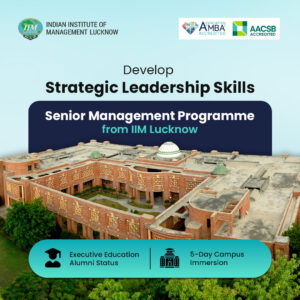
One shining example is the IIM Lucknow Senior Management Programme. This program is like a leadership boot camp.

Here’s the lowdown on what makes this program so impactful:

  • Building a Rock-Solid Foundation: The program starts with the fundamentals, ensuring you have a strong grasp of core business concepts. Think of it as building a sturdy house – you need a solid foundation before you can add the fancy bells and whistles.
  • Mastering the Modern Business Toolkit: Get ready to dive into the nitty-gritty of marketing, strategic decision-making, and digital transformation. These are the essential skills you need to navigate the complexities of today’s business world.
  • Future-Proofing Your Leadership: This program isn’t just about the here and now. It equips you with the knowledge and foresight to tackle the challenges of tomorrow. Think macroeconomics, artificial intelligence, and ever-evolving business models. You’ll be ready for whatever the future throws your way.

Senior Management Program

Beyond the Curriculum: The Perks of Being an IIM Lucknow Leader

However, the IIM Lucknow Senior Management Programme offers more than just a stellar curriculum. Here are some of the extra goodies you get as a participant:

  • You’ll have the privilege of soaking up wisdom from distinguished IIM Lucknow faculty and industry leaders. These are the rockstars of the business world, and you get front-row seats to their experience and insights.
  • The program grants you access to the prestigious IIM Lucknow alumni community. This network opens doors to invaluable networking opportunities and ongoing support from fellow leaders who have walked the same path.
  • The program includes a leadership assessment and coaching component. This self-discovery journey helps you identify your strengths and weaknesses, allowing you to refine your leadership style and become the most effective leader you can be.

Learning That’s Anything But Dull: An Immersive Experience

Traditional classroom learning can sometimes feel like watching paint dry. But the IIM Lucknow Senior Management Programme throws that notion out the window. Get ready for:

  • Live and Interactive Sessions: No more snoozing in the back row! Live virtual sessions and interactive masterclasses will keep you engaged and on your toes.
  • Campus Buzz: While the program offers flexibility with a virtual component, you’ll also get the chance to immerse yourself in the vibrant IIM Lucknow campus atmosphere.
  • The Power of Play: Sharpen your strategic decision-making skills through the Imarticus GameStudio Business Simulation. This gamified learning experience puts you at the helm of a virtual company, letting you test your mettle in a safe & controlled environment.

The Takeaway: Invest in Yourself, Invest in Your Future

The IIM Lucknow Senior Management Programme is an investment in your future as a leader. It’s a chance to learn from the best, refine your skills, and connect with a powerful network. If you’re serious about taking your leadership to the next level, this program is a no-brainer.

Key Summary Points:

  • The IIM Lucknow Senior Management Programme provides a comprehensive curriculum that covers essential business concepts, modern business skills, and future-proofing strategies.
  • The program boasts world-class faculty and industry leaders, offering invaluable insights and practical experience.
  • Participants gain access to the prestigious IIM Lucknow alumni network, opening doors to career-boosting opportunities.

Introducing the Senior Management Programme by Imarticus Learning

Unlock the door to advanced business knowledge with Imarticus Learning’s Senior Management Programme. Leadership courses in India dive deep into essential areas like marketing, strategic decision-making, and digital transformation. Get ready to build a strong foundation in business dynamics and elevate your skills to thrive in today’s competitive landscape.

Discover how to effectively manage finances, lead digital transformations, strategize operations, and master strategic marketing and pricing strategies. With Imarticus Learning, you’ll gain the tools and knowledge needed to navigate the complexities of modern business with confidence.

Prepare for the future of leadership by exploring macroeconomics, decoding digital transformation and AI, understanding evolving business models, and honing your strategic leadership skills. Take the next step in your career journey with Imarticus Learning’s Senior Management Programme. Enroll now and empower yourself to lead with excellence in today’s dynamic business environment.

Redefining Leadership: Exploring the Latest Trends in Senior Leadership Courses

Ever feel like the world of leadership is on fast-forward? Disruption is the name of the game; technology’s evolving at lightning speed, and employee expectations are shifting like desert sands. It can be tough to keep your leadership compass pointed in the right direction, especially as you climb the senior ranks.

Executive managers are individuals who are given important powers by the board of directors or the shareholders of a company. They have a lot of responsibility and oversee the senior management team. This means they don’t usually deal with the daily operations of the business but focus on making big decisions. The senior management team includes leaders of different departments like product development, finance, operations, and strategy. In project management, senior managers are the ones who decide whether or not to provide funding for projects.

But fear not, fellow trailblazers! Today, we’re diving deep into the exciting world of senior leadership courses. Buckle up because we’re about to explore the executive leadership programs for C-suite professionals that are redefining what it means to be a leader in today’s dynamic landscape.

Why are executive leadership training programs essential for senior managers?

Here’s why executive leadership training programs are crucial for senior managers:

  • Sharpen the Saw: Imagine a great carpenter. Their skills come from years of experience, but they also need to keep their tools sharp. These programs are like sharpening the tools of a leader. They refresh and improve existing skills and introduce new ones relevant to today’s business challenges.
  • Level Up! Senior managers have climbed the ladder, but the executive suite demands a broader view. These programs help them see the “big picture” of the organization, think strategically, and make sound decisions that benefit the entire company.
  • Communication is Key: Leaders need to clearly communicate ideas, motivate teams, and even navigate difficult conversations. Training programs hone communication skills, making senior managers more effective in all their interactions.
  • Building a Dream Team: Great leaders don’t operate alone. These programs teach senior managers how to build strong, engaged teams. They learn how to delegate tasks effectively, provide coaching and feedback, and foster a positive work environment.
  • Change is Constant: The business world is always evolving. Leadership training programs help senior managers stay ahead of the curve by introducing them to new trends, technologies, and business practices.

Executive leadership training programs are an investment in the future of both the senior manager and the organization. They provide the tools and knowledge needed to excel in a demanding role, ultimately leading to a more successful and sustainable company.

XLRI Senior Leadership course

What are the latest trends in senior leadership courses?

Think of them as your personal leadership gym. They’re designed to equip you with the knowledge, skills, and mindsets to navigate complex challenges, inspire and empower your teams, and drive results in a way that feels authentic and impactful.

Let’s break it down. Here are some key trends shaping the senior leadership course landscape:

  • From Command & Control to Collaborative Captain

Senior leadership courses today emphasize the power of collaboration. You’ll learn how to foster a culture of open communication, build trust with diverse teams, and leverage the collective intelligence of your people. Think of yourself as the captain of a high-performing ship, guiding your crew towards a shared vision.

  • Embracing the Power of “We” over “Me”

Leading with humility is a hot trend, and for good reason. Senior leadership courses recognize that true leadership isn’t about ego trips. It’s about empowering others to shine. You’ll learn how to delegate effectively, celebrate successes as a team, and create an environment where everyone feels valued and heard.

  • Mastering the Art of Agility

The only constant is change, right? Senior leadership courses equip you with the tools you need to be adaptable. You’ll learn how to navigate uncertainty, embrace new technologies, and pivot strategies when needed. Because let’s face it, the ability to roll with the punches is key to leading effectively in today’s ever-evolving world.

  • Building Bridges, Not Walls

The world is becoming increasingly interconnected, and senior leadership courses recognize the importance of global competence. You’ll develop your cultural intelligence, learn how to navigate diverse viewpoints and build strong relationships with teams and stakeholders across the globe.

  • Leading with Emotional Intelligence (EQ) in Your Back Pocket

Senior leadership courses today emphasize the importance of emotional intelligence. You’ll learn how to manage your own emotions, understand the emotions of others, and build strong interpersonal relationships. Because let’s be real, people follow leaders they connect with on a human level.

  • Technology as Your Trusted Ally

Technology is no longer just a tool; it’s a strategic partner. Senior leadership courses equip you with the knowledge you need to leverage technology effectively to drive innovation, streamline processes, and improve communication across your organization.

  • Lifelong Learning: It’s Not Just a Buzzword

The best leaders are lifelong learners. Senior leadership courses highlight the importance of continuous learning and development. You’ll learn how to stay current with industry trends, explore new ideas, and challenge your assumptions.

The Final Words

Taking a senior leadership course isn’t just about acquiring knowledge; it’s about investing in yourself and your future. It’s about building a strong foundation for success and leading your organization to new heights.

By investing in these programs, senior managers can sharpen their skill sets, broaden their perspectives, and become more effective leaders. They’ll be equipped to navigate challenges, inspire teams, and drive organizational success in the years to come.

If you’re a senior manager looking to take your leadership to the next level, explore the latest executive leadership training programs available. It’s an investment that will pay dividends for both you and your organization.

Key Takeaways: Your Cheat Sheet to Senior Leadership Greatness

So, you’re ready to take your leadership game to the next level? Here’s a quick cheat sheet to keep in mind when searching for senior leadership courses:

  • Focus on Collaboration: Look for courses that emphasize building a culture of trust and empowering teams.
  • Embrace Humility: Choose Strategic leadership development programs that help you develop your leadership skills.
  • Sharpen Your Agility: Opt for a program that equips you with the tools to navigate change and lead through uncertainty.
  • Go Global: Consider courses that broaden your cultural intelligence and prepare you for the global landscape.
  • Master Your EQ: Find a course that helps you develop your emotional intelligence and build stronger relationships.
  • Tech-Savvy Leader: Look for programs that explore the strategic use of technology in leadership.
  • Lifelong Learner: Choose a program that encourages continuous learning and exploration.

Introducing The Postgraduate Certificate In Senior Leadership by Imarticus Learning

Embark on your leadership transformation journey with Imarticus Learning’s Postgraduate Certificate in Senior Leadership. Over 12 months, this program is meticulously crafted for professionals aiming to excel in senior management roles. Rooted in real-world challenges and insights, this program offers hands-on skill development essential for navigating today’s fast-paced and competitive corporate landscape.

Delve into strategic thinking, corporate value creation, digital transformation, conflict management, and cultivating high-performance teams. Gain an inside perspective on the day-to-day functioning of business activities, encompassing dimensions such as strategy, sustainability, and digital transformation crucial to senior leadership roles.

Imarticus Learning’s Senior Leadership course connects you with industry supporters who possess a keen understanding of emerging trends in the domain. Benefit from their expertise and guidance, tailored to equip you with the skills and knowledge needed to lead confidently in today’s dynamic business environment.

Take the first step towards your leadership journey. Enroll now and unlock your potential to lead with confidence and competence in the modern corporate world.

Is a General Management Program Right for You? A Guide to Help You Decide

Are you staring down the barrel of a career crossroads, wondering if you should take the plunge into a general management program? You’re not alone. Many individuals, from recent grads to seasoned professionals, find themselves drawn to the well-rounded knowledge and leadership skills these programs promise. But with so much riding on your decision, it’s natural to feel a little unsure.

Program management involves overseeing multiple connected projects, usually aimed at making an organization perform better. It’s different from project management. In reality and its goals, program management is often tied closely to systems engineering, industrial engineering, change management, and business transformation. 

In the defense field, it’s the main method for handling big projects. Since big defense projects involve working with contractors, it’s also known as acquisition management. This means the government buyer gets goods and services through contractors.

This guide is here to navigate you through the key features of general management programs and help you decide if it’s the Perfect Management Training to launch you toward your dream career.

Decoding General Management Programs: What’s Under the Hood?

Imagine a business as a complex machine. A general management course equips you to understand all its moving parts – finance, marketing, operations, human resources, you name it. You’ll delve into the intricacies of each function, gaining a holistic perspective on how a business operates as a cohesive unit.

A general management program teaches you about how businesses work, which can open up more job options for you. These programs cover lots of different topics like finance, marketing, how things are made, hiring people, and planning. They also help you learn important management skills like making decisions and understanding the world of business on a global scale.

Here is a sneak peek at what you can expect to encounter:

  • Business Fundamentals: Brush up on core business principles like accounting, finance, marketing, and operations. This strong foundation will be crucial for strategic decision-making later on.
  • Leadership and Communication: Great leaders are made, not born, and general management programs hone your ability to inspire, motivate, and guide teams. You’ll develop strong communication skills, both written and verbal, to effectively articulate your vision and get things done.
  • Strategic Thinking: Businesses thrive on well-defined strategies. You’ll learn to analyze market trends, identify opportunities, and craft winning strategies to achieve your company’s goals.
  • Problem-Solving and Decision-Making: The business world is full of challenges. General management education equips you with the critical thinking tools to tackle problems head-on, analyze data effectively, and make sound decisions under pressure.

Who Benefits Most from a General Management Program?

Here are some signs that a top management program might be your perfect match:

  • You Crave a Broad Business Acumen: Do you find the idea of being a jack-of-all-trades in the business world appealing? If you’re not drawn to a specific specialization but want a strong understanding of all aspects of running a business, this program is for you.
  • You’re a Career Climber: General management programs are a launchpad for leadership positions. They equip you with the skills and knowledge to excel in various management roles across different industries.
  • You’re a Career Switcher: Maybe you’ve been in a different field but have a burning desire to transition into business management. This program provides the foundational knowledge you need to make a smooth switch.
  • You’re an Entrepreneur in the Making: Do you dream of starting your venture? The comprehensive business training offered by general management programs will be invaluable in navigating the exciting yet challenging world of entrepreneurship.

general management course

What Makes a General Management Program Special?

While academics are essential, a good general management program goes beyond textbooks. Here are a few additional perks you can expect:

  • Case Studies and Simulations: Get ready to put your learning to the test! These programs often use real-world business scenarios to allow you to apply your knowledge & develop practical problem-solving skills.
  • Networking Opportunities: These programs attract ambitious individuals from diverse backgrounds. You’ll have the chance to build valuable connections with classmates, professors, and industry professionals, expanding your network and opening doors to future opportunities.
  • Specializations: Some programs offer the flexibility to tailor your studies to your interests. You might be able to choose electives or concentrations in areas like marketing, finance, or human resources.

Making the Call: Is it a Go or No-Go?

So, you’ve weighed the pros and cons. Here are some additional factors to consider before making your final decision:

  • Program Reputation: Research different programs and choose one with a strong reputation for academic excellence and industry connections.
  • Time Commitment: General management programs can be intensive, requiring a significant time investment. Ensure you can manage your schedule effectively to balance your studies with your current responsibilities.
  • Financial Investment: Tuition fees can vary considerably. Explore scholarship opportunities and financial aid options, & consider the long-term career benefits when evaluating the cost.

There’s no one-size-fits-all answer. Talk to program advisors, alumni, and current students to get a well-rounded perspective.

Conclusion: Charting Your Course to Success

A general management program can be a powerful tool to propel you toward your dream career in business. By equipping you with a broad knowledge base, strong leadership skills, and the ability to think strategically, it can unlock a world of possibilities.

But remember, the program is just the beginning. Your dedication, ambition, and willingness to learn will ultimately determine your success.

Key Highlights

  • General management programs offer a holistic understanding of business operations, encompassing finance, marketing, operations, and human resources.
  • They develop essential leadership and communication skills, critical for inspiring and guiding teams.
  • Strategic thinking, problem-solving, and decision-making abilities are honed, preparing you for the dynamic business landscape.
  • These programs are ideal for individuals seeking a broad business understanding, aspiring to climb the corporate ladder, switching careers into business management, or launching their ventures.
  • Beyond academics, the program offers valuable real-world learning through case studies and simulations, networking opportunities, and potential specialization options.

Remember, a general management program is an investment in yourself and your future. By carefully considering your goals, researching programs thoroughly, and committing to the journey, you can transform this investment into a springboard for a fulfilling and successful career.

So, are you ready to take the plunge? With the right preparation and a thirst for knowledge, a general management program can be the catalyst that propels you to the forefront of the business world.

Mastering Management Essentials with Imarticus Learning’s GMP

Imarticus Learning’s General Management Programme (GMP) stands as a leading executive program meticulously crafted and fostered by IIMA in Dubai, designed to empower professionals in augmenting their functional and leadership competencies. Tailored entirely to fit the regional context, GMP has witnessed 21 successful batches since its establishment in 2009, earning widespread acclaim as a beacon of excellence.

The program’s primary objective is to equip participants with the skills necessary to transition into senior-level general management roles in the future seamlessly. By refining your management understanding, you’ll amplify your capacity to tackle intricate business dilemmas and steer organizational triumph.

Enroll now to elevate your management prowess and propel your career forward with GMP!