Generative AI marks a significant advancement in artificial intelligence. Given its capacity to significantly assist human abilities and knowledge, it is designed to revolutionise the way we work and reshape the workforce of the future. It is critical that professionals not only recognize the potential of Generative AI but also equip themselves with the skills to handle the inevitable shifts in the organisation.
To go on a path of bringing forth the content revolution, enhancing machine learning, and confirming fresh and original ideas, enrolling in a Generative AI course is a trend worth pursuing. Not only that, but it is a rapidly increasing force that is transforming industries and bringing them incredible opportunities.
What is Generative AI?
Generative artificial intelligence (AI) refers to algorithms (like ChatGPT) that can generate novel content, such as images, videos, audio, code, text, simulations, software code and product designs. Recent advances in the discipline have the potential to fundamentally alter the way we approach content development.
Generative AI may learn from existing artefacts to create new, realistic artefacts (at scale) that represent the properties of the training data while without repeating it. The process involves various techniques that continue to evolve. First and foremost are the AI foundation models, which are trained on a massive set of unlabelled data which can be used for different tasks, with extra fine-tuning. These trained models need complex mathematics and huge computational capabilities to develop, yet they are essentially prediction algorithms.
Presently, generative AI is most typically used to generate content in response to natural language queries; it does not require knowledge of or access to code; nevertheless, corporate use cases are many, including advancements in medication and chip design and material science findings.
What are the Benefits of Generative AI?
Automation, machine learning, and autonomous IT and business process execution are all possible with AI architectural innovations, one of which is generative pre-trained transformers, one of the foundation models which power ChatGPT.
The benefits of generative AI include:
Enhanced product development
Boosted customer experience
Advanced productivity of the employees
It has to be noted that the specifics depend on the use case.
Also, end users should be realistic about the value they expect to achieve, especially when utilising a service that has significant limits. Generative AI produces artefacts that may be incorrect or discriminatory, necessitating human validation and potentially restricting the time it saves workers.
Applications of Generative AI
Thecommon generative AI applications are vast in number and these use cases can be applied to generate virtually any kind of content. As different kinds of users can access the technology’s ground-breaking breakthroughs like GPT that can be utilised for various applications. Some of the major generative AI uses have been listed below:
Drafting email responses, dating profiles, resumes, etc.
Implementing chatbots for customer service and technical support.
Improvising dubbing for movies and product demonstration videos.
Enhancing educational content in different languages.
Creating photorealistic art in a particular style.
Suggesting new drug compounds to test.
Designing physical products and buildings.
Optimising new chip designs.
Improvising product demonstration videos.
Use deepfakes to impersonate persons or specific individuals.
Composing music in a specific style or tone.
Final Words
Aiming to bring about the fusion of technology and creativity, Imarticus Learning, the premier edtech company for upskilling and professional education, in collaboration with the E&ICT Academy at IIT Guwahati, has established an Advanced Certificate Program in Generative AI.
The Advanced Generative AI Course is spanned over a duration of 6 months. The curriculum depends on a renewed focus on skills that leverage human talents and automation. With 140 hours of instruction, together with 3 days of campus immersion at IIT Guwahati, the program delivers a learning experience that will empower learners to pioneer new positions of the future.
In a changing marketplace, it is crucial to stay relevant for a successful business. Considering this, business analytics can offer valuable insights to a company to beat competitors. When used effectively, it can prove to be a powerful tool for business growth.
Considering the increasing demand for business analytics professionals, one can pursue this lucrative career option by enrolling in a reputable course like IIM Calcutta Senior Management Programme in Business Analytics. Read ahead to learn more about business analytics and how data analytics influences business decisions.
Understanding Business Analytics
Involving a process of collecting, organising, analysing, and interpreting data, business analytics helps gain insights to make informed business decisions. Featuring statistical and quantitative analysis, it can be applied to different aspects of business that include sales, finance, marketing, operations, and customer service. Data analysis of various areas of business can help organisations identify trends, patterns, and correlations to make decisions, optimising their business processes.
Further, business analytics uses data mining, machine learning algorithms, data visualisation and predictive analytics to process and analyse large volumes of data. It helps improve the competitiveness and profitability of businesses in today’s data-driven environment. For instance, analysing customer data can not only help improve customer retention, but also increase sales.
How data analytics influences business decisions? Answering this question, business analytics helps identify opportunities for expansion, make strategic decisions about resource allocation, predict future outcomes and improve overall performance.
Business Analytics Types
The following are some of the most common types of business analytics that businesses use to gain key insights:
Descriptive analytics: Involves analysing historical data
Diagnostic analytics: Includes analysing data to learn why something happened in the past
Prescriptive analytics: Uses data and insights to make decisions about future actions
Predictive analytics: Involves analysing data to make predictions for future
Spatial analytics: Includes analysing geographic data
Text analytics: Involves analysing unstructured data like customer feedback and social media posts
Business Intelligence vs. Data Science
Business intelligence (BI) involves the process of collecting, analysing, and presenting data to support decision-making. It focuses on sharing data summary in the form of reports and dashboards.
On the other hand, data science involves different techniques like statistical analysis, machine learning, and data visualisation to gain insights from data. It typically focuses on analysing large and complex data sets, such as text data, image data, and social media data.
Notably, business analytics and data science are related to using data to extract insights for effective decision-making. But, they differ in their focus and techniques. Also, it is to be noted that though related, business analytics and business intelligence are distinct concepts.
Business Analytics Essentials
The following are some essentials of business analytics:
Here are the reasons for adopting business analytics:
Get insights that help make data-driven decisions to effectively achieve goals, improve efficiency and optimise business operations
Gain a competitive advantage by identifying opportunities and risks
Identify areas for improvement for enhanced performance
Better understanding of customers to meet their needs and increase satisfaction
Mitigate risk by predicting potential outcomes and reducing the odds of negative consequences
Benefits of Business Analytics
The following are the benefits of using business analytics tools:
Eliminate guesswork and reduce potential financial loss
Reveal vulnerabilities in processes and improve security
Optimise customer outreach
Spot risk factors and take preventive measures
Conclusion
In today’s day and age, the business landscape has become data-driven. This makes it essential for managers across different business operations to acquire analytics skills. The valuable insights gained as a result of analysing vast amounts of data can not only help tackle different challenges effectively, but also make informed business decisions, enabling growth.
If you want to elevate your senior leadership game, then pursue the IIM Calcutta Senior Management Programme to scale heights in your career. For further details, please connect with Imarticus Learning.
If one has to define the job and CFO responsibilities, then the simple answer is that he/she leads a company’s finance functions. However, over the years the job and roles of a CFO have expanded tremendously. So, let us begin by answering a very important question– What is a Chief Financial Officer?
In the corporate world of today, CFO is considered the CEO’s strategic partner as well as a key colleague across businesses and functions who plays a crucial role in maximising value creation. Apart from leading a capable and business-savvy finance team, some of the key CFO responsibilities include shaping portfolio strategies, undertaking major investment and financing decisions as well as communicating with key stakeholders.
The CFO plays an important role in building credibility for the strategic direction of the company and communication is also a very important role both with investors and boards. Apart from the above-mentioned CFO responsibilities, dealing with risk is also a crucial aspect of the CFO job. The CFO is responsible for taking care of risks that are associated with not just cash but also with resource deployment, capital, accounting compliance as well as strategy.
Now that you understand what is a Chief Financial Officer, keep on reading to learn about the role and CFO responsibilities in detail.
Role and Responsibilities of a CFO
All-Round Financial Management: This is a key responsibility of CFOs because they are at the helm of financial management. The CFO and the finance team oversee all aspects of the financial function in an organisation. Taking care of the overall financial management includes monitoring cash flow, managing budgets, optimising capital structure as well as making sure that the financial resources of the organisation are utilised effectively to enhance profitability and drive growth.
Financial Analysis and Planning: Developing and overseeing financial plans and strategies is among the key CFO responsibilities and they also need to ensure that strategies align with the goals of the organisation. Financial analysis and planning also include forecasting future trends and assisting their team by providing valuable insights so that they can make informed decisions.
Strategic Decision Making: As discussed above the CFO plays the role of a strategic partner to the CFO as well as the senior management, therefore they play a crucial role in making major decisions as they are responsible for evaluating financial implications and providing insights into potential risks and rewards. The CFO is part of important strategic planning sessions, and capital investment decisions as well as mergers and acquisitions.
Compliance and Risk Management: This is one of the biggest CFO responsibilities. CFOs play a key role in identifying as well as managing financial risks that can adversely affect the stability and reputation of a company. CFOs structure and create risk mitigation strategies as well as implement internal control systems. They also make sure that regulatory guidelines and reporting standards are strictly adhered to.
Capital Allocation and Managing Investor Relations: CFOs are always actively engaging with stakeholders and investors to ensure financial transparency by presenting financial performance, investment strategies as well as growth opportunities. The CFO and their financial team take care of capital allocation while balancing the need for investment in innovation, expansion, and return on investment for shareholders.
CFO Qualifications and Skills
The position of CFO includes leadership and management roles, therefore an MBA with a specialisation in finance program will help finance professionals advance in their careers. Moreover, enrolling in a customised programme like the Chief Finance Officer Specialisation Certificate in IIM Lucknow’s Global Senior Leadership Programme (GSLP) is also a smart choice as this program is the gateway to a transformative future, leading you to the CFO’s chair with inviolable confidence and competence.
Important CFO Skills
CFO is a leadership role and therefore as a Chief Financial Officer, a person needs to be sharp and strategically minded so that he/she can execute strategies in an informed manner while also being aware of the shifting markets and competitor behaviour. A CFO also needs in-depth knowledge of accounting and tax to be successful.
What Is the Average Salary of a CFO?
In India, the average salary of CFOs ranges between ₹12.0 Lakhs to ₹101.0 Lakhs with an average annual salary of ₹53.4 Lakhs. This salary estimate is based on the 2.3k latest salaries received from CFOs.
Conclusion
In today’s competitive business world, the role of a Chief Financial Officer entails much more than financial acumen. A CFO requires a diverse skill set that includes risk management, the ability to provide insightful financial guidance, and strategic thinking. If you are interested in making a career in the field of finance and want to delve deeper to acquire skills for this journey, consider exploring the Chief Finance Officer Specialisation Certificate from Imarticus.
In 2024, with the continuous growth of complex data and analytics, the demand for BI has increased in the corporate world. As digitalization continues and firms thrive to sustain themselves in the competition, BI is becoming a game-changer.
Here is a set of important Power BI Interview questions and answers to help you crack a Power BI interview with ease. The article has been divided into three sections, Power BI interview questions and answers for freshers, Power BI interview questions and answers for intermediates and Power BI interview questions and answers for experienced professionals.
Power BI Interview Questions and Answers for Freshers
Freshers having completed a data analytics course and possess some basic knowledge about BI are eligible for an interview. Freshers are asked some of the basic Power BI questions in an interview for entry-level Power BI analyst roles. This section deals with some of those basic Power BI interview questions and answers.
Define Power BI.
Microsoft introduced Power BI, an array of corporate statistical applications that allow users to gather, analyse, display, and circulate data. Power BI covers a diverse set of databases and offers powerful analytics features via connections with Excel.
What is the purpose of using Power BI?
Its simple interface and broad features serve as an effective tool for firms seeking insights, making data-driven choices, and cultivating a data-driven culture.
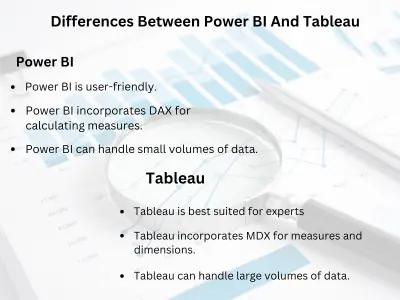
What are the differences between Power BI and Tableau? State any three
Tableau and Power BI are the biggest data analytics tools in today’s time, but both have some significant differences. They are as follows:
Power BI
Tableau
Power BI is user-friendly.
Tableau is best suited for experts.
Power BI incorporates DAX for calculating measures.
Tableau incorporates MDX for measures and dimensions.
Power BI can handle small volumes of data.
Tableau can handle large volumes of data.
What are the differences between Power Query and Power Pivot?
The differences between Power Query and Power Pivot are as follows:
Power Query
Power Pivot
Power Query analyses data.
Power Pivot gathers and shares data.
This is an ETL service tool.
his is an in-memory data modeling component.
Explain Power BI Desktop.
Microsoft built and developed Power BI Desktop, a free application. Power BI Desktop enables individuals to effortlessly link to, alter, and visualise their data. Users can share the accumulated data as reports with their heads and colleagues.
Define Power Pivot.
Since 2010, Microsoft has released a plugin for Excel known as Power Pivot. Power Pivot was created to expand Excel’s data analysis features and assistance.
Define Power Query
Microsoft developed Power Query, a business analytics application for Excel. Power Query enables users to input data from a variety of sources and then neat, alter, and restructure it as needed. Power Query enables users to compose a query once and subsequently execute it with a single reload.
What are the two main components of the self-service BI solution by Microsoft.
Self-service business intelligence (SSBI) has two main components, the Excel BI Toolkit and Power BI.
Explain what is a self-service BI.
Self-Service Business Intelligence (SSBI) helps users from no technical or coding background use Power BI to generate reports.
Define DAX.
Data Analytics Expressions (DAX) is a group of functions and constants incorporated in formulas to determine and return values.
Power BI Interview Questions and Answers for Intermediates
Power BI interview questions and answers for the intermediate level are more advanced and require more knowledge. This portion will highlight some of the important Power BI interview questions and answers for intermediates. Here are the Power BI questions and their answers.
How is data collected and stored in Power BI?
Power BI stores data with the help of the cloud. Power BI primarily uses Microsoft Azure, a cloud service provider to store data.
Define row-level security.
Row-level security uses filters to restrict the information that a user can examine and retrieve. Users may establish guidelines and roles in Power BI Desktop and then upload them to Power BI Service to set up row-level security.
Why should general formatting be applied to Power BI data?
Users may apply basic formatting to help Power BI organise and locate data, rendering it substantially simpler to analyse and work with.
State the different views available in Power BI Desktop.
Power BI has three views, each serving a distinct objective:
Report View – The Report View allows users to add visuals and supplementary analysis pages before publishing them on the site.
Data View – The Data View allows users to shape information employing the Query Editor tools.
Model View – The Model View allows users to handle connections among complex databases.
What are the different versions of Power BI?
Power BI Desktop
Power BI Service
Power BI Android app
Power BI iOS and app
State the critical components of the Power BI toolkit.
The important components of Power BI are as follows:
Power Query
Power Pivot
Power View
Power Map
Power Q&A
Shed some light on the content pack.
A content pack is a pre-built set of visuals and Power BI presentations created by the selected provider.
How to use a custom visual file?
If the preconfigured files do not meet a company’s requirements, a developer will create a customised visual file. Developers construct customised graphic files, which may be imported and used identically as prepackaged files.
State some of the sources for data in the Get Data menu in Power BI.
Some of these sources are text data, data from the internet, spreadsheets, Power BI datasets, SQL server, and analysis services.
State the categories of data types.
All
File
Database
Power BI
Azure
Online Services
Other
What are the commonly used tasks in the Query Editor?
Connect to data
Shape and combine data
Group rows
Pivot columns
Create custom columns
Query formulas
Define grouping.
Power BI Desktop allows users to organise the information in the visualisations into sections. To group components in the graphic, select them with Ctrl + Click. Right-click on any of the items and select Group from the option that displays. The Groups box allows you to establish fresh groups or change ones that already exist.
In Power BI, what do we mean by responsive slicers?
A programmer may adjust the responsive slicer to different widths and designs, and the information gathered in the framework is reorganised to locate a match. If a visual report grows too tiny to be usable, an icon of the visual replaces it, conserving the area on the report page.
Explain query folding in Power BI.
Query folding occurs when steps described in the Query Editor are converted into SQL and performed by the original database rather than the mobile device. It promotes flexibility and effective computing.
Define M language.
M is a coding language utilised by Power Query that is effective, case-dependent, and user-friendly.
Power BI Interview Questions and Answers for Experienced Professionals
Power BI interview questions and answers for experienced professionals require in-depth knowledge of the software and data analytics. These Power BI developer questions and answers are a must-go-through before appearing for an interview.
State the major differences between visual-level, page-level, and report-level filters in Power BI.
Visual-level filters are implemented to restrict data inside a single display. Page-level filters are employed to operate on a full page in a summary, and each page might have distinct filters. Report-level filters are applied to narrow down all the data in the document’s graphics and sections.
State the most common tools for data shaping.
Adding indexes
Applying a sort order
Removing columns
How does the Schedule Refresh function?
Users can schedule an automated refresh of data depending on their routine needs. Users are limited to scheduling one refresh every day unless they are using Power BI Pro. The Schedule Refresh feature allows users to pick an interval, zone of time, and moment of day using the pull-down menus.
How is a map created in Power Map?
Power Map supports geographical representations. As a result, some geographic information is required, such as city, state, nation, or geographical coordinates.
What is the name of the in-memory analytics engine that is used by Power Pivot?
Power Pivot employs the xVelocity engine. xVelocity can handle large volumes of information and store it in tabular systems. When using in-memory statistics, every bit of information is put into the RAM, resulting in quicker analysis.
State the important components of SSAS.
The important components of SSAS are:
OLP Engine- Users employ an OLAP Engine to conduct ADHOC queries more quickly.
Data Drilling- Data Drilling in SSAS is defined as a method of investigating data characteristics at different levels of precision.
Slicers- The data slicing method used by SSAS is described as the storage of information in the form of columns and rows.
Pivot Tables- Pivot Tables assist in toggling among the many kinds of data recorded in rows and columns.
Name the variety of Power BI Formats.
Power BI is primarily available in three formats. They are:
Power BI Desktop
Power BI Services
Power BI Mobile Application
State the different stages in the functioning of Power BI.
The three different stages in the functioning of Power BI are as follows:
Data Integration
Data Processing
Data Presentation
Who are the ones who use Power BI the most?
Power BI is primarily used by Business Analysts, Business Owners, and Business Developers.
Explain advanced editor.
The advanced editor is employed to inspect searches that Power BI is performing against information sources when importing data. The query is displayed in M-code. To access the query code, users need first pick “Edit Queries” from the main menu, then “Advanced Editor” to begin working on the search query.
How to depict a story in Power BI?
Every graph or graphic report created is compiled and shown on one screen. This strategy is known as a Power BI Dashboard. A dashboard in Power BI is an instrument to tell a narrative with data.
Define KPIs in Power BI
Key Performance Indicator (KPI) is used by professional organisations for all their employees. A KPI is an indicator of an employee’s targets. KPIs are used to compute progress in comparison to previous performances.
What is a Power BI designer?
It is an integrated solution that allows users to post visualisations and reports to the PowerBI.com portal for reference. It includes Power Pivot, Power Query, and Power Table.
How to reshape data in Power BI?
Power BI supports a wide range of information source connection options. Data Editor is an instrument for manipulating the cells and rows of information and reshaping them to meet particular demands.
State some applications of Power BI.
Some of the applications of Power BI are as follows:
Business Analysis
Data Analysis
Database Administration
IT Professional
Conclusion
Business Intelligence (BI) is vital for modern firms, offering vital understanding through the evaluation of data. BI solutions such as Power BI play a critical role in translating unstructured information into meaningful business insight, encouraging an environment that values data throughout companies.
Enroll in Imarticus’ Postgraduate Program in Data Science and Analytics course to launch a career in Data Analytics.
FAQ’s
Does Power BI support mobile devices?
Power BI has apps for Android and iOS devices and Windows 10 devices.
What are the requirements to use Power BI?
A Web browser and email are all that are required to use Power BI. The Power BI mobile apps can also be downloaded for free from the various app stores.
How to undo in Power BI?
To undo an action in Power BI, simply press CTRL+Z.
Why is a work email required to sign up for Power BI?
Power BI does not support email addresses from customer email providers or telecommunications firms.
Establishing a solid and enduring financial position is crucial when embarking on a company venture. Finances form the structural basis of an economic institution. A sufficient monetary sum and efficient financial strategising, which incorporates the goals of financial management, are crucial to guarantee the long-term survival of a corporation. If a company has consistently practiced effective financial management throughout its existence, it remains advantageous even during the process of dissolution.
Every organisation has a sum of finances to manage and certain processes to balance the same. Thus, a corporation must also have a system to review the business’s financial information in its runtime. Understanding financial management is not just about balancing chequebooks it comprises the goals of financial management, which also include maximising profits, maintaining sufficient cash flow, growing shareholder wealth, and managing risks effectively. Nevertheless, to put it simply, a company that handles its funds expertly sees growth and development.
What is financial management?
Financial management encompasses the strategic organisation, planning, control, and direction of an institution’s or organisation’s financial undertakings. Furthermore, it entails the implementation of management principles onto an organisation’s financial assets and contributes significantly to fiscal management.
The goals of financial management can be broken down into these key objectives:
Sustaining an adequate financial resource for the organisation
Ensuring that the organisation’s shareholders receive satisfactory returns on their investments
Effective and optimal application of funds
Developing secure and legitimate investment opportunities
Broad areas of finance
Numerous societal segments operate financially and need money. As a result, there are three primary financial subcategories:
Personal finance – Personal finance is the financial management for an individual or family. This entails examining the financial state and activities of that person to strategy for future demands. Personal finance techniques are frequently influenced by an individual’s income, housing needs, and financial objectives.
Personal financial management, for instance, is applicable to someone who invests and saves money throughout their work in order to prepare for retirement. Financial items such as mortgages, insurance, and credit cards can also be included in personal finance. Personal finance also includes banking, which includes checking and savings accounts as well as any mobile or internet payment services.
Corporate finance – The financial administration of a business is known as corporate finance. Corporate finance frequently aims to minimise a business’s financial risks while maximising its profit typically, risk management and investment analysis are corporate finance’s main tasks. Trying to manage a budget and choose which projects to finance now and which to invest in later is an example of corporate finance in action.
Public finance – The financial administration of a government body is known as public finance. It entails the social and fiscal duties of the government, which include monitoring resource allocation, economic stability, income distribution, and the sufficiency of social programs. Taxation, budgeting, spending, and other measures that influence how a government pays for the public services it offers are together referred to as public finance. Managing income taxes is one of the primary responsibilities of public finance management.
Scope of financial management
Having grasped the meaning of financial management, let’s now examine the scope in a career in finance.
Capital Structure – A capital structure is necessary to maintain a balance between various sources of resources. Companies employ a combination of stock and debt to finance their operations. This framework governs business-related financial decisions, such as the short- and long-term debt-equity ratios, and plays an important role in achieving several goals and objectives of financial management such as:
Optimising the cost of capital
Maximising shareholder’s wealth
Financial decision – The aspect of financial management deals with how and when the funds from current long or short-term sources should be made available, this is known as capital budgeting and is regarded as one of the goals of financial management. The finance manager is responsible for establishing a capital structure in order to maintain the organisational value, achieving this requires a proper balance between debt and equity to ensure attractive returns for stakeholders. It is important for a company to align with these factors so that the market value per share increases and can be beneficial for everyone.
Financial decisions and fundraising avenues such as stakeholders, banks, public deposits and other financial lenders inspect all the sources carefully and then choose the one with maximum profit and liability. Financial professionals also discover investment strategies and source funds for the sake of the company’s ROI. They carry out capital budgeting and ensure the safety of business, liquidity and profitability through several opportunities.
Profit Management – One of the most important duties of a financial manager is to maximise profits. A business may have both short- and long-term financial success. Financial managers have an obligation to look for ways to increase profits while lowering risks.
Working Capital Management – Working capital is measured by subtracting current assets from current liabilities; Analysing it helps firms use their current assets more efficiently, hold on to appropriate cash flow, and meet their immediate and medium-term company demands.
Efficient working capital management can directly contribute to several key goals of financial management as it can help firms access cash that remains stranded on the balance sheet. Access to capital minimises their dependency on external borrowing and helps them to develop their operation, acquire new firms and invest in technology and procedures that further boost their efficiency.
Objectives of financial management
The objectives are nothing but the goals of financial management, and it is for them that we make various decisions. This indicates that the objectives of financial management are the ultimate goals of a certain form, organisation, or even individual endeavor. Therefore, it’s crucial to discuss the goals of financial management they are as follows:
Maximising profits – Share information on factors that might cause the cost of items supplied to rise, such as growing raw material costs.
Availability of funds – It serves as a major goal of financial management. The only way for any company organisation to succeed is via disciplined financial management. Thus, it is crucial to confirm that all funds are available and to prepare for the equitable distribution of cash from variable resources.
Monitoring cash flow and liquidity – Make sure the business has adequate cash on hand to pay its debts
Maintaining records – Maintaining accurate records of all financial transactions made by a business is another benefit of financial management. It is one of the clauses that ensure the best possible use of the available money and its security.
Creating financial scenarios – These are based on projections that take a broad range of probable outcomes depending on market circumstances and the existing status of the firm.
Control connections – interacting with boards of directors and investors in an efficient manner.
Planning and Financial Data – Giving accurate financial information to lenders, clients, and higher authorities is another important goal of financial management. Additionally, the financial manager has to have a proper strategy in place for handling the finances, including equalisation and use, among other things.
Functions of financial management
Based on the objectives and goals of financial management some function of financial management are as follows:
Calculation of capital requirements – A finance manager must estimate the amount of capital the business will need. This will rely on anticipated expenses and earnings as well as upcoming initiatives and policies of a company.
Planning and Projecting Finances – The longer-term objective of social and non-profit organisations is the betterment of society. Still, the majority of businesses want to increase their return on investment. The company’s present financial situation and its future position are buffered by these earnings. Effective distribution of resources allows the financial management to organise and project the future of the business. It enables them to decide how to use the created earnings, whether an organisation will gain from taking the money out and buying assets or from reinvesting the profits in the business and enhancing marketing plans.
Financial Reporting – The expenses of the organisation must be closely monitored by financial management. They can show the financial status, including specifics about assets, liabilities, cash flow, and expenditures, through financial reports. Periodically, these reports are prepared to guarantee that all funds are in order.
Cash flow maintenance – You know that a good financial manager is at work when a business remains solvent. Among the duties of financial management is making sure the company has enough money on hand for wages, daily costs, and other activities.
The normative goal of financial management
Maximising shareholder wealth concept can be considered as the normative goal of financial management as it serves an important role for evaluating financial decisions. While business may also consider other factors like social responsibility and employee well being for making financial decisions.
Sharpen your management skills
Financial management is a dynamic area that is always growing. In order to be informed about the current trends and practices of financial management, go visit Imarticus Learning blogs for deep information on numerous management issues.
Financial management is a very important skill set for individuals as well as businesses. It includes a wide range of learning based on the objectives, functions and goals of financial management. If you are someone who has a keen interest and wants to enhance your financial knowledge you can enroll in Imarticus Learning Postgraduate Financial Analysis program. Seats are filling fast!
Frequently Asked Question
What is the fundamental goal of financial management?
The basic goal of financial management is to estimate capital costs, establish a capital structure, and set strategies for the purchase and distribution of cash.
What are the four financial objectives?
The four major financial objectives of organisations are; stability, liquidity, profitability, and efficiency.
What is financial management in a business?
The concept of financial management is the strategic activity of developing, controlling, and monitoring all financial resources to fulfill your corporate goals.
What are the qualities of financial management?
Financial management requires critical thinking and risk management. In addition, it is accountable for sustaining earnings and lowering expenditures.
An equity market offers investors quick access to stocks of publicly traded companies. It offers a convenient way for investors to increase their capital and generate more profits. A range of equity markets cater to diverse categories of investors and companies.
So, understanding the intricacies of the equity market is important for every investor. Navigating its market needs extensive knowledge, analysis, and intuition. In this guide, we will discuss what is equity market, how it works, its types, and examples.
What is the equity market?
Before trading, it is important to know the equity market meaning. Well, the equity market is the meeting point of the sellers and buyers of stocks. Within the equity market, investors trade securities into two main categories: privately traded stocks and public stocks.
Investors exchange private stocks through intermediaries. It mainly represents the ownership interests in companies. This allows investors to participate in the success and growth of the business. The equity stock market offers a platform for all investors to grow their capital.
With it, the investors purchase and sell the shares based on profitability and future performance. So, it will be fair to say that equity can bring high returns to investors.
How does the equity market work?
Different mechanisms streamline the buying and selling of shares. It influenced investor behavior and stock prices.
So, after knowing what is equity in share market, understanding how it works is important. At the core, the equity market operates via several channels:
IPO or initial public offering
Private companies conduct an IPO when they first decide to go public and offer their shares. This process helps the companies to raise capital by selling shares to investors. When they complete the IPO, their shares get on the stock exchange list.
Secondary market
Once the IPO issues the equity shares, they enter the secondary market. This is where the investors buy and sell assets. The prices of the secondary equity stock market vary on the supply and demand dynamics.
Stock exchanges
The equity in the share market occurs on stock exchanges. These exchanges offer regulations and infrastructure important for orderly trading.
Market participants
After knowing what is equity trading, it is important to know the market participants. The participants are institutional investors, individual investors, brokers, traders, and market makers. Every participant plays a crucial role in shaping the market liquidity and dynamics.
Price discovery
An important thing in the equity market is the price discovery. Here, the interaction of the sellers and buyers determines the stock’s fair market value. For instance, when the demand for a stock increases, the price of it will rise automatically.
Regulation
Any investor will never know the whole equity market meaning without understanding its regulations. Different regulatory bodies strictly regulate the equity market to maintain transparency and fairness. It protects investors and prevents market manipulation.
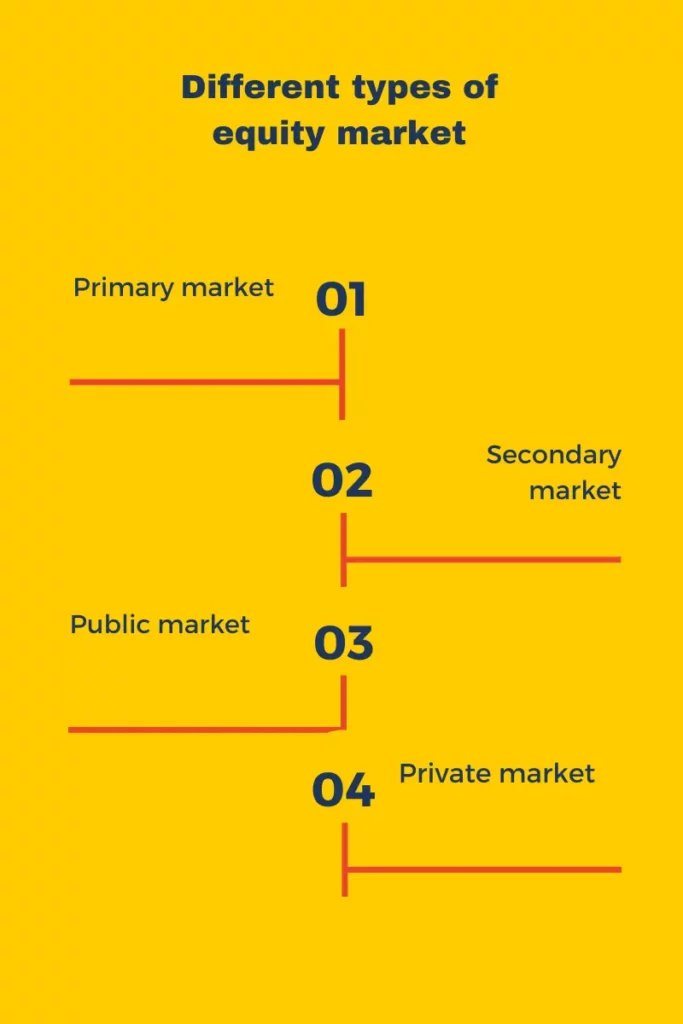
Many novice investors ask, what is equity market? What are the types? There are four types of equity markets. The types depend on many factors, like company size, geography, and trading methods.
Primary market
It is one of the types of equity market that investors use to issue new shares via IPO. This type helps investors raise their capital by selling ownership stakes for the first time.
Secondary market
The secondary market is mainly the stock market. Here, the investors buy and sell the issued shares.
Public market
One of the most important types of equity market is the public market. It is for the general public. So, anyone can purchase and sell shares on stock exchanges.
Private market
When investors are involved in the trading of shares in private companies, it refers to the private market.
So, these are the types of equity market. Every market comes with its own characteristics and investment opportunities. Anyone looking to expand their knowledge in the equity market can enroll in the Investment Banking course. Through this extensive program, one could become an equity expert.
Trading in the equity market
After understanding the concept of what is equity in share market, learning how to trade is important. In the stock market, investors make offers to buy stocks at a specific price. But, the sellers ask for a certain price. After a proper negotiation, a sale happens.
Often, several investors want the same stocks. In that case, the first bidder always gets the stock. When a buyer wants to pay any price to buy the stock, they purchase it at market value. Likewise, whenever a seller accepts any stock price, they sell at the market value.
When companies sell their stocks on the market, they become publicly traded. Here, every stock represents ownership, and it attracts investors. So, when the companies perform well, the stock value increases, and investors get rewards.
To get a clear understanding of what is equity trading, investors must know the potential risks. Whenever the companies struggle, the stock price value always drops. But, investors can buy and sell stocks quickly.
Examples of equity market
It is important to know the examples of the equity market to understand the equity market meaning properly. So some examples are:
National stock exchange (NSE) and Bombay stock exchange (BSE)
These two stock exchanges are the most popular and largest stock exchanges. It lists a wide range of companies in India.
New York stock exchange (NYSE)
Another significant stock exchange is the New York Stock Exchange or NYSE. It features companies from the US and other International companies.
NASDAQ
This equity stock market exchange is famous for its growth and technology-oriented companies. It is a leading stock exchange that streamlines the trading of shares for several innovative companies.
London stock exchange
It is one of the most established and oldest stock exchanges. This stock exchange features companies from different sectors.
In conclusion
The equity market has become a significant platform of the global economic system. It allows investors to improve their growth potential. But, anyone who wants to trade in the equity market must have an understanding of what is equity market.
With the basic idea, they can target specific stocks and invest in the most suitable stocks. To learn the fundamentals of the financial market and equity in-depth, enroll in the Certified Investment Banking Operations Professional course.
This Imarticus program is suitable for every type of learner. Through this, learning crucial skills is possible. Investors can also get a clear view of what is equity in share market, which helps in future trading.
FAQ’s
Is the stock a kind of equity?
Yes, the stock represents the ownership equity in a company. It entitles the shareholders to a proportional share of the earnings and assets.
What is the difference between shares and equity?
To know the equity market meaning, it is important to understand the difference between shares and equity. Shares refer to the individual units of ownership in a company. However, equity is the total ownership interest of the shareholder.
What is the formula of equity?
Investors can calculate the equity based on the difference between liabilities and a company’s assets. It means the formula is: Equity= Assets – Liabilities.
Can anyone do online equity trading?
Yes, investors can do online equity trading using online broker platforms. For that, they have to open a trading account to invest in the live equity market.
The field of digital marketing is expanding and it is going to get even bigger and better. As more individuals are showing interest in the online world, the business options to connect with the mass shall grow. The ever-changing world of social media and innovative client engagement will provide you novel marketing opportunities. Data and smart technology will allow marketers to make better judgments and provide more customised experiences. Voice commands, image-based searches, and engaging video content will all continue to influence the realm of digital advertising. The future of digital marketing has the potential for rapid development and transformation, providing several opportunities for both organisations and professionals.
Digital marketing in India is an excellent career option in this decade. In addition to that, the field has been offering the highest-paid digital marketing jobs and the ongoing trends have emerged in the industry since the pandemic. So, you can explore the scope of digital marketing if you are an aspiring professional.
Important Technological New Trends in Digital Marketing
Digital marketing is based on technology. Any new technical innovation creates new opportunities for digital marketers to improve the client experience. In recent years, the emergence of big data and predictive models has become essential in deciding corporate growth. The primary cause is competition worldwide.
Some of the new trends in digital marketing include:
Digital marketing is a well-paid career option in India. More than half of consumers discover brands via social media news feeds. This rise in popularity of the power of online content and advertisements have placed a high demand for digital marketing experts in the market.
Content Manager
Search Engine Marketing Specialist
SEO Manager
Social Media Marketing Manager
Email Marketing Manager
Reasons to Pursue a Digital Marketing Course
A digital marketing course may greatly help in job advancement. It improves your knowledge and skills, increases the authenticity of your resume, offers a competitive advantage, and allows you to earn more money. It allows you to take the course either online or in a classroom.
Following are the reasons why you should consider opting for a digital marketing course:
Increase in demand for digital marketing professionals
Development of entrepreneurial skills
Diverse digital marketing options that are well-liked
Excellent compensation packages
Does not get affected by the recession
Acquiring business insights
Final Words
If you wish to become a pro and upgrade your skills, you can enrol in the Professional Certification course in Digital Marketing and Martech, offered by Imarticus Learning in collaboration with IIT Roorkee. This course, which prepares you on the grounds of the scope of Digital Marketing in India, will help you learn every essential skill related to Digital Marketing, starting from social media marketing to website designing.
A specially curated curriculum on digital marketing, by the professors at IIT Roorkee and other eminent experts in the field, can be completed in a duration of 4.5 months. This live online training program is intended to teach you how to utilise technology, figure out the operation scheme of the current digital marketing industry and the use of various digital marketing mediums including social media, emails, sponsored search and organic search.
Additionally, you are provided with an access of 6 months to a premium employment site with advanced search tools and information to help you discover your dream job faster and more efficiently.
Performing well in a senior management role requires effective leadership skills. These skills help facilitate effective team dynamics, drive success and manage change. Also, they are crucial for both professional and personal development. Read ahead to learn who are senior managers, their roles and responsibilities, as well as senior manager salary.
Who are Senior Managers?
Senior managers are highly experienced leaders who face unique challenges when leading from the top. They are responsible for not only setting a vision, but also building the future. To accomplish these tasks, senior managers in leadership roles need to deal with real and challenging short-term pressures effectively and efficiently.
Further, senior managers can benefit by gaining a deep understanding of their strengths and development opportunities. Also, focus must be laid on innovation, which is critical for any organisation to survive and thrive. This is a great strategy for senior leaders who want to make a successful transition from managing a team to leading an organisation at the functional level.
Moreover, they must focus on solving challenges by working across organisational boundaries, thinking and acting strategically, and creating engagement. Notably, one of the major senior management roles and responsibilities includes motivating people to complete their tasks as per the schedule.
Besides, it is important to note that the average senior manager salary in India is ₹26,50,000 per year. Also, the average additional cash compensation for the role is ₹3,50,000.
Must-have Leadership Skills for Senior Managers
Leadership is not just about one quality but a combination of different skills working together. To be a strong leader, one must possess the following set of skills:
Ability to teach and mentor
Active listening
Creativity
Reliability
Effective feedback
Empathy
Flexibility
Patience
Positivity
Timely communication
Building strong teams is essential for any business and project to perform successfully. And, effective leaders ensure this through the following skills:
Agility and Adaptability: Ability to not only adapt to both internal and external changes, but also facilitate one if need be
Conflict Management: Ability to mitigate a conflict before it negatively affects a business and keep the peace
Critical Thinking: Involves understanding logical links between different ideas
Decisiveness: Ability to make decisions quickly with the information at hand and lead with conviction
Dependability: Includes keeping promises and creating a resilient team
Employee Motivation: Involves improving employee engagement and efficiency
Integrity: Involves having a strong value system
Innovation: Ability to ideate and push boundaries to achieve growth
Negotiation: Ability to get the most out of different sides in order to win the game
Relationship Building: Ability to develop a strong and collaborative team
Problem Solving: Involves staying calm and identifying solutions to resolve obstacles
How to Improve Leadership Skills?
Leadership skills can be practised in any role, at any level. For instance, showing up for meetings on time and meeting deadlines display dependability. Or, supporting and guiding less experienced colleagues is also an example of leadership.
Further, the following are the ways to develop and/or improve leadership skills:
Read books or watch podcasts on leadership to find your style
Pursue leadership training programmes or attend related workshops
Participate in leadership activities outside of the workplace
Request a leader for mentoring
Conclusion
Good leaders support a positive environment and help remove obstacles for their team. Also, they inspire their colleagues to apply positive leadership traits in their work, ensuring tasks are accomplished in time for business growth. If you want to acquire strategic leadership skills to get a good senior manager salary, then enrol in the IIM Lucknow Senior Management Programme. Reach out to Imarticus Learning, if you have any related queries.
Preparing for a finance interview can be very challenging, but with the right guidance, one can ace the toughest of finance interview questions. With the following guide, we will help you tackle the most common finance interview questions as well as other finance related questions.
This guide will also provide knowledge about various other aspects such as expectations, how to prepare, what kind of finance questions can be asked and the necessary concepts you must know of. Whether you are a fresher or even a working professional, this guide will help you prepare for the finance interview.
What To Expect In a Finance Interview
Before preparing for the finance interview questions it is very important to know what the interviewers expect from the candidates. The interviewees are not only expected to have good financial knowledge but also how to apply the financial knowledge. The candidates can expect the following types of questions while preparing for the finance interview questions-
Technical questions: In finance interview questions these questions are meant to test the financial concepts of the candidate and to find out how well they can perform the financial tasks
Behavioral questions: In finance interview questions these questions are asked to find out how the candidates have handled their work in the past jobs because finance requires experience.
Situational questions: In such types of questions, the candidates are given some situations or scenarios and they are required to answer how they would react in that situation. These are very important kinds of questions and are asked in finance interview questions.
Preparation For The Interview
Preparation is the key thing that candidates need to do in order to ace the finance interview questions. Here are some of the points that should be kept in mind in order to prepare for finance interview questions:
Research the company: Before going for an interview in a company, it is necessary to research the company in detail such as current news, the founders and their achievements, etc.
Review common 1uestions: The candidates can look into some sample interviews of the company and prepare some finance interview questions to gain confidence.
Brushing up the basics: While preparing for the finance interview questions, the candidates must know the basic concepts that they have learned in the past.
Key Financial Concepts
Before preparing for the finance interview questions, the candidates must go through the basic finance questions and concepts to prepare for finance interview questions which are provided below:
Financial statements: This includes understanding the income statement, balance sheet, and cash flow statement of the company.
Valuation methods: Candidates must be aware of the different valuation methods such as the Discounted Cash Flow (DCF), Comparable Company analysis, etc.
Financial ratios: These ratios tell about the liquidity, profitability, and leverage of the company.
Return on Investment (ROI): The return on Investment tells about the return a company can expect from the investments they have made.
Net Worth: The net worth tells about the financial health of the company. It is measured as the difference between the total assets and the total liabilities.
Common Finance Interview Questions and Sample Answers
Tell me about yourself.I graduated with a degree in finance from the following xyz university which helped me gain a deeper and complete knowledge of financial concepts and also helped forge a strong foundation in financial analysis and corporate finance. After completing graduation, I worked as an intern at ABS Ltd. to apply my knowledge in practical life. I wish to pursue a career in the finance field as it is quite challenging as well as exciting for me.
Why do you want to work in finance?I feel comfortable working with numbers and I like to analyse data, learn the trends and help businesses in making financial decisions. I have good analytical skills and also they have always had an interest in business and so they think they can combine both skills and have a good career in the finance field.
Explain a financial model you have built.I developed a discounted cash flow (DCF) model to assess a possible acquisition in their previous position. Forecasts for capital expenditures, cost estimates, and revenue were all incorporated into the model. I decided to move forward with the purchase after calculating the acquisition’s possible return on investment by discounting future cash flows.
How do you value a company?There are many ways in which we can value a company such as by the DCF analysis, Comparable analysis and precedent transactions. The DCF involves determining future cash inflows and discounting them in present value, comparable analysis basically chooses companies from the same sector and makes comparisons, precedent transactions look at recent sales of companies and analyzes the current market trends.”
What is EBITDA and why is it important?EBITDA stands for Earnings Before Interest, Taxes, Depreciation, and Amortisation. It’s a measure of a company’s operating performance and is often used to compare profitability. EBITDA helps to assess a company’s operational efficiency by excluding the effects of capital structure and non-cash items..
Describe a time you worked in a team to achieve a common goal?In the university, I worked as the head of the finance club where they had a case study competition. There were several teams and each team was given a case study on any one company and they were required to solve it within a certain time limit. My team efficiently worked towards solving the case, with good teamwork and communication, the team won a second prize in the competition.
How do you stay updated on financial news and trends?I invest in stocks so it is necessary to be updated on financial news and current trends. The candidate reads the news every day from the Economic Times, The Wall street Journal, etc. They also follow various news channels on Twitter and LinkedIn.
What do you think is the biggest challenge facing the finance Industry today?The rapid development of technology and the widespread use of artificial intelligence (AI) in financial services pose major risks. Although these technologies are innovative and efficient, they also come with risks. like the need for updated legal frameworks and cybersecurity threats. It’s critical to remain adaptable and keep up with technological advancements.
How do you handle stressful situations?I focus on work and maintain discipline to help them cope with stress. For example, I efficiently interacted with the team and divided the work into manageable portions throughout a high-stakes project with short time frames. I was able to stay focused by taking regular rests and keeping an optimistic attitude.
Give an example of a financial analysis you have done and its impact.I prepared a profitability study for product lines at their prior position. They determined which goods were underperforming by analyzing the margins and sales figures of each product. Over the following two quarters, their suggested withdrawal of these products and emphasis on high-margin items resulted in a 15% rise in profit margin.
Conclusion
Acing finance interview questions will not be possible with just memorising the answers. Cracking interviews is also about understanding the concepts properly and having knowledge of how to apply those concepts. Whether you are preparing for finance related questions and finance interview questions for freshers, or even if you are preparing for tougher finance executive questions, the advice in this guide should help you out in all cases.
Good luck with the interview and do not forget to prepare because preparation is the key in preparing for finance interview questions. To learn advanced concepts of financial accounting and financial management, you can check out the Financial Accounting and Management course by Imarticus.
FAQ’s
What are some common finance interview questions for freshers?
Preparing finance interview questions for freshers includes knowing about financial terms and how to value a company. The candidate must be aware of the key concepts.
What are some of the finance interview questions for the executive level?
Finance executive interview questions include questions like, “Have you handled any market downturns? How do you deal with technology to stay ahead in your career?”, “What kind of strategies do you adopt in order to maintain the financial stability of your company?”, etc.
What are the key concepts I should understand for a finance interview?
It is important to be well acquainted with concepts like financial statements and valuation models, to know about current market trends and news and have knowledge about financial modeling, etc. Knowing about these types of concepts for finance questions is enough for the interview.
How should I prepare for the basic finance questions?
To prepare for basic finance questions it is important to go through the basic financial concepts and terms. You will have to know finance from the base and how to apply them and also analyse it in real life. This can be done by preparing some finance basics for interview.
Where can I prepare for finance interview questions?
There are many online websites and online videos and articles that help candidates prepare for the finance interview questions. Youcan also go for mock interviews to prepare for the interview. This will help you in getting an idea as to how you can prepare for finance interview questions and know which finance related questions are being asked by the interviewers.
Large corporations, such as Reliance and Facebook, often pursue diversification strategies through acquisitions or capital-raising initiatives. These complex transactions necessitate the expertise of specialised individuals and organisations adept at dealing with strategic financial decisions.These experts conduct comprehensive research and analysis to assess the profitability of high-value financial transactions, ensuring their viability and potential return on investment. Investment banking plays a crucial role in this process, facilitating these transactions and providing essential valuation services.Investment bankers employed by investment banks are responsible for conducting these valuations, which are a core component of investment banking’s financial services offerings. By securing the necessary capital, what do investment bankers do is enable companies to maintain competitiveness and achieve growth within the market.To make these concepts easy for you, we have prepared this guide. Through this article, we will explain what investment banking is and what do investment bankers do. We will also discuss what the core functions of investment banking are and what are the different types of investment banking.
What is Investment Banking?
Investment banking is a special financial service that helps companies, governments, and individuals raise capital to meet their short-term and long-term financial goals. The needed capital is acquired through IPOs, mergers, and a few other methods.Investment banks also provide financial advice to companies with reorganisation and risk management. These investment banking solutions span many sectors and products. There are a few investment banks raking in billions with their top-notch investment advice.They are:
J.P. Morgan – They made $49.6 billion in 2023 as net income, which is the highest in American history.
Goldman and Sachs – They made $8.52 billion in 2023 as net income.
Credit Suisse – This Swiss investment bank made $27.8 billion in the year 2023.
In India, there are many good investment banks, but a few stand out, like:
ICICI Securities – They made a net profit of ₹ 536.53 Cr in the last quarter of 2023.
HDFC Bank – They offer a wide range of financial services to raise capital for businesses in India.
Edelweiss Financial Services – They also have merger and acquisition services as financial solutions.
Understanding Investment Banking
All financial services offered by investment banks are investment banking operations. They are further supported by processes like due diligence, which help investment banking operations to perform smoothly.Let’s discuss what do investment bankers do in detail.
Investment Banking Operations
Investment banking operations are the main functions that a well-established investment bank will offer.
Capital Raising and Underwriting
The role of investment banks is to assist companies in receiving investments by selling their stocks or bonds. These securities are underwritten by the underwriters, who guarantee that the securities will be sold at a pre-agreed price. This enables companies to raise capital to support operations and expansion.
Mergers and Acquisitions (M&A)
Investment banks raise finance, advise on, and execute mergers, acquisitions, and divestitures. They review accounts, appraise resources, bargain for deals, and execute deals in a way that will meet the client’s needs. This may include extensive negotiations and administrative or regulatory permits.
Advisory Services
Investment banks provide corporations and governments with strategic advice concerning finance. This can include strategies for restructuring and financial planning and even market strategies to assist clients in decision-making.
Sales and Trading
Financial intermediaries who trade in securities like shares, bonds, and futures for their clients. These products are also marketed to institutional customers by sales staff. This activity keeps liquidity in the market and provides an effective means for trading.
Research and Analysis
Investment banks perform studies on various industries and organisations. They apply this information to their clients, investors and internal team members. This research is very crucial in making an investment decision.
Investment Banking Concepts
The investment banking concepts are the techniques at a theoretical and practical level that investment bankers apply in the field of finance. These concepts include interpreting financial statements, making investment decisions, and measuring the effect of economic conditions on various sectors.By understanding these concepts, what do investment bankers do is offer efficient advice to their clients to enable them to reach their objectives. Investment banking operations function smoothly because of concepts that guarantee the successful execution of financial transactions.Due DiligenceDue diligence is an investigation aimed at determining whether the financial and legal aspects of a possible transaction or investment are genuine. Investment bankers undertake it through thorough research and evaluation.
Valuation and Pricing
Investment bankers evaluate the worth of assets, firms or transactions in which they are involved. This is important in determining the right price for transactions like takeovers or mergers.
Regulatory Compliance
Financial investment institutions must follow many guidelines and regulations. This helps in their operation and compliance to safeguard the interests of the bank and its customers.
Risk Management
Good risk management is very crucial for the growth and performance of an investment bank. Risk Management is the process of evaluating probable risks of a business or investment.Banks involved with investment activities tend to appraise and mitigate these potential risks concerning financial transactions and investments. Some of these risks are market risk, credit risk and operational risk.
Initial Public Offering
Initial Public Offering (IPO) can be referred to as a growth strategy where a company is open to selling its shares in a regulated public market. This transaction enables companies to accelerate growth by acquiring the capital required to put their business model into practice.IPO enables private shareholders to acquire liquidity, and realise the value of their shares and increase their level of assets.
Example of Investment Banking in Action
For instance, there is a local Indian restaurant chain in New Delhi called “Raj’s Rasoi,” and it has been working successfully for several years, so it may decide to issue an initial public offering.Raj, the owner, enters an investment banker’s office in a well-known financial institution called Priya Investment Bank. After talking, they mutually decide that the firm of Priya will make an offer of the IPO of 5,00,000 shares of the company of Raj Rasoi at ₹100 per share.This is the valuation of a stock, which is based on research conducted by the analysts from the investment bank, a critical aspect of investment banking.It floats the shares to the market at ₹110 per share after acquiring 5 crores of their shares at ₹5 each. But it can only offer 30% of the shares in the market at this price and has to lower it to ₹95 to offer the other 70% of the shares.This is one of the things that can happen in investment banking because the value may be high when the client asks for the valuation but the market may not be impressed at the same time.Finally, the investment bank receives a return of 48 rupees. 5 crore [150000 shares at ₹110 + 350000 shares at ₹95 = ₹1.65 crore + ₹3.325 crore = ₹4.975 crore]. This means that they lost ₹25 lakhs on the deal since they overpriced Raj’s Rasoi shares.This example specifically serves the purpose of supplying the investor with highly important investment banking analysis related to the risks of underwriting an IPO.This scenario fits well in describing what one can anticipate in what do investment bankers do. There is a huge demand and high competition for IPO deals, which sometimes results in over-bidding and not obtaining the expected punitive.Further, there is also an added advantage in terms of spreading around the risks associated with financing securities but this may translate to reduced profits for individual banks.This example is simplistic but presents one of the most important processes involved in the concept of investment banking, opening the market for equity and providing companies with access to the market.It shows that the process of investment banking involves an accurate prediction of company valuation and the level of risk that needs to be taken to achieve the desired result.
What Do Investment Bankers Do
An investment banker is a type of finance professional who deals with the company, even the state, or an individual to obtain a loan or issue shares. They also offer support during crucial transactions in finance for example mergers and acquisitions.They also engage in advocacy on when to raise certain financial securities, such as bonds or stocks.They further advise about how many securities should be floated as well as what price each security should be offered. What do investment bankers do is save time and money, as they can point out the risks involved in a project.
Let’s look at What do Investment Bankers do:
Working in the division that deals with merging and acquiring companies and creating financial models to build it or assist in the process of merging or acquiring a company.
The problem of stock pricing to facilitate the investors entitles them to make investments in the stock for the betterment of the company.
Establishing mechanisms for ensuring conformity to financial regulation bodies like the SEBI, given the fact that they offer financial services as well.
Economic and financial issues concerning IPOs and documentation.
Advocacy for the clients in determining the pricing of the financial tools.
Providing advice to corporations regarding the type of securities to offer to shareholders.
Assisting firms or other entities to sell municipal bonds, equities, or debt-carrying securities in the private or public markets.
Types of Investment Banking
Investment banking is a diverse industry with various types. Each investment banking type serves different clients and transaction sizes.
Bulge Bracket Investment Banks
Bulge-bracket investment banks typically manage deals over $1 billion and offer comprehensive investment banking services. With a global presence, they build strong international networks. Citibank, JP Morgan, and Barclays are renowned Bulge Bracket Investment Banks.
Elite Boutique Investment Banks
These banks specialise in a smaller range of activities, unlike the broader focus of the bulge bracket investment banks. Some of these investment banks focus on specific niches, like mergers and acquisitions or capital restructuring. Others concentrate on specific industries, such as consumer products or energy (gas and oil). Despite their niche focus, they are known for their expertise and ability to handle large deals.
Regional Boutique Investment Banks
Regional boutique investment banks are the smallest type of investment banks, working primarily with small local businesses. Their deals typically range under $10 million, sometimes reaching up to $50 million. They are limited by their geographical coverage and focus on helping businesses with financing loans.
Mid-Market Investment Banks
These banks cater to mid-sized clients and transactions falling between regional firms and bulge-bracket banks. The usual deal size for these banks would be around $500 million to $1 billion. Mid-market investment banks are not as well-known. However, they have significant financial expertise and offer similar services to larger banks but with a narrower geographic focus.Every type of investment bank offers unique benefits and drawbacks. The ideal choice depends on the transaction’s size and the client’s specific needs. Understanding these types of investment banking and what do investment bankers do is essential for anyone interested in this sector.
Conclusion
Investment Banking as a financial service is an important vein for businesses. The knowledge and expertise they bring to assist is unparalleled. What do investment bankers do is both demanding and challenging but highly rewarding. If you are someone who sees themselves in such a position, then the Investment Banking course by Imarticus Learning is your best bet.
FAQ’s
Is investment banking really banking? No, investment banking is different from a traditional commercial bank. Investment banking focuses on raising capital and other investment banking operations.
Which is better, an MBA or investment banking? The better option would depend on your career goals. Analyse which option suits your career goals and choose that option.
Who earns more, a CA or an investment banker? Both career options have good earning potential. With good experience and hard work, you can make a good yearly salary, whether you are a CA or an investment banker.
Why is investment banking called investment banking? Investment banking is called so because it focuses on investments and capital markets.
What is the future of investment banking? The future of investment banking looks promising because there are constant financial tech advancements and increasing fluctuations in the financial market. Investment banks will play an important role for companies with their financial goals.