10 Essential Leadership Qualities For The Age Of Artificial Intelligence

Artificial intelligence (AI) is slowly being a revolution that can completely change the workforce. At the same time, it is still not able to replace human intelligence and reliability.

This is the main reason why leadership qualities are highly significant under the circumstances.
When AI is starting to show its power, it takes a highly capable leader to show the team that there is still a lot the humans can do.

In order to show them the same, a ladder needs to have certain attributes at this age of AI. These are qualities that are not taught during an Artificial intelligence course but are the ones that you need to develop yourself.
The essential leadership qualities

  1. Agility: In this fast world, a leader needs to have a quicker mind and make strategies on the go. This is one area where there are no compromises. If you have to survive in this era you have to be an agile leader.
  2. Adaptability: Sharpen adaptability skills because the requirements and circumstances could change anytime, A leader must be willing to make changes swiftly but effectively to adapt to the situations. Better the adaptability, finer would be the outcome.
  3. Accountability: Be accountable for all or any actions and decisions made as a team. Since leading from the front requires trust, this attribute helps develop confidence within the team. So be accountable and transparent.
  4. Commitment: Artificial intelligence may be able to show the way but the decision-making power is still with the humans- leaders. A leader must be committed to the decisions made and for any changes thereafter.
  5. Better communication: A leader needs better communications skills, period. Developing this attribute is more important than enrolling in any Artificial intelligence course. Look for courses that help develop this personal quality.
  6. High work ethics: Learn to value others in the team and give as much importance to every part of the work system. One who can inspire others and aspire to be a better person is better valued by the companies.
  7. Foresight: AI may be able to foresee future possible changes but it is the leader who needs to have the foresight to see and decide for the possible changes that could be down the lane. It also calls for some amount of creativity to use such changes for the betterment of the company.
  8. Flexibility with demands: When Artificial intelligence is predicting changes even a small change of course can have major impacts. A true leader must be flexible with such changes according to the demands. A leader must be able to alter his or her working style to suit the new scenario and should also be able to make it productive.
  9. Be able to influence: The flexibility in work and coming up as the winner at the end of such a trial should be enough to influence others to follow. This is one leadership quality that is highly dependent on the other attributes. One must be reliable, adaptable, and trustworthy enough to influence others. When you influence others to be positive, you are giving more value to yourself and to the company.
  10. Stay Humane: AI might be taking over too much of human efforts but the one thing that it cannot take away is the humane nature. A ladder who stays humane under all circumstances is sure to be born as a commander. This is another attribute that no Artificial intelligence course could teach you. You stay grounded even when you are flying high; it’ll make you the person that defines leadership qualities in this very age of robotics and manmade intelligence.

Also Read: 10 Interesting Facts About Artificial Intelligence

Don’t Miss These Comprehensive Questions To Ace Data Science Interview!

109 common data science interview questions to remember

 Data science interviews are often considered to be difficult and it might be difficult for you to anticipate what questions you will be asked. The interviewer can ask technical questions or throw you off guard with questions you hadn’t prepared for.

To pursue a full-fledged Data Science Career, it is important for you to be up to date on an array of questions that might be asked during the interview, ranging from programming skills to statistical knowledge, or even field expertise and plain communication skills.

Here is a segmentation of the various categories along with the list down of the possible questions you can expect in each category as an interviewee during a data science interview.

Statistics

As an interviewee, it is essential for you to be prepared on statistical questions since statistics is considered to be the backbone of data science.

  • What are the various sampling methods that you know of?
  • Explain the importance of the Central Limit Theorem.
  • Explain the term linear regression.
  • How is the term P-value different from R-Squared value?
  • What are the various assumptions you need to come up with for linear regression?
  • Define the term- statistical interaction.
  • Explain the Binomial Probability Formula.
  • If you were to work on a non-Gaussian distribution, what is the dataset you would use?
  • How does selection bias work?

Programming

Interviewers may ask completely general questions on programming to test your overall skills or may try and test your knowledge on big data, SQL, Python or R. Listed are a couple of questions that may turn out to be relevant for you to crack that interview like a pro.

  • List the pros and cons of working with statistical software.
  • How do you create an original algorithm?
  • If you were to contribute to an open-source project, how would you do it?
  • Name your favorite programming languages and explain why do you feel comfortable working in them.
  • What is the process of cleaning a dataset?
  • What is the method you would take for sorting a large list of numbers?
  • How does MapReduce work?
  • What is Hadoop Framework?
  • If you are given a big dataset, explain how would you deal with missing values, outliners and transformations.
  • List the various data types in Python.
  • How would you use a file to store R objects?
  • If you were to conduct an analysis, would you use Hadoop or R, and why?
  • Explain the process using R to splitting a continuous variable into various groups in R.
  • What is the function of a UNION?
  • Explain the most important difference between SQL, SQL Server, and MSQL?
  • If you are programming in SQL, how would you use the group functions?

Modeling

While a Data Science Course will teach you the basics of modeling, at an interview you may be asked technical questions like building a model, your experiences, success stories and more.

  • What is a 5-dimensional data representation?
  • Describe the various techniques of data visualization.
  • Have you designed a model on your own? If yes, explain how.
  • What is a logic regression model?
  • What is the process of validating a model?
  • Explain the difference between root cause analysis and hash table collisions.
  • What is the importance of model accuracy and model performance while working on a machine learning model.
  • Define the term- exact test.
  • What would you rather have; more false negatives than false positives and vice versa?
  • Would you prefer to invest more time in designing a 100% accurate model, or design a 90% accurate model in less time?
  • Under what circumstances would a liner model fail?
  • What is a decision tree and why is it important?

Problem Solving

Most interviewers will try and test your problem-solving ability during a data science interview. You may be asked trick questions or be subjected to topics that evoke your critical thinking abilities.

Listed are some questions that will help you prepare for an upcoming interview.

  • How would you expedite the delivery of a hundred thousand emails? How would you track the response for the same?
  • How would you detect plagiarism issues?
  • If you had to identify spam social media accounts, how would you do so?
  • Can you control responses, positive or negative to a social media review?
  • Explain how would you perform the function of clustering and what are the challenges you might face while doing so.
  • What is the method to achieve cleaner databases and analyze data better?

Personalization Is The Future of L&D: Here’s How?

The business dynamics of today are rapidly changing. Almost all industries are undergoing a change and as a result, consumers are getting access to content and services that serve their unique needs and demands.

Long gone are the days, when companies could churn out off the shelf content and services like cookie cutters and target it towards a specific market. These days personalization is at the forefront of innovation and companies are creating services and content from the ground up, based on their learnings of user behavior.

This situation is true for L&D (Learning and Development) companies as well. They are integrating old content with new personalized pieces and engaging their users from fresh perspectives and so far, it has yielded results that are better and significantly more profitable, thus marking this innovation as the way for the future.

Advantages of Personalization in L&D

Personalizing learning and development initiatives for students has more benefits than ever before. Mentioned below are some of the most significant ones:

Personalization Favours the Development of Skills

The first and most significant benefit of personalizing L&D content is the promotion of skill development. By customizing the content to a student’s specific needs and demands, not only does the student acquire more skills, but also acquires it in a more efficient and effective manner.

Personalization allows for the creation of a learning journey that is synonymous with the student’s thought process and perspective. This serves two purposes; first, the learner is able to relate better to the content that is being taught and second, the instructor can deliver the course material better, as he understands the needs of the student.

This way, students are naturally encouraged to reach beyond their prescribed curriculums and thus acquire more skills.

Personalization Boosts Learning Engagement

Engaging learners is one of the most fundamental objectives of any learning environment and personalization helps platforms and instructors achieve this in the best possible way. Research shows that personalized content sparks intrinsic motivation in students, which further urges them to move forward with the course and ultimately encourages them to go beyond as well.

Along with this, personalization also makes the learning journey more fun and interesting, which assures that the students are engaged for longer bursts of the time, rather than short intervals. Additionally, leading online learning platform Udemy has reported higher retention among its students because of personalizing all the course material that is available on the platform.

Personalization Is the Future

In this rapid era of technological development, individuals always need to be on the lookout for what’s next in order to prepare themselves better for the future. Personalizing the learning journey of the students has been reported to make them more curious and inquisitive to learn about the next big thing. This will not only help you retain your students for a longer period of time but also encourage them to find and discover the next big thing on their own and chase it with all their might.

How to Personalize Your Content?

Now that you know the importance of personalization, one of the best ways to achieve this within your organization is by promoting coaching. Both internal and external coaching has been proved to be one of the best ways to promote personalized learning as the course material is highly curated and targeted for a specific audience.

You can either choose to work 1 on 1 with your employees or even work with them in small batches of 5 to 10. This will allow your students to interact more freely with the instructors and also give them the freedom to be more creative. Along with this, you need to make sure that your learning space is safe and judgment-free. Urge your students to take risks, fail and most importantly succeed and learn continuously.

Conclusion
Personalizing content is the future for learning and development. Thus, now is the time you start personalizing your organizations approach the development of your employees and believe us, you will see results that will make you proud.

So, go ahead discuss with your stakeholders and plant the foundation of personalization in L&D for your organization today.

For more details, you can also visit: https://www.linkedin.com/showcase/4821209/admin

Why Are Companies Considering Candidates With An Artificial Intelligence Certification?

Artificial Intelligence has expanded at an exponential rate in recent years, despite significant progress in the field. In the field of computer science, AI practices can be found everywhere. It provides you with an idea of how many different ways a computer system can be designed.

artificial intelligence and machine learning courses in India It is designed to carry out the cognitive functions that humans have specified. This indicates that the scope of an artificial intelligence and machine learning course is enormous, and AI has potential that is currently beyond human grasp.
Scope of An Artificial Intelligence Course in India

Artificial Intelligence has enormous potential to transform every sector of the economy for the greater good.

AI encompasses a wide range of technologies, including self-improving algorithms, machine learning, big data, and pattern recognition, to name a few. There will be few industries or sectors left unaffected by this potent weapon in the not too distant future. This is why online Artificial Intelligence courses are becoming increasingly popular in India.

With each passing day, the gap between the number of AI professionals required and those available widens. Corporations are spending money to train their existing employees on Artificial Intelligence technologies. However, the demand is far higher.

Learn AI

Certification In Artificial Intelligence & Machine Learning

Learn AI via 25 in-class, real-world projects focused on offering exposure to various industries. This 9-month program will help you prepare for the roles of Data Scientist, Data Analyst, Machine Learning Engineer, and AI Engineer.

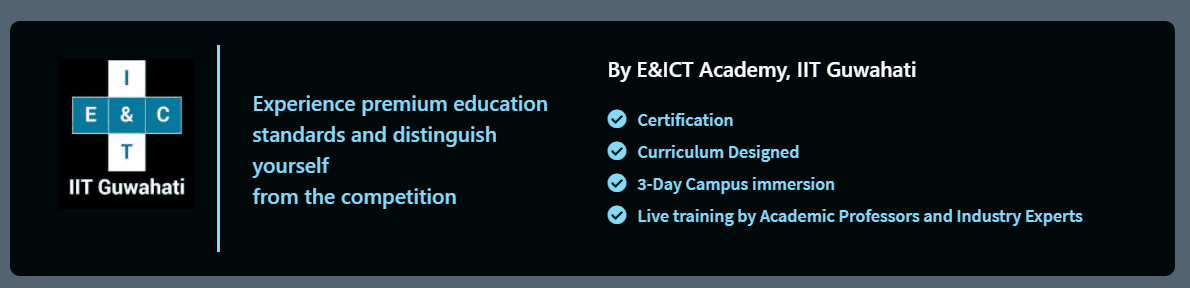
artificial intelligence and machine learning courses by E&ICT, IIT GuwahatiThis machine learning certification program was established in collaboration with the E&ICT Academy, IIT Guwahati, and industry professionals to give an optimum learning outcome,

This course will strengthen your core abilities, allow you to take advantage of our Expert Mentorship program, and give you a practical grasp of AI and Machine Learning.

Data Science Prodegree

Develop your knowledge of Data Science ideas and build robust models to generate relevant business insights or forecasts with a working knowledge of critical Data Analytics technologies such as Python, R, SQL, and Tableau in these 14 in-class and industry-oriented projects.

PGP In Digital Marketing

Our Digital Marketing Postgraduate course is meant to provide you with a more in-depth and practical understanding of Digital Marketing ideas. The postgraduate program takes a collaborative approach that emphasizes several Capstone projects, job-specific skills, and guaranteed job interviews.

This course will prepare you from beginning to end to start or advance your career in the Digital Marketing segment, including resume building, mock interviews, job leads, and references, making it an ideal Digital Marketing course with a strong focus on placements to help you land your dream job.

Post Graduate Program in Data Analytics & Machine Learning

This machine learning certification program is for recent graduates and early career professionals interested in pursuing a career in Data Science and Analytics, the most in-demand job skill.

To become job-ready, master the fundamentals of data analytics and machine learning, as well as the most in-demand data science tools and methodologies.

With this placement-guaranteed program, you’ll learn Python, SQL, Data Analytics, Machine Learning, and Data Visualization. After completing the course, students are promised interview opportunities.

artificial intelligence and machine learning coursesTakeaway

AI is one of the most popular technologies on the planet because of its diversity and superior solutions. It has been rapidly expanding. As you can see, the scope of AI has broadened to include a wide range of industries, including healthcare, transportation, security, etc. Multiple industries require the expertise of experienced AI specialists as a result of this increase.

Check out Imarticus IT classes, targeted at working professionals, if you want to learn more about AI and machine learning algorithms.

The Impact of Data Science on Current Events and the World

The Impact of Data Science on Current Events and the World

Data science remains one of the most lucrative and challenging career pathways for experts. Successful data professionals now grasp the traditional skills of analyzing massive quantities of data, data mining, and programming.

best data science courses in IndiaData scientists must control the complete spectrum of the data science life cycle and must be flexible and understandable so as to optimize returns at each stage of the process to detect meaningful intelligence for their organizations.


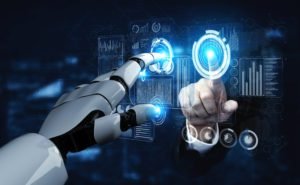
You can also contribute to this surge by doing proper data science online training.

Skills that data scientists must have:

According to a study by IBM, a data scientist must be able to perform the following tasks:

  • Use math, statistics, and a scientific approach
  • Use a variety of tools and strategies for data assessment and preparation – for example, SQL, data mining, and data integration methods
  • Data extraction through predictive analysis and artificial intelligence (AI), including in-depth learning and models
  • Write apps for data processing and calculating automation
  • Tell — and illustrate — stories that show the importance of findings at every level of technical knowledge and comprehension to decision-makers and stakeholders
  • Explain the use of these results for business challenges

The number of job opportunities in the industry is increasing by more than 5% a year, according to an IBM study.

What is the role of data science in the current scenario?

  • Inadequacies can cost companies up to 30% of their income. The data science course allows you to follow a number of business indicators, including manufacturing times, delivery expenses, productivity for employees, and more, and suggest improvements.

It is feasible to reduce total expenses and increase return on investment by limiting waste of resources.

  • Data science enables companies to consistently refine their products and services to suit a changing market by assuring a ready-flow of practical insight into customer psychology, behavior, and satisfaction.

Data on clients can be accessed from a range of sources, and information mining from third-party platforms such as social media, search engines, and data sets.

  • One of the most intriguing aspects of data science is testing. New, inventive options are compared with current features and often produce surprising outcomes.

Companies can create incremental revenue gains through consistent, long-term testing. Data scientists are in charge of conducting thorough tests to ensure the effectiveness of marketing campaigns, product launches, job satisfaction, website optimization, et al.

  • Data science is used in the current scenario to improve a company’s safeguarding of sensitive information. Banks, for example, deploy sophisticated machine-learning algorithms for detecting fraud based on variations from a user’s normal financial activities. Because of the vast volume of data created every day, these algorithms can detect fraud faster and more accurately than humans.

Algorithms can be utilized to protect sensitive information via encryption.  By ensuring data privacy you can help guarantee that your organization does not misuse or reveal sensitive information about its consumers, such as credit card numbers, medical information, or Social Security numbers.

  • Data collection and analysis on a bigger scale can help you spot developing trends in your market. Purchase information, stars and influencers, and search engine searches can all be utilized to discover the things people want.

Conclusion

It can be concluded that a career as a data scientist is an extremely lucrative option in the current world as data science is gradually taking over the entire world. The data science pro degree can help you understand the intricacies of this field and learn data science effectively.

If you are a recent graduate and want to learn data science, a post-graduate program in data analytics and machine learning can help you learn better from live faculty and bag guaranteed jobs in the future. Proper data science online training can help the audience come here.

What is the Scope of Scrum master?

Scrum
Scrum is a framework that helps different teams to work in a cohesive manner. Scrum helps teams to remain self-organized while dealing with a problem. Using the Scrum framework, teams learn from their experiences. Scrum enables effective use of all the available resources and makes the deliverables available with high efficiency.

Scrum helps in dividing the overall projects into various sub-projects referred to as sprints. The use of scrum empowers all the team members to have visibility of everything happening in the project. The use of scrum makes it possible to have a 3600 feedback system regularly. Along with the performance and efficiency of the entire team, Scrum also focuses on the individual performers in the team.

Scrum Master
The scrum team leader, also referred to as the scrum master is a person who takes care of to and for communication between the product owner and the entire team members, communication within the team, without actually being included in the strategy flow of the product. Along with smooth communication, scrum master also ensure that all the team members follow astute values.

Scrum Master Course

Who should attend the Scrum Master Course?
The Scrum Master course is meant for the professionals who use the Scrum framework to develop software and the professionals whose ultimate commitment at the workplace to maximize the Scrum

Scrum master Course-Competencies

Competency 1 – Scrum values

Clear focus, Respect, commitment, and courage are the key values possessed by a Scrum master. The ability to apply the stated values in the organizations with the different sets of values altogether defines the role of the Scrum master. Practitioners living with the scrum values help create an environment where continual improvement with self-organization continuously flourishes.

Competency 2 – Empiricist Philosophy

Practicing Empiricist Philosophy to solve problems is the essential quality of the scrum master. The entire philosophy talks about breaking the complex problems into various incremental problems for empirical execution. The use of scientific methods to solve complex problems is the key attribute of empirical philosophy.

Competency 3- Scaling

The design of the Scrum framework helps to achieve the individual targets at the team, product, and organizational levels. The practitioner has a complete understanding of all the scales and the levels of the scrum. Different levels of scaling can be used in complex frameworks, keeping the essential qualities of scrum such as empiricism and continuous improvement intact.

Competency 4 – Events

The entire Scrum framework is defined in 5 stages. Sprint is the first stage, followed by sprint planning. The entire sprint planning defines the third, fourth, and fifth stage which is daily scrum, sprint review, and sprint retrospective respectively. These time-bounded stages facilitate the progress and achievement of goals through transparency. The three pillars of Scrum i.e. transparency, inspection, and adaptation uphold the entire system.

Competency 5 – Sprint-Product Backlog and Increment

Product and sprint provide the team with materials to plan, execute and review the sprint deliverables. Professionals in the same field will understand the application of these facts in real and complex situations, hence integrating the facts with the organization’s own objectives.

Competency 6 – ‘Done’
‘Done’ (DoD) is defined by the practitioner as the focus area to be applied to the particular context. The same needs to be communicated and visualized internally in the organization. The practitioner will be able to describe the trade-offs and compromises to be considered to deliver ‘done’.

Scrum master Salary in India
Average salary of Scrum Master in India is Rs.1,412,000 per annum which range between Rs.2,268,000 and Rs.7,02,000. Factors that determine the salary range for a candidate are experience in the field, region, and the company’s profile. Favorable factors decide the inclination towards the higher spectrum of the salary.

How Edge IoT Solutions Can Improve Business Performance?

Artificial Intelligence (AI) and Internet of Things (IoT) technologies are transforming the ways of business entirely. The power of these technologies is revolutionizing the business sphere by evolving its chief resources such as software, products, applications, and overall systems.

AI and IoT are becoming widespread as businesses are looking for ways to hyper-optimize their performance by propelling the value-addition processes and generating better results from data through connected devices.

AI and IoT help companies to find patterns not easily identified by humans. It enhances operational capacity and boosts the production of products and services. By implementing AI and IoT businesses mitigate their risks and improve their efficiency.

artificial intelligence courses in IndiaThat is why companies today are investing heavily in the digitalization of their businesses.


They are employing new technologies and experts with an artificial intelligence and machine learning career to help them achieve optimal performance levels.

AI at the Edge

Artificial Intelligence at the edge is the intelligence that is influencing the retail and semi-autonomous car businesses at large. These technologies are diminishing the data communication costs and allowing instantaneous business operations which comprise decision-making, information creation, and action-taking. The real-time processing in AI at the Edge is vital for many operations in robots and semi-autonomous vehicles, etc.

A high amount of computational power is required by many Edge AI technologies. When the latency and instantaneous response process is low Edge AI becomes crucial for businesses. Through these Edge AI technologies, businesses get to mitigate their risks, detect problems, and find solutions to resolve issues.

Attaining Business Values

The AI at the Edge solutions helps businesses improve their functional capability and, hence, increase competence. These technologies break down important data streams for businesses and help them understand relevant parameters for achieving desired outcomes. The AI-based IoT solutions help businesses streamline their production-planning process by reducing the expected downtime and identifying and diminish the factors of poor performance.

IoT solutions also help in reducing maintenance visits by describing the accurate and real-time status of machine health. These technologies create large amounts of data. But storing and analyzing these data when needed is a whole different task. For this, companies need Edge AI. Edge AI helps businesses find their point of error and failure in the process.

The Edge in Edge AI technology is used relatively. It helps differentiate the local from the central. However, there is a need to differentiate various types of things that lie at the edge. Employing Edge AI technologies smartly by mapping out clear processes and action plans to achieve measurable results can help businesses deliver better outcomes.

For achieving their business values through AI at the Edge technologies, companies are looking for experts with comprehensive knowledge and skills in this domain to help them implement it in their business models. Considering the rising demands of expertise in this field, Artificial intelligence and machine learning courses are being developed for prospects looking to make a career in this field. Edge AI is entering into every industry slowly and with its enormous potential, it is likely to prove quite beneficial.

TOP 10 APPLICATIONS OF DEEP LEARNING ARTIFICIAL INTELLIGENCE IN DIVERSE INDUSTRIES

Artificial Intelligence is the indispensable future. It is already in power and used by diverse industries like healthcare, education, and finance.

And now, deep learning has come as an addition to the next level of technological advancement. This blog post explores ten applications of artificial intelligence across different industries.

 TOP 10 BEST APPLICATIONS OF DEEP LEARNING

Virtual Assistants

AI Deep Learning has led to virtual assistants that understand natural languages; the best examples to quote being Siri, Alexa, and Google Assistant. The technology allows them to comprehend human speech more than before, turning everyday words into actionable data.

A virtual assistant is an application that handles day-to-day tasks and answers questions using artificial intelligence, natural language processing (NLP), and machine learning algorithms. Today, there are many popular virtual assistants: Amazon’s Alexa, Apple’s Siri; Microsoft Cortana; Google Now.

Chatbots

The chatbot has rules that use natural language processing to communicate with users. Chatbots can engage in one-on-one conversations and group chats on Facebook, Slack, or Telegram platforms.

Healthcare

Deep Learning & Artificial intelligence has found their application in diagnostics and healthcare. It combines the input of a large set of variables with historical patterns from similar cases to make accurate predictions on patient outcomes. It enables doctors to provide better diagnoses and personalized treatments.

Entertainment

Creators are using it to engage their audiences and create new experiences. For example, many music companies are using it for music composition. In contrast, other multimedia giants like Disney explore storytelling possibilities such as virtual reality movies or interactive games.

News Aggregation

A news aggregator is an application that collects articles, videos, and other content from different sources to organize it into categories.

Composing Music

Computer-generated music is possible because of AI methods. Such as generative adversarial networks (GAN). Computers can create new musical compositions inspired by those composed by humans.

Image Coloring

This technology is being used for image coloring as well. It is a visualization of an uncolored photo or artwork. It helps artists and designers understand how their work will look when it gets printed on paper.

Robotic

AI/ML and Deep Learning allow robots to learn from their own experiences by performing a task. For example, they can become more efficient at drilling holes in walls. Thus they perform the same action many times across different surfaces through deep reinforcement learning.

Automobiles

Automobile companies are also exploring the benefits of applying this technology to their cars. They have begun using computer vision and image processing techniques, which allow vehicles to learn how to drive over time by detecting any obstacles on the road. This technology helps prevent accidents as well as reduces traffic congestion through self-driving cars.

E-commerce

E-commerce uses it for product recommendations and helps consumers make better buying decisions. Thus providing them with a shopping experience based on their preferences and behavior patterns.

Why Enroll In AI Progam At Imarticus Learning

artificial intelligence courses in IndiaImarticus Learning offers Artificial Intelligence and machine learning courses that improve students’ foundational abilities.

Take advantage of the Expert Mentorship programs from Imarticus Learning to learn about Artificial Intelligence and Machine Learning in a real scenario.

This program enables you to gain access to attractive professional prospects in the disciplines of Artificial Intelligence and Machine Learning. This intensive 9-month curriculum prepares students for roles like data scientist, Data Analyst, Machine Learning Engineer, and AI Engineer.

Some course USPs:

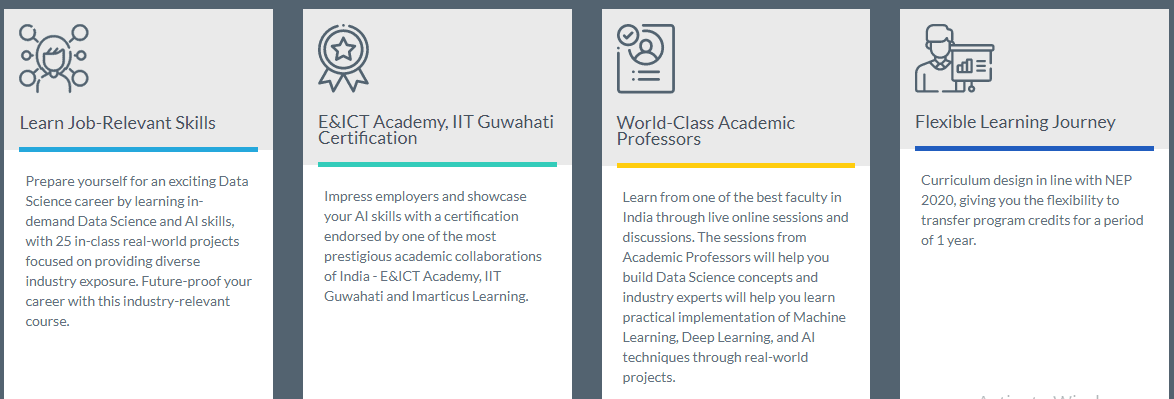
  • The course lets the students learn job-relevant skills that prepare them for an exciting Data Science career.
  • Impress employers & showcase AI skills with a certification endorsed by the most prestigious academic collaborations of India – E&ICT Academy, IIT Guwahati, and Imarticus Learning.
  • World-Class Academic Professors to learn from through live online sessions and discussions. This will help students learn the practical implementation of AI/ML & Deep Learning techniques through real-world projects.
  • Flexible Learning Journey that gives you the flexibility to transfer program credits for a period of 1 year.

For further details, contact us through the Live chat support system or schedule a visit to training centers in Mumbai, Thane, Pune, Chennai, Bengaluru, Hyderabad, Delhi, and Gurgaon.

How are Analytics and Supply Chain Management Shaping New-Age Careers?

Analytics is a relatively new term, but it has already become an indispensable part of our lives. This can be seen in the rise to the prominence of data scientists responsible for gathering & analyzing vast amounts of data from various sources. Data scientists have been instrumental in shaping how companies do business and creating tools that help them explore their data.

Analytics and Supply Chain Management: The Conjunction

Analytics and Supply Chain Management are two areas that have seen a significant transformation in the last few years. Analytics is now being used to improve customer experience, which has become one of the most important goals for businesses.

Supply Chain Management trainingsupply chain management courses in India is being used to increase efficiency throughout the entire supply chain, from production to delivery.

The role these two departments play in business cannot be understated- it’s more evident than ever that they are shaping new-age careers!

How has analytics become an integral part of supply chain management?

Supply chain analytics is the process used by organizations to gain insight & extract data associated with procurement, processing, and distribution. Supply chain analytics is an essential part of SCM.

The mathematical models, data infrastructure, & applications supporting analytics have evolved significantly. This improvement came from better statistical techniques, predictive modeling & machine learning.

Data infrastructure has changed with cloud infrastructure, complex event processing & IoT. Applications now provide insights across traditional application silos such as ERP, warehouse management, logistics & enterprise asset management.

Features of Supply Chain Analytics:

Data visualization: The ability to derive and reciprocate data to have better insights.

Stream processing: Deriving insights from wide data streams

generated by IoT, applications, weather reports & third-party data.

Social Media integration: Using data from social feeds to improve planning.

Natural Language Processing: Extracting & organizing unstructured data in documents, news sources & data feeds.

Location intelligence: Extracting insights from data to understand and optimize distribution.

A digital twin of the supply chain: Organizing data into a comprehensive model of a supply chain can aid in improving predictive & prescriptive analytics.

Supply Chain Analytics Uses

  • Identifying and improving risks & predicting future threats based on patterns & trends throughout the supply chain.
  • Boost planning accuracy by analyzing customer data to identify factors that increase or decrease demand.
  • Improve order management by consolidating data sources to assess inventory levels, predict demand & identify fulfillment issues.
  • Streamline procurement by organizing & analyzing cash flow across departments to improve negotiations & identify opportunities for discounts or alternative sources.
  • Increase working capital by refining models to determine inventory levels needed to ensure service goals with minimum means.

Learn and Grow with Imarticus Learning:

If you are looking for a career that has both excellent prospects and flexibility, then, IIT Supply chain Management course offered by Imarticus Learning is perfect for you.

Supply Chain Analytics enables management to make data-driven decisions at strategic, operational, and tactical levels. With this course, you can explore employment opportunities in job roles like Demand Planner, Data Scientist, Supply Planner, and Supply and Operations Planner. Master your SCM skills with analytics through this cutting-edge curriculum that helps you get more data-centric & improve the decision-making of a Supply Chain by leveraging the power of Python.

Can’t wait to Enrol? For further details, contact us through the Live Chat Support system or visit our training centers in Mumbai, Thane, Pune, Chennai, Bengaluru, Hyderabad, Delhi, and Gurgaon.

Some Supply Chain Management Trends that’ll Shape the Sector Sharply in Future!

Supply chain management has become increasingly important with globalization, as companies have found it necessary to learn more about their supply chains to understand which materials are needed for production or distribution.

Supply chain management: Definition

Supply chain management is a process that deals with the flow of materials, goods, and related information between suppliers, manufacturers, distributors, and customers. It incorporates many different aspects which are constantly changing due to technological breakthroughs.

Supply Chain Trends: An Overview

The Supply chain management sector has evolved over the years. SCM professionals increasingly find themselves having to contend with several challenges such as increased competition for resources, new technologies, and changing customer expectations. A survey named “Improve the Supply Chain with Advanced Analytics and AI “by Gartner elaborate how 96% of supply chain leaders use predictive analytics, 85% use prescriptive analytics, and 64% use AI/ML.

Some Trends in SCM:

Artificial intelligence and machine learning

AIML is at the forefront as a solution to supply chain partners. Be it in-demand forecasting, production planning, or predictive maintenance, AIML is turning is a game-changer. It tracks historical shipment data & converts it into a forecast to gauge seasonal fluctuations in demand & make predictions at a store, product, or facility level. Knowing future needs allows businesses to plan production & predictive maintenance better than ever before.

Internet of Things

Devices communicating amongst them make information flow smoothly and efficiently, operating the whole network. Advanced robotics with big data gives organizations a comprehensive & accurate view of the real-time status of supply chain partners, shipments, and networks. With IoT connectivity comes data that allows highly optimized processes.

Continuous monitoring of critical equipment, improved inventory practices, and increased transparency are other benefits of IoT.

Blockchain

A robust supply chain consists of a known & trusted network. Blockchain technology in SCM can counter many related challenges. Entities in the blockchain network can track where the transaction originated from. Be it raw materials, payments to vendors, or copyrights of assets, everything is in a loop. Since deletion of trade within a blockchain is impossible, it adds to the transparency of transactions, ensuring the security of the entire operation.

Advanced analytics

Advanced analytics allows organizations to work with processes in real-time. In-depth analytics let professionals extrapolate data from existing conditions & imagine future scenarios to design more profitable strategies & create an efficient supply chain. The ability to track orders, optimize transportation, & even analyze returns on products & routes make it essential to integrate advanced analytics into SCM platforms.

Custom applications

Most new-age companies need unique solutions to cater to specific requirements of business & inter-departmental needs. Custom applications are personalized that enables management to gain greater power with real-time visibility, flexibility on move, dynamic tracking, increased

collaboration & hands-free operations. By leveraging these technologies, professionals can ensure that businesses survive but thrive in this chaotic environment.

Make a Career in SCM with Imarticus Learning!

supply chain management coursesFuture-proof your career with a supply chain management course from Imarticus Learning. The supply chain certification online course equips students to make data-driven decisions at strategic, operational, and tactical levels.

Due to the shortage of professionals with process and analytics talents in SCM, this program prepares students for high-demand job roles like Demand Planner, Data Scientist, Supply Planner, and Supply and Operations Planner.

Uniquely designed by IIT faculty & industry leaders, this 6-months program prepares you to gain the best from this opportunity.

Contact us through the Live Chat Support system or visit our training centers in Mumbai, Thane, Pune, Chennai, Bengaluru, Hyderabad, Delhi, Gurgaon & Ahmedabad.