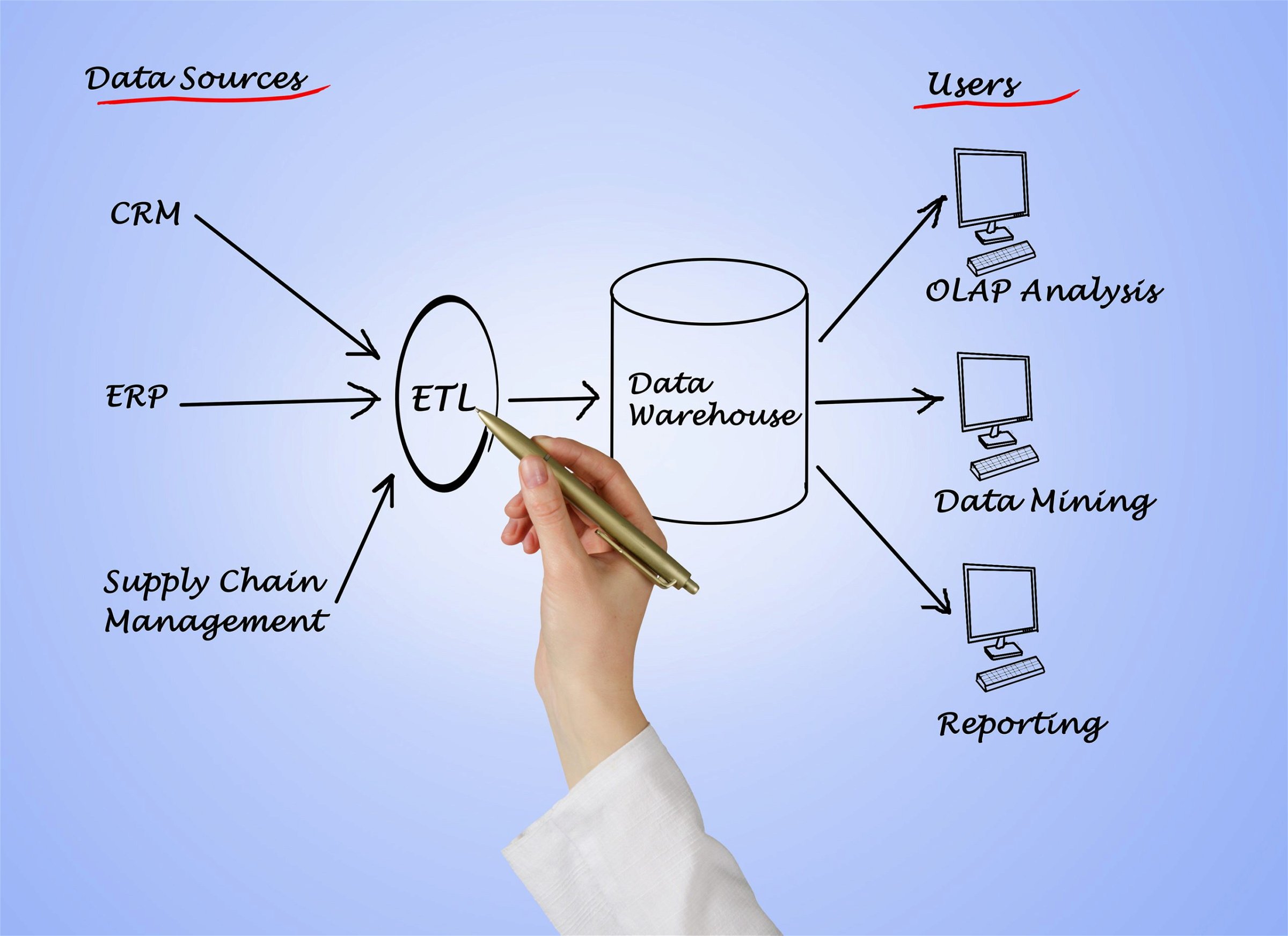
Different Ways Data Mining Helps Marketers

What is Data Mining?

Everything that we do leaves data behind. That data is ultimately used to extract useful information. Data mining is a technique of analyzing that large amount of data and making use of it in marketing strategies by determining the correlations and patterns among them. Budding industries tend to use data mining at a great advantage by using the information uncovered to target audiences accordingly.

It is highly advisable to have a data analytics certification through a data mining course to become a professional in this field.

Steps of data mining –

  1.     Extract and transform the information collected
  2.     Digitally store and manage the data
  3.     Analyze the data by using different data mining techniques
  4.     Display the data in a useful way, like in a graph or number chart

Frequently used data mining techniques

Data mining can turn out to be a highly effective technique if done correctly. Here are some basic techniques that are quite common:

  • Observe a pattern – Simple line graphs and bar charts can be used to represent the data collected so it becomes easier to recognize certain patterns and intervals in them.

  • Classification – Classification is a more detailed data analysis technique. It helps in classifying data further into groups or clusters for better analysis.

  • Association – This helps in finding a hidden pattern. This technique helps you unfold links between two different types of variables.

  • Regression – This technique is used to spot the relationship between different variables depending on the presence of another factor. It is a form of planning and modeling.

  • Outer detection – This technique is also known as an outlier technique or analysis that helps in finding variables in a data set or group that do not match the pattern.

  • Prediction – As its name suggests, this technique helps in analyzing past or similar data to predict future patterns or events.

Benefits of data mining

Data mining can add great value to a business that is why marketers interested in growing a business must understand its benefits.

  • Marketing campaigns are more optimized –. Data mining is a great way to analyze marketing campaigns and which methods will help in generating more engagement and leads.

  • Helps in making better business decisions – The information and insights gathered from data mining can help you make better decisions for your business.

  • It will help you detect any kind of fraud – Data mining in business can help in detecting any kind of fraud or potential fraud like fake money transactions.

  • Improves external market performance – It helps to understand and predict employee behavior which in turn helps in improving external market performances.

Data mining is the future

Data analysis and management is a huge source of employment even today. Data mining professionals can work individually or as employees of a company to evaluate important information and discard the ones that are not reliable.

This requires detailed knowledge of understanding data. This knowledge can be acquired through data mining courses in India that are available online. Since every company is going digital now, reliable data analysts will be in a lot of demand so it is better to start now.


Understanding Linear Discriminant Analysis in Python for Data Science

When we are working with more than two classes in data, LDA or Linear Discriminant Analysis is the best classification technique we can use. This model provides very important benefits to data mining, data retrieval, analytics, and Data Science in general such as the reduction of variables in a multi-dimensional dataset.

This is very useful for minimizing the variance between the means of the classes while maximizing the distances between the same. LDA removes excess variables while retaining most of the necessary data. This is extremely crucial for Applied Machine learning and various Data Science applications such as complex predictive systems.

What is Linear Discriminant Analysis?

LDA is a linear classification technique that allows us to fundamentally reduce the dimensions inside a dataset while also retaining most of the crucial data and utilizing important information from each of the classes. Multi-dimensional data contains multiple features that have a correlation with other features. Using dimensionality reduction, one can easily plot multidimensional data into two or three dimensions.

This also helps make data more cognizable for non-technical team members while still being highly informative (with more relevant details). LDA estimates the probabilities of new sets of inputs belonging to each class and then makes predictions accordingly.

Classes with the highest probability of having new sets of inputs are identified as the output class for making these predictions. The LDA model uses Bayes Theorem for estimating these probabilities from classes and data belonging to these classes.

LDA allows unnecessary features that are “dependent”, to be removed from the dataset when converting the dataset and reducing its dimensions. LDA is also very closely related to regression analysis and analysis of variance. This is due to all of their core objectives of trying to express individual dependent variables as linear combinations of other measurements or features.

However, Linear Discriminant Analysis uses a categorical dependent variable and continuous independent variables. Unlike different regression methods and other classification methods, LDA assumes that independent variables are distributed normally. For example, logistic regression is only useful when working with classification problems that have two classes.

How is LDA used in Python?

Using LDA is quite easy, it uses statistical properties that are predicted from the given data using various distribution methods such as multivariate Gaussian (when there are multiple variables). Then these statistical properties are used by the LDA model for making predictions. In order to effectively use the LDA model or to use Python for Data Science, one must first employ various libraries such as pandas, matplotlib, and numpy.

First, you must import a dataset such as the ones available in the UCI Machine Learning repository. You can also use scikit-learn to import a library more easily. Then, a data frame must be created that contains both the classes and the features.

Once that is done, the LDA model can be put into action, which will compute and calculate within the classes and class scatter matrices. Then, new matrixes will be created and new features will be collected. This is how a successful LDA model can be run in Python to obtain LDA components.

Conclusion

Linear Discriminant Analysis is one of the most simple and effective methods for classification and due to it being so preferred, there were many variations such as Quadratic Discriminant Analysis, Flexible Discriminant Analysis, Regularized Discriminant Analysis, and Multiple Discriminant Analysis. However, these are all known as LDA now. In order to learn Python for Data Science, a reputed PG Analytics program is recommended.

Looking to Upgrade Your Career in Supply Chain Management and Analytics? Find Your Path Here

Supply chain management is a useful process for any organisation that wants to boost its ROI (Return on Investment). Businesses have to keep track of their services and products in the supply chain for more insights. With more insights, businesses can take better decisions related to the supply chain. To extract meaningful insights, data analytics is used by supply chain experts. If you want to upgrade your career in supply chain management, you can go for an online course that covers the analytical aspects. Read on to know more about building a career in supply chain management and analytics.

What is SCM?

SCM (Supply Chain Management) helps businesses in understanding the flow of goods and services. All the processes that convert the raw materials into finished goods come under the supply chain. SCM enhances the transparency of day-to-day business processes and you can make better decisions. When a firm knows the cost of its supply chain processes, it can make better decisions for slashing the costs. From the movement of products to the storage of raw materials, everything comes under the supply chain.

What are the pros of SCM?

The benefits of SCM in the current business scenario are as follows:

  • Supply chain management helps in meeting the supplies as per the customer demands. SCM helps a business in steering through market challenges and fluctuating economies.
  • You can enhance your inventory system with SCM and reduce damages in storing products/services.
  • With better SCM, a business can have better relationships with vendors and distributors. Better communication between different points of the supply chain adds to overall productivity.
  • You can gain insight into day-to-day operational costs incurred by your organisation with better SCM. Cutting overhead costs is one of the major advantages of SCM.
  • With SCM, you can reduce the delays in your business processes. Customers can receive finished goods and services in less time with better SCM.
  • You can optimise the space at your sales outlets with better SCM. You can highlight products according to the demands of customers in your sales outlets.

Due to the numerous benefits of SCM, firms need expert individuals who can enhance their overall productivity. Firms are hiring individuals who have completed a supply chain management course for better results. At present, data analytics is being used heavily for the supply chain management. With data analytics, you can know the demands of the customers and can forecast market situations.

What are different job roles in supply chain management?

Job roles in the supply chain management industry are as follows:

  • Production Manager: It prepares the staff schedules and ensures all equipment is working fine.
  • Supply Chain Manager: A supply chain manager interacts with vendors and distributors to ensure continuous supply/sale.
  • Logistics Manager: The logistics manager is concerned with the supply of products/services to the customer.
  • Purchasing Manager: Major purchase contracts are overseen by purchasing managers in respective firms.

How to learn SCM and analytics?

Young enthusiasts can go for the Professional Certification in Supply Chain Management & Analytics offered by Imarticus Learning. This supply chain management online course is sponsored by IIT Roorkee, one of the premier educational institutions of the country. You get to learn from industry experts and faculty members of IIT Roorkee. Not to forget, this course provides hands-on learning with numerous real-world SCM projects.

Conclusion

At the end of the IIT supply chain management course, Imarticus will offer extensive placement support. You can kickstart your career in the industry with an online course. Working professionals can also uplift their careers by completing an SCM online course. Start your IIT supply chain management course now!  

Is Python Difficult to Learn?

The average pay of a software programmer in India goes up to INR 10 lakh per annum. To start your professional journey in the tech field, you will need to learn a programming language.

In this article, we will look at one of the most recommended programming languages for beginners and professionals alike. You will also discover why you should learn Python and how much it is easier.

Learn PythonWhat is Python?

Python is one of the most popular programming languages in the world. It is a high-level general-purpose programming language and entered the market in 1991. Since its arrival, it has become an industry staple.

Programmers use Python in numerous industries, such as entertainment, healthcare, software, and finance. Due to its vast popularity, you will find it in the curriculum of most data science courses in India.

Why you should learn Python?

There are many reasons why you should learn this programming language. Here are some of them:

Easy syntax

If you are familiar with English, then learning Python is quite easy for you. One of the many reasons behind Python’s widespread popularity is its simple syntax. Many of its commands are derived directly from English, hence you can learn the fundamentals of programming along with learning the fundamentals of Python.

Pro tip: If you are a beginner, then you should look for an online data science course in India that covers Python. It will be much easier to learn programming through such a data science course in India.

High demand

Python ranked third in Stack Overflow’s 2020 Developer Survey. For languages that developers aren’t using but want to learn, Python took the top spot for the fourth year in a row.

Most Python developers are programmers, software engineers, team leads, DevOps engineers, and data science professionals. The demand for Python expertise is substantially high among companies, which is another prominent reason why you should learn this programming language. It is also very reliable and hence, has high popularity in the IT world.

Versatile application

Due to its vast collection of libraries, Python finds applications in various sectors, including data science, artificial intelligence, machine learning, app development, and others.

This means you can use a Python programming course to develop a mobile application as well as create a machine learning algorithm. It allows you to focus on an application’s core functioning while taking care of the common programming tasks.

Learn PythonHow to learn Python?

You know that it would be great to learn this language but where can you start. Well, the best way to start learning Python is by joining an online data science course in India. Data science courses teach you the basics and advanced applications of Python along with many related technologies.

After all, learning Python alone would not be sufficient in this cut-throat competition-ridden world. Joining a data science course in India would help you in multiple other ways. First, data science courses provide you with a step-by-step structure so you can plan your studies accordingly.

You can always check your data science course details to see how much progress you have made. On top of that, if you want to start a tech career, you can join a data science course with placement support. A data science course with placement support will help you kickstart your career right after you complete the program.

Before picking a program, be sure to check the data science course fees and other data science course details.

Learning Python is quite simple. Its easy-to-learn syntax and versatile applications make it a perfect programming language for a beginner. If you are interested in learning more about data science courses in India, then you can check out the programs offered by Imarticus.

The Popular Use Cases of Artificial Intelligence in BFSI

AI has revolutionized every industry and has changed the way businesses function. Everyone is finding ways to adopt AI into their work. Similarly, the banking, financial services, and insurance sector is also looking to integrate AI into their business and one major reason for doing that is the security of customers.

Customers expect banks to deliver flawless experiences and improve methods of interaction. In the last few years, banks have faced a rise in security threats which is why the banks had to come up with new ways of tightening the security because they were starting to lose clients.

A global study indicates that 85% of respondents have already implemented AI within their organizations and expect to use AI in the new use cases that come and 77% of respondents are anticipating the use of AI processes in their business in the next 2 years.

How is AI strengthening the competitiveness of banks?

Artificial Intelligence and machine learning is the future of banking as it has the power to combat fraudulent activities and improve customer service. Here are some examples of what changes AI has brought about in the banking industry –

  1. Mobile banking – Mobile apps are becoming more advanced and personalized. Banks can generate more revenue with mobile banking services than they generate from customers visiting the branches. This has also saved a lot of time for consumers and improved the quality of services provided.
  2. AI chatbots – In banking, chatbots are used to create an interactive experience for the customers. Bots can communicate with the customers and solve their queries while staying within reason and following the rules. Chatbots can also work 24 hours a day without breaks, which increases the productivity of the banks.
  3. Enhanced security – With the unlimited amount of personal data that is digitized and the number of digital frauds that are happening, it is customary for the banks to keep the client’s money and confidential information safe, and AI helps with that. They have come up with cybersecurity measures like fingerprints, iris, and voice recognition. These measures are almost impossible to forge, therefore everything is safe.
  4. Conformity – It is important to regulate data constantly. There are different processes like “Know Your Customer (KYC)” or “Anti Money Laundering (AML)” that can gather data and transactions digitally, which makes the work faster and easier. If done manually, this process can take up a lot of time. AI algorithms can integrate data very accurately and efficiently.
  5. Financial evaluation – Banks usually earn their profits through the interest they receive on loans. To keep a check that the loans are given back on time with proper interest, they have machine learning algorithms that analyze millions of data and assess whether the client is a risk or not, and then come up with a decision.

Conclusion

People are looking for exceptional services at the click of a button, they don’t want to wait for days for a transaction or money transfer. AI is not only the future of banking, it is also the present. It is advised that all financial institutions start investing in AI right now so that they can optimize their services. With the help of AI certification that is offered by AI and machine learning courses, people can make this revolutionary change in their businesses.

5 Powerful Business Analysis Tools Aspirants Must Learn!

The term “Business Analysis” is self-explanatory. It is a system put in place by enterprises to analyze various aspects of their business. To define it more elaborately, it is a research-based practice that drives change in an organizational context by analyzing limitations and loopholes, defining needs, and guiding solutions aimed to deliver value to stakeholders. The reason why some businesses grow exponentially bigger than others is rooted in successful business analysis systems.

Business analysts often rely on software and tools to aid in the process of business analysis. There are several such tools in the market, each with its own unique features. Comprehensive knowledge of business analysis tools is often a key requirement in the recruitment of business analysts.

In this article, we list the 5 most powerful business analysis tools that are a must-learn for a successful business analyst career.

Top Business Analysis Tools

SWOT

SWOT analysis is one of the leading techniques of business analysis, which involves a strategic review of current strengths, weaknesses, opportunities, and threats. There are several SWOT analysis tools available online, but SWOT is perhaps the most comprehensive of the lot. Not only does it make SWOT analysis easy, but also provides a platform to brainstorm and collaborate among teams.

Trello

Trello is a Kanban-based collaboration tool that makes managing and prioritizing tasks incredibly easy for entire teams. Trello is a simple yet comprehensive way for business analysts to track tasks, plan projects, and chart progress. It is an extremely useful tool that every business analyst must master.

Version One

Version One is a powerful business analysis tool that also allows integration with enterprise and agile software development applications. It is expressly built to allow automation and scale-up project workspaces across teams in multiple locations.

Pencil

Pencil is a free and open-source tool that is used for prototyping and creating mockups. Prototyping is often critical for business analysts to give customers and stakeholders a visual sense of a product. Pencil allows changes and recommendations to be incorporated into the prototype to ensure the best final product.

Microsoft Visio

One of the leading project management and business modeling tools that many big businesses use is Microsoft Visio. Visio is a comprehensive business analytics solution that helps analysts create project flowcharts, schedules, use case diagrams, data models, process flows, etc.

A Career in Business Analysis

Job titles under the business analysis spectrum include business analysts, business systems analysts, requirements engineers, business intelligence analysts, data scientists, and more. Business analysts enjoy a demanded position in businesses of all shapes and sizes. This field of work comes with the guarantee of long-term stability and a lucrative remuneration.

You might be wondering – how to become a successful business analyst? The first step in pursuing a career in business analysis is to get certified. Acquiring certification not only imparts the necessary skills and training required by any business analyst but also gives the candidate a winning edge in the eyes of the recruiting company. Candidates with an MBA or a Bachelors’ degree in Business, IT, or a related field are usually preferred over others. Sound knowledge of business analysis tools is an added plus point.

Conclusion

Business analysis is a profitable career path that guarantees growth, stability, and a high salary. In order to advance your prospects of securing a business analyst role, you could consider signing up for a business analyst course such as a PG Program for Agile Business Analyst that would provide foundational training and knowledge.

What is the best approach to Data Analysis in 2021?

As time goes by the approach to any form or strategy of business changes. Even more so when it comes to data, as it is ever-changing. Throughout the years, data analytics has grown from a peripheral part of a business to an integral part of it. It is a prominent tool to not only extract and decipher past records but also predict and develop future strategies.

However, it comes with a little difficulty as most of the time, data analysts have little idea of how to execute a business. And in the same way, executives have little idea of how data analytics works and how to use it.

This is why it is important to have a basic idea of what is business analytics to give you that little edge over others. The best way to do this would be with a data analytics certification course, similar to what Imarticus Learning is providing with their new PG program. However, to make it easier, here we have compiled two successful ways that data analytics can be approached in 2021.

For the long run

In many cases, companies invest a lot in data analytics and focus on building business value around it. This includes training the employees about data analytics, developing company systems and syncing them with data analysis, and finally, discussing more data analysis initiatives. This requires a complete transformation of business values and systems.

Tackling clearly-define high-grade problems

One of the best ways to approach data analysis is by defining a high-grade problem with clear goals. When it comes to high-grade problems, the issue remains in the volume or layers in which a problem is divided. Each of these layers interplays and pile up to end up being a high-grade problem.

So, with data analytics, you can target a small subset of the problem and by getting the numbers right, you can take a sustained route towards growth. Unlike the investment model where too much time could pass before results show, this model seems clearly the best approach in 2021.

Things to keep in mind

One thing to always keep in mind is that data analytics merely show a record of how the past has been and how the future can turn out to be. It is not always possible to meet the exact expectations as the results depend on a variety of things. There are a few other things that everyone should keep in mind when it comes to data analytics, such as:

  • Data analytics need to be made a part of the main wing of a business as without being in the loop it would be impossible for the analytics team to be of any help.
  • Problems should be specified and addressed together with the executives. This will make the process of extracting and deciphering data as well as developing a proper plan to address the specified problems a lot easier on both sides.
  • Executives should have a basic knowledge of what is business analytics. It will make the communication and understanding between the two teams smoother.

 Conclusion

 The process can create disruptions as data tends to create transparency. It can be uncomfortable to face the shortcomings of a business, however, this is also the best way to form strategies to overcome those shortcomings. This is why companies need experts on their teams to help them along the way. You can enhance your skills with a proper data analytics certification course or a PG program if you wish to pursue this career.

What is the job description of a logistics manager?

The logistics manager is an integral part of the supply chain management system. The supply chain management career is an ever-growing field that opens up plenty of job opportunities. Although the logistic manager will be mainly focusing on warehouse storage and the subsequent distribution, it is a job that can offer further growth in their career. There are several who are opting for this field as a career.

If you intend to be such a manager or are opting for a logistics and supply chain management course, you should be aware of the proper job description of the role. 

What is a logistics manager?

A logistics manager will be responsible for the overall management of the warehouse of the companies right from the planning, operating, storing, coordinating, and transporting of the associated materials. The manager would need to keep up with the inventory and the transportation until the products reach the next level in the supply chain. A manager may be responsible for a particular warehouse or multiple warehouses of a particular region as well. 

This is an area that serves as the middle in the overall supply chain. It requires a bunch of skills such as negotiation, analytical, leadership, administrative, organizing, and budgeting powers. This is where the Certificate in Supply Chain Management & Analytics helps. This course covers a wide range of program languages and tools to help candidates prepare for their responsibilities.  

Responsibilities of a logistics manager

  • Managing the warehouse includes organizing the goods, preparing proper inventory, and labeling the goods to ease the process. 
  • Preparing a proper budget for the transportation and negotiating with the carriers to transport it within the budget is another responsibility. 
  • Keeping track of both the incoming and outgoing deliveries can be a daunting task which also requires plotting the routes. 
  • A logistics manager should be aware of the latest shipping techniques to reduce the cost and maintain the goods in their proper shape and quality. 
  • It is also the responsibility of the logistics manager to have in-depth knowledge about the rules and regulations of the transportation, the ISO requirements, or the various guidelines. Managers must ensure that all the laws are properly followed by everyone under them until the goods reach the next level. 

The Certification in Supply Chain Management & Analytics course trains the candidates in the departments such as metrics, planning, designing, coordinating, sales and operations, etc. 

How to qualify to be a logistics manager

The primary requirement for starting a supply chain management career is to find a quality logistics and supply chain management course such as the SCM. Anyone with a Bachelor’s degree can apply for such a course.

Having at least 2 years of experience in the SCM field would be an added advantage. The candidate should have strong knowledge about supply chain, distribution, management, inventory, etc, along with exceptional skills in communication and analysis. A keen eye to observe the minute details would be a huge advantage as the manager is responsible for the daily operations as well as the employees’ performance. 

Conclusion

The role of a logistics manager is demanding as every day comes with a new challenge. It can be exciting or exhausting. This demanding job is not suitable for all. But those who are enthusiastic about such responsibilities can find it exciting. Those who like to solve problems will find such a job description thrilling. If you are among those, enroll into SCM now to have a stimulating career ahead. 

How Can A Supply Chain Management Course Help Professionals?

Supply Chain Management is a relatively new concept in the business world, but it has become increasingly important. Supply Chain Managers are responsible for ensuring that items and materials never run out. They work to ensure that their company is profitable by keeping costs low and having enough products to sell.

A supply chain management course can help professionals learn how this process works and give them an edge in the job market!

Supply Chain Management: An Overview

Supply chain management is a profession that has been gaining popularity over the past few years. The supply chain refers to the process of delivering goods from suppliers or manufacturers to customers. The supply chain may also include warehousing, production, and distribution, as well as retailing. This industry encompasses everything from sourcing raw materials for manufacturing products to how those products are marketed and sold at stores after they have been manufactured.

Supply chain management is a process that links the production and distribution of goods, materials, and services. The goal is to deliver what the customer needs as efficiently as possible. The process helps companies to manage the flow to help maximize efficiency.

Supply Chain Management Career: An Invincible Option

Organizations always look for ways to increase production while reducing costs. A supply chain management course can provide professionals with an understanding of how retailers work together to meet consumer needs.

Here is how a supply chain management course can help professionals:

supply chain management and analytics course by IIT, RoorkeeEfficient Collaboration: To swiftly and effectively deal with issues when they arise, it is vital to maintain a smoother flow of information across the supply chain to avoid any miscommunications and confusion.
Quality control improvements: To source better components and services, you must have better awareness & control of different links in the supply chain within your processes.

Keep up with demand: Supply and demand are factors that fluctuate in counter-intuitive ways. Improved data analysis & communication between producers, sellers, and suppliers can reduce the chance of supply hitting a bottleneck.

Cost Reduction: Improvement in quality control and inventory management brings along lower overheads & allows better optimization for profitability.

Mitigate risks:  A supply chain certification helps you figure out how to predict new challenges, for example, a supplier going out of business. Professionals can efficiently prepare for any unpredictable situation and minimize inefficient risk mitigation costs like unnecessary stockpiling.

Transform your SCM Career with Imarticus Learning:

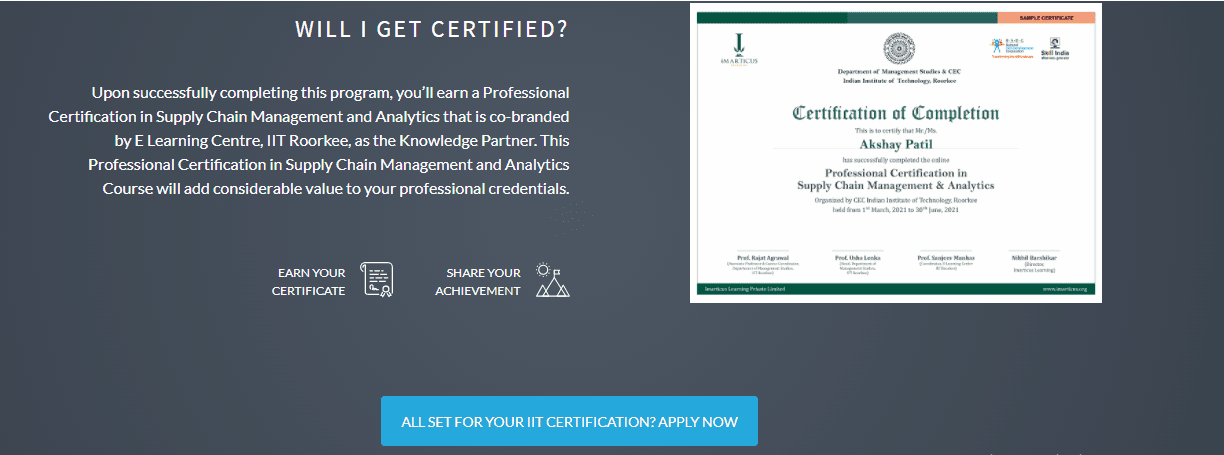
If you are passionate about a supply chain management career, the Professional Certification in Supply Chain Management and Analytics course you need to enroll in today! The program has been designed in collaboration with DoMS and E-learning Centre, IIT Roorkee, and experienced industry leaders. The system provides a cutting-edge experience to candidates who wish to enter the operations and supply chain industry.

supply chain management and analytics courses by IIT, RoorkeeSupply chain certification enables professionals to make data-driven decisions at strategic, operational, and tactical levels. In the Supply Chain Management field, there is a shortage of professionals with process and analytics talents. This certification prepares you for high-demand job roles such as Demand Planner, Data Scientist, Supply Planner, and Supply and Operations Planner.

USP’s of Supply chain Management course

  • Master SCM know-how & much-needed skills in analytics through this cutting-edge curriculum designed by the DoMS & E-Learning Centre, IIT Roorkee.
  • Learn from one of the best faculties in India through live online sessions and discussions.
  • Get an opportunity to participate in the 3-day campus Immersion module to visit the IIT Roorkee campus.
  • Solve complex real-industry problems demanding a thorough understanding of concepts, mastery over a skill, and understanding the business context.
  • Supply chains generate massive amounts of data – Big Data, to be more specific.

For further details, contact us through the Live Chat Support system or visit our training centers in Mumbai, Thane, Pune, Chennai, Bengaluru, Hyderabad, Delhi, and Gurgaon.

How can a machine learning and artificial intelligence course help you become a social media analyst?

Social media has become an integral part of our lives. It is how we keep up to date with the world, and it is also a way for businesses to promote their products/services. With all of this in mind, many people are looking for ways to get into the social media industry.

One of the popular routes is through a job in social media analysis. Social media analysts are becoming more and more important as time goes on. This position requires you to monitor and analyze data on your company’s various social channels.

Thus, machine learning and artificial intelligence courses are becoming more popular among people looking for a potent solution.

How AI and ML are used in social media?

Social media is a very lucrative and competitive industry. Those who can best analyze data, find useful patterns and insights into the business end up earning the most money. This has led to many big players such as Twitter, Facebook, and LinkedIn investing heavily in AI systems that help them better understand their users’ behaviors without even gathering any specific user information!

Social media marketing agencies also use these analytics tools for understanding consumer behavior around products or services offered on social channels like Instagram & Snapchat. The same technologies are used by internet giants like Amazon and Google to offer seemingly personalized search results with just one keyword input from anyone trying out something new online – be it buying a product or browsing through material freely available on the web!

This ongoing trend of personalization based upon customer behavior and interests has made AI a huge part of our lives today.

How do ML and AI courses help you become a social media analyst?

Many companies are now looking for social media analysts to help them understand consumer insights and market expansion opportunities. If you want to become a successful analyst, it is important that you learn how machine learning and artificial intelligence can aid your efforts as marketers in various ways.

Here’s how ML and AI help you become a social media analyst:

Track consumer behavior patterns. ML and AI help you understand the behavioral pattern of your customers by tracking their social media activity. This information enables you to make a business decision or product development strategy that will help gain customer attention in the future!

Increase ROI with AI-assisted marketing campaigns: ML and AI will help you identify the best marketing campaign to increase your brand exposure. You can use AI-driven tools such as chatbots, ads bots, etc., for effective customer engagement using social media platforms like Facebook or Twitter!

Use Sentiment Analysis: You can easily understand consumer sentiment by tracking what they say about a product on different platforms with ML assistance. This information is crucial in understanding their needs so that you can provide them with better quality products/services!

These were just some of the many ways how ML & AI courses can help you become a successful Social Media Analyst!

Elevate your social media analyst’s profile with Imarticus Learning

Imarticus Learning offers Machine Learning and Artificial Intelligence courses. The comprehensive curriculum of these courses will help you build a strong foundation in machine learning, data analysis, deep learning, and artificial intelligence to take on complex problems for social media strategies.

What’s unique about this AI ML certification course?

  • Cutting-edge curriculum and certification by E&ICT Academy, IIT Guwahati
  • Opportunity to participate in campus immersion module
  • Learn what new-age AI & ML Engineers do in a real-world scenario
  • Build an impressive AI & ML project portfolio for future employers

This comprehensive program can take your career a step ahead towards rewarding opportunities in this domain.