An Introduction to Financial Risk Management

Uncertainties are an inevitable and integral part of any and every sector. Likewise, the financial world, too, is susceptible to risks. Over the years, the increasing globalisation of markets has significantly increased the chances of risks, even in domestic markets. The easy accessibility of information, whether it is related to exchange rates, interest rates or commodity prices, makes businesses more vulnerable to financial risks.

Navigating this inherently uncertain environment is an everyday job for professionals engaged in corporate banking. Businesses and investors must handle and mitigate risks proficiently to sustain in this fiercely competitive landscape. 

This article will delve into the basics of risk management, why it is essential to manage risks and the tools used in the process. Meanwhile, opt for a capital market course to learn more about risks and risk management.

Understanding Risks in Finance

Risks in finance can be described as necessary evils which offer both challenges and opportunities for growth. Simply put, risk is the probability of loss due to market exposure. Diverse in nature, risks can span market fluctuations, credit uncertainties, operational disruptions, and liquidity challenges, among others. 

There are primarily three types of financial risks — market risks, credit risks and operational risks. 

  • Market Risk – Market risks emerge from the unpredictability of financial markets, where factors such as interest rates, exchange rates, and commodity prices can undergo volatile shifts. 
  • Credit Risk – This type of risk occurs when counterparties fail to fulfil their financial obligations, introducing an element of uncertainty into lending and investment activities. 
  • Operational Risk – Operational risk, on the other hand, arises from internal processes, systems, and human factors, encompassing everything from technological glitches to managerial errors.

IIM Lucknow courses on investment and corporate finance offer an excellent opportunity to learn about these risks in depth, helping individuals identify and combat them in their personal as well as professional lives.

The Origin of Financial Risks

The inherent dynamism of global economies and the interconnectedness of financial markets give rise to financial risks. Geopolitical events, economic downturns, or sudden shifts in investor sentiment can trigger market risks. Credit risks may be escalated by the financial health of borrowers and the broader economic climate. It may arise from the activities of vendors, lenders and counterparties indulging in derivative transactions. 

Operational risks often stem from inadequate internal controls (people, processes and systems), technological vulnerabilities, or human errors. Recognising the sources of these risks is fundamental to their effective management.

Financial Risk Management – An Overview

Financial risk management is a strategic discipline that involves identifying, assessing, and mitigating potential threats to an organisation’s or individual’s financial health and objectives. Addressing financial risks allows businesses a competitive edge. It involves making strategic decisions to safeguard the business’s finances.

Key Components of Financial Risk Management (FRM)

  • Identifying risks – FRM begins with identifying potential risks an organisation may face. This encompasses market risks, credit risks, liquidity risks, operational risks, and more, each with its unique characteristics and sources.
  • Assessing risks – Once identified, risks are systematically assessed in terms of their probability, potential impact, and relationship with other risks. This process involves quantitative and qualitative analysis to gauge the organisation’s overall risk exposure.
  • Mitigating risks – The next step involves developing and implementing strategies to mitigate and manage the identified risks effectively. These strategies can vary based on the type of risk and may include hedging, diversification, contingency planning, and the use of financial instruments.
  • Monitoring and adaptation – FRM is an eternal process requiring continuous monitoring of the financial landscape. This involves staying updated about market conditions, regulatory changes, and other external factors that may impact the risk environment. Adapting risk management strategies in response to evolving conditions is crucial to this process.

Why is Financial Risk Management Essential?

FRM is essential to help organisations avoid making severe decisions that might lead to their irreversible collapse. Here are a few reasons why financial risk management is important:

  • By identifying and mitigating risks, financial risk management aims to preserve the capital of an organisation, protecting it from potential financial losses.
  • Informed risk management enables better decision-making by providing a clear understanding of the potential risks and their impact on financial objectives.
  • Financial risk management ensures adherence to regulatory requirements and governance standards, contributing to the overall compliance framework.
  • A robust financial risk management framework enhances the sustainability and resilience of an organisation, allowing it to weather economic uncertainties and challenges.

Tools and Measures in FRM

Financial risk management encompasses various tools and measures tailored to address specific risk categories. Corporate banking specifically deals with using these tools to protect clients’ financial interests.

  • Derivatives: Derivative instruments, such as options and futures contracts, are commonly used to hedge against market risks. These instruments enable market participants to protect themselves from adverse price movements in currencies, commodities, or interest rates.
  • Credit Scoring and Analysis: Rigorous credit scoring models and in-depth credit analysis are pivotal in managing credit risk. By evaluating the creditworthiness of counterparties, lenders can make informed decisions on lending and investment activities.
  • Operational Controls and Contingency Planning: Implementing robust internal controls, technological safeguards, and contingency plans is crucial for mitigating operational risks. Adequate training and adherence to best practices can further reduce the likelihood of human errors.
  • Diversification: Diversifying portfolios across different asset classes and geographies is a time-tested strategy for managing various types of risks. By spreading investments, financial institutions can reduce the impact of localised markets or economic downturns.

Conclusion

Financial risk management is an art in this dynamic business environment, where uncertainty is an omnipresent companion. Understanding the nature of risks, their origins, and the tools available for mitigation is imperative for corporate banking professionals and financial institutes to navigate this turbulent terrain. Effective risk management can be instrumental to financial stability, preserving capital and fostering growth. 

With the rising demand for professionals with a background in financial risk management, Imarticus Learning’s Advanced Management Program In Financial Services And Capital Markets can be an excellent step in exploiting that market demand. Among the best IIM Lucknow courses available, the programme is specifically designed for experienced professionals looking to transition into senior management roles. 

Influencer Marketing Trends in 2024: A Look into the Future

Post-COVID-19, the field of digital marketing witnessed a drastic increase in terms of interest and investment. One particular segment in this aspect that caught the eyes of marketers was influencer marketing. It has grown steadily over the years and is showing no signs of stopping. 

Back when the global influencer marketing industry was just $1.7 billion, it is expected to hit $69.92 billion by the end of 2029. This amounts to as much as 32.50% CAGR. 

As we look ahead, the future of influencer marketing is poised for exciting developments. In this article, we will explore some of the many trends that will shape the landscape of influencer marketing 2024.

Long-Term Influencer Collaboration

While on-off collaborations will continue, a trend towards long-term partnerships between brands and influencers is emerging. Businesses are recognising the benefits of sustained relationships, allowing influencers to become genuine ambassadors for their products or services. This regular and consistent endorsement from trusted influencers can foster trust and credibility, as opposed to fleeting appearances by multiple changing faces. 

Rise of Virtual Influencers 

In a 2022 survey, 58% of respondents claimed that they follow at least one virtual influencer on social media. Similarly, 35% indicated that they had purchased products that were promoted by these virtual influencers. 

Needless to say, virtual influencers, or computer-generated characters with curated personalities and styles, are rapidly gaining traction in the realm of digital marketing. Leading brands like Prada, Dior, and Calvin Klein are actively pursuing collaborations with digital personalities to craft distinctive and attention-grabbing campaigns.

Considering the substantial demand, it’s reasonable to anticipate that virtual influencers will play an increasingly significant role in influencer marketing in the years to come.

The Era of Niche Expertise and Professionalism

In the future, influencers will increasingly focus on niche topics and industries, positioning themselves as experts in specific domains. Rather than catering to broad audiences, influencers will hone in on their passions, whether it is sustainable fashion, tech innovation, or other niche hobbies. This specialisation will allow influencers to build a dedicated and engaged audience that shares a profound interest in their chosen niche.

In addition, many researchers believe that 2023 will bring about the ‘end of amateurism’. As influencer marketing evolves, the quality of content produced by influencers is also maturing. Brands are likely to be drawn to influencers who prioritise professionalism, ensuring that their products or services are showcased in a polished and visually appealing manner.

Digital Marketing Certification Course

Authenticity Will be the New Norm

Authenticity has consistently played a pivotal role in influencer marketing, and this emphasis is poised to grow even stronger in the future. Influencers must exercise caution in the content they share, ensuring that the products or services align with the preferences of their audience.

Similarly, brands must be vigilant in their selection of influencers to promote their offerings. Businesses must verify that the influencer’s audience aligns with their target demographic when choosing individuals to showcase their products and services.

Without authenticity, even the most engaging influencer will fail to create value or demand for a product or service for which their audiences might not simply care. 

Increase in Demand for Employee-Driven Content

One of the most crucial influencer marketing trends is the increase in demand for employee-driven content. 

Employee-driven content is a powerful tool for building employee advocacy. When employees actively participate in shaping the company’s narrative, they become ambassadors for the brand. Audiences are consistently interested in gaining insights into the inner workings of a company. By encouraging employees to share their experiences, insights, and perspectives, organisations can unveil an authentic and relatable narrative. This, in turn, fosters a stronger connection between the company and its consumer base.

Conclusion

As influencer marketing continues to evolve, brands and marketers must stay attuned to these influencer marketing trends to remain effective and relevant. From long-term collaborations to the emergence of virtual influencers, the future of influencer marketing promises exciting opportunities. By adapting to these trends, brands can create engaging, impactful, and authentic campaigns that resonate with their target audience in this ever-changing digital landscape. 

If you wish to build a successful career in this field, check out this professional certification in digital marketing and MarTech offered by II1-Roorkee in collaboration with Imarticus Learning. Through this marketing course, you will acquire some of the essential skills required to excel in digital marketing. In addition, this program also offers several advantages to each of its candidates, including professional certifications, extensive career support, industry-specific training, and more to learn digital marketing intricacies.

Automation in Logistics: Exploring 5 Major Innovations

Automation has been a driving force in revolutionising every industry worldwide. The field of logistics is no exception to this either. In fact, by the year 2032, the logistics automation market size is expected to witness a humongous growth, amounting to as much as 12% of CAGR. 

From warehouses to transportation, innovative automation solutions are reshaping the logistics landscape. Let us take a look at how these innovations are taking place!

In this article, we will explore five such logistics automation innovations that are currently trending.

Artificial Intelligence and Machine Learning

Artificial Intelligence (AI) and Machine Learning (ML) technologies are significant in logistics automation. They empower systems to learn from data, make predictions, and consistently enhance decision-making processes across different facets of logistics.

For example, by leveraging the power of AI and ML algorithms, managers can optimise route planning and load consolidation. This not only lowers fuel consumption and carbon emissions but also strengthens overall sustainability initiatives.

Robotics

Warehouse robotic systems entail the deployment of automated machines and robots to execute diverse tasks, such as picking and packing, managing inventory, and even handling the loading and unloading of goods. This results in enhanced uptime and productivity compared to manual labour.

A noteworthy example of integrating robotics into logistics involves using Autonomous Mobile Robots (AMRs) to optimise the movement of goods within warehouses and storage facilities.

Supply Chain Management Certification Course

Internet of Things (IoT)

IoT has changed how logistics works, simplifying it to see, control, and improve efficiency in the supply chain. Devices like GPS trackers, RFID tags, and sensors with IoT technology are used to track where goods are, their condition, and their status during transit. These devices send real-time data to a central system. This means logistics managers get more accurate and current information about where things are, helping them track the progress of goods in the supply chain.

Another prevalent application of IoT in logistics involves utilising IoT-powered sensors for monitoring environmental factors like temperature, humidity, and vibrations. These sensors can be strategically placed in containers, warehouses, or vehicles to safeguard the quality and integrity of goods.

Warehouse Automation

Automated warehouse technologies mainly include Automated Guided Vehicles (AGVs), robotic picking systems, and Automated Storage and Retrieval Systems (ASRS). These technologies not only improve operational efficiency but also contribute to better accuracy, faster order fulfilment, and reduced labour dependency. For example, with the help of AGVs, businesses can easily navigate and transport goods within a warehouse or distribution centre. They can follow predefined paths or use guidance systems such as lasers or vision technology for navigation. 

In addition to this, ASRS, or automated storage and retrieval systems, are also used to ensure accurate inventory management by automating the entire process, thereby minimising the risks of errors that usually come alongside manual handling.

Blockchain

Blockchain technology is being increasingly adopted in the logistics industry to enhance transparency, traceability, and security. By creating a decentralised ledger, blockchain ensures that every transaction or movement of goods is recorded and can be traced easily throughout the supply chain. It ultimately eliminates the need for extensive paperwork and manual record-keeping, thereby promoting accuracy and reducing administrative overhead. 

Conclusion

From AI-driven decision-making to blockchain-enabled transparency, these innovations are not just trends but integral components of the future logistics landscape. The amalgamation of these innovations has significantly contributed to enhancing efficiency, and accuracy fostering innovation. As logistics providers persist in incorporating these technologies, the industry is on the brink of further advancements that will entirely reshape the global landscape for transporting and delivering goods.

Hoping to build a successful career in logistic management? Check out the Advanced in Supply Chain Management Certification Course offered by IIT-Roorkee in collaboration with Imarticus Learning. It is a 6-month program that covers interesting topics such as sales and operations planning, distribution network design, demand forecasting basics, and more. 

So, hurry up and kickstart your career today with Imarticus!

How to Align Organisational Culture with Business Goals?

In today’s competitive and ever-evolving business landscape, organisations need to constantly adapt and align their strategies to meet their goals. One crucial aspect that often determines success is the alignment of organisational culture building with these business objectives.

In this blog, we will explore the importance of aligning organisational culture with business goals and provide practical strategies to achieve this synergy.

Overview of Business Goals

Business goals serve as a roadmap for organisations, guiding them towards their desired outcomes. These goals can be financial targets, market expansion plans or even social impact objectives. Whatever the nature of the goals, they need to be clear, measurable, achievable, relevant and time-bound (SMART) for effective implementation.

What is Organisational Culture?

Organisational culture refers to a set of shared values, beliefs, norms and behaviours that define how employees interact and work together within a company. It encompasses elements such as communication styles, leadership approaches, decision-making processes and employee engagement practices. Building a strong organisational culture fosters collaboration, innovation and high performance among employees.

HR Course

The Importance of Alignment

Aligning organisational culture building with business goals is crucial because it ensures that every decision and action taken within the company supports the overarching objectives.

Challenges and Common Misalignments

Aligning organisational culture with business goals may not always be a smooth process due to various challenges.

  • One common challenge is the resistance to change from employees who are accustomed to existing cultural norms.

  • Another challenge is the lack of communication or understanding between different departments or hierarchical levels within an organisation.

Ensuring Alignment

To overcome these challenges, organisations need to identify potential misalignments early on and address them proactively.

1. Conducting a Culture Assessment

The first step towards aligning organisational culture building with business goals is conducting a thorough culture assessment.

  • This involves evaluating existing cultural norms, values and behaviours within the organisation.

  • Companies can use surveys, focus groups and interviews to gather insights from employees at all levels.

2. Defining Clear Business Goals

Once a culture assessment is completed, it’s essential to define clear and specific business goals that align with the company’s overall vision and mission.

  • These goals should be communicated effectively to all employees so that everyone understands how their contributions contribute to the larger objectives.

3. Identifying Cultural Values that Support Goals

Next, organisations need to identify cultural values that support the achievement of business goals.

  • For example, if one of the business goals is innovation, fostering a culture of experimentation and risk-taking would be crucial.

  • Similarly, if collaboration is a key goal, encouraging teamwork and open communication becomes essential.

4. Leadership’s Role in Alignment

Leadership plays a critical role in aligning organisational culture with business goals.

  • Strong leaders act as role models by embodying the desired cultural values themselves.

  • They also communicate the importance of alignment and provide guidance and support to employees throughout the process.

5. Implementing Changes and Nurturing Alignment

Aligning organisational culture building with business goals often requires implementing changes within various aspects of the company.

  • This could involve revisiting policies, improving communication channels or providing training programs focused on developing desired competencies among employees.

6. Measuring Success and Making Adjustments

To ensure ongoing alignment, organisations must establish metrics for measuring success.

  • This could include tracking employee engagement levels, monitoring progress towards specific targets or conducting regular performance reviews.

  • Based on these measurements, adjustments can be made as necessary to further enhance alignment.

In conclusion, aligning organisational culture building with business goals is crucial for long-term success. By conducting a thorough culture assessment, defining clear business goals, identifying supporting cultural values, involving leadership actively, implementing changes and nurturing alignment, organisations can create a synergy that drives performance, engagement and innovation.

If you want to learn more about the intricacies of organisational culture building and how it aligns with business goals, consider enrolling in our HR Manager Course. Imarticus Learning offers a comprehensive program that covers topics related to organisational culture building and strategic alignment. Don’t miss out on this opportunity to enhance your skills and contribute to your company’s success. Visit our website today to learn more about our IIT Human Resource Management Program.

6 Latest Trends in the Supply Chain Analytics

Supply chain analytics has revolutionised the way businesses optimise their operations, enhance efficiency and meet customer demands. In this blog, we will explore the latest trends in supply chain analytics that are reshaping the industry.

If you’re interested in becoming a supply chain expert or enhancing your skills in this field, consider enrolling in a supply chain management course or pursuing relevant supply chain certifications.

Overview of Supply Chain Analytics

Supply chain analytics involves gathering and analysing data from various sources within the supply chain to gain insights and make informed decisions. This data-driven approach helps organisations streamline their processes, reduce costs, improve customer satisfaction and achieve a competitive edge.

Why is Supply Chain Analytics Important?

Supply chain analytics has become increasingly important due to the growing complexity of global supply chains. Companies need to leverage analytics to drive efficiency and profitability in their operations. By harnessing the power of data, organisations can:

1. Identify bottlenecks: Analytics allows companies to identify areas where the flow of goods or information is hindered.

2. Optimise inventory levels: Analytics helps companies determine the optimal inventory levels at different stages of the supply chain.

3. Enhance forecasting accuracy: Analytics leverages historical data, market trends and external factors to improve the accuracy of demand forecasts.

4. Mitigate risks: Analytics enables organisations to identify and mitigate potential risks in their supply chain by analysing data related to supplier performance, transportation delays, geopolitical factors and natural disasters.

5. Respond to market changes: Analytics provides real-time insights into customer preferences, market trends and competitor activities.

Now let’s delve into the six latest trends shaping supply chain analytics:

supply chain management course

1. Artificial Intelligence (AI) and Predictive Analytics

  • AI-powered algorithms can analyse historical data patterns to predict future scenarios accurately.

  • From demand forecasting to inventory optimisation and route planning, AI enables organisations to make data-driven decisions proactively.

  • For example, in e-commerce logistics, AI algorithms can predict order cancellations or returns based on customer behaviour patterns.

2. Real-time Visibility and Insights

  • Real-time visibility across the entire supply chain is essential for effective decision-making.

  • With advanced technologies like IoT sensors and RFID tags, organisations can track goods throughout their journey right from production to delivery.

  • Real-time insights into inventory levels, transportation conditions and lead times enable agile decision-making and prompt responses to disruptions.

3. End-to-end Integration

  • To maximise operational efficiency and eliminate silos within the supply chain ecosystem, end-to-end integration is crucial.

  • By integrating various systems such as procurement, manufacturing, warehousing and transportation into a unified platform, organisations can optimise workflows, reduce redundancy and improve coordination.

4. Cloud-based Solutions

  • Cloud-based supply chain analytics platforms offer scalability, flexibility and cost-effectiveness.

  • They allow organisations to store and process large volumes of data securely while providing real-time access to stakeholders across the supply chain.

  • Cloud-based solutions also facilitate collaboration among suppliers, manufacturers, distributors and retailers for seamless information sharing.

5. Sustainability

  • With increasing focus on sustainability and environmental impact, supply chain analytics plays a vital role in optimising resource utilisation and reducing waste.

  • By analysing data related to energy consumption, emissions and carbon footprint along the supply chain network, organisations can identify areas for improvement and implement sustainable practices.

6. Collaboration

  • In today’s interconnected world, collaboration between supply chain partners is key to driving efficiency and meeting customer expectations.

  • Supply chain analytics fosters collaboration by providing shared visibility into inventory levels, demand patterns, production capacities and delivery schedules.

  • Collaborative planning helps align the entire supply chain ecosystem towards common objectives.

Accelerate Your Supply Chain Career

In conclusion, supply chain analytics is rapidly evolving with these latest trends. Organisations that embrace these advancements gain a competitive advantage by enhancing operational efficiency and responsiveness in dynamic markets.

If you’re interested in gaining expertise in supply chain analytics or pursuing a career in this field, Imarticus Learning offers comprehensive supply chain management courses and certifications that cover these latest trends.

Your journey towards becoming a proficient supply chain professional starts here and now. Consider enrolling in our Supply Chain Management Course. Don’t miss out on this chance to boost your career prospects! Visit our website to learn more about our courses.

How Technology is Transforming the Role of Chief Operations Officer

The role of a Chief Operations Officer (COO) in today’s fast-paced business world is evolving rapidly, thanks to technology. As companies embrace digital transformation and rely more on innovative technologies, the responsibilities and expectations placed on COOs have changed significantly.

In this blog, we will explore how technology is transforming the role of a Chief Operations Officer and how professionals can stay ahead in this dynamic field.

Roles and Responsibilities of a COO

In addition to overseeing day-to-day operations, a Chief Operations Officer (COO) also has several other core responsibilities. These may include:

  • Strategic Planning: The COO collaborates with other executives to develop and implement the organisation’s overall strategic plan. They align operational goals with the company’s long-term objectives.

  • Resource Management: The COO is responsible for managing and allocating resources effectively. This includes optimising the use of financial, human and technological resources to achieve operational efficiency and productivity.

  • Process Improvement: The COO identifies areas for process improvement and implements strategies to streamline operations. They analyse existing processes, identify bottlenecks and implement changes.

  • Performance Monitoring: The COO establishes key performance indicators (KPIs) and metrics to monitor the organisation’s performance. They regularly assess operational performance, identify areas of improvement and take corrective actions to ensure goals are met.

  • Risk Management: The COO assesses operational risks and develops strategies to mitigate them. They implement risk management frameworks, establish contingency plans and ensure compliance with regulations and industry standards.

  • Team Leadership: The COO provides leadership and guidance to the operations team. They foster a positive work culture, promote collaboration and develop talent within the organisation.

supply chain management course

Importance of a COO

A competent Chief Operations Officer (COO) plays a crucial role in the success of any organisation. They bring a wealth of experience and expertise to the table, focusing on operational excellence and driving the company forward.

  • One of the key responsibilities of a COO is to identify inefficiencies within the organisation. They analyse processes, systems and workflows to pinpoint areas that can be streamlined and optimised.

  • By implementing improvements, the COO helps reduce costs, enhance productivity and maximise efficiency across different departments.

  • In addition to cost reduction and process improvement, a skilled COO also plays a pivotal role in driving growth. They work closely with the executive team to develop and execute strategic plans that align with the company’s objectives.

  • By leveraging their industry knowledge and market insights, the COO identifies opportunities for expansion, new markets and innovative business models.

1. Significance of Continuous Learning

Given the rapid changes brought about by technology, COOS need to embrace continuous learning. Professionals who invest in their skills development through relevant courses like a Supply Chain Management Program or Logistics & Supply Chain Management gain a competitive advantage. These programmes provide them with insights into emerging technologies and industry best practices.

2. Rise of Technology in Operations

In recent years, technology has revolutionised every aspect of our lives – from personal communication to business operations. The same goes for the role of a COO. With advancements such as artificial intelligence (AI), machine learning (ML), robotics process automation (RPA) and blockchain, operations management has become more streamlined and efficient.

3. Technology’s Impact on Operations Management

Technology has automated many manual tasks, enabling COOs to focus on strategic decision-making. For example, AI-powered analytics tools can gather and analyse vast amounts of data to provide actionable insights. This allows COOs to make data-driven decisions that optimise processes, improve resource allocation and enhance overall operational efficiency.

4. Opportunities That Arise Due to Technological Transformation

With technology driving operational transformations, new opportunities have emerged for COOs. They can now explore innovative solutions like smart factories, Internet of Things (IoT) integration and predictive analytics to gain a competitive edge. These technologies enable real-time monitoring of production lines, predictive maintenance, inventory optimisation and seamless collaboration across the supply chain.

5. Challenges That Arise Due to Technological Transformation

While technology presents immense possibilities for COOs, it also brings challenges that need to be addressed. Cybersecurity risks have increased with the digitisation of operations. COOs must ensure that robust security measures are in place to protect sensitive data and prevent cyberattacks. Additionally, implementing new technologies requires upskilling existing employees or hiring new talent who are proficient in these technologies.

Embracing Technological Transformation The Right Way

In conclusion, technology is transforming the role of a Chief Operations Officer in profound ways. As companies adapt to digital transformation, COOs must embrace technological advancements and continuous learning to stay relevant and effective in their roles.

If you want to enhance your skills in supply chain management course or logistics & supply chain management, consider enrolling in Imarticus Learning‘s comprehensive courses. These courses provide the latest industry insights, practical knowledge and hands-on training to boost your career prospects. Visit our website today to learn more and embark on your journey towards becoming a successful Chief Operations Officer.

Strategic Cost Management vs. Traditional Costing: Which Approach is Right?

In today’s competitive business landscape, the ability to effectively manage costs plays a crucial role in the success of any organisation. Cost management techniques have evolved, with strategic cost management emerging as a powerful approach. This blog explores the differences between strategic cost management and traditional costing, highlighting their respective benefits and helping young professionals make an informed choice.

What is Strategic Cost Management?

Strategic Cost Management is a comprehensive approach to cost management that goes beyond basic record-keeping. It involves aligning costs with the overall strategic goals of the organisation. This approach recognises that costs are not just expenses to be minimised, but strategic levers that can be used to create value and gain a competitive advantage.

In Strategic Cost Management, cost drivers are identified and analysed to understand the factors that influence costs within the organisation. This analysis helps in identifying areas where costs can be reduced or optimised without compromising the organisation’s strategic objectives.

By focusing on value chains, Strategic Cost Management aims to identify activities that add value and those that do not, allowing for better resource allocation and cost optimisation.

What is Traditional Costing?

Traditional Costing, also known as Absorption Costing, is a conventional method used to allocate manufacturing overheads by assigning them uniformly to products or services. It relies on direct labour hours or machine hours as allocation bases without considering other factors that may impact costs.

Under traditional costing, manufacturing overhead costs, such as rent, utilities and depreciation, are allocated to products based on a predetermined overhead rate. This rate is calculated by dividing the total estimated overhead costs by a chosen allocation base, such as direct labour hours or machine hours. The allocated overhead costs are then added to the direct materials and direct labour costs to determine the total cost of a product.

financial services coursesEvolution of Costing Methods

The increasing complexity of business operations and changing market dynamics have necessitated the evolution of costing methods. While Traditional Costing served its purpose for many years, it falls short in today’s dynamic environment where organisations need to make data-driven decisions for sustainable growth.

Importance of Strategic Cost Management

Strategic Cost Management offers several advantages over Traditional Costing.

  • Firstly, it helps identify profitable products or services by providing insights into their actual costs and profitability margins.

  • Secondly, it enables organisations to analyse cost behaviour patterns and make accurate predictions about future costs.

  • Lastly, it facilitates effective resource allocation by identifying areas where cost reduction or optimisation is possible.

Strategic Cost Management Techniques

Several techniques are employed in Strategic Cost Management to enhance decision-making and improve cost efficiency:

  • Activity-based costing (ABC) breaks down costs based on activities performed rather than relying solely on volume-based measures.

  • Target costing sets cost objectives during the product development stage to ensure profitability.

  • Life-cycle costing considers costs throughout a product’s life, including production, maintenance and disposal.

These techniques provide a more comprehensive understanding of costs and aid in making informed decisions.

Comparison of Benefits

Strategic Cost Management

Traditional Costing

Aligns cost management with strategic goals

Simplistic approach without considering non-volume-based factors

Provides insights into actual costs and profitability margins

Fails to provide a detailed view of profitability margins

Enables accurate cost predictions

Cannot accurately predict future costs

Facilitates effective resource allocation

Limited scope for resource optimisation

Future Trends in Cost Management

As businesses continue to evolve, so does the field of cost management.

  • The emergence of advanced technologies such as artificial intelligence and machine learning has opened up new possibilities for cost optimisation. They can automate routine tasks, streamline processes and identify cost-saving opportunities.

  • Predictive analytics can help organisations anticipate future costs and proactively take measures to mitigate them.

  • Additionally, cloud-based solutions enable real-time collaboration and data-driven decision-making.

Excel in Cost Optimisation

Strategic Cost Management offers a more comprehensive and forward-thinking approach to managing costs compared to Traditional Costing. By aligning cost management with strategic goals, organisations can make informed decisions that optimise resources, identify profitable products/services and stay ahead in today’s competitive market.

If you want to enhance your skills in Strategic Cost Management or explore other areas of finance, consider our online certificate courses offered by IIM Lucknow. Imarticus Learning provides comprehensive courses that equip young professionals with the necessary knowledge and skills to excel in their career in the capital market. Don’t miss out on this chance to boost your career prospects. Visit our website today to learn more and get started on your journey.

FAQ’s

What is the main difference between strategic cost management and traditional costing?

Strategic cost management focuses on aligning the costs with a business strategy, whereas the primary concern of the traditional costing is on historical cost data.

Why is strategic cost management important?

Strategic cost management is important since it helps an organization in making better decisions that enhance both profitability and competitiveness.

When should businesses switch from traditional costing to strategic cost management?

Businesses should ideally consider switching when there is a need to make strategic decisions, enhance profitability, or gain a competitive advantage.

What are the key elements of strategic cost management?

Some key elements of strategic cost management are activity-based costing, target costing, value-based pricing, and life cycle costing.

How does strategic cost management help businesses achieve their strategic goals?

Strategic cost management enables the companies to make more informed decisions regarding resource allocation, pricing, and product development with a more accurate perception of costs.

What are the challenges in implementing strategic cost management?

The challenges in implementing strategic cost management are that it requires specialized skills, data availability, and organizational change.

What are the limitations of traditional costing?

Traditional costing may be inaccurate for complex products or services involving multiple activities.

How do companies make a transition from traditional costing to strategic cost management?

The transition of strategic cost management can be done gradually by starting as a pilot project and expanding the area of implementation over time.

What is the professional benefit of learning strategic cost management?

The skills of strategic cost management can help you advance your career, increase your earning prospects, and add to the success of your organization. With an ability to understand costs and make data-driven decisions, you can stand out in the job market and also gain better job satisfaction.

Unravelling Capital Markets: Exploring a Fundamental Pillar of the Financial Landscape

How crucial are stock and other financial markets to our world? These markets, bustling with large sums of money, are the engines of the global economy. 

For instance, in August 2023, Tradeweb Markets Inc., a key player in electronic marketplaces, reported a wild monthly trading volume of $33.0 trillion. This translates to $1.44 trillion traded daily, marking a 41.2% increase from the previous year, partly influenced by foreign exchange rate changes. In 2023, the total valuation of the global share market reached approximately $109 trillion!

This article unravels the complexities of capital markets, studying their roles, structures, and impacts on global economies and investors. It’s a journey through the evolving landscape of finance, marked by a constant drive for growth and innovation. Join us as we explore this vital financial ecosystem.

Understanding Capital Markets

Capital markets are directly related to economic growth, posing as a channel for efficient capital allocation. They facilitate the process of transferring funds from savers who have surplus funds to entities that require capital for productive activities. This crucial process, termed capital formation, is essential for economic progress. A World Bank report indicates that effective capital markets correlate with increased economic growth. This is because they facilitate improved allocation of resources and encourage investments in productive activities.

The stock market, one of the important components of capital markets, helps businesses to generate funds by issuing shares. In 2023, the estimated value of the global stock market reached approximately $112 trillion. The bond market, another crucial segment, deals with the trading of debt securities. The global bond market’s size was over $51 trillion, sowing how it grows.

There are two types of capital markets. Let’s understand in depth what they are so you know where you need to put your finances!

Types of Capital Markets – Primary vs Secondary 

Aspect Primary Market Secondary Market
Definition The primary market is where securities are initially issued and offered for sale for the first time. The secondary market is where investors trade previously issued securities.
Purpose The purpose is to raise new capital for companies, governments, or other entities. The purpose is to provide liquidity and a platform for trading existing securities.
Participants Issuers of securities (like companies doing an IPO), underwriters, and initial investors. Individual and institutional investors, brokers, dealers, and market makers.
Types of Securities Bonds, new stock shares, or other financial instruments. Existing bonds, stocks, and other financial instruments have already been issued.
Trading Venue Directly between the issuer and the investor, often with the help of underwriters or financial firms. Organised exchanges (like the NYSE and Nasdaq) or over-the-counter (OTC) markets.
Price Determination Prices are set before the sale based on valuation methods, demand, and underwriting processes. Prices are already determined by market forces, i.e., supply and demand in the market.
Frequency of Sale One-time event for each issuance. Continuous trading, as long as the market is open and the securities are in demand.
Regulatory Oversight Heavily regulated to ensure transparency and fairness in the issuance process. Regulated, but the focus is more on trading practices and ensuring a fair and orderly market.
Examples Initial Public Offerings (IPOs), new bond issues. Trading of stocks on the New York Stock Exchange, bonds on the secondary bond market, etc.

Studying Recent Trends and Market Activity

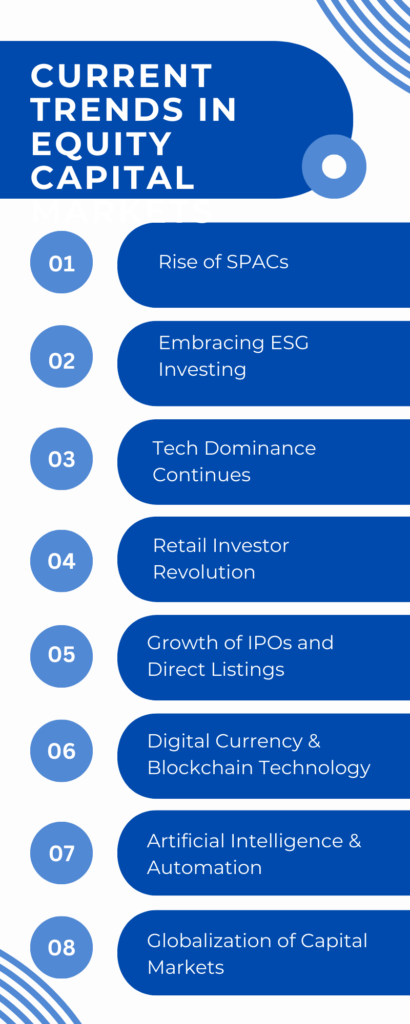
In 2023, the capital markets are witnessing an interplay of economic volatility and technological innovation. This year is defined by resilience in the face of global economic challenges and a transformative shift towards leveraging technology for enhanced market efficiency. The key trends that are shaping this industry include – 

  • Economic Instability and Resilience

2023 began with economic uncertainty, yet capital markets showed resilience. This resilience is reflective of the market’s adaptability to global economic shifts.

  • Regulatory Reforms for Growth

Various regions are implementing regulatory reforms to stimulate market growth. For example, the UK’s Edinburgh Reforms aim to enhance the competitiveness of financial services, potentially reducing transaction costs.

  • Embracing Technological Advancements

Capital markets are increasingly leveraging technology to manage profitability pressures. Investments in digital platforms and data analytics tools are becoming more prevalent.

  • Data Monetisation and Management

The focus on data quality and management is intensifying. Financial services are utilising technology to harness real-time data for better decision-making.

  • Diverse Regulatory Approaches Globally

Different countries are adopting contrasting regulatory approaches, influencing market dynamics. While some are loosening regulations to foster growth, others maintain stringent controls.

  • Impact on Investment Strategies

These trends are significantly influencing investor behaviour and strategies. The emphasis on agility and innovation is crucial for navigating the evolving economic and technological landscape.

Financial Analysis Course

The Future of Capital Markets 

Machine Learning and Artificial Intelligence

AI and machine learning are set to change the face of financial markets by enhancing risk management and investment decision-making. These technologies enable the analysis of vast data sets, uncovering new investment opportunities and optimising portfolio management.

Blockchain and Distributed Ledger Technology

Blockchain’s decentralised nature promises increased transaction transparency, security, and efficiency. Smart contracts, enabled by blockchain, can automate agreements, reducing intermediary involvement and streamlining securities trading.

Fintech and Digitalization

The integration of fintech is reshaping capital markets, with online platforms, robo-advisors, and digital asset exchanges gaining popularity. These innovations democratise market access, allowing retail investors to participate more easily and diversify their portfolios.

Sustainable Finance

A growing focus on sustainability and ESG factors is influencing investor decision-making. Capital markets are adapting by offering more ESG-related investment opportunities and robust reporting frameworks.

Key Takeaway

The capital markets are undergoing a transformative phase, marked by technological advancements and a shift towards sustainable finance. The integration of AI, blockchain, and fintech is not just reshaping these markets but also redefining the way we invest and manage financial assets. The emphasis on ESG factors reflects a growing awareness of the need for responsible investing.

For those looking to navigate this evolving landscape, being up-to-date and upskilling yourself is crucial. Imarticus offers different programs designed to equip you with the knowledge needed to excel in the modern financial world. Whether you’re a seasoned professional or just starting out, their financial analyst course provides a financial certification along with valuable insights into the latest trends and technologies in capital markets.

7 Major Impacts of AI Technologies on Business

Reimagining business with AI: A new horizon

Artificial Intelligence (AI) is a game-changer for businesses, completely changing how companies work and affecting various industries. In this blog, we’ll explain AI technologies and explore the seven significant ways it’s impacting businesses today. Whether you’re a fresh graduate, a young professional, or someone looking to enhance your technical skills, understanding the effects of AI is crucial for your career growth. Imarticus Learning offers executive management programmes and sales leadership program that can help you navigate this evolving landscape.

Overview of artificial intelligence

Artificial Intelligence, or AI, is when computers are made to think and learn like people. It’s like teaching machines to be smart. AI includes different technologies like machine learning, natural language processing (NLP), robotics, and computer vision. These smart machines can do tasks that normally need a human brain. Thus, AI can help businesses get more work done faster and better.

7 Major impacts on business due to AI

In the business world, AI has made some big changes. Automation, data analytics, and NLP are some of the main ways AI is used. But what does this all really mean, and how does AI make things easier and more efficient in business? Let’s explore these impacts and their benefits.

1. Automation and efficiency

AI technologies automate repetitive tasks, freeing up valuable human resources for more complex projects. Businesses can use AI-powered bots or software applications to streamline operations, reduce errors, and improve overall efficiency. For example, customer service chatbots can handle routine inquiries while human agents focus on more specialised issues.

iim l sales leadership program

2. Enhanced decision-making

AI algorithms quickly and accurately analyse loads of data, offering valuable insights for decision-making. Using AI-driven tools, businesses can make data-based choices on pricing, customer preferences, market trends, and risk assessment.

3. Improved customer experience

AI tech helps businesses personalise customer experiences by studying customer data and predicting their needs. Chatbots with 24/7 support and AI’s NLP skills boost customer satisfaction. Plus, AI suggests products or services tailored to individual preferences and behaviours.

4. Effective marketing strategies

AI is changing the game in business marketing. It predicts what consumers will do, makes ads better, and listens to what customers say. With AI, businesses can group customers by what they like and send them personalised content, which means more sales and a better return on investment (ROI).

5. Advanced data security

AI tech is a ground-breaking technology when it comes to keeping businesses safe from cyber threats. It uses machine learning to spot suspicious activities and quickly identify potential security breaches.

Moreover, AI-powered authentication systems step up data security by offering multi-factor authentication methods that are tough to breach.

6. Efficient supply chain management

AI technology makes supply chains work better by guessing what people will want, minimizing inventory costs, and making deliveries faster. Businesses can use AI tools to figure out what people will buy, handle their stored goods smartly, and get things to them on time.

7. Job market transformation

While AI brings several benefits to businesses, it also raises concerns about job displacement. However, it is important to note that AI technologies create new job opportunities as well. As certain tasks become automated, individuals can focus on higher-level decision-making roles that require creativity and analytical thinking.

Opportunities and challenges due to the AI revolution

The impact of AI technologies on business is undeniable. However, it brings both opportunities and challenges for professionals. Embracing AI opens up avenues for innovation, career growth, and competitive advantage. But, it also means that companies need people who know a lot about AI to make the most of it. Finding the balance between harnessing the benefits and addressing the challenges is pivotal for sustainable growth in this evolving landscape.

AI technologies: The new frontier of business success

Artificial Intelligence has changed the business world significantly. It automates tasks, helps with decision-making, makes customers happier, and boosts data security. Knowing these impacts is vital for young professionals who want to succeed in their careers or fresh graduates exploring online courses to sharpen their technical skills.

If you want to enhance your skills in managing the impacts of AI technologies on businesses, consider enrolling in Imarticus Learning‘s Executive Management Program by IIM Lucknow or the sales leadership programme offered in collaboration with IIM Lucknow. These comprehensive courses cover various aspects of leveraging AI technologies for business success.

Don’t miss out on this chance to boost your career prospects. Visit our website today to learn more and get started on your journey toward mastering the impact of AI technologies.

Roles and Functions of Top Executives in Sales & Marketing

The strategic role of sales and marketing executives

In today’s competitive business environment, the sales and marketing industry plays a pivotal role in driving growth and revenue for companies. For recent graduates and young professionals who are seeking to excel in this field, it is essential to understand the responsibilities of top executives who lead these teams.

In this blog, we will delve into the broad responsibilities of these leaders and highlight their strategic contributions that lead to organisational success.

Overview of the sales and marketing industry

The sales and marketing sector encompasses a wide range of activities that are dedicated to promoting products and services to potential customers. It is a dynamic and continuously evolving field due to technological progress, evolving customer preferences and market trends. This industry offers numerous career opportunities, in various roles like sales representatives, brand managers, digital marketers, market researchers and more.

Future of the sales and marketing industry

Technology continues to reshape industries across the globe, making the future of sales and marketing look promising. The rise of artificial intelligence (AI), machine learning, data analytics and automation has revolutionised the way businesses engage with customers. These advancements enable executives to analyse vast amounts of consumer data, optimise campaigns for better targeting, personalise customer experiences and predict market trends accurately.

iim l sales leadership program

Roles and responsibilities of top executives

  • Developing effective strategies: Top executives are tasked with crafting comprehensive sales and marketing strategies that align with the organisation’s objectives. This entails analysing market trends, pinpointing target audiences, outlining pricing strategies, establishing distribution channels, allocating advertising budgets, harnessing digital platforms for broader reach and monitoring competitors to maintain a competitive edge.

  • Setting sales targets: Executives set ambitious yet achievable sales targets based on market analysis while considering factors like product demand, competition landscape, economic conditions, etc. They collaborate with teams to develop effective sales plans that align with overall business objectives.

  • Leading cross-functional teams: Successful executives lead cross-functional teams comprising marketers, sales managers/representatives, creatives/designers (for branding), analysts (for data-driven insights) and customer service professionals. They foster a collaborative work culture, encourage innovation and provide guidance to ensure effective execution of strategies.

  • Building relationships: Top executives play a crucial role in building and nurturing relationships with key stakeholders, including clients, potential customers, industry experts and partners. They attend industry events, conferences and networking sessions to establish connections that can drive business growth through strategic partnerships and collaborations.

  • Monitoring performance: Executives regularly monitor sales performance against targets using various metrics such as revenue growth, market share, customer satisfaction ratings, etc. They employ data analytics tools to gain insights into sales trends, identify areas of improvement and make data-driven decisions for enhancing sales effectiveness.

  • Adapting to technological advancements: Top executives need to stay updated with the latest technological advancements in the sales and marketing industry. This includes understanding emerging tools like Customer Relationship Management software, marketing automation platforms and predictive analytics tools for sales forecasting.

Takeaway of the roles and responsibilities of sales and marketing executives

The roles and functions of top executives in the sales and marketing industry are critical for driving business growth and success. Their ability to develop effective strategies, set ambitious sales targets, lead cross-functional teams and build relationships with stakeholders while adapting to technological advancements distinguishes them as leaders in this field.

If you want to enhance your skills in the dynamic sales and marketing industry or understand the responsibilities of top executives better than ever before, check out the sales and marketing course on Imarticus Learning.

Imarticus Learning offers comprehensive programs that equip young professionals with structured technical proficiency development courses on the internet tailored to their needs. Read more about the course here.