In the dynamic landscape of finance, mastering the intricacies of investment banking and capital markets is paramount for professionals aspiring to thrive in the industry. The Executive Programme in Investment Banking and Capital Markets by IIM Calcutta stands as a beacon of financial knowledge, offering a transformative learning experience that combines academic rigour with real-world application.
At the heart of this program is a focused exploration of IIMinvestment banking, a discipline where IIM Calcutta has established itself as a leader. The curriculum delves into the nuances of mergers and acquisitions, capital raising, and financial restructuring, providing participants with a holistic understanding of the investment banking landscape.
Benefits of the Executive Programme
Comprehensive Curriculum: The program’s curriculum is meticulously designed, covering diverse aspects of investment banking and capital markets. From financial modelling to risk management, participants gain a 360-degree view of the financial domain.
Industry-Relevant Learning: Taught by seasoned industry experts and renowned faculty, the program ensures that participants are equipped with insights directly applicable to the ever-evolving financial sector.
Networking Opportunities: Beyond classroom learning, the program fosters a conducive environment for networking. Participants interact with industry professionals, creating avenues for collaboration and career advancement.
Practical Application: Theoretical knowledge is complemented by hands-on applications, case studies, and simulations. This ensures that participants not only understand financial concepts but also know how to apply them in real-world scenarios.
Online Finance Course: Redefining Flexibility in Learning
One distinguishing feature of the Executive Programme in Investment Banking and Capital Markets is its online format. Recognising the demands of busy professionals, Imarticus Learning has crafted a program that offers flexibility without compromising academic excellence. This online finance course enables participants to pursue advanced education without the constraints of geographical location or rigid schedules.
Why Choose an Online Format?
Global Reach: Participants from across the globe come together in a virtual classroom, creating a rich and diverse learning environment. This global perspective is invaluable in understanding the interconnected nature of financial markets.
Flexibility: Professionals juggling work commitments find the flexibility of an online finance course instrumental. Whether in a different time zone or managing a hectic work schedule, participants can access course materials at their convenience.
Interactive Learning: The online platform is not just about watching lectures; it’s about active engagement. Discussion forums, live webinars, and collaborative projects ensure that participants actively participate in their learning journey.
Finance Training: A Gateway to Career Advancement
For those seeking career advancement, a specialised finance training program is often the key to unlocking new opportunities. The Executive Programme in Investment Banking and Capital Markets by IIM Calcutta in association with Imarticus Learning, positions participants as strategic financial leaders, ready to take on roles that demand both expertise and innovation.
Career Trajectory
Investment Banking Roles: Graduates of the program find themselves well-equipped for roles in IIM investment banking, be it as financial analysts, associates, or even vice presidents.
Capital Market Specialists: The curriculum’s focus on capital markets prepares participants for careers as market analysts, traders, or investment strategists, where understanding market dynamics is crucial.
Financial Consultancy: Armed with a comprehensive understanding of financial strategies, program graduates are well-suited for consultancy roles, guiding businesses in making sound financial decisions.
Final Words
In a world where financial landscapes are constantly evolving, mastering financial strategies becomes a transformative journey. The Executive Programme in Investment Banking and Capital Markets by IIM Calcutta in association with Imarticus Learning with its focus on IIM investment banking expertise, online finance course flexibility, and career-centric approach, emerges not just as a course but as a catalyst for elevating financial expertise. As you embark on this learning journey, you’re not just acquiring knowledge; you’re shaping the future of finance.
If you think that the above reasons persuade you to take up professional financial training, don’t waste any more time and improve your skills by registering for the Executive Programme in Investment Banking and Capital Markets by Imarticus Learning. It is one of the best Investment Banking and Capital Markets programs that will arm you with all the aspects of the same that you will require as a stepping stone while making a career in this field.
The financial services and capital markets industry, including banking, investments, insurance, consumer finance, and real estate sectors, is one of the major contributors to the national economy. Considering this, there are many opportunities available to grow your career in this domain. You can pursue a financial services course or a capital market course to explore career opportunities with high earnings. Read ahead to know more…
Benefits of Career Advancement
It is important to have growth plans to advance in your career. And, to accomplish this, it is vital to upskill yourself to be industry relevant. Let’s discuss some more advantages of career advancement programmes.
Get Higher Salary Package: Notably, your designation, industry experience, education level and sector, affect your pay cheque big time. As one advances in his/her career, pay also increases. Pursuing a financial services course or a capital market course can help you bag better-paying jobs.
Gain Job Satisfaction: As you advance in your career, your responsibilities and independence increase too. And, this is linked to employee satisfaction. According to World Financial Review, careers in finance score 9.6 out of 10 when it comes to work satisfaction. It is to be noted that many companies in this domain invest in their employees and help them build their careers.
Enhance Career Diversity: As you grow in your career, your opportunities also increase. For instance, if you are in corporate finance, then you can also explore opportunities in financial planning or investment banking and hedge funds, after pursuing a related certification course. These short-term programmes prepare you to explore new paths and switch companies and sectors.
How to Advance Career in Financial Services and Capital Markets?
In order to advance your career in the financial services and capital markets industry, follow these steps to attain your career goals:
Get an Advanced Degree: Earning a bachelor’s degree is a prerequisite to excel in the financial services domain. This helps you acquire the basics of accounting, economics, or business administration. Besides, it is helpful and recommended to pursue certification courses to gain advanced knowledge and soft skills to find long-term success. These short-term courses help develop analytical aptitude, communication skills, detail orientation and proficiency in mathematics.
Expand Your Network: It is important to forge connections with other professionals in the financial services and capital markets industry to open new career avenues. You can join virtual and in-person conferences relevant to your industry in order to meet more professionals having similar interests. Also, you can participate in finance-targeted networking events to stay updated on trends in the world of finance.
Careers in Financial Services and Capital Markets
Pursuing a reputable financial services course or a popular capital market course can help you acquire the necessary skills to perform your duties efficiently and effectively in the following roles:
Investment banker
Venture capital analyst
Credit analyst
Fund manager
Actuary
Business development manager
Stockbroker
Financial analyst
Underwriter
Chief financial officer
Operations manager
Branch manager
Loan officer
Treasurer
Internal auditor
Financial adviser
Wealth manager
Personal banker
Qualitative research analyst
Investment banking analyst
Executive director
Conclusion
As the financial services and capital markets industry prospers, it not only reflects that the economy is strengthening but also states job opportunities are growing. And, to prepare oneself for these opportunities, it is vital to pursue a financial services course or a capital market course like the IIM Lucknow finance course, which focuses on a forward-looking curriculum, interactive learning and masterclasses by industry experts. This programme will help build technical expertise, develop strong analytical capabilities, gain industry exposure, and cultivate critical soft skills. Reach out to Imarticus Learning for more details about the programme and enrollment queries.
The CPA certification is the highest level of expertise in the field of accounting around the globe, and it is a highly sought-after and versatile certificate for accountants.
Certified Public Accountants is the full form of the acronym CPA. It is an exam administered by the American Institute of Certified Public Accountants (AICPA). It is a worldwide recognised qualification for which the applicants must successfully pass the Uniform CPA Examination. In India, the Chartered Accountant (CA) designation is comparable to CPA.
With over a decade of expertise, Imarticus Learning is your best choice when looking for prominent accounting employment options in India. Our tailored US CPA course and certification curriculum accelerate your achievement while complimenting your prior education. Join us to acquire top-tier opportunities in India’s burgeoning job market and meet your goal of becoming a CPA.
Career Path of CPA
With US CPA course you can master your skills in Financial Accounting, Financial Reporting, Financial Analysis, Audit & Attestation, Tax Planning and Business Regulations.
Thedesignation of CPA opens the door to a broad spectrum of career opportunities. After obtaining your CPA certification, you will have the option of working in several accounting sectors such as international accounting, consulting services, internal and external auditing, forensic accounting, taxation, assurance services, financial planning, etc. In many nations, you will find the best places to work because of its reputation and recognition around the world.
Course Duration and Fee of CPA
The US CPA course offered by Imarticus takes a minimum of 12 to 18 months.
The CPA course fee is INR 1,20,000. The CPA exam price is $1000, while the international testing fee is $1500. In addition, $225 is required as evaluation expenses. Thus, the entire cost is $2750, or nearly INR 2,00,000, excluding training expenses.
Eligibility Criteria
CPA exams are conducted by the AICPA, the world’s biggest accounting association. The AICPA provides membership to all hopefuls who pass all four CPA tests. However, CPA licences are awarded by the 55 state boards of accountancy in the US that are members of NASBA. Each state board has distinct qualifying requirements for aspirants to take the US CPA examinations.
Master’s degree in any of the fields of commerce, accounting or finance.
An aspirant requires 120 credits to take the US CPA tests, and 150 credits to obtain his CPA licence.
A year of university study in India is equivalent to 30 credits of schooling in the United States.
In some situations, first-class graduates of three-year degrees from NAAC-A-certified Indian colleges are eligible to take the US CPA examinations.
CPA Curriculum
Current Curriculum
It includes 4 mandatory subjects:
Audit & Attestation (AUD)
Financial Accounting & Reporting (FAR)
Taxation & Regulations (REG)
Business Environment and Concepts (BEC)
New Curriculum
The CPA Evolution Program establishes a new structure for US CPA certification, which includes a rewritten curriculum. Beginning in January 2024, the revised CPA curriculum will apply to all tests.
The new CPA Evolution Course framework consists of six papers, four of which must be successfully passed. These six papers are separated into two sets of three papers each.
The first group, referred to as the ‘CORE’ papers, is required for all applicants:
Core 1 – Audit & Attestation (AUD)
Core 2 – Financial Accounting & Reporting (FAR)
Core 3 – Taxation & Regulations (REG)
The second group is referred to as the ‘Discipline’ papers. The aspirants must select one out of the three subjects on the basis of their preferences:
Discipline 1 – Business Analysis & Reporting (BAR)
Discipline 2 – Information Systems & Control
Discipline 3 – Tax Compliance & Planning (TCP)
Career Prospects of US CPA in India
The US CPA credential offers great potential as a lucrative professional option in India and abroad. With their distinguished reputation, CPAs are in great demand among global firms operating in the country.
CPAs’ extensive accounting knowledge and skills in International Accounting Standards enable them to flourish not just locally, but also internationally.
As a result, CPAs are sought after for a variety of positions in the financial services business. Employers actively recruit and value CPAs in India, demonstrating a rise in demand for their services.
With Imarticus, you also get the opportunity of free placement boot camp.
Salary
A CPA professional in India can expect to earn an average salary ranging between INR 12,50,000 and INR 20,50,000 per year. Once someone has more than 10 years of experience in a field, they usually move on to another one.
Final words
For CPA admission, an aspirant must have experience in accounting and business for at least five years. CPAs are accredited public accountants who act as strategic business advisers.
Imarticus offers an all-inclusive Certified Public Accountant course designed to help you find your full potential and launch a successful career in accounting and finance.
Thinking about stepping into the world of finance, whether you’re a fresh grad, a working professional itching for the next leap, or someone simply curious about the inner workings of money and markets? Then the CFA Course might be your ticket.
Let’s be honest: pulling off a serious credential like the CFA isn’t just about collecting letters after your name. It’s about rewiring how you think: not only what the numbers show, but why they matter, how they drive decisions, and what they reveal about the financial world around you. The journey is more than exams and textbooks – it’s about cultivating a mindset that speaks the language of global finance, one that hiring managers and investment teams recognise and value.
I’ll give you a look at what the journey actually involves, the skills you’ll pick up, the doors it can open for your career, and some tips to tackle it without feeling burned out. By the end of this guide, you’ll have a clear roadmap for your CFA course journey – so you can step in confident, focused, and ready to take your place in the world of finance. Let’s dive in and explore what makes this credential a game-changer.
Interesting Fact: The CFA Program is recognised in 160+ markets around the world.
To me, the CFA course isn’t just another finance qualification – it’s a shift in the way you see the world of investing. It’s what happens when you stop just reacting to market changes and start anticipating them with insight.
The Chartered Financial Analyst (CFA) program, offered by the CFA Institute, is one of the most respected credentials in global finance. It’s not a quick shortcut or a simple course to boost your career – think of it more like a marathon one that builds lasting expertise and prepares you for the long game in investment and financial management. Each level challenges you to dig deeper into how money flows – through markets, portfolios, and entire economies, and trains you to make smarter, more informed decisions along the way.
Think of it as your complete financial toolkit. You don’t just learn how to analyse a balance sheet; you learn how to connect numbers to narratives – to understand why a company’s valuation changes, how macroeconomic shifts affect portfolios, and what ethical choices define great investors.
When someone earns the CFA charter, it signals more than knowledge. It shows discipline, judgment, and a long-term view – the exact traits that employers and clients look for in investment professionals from Mumbai to London to New York.
In short: the CFA course isn’t just about mastering finance – it’s about learning to think like the people who shape it.
If you’re still exploring whether the CFA course is right for you, our CFA course details section breaks down everything from how the program works to what skills you’ll build and how to prepare for success.
The fundamental purpose of finance is to contribute to society through increases in societal wealth and well‑being. We need more people in our professional ranks who have clear ethics and a sense of commitment. – Paul Smith, CEO of CFA Institute
Why Choose the CFA Course for Your Finance Career?
Why would anyone willingly invest hundreds of hours in this demanding course? For me, it’s simple: it prepares you to be the professional people turn to when markets move, when portfolios need insight, or when critical financial decisions are on the line.
Imagine being the go-to professional when your company needs insight into market trends, portfolio risks, or asset valuations. The CFA charter doesn’t just open doors; it unlocks them widely across investment management firms, hedge funds, and corporate finance departments worldwide.
When employers seek trusted experts, having a CFA course credential on your resume sets you distinctly apart. And more importantly, it gives you the confidence to make decisions that others might hesitate to take.
The CFA program is experiencing significant growth in India, with candidate numbers increasing by almost 25% annually since 2019, highlighting its growing importance in emerging markets.
Curious why the CFA is hailed as the gold standard in finance? This video breaks down what makes the CFA so valuable for your career – from global recognition to high-paying roles.
CFA Course Levels and Curriculum
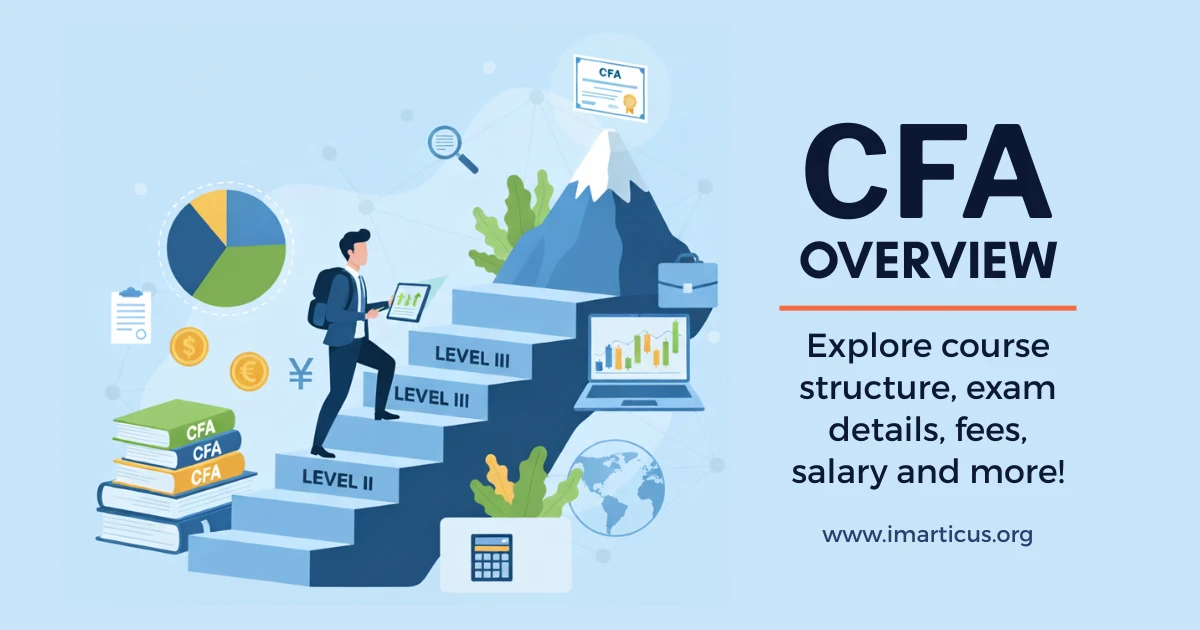
The CFA course is similar to climbing a mountain – each level builds on the last; it is structured in three progressive levels:
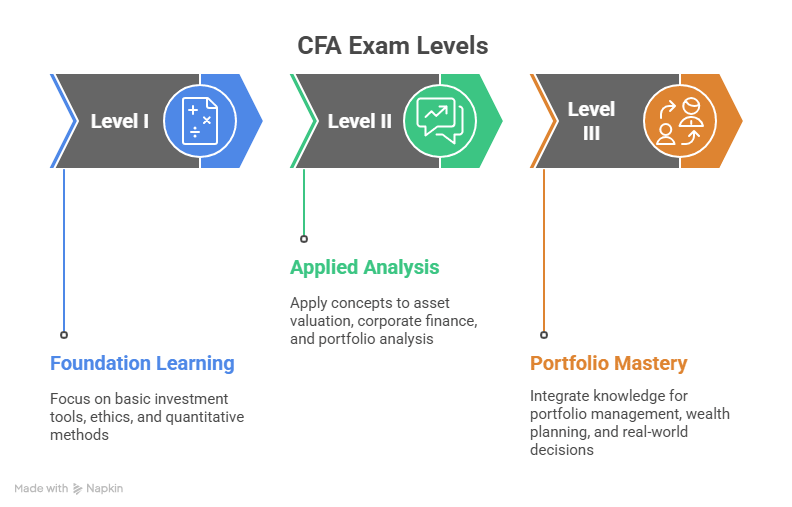
Level 1 – Building Fundamentals: It’s like learning to read the language of the financial world. This level assesses your understanding of the basics, such as ethics, quantitative methods, economics, and financial reporting, with multiple-choice questions. It’s the foundation every apprentice investor needs.
Level 2 – Application of Concepts: Now, envision stepping into the shoes of a financial analyst who must apply knowledge to real-world cases. Level 2 examines your ability to analyse complex equity valuations, fixed income, corporate finance, and risk. At this level, the questions are scenario-based, mirroring actual market challenges.
Level 3 – Mastering Portfolio Management: At this stage, the questions are scenario-based, reflecting real-world market challenges and opportunities. The focus is on advanced portfolio management and wealth planning, with essay-style and case study questions that test your ability to think critically, apply sound judgment, and communicate your investment rationale effectively – just as you would in actual client situations.
Each step builds on the last, requiring around 300 study hours per level – so perseverance counts as much as intelligence.
You can hire people with an MBA, but you don’t necessarily know that one MBA is the same as another MBA. If you hire investment professionals with a CFA designation, you absolutely have confidence at the level of qualification.” – CFA Institute.
The CFA Course Eligibility
When aspiring CFA candidates or current professionals inquire about the program, their uncertainties often stem not from the official structure, exam format, different levels, potential salary, fees, or diverse career paths, but rather from their personal perceptions and assumptions about these aspects.
Finance credentials today aren’t just certificates; they’re global passports. The CFA designation is one such credential, well-respected across continents and industries. But with all the buzz around this top-tier finance credential, many wonder –
Who exactly is eligible to take the CFA course?
Is it only for finance graduates?
Is there an age bar?
Do you need years of experience before applying?
This is one of those common misconceptions about the CFA program, and I always enjoy clearing up that confusion as soon as possible. Whenever someone asks me about the CFA’s prerequisites, they expect a long list of rigid financial experience, like needing five years as a junior analyst or something equally intimidating.
The truth might surprise you: the CFA program is actually designed to be incredibly inclusive and accessible to a broad range of candidates, particularly for the first hurdle, Level I. For me, that’s the beauty of it. They’re looking for potential and commitment, not just a CV. You essentially have three pathways to apply for the Level I exam:
Educational Background: A Bachelor’s Degree (or an equivalent qualification) is the standard route. You don’t even have to have completed it yet – you can register if you are in the final year of your program.
Professional Experience – if you’ve clocked 4,000 hours of work experience and higher education, that adds up to three years. Critically, this experience doesn’t even have to be investment-related – it just needs to be relevant to business.
So, in short, you don’t need years of dedicated investment-banking experience to start. You are required to have one of those solid foundations in place, and then, most importantly, the discipline to study. The real experience begins when you start tackling the curriculum!
CFA Exam
The CFA program has three levels, each testing different skills. The program’s three levels take you from foundational knowledge to advanced portfolio management:
Level I: Focus on basic concepts – ethics, quantitative methods, and financial reporting.
Level II: Dive deeper into asset valuation and investment tools.
Level III: Master portfolio management and wealth planning.
Level
Focus
Exam Format
Duration
Level 1
Basic knowledge and comprehension of investment tools, ethics, and financial reporting
Multiple-choice questions
2 sessions × 2 hours 15 mins each
Level 2
Application of concepts to analyse and value investments
Item set questions (mini case studies)
2 sessions × 2 hours 12 mins each
Level 3
Portfolio management, wealth planning, and integrating concepts with decision-making
Constructed response (essay) + item sets
2 sessions × 2 hours 12 mins each
Key Points:
All exams are offered in English.
Ethics is emphasised at every level.
Passing requires both knowledge and the ability to apply concepts to real-world scenarios.
Want a clear snapshot of what the CFA course journey looks like and why it’s worth it? This video covers the essentials for anyone curious about starting their CFA path.
CFA Course Preparation
Let’s be honest – preparing for the CFA exams is tough. You can’t just cram formulas or skim through notes and expect to ace it. It’s about really understanding the material and being able to use it when it counts. I like to think of it as training for a marathon; you don’t run 42 km on day one. You start small, stay consistent, and slowly build the endurance to cross that finish line.
From what I’ve seen and heard from people who’ve actually done it, here’s what really helps:
Start early and stay consistent.
One of my friends, Rohan, began his CFA Level I exam preparation four months in advance. Every night after work, he’d put in just 90 minutes. No all-nighters, no panic. By the time exam week came around, he was calm, and he passed on the first try. That’s the power of steady effort.
Practice like it’s the real thing.
A candidate once told me she treated her mock exams like the real deal – no breaks, no distractions, just her and the timer. By exam day, she wasn’t nervous; it just felt like another practice session. Mock tests aren’t just practice – they build confidence.
Don’t skip ethics.
I get it, ethics doesn’t sound exciting. But a lot of people miss their passing mark because they underestimate it. One person I know actually turned his borderline fail into a pass because he reviewed ethics carefully in the last week – it really can make that much difference.
Find your tribe.
Studying alone can feel isolating. I remember a small online group that met every Sunday evening – half the time they were just complaining about how hard derivatives were, but that sense of community kept everyone motivated. You learn faster when you’re not alone in it.
Take care of yourself.
Burnout is real. I’ve seen people try to power through on four hours of sleep and crash halfway. One candidate I spoke to started taking short walks after study sessions – it helped clear his head and made a huge difference in his focus.
The CFA exams are challenging – no sugar-coating that, and pass rates often sit below 50%. But it’s not about being a genius. It’s about showing up, being consistent, and believing in the process. When you finally see that “pass” on your result, all those late nights and weekends suddenly feel worth it.
Did you know that Global pass rates hover around 40-50% per level, highlighting the rigour and value of the program.
CFA Course Fees
Investing in CFA Certification is an investment in your career; the return often outweighs the cost many times over. From my experience, understanding the CFA course fees upfront helps you plan better. Here’s a breakdown:
Note – The program fee at Imarticus covers the program, including both training and study materials.
Career Opportunities After Completing the CFA Course
Earning your CFA charter opens doors to a wide array of finance career paths – both in India and globally. CFAs are highly sought after because they bring a strong mix of analytical skills, ethical standards, and practical market knowledge. Some of the key career opportunities include:
CFAs thrive in roles like:
Portfolio Managers who decide how to allocate assets for investment funds.
Financial Consultants / Advisors provide strategic advice to businesses and individuals on financial planning, investments, and retirement strategies.
Employers worldwide trust CFAs to make crucial financial decisions. Your salary potential grows alongside this trust, with entry-level CFAs in India averaging ₹8-10 LPA and seasoned professionals earning well into the ₹40 LPA+ range.
If you’re curious about how the CFA designation can shape your professional journey, check out our detailed guide on the career options after CFA certification.
Interesting Fact: According to the CFA Institute, 91% of charterholders report that their designation has enhanced career opportunities.
Salary After Completing CFA
Now, onto the part that really catches everyone’s attention – the salary. Earning your CFA charter definitely opens the door to better paychecks, but it’s also about the career growth and opportunities that come with it.
Entry-level CFAs in India can usually expect salaries around ₹8-12 lakhs per annum, which is generally higher than non-certified peers in finance roles. And experience makes a significant difference. Mid-career professionals with a CFA often reach ₹20-40 lakhs or more, especially in multinational companies or investment firms.
After Level 2, professionals often move into front-office or client-facing roles with noticeable pay jumps.
Job Role
Entry-Level (0-2 yrs)
Mid-Level (3-5 yrs)
Senior-Level (6-10 yrs)
Equity Research Analyst
₹8-12 LPA
₹14-20 LPA
₹20-28 LPA
Investment Banking Associate
₹10-15 LPA
₹18-25 LPA
₹28-35 LPA
Portfolio Analyst
₹9-13 LPA
₹15-22 LPA
₹22-30 LPA
Credit/Risk Analyst
₹8-12 LPA
₹14-20 LPA
₹20-26 LPA
Corporate Finance Analyst
₹7-11 LPA
₹12-18 LPA
₹18-25 LPA
CFA Level 3 – Charterholder/Advanced Roles & Salary Growth
CFA Level 3 pass-outs and charterholders are eligible for senior, leadership, and client advisory roles. Compensation includes bonuses and performance-linked pay.
Job Role
Entry-Level (0-2 yrs)
Mid-Level (3-5 yrs)
Senior-Level (6-10+ yrs)
Portfolio Manager
₹12-18 LPA
₹20-35 LPA
₹40-60 LPA+
Investment Manager
₹14-20 LPA
₹25-40 LPA
₹45-70 LPA+
Equity/Research Head
₹10-16 LPA
₹20-30 LPA
₹35-50 LPA+
Risk/Strategy Consultant
₹12-18 LPA
₹22-32 LPA
₹35-55 LPA+
Wealth/Asset Manager
₹10-15 LPA
₹18-28 LPA
₹30-45 LPA+
Globally, the story looks even more impressive. Fresh CFAs can start at $70,000+ annually in countries like the US, UK, or Singapore. Senior CFAs, especially portfolio managers or executives, easily pull in six-figure salaries – sometimes well over $200,000. If you’re curious about how these numbers compare closer to home, check out our detailed breakdown of CFA salary in India to see how earning potential grows with experience and role.
But here’s a little secret: the salary is more than just your base pay. CFA holders often get bonuses, stock options, and profit-sharing opportunities that can multiply their total income. Plus, the global nature of the CFA means you can explore career avenues around the world – and that international edge can be a game-changer.
Of course, the CFA alone isn’t an instant ticket to a massive paycheck. It’s a respected credential that, combined with real-world experience, networking, and continuous learning, propels your career forward steadily but surely.
CFA Course vs. Other Finance Certifications
If you’ve met professionals with CPA, FRM, or CA certifications, you might wonder how the CFA course compares. Think of it as choosing between various vehicles for a financial career journey – the CFA course is particularly tailored to investment and portfolio management, while the CPA focuses more on accounting and auditing, and the FRM zeroes in on risk analysis. The CFA charter’s global recognition and emphasis on ethics make it especially coveted in asset management circles, offering a unique blend of depth and applicability. Here’s a concise overview of the CFA course with other popular finance certifications to help you get a better understanding.
Aspect
CFA
CPA
FRM
CA
Eligibility
Bachelor’s or final year
Bachelor’s + accounting credits
Bachelor’s degree
10+2 or graduation
Levels
3
4
2
3
Exam Style
MCQs + case studies
MCQs + simulations
MCQs
Descriptive + objective
Pass Rate
~40–45%
~50%
~45–50%
~10–15%
Focus
Investments & finance
Accounting & auditing
Risk management
Accounting & taxation
Job Roles
Analyst, PM, Strategist
Auditor, CFO, Controller
Risk Analyst, Risk Manager
Auditor, Finance Manager
Salary Range
₹8-25 LPA
₹7-20 LPA
₹8-22 LPA
₹6-18 LPA
Global Recognition
Very high
High (esp. U.S.)
High
Strong in the Commonwealth
Why Choose Imarticus for Your CFA Course Journey?
Having a CFA program on your resume is one thing; mastering it is another. Here’s why I feel Imarticus Learning is a great learning partner for your CFA course preparation:
Structured Learning & Mentorship: Every student gets one-on-one guidance from industry experts to help understand tough concepts and stay on track.
Global Curriculum Standards: Imarticus is aligned with CFA Institute guidelines, ensuring you’re prepared for exam rigour worldwide.
Practical Exposure: Through case studies, simulations, and workshops, you learn to connect theory with real-world decision-making.
Career Support: Resume-building, interview preparation, and access to global networks help you transition from certification to career.
With this kind of backing, I always tell you’re not just studying for the CFA course; you’re preparing to step into a role where your decisions matter.
FAQs About the CFA Course
If you’ve made it this far, you probably still have a few questions swirling in your mind. These frequently asked questions break down everything you need to know about the CFA course.
What is a CFA course?
The CFA course is a globally respected program that trains you in investment management, financial analysis, and ethical decision-making. It’s way more than just studying numbers – it’s about learning to see what those numbers mean, how they influence markets, and how to make smart, confident financial decisions that matter. Think of it as a deep dive into the language and mindset of the world’s top investment pros.
Is CFA harder than CA?
It depends on your strengths. CA is more technical and accounting-heavy, with tough exams and lots of memorisation. CFA, meanwhile, focuses on investment analysis, markets, and decision-making – it’s about applying concepts, not just recalling them. Both are challenging, but in different ways. If you love finance and markets, the CFA course might feel more your style.
What is a CFA salary?
CFA charterholders usually see a strong boost in earnings. In India, fresh CFAs earn around ₹8-12 LPA, while experienced professionals can make ₹20-40 LPA or more, especially at top firms. Globally, salaries often start above $70,000 and rise quickly with experience. It’s not instant – but it’s a steady, rewarding climb. With Imarticus Learning’s comprehensive CFA training programs, you can strengthen your conceptual foundation, gain industry insights, and position yourself for these high-growth career opportunities.
How many years is the CFA course?
On average, it takes about 2.5 to 4 years to complete all three levels of the CFA course, considering you pass each on your first try and accumulate necessary work experience. With structured guidance and expert mentorship from Imarticus Learning, you can streamline your CFA journey and stay on track to achieve your certification efficiently.
Who is eligible for the CFA course?
You need a bachelor’s degree or equivalent, or be in your final year of studies. Alternatively, if you have a combination of work experience and education equaling four years, you can apply for the CFA course. You don’t need prior investment experience to start; it’s designed to welcome diverse backgrounds. With Imarticus Learning’s CFA prep program, you can get personalised guidance and structured study support to confidently meet eligibility requirements and excel in your exams.
Is CFA higher than MBA?
They serve different purposes. CFA is a deep specialisation in investment and finance, focusing on technical expertise and ethical practice. MBA covers broader business management topics like strategy, marketing, leadership, and operations. Many professionals actually complement their MBA with CFA to get both breadth and depth.
What is the CFA course pass rate?
Historically, pass rates for the CFA course hover below 50%. The exams are tough and designed to be challenging – they filter out those who aren’t fully prepared. With the right preparation and mindset, you can absolutely ace it. At Imarticus Learning, you’ll get guidance from expert mentors, a hands-on, industry-focused curriculum, and continuous support throughout your journey.
Is 27 too late for pursuing the CFA course?
Absolutely not! The CFA program has no age limit. Whether you’re 22 or 40, if you have the drive to learn and grow in finance, this credential is for you. Many people pursue the CFA mid-career to switch tracks or boost their credentials.
How many papers are in the CFA course?
Instead of ‘papers,’ the CFA program has three levels – Level 1, 2, and 3. Each level has a unique exam format covering core finance topics, increasingly testing your analytical and portfolio management skills as you progress.
Is the CFA course in demand?
Yes! CFA charterholders are highly sought after in investment banking, asset management, equity research, risk management, and wealth planning. The global finance industry values CFA expertise, and demand continues to grow alongside complex financial markets.
Which degree is better with the CFA Course?
CFA course pairs well with degrees in finance, economics, accounting, business, or even engineering and math. If you want a smooth learning curve, a finance or commerce background helps, but CFA’s design welcomes all analytical minds ready to dive deep into investments.
Can CFA earn 1 crore?
Yes, senior CFAs in leadership roles like Chief Investment Officers or Fund Managers in top firms can earn ₹1 crore or more annually, counting bonuses and profit shares. It’s not guaranteed overnight, but it is attainable with experience, skill, and the right opportunities.
Elevate Your Finance Career with the CFA Course
Completing the CFA Course isn’t just a qualification – it’s a transformation. It represents the shift from knowing what happens in finance to understanding why it matters, and having the confidence to act on that knowledge.
As the CFA Institute puts it: For many of us, ‘CFA charterholder’ is a defining attribute. It means you have made a significant commitment to your practice, putting investors first, and maintaining the highest ethical and professional standards.
Earning this credential isn’t just about a certificate or clearing the levels – it’s a key that opens doors to careers in investment management, wealth advisory, risk strategy, and beyond. It tells employers around the world that you’re not just qualified – you’re ready to lead.
CFA Course is more than a certificate – it’s your chance to think, decide, and lead like a finance pro. When you finish, you’ll stand out, make an impact, and speak the language of global finance. Ready to begin your career as a CFA Charter?
The Chief Financial Officer holds a very crucial role in the world of finance as the strategic decision maker and a leader whose financial prowess is supreme. An important profile such as a CFO requires someone who has the right experience, expertise as well as education to hold on to the position in a way that could lead the company towards its financial goals successfully.
If you are looking to further your career in the field of finance and want to achieve success as a CFO then the ISB CFO program or the Chief Financial Officer Programme by ISB in association with Imarticus Learning can pave the way for you to realise your dreams. This ISB course is created to empower finance professionals with the expertise, insights and knowledge that is required to become the best in the dynamic world of financial leadership. This article will help you understand the nitty-gritty of the ISB CFO program and how it is a beacon of excellence in the world of financial education.
ISB CFO Program- Overview
This ISB Course is designed to help individuals get in depth knowledge on subjects that play a crucial role in financial management as a CFO. Once you enrol in the course, you will gain experience in the following:
Financial Risk Management
Financial Risk Accounting
Financial Modelling
Change Management
Talent Management
Financial Modelling
Due Diligence
This course is perfect for individuals who aspire to become successful in the field of finance and want to hold leadership jobs in the sector.
ISB CFO Course – What Will You Learn?
The course will help you understand the innovations transforming finance, business models and fintech trends
The course will give you a deeper insight in the ever changing world of risk management, financial markets, and corporate governance through customised program curriculum
The course will help you understand and learn how to apply change management and flexible leadership strategies for effective stakeholder management
The course will assist you in how to navigate the economic challenges in the global scenario and assess the risks they pose while also taking financial decisions based on your findings
The course will help you learn and mould your experience and expertise to the ever changing CFO responsibilities allowing you to lead your teams better, quantifying your business objectives and also excelling in negotiations
This finance course is perfect if you want to sharpen your business acumen and to take your financial leadership skills to the next level. Not only will you be able to draw a hefty chief financial officer salary but the program will also teach you to create a high performing team while taking decisions prudently and leading your organisation towards financial success in the most efficient manner. A corporate world that is based on a volatile and composite business framework, this ISB CFO Course will help you learn to leadwithintegrity and purpose.
Eligibility Criteria
To enrol in the ISB CFO program, the minimum qualification required is a UG qualification – either a Bachelor’s Degree or equivalent (10+2+3) or (10+2+4) or Diploma (10+2+3). Moreover, Individuals who have a two years of Master’s Degree in any discipline with a minimum of 50% aggregate marks from a recognised University (UGC, AICTE, DEC, AIU, State Government, etc.) are preferred. Also, candidates must have 10 years’ minimum work experience after they have completed the above mentioned qualifying courses or degrees.
Understanding ACCA Training for Accounting Professionals
The Association of Chartered Certified Accountants, popularly known as ACCA is an accountancy certification with global recognition. You can attend ACCA training after graduating 12th standard. Or, you can opt to pursue an accounting degree before joining for ACCA training. In the latter case, you will be exempted from writing certain papers.
There are 13 ACCA papers in total. Professionals with ACCA course are hired in various job profiles. The salary range for an accounting professional with ACCA qualification varies from Rs.5 lakhs to Rs.25 lakhs.
This article will discuss two topics- ‘who are accounting professionals?’ and ‘what are the benefits of ACCA training?’
Who are accounting professionals?
Accounting professionals are individuals who perform a number of financial functions. This includes tasks like account analysis, financial statement analysis, financial planning, and making strategic decisions. They work at accounting firms or in the accounting and finance department of big organisations.
Accounting professionals make sure an organisation is ready for its upcoming tax season. Apart from that, these professionals also implement effective and efficient practices that will benefit your company finance system. Now that you have your answer to ‘who are accounting professionals?’, let’s check out the benefits of ACCA training for accounting professionals.
What are the advantages of completing ACCA training for accounting professionals?
Opportunity to work in over 180+ countries
ACCA training for accounting professionals open doors to a number of job opportunities both in India and abroad. You can move to a number of countries with your qualification. This includes countries like the UK, Australia, Singapore, Dubai, Germany and Canada where accounting professionals are in demand.
You can be employed in any firm across 180+ countries. Accounting professionals in big 4 companies, major banks and MNCs are recruited from the ACCA pool of talent.
ACCA is one of the most prestigious certifications in accounting and is globally recognised. Thus, you are not limited by your location. If you have plans to live abroad you can get a job almost anywhere with these credentials.
You can also explore career growth opportunities there. For that, you will not be asked to join a new institution in the country of your choice and attend fresh training. As you are already recognised as a qualified accounting professional, life will be easier there.
Varied Career Opportunities
Your career scope will be tremendous after certification. You will be presented with a number of unique and flexible career choices to consider. You can offer your devices across a variety of accounting-related fields. Fund management, taxation, treasury service, etc. are a few popular fields.
You can work in a number of industries across various business sectors. You can also choose to freelance as an accountant or become a financial advisor. You can also start your own finance consulting business.
Developing life skills
ACCA training for accounting professionals teaches you the technical knowledge required to pursue a career in accounting and finance. Additionally, it also equips you with the soft skills to exercise that knowledge in the real world.
For instance, your technical skills can be enhanced further if you have the essential people skills. Learning how to effectively communicate figures, facts and ideas to other people is crucial here.
Through this course, you will develop a strong work ethic, and collaboration and problem-solving skills. The knowledge you possess is important. At the same time, how you implement that knowledge is equally crucial.
ACCA course will make sure that you turn out to be a well-rounded accounting professional. It prepares you to take on the challenges that you may encounter in the course of your career.
A high-demanding job
The demand for quality is always high. Organisations are always in the lookout for accounting and finance professionals who possess cutting-edge training. This is where your ACCA training will come to use.
The knowledge and skills you possess will give you an edge over your competition. It will ensure that you stand out. ACCA training for accounting professionals assures your ability to work in a global environment and quickly adapt to the company needs. Employers understand the value of ACCA certificates and prefer individuals who have completed ACCA training for accounting professionals.
Membership in a prestigious community
You get to be part of an elite group of 2,00,000 members. This comes with a lot of benefits that can be used to enhance your career.
The board offers free access to job openings from top organisations. They also update you with the latest accounting standards and provide new learning opportunities. You are also exposed to the latest trends across various financial fields. As the certification is valued by other academic institutions, you don’t have to pursue another certification.
Why Choose Imarticus Learning?
The experts at Imarticus Learning understand who are accounting professionals and what their responsibilities are. We have decades of experience in providing ACCA training and have been able to unlock various career opportunities worldwide.
We guarantee to get you through all ACCA exams. Imarticus Learning has partnered with Kaplan to provide you with the most updated study materials. Internships and placements are also guaranteed by joining us. Top companies like Bank of America, KPMG, UBS, RBS, etc. recruit our students every year.
Discover the Secrets to Successful Social Media Marketing
We live in a world where social media has become a powerful tool for businesses to reach their target audience. But, it’s not just about posting pretty pictures and witty captions. Social media marketing requires a set of essential skills that can help businesses create effective social media strategies.
From understanding the basics of social media platforms to analyzing metrics, social media marketing courses cover it all. These courses provide learners with the knowledge and skills they need to tap into the vast market potential of social media. In this article, we will dive into the top 8 essential skills covered in social media marketing courses and explore how they can help businesses grow and succeed in the digital age. Let’s get started!
Stay Ahead with These Essential Social Media Marketing Skills
Social media marketing courses cover a range of essential skills that are required to succeed in the industry. These courses are designed to teach learners everything from basic social media principles to advanced marketing techniques. By mastering these skills, individuals can develop successful social media campaigns that engage with their audience and drive business growth.
These courses are perfect for those looking to kick start their career in social media marketing, or even for entrepreneurs who want to enhance their current skill set. With so much information available, it’s important to choose the right course that meets your specific goals and learning needs. Let us look at the skills covered in these courses:
1. Social Media Strategy
A solid understanding of social media channels and how to use them is key to creating an effective social media strategy. Students will learn how to identify their target audience and create content that resonates with them.
2. Content Creation
Social media marketing courses teach students how to create high-quality content that is optimized for social media. This includes creating graphics, videos, and written content that is engaging and shareable.
3. Social Media Advertising
Social media advertising is a crucial part of any social media marketing strategy. Students will learn how to create effective ad campaigns that target specific audiences and drive conversions.
4. Analytics and Metrics
Measuring the success of a social media marketing campaign is essential. Students will learn how to use analytics tools to track their campaigns and make data-driven decisions.
5. Community Management
Managing a social media community requires a unique set of skills. Students will learn how to create engagement and build relationships with followers.
6. Influencer Marketing
Influencer marketing is a powerful tool that can help businesses reach new audiences. Social media marketing courses teach students how to identify and work with influencers to promote their products or services.
7. Crisis Management
In today’s social media landscape, brands need to be prepared for any crisis that may arise. Students will learn how to handle negative comments, reviews, and other potential crises.
8. Customer Service
Social media is often the first point of contact for customers. Students will learn how to use social media to provide excellent customer service and resolve customer issues. By mastering these critical skills, students will be better equipped to succeed in today’s competitive business landscape by creating lasting relationships with satisfied customers through effective communication channels.
Social media marketing courses cover a range of essential skills that are required to succeed in the industry. Whether you’re a beginner or an experienced marketer, these courses are a valuable investment in your career.
Elevate your career with a social media marketing course
Social media marketing course is a learning program that focuses on the use of social media platforms to market and promote businesses. It covers a range of topics such as social media strategy, content creation, and analytics. The course is designed for anyone looking to grow their social media presence and increase customer engagement. A strong takeaway from this course is the importance of understanding your target audience and tailoring your content to their needs.
With a good understanding of social media marketing, businesses can effectively reach their customers and increase their bottom line. With Imarticus Learning, you can access quality social media marketing courses and establish yourself as a leading platform for learning programs. Enrol in a social media marketing course today to start your journey towards success.
A supply chain ensures that a company’s goods reach its customer in the least time. It fulfils customer satisfaction and business profitability – two significant goals for any firm. With the rising demand for reduced delivery time, organisations are looking for ways to optimise their supply chain operations. For that, a good supply chain design is crucial.
As a supply chain manager, you will be responsible for managing the flow of goods, finances and data, right from procurement of raw materials to delivery of finished products. Supply chain management programmes enable you to develop efficient and economical supply chains. Today, these programmes also teach about the role of technology in these processes.
This article will discuss what is supply chain design and its impact on fintech companies. But first, let’s understand the supply chain better.
What is a supply chain?
Before diving into what is supply chain design, you must understand what supply chain is. Simply put, supply chain refers to the process of producing goods and selling them to customers. Every activity of the company, from sourcing raw materials to delivering finished products to customers, comes under the supply chain. The supply chain also takes care of the flow of information from one end to another.
Managing the supply chain is crucial as any issues in its functions can give rise to many concerns. These include shortage of raw materials, poor quality of goods, delayed delivery of products etc. All these problems will have a negative impact on the company’s profits and reputation.
In a competitive market, companies must be looking for ways to reduce company costs while meeting customer demands regarding delivery. Only a perfect supply chain design can ensure this. Now, what is supply chain design? Read further to understand.
What is supply chain design?
Supply chain design is the process of making sound decisions regarding various supply chain elements. A good design will benefit the company as it ensures a smooth process from procurement of raw materials to delivering finished goods to customers.
The supply chain involves various elements, each of which should be in the right place for the company to benefit from them. Supply chain design aims at optimising the flow of goods and information while ensuring maximum efficiency. There are a variety of factors that influence the development of supply chain design.
First, you should look into the location of its facilities to ensure quick delivery of goods with reduced costs. You should then check out the suppliers’ locations before creating the design. Regulatory requirements and infrastructure availability are two of the other factors to take into consideration.
While deciding on the production facility, organisations should check the availability of a skilled workforce. Transportation is another crucial element influencing the development of supply chain design.
What is fintech?
The term ‘fintech’ is a combination of two words: ‘finance’ and ‘technology’. Fintech refers to the companies that use technology to automate and enhance various aspects of financial services and business processes. It is a rapidly growing industry which serves the interests of both companies and customers.
The impact of supply chain design on fintech
Today, supply chain design has turned out to be a crucial economic factor ensuring the survival of modern companies. Various parties such as sellers, buyers, carriers, technology providers and financial institutions are involved in the supply chain design. By coordinating the alignment of cash flows with goods and information flows within the supply chain, companies are strengthening efficiency in cash flow management.
The working conditions these days are making every party involved in the supply chain rely on each other for revenue. Hence, companies are now focusing on building and maintaining good relationships with their supply chain partners. Their efforts towards cultivating these relationships are reflected through various company policies and decisions.
Firms are now using the power of advanced technologies like AI, machine learning and analytics to their advantage. Additionally, they are also fulfilling stakeholder demands by implementing sustainable practices in various activities including production. This way, the high degree of economic interdependence between parties within the supply chain has shaped many business decisions.
Thus, changes in trade credit and inventory policies can negatively affect cash flows. Also, disturbances in the firm’s interactions with different parties of the supply chain will not favour its capital structure. That explains why companies invest in financial technology today to automate and improve their activities along the supply chain.
Why choose Imarticus Learning?
The Digital supply chain Management Course by Imarticus Learning helps understand the role of technology like these fintech solutions in the supply chain. The programme equips you with the knowledge and skills to develop a digitally enabled supply chain. It allows you to use technological developments to your advantage and optimise supply chain operations.
By joining Imarticus Learning, you will get the opportunity to experience case-based learning. You will be working on 15+ case studies, 1 complete end-to-end simulation project and 3+ industry-recognised tools.
Imarticus will also provide all the placement assistance required. We conduct career mentoring sessions and mock interviews to prepare you for the job. Visit Imarticus Learning and grab the chance to join the course now.
In the ever evolving world of finance, understanding and accurately assessing the value of assets and investments is crucial. Financial valuation plays an important role in making informed business decisions. It also helps in attracting investments, and ensuring financial stability. In this article, we will explore various emerging trends in financial valuation and understand “what is a valuation in finance?”.
IIM Lucknow’s Financial Services course is one of the best in India. Want to know more about it? We got you!
Read this blog post! We will explore the various methodologies that are shaping the field of finance and also see what the program has to offer.
What Is A Valuation In Finance
If you’re looking to finance a business or investment, you’ll need to know what a valuation is. A valuation is an estimate of the worth of an asset or company. A valuation can be used to determine the price of a company’s shares, the value of a property, or the worth of a business. A valuation is based on a number of factors, including the asset’s or company’s financial history, current market conditions, and future prospects.
Emerging Trends In Financial Valuation
1. Data driven Valuation
Data driven Valuation is a financial valuation approach that relies on data and analytics to determine the value of a company or asset. It helps in improving the accuracy and efficiency of valuation models. Data driven valuation enables professionals to make more informed decisions and uncover valuable insights.
2. ESG
Environmental, Social, and Governance (ESG) factors are gaining significant attention in the world of finance. Investors and stakeholders are increasingly considering ESG metrics when finding the value of investments. Financial valuation now incorporates ESG considerations, reflecting the growing emphasis on sustainable business practices.
3. Scenario based Valuation
Traditional valuation methods often rely on assumptions and projections. However, scenario based valuation is gaining acceptance. It incorporates multiple possible future scenarios and assesses the impact on valuation. This approach provides a more comprehensive view of risk and uncertainty. It allows decision makers to evaluate different outcomes and develop strategies.
4. Intangible Asset Valuation
In today’s knowledge based economy, intangible assets play a crucial role in determining a company’s value. Valuation techniques are evolving to better capture and assess the worth of intangible assets. It helps in ensuring a more accurate reflection of a company’s overall value.
5. Valuation of Digital Assets
The valuation of digital assets is gaining importance. It is because the digital economy is expanding. Valuing these assets requires specialized knowledge due to their unique characteristics. Financial professionals are adapting their valuation methodologies. This is to stay level of the evolving digital world.
Financial Services and Capital Markets Program by IIM Lucknow
Imarticus Learning offers the Financial Services and Capital Markets course designed to provide participants with an overview of the financial services industry and its various sub sectors. The course covers topics such as investment banking, asset management, insurance, and commercial banking. It also includes an introduction to the capital markets, including equity and debt markets.
It equips participants with the necessary skills to excel in the field. Some of the program’s crucial benefits include:
Campus Immersion: Participants get the opportunity to experience a campus immersion at IIM Lucknow. It is one of India’s top management institutes. This provides a productive learning environment for participants. It also helps in exposure to esteemed faculty members and industry experts.
Learn from Renowned Faculty: The program boasts various renowned faculty members. Participants gain insights from their expertise, ensuring a industry relevant learning experience.
Alumni Status by IIM Lucknow: Upon successful completion of the program, participants earn an alumni status from IIM Lucknow. It enhances their professional credibility and opens doors to a vast network of alumni.
Forward-Looking Curriculum: The curriculum is designed to be forward-looking, incorporating the latest industry trends.
Industry Case Studies: The program includes industry relevant case studies and projects. This provides participants with hands-on experience. This practical approach enables them to apply their learning to real world scenarios. This helps in improving their problem solving and analytical skills.
Strong Industry Connections: The program has a strong network of industry connections. This facilitates industry interactions. It also provides networking opportunities. This allows participants to build valuable connections.
Final Thoughts
The emerging trends in financial valuation are changing how assets, companies, and investments are assessed. The integration of data driven approaches, consideration of ESG factors, and valuation of digital assets are reshaping the financial valuation. By staying updated with these trends, professionals can effectively navigate the evolving finance industry.
Our Financial Services and Capital Markets programprovides the skills and knowledge necessary to pursue a career in this rapidly growing industry. Our graduates are currently working in renowned organizations such as the Bank of America, JP Morgan, and CitiGroup. If you are interested in a career in finance, our program is the perfect place to start.
Why Choose An Online Certified Management Accountant Course?
Choosing an online Certified Management Accountant (CMA) course offers several advantages for individuals seeking to enhance their accounting and management skills. Here are some key reasons to consider:
Flexibility and convenience
An online Certified Management Accountant course provides easy learning at a comfortable speed. You can access course materials and lectures from anywhere, anytime. This makes it ideal for working professionals and individuals with busy schedules. With online learning, you can seamlessly balance your professional commitments. You can also acquire valuable knowledge and skills.
Comprehensive curriculum
A Certified Management Accountant course covers a wide range of topics that are crucial for financial management professionals. Online CMA courses provide practical skills in financial planning, risk management, and decision making.
Through learning modules and case studies, you gain a thorough understanding of financial management principles.
US CMA Certification in India
The US CMA certification in India holds value in the finance and accounting industry. That is not only in India but also globally. Achieving this certification demonstrates your proficiency in management accounting and financial management. It is a testament to your dedication, expertise, and commitment to staying updated with the latest industry practices. The US CMA certification in India opens doors to a wide range of job opportunities in prestigious organizations worldwide.
Certified Management Accountant Program By Imarticus Learning
Imarticus Learning, a leading institute in professional education, offers the Certified Management Accountant Course. This 6-month online course is designed to provide you with the necessary knowledge and skills required to excel as a management accountant. The program goes beyond theoretical concepts and focuses on practical application. It helps in ensuring you’re well-prepared for real-world challenges. The dedicated career services allow participants to get jobs in top companies.
Following are the various benefits of the Certified Management Accountant Course by Imarticus Learning:
Guaranteed Interviews and Top Placement Opportunities: Upon successful completion of the program, Imarticus Learning guarantees interviews with the best companies. This opportunity allows you to showcase your skills and get job offers from top companies.
Expert Mentoring: Throughout the program, you receive guidance and support from industry experts. Their expertise and insights help you gain a deeper understanding of the subject.
Unlimited Access to Study Material: Imarticus Learning provides students with unlimited access to study materials. This includes comprehensive notes, practice, and interactive learning resources. The abundance of study material ensures you have all the resources needed to excel in your CMA journey.
Pass Protection: Imarticus Learning is committed to the success of its students. They offer complete pass protection, which means that students only pay 50% of the course fee when enrolling. The remaining 50% after passing the accredited CMA exam.
Impressive Alumni Network: Graduates of the Certified Management Accountant Course by Imarticus Learning have secured positions in top companies. These companies include JP Morgan, Morgan Stanley, UBS, RBS, Goldman Sachs, Standard Chartered, and many more. The strong alumni network provides excellent networking opportunities and enhances career prospects.
Final Thoughts
Choosing an online Certified Management Accountant course offers numerous advantages. It includes flexibility, a comprehensive curriculum, and the rewarding US CMA certification in India. Imarticus Learning’s Certified Management Accountant program stands out as an excellent choice for individuals aspiring to excel. With guaranteed interviews, expert mentoring, and pass protection, Imarticus Learning ensures that students receive support throughout their CMA journey.
The Certified Management Accountant Course provides you with the skills you need to become a successful management accountant. By enrolling in this course, you open doors to a world of possibilities. With this certification, you can work in any industry and in any country.
In conclusion, choosing an online Certified Management Accountant course is a smart decision for those seeking skill development. The program offers US CMA course in India, guaranteed interviews, unlimited access to study material, and pass protection. With a track record of alumni working in top organizations, Imarticus Learning stands as a trusted partner in your journey toward becoming a successful management accountant.