The Future of Career in Financial Modelling: Expert View
Do you dream of a career in financial modelling? Or do you want to improve your finance skills? Then you’re in the right place! Financial modelling is a top skill in finance, and its demand is growing. In this blog, we’ll talk about the exciting future of a career in financial modelling. Plus, we’ll give expert tips on how to succeed in this field. Let’s get started!
Financial Modelling – A Key Skill in Finance
Financial modelling is crucial for making smart financial decisions. It helps professionals study complex money situations, predict results and judge possible investments. As financial markets get more complex, skilled financial modellers are in high demand. A career in financial modelling opens doors to great job chances and growth in areas like investment banking, corporate finance, and private equity.
The Future of Financial Modelling
In the future, financial modelling will use more data-driven methods. It will advance with the help of data analytics, artificial intelligence and machine learning. These technologies will make financial models more accurate and efficient. This way, professionals can make smarter decisions and help their organisations succeed.
Expert Tips to Succeed in Financial Modelling
Choose the Right Financial Modelling Course
To excel in financial modelling, you need the right knowledge and skills. A comprehensive financial modelling course, like Imarticus Learning’s Financial Analysis Prodegree, is perfect for you. This course covers key financial modelling topics, such as financial statement analysis, valuation techniques, and forecasting. It’s great for people who want to build or upgrade their finance careers.
Develop Strong Skills
For a successful career in financial modelling, you need strong technical and analytical skills. Master tools like Excel and programming languages like Python or R. Improve your analytical skills to understand complex financial data and make smart decisions.
Stay Updated with Industry Trends
It’s important to stay updated with industry trends and best practices. Read financial publications, attend conferences, and join webinars to stay informed. This will help you adapt to changes and stay ahead in your career.
Develop Soft Skills and Emotional Intelligence
Technical skills are important, but soft skills and emotional intelligence are also valuable. Good communication, teamwork, and problem-solving skills are crucial. Emotional intelligence helps you handle tough situations and build strong professional relationships.
Find Opportunities with Networking and Experience
Build Your Network for Job Opportunities
A strong professional network helps your financial modelling career. Connect with industry professionals, peers, and mentors for valuable resources, insights, and job opportunities. Attend networking events, join professional associations, and use social media to expand your network.
Gain Practical Experience
Real-world experience improves your financial modelling skills and your resume. Look for internships or entry-level finance positions to apply what you’ve learned from your financial modelling course. You can also work on personal projects or join case competitions to showcase your expertise.
Stay Passionate and Persistent
Success in financial modelling takes passion, persistence, and dedication. Stay motivated by setting clear goals and celebrating your wins. Embrace challenges, learn from mistakes, and keep a growth mindset to improve your skills and move forward in your career.
Boost Your Skills with Certifications
In addition to taking a financial modelling course, consider enhancing your profile with Finance certifications from recognized institutions. Certifications like the Chartered Financial Analyst (CFA) or Financial Risk Manager (FRM) can showcase your commitment to the field and help you stand out in a competitive job market. Pursuing these certifications can also broaden your knowledge and improve your skill set, making you an even more attractive candidate for career opportunities.
Find a Mentor
A mentor can play a significant role in guiding you toward success in your financial modelling career. Look for experienced professionals in your network or industry who can provide valuable insights, advice, and support. Mentors can help you navigate challenges, develop essential skills, and set achievable career goals. Building a strong relationship with a mentor can also enhance your network, opening doors to new opportunities and professional connections.
Kickstart Your Career with Imarticus Learning
Are you ready for a thriving career in financial modelling? Imarticus Learning’s Financial Analysis Prodegree is the perfect starting point for your journey. This comprehensive program, designed for individuals looking to build or upskill their careers in finance, covers essential financial modelling concepts and techniques. Don’t wait – take the first step towards a rewarding career in financial modelling by enrolling in the Financial Analysis Prodegree today!
The future of a career in financial modelling is bright, with many opportunities for growth and success. By choosing the right financial modelling course, honing your skills, and staying current with industry trends, you can excel in this dynamic field. Follow expert advice, build a strong network, and remain passionate about your career to unlock your full potential in financial modelling.
Start your journey with Imarticus Learning’s Financial Analysis Prodegree and achieve your dreams in the world of finance.
As a Certified Management Accountant (CMA), you possess the knowledge and skills necessary to make financial decisions that drive business success. But with the world rapidly changing, what does the future hold for the CMA certification? In this article, we will discuss the emerging trends and developments that will shape the future of CMA certification and the scope of CMA in the future.
What Is CMA Certification?
Before we delve into the future of CMA certification, let’s first understand what it is. The CMA certification is a professional credential awarded by the Institute of Management Accountants (IMA). It is a globally recognized certification that signifies expertise in financial planning, analysis, control, and decision support.
The CMA certification requires passing a two-part exam, fulfilling educational and professional requirements, and committing to continuing education. The exam covers various topics such as financial statement analysis, cost management, decision analysis, and risk management.
Emerging Trends and Developments
The world is changing, and with it, the business landscape is also changing. As a result, the role of the CMA is evolving. Here are some of the emerging trends and developments that will shape the future of CMA certification:
1. Emphasis on technology and data analytics
The rapid advancement of technology has led to the emergence of data analytics as a critical tool for financial decision-making. As a result, the CMA certification is evolving to include a greater emphasis on data analytics and technology. CMAs will need to possess knowledge of data analytics tools and techniques to remain relevant in the future.
2. Shift towards a strategic role
CMAs have traditionally played a role in financial reporting and analysis. However, as companies continue to face challenges and opportunities, the role of the CMA is shifting towards a more strategic one. CMAs are now expected to be business partners and advisors, providing strategic guidance and supporting business decisions.
3. Focus on sustainability and ESG
Sustainability and environmental, social, and governance (ESG) issues are becoming increasingly important for businesses. CMAs will need to possess knowledge and expertise in these areas to provide value to their organizations. As a result, the CMA certification is evolving to include a greater emphasis on sustainability and ESG.
4. Globalization
The world is becoming more connected, and businesses are operating in a globalized environment. CMAs will need to possess knowledge and expertise in international business practices and regulations to remain competitive. As a result, the CMA certification is evolving to include a greater emphasis on international business.
5. Role in Corporate Strategy
The CMA certification is evolving to encompass a broader range of skills and knowledge beyond accounting and financial management. CMAs are increasingly involved in strategic decision-making, providing insight and analysis to support corporate strategy. This requires CMAs to have a strong understanding of business strategy, marketing, and operations. The CMA curriculum is being updated to reflect this change, ensuring that CMAs are well-equipped to contribute to corporate strategy.
Scope of CMA in the Future
The future of CMA certification is bright, with significant opportunities for growth and development. As businesses continue to evolve, the need for CMAs who can provide strategic guidance and support business decisions will only increase. Here are some of the areas where CMAs can make a significant impact in the future:
1. Technology and data analytics
As mentioned earlier, the future of the CMA certification will place a greater emphasis on technology and data analytics. CMAs who possess knowledge and expertise in these areas will be highly sought after by organizations.
2. Strategic decision-making
The role of the CMA is shifting towards a more strategic one, with a focus on providing guidance and support for business decisions. CMAs who can provide value in this area will be highly valued by organizations.
3. Sustainability and ESG
Sustainability and ESG issues are becoming increasingly important for businesses. CMAs who possess knowledge and expertise in these areas will be highly sought after by organizations.
4. International business
As businesses continue to operate in a globalized environment, the need for CMAs who possess knowledge and expertise in international business practices and regulations will only increase.
Conclusion
In conclusion, the future of the CMA certification looks exceptionally promising, with a rising demand for Certified Management Accountants (CMAs) in today’s dynamic and technology-driven business environment. As industries evolve, the CMA credential is adapting to focus more on areas such as digital transformation, globalization, and strategic financial decision-making. With businesses becoming more complex and data-centric, the need for skilled CMAs who can manage financial planning, analysis, and control will continue to grow significantly.
The CMA certification not only strengthens your knowledge base but also opens doors to accelerated career growth in financial management. Whether you’re a student or a working professional, achieving success in the CMA Result is a key milestone on the path to a rewarding finance career.
If you’re aiming to build a future in finance and accounting, Imarticus Learning offers a well-structured Certified Management Accountant Course tailored for both 12th-pass students and professionals. This program provides in-depth training aligned with the CMA certification exam, equipping you with the skills and knowledge required to succeed in the field of management accounting. Visit the official Imarticus website today to learn more and take the first step toward your dream career in finance.
Are you looking for a certification that will help you earn a great salary? CMA certification in the United States can help you achieve that. But how much can you actually earn with a CMA certification? We have the answer for you. Read more to find out!
The CMA (Certified Management Accountant) certification is a professional certification. It is designed to enhance the knowledge of accounting and finance professionals. The certificate also ensures an increase in CMA salary and job security. It is provided by the Institute of Management Accountants (IMA). IMA is a global organization committed to advancing the management accounting profession.
The CMA designation is recognized globally. It signifies a level of expertise in financial planning, analysis, control, and decision support. Achieving the CMA certification can open up numerous opportunities for career advancement.
Its requirements are:
Candidates should have a relevant degree
Two years of experience in management accounting or financial management
Passing a rigorous two-part exam
Scope of the CMA US Certification
CMA certification adds value to your career and educational development. It is a professional certification in management accounting and financial management. The scope of CMA certification is vast and it opens up new pathways for career growth. A CMA can work in various fields such as corporations, non-profits, government agencies, public accounting firms, and consulting firms.
A CMA certification enhances your accounting and management skills and increases your earning potential. It also gives you an edge over your peers and sets you apart in the job market. CMA-certified professionals can earn significantly more throughout their careers than non-certified accountants.
The certification process consists of passing two rigorous examinations. These exams test your knowledge in financial planning, analysis, control, and decision-making. The CMA program is designed to equip you with the knowledge and skills required to excel in today’s dynamic business environment. CMA-certified professionals are in high demand globally and possess the necessary knowledge and expertise to handle the challenges of the industry.
Details of The CMA US Course
The CMA course offered by Imarticus Learning is a professional certification in management accounting.
The course is designed to equip students with the skills and knowledge required to succeed in management accounting.
The course curriculum covers topics like financial planning, analysis and control, and risk management.
It includes two parts, which can be taken in any order, and candidates must pass both parts to earn the CMA designation.
Imarticus Learning provides a comprehensive and interactive learning experience for students. This includes live online classes, study materials, practice tests, and mock exams.
The faculty consists of experienced CMA professionals who are dedicated to helping students achieve their career goals.
Upon completion of the CMA USA course, students will have the skills and knowledge needed to excel in management accounting roles in any industry.
The certification is recognized globally, providing students with a competitive edge in the job market.
Overall, the CMA USA course from Imarticus Learning is a great choice for anyone looking to advance their career in management accounting and achieve professional success.
Expected Salary With A CMA Certification
The CMA salary varies depending on several factors. These include the industry, location, experience, and job title. On average, a certified management accountant earns an average salary of 7 to 8 LPA.
The CMA certification is especially beneficial for those working in management accounting, financial planning and analysis, and strategic planning. These roles offer a higher salary range than traditional accounting roles. The CMA certification increases the chances of landing these higher-paying positions.
It is important to note that the CMA certification not only increases earning potential but also opens doors for career advancement opportunities. Employers recognize the value of the CMA certification and view it as a mark of excellence. This leads to a higher level of responsibility, promotions, and bonuses.
Obtaining a CMA certification can significantly increase the expected CMA salary. It is a valuable tool that is recognized globally. It provides the qualifications necessary to become a leader in the finance and accounting industries.
In A Nutshell
The CMA USA certificationcourse is a great way to advance your career in finance and accounting. It covers a wide range of topics, including financial planning, analysis, control, decision-making, and professional ethics. The CMA US course from Imarticus Learning is designed to provide you with the knowledge required to excel in the world of management accounting. The certification exam is rigorous and challenging, but it is achievable through the best preparation with Imarticus Learning. The benefits of earning a CMA US certification are numerous, including a higher CMA salary, increased job opportunities, and professional credibility. Thus, the CMA certification course is an excellent investment in your career.
Embarking on the journey to become a Certified Public Accountant (CPA) in the United States is a significant step towards a rewarding and esteemed career in the field of accounting.
In this post, we will walk you through the intricacies of becoming a US Certified Public Accountant, providing valuable insights, practical tips, and a roadmap to navigate the complex requirements of the certification process.
From educational prerequisites and examination details to experience requirements and licensure, we aim to demystify the entire process, empowering aspiring accountants with the knowledge they need to succeed.
Overview of US CPA:
Being recognized as a Certified Public Accountant in the United States opens doors to a world of opportunities. It is more than simply a certification; it is a mark of distinction, evidence of your commitment to and expertise in the intricate field of accounting. CPAs are trusted financial advisors, providing invaluable insights that steer businesses toward success.
To obtain a CPA license, you need to fulfill the education, examination, and experience prerequisites. Successful completion of the Uniform CPA Examination (CPA Exam) is mandatory for all candidates, comprising three four-hour Core sections and one four-hour Discipline section of your preference.
The Core sections encompass Auditing and Attestation (AUD), Financial Accounting and Reporting (FAR), and Taxation and Regulation (REG). Meanwhile, the Discipline sections include Business Analysis and Reporting (BAR), Information Systems and Control (ISC), and Tax Compliance and Planning (TCP).
While the CPA Exam remains consistent for all candidates, variations in other requirements may exist based on the jurisdiction. It is advisable to consult your specific Board of Accountancy for detailed information.
Why pursue a Certified Public Accountant certification?
Pursuing a Certified Public Accountant certification is a strategic and valuable choice for individuals aspiring to excel in the field of accounting. The CPA designation is widely recognized as a mark of professional excellence and carries several compelling reasons to pursue it:
Career Advancement after US CPA:
Before we delve into the nitty-gritty of the CPA journey, let’s talk about what awaits you on the other side. Earning the CPA designation isn’t just about letters after your name; it’s about catapulting your career to new heights. Imagine having the expertise and credibility to work in prestigious roles such as a financial controller, auditor, or even as a partner in a renowned accounting firm. The possibilities are as vast as your ambition.
Understanding the CPA Exam Requirements
Now, let’s get down to the brass tacks – the CPA Exam. This isn’t your average test; it’s a comprehensive assessment designed to gauge your knowledge across four critical areas: Auditing and Attestation (AUD), Business Environment and Concepts (BEC), Financial Accounting and Reporting (FAR), and Regulation (REG). Each section demands thorough preparation and a deep understanding of the subject matter.
To conquer the CPA Exam, you must meet specific eligibility criteria, including educational requirements and credit hours. Generally, a bachelor’s degree with a major in accounting is the baseline. However, each state may have its nuances, so it’s crucial to research and ensure you meet the criteria for the jurisdiction in which you plan to practice.
Preparing for the CPA Exam:
Preparing for the US CPA Exam is like gearing up for a marathon. It requires dedication, discipline, and a well-thought-out study plan. Consider enrolling in a CPA course that aligns with your learning style. These courses not only provide structured study materials but also offer practice exams and simulations, mirroring the actual exam conditions.
Effective time management is the key to success. Break down your sessions into manageable chunks, focusing on one section at a time. Leverage online resources, join study groups, and make use of CPA forums to gain insights from those who have successfully navigated the same journey.
Meeting Work Experience Requirements:
Becoming a CPA isn’t just about taking exams; it’s also about gaining hands-on experience. Most states require candidates to fulfill a certain number of work hours under the supervision of a licensed CPA. This practical experience is vital as it equips you with real-world skills that go beyond what textbooks can teach.
Whether you’re working in public accounting, corporate finance, or government, ensure that your experience aligns with the specific requirements set by the state board. Document your tasks, responsibilities, and the duration of your experience diligently, as these details are critical when applying for your CPA license.
Navigating the CPA Application Process:
Once you’ve conquered the exam and amassed the required work experience, it’s time to navigate the CPA application process. This involves submitting transcripts, exam scores, and a detailed application to the state board. Be meticulous in providing accurate information, as discrepancies can delay the approval process.
Prepare for the Uniform CPA Examination Advisory Score before receiving the official scores. This provisional score gives you an indication of your performance, allowing you to plan your next steps while awaiting the official results.
The Final Words:
The journey to becoming a US Certified Public Accountant is a challenging but rewarding endeavor. From understanding the CPA Exam requirements to preparing diligently, meeting work experience criteria, and navigating the application process, every step is a building block toward your professional success.
Summary Key Highlights:
The CPA designation opens doors to diverse career opportunities, symbolizing dedication and proficiency in accounting.
CPAs serve as trusted financial advisors, providing critical insights for steering businesses toward success.
Fulfill education, examination, and experience prerequisites for CPA licensing.
The Uniform CPA Examination (CPA Exam) consists of Core sections (AUD, FAR, REG) and Discipline sections (BAR, ISC, TCP).
Earning the CPA designation propels careers to new heights, unlocking roles like financial controller, auditor, or partner in prestigious accounting firms.
The CPA Exam assesses knowledge in four key areas: AUD, BEC, FAR, and REG.
Specific eligibility criteria, including educational requirements and credit hours, must be met.
Ignite Your CPA Aspirations with Imarticus Learning
Elevate your professional profile and embark on your CPA journey with Imarticus Learning. Our comprehensive US CPA certification program is tailored to accelerate your success, seamlessly complementing your existing education. Through a dedicated personal branding project, we empower you to stand out in the job market.
Prepare for career triumph with exclusive sessions focused on soft skills development, mentorship for a seamless transition from campus to corporate, and interview preparation assistance. Imarticus Learning, with over a decade of extensive experience, is your ultimate ally in realizing prestigious accounting careers in India.
Ready to kickstart your CPA career? Enroll in Imarticus Learning’s US CPA certification program today and fast-track your journey to success. Achieve your CPA aspirations in just under 12 to 18 months, securing top-tier positions in India’s thriving job market. Don’t just dream of a successful accounting career – make it a reality with Imarticus Learning.
You’ve completed your commerce degree. You’ve spent late nights balancing ledgers, deciphering financial statements and trying to imagine what your career could really become. Now you’re asking the big question: What comes next?
For many ambitious finance professionals in India, the answer lies in taking the leap from good to global, and that’s precisely where the Certified Public Accountant (CPA) credential shows its edge. Before diving into the CPA course details, let’s answer the question every aspirant asks – how long does it actually take? But one thing stands between you and that global career: What’s the realistic CPA course duration?
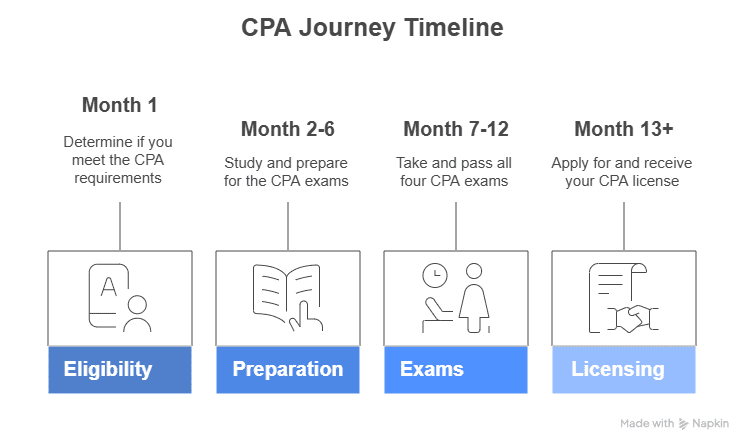
Here’s the truth: the CPA journey can be completed in 12 to 18 months for most motivated candidates – yes, you can go from working in Indian finance to holding a globally recognised qualification within a year to a year and a half. But “12 to 18 months” only scratches the surface. What it doesn’t capture is the preparation time, the exam windows, the eligibility steps, the state board filings and the strategy involved.
In this guide, we’ll walk you through every part of that timeline: what the CPA course duration really means in India, how you should plan your months and milestones, how the exam structure is designed, and how you can integrate the process with your current job or studies. At Imarticus Learning, we’ve helped countless candidates accelerate this path – we’re here to help you too.
So let’s unpack your roadmap to global accounting recognition – starting now.
The Certified Public Accountant, or CPA, isn’t just another accounting credential you add to your resume – it’s a genuine passport to the world of global finance. Recognised not only in the US but across more than 130 countries, the CPA opens up doors to exciting international roles, leadership positions, and a level of professional trust that really makes employers notice you.
But what exactly does the CPA course prepare you for? Well, it’s designed for people who want to go beyond just crunching numbers. It helps you build the skills to interpret complex financial data, analyse reports, and lead in areas like auditing, taxation, and strategic financial management – all the critical elements businesses rely on to grow and stay compliant.
Put simply, being a CPA means you’re not just someone who deals with accounts. You’re a trusted financial advisor whom companies look to for ethical judgment, clear insights, and expertise that spans across borders.
The course itself is governed by the American Institute of Certified Public Accountants (AICPA), and to earn the CPA title, you’ll need to tick three important boxes: meet educational and eligibility requirements, pass four challenging exam sections, and complete experience requirements set by a U.S. state board.
For Indian students and working professionals, this means gaining a qualification that’s respected worldwide, especially by multinational corporations, the Big 4 firms, and top consulting companies.
And here’s the best part – you can get your CPA certification in as little as 12 to 18 months. That’s a lot faster than many other international finance qualifications. No wonder more and more finance grads and professionals in India are choosing CPA as their fast-track ticket to exciting, global finance careers.
Did you know? The US CPA course duration is one of the shortest among global accounting qualifications, making it an ideal next step for ambitious finance professionals.
Why Pursue the CPA in 2025?
The world of finance isn’t what it used to be. Technology is transforming how things get done – automation is taking over routine accounting tasks, and companies are spreading their wings far beyond borders. In this fast-changing landscape, financial leaders aren’t just number crunchers anymore; they’re expected to think big, strategise, and guide businesses through complexity.
That’s exactly why 2025 feels like the perfect moment to consider the CPA course.
Because the CPA is more than just a certificate. It’s a signal to employers that you’ve got the smarts, the ethics, and the sharp analytical skills to tackle the toughest global finance challenges.
As Indian companies and multinationals race to find talent who know both local rules and international standards, CPA professionals are stepping into the spotlight – taking on roles where they’re not just needed, but actively sought after.
Already a CPA and wondering what’s next? Watch this video to learn how to chart your path from CPA to CFO – mastering the leadership, strategy, and executive skills that define top finance leaders.
What Makes the CPA Unique in 2025?
First off, global recognition. The CPA isn’t just respected in the US – it’s accepted across Canada, Australia, the Middle East, and much of Asia too. In other words, it gives you the freedom to move and work almost anywhere on the planet.
Then there’s the career boost. CPAs are among the top picks for roles in auditing, financial analysis, consulting, taxation, and leadership. Whether it’s with the Big 4 accounting giants or Fortune 500 companies, a CPA credential puts you right in the running.
Now, let’s talk about money. CPA professionals typically earn 30-40% more than their non-certified peers, and it’s easy to see why. In roles like Finance Controller, Audit Manager, or those on the fast track to becoming CFOs, their expertise and global credibility make all the difference.
How about time? Unlike other international accounting courses that can drag on for 3 to 4 years, you can finish your CPA in just 12 to 18 months. That makes it one of the fastest and smartest routes to a globally respected qualification.
And don’t forget job security. With constantly evolving regulations and the rising focus on ESG and cross-border taxation, companies are eager to hire professionals who really know their stuff – like CPAs with US GAAP and IFRS expertise.
Simply put, the CPA is your ticket to moving beyond just balancing the books. It puts you in a position to influence the business, make strategic decisions, and lead with confidence.
Wondering how long it really takes to complete the CPA course in India? On average, most candidates wrap it up in about 12 to 18 months, depending on their pace, work commitments, and study strategy.
CPA Course Duration – A Realistic Breakdown
Let’s be real – one of the very first questions on every CPA aspirant’s mind is, “How long is this going to take?” After all, it’s a big commitment, and you want to plan your life accordingly.
The answer? For most people, it takes somewhere between 12 to 18 months to go from being an accounting graduate in India to holding that globally recognised CPA credential. That’s right – in about a year, you could be certified and ready to take on the world.
But here’s the real thing – the timeline can look different for everyone. It’s not just about passing the exams; there’s a whole process behind the scenes. You have to tick off eligibility checks, meet licensing requirements, and balance studying with life and work.
But the timeline can look a little different for everyone. Let’s unpack what really goes into it.
How Long Does It Take to Become a CPA
Completing the CPA isn’t just about passing exams – it’s about ticking every box, from eligibility to licensing. This breakdown gives a practical overview of the CPA course duration in months, helping you plan your preparation realistically.
Stage
Duration
What Happens Here
Eligibility Evaluation
1-2 months
Your academic transcripts are verified, and your state board is selected.
Exam Preparation
6-9 months
You study for all four sections – one at a time or back-to-back, depending on your schedule.
Exam Completion
3-6 months
You appear for each of the four CPA exams.
Result & Licensing
1-2 months
Results, work-experience validation, and the final licensing step.
If you’re planning your CPA course timeline in India, most candidates finish all four sections within 6 to 18 months – depending on work schedules and study pace.
Interesting Fact – Many learners complete the entire process in under a year with structured study plans and mentorship, proof that efficiency is all about the right guidance.
CPA Exam Duration: The Hours That Matter
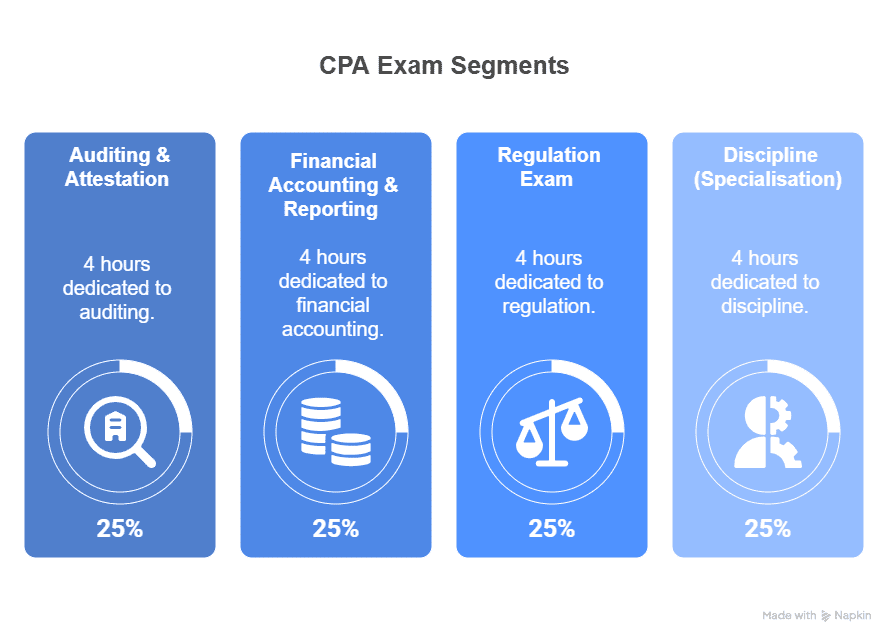
Each CPA exam section runs for 4 hours, covering the four core pillars of global accounting.
Section
Type
Duration
What You’ll Learn
Auditing & Attestation (AUD)
Core
4 hours
Learn auditing standards, internal controls, ethics, and professional responsibilities – the backbone of every CPA’s credibility.
Financial Accounting & Reporting (FAR)
Core
4 hours
Master U.S. GAAP, financial statements, and reporting frameworks that form the foundation of global accounting practices.
Regulation (REG)
Core
4 hours
Build a solid understanding of U.S. taxation, business law, and professional ethics – essential for compliance and advisory roles.
Discipline Section (BAR / ISC / TCP)
Specialisation
4 hours
Choose your area of expertise – Business Analysis & Reporting (BAR), Information Systems & Controls (ISC), or Tax Compliance & Planning (TCP) – introduced in 2025 to reflect evolving industry needs.
Total exam time: 16 hours – but it’s the preparation that counts.
You can find a detailed breakdown of each exam module in the ‘Uniform CPA Examination Blueprints’ published and approved by the AICPA Board of Examiners.
The good news?
There’s no fixed exam window anymore, so you can schedule each test when you’re ready – no waiting around for months.
CPA Study Duration: How Much Time You’ll Need
Your study timeline depends entirely on your lifestyle. A full-time student might breeze through faster than a working professional juggling deadlines and weekend study sessions.
Study Style
Weekly Hours
Typical Duration
Full-time focus
25-30 hrs/week
8-10 months
Working professional
12-15 hrs/week
10-12 months
Weekend learners
8-10 hrs/week
12-14 months
Depending on your pace, you can wrap up all four sections in 6 to 12 months – that’s the typical CPA course duration in months for most candidates aiming to complete their exams efficiently.
Looking for trusted study materials? Explore our curated list of must-read CPA books to enhance your exam preparation.
If you are wondering whether you can pursue a CPA while working? The answer is absolutely yes. In fact, many professionals do.
Since exams are offered throughout the year, you can easily pace your preparation alongside your job. With the right strategy and guidance, most working professionals complete their CPA within 12-18 months, balancing learning with experience.
Fact: For working professionals, the CPA course duration typically extends to 14-18 months with part-time study.
Career Transformation Through CPA
If you’ve ever wondered how a professional qualification can truly change the course of your life, the CPA journey offers some inspiring examples across different backgrounds.
BCom Graduate Pathway
If you are fresh out of a commerce degree, wide-eyed and eager to make your mark, the path ahead can feel vast and a bit overwhelming. You hear about the CPA – a global credential that could turn local dreams into worldwide opportunities. With a little guidance, you can dive into the eligibility process, sorting through transcripts and choosing a state board.
The initial months usually go between preparation and paperwork, but steady effort pays off.
By dedicating just 12-15 hours a week, you can confidently tackle each CPA exam section – one step at a time.
And before you know it, within a year, that distant goal will become your reality: you’ll be a globally certified accountant, ready to take on roles at Big 4 firms or leading multinational companies.
The CPA isn’t just a qualification – it’s proof of your dedication, resilience, and the journey you took to get there.
CA Pathway
Now picture yourself as a mid-career professional, already qualified as a CA, with years clocked in Indian finance firms but craving that global edge. The eligibility check is a breeze – your background aligns perfectly. Juggling a demanding job, you carve out time over weekends and evenings, pacing your study smartly.
With a mentor’s encouragement and a clear plan, you clear the exams section by section over the next 10 months.
When that CPA license lands in your hands around month 14, it unlocks new doors – international assignments, cross-border taxation roles, and leadership tracks.
The CPA becomes the smart boost that complements your existing expertise and propels you onto the global stage.
Working Professional Pathway
Imagine a working professional, managing a full-time job and family commitments, who wonders if a CPA is even possible. With determination, they craft a part-time study schedule stretching across 15 months. Progress is steady – no rush, no burnout. They lean on structured courses and mentorship, celebrating small wins with each passed section.
In the end, this balance between persistence and planning pays off.
The CPA credential boosts their profile at work, leading to promotions and new responsibilities.
The journey proves that even with a busy life, ambition backed by a smart strategy can transform careers.
Before you plan your study calendar or look into the CPA course duration, it’s crucial to check your CPA course eligibility.
Thinking about becoming a US CPA? Watch this video to explore real US CPA salary insights and top career roles across India and abroad, and see why it’s one of the most rewarding finance qualifications worldwide.
CPA Eligibility Criteria – Who Can Apply?
Before you plan your study calendar or look into the CPA course duration, there’s one important question to answer: Are you eligible for the CPA exam? Here’s your guide to CPA eligibility.
The Certified Public Accountant (CPA) credential is regulated by the U.S. state boards, each with its own eligibility requirements. While that may sound complicated, it really comes down to one thing – having the right educational background in accounting and business.
If you’re based in India, here’s how it works:
BCom + MCom holders meet the 150-credit rule.
CA, CMA, or CS professionals are also eligible in most states.
BCom graduates may need to complete a postgraduate program or additional coursework.
Each US state board has its own criteria, so the team at Imarticus Learning helps you choose the one that best fits your academic profile. That way, you can focus on studying – not on paperwork.
Want to see the CPA journey in action? Watch this short video where our mentors walk through the realistic steps you’ll take in becoming a CPA.
How Imarticus Learning Helps You Ace It
At Imarticus Learning, we don’t just help you prepare for the CPA exam; we help you build a career. Our CPA program, powered by Becker, is designed to fit around your schedule and goals, whether you’re a working professional or a student aiming to fast-track your success.
You get end-to-end mentorship from eligibility evaluation to license guidance, and globally trusted and exam-aligned materials. So while the CPA course might seem challenging, with the right mentorship and structure, you’re never doing it alone.
We’ve designed our CPA program around the latest 2025 syllabus and structure. You’ll get:
Expert-led sessions that simplify even the toughest US GAAP and tax concepts.
Real-time simulations and mock tests to track your readiness.
A clear, personalised study plan aligned with your CPA course duration goals.
Because the CPA isn’t just another certification – it’s your stepping stone to becoming a trusted finance leader, equipped to make a global impact.
Ready to start your CPA journey? Explore the Imarticus Learning CPA program powered by Becker – structured to fit your schedule and designed for real results.
Still debating between CPA and CA? Watch this quick breakdown to discover which qualification can accelerate your rise to global finance leadership faster.
Why Should You Choose CPA Over Other Courses?
If you’re looking for a globally recognised, fast-paced qualification that delivers real returns, the CPA course stands out as a smart investment in both time and money. This table gives a short overview of how CPA is better than other finance certifications.
Course
Global Reach
Fast Duration
High Salary (India)
CPA (USA)
✔️
✔️
✔️
CA (India)
❌
❌
❌
CMA (USA)
✔️
✔️
✔️
ACCA (UK)
✔️
❌
❌
When it comes to CPA duration in India, most learners complete the course in about a year, making it one of the fastest pathways to becoming a globally recognised accounting professional.
Key Takeaway– When you compare the CPA course duration and fees to other global programs like CMA or ACCA, CPA offers faster ROI.
Planning to build your finance career in Canada? Watch this video to uncover whether CPA US or CMA US is the smarter route for your global goals, career growth, and salary potential.
FAQs About CPA Course Duration
You’ve now got a clear picture of how the CPA course works – from eligibility and structure to fees and scope. But if you still have some questions in your mind. Here are a few frequently asked questions about CPA Course Duration.
How long does it take to complete the CPA Course?
On average, for Indian aspirants, the CPA course duration ranges between 12 to 24 months, depending on your background, preparation strategy. And study pace. Many candidates finish all four exam sections within a year when following a consistent preparation schedule.
Is CPA harder than CA?
Not necessarily. The CPA course is different, not harder. CA focuses deeply on Indian accounting and taxation, while CPA tests your understanding of U.S. GAAP and global accounting principles. The CA exam has three levels after 12th grade and 2 levels if you start after graduation. Whereas CPA has no levels and just four sections, which makes the passing rates quite higher compared to CA. With structured preparation and the right study plan, most candidates find the CPA exam more straightforward and quicker to complete.
Can I complete CPA in 1 year?
Yes, if you stay consistent, plan smartly, and focus on one section at a time, you can easily complete the CPA course in 12 months or even less. Many working professionals do it while managing full-time jobs with guided mentorship.
Can I pass the CPA in 3 months?
Yes, it’s ambitious and challenging, but not impossible. If you can dedicate full-time hours to preparation, you could complete one or even two sections within 3 months. However, finishing all four in that time requires an intensive study plan and complete focus.
How many attempts are required to pass the CPA?
With the right strategy and coaching, most candidates clear each section in one attempt. The CPA exam allows multiple retakes, but consistent practice, mock tests, and time management can go a long way in ensuring you pass on the first attempt.
Take the Smartest Route to a Global Accounting Career
At its core, the CPA course isn’t just a certification – it’s a career catalyst. In a world where finance professionals are expected to go beyond spreadsheets and actually drive strategy, becoming a CPA gives you that global edge. It tells employers you understand not just accounting principles, but the business impact behind every number.
And the best part? The CPA course duration makes it one of the most time-efficient ways to earn a globally respected credential. In as little as 12-18 months, you can move from being a local finance graduate to a global accounting professional – trusted by Big 4 firms, multinational corporations, and financial consultancies worldwide.
If you’ve been waiting for a sign to take your accounting career global – this is it.
The CPA certification is your pathway to international opportunities, faster promotions, and the kind of professional credibility that makes people listen when you speak.
Imagine a workplace where employees feel valued, engaged, and motivated. A place where collaboration thrives and innovation flourishes. This isn’t just a utopian dream; it’s the reality of companies with a strong, positive work culture. And guess who plays a key role in creating this kind of environment? Human resources (HR)!
HR goes far beyond just hiring and firing. They’re the architects of company culture, the champions of employee well-being, and the driving force behind initiatives that foster a positive and productive work environment.
In this blog post, we’ll explore the many ways HR contributes to building a workplace that people love. We’ll delve into specific strategies, highlight real-world examples, and provide tips for HR professionals and business leaders alike. So, buckle up and get ready to discover the magic of HR in action!
Overview of HR Management
Let’s start with the basics. Human Resources, or HR, is like the hero of yourWorkforce Management. These are the folks who handle everything from hiring to firing, benefits to bloopers, and everything in between. In a nutshell, they’re the guardians of the employee experience. They’re not just paper pushers; they’re the architects of your work environment.
Importance of Positive Work Culture:
Now, why does this whole “positive work culture” thing matter? Well, imagine spending a third of your day in a place that feels like a black hole of negativity. Not so appealing, right? That’s where HR swoops in, capes and all. A positive work culture is the secret that turns your job into a fulfilling adventure rather than a tedious chore.
The Core Movements of HR:
Recruitment: Finding the right notes. HR searches for skilled talents, attracting top ones through strategic sourcing and meticulous selection processes.
Onboarding: Harmonizing the new arrivals. HR welcomes new hires with warmth, ensuring they understand their parts and seamlessly blend into the ensemble.
Training and Development: Elevating the performance. HR provides the instruments of knowledge and skills, empowering employees to refine their craft and reach their highest potential.
Compensation and Benefits: HR ensures fair compensation that resonates with employees’ contributions while enriching their lives with valuable benefits packages.
Employee Relations: Maintaining the rhythm. HR fosters a positive and collaborative work environment, mediating conflicts and ensuring harmony in the workplace.
What is the role of HR in workplace culture?
HR is like the puppet master behind the scenes, pulling the strings that shape the culture of your workplace. From hiring people who vibe with the company values to ensuring fair play in the office, they are the maestros conducting the symphony of work life. Think of HR as the guardian ensuring that your office isn’t just a place to clock in and out but a community where everyone thrives.
Advantages of a Positive Work Culture
A positive organizational culture isn’t just fluff; it’s the real deal. Picture this: increased productivity, happy faces, and a sense of belonging that makes you excited to tackle Monday mornings. HR also plays a pivotal role in creating an environment where collaboration trumps competition and where everyone feels heard and appreciated. Happy employees are like superheroes – they save the day with enthusiasm and commitment.
How to Build a Positive Work Culture?
Now, here comes the fun part. How do you turn your workplace into a positive culture?
Here are a fewStrategies for HR Professionals to Build a Sustainable Company Culture:
Communication is Key
HR ensures that communication flows freely. Be it through team meetings, newsletters, or the occasional virtual happy hour, keeping everyone in the loop builds trust and camaraderie.
Recognition and Rewards
HR champions recognition programs. Who doesn’t love a pat on the back for a job well done? Regular acknowledgment boosts morale and fosters a culture of appreciation.
Flexible Work Arrangements
HR understands the need for work-life balance. Offering flexible schedules or remote work options shows that your workplace values its employees as humans, not just cogs in the corporate machine.
Professional Development
HR encourages continuous learning. Workplaces that invest in the growth of their employees create a culture of empowerment where everyone feels they have the tools to succeed.
Inclusivity and Diversity
HR ensures that the workplace is a melting pot of diverse talents and perspectives. Embracing differences leads to innovation and a richer, more vibrant work environment.
HR Trends 2024: A Human-Centric Approach to Work Culture
Forget about rigid hierarchies and one-size-fits-all policies. 2024 is the year HR steps out of the back office and onto center stage, adopting a human-centric approach that places employee well-being and individual needs at the core of work culture.
Here are the trends that will define this transformation:
From Compliance to Culture: HR ditches the rulebook and becomes a facilitator of purposeful work experiences. Expect to see a shift towards employee-driven culture building, open communication channels, and personalized development plans.
Redefining Talent Acquisition: Attracting and retaining top talent requires more than just attractive packages. Companies will prioritize diversity, equity, and inclusion (DE&I) initiatives, focusing on building a welcoming environment for all.
Technology with a Human Touch: AI and automation won’t replace human connection. Instead, HR will leverage technology to streamline processes, freeing up time for personalized interaction and meaningful employee engagement.
Prioritizing Mental Wellness: The days of ignoring burnout are over. HR will champion work-life balance and mental health initiatives, offering resources like stress management programs and flexible work arrangements.
Learning Never Stops: 2024 is all about continuous learning and development. HR will offer personalized training programs that cater to individual needs and aspirations, preparing employees for the ever-evolving job market.
The Final Words
In a nutshell, HR is the secret ingredient in the recipe for a positive work culture. They don’t just manage people; they sculpt experiences. By fostering communication, recognition, flexibility, development, and diversity, HR builds a workplace where everyone wants to be.
Summary of Key Points:
HR shapes the workplace culture by orchestrating hiring practices, ensuring fairness, and fostering a sense of community.
A positive work culture increases productivity, employee happiness, and a sense of belonging, turning your workplace into a thriving community.
HR achieves this by promoting open communication, recognizing and rewarding achievements, offering flexible work arrangements, encouraging professional development, and embracing diversity and inclusivity.
The Imarticus Learning HR Management Program
Imarticus Learning offers IIM HR courses designed to equip participants with the necessary skills needed to navigate the complexities of human resources in today’s dynamic business environment. From job analysis to employee engagement, this program covers a spectrum of topics crucial for effective HR management.
Imarticus Learning’s program ensures hands-on training, providing students access to 3+ trending tools, 8+ case studies, and real-world projects. This isn’t your typical lecture; it’s a journey where theory meets practicality, preparing you for the real challenges of HR management.
Contact us now and pave the way to becoming an HR maestro. Immerse yourself in a program that not only educates but empowers, shaping you into a leader in the domain of human resources. Let’s build positive work cultures together.
In the ever-changing seas of the business world, being the captain of your ship requires more than just steering a steady course.
The 21st century has ushered in an era of constant disruption, where innovation is the wind that propels ships forward. In this dynamic landscape, the role of a CEO has evolved into that of a seasoned navigator, charting a course through uncharted waters.
This blog explores the significance of leadership development for CEOs in an era of industry transformation in this era of disruption, shedding light on why these educational endeavors are more crucial now than ever before.
Overview of the Evolving Business Landscape
Before we dive deep, let’s gaze upon the vast horizon of the business world. The terrain is shifting, and what once was familiar ground is now a turbulent sea. Rapid technological advancements, global interconnectedness, and shifting consumer behaviors have given rise to an environment where adaptability is the key to survival. Trending CEO programs are the helmsmen of their organizations, and understanding this evolving landscape is paramount.
The business is constantly evolving due to various factors.
Here are some key aspects:
Increasing Business Resilience: The COVID-19 pandemic has put pressure on businesses to increase their resilience. This involves embracing a new way of working that allows for more agile and flexible operations. Businesses are now required to identify and address vulnerabilities within their company proactively.
Emerging Markets: Emerging markets are changing where and how the world does business. These markets have been a source of low-cost but increasingly skilled labor.
Digital Influence: The rise of e-commerce and social media has significantly shifted consumer behavior. Businesses must also adapt to this changing landscape by enhancing their online presence and ensuring a seamless digital customer experience.
Globalization vs. Localization: The balance between globalization and localization is another factor shaping the business landscape. While globalization involves reaching out to a broader market, localization focuses on adapting products or services to meet the needs and preferences of a specific region.
Roles and Responsibilities of a CEO
Every captain needs a comprehensive map. CEOs, as the leaders of their organizations, are entrusted with the responsibility of not just steering the ship but also envisioning the course ahead. From setting strategic directions to fostering a culture of innovation, CEOs wear many hats.
As disruptions become the norm, the expectations from a CEO have transcended traditional boundaries. They are now not just leaders but also visionaries who can foresee the future and guide their teams through the storms.
Why is CEO Education Essential in Disruptive Times?
Disruption – a term tossed around in boardrooms and coffee shops alike. But what does it truly mean in the context of today’s business environment? Disruption isn’t just about the latest tech gadget; it’s about seismic shifts in the way industries operate.
Think of Uber revolutionizing transportation or Netflix transforming the entertainment landscape. A CEO without a deep understanding of disruption is like a sailor without a compass in a storm – directionless.
How Does CEO Training Prepare Leaders for Business Disruptions?
As the waves of disruption crash against traditional business models, the role of a CEO is undergoing a metamorphosis. No longer confined to boardroom strategies, CEOs must now be agile decision-makers, adept at pivoting when necessary.
The ability to lead in uncertainty, inspire innovation, and navigate the complexities of a globalized world is the new normal. A CEO course acts as a compass, guiding leaders to navigate this uncharted territory effectively.
The Curriculum of CEO Courses
What does it take to groom a CEO for these tumultuous times? The curriculum of CEO courses is designed to equip leaders with a diversified skill set. From strategic management and financial acumen to emotional intelligence and crisis leadership, these courses are a holistic toolkit. They delve into case studies of successful navigations through disruptions, providing valuable insights that can only be gleaned from textbooks.
Networking and Collaborative Learning
In the realm of leadership, learning doesn’t happen in isolation. CEO courses foster an environment of networking and collaborative learning. The opportunity to work together with peers from diverse industries not only broadens perspectives but also creates a network of support.
In a world where alliances can be the difference between sinking and sailing, these connections are priceless. The collaborative spirit cultivated in these courses mirrors the teamwork required to weather storms in the business world.
The Final Word
As we sail towards the conclusion, it’s evident that the role of a CEO is akin to captaining a ship through a perfect storm. The significance of CEO courses lies in their ability to transform leaders into navigators who not only weather disruptions but also harness them for growth. The evolving business landscape demands leaders who are not just captains but also visionaries, and these courses serve as the training ground for such individuals.
Summary of Key Points:
The business landscape is undergoing constant disruption, necessitating a shift in leadership paradigms.
The task of a chief executive officer in education in the age of disruption has evolved into that of a navigator, requiring a diverse skill set and adaptability.
CEO courses offer a comprehensive curriculum, addressing the multifaceted challenges of disruptive times.
Networking and collaborative learning are integral components of fostering a supportive community of leaders.
Imarticus Learning: Paving the Path to Forward-Thinking Leadership
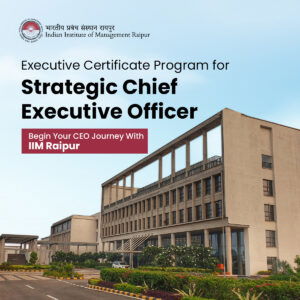
Embarking on a journey to comprehend the past often illuminates the way forward. Imarticus Learning presents the Executive Certificate Programme for Strategic Chief Executive Officers from IIM Raipur, a transformative initiative steering professionals towards advanced leadership capabilities.
This carefully crafted 12-month CEO course serves as a compass for those eager to enhance their leadership acumen, fostering strategic thinking, team building, change management, and instilling a growth mindset. In the intricate and ever-evolving landscape of today’s business world, this program equips you not only to lead but to lead with integrity and purpose.
Our program, meticulously curated, navigates through a comprehensive curriculum encompassing cutting-edge business, leadership, and strategy modules. Delving into experiential learning empowers CEOs with the indispensable skills needed to lead effectively amidst the challenges of tumultuous business environments. The roadmap to success begins with understanding the intricacies of strategic leadership, honing the ability to build high-performing teams, and mastering the art of navigating change with a growth-oriented mindset.
Participants in our program have the unique opportunity to engage with chief industry and academic experts. These luminaries, including the esteemed Director of IIM Raipur and other seasoned faculty members, bring forth decades of experience distilled into compelling strategies and frameworks.
This wealth of knowledge is not merely theoretical but is primed for practical implementation in your workplace. Imarticus Learning bridges the gap between academic insights and real-world application, ensuring that learners gain a profound understanding of the intricacies of strategic leadership.
Enroll today, and let the transformative learning experience reshape your leadership trajectory. Imarticus Learning – forging leaders who not only navigate change but lead with wisdom and foresight.
In the dynamic landscape of finance, the role of Chief Financial Officer (CFO) has evolved significantly. Today’s CFOs are not just numbers people; they are strategic leaders navigating businesses through complexities and aspiring to reach the pinnacle of financial leadership.
A CFO designation might be the goal, but getting there requires more than just ambition—it demands the right set of skills and credentials.
In this blog post, we’ll explore how obtaining the right CFO certification can be your game-changer in ascending to the coveted CFO designation and provide tips on how to become a CFO with the right qualifications.
Before delving into the certification journey, let’s understand the landscape a modern CFO navigates. Gone are the days when CFOs were confined to financial reporting and compliance. Today, they are strategic partners, decision-makers, and communicators. From risk management to fostering innovation, a new-age CFO wears multiple hats.
Why pursue a CFO certification?:
Elevating Your Skillset:
Finance training isn’t just a piece of paper; it’s a testament to your advanced financial knowledge and skills. It provides a comprehensive understanding of financial strategies, risk management, and business leadership, equipping you with the tools necessary to excel in the multifaceted role of a CFO.
Global Recognition:
In a world where businesses transcend borders, a globally recognized CFO certification amplifies your credentials. It serves as a common language in the international business arena, opening doors to global opportunities and partnerships.
Benefits of a CFO Certification:
Imagine you’re a seasoned finance professional, and you’ve just spotted a shiny object in the distance. It’s the coveted CFO Certification, gleaming with promise and potential. But why should you embark on this journey to acquire it?
The CFO Certification is a globally recognized credential, signaling to employers that you possess the skills and knowledge to navigate the complex labyrinth of corporate finance.
The certification guides you through the ever-evolving landscape of financial regulations, risk management, and strategic planning. It equips you with the latest techniques, ensuring you stay ahead of the curve in this dynamic field.
Certified CFOs often command a premium in the job market, reflecting the value they bring to an organization. Lastly, the journey towards obtaining top finance credentials is a transformative one. It’s like climbing a mountain – challenging, yes, but the view from the top is worth it.
How a CFO Certification Sets You Apart?
CFOs are crucial players in strategic decision-making. A certification arms you with the analytical skills and strategic mindset required to contribute meaningfully to the growth and success of your organization.
The corporate landscape is fiercely competitive. A CFO certification sets you apart from the crowd, demonstrating your commitment to continuous learning and professional development. Employers seek candidates who invest in their expertise, making a certified CFO a sought-after asset.
Embarking on the certification journey introduces you to a network of like-minded professionals, experts, and mentors. This network isn’t just a resource; it’s a support system that can guide you through challenges, share insights, and open doors to career-enhancing opportunities.
The business landscape is ever-evolving, and a CFO needs to be adaptable. Certification ensures you stay ahead of industry trends, technological advancements, and regulatory changes, making you a reliable leader in times of uncertainty.
Here’s how a CFO Certification can make you stand out in the finance world:
The Golden Key: A CFO Certification is like a golden key that unlocks the door to the C-suite. It’s a clear signal to employers that you’re equipped with the skills and knowledge to take on top-tier finance roles.
The Cutting Edge: In the fast-paced world of finance, staying ahead is crucial. A CFO Certification ensures you’re up-to-date with the latest tools and techniques in the industry.
The Value Proposition: With a CFO Certification, you become a high-value asset to any organization. Certified CFOs often command higher salaries, reflecting the significant value they bring to the table.
The Global Network: The journey towards obtaining a CFO Certification connects you with a global community of finance professionals. This network can be a goldmine for insights, advice, and opportunities.
The Leadership Ladder: The CFO Certification isn’t just about technical skills. It also hones your leadership abilities and strategic thinking, setting you apart as a finance leader.
Choosing the Right CFO Certification
Not all certifications are created equal. Choose one that aligns with your career goals and covers a broad spectrum of financial disciplines. Look for programs that integrate real-world case studies and practical applications, providing you with hands-on experience.
Opt for a certification that holds weight in your industry. Research the credibility and reputation of the certifying body, ensuring that your efforts translate into tangible career advancements.
The Final Words:
The journey toward attaining a Chief Financial Officer (CFO) designation is a transformative one, and obtaining the right CFO certification serves as a pivotal milestone in this pursuit. The dynamic landscape of finance demands modern CFOs to be more than just number-crunchers, evolving into strategic leaders navigating complexities in today’s business world.
Finance training is not merely a credential; it signifies an advanced skill set encompassing financial strategies, risk management, and business leadership. It acts as a global language, providing recognition in the international business arena and opening doors to global opportunities.
Summary of Key Points:
The modern CFO is a strategic leader involved in decision-making and innovation, transcending traditional financial reporting responsibilities.
Elevating Your Skillset: CFO certification is a testament to advanced financial knowledge and skills, equipping individuals for the multifaceted role of a CFO.
Global Recognition: A globally recognized CFO course enhances credentials, fostering international opportunities and partnership
Continuous Learning: Guides professionals through evolving financial landscapes, ensuring they stay ahead with the latest tools and techniques.
Transformative Journey: The certification process enhances technical skills, leadership abilities, and strategic thinking.
Imarticus Learning and the Chief Financial Officer Programme: Elevating Financial Leadership
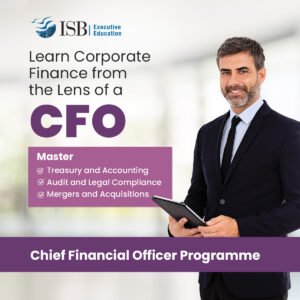
Embarking on the Chief Financial Officer Programme by the Indian School of Business (ISB) through Imarticus Learning is your ideal route to enhance financial leadership skills. This comprehensive 8-month program is designed to elevate your thinking, cultivate effective team leadership, and empower you to drive growth strategically.
In navigating today’s intricate and dynamic business landscape, the program also instills values of integrity and purpose in your leadership approach. Through immersive experiential learning, CFOs are equipped with the essential skills required to lead effectively in this era of revolution. This makes it an ideal choice for those aiming for a smooth transition into the C-suite.
Imarticus Learning, in collaboration with ISB, ensures that participants gain unparalleled expertise from the distinguished faculty. ISB stands at the forefront of academic research in the country, with faculty actively recognized by government and regulatory bodies for their role in policymaking. The industry values and seeks ISB faculty for their innovative insights, expediting change management in organizations.
Are you ready to redefine your financial leadership journey?
Join the Chief Financial Officer Programme with Imarticus Learning and ISB Executive Education. Advance your skills, network with industry leaders, and be at the forefront of financial innovation. Enroll now to shape your future in the world of finance.
Welcome to a riveting exploration of how finance courses can be the catalyst for your career metamorphosis. In the landscape of professional growth, the pulsating heartbeat of success often resonates in the corridors of knowledge. Imagine unlocking the doors to career advancement through a key that not only opens opportunities but transforms your entire trajectory.
In the realm of finance, where numbers dance to the rhythm of strategy, the influence of specialized courses becomes the compass guiding you through the labyrinth of possibilities.
Get ready to break free from the conventional and embrace a world where the language of money becomes your fluency, and the path to career excellence unfolds before your very eyes. The influence of finance courses on your career advancement is not just an investment in knowledge; it’s an investment in your future self, armed with the tools to conquer the professional frontier.
Why choose finance courses for career development?
Before we embark on this journey, let’s paint a vivid picture of the finance industry. It’s more than just balance sheets and stock markets; it’s a complex ecosystem of interconnected elements, from banking and investments to risk management and financial analysis.
In 2024, the tech whirlwind, featuring the rise of generative AI, a shift to the cloud, escalating fraud and cyber threats, and the blending of industry boundaries like the embedded finance wave, will demand financial leaders to be more agile than ever. Crafting innovative strategies becomes paramount, guiding firms to sail with the prevailing winds, no matter their origin.
Those who opt to invest in this unfolding future, becoming catalysts for new and transformative products and services, could establish a lasting competitive edge. Understanding this landscape is crucial for anyone aspiring to make a mark in the finance world.
Significance of Skill Enhancement
Why invest your time and effort in financial classes? The answer lies in skill enhancement. CFO certifications are not just about acquiring knowledge; they’re about developing the practical skills required in the industry.
Whether it’s mastering financial modeling, understanding risk management strategies, or navigating the nuances of investment analysis, these courses equip you with the important tools needed to thrive.
How finance courses can boost career opportunities?
Throughout history, the financial training benefits have often been a driver of progress, aiding organizations and individuals in navigating economic and societal shifts. As the decade concludes, leaders in the financial services industry might reflect on 2024 as the year when the future truly started unfolding.
Industry-Relevant Expertise:
Finance courses go beyond textbook theories; they provide you with hands-on experience and industry-relevant expertise. Imagine being able to dissect financial statements with the precision of a seasoned analyst or creating robust financial models that stand up to real-world scrutiny. These are the skills that set you apart in a competitive field.
Network Building:
In the world of finance, who you know can be just as important as what you know. Finance courses offer a unique opportunity to build a network of like-minded professionals, mentors, and industry experts. Networking opens doors to new possibilities, from job opportunities to valuable insights that can shape your career.
Real-world Application:
Theories are the building blocks, but the real magic happens when you apply them to real-world situations. Finance courses bridge the gap between theory and practice, allowing you to test your knowledge in scenarios mirroring those encountered in the industry. This hands-on approach not only solidifies your understanding but boosts your confidence in tackling complex financial challenges.
Salary Growth Potential:
Let’s talk about the elephant in the room – financial rewards. Finance courses are not just an investment in knowledge; they’re an investment in your earning potential. The finance industry rewards expertise and a specialized finance education can significantly impact your salary growth trajectory.
Global Perspective:
Finance is a global language, and understanding its nuances on a global scale is invaluable. Finance courses often include modules that provide a broad perspective on international markets, regulations, and economic trends. This global mindset is a key asset in an interconnected world.
Strategic Decision-Making:
In the finance world, every decision is strategic. Finance courses teach you not just to analyze data but to transform it into actionable insights. Strategic decision-making is a hallmark of successful finance professionals, and it’s a skill that can elevate you to leadership roles.
The Final Words:
The influence of finance courses on your career advancement is profound. From industry-specific expertise and networking opportunities to real-world application and global perspectives, the benefits are multifold. Choose the latest trends in financial education and careers that propel you toward a fulfilling career in finance.
Summary Of The Key Benefits:
Explores the multifaceted nature of the finance industry beyond balance sheets and stock markets
Acknowledges the dynamic challenges of 2024, such as tech advancements, AI, cloud computing, fraud, and industry convergence
Positions the year 2024 as a potential turning point for the finance industry.
Encourages individuals to invest in finance education as a means of staying agile and innovative.
Emphasizes that CFO certifications go beyond theoretical knowledge to develop practical industry skills.
Highlights the importance of mastering financial modeling, risk management, and investment analysis.
Stresses the importance of industry-relevant expertise gained through finance courses.
Advocates for networking as a critical aspect of success in finance, connecting professionals, mentors, and industry experts.
Imarticus Learning’s CFO Programme at the Indian School of Business
Embark on an extraordinary journey with Imarticus Learning through the CFO certification at the esteemed Indian School of Business, a transformative path designed to elevate your financial leadership prowess. This comprehensive 8-month program not only hones your strategic acumen but also cultivates the art of prudent decision-making, team sculpting for high performance, and effective leadership for sustainable growth.
In the intricate and ever-evolving landscape of modern business, you’ll also acquire the skills to lead with unwavering integrity and purpose. This meticulously crafted curriculum strategically navigates the latest trends in business, leadership, and strategy. Immerse yourself in experiential learning to equip CFOs with the indispensable skills required to lead in this era of revolutionary change.
At the forefront of academic research, the Indian School of Business boasts a faculty actively recognized by government and regulatory bodies for shaping policies. Industry leaders actively seek ISB faculty for their innovative perspectives, expediting change management.
Immerse yourself in the pinnacle of financial leadership with ISB Executive Education’s flagship CFO Course. This transformative experience attracts experts from diverse domains, sectors, and geographies. Forge invaluable connections with like-minded CXOs and industry leaders, building not just a professional network but enhancing your social net worth.
Ready to elevate your financial leadership journey? Connect with us to embark on this transformative experience. Your next level of success awaits!
Organisations are being driven to reconsider their operations and embrace sustainable practices as global concerns such as the environment, social inequities, and diminishing resources become more prominent. Sustainability, formerly derided as an organisational cliche, has evolved into a vital component of business strategy, suggesting a growing recognition that long-term success is intrinsically linked to ethical and sustainable behaviours.
From the perspective of an accountant, especially one with the prestigious ACCA certification, the context of business sustainability took on a distinct character. ACCA-certified accounting professionals, who are usually linked to financial management and complying with regulations, are now at the cutting edge of a changing perspective that includes social, economic, and environmental concerns in addition to profit ratio. This transition needs a thorough grasp of the intricate connection between financial information and sustainable accounting practices, which ACCA experts are well-suited to provide.
As we proceed to explore sustainable accounting practices, it becomes increasingly clear that the ACCA certification represents not only financial expertise but also a dedication to sustainable and ethical company conduct.
Key Components of Business Sustainability
Enterprise sustainability is built on three foundations: sustainability in the economy, society, and the environment. Sustainable growth comprises measuring and revealing an organisation’s ecological impact, evaluating the cost of environmental activities, and incorporating environmentally friendly strategies into financial reporting. The topic of social sustainability is concerned with stakeholder participation, happiness for staff diversity, and societal impact evaluation and monitoring.
Environmental Sustainability
Environmental sustainability involves publicising a company’s influence on the surroundings. ACCA-certified accountants serve an important role in developing and executing measurement standards. Notably, measurement that is precise is the basis of informed choices and focused development.
ACCA experts assist in business sustainability by including the expenses related to environmental efforts in reporting on finances. This includes the costs associated with adopting environmentally friendly technologies, executing waste reduction measures, and adhering to environmental standards. Accurate cost reporting enables organisations to assess their return on spending on sustainability initiatives.
ACCA-certified accountants help to seamlessly integrate environmentally friendly procedures into reporting on finances. This includes not only reporting the environmental costs but also emphasising the financial benefits of sustainable activities. Financial reports have evolved into thorough papers that reflect the company’s whole value, considering both environmental responsibility and standard economic success.
Social Sustainability
Social sustainability is dependent on successful stakeholder involvement, which accountants, particularly individuals with ACCA certification, constantly pursue. This entails recognising and connecting with stakeholders in order to clarify their demands and challenges. Accountants play an important role in disclosing these obligations, indicating their dedication to accountability and openness.
ACCA-certified accountants help organisations ensure social sustainability by including staff welfare and diversity criteria in accounting structures. This involves monitoring employee satisfaction, wellness and security measures. Businesses that assess and report on these factors demonstrate their dedication to creating equitable and encouraging workplaces.
Economic Sustainability
ACCA-certified accountants specialise in designing and reporting financial achievement metrics that go beyond typical profitability measures. They include sustainability-related economic indicators like the expenditure of capital, profitability of sustainability expenditures, and comprehensive economic resilience. This integrated strategy ensures that financial stability is considered alongside environmental and social considerations.
Also, ACCA-certified accountancy helps to improve financial planning and budgeting procedures by using sustainable accounting practices. They collaborate with leadership to create environmentally friendly programmes, allocate resources effectively, and connect financial targets with long-term sustainability goals. This incorporation guarantees that sustainability is not a secondary factor but rather a critical component in comprehensive financial preparation.
Conclusion
In completing this discussion of business sustainability using the determining lens of an ACCA-certified accountant, it is clear that the combination of financial knowledge and sustainability is not only achievable but also necessary for the long-term achievement and endurance of enterprises in our ever-changing global environment.
The ACCA certificate, which represents a dedication to competence in accounting and finance, adds dimension to the sustainability topic. As organisations face the compelling need to tackle environmental, social, and financial concerns, ACCA-certified experts arise as valuable allies in managing this complicated area. Their expertise in financial leadership, along with a thorough awareness of sustainability measures and ethical company behaviour, positions them as agents of beneficial change.
Explore the Association of Chartered Certified Accountants, UK programme offered by Imarticus to learn more about how sustainability can be explored in the field of finance and unlock opportunities in the accounting sector.