




Request CallBack

Whatsapp Us



CFA Course - Chartered Financial Analyst®
The gold standard CFA certification for careers in investment management, financial analysis and portfolio management.




Mode of Learning
Online and Classroom CFA Classes

CFA Course Duration
6 Months Per Level | 3 Levels |

CFA Salary in India**
₹10 LPA - ₹45 LPA

Scope
2,00,000+ CFA Charterholders Worldwide — Global Career Reach


Imarticus Learning and KPMG in India collaborate to deliver an industry-led CFA certification program built on real-world case studies, curated resources, an internship, and a joint certification — bridging CFA course theory with practical investment management expertise.
Joint CFA Certification:
Showcase your expertise with a joint certification upon completing the CFA program, giving your CFA career a competitive edge.
CFA Study Materials:
Access the globally trusted CFA study materials — including CFA books, question banks and mock exams, designed specifically for CFA, US CMA, US CPA, FRM and ACCA aspirants.
Webinars and Live CFA Classes with KPMG in India:
Monthly webinars on investment management trends and industry insights. One-hour live practical case studies sessions by KPMG in India professionals — 12 sessions annually, exclusively for CFA course students.

Joint CFA Certification:
Showcase your expertise with a joint certification upon completing the CFA program, giving your CFA career a competitive edge.
CFA Study Materials:
Access the globally trusted CFA study materials — including CFA books, question banks and mock exams, designed specifically for CFA, US CMA, US CPA, FRM and ACCA aspirants.
Webinars and Live CFA Classes with KPMG in India:
Monthly webinars on investment management trends and industry insights. One-hour live practical case studies sessions by KPMG in India professionals — 12 sessions annually, exclusively for CFA course students.
Build Real-World Skills:
Solve 23 real-world case studies - directly aligned with the CFA curriculum across CFA Level 1, Level 2 and Level 3 topics — evaluated by KPMG in India practitioners.

Internship for top performer:
Stand out with a unique opportunity to intern at KPMG in India, gaining hands-on experience and exposure to global industry practices.
Eligibility:
Open to the top CFA course performer who excels in internal assessments and passes the CFA certification exam — a unique opportunity to work alongside KPMG in India professionals.

Your journey to becoming a global financial expert starts here.
Why Imarticus Is India's Best CFA Coaching Provider

Imarticus Learning ∞ KPMG in India
Industry-led CFA certification program featuring real-world investment management case studies, curated resources, and a joint certification with KPMG in India.

India’s First & Only
Imarticus Learning is India's First & Only Approved Prep Provider for the world's top 5 finance certifications — CFA, ACCA, US CPA, US CMA and FRM.

Money-Back Guarantee
When you enrol for the CFA course at Imarticus, your investment is protected — 100% pass guarantee, and if you fail any CFA exam we refund 50% of your CFA course fees.

CFA Study Materials from Kaplan Schweser
Access the best CFA study materials from Kaplan Schweser — the globally trusted content for CFA preparation. CFA books, study notes, question banks and mock exams across all 3 CFA levels, to prepare you fully for the CFA exam.

Dual Teacher Model
With a dual-teacher model, CFA charter faculty conduct live online CFA classes while a second teacher provides one-on-one support and guidance 24x7 — ensuring every student is exam-ready at every CFA level.

Pre-placement Bootcamp
After clearing CFA Level 1, Imarticus provides placement support including mentorship, resume building, mock interviews and real CFA job interview opportunities — helping you convert your CFA certification into your first finance role.
Get Started


Where Our CFA Alumni Work — Jobs After CFA Certification



















CFA Course Eligibility — Are You Eligible for the CFA?
CFA eligibility: Candidates in their final year of a bachelor's degree or holding a bachelor's degree from any discipline. Work experience in finance may substitute. CFA eligibility in India follows the same global criteria set by the CFA Institute.



Industry-aligned CFA preparation program in collaboration with KPMG in India

CFA Course Curriculum
The CFA course syllabus covers both foundational and advanced investment analysis and portfolio management skills across its three levels — CFA Level 1, Level 2 and Level 3
Before starting your CFA course preparation, laying a strong foundation is important. The CFA Institute offers prerequisite readings in quantitative methods, economics and financial statement analysis — core topics in the CFA Level 1 syllabus. This content is not directly tested in the CFA exam but is essential for grasping the core CFA curriculum.
These prerequisites are the building blocks to your CFA exam success — covering the same foundational topics tested across the CFA Level 1 course and beyond.
The CFA core module has 10 subjects. The weightage and depth of the CFA curriculum differ across CFA Level 1, Level 2 and Level 3 — click each level below to see the full CFA course syllabus per level.
In this CFA Level 1 topic, learners develop financial analysis skills to calculate returns, assess risk and make data-driven decisions for investment management — a core area of the CFA course syllabus.
Topics

Rates and Returns
Time Value of Money in Finance
Statistical Measures of Asset Returns
Probability Trees and Conditional Expectations
Portfolio Mathematics
Simulation Methods
Estimation and Inference
Hypothesis Testing
Parametric and Non-Parametric Tests of Independence
Simple Linear Regression
Introduction to Big Data Techniques
This CFA curriculum section covers fundamental supply and demand concepts, market structures, macroeconomic principles including aggregate output and income measurement, aggregate demand and supply analysis, and economic growth factors — concluding with business cycle analysis and its effect on investment decisions across the CFA course.
Topics
The Firm and Market Structures
Understanding Business Cycles
Fiscal Policy
Monetary Policy
Introduction to Geopolitics
International Trade
Capital Flows and the FX Market
Exchange Rate Calculations
In this CFA course topic, you learn the fundamentals of portfolio and risk management — including return and risk measurement, portfolio planning and construction, individual and institutional investor needs, and the capital asset pricing model for identifying optimal risk. Portfolio management is one of the most heavily weighted areas of the CFA certification.
Topics
Portfolio Risk and Return: Part I
Portfolio Risk and Return: Part II
Portfolio Management: An Overview
Basics of Portfolio Planning and Construction
The Behavioural Biases of Individuals
Introduction to Risk Management
This CFA curriculum topic covers corporate governance, investing and financing decisions, stakeholder management and the growing impact of environmental and social factors in finance. It also covers how companies manage leverage and working capital — essential knowledge for the CFA exam at Level 1 and Level 2.
Topics
Organizational Forms, Corporate Issuer Features, and Ownership
Investors and Other Stakeholders
Corporate Governance: Conflicts, Mechanisms, Risks, and Benefits
Working Capital and Liquidity
Capital Investments and Capital Allocation
Capital Structure
Business Models
This CFA Level 1 syllabus section provides a thorough explanation of financial reporting procedures, the standards governing disclosures, and how alternative accounting methods affect financial statements and their analysis — teaching students to examine primary statements using a structured CFA course framework.
Topics
Introduction to Financial Statement Analysis
Analyzing Income Statements
Analyzing Balance Sheets
Analyzing Statements of Cash Flows I
Analyzing Statements of Cash Flows II
Analysis of Inventories
Analysis of Long-Term Assets
Topics in Long-Term Liabilities and Equity
Analysis of Income Taxes
Financial Reporting Quality
Financial Analysis Techniques
Introduction to Financial Statement Modeling
This section explores the characteristics of equity investments, security markets, and indexes and explains how to analyze industries, companies, and equity securities as well as the use of basic equity valuation models. Global equities are important for meeting longer-term growth and diversification objectives.
Topics
Market Organization and Structure
Security Market Indexes
Market Efficiency
Overview of Equity Securities
Company Analysis: Past and Present
Industry and Competitive Analysis
Company Analysis: Forecasting
Equity Valuation: Concepts and Basic Tools
This section explains how to describe fixed income securities and their markets, yield measures, risk factors, and valuation measurements and drivers. This also covers calculating yields, values of fixed income securities, the securitization of assets, the fundamentals of bond returns and risks, and basic principles of credit analysis.
Topics
Fixed-Income: Instruments Features
Fixed-Income Cash Flows and Types
Fixed-Income Issuance and Trading
Fixed-Income Markets for Corporate Issuers
Fixed-Income Markets for Government Issuers
Fixed-Income Bond Valuation: Prices and Yields
Yield and Yield Spread Measures for Fixed-Rate Bonds
Yield and Yield Spread Measures for Floating-Rate Instruments
The Term Structure of Interest Rates: Spot, Par, and Forward Curves
Interest Rate Risk and Return
Yield-Based Bond Duration Measures and Properties
Yield-Based Bond Convexity and Portfolio Properties
Curve-Based and Empirial Fixed-Income Risk Measures
Credit Risk
Credit Analysis for Government Issuers
Credit Analysis for Corporate Issuers
Fixed-Income Securitization
Asset-Backed Security (ABS) and Instrument and Market Features
Mortgage-Backed Security (MBS) Instrument and Market Features
This section teaches you to build the conceptual framework for understanding the basic derivatives and derivative markets. You then get introduced to essential features and valuation concepts for forward commitments such as forwards, futures, swaps, and contingent claims. Finally, you learn to examine arbitrage, a critical concept that links derivative pricing to the price of the underlying asset.
Topics
Derivative Instrument and Derivative Market Features
Forward Commitment and Contingent Claim Features and Instruments
Derivative Benefits, Risks, and Issuer and Investor Uses
Arbitrage, Replication, and the Cost of Carry in Pricing Derivatives
Pricing and Valuation of Forward Contracts and for an Underlying with Varying Maturities
Pricing and Valuation of Futures Contracts
Pricing and Valuation of Interest Rates and Other Swaps
Pricing and Valuation of Options
Option Replication Using Put–Call Parity
Valuing a Derivative Using a One-Period Binomial Model
This topic explores alternative investments, including hedge funds, private equity, real estate, commodities, and infrastructure. You cover the use of alternative investments for diversifications and higher returns. In this curriculum, you understand alternative investments and the characteristics they have in common.
Topics
Alternative Investment Features, Methods, and Structures
Alternative Investment Performance and Returns
Investments in Private Capital: Equity and Debt
Real Estate and Infrastructure
Natural Resources
Hedge Funds
Introduction to Digital Assets
The focus of this topic is ethics, related challenges to ethical behavior, and the role ethics and professionalism play in the investment industry. CFA institute provides a framework to support ethical decision-making.
Topics
Ethics and Trust in the Investment Profession
Code of Ethics and Standards of Professional Conduct
Guidance for Standards I–VII
Introduction to the Global Investment Performance Standards
Ethics Application
In this CFA Level 1 topic, learners develop financial analysis skills to calculate returns, assess risk and make data-driven decisions for investment management — a core area of the CFA course syllabus.
Topics
Rates and Returns
Time Value of Money in Finance
Statistical Measures of Asset Returns
Probability Trees and Conditional Expectations
Portfolio Mathematics
Simulation Methods
Estimation and Inference
Hypothesis Testing
Parametric and Non-Parametric Tests of Independence
Simple Linear Regression
Introduction to Big Data Techniques
This CFA curriculum section covers fundamental supply and demand concepts, market structures, macroeconomic principles including aggregate output and income measurement, aggregate demand and supply analysis, and economic growth factors — concluding with business cycle analysis and its effect on investment decisions across the CFA course.
Topics
The Firm and Market Structures
Understanding Business Cycles
Fiscal Policy
Monetary Policy
Introduction to Geopolitics
International Trade
Capital Flows and the FX Market
Exchange Rate Calculations
In this CFA course topic, you learn the fundamentals of portfolio and risk management — including return and risk measurement, portfolio planning and construction, individual and institutional investor needs, and the capital asset pricing model for identifying optimal risk. Portfolio management is one of the most heavily weighted areas of the CFA certification.
Topics
Portfolio Risk and Return: Part I
Portfolio Risk and Return: Part II
Portfolio Management: An Overview
Basics of Portfolio Planning and Construction
The Behavioural Biases of Individuals
Introduction to Risk Management
This CFA curriculum topic covers corporate governance, investing and financing decisions, stakeholder management and the growing impact of environmental and social factors in finance. It also covers how companies manage leverage and working capital — essential knowledge for the CFA exam at Level 1 and Level 2.
Topics
Organizational Forms, Corporate Issuer Features, and Ownership
Investors and Other Stakeholders
Corporate Governance: Conflicts, Mechanisms, Risks, and Benefits
Working Capital and Liquidity
Capital Investments and Capital Allocation
Capital Structure
Business Models
This CFA Level 1 syllabus section provides a thorough explanation of financial reporting procedures, the standards governing disclosures, and how alternative accounting methods affect financial statements and their analysis — teaching students to examine primary statements using a structured CFA course framework.
Topics
Introduction to Financial Statement Analysis
Analyzing Income Statements
Analyzing Balance Sheets
Analyzing Statements of Cash Flows I
Analyzing Statements of Cash Flows II
Analysis of Inventories
Analysis of Long-Term Assets
Topics in Long-Term Liabilities and Equity
Analysis of Income Taxes
Financial Reporting Quality
Financial Analysis Techniques
Introduction to Financial Statement Modeling
This section explores the characteristics of equity investments, security markets, and indexes and explains how to analyze industries, companies, and equity securities as well as the use of basic equity valuation models. Global equities are important for meeting longer-term growth and diversification objectives.
Topics
Market Organization and Structure
Security Market Indexes
Market Efficiency
Overview of Equity Securities
Company Analysis: Past and Present
Industry and Competitive Analysis
Company Analysis: Forecasting
Equity Valuation: Concepts and Basic Tools
This section explains how to describe fixed income securities and their markets, yield measures, risk factors, and valuation measurements and drivers. This also covers calculating yields, values of fixed income securities, the securitization of assets, the fundamentals of bond returns and risks, and basic principles of credit analysis.
Topics
Fixed-Income: Instruments Features
Fixed-Income Cash Flows and Types
Fixed-Income Issuance and Trading
Fixed-Income Markets for Corporate Issuers
Fixed-Income Markets for Government Issuers
Fixed-Income Bond Valuation: Prices and Yields
Yield and Yield Spread Measures for Fixed-Rate Bonds
Yield and Yield Spread Measures for Floating-Rate Instruments
The Term Structure of Interest Rates: Spot, Par, and Forward Curves
Interest Rate Risk and Return
Yield-Based Bond Duration Measures and Properties
Yield-Based Bond Convexity and Portfolio Properties
Curve-Based and Empirial Fixed-Income Risk Measures
Credit Risk
Credit Analysis for Government Issuers
Credit Analysis for Corporate Issuers
Fixed-Income Securitization
Asset-Backed Security (ABS) and Instrument and Market Features
Mortgage-Backed Security (MBS) Instrument and Market Features
This section teaches you to build the conceptual framework for understanding the basic derivatives and derivative markets. You then get introduced to essential features and valuation concepts for forward commitments such as forwards, futures, swaps, and contingent claims. Finally, you learn to examine arbitrage, a critical concept that links derivative pricing to the price of the underlying asset.
Topics
Derivative Instrument and Derivative Market Features
Forward Commitment and Contingent Claim Features and Instruments
Derivative Benefits, Risks, and Issuer and Investor Uses
Arbitrage, Replication, and the Cost of Carry in Pricing Derivatives
Pricing and Valuation of Forward Contracts and for an Underlying with Varying Maturities
Pricing and Valuation of Futures Contracts
Pricing and Valuation of Interest Rates and Other Swaps
Pricing and Valuation of Options
Option Replication Using Put–Call Parity
Valuing a Derivative Using a One-Period Binomial Model
This topic explores alternative investments, including hedge funds, private equity, real estate, commodities, and infrastructure. You cover the use of alternative investments for diversifications and higher returns. In this curriculum, you understand alternative investments and the characteristics they have in common.
Topics
Alternative Investment Features, Methods, and Structures
Alternative Investment Performance and Returns
Investments in Private Capital: Equity and Debt
Real Estate and Infrastructure
Natural Resources
Hedge Funds
Introduction to Digital Assets
The focus of this topic is ethics, related challenges to ethical behavior, and the role ethics and professionalism play in the investment industry. CFA institute provides a framework to support ethical decision-making.
Topics
Ethics and Trust in the Investment Profession
Code of Ethics and Standards of Professional Conduct
Guidance for Standards I–VII
Introduction to the Global Investment Performance Standards
Ethics Application
A Practical Skills Module (PSM) uses a combination of videos, multiple-choice questions, guided practice, and case studies to develop your practical skills. To receive your exam result, you must complete at least one PSM at each level. Each PSM takes 10-15 hours to complete.
For CFA Level 1
For CFA Level 2
For CFA Level 3
Download Curriculum


Become a CFA-Certified Professional — Excel in Top CFA Jobs and Finance Roles Globally

Credit Research Analyst
The Credit Research Analyst evaluates the creditworthiness of companies or entities by analysing financial statements, economic data, and market trends. This role involves assessing risks, making recommendations, and presenting findings to support lending and investment decisions.
₹9.1 LPA
**Average Salary in India
$69,000
**Average Salary in Abroad
Quantitative Analyst
The Quantitative Analyst develops complex models and algorithms to analyse financial data and predict market trends. This role involves leveraging mathematical and statistical techniques to improve investment strategies, risk management, and trading decisions.
₹20.7 LPA
**Average Salary in India
$101,000
**Average Salary in Abroad
Investment Analyst
The Investment Analyst conducts in-depth research on markets, industries, and companies to identify potential investment opportunities. This role involves analysing financial data, preparing reports, and providing recommendations to portfolio managers and investors.
₹12 LPA
**Average Salary in India
$70,000
**Average Salary in Abroad
Risk Analyst
The Risk Analyst assesses financial and operational risks that may impact an organisation's performance. This role involves evaluating risk factors, performing scenario analysis, and recommending strategies to mitigate risks and enhance financial stability.
₹7.9 LPA
**Average Salary in India
$71,000
**Average Salary in Abroad
Equity Research Analyst
The Equity Research Analyst specialises in analysing stocks and providing insights on equity investments. This role involves assessing financial reports, market trends, and company performance to generate investment recommendations for institutional and individual investors.
10.9 LPA
**Average Salary in India
$101,000
**Average Salary in Abroad
Investment Banker
The Investment Banker advises corporations on mergers, acquisitions, and capital-raising efforts. This role involves structuring deals, performing valuations, and providing strategic guidance to clients on financial transactions that maximise shareholder value.
₹20.2 LPA
**Average Salary in India
$81,000
**Average Salary in Abroad
Portfolio Manager
The Portfolio Manager oversees a portfolio of investments, making decisions on asset allocation, investment strategies, and risk management. This role involves monitoring market conditions, evaluating performance, and adjusting the portfolio to meet clients' financial objectives.
₹12.8 LPA
**Average Salary in India
$77,000
**Average Salary in Abroad
Enrol Now

Your CFA Course roadmap

1
Expert-Led Learning
Learn from CFA-certified instructors through live structured classes.
2
Enrol for cfa
Register for the CFA program to begin your journey.
3
kaplan study material
Utilise trusted study materials from Kaplan Schweser.
4
practice and support
Get hands-on practice with personalised doubt-solving sessions.
5
kaplan mocks
Simulate real exam conditions with Kaplan mock tests.
6
pass cfa exams
Successfully pass the CFA exams on your first attempt.
7
Placement Bootcamp
Receive personalised career guidance and job placement assistance.
8
cfa chartholder
Achieve your CFA designation and advance your career.Start Your Journey Now


Learn from Expert CFA Coaching Faculty

Rahul Agarwal

CFA | ACCA | CA | B.Com
Rahul is a finance professional with deep expertise in investment analysis, financial research, and valuation. Known for his structured approach to investment strategy and financial modeling, he guides aspirants in developing analytical clarity and decision-making confidence. His strong passion for both finance and teaching makes him a trusted mentor for candidates pursuing global finance certifications and career advancement.

Amit Parakh
CA | CFA | FRM | CS | IIM Ahmedabad-PGP
Amit brings extensive experience across banking and equity research. At ICICI Bank’s Structured Products Group, he conducted credit analysis and valuation assignments, and as an Equity Research Analyst at J.P. Morgan, he developed valuation models and analyzed Indian IT services companies. He now leverages this industry expertise in academia, helping students connect financial theory with real-world application.

Prabodh B. Nayak
CPA | CFA | CMA (US) | B.Com
Prabodh specializes in strategic planning, costing, finance, taxation (UK & US), and business analytics. With experience as a Cost Analyst and Head of International Training & Delivery, he integrates corporate leadership with applied teaching. Skilled in Excel, Power BI, and AI-driven financial analysis, he trains candidates for FRM, CFA, ACCA, CPA, US CMA, and analytics programs. He is also a member of AICPA and IOA, guiding learners toward practical financial expertise.

Bharat Bhatia
CFA | CFP | MBA | BAF
Bharat is a finance professional holding CFA and CFP credentials along with a Bachelor’s degree in Accountancy & Finance. Recognized for strong analytical, technical, and presentation capabilities, he excels at conceptualizing and executing financial strategies. Detail-oriented and strategy-driven, he mentors learners to develop structured thinking, precision, and adaptable problem-solving skills.


Amit Aggarwal
CFA | CA | B.Com
Amit has deep expertise in evaluating financial markets, designing investment strategies, and applying rigorous analytical frameworks to business decisions. With a strong passion for mentoring and knowledge sharing, he integrates technical precision with practical insight. His guidance helps aspiring professionals build clarity, competence, and confidence in real-world finance scenarios.

Utkarsh Maru
CA | CFA | FRM | B.Com
Utkarsh is a finance professional with CA, CFA, and FRM credentials specializing in buy-side investment research, credit and equity analysis, and portfolio management. He has hands-on experience building financial models, drafting investment theses, and using Power BI and AI tools to generate actionable insights across sectors. His mentoring style develops analytical rigor and real-world investment judgment.
Enquire Now
CFA — Chartered Financial Analyst: The Gold Standard in Global Finance
The CFA, is the most respected and recognised professional investment management credential in the world. The CFA full form is Chartered Financial Analyst, awarded by the CFA Institute, USA, and recognised in 160+ countries by global banks, asset managers and investment firms.

160+ Societies
Global professional network

100+ Countries
Recognise the CFA certification

192%
**Average Salary Growth

2,00,000+
CFA Charterholders Globally

The CFA credential
One of the most respected designations in finance


Establish Your Authority as a CFA Charterholder — Build a Global Finance Career
Earning the CFA designation empowers individuals with cutting-edge expertise in finance, making them indispensable assets across multiple financial industries in India.

Master Global Financial Standards
CFA charterholders leverage their extensive understanding of international practices to navigate both local and global markets with finesse, bringing fresh perspectives and adaptability.

Demand Across Premier Industries
From commercial banking, investment banking, research and investment firms to private equity, asset management and corporate finance, CFAs are the driving force behind strategic decisions and innovative investment analysis.

Competitive Income with Growth Potential
The CFA qualification offers professionals access to highly rewarding career paths, marked by substantial salaries and accelerating advancement into senior-level positions.

Open Doors to Global Leadership Roles
Obtaining the CFA charter signifies excellence, granting access to distinguished positions and sustained career development within renowned financial institutions worldwide.
Master Global Financial Standards
CFA charterholders leverage their extensive understanding of international practices to navigate both local and global markets with finesse, bringing fresh perspectives and adaptability.
Demand Across Premier Industries
From commercial banking, investment banking, research and investment firms to private equity, asset management and corporate finance, CFAs are the driving force behind strategic decisions and innovative investment analysis.
Competitive Income with Growth Potential
The CFA qualification offers professionals access to highly rewarding career paths, marked by substantial salaries and accelerating advancement into senior-level positions.
Open Doors to Global Leadership Roles
Obtaining the CFA charter signifies excellence, granting access to distinguished positions and sustained career development within renowned financial institutions worldwide.
Master Global Financial Standards
CFA charterholders leverage their extensive understanding of international practices to navigate both local and global markets with finesse, bringing fresh perspectives and adaptability.
Demand Across Premier Industries
From commercial banking, investment banking, research and investment firms to private equity, asset management and corporate finance, CFAs are the driving force behind strategic decisions and innovative investment analysis.
Competitive Income with Growth Potential
The CFA qualification offers professionals access to highly rewarding career paths, marked by substantial salaries and accelerating advancement into senior-level positions.
Open Doors to Global Leadership Roles
Obtaining the CFA charter signifies excellence, granting access to distinguished positions and sustained career development within renowned financial institutions worldwide.
Master Global Financial Standards
CFA charterholders leverage their extensive understanding of international practices to navigate both local and global markets with finesse, bringing fresh perspectives and adaptability.
Demand Across Premier Industries
From commercial banking, investment banking, research and investment firms to private equity, asset management and corporate finance, CFAs are the driving force behind strategic decisions and innovative investment analysis.
Competitive Income with Growth Potential
The CFA qualification offers professionals access to highly rewarding career paths, marked by substantial salaries and accelerating advancement into senior-level positions.
Open Doors to Global Leadership Roles
Obtaining the CFA charter signifies excellence, granting access to distinguished positions and sustained career development within renowned financial institutions worldwide.
CFA exam structure
Key months of CFA exam calendar:

February
- Early Registration by previous year July
- Standard Registration by previous November
May
- Early Registration by previous year October
- Standard Registration by February
August
- Early Registration by January
- Standard Registration by May
November
- Early Registration by April
- Standard Registration by August
Subject weightage in CFA L1
Ethical and Professional Standards
Weightage : 15-20%
Quantitative Methods
Weightage : 6-9%
Economics
Weightage : 6-9%
Financial Statement Analysis
Weightage : 11-14%
Corporate Issuers
Weightage : 6-9%
Portfolio Management
Weightage : 8-12%
Equity Investments
Weightage : 11-14%
Fixed Income
Weightage : 11-14%
Derivatives
Weightage : 5-8%
Alternative Investments
Weightage : 7-10%
CFA exam centres in India
Ahmedabad
Bangalore
Bhopal
Bhubaneshwar
Chandigarh
Chennai
Coimbatore
Dehradun
Guwahati
Gurgaon
Hyderabad
Indore
Jaipur
Jodhpur
Kochi
Kolkata
Lucknow
Manipal
Mumbai
Nagpur
Nashik
New Delhi
Noida
Pune
Raipur
Rajkot
Ranchi
Surat Vizag
Visakhapatnam
Exam Delivery partners

&

CFA Exam Structure — Pattern, Format and Fees Across All 3 Levels
CFA Level 1 - Exam Session 1
OPTIONAL BREAK
30 MINS
CFA Level 1 - Exam Session 2
Enrol Now
Key Skills You Gain from the CFA Certification Program

Financial Analysis & Valuation
Portfolio Management
Wealth Management
Investment Strategies
Quantitative Analysis
Economic Analysis
Financial Modeling
Risk Management
Equity Research
Financial Analysis & Valuation
Portfolio Management
Wealth Management
Investment Strategies
Quantitative Analysis
Economic Analysis
Financial Modeling
Risk Management
Equity Research
Equity Research
Risk Management
Financial Modeling
Economic Analysis
Quantitative Analysis
Investment Strategies
Wealth Management
Portfolio Management
Financial Analysis & Valuation
Equity Research
Risk Management
Financial Modeling
Economic Analysis
Quantitative Analysis
Investment Strategies
Wealth Management
Portfolio Management
Financial Analysis & Valuation



CFA Certification
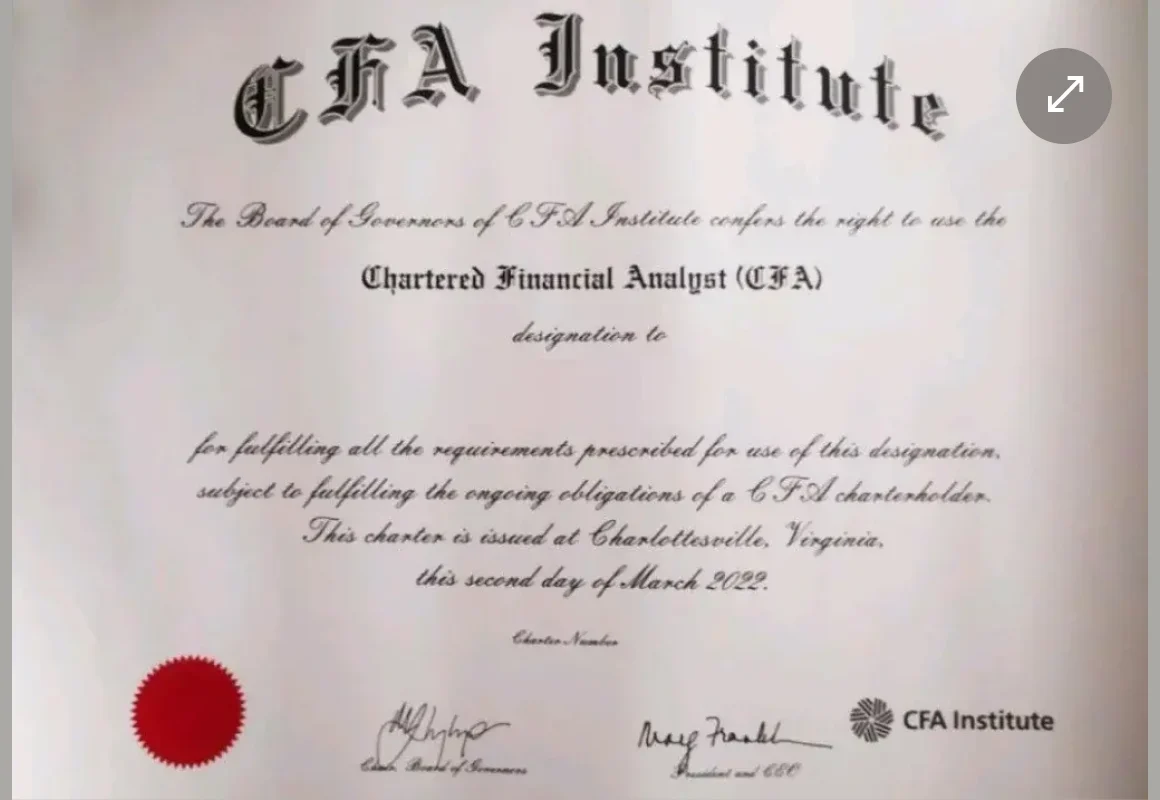
Joint Certification
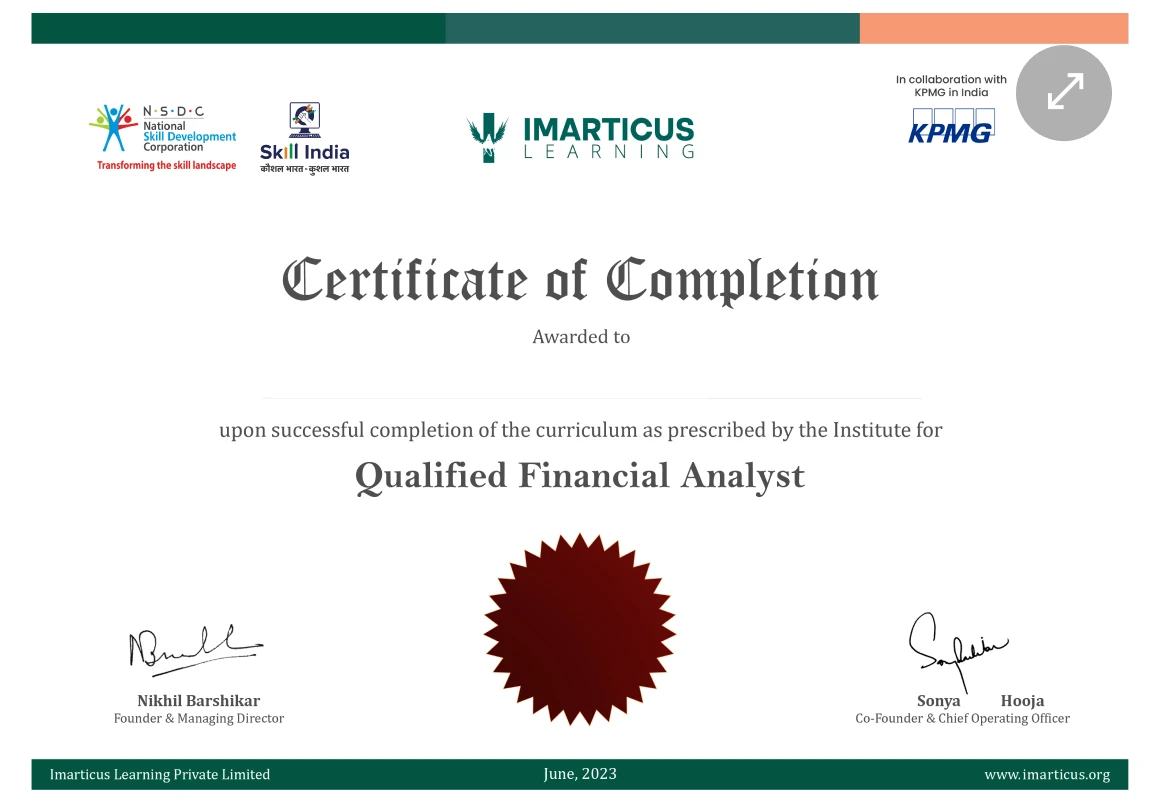
Study CFA with Imarticus in collaboration with KPMG in India
Pick the CFA Exam Level & mode of study that suits you

₹75,000
Each for CFA level 1, 2 and 3(All inclusive)
₹10,000
(Remaining fee in easy EMIs or part payments)

In person Sesssions
Learning at Imarticus Centre
Group Mentoring Sessions
Comprehensive Study Materials
Access to Class Notes
Access to Kaplan Schweser
Online Access to Case Studies
Practice Sessions
CFA Level Mock Exams
Exam Guide & Mind Maps
Exam Passing Guarantee
₹60,000
Each for CFA level 1, 2 and 3(All inclusive)
₹10,000
(Remaining fee in easy EMIs or part payments)
Live Streaming Sessions
Online CFA Classes
One to One Mentoring Sessions
Comprehensive Study Materials
All Class Recordings & Notes
Access to Kaplan Schweser
Case Studies by KPMG in India
Practice Sessions
CFA Level Mock Exams
Exam Guide & Mind Maps
Exam Passing Guarantee
Pay Now
FAQs
About the Program

Exam

Preparation
Fee
The CFA program — Chartered Financial Analyst — is a graduate-level, self-study professional credential offered by the CFA Institute, USA. The CFA course covers investment tools, portfolio management, financial analysis and ethics — applicable across diverse investment management careers.
The CFA is a global program and one of the most respected qualifications across the world. The larger markets such as the USA, India, China, Europe, Middle East have the highest demands for CFA professionals. India is a part of the 160+ CFA societies in the world. You can find more information about the CFA society in India here.
Imarticus Learning Pvt Ltd. is a CFA Institute Prep Provider, offering structured learning programs aligned with the CFA curriculum. Our courses provide expert-led instruction, practical applications, and rigorous practice to help candidates build a strong foundation for the CFA exam.
Disclaimer: Imarticus Learning Pvt Ltd. is a CFA Institute Prep Provider. Only CFA Institute Prep Providers are permitted to make use of CFA Institute copyrighted materials which are the building blocks of the exam. We are also required to create / use updated materials every year and this is validated by CFA Institute. Our products and services substantially cover the relevant curriculum and exam and this is validated by CFA Institute. In our advertising, any statement about the numbers of questions in our products and services relates to unique, original, proprietary questions. CFA Institute Prep Providers are forbidden from including CFA Institute official mock exam questions or any questions other than the end of reading questions within their products and services.
CFA Institute does not endorse, promote, review or warrant the accuracy or quality of the product and services offered by Imarticus Learning Pvt Ltd.. CFA Institute®, CFA® and Chartered Financial Analyst® are trademarks owned by CFA Institute.
The KPMG name and logo are trademarks of KPMG International Cooperative and are used under license by its independent member firms. Their inclusion in this programme is compliant with KPMG’s global trademark policies.
KPMG in India is not involved in the placement assistance or internship offered through this program and does not guarantee employment, career advancement, or future earnings. Its role is limited to providing CFA preparation and training for a specified number of hours, without endorsing or committing to any salary expectations. However the top performing participant will gain access to a KPMG in India internship opportunity while the next four highest achievers will be invited to engage in webinars and virtual events exploring global accounting practices as part of the CFA program. This is in addition to the original case studies as part of the overall program experience.
Only the top performer in the CFA program will be eligible for an internship at KPMG in India. The internship will be offered to select learner/s based on specific eligibility criteria.
The final selection is at the mutual discretion of Imarticus Learning and KPMG in India. Neither Imarticus Learning nor KPMG in India takes any responsibility for your placement in a full-time role or for the conversion of the internship into a Pre-Placement Offer (PPO) upon completion of the program.
Yes, KPMG in India will create and share a total of 23 original case studies aligned with various professional programs. These case studies are designed to offer real-world insights and practical application across different domains. The breakdown is as follows:

ACCA Skill: 5 case studies
ACCA Professional: 3 case studies
CMA (US GAAP): 7 case studies
CPA (US GAAP): 4 case studies
CFA (USA): 2 case studies
FRM (USA): 2 case studies
CFA salary in Big 4 and multinationals firms range from Rs. 10-45 LPA** in India and may vary based on multiple factors like experience, location, industry and one’s professional competence.
**All salary-related data presented has been sourced from credible job and employer review platforms, including Indeed and the impact assessment report of the CFA Program in India. Average salary in Abroad is calculated as the average salary in the US, UK and Canada. 192% Average salary growth indicates the salary growth from CFA Level 1 to Charterholder; on an average, it took the respondents of the survey 6 years to get the CFA charter.
Follow us on


Download our app


Download our app