


Last Updated on 8 months ago by Imarticus Learning
Data analysts are living in a world of ample opportunities. On one hand, you’ve got SQL vs Python for data science, and they’re both serious contenders. SQL is what you need if you’ve got fantastic big relational databases that you need to query; Python’s what you need if you’ve got to clean, model and visualise.
This detailed comparison of SQL and Python, like which is better: SQL or Python, major tricks of Python and SQL for data analysts, data analysis tools comparison, this guide will assist in comparing sql and python, sql vs python pros and cons, and what you need in optimizing your use of both tools so that you can select the optimum tool for each step of your workflow.
Table of Contents
- What Is SQL vs Python?
- Why Use Both SQL and Python?
- Feature Comparison: SQL vs Python
- Pros and Cons of Each Tool
- When to Use SQL or Python
- Best Practices for Hybrid Workflows
- Real-World Usage Statistics
- Unique Pipeline Example
- Frequently Asked Questions
- Conclusion & Key Takeaways
What Is SQL vs Python?
SQL vs Python: which is better?
Depends on the task: use SQL for database queries and set-based operations in a flash; use Python for automation, in-depth analysis and visualisation. Both are used by most analysts to construct robust data pipelines.
Why Use Both SQL and Python?
Data Extraction: SQL queries a large table with speed.
Data Transformation: pandas and NumPy in Python do sophisticated joins and reshaping.
Machine Learning: scikit-learn, TensorFlow and PyTorch reside in Python.
Visualisation: Matplotlib, Seaborn and Plotly provide low-level control.
Automation & Integration: Python scripts hook into APIs, schedule with cron or Airflow.
Together they offer speed as well as flexibility.
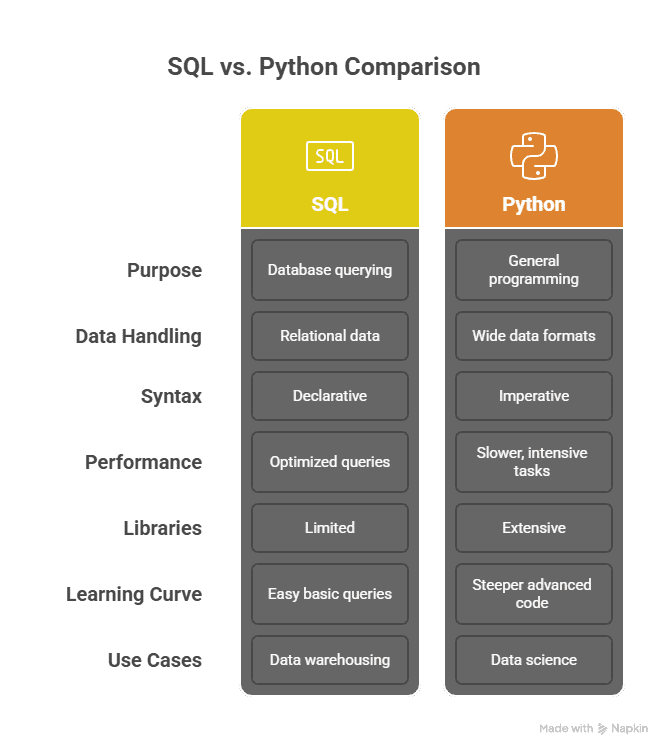
Feature Comparison: SQL vs Python
| Feature | SQL | Python |
| Typical Use | Relational queries & reporting | End-to-end analytics, ML, visualisation |
| Syntax | Declarative (“what” to retrieve) | Imperative (“how” to retrieve) |
| Learning Curve | Easy for simple SELECTs; steep for window functions | Moderate; simple Python first, then libraries |
| Performance | High for indexed-table set operations | High using C-backed libraries like NumPy |
| Extensibility | Only to SQL dialect extensions | Big ecosystem: pandas, scikit-learn, Dask |
| Portability | Dialect variations (MySQL, PostgreSQL, T-SQL) | Universal across platforms using virtual environments |
| Community & Support | Mature DB-oriented | Massive data-science community |
Advantages and Disadvantages of Each Tool
Advantages of SQL
- Optimised for server bulk data operations.
- Simple groupby aggregation queries.
- Built-in security and user access control.
SQL Disadvantages
- Poorly fitted for nested or unstructured data.
- Procedural operations need stored procedures or external scripts.
- Dialect splitting may cause portability problems.
Python Advantages
- Scales well to accommodate multiple sources of data (CSV, JSON, APIs).
- Handles machine-learning libraries extremely well.
- Supports interactive Jupyter notebook development.
Python Disadvantages
- Slower in direct database querying without optimisation.
- Needs environment and dependency management.
- Sloping initial setup for data-pipeline frameworks.
When to Use SQL or Python
- Simple Aggregations & Joins: SQL
- Exploratory Analysis: Python on Jupyter
- Production Pipelines: SQL ELT with Python transformations
- Machine Learning Models: Python
- Ad-hoc Reporting: SQL + Python automation scripts
Best Practices for Hybrid Workflows
- Push Down Computation: Offload heavy aggregations to the database using SQL.
- Selectively Extract: Only fetch required columns and rows using SQL.
- Version Control: Put Python scripts and SQL queries under version control in Git repositories.
- Parameterised Queries: Do not permit SQL injection in Python connectors (e.g., psycopg2).
- Reusable Modules: Bundle common Python functions into modules for ease of maintenance.
Real-World Usage Statistics
A Stack Overflow 2023 survey illustrated that 68% of career experts use SQL and Python together, highlighting their complementary relationship.
As DeepLearning.AI illustrates how over 90% of data experts use Python for analysis while close to 53% still use SQL as a default query language .
Unique Pipeline Example: ELT + Python
- Extract: Query raw data in PostgreSQL with SQL’s COPY command.
- Load: Import CSV into a pandas DataFrame.
- Transform:
- Clean missing data with df.dropna().
- Create new variables (e.g. rolling mean).
- Analyse: Run statistical tests with SciPy.
- Visualise: Plot trends with Matplotlib.
- Deploy: Save last tables to a database or publish with Flask API.
This hybrid workflow combines SQL’s performance with Python’s flexibility.
Introduction to SQL Commands | Essential SQL Basics for Beginners| Part 1
What is Python? Introduction to Python | Python Tutorial
Frequently Asked Questions
Can I learn SQL and Python?
Absolutely—begin with straightforward SQL SELECTs, then learn pandas and NumPy in Python.
Which one is faster for big data?
SQL is set-based optimised; Python accelerates through C-backed libraries.
Do I need to know both to do data science work?
Pandas and SQL are both essential for most data analyst and data scientist jobs.
One can use them together or separately, depending on the project.
How do I link Python with my database?
Utilise adapters like psycopg2 for PostgreSQL or pyodbc for SQL Server.
Is machine learning feasible in SQL?
Some platforms (e.g. BigQuery ML) do support ML, but Python and its libraries otherwise are more versatile.
Can Python replace SQL entirely?
Not for simple relational queries—SQL remains ideal for rapid database querying.
What should I learn?
- Official SQL Tutorial (W3Schools)
- pandas Documentation
- Python.org
How do I enjoy performance with Python?
Utilise vectorised operations via NumPy and avoid Python-level loops.
Do best-practice frameworks matter?
Utilise Airflow. Prefect. to schedule SQL and Python tasks in production.
Conclusion & Key Takeaways
An understanding of SQL vs Python is the best data analysis toolset. Utilise SQL for fast wrangling and pre-aggregating data; utilise Python for running advanced analysis, building predictive models and automating reports.
Key Takeaways:
- Utilise SQL for database querying and ELT at scale.
- Utilise Python for data conversion, machine learning and visualisation.
- Utilise a hybrid approach for optimising performance with flexibility.
Want to change your career to a better one? Stop by Imarticus Learning’s Postgraduate Program in Data Science & Analytics, learn from industry experts on SQL and Python, and become a part of the league of data professionals who make business decisions a reality today:
