How Imarticus Helps The Young Adults Towards ‘on the job’ Learning With Their Future Education Plans?

Imarticus Learning is a privately held education company located all over India, holding expertise in technical learning. This education company offers classes on various domains through both physical classrooms and virtual online mediums.

In today’s technology-driven world, holding onto a job with hectic timings and updating yourself through education to achieve career growth has become a necessity.

What Imarticus has to offer:

Imarticus offers ‘On the job’ learning with various benefits. For professionals with full-time jobs, this education company provides well-organized sessions through E-learning. The education programs aim to train learners to gain in-demand skills, extract insights, and improve decision making.

The courses are tailored by experts to give hands-on knowledge and experience via industry-specific projects and a cutting-edge curriculum developed following current trends that meet the organization’s and employee’s needs.

With over 3000 hours of developed E-learning classes, they offer a variety of E-learning solutions to educate anyone on a variety of expert fields. They have a capable team equipped with the experience to provide solutions through E-learning classes.

Program features:

The course consists of skill retraining and upskilling, keeping in mind the current requirements of the industry. It comes with a legion of program features like mentorship, integrated LMS (learning management system) which promotes self-paced learning, delivery of learning hours with a team of E-learning professionals, high learning engagement, and post-training evaluation.

These programs help in developing critical thinking, retraining, knowledge enhancement, and strategic development.

Data Science CourseThey also conduct skill assessments and competency mapping so as to create a comprehensive learning framework to prepare the new employees and also the existing employees with relevant future skills, dedicated delivery analysts, and account managers to ensure seamless delivery of training.

Other benefits:

‘On the job’ learning through specialized Imarticus E-learning also promotes various other benefits to the learners.

  • Flexibility:

It is far easier for the students to hold on to online learning than traditional classroom learning, especially for professionals with hectic schedules. A stable internet connection and a computer are the only requirements to turn any place into a classroom.

  • Accessibility:

These E-learning courses are accessible from all around the country, so even if you are out of the city for work purposes, you will still have continuous access to classes, which would not be possible otherwise.

  • Range of specializations:

For the job holders who are looking to improve their skill set through online learning, thousands of hours of useful content that can strengthen their knowledge and skill base is always available. They can choose the best suited to their domains.

  • Cost-effectiveness:

The options of E-learning are much more economical than classroom training methods. In today’s economy, where job losses and pay cuts are normal, the students can still be assured that their education will not be affected and, in turn, their careers.

Conclusion:

The global demand for online training programs has increased a lot in recent times. The field of online education has been observing fast growth because of the need to upskill or retrain skills. It’s a boon for anyone looking to progress in their career.

How the Indian Government’s AI Website Will Help the Country’s Artificial Intelligence Industry?

Collaboratively developed by the National Association of Software and Service Companies (Nasscom) and the National e-Governance Division of the Ministry of Electronics and Information Technology (MeitY), the portal is intended to be a one-stop-shop for all AI-related developments to happen in India.

The portal will also distribute documents, case studies, research reports and more relating to AI, and will also become a repository for AI-related learning job roles.

Noteworthy Resources On the Website

  • AI Courses

In order to help professionals and fresh graduates upskill, a variety of AI-related and machine learning courses are being offered through this government portal. The course providers range from IIT Bombay to companies such as IBM.

  • Editorial content

In order to collect all related information in one place, the website publishes editorial content and news as well as case studies and resources for budding AI entrepreneurs.

  • Highlighting successes

The portal also aims to highlight the country’s successes in AI in the recent past, spanning industries and use cases.

How the Website Will Help India’s AI Industry

The website is a distinctive step forward in recognizing the potential and scope of AI in India. Here are some ways in which the website can benefit the AI landscape at national and grassroots levels:

  • Democratising AI

Sanjay Dhotre, the MoS for E&IT, Communications, and HRD, said that digital innovation, including AI, has been a massive equaliser among the Indian population despite the diversity of the country. AI has already penetrated several homes; in the future, this website hopes to bring AI to virtually every part of the country and expound on its benefits in a growing economy.

  • Cementing India’s Place in the World

This public declaration of support towards Artificial Intelligence developments is a solid way of confirming to the world that India is investing in the technologies of the future. India has already supplied global leaders in technology to different parts of the world. By funding this AI website and encouraging its use, the country is making its way up the list of countries with one eye on the foreseeable future.

  • Encouraging Innovation

By making case studies, courses and resources accessible to the masses, the AI website is, in effect, encouraging each and every citizen to experiment in the field. There is no dearth of innovation and ideation in the country; this website becomes a place for resources to support the realization of AI-related dreams and the furthering of the country’s technological goals.

  • Building Networks

The website is touted as a convergence point for students, fresh graduates, AI experts, experimental businesses and new-age entrepreneurs to share and transact over revolutionary AI-driven ideas and proposals. The website also becomes a launching pad for innovation and a networking platform for those with ideas and those with the power to fund them. The departments are also working on creating investor pitch events to link ideators and funders alike.

  • Preparing the Future Generation

Alongside the website, the departments also announced the Responsible AI for Youth Program which is targeted at imparting AI education in government schools. The different phases of the programme aim to train teachers and gather groundbreaking ideas from the students themselves. Keeping in mind that India is one of the most populous countries in the world, instilling an understanding of AI and a passion for innovation at a young age is critical to the growth of the country internationally.

Conclusion

The AI website can be looked at as a show of support towards futuristic technologies that emerge from the grassroots level. By attempting to democratize AI, this government website is also creating a conducive atmosphere for technological growth on par with the rest of the world.

RPA Lifecycle – Everything About Different Stages of Bot Development!

Robotic Process Automation (RPA) in Machine Learning is a hot topic right now. Aspiring learners are looking to amass knowledge in it while IT professionals are looking to gain hands-on experience. In this quest, you are bound to come across the RFA lifecycle which is how bots are built from scratch.

Let’s take a look at the critical stages of bot development.

RPA Lifecycle

robotics programming automation course

Before we get into the stages of bot development, let’s first understand what Robotic Process Automation in Machine Learning really is. In laymen terms, RPA allows a process to be automated using software, robots, or any type of bots so that human intervention can be minimized.

Ever contacted the customer support of Amazon.in and a chatbot suddenly appeared on your screen? That is RPA in motion. It involves mimicking a human activity so that basic actions (like responding to a customer’s query about a recent purchase) can be automated. This helps reduce costs and human resources.

Let’s move on to the different stages of bot development.

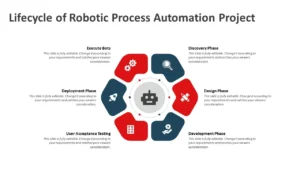
Discovery

In this phase, the brief provided by the client is analyzed.

Can the process be automated? Can a bot for the said process be built? What are the challenges and advantages of building it?

Answers to these questions will give the entire RPA development team a clear understanding of the project. Thorough coordination with the client is essential in this phase.

Solution Design

In this phase of RPA in Machine Learning, a Process Definition Document (PPD) is created which provides detailed information about the process. A flowchart is then created that will act as a blueprint to the bot creation. What actions will trigger the bot? How many elements should it include? Such questions are asked.

data analytics course

This is perhaps the most important phase of Robotic Process Automation in Machine Learning as the information gathered here will heavily influence the final product: the bot.

Development

Once all processes are established, the next step is development. This is the longest phase in RPA in Machine Learning and can extend depending upon the scope and volume of the project.

Different RPA tools are used to develop bot. High levels of coding are executed in addition to automated tools and templates. This is where skilled and experienced individuals in the ML field is required.

The key element of the Development phase is to test how extensive the build of the bot is. Have all scenarios and outcomes been tested and there is no gap in the development? Will there be a situation when the bot goes live and it fails to act? Proper coordination with the research done in the initial phases is extremely important. This will ensure the bot is a success.

Testing

As the name suggests, this stage involves all types of testing. From the user interface to the backend, all elements are rigorously tested to ensure there are no loopholes.

In a way, Robotic Process Automation in Machine Learning is a complex procedure. Testing, therefore, is the second-most important phase because the findings in this stage can make or break the project.

Deployment

Last on the RPA lifecycle is the deployment stage. Here the bot goes live on the frontend and is ready for user interaction. Maintenance and bot execution are generally part of this stage.

That is the RPA lifecycle in a nutshell for you. Of course, when you go deep into each of the stages discussed above, you will understand the complexity of RPA in Machine Learning. It’s an interesting concept but one where the lifecycle has to be religiously followed to avoid mistakes.

Python Developer Salary in Terms of Job Roles

What is Python?

The second most liked Programming language in the world, Python is one of the widely used term in the web-development world.

Who are Python Developers?

The web-developers who design and code the software applications with the help of Python language are referred to as Python Developers.

Roles and responsibilities of Python Developers

 Python Developers as Data Scientists

Major businesses in today’s world require tools and skilled people for the data-related tasks such as data collection, data cleaning and processing.

Python Programming Course with Data ScienceData Scientists are the programmers who do these tasks for the organizations. Data Scientists gather a large quantity of data and convert it into a useful form, followed by recognizing data-analytics solutions for organizational growth.

Data Scientists encourage the data-driven approach in organizations to deal with complex business problems.

 Artificial Intelligence

In AI Python Developers create and implement the required Machine Language algorithms. They analyze the success and failure of the algorithm and rank them according to their performance for future use. Training and Retraining ML algorithms is one of the key tasks performed by Python Developers.

Salaries of Python Developers in India

The changing focus of the organizations on data-driven solutions is resulting in a manifold increase in the salaries of the Python Developers. In the coming years the demand for AI-skilled people will increase, and hence the salaries.

Major IT giants like Google, YouTube, Amazon etc. are adopting Python-driven systems and hence, manifold increases in the salaries of the Python Developers.

Python Programming Course with Data scienceThe entry level salary of a Data Scientist is approximately INR 500,000 per annum (Source: payscale.com) Data scientists with 5-9 years of work experience gets +100% more salary in India. With the experience and refinement of the skill, the salary of Data scientists shows exponential growth.

 An entry-level engineer who develops the ML Algorithms earns the average salary of approximately INR 700,000 annually. With further experience and refinement of the skills, the average salary of the Data Scientist shows exponential growth.

Factors affecting the Salaries of Python Developers

Job location: Considering the increasing demand of Python Developers, not only in India, the faster salary growth is visible in UK and in US.

Location

Approximate Average Salary in INR

Gurgaon

700,717

Bangalore

669,787

Delhi

600,000

Mumbai

579,728

Chennai

540,131

Hyderabad

475,000

UK Python Developer annual salary

£67,000

US Python Developer annual salary

$117,000

Experience:

Python Developer

Approximate Salaries in INR

Entry Level Python Developer

427,293

Med-Level Python Developer

909,818

Experienced Python Developer

1,150,000

Refined Skills:

Mere understanding of the Python is of no use, till is integrated with the problems and solutions. How one uses the well-known Python tools define the person’s skill set, which is a determiner of the salary.

Job Role:

Python Developer

Approximate Average Salary in INR

Data Scientists

700,000

ML Engineer

670,000

DevOps Engineer

660,000

Software Engineer

500,000

Web Developer

300,000


Python Programming Course with Data ScienceShould know more interesting things about Python programming training and Python career.


Artificial Intelligence in Fintech: Understanding Robo-advisors Adoption Among Customers

The influence of Artificial Intelligence (AI) and its application in various industries have brought about a positive outlook on how operations are done in many sectors. In direct contrast to traditional methods, AI is making processes more smooth, beneficial to businesses by reducing overhead costs on labor and human error.

AI in financial technology (Fintech) has also seen vast applications and not just in banking and financial management but also in catering to the advisory portion of it. With AI in the mix, Fintech companies can now offer customers 24/7 support along with and reduce operational fees levied for their services.

Fintech Courses in India

Fintech isn’t just for financial institutions but also for businesses that employ financial services as part of their operations. Thus, despite the field of operations, fintech is useful in all businesses to make the process automated and smooth. Thus, many fintech startups are seeing rapid growth in the field.

Fintech courses in India have seen great exposure as the applications of this course don’t just stop at giving businesses backend solutions but also make customer-facing services smoother. Wealth management, better banking and investment management services, and more, this field has financial technology courses that give students a chance to get into great positions in the field.

Some of the courses that rank high in India include:

  • Data Science Analysis
  • Data Science Visualization
  • Artificial Intelligence in Fintech
  • Machine Learning in Fintech
  • Wealthtech
  • Robo-advisors and their applications
  • Cyber Security and more

Adoption of Robo-Advisors Among Customers

The scope of this financial technology course studies the application and adoption of Robo-advisors in the banking and investment sector. Businesses including financial institutions save a lot of costs involved in manpower and support by adopting Robo-advisors in their business to deal with customer-facing queries.

With this course, you understand the challenges involved in AI in financial services, the history of Robo-advisors and customer feedback on them, and measures involved in the successful implementation of Robo-advisors for business.

As with any new innovation, customers and even businesses are slow to adapt and test the use case of Robo-advisors. However, the course is aimed at understanding user behavior and how to overcome traditional beliefs involved in its implementation.

Careers in Fintech

There is no doubt that fintech has brought about a huge change in financial services. It is not just about the digitalization of banking and investment services but also includes cryptocurrencies, blockchain management, and more.

The prospects of a career in fintech have high demand. Fintech is the upcoming innovation that has led many financial products and their management smoother and more profitable for businesses. Entry into one of the fintech companies requires a course or a degree in financial technology and the knowledge of AI, machine learning, and its applications.

As a fintech student, you can push your career path as a data analyst, blockchain developer, cybersecurity specialist, mobile app development, and other positions. Many organizations are looking forward to hiring candidates with the right skills to help them develop the necessary IT infrastructure or monitor and analyze data secured by AI functions.

Working in a fintech company has a lot of benefits as AI in finance is a disruptive force taking over several operations in the financial sector. It can soon replace many traditional methods of banking, investment, and handling financial services. The growth in your career and the monetary benefits are worth pursuing a course in fintech.

Which Career Is More Promising: Data Scientist or Software Developer?

As per a study, about 2.5 quintillion bytes of data are produced every day. The number is about to increase by many folds in the future. The pace at which data is being generated demands more data science professionals. That’s the reason data science jobs are now regarded as one of the highest-paid jobs across the globe. And, people are joining data science training to explore a career in data.

As, firms are hiring employees who can build technical applications, and collect, analyse and predict data. That’s the reason students are enroling in data science training courses that are best and give job assurance.

Companies are keen to employ data scientists, data analysts, web developers, full-stack developers, and much more technology professionals. According to Imarticus Learning and Analytics India Magazine’s research, there will be a 30.1% increase in data science and analytics jobs in 2022 compared to 2021.

However, more competition in Information Technology requires software career enthusiasts to learn the latest technology for survival. The primary responsibility of data scientists is business analytics. They also work on constructing data and software products using algorithms. The demand for data scientists is high due to the shortage of skilled people for start-ups and corporates. Global companies are searching for professional data scientists to up their game in this competitive world.

Who is a data scientist?

Data scientists collect and interpret large amounts of structured and unstructured information. They analyse, process, and model data before interpreting the findings to develop actionable plans for businesses. The data scientist uses computer science, statistics, and mathematics for data interpretation.

Who is a software developer?

Software developers are the thinkers and doers behind computer programs of all kinds. While some software developers specialise in a single program or application development, others build massive networks or underlying systems that trigger and power other programs. As a result, there are two types of developers: applications software developers and systems software developers.

The approach of data scientists and software developers

To use and organise data in a structured or unstructured form, a data scientist becomes essential and can master the art with the right Data Science Training. Hence, there is a need for a data scientist, with sound knowledge of handling data that demands the best data science training and experience.

Software developers collaborate with computer programmers to test the convenience of using a software program. The component that powers digital systems is software which is the core element of computers. To be precise, software engineering can be termed as the application of engineering principles for designing, structuring, developing, and implementing software. An efficient software developer understands the client’s needs and then develops the software as a solution to the client’s needs.

Important tools used in software development and data science

To be productive, data science career aspirants should be knowledgeable about statistics, software programming, and analytical thinking. In addition, a data scientist should have the urge to learn and be updated about new programming languages.  Python, Swift, and Ruby, apart from mastering SQL, Spark, machine learning, and Hadoop are the most important to learn.

A software developer should know the latest programming languages along with a bachelor’s degree in computer science. A good understanding of computer programming by understanding the functionality of new tools is a plus. Along with various skills, a software developer should possess to flourish in the field of analytical skills. Followed by attention to detail, creativity, problem-solving techniques, and interpersonal skills are vital.

The pay scale for data scientists versus software developers

A report from Payscale.com reveals that the median salary for a data scientist is around 6,00,000. It is not much different in the US. According to a survey by Glassdoor, the median salary for a data scientist is $91470, which is great. So, it is evident that data science can offer ample money and growth. But, the salary also depends on the qualifications, skills, experience, and location. Firms also play a vital role in deciding the pay. 

Currently, the median salary for software developers is $1,00,80 and the growth in employing software developers is set to increase by 24% in a decade. In addition, an estimate states that there are 3.7 billion mobile users worldwide. It demands newer and better applications for smartphones and tablets. It increases the demand for software developers globally. Factors that affect the salary of a data scientist are similar to those of software developers. 

Roles and job titles for a career in data science versus software development

A few important job titles that a data scientist can do are data architect, data scientist, and business analyst. In fact, the roles of data administrator, and business intelligence manager are also in demand. Global companies in the digital world, like Facebook, Twitter, IBM, and Apple, are racing to hire the best data scientists. So, the demand for data scientists is growing like never before.

Some of the interesting career options that connect to software developers are Computer programming. Computer system analysts, web developers, computer network architects, and computer hardware engineers are also on the list. Though data science is a relatively newer concept than software development, it is increasing rapidly. 

Conclusion

This article has showcased the digitisation, technology, data rise, and demand of technology professionals. The high demand for data scientists, and software developers have given rise to the skills gaps. If you are eager to learn new tools for efficient data handling, you can grab a chance to flourish as a data scientist in the long run. Enrol for the best data science training course and enter the world of data.
But, selecting the best institute for data science training is not easy.

You should enquire about the faculty, course curriculum, and the job assistance that they provide. It is always good to get interview assistance, career monitoring, and resume-building tips from the experts. If the institute provides all this then it is the best for the learners.

It should be your priority to learn coding and programming if you want to become a software developer. Furthermore, the amount of data being produced every day is high, which signifies long-term growth and attractive salary await a talented data scientist. So, in the end, we can say that both careers in data science and software development are promising. It depends on individual preferences and interests. Both, career options are good and offer career growth. 

For more details, you can also search for – Imarticus Learning.  You can drop your query by filling up a form from the site. You can also contact us through the Live Chat Support system. To explore more you can visit one of our training centers based in – Mumbai, Thane, Pune, Chennai, Bangalore, Hyderabad, Delhi, and Gurgaon.

Advanced Data Science Skills to Stay Relevant in the Post-Pandemic World!

The need to upskill to meet the dynamic demands of a technology-first world has been around for the past few years; it has only become more urgent in the wake of the COVID19 pandemic. The emergence of new technologies such as Artificial Intelligence, machine learning and data science has set the tone for the future.

Data Science

In the post-COVID19 world, there are a few advanced data science skills that, when added to the toolkit of a data scientist, can make or break their career.

To ensure that your core competencies are strengthened as a data scientist, you can sign up for a comprehensive data science training course that explores the following:


#1: Geospatial Technologies

 With more people working on data-driven decision processes, geospatial data has helped better planning and processing of the system. This knowledge has proved invaluable in tracking the COVID19 outbreak all over the world; come the near future, geospatial technology will likely be extended to other research areas as well.

Data Science

A geospatial data scientist will need to sift through vast geographic and demographic datasets that hide gold nuggets of insight across diverse research topics.


#2: Natural Language Processing (NLP)

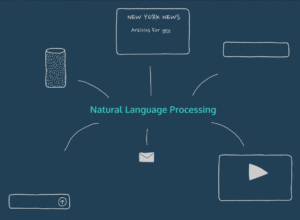
NLP gained traction even before the pandemic reared its ugly head. That said, it is only set to increase in importance and reach in a post-pandemic world. Natural Language Processing

Most organisations often implement self-service systems, such as bots that come with multi-language optimized NLP to help solve customer problems.

Data scientists of the future must understand NLP and master it enough to help companies develop automated solutions for a better post-COVID outcome.

#3: Computer Vision

Computer vision is an artificial intelligence field which trains computers to interpret and comprehend the visual world. It uses digital images from cameras and videos as well as deep learning models to recognise and distinguish objects correctly. With the help of algorithms, computer vision is also integrated to follow up with a programmed response. In current scenarios, computer vision has proved helpful in containing the outbreak and regulating quarantines and social distancing in cities across the world. In the future, where maintaining distance might become the norm, data scientists specializing in computer vision will automatically become more hire able.

#4: Data Storytelling

With data analytics becoming a prime concern for companies across industries, the need for good data storytelling has increased. The benefit of data analysis is not just in the evidence it provides but also in how it is made meaningful and impactful. Gripping storytelling makes it easier for non-data-scientist stakeholders to understand the value of the information and the possibilities it poses.

Data presented as contextual stories, rather than isolated data points, makes individuals more likely to understand the impact, decipher patterns and make more informed decisions.


In turn, as data storytelling would help business leaders with powerful insights, it would help them better prepare for the post-pandemic world’s opportunities.


#5: Explainable AI

Considering that AI has reached into nearly every area of human life, companies must be able to trust computers and their decisions. This is where the need for explainable AI emerges. Until now, companies build and sourced AI models that predicted accurate insights from large data dumps. In a post-pandemic world, they may well shift to models that also provide explanations for predictions. Explainable AI is a step forward in reducing the mistrust in non-human workflows. It makes AI systems more transparent and much fairer and all-inclusive than they were earlier.

Conclusion

Advanced data science skills are crucial to the cause of innovation and growth. Advanced upskilling is an integral step for data scientists looking to become more than relevant in the coming years.

How A Big Data Can Be Used In Retail Banking?


Like in all successful business ventures, the field of banking is no exception. Big Data drives decisions. The successful use of such large-volume data-based applications already exists and is hugely popular too. Retail banks are big data-driven with nearly all its processes being already supported by such data to deliver business value to their customers.

Their advantages and competitive value is data fueled and depends on the insights provided by the most effective use of such data. It is surprising that in spite of having had access to such large databases for over a decade now, Retail Banking is yet to exploit the numerous benefits uses of big data in retail-banking can bring in.

A data analyst Retail Bankingintern or freshman makes a handsome payout package and the range of the salary depends on the skill-set, certification, and experience. The skills required can vary depending on the employer and industry. As they climb the ladder the promotions depend on continuous skill up-gradation, managerial and leadership skills. Hence, soft-skills and personality development are also important attributes.

Big Data transformation benefits:

With the move by customers to digital transactions many banks did invest substantial efforts in dedicated teams, advanced analytics, appointing data officers, and upgrading their infrastructure. The early adapters are the survivors and have evolved more competitive as new-age banks offering customer-need based services based on Big Data insights. There are many areas where banks are yet to ramp up their use of big data to reap benefits according to the Boston Consulting Group’s reports.

The three main abilities that are leading transformations are: 

  • Data: Multi-source multi-system huge volumes of data petabytes being available which include high definitions of detail and features.
  • Models and ML: The models are now more insightful thanks to the evolution of better ML software which enables decisions and predictions that are data-driven.
  • Software technology: The hardware-software clustering technique in software like Hadoop has proven to be big-data centric and allowing use of complex databases non-structured and structured in a cost-effective manner.

There are at least six areas in Retail Banking which focused and coordinated big-data programs can lead to substantial value for banks in the form of increased revenues and bigger profits.

IMPROVING CURRENT PRACTICES WITH POINT ANALYTICS: Applications of big data analytics for individual needs can be simple and yet powerful with the point analytics method.

TRANSFORMING CORE PROCESSES WITH PLATFORM ANALYTICS: Big data and point analytics can be used to improve customer risk assessment and for effectively tapping the marketing potential measures analyzed.

TRANSFORMING CORE PROCESSES WITH PLATFORM ANALYTICS: Big data applications can transform the collection process with step-by-step optimization to bring in a 40 percent savings in terms of writing off bad debts, with effective use of mining outdated customer information, their predispositions, and newer behavioral models.

BOOSTING IT PERFORMANCE: Big-data IT technologies should have need-based linear scaling to reduce costs. Data-intensive models, mining omnichannel customer experience, balancing data warehouse workloads and effective leveraging of data can help.

CREATING NEW REVENUE STREAMS: 

A European bank used new architecture, hybrid data-warehousing combining banking tech and big-data by clustering the Hadoop commodity servers. Budget savings were 30 percent with all functionalities!

GETTING THE MOST FROM BIG DATA: 

This involves these basic steps of infra and people management detailed below: 

Assess the present situation: Banks needs to bring in newer innovative applications as a differentiator from the competition where all organizational levels collaborate to contribute to the use and needs-based model.

Be Agile: The agile requirements of communication, collaboration, and contribution across all processes will help big data transform them.

Critical capability cultivation: If not implemented the cultivation of critical capabilities can hinder the big data transformation of processes. Limiting the capability to the vision essentials is recommended in all domains of big data capabilities.

The three domains of Big data capabilities that Retail Banking should question itself about are: 

  • The usage of data
  • The engine driving the data
  • The ecosystem of the data

Retail banks should necessarily explore and act on these domains effectively by using smaller discrete programs to take their strategy to execution.

Conclusion:

BIG business for all banks comes from effectively exploring Big Data. Such large institutions who cash in early will stay ahead of the other banks by adapting technology into the very fabric of their banks for its many benefits.

The future holds great promise for development in the field of Retail Banking and to make a high-paid scope-filled career even without experience. Start your Big Data Analytics Course at Imarticus Learning and take advantage of their assured placements and certification. All the best with your career in big data and retail banking!

For more details, you can also contact us through the Live Chat Support system or can even visit one of our training centers based in – Mumbai, Thane, Pune, Chennai, Banglore, Hyderabad, Delhi, Gurgaon, and Ahmedabad.

Welcome to the Data Science Club of Imarticus Learning!

Imarticus Learning is among the top online education providers in India. After its data science course helped many data science aspirants to build a successful career in the industry, it has now come with a new campaign i.e. the ‘Data Science Club’. This club will aim at addressing the shortage of data scientists in India. It will also help in unifying data science aspirants from all over the country & giving them a chance to interact.

Data Science CourseYou can bring the data science club to your college/university with just a simple process. They already have registered 30 colleges from locations like Delhi, Tamil Nadu, and Karnataka.

The registration process is open & you can experience a whole new aspect of data science. One can also join the data science community of Imarticus on various social media platforms.

Mission & Vision of the Data Science Club

  • To promote students across India to build a successful career in data science.
  • To address the talent gap in the data science industry & shortage of skilled data scientists in India.
  • To facilitate the exchange of ideas & information relating to data science between club members across PAN India.
  • To provide industry-oriented learning of data science involving technological advancements & tools used in the industry.

Registration Process

Generally, most of the colleges don’t even have a data science club. You could be the first to introduce a data science club at your college/university. You can visit the Imarticus website and can easily register your college/university for the data science club. You will be required to fill a google form asking for a few details like college name, address, department, designation, email address, etc. The Imarticus panel will get back to you and will inform you about further proceedings.

Benefits of Being a Club Member

This data science club will facilitate its members from various colleges across India in understanding the importance of data science. It aims at motivating aspirants for building a successful career in data science and bridging the talent gap in the current data science industry. The benefits of joining the data science club of Imarticus are as follows:

  • Students of member colleges can attend any event/competition under the data science club for free.
  • You will get to attend lectures or webinars from industry experts/professionals.
  • The members of the club will get to test themselves by participating in the national level hackathon.
  • You will get to attend data science workshops under this club. You will also get a certification from Imarticus Learning for being a part of the data science club.
  • The members of the club will also undergo the faculty development programme.
  • Eligible members/students of the club will also get full placement support from Imarticus.
  • You will get to know about the industry practices & trends by being a member of this club. You will also get to know about the right career roadmap in the data science industry.

If you want to make a transition from data science aspirant to an expert, you have to grab this wonderful opportunity which will bring you closer to the data science community in India. One can also opt for the data science course provided by Imarticus Learning to know about the data science aspects in detail.

Register for the data science club now!

Why Artificial Intelligence is better than Other Technology

Living in the 21st century, we have been able to see a lot happening in the field of technology and its advancement. Artificial Intelligence in that regard is the latest and the most developed version of classic technology. However, the term artificial intelligence still perplexes many people as they are not aware of its details. Even though people are using gadgets birthed by artificial intelligence, they may still not know about it.

What Artificial Intelligence Exactly Is?

AI is that field of machined technology that imitates humans and their functions on various levels. These machines or robots are functioned using various codes and algorithms to make them work as humanly as possible. It deals with the behavioural part of the machines which has a connection or a relation with intelligence. This branch of computer science has made it possible for the machines to think and act rationally and humanly to a great extent.

Why is AI Better than Other Technology?

Artificial Intelligence is any day better than human intelligence or works efficiently as compared to other technologies of the world. This can be made clear through the following points:

  • Mitigating Risks: AI has been working incessantly in reducing the risk factor associated with completing a task as compared to other technologies. To quote it as an example, forest fires can be handled more effectively with AI robotic drones instead of manual machines to put out the fire. AI can minimize the risks associated with human lives in many areas like radiation, electricity, hydropower and fire etc.
  • Zero Errors: Unlike other forms of technology or human intelligence for that matter, AI works so efficiently that it leaves no chance for errors or mistakes. Owing to a situation, human beings can alter the ways they work but AI does not change frequently according to their surroundings in all situations.
  • Remarkable Anticipation: The technology preceding AI is not accurate enough to make correct judgements about the events which are about to happen. However, forecasts or predictions made by AI are far more accurate. Likewise, AI sensors to forecast and measure the intensity of an earthquake beat the normal scales to measure the earthquakes. Also, AI functions with far less human involvement as compared to other technology.
  • Saves Time and Money: The classic technological advancement would just let you type a song name in the search list and it will present you a list of preferred songs. However, Siri and Alexa, a gift of artificial intelligence are voice regulated gadgets which work on your personalized instructions. There is no default set of questions and answers fed in these gadgets. They respond to any question with any suitable answer, isn’t that amazing?
  • Reduced Human Intervention: When technology functions on its own without human intervention, it can turn out to be the best. To illustrate, a doctor carrying out a surgical procedure makes use of all the modern gear and instruments but can still perform differently with different patients of the same conditions. However, this is not the case if robots carry out the surgery by themselves. This points to the fact that AI outshines human interference while making use of technology.

Conclusion
Embracing a positive approach to make use of Artificial Intelligence can always turn out to be in the best interest of every human being. Although, AI has eased the lifestyle and the way people used to work but still, exploring it outside the boundaries of positive development can cause harm to humanity at once.

If you wish to explore the field of AI and aspire to learn artificial intelligence, you must check out Imarticus learning for the same.