



Last updated on August 2nd, 2024 at 07:48 pm
Last Updated on 2 years ago by Imarticus Learning
Investment bankers must have comprehensive knowledge about the core of an organisation — its cash flow since it exposes a company’s actual financial health. Among the numerous tools and strategies that help understand volatile financial data, cash flow analysis is among the most important.
Cash flow analysis is the foundation upon which sound investing strategies are formed. It investigates the cash inflows and outflows of a company, shedding light on the source of revenue, cash reserves, and expenditure. Cash flow, unlike profit statements, goes beyond paper earnings to provide a real-time view of liquidity and solvency. This understanding is essential for investment bankers, acting as a compass in the dynamic and unstable financial markets.
Whether you’re a beginner or a seasoned investor, the blog will guide you in assessing assets like an expert. To become an investment banker, enrol in an investment banking course and gain extensive knowledge about operational and free cash flow, Discounted Cash Flow Valuation and other aspects of investment banking.
What is Cash Flow Analysis?
Cash flow analysis assists individuals, corporations, and investors in fundamentally examining the flow of money inside an organisation, offering a clear picture of its liquidity and fiscal condition. It reveals the state of the business’s affairs.
There are three basic components: operational activities, investment activities, and financing activities. Day-to-day business transactions, such as sales and costs, are included in operational activities. Investing entails the acquisition and selling of securities, businesses and assets such as equipment or investments. Financing cash flow, on the other hand, comprises transactions between shareholders and creditors, such as stock issuance or loan repayment.
Investment bankers can identify patterns, analyse risks, and assess a company’s capacity to fulfil its obligations by studying the cash flow. Positive cash flow suggests that a company’s liquid assets are growing, which improves its financial flexibility. Whereas negative cash flow may indicate potential danger and necessitate further investigation.
Investors use cash flow analysis to make strategic decisions. A firm may declare profits, but if its cash flow is negative, it may be difficult to pay bills or invest in growth. As a result, knowing the subtleties of cash flow is critical, acting as the compass directing financial decisions in the ever-changing economic landscape.
Why is Cash Flow Analysis Important?
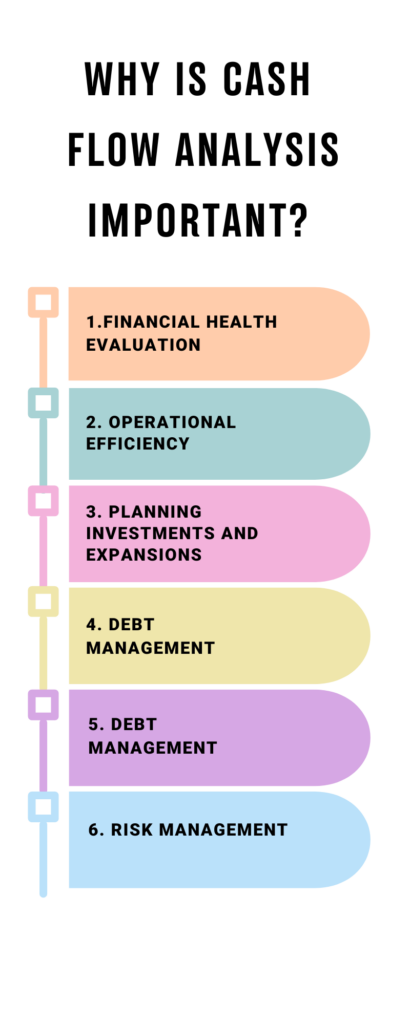
An investment banking course will explain how cash flow analysis is critical for determining financial stability, improving operational efficiency, planning investments, managing debts, and reducing risks. Businesses that prioritise frequent cash flow analysis are more adept at handling uncertainty and making strategic decisions that promote long-term success.
- Financial health evaluation: A cash flow analysis is essential for assessing a company’s financial well-being. Businesses can analyse their liquidity and capacity to satisfy short-term obligations by evaluating cash inflows and outflows. This knowledge helps make sound financial decisions and avoid future crises.
- Operational efficiency: A company’s operational efficiency can be ascertained by examining its cash flow. Businesses can spot opportunities for development by examining how effectively they handle their financial resources. Effective budgeting ensures that business needs are satisfied on time and without unwarranted interruptions.
- Planning investments and expansions: Cash flow analysis is critical whilst planning investments or expansions. Positive cash flow exhibits that money is available for strategic objectives, decreasing the need for external finance. It assists firms in determining their ability to invest in new projects, research, or acquisitions, supporting long-term growth.
- Debt management: Monitoring cash flow is critical for organisations with loans or obligations. It aids in prompt debt payments, avoiding default and the accompanying penalties. Companies preserve their creditworthiness and establish confidence with creditors by matching cash inflows with debt commitments.
- Risk management: Knowing your cash flow patterns assists in recognising financial risk. Unpredictable financial flows can cause cash shortages, impeding day-to-day operations. Businesses may proactively manage risks and ensure stability and continuity by analysing past data and forecasting future cash flows.
What Does Cash Flow Analysis Tell You?
Positive Cash Flow
When a company’s incoming cash surpasses its outgoing cash for a particular period, it indicates its fiscal health and solvency. It indicates that the company has sufficient cash in reserve to satisfy obligations, invest in expansion, or pay dividends. Positive cash flow is critical for operational sustainability, allowing organisations to successfully cover costs and service debts and pursue strategic objectives.
Negative Cash Flow
When a company’s cash outflows surpass its cash inflows within a given period, it has negative cash flow. This might occur due to high operational expenditures, significant debt repayments, or low sales. It suggests financial insecurity, probable liquidity problems, and difficulties meeting short-term obligations. To fix and correct negative cash flow conditions, timely analysis and proactive financial management are critical.
Free Cash Flow
The capacity of a corporation to generate cash after accounting for capital expenditures and operating expenses is measured by free cash flow. It denotes excess availability of cash for dividends, debt payments, or additional investments. FCF is an important measure of a business’s financial stability, demonstrating its ability to develop, acquire, and offer profit to shareholders while operating normally.
Limitations of Cash Flow Analysis
To establish a career in investment banking, it is equally important to know the limitations of cash flow analysis. Some of the drawbacks are:
- Ignores non-cash items: Non-cash expenditures like depreciation and amortisation are not considered in cash flow analysis. As a result, it could fail to provide a clear picture of a company’s profitability because these non-cash elements influence financial performance.
- Short-term focus: Because cash flow analysis is primarily concerned with short-term liquidity, it may neglect long-term financial health and sustainability. It can overlook investments in R&D or long-term projects, impacting the estimate of a company’s total worth.
- Manipulation potential: Businesses can manipulate cash flow data by delaying payments or increasing receipts. This manipulation might provide a false impression of the company’s financial health, leading to incorrect judgements.
- Differences by industry: Different industries have distinct cash flow patterns. Comparing cash flows across industries may not provide relevant information since what is common in one industry could be problematic in another.
- Lack of timing consideration: The timing of cash flows is not considered in cash flow analysis. For example, a corporation may have strong cash flow but substantial upcoming obligations, compromising its capacity to satisfy future financial commitments. A thorough financial examination requires precise timing, which cash flow analysis doesn’t cover.
Conclusion
Mastering cash flow analysis is critical for investment bankers. It not only ensures a thorough grasp of a company’s financial health but also provides bankers with the information they need to make smart investment decisions. Investment bankers can discover attractive possibilities, handle risks efficiently, and offer customers educated advice by interpreting cash flow patterns, maximising their investment potential and supporting long-term financial success.
If you’re looking for a feasible certification in investment banking, check out Imarticus Learning’s Certified Investment Banking Operations Professional Course. This would help upscale your career in investment banking, alongside providing you with optimal job opportunities.
To know more, check out the website right away.
