ACCA Exam Guide: Syllabus, Timetable, and Smart Study Plan

The ACCA Exam is one of the most widely respected gateways to global finance careers. Students do not only see it as another certification. They treat it as a personal milestone that shapes the next decade of their professional journey. When you speak to learners who cracked the final stage on their second or third attempt, they often say the ACCA taught them a way of thinking rather than a set of rules. That is the energy we carry into this guide.

In this article, I will help you to understand how the ACCA Exam works, how the sessions are structured, how the exam dates are set throughout the year, and how the entire study journey can be simplified with the right approach. 

The goal is to give you clarity through relatable examples, tables, practical tools, mock exam strategies, and section-wise breakdowns. Every insight comes from hands-on mentoring experience and feedback shared by hundreds of learners. Use this as a long-form guide that grows with you during your ACCA preparation.

What is ACCA Exam?

Understanding what is ACCA becomes far easier when you look at it as a global framework that prepares you for modern finance roles instead of a traditional accounting qualification. ACCA stands for the Association of Chartered Certified Accountants.

It is an international professional body that builds talent for financial reporting, analysis, risk, audit, governance and strategic decision making. The organisation has existed for more than a century and has members who work in over 180 countries.

Students join ACCA because the qualification covers three learning zones. Technical accounting. Digital era business thinking. Applied strategic judgment. These three areas equip professionals to work with multinational companies, global audit practices, fintech firms, investment teams and consulting groups. The ACCA Certificate is recognised across continents, which removes barriers for learners who aspire to cross-country careers.

Once a learner registers for the qualification, the next step is to face the exam pathway. The ACCA Exam is a structured assessment series that checks how well you understand financial concepts, regulations, business environments and real-world scenarios. The pathway contains 13 exams placed across three levels. Each level builds a different part of your professional foundation.

This table shows the connection between the ACCA course itself and the exam structure that brings you closer to membership.

ComponentWhat it RepresentsWhy it Matters
ACCA QualificationA global certification for accounting, audit and finance careersOffers international recognition and cross-border opportunities
ACCA Exam Pathway13 papers divided into 3 levelsTests the technical, analytical and strategic skills needed in global finance
ACCA MembershipFinal status after exams, ethics module and experienceGives professional identity and industry-wide credibility

Why employers care

Recruiters in finance teams see ACCA employability because the exam focuses on global compliance, IFRS mastery, strategic thinking and digital era decision making. From my personal mentorship experience, the ACCA Exam bends your mind toward analytical thinking rather than mechanical calculations. This is why candidates who complete all 13 papers find roles across fintech, IB, audit, consulting and even CFO tracks over time.


Here is a video that explains ACCA in greater detail and how the exam prepares you for global finance roles:


Complete ACCA Exams List

The ACCA Exam pathway is divided into three stages. Applied Knowledge. Applied Skills. Strategic Professional. Each stage builds a different layer of your finance capability.

This table summarises the exam framework before I break down each level with greater depth.

LevelPurposeNumber of PapersExam Format
Applied KnowledgeBuild a conceptual base3 papersComputer-based on demand
Applied SkillsStrengthen technical and analytical ability6 papersSession-based exams
Strategic ProfessionalTrain leadership and advanced judgment4 papers (2 compulsory plus 2 optional)Session-based exams

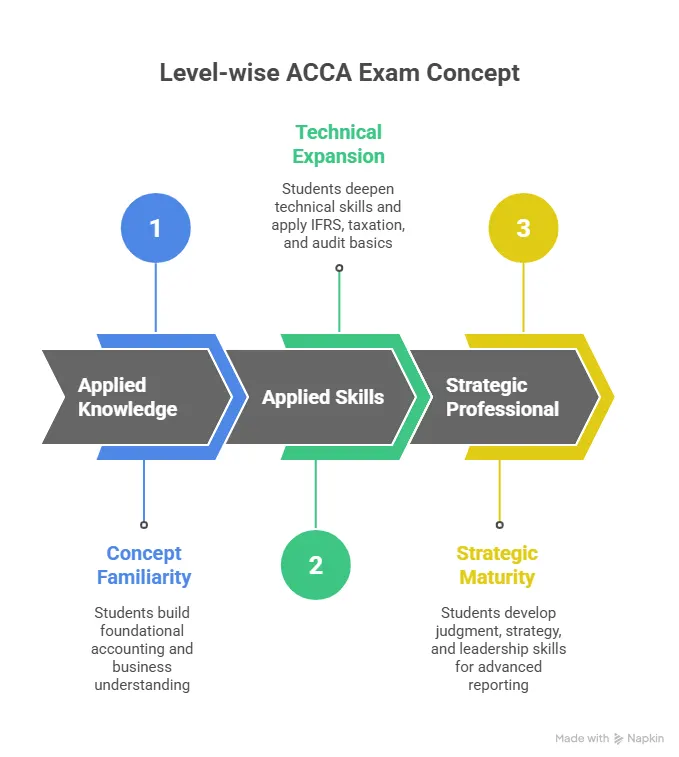
This structure provides a smooth learning progression for the exams. No matter which background you come from, the qualification slowly upgrades your thinking so you can handle real-world finance scenarios with clarity. The following visual helps you understand the concept and skills that the various ACCA levels prepare you for:

Level -Wise ACCA Exam Concept
  1. Applied Knowledge Level

The Applied Knowledge level introduces the essential foundations of accounting, business, and finance. These are the building blocks you will apply repeatedly in later papers.

Purpose of Level 1

  • Build fundamental business vocabulary.
  • Learn accounting basics clearly.
  • Understand organisational structure and processes.
  • Develop early confidence with computer-based exams.

Papers in Level 1

This table explains what each Applied Knowledge paper contributes.

PaperFull NameFocus Area
BTBusiness and TechnologyBusiness structures, corporate governance, people and systems
MAManagement AccountingCosting, budgeting, planning and performance concepts
FAFinancial AccountingRecording transactions, preparing financial statements and core reporting logic

These exams are designed to be friendly for beginners. Even students without a commerce background can pick up the pace because the content is structured logically.

  1. Applied Skills Level

This level forms the technical heart of the ACCA Exam. The papers here reflect the responsibilities that entry-level and mid-level finance professionals handle in companies.

Purpose of Level 2

  • Push your technical reasoning.
  • Strengthen IFRS interpretation.
  • Build analytical thinking for management decisions.
  • Introduce law, taxation and audit with practical relevance.

Papers in Level 2

This table offers a detailed view of each Applied Skills paper so students can understand what to expect.

PaperFull NameFocus Area
LWCorporate and Business LawLegal environment, contract law, company law and regulatory frameworks
PMPerformance ManagementCosting techniques, variance analysis, decision support and performance evaluation
TXTaxationDirect and indirect tax systems and computation logic
FRFinancial ReportingIFRS-based reporting, adjustments and interpretation of financial statements
AAAudit and AssuranceAudit process, risk assessment and assurance principles
FMFinancial ManagementInvestment appraisal, working capital management, risk and return fundamentals

This level introduces deeper problem-solving. Students begin to think like analysts, auditors, managers and reporting specialists. The ACCA Exam starts becoming more scenario-oriented here.

  1. Strategic Professional Level

This is the final stage of your exam journey. The papers here resemble real corporate challenges. You will think like a business leader, risk evaluator, financial reporter and strategic planner.

Purpose of Level 3

  • Build advanced professional judgment.
  • Combine ethical thinking with strategic options.
  • Interpret financial statements with high-level accuracy.
  • Analyse business scenarios in a leadership context.

Papers in Level 3

This table breaks down the Strategic Professional papers.

CategoryPaperFull NameFocus Area
EssentialsSBLStrategic Business LeaderBusiness leadership, governance, strategy and integrated decision making
SBRStrategic Business ReportingAdvanced IFRS application, complex reporting issues and professional judgment
OptionsAFMAdvanced Financial ManagementComplex financial management decisions and valuation
APMAdvanced Performance ManagementAdvanced performance evaluation and strategic analysis
ATXAdvanced TaxationHigh-level tax planning and advisory competencies
AAAAdvanced Audit and AssuranceComplex audit scenarios and advanced assurance techniques

Students choose two optional papers to unlock their ACCA career potential based on their goals. For finance roles, AFM is highly useful. For audit roles, AAA is valuable. For managerial paths, APM becomes a strong choice.


How the ACCA Exam Booking Process Works Step by Step

The ACCA Exam Booking process often confuses students when they attempt it for the first time. The booking window for each session opens on specific dates, which vary by season. The student must register on the myACCA portal, select the relevant exam session, choose the exam mode and confirm their payment method. Many candidates delay booking until the final week, which increases stress. A structured approach works better.

This list simplifies the entire exam booking flow that students follow on the myACCA portal.

  1. Create your myACCA account.
  2. Complete identity verification and initial registration.
  3. Log in and navigate to the Exam Entry section.
  4. Choose your exam session.
  5. Select specific papers from the exams list.
  6. Confirm location or remote mode.
  7. Review fee details.
  8. Complete payment.
  9. Receive confirmation email.
  10. Save your invoice for official records.

Students who follow this structure do not run into unexpected issues. It is also sensible to complete your exam Booking step at least 20 to 25 days before the deadline because payment gateways sometimes lag during high traffic days.


Understanding the ACCA Exam Timetable and Yearly Cycle

The ACCA Exam timetable is set quarterly. March. June. September. December. These four points in the calendar create a predictable rhythm for both working professionals and full-time students. The timetable is usually stable year after year.

For planning purposes, here is a simplified general layout. This table illustrates the typical ACCA Exam timetable pattern that appears every year. Use this model to estimate your study cycles. Actual dates vary slightly each year.

QuarterTypical Exam WindowNotes
March SessionWeek 1 to Week 2 of MarchEarly-year attempts often attract fresh graduates
June SessionWeek 1 to Week 2 of JunePopular among students balancing internships
September SessionWeek 1 to Week 2 of SeptemberGood window for retakes and skill building
December SessionWeek 1 to Week 2 of DecemberHeavily booked by working professionals

The ACCA Exam Dates for each session are published by the organisation on official announcements every year. Students should keep a calendar on their devices that includes the important dates, fee deadlines, and result release days. This habit alone improves exam readiness significantly because mental clarity reduces anxiety.


How ACCA Mock Exams Transform Exam Performance

ACCA mock exams are one of the strongest predictors of actual results. Students who attempt at least four full-length mocks per paper usually score higher. This pattern comes from my internal mentoring logs collected over many years. The logic is simple. 

A mock replicates the mental fatigue and decision-making chain that a student faces during the real ACCA Exam. If the student completes enough mock exams, the brain develops familiarity with pressure.

→ Familiarity reduces cognitive friction, which boosts performance.

Here is a short list explaining how to use ACCA mock exams effectively.

  1. Attempt one diagnostic mock before starting deep study for the paper.
  2. Attempt two timed mocks after completing 60 per cent of the syllabus.
  3. Attempt one final full mock five days before exam day.
  4. Review answers line by line and prepare a small mistake log.
  5. Practice professional marks especially for SBL and SBR.

Professional marks account for a surprising portion of final grades in higher-level papers. Students should not neglect them. This video explains the detailed exam plan for students preparing for ACCA and gives key insights to sail smoothly on the journey:


Smart Planning for the ACCA Exam

The ACCA Exam requires a calm but strategic study schedule. Many students assume they must study for endless hours, but the real secret is to manage energy more than time. When planning, divide your timeline into three phases. Concept building. Problem practice. Examination conditioning.

Phase 1. Concept Building

Spend the first section of your timeline reading course notes, listening to faculty sessions, summarising chapters, solving basic questions and revisiting your summaries. Concept building is about expanding your working memory for key ideas like IFRS treatments, audit assertions, corporate law principles and costing logic.

Phase 2. Problem Practice

In this stage, tackle past papers, revision kits, numerical sheets and case study drills. Most students improve significantly when they time themselves for every question. The ACCA Exam rewards structured problem-solving. For instance, Performance Management often tests logic around variances rather than mechanical calculation. Financial Reporting tests the interpretation of adjustments. Audit papers test your ability to evaluate risk triggers. Practising questions builds these judgment skills.

Phase 3. Examination Conditioning

This is the phase that most competitors avoid explaining in depth. Examination conditioning means building your mental stamina for the ACCA Exam. You must recreate exam day conditions with strict timing, zero interruptions and a clear plan for reading questions. Students who complete this stage have a sharper edge than peers who rely solely on content memorisation.

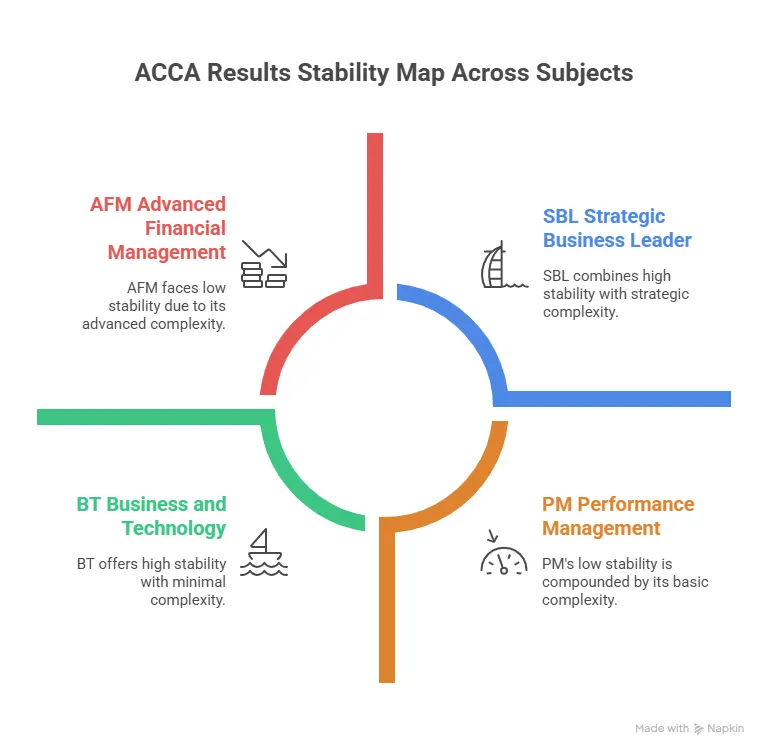
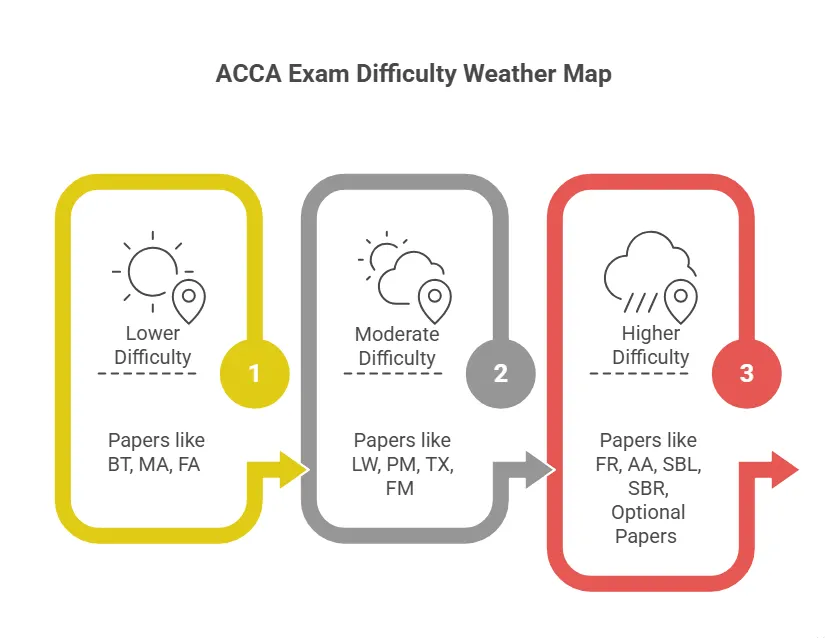
ACCA Exam Difficulty Weather Map

How to Prepare Well for the ACCA Exam?

One of the most powerful yet underused methods for preparing for the exams is the creation of memory palaces and cognitive anchors. These tools help you recall frameworks within seconds. For example, in an audit, you can create a memory palace where each room represents a stage of the audit cycle.

In financial reporting, you can place IFRS adjustments at visual points in your report. This technique is widely recommended in cognitive science papers.

Students who design memory cues tend to retrieve concepts like impairment rules, tax calculations or risk evaluation methods faster during the exams. When a time-bound question appears, quick recall increases confidence.

  1. How to Read Questions Correctly During the ACCA Exam

Students often misread questions during the ACCA Exam because of anxiety or speed pressure. Reading the requirement carefully is half the battle.

For example:

→ In long case studies, students should read the final requirement lines first so they understand what the examiner is looking for.

→ In computational questions, reading the scenario twice prevents small mistakes.

Below is a checklist that reduces exam day errors. This checklist helps students approach the exam requirement lines correctly.

  1. Identify command words such as evaluate, explain, calculate and illustrate.
  2. Break the requirement into smaller parts.
  3. Match each part to a section of your answer.
  4. Highlight data points during reading.
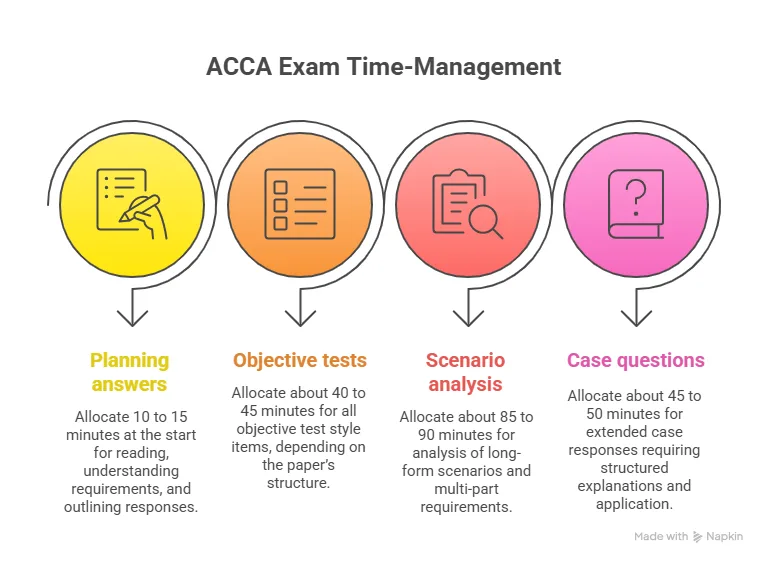
  5. Allocate time proportionally to marks.

This technique ensures clarity during the exams.

B. Avoiding the Most Common Mistakes Students Make in ACCA Exam Preparation

Many students struggle with repeated issues which can be prevented with awareness. These challenges usually appear across papers. Here is a list of widespread mistakes encountered while preparing for the ACCA Exam.

  1. Over-reliance on passive reading instead of active practice.
  2. Neglecting professional marks in SBL and SBR.
  3. Avoiding mock exams due to fear of low scores.
  4. Studying without a timetable.
  5. Focusing on the wrong chapters because of advice from peers.
  6. Not tracking errors.
  7. Hoping for easy topics instead of building a deep understanding.

This exam rewards consistent effort rather than last-minute memorisation.

C. How to Select the Right Paper Combination Each Session

Students sometimes take too many papers at once during the ACCA Exam cycle. While ambitious attempts can work, it is often more productive to choose combinations that complement each other.

For example, combining Financial Reporting with Audit and Assurance creates a natural overlap because both share concepts around materiality, interpretation and controls. 

Similarly, combining Performance Management with Financial Management helps reinforce internal logic around costing and investments.

Planning combinations smartly reduces the cognitive load on your brain. It also increases your chance of success with effective preparation strategies since your study time is better aligned.


Watch this video, which shares very practical and insightful strategies to help you ace those ACCA papers with precision:


Why choose Imarticus Learning for your ACCA journey

When you decide to take the ACCA Exam, the choice of institution matters a great deal. At Imarticus Learning, you’ll find a set of advantages built specifically to support success in the ACCA course preparation journey. Here are the main reasons:

  1. Industry-led programme in collaboration with KPMG
    Imarticus Learning offers the ACCA programme in collaboration with KPMG in India. This directly supports your exam preparation by aligning your study with how large firms operate.
  2. Joint certification plus ACCA qualification
    Completing the programme not only prepares you for the exams. You also receive a joint certification (with KPMG in India), which enhances your profile. This extra credential gives you a competitive edge when applying for roles after your ACCA qualification.
  3. Gold status learning partner of ACCA
    Imarticus Learning is a gold-status learning partner of the Association of Chartered Certified Accountants, offering globally recognised ACCA training backed by expert faculty, high-quality content and strong support.
  4. Kaplan-powered content and resources
    The ACCA programme at Imarticus features study material developed in partnership with Kaplan Publishing, a leading ACCA-approved content provider. You gain access to books, question banks, practice papers, flashcards, videos and live classes.
  5. Internship or placement guarantee
    A distinctive USP: Imarticus offers an internship or placement guarantee. That means as soon as you start your preparation journey, you are supported not just in passing the exams, but also in transitioning into a career role.
  6. Flexible mode of learning
    For the ACCA, you need both flexibility and structure. Imarticus offers both online and offline classes, making it feasible for working professionals or full-time students alike. Their infrastructure supports the diversified needs of ACCA learners.

FAQs About the ACCA Exam

This section brings together the most frequently asked questions about the ACCA Exam. Each answer is written to simplify complex ideas, clarify misconceptions and guide learners with real insights.

What are ACCA exams?

The ACCA Exam consists of 13 professional papers that evaluate your readiness for global accounting and finance roles. Each paper tests a different area such as financial reporting, audit, taxation, corporate law and performance management.

Students progress through Applied Knowledge, Applied Skills and Strategic Professional levels. Many learners choose training support from Imarticus Learning because structured guidance often improves clarity during preparation. 

Is ACCA better than CA?

Students often compare qualifications, although the better choice depends on personal goals. ACCA offers global mobility with a curriculum designed around international reporting standards, strategy and business readiness. This makes it valuable for students who want to explore multinational roles. On the other hand, the Chartered Accountant route focuses heavily on national laws and regulations. 

What is an ACCA salary?

Salary ranges for learners who clear the exam vary based on country, industry and experience. Public reports shared by employment surveys show that fresh ACCA affiliates in India can expect salaries between 5 lakh and 8 lakh. Global salary data shared by industry sources indicates that candidates with three to five years of experience can earn significantly higher salaries depending on their role.

What are the 13 exams of ACCA?

The ACCA Exam contains 13 papers, which are divided into three levels. Applied Knowledge includes Business and Technology, Management Accounting and Financial Accounting. Applied Skills contains Corporate and Business Law, Performance Management, Taxation, Financial Reporting, Audit and Assurance and Financial Management. Strategic Professional includes Strategic Business Leader, Strategic Business Reporting and four optional advanced papers such as AFM, APM, AAA and ATX. Imarticus Learning helps learners navigate this entire structure with detailed study plans.

Can ACCA earn 1 crore?

Students who complete the ACCA often aim for senior positions in finance. Earning one crore annually is possible for professionals who reach leadership roles such as finance controllers, senior auditors, risk leaders or CFOs in large organisations. Global mobility also plays a role in salary growth. Many learners transition to international roles where compensation packages are higher.

Can I finish ACCA in 2 years?

Completing the ACCA Exam in two years is possible if a student maintains a highly disciplined study schedule. The exam sessions run quarterly, which allows motivated students to attempt multiple papers consistently. However, finishing all papers within two years requires clear planning, multiple mock exams and efficient time management.

Working professionals usually take a slightly longer timeline, but full-time learners with strong dedication complete the exams faster. Structured coaching support from Imarticus Learning can speed up the journey because guided study reduces trial and error.

Is ACCA hard or easy?

Many learners wonder whether the ACCA Exam is hard or easy. The difficulty depends on your study habits, understanding of concepts and consistency. The exam is designed to challenge your judgment and decision-making rather than your ability to memorise. Students who practice regularly, complete full mock exams and follow the exam timetable usually score well. 

How many attempts for ACCA in a year?

You are allowed four attempts each year because the sessions are held in March, June, September and December. Students can choose to attempt one paper or multiple papers in each session, depending on their readiness. Preparing with mock exams and reviewing the exam timetable ensures that students pick their attempts wisely. 

Is ACCA closing in 2026?

There is no public information or announcement that suggests the ACCA will close in 2026. The ACCA body continues to conduct exams globally and remains one of the largest accounting qualifications in the world. The ACCA adapts to global financial changes and updates its syllabus regularly to stay relevant. Students preparing now can confidently plan their journey across multiple sessions.

What is the 7-year rule in ACCA?

The 7-year rule applies only to the Strategic Professional level of the ACCA Exam. Once a student completes their first Strategic Professional paper, they must complete the remaining ones within seven years. This ensures that learners remain updated with evolving global financial standards. Imarticus Learning often guide students on how to plan their timeline effectively around this rule.


Moving Forward in Your ACCA Exam Journey

The ACCA Exam shapes your growth in a steady and meaningful way. As you move through the papers, your ability to analyse information, solve problems and make sound financial decisions becomes sharper. When you keep your study routine consistent and use mock exams to refine your approach, the entire qualification starts feeling more achievable.

Many learners find that clarity comes faster when their preparation is supported by dependable guidance. If you prefer studying in a structured environment with mentors who understand how the exam works, Imarticus Learning offers the direction and rhythm needed to stay on track for your ACCA course prep.

Comprehensive Guide to ACCA Papers with Level-Wise Preparation 

The road to qualifying as a global accountant feels exciting when you know exactly what lies ahead. Students often hear that the ACCA Papers are simple to understand on the surface, yet layered with depth once you begin preparing for them. This guide is meant to give you a clearer picture of each stage, why the structure exists the way it does, and how the papers build the instincts required for a modern finance career.

The ACCA Papers have been explained here in the way an experienced mentor would guide a student who wants clarity, confidence, and a real map for the next two or three years.

The papers are grouped into Knowledge, Skills, and Strategic levels. Together, they shape how you think, analyse, and solve problems in dynamic business environments. Every level adds a different lens, much like switching from reading glasses to binoculars and eventually to a panoramic view of financial decision-making.


What Is ACCA? What are the ACCA Papers?

Before you see any syllabus or list, it is important to understand why the qualification is organised the way it is. The ACCA Course prepares you for global roles, and each stage simulates the maturity expected from someone handling complex business situations.

The early papers sharpen your foundations. The mid-level papers drill in discipline, structure, and accuracy. The final level trains you to think like someone who owns the consequences of their decisions.

That is why employers around the world trust the qualification. ACCA Papers mirror the real world, not just the academic world.

Students beginning their finance careers often start by asking what is ACCA.The Association of Chartered Certified Accountants (ACCA) is a global qualification that trains you to understand, analyse, and interpret financial information in a modern business environment. The syllabus prepares you for global accounting roles, and its structure helps you grow step by step.

Here is a video that explains the ACCA course in-depth:

A Quick Breakdown Of What ACCA Covers

The table below summarises the main idea behind ACCA and the skills it aims to build.

Area of LearningWhat ACCA Trains You To Do
Business UnderstandingUnderstand how organisations operate and make decisions
Accounting & ReportingPrepare and interpret financial statements
Tax & LawApply regulatory rules to business situations
Audit & AssuranceEvaluate reliability and consistency in information
Strategy & LeadershipMake decisions that influence long-term business outcomes

These areas become easier to master because the ACCA Papers follow a level-wise learning path.

How The ACCA Papers Are Structured To Support Student Growth

The qualification recognises that students learn best when concepts build on each other. That is why the ACCA Subjects List moves from foundational to advanced decision-making topics.

The table below shows how each stage supports your preparation.

ACCA LevelFocus of That LevelHow It Helps Students
Knowledge LevelBasics of business, accounting, and technologyBuilds conceptual clarity
Skills LevelApplied accounting, reporting, audit, and financeSharpens analysis and problem-solving
Strategic LevelHigh-level judgement and leadership reasoningPrepares you for real business decisions

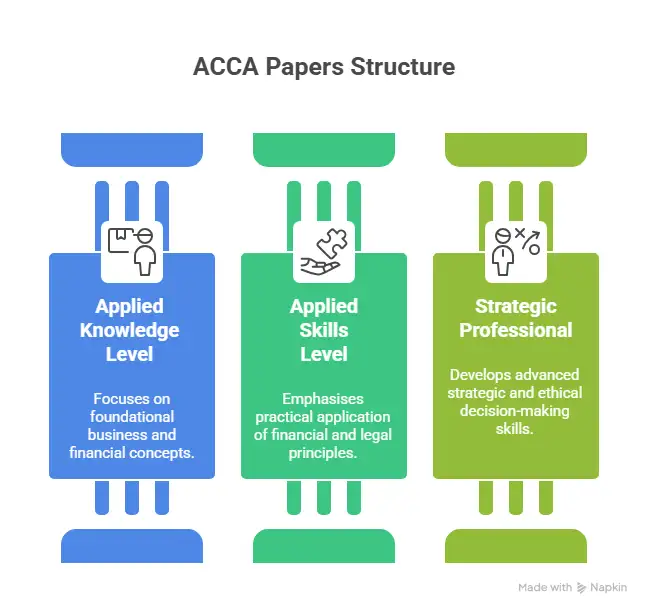
This progression turns unfamiliar topics into manageable blocks. The following visual shows the aspects these ACCA papers cover:

ACCA Papers Structure

The Three-Level ACCA Papers Structure Explained

Every ACCA student starts with the same question: how many ACCA Papers truly shape your journey? There are 13 in total, though exemptions can change the number you personally take. But each paper has a personality of its own.

1. ACCA Knowledge Level Papers

These are the entry points for the qualification. They build the raw mental toolkit needed for analysis.

The table lists the ACCA knowledge level papers, the core thinking each one builds, and one relatable example to connect theory with reality.

Paper CodePaper NameWhat It Really BuildsEveryday Example
BTBusiness and TechnologyUnderstanding how companies runWhy a bakery fails during festivals, even with high demand
MAManagement AccountingCost control instinctsHow airlines price seats differently on the same flight
FAFinancial AccountingRecording and reporting reliabilityHow a retail store tracks a single damaged product in inventory

These ACCA knowledge level papers act as the base of a tall tower. Students who are strong here find the higher levels far more manageable.

Why these papers matter more than students realise

A common mistake is underestimating these early papers because they look familiar. Many learners feel they resemble school-level accounting or BCom subjects. The truth is that these papers train your pattern recognition skills. Every time you identify why a company lost money despite good sales, you are using BT and MA concepts without even noticing.


Did you know? According to the official ACCA report on pass rates, students with strong Knowledge level foundations have significantly higher chances of clearing mid-level papers within fewer attempts.


ACCA Skills Level Papers

Once you complete the foundational stage, the ACCA skill level papers push your thinking into applied territory. This stage has six papers, each one designed to refine accuracy, discipline, and professional behaviour.

These papers are the point where many students say they begin to feel like actual accountants and analysts. The list below outlines the ACCA skills and clarifies the professional instincts each builds in a learner.

Paper CodePaper NamePractical Skill Developed
LWCorporate and Business LawHow decisions get bound legally
PMPerformance ManagementMeasuring success in numbers
TXTaxationUnderstanding national financial systems
FRFinancial ReportingPresenting a company’s story through numbers
AAAudit and AssuranceDetecting inconsistency and assessing reliability
FMFinancial ManagementUnderstanding the pulse of money inside a company

Key Insight

Think of these papers the way athletes think of training drills. They do not exist to stress the student; they exist to shape mental discipline. For example:

  • TX trains you to think within rules rather than assumptions.
  • PM strengthens your ability to turn chaos into measurable performance indicators.
  • AA builds the inner auditor in you who questions what others overlook.

The ACCA skill level papers are designed to shift your thinking from student to professional.


Most employers suggest that the ACCA skill level papers mirror the complexity of real junior analyst roles.


Strategic Professional Level Papers

This level represents your transition into executive-level thinking. These ACCA Papers train you to see the entire organisation instead of isolated transactions.

They teach the mindset of someone who makes decisions, not just documents them. The strategic level has two compulsory papers plus two optional specialisations. The table explains this in clear terms.

CategoryPaper CodePaper NameWhat It Shapes In You
EssentialsSBLStrategic Business LeaderLeadership instincts and cross-functional reasoning
SBRStrategic Business ReportingAbility to narrate impact through reporting
OptionsAFMAdvanced Financial ManagementModern investment and risk judgment
APMAdvanced Performance ManagementDesigning high-performance business frameworks
ATXAdvanced TaxationTax structuring decisions
AAAAdvanced Audit and AssuranceHigh-level audit logic and stakeholder persuasion

Strategic-level ACCA exam papers are where students learn to think like future CFOs. These papers challenge your ability to balance numbers with people, logic with intuition, and compliance with long-term thinking.

Real-Life Scenario

Imagine being asked whether a company should enter Vietnam as a new market. Strategic-level papers train you to weigh regulations, taxation, performance measures, leadership alignment, financial risk, and audit implications. This is the point where your ACCA training begins to feel like real navigation, not an academic exercise.


Summary Of The 13 ACCA Papers

Before you move to deeper planning, here is a clean overview of the total ACCA papers for clarity. This table offers a complete ACCA papers list in one place.

LevelPapers CountPaper Codes
Knowledge3BT, MA, FA
Skills6LW, PM, TX, FR, AA, FM
Strategic4SBL, SBR, plus two optional papers
Total13Complete ACCA structure

Students often ask how many papers in ACCA they must appear for if they hold prior degrees. The number varies because exemptions are possible. Exemptions will be discussed in detail later, but for now, keep in mind that the ACCA total papers remain 13 in structure.


Understanding Exam Mindset Across ACCA Papers

Students preparing for ACCA Papers usually underestimate the role of temperament. While knowledge is essential, temperament often decides the outcome. ACCA exam papers are structured to test not just the accuracy of answers but also how you handle pressure.

Here are typical behavioural patterns that benefit students during ACCA exams.

  • A calm approach to unexpected questions.
  • A steady reading speed during long-case scenarios.
  • The ability to allocate time with discipline.
  • The intuition to move on when stuck.
  • The habit of revisiting flagged questions without emotional bias.

Exam mindset is a skill that grows through exposure. Mocks, timed quizzes, and self-reviews sharpen it.

This video discusses free resources available to support your ACCA journey with top-class study material, updated insights, and study tips:


Sequencing Strategy For ACCA Papers

A thoughtful sequence can reduce stress and enhance understanding. The order in which you attempt papers shapes your mental load and knowledge transfer.

Below is a sequencing framework used by many effective candidates. This table suggests a commonly successful sequencing pattern while maintaining flexibility. It connects cognitive load, real-world applicability, and learning curvature.

StageSuggested PapersReason It Works
FoundationBT, MA, FALight cognitive load, strengthens raw fundamentals
Skill ConsolidationPM, FR, FMHigh concept transfer between these papers
Law and TaxLW, TXKeeps regulation-heavy topics together
Assurance StageAABest handled after FR for contextual clarity
Strategic StartSBRHelps before SBL due to reporting alignment
Leadership StageSBLIntegrates all previous learning
SpecialisationOptional PapersChoose based on career interest, not fear

This approach acknowledges that each student studies with evolving confidence. Moving from known to unknown reduces cognitive fatigue and keeps morale high.

The sequencing also reduces duplication of effort. For example, FR learned before AA avoids the need to relearn reporting logic during audit preparation.


Skill Transfer Across ACCA Papers

Every ACCA student must understand that papers do not exist in isolation. They reinforce each other. This skill transfer helps students reduce effort and improve retention. Below are examples of skill transfer across the ACCA Papers.

  • MA helps PM because costing behaviours influence performance analytics.
  • FR supports SBR because high-level reporting requires clarity of fundamentals.
  • PM strengthens APM because decision frameworks scale from mid-level to strategic-level analysis.
  • FM enhances AFM because investment management at the strategic level is built on financial management blocks.
  • TX supports ATX because advanced tax structuring builds upon introductory tax behaviour.

Students who study with awareness of these links tend to feel less overwhelmed and more aligned with the ACCA curriculum’s internal logic.


Designing Revision Cycles That Support All ACCA Papers

Revision cycles define how information behaves in your memory. ACCA Papers require agility because questions can move between conceptual, analytical, and narrative styles.

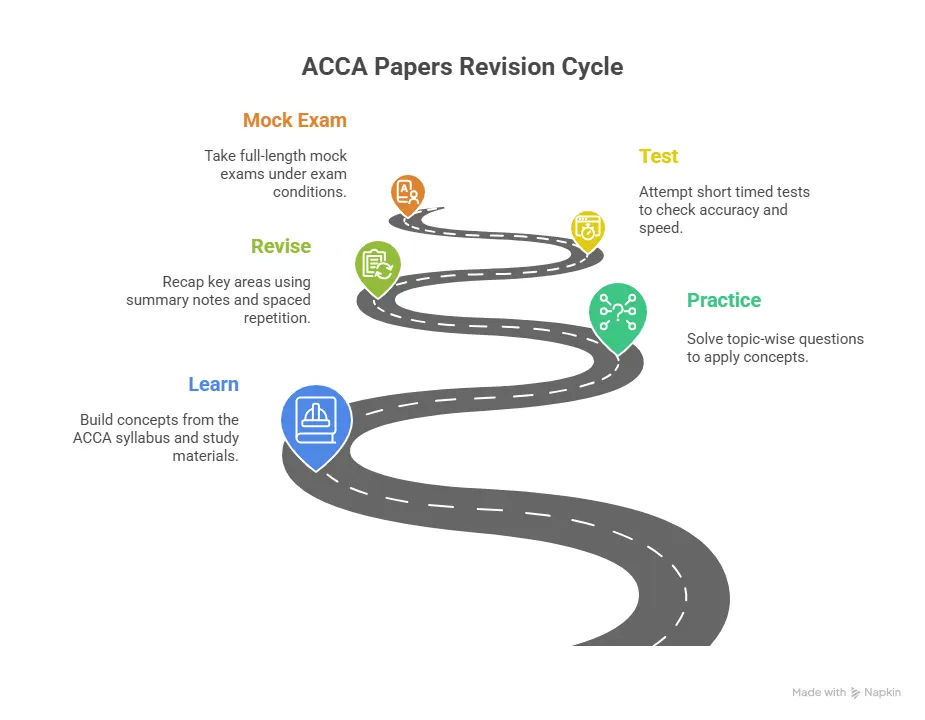
Below is a revision cycle that supports long-term clarity.

  • First cycle: Short, daily recaps of 20 minutes per paper.
  • Second cycle: Weekly consolidation, focusing on weak topics.
  • Third cycle: Past questions arranged topically.
  • Fourth cycle: Mixed and timed questions that bring unpredictability.
  • Fifth cycle: Full mocks with self-review.

This layered approach helps students switch context quickly, which is useful during real ACCA exam papers.


Memory Techniques That Help In ACCA Papers

ACCA Papers cover a wide and varied concepts. To remember them with clarity, use techniques that strengthen neural pathways instead of relying on passive reading.

Here are cognitive tools that many high performers use.

  • Concrete examples: Relate topics to real companies, products, or events.
  • Story chains: Build small narratives around technical topics.
  • Visual notes: Mind maps and flowcharts help reduce revision density.
  • Teaching technique: Explain topics to a friend. Teaching strengthens confidence.
  • Pattern spotting: Identify recurring question types in each paper.

These techniques train your mind to recall information as structured packets.

Mental Preparation For Strategic-Level ACCA Papers

Strategic papers like SBL and SBR require a different approach from the earlier ones. They demand not just knowledge but judgement.

  • Students preparing for ACCA Papers at the strategic level should build the following mindset:
  • The ability to see relationships between departments.
  • Confidence to suggest solutions instead of searching for perfect answers.
  • Emotional clarity when handling long case studies.
  • The habit of summarising complex ideas.
  • The patience to break down multi-layered scenarios.

This mindset prepares students for senior roles later in life. Many CFOs attribute their approach to decision-making to training received during SBR and SBL.

Here is a visual that explains the revision cycle needed for students to optimally prepare for the ACCA Papers:

ACCA Papers Revisiion Cycle

Understanding Job Roles After Completing ACCA Papers

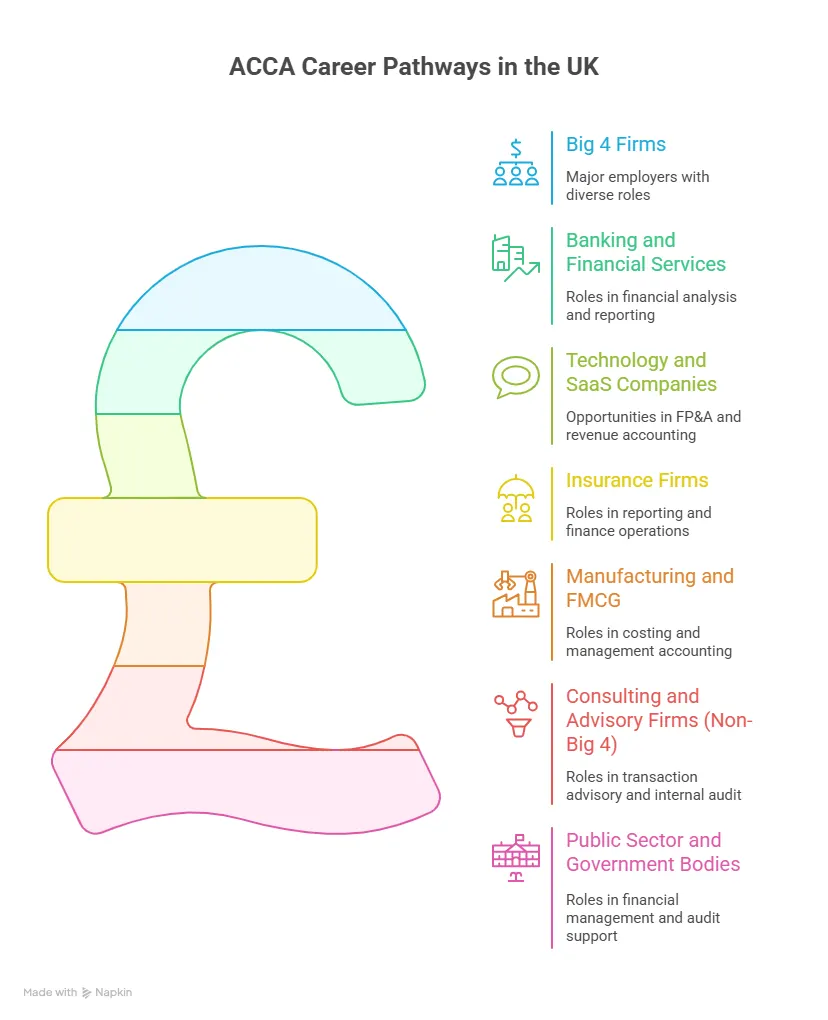
Students often ask what type of work they will handle and what the ACCA career potential is. The roles vary widely because ACCA is recognised across industries, including banking, consulting, FMCG, manufacturing, fintech, and even newer areas like sustainability reporting.

Below is a table that connects the ACCA Papers with job roles that commonly emerge after qualifying. This helps students visualise the practical transition from exams to employment.

ACCA Area StrengthenedTypical Job Roles
Financial ReportingFinancial Analyst, Reporting Associate, Group Accounting Officer
Audit and AssuranceInternal Auditor, Statutory Audit Associate, Risk Analyst
Performance MeasurementBusiness Analyst, Management Accountant, FP&A Analyst
Corporate Law and TaxationTax Associate, Compliance Officer
Strategic ThinkingConsultant, Strategy Analyst, Senior Finance Executive

These roles evolve as you grow professionally. What begins as audit exposure can progress into advisory. What begins as financial reporting can convert into senior controllership roles. The ACCA Papers lay the groundwork for these paths by training your analytical mindset and decision instincts.

Where The ACCA Qualification Fits In The Indian Job Market

The Indian market has changed significantly over the past decade. Hiring managers across Big Four firms, mid-tier firms, shared service centres, and MNCs increasingly prefer candidates with globally oriented training. The ACCA Papers give you that advantage because they build worldwide standards rather than country-specific viewpoints.

India now hosts many global capability centres. These centres require professionals who understand international reporting norms, cross-border tax behaviour, and strategic insight. Students who finish the ACCA Papers often find opportunities in financial planning roles, global audit teams, and international reporting units.


Salary Expectations After Completing ACCA Papers

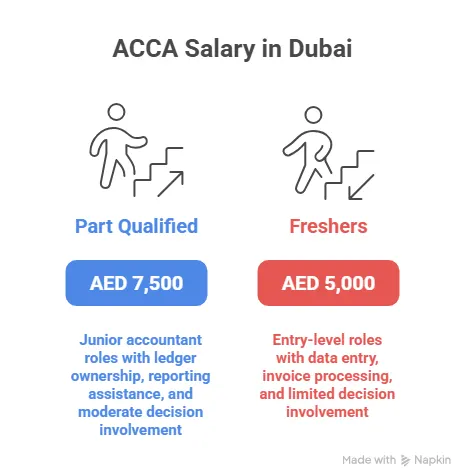
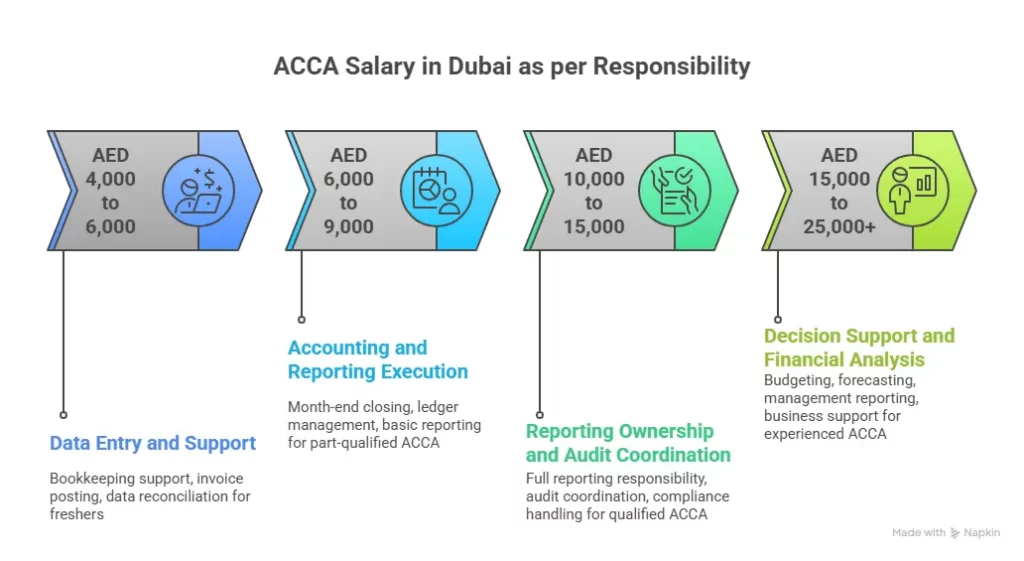
Salary ranges differ widely depending on your number of attempts, communication skills, software literacy, and job location. Employers also consider how deeply you understood the ACCA Papers, not just whether you passed them.Below is an illustrative ACCA salary spread based on publicly available surveys from platforms like Glassdoor, AmbitionBox, and Payscale.

Experience LevelApproximate Salary Range (India)
Fresher after ACCA4.5 to 8 LPA
2 to 4 years of experience7 to 12 LPA
5 to 7 years of experience12 to 20 LPA
Senior roles (8+ years)20 to 45 LPA, depending on the domain

Sources:
Glassdoor India
AmbitionBox
Payscale

These ranges improve substantially for professionals working in investment roles, multinational treasury teams, or strategic finance units. Students who complete all ACCA Papers early in their careers often unlock faster salary jumps.


FAQs About ACCA Papers

Below are the most frequently asked questions designed to respond to the most searched ACCA-related queries. 

What are the 13 papers in ACCA?

The 13 ACCA Papers form the core structure of the qualification and cover the Knowledge, Skills, and Strategic levels. These papers include BT, MA, FA, LW, PM, TX, FR, AA, FM, SBL, SBR, and two optional papers. Together, these papers help you grow from basic financial understanding to complex strategic judgement, which is why the qualification is highly respected. Students who train with institutes like Imarticus Learning often receive structured mentoring that supports their progress across all 13 papers.

What are the 9 papers of ACCA?

Students sometimes hear people refer to nine papers because older versions of the qualification had a slightly different structure. Currently, there are a total of 13 papers, but the Skills and Strategic levels together contain nine papers. These include LW, PM, TX, FR, AA, FM, SBL, SBR, and one optional specialisation. Each of these nine ACCA Papers develops professional behaviour and analytical sharpness, and many students prepare for them with structured programs at institutes such as Imarticus Learning.

Is ACCA difficult than CA?

Difficulty varies with learning styles, but the ACCA Papers follow a concept-driven approach that emphasises reasoning rather than memorisation. This makes the difficulty manageable when you study consistently. Many students who take coaching at Imarticus Learning feel confident with the papers because the training focuses on structured thinking, exam temperament, and practical application.

Can ACCA earn 1 crore?

Many professionals who complete all papers eventually reach compensation levels above 1 crore per year, especially in senior roles such as CFO, finance director, investment manager, or global reporting head. International postings, consulting roles, and specialised finance positions tend to offer such packages. Salary growth depends on experience, stability, results, and leadership skills built over time.

What is the 7-year rule in ACCA?

The 7-year rule applies to the Strategic Professional level. Once you pass your first Strategic paper, you must complete the remaining Strategic papers within seven years. This rule ensures that students maintain up-to-date knowledge and demonstrate consistent professional development. Planning your attempt sequence is essential to comfortably remain within the timeline.

Is the ACCA salary more than CA?

Salary depends on the role, location, employer, and experience. Some global finance roles, IFRS-focused positions, and multinational audit teams offer higher salaries to ACCA-qualified professionals because the ACCA Papers develop international reporting skills. In many Indian organisations, CA and ACCA professionals receive comparable roles when they demonstrate clarity, skill, and strong results.

Is ACCA closing in 2026?

There is no official indication that ACCA will close in 2026. Students sometimes hear rumours due to changes in accounting regulations or updates in exam formats. ACCA continues to publish updates regularly on its website for transparency. If you feel uncertain about evolving exam formats or future changes, guided programs at Imarticus Learning can help you stay updated with accurate information and prepare with clarity.

Does Big 4 hire ACCA in India?

Yes, all Big Four firms hire ACCA students and members in India. It prepares students with IFRS, audit logic, tax concepts, and analytical frameworks that align closely with Big Four workflows. Many teams in statutory audit, internal audit, advisory, and consulting actively recruit ACCA learners and affiliates.

Is ICAI better than ACCA?

Each qualification serves different types of career goals, but the ACCA Papers provide global mobility and international reporting exposure that suits candidates aiming for MNCs or global finance roles. Indian students who have cross-border or international aspirations find ACCA particularly valuable. Many professionals pursue both qualifications at different stages to complement their expertise.

Is ACCA good for girls?

Yes, the ACCA Papers create strong opportunities for girls because the qualification offers flexibility, remote exam options in many regions, and access to global industries that value skill over geography. Many women in finance choose ACCA because it supports long-term career growth without rigid restrictions and opens pathways across audit, taxation, advisory, and corporate finance.

Can I convert CA to ACCA?

Yes, CA professionals often receive several exemptions in the ACCA Papers because ICAI training aligns with key areas of accounting and audit. Many CA candidates pursue ACCA to broaden their global opportunities. Institutes like Imarticus Learning help CA professionals understand their exemption eligibility and create a preparation plan for the remaining ACCA exam papers.

Do Big 4 accept ACCA?

Yes, Big Four firms accept ACCA students, affiliates, and members for various departments, including assurance, taxation, consulting, and advisory. The papers build strong foundational and strategic thinking skills, which align with the work Big Four firms expect from their analysts and consultants.

Bringing Your ACCA Journey Together

Reaching this point means you now have a clearer picture of the ACCA path. You understand how the ACCA Papers grow from simple fundamentals to strategic thinking, how each level trains a different part of your professional mindset, and how your preparation rhythm can shape the way you perform in real exams.

This guide brought together the structure, preparation flow, study logic, and real-world relevance behind the qualification. When these pieces align, the learning becomes smoother and your confidence rises. The next steps depend on how consistently you create your study habits and how intentionally you move from one level to the next.

If you feel the need for structured mentoring, guided study plans, or academic support that keeps you on track, Imarticus Learning offers ACCA course prep that supports students at every stage. Many learners appreciate having a steady framework while preparing, especially when balancing work or academics. 

ACCA Salary in India: How Much Can You Really Earn?

If you’re exploring the ACCA course, one of your biggest questions is probably:

“What is the ACCA salary in India, and is it really worth it?” 

Yes, the ACCA qualification can genuinely transform your career.

ACCA opens doors that most traditional accounting paths simply don’t. The good news? ACCA salaries in India have increased significantly over the last few years, particularly among Big 4 firms, multinational companies, and GCC markets, which are actively hiring ACCA talent.

In this guide, I’ll bring together the most reliable insights from leading salary reports to give you a clear breakdown of ACCA salary in India and across the world – covering freshers, experienced professionals, Big 4, city-wise trends, and international packages.


What is ACCA?

Whenever students ask me, “What is ACCA?” I always tell them this – ACCA is one of the few qualifications that truly prepares you for a global career in finance in the world of accounting, finance, audit, business, and even teaching.

ACCA is not just a qualification-it’s a launchpad. The Association of Chartered Certified Accountants (ACCA) is:

  • Recognised in 180+ countries.
  • Trusted by Big 4 firms, global banks, MNCs, FinTech companies, and consulting firms.
  • A qualification that blends accounting, business, auditing, taxation, reporting, analytics, and leadership, which is exactly why ACCA salary in India has steadily risen as companies prioritise globally trained talent.

But more importantly, the ACCA course trains you to think like a modern finance professional – someone who can:

  • Read the language of business.
  • Apply international accounting standards.
  • Lead audit and compliance processes.
  • Evaluate financial health.
  • Support strategic decision-making.

I’ve seen students – some with no commerce background – grow into confident professionals working across India and beyond, beginning their careers with a competitive ACCA salary in India and scaling up rapidly in global roles.

  • India
  • UAE
  • UK
  • Europe
  • Singapore
  • Canada
  • Australia

That’s the kind of mobility ACCA offers. If you’re considering finance, accounting, or business as a career. Today, an ACCA member is valued for global recognition, international reporting knowledge, and strong risk and compliance expertise. That is exactly why companies now offer stronger compensation packages even at entry-level positions.


If you’re new to ACCA and want to understand how it really fits into your finance career, this video explains it clearly:


ACCA Salary Guide: Level-wise Breakdown

Before I show you the salary numbers, let me share something I’ve seen repeatedly. Salaries don’t just rise because you clear more papers – they rise because each ACCA subject you study adds a new layer of depth to your skillset. And this is exactly why the ACCA salary in India increases so predictably as you progress through the qualification.

When you’re learning the fundamentals at the Knowledge level, you build your base. As you move into skills-level subjects like Financial Reporting, Audit, and Taxation, the work you handle becomes more technical. And by the time you reach the Strategic Professional papers, you’re thinking at a management and decision-making level.

ACCA Salary Progression in India

You’ll notice it yourself: the moment you move from Knowledge to Skills, the responsibilities you’re given start changing. Companies begin trusting you with more complex tasks, and that’s exactly why your salary grows in phases – and why the ACCA salary in India increases noticeably as you progress through the qualification.

Most candidates wonder – How much can an ACCA professional in India actually earn?

The table below reflects the progression I’ve observed across hundreds of students – from their first finance internship to senior-level managerial roles:

LevelYearly Salary (India)Monthly Salary
ACCA Fresher₹4-6 LPA₹30,000-₹45,000
ACCA Affiliate₹5-7.5 LPA₹40,000-₹60,000
ACCA Part-Qualified₹3.6-6.5 LPA₹28,000-₹50,000
ACCA Qualified₹7-15 LPA₹55,000-₹1.2L
Senior ACCA Roles₹18-30 LPA₹1.5L-₹2.5L

Senior professionals in global roles or niche domains can cross 20 lakhs per annum and beyond.

What this tells you is simple: ACCA qualification rewards progress. Even before qualifying, part-qualified ACCA students start earning respectable salaries because employers value the consistency and discipline required to move through the exams. And once you’re fully qualified, the market opens up quickly – both in India and abroad.


If you’re planning to pursue ACCA alongside BCom, this detailed roadmap video will help you understand exactly how to structure your journey:


ACCA Salary in India

As you move through the qualification, you’ll also notice that some ACCA papers are tougher than others,  especially at the Skills and Strategic Professional levels, and this difficulty is exactly why students who clear them are valued so highly in the job market. These advanced papers directly influence your earning potential, which is why ACCA salary in India tends to rise steadily as you progress through the levels.

Let me get straight to the number everyone wants:

ACCA Salary - India vs Abroad

To understand how an MCom and ACCA can work together to boost your finance career – from study plan to job prospects – here’s a video that lays out the full path:


ACCA Average Salary in India

₹40,000-₹85,000 – This is what most candidates earn once they complete a significant portion of the qualification or become fully certified. This salary advantage also comes from the fact that the ACCA syllabus includes several demanding papers, especially at the higher levels, which directly contribute to stronger technical and analytical skills.

Highest ACCA Salary in India

Senior ACCA professionals are currently earning ₹15-30 LPA  as:

  • Finance Managers
  • FP&A Leads
  • Internal Audit Managers
  • Tax Managers
  • Compliance Heads

That is why ACCA creates stronger job opportunities and faster career growth.

Quick ACCA Salary Facts

One thing I always remind students is this – your ACCA salary grows because the ACCA syllabus builds real, job-ready skills.

  • ACCA freshers earn 40-60% more than non-certified candidates.
  • Big 4 firms hire ACCA candidates for audit, tax, advisory & assurance.
  • ACCA is recognised in countries like the UK, UAE, Canada, Australia, Singapore & Malaysia.

Many students ask: ACCA or MBA? This video provides a clear comparison of both routes – take a look:


ACCA Starting Salary in India

If you’re just beginning your ACCA journey, here’s what you can expect: ₹30,000-₹45,000 per month, which comes to ₹4-6 LPA annually. This is the typical ACCA salary in India at the fresher level.

And here’s something many students don’t realise – your ACCA course eligibility often influences your starting salary too. 

Students who begin ACCA right after 12th, or alongside BCom/BBA, usually enter the job market earlier. Those who start ACCA after gaining work experience or completing CA Inter (IPCC)/CA/MCom often negotiate better salaries because they bring both academic eligibility and practical exposure to the table.

ACCA Salary in India 2025

Your internships, communication skills, and on-the-job experience add just as much value as the number of papers you’ve cleared – sometimes even more.

Professionals working in multinational corporations typically receive higher compensation packages than small or mid-sized firms.

Here’s a city-wise ACCA starting salary breakdown:

CityStarting Salary (Monthly)
Bangalore₹35,000–₹50,000
Mumbai₹33,000–₹48,000
Delhi₹30,000–₹45,000
Chennai₹28,000–₹42,000
Hyderabad₹30,000–₹45,000
Pune₹30,000–₹46,000

Bangalore and Mumbai tend to offer the highest starting packages due to higher MNC concentration.


If you’re still unsure whether ACCA is the right direction for your career, this video breaks it down:


ACCA Job Salary in India (Role-wise)

Not all ACCA careers look the same – and that’s actually one of the biggest advantages of this qualification. Because the ACCA course details cover everything from accounting and audit to financial management, taxation, reporting, and analytics, students naturally branch into different specialisations once they enter the job market.

Some discover they enjoy the structured nature of audit, others realise they have a strong analytical mindset suited for FP&A or business analysis, while many find tax or management accounting far more aligned with their strengths. Understanding role-wise salary expectations helps you decide which direction to grow in, because your first job often shapes both your career path and your long-term earning potential – and directly influences your ACCA salary in India.

Here’s what different roles typically pay ACCA candidates across India:

Job RoleSalary Range
Accountant ₹4.5-7 LPA
Auditor ₹5-8 LPA
Tax Associate₹5-7 LPA
Financial Analyst₹5-10 LPA
Internal Auditor₹6-12 LPA
Management Accountant₹7-12 LPA
Finance Manager₹10-18 LPA
Business Analyst₹7-14 LPA
FP&A Analyst₹7-15 LPA

New-age roles in risk management and global reporting are among the fastest-growing job opportunities for ACCA professionals.

What stands out here is the growth potential. Roles like FP&A, internal audit, and management accounting see some of the fastest jumps in compensation once you gain even 1 to 3 years of experience. If you choose your first role wisely, your ACCA journey becomes significantly more rewarding.


ACCA Salary in Big 4 (India)

Working with a Big 4 is a dream for many ACCA aspirants – and for good reason. The training, exposure, and credibility these firms provide can transform your career. Over the years, I’ve seen students who started their journey at a Big 4 rise rapidly in the industry, not just because of the salary, but because of the brand and the opportunities that follow, which is also why the ACCA salary in India tends to be higher for those who begin their career in these firms.

But it’s important to understand something honestly:

The ACCA course does come with its challenges – and that’s exactly why Big 4 firms value it so highly. 

ACCA Skill and Professional levels feel intense. They require consistency, strong conceptual understanding, and practice with exam-style questions. But here’s the silver lining: these same challenges are what prepare you for Big 4 work – where deadlines are tight, client exposure is high, and analytical thinking is non-negotiable.

And because ACCA trains you to handle global standards and complex reporting scenarios, Big 4 hiring teams often prefer ACCA candidates for audit, risk, advisory, and assurance roles.

Here’s what ACCA professionals typically earn across the Big 4 firms in India:

Big 4 FirmSalary Range
Deloitte₹6.5-12 LPA
PwC₹7-14 LPA
EY₹6.5-13 LPA
KPMG₹6-12 LPA

Big 4 hiring heavily favours ACCA because of the IFRS and audit focus. The real value of a Big 4 isn’t just the starting salary – it’s the learning curve. A year of experience in a Big 4 often equals two to three years of learning anywhere else. That’s why many ACCA students specifically target these firms to kick-start their careers.


Preparing for a Big 4 interview as an ACCA candidate? This video gives you practical strategies and tips to ace it:


ACCA Salary City-Wise in India

Whenever students ask me, Which city gives the best ACCA salary? – I always tell them that salaries depend on the ecosystem around you. Some cities have Big 4 offices, some are dominated by GCCs, while others are hotspots for FinTechs and shared service centres. Naturally, this is why ACCA salary in India varies so much from one city to another. 

Every city offers unique benefits when it comes to finance careers. Some offer aggressive, fast-paced markets, while others offer stable, long-term growth. To help you understand the landscape better, here’s a clear, city-wise view of what fresh ACCA candidates typically earn:

CityACCA Salary Range (Annual)
Bangalore₹6-11 LPA
Mumbai₹6-10 LPA
Delhi₹5.5-9 LPA
Chennai₹5-8.5 LPA
Hyderabad₹5-9 LPA
Kolkata₹4.8-7.5 LPA
Pune₹5.5-9 LPA
Ahmedabad₹4.5-7 LPA
Kochi₹4-7 LPA
Jaipur₹4-6.5 LPA
Gurgaon₹6-10 LPA
Noida₹5.5-9 LPA
Chandigarh₹4-7 LPA
Kerala ₹3.8-7 LPA

As you can see, Bangalore and Mumbai consistently offer higher starting packages – largely because of their dense corporate presence and international client exposure. But don’t underestimate Tier-2 cities like Kochi or Chennai; their finance and outsourcing ecosystem has grown rapidly, offering stable and rewarding entry-level roles.


Which Indian City Is Best for ACCA Placements?

One thing I’ve consistently noticed is that your ACCA placements often depend on where you complete your exams and where you begin your professional journey. The ACCA exams build your technical foundation, but it’s the job market around you that determines how quickly you can apply what you’ve learned and how competitive your ACCA salary in India will be in the early years.

An ACCA professional in India is trained to work with international standards, which gives them strong global recognition and makes them highly desirable for multinational corporations.

Every city has its strengths, but when it comes to ACCA placements, these cities stand out:

City / RegionWhy It’s a Strong Market for ACCA ProfessionalsKey Hiring Sectors
BangaloreIndia’s tech and startup powerhouse; consistently high demand for ACCA talent due to rapid financial transformation across companies.Big 4 firms, MNCs, shared service centres, FinTech companies.
MumbaiThe financial capital of the country is ideal for students aiming for high-growth finance and investment careers.Investment banks, Audit firms, Corporate finance, Consulting firms.
Delhi NCRA major hub for global organisations and consulting giants; excellent for strategic and analytical finance roles.Internal audit, FP&A (Financial Planning & Analysis), Risk advisory.
Kochi / Trivandrum (Kerala)A rapidly emerging finance and outsourcing destination with increasing international work exposure.IT companies, outsourcing firms, and International audit outsourcing hubs.
ChennaiKnown for stability and steady finance job growth – especially in shared services and outsourcing.Shared service centres, Business process outsourcing, Audit & accounting KPO firms.

If placements are your priority, Bangalore and Mumbai currently lead the ACCA recruitment landscape. These cities offer strong employer networks, faster career growth, and some of the highest ACCA salaries in India because they concentrate Big 4 firms, MNCs, and global capability centres.


ACCA Salary Abroad

Now let’s step beyond India. One of the biggest advantages ACCA gives you is true global mobility. I’ve seen students move to Dubai within months of qualifying, get hired in London after just a couple of years of experience, or relocate to Singapore because their organisations needed IFRS-trained talent. And while ACCA salary in India offers a strong foundation to begin your career, international markets often amplify that growth even further because the ACCA curriculum is built around global accounting standards.

And here’s the interesting part:

The reason ACCA professionals fit so well into these international roles is that the ACCA course subjects themselves align directly with global job requirements. Employers abroad know that someone who has cleared these papers already understands IFRS, international audit standards, analytics, and business strategy.

ACCA Salary Overview in India by Cities

That’s why ACCA salaries abroad are consistently higher than Indian packages – especially in audit, reporting, FP&A, and financial management roles.

Here is a country-wise table summarising international ACCA salary ranges across top markets:

CountrySalary Range (in INR per year)Career Insights (Based on Industry Experience)
United Kingdom (UK – outside London)₹29-58 LPAStrong demand for audit, IFRS, and financial reporting professionals. Excellent start for those aiming for long-term UK careers.
United Kingdom (London)₹36-68 LPAHigher pay due to global HQs, consulting firms, and investment companies concentrated in London.
UAE / Dubai₹19-48 LPAOne of the most popular destinations for ACCA professionals, with tax-free income and fast career progression.
Qatar₹15-45 LPAAttractive packages and steady demand in audit, assurance, and government-linked entities.
Saudi Arabia₹12-40 LPAGrowing financial reforms and high hiring activity in compliance, audit, and internal control roles.
Malaysia₹10-30 LPAIncreasingly becoming a shared-services and regional finance hub for many global companies.
Ireland₹25-55 LPAPreferred by many ACCA students due to smooth work visa pathways and strong accounting demand.
Switzerland₹60 LPA – ₹1.2 Crore per annumOne of the highest-paying finance markets, ideal for senior audit, risk, and finance leadership roles.
Germany₹35-70 LPAStrong market for IFRS-focused roles and multinational finance teams.
Singapore₹25-65 LPAHighly competitive, but excellent for long-term growth in FP&A, audit, and regulatory roles.
Canada₹28-50 LPAIdeal for ACCA professionals targeting audit, banking, or corporate finance roles; stable migration pathway.
Australia₹30-55 LPAHigh-quality work environment with strong demand for management accounting and financial analysis.
USA₹35-75 LPAStrong packages in Big 4, advisory, and financial reporting compliance roles.

This table alone tells you why ACCA is such a powerful qualification. Your earning potential multiplies once you step into global markets. And the best part? Many professionals complete most papers in India affordably, and then move abroad for higher-paying roles – making ACCA an incredibly high-ROI qualification.

Many professionals first build strong foundations in India and later use additional certifications and experience to move into global roles.

At the same time, it’s important to remember that ACCA salary in India remains highly competitive when adjusted for cost of living, career growth, and the sheer number of Big 4, GCCs, and MNCs operating here. For many students, India becomes the perfect place to start their ACCA journey, gain experience, and then decide whether they want to explore global opportunities later.


ACCA Salary Insights – What You Should Know

Before we dive deeper, here’s an important ACCA salary insight I’ve seen play out again and again – your earning potential in ACCA will grow with your skillset, attitude, and willingness to learn, not just the certificate. And yes – ACCA can genuinely change your career, if you treat it seriously. 

  • ACCA demand in India, especially in the Big 4, keeps rising every year – and that’s one of the biggest reasons ACCA salaries in India have seen steady growth across roles and industries.
  • ACCA qualified professionals earn 50-120% more than part-qualified or non-certified candidates.
  • ACCA is one of the fastest pathways to global accounting careers.
  • Even freshers get opportunities across audit, taxation, management accounting, and risk.
  • ACCA doesn’t make you successful by itself. But it gives you a stronger start and a wider career path than almost any other accounting qualification.

Want a clear comparison of how much ACCA and CA professionals earn in India and abroad? Watch this video for a detailed breakdown:


How Imarticus Learning Supports Your ACCA Journey

One thing I’ve learned after mentoring countless ACCA aspirants is this: Your training partner can shape your entire ACCA experience – from how confidently you learn the ACCA syllabus to how quickly you land your first job and start earning a competitive ACCA salary in India.

That’s exactly where Imarticus Learning stands out. Over the years, I’ve seen students transform from unsure beginners to confident finance professionals because they had the right guidance at every step.

Here’s what makes their ACCA support system so effective:

  • Expert ACCA faculty (industry practitioners + exam specialists) – At Imarticus, you learn from people who’ve actually worked in the industry – qualified ACCA mentors and exam-focused trainers who know exactly how the papers are tested. Their teaching is practical, clear, and designed to build strong conceptual understanding.
  • Live online classes tailored to all learning levels – Whether you’re at the Knowledge level or preparing for Professional papers, the classes are structured to fit your routine. With live sessions, flexible timings, and real-time doubt clearing, staying consistent becomes much easier.
  • Placement support with top hiring partners – Imarticus’ industry network opens real doors for ACCA students. You get resume help, interview training, Big 4 preparation, and access to hiring drives – many students land roles even before they complete all their papers. This early start often gives them a strong edge in their career, especially because the entry-level ACCA salary in India is already competitive compared to most finance qualifications.
  • Doubt-solving + mentorship support – ACCA can feel overwhelming, but you’re never on your own. You get one-on-one mentorship, regular doubt-solving sessions, exam strategy guidance, and study planners that keep you on track – support that genuinely improves first-attempt pass rates.
  • Exam-oriented training that helps students clear papers smoothly – From Kaplan content to mock tests, revision kits, and progress trackers, every resource is designed to help you understand the exam pattern and walk into your papers with confidence.
  • A Guided, Structured Learning Path – No more confusion about paper order, exemptions, or exam timelines. Imarticus helps you plan your entire ACCA journey with a personalised roadmap that keeps everything simple, efficient, and aligned with your career goals.

If you want structured guidance and a clear path, they’re a reliable choice.


Key TakeAways

The growth of ACCA salaries in India is driven by:

  • Rising presence of multinational corporations.
  • Global reporting standards.
  • Demand for skilled tax consultants.
  • Expansion of risk management roles.

Whether you start with entry-level positions or move into leadership, ACCA offers excellent job opportunities, strong global recognition, and salaries that can cross 20 lakhs with the right experience.


FAQs About ACCA Salary in India

Before students begin their ACCA journey, the most common questions I hear are always about salaries, growth, and long-term earning potential. And it’s completely natural – you want to know what your future might look like before you invest your time and effort. So here are a few frequently asked questions about ACCA salary in India to give you complete clarity.

Can an ACCA earn ₹1 crore?

Yes – absolutely. An ACCA professional in India crossed the ₹1 crore mark, especially those working in:

  • Senior audit roles in the UAE.
  • FP&A and financial controller roles in Singapore.
  • Senior advisory or consulting roles in the UK.
  • Director-level positions in Big 4 firms.
  • CFO/Finance head roles in India.

While this level isn’t achieved in the first few years, it becomes realistic with the right mix of experience, international exposure, and specialised expertise. In fact, many professionals who begin with a solid ACCA salary in India eventually scale up to these high-earning global leadership roles.

Who earns more, CA or ACCA?

In India, CAs often earn more at the entry level due to their expertise in Indian laws. However, ACCA salary in India is competitive in Big 4 firms and MNCs, and globally, ACCA professionals tend to earn more thanks to their IFRS and international finance focus. At Imarticus Learning, we guide students to choose the right path based on their career goals.

Is ACCA in demand in India?

Yes, the demand for ACCA in India has grown sharply over the last five years.

Top companies hiring ACCA include:

  • Big 4 firms
  • Global Capability Centres (GCCs)
  • Shared service centres
  • IT and consulting firms
  • FinTech companies
  • Outsourcing and audit support firms

With India becoming an IFRS-aligned economy and multinational companies expanding here, ACCA demand is at its highest level yet.

Who is the highest-paid ACCA?

The highest-paid ACCA professionals usually work in senior audit & advisory roles in Big 4, finance leadership roles (CFO, Director of Finance, Financial Controller), consulting roles in the UK, UAE, Singapore, or Europe, risk, compliance, and regulatory reporting roles at global banks. While the ACCA salary in India itself can be very strong at senior levels, it’s these international and leadership roles that unlock the highest earning potential for ACCA professionals worldwide.

What is the first salary of an ACCA?

Most ACCA freshers in India start with a monthly package of ₹30,000–₹45,000, which works out to about ₹4-6 LPA. In metro cities like Bangalore or Mumbai, the ACCA salary in India can go even higher – often touching ₹50,000 per month – thanks to stronger MNC presence and greater international client exposure.

Who earns more ACCA or an MBA?

The comparison depends on the MBA: A tier-1 MBA (IIM/ISB) will typically earn more than ACCA. A general MBA from a mid-tier college usually earns less than ACCA professionals working in Big 4, MNCs, and GCCs. In global markets (UK, UAE, Singapore), ACCA salaries are often higher than general MBA salaries because companies value IFRS, audit, and reporting skills.

Does ACCA salary increase after clearing each level?

Yes. ACCA salaries rise noticeably as you move from Knowledge → Skills → Professional level. Each stage adds more technical depth, making you eligible for specialised and better-paying roles. Many students see a 20-40% jump after clearing major Skills or Professional papers. At Imarticus Learning, students get structured guidance, exam-focused training, and mentor support that helps them clear papers faster – which means they advance through levels more efficiently and unlock higher salary slabs earlier in their career.

Do Big 4 firms pay more to ACCA-qualified professionals?

Generally, yes. Big 4 firms offer ₹6-14 LPA to ACCA candidates based on their level and interview performance. ACCA-qualified professionals with IFRS expertise often receive higher packages because their skillset aligns directly with audit, assurance, and advisory work.  Students who train with Imarticus Learning often secure better starting packages because they receive structured exam preparation, placement assistance, resume-building support, and interview training that helps them stand out in competitive hiring processes – especially in Big 4 firms, GCCs, and MNC finance teams.

Do ACCA candidates earn more with work experience?

Absolutely. After 1-3 years of experience, ACCA candidates often witness their salaries grow from ₹6-8 LPA to ₹10-15 LPA. Experience in audit, FP&A, or management accounting accelerates career growth significantly.

Is ACCA worth it for freshers in India in terms of salary?

Yes. ACCA freshers earn 40-60% more than general BCom/MCom candidates because they enter the workforce with global accounting knowledge, IFRS training, and stronger analytical skills. Even at the starting level, ACCA provides a higher salary baseline.

Does location affect ACCA salary in India?

Yes, ACCA salaries vary by city. Metro cities like Bangalore, Mumbai, Gurgaon, Hyderabad, Pune offer higher packages – often ₹6-11 LPA, due to multinational companies, Big 4 firms, startups, and GCCs operating there. Tier-2 cities offer slightly lower but stable salary ranges.

Can ACCA professionals earn in dollars while working in India?

Yes. Many ACCA candidates working in Big 4 offshore teams, GCCs, outsourcing firms, and international audit support roles receive client-linked compensation or foreign currency incentives. Some firms also offer hybrid or remote international roles.

Does risk management pay more?

Yes. ACCA roles in risk management, compliance, and governance are among the highest-paying today.


ACCA Salary in India: High-Paying Career Path

The rise in ACCA salary in India is no coincidence – it reflects how rapidly organisations are shifting towards global accounting standards, international reporting frameworks, and cross-border finance roles.

Whether it’s the Big 4, multinational companies, GCCs, or high-growth startups, employers today actively seek ACCA professionals for their global perspective and practical skill set.

For freshers, ACCA opens the door to stable, well-paying roles. For experienced professionals, it creates a pathway to leadership positions in finance, audit, advisory, FP&A, and compliance. And for those looking abroad, ACCA offers some of the strongest global salary potential in the world of finance.

And if you’re serious about building a career in finance, my advice is simple: Start early. Stay consistent. Learn deeply. And choose the right guidance. Take the first step today. Join the ACCA course and build the global career you deserve.

ACCA Exemptions: Clear List of Papers You Can Skip

Every student looks at the ACCA pathway and wonders how to shorten the long road ahead. This is where ACCA Exemptions quietly become one of the most valuable advantages available to commerce, finance and accounting graduates.

Most candidates hear about them in passing, but very few understand the deeper impact these exemptions have on learning load, scheduling, exam strategy and final career outcomes.

The official guidance on exemptions is outlined on the ACCA’s official page, but what often goes unspoken is how exemptions reshape your entire preparation journey. Learning load reduces, timelines shrink, but the expectations on foundational knowledge remain the same.

This guide is designed to be the missing link between what the ACCA outlines and what students experience on the ground.


Understanding ACCA Exemptions In Real Terms

If you are trying to understand how ACCA Exemptions actually help, it makes sense to start with a clear idea of what is ACCA. It is a professional qualification in accounting and finance that is recognised globally, but at its core, it is simply a structured way to learn the skills needed in real-world finance roles. It teaches you how to read financial statements properly, how to analyse decisions using numbers, how to audit with accuracy, and how to think financially in a way that companies genuinely value.

The full ACCA course has thirteen exams, and that number can feel intimidating when you first hear it. This is where ACCA Exemptions become very practical. If your previous degree already covered certain subjects, ACCA lets you skip the equivalent exams. Nothing complicated. 

This helps in three straightforward ways.

First, it removes repetition. A BCom or MBA Finance student has already done subjects like financial accounting, management accounting or business law.

Second, it changes your starting point. Instead of beginning from the very first paper, you start from the level that actually matches your knowledge. 

Third, it cuts down the overall time you spend preparing. 

ACCA Levels and Papers Eligible for Exemptions

The following table summarises the structure of ACCA’s early levels and helps you understand how exemptions map to the exam tiers. This is especially useful for students who are unclear about which level their degree corresponds to.

ACCA LevelPapersEligible for ExemptionsNotes
Applied KnowledgeBT, MA, FAYesMaximum exemptions at this level
Applied SkillsLW, PM, TX, FR, AA, FMYesExemptions depend on degree relevance
Strategic ProfessionalSBL, SBR, AFM, APM, ATX, AAANoExemptions not permitted

Many students think exemptions at the Applied Skills level are automatic. They are not. The matching is based on syllabus strength, depth of coverage, credit hours and institutional approval history.

Now, imagine climbing a thirteen-story building one floor at a time. Some floors are easy, some have tricky corners, and some feel like they have been designed to test your patience. This is how the ACCA journey feels for most students. It is long, demanding and requires the kind of discipline that most university degrees do not prepare you for.

This is exactly where ACCA Exemptions come in.

ACCA looks at the academic and professional work you have already done. If your past studies covered a subject in a way that matches ACCA’s standards, you are not asked to climb that floor again. You simply take the express lift past it and continue your journey from a higher level.

It sounds simple, but the impact is enormous.

The best part is that exemptions do not dilute the qualification. ACCA maintains the same global recognised standard whether you take all thirteen papers or begin midway. What changes is your starting point. It is like entering a marathon with the advantage of already having built stamina through past training.


💡Key Insight!
Students who receive four to six ACCA Exemptions often finish the qualification nearly 40% faster than those who start from scratch. This does not just save time. It accelerates when you begin Strategic Professional papers, when you start earning, and when you qualify for roles that require higher financial judgment.


Understanding ACCA Exemptions for CA, MBA Finance, BCom, and CMA

This section gives you a quick, practical look at how different academic and professional backgrounds translate into ACCA Exemptions. By highlighting CA, MBA Finance, BCom and CMA pathways, it helps you understand why some students start ACCA at higher levels, which ACCA subjects their previous qualifications already cover, and how these exemptions shape their overall ACCA journey.

CA

Chartered Accountants receive some of the strongest recognition within the ACCA framework because the CA syllabus already covers advanced accounting, taxation, law, auditing and financial management with considerable depth. This alignment allows qualified CAs to secure the maximum block of ACCA Exemptions across both the Applied Knowledge and Applied Skills levels. 

MBA Finance

Many MBA Finance students cover advanced modules like corporate finance, financial modelling and managerial economics. Syllabus depth tends to align well with FM, PM and sometimes MA. This is why ACCA Exemptions for MBA Finance often come out stronger.

BCom

ACCA exemptions for BCom usually include FA, MA, BT and sometimes FR, depending on the institution. Indian BCom degrees vary widely in curriculum quality.

CMA

For ACCA exemptions for CMA, exemptions tend to be higher because CMA training is structured around cost accounting, management accounting and financial principles.

The following visual captures this and gives an overview of the exemptions.

Degree wise ACCA Exemptions

ACCA Exemptions for CA

If you are a Chartered Accountant, your CA qualification carries one of the strongest alignments with ACCA’s early levels. This means you can skip a large part of the foundational structure and begin directly with the advanced papers. 

To make this easy to understand, the section below breaks down:

  • What exemptions does a Qualified CA receive
  • What exemptions a CA Inter student may receive
  • What stays non-exempt at all levels

Why CAs Receive High ACCA Exemptions

A full CA qualification includes deep training in:

  • Financial Reporting
  • Cost and Management Accounting
  • Taxation
  • Corporate Laws
  • Audit and Assurance
  • Strategic Financial Management

Because of this coverage, ACCA recognises a large portion of the Applied Knowledge and Applied Skills syllabi.

  1. Exact ACCA Exemptions for Qualified CA

This table shows the typical exemption mapping followed for Qualified Indian CAs, excluding any university-level variations.

ACCA LevelACCA PaperExemption Status for CANotes
Applied KnowledgeBusiness & Technology (BT)ExemptCovered in CA foundation and intermediate law and business modules
Applied KnowledgeManagement Accounting (MA)ExemptCovered through CA costing and management accounting
Applied KnowledgeFinancial Accounting (FA)ExemptCovered comprehensively in CA accounting papers
Applied SkillsCorporate & Business Law (LW)ExemptIndian corporate law coverage is strong enough for exemption
Applied SkillsPerformance Management (PM)ExemptManagerial accounting and costing in CA match the PM content
Applied SkillsTaxation (TX)ExemptIndian direct and indirect tax coverage satisfies the exemption
Applied SkillsFinancial Reporting (FR)ExemptCA FR coverage aligns with ACCA’s FR outcomes
Applied SkillsAudit & Assurance (AA)ExemptCA audit training fulfils the audit syllabus
Applied SkillsFinancial Management (FM)ExemptStrategic financial management in CA covers FM modules

Total Exemptions for Qualified CA: 9 (Maximum allowed)

A qualified CA typically receives full exemptions across both Applied Knowledge and Applied Skills.
This means they start ACCA directly at the Strategic Professional level.

  1. ACCA Exemptions for CA Inter

CA Inter students do not receive the full exemption block, but they are still eligible for several important skips.

ACCA Exemptions for CA Inter (Typical)

This table outlines the common exemptions CA Inter students receive, based on partial completion of the CA syllabus.

ACCA PaperExemption StatusReason
BTExemptBusiness and law modules covered
MAExemptCosting and management accounting completed
FAExemptFinancial accounting is covered in depth
LWConditionalDepends on the law papers cleared
PMPartialSome content overlaps, varies by transcript
TXNot ExemptACCA tax aligns with the international tax base
FRNot ExemptIFRS-heavy paper, CA Inter does not fully satisfy
AANot ExemptCA Inter audit coverage is insufficient for a full exemption
FMPartially Exempt or Not ExemptDepends on the depth of SFM completed

Typical CA Inter Exemptions: 3 to 5 papers

They usually begin at the Applied Skills level.

What CA Students Cannot Be Exempted From

Regardless of qualification:

  • No exemptions are given at the Strategic Professional level
  • Mandatory papers include SBR, SBL and the optional advanced paper you select
  • Case-based professional judgment must be demonstrated directly through exams

This ensures all ACCA members meet the same global standard at senior levels.


Both CA and ACCA are considered among the most sought-after qualifications in Finance. Understanding which one best suits your career goals, hence becomes very important. Below is a video that draws comparisons between the key aspects of both the qualifications and reflects on the salary prospects in-depth:


ACCA Exemptions for MBA Finance

MBA Finance students often carry a diverse academic background. Some completed a BCom or BBA before the MBA, while others transitioned from engineering or economics into finance at the postgraduate level. The MBA curriculum usually includes modules like corporate finance, financial modelling, financial markets, management accounting, and strategic cost management. These align well with several ACCA Applied Skills papers.

Most MBA Finance students using the official ACCA Exemption Calculator on the ACCA site find that at least four to six exemptions are possible. This includes MA, PM, FM and sometimes BT, depending on the university’s accreditation. If the MBA programme includes substantial coursework in accounting theory, FR may also appear on the calculator summary.

The scenarios here are drawn from mentorship examples to help students relate to how MBA exemptions typically look in real situations.

Exact ACCA exemptions for an MBA in Finance

This table outlines the common ACCA exemptions information awarded to students with an MBA in Finance degree. Actual exemptions may vary slightly depending on the university’s curriculum, accreditation status and the strength of subjects like accounting, finance and analytics.

ACCA LevelACCA PaperExempt for MBA FinanceReason for Exemption
Applied KnowledgeBusiness & Technology (BT)YesCovered through business management and organisational behaviour modules
Applied KnowledgeManagement Accounting (MA)Yes (Most MBAs)Managerial accounting, cost analysis and budgeting are taught in MBA core subjects
Applied KnowledgeFinancial Accounting (FA)Yes (Many MBAs)Financial accounting fundamentals are present in most MBA Finance programmes
Applied SkillsCorporate & Business Law (LW)SometimesDepends on the law coverage in the curriculum
Applied SkillsPerformance Management (PM)YesStrong alignment with managerial economics, analytics and performance evaluation subjects
Applied SkillsTaxation (TX)RarelyMBA Finance typically does not include detailed tax training
Applied SkillsFinancial Reporting (FR)SometimesExemption depends on IFRS or advanced accounting exposure
Applied SkillsAudit & Assurance (AA)NoMBA Finance does not offer audit-specific learning
Applied SkillsFinancial Management (FM)YesStrong match with corporate finance, investment analysis and capital budgeting modules

Common scenarios for MBA Finance exemptions

  • Students with a strong finance-heavy MBA receive exemptions in 5 to 6 papers
  • Students whose MBA was general management-focused receive fewer exemptions
  • MBAs from AICTE-approved institutes often qualify for predictable exemption patterns
  • International MBA programmes with IFRS coverage may secure FR exemptions
  • Students with a dual degree, such as MBA plus BCom, see outcomes influenced mainly by the MBA

One important detail that students often overlook is that the ACCA calculator prefers postgraduate courses where the accounting content is well-documented in transcripts. If your transcript generalises subjects under terms like “Financial Studies”, the calculator may not recognise the syllabus match.


ACCA Exemptions for BCom

BCom students form the largest segment of ACCA aspirants in India. Many universities teach financial accounting, but vary widely in coverage of IFRS, audit practice and strategic subjects like performance management. Because ACCA follows a globally consistent standard, BCom exemptions depend heavily on the intensity and structure of the programme.

Typical Exemption Outcomes for BCom Graduates

This table summarises typical exemption outcomes observed among BCom students across a variety of Indian universities. It reflects mentoring trends, not official ACCA numbers.

BCom CategoryTypical ExemptionsInfluencing Factors
BCom (General)3 to 4 papersAccounting coverage, auditing depth, and IFRS exposure
BCom (Hons)4 to 5 papersHigher credit hours, structured finance modules
BCom with International Accounting Electives5 to 6 papersIFRS, international reporting, audit modules

Watch this video to explore how you can get started on your ACCA journey after you have done a BCom:


Key Insight: Many students assume that BCom is a guaranteed path to a high number of exemptions. The quality of the university plays a significant role. Autonomous colleges that follow global accounting standards often see higher alignment with ACCA.


ACCA Exemptions for CMA

Students who have completed CMA tend to receive more exemptions than typical degree holders. This is because CMA training includes structured modules in costing, performance management, finance theory and strategic analysis. These subjects map directly to ACCA’s Applied Skills level.

When CMA students run their qualification through the ACCA exemption calculator tool, they often find exemptions in PM, FM, MA and sometimes additional papers depending on international accreditation.

ACCA Exemptions for CMA Graduates

This table explains the ACCA exemptions usually awarded to CMA students. Since the CMA curriculum focuses heavily on cost accounting, performance management, corporate finance and strategic decision making, it aligns closely with several ACCA Applied Skills papers. Actual exemptions may vary slightly based on whether the candidate holds CMA India or CMA USA, the year of completion and transcript match.

ACCA LevelACCA PaperExempt for CMAReason for Exemption
Applied KnowledgeBusiness & Technology (BT)Yes (Most CMA students)CMA covers the business environment, management concepts and organisational performance
Applied KnowledgeManagement Accounting (MA)YesCMA core syllabus includes extensive cost and management accounting
Applied KnowledgeFinancial Accounting (FA)SometimesSome CMA programmes include accounting fundamentals; varies by transcript
Applied SkillsCorporate & Business Law (LW)NoCMA does not provide detailed corporate law coverage
Applied SkillsPerformance Management (PM)YesStrong match due to CMA’s focus on decision making, variance analysis and costing systems
Applied SkillsTaxation (TX)NoCMA curricula do not typically include taxation to the ACCA depth
Applied SkillsFinancial Reporting (FR)SometimesDepends on exposure to financial statements and IFRS concepts
Applied SkillsAudit & Assurance (AA)NoAudit is not part of the CMA core syllabus
Applied SkillsFinancial Management (FM)YesCMA covers capital structure, investment analysis, working capital, and financial strategy

Common patterns in CMA-based exemptions

This list captures common outcomes and patterns seen among CMA students pursuing ACCA.

  • CMA often leads to 6 or more exemptions, depending on the region
  • Students with CMA and prior commerce degrees may start ACCA at the Strategic Professional stage
  • CMA improves performance in SBL because of strong strategic modules
  • CMA candidates entering ACCA find financial management papers easier if they skip exemptions and choose to revise
  • CMA qualification improves job readiness while progressing through the Strategic Professional papers

One thing CMA students appreciate is that ACCA recognises rigorous professional qualifications. The exemptions granted to CMA students reflect confidence in professional learning outcomes.


The Impact of Exemptions on Your ACCA Timeline

Students often underestimate how exemptions reshape their preparation calendar. Those starting with 6 or more exemptions finish the qualification much earlier, but must adapt to the pace of Strategic Professional.

Estimated ACCA Completion Timelines With Exemptions

This table illustrates how exemptions affect the total timeline for different student types and provides a broad estimate for planning.

Starting PointEstimated DurationNotes
0 Exemptions2.5 to 3 yearsFull journey through 13 papers
3 to 4 Exemptions2 to 2.5 yearsCommon for BCom students
5 to 6 Exemptions1.5 to 2 yearsTypical for MBA Finance students
6 to 7 Exemptions1.3 to 1.8 yearsMany CMA students fall here
8 to 9 Exemptions1 to 1.3 yearsRare but possible for accredited degrees

Choosing Whether to Claim or Skip Exemptions

Many students assume that claiming every eligible exemption is always beneficial. This assumption becomes problematic for students with weak foundations. For example, if a BCom graduate claims exemption in Financial Reporting but has little exposure to IFRS, they will struggle heavily in Strategic Business Reporting later.

  • Claiming exemptions requires a careful balance. Consider these factors:
  • Strength of your academic foundation
  • Gap between graduation and the ACCA start date
  • Comfort with international reporting standards
  • Goal of becoming a statutory auditor
  • Long-term plans with Big 4 firms

Mentors often ask students to consider how exemptions affect future exam performance rather than how they save time.

How To Use ACCA Exemptions To Strengthen Your Preparation

Some students claim all exemptions and then realise they are underprepared for strategic-level exams. Others spend months avoiding exemptions because they fear missing foundational knowledge. Both extremes cause unnecessary delays.

The key is to evaluate your exemptions not as shortcuts but as academic evidence of what you already know. If you have genuinely mastered performance management or managerial accounting, claiming the PM or MA exemption makes perfect sense. If your exposure to IFRS is weak, it may be useful to skip claiming the FR exemption and sit for the paper.

Strategies for using ACCA exemptions in a thoughtful manner

This list presents strategies that help students use exemptions intelligently rather than mechanically.

  • Claim exemptions only for subjects you feel fully confident about
  • Take one or two foundational papers manually if your basics need strengthening
  • Use mentor feedback to identify weak conceptual areas
  • Plan Strategic Professional exams only after reviewing missed concepts
  • Use revision modules offered by academies like Imarticus Learning to fill conceptual gaps
  • Treat exemptions as time savers, not knowledge substitutes

This approach refines your ACCA career journey and improves your confidence in higher-level exams.

Exemptions Are Not Awarded Based On Multiple Degrees Combined

This is a fact that surprises many students. If you have a BCom, an MBA in Finance, a CA, and a CMA, ACCA does not combine exemptions from all three. Instead, ACCA evaluates the single qualification that provides the highest number of exemptions.

For example:

  • BCom might provide 4
  • MBA Finance might provide 5
  • CMA might provide 7

ACCA will grant the highest eligible number, which in this case aligns with CMA.

Students sometimes misinterpret this as ACCA ignoring their other degrees. In reality, ACCA ensures that exemptions are academically justified rather than accumulated.


Using the ACCA Exemption Calculator Correctly

Many students have used the calculator casually. The ACCA Exemption Calculator available on the ACCA’s official website is highly precise, but students often interpret the results incorrectly. The calculator does not evaluate the quality of your transcripts. This guide to applying for exemptions simply reflects what ACCA already recognises globally. The final approval always happens after registration and document upload.

Checklist for interpreting exemption calculator results

Students often misinterpret what the calculator shows for ACCA exemptions. This checklist helps confirm whether you are reading the results in the right context, especially when evaluating exemption eligibility before joining ACCA.

  • Ensure the correct country and university are selected
  • Match your exact degree title, not a close alternative
  • Understand that exemptions for BCom, MBA, CMA or BBA differ
  • Expect minor variations when ACCA updates its syllabus
  • Treat results as provisional until ACCA verifies documents

Why Not All Degrees Receive Equal Exemptions

Higher exemptions are awarded only when the degree content matches ACCA standards. Many Indian universities follow theory-heavy accounting curricula without integrated practical components. ACCA looks for practical, standards-based learning. If your degree had minimal IFRS training, exemptions in FR or SBR will not be granted.

This is why some MBA Finance degrees get more exemptions than BCom degrees, even though BCom is technically more accounting-focused. The key differentiator is curriculum depth.


Your Roadmap After ACCA Exemptions

Once exemption outcomes are visible in the student portal, most candidates are unsure how to build a structured preparation plan. Many students rush into Strategic Professional exams without revisiting concepts from exempted papers. This creates conceptual gaps that surface unexpectedly during case-based or scenario-based questions.

A successful plan begins by evaluating how many papers you must complete, how many papers you skipped, and how strong your base knowledge is for the advanced exams you intend to take.

Strategic planning framework for post-exemption ACCA students

The framework outlines a stepwise process for planning your ACCA journey after exemptions are confirmed. It is suitable for students with 0 to 9 exemptions.

  1. Review all topics from your exempted papers to identify areas needing revision
  2. Map each Strategic Professional paper to the foundational papers underneath it
  3. Build a study timeline that includes a short revision cycle for exempted concepts
  4. Practice integrated case studies to check conceptual depth
  5. Take at least one mock exam per subject with mentor feedback
  6. Use revision lectures from training academies like Imarticus Learning to rebuild weaker areas
  7. Plan Strategic Professional attempts in pairs, especially SBR with SBL
  8. Leave enough time to revisit corporate reporting and audit techniques

This structured approach avoids rushed attempts and improves exam confidence.


How ACCA Evaluates Your Qualification

ACCA never discloses internal scoring criteria, but over time, mentors observe patterns. ACCA typically assesses:

  • Curriculum matches with ACCA modules
  • Credit hours of accounting and finance subjects
  • Whether the institution is accredited
  • Whether the qualification is relatively recent
  • Depth of subjects such as financial reporting and audit
  • Whether quantitative subjects carry academic weight

This evaluation is the reason why sometimes two students with the same degree from different universities receive different exemption outcomes.

Here is a visual that maps the various ACCA skills that you will be evaluated as per the degree you hold. This allows you to apply for exemptions:

ACCA Skill Mapping

Why Choose Imarticus Learning for Your ACCA Journey

Choosing the right learning partner matters more than most students realise. ACCA is a long, layered qualification, and the quality of your preparation shapes how confidently you move through each level. Imarticus Learning stands out because its ACCA course prep is designed with a clear structure, industry alignment and transparent outcomes. Nothing is vague. Nothing is overstated. Every feature ties back to what an ACCA student actually needs.

  • Joint certification in collaboration with KPMG in India: the programme is co-designed with KPMG in India.
  • Gold status ACCA Learning Partner: Imarticus is a gold-status approved partner of the ACCA, signalling high quality in content and delivery.
  • Study materials powered by Kaplan: Course content uses Kaplan-approved resources: books, question banks, practice papers and on-demand sessions.
  • Money-back guarantee: If you do not clear all your ACCA Professional level exams, Imarticus offers a 50% fee refund guarantee.
  • 100% placement/intership support: For students completing the initial levels, Imarticus promises internship or placement opportunities with leading firms.
  • Real-world case-study focus: The ACCA programme is built with 23 business case studies aligned to market requirements and evaluated by KPMG practitioners.
  • Flexible learning modes: Offers both offline and online classes, making the ACCA path accessible regardless of your location.

FAQs About ACCA Exemptions

This section answers the most frequently asked questions students ask about ACCA exemptions, from eligibility and rules to fees and degree-wise exemption limits. It is designed to clarify doubts quickly and help you understand how exemptions work, how many you can receive and how they affect your overall ACCA journey.

How to get 9 exemptions in ACCA?

Students can receive up to nine ACCA Exemptions if their qualification matches ACCA’s Applied Knowledge and Applied Skills syllabi completely. This is usually possible when a degree is formally accredited by ACCA and covers accounting, finance, audit and taxation in depth. Students should verify their eligibility using the official calculator on the ACCA site and then submit transcripts for review. Training institutes such as Imarticus Learning can guide students through document preparation 

How many exemptions are there for ACCA?

There is a maximum of nine ACCA Exemptions available across the Applied Knowledge and Applied Skills levels. These include BT, MA, FA and LW, PM, TX, FR, AA and FM, depending on academic background. Strategic Professional papers do not carry exemptions. Students often assume these exemptions are automatic, but each exemption reflects a syllabus match that ACCA must validate through transcripts. 

What is the 7-year rule for ACCA?

The seven-year rule applies once a student enters the Strategic Professional exams. From the first attempt of a Strategic Professional paper, students have seven years to complete the remaining exams. This ensures that ACCA members demonstrate updated, consistent knowledge. Many students enrol in coaching support through Imarticus Learning to maintain exam consistency.

How to claim per the exemption ACCA?

Claiming exemptions is done through the official ACCA portal after registration. Students must upload academic transcripts, degree certificates and any supporting documentation. ACCA then verifies the syllabus match and confirms the exemptions along with applicable exemption fees. Students should check their qualifications through the calculator first, then finalise documents before submitting the exemption request.

Is ACCA closing in 2026?

There is no announcement from ACCA indicating closure in 2026. Rumours usually arise from changes in global regulatory environments or updates to international accounting standards. ACCA has existed for more than a century and remains one of the most widely recognised global accounting qualifications. 

Is it better to claim ACCA exemptions?

Claiming exemptions can save significant time and effort when the student’s academic foundation is strong. However, exemptions must be claimed thoughtfully. Students who feel uncertain about IFRS, taxation or audit may benefit from sitting for certain papers even if exemptions are available. Institutes like Imarticus Learning help students evaluate whether claiming or skipping certain exemptions will enhance readiness for Strategic Professional exams.

What is the cost of ACCA exemptions in India?

The cost of exemptions in India varies depending on the paper and is updated regularly by ACCA. Students must pay an exemption fee for each paper they skip. These fees tend to increase gradually over time because they reflect administrative processing and recognition of prior learning. Students should check the current fee structure on the official ACCA site or consult with academies like Imarticus Learning for the latest updates and planning advice.

Is ACCA losing its worth in India?

ACCA remains a respected global qualification in India. Demand for ACCA professionals is rising because of global business processes, international accounting standards and multinational corporations operating in India. Big 4 firms and global capability centres are actively hiring ACCA students..

Which degree gives the maximum ACCA exemptions?

Degrees that provide the highest number of exemptions are usually ACCA-accredited accounting and finance degrees offered by recognised universities. Professional qualifications like CMA also offer strong exemption pathways. MBA Finance degrees with intensive accounting modules can offer multiple exemptions as well. Institutes such as Imarticus Learning can help students interpret calculator results correctly.

Which university gives the most ACCA exemptions in India?

Several Indian universities offer strong pathways for exemptions, particularly those that embed international accounting, IFRS-based teaching and practical financial reporting modules. Universities that partner with ACCA or global accounting academies often align their syllabus closely with ACCA expectations. Students should verify the exact exemption count through the ACCA calculator and then consult training partners like Imarticus Learning for mentorship support.

Which degree is equal to ACCA?

No degree is considered equal to ACCA, although some qualifications align closely enough to provide several exemptions. ACCA is a professional qualification with global recognition, practical assessment methods and international regulatory alignment. Degree programs, even if comprehensive, do not fully replicate the strategic case-based structure of ACCA’s advanced papers.

Can I apply for ACCA exemptions after registration?

Yes, students can apply for exemptions after registration by uploading the required documents in the ACCA portal. Students often start with registration first, then gather transcripts and degree certificates to claim exemptions. The process is straightforward but must be completed accurately to avoid approval delays.


Conclusion

ACCA exemptions allow you to begin ACCA from the level that genuinely reflects your prior learning. They reduce repetition, shorten timelines and help you focus your effort on the papers that have the most impact on your global finance career. Whether you come from BCom, MBA Finance, CA or CMA, using your exemptions thoughtfully ensures you build momentum instead of feeling weighed down by subjects you have already mastered.

Pairing these exemptions with structured preparation strengthens the advantage even further. Imarticus Learning’s ACCA course prep offers a balanced mix of guided training, industry-aligned resources and steady mentor support, making the progression to Strategic Professional levels far smoother. If you are ready to begin your ACCA journey, choosing the right academic partner can make your exempted pathway faster, clearer and far more rewarding.

ACCA Course Fees: Total Cost and Fee Structure Explained

While planning your ACCA journey, one of the first things you’ll want absolute clarity on is ACCA Course Fees. And that makes sense – unlike many global accounting qualifications, ACCA doesn’t follow a single fixed fee. Your location, number of papers, learning mode, and even the time of the year you register can change the overall ACCA total fees.

While speaking to ACCA aspirants from different countries, I noticed something interesting: Everyone pays the same ACCA exam fees in GBP – but the final amount is completely different depending on where you live.

Why? Although ACCA sets a global fee structure in pounds, your bank converts it into your local currency. When you pay your exam fees or your annual subscription fee from India, it’s automatically converted to INR, and this fluctuates depending on the day’s exchange rate.

That’s why, when one student says their total ACCA cost was ₹2.8 lakhs, 

While another may say it was ₹3 lakhs, they both are correct. 

Their fees differ even if both wrote the same number of papers.

And this isn’t just an India-specific story; it affects students everywhere.

But here’s the real twist:

Even though the exam fees are globally the same, the total cost of completing ACCA differs drastically from country to country – not because of ACCA course fees, but because of the cost of living, training costs, and local economics.

So whether you’re a student, a working professional, or switching careers, in this guide, I’ll help you plan your ACCA journey smartly, confidently, and cost-effectively.


What Makes ACCA Worth the Cost?

Before we talk about numbers and have a look at ACCA course fees, let’s take a step back and understand what is ACCA and why lakhs of students across the world choose it every year.

What Is ACCA? 

ACCA is a globally recognised professional accounting qualification. It opens opportunities to international careers in:

  • Finance
  • Audit
  • Accounts
  • Tax
  • Business analytics
  • Advisory
  • Investment & corporate finance

And unlike many qualifications, the ACCA Course:

  • Has 13 papers only.
  • Can be completed in 2-3 years.
  • Offers flexible exam scheduling.
  • And the best part? It is recognised in 180+ countries.

With ACCA, you’re not just learning how to handle accounts – you’re learning how business works, how decisions are made, and how organisations grow responsibly.

Understanding your ACCA course duration and ACCA course fees clearly helps you plan your time and money efficiently.


ACCA Fee Structure: What Costs Should You Expect?

The ACCA fee structure has four primary components, which will help you find the complete breakdown of each of these, so you can estimate your ACCA total fees accurately.

Understanding ACCA Fees

What is the ACCA Registration Fee in India?

The very first payment you’ll make is the ACCA Registration Fee.

₹9,500 – ₹12,000 (approximately, depending on exchange rates)

This fee is paid once when you first register as an ACCA student.

Many institutes run promotions where this entire fee is waived, reducing your total cost for ACCA significantly.

What is the ACCA Annual Subscription Fee or ACCA Membership Fees?

After registering, you’ll be required to pay a yearly membership charge called the ACCA Annual Subscription Fee of ₹10,000 – ₹12,500 per year. This is compulsory until you complete all exams.

What is the ACCA Exam Fee Structure Per Paper?

This is where most students want clear numbers. ACCA has three levels, and the ACCA exam fees vary according to the level and the time you register. Most students ask me whether ACCA fees are the same for all level papers? To answer this question, no. ACCA exam fees are different at each level. 

Below is the overall breakdown of ACCA per paper fee:

ACCA Applied Knowledge Level Exam Fee

ACCA Applied Knowledge Level has 3 papers with an approximate fee between ₹9,000 – ₹12,000 per paper.

ACCA Skills Level Exam Fee

ACCA Skills Level has 6 papers with an approximate fee between ₹14,000 – ₹18,000 per paper.

ACCA Professional Level Exam Fees (P-Level)

ACCA Strategic Professional Level has 4 papers with an approximate fee between ₹18,000 – ₹27,000 per paper.

These prices vary based on:

Early, standard, or late exam registration, Exchange rate fluctuations, and exam centre vs remote exam.

What are the ACCA Online Course Fees in India?

This is the cost you pay to a training provider for the course, study materials, placement support and doubt sessions.

₹1,50,000 – ₹3,00,000 (for all 13 papers)

Your cost depends on:

  • Mode of lectures – whether classes are held online or offline.
  • City – location plays an important role in the fee structure as pricing differs for tier 1, 2 and 3 cities.
  • Type of package – whether training includes exemption handling, mentoring, and revision kits.

ACCA Total Fees in India

By combining all costs, the estimate of your ACCA total fees comes to ₹2,80,000 – ₹5,50,000. This includes:

  • ACCA registration fee
  • ACCA subscription fee
  • ACCA exam fees (all levels)
  • Training / ACCA online course fees

If you apply during a registration fee waiver period, you can save ₹10,000-₹12,000.

ACCA Syllabus Summary 

Now that you know how the exam fees differ across Knowledge, Skills and Strategic Professional levels, it’s useful to understand what the ACCA syllabus is and the topics each level actually covers before you calculate costs.

  • Applied Knowledge Level (3 papers) – Fundamentals of accounting & business.
  • Applied Skills Level (6 papers) – Core finance, audit, tax, and reporting.
  • Strategic Professional Level (4 papers) – Advanced corporate reporting, strategy, and auditing.

Because the syllabus is structured level-wise, the cost increases as you progress. This explains why Knowledge-level fees are lower than Professional-level fees.


ACCA Cost Summary Table 

Before we go deeper into the ACCA course fees, here’s a simple snapshot of the entire ACCA cost structure in India for 2025:

Cost ComponentApprox. Fees (₹)
Registration Fee (One-Time)₹9,500 – ₹12,000
Annual Subscription (Per Year)₹10,000 – ₹12,500
Exam Fees (13 Papers)₹1,80,000 – ₹2,20,000
Online Course Fees₹1,50,000 – ₹3,00,000
Total ACCA Cost (2025)₹2,80,000 – ₹5,50,000

Note: Students should also account for optional expenses such as exemption fees, reactivation fees, and study materials, which are not included in the summary above.

Mini Calculator Formula for ACCA total cost = Registration Fee + (Subscription Fee × Years) + (Exam Fees × Papers) + Coaching Fees


ACCA Fee Payment Timeline 

One common concern among students is: “Do I need to pay everything together?” Thankfully, no. You are not required to pay the entire ACCA course fees in advance.

You don’t need to pay for all papers at once. ACCA allows students to pay only per paper and pay annually for subscriptions. This pay-as-you-go model keeps ACCA accessible even for students who are working part-time or self-funding the course.

ACCA follows a three-tier exam fee structure-early, standard, and late. Choosing early registration can lower your exam cost by 20-30%, while late fees increase the price considerably. 

Here’s a simple timeline of when each ACCA fee is actually paid:

  • At the time of registration, the Registration fee + the first year subscription fee
  • Before each exam attempt – Exam fees for the specific papers you choose to attempt
  • Every January – Annual subscription fee (until you finish all exams)
  • When you join a coaching, Training, or ACCA online course, fees (often available on EMI)
  • Optional costs – Retake fees (only if needed), late registration fees, and exemption fees (if applicable)

This timeline helps you plan your finances smoothly, rather than paying everything up front.


Smart Tips To Reduce ACCA Course Fees

The best part about ACCA course fees is that you can significantly reduce your total cost with smart planning.

Here’s how:

1. Register Early – Exam fees are lower during early registration windows.

2. Avoid Late Exam Registration – Late fees can increase your exam cost by 30-40%.

3. Clear Papers on First Attempt – Every retake increases your expense.

4. Choose Online Classes Over Offline – Online fees are usually 20-40% lower.

5. Leverage Exemptions – If you have a BCom, BBA, MCom, CA Inter, or CA Final background, you can skip multiple papers – saving both time and money.

6. Watch for Registration Fee Waivers – Look for limited-time ACCA fee waivers – ACCA and many learning partners often run promotions where the registration fee or exemption processing fee is waived completely. These periods can reduce your total cost significantly.

7. Create a personal ACCA budget – Before starting ACCA, map out expected costs for registration, annual subscription, per-paper fees, and coaching. Break this into monthly saving targets so you’re financially prepared before each exam window.

8. Plan your exam attempts smartly – Attempting too many papers at once increases stress and can lead to retakes. But spacing them too far apart increases subscription fees. A balanced 2–3 papers per exam session helps optimise cost and performance.

9. Use EMI or instalment plans if needed – Most training institutes allow students to split coaching fees into monthly instalments, making it easier to manage ACCA costs without financial pressure.

Tiny decisions can save you ₹20,000-₹60,000 in your ACCA course fees over your entire ACCA journey.


ACCA Cost in India vs Other Countries

Because ACCA exams fees are charged in GBP, your ACCA cost in India is converted to INR on the payment date. This is why fee estimates vary slightly by month. At the same time, India remains one of the most affordable countries to complete ACCA compared to the UK, UAE, Singapore, and Australia.

How Do ACCA Fees Differ by Country?

Even though ACCA is a single global qualification, the experience and the cost can look very different depending on where you study.

If you’re in India, you get:

  • Lower training fees.
  • Affordable living costs.
  • International-quality training through online programs.
  • The same global exam papers.
  • This makes India one of the best value-for-money destinations to complete ACCA.

If you’re abroad (UK, UAE, Singapore, Australia), you get:

  • Stronger local job markets
  • Access to corporate networks
  • Higher training/living expenses

Many students actually start ACCA in India, complete most papers affordably, and then move abroad for jobs.

And that’s the beauty of ACCA – ACCA is one of the few qualifications where you can begin in India, continue in Dubai, and finish in London – without losing a single exam attempt. In simple words, ACCA is like a passport.

The ACCA course fees may change based on where you live, but the qualification opens doors everywhere. Your investment stretches further in India – but your opportunities remain global. 

Exploring ACCA Cost Variations Globally

How Geographical Locations Affect Total Cost for ACCA?

The ACCA course fees don’t just depend on exam fees – where you live plays a major role too. Training fees, cost of living, availability of coaching, and even access to exemptions can dramatically change your overall investment.

To give you a clearer picture, here’s how the ACCA journey looks for students in different parts of India and across the world. Each story highlights how location quietly shapes the total cost of becoming an ACCA professional.

1. India – The Most Affordable ACCA Destination

India remains one of the most budget-friendly destinations for ACCA because:

  • Training fees are lower.
  • Multiple online coaching options are available.
  • Living costs are manageable.
  • Students can study while continuing college or a job.

Here’s what the ACCA course fees look like across various cities in India:

  • Mumbai: Offline classes preferred due to networking and strong finance industry presence.
  • Kerala & Tier-2 Cities: Students often choose online coaching due to fewer local centres, saving up to ₹60,000.
  • Delhi NCR: Career-switchers prefer offline batches for structure and consistency.
  • Chennai: Online learning is popular among working professionals with rotating shifts.
  • Bangalore: College students balance ACCA with degree programs via online classes.

Typical ACCA Cost in India: ₹2.8 to 5.5 lakhs for the complete ACCA course.

This makes India one of the smartest and most economical locations to complete ACCA – without relocating or pausing your education.

2. United Kingdom – Studying Where ACCA Was Born

In the UK, the fee structure for exams remains the same globally, but everything around it becomes more expensive:

  • Coaching institutes charge premium fees.
  • Rent, food, and transport are significantly costlier.
  • Central London almost doubles overall expenses.

Typical ACCA Cost in the UK: £3,500 – £6,000+ (₹3.5 to 6 lakhs+). Higher for students living in central London.

Many UK learners choose online ACCA coaching from India to reduce costs.

3. UAE – A Popular Destination for ACCA + Work

In Dubai and Abu Dhabi:

  • Training fees are higher.
  • Living costs are premium.
  • But many employers reimburse or sponsor ACCA.
  • Tax-free income makes self-funding easier.

Typical ACCA Cost in the UAE: AED 15,000 – AED 25,000 (₹3.5 to 6 lakhs).

Corporate sponsorship reduces expenses for many learners.

4. Singapore – High Quality, High Cost

Singapore offers excellent coaching quality, but it comes with:

  • Premium tuition fees.
  • One of the highest living costs globally.
  • Access to university-affiliated training centres.

Typical ACCA Cost in Singapore: SGD 6,000 – SGD 10,000 (₹3.7 to 6.2 lakhs).

The higher cost is offset by strong demand for ACCA-qualified professionals in the Singapore financial district.

5. Australia – A Global Career Hub With Higher Training Costs

In Australia: 

  • Professional training fees are comparatively high.
  • Living costs add a major chunk.
  • Many students start ACCA in India and finish it after relocating.

Typical ACCA Cost in Australia: AUD 5,500 – AUD 10,000 (₹3 to 5.5 lakhs). Excluding living expenses

The investment pays off, as ACCA professionals are eligible for high-paying roles in audit, advisory, and corporate finance across Australian cities.


If you are planning to take the ACCA exams, this video will guide you through the preparation and strategies to clear the exam on your first attempt:


City-Wise ACCA Course Fees in India

ACCA course fees can vary quite a bit depending on where you live. Different cities have distinct teaching ecosystems, varying infrastructure costs, and differing faculty availability – all of which impact the overall fee structure.

Here’s a quick look at what ACCA coaching typically costs across major Indian cities:

CityApprox. Total Coaching Fees (₹)
Bangalore₹2,50,000 – ₹3,50,000
Delhi / NCR₹2,50,000 – ₹3,30,000
Mumbai₹2,40,000 – ₹3,20,000
Hyderabad₹2,30,000 – ₹3,10,000
Chennai₹2,20,000 – ₹3,00,000
Kerala (Cochin / Trivandrum)₹2,00,000 – ₹3,00,000

Online vs Offline ACCA Course: Which One Should You Choose?

One of the biggest decisions ACCA students face is choosing between online and offline coaching.

Both options have their advantages, but the right choice depends on your learning style, schedule, budget, and the ACCA syllabus difficulty level.

ACCA Online Course Fees

Here’s the good news – online ACCA coaching is usually more affordable and more consistent across all states. You don’t have to worry about city-based price differences, and you get access to the same quality of faculty, study materials, doubt-solving sessions and mock tests, no matter where you are.

This is why many students from tier-2 and tier-3 cities choose online programs: They get metro-city quality training without metro-city pricing.

Best suited for: college students, working professionals, and individuals who prefer flexibility.

Why students choose it:

  • More affordable than offline coaching.
  • Access to recorded & live lectures.
  • Doubt-solving sessions from anywhere.
  • No travel time or living expenses.
  • Consistent quality across India.

If you’re from a city where ACCA classes are limited or expensive, online coaching gives you access to top faculty at a much lower cost.

ACCA Offline Course Fees

Here’s the other side of the story – an offline ACCA course offers a classroom experience that many students still prefer.

With in-person lectures, direct interaction with faculty, and a structured study routine, offline classes create a learning environment that some students find more engaging and motivating.

You also get the added benefit of peer learning, immediate doubt clarification, and a focused study atmosphere – especially helpful if you struggle with self-discipline or prefer face-to-face teaching.

However, offline coaching does come with city-based price differences, and the overall cost may be higher due to factors such as infrastructure, faculty availability, and travel or living expenses, depending on your location.

Best for: Students who prefer classroom interaction.

Why some prefer it:

  • Face-to-face support.
  • Peer environment.
  • Structured daily routine.
  • Immediate doubt resolution.

But the downside is higher costs, especially in metro cities where infrastructure and rent are expensive.


ACCA Course Duration and Fees 

The faster you clear ACCA, the lower you end up paying ACCA course fees. Here’s why:

  • You pay the annual subscription fee for fewer years.
  • You avoid retake fees.
  • You spend less on additional coaching.
  • You enter the job market earlier, earning sooner.

Example:

If you complete the course in 2 years, your total subscription cost is around ₹20,000.

If you take 4 years, it becomes ₹40,000+.

Time saved = money saved.

ACCA Exemptions Explained 

Knowing the ACCA course eligibility helps you in planning to take the exams. Your academic background may enable you to skip certain ACCA papers, which can significantly reduce your total cost. 

QualificationPossible ExemptionsWhy are these exemptions given
BComUp to 3-4 papersBCom covers core accounting, business, and finance fundamentals that match the Applied Knowledge level.
BBAUp to 2-3 papersBBA includes introductory business and management subjects aligned with early ACCA papers.
MComUp to 4-6 papersPostgraduate-level commerce expands on accounting, reporting, and finance, overlapping with Skills-level knowledge.
CA InterUp to 6-9 papersCA Inter has advanced accounting, audit, and taxation content equivalent to multiple ACCA Skills-level papers.
CA FinalUp to 9 papersCA Final covers professional-level competencies in auditing, strategy, and reporting – giving exemptions up to the Strategic level.
MBA FinanceUp to 4-5 papersMBA Finance includes corporate finance, financial management, and business strategy subjects that align with ACCA’s mid-level papers.

Exemptions = fewer papers → lower exam fees → faster completion → lower total cost.


Did You Know? The ACCA Exemption Calculator helps you calculate the papers that you can skip.


Factors That Can Increase Your ACCA Course Fees

While planning to pay your ACCA course fees, remember:

  • If you fail a paper, you must repay the ACCA per-paper fee.
  • If you miss the annual subscription, you must pay a reactivation fee.
  • Late exam registration increases cost by 30-40%.
  • Always aim for “early registration” to reduce your expenses.

How ACCA Course Duration and Fees Affect the Total Cost

Once you know what ACCA really offers, it becomes easier to understand and plan the cost involved.

Your ACCA course fees depend on:

  • Your location
  • The number of papers you take
  • Exchange rates
  • Coaching or online course fees
  • Duration of your ACCA journey

Planning ensures you manage both time and budget efficiently – without surprises along the way. 

It is essential to explore how the syllabus is structured across all levels and to have a clear understanding of the ACCA subjects.


In this video, you will learn how to leverage your BCom with ACCA:


Is ACCA Expensive Compared to Other Accounting Certifications?

ACCA delivers a rare combination: global portability at a lower cost. Compared to CPA and CFA, which are expensive and region-focused. ACCA gives Indian students access to roles across the UK, EU, Middle East, Australia, and Singapore at a fraction of their cost. 

When students begin comparing finance and accounting certifications, one of the first questions they ask is:  Is ACCA expensive?

The truth is, ACCA sits right in the sweet spot – it offers global recognition, high salary potential, and flexible learning options at a much lower cost than most international qualifications. Compared to CA, CPA, CMA, or CIMA:

  • ACCA offers the best global mobility.
  • ACCA course fees are significantly less than CPA/CIMA.
  • Has a more flexible exam structure.
  • Provides better international salary potential.

Another advantage is ACCA’s flexible exam pattern and strong exemptions. Students from commerce, finance, and CA backgrounds progress faster than in CA or CPA, where exemptions are extremely limited.

ACCA vs CA vs CFA vs CMA vs CPA vs FRM

In fact, ACCA offers one of the most affordable pathways to an international finance career.

It strikes the perfect balance between:

  • reasonable cost
  • global recognition
  • flexibility
  • strong career growth
  • fast ROI

Students who complete ACCA typically recover their investment within 1-2 years of working in audit, finance, or accounting roles. This is why students continue to choose ACCA as their long-term global qualification.


ACCA Course Fees vs. Other Accounting Certifications

Now that you are clear with the ACCA course details, you might want to understand where ACCA stands compared to other major finance and accounting qualifications. Here’s a quick side-by-side comparison across key factors like fees, exemptions and overall affordability.

Feature / CourseACCACA (India)CFACMA (USA)CPA (USA)FRM
Affordable / Reasonable Fees
Scholarships / Discounts
Exemptions Available✔ (Strong)✔ (Limited)
Affordability

ACCA vs. Other Accounting Certifications Detailed Fee Comparison 

Here’s a cost comparison using actual estimated fee ranges in INR:

CourseTotal Estimated Cost (₹)
ACCA₹2,80,000 – ₹5,50,000
CA (India)₹1,00,000 – ₹3,00,000
CFA₹3,00,000 – ₹6,00,000
CMA (USA)₹2,50,000 – ₹3,50,000
CPA (USA)₹4,00,000 – ₹7,00,000 (for Indian candidates)
FRM₹1,80,000 – ₹3,00,000 

Unlike CPA or CFA, whose fees change based on exam centres, testing partners, and international surcharges, ACCA maintains a simple and predictable fee system based on GBP pricing. Despite being a global organisation, the ACCA qualification remains one of the most affordable international qualifications.


Why Students Feel ACCA Is Worth the Investment

Unlike many qualifications that take years of preparation and strict batch schedules, ACCA is designed for modern learners:

Only 13 Papers – You study structured concepts without unnecessary repetition – making the journey efficient and practical.

Flexible Exam Windows – You choose when to appear for exams. No fixed annual timetable. This is why students easily balance ACCA with college or work.

Future-Ready Curriculum – ACCA continuously updates its syllabus to match skills in demand: ESG, data analytics, automation, financial modelling, risk management, and more.

2-3 Year Completion Time – Most students complete ACCA in 2-3 years, depending on exemptions and their study pace

Global Job Opportunities – From Big 4 firms to multinational companies, ACCA is recognised across the UK, Europe, the Middle East, India, Singapore, Canada, and Australia.

ACCA ROI – How Fast You Recover Your Investment

ACCA is a rare finance qualification where the cost-to-opportunity ratio is extremely favourable. ACCA graduates typically earn:

ACCA Certification : High ROI Career

Most students recover their entire ACCA investment in 1-2 years, especially when placed in:

  • Big 4 firms
  • MNCs
  • Banks
  • Financial consultancies
  • Audit and advisory roles

This is where ACCA truly shines – high ROI + global opportunities + affordable cost.


How Imarticus Learning Helps You Reduce Your ACCA Course Fees

At Imarticus Learning, we’ve helped thousands of students complete ACCA faster, more affordably, and with higher pass rates, thanks to a structured, student-friendly approach.

Here’s how we help you reduce your overall ACCA cost:

  • Fee Waivers & Discounts

We frequently offer 100% ACCA registration fee waivers, early-bird discounts, and bundled offers – reducing your upfront cost significantly.

  • EMI & Instalment Options

Instead of paying ₹1.5 to 3 lakhs at once, Imarticus allows you to split your training fees into low-interest monthly EMIs, making ACCA accessible to everyone.

  • Exemption Support

If you’re from BCom, BBA, CA Inter, CA Final, or MBA Finance, we help you identify & claim all valid exemptions – saving you both money and time.

  • Guaranteed Quality Across India

For online learners, you don’t pay “city-based pricing” – you get consistent training quality with expert faculty, mock tests, revision bootcamps, and personalised doubt-clearing.

  • Proven Career Support

From resume building to mock interview training to Big 4 placements, our dedicated Career Services team helps students recover their ACCA investment within 12 years of starting their career.

If you’re planning to reduce your ACCA course fees and fast-track your global accounting career, Imarticus Learning offers a structured, affordable, and proven learning pathway.


FAQs About CFA Course Fees

These frequently asked questions about ACCA course fees help you understand the complete cost structure, value, and long-term career benefits of pursuing the ACCA qualification in India and globally.

What are the total ACCA course fees?

The total ACCA fees in India range from ₹2,80,000 to ₹5,50,000. This includes the ACCA registration fee, annual subscription fee, ACCA exam fees for all 13 papers, and online/offline coaching fees. The final amount varies based on exemptions, exchange rates, and your mode of training.

Is ACCA more costly than CA?

No. ACCA is not costlier than CA in India. CA usually costs ₹1-3 lakhs, while ACCA costs ₹2.8-5.5 lakhs, but CA takes longer, has a lower pass rate, and has limited global recognition. ACCA offers higher global mobility,  flexible exams, faster completion, and better international opportunities. For the value it provides, ACCA is considered more cost-efficient globally.

Is ACCA worth the cost?

Yes, ACCA is absolutely worth the cost. With global recognition in 180+ countries, only 13 papers, flexible exam scheduling, and strong demand from Big 4 firms and MNCs, ACCA provides an excellent return on investment. Most students recover their ACCA fees within 1-2 years of starting their career.

Does ACCA have hidden charges?

No, ACCA does not have any hidden charges. However, possible additional costs in ACCA include late exam registration fees, retake fees, exemption fees, reactivation fees (if you miss the subscription deadline), and study materials (if purchased separately).

Does ACCA offer scholarships?

Yes. Students can avail: ACCA scholarships, Early exam registration discounts, and Fee waivers through approved learning partners. Imarticus Learning often offers ACCA registration fee waivers.


Planning Your ACCA Journey the Smart Way

The ACCA qualification is one of the most globally recognised accounting credentials in the world, and when planned smartly, it’s also one of the most affordable international qualifications.

With the right planning, exemptions, fee waivers, and smart exam scheduling, you can reduce your ACCA course fees by ₹20,000 to ₹60,000 – and recover your entire investment in just 12–24 months after you begin working.

Whether you’re starting ACCA in India or planning to pursue global opportunities in the UK, UAE, Singapore, or Australia, the qualification stays the same – only your strategy changes.

And if you need structured guidance, exemptions support, fee planning help, or end-to-end ACCA coaching, Imarticus Learning is here to make your journey smoother, more affordable, and career-ready.

Your ACCA journey is not just an expense, it’s an investment in a global career.

The ACCA Course is one of the most flexible and globally recognised finance qualifications in the world – and understanding your ACCA Course Fees upfront helps you start your journey with confidence.

ACCA Syllabus Difficulty Guide: Papers, Pass Rates and Expert Strategies

If you really want to understand the ACCA syllabus, ignore the exam names for a moment and look at what CFOs are hiring for. You’ll notice something interesting: the gaps in global finance teams are not “talent shortages”, they’re judgment shortages.

Companies aren’t struggling to find people who know accounting rules. They’re struggling to find people who can interpret uncertainty, challenge assumptions, and prevent financial mistakes before they turn into reputational damage.

The ACCA syllabus wasn’t built around academic difficulty; it was built around these organisational blind spots.

Every “paper” is essentially a simulation of a failure point inside a real finance function:

  • Where performance derails
  • Where controls usually crack
  • Where reporting gets misread
  • Where risks are ignored because someone didn’t know what they were looking at

This is why the ACCA qualification is valuable in the market. Not because it is global, not because it is recognised, but because it trains a professional to think the way high-stakes finance environments actually operate when nobody is watching.

In this blog, you’ll explore subject-level insights, difficulty patterns, the toughest ACCA papers, India-specific exemption logic, pass-rate signals, syllabus updates, and how each subject influences your career trajectory across core finance roles.


What is ACCA?

When people ask what is ACCA, I rarely begin with the usual “globally recognised accounting qualification” line. The real value sits elsewhere. ACCA is a training framework that gradually reshapes how you think about organisations, numbers, accountability, and decision-making. It strengthens the reflexes you rely on when you have limited information and real-world pressure. That mindset shift is the qualification’s core promise.

You’ll notice this the moment you step into the ACCA course. It doesn’t just transfer knowledge. It builds the ability to interpret situations, anticipate risks, question assumptions, and apply concepts in environments that move quickly. Each paper pushes you to unlock a different layer of professional maturity.

Here is a clear, structured way to see it.


How the ACCA Syllabus Shapes Your Professional Identity

The ACCA syllabus does more than organise subjects. If you’re wondering how an ACCA course can propel your career, the answer is this. It gradually builds the professional instincts employers look for: judgment, clarity in financial thinking, ethical consistency and confidence with complex decisions. This section explains how each stage of the syllabus shapes the mindset and identity of a future finance professional.

Understanding these subjects will also help build your ACCA skills and accelerate your career in finance.

The Professional Lens ACCA Builds

  • Seeing financial statements as decision-maps, not documents
  • Recognising patterns in performance, cost behaviour, and operational stress
  • Spotting audit gaps before they become audit findings
  • Translating technical regulations into business clarity
  • Approaching strategy through cash flows, incentives, and control mechanisms
  • Handling ambiguity without losing structure or accuracy

How the ACCA Syllabus Creates This Capability

The syllabus isn’t arranged just for academic progression. It mirrors how careers unfold.

  • First, you learn how financial systems work
  • Then you learn to measure, analyse, and challenge outcomes
  • Finally, you learn to shape direction and strategy

The ACCA subject list strengthens a capability that employers immediately recognise: reporting accuracy, audit judgement, performance interpretation, tax logic, and strategic reasoning.

ACCA Syllabus Overview

Here we map out the ACCA syllabus in detail: the three levels, all the subjects, and how they connect, because understanding the syllabus architecture is the foundation. We will discuss the 9 ACCA papers and the optional papers too.

ACCA is divided into three levels:

  1. Applied Knowledge
  • BT – Business & Technology
  • MA – Management Accounting
  • FA – Financial Accounting
  1. Applied Skills
  • LW – Corporate & Business Law
  • PM – Performance Management
  • TX – Taxation
  • FR – Financial Reporting
  • AA – Audit & Assurance
  • FM – Financial Management
  1. Strategic Professional
  • Essentials: SBL (Strategic Business Leader), SBR (Strategic Business Reporting)
  • Options (choose two): AAA (Advanced Audit & Assurance), AFM (Advanced Financial Management), APM (Advanced Performance Management), ATX (Advanced Taxation)

You can get a comprehensive understanding of the ACCA course and syllabus breakdown with this brief overview:


Data-Driven Pass Rates: What the ACCA Syllabus Reveals About Difficulty

Pass rates tell a story that students often miss when navigating the ACCA syllabus. Every exam cycle reflects how candidates worldwide engage with the technical depth, application demands, and analytical pressure of each paper.

Some subjects consistently show lower pass percentages because they require layered reasoning, multi-standard integration, or professional judgement under time constraints. Others fluctuate when syllabus updates shift the focus of examiner expectations.

By examining these numbers objectively and understanding the ACCA eligibility requirements, you gain a realistic view of where the hardest ACCA exam challenges appear, why certain papers routinely emerge as the toughest paper in ACCA, and how preparation strategies should be adjusted.

Recent ACCA Pass Rates by Paper
(Based on June 2025 sitting unless otherwise stated)

LevelPaperPass Rate (June 2025)Notes on Difficulty
Applied KnowledgeBT88%One of the higher pass rates → more conceptual, less application.
Applied KnowledgeMA64% Moderate difficulty, some numerical analysis.
Applied KnowledgeFA68% Balanced theory + financial facts.
Applied SkillsLW81% Relatively manageable legal content.
Applied SkillsTX54%Technical and jurisdiction-specific tax legislation.
Applied SkillsFR50%IFRS-heavy, mixes calculations + reporting.
Applied SkillsPM43% One of the toughest, strong conceptual + decision-making demands.
Applied SkillsAA44% Audit standards + interpretation-heavy.
Applied SkillsFM48%Financial management + risk + time value of money.
Strategic Professional – EssentialsSBL51%Case-based, professional judgement, ethics.
Strategic Professional – EssentialsSBR49% IFRS + narrative business reporting.
Strategic Professional – OptionsAAA40% Very low – advanced audit theory, standards, and application.
Strategic Professional – OptionsAFM46% (approx) Financial strategy, treasury, risk.
Strategic Professional – OptionsAPM40% High-level performance management, strategic decisions.
Strategic Professional – OptionsATX49% Advanced taxation concepts.

Why Are Some ACCA Subjects Considered the Hardest?

There are a few reasons why certain papers are always the most difficult ACCA papers:

  • Syllabus difficulty
  • Amount of material to memorise
  • Application-type and analytical questions
  • Short exam time
  • Low pass rates globally

Let’s talk about the papers that are allegedly tough and why.

ACCA Subjects Challenges

Most Difficult ACCA Subjects (with Pass Rates)

1. Strategic Business Leader (SBL)

  • Level: Strategic Professional
  • Global Pass Rate: ~50% (2023)

Why it’s tough:

  • Combines content from various subjects
  • Requires professional judgment
  • Steep emphasis on communication and ethics
  • Case-study long format

Expert Advice:

Practice case studies under a time limit. Develop strategic thought and framed answers.

2. Advanced Audit and Assurance (AAA)

  • Level: Strategic Professional
  • Global Pass Rate: ~32% (2023)

Why it’s tough:

  • Need to be familiar with audit standards thoroughly
  • Use in complex business scenarios
  • Always open-ended and subjective

Expert Tip:

Use concepts rather than memorising. Use actual audit reports to practice.

3. Strategic Business Reporting (SBR)

  • Level: Strategic Professional
  • Global Pass Rate: ~47% (2023)

Why it’s tough:

  • There is widespread IFRS knowledge required
  • Analysis-based questions rather than memorising
  • Impossible to pass without commercial awareness

Expert Tip:

Use theory to actual financial statements. Do not neglect IFRS updates.

4. Financial Reporting (FR)

  • Level: Applied Skills
  • Global Pass Rate: ~47% (2023)

Why it’s tough:

  • Range of topics with IFRS
  • Requires a firm conceptual basis
  • Theory and calculations mixed

Expert Tip:

Double-entry mastermind and understand why each standard is there, don’t memorise.

5. Taxation (TX)

  • Level: Applied Skills
  • Global Pass Rate: ~51% (UK version)

Why it’s tough:

  • Technical nature of content
  • Tax legislations that vary with every passing of time
  • Unresolved calculations against the clock

Expert Tip:

Practice with recent legislation and editions (UK/India/global).

Challenging ACCA Syllabus Topics to Watch Out For

They are generally referred to as the most challenging ACCA syllabus topics for exams:

  • Ethics and Corporate Governance (SBL)
  • IFRS 15, 16, 9, and 13 (SBR/FR)
  • Winding Audit Risk (AAA)
  • Tax Planning and International Taxation (TX)
  • Business Valuation Techniques (AFM)

Conceptual knowledge of these topics is imperative in order to pass the exam.


Hardest ACCA Papers Based on Syllabus Complexity

Let’s take a look at the following ranked list of the hardest ACCA papers (syllabus-based + pass rate + student feedback):

  1. AAA (Advanced Audit & Assurance): Advanced standards, deep professional judgment, open-ended scenarios.
  2. APM (Advanced Performance Management): Strategy + performance, very conceptual, requires strong exam technique.
  3. PM (Performance Management): High weight of decision-making, costing, and budgeting.
  4. SBR (Strategic Business Reporting): IFRS-heavy, analysis + narrative.
  5. SBL (Strategic Business Leader): Integrated case study, ethics, communication.
  6. FR (Financial Reporting): IFRS + technical accounting + calculations.
  7. TX (Taxation): Jurisdiction-specific tax law complexity, especially for local variants.

This ranking aligns with real student experience: AAA and APM frequently show among the lowest pass rates, and PM is notoriously difficult because of its mixed quantitative-conceptual nature.


Why These Papers Are So Hard: Syllabus-Level Insight

Here are key reasons why these hardest ACCA exams are particularly challenging, tied to specific parts of the ACCA syllabus:

  • AAA: Requires mastery of international audit standards, risk assessment, ethical frameworks, and deep professional judgment. Students must navigate case-based scenarios where there is no single “right answer.”
  • APM: The syllabus demands strategic thinking; how to apply performance frameworks, balanced scorecards, variance analysis, and business metrics in complex contexts. It’s not just numbers, but why companies make the decisions they do.
  • PM: Topics like standard costing, decision-making under uncertainty, budgeting, and performance measurement. Syllabus depth + time-pressure questions make it tough.
  • SBR: Students need to know IFRS standards, interpret statements, perform ratio analysis, and provide narrative answers on financial reporting issues.
  • SBL: The case study in SBL covers ethics, leadership, governance, risk management, and strategy. The syllabus requires cross-disciplinary thinking.
  • FR: Deep knowledge of IFRS, plus strong technical accounting, consolidation, and adjustments.
  • TX: Tax law varies by jurisdiction; ACCA students in different countries must learn local tax legislation + practical computation + planning.

Performance Management (ACCA) Deep Dive: Why It’s So Tricky

Given that performance management is a top concern for many students, it deserves a full breakdown.

Syllabus Topics in PM (Applied Skills)

Here are some of the core syllabus areas in Performance Management:

  • Costing techniques: absorption, marginal, activity-based costing
  • Budgeting: Master budgets, flexed budgets
  • Standard costing: variances (material, labour, overhead)
  • Decision-making: make-or-buy, relevant costing, special orders
  • Risk and uncertainty: sensitivity analysis, simulation
  • Performance measurement: balanced scorecard, key performance indicators (KPIs)
  • Divisional performance: ROI, residual income
  • Transfer pricing

Each of these topics carries significant exam weight and requires strong conceptual clarity + calculation + decision reasoning.

Why PM Is One of the Hardest ACCA Papers

  • Mixed skill demand: It’s not just number crunching; students must analyse, make decisions, and justify them.
  • Time pressure: Calculations + reasoning in the same exam makes time management critical.
  • Uncertainty: Topics like risk, sensitivity analysis, and simulation introduce ambiguity; the syllabus demands you model scenarios, not just compute fixed numbers.
  • Performance measurement: Balanced scorecard, KPIs, performance reports; these are not formulaic but strategic, so students must think like a manager.
  • Exam technique: Many students underestimate the narrative part; they do well in computations but lose marks on explanations.

Strategic Tips to Tackle PM (Performance Management ACCA)

  • Use real business examples: think of how a company sets KPIs, uses balanced scorecard, or makes budget decisions.
  • Practice integrated questions: mix variance + decision-making + performance measurement in mocks.
  • Time yourself: in exam conditions, simulate the split between calculation and theory.
  • Use examiner reports: ACCA publishes feedback; know where students lose marks most.

ACCA Exemptions: India-Specific Flow & Calculator Logic

Exemptions often shape the starting point of an ACCA journey in India, yet many students misunderstand how the ACCA syllabus connects with their existing qualifications. The exemption structure is designed to recognise prior learning, but it follows a defined logic that considers academic depth, curriculum relevance, and the progression requirements set by ACCA.

Knowing how exemptions work helps you avoid skipping foundational subjects that might be essential for tackling advanced papers later. 

How ACCA Exemptions Work

  • ACCA grants exemptions based on your prior education (university degree, professional qualification)
  • The number of ACCA subjects you need to sit reduces depending on your qualification, especially in the Applied Knowledge and sometimes the Applied Skills levels.
  • Exemptions are mapped subject-by-subject: for instance, a commerce graduate might get exemptions for BT, MA, FA (Applied Knowledge), but may still need applied skills papers.

Check the exemptions that you might be eligible for with the ACCA Global Exemptions Calculator.


Example:

  • A student with CA Inter may get exemption for 6 papers → only needs to sit 7 ACCA papers → huge saving.
  • A B.Com (honours) student may skip the 3 Knowledge papers → 10 to take.

Optimised Exam Sequence Based on Syllabus Difficulty

Choosing which ACCA paper to attempt first can dramatically affect your pass rate. Because some papers are tougher (based on syllabus and pass rates), building a syllabus-driven roadmap is essential.

Here is a recommended exam order for students, based on the ACCA syllabus and difficulty curve:

PhaseLevelSuggested PapersRationale
Phase 1Applied KnowledgeBT, FA, MAThese are foundation papers. High pass rates, conceptual clarity. Build confidence.
Phase 2Applied Skills – Easy / ModerateLW, TX, FRLW is relatively manageable; TX gives technical but digestible tax; FR gives IFRS exposure without extreme strategic depth.
Phase 3Applied Skills – HardPM, AA, FMOnce you’ve built a base, take on the tough ones. PM challenges conceptual + applied thinking; AA is audit-heavy; FM introduces financial management.
Phase 4Strategic Professional EssentialsSBL, SBRBy now, you have skills + knowledge. These papers are case-based (SBL) and reporting-based (SBR), but manageable if you prepare well.
Phase 5Strategic Professional OptionsAAA, APM, AFM or ATX (choose two)Based on your career interests: audit (AAA), performance (APM), treasury (AFM), tax (ATX). Leave the hardest ones (e.g., AAA or APM) for later when you have more exam maturity.

Strategic benefits of this order:

  • Builds confidence early.
  • Distribute high-risk papers when you are more experienced.
  • Aligns with typical career paths (e.g., if you want audit, pick AAA; if you like performance, pick APM).
  • Helps with study planning: you can prepare subject-by-subject in a way that leverages the ACCA syllabus flow.

ACCA Syllabus Changes 2024–25 Updates

Staying aligned with the new ACCA program structure requires more than checking what’s taught in each paper. The qualification evolves every year based on global reporting standards, technology shifts, regulatory updates, and employer expectations.

Many students underestimate how the ACCA syllabus revisions influence exam patterns, conceptual depth, and the weightage of application-driven questions. The 2024–25 cycle brings targeted adjustments that strengthen analytical skills, digital readiness, and ethical judgement across multiple ACCA subjects. 

Notable Changes (2024–25):

  • Certain IFRS updates (if any): Always check ACCA’s official study guides for Strategic Business Reporting (SBR) for any standard updates.
  • Shift to more computer-based exams (CBEs): ACCA’s Report on Regulation 2025 confirms a continuation of session-based CBEs.
  • Emphasis on professional skills: SBL (Strategic Business Leader) emphasises not just technical but also leadership, ethics, and professional judgment, which reflects ACCA’s evolving syllabus.
  • Performance Management: Potential growth in advanced scenario-based questions (e.g., risk + uncertainty).

Why This Matters:

  • Students need to know the ACCA syllabus change for 2024–25 need to align their revision with these updates.
  • They benefit from knowing exactly which topics have changed, so they don’t study outdated material.

Which ACCA Subjects Are Most Valuable for Jobs

Employers rarely look at ACCA exam results in isolation. They evaluate how well a candidate’s understanding of the ACCA syllabus translates into day-to-day decision-making, analytical depth, and confidence with real business scenarios. Certain ACCA subjects build the exact competencies hiring managers prioritise in finance, audit, taxation, consulting, and corporate strategy roles.

Your ACCA employability depends on these papers that sharpen technical judgment, shape commercial awareness, and train you to interpret information the way organisations actually operate.

Here’s a career-subject mapping table that links ACCA syllabus papers to career paths:

Career PathRecommended ACCA SubjectsWhy These Subjects Matter
Audit / AssuranceAAA, SBL, FR, AAAudit roles love AAA because of audit standards + judgment; FR for strong financial reporting; SBL for leadership skills.
Financial Reporting / Corporate FinanceSBR, FR, AFM, PMSBR builds deep reporting skills; AFM for financial strategy; PM for management decision-making.
Management Consulting / StrategySBL, APM, PMThese subjects develop professional judgment, leadership, and strategic performance analysis.
Tax Advisory / ComplianceATX, TX, SBRTax papers are directly relevant; combined with reporting and strategic level, you become very attractive for tax advisory.
Treasury / Risk ManagementAFM, FMAFM covers advanced financial strategy + risk; FM provides foundational treasury and financial management theory.

Strategic Tips for Career-Focused Students:

  • If your goal is audit, prioritise → AAA + FR in your exam sequence.
  • For a finance leadership career, pick → APM + AFM + SBL.
  • If you want tax consulting, then → ATX + TX is a powerful combination.
  • Use your exam order to align with your career goals: this ensures your ACCA syllabus preparation is not just about passing, but also about building relevant skills.

Here is a visual showing the ranking of ACCA papers with respect to their career reward and efforts:

ACCA Syllabus

Common Mistakes & Syllabus Pitfalls Students Make

Patterns always emerge when you look closely at examiner reports, marker feedback, and real student performance across multiple exam cycles. Much of the difficulty in the ACCA syllabus doesn’t come from the technical content itself but from the way candidates approach it. 

Students often focus heavily on memorising rules instead of understanding why those rules exist, overlook examiner-tested topics because they seem “too basic,” or fail to connect concepts across different ACCA subjects. 

Here are specific syllabus-level pitfalls that often slow the progress of ACCA students, especially on difficult papers:

Syllabus Area / PaperCommon PitfallWhy It Happens
PM (Performance Management)Focusing only on calculations and ignoring narrative/analysis questions (e.g., decision-making, balanced scorecards)Students assume PM is purely numerical and don’t practise interpretation-based questions
SBL (Strategic Business Leader)Not practising full case studies under timed conditionsSBL requires integrated thinking; students underestimate the time and structure needed for long case responses
SBR / FR (Financial Reporting)Missing IFRS updates or failing to connect theory with real financial statementsStudents rely on rote learning instead of applying standards to real business scenarios
AAA (Advanced Audit & Assurance)Memorising audit standards but failing to apply them to specific case scenariosAAA is application-heavy; theory alone doesn’t score without contextual analysis
TX / ATX (Taxation)Overlooking nuances in tax laws and avoiding planning/advisory practiceStudents focus on rules but not on practical interpretation and structuring tax advice
All Papers – Topic WeightingStudying all topics equally instead of prioritising high-weighted chaptersMisjudgment of examiner trends and a lack of strategic study planning
All Papers – Examiner ReportsIgnoring examiner reports despite them highlighting recurring mistakesStudents don’t realise these reports reveal common pitfalls, poor phrasing, and scoring patterns

Strategy to Avoid These Pitfalls:

  • Use examiner report insights to build your study plan
  • Practice mixed-type questions (MCQ, scenario, case)
  • Time your mocks to simulate exam conditions
  • Revise syllabus topic weights; focus more on high-weight, high-risk areas
  • Stay up-to-date on IFRS and auditing standards via ACCA updates

Here is an interesting watch if you want to clear the ACCA exam on your first attempt. Yes, even the papers you think are tough:


How to Study Strategically for the ACCA Syllabus (Especially the Hardest Papers)

Here are advanced, mentor-level strategies to maximise success across the ACCA syllabus, especially the hardest ACCA exam papers:

  1. Syllabus Mapping & Weighting
    • Break down the syllabus by topic weight (from ACCA syllabus guides or examiner reports)
    • Allocate study time proportionally: high-weight + high-difficulty topics deserve more focus
  2. Mixed Practice Strategy
    • Combine MCQs, case-based questions, and long-form scenario questions in your mocks.
    • Use real exam-style mocks under timed conditions.
  3. Exam Technique over Memorisation
    • For tricky papers like AAA or APM, focus on how to apply audit or performance frameworks, not just memorising standards.
    • Practice structured answers using PEEL (Point, Explanation, Example, Link) or similar frameworks.
  4. Use the Exemption Calculator to Plan
    • If you have previous qualifications, use (or build) an ACCA exemption calculator logic
    • Map out how many papers you can skip → fewer “hardest papers” to tackle
  5. Leverage Examiner Reports & Feedback
    • Read ACCA examiner feedback carefully: these reports often highlight common pitfalls, misinterpretations, and mark-losing patterns.
    • Adapt your answers based on real student mistakes reported in previous exams.
  6. Peer & Mentor Support
    • Join study groups focused on performance management, AAA, and APM to collaborate on tough topics.
    • Engage with ACCA mentors (like those at Imarticus Learning) who can simulate real-exam strategic thinking.
  7. Revision & Retake Plan
    • For the hardest papers, assume you might need two attempts: set aside revision slots accordingly.
    • Use a fail-and-retry mindset: failure in these tough ACCA papers is not uncommon, and strategic reattempts build mastery.

Struggling to design a detailed way to plan your ACCA syllabus and exams? This is just the guide that you’ll find useful.


Why Choose ACCA with Imarticus Learning

Choosing where to pursue your ACCA course can influence how smoothly you navigate the ACCA syllabus, especially when you’re dealing with the toughest papers and long study cycles.

This section outlines why Imarticus Learning’s structure, resources and support ecosystem align well with the actual demands of the ACCA syllabus. The goal is straightforward: to show how the right academic environment can strengthen your preparation without exaggeration or sales language.

Core USPs

  • Dual Certification Opportunity: On completing the ACCA course, you also earn a joint certificate (in partnership with KPMG in India) that strengthens your global appeal.
  • Money-Back Guarantee: If you do not clear all your ACCA Professional Level exams after following the program, Imarticus will refund 50% of your course fee.
  • Gold Status Learning Partner: Imarticus is recognised as a Gold (or “Gold status”) Learning Partner of the global Association of Chartered Certified Accountants (ACCA) body, meaning curriculum, delivery and partner content meet high standards.
  • Kaplan-Powered Study Materials: All core course materials (books, question banks, practice papers, live classes) are powered by Kaplan, an ACCA-approved content partner.
  • 100% Placement or Internship Guarantee: Even after completing just the first two levels of ACCA with Imarticus, you get an internship/placement guarantee or a refund option.

FAQs: Your ACCA Syllabus Questions Answered

Clarity matters when you’re planning your path through the ACCA syllabus, especially when the stakes include exam timelines, exemptions, pass rates, and long-term career outcomes. These frequently asked questions about the ACCA Syllabus bring a mentor’s perspective to the most practical concerns learners raise, including the toughest paper in ACCA, exam attempts, global rules, costs, future scope, and expected progression.

What are the 13 papers in ACCA?

The ACCA syllabus includes 13 standard papers: 3 at Applied Knowledge (BT, MA, FA), 6 at Applied Skills (LW, PM, TX, FR, AA, FM), and 4 at Strategic Professional (choose 2 of the options: AAA, AFM, APM, ATX, plus the 2 essentials SBL and SBR, making a total 13). Depending on your exemptions, you might not need to sit for all 13.

Is ACCA as tough as CA?

ACCA is challenging, but its difficulty differs from CA. The difficulty is different but not strictly “easier” or “harder.” ACCA’s toughest paper tends to be AAA or APM, which demands high-level professional judgment and strategic thinking. CA exams might emphasise tax, audit, or regulation more aggressively. With disciplined preparation, the ACCA syllabus is manageable. Imarticus Learning helps streamline the journey through structured classes, guided strategies and exam-focused support for the toughest papers.

How many subjects are in ACCA?

ACCA has 13 standard subjects (or papers) in its core qualification syllabus. These 13 cover the three levels (Applied Knowledge, Applied Skills, and Strategic Professional). However, depending on your exemptions, you may not need to sit for every subject, which is where tools like an ACCA exemption calculator come in handy.

What is the 7-year rule for ACCA?

In the ACCA syllabus, the 7-year rule refers to the time limit for completing Strategic Professional papers. Once you pass your first Strategic Professional exam, you have 7 years to pass the rest of your strategic papers; if not, some passed papers may be forfeited, and you’ll have to re-sit them. This makes it important to plan your exam sequence carefully so that the hardest ACCA papers, like AAA or APM, don’t all cluster at the end without time.

Can ACCA earn 1 crore?

Yes, many ACCA professionals go on to earn very high salaries, including compensation packages that can reach or exceed 1 crore INR, especially in senior roles in Big 4 firms, consulting, FP&A or finance leadership. However, achieving that level depends on more than just passing the ACCA syllabus: practical experience, professional network, choice of ACCA subjects (for example, those aligned with high-paying domains like financial management or tax) and career strategy all matter.

Can I finish ACCA in 2 years?

Yes, you can finish the ACCA syllabus in 2 years with exemptions and consistent exam-session planning. Students who clear 3–4 papers per sitting often achieve this timeline. Imarticus Learning supports such fast-track plans with structured coaching, Kaplan materials and guided study schedules built for high-volume exam cycles.

Is ACCA closing in 2026?

No. There is no official announcement by ACCA Global that the ACCA syllabus or qualification is closing in 2026. ACCA continues to run exam sessions, update its syllabus, and support students globally. Any claims about ACCA shutting down in 2026 are likely myths or rumours; always refer to the official ACCA website for up-to-date information.

What is the ACCA pass rate?

The ACCA pass rate depends on the paper and is closely linked to the syllabus’s complexity. For example, in the June 2025 sitting, Performance Management (PM) had a pass rate of 43%, AAA (Advanced Audit & Assurance) was 40%, and SBL was 51%. These pass rates reflect how syllabus topics influence exam difficulty; a lower pass rate often means more challenging syllabus content or exam structure.

How many attempts for ACCA in a year?

Students can attempt ACCA exams in multiple exam sessions per year, depending on the paper. Many Applied Skills and Strategic Professional papers are offered in the standard ACCA sessions throughout the year (March, June, September, December), subject to ACCA’s exam calendar. 

What are the 9 papers of ACCA?

The 9 papers of ACCA usually refer to the Applied Knowledge and Applied Skills modules: BT, MA, FA, LW, PM, FR, TX, FM and AA. Students with exemptions often complete only these nine. Imarticus Learning supports this path with structured classes, Kaplan-backed materials and guided exam preparation.

What if I fail an ACCA exam?

Failing an exam is part of many students’ ACCA journey. When you fail, you revisit that particular paper’s syllabus, identify weak topics, and reattempt in the next available session. Because some of the hardest ACCA papers have lower pass rates, it’s common for students to retake them. Imarticus Learning supports the retake strategy by providing mock tests, targeted revision, and expert insight into tough syllabus areas.

How much does ACCA cost in total?

The total cost to complete the ACCA syllabus depends on how many papers you must take (after exemptions), plus tuition, study materials, and exam fees. In India, according to recent reports, the cost to complete all 13 ACCA papers (without exemptions) can be in the range of ₹2,50,000 to ₹3,00,000, which includes registration fees, exam fees, study materials, and coaching support.


Your Next Steps Towards ACCA

Progress through the ACCA syllabus often becomes a personal journey of discipline, clarity, and steadily expanding capability. The exams introduce you to accounting principles, but more importantly, they train you to handle judgment calls, interpret financial realities, and respond to business pressures with structure and precision.

Some papers feel demanding because they simulate the complexity of real workloads. Others require a sharper conceptual foundation or consistent practice. When viewed together, the syllabus doesn’t just certify technical ability. It builds the kind of professional instinct that organisations trust in moments when accuracy, ethics, and resilience matter the most.

For aspirants who want a learning environment shaped by industry mentors, structured guidance, and outcome-driven support, Imarticus Learning offers a path that aligns preparation with long-term career ambition. If you are ready to begin the ACCA course with a framework that strengthens your chances of success at every level, Imarticus is a strong place to start.

What is ACCA? The Complete Guide for 2025

Have you ever dreamed of working with the Big 4, building a global finance career, or even landing opportunities abroad – but felt that without a CA it wasn’t possible? The fact of the matter is that you don’t have to endure 4-5 years of poor pass rates and inflexible exam cycles to achieve that.

With ACCA, you can start right after Class 12 and, in 2-3 years, complete the qualification. You could be working in international roles which are recognised in 180+ countries.  If you’re considering how to begin, you may want to explore structured ACCA course that can help you plan your journey more effectively. It is your time to think higher, dream bigger, and a global career can become a reality sooner than you think.

Employers from the Big 4 Accounting Firms (Deloitte, PwC, EY and KPMG) to Fortune 500 companies (JP Morgan and Unilever) are all actively looking for ACCA people because of the depth of their technical knowledge, ethical framework and international harmonisation. 

We have developed this guide to provide a comprehensive overview of ACCA in 2025. We will cover the qualification, the structure, exam level, pass rates, your career scope, salary trends, and comparisons to other global certifications like CPA (US) and CFA.

By the end of this guide, you will be able to answer the question: What is ACCA and how can ACCA boost your career?


What is ACCA?

The Association of Chartered Certified Accountants (ACCA) began in 1904 in London, UK, with the purpose of making accounting a career available to people of all backgrounds – not just the privileged. More than 120 years later, it has evolved into a multinational organisation that:

  • Supports 257,900 fully qualified members and 530,100 students.
  • Operates across 180+ countries.
  • Works with more than 7,600 approved employers.
  • Maintains 110 offices and learning centres worldwide (ACCA Global).

The ACCA qualification is considered one of the gold standards in professional accountancy, comparable to the US CPA or the Indian CA, but with a much stronger international scope. Understanding what is ACCA is crucial for anyone aspiring to a global finance career.


Why ACCA Matters in Today’s Finance World?

The financial industry has changed dramatically in the last decade. Accountants are no longer just “number crunchers.” Instead, they are expected to be:

  • Strategic decision-makers guiding business growth.
  • Technology leaders who can analyse data and implement automation tools.
  • Ethical advisors in governance, compliance, and sustainability.

According to the Global Talent Trends 2025 survey by ACCA:

  • 52% of professionals think of qualifications like ACCA as an entry point to becoming an entrepreneur.
  • 43% of Gen Z professionals work several jobs or side hustles, underscoring a stronger need for flexibility in finance positions.
  • 41% expect annual pay increases of over 11%, proving the high earning potential of the profession.

In this context, ACCA-qualified professionals are particularly esteemed because they combine:

  • Technical mastery (accounting, taxation, audit, finance).
  • Strategic vision (leadership, risk management, business analysis).
  • Global recognition (accepted in 180+ countries).

Why Build a Global Accounting Career with ACCA?

In an internationalised world where companies function spanning borders, finance professionals must have skills and qualifications that travel with them. This is where ACCA truly stands out.

ACCA Global Career Impact

International Recognition

ACCA is recognised in 180+ countries, making it one of the most portable qualifications in the finance world. Mutual recognition agreements with CPA Canada, CA ANZ (Australia and New Zealand), and HKICPA give ACCA members added pathways to global credentials.

Global Job Market Demand

According to ACCA Global’s Report:

  • 74% of employers believe ACCA prepares professionals for international business challenges.
  • 68% of ACCA members work in multinational corporations or roles with cross-border responsibilities.

Career Mobility

Whether you’re in London, Dubai, Mumbai, or Singapore, the ACCA designation signals credibility. It allows professionals to:

  • Work in multinational corporations.
  • Transition easily between countries.

Take advantage of professional prospects in globally renowned financial hubs such as the United Kingdom, the United Arab Emirates, Singapore & Hong Kong.

Global Advantage in a Globalised Economy

Unlike region-specific qualifications like India’s CA or US CPA, the ACCA qualification equips professionals with:

  • A broader and international accounting framework (IFRS standards).
  • Increased exposure to international taxation and compliance.
  • Skillsets that match the structure and accounts of a multinational organisation.

In short, ACCA is more than a qualification for finance professionals; ACCA is a globalised career license, unlocking your career potential.


Benefits of Pursuing the ACCA Course

There are both tangible & intangible benefits related to choosing ACCA that provide better career prospects than other accounting or accounting-related qualifications/certifications.

Key benefits of ACCA at a glance

BenefitWhy It Matters
Global RecognitionAccepted in 180+ countries, enabling international mobility.
Career OpportunitiesOpens roles in audit, taxation, consulting, corporate finance, and leadership.
Higher SalariesACCA professionals in India earn ₹8-10 LPA as freshers, while senior leaders earn ₹30-50 LPA+.
Flexible LearningExams are available 4 times a year with multiple entry routes and exemptions.
Technology & Future-ReadinessUpdated syllabus covers AI, data analytics, ESG reporting, and digital finance.
Prestige & CredibilityEmployers value ACCA as proof of technical competence and ethical grounding.
Continuous LearningMandatory CPD ensures members remain updated with industry changes.
Long-Term Career GrowthACCA members are 50% more likely to reach senior leadership roles like CFO compared to non-ACCA professionals (source: ACCA Careers Survey 2025).

The qualification also offers flexibility to branch into entrepreneurship, consulting, or fintech roles.

Work-Life Balance & Flexibility

  • With computer-based exams and digital learning resources, the ACCA course can be pursued alongside work or other studies.
  • Professionals can complete ACCA in 2-3 years, depending on exemptions, which is faster than becoming a CA.

When you choose ACCA, you are not just earning a certificate but also securing a truly global career, having a high earning capacity, and will always be relevant.


What is ACCA Course Eligibility

One of the reasons ACCA picks up such a varied student population is the wide range of entry criteria. Students, graduates, and working professionals can take it as long as they meet some minimum requirements. 

Minimum Admission Requirements

  • 12th grade (10+2) with 65% in Accounts/Mathematics and English, and 50% in other subjects. 

Warning: If applicants do not meet those minimum marks, they can still start down the Foundations in Accountancy (FIA) road, leading to the ACCA qualification.

Graduate and Postgraduate Students

  • B.Com, BBA, or MBA graduates are directly eligible for the main ACCA program.
  • Professional qualifications like CA, CMA, and CS can fetch subject exemptions.

International Students

  • Must have completed an equivalent of high school (10+2) in their country.
  • Proof of English proficiency (like IELTS) may be required in certain regions.

This makes ACCA eligibility fairly broad, making it one of the easiest global accounting qualifications to access in contrast to CA or CPA, which have more rigid entry standards.


Structure of the ACCA Qualification

The ACCA journey is structured into three exam levels, an Ethics module, and a Practical Experience Requirement (PER).

ACCA Qualification Structure (2025)

LevelPapers / ModulesFocus Area
Applied KnowledgeBusiness & Technology (BT), Management Accounting (MA), Financial Accounting (FA)Basics of finance and business
Applied SkillsCorporate & Business Law (LW), Performance Management (PM), Taxation (TX), Financial Reporting (FR), Audit & Assurance (AA), Financial Management (FM)Technical and analytical skills
Strategic ProfessionalEssentials: Strategic Business Leader (SBL), Strategic Business Reporting (SBR). Options (choose 2): AFM, APM, ATX, AAAAdvanced strategy, leadership & specialisation
Ethics & Professional Skills Module (EPSM)One compulsory moduleProfessional ethics, leadership, and communication
Practical Experience Requirement (PER)36 months of work experienceReal-world application of ACCA skills

This structured pathway ensures students not only pass exams but also become well-rounded finance leaders. Understanding the ACCA subjects is key to navigating this structure.

Get the Full ACCA Exam Resources Here


What are ACCA PER Requirements?

Apart from clearing exams, ACCA requires candidates to complete Practical Experience Requirements (PER) to become a fully qualified member.

Key PER

  • 36 months (3 years) of relevant work experience in finance, accounting, or auditing.
  • Work can be done before, during, or after the exams.
  • Experience must cover at least 9 performance objectives, out of which 5 are essential (like ethics, professionalism, corporate reporting).

Why PER Matters

  • Ensures candidates gain real-world application of ACCA concepts.
  • Builds employability—graduates with PER are ready for leadership roles.
  • Employers recognise PER as proof of a well-rounded professional.

In short, PER bridges the gap between academic knowledge and workplace competence.


What is ACCA Course Duration?

One of the most significant advantages of ACCA is the flexibility that it offers with regard to completing it. There is the option to run through the content very quickly or to take your time if your personal or professional commitments require that.

Overall Duration of ACCA

For graduates who have received exemptions, ACCA takes on average 2-3 years to complete; for students commencing immediately after Class 12, ACCA typically takes 3-4 years to complete. However, the ACCA completion timeframe varies depending on:

  • The number of exemptions awarded (if any).
  • How many exams does a candidate attempt per session?
  • The ability to balance studies alongside work.

ACCA Syllabus and Exam Structure

The ACCA syllabus is divided into three levels, with 13 exams in total (before exemptions):

ACCA LevelNumber of PapersSuggested Time to Complete
Applied Knowledge36 months
Applied Skills612-18 months
Strategic Professional412-18 months

That means a fresh candidate without exemptions will take around 3 to 4 years, while those with a B.Com or CA background may finish in 2 to 2.5 years. The ACCA course duration is a key factor for many.

ACCA Exam Sessions

  • ACCA exams are conducted four times a year: March, June, September, and December.
  • Students can attempt up to 4 papers per session and a maximum of 8 papers in a year.
  • With focused preparation, a motivated student can fast-track the qualification.

ACCA Pathway Examples

Student ProfileDuration for Exams & SyllabusExplanation
Class 12th Pass3-4 yearsStarts from Applied Knowledge, no exemptions
B.Com Graduate2.5-3 yearsGets exemptions in some Applied Knowledge/Skills papers
CA Inter / CMA1.5-2 yearsMajor exemptions directly enter the Skills or Strategic level

Important Note regarding PER: Regardless of how quickly students pass their exams, students are still required to have completed 36 months of Practical Experience Requirement (PER). PER usually runs concurrently with the exams (at least it is designed to), but in some instances, it may prolong how long it takes to finish.


What are ACCA Exemptions?

Exemptions allow students with prior qualifications to skip certain exams, saving time and effort.

Who is Eligible for ACCA Exemptions?

  • Commerce Graduates (B.Com, M.Com) – Exempted from some Applied Knowledge/Applied Skills papers.
  • CA / CA Inter – Multiple exemptions depending on completion stage.
  • CMA, CS, MBA – May receive exemptions for specific subjects.

Important Notes

  • Exemptions are not automatic; they must be applied for and approved by ACCA.
  • Students still pay a fee per exemption.
  • Exemptions do not reduce the PER requirement – work experience is still mandatory.

By using exemptions strategically, students can cut down the ACCA course duration and move faster toward becoming ACCA-qualified.

Candidates can check for applicable exemptions at the ACCA Exemption Calculator.

Check Now


ACCA Exams: Levels, Subjects & Pass Rates

Understanding recent pass rates offers a perspective on exam difficulty and preparation strategies.

Overall ACCA Exam Stats (June 2025 Sitting)

  • 111,639 students registered, with 128,651 exams completed.
  • 4,527 candidates achieved affiliate status, completing all ACCA requirements. (ACCA Global)

Pass Rates by Paper (June 2025)

LevelPaperPass Rate %
Applied KnowledgeBusiness & Technology (BT)88%
Financial Accounting (FA)68%
Management Accounting (MA)64%
Applied SkillsCorporate & Business Law (LW)81%
Taxation (TX)54%
Financial Reporting (FR)50%
Performance Management (PM)43%
Financial Management (FM)48%
Audit and Assurance (AA)44%
Strategic ProfessionalStrategic Business Leader (SBL)51%
Strategic Business Reporting (SBR)49%
Advanced Audit and Assurance (AAA)40%
Advanced Financial Management (AFM)46%
Advanced Performance Management (APM)40%
Advanced Taxation (ATX)49%

The ACCA Applied Knowledge level sees high pass rates, typically above 60-80%, as its focus is on foundational principles.

The ACCA Strategic Professional level is the most challenging, with pass rates between 40-51%, reflective of the depth and case-study style exams. 

The higher-level ACCA exams are tougher because they test not just technical knowledge but also application in real-world business scenarios. This comprehensive understanding of ACCA subjects is vital.

Looking for smart ways to prepare? Explore our best free ACCA resources in this video to kickstart your journey with the right guidance.


Why Students and Professionals Choose ACCA?

ACCA distinguishes itself by bridging academic rigour with practical relevance, offering a framework that resonates with both emerging students and experienced professionals.

For students, it represents a structured pathway into the financial world that prioritises adaptability and future-oriented skills.

For professionals, it provides a means to remain competitive in a marketplace defined by technological change, regulatory evolution, and cross-border business dynamics.

Global Prestige and Recognition

ACCA member status is recognised and respected by employers around the world and is often seen as equivalent to master’s level qualifications, making the professionals very marketable globally. This outlines the answer to what ACCA is in terms of prestige. 

Wide Variety of Career Options 

Obtaining the ACCA qualification opens many different career paths in auditing, financial management, taxation, corporate finance, risk management and consulting. Employers include Big Four firms, multinational companies, government organisations and start-up ventures. 

Competitive Salaries and Promotions 

ACCA qualified professionals in India can expect salaries in the range of ₹6 lakh to ₹25 lakh per annum, depending on their experience and job function, along with multi-national experience, garnering even higher salaries at the senior level. 

Worldwide, ACCA registered members have significant increases in salary and promotions due to the extensive skills and strategic understanding gained through their qualification. This is a fundamental part of ACCA salary and overall earning potential. 

Continuous Professional Development 

ACCA places a high focus on lifelong learning with its required CPD (Continuing Professional Development), which equally maintains or expands on the high standards of performance in the ever-changing environment of accounting and finance, and the rapid changes in technology. 

Flexibility and Accessibility 

Offered every year, the ACCA qualifications allow candidates to choose multiple sittings and also exemptions to build their own learning journey from prior learning qualifications. 

With all of your exams being computer-based and the use of technology for your study, ACCA permits you to study and sit your exams anywhere in the world and supports working professionals to develop their careers. 


The market for ACCAs is driven by these primary global trends:

  • Digital Finance Transformation: Analytics, AI and Cloud finance skills are now embedded into the ACCA syllabus.
  • Sustainability & ESG Reporting: Companies are required to present sustainability metrics, and ACCA are leading.
  • Remote Work & International Careers: ACCA professionals are finding opportunities across borders faster than ever.
  • Post-Pandemic Recovery: ACCA professionals are forging their companies’ corporate recovery and restructuring.

How to Start Your ACCA Journey

Deciding to start ACCA is a significant step; however, as you’ll see, the process can be straightforward when broken up into some simple steps. Unlike many professional qualifications, the ACCA offers various entry paths, exemptions and study modes, which makes it a popular choice for students and working professionals. 

Step 1: Register on ACCA Global

Your first step is to register as a student on the official ACCA Global website. This will allow you access to the ACCA portal, resources for study, and important updates. 

You can register at any time during the year; however, it is best to bring your registration in line with the next exam session.

Step 2: Check the Eligibility

In order to register for ACCA in India, the basic eligibility requirement is a Class 12th qualification with Accounts and Maths with at least 65% in both subjects and at least 50% in other subjects. Many graduates (B.Com, BBA, MBA) or other professionals (CA, CMA, CS) are also eligible, often with exemptions. 

If you do not meet these criteria, you also have the option to start with the Foundations in Accountancy (FIA) qualifications that allow you to get into ACCA later on. This qualification covers the important ACCA eligibility criteria.

Step 3: Choose a Learning Partner

You can study ACCA on your own; however, the majority of students study with the help of structured coaching. Enrolling with an Approved Learning Partner (ALP) such as Imarticus Learning ensures you get live online classes, mock tests, mentorship, and exam prep tailored to ACCA’s standards. 

It offers ACCA coaching in collaboration with KPMG India, backed by Kaplan content, live classes, and a placement guarantee. This increases your chances of clearing papers on the first attempt.

Step 4: Plan Exam Progression

The ACCA qualification has three levels and 13 exams (before exemptions). Plan how many papers you’ll attempt each session. Many students aim to finish in 2-3 years by giving 2-3 exams per sitting. Working professionals may prefer a slower pace.

Step 5: Complete PER & EPSM Alongside Exams

To become a fully qualified ACCA member, you must complete 36 months of Practical Experience Requirement (PER) and the Ethics and Professional Skills Module (EPSM). It’s recommended to pursue these alongside your exams, so you don’t face delays after finishing the syllabus.

Step 6: Stay Consistent and Network

Consistency is the key to cracking ACCA. Build a study routine, track your progress, and stay updated with exam changes. Engage with ACCA student communities, LinkedIn groups, and forums to exchange resources and experiences. Networking with peers and mentors can also open doors to internships and job opportunities.

By following these steps strategically, you can ensure a smooth ACCA journey and position yourself for a rewarding global career in finance and accounting.


Life After ACCA: Career Paths

For ACCA-qualified professionals, the designation is a launchpad into a spectrum of specialised and leadership-oriented careers. The strength of ACCA lies in its global portability and its integration of finance, strategy, and governance, enabling members to transition seamlessly across industries and geographies.

Graduates often find themselves in roles that extend well beyond traditional accounting, managing cross-border mergers, leading sustainability reporting, steering financial transformation projects, or shaping corporate strategy in multinational firms, to name a few.

ACCA Career Path

Career Opportunities with ACCA

ACCA members work in a variety of roles, including but not limited to:

  • Financial Accountant: Handling daily financial operations, reporting, and compliance.
  • Auditor: Conducting audits to assess financial health and compliance.
  • Tax Consultant: Advising organisations on tax matters and compliance.
  • Management Accountant: Budgeting, forecasting, and financial planning.
  • Financial Analyst: Evaluating business performance and investment opportunities.
  • Corporate Finance Advisor: Supporting mergers, acquisitions, and capital management.
  • Chief Financial Officer (CFO): Leading financial strategy and governance.

Additional growing roles include:

  • Forensic Accountant: Investigating financial discrepancies and fraud using data analytics.
  • Risk Manager: Identifying and managing financial and operational risks within organisations.
  • Internal Auditor: Monitoring internal controls and compliance to improve organisational processes.
  • Compliance Officer: Ensuring adherence to statutory regulations and corporate policies.
  • Business Consultant: Providing strategic advice on financial management and efficiency improvements.
  • Financial Controller: Overseeing the company’s accounting functions and financial reporting.
  • Treasury Analyst: Managing company cash flow, investments, and financial risk.
  • Sustainability Reporting Specialist: Preparing ESG (Environmental, Social, and Governance) reports aligned with global standards.

Roles in financial technology (FinTech) and digital finance transformation are also growing rapidly, as businesses adopt advanced analytics and automation in financial functions.

Because ACCA is globally recognised, professionals can pursue opportunities across diverse industries—including banking and financial services, consulting, government agencies, multinational corporations, startups, and non-profits—allowing flexibility and upward mobility in their careers worldwide. 

Student Testimonial → ACCA learner success stories 

Rishabh Rai’s ACCA Journey: Transforming Careers with Imarticus Learning – YouTube

ACCA Scope and Salary in India and Abroad

One of the biggest reasons students choose ACCA is the global career scope it offers. The qualification is recognised in 180+ countries, including the UK, Canada, UAE, Singapore, and Australia, making it a powerful passport to international opportunities.

ACCA Scope in India

In India, demand for ACCA professionals has grown rapidly due to the adoption of IFRS (International Financial Reporting Standards), the entry of multinational companies, and the Big 4 accounting firms’ expansion of their operations. 

Top recruiters include EY, PwC, Deloitte, KPMG, BDO, Grant Thornton, Accenture, and TCS. With India’s growing integration into global markets, ACCAs are increasingly hired for roles traditionally reserved for CAs. Understanding what is ACCA in accounting in the Indian context is vital.

ACCA Scope Abroad

Internationally, ACCA members are highly valued for their expertise in accounting, auditing, and financial strategy. Countries like the UK, UAE, Canada, and Singapore actively hire ACCA professionals across banking, consulting, and corporate finance. ACCA is considered a direct route to leadership roles like Finance Manager, CFO, or Partner in global firms.

Average Salaries of ACCA Professionals

One of the biggest advantages of becoming ACCA-qualified is the strong salary potential it offers. From entry-level roles to senior leadership, ACCA professionals enjoy competitive pay in India and abroad, reflecting the global value of the qualification.

Here are a few roles in which you can work after becoming an ACCA:

And for the truly experienced folks at the top, a CFO with over a decade of experience could be looking at well over ₹40 LPA in India – and a fantastic $150,000 – $200,000 abroad!

Note: Salaries vary based on location, employer, and years of experience.

Top Countries Hiring ACCA Professionals

Employers recognise the rigour of ACCA and reward its members with compensation packages that reflect both global credibility and strategic capability.

What sets ACCA apart is the breadth of opportunities: professionals can begin with competitive salaries in analytical and managerial roles, and over time, progress into leadership positions where remuneration scales sharply.

CountryAverage Salary Range (USD)Popular Roles
United Kingdom$55,000 – $120,000Auditor, Tax Consultant, Finance Manager
United Arab Emirates$65,000 – $110,000Risk Manager, CFO, Management Accountant
Singapore$60,000 – $115,000Financial Analyst, Treasury Manager, Controller
Canada$60,000 – $105,000Auditor, Compliance Officer, Finance Manager
Australia$65,000 – $110,000Corporate Finance Advisor, Financial Controller

Key Notes:

  • In India, Fresh ACCA affiliates start at ₹6-8 LPA, with senior roles crossing ₹40 LPA.
  • Abroad: Salaries are significantly higher, with mid-level managers easily earning $70,000-$100,000 annually.
  • Career growth is faster due to ACCA’s global recognition and employer demand.

Clearly, ACCA is not just a certification but a career accelerator, opening high-paying roles both in India and internationally. The ACCA salary overview confirms its lucrative nature.


ACCA vs Other Global Finance Certifications

Many students compare ACCA with CPA (US), CA (India), and CFA. Here’s a quick breakdown:

CertificationDurationRecognitionFocus AreaDifficultyCost
ACCA2-3 yearsGlobal (180+ countries)Accounting, Finance, StrategyModerate-High₹2.5-3.5 L
CPA (US)1-1.5 yearsUS + some global recognisedAccounting, Audit, TaxHigh₹2-2.5 L
CA (India)4-5 yearsIndiaAccounting, Audit, LawVery HighLow
CFA2-4 yearsGlobalInvestments, Portfolio ManagementHigh₹3-4 L

For those seeking international mobility and career diversity, ACCA stands out.

Watch Video → ACCA vs CMA vs CFA vs CPA vs FRM – Best Global Finance Certification After B.Com?


Why Choose Imarticus Learning for ACCA Training in 2025?

Choosing Imarticus Learning ensures a robust and career-aligned ACCA preparation experience:

Gold Status ACCA Learning Partner

  • Imarticus is recognised as a Gold Status Learning Partner by ACCA globally, demonstrating commitment to quality education and an updated curriculum.

Collaboration with KPMG India

  • Courses offered in partnership with KPMG India bring industry-relevant insights and practical exposure.
  • Curriculum powered by Kaplan, ACCA’s approved content provider, ensures best-in-class learning materials.
  • Certification jointly with KPMG India enhances global recognition and credibility.

Exam and Career Support

  • Money-back guarantee if you don’t clear all ACCA Professional Level exams exemplifies confidence in results.
  • Dedicated placement support includes pre-placement bootcamps, soft skills training, resume building, and assured interviews with top recruiters.
  • 100% placement or internship guarantee upon successful completion of early ACCA levels to jumpstart your career with ACCA training.

Flexible Learning Modes

  • Live interactive sessions and on-demand classes allow working professionals to balance study and work effortlessly.
  • Expert faculty with industry experience ensure practical learning beyond textbooks. 

Register Now


Frequently Asked Questions About ACCA

If you’re considering ACCA, it’s natural to have questions about the course, its benefits, and the career opportunities it can open up. In this section, we’ve answered some of the most frequently asked questions to help you get a clear understanding before you take the next step.

What is ACCA and why is it important?

The Association of Chartered Certified Accountants (ACCA) is a worldwide recognised professional qualification in accounting and finance. Its importance comes from the fact that it is a combination of technical expertise, strategic leadership skills, and global recognition in over 180+ countries. This global recognition makes it one of the most prized potential credentials in the finance world.

Who can pursue ACCA?

Anyone who has completed Class 12 with Accounts and Mathematics is eligible to start ACCA in India. Graduates and working professionals in commerce, finance, or business can also pursue ACCA, often with exemptions from certain papers depending on prior qualifications (like B.Com, CA Inter, or MBA). This covers the ACCA eligibility requirements.

What is the full form of ACCA?

The ACCA full form, the Association of Chartered Certified Accountants (ACCA), has over half a million students around the world. With that, it is one of the most valued qualifications out there in the financial qualification space.

How is the ACCA qualification structured?

The ACCA journey includes:

  • Applied Knowledge (3 papers)
  • Applied Skills (6 papers)
  • Strategic Professional (4 papers – 2 compulsory + 2 optional)
  • Ethics & Professional Skills Module (EPSM)
  • 36 months of Practical Experience Requirement (PER)

This ensures candidates gain both academic knowledge and practical industry experience. Understanding the ACCA subjects is key here.

How long does it take to complete ACCA?

On average, ACCA takes 2-3 years to complete, depending on exemptions, exam planning, and how quickly a student clears papers. Working professionals often take longer to balance studies with work. This is the typical ACCA course duration.

What is the pass rate for ACCA exams?

Pass rates vary by exam level.

  • Applied Knowledge: 60-88% (comparatively higher)
  • Applied Skills: 43-54%
  • Strategic Professional: 40-51% (most challenging)

These figures highlight the progressive difficulty as students move from fundamentals to advanced strategy.

Is ACCA recognised globally?

Yes. ACCA is recognised in 180+ countries and has mutual recognition agreements with leading accounting bodies like CPA Canada, CA ANZ, and HKICPA. This makes it one of the most internationally portable qualifications compared to region-specific ones like CA (India).

What career opportunities are available after ACCA?

ACCA opens doors to diverse roles such as:

  • Financial Accountant
  • Auditor / Internal Auditor
  • Tax Consultant
  • Management Accountant
  • Corporate Finance Advisor
  • Risk Manager
  • CFO or Finance Controller
  • ESG & Sustainability Reporting Specialist

Opportunities exist across industries – Big 4 firms, MNCs, banks, startups, and government organisations. This highlights what is ACCA in accounting and its broad applicability.

How much can ACCA professionals earn?

In India (2025):

  • Freshers: ₹8-10 LPA
  • Mid-level (5–10 yrs): ₹15-24 LPA
  • Senior leaders (10+ yrs): ₹30-50 LPA+ (CFO, Controller)

Globally, ACCA professionals in the UK, UAE, and Singapore can earn six-figure salaries depending on role and experience. This is the typical ACCA salary range.

How does ACCA compare to other qualifications like CA, CPA, or CFA?

  • ACCA: 2-3 years, global recognition, accounting + finance + strategy, moderate-high difficulty.
  • CA (India): 4-5 years, India-focused, very high difficulty.
  • CPA (US): 1-1.5 years, US-focused, accounting + audit.
  • CFA: 2-4 years, investment & portfolio management.

ACCA is ideal for those seeking international mobility and diverse finance roles.

Why should I choose Imarticus Learning for ACCA preparation?

Imarticus Learning is a Gold Status ACCA Learning Partner, offering:

  • Training in collaboration with KPMG India
  • Kaplan-powered study materials (official ACCA provider)
  • 100% placement or internship guarantee
  • Money-back assurance if professional-level exams are not cleared
  • Flexible online learning with expert faculty

This ensures industry-aligned preparation and strong career outcomes.


Conclusion

So, what is ACCA? It’s much more than just another professional qualification. It is the international passport into a career in accounting, finance, consulting, and business leadership.

  • It equips you with technical knowledge, strategic skills, and global recognition.
  • It provides career opportunities with top employers and starting salaries of ₹8-10 LPA in India.
  • It prepares you for the future of finance with an emphasis on technology and sustainability.

If you believe you are ready to take the next step, register for the ACCA program at Imarticus Learning, the first and only approved cert prep provider for ACCA, CPA, CFA and CMA in India. With arm’s-length learning from mentors, KPMG-led master classes, and guaranteed placement support, we support your ACCA journey.

Your Guide to the ACCA Syllabus in 2025

Early in their careers, most finance people are laser-focused on one thing: landing that first job. Could be an audit associate role, an analyst position, or maybe some kind of trainee spot. But talk to them a couple of years down the line, and the conversation is completely different. They’re not worried about getting in anymore. They want to know what comes next.

That’s really what ACCA Certification is for. It’s not just exam after exam. It’s a structure that takes you from the fundamentals through to actually applying what you’ve learned, and then on to thinking like someone who makes strategic business decisions. The 2025 syllabus is that entire journey; foundational stuff first, then practical skills, then strategic-level thinking.

This blog walks through the whole thing. Each level, what’s in it, some examples that make sense, and resources that might help. You could be a student figuring out which paper to take first, you’re switching into finance from another field, or you’re just trying to understand what ACCA actually is. Either way, this will cover it.


What is ACCA?

If you’re wondering what is ACCA stands for, let me break it down for you as I would for a student sitting across from me. The ACCA (Association of Chartered Certified Accountants) isn’t just another accounting certification you tick off your resume.

Think of it like training to become a professional pilot. You don’t just learn to cruise a plane; you learn how to read the skies, navigate unexpected turbulence, and make decisions that impact lives. In the same way, ACCA trains you to navigate the complex world of finance, business, and strategy.


Overview of ACCA Syllabus

The ACCA Syllabus 2025 is designed to do exactly that. It builds you up step by step. It starts with the Applied Knowledge level, where you get your fundamentals right, like understanding the instruments in a cockpit. Then comes Applied Skills, where you actually start flying in controlled environments, applying what you learned to real-world financial scenarios. Finally, the Strategic Professional level is where you’re handling the flight plan in full autonomy, making strategic decisions and leading teams.

Imagine running a small business. At the Knowledge level, ACCA teaches you how to read your accounts and understand the basics of taxes and management. At the Skills level, you start making budget decisions, analysing performance, and understanding legal obligations.

By the time you reach Strategic Professional, you’re not just running one business – you could advise multiple companies on strategy, sustainability, and global finance. That’s the power of the ACCA Syllabus: it takes you from knowing concepts to applying them, to thinking strategically like a CFO.

And it’s not just theory. The syllabus includes everything from digital finance trends, ESG reporting to leadership and ethics. So whether you want to work in a Big 4 audit firm, manage finances for an MNC, or become a global financial consultant, ACCA equips you with the toolkit to handle it. 

The Three Levels of ACCA

Before we deep dive into subjects, here’s the big picture:

  1. Applied Knowledge → Your foundation. Think of this as learning the grammar of finance.
  2. Applied Skills → Here, you move from grammar to fluency. You solve problems, work through case studies, and build practical expertise.
  3. Strategic Professional → This is your leadership stage, where you integrate everything to solve complex business problems, often in boardroom-like scenarios.

So, in short, ACCA is your roadmap to a global finance career, and the ACCA Syllabus is your blueprint. If you approach it like a step-by-step journey rather than just exams to pass, it becomes one of the smartest career moves you can make.


Did you know?
Over 241,000 ACCA members and 542,000 students worldwide attest to ACCA’s global recognition and relevance (ACCA Global).


Why the ACCA Syllabus Matters

Every few years, the ACCA syllabus is updated to keep pace with how the finance world evolves. In 2025, there are subtle but meaningful ACCA syllabus changes across levels, from a sharper focus on digital finance to updated case study styles.

Understanding the syllabus isn’t just about ticking subjects off a list. It’s like reading a map before a road trip. If you know the terrain, you won’t get lost midway.

According to ACCA Global, their syllabus is designed to build a “progressive development pathway” from fundamental accounting knowledge to strategic leadership skills.

Here is an overview of the key changes ACCA has incorporated into their syllabus for the session stretching from September 2025 to June 2026.

acca syllabus changes for all subjects

Applied Knowledge Level (Foundation)

Imagine building a house. You wouldn’t start with the roof; you’d first lay a solid foundation. That’s exactly what Applied Knowledge is: laying the groundwork that every future paper builds upon.

This level is ideal for:

  • 12th pass students stepping into finance
  • Graduates from non-commerce backgrounds
  • Working professionals switching to finance

Subjects at the Applied Knowledge Level

The Applied Knowledge level lays the foundation for your ACCA journey. It covers the basics of business, management, and financial accounting, which are the essential building blocks you’ll use in real finance roles. The ACCA Syllabus ensures you get a clear understanding of these fundamentals before moving on to more complex, applied topics.

Paper CodeSubject NameCore Focus Area
BTBusiness and TechnologyUnderstanding how businesses operate and the role of accountants in organisations
MAManagement AccountingFundamentals of costing, budgeting, and decision-making
FAFinancial AccountingCore accounting principles, double-entry system, and preparation of financial statements

Before diving into these, here’s a candid truth: don’t rush through these subjects. Many students underestimate this level because it looks “basic.” But just like a weak foundation causes cracks later, gaps here can make Applied Skills feel overwhelming.

👉 Students who perform strongly in MA and FA often find ACCA’s later strategic papers easier, because they’ve already internalised core logic.


How to Approach Applied Knowledge Effectively

Think of this level as your finance gym. You’re not running marathons yet; you’re building strength. Here are a few strategies:

  • Start with BT, because it sets the context of business and technology – the environment in which all other topics operate.
  • Use MA to get comfortable with numbers and analytical reasoning. Practice small caselets daily.
  • For FA, imagine you’re maintaining the books of your own startup – this mental trick makes journal entries far less abstract.

👉 Syllabus:
BT Guide | MA Guide | FA Guide 


Applied Skills Level: Building Fluency

If the Applied Knowledge level is your foundation, the Applied Skills level is where you start building the house. You’re no longer just learning concepts – you’re applying them to real business problems, often under time pressure.

Think of this stage like learning to drive in traffic after practising in an empty parking lot. You’ve got the basics, but now you have to stay alert, switch gears quickly, and make decisions that affect more than just yourself.

This level typically takes 9-12 months to complete and is the most intense stage for many students.

Subjects at the Applied Skills Level

At the Applied Skills level, the subject list is designed to strengthen your practical knowledge and prepare you for real-world finance challenges. The ACCA Syllabus covers areas like corporate law, performance management, taxation, financial reporting, audit, and financial management.

These aren’t just abstract topics — each paper teaches skills you’ll use on the job, whether it’s analysing financial statements, planning budgets, or ensuring compliance. This is where your foundation from the Knowledge level starts turning into actionable expertise that employers value.

Paper CodeSubject NameKey Focus Area
LWCorporate and Business LawLegal framework of business operations, contracts, and governance
PMPerformance ManagementAdvanced costing, decision-making techniques, and variance analysis
TXTaxationCore taxation principles, computation of tax liabilities (country-specific)
FRFinancial ReportingDeeper dive into financial statements, IFRS standards, and interpretation
AAAudit and AssurancePrinciples and processes of auditing, internal control, and risk assessment
FMFinancial ManagementInvestment appraisal, risk management, working capital, and sources of finance

Applied Skills is the transition stage where ACCA expects candidates to demonstrate both breadth and depth of knowledge. It’s also where most students face their first time-bound computer-based exams.

👉 Syllabus:
LW Guide | PM Guide | TX Guide | FR Guide | AA Guide | FM Guide


How to Tackle Applied Skills Without Burning Out

Many students hit a wall here because the subjects are both technical and time-consuming. Here are some candid strategies to navigate this phase smartly:

  • Cluster Subjects Intelligently:
    Don’t pair two heavyweight papers like FR and AA together in one session unless you have a lot of time. A smart combo is LW + PM or TX + AA, depending on your strengths.
  • Think in Business Scenarios:
    For example, when studying FR, imagine you’re part of the finance team at a large company like Infosys or Unilever, preparing financial statements that investors will rely on. This mental framing makes concepts stick better.
  • Mock Exams Are Non-Negotiable:
    Especially for PM, TX, and FR. These papers often test the application. Do timed mocks every 2–3 weeks.

Strategic Professional Level: The Leadership Phase

This is where the ACCA course can transform your career from a technical expert into a strategic leader. At this level, you’re expected to combine everything you’ve learned – accounting, law, strategy, ethics – and apply it to complex, ambiguous business situations.

Think of this as your boardroom simulation. You’re no longer solving textbook problems; you’re advising CEOs.

The Strategic Professional level consists of four papers – two essentials and two options.

Essentials (Compulsory)

The Essentials papers form the core of the Strategic Professional level. They focus on strategic thinking, leadership, and advanced financial reporting; skills you’ll rely on in senior finance roles. The ACCA Syllabus ensures these subjects build the judgment and decision-making abilities expected of experienced professionals.

Paper CodeSubject NameKey Focus
SBLStrategic Business LeaderIntegrated case study exam testing leadership, strategy, governance
SBRStrategic Business ReportingAdvanced reporting under IFRS, ethics, and integrated reporting

Options (Choose Any Two)

The Options papers let you tailor your ACCA journey to your career potential and goals. You can choose two subjects that align with your interests, whether it’s advanced taxation, audit, financial management, or performance management. The ACCA Syllabus uses this flexibility to help you specialise while developing strategic expertise for senior roles.

Paper CodeSubject NameKey Focus
AFMAdvanced Financial ManagementStrategic investment, M&A, treasury, risk
APMAdvanced Performance ManagementStrategic performance evaluation, advanced decision-making
ATXAdvanced TaxationComplex tax scenarios, advisory, international tax
AAAAdvanced Audit and AssuranceHigh-level audit scenarios, risk, ethics, and assurance frameworks

👉 Syllabus:
SBL Guide | SBR Guide | AFM Guide | APM Guide | ATX Guide | AAA Guide


Strategic Tips for the Strategic Professional Level

Strategic Professional can be brutal. This section helps you figure out how to handle the worst of it, mainly Strategic Business Leader and Strategic Business Reporting. Case studies, revision planning, using examples properly, all that. Just practical stuff to make your prep less chaotic and more focused.

  • Start with SBL – It’s broad, strategic, and gives context to other papers. Many students also pair it with one optional paper.
  • Case Practice Is Everything – Unlike earlier levels, you can’t rely on question banks alone. Practise interpreting exhibits — just like a consultant would.
  • Leverage Global Case Studies – For SBR, read real IFRS-based financial statements (e.g., TCS, Nestlé) to build familiarity with disclosures and integrated reporting.

ACCA Exam Structure: What You’re Really Signing Up For

Before you dive into each paper, you need a big-picture map of the ACCA journey. Think of it like plotting a cross-country road trip – you need to know the milestones, pit stops, and detours to reach your destination efficiently.

The ACCA qualification comprises 13 exams, spread across three progressive levels:

LevelNo. of PapersExam Type MixKey Focus
Applied Knowledge3Objective-type, CBE (on-demand)Fundamentals, concepts
Applied Skills6Objective + Constructed ResponseApplication, scenario-based problems
Strategic Professional4 (2+2)Integrated case studies, writtenStrategy, leadership, advanced skills

Why This Structure Matters

Each level isn’t just harder, but it demands a different type of thinking.

  • At the Knowledge level, it’s about recognition and recall.
  • At the Skills level, it’s about application and analysis.
  • At the Professional level, it’s about evaluation and synthesis, i.e., making judgment calls like a real CFO or consultant.

ACCA Global designed this tiered structure to align with Bloom’s Taxonomy of Learning, which progresses from understanding to application to strategic decision-making. This ensures ACCA members are work-ready from day one.

This video provides a comprehensive overview of the ACCA Syllabus 2025, detailing the exam structure, subject updates, and key changes across all levels. It’s a valuable resource for candidates aiming to align their study plans with the latest syllabus revisions.


Paper-Wise ACCA Syllabus Breakdown

Here’s where we get tactical. Below is a comprehensive paper-wise breakdown of the ACCA Syllabus, including updates, difficulty pointers, and strategic notes.

Applied Knowledge

The Applied Knowledge level is your foundation. This is where you learn the core concepts of accounting, business, and finance — basically how organisations function and how financial data flows. Once you’ve got a good grip on these basics, the advanced topics in later levels won’t feel nearly as intimidating.

PaperSubjectKey 2025 FocusExam FormatDifficulty Trend
BTBusiness & TechnologyDigital business models, governanceMCQs (CBE)
MAManagement AccountingData analytics intro, budgetingMCQs (CBE)⭐⭐
FAFinancial AccountingIFRS Foundation, double entryMCQs (CBE)⭐⭐

Strategy Note: These are on-demand CBEs, so pace them according to your strengths. Many Indian students finish all three within 4–6 months.

Applied Skills

The Applied Skills level is where you start building real technical strength and putting those foundational concepts to work. This is where the syllabus gets into the practical stuff — taxation, audit, financial reporting, management accounting — all the skills you’ll actually use on the job. It’s the point where things shift from learning theory to figuring out how to use it, so you can tackle actual business problems with confidence.

PaperSubject2025 FocusExam FormatDifficulty Trend
LWCorporate & Business LawInternational law elements addedObjective + CR⭐⭐
PMPerformance ManagementAI in costing, ESG KPIsObjective + CR⭐⭐⭐
TXTaxationNew global tax reformsObjective + CR⭐⭐⭐
FRFinancial ReportingESG disclosures, IFRS 18 updatesObjective + CR⭐⭐⭐⭐
AAAudit & AssuranceRisk frameworks, tech auditingObjective + CR⭐⭐⭐⭐
FMFinancial ManagementTreasury tech, risk analyticsObjective + CR⭐⭐⭐

Strategy Note: Papers like FR & AA are notorious for low pass rates — build your foundation early and practice mock papers under timed conditions.

Strategic Professional

The Strategic Professional level brings together everything from your earlier studies and tests how well you can apply it in practice. It’s less about recalling theory and more about using what you know to make decisions and solve complex problems.

The focus here is on strategic thinking and professional judgment — the skills you’ll actually need when you’re working in senior finance roles. This stage is really about closing the gap between academic knowledge and real professional capability.

PaperSubject2025 FocusExam FormatDifficulty Trend
SBLStrategic Business LeaderESG strategy, integrated case4-hour case⭐⭐⭐⭐⭐
SBRStrategic Business ReportingSustainability reporting, ethicsWritten + exhibits⭐⭐⭐⭐
AFM/APM/ATX/AAAOptionalStrategic applicationWritten, scenario-based⭐⭐⭐⭐ to ⭐⭐⭐⭐⭐

Strategy Note: Treat SBL like a business simulation, not an exam. Practise reading exhibits quickly, like a consultant reviewing a board pack.

acca syllabus breakdown for all papers

ACCA Preparation Timeline (Sample Plan)

One of the biggest mistakes students make is starting ACCA without a structured timeline. You wouldn’t start training for a marathon without a calendar, right? Same here.

Below is a sample 2.5-year plan, assuming no exemptions and part-time study (10-15 hrs/week):

TimelineStagePapers CoveredMilestone
Months 1-6Applied KnowledgeBT, MA, FABuild foundation
Months 7-18Applied SkillsLW → FMApply concepts in real scenarios
Months 19-30Strategic ProfessionalSBL, SBR + 2 OptionsMaster strategy & leadership

Pro Tips for Timeline Management

  • Stagger heavy papers – don’t take FR and AA together unless full-time.
  • Use exemptions smartly – commerce grads in India often skip the Knowledge Level.
  • Integrate the Ethics Module early – ACCA’s Ethics and Professional Skills Module (EPSM) boosts SBL readiness.
acca syllabus with exam preparation timeline

ACCA India reports that most students complete ACCA in 2.5-3 years, but timelines vary based on work commitments and exemptions.

This video shows how you can tackle the ACCA Syllabus effectively. It highlights the best free and affordable study materials, practical tips, and a smart study plan, giving you a clear roadmap to prepare efficiently, stay consistent, and maximise your chances of passing.


Key Takeaways Before You Start Your ACCA Journey

Before jumping into your ACCA studies, take a moment to get your bearings. This section gives you the essentials from the ACCA Syllabus — what matters most, what each level involves, and how to structure your prep. It’s not meant to replace the detailed study ahead, but rather to give you a clear starting point so you can begin with confidence and direction.

  • ACCA Syllabus is structured for progressive mastery — from understanding → application → strategy.
  • Use tables, timelines, and structured planning to keep your prep on track.
  • Leverage real-world business scenarios to make learning stick.
  • Treat Strategic Professional as a leadership bootcamp, not a memory test.
  • Keep ACCA Global’s syllabus page bookmarked — they update syllabi annually.

FAQs about ACCA Syllabus

Before wrapping up, let’s clear up a few frequently asked questions about ACCA Syllabus that students have. If you’ve been wondering about eligibility, duration, exam difficulty, or how to plan your studies, this section will tie everything together for you.

What are the 13 papers in ACCA?

The ACCA Syllabus has 13 papers, and yeah, it sounds like a lot at first. You start with the basics: the first three papers teach you how businesses work and how to read financial statements. Pretty simple stuff, just getting your feet wet.

Then there are six papers where you actually learn to do things: budgeting, tax, audit, and management stuff. And finally, four big ones at the end, where you have to think like a finance leader. By the end, you’re not just passing exams; you actually know how finance works.

Can I finish ACCA in 2 years?

Yes, you can. You just need a plan and consistency. Exams happen multiple times a year, so you can space them out. If you’ve done CA Inter or a commerce degree, you might get exemptions too, which makes it faster. With focus, 2 – 2.5 years is doable.

What type of maths is in ACCA?

Don’t worry. It’s nothing crazy. Mostly percentages, ratios, simple algebra, and interest calculations. Stuff you’d use in real business situations. It’s about understanding numbers, not complex formulas. If you can do high school maths, you’ll be fine.

What is the hardest subject in ACCA?

Most people say SBL and AAA. Not because they’re impossible, but because you actually have to think and make decisions like a manager. It’s not about memorising. It’s about analysing situations, figuring out what to do, and writing it down under exam conditions. That’s the tricky part.

Can I do ACCA without math?

Yes, totally. You just need basic number sense. ACCA is more about logic and reasoning than anything else. Lots of students from arts or non-maths backgrounds pass ACCA. You just need to practice and stay consistent.

Which degree is best for ACCA?

Commerce, finance, or accounting degrees help because there’s an overlap. Makes it a bit easier. But really, any degree works. People from the arts, science, and anything have done ACCA. It’s more about how you study and stick to it.

What is the passing percentage for ACCA?

Usually between 40–55%, depending on the paper. Early papers are easier, later ones are harder. The trick isn’t memorising, but it’s understanding. Once you get the logic, passing becomes way simpler.

What is the salary of ACCA per month?

In India, fresh ACCA professionals usually get around ₹40,000–₹80,000 a month. Depends on the city and the company. Experience makes a big difference. With a few years of overseas exposure, it goes up a lot. ACCA skills are valued, so growth is natural.

Can ACCA earn ₹1 crore?

Yes, but not right away. Usually happens when you reach senior roles like CFO or Finance Director. ACCA gives you the skills, but real experience and smart career moves get you there.

Which country is best for ACCA?

The UK is the most obvious choice. ACCA started there, and the market’s big. But the UAE, Singapore, Australia, and Canada are all good too. It depends on where you want to work and grow.

How many exams are there in ACCA?

13 exams in total, split across three levels: basics, practical skills, and strategic thinking. You start with fundamentals, learn to apply them, then finish by thinking like a finance leader. By the end, you’re ready for real-world work.

Is ACCA harder than CA?

ACCA is comparatively easier than CA when it comes to the passing rate and flexibility. Generally, CA requires more time to clear the exams due to its rigid structure, less flexibility in exemptions and a low passing rate. ACCA, on the other hand, has a challenging syllabus, but is still considered manageable due to the flexible structure of exams, higher passing rates and exemptions based on prior professional qualifications.


Your Next Steps

ACCA isn’t just exams. It’s built to take you from knowing nothing to being able to work in senior finance roles. There are three levels. Applied Knowledge teaches you the basics. Applied Skills shows you how to actually use what you learned. Strategic Professional is where you learn to think like someone who runs things.

Finishing ACCA changes you. You don’t just know accounting. You can analyse situations and think strategically, which is what matters in real jobs.

The syllabus covers current stuff now: digital finance, ESG, AI, and international tax. So you’re not learning outdated material. For Indians specifically, ACCA works well because you get international recognition, but you already understand the local context. Makes it easier to work abroad or switch sectors.

You need a plan. Figure out when to sit each exam. Use exemptions if you qualify. Do loads of case studies. Try to relate everything to actual work. And remember, ACCA isn’t just technical. It’s about ethics, leadership, and solving big problems. That’s what gets you into senior jobs.

ACCA takes time and effort. You have to be consistent and plan properly. But it opens doors. Reporting, advisory, audit, management, whatever direction you go, people recognise the qualification. You’re not just passing exams. You’re building a career that works across countries and industries, with skills that companies actually want right now.

👉 If you want to approach the ACCA Syllabus with confidence and real-world readiness, this ACCA program, in collaboration with KPMG in India, is designed to do just that. With mentor-led guidance, a pass guarantee, and career support, including internships with firms like KPMG, it bridges the gap between learning and meaningful professional experience. Flexible learning options and a curriculum aligned with global standards ensure you’re not just exam-ready, but career-ready too.

ACCA New Program Structure

One of the world’s oldest and largest professional accounting qualifications, ACCA, is changing, and it is changing for good. The Association of Chartered Certified Accountants (ACCA UK), which owns and runs the ACCA qualification globally, announced some major updates in the ACCA program framework and syllabus recently. The upcoming change is more than just an ACCA curriculum refresh; rather, it is designed to ingrain the emerging areas of today’s fast-paced, AI & tech-driven world of accounting &  finance. Although these updates are practically going to be applicable from July 2027 onwards only,  there are queries around the changing ACCA course, and hence, it becomes important for everyone to know it in-depth.

Why is the change happening in ACCA?

ACCA, as the world’s largest accounting body and truly a torchbearer of the professional accounting qualification in 180 countries, works very closely with all stakeholders globally. The 4 key stakeholders  whom ACCA gives topmost priority are:
  • Students who want to pursue or are pursuing the ACCA qualification 
  • Companies which hire ACCA students, ACCA affiliates and ACCA members
  • Regulators across different countries where ACCA Professionals work 
  • ACCA Learning Partners and training institutions that teach the ACCA course 
As a global accounting body, ACCA keeps interacting regularly with all these stakeholders across the world and ensures that the entire ACCA ecosystem remains in sync with the ever-evolving accounting & finance industry trends. While the conversations from students and ACCA aspirants allow ACCA to know about the learning journey, challenges, examination acceptance, preferences, etc, the deep interactions with companies give insights to ACCA on the skills that these companies are looking for. This helps ACCA to know the changing job roles, evolving demands, qualification value, and what else companies are expecting in the days to come. With regulators, ACCA has always been building recognition and acceptance for the qualification and at the same time, with learning partners, they get to know about the ACCA syllabus, training, ACCA qualification demands and expectations.  This gives ACCA a 360-degree view of the entire accounting & finance industry and hence ACCA can plan not just for today but also create a global accounting & finance qualification framework which will be relevant, in demand and top-notch even in future. The upcoming change in ACCA and the new ACCA syllabus come in response to growing demands from these stakeholders and industry leaders who want job-ready accounting & finance professionals with professional skills, strategic insight, practical expertise & hands-on experience with emerging tech in the accounting & finance domain. Though ACCA syllabus updates are very regular in nature, but at a time interval of almost every 10  years, ACCA does bring in significant restructuring in a bid to realign the program to the changing dynamics of the industry and stay in demand. After 2007 and 2017, the next major change in the ACCA course is going to happen in 2027. Yes, that’s almost every 10 years! Over the last few years, in ACCA’s engagement with all these stakeholders, ACCA identified the need to bring in more focus on artificial intelligence, tech enablement, data science, digital technology, risk management, sustainability, etc and all these with special context to accounting & finance. While these new elements were rightly to be added or enhanced in the qualification, the other thought was also not to increase the exams or duration, but rather to reduce it a bit. Keeping in mind all these findings, ACCA has rolled out changes which are not only going to multiply the need for the qualification in the industry but also will position it way ahead of any other professional accounting qualification in the world.

What is the new ACCA program framework?

Here is what the new ACCA course will look like: ACCA New Program Structure Let us now decode the ACCA 2027 curriculum point by point:

Renamed Levels

The currently prevailing names of ACCA levels -Applied Knowledge, Applied Skills, and Strategic Professional levels are being changed a bit. They would be renamed as Knowledge, Expertise & Strategic Professional levels.  

Levels Restructuring

Currently, the count of papers in the ACCA qualification is 3 at Knowledge, 6 at Skill and 4 at Professional (2 compulsory and 2 electives out of 4 ACCA papers). In the new ACCA structure, the number of ACCA papers would be 3 at Knowledge, 5 at Skill and 3 at professional (2 compulsory and 1 elective out of 5 ACCA papers).

ACCA FIA Revamp

The subjects in the ACCA Foundation route are completely restructured now. In place of FBT, FMA & FFA, now the subjects are – Accounts Preparation, Management Information, and Decision Making with Data. The ACCA FIA route applies to all those who don’t meet the standard entry requirements of ACCA eligibility.

Subjects Restructuring

The nomenclature and level of some of the subjects are changing. Here is the list of new ACCA papers and their ACCA codes in the new ACCA syllabus:
  • ACCA Knowledge Level (3 Papers)

      • K1 – Financial Accounting
      • K2 – Management Accounting
      • K3 – Business Law 
  • ACCA Expertise Level (5 Papers)

      • E1 – Taxation
      • E2 – Financial Reporting
      • E3 – Audit, Risk and Control
      • E4 – Finance and Investment
      • E5 – Performance with Data Analysis
  • ACCA Professional Level (3 Papers)

    • 2 Compulsory Papers
      • S1 – Business and Sustainability Reporting
      • S2 – Strategic Business Leader
    • 1 Elective Paper
      • SAA – Audit and Assurance Professional
      • ACF – Corporate Finance Professional
      • SDS – Data Science Professional
      • SPI – Performance and Insights Professional
      • STA – Taxation Advisory Professional

What changes in the ACCA syllabus?

Changes at the Knowledge level

  • The ACCA subject of BT (Business & Technology) is no longer there, and rather Business Law moves in at the ACCA Knowledge level, which was earlier at the ACCA Skill level.  
Changes at the Expertise level
  • The paper on Audit is renamed and also builds risk management concepts into it.
  • The Financial Management paper is renamed and replaced with Finance & Investments, which will not only cover corporate finance and financial management but will also include topics on financial markets and investments.
  • The paper on performance Management is now going to include data analysis as well, making it more in sync with the market demands.
Changes at the Professional level
  • SBL becomes paper no. 2
  • SBR moves in as paper no. 1
  • SBR is also revamped as Business & Sustainability Reporting. This new paper of BSR (earlier SBR) would include elements of ESG & sustainability going forward.
  • Among elective papers at the ACCA professional level.
  • Audit & Assurance and Tax continue as it is, just that in place of being called Advanced, they would now be called Professional.
  • Financial Management paper changes into Corporate Finance Professional paper.
  • Performance Management paper converts into Performance & Insights professional.
  • Data Science gets added as a new, standalone elective subject at the professional level.

Fewer Exams

  • The revised syllabus will mean 2 fewer exams for ACCA full course candidates.
  • At the ACCA Expertise level, there will be only 5 exams, which means 1 fewer exam.
  • At the ACCA Professional level, there would be only 3 exams, meaning 1 exam less here as well.
  • For those who have exemptions, the actual exams required to be passed will be even fewer, making it faster to complete the ACCA qualification.

More Optional Papers, yet Fewer Optional Exams

Currently, ACCA has 4 optional papers at the professional level, out of which everyone has to pick 2 subjects for the ACCA exams. In the new framework, rather than 4 ACCA electives, you will get 5 ACCA elective papers, but in place of 2, you will have to write only 1 ACCA elective exam.

Empowering Certificates

After completion of each level, you will be awarded with ACCA Certificates & Diplomas as follows: 
  • Passing ACCA FIA: Diploma in Accounting & Business from ACCA  
  • Passing ACCA Knowledge: Higher Diploma in Accounting & Business from ACCA
  • Passing ACCA Expertise: Advanced Diploma in Accounting & Business from ACCA.
  • Passing ACCA Professional: ACCA Qualification 
At the Expertise & Professional level, you will have the option to earn a B.Sc. Professional Accountancy and M.Sc. Professional Accountancy degree respectively from the University of London.

Employability Modules

Current EPSM (Ethics & Professional Skill module) in ACCA is changing upside down now and coming in a completely new avatar. ACCA is introducing self-paced employability modules, which can also be clubbed with your ACCA PER (Practical Experience Requirement of 3 years) and reduce your PER requirements by up to 6 months. The Employability modules aim at strengthening career readiness alongside building knowledge on digital tech, innovation, ethics, leadership and entrepreneurship. There are some compulsory employability modules at each level, and then, in addition to them, there are optional modules available as well, putting more & more focus on employability as the outcome of ACCA.

Why this ACCA redesign matters!

Over the last decade or so, data science and artificial intelligence have become a critical element for all industries. Similarly, data science and AI have significantly transformed accounting and finance jobs  by not only automating most of the basic accounting tasks, but also building systems for financial control, enhancing decision-making, improving risk management and shifting focus from execution of tasks to more strategic functions. Employers are increasingly demanding not just accountants or finance guys who can prepare financial statements or do an audit, but rather they demand someone who brings proficiency in solving complex problems and ensuring financial success to the business. And hence, the Accounting & Finance professionals of tomorrow must be in command of these emerging areas. The ACCA 2027 syllabus focuses on real-world relevance by: 
  • Adding data science, AI and digital readiness in accounting tools 
  • Combining employability skills at each level of the ACCA curriculum 
  • Incorporating realistic case studies in assessments 
  • Emphasising ethics, sustainability, innovation and entrepreneurship  
With the upcoming changes in ACCA course design, it completely goes on the tag line of ACCA “Think  Ahead”. With these changes, ACCA is surely thinking the whole of the accounting & finance space from a new angle and taking this far ahead of any other qualification. You can master Global Accounting Standards with ACCA. Imarticus Learning offers a comprehensive, industry-aligned training program for the ACCA UK certification. As India’s first and only authorised prep provider for the world’s top 5 certifications in Accounting & Finance, we provide:
  • 24×7 academic support
  • Expert-led faculty sessions
  • A structured exam mentorship plan
  • Practical skill-building with real-world relevance
  • Pass assurance and a 100% job guarantee
Imarticus Learning is India’s first and only authorised prep provider for the world’s top 5 certifications in Accounting & Finance. This article is written by Rajesh Singh. Rajesh is the Business Head at Imarticus Learning and ex-CEO at ICoFP (Bajaj Capital Group). A mentor to thousands, he has trained and placed candidates at top firms, including the Big4. His recruiter-level insights and certification expertise make this a must-attend session for every aspiring finance professional.

Unlock Your Global Finance Career with ACCA Qualification

If there’s one credential that has truly erased the boundaries of finance, it’s the ACCA Qualification. Recognised in over 180 countries, the ACCA (Association of Chartered Certified Accountants) opens the gateway to a world of opportunities, literally.

From London’s financial district to Singapore’s fintech hubs, ACCA professionals are in demand for their deep technical expertise, ethical grounding, and ability to navigate international regulations.

The qualification has over 240,000 members and 600,000 students globally, forming one of the largest professional communities in finance. Whether you aim to work for the Big 4 firms, consult across emerging markets, or lead corporate finance divisions, ACCA sets a foundation that’s as globally relevant as the career aspirations it fuels.

In this blog, we’ll break down how the ACCA Qualification opens doors to global career opportunities, helping finance professionals work across 180+ countries with recognised credibility and limitless growth potential.


What is the ACCA Qualification?

The ACCA Qualification is a professional accounting credential awarded by the Association of Chartered Certified Accountants (ACCA), a UK-based global body established in 1904. The goal of the ACCA course is to produce well-rounded finance professionals who not only excel in accounting principles but also understand technology, sustainability, and ethics, skills that define the modern finance leader.

At a Glance

ElementDetails
Founded1904 (London, UK)
Exam LevelsApplied Knowledge, Applied Skills, Strategic Professional
Practical Experience36 months (documented via the ACCA PER Tool)
Ethics ModuleEthics and Professional Skills (EPSM)
RecognitionAccepted in 180+ countries
Members Worldwide240,000+ professionals
Students600,000+ globally

After understanding what is ACCA, it is important to know that ACCA’s syllabus integrates traditional finance disciplines like audit and taxation with new-age subjects like digital transformation, data analytics, and sustainability reporting – ensuring members remain relevant in an evolving economy.


Here is a video to distil down the ACCA course details in an engaging manner for you –


Why the ACCA Qualification Matters in 2025

Finance roles today demand agility across regulation, automation, and sustainability. Employers want professionals who can interpret IFRS standards, manage ESG disclosures, and make tech-driven financial decisions.

That’s why the ACCA Qualification continues to rank among the top global finance credentials. It’s not just an exam; it’s an evolving benchmark that shapes accountants into strategic business partners.

The ACCA framework also supports hybrid and remote learning, allowing candidates to prepare through online programs.


ACCA Eligibility 2025: Who Can Register

Before you begin your ACCA journey, understanding the eligibility criteria is crucial. ACCA welcomes learners at various stages: students, graduates, or professionals seeking a global credential.

Eligibility Routes

The ACCA Qualification is designed to be inclusive; whether you’re a school-leaver, a graduate, or a working professional, there’s a pathway suited to your background. Each route outlines the academic qualifications, exemptions, and preparatory options available, helping you choose the most efficient start toward earning your ACCA credential.

Candidate TypeRequirements
School-LeaversMinimum of 3 GCSEs and 2 A-Levels (or equivalent) in five subjects, including Maths and English.
GraduatesRecognised degree holders may receive up to 9 paper exemptions
Mature StudentsIt can begin with the Foundations in Accountancy (FIA) and then transition to the full ACCA.
English ProficiencyIELTS, TOEFL, or equivalent certification (if prior education wasn’t in English).
Minimum Age16 years old on the date of first exam registration.

This flexible eligibility framework ensures inclusivity and adaptability, one of ACCA’s strongest appeals. Here is a snapshot to help you understand better.

ACCA Qualification Eligibility Pathway

Check your exemptions eligibility with this free calculator:

 ACCA’s exemption calculator


ACCA Course Structure and Syllabus

The ACCA Qualification is structured across three distinct stages, each progressively deepening your technical and strategic acumen.

1. Applied Knowledge (3 Papers)

A foundational stage that introduces core business and finance principles:

  • Business and Technology (BT) – understanding business structures and digital integration
  • Management Accounting (MA) – planning, budgeting, and performance measurement
  • Financial Accounting (FA) – recording and reporting financial transactions

2. Applied Skills (6 Papers)

Bridges conceptual learning with practical skills:

  • Corporate and Business Law (LW)
  • Performance Management (PM)
  • Taxation (TX)
  • Financial Reporting (FR)
  • Audit and Assurance (AA)
  • Financial Management (FM)

3. Strategic Professional

At this level, ACCA moulds you into a leader and decision-maker.
Compulsory Papers:

  • Strategic Business Leader (SBL)
  • Strategic Business Reporting (SBR)

Optional Papers (Choose any 2):

  • Advanced Financial Management (AFM)
  • Advanced Performance Management (APM)
  • Advanced Taxation (ATX)
  • Advanced Audit and Assurance (AAA)

Alongside, you must complete:

  • Ethics and Professional Skills Module (EPSM) – a real-world ethics simulator focused on judgment and integrity.
  • Practical Experience Requirement (PER) – 36 months of verified professional experience in finance or audit roles.

Global Recognition of ACCA in 180+ Countries

Few qualifications rival ACCA’s worldwide acceptance. Through Mutual Recognition Agreements (MRAs) and partnerships with top professional bodies, ACCA ensures its members can work or register locally in nearly every major economy.

RegionPartner/RecognitionNotes
UK & EuropeFull practising rights through ICAEW & ICASRecognised as a Chartered Certified Accountant
Australia & New ZealandCPA Australia & CA ANZReciprocal membership agreements
Middle EastUAE, Qatar, Saudi ArabiaACCA is recognised by financial authorities
Asia-PacificHong Kong, SingaporeRegistration through local boards
North AmericaCPA CanadaDirect entry route post-qualification
AfricaSouth Africa, NigeriaMRAs & exemptions available

This level of portability makes the ACCA Qualification ideal for professionals who want career flexibility without needing multiple national certifications.

ACCA Qualification and Global Recognition

The Real-World Advantage: Salaries and Roles

The global demand for ACCA professionals translates into strong pay packages across geographies.

CountryAverage ACCA Salary
India₹6–20 LPA
UK£35,000–£70,000
UAEAED 180,000–300,000
SingaporeSGD 60,000–100,000
AustraliaAUD 80,000–120,000

Sources:

Naukri.com, Glassdoor India, Prospects UK, GulfTalent, JobStreet Singapore, Seek Australia

With senior finance positions exceeding ₹20 LPA in India and £100,000 in the UK, the earning potential mirrors the qualification’s global prestige.


Building the Future-Ready ACCA Professional

The finance world has evolved far beyond the cubicle. Today’s accountants are no longer bound by physical offices or city-based firms; they work across time zones, tools, and digital ecosystems. The ACCA Qualification fits perfectly into this global shift.

A Fresh Perspective: The Remote-Ready Accountant

The ACCA curriculum’s inclusion of modules in Digital Finance, Data Analytics, and Sustainability Reporting reflects how the profession itself has transformed. The future finance professional isn’t just crunching numbers; they’re interpreting data through platforms like Power BI, automating workflows through RPA, and advising management on environmental disclosures.

A remote-ready accountant can:

  • Collaborate with international audit teams via cloud-based software like CaseWare and Xero
  • Provide virtual CFO services to startups scaling across geographies
  • Leverage AI tools to optimise tax filings and forecasting
  • Participate in online board meetings and financial reviews seamlessly

With the ACCA’s global syllabus and flexible examination system, professionals can qualify while working remotely or studying online.


Why Employers Value ACCA in the Hybrid Economy

The pandemic taught global organisations that accounting systems must be agile. Firms like EY, Deloitte, and KPMG have since prioritised hiring finance professionals trained in global reporting standards (IFRS) and capable of using digital audit tools, both hallmarks of ACCA graduates.


According to ACCA Global’s 2024 survey, 82% of multinational employers said they prefer ACCA-qualified candidates for roles requiring cross-border reporting and sustainability insights.


That’s because an ACCA Qualification doesn’t just represent exam success — it symbolises analytical thinking, business strategy understanding, and ethical decision-making.

These attributes collectively explain why the ACCA credential has become synonymous with future-ready finance leadership.


ACCA Qualification and the Global Job Market

Every economy needs credible, ethical finance professionals, which is precisely why the ACCA India Talent Trends 2025 data shows. This makes the ACCA qualification so relevant in global hiring. In 2025, top roles for ACCA members include:

  • Financial Analyst – evaluating investment opportunities and corporate performance
  • Audit Manager – leading statutory audits under IFRS frameworks
  • Tax Consultant – managing direct and indirect taxes for multinational clients
  • Risk Manager – identifying and mitigating market or operational risks
  • Management Accountant – supporting business strategy with financial insights
  • ESG Finance Specialist – preparing sustainability and climate disclosures

Regional Demand Snapshot (2025)

RegionHiring TrendTypical Roles
IndiaRapid growth in Big 4 hiring and fintechAnalyst, Auditor, Finance Controller
UKConsistent demand for IFRS and ESG rolesSenior Accountant, Reporting Manager
Middle EastPreference for ACCA in MNC finance divisionsFP&A, Internal Audit, Treasury
Asia-PacificGrowth driven by digital finance startupsManagement Accountant, Data Analyst
AfricaIncreased public sector and NGO adoptionCompliance Officer, Budget Manager

The takeaway: wherever finance flows, ACCA follows.


ACCA in India: Rising Scope and Demand

The ACCA Qualification has witnessed exponential growth in India, driven by the country’s increasing integration with global financial systems.

Indian firms adopting IFRS-based reporting and global outsourcing hubs for audit and consulting are fuelling this trend. The Big 4 firms (EY, PwC, Deloitte, and KPMG), as well as multinational banks like HSBC and Barclays, are among the largest recruiters of ACCA-qualified professionals.

India’s demand for ACCA-certified professionals is continually on the rise, along with finance certifications like the CMA and CPA.

Top Cities Hiring ACCA Professionals in India

Major financial hubs like Mumbai, Bengaluru, and Delhi NCR have become hotspots for ACCA-qualified talent, with opportunities spanning audit, taxation, consulting, and corporate finance.

CityAverage Salary (₹ LPA)Key Recruiters
Mumbai8–30 LPADeloitte, EY, PwC
Bengaluru8–28 LPAKPMG, HSBC, Flipkart
Delhi NCR7–25 LPAPwC, Genpact, Barclays
Hyderabad7–23 LPAAmazon, Deloitte, ICICI

ACCA professionals in India often start as finance associates, analysts, or internal auditors and quickly transition into managerial positions within 3–5 years.

The value of ACCA in India isn’t just in the paycheque — it’s in the global exposure and flexibility it offers. Whether you wish to work from Mumbai for a Singapore client or relocate to London for a Big 4 role, the qualification ensures mobility.


ACCA’s 180+ Accepted Countries: Your Global Career Passport

When you hold an ACCA credential, you’re not confined to one geography. You can:

  • Apply for finance and accounting roles across 180+ countries
  • Easily convert membership under MRAs to practice locally
  • Access the ACCA Careers Portal, which lists global openings across industries
  • Enhance your work visa profile with a recognised international qualification

One of the most compelling aspects of the ACCA Qualification is its worldwide recognition.

The ACCA 180 countries list includes key economies like:

  • United Kingdom
  • Australia
  • Canada
  • Singapore
  • United Arab Emirates
  • Malaysia
  • South Africa
  • India
  • Qatar
  • Hong Kong

This global acceptance is supported by Mutual Recognition Agreements (MRAs) that allow ACCA members to:

  • Register as CPAs in Australia and Canada
  • Obtain audit rights under UK laws
  • Join local accounting bodies (e.g., CA ANZ, ICAEW, ICAS)
  • Apply for work visas with professional status recognition

In essence, the ACCA Qualification acts as your finance passport; one that needs no translation wherever you go.


Why ACCA Professionals Earn More

Employers reward qualifications that deliver tangible results. The ACCA Qualification signals global readiness, technical proficiency, and leadership potential — qualities that command competitive salaries worldwide.

Entry Level: ₹6–10 LPA
Mid-Level (3–5 years): ₹12–20 LPA
Senior Level: ₹25–35 LPA+

In international markets, these figures climb even higher:

  • UK: £35,000–£70,000
  • Australia: AUD 80,000–120,000
  • Singapore: SGD 60,000–100,000
  • UAE: AED 180,000–300,000
    (Source- ProspectsUK, Seek Australia, JobStreet Singapore, GulfTalent)

What’s particularly interesting is the sectoral spread. ACCA professionals are not limited to audit or tax — they work in consulting, fintech, investment management, and sustainability finance. This diversification shields their career from economic fluctuations and opens multiple revenue channels over time.


ACCA vs. the Future: Where the Profession Is Headed

The next decade will redefine accounting as technology merges with financial decision-making. Artificial Intelligence will handle routine reconciliations, while human accountants will focus on strategy, risk, and innovation.

That’s precisely the mindset ACCA promotes, turning accountants into digital strategists.

Through its updated syllabus, ACCA ensures members are fluent in:

This evolution has made the ACCA credential future-proof, a continuous investment in adaptability.


Why Choose Imarticus Learning for ACCA

Navigating global qualifications can feel complex, but Imarticus Learning simplifies this through the structured ACCA Program in Collaboration with KPMG in India.

Key Program Highlights

  • Gold Status Learning Partner: Imarticus Learning is recognised as an approved learning partner for ACCA UK, ensuring its curriculum, materials, and training align with ACCA’s global standards.
  • Collaboration with KPMG in India: The ACCA programme is delivered in partnership with KPMG in India, offering real-world case studies, internships for top performers, and expert masterclasses from industry practitioners.
  • Kaplan-powered content: Your study materials are sourced from Kaplan (official ACCA-approved content provider), giving you high-quality books, question banks, live and on-demand modules, aligned with the latest ACCA syllabus. 
  • Placement / Internship Guarantee: Even after completing the early levels, students gain access to internships; after two levels of the ACCA route, Imarticus offers a 100% placement or internship guarantee (or money-back option) for selected batches.
  • Pass Guarantee / Money-Back Assurance: The programme offers strong student success backing, such as the ability to retake sessions without extra cost and, in some cases, refunding fees if professional-level exams are not cleared.
  • Flexible learning for working professionals: With live online classes, recorded sessions, personalised mentors and modular batches, Imarticus supports both full-time students and working professionals pursuing the ACCA Qualification.
  • Global career focus: Since ACCA is recognised in 180+ countries, Imarticus ensures its programme emphasises international mobility. Their brochures highlight salary ranges, global job roles and accepted countries.

By enrolling through Imarticus Learning, candidates benefit from mentorship that blends exam mastery with career readiness, ensuring every learner emerges not just qualified, but employable.


Key Takeaways

  • Global Reach: Recognised in over 180 countries through MRAs
  • Flexible Pathways: Start after 12th, during graduation, or as a working professional
  • High Earning Potential: Senior ACCA professionals earn ₹20-35 LPA in India and six-figure salaries abroad
  • Digital & Ethical Edge: Curriculum integrates analytics, automation, and sustainability reporting
  • Career Mobility: Enables relocation and recognition across continents

FAQs on the ACCA Qualification

If you’re planning to start your global accounting journey, it’s natural to have a few questions about the ACCA Qualification. From who can apply and how many exams there are, to where it’s recognised and what salary you can expect, this section answers the most common queries students and professionals have.

What is the qualification ACCA?

The ACCA Qualification (Association of Chartered Certified Accountants) is a globally recognised professional accounting credential headquartered in the UK. It certifies expertise in financial management, auditing, taxation, and business strategy under international standards like IFRS. The qualification includes three levels – Applied Knowledge, Applied Skills, and Strategic Professional – along with 36 months of practical experience and an Ethics & Professional Skills module.

Who is eligible for the ACCA exam?

To register for the ACCA Qualification, candidates must be at least 16 years old and have completed five subjects at the high school level, including Maths and English. Graduates with recognised degrees can claim up to nine exam exemptions, while those without formal education can begin with the Foundations in Accountancy (FIA) route. With Imarticus Learning, students receive end-to-end guidance on eligibility, exemptions, and registration to ensure a seamless start to their ACCA journey.

Is ACCA harder than CA?

The ACCA Qualification is not inherently harder than the Chartered Accountancy (CA) course; it’s structured differently. ACCA emphasises applied learning, international standards, and flexibility with multiple annual exam sessions. Since it follows global accounting frameworks like IFRS, professionals aiming for international roles find ACCA a more globally portable choice. With Imarticus Learning’s guided ACCA training, students can navigate the syllabus efficiently and gain clarity on complex IFRS concepts.

Can I take ACCA after 12th?

Yes, students can start the ACCA Qualification immediately after completing Class 12 (or equivalent). You’ll begin with the Applied Knowledge Level, which covers business, management, accounting, and financial accounting fundamentals. Imarticus Learning offers guided batches specifically for school-leavers, making the transition from academic learning to professional qualification smooth and structured.

Is ACCA full of math?

No, the ACCA Qualification focuses more on logic, analysis, and business application than advanced mathematics. While you’ll use arithmetic and financial formulas, the course prioritises understanding financial systems, corporate decisions, and ethical implications. Anyone comfortable with basic numerical reasoning can succeed with structured guidance and consistent practice.

What is the ACCA salary per month?

Salaries for ACCA professionals vary across countries and experience levels. In India, freshers typically earn between ₹50,000 and ₹1,00,000 per month, while mid-level professionals can make ₹1.5–2.5 lakh monthly. Internationally, average monthly pay ranges from £3,000 in the UK to AED 15,000 in the UAE. These figures reflect the premium attached to the ACCA’s global reputation.

How many levels are in ACCA?

The ACCA Qualification consists of three levels:

  1. Applied Knowledge (3 papers)
  2. Applied Skills (6 papers)
  3. Strategic Professional (4 papers: 2 compulsory + 2 optional)
    Additionally, candidates must complete the Ethics & Professional Skills Module and a 36-month Practical Experience Requirement (PER) to achieve full membership status.

What is the 7-year rule in ACCA?

The 7-year rule in the ACCA Qualification refers to the time limit to pass all exams at the Strategic Professional level. Once you pass your first paper at that level, you have seven years to complete the remaining papers. The Applied Knowledge and Applied Skills levels have no time limits, ensuring flexibility during your early ACCA journey.

Is ACCA in demand in India?

Absolutely. The ACCA Qualification is gaining immense traction in India due to the country’s adoption of IFRS-aligned accounting standards and the rise of global service centres. Top employers such as Deloitte, PwC, and HSBC actively hire ACCA professionals for cross-border finance roles. Through Imarticus Learning’s offering of ACCA prep, learners can build the global skills employers seek and position themselves for high-demand opportunities in India.


Conclusion: From Classroom to Global Boardroom

Earning the ACCA Qualification is more than a milestone; it’s a mindset. It’s about preparing to think globally, act ethically, and lead strategically. In an economy where borders blur and industries evolve overnight, this credential gives you the professional currency to thrive anywhere.

Through structured mentorship, live classes, and global accreditation, Imarticus Learning transforms ACCA aspirants into competent professionals ready to step into international finance roles.

Begin your journey toward becoming a globally recognised Chartered Certified Accountant today — visit the Imarticus Learning ACCA page and start your global career.