


Last updated on June 16th, 2026 at 07:22 pm
Early in their careers, most finance people are laser-focused on one thing: landing that first job. Could be an audit associate role, an analyst position, or maybe some kind of trainee spot. But talk to them a couple of years down the line, and the conversation is completely different. They’re not worried about getting in anymore. They want to know what comes next.
That’s really what ACCA Certification is for. It’s not just exam after exam. It’s a structure that takes you from the fundamentals through to actually applying what you’ve learned, and then on to thinking like someone who makes strategic business decisions. The 2026 syllabus is that entire journey; foundational stuff first, then practical skills, then strategic-level thinking.
This blog walks through the whole thing. Each level, what’s in it, some examples that make sense, and resources that might help. You could be a student figuring out which paper to take first, you’re switching into finance from another field, or you’re just trying to understand what ACCA actually is. Either way, this will cover it.
Considering ACCA?
Get personalized guidance on your ACCA journey—eligibility, exam roadmap, and career outcomes in a 15-minute call with our expert counsellor.
No commitment required • 200+ students counselled this month
What is ACCA?
If you’re wondering what is ACCA stands for, let me break it down for you as I would for a student sitting across from me. The ACCA (Association of Chartered Certified Accountants) isn’t just another accounting certification you tick off your resume.
Don’t Let Our Best Advice Get Buried
Add Imarticus as a Preferred Source — see more of what we publish, every time you search.

Think of it like training to become a professional pilot. You don’t just learn to cruise a plane; you learn how to read the skies, navigate unexpected turbulence, and make decisions that impact lives. In the same way, ACCA trains you to navigate the complex world of finance, business, and strategy.
Overview of ACCA Syllabus
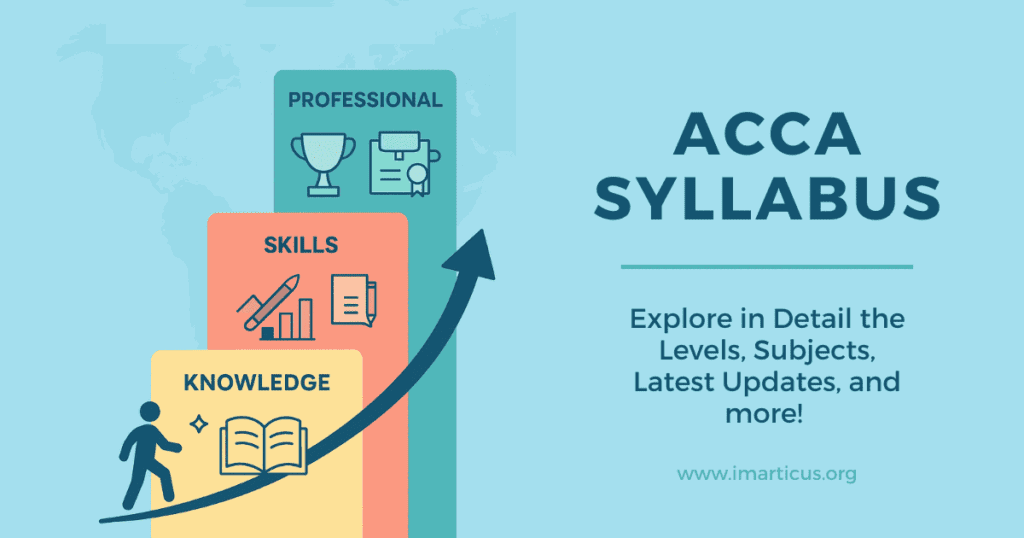
The ACCA Syllabus 2026 is designed to do exactly that. It builds you up step by step. It starts with the Applied Knowledge level, where you get your fundamentals right, like understanding the instruments in a cockpit. Then comes Applied Skills, where you actually start flying in controlled environments, applying what you learned to real-world financial scenarios. Finally, the Strategic Professional level is where you’re handling the flight plan in full autonomy, making strategic decisions and leading teams.
Imagine running a small business. At the Knowledge level, ACCA teaches you how to read your accounts and understand the basics of taxes and management. At the Skills level, you start making budget decisions, analysing performance, and understanding legal obligations.
By the time you reach Strategic Professional, you’re not just running one business – you could advise multiple companies on strategy, sustainability, and global finance. That’s the power of the ACCA Syllabus: it takes you from knowing concepts to applying them, to thinking strategically like a CFO.
And it’s not just theory. The syllabus includes everything from digital finance trends, ESG reporting to leadership and ethics. So whether you want to work in a Big 4 audit firm, manage finances for an MNC, or become a global financial consultant, ACCA equips you with the toolkit to handle it.
The Three Levels of ACCA
Before we deep dive into subjects, here’s the big picture:
- Applied Knowledge → Your foundation. Think of this as learning the grammar of finance.
- Applied Skills → Here, you move from grammar to fluency. You solve problems, work through case studies, and build practical expertise.
- Strategic Professional → This is your leadership stage, where you integrate everything to solve complex business problems, often in boardroom-like scenarios.
So, in short, ACCA is your roadmap to a global finance career, and the ACCA Syllabus is your blueprint. If you approach it like a step-by-step journey rather than just exams to pass, it becomes one of the smartest career moves you can make.
Did you know?
Over 241,000 ACCA members and 542,000 students worldwide attest to ACCA’s global recognition and relevance (ACCA Global).
Why the ACCA Syllabus Matters
Every few years, the ACCA syllabus is updated to keep pace with how the finance world evolves. In 2026, there are subtle but meaningful ACCA syllabus changes across levels, from a sharper focus on digital finance to updated case study styles.
Understanding the syllabus isn’t just about ticking subjects off a list. It’s like reading a map before a road trip. If you know the terrain, you won’t get lost midway.
According to ACCA Global, their syllabus is designed to build a “progressive development pathway” from fundamental accounting knowledge to strategic leadership skills.
Here is an overview of the key changes ACCA has incorporated into their syllabus for the session stretching from September 2025 to June 2026.
Applied Knowledge Level (Foundation)
Imagine building a house. You wouldn’t start with the roof; you’d first lay a solid foundation. That’s exactly what Applied Knowledge is: laying the groundwork that every future paper builds upon.
This level is ideal for:
- 12th pass students stepping into finance
- Graduates from non-commerce backgrounds
- Working professionals switching to finance
Subjects at the Applied Knowledge Level
The Applied Knowledge level lays the foundation for your ACCA journey. It covers the basics of business, management, and financial accounting, which are the essential building blocks you’ll use in real finance roles. The ACCA Syllabus ensures you get a clear understanding of these fundamentals before moving on to more complex, applied topics.
| Paper Code | Subject Name | Core Focus Area |
| BT | Business and Technology | Understanding how businesses operate and the role of accountants in organisations |
| MA | Management Accounting | Fundamentals of costing, budgeting, and decision-making |
| FA | Financial Accounting | Core accounting principles, double-entry system, and preparation of financial statements |
Before diving into these, here’s a candid truth: don’t rush through these subjects. Many students underestimate this level because it looks “basic.” But just like a weak foundation causes cracks later, gaps here can make Applied Skills feel overwhelming.
👉 Students who perform strongly in MA and FA often find ACCA’s later strategic papers easier, because they’ve already internalised core logic.
How to Approach Applied Knowledge Effectively
Think of this level as your finance gym. You’re not running marathons yet; you’re building strength. Here are a few strategies:
- Start with BT, because it sets the context of business and technology – the environment in which all other topics operate.
- Use MA to get comfortable with numbers and analytical reasoning. Practice small caselets daily.
- For FA, imagine you’re maintaining the books of your own startup – this mental trick makes journal entries far less abstract.
👉 Syllabus:
BT Guide | MA Guide | FA Guide
Applied Skills Level: Building Fluency
If the Applied Knowledge level is your foundation, the Applied Skills level is where you start building the house. You’re no longer just learning concepts – you’re applying them to real business problems, often under time pressure.
Think of this stage like learning to drive in traffic after practising in an empty parking lot. You’ve got the basics, but now you have to stay alert, switch gears quickly, and make decisions that affect more than just yourself.
This level typically takes 9-12 months to complete and is the most intense stage for many students.
Subjects at the Applied Skills Level
At the Applied Skills level, the subject list is designed to strengthen your practical knowledge and prepare you for real-world finance challenges. The ACCA Syllabus covers areas like corporate law, performance management, taxation, financial reporting, audit, and financial management.
These aren’t just abstract topics — each paper teaches skills you’ll use on the job, whether it’s analysing financial statements, planning budgets, or ensuring compliance. This is where your foundation from the Knowledge level starts turning into actionable expertise that employers value.
| Paper Code | Subject Name | Key Focus Area |
| LW | Corporate and Business Law | Legal framework of business operations, contracts, and governance |
| PM | Performance Management | Advanced costing, decision-making techniques, and variance analysis |
| TX | Taxation | Core taxation principles, computation of tax liabilities (country-specific) |
| FR | Financial Reporting | Deeper dive into financial statements, IFRS standards, and interpretation |
| AA | Audit and Assurance | Principles and processes of auditing, internal control, and risk assessment |
| FM | Financial Management | Investment appraisal, risk management, working capital, and sources of finance |
Applied Skills is the transition stage where ACCA expects candidates to demonstrate both breadth and depth of knowledge. It’s also where most students face their first time-bound computer-based exams.
👉 Syllabus:
LW Guide | PM Guide | TX Guide | FR Guide | AA Guide | FM Guide
How to Tackle Applied Skills Without Burning Out
Many students hit a wall here because the subjects are both technical and time-consuming. Here are some candid strategies to navigate this phase smartly:
- Cluster Subjects Intelligently:
Don’t pair two heavyweight papers like FR and AA together in one session unless you have a lot of time. A smart combo is LW + PM or TX + AA, depending on your strengths. - Think in Business Scenarios:
For example, when studying FR, imagine you’re part of the finance team at a large company like Infosys or Unilever, preparing financial statements that investors will rely on. This mental framing makes concepts stick better. - Mock Exams Are Non-Negotiable:
Especially for PM, TX, and FR. These papers often test the application. Do timed mocks every 2–3 weeks.
Ready to turn syllabus knowledge into exam preparation? Browse sample ACCA questions and start approaching the exam in a more structured way.
ACCA Exam Papers
Strategic Professional Level: The Leadership Phase
This is where the ACCA course can transform your career from a technical expert into a strategic leader. At this level, you’re expected to combine everything you’ve learned – accounting, law, strategy, ethics – and apply it to complex, ambiguous business situations.
Think of this as your boardroom simulation. You’re no longer solving textbook problems; you’re advising CEOs.
The Strategic Professional level consists of four papers – two essentials and two options.
Essentials (Compulsory)
The Essentials papers form the core of the Strategic Professional level. They focus on strategic thinking, leadership, and advanced financial reporting; skills you’ll rely on in senior finance roles. The ACCA Syllabus ensures these subjects build the judgment and decision-making abilities expected of experienced professionals.
| Paper Code | Subject Name | Key Focus |
| SBL | Strategic Business Leader | Integrated case study exam testing leadership, strategy, governance |
| SBR | Strategic Business Reporting | Advanced reporting under IFRS, ethics, and integrated reporting |
Options (Choose Any Two)
The Options papers let you tailor your ACCA journey to your career potential and goals. You can choose two subjects that align with your interests, whether it’s advanced taxation, audit, financial management, or performance management. The ACCA Syllabus uses this flexibility to help you specialise while developing strategic expertise for senior roles.
| Paper Code | Subject Name | Key Focus |
| AFM | Advanced Financial Management | Strategic investment, M&A, treasury, risk |
| APM | Advanced Performance Management | Strategic performance evaluation, advanced decision-making |
| ATX | Advanced Taxation | Complex tax scenarios, advisory, international tax |
| AAA | Advanced Audit and Assurance | High-level audit scenarios, risk, ethics, and assurance frameworks |
👉 Syllabus:
SBL Guide | SBR Guide | AFM Guide | APM Guide | ATX Guide | AAA Guide
Strategic Tips for the Strategic Professional Level
Strategic Professional can be brutal. This section helps you figure out how to handle the worst of it, mainly Strategic Business Leader and Strategic Business Reporting. Case studies, revision planning, using examples properly, all that. Just practical stuff to make your prep less chaotic and more focused.
- Start with SBL – It’s broad, strategic, and gives context to other papers. Many students also pair it with one optional paper.
- Case Practice Is Everything – Unlike earlier levels, you can’t rely on question banks alone. Practise interpreting exhibits — just like a consultant would.
- Leverage Global Case Studies – For SBR, read real IFRS-based financial statements (e.g., TCS, Nestlé) to build familiarity with disclosures and integrated reporting.
ACCA Exam Structure: What You’re Really Signing Up For
Before you dive into each paper, you need a big-picture map of the ACCA journey. Think of it like plotting a cross-country road trip – you need to know the milestones, pit stops, and detours to reach your destination efficiently.
The ACCA qualification comprises 13 exams, spread across three progressive levels:
| Level | No. of Papers | Exam Type Mix | Key Focus |
| Applied Knowledge | 3 | Objective-type, CBE (on-demand) | Fundamentals, concepts |
| Applied Skills | 6 | Objective + Constructed Response | Application, scenario-based problems |
| Strategic Professional | 4 (2+2) | Integrated case studies, written | Strategy, leadership, advanced skills |
Why This Structure Matters
Each level isn’t just harder, but it demands a different type of thinking.
- At the Knowledge level, it’s about recognition and recall.
- At the Skills level, it’s about application and analysis.
- At the Professional level, it’s about evaluation and synthesis, i.e., making judgment calls like a real CFO or consultant.
ACCA Global designed this tiered structure to align with Bloom’s Taxonomy of Learning, which progresses from understanding to application to strategic decision-making. This ensures ACCA members are work-ready from day one.
This video provides a comprehensive overview of the ACCA Syllabus 2026, detailing the exam structure, subject updates, and key changes across all levels. It’s a valuable resource for candidates aiming to align their study plans with the latest syllabus revisions.
Paper-Wise ACCA Syllabus Breakdown
Here’s where we get tactical. Below is a comprehensive paper-wise breakdown of the ACCA Syllabus, including updates, difficulty pointers, and strategic notes.
Applied Knowledge
The Applied Knowledge level is your foundation. This is where you learn the core concepts of accounting, business, and finance — basically how organisations function and how financial data flows. Once you’ve got a good grip on these basics, the advanced topics in later levels won’t feel nearly as intimidating.
| Paper | Subject | Key 2026 Focus | Exam Format | Difficulty Trend |
| BT | Business & Technology | Digital business models, governance | MCQs (CBE) | ⭐ |
| MA | Management Accounting | Data analytics intro, budgeting | MCQs (CBE) | ⭐⭐ |
| FA | Financial Accounting | IFRS Foundation, double entry | MCQs (CBE) | ⭐⭐ |
Strategy Note: These are on-demand CBEs, so pace them according to your strengths. Many Indian students finish all three within 4–6 months.
Applied Skills
The Applied Skills level is where you start building real technical strength and putting those foundational concepts to work. This is where the syllabus gets into the practical stuff — taxation, audit, financial reporting, management accounting — all the skills you’ll actually use on the job. It’s the point where things shift from learning theory to figuring out how to use it, so you can tackle actual business problems with confidence.
| Paper | Subject | 2026 Focus | Exam Format | Difficulty Trend |
| LW | Corporate & Business Law | International law elements added | Objective + CR | ⭐⭐ |
| PM | Performance Management | AI in costing, ESG KPIs | Objective + CR | ⭐⭐⭐ |
| TX | Taxation | New global tax reforms | Objective + CR | ⭐⭐⭐ |
| FR | Financial Reporting | ESG disclosures, IFRS 18 updates | Objective + CR | ⭐⭐⭐⭐ |
| AA | Audit & Assurance | Risk frameworks, tech auditing | Objective + CR | ⭐⭐⭐⭐ |
| FM | Financial Management | Treasury tech, risk analytics | Objective + CR | ⭐⭐⭐ |
Strategy Note: Papers like FR & AA are notorious for low pass rates — build your foundation early and practice mock papers under timed conditions.
Strategic Professional
The Strategic Professional level brings together everything from your earlier studies and tests how well you can apply it in practice. It’s less about recalling theory and more about using what you know to make decisions and solve complex problems.
The focus here is on strategic thinking and professional judgment — the skills you’ll actually need when you’re working in senior finance roles. This stage is really about closing the gap between academic knowledge and real professional capability.
| Paper | Subject | 2026 Focus | Exam Format | Difficulty Trend |
| SBL | Strategic Business Leader | ESG strategy, integrated case | 4-hour case | ⭐⭐⭐⭐⭐ |
| SBR | Strategic Business Reporting | Sustainability reporting, ethics | Written + exhibits | ⭐⭐⭐⭐ |
| AFM/APM/ATX/AAA | Optional | Strategic application | Written, scenario-based | ⭐⭐⭐⭐ to ⭐⭐⭐⭐⭐ |
Strategy Note: Treat SBL like a business simulation, not an exam. Practise reading exhibits quickly, like a consultant reviewing a board pack.
ACCA Preparation Timeline (Sample Plan)
One of the biggest mistakes students make is starting ACCA without a structured timeline. You wouldn’t start training for a marathon without a calendar, right? Same here.
Below is a sample 2.5-year plan, assuming no exemptions and part-time study (10-15 hrs/week):
| Timeline | Stage | Papers Covered | Milestone |
| Months 1-6 | Applied Knowledge | BT, MA, FA | Build foundation |
| Months 7-18 | Applied Skills | LW → FM | Apply concepts in real scenarios |
| Months 19-30 | Strategic Professional | SBL, SBR + 2 Options | Master strategy & leadership |
Pro Tips for Timeline Management
- Stagger heavy papers – don’t take FR and AA together unless full-time.
- Use exemptions smartly – commerce grads in India often skip the Knowledge Level.
- Integrate the Ethics Module early – ACCA’s Ethics and Professional Skills Module (EPSM) boosts SBL readiness.
ACCA India reports that most students complete ACCA in 2.5-3 years, but timelines vary based on work commitments and exemptions.
This video shows how you can tackle the ACCA Syllabus effectively. It highlights the best free and affordable study materials, practical tips, and a smart study plan, giving you a clear roadmap to prepare efficiently, stay consistent, and maximise your chances of passing.
Key Takeaways Before You Start Your ACCA Journey
Before jumping into your ACCA studies, take a moment to get your bearings. This section gives you the essentials from the ACCA Syllabus — what matters most, what each level involves, and how to structure your prep. It’s not meant to replace the detailed study ahead, but rather to give you a clear starting point so you can begin with confidence and direction.
- ACCA Syllabus is structured for progressive mastery — from understanding → application → strategy.
- Use tables, timelines, and structured planning to keep your prep on track.
- Leverage real-world business scenarios to make learning stick.
- Treat Strategic Professional as a leadership bootcamp, not a memory test.
- Keep ACCA Global’s syllabus page bookmarked — they update syllabi annually.
FAQs about ACCA Syllabus
Before wrapping up, let’s clear up a few frequently asked questions about ACCA Syllabus that students have. If you’ve been wondering about eligibility, duration, exam difficulty, or how to plan your studies, this section will tie everything together for you.
What are the 13 papers in ACCA?
The ACCA Syllabus has 13 papers, and yeah, it sounds like a lot at first. You start with the basics: the first three papers teach you how businesses work and how to read financial statements. Pretty simple stuff, just getting your feet wet.
Then there are six papers where you actually learn to do things: budgeting, tax, audit, and management stuff. And finally, four big ones at the end, where you have to think like a finance leader. By the end, you’re not just passing exams; you actually know how finance works.
Can I finish ACCA in 2 years?
Yes, you can. You just need a plan and consistency. Exams happen multiple times a year, so you can space them out. If you’ve done CA Inter or a commerce degree, you might get exemptions too, which makes it faster. With focus, 2 – 2.5 years is doable.
What type of maths is in ACCA?
Don’t worry. It’s nothing crazy. Mostly percentages, ratios, simple algebra, and interest calculations. Stuff you’d use in real business situations. It’s about understanding numbers, not complex formulas. If you can do high school maths, you’ll be fine.
What is the hardest subject in ACCA?
Most people say SBL and AAA. Not because they’re impossible, but because you actually have to think and make decisions like a manager. It’s not about memorising. It’s about analysing situations, figuring out what to do, and writing it down under exam conditions. That’s the tricky part.
Can I do ACCA without math?
Yes, totally. You just need basic number sense. ACCA is more about logic and reasoning than anything else. Lots of students from arts or non-maths backgrounds pass ACCA. You just need to practice and stay consistent.
Which degree is best for ACCA?
Commerce, finance, or accounting degrees help because there’s an overlap. Makes it a bit easier. But really, any degree works. People from the arts, science, and anything have done ACCA. It’s more about how you study and stick to it.
What is the passing percentage for ACCA?
Usually between 40–55%, depending on the paper. Early papers are easier, later ones are harder. The trick isn’t memorising, but it’s understanding. Once you get the logic, passing becomes way simpler.
What is the salary of ACCA per month?
In India, fresh ACCA professionals usually get around ₹40,000–₹80,000 a month. Depends on the city and the company. Experience makes a big difference. With a few years of overseas exposure, it goes up a lot. ACCA skills are valued, so growth is natural.
Can ACCA earn ₹1 crore?
Yes, but not right away. Usually happens when you reach senior roles like CFO or Finance Director. ACCA gives you the skills, but real experience and smart career moves get you there.
Which country is best for ACCA?
The UK is the most obvious choice. ACCA started there, and the market’s big. But the UAE, Singapore, Australia, and Canada are all good too. It depends on where you want to work and grow.
How many exams are there in ACCA?
13 exams in total, split across three levels: basics, practical skills, and strategic thinking. You start with fundamentals, learn to apply them, then finish by thinking like a finance leader. By the end, you’re ready for real-world work.
Is ACCA harder than CA?
ACCA is comparatively easier than CA when it comes to the passing rate and flexibility. Generally, CA requires more time to clear the exams due to its rigid structure, less flexibility in exemptions and a low passing rate. ACCA, on the other hand, has a challenging syllabus, but is still considered manageable due to the flexible structure of exams, higher passing rates and exemptions based on prior professional qualifications.
Your Next Steps
ACCA isn’t just exams. It’s built to take you from knowing nothing to being able to work in senior finance roles. There are three levels. Applied Knowledge teaches you the basics. Applied Skills shows you how to actually use what you learned. Strategic Professional is where you learn to think like someone who runs things.
Finishing ACCA changes you. You don’t just know accounting. You can analyse situations and think strategically, which is what matters in real jobs.
The syllabus covers current stuff now: digital finance, ESG, AI, and international tax. So you’re not learning outdated material. For Indians specifically, ACCA works well because you get international recognition, but you already understand the local context. Makes it easier to work abroad or switch sectors.
You need a plan. Figure out when to sit each exam. Use exemptions if you qualify. Do loads of case studies. Try to relate everything to actual work. And remember, ACCA isn’t just technical. It’s about ethics, leadership, and solving big problems. That’s what gets you into senior jobs.
ACCA takes time and effort. You have to be consistent and plan properly. But it opens doors. Reporting, advisory, audit, management, whatever direction you go, people recognise the qualification. You’re not just passing exams. You’re building a career that works across countries and industries, with skills that companies actually want right now.
👉 If you want to approach the ACCA Syllabus with confidence and real-world readiness, this ACCA program, in collaboration with KPMG in India, is designed to do just that. With mentor-led guidance, a pass guarantee, and career support, including internships with firms like KPMG, it bridges the gap between learning and meaningful professional experience. Flexible learning options and a curriculum aligned with global standards ensure you’re not just exam-ready, but career-ready too.
Liked This? Follow Us Where You Already Search.
Preferred Sources is Google’s built-in follow button — no app, no login, just more Imarticus in your results.