Keen to Know What Transitions a Fintech Aspirant to a Fintech Expert? Check This Out!

Financial services have experienced a major paradigm shift due to the introduction of fintech. Digital banks are replacing traditional ways of accessing financial services. The current fintech market in India is more than 1,900 billion and will grow with an impressive CAGR in the coming years.

There are a lot of job opportunities in the fintech sector and you can build a successful career in fintech by choosing the right career path. Read on to know more about the transitions required to become a fintech expert.

 Get the Right Education

A bachelor’s degree in mathematics or computer is the best to get into the fintech industry. Many fintech aspirants also have degrees in business, accounting, economics, etc. Getting a degree will not teach you about the working of the fintech industry but it will help you in developing an analytical & statistical mind.

Many fintech aspirants also prefer to get a master’s degree for opting for senior job roles in the fintech industry. One should also try to be updated with the modern-day technologies used in the fintech industry. AI (Artificial Intelligence), ML (Machine Learning), deep learning, etc. are used widely to improve fintech solutions.

A technical degree with Fintech Course as a specialization will also help you in getting into the fintech industry. Along with getting a degree, you can also opt for internships, sponsored/individual projects, workshops, etc. in fintech for boosting your knowledge.

Fintech TrainingYou can target any particular job role in the fintech industry based on your skillset. There are many types of job roles in the fintech industry like a compliance expert, cybersecurity expert, data scientist, financial analyst, etc.

Acquire Necessary Skills

You will require several technical & non-technical skills to become a fintech expert which is as follows:

  • You should have good problem-solving skills to create better ways of providing financial services to people with the aid of technology.
  • You should have good analytical skills to draw conclusions and to analyze various solutions.
  • Good programming skills are required to become a fintech expert. Programming languages like C#, C++, Java, Python, SQL, etc. are widely used in the fintech industry. You should also be aware of the databases used in the fintech industry.
  • You also should have good financial skills to become an expert. You should be able to read & analyze financial statements & reports for creating better financial services.
  • You should know about the applications/tools used in the fintech industry know about the practices involved in the fintech industry. You should also be familiar with the latest technologies like AI, blockchain, etc. used in the fintech industry.
  • You will also have to possess some soft skills like collaborative skills, communication skills, adaptability, etc. to thrive in the fintech sector.

 Get the Right Certification Course

Besides getting a degree in the related field, you will need to get a certification in fintech from a reliable source to know about the working methodology of the fintech sector. Imarticus Learning is a reliable source that provides you an online Professional Certification in FinTech course. This course by Imarticus Learning is associated with the SP Jain School of Global Management. You will get to learn via an industry-first approach and will get to study real-life case studies.

This course touches on many aspects/processes involved in the fintech industry like payments lending, API, RPA (Robotic Process Automation)cryptocurrency management, blockchain, etc. You can choose from the Core Modules (for broad coverage) & PRO Modules (for in-depth coverage) of the aforementioned course.

Imarticus also provides several other courses like Pro Degree in Financial Analysis & PG Program in Finance and Accounts to know more about the financial services/industry. The Project: Paradigm Shift provided by the fintech course will help you in creating/transforming business ideas.

Conclusion

Personal capabilities are the main factor for upskilling in any industry. You will only end up working smartly if you follow the right career path. You will get to work on various projects by opting for the fintech course provided by Imarticus Learning.

It provides an excellent practical environment to implement the things learned in the course. Expert faculties which are associated with reputed firms/institutions will be teaching you if you opt for Imarticus courses. Start your fintech course now!


 

How Digital Leaders are looking to implement change in 2021 into Investment Banking Culture?

The banking industry has gone through a sea of change in the past one and a half years because of the global pandemic. With each passing day, more and more banking institutions are embracing digital practices and providing better digital experiences to their customers.

In order to work efficiently, it is important for digital leaders to maneuver the obstacles that they might have to face. Providing proper leadership and guidance is the most important role in today’s time. A certificate in investment banking can help you progress in investment banking training and get you investment banking jobs.

 Who are digital leaders?

Digital leaders are the ones who are capable of functioning and running businesses using new-age technology. Digital leaders use the digital assets of their companies to meet business goals. They find out and implement innovative techniques and change the response of their business towards the challenges that they face using technology.

Digital leaders of the present era must maneuver the changes in behavior, economics, and society that Digital, Mobile, Social Networks, and Big Data have brought about. They should rethink the future and create new business models while also managing change. Finally, this has the potential to alter a company and lead to a successful digital strategy.

Realizing the key to converting such basic transformations into business impacts at the industry, organizational, and individual levels is the essence of successful leadership. While achieving personal and professional success in this endeavor necessitates adopting totally new languages, attitudes, and mindsets to aid in the transition into new Digital Environments.

How digitalization helps investment banking?

Digitalization is inevitable in investment banking. To begin with, big data analytics has been critical for all sectors of the banking business. To gather insights, many FinTechs bases their operations and solutions on big data analysis. Assessing the outcome of investment decisions is important by assessing both structured and unstructured data. FinTech solutions are attaining unquestionable prominence.

They can demonstrate their worth in a variety of ways throughout the investment banking and customer journey. Users’ emphasis has shifted to personal investment transactions as data availability and utilization have expanded. Banks are taking advantage of this by providing ongoing financial advice through chatbot advisors.

These advisors quickly evaluate individualized big data and recommend the best investment decision. Chatbots are very important in investment banking. They may include responses to users’ capital-markets-related questions as well as customer-service-related ones. As a result, both the customer experience and investment decisions are improved on their own. With the support of AI, the foundation of digitalization, this also increases efficiency and curtails costs.

How Digital Leaders can help drive investment banking today?

 Hedge funding is an important aspect of investment banking. Hedge funds are active investor-run pools whose managers employ a broad variety of tactics, much-involving money borrowed and specialized assets trading, in an effort to improve their customers’ average return on investments.

best investment banking courses with placement in IndiaHedge funding is used as leverage to make big investment decisions and protect those investment decisions related to those investments. Investment bankers are specialists who look after hedge funding.


A digital leader can help in hedge funding by Algo-trading. Algo-trading is a means of carrying out the process of hedge funding through machine learning, Big Data, and AI.

A new-age digital leader knows how to build a system by which hedge funds can be managed automatically with the help of algorithms, bots, and High-Frequency Trading.

 Conclusion

A career in investment banking is an extremely lucrative option in today’s time as there are many investment banking jobs.

You can get ahead in this field if you have a certificate in investment banking. In case you want to pursue a career in investment banking, a specialization course is a suitable starting point. These courses could fetch you a good number of job opportunities in the future.

Why Are Companies Considering Candidates With An Artificial Intelligence Certification?

Artificial Intelligence has expanded at an exponential rate in recent years, despite significant progress in the field. In the field of computer science, AI practices can be found everywhere. It provides you with an idea of how many different ways a computer system can be designed.

artificial intelligence and machine learning courses in India It is designed to carry out the cognitive functions that humans have specified. This indicates that the scope of an artificial intelligence and machine learning course is enormous, and AI has potential that is currently beyond human grasp.
Scope of An Artificial Intelligence Course in India

Artificial Intelligence has enormous potential to transform every sector of the economy for the greater good.

AI encompasses a wide range of technologies, including self-improving algorithms, machine learning, big data, and pattern recognition, to name a few. There will be few industries or sectors left unaffected by this potent weapon in the not too distant future. This is why online Artificial Intelligence courses are becoming increasingly popular in India.

With each passing day, the gap between the number of AI professionals required and those available widens. Corporations are spending money to train their existing employees on Artificial Intelligence technologies. However, the demand is far higher.

Learn AI

Certification In Artificial Intelligence & Machine Learning

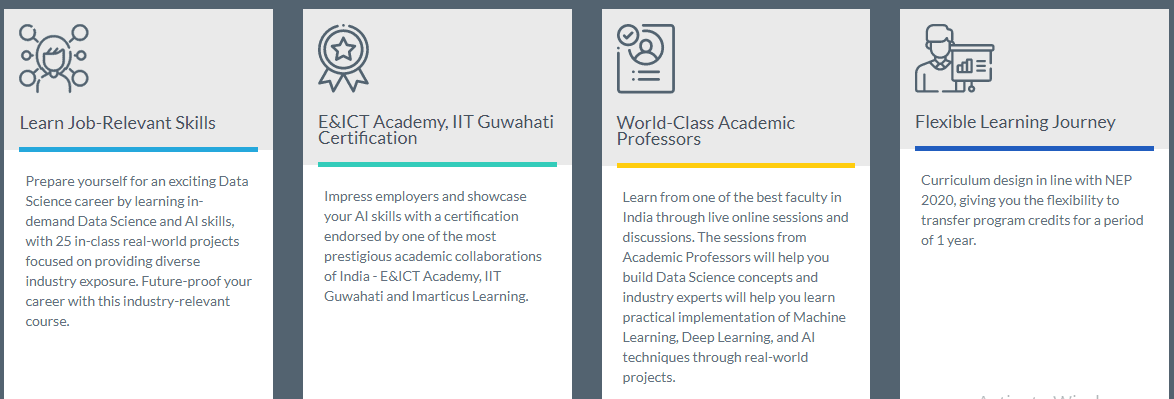
Learn AI via 25 in-class, real-world projects focused on offering exposure to various industries. This 9-month program will help you prepare for the roles of Data Scientist, Data Analyst, Machine Learning Engineer, and AI Engineer.

artificial intelligence and machine learning courses by E&ICT, IIT GuwahatiThis machine learning certification program was established in collaboration with the E&ICT Academy, IIT Guwahati, and industry professionals to give an optimum learning outcome,

This course will strengthen your core abilities, allow you to take advantage of our Expert Mentorship program, and give you a practical grasp of AI and Machine Learning.

Data Science Prodegree

Develop your knowledge of Data Science ideas and build robust models to generate relevant business insights or forecasts with a working knowledge of critical Data Analytics technologies such as Python, R, SQL, and Tableau in these 14 in-class and industry-oriented projects.

PGP In Digital Marketing

Our Digital Marketing Postgraduate course is meant to provide you with a more in-depth and practical understanding of Digital Marketing ideas. The postgraduate program takes a collaborative approach that emphasizes several Capstone projects, job-specific skills, and guaranteed job interviews.

This course will prepare you from beginning to end to start or advance your career in the Digital Marketing segment, including resume building, mock interviews, job leads, and references, making it an ideal Digital Marketing course with a strong focus on placements to help you land your dream job.

Post Graduate Program in Data Analytics & Machine Learning

This machine learning certification program is for recent graduates and early career professionals interested in pursuing a career in Data Science and Analytics, the most in-demand job skill.

To become job-ready, master the fundamentals of data analytics and machine learning, as well as the most in-demand data science tools and methodologies.

With this placement-guaranteed program, you’ll learn Python, SQL, Data Analytics, Machine Learning, and Data Visualization. After completing the course, students are promised interview opportunities.

artificial intelligence and machine learning coursesTakeaway

AI is one of the most popular technologies on the planet because of its diversity and superior solutions. It has been rapidly expanding. As you can see, the scope of AI has broadened to include a wide range of industries, including healthcare, transportation, security, etc. Multiple industries require the expertise of experienced AI specialists as a result of this increase.

Check out Imarticus IT classes, targeted at working professionals, if you want to learn more about AI and machine learning algorithms.

How Treasury Management in Banking is Essential for Small Businesses

Entrepreneurs are constantly on the search for banking services to help them manage their financial investments and assets. Treasury management services, which manage cash, investments, and other financial assets, can help businesses optimize their finances.

Treasury management is a way of managing aimed at optimizing a company’s liquidity avoiding financial, operational, and reputation hazards. Therefore, a post-graduate diploma in banking and finance will give you a fair idea about this part of the banking sector.

Importance of treasury management:

When recurring manual procedures, such as financial data management or automatic payment initiation, are automated, treasury management can help to boost productivity by eliminating inefficiencies within business operations.

Human errors can be reduced by minimizing manual operations. Finally, because cash flow is actively monitored, treasury management services in banks can assist a corporation to stay afloat.

Why should treasury management be considered by small businesses:

  1. One of the most significant advantages is time savings. Businesses can improve the payment process and reduce the time spent on payment approval and activation by installing a treasury management system.


  1. Businesses with access to numerous tools and resources can promptly discover the cost of cross-border transactions and better regulate other related expenses. Having better command over these procedures also removes some of the ambiguity from financial planning, lowering the risk of serious mistakes.


  1. Cash flow is vital for small businesses. Profitable businesses can fail due to a lack of cash on hand to pay debts. The treasury management function, a vital component of cash flow management, examines the timing and amounts of cash inflows and outflows. Accounts receivable conversions to cash, short-term and medium-term borrowing, asset sales or dispositions are all examples of cash inflows. Treasury management also entails monitoring and tracking the operations that necessitate the most cash.


  1. Treasury management’s duty also entails increasing the amount of time a company keeps the money needed to pay its debts while decreasing the amount of time it keeps money owed to its customers. Treasury management processes involve establishing policies for accounts payable and receivable, establishing credit approval policies, and determining collection terms. These activities provide a corporation with a float or excess short-term capital that can be invested. Larger corporations may open savings and money market accounts to serve as sweep accounts, earning short-term interest on incoming funds that will be used to pay bills quickly.


  1. Small businesses that have a treasury management system can devote more time to key business objectives. They can conserve the time spent on financial concerns. CFOs may require to know the location of their cash reserves and the currency value of the same. They also need to determine whether they should invest or just borrow. Furthermore, it is critical to understand whether they’re financially overexposed, or undervalued.


  1. Treasury management services can increase the transparency of user activities. Audit trails for all end users can be set up. Furthermore, because you now have a platform to standardize procedures and systems, treasury management services may assist ensure that firms are fully compliant with regional and worldwide requirements.


Conclusion:

Finally, a treasury management service that is dependable, and steady assists you in minimizing risk and maximizing your company’s growth opportunities. Personal contact with a qualified bank might help you a lot here. There are good online courses on this subject as it is a budding sector in the banking industry. A postgraduate diploma in banking and finance will help you fetch lucrative jobs in reputed banks.

The Impact of Data Science on Current Events and the World

The Impact of Data Science on Current Events and the World

Data science remains one of the most lucrative and challenging career pathways for experts. Successful data professionals now grasp the traditional skills of analyzing massive quantities of data, data mining, and programming.

best data science courses in IndiaData scientists must control the complete spectrum of the data science life cycle and must be flexible and understandable so as to optimize returns at each stage of the process to detect meaningful intelligence for their organizations.


You can also contribute to this surge by doing proper data science online training.

Skills that data scientists must have:

According to a study by IBM, a data scientist must be able to perform the following tasks:

  • Use math, statistics, and a scientific approach
  • Use a variety of tools and strategies for data assessment and preparation – for example, SQL, data mining, and data integration methods
  • Data extraction through predictive analysis and artificial intelligence (AI), including in-depth learning and models
  • Write apps for data processing and calculating automation
  • Tell — and illustrate — stories that show the importance of findings at every level of technical knowledge and comprehension to decision-makers and stakeholders
  • Explain the use of these results for business challenges

The number of job opportunities in the industry is increasing by more than 5% a year, according to an IBM study.

What is the role of data science in the current scenario?

  • Inadequacies can cost companies up to 30% of their income. The data science course allows you to follow a number of business indicators, including manufacturing times, delivery expenses, productivity for employees, and more, and suggest improvements.

It is feasible to reduce total expenses and increase return on investment by limiting waste of resources.

  • Data science enables companies to consistently refine their products and services to suit a changing market by assuring a ready-flow of practical insight into customer psychology, behavior, and satisfaction.

Data on clients can be accessed from a range of sources, and information mining from third-party platforms such as social media, search engines, and data sets.

  • One of the most intriguing aspects of data science is testing. New, inventive options are compared with current features and often produce surprising outcomes.

Companies can create incremental revenue gains through consistent, long-term testing. Data scientists are in charge of conducting thorough tests to ensure the effectiveness of marketing campaigns, product launches, job satisfaction, website optimization, et al.

  • Data science is used in the current scenario to improve a company’s safeguarding of sensitive information. Banks, for example, deploy sophisticated machine-learning algorithms for detecting fraud based on variations from a user’s normal financial activities. Because of the vast volume of data created every day, these algorithms can detect fraud faster and more accurately than humans.

Algorithms can be utilized to protect sensitive information via encryption.  By ensuring data privacy you can help guarantee that your organization does not misuse or reveal sensitive information about its consumers, such as credit card numbers, medical information, or Social Security numbers.

  • Data collection and analysis on a bigger scale can help you spot developing trends in your market. Purchase information, stars and influencers, and search engine searches can all be utilized to discover the things people want.

Conclusion

It can be concluded that a career as a data scientist is an extremely lucrative option in the current world as data science is gradually taking over the entire world. The data science pro degree can help you understand the intricacies of this field and learn data science effectively.

If you are a recent graduate and want to learn data science, a post-graduate program in data analytics and machine learning can help you learn better from live faculty and bag guaranteed jobs in the future. Proper data science online training can help the audience come here.

Trade Finance Methods & Types Explained in Detail

Trade Finance Methods & Types Explained in Detail

Trading finance is basically the funding of financial assistance that is provided to businesses worldwide by the means of financial tools. International trade finance in itself is like an umbrella, under which a variety of financial products exist. All of them are structured to ease up how a business is executed for traders globally. As with all wings of business, trade finance has also gone through a series of upheavals because of the crisis faced by the world.

trade finance coursesThe end result is disruption of costs, increased rules and regulations on both exports and imports not just globally but also domestically. This is why a career in finance has always been sought after in this country.


The only way to do it is to get enrolled in banking courses in India after graduation. Imarticus Learning provides a solid solution for it in the form of their PG program.

Coming back to trade finance, managing supply chain and suppliers is one of the most important things to trade finance. The reason is most of the trading around the world happens as a result of a merging of both pre-export and post-export finance tools. There are a few types of trade finance that need to be addressed here. Such as:

Advance payment

It is basically a pre-export type of trade finance that requires full payment from the importer even before the items are delivered. It, unfortunately, runs the risk of undelivered items on the buyer’s side and credit risk on the supplier’s side.

 Business loans

Business loans or working capital loans are funded by banks or funding organizations. They are basically used to afford the upfront short-term costs of a business. From raw materials to labor costs, these things are funded through a business loan. They are short-term loans and company assets are kept as a warranty of repayment.

Letter of credit

It is easy to use and mostly available in current accounts of businesses. It permits a business to overdraw with terms and conditions applied by the funder. It is simple and flexible to use, however, credit lines do get extended because of it. The only thing to worry about is making sure that the company does not get charged with a peak interest rate.

 Factoring in invoice

 It is a post-export type of trade finance that depends on receivables. It is used to free up working capital by using invoices to optimize a balance sheet. It ensures about 80% immediate payment and depends on short-term receivables. The buyer pays the funder, the supplier receives. Then they receive the remaining balance provided by the funder after the discount is deducted.

 Forfaiting

 It is also based on receivables and the way to distinguish it from factoring is by the time period of the financing. Basically, a virtual deduction of risks takes place by the supplier after the buyer receives the items. The receivables are supported by the buyer’s funder, permitting the buyer to withdraw the exchange from the balance sheet. Which in turn, backs up the financial ratios.

 Conclusion

Trade financing can be used as a tool to lessen the risk factor that comes with a trading business. The only way to do it is with proper finance tools, which need a proper skillset. Enrolling in banking courses in India after graduation would be a good idea if you want to get into financing. A lot of institutes offer PG degrees in finance in India, such as Imarticus Learning’s PG program.

Future of Financial Accounting from 2021: How will Digital Transformations Impact Accountants?

Change is inevitable when it comes to the world of business. Especially so when it comes to financing, and accountants are a major if not the main part of it. Finance has been one of the foremost career prospects for students for a long time.

banking and finance coursesThis is why banking courses in India after graduation have never lost their place in the trends. MBA and diploma in banking and finance is a popular choice for students all over the world.

Imarticus Learning has a lot to offer in this department with its diploma certificate courses and PG programs.

However, with the progress of AI tools, along with a lot of other professions, accountants also faced the potential threat of going out of jobs. However, that is not the case as accounting is not merely made up of bookkeeping, but also strategy forming, and other creative aspects. AI simply can not keep up.

A support tool, not a replacement

With the evolution of new and improved AI technology, accountants all over the world were worried about where it would leave them. Along with that, the unforeseen disruption caused by Covid-19 caused panic amongst the community.

However, as days passed, it became evident that AI works as a support tool for accountants that benefits them immensely. Technology has taken over the grunt work so that accountants can pour over the finer aspects of the industry. Namely, creativity, and strategy forming. Which, as of now, AI is not developed enough to approach.

The constant evolution of technology has changed the way any sort of professionals, be it accountants or otherwise, approach their work. There are lots of people and lots of projects to work on. As a result, the flow of data has become immense. This is why it is a need now to rely somewhat on technology to share some of the burdens so that accountants can do what AI can not.

 AI makes future accountants more relevant

The use of AI has considerably lessened costs and waste of time as well as smoothened the terms of communication as well as collaboration. It makes the system a lot more comprehensible by dismantling data silos. As a result, the quality of the data rises along with the quantity.

This works as leverage for the accountants as the tedious work gets done a lot faster and there is little space for human errors to occur. There are a few key things that need to be kept in mind, however, such as:

  • As accounting becomes more about the finer aspects of financial strategies, accountants will need to be well versed in those aspects as well. This can only happen through a proper degree from an MBA or diploma in banking and finance.
  • With a higher level of skills, accountants will be able to be of aid to other units of a company. Such as setting budgets or providing them with other types of financial intelligence.
  • Future accountants might play the role of an advisor as their job descriptions might evolve with the help of AI.

 Conclusion

AI is supposed to provide accountants with much-needed technical support so that the system can run smoothly. It is not here to replace them. However, future accountants evidently will need a much higher level of skills that can only be obtained by a proper course. Many institutes offer banking courses in India after graduation, like that of Imarticus Learning’s PG programs. Check them out to get a boost to your career.

Combining Career Progression With Self Development In The World Of Investment Banking Operations

Historically, banking has been one of the most popular career paths for ambitious people looking for long-term stability, competitive salaries, and numerous opportunities for growth. Now with technology transforming the space and more avenues opening up, banking has become more sought-after than ever.

Investment banking is a division within the larger ambit of a bank or a financial institution that connects investors with corporations, governmental bodies like municipalities, and large institutions. The primary function of investment banking is to expedite capital funding through investments.

Contrary to popular belief, investment banking is not a single job. Rather, it is a vast ecosystem within which several job profiles thrive and efficiently work together. One such job profile is investment banking operations which is mainly responsible for ensuring accuracy, profitability, and risk reduction in bank transactions for the company’s clientele.

best investment banking courses with placement in IndiaIn this article, we discuss what an investment banking career in operations entails as well as what to study to become an investment banker.

If you are looking to upskill yourself to advance your career prospects in this niche, then sit back and read on.

What Are Investment Banking Operations?

Investment Banking Operations is a specific profile in the ambit of investment banking that mostly deals with backend operations within the company. Operations staff provide support to client-facing departments such as corporate finance. Their primary function is to ensure that the business is efficiently administered.

Every banking institution deploys sophisticated IT solutions within the company and a key role of the operations unit is to develop, maintain, troubleshoot, and oversee IT systems within a company. This role has become ever more important with the digital revolution transforming the way companies in every industry use digital innovations.

In other words, operations staff are responsible for:

  • Developing and maintaining backend IT systems
  • Collating and analyzing systems information
  • Liaising with other bank divisions to deploy IT solutions effectively
  • Overseeing data flows and ensuring accuracy
  • Managing everyday banking processes
  • Aiding in maximization of efficiency and profitability

A Career In Investment Banking Operations

Like any other investment banking role, getting into operations can be challenging because of the competitiveness that exists in the field. Companies take a close look into the profile, experience, educational qualifications, and skillsets of the potential candidate before handing out a letter of appointment.

One of the most asked questions among candidates is this – What to study to become an investment banker? Employers usually specify the degree level that they look for in their potential recruits. Candidates with a degree in finance often have a competitive edge over others when it comes to cracking a role in investment banking operations. Companies also regard apprenticeship or internship experiences in operations with high value.

best investment banking courses with placement in IndiaOne can pursue voluntary certifications like the Chartered Financial Analyst (CFA) course offered by the CFA institute to improve their aptitude.

Similarly, MBA degrees with specializations in finance or technology management are also excellent options to develop an overall aptitude to land a leadership role in investment banking operations.

Nowadays, there are several online advanced certification courses available in the market that help professionals learn investment banking and develop the necessary skillsets for a career in investment banking operations.

Conclusion

An investment banking career provides high levels of personal and professional growth, stability, and lucrative financial rewards. Let’s just say that if you are an ambitious professional with the ability to take on a challenge, you could be a successful investment banker.

If you are looking to upskill yourself to suit the requirements of an investment banking operations career, then a specialization course like this Certified Investment Banking Operations Professional course is a good place to start.

Difference Between MBA & Business Management

What is Masters Of Business Administration (MBA)?

With a Masters in Business Administration, one can learn technical skills as well as skills in management and leadership. It is a general business degree for graduates. Earning it would equip students with valuable skills and information and help increase the size of their professional network while also creating a large number of novel opportunities.

It helps students in transitioning to a completely new industry, creates opportunities for aspiring entrepreneurs, and increases the rate of success in their careers.

What is a Masters in Business Management (MiM)?

A Masters in Business Management is a postgraduate degree that targets individuals who have recently graduated or young professionals. It equips students with information about a variety of streams in management. These include streams like finance, marketing, entrepreneurship, and so on. It is a perfect degree for people looking and aspiring to work in a management field. It also gives leverage to people who wish to change from one stream to another early on.

What Are the Differences Between MBA and Business Management?

In top MBA Universities, there are a large number of criteria and high requirements that their students must reach in order to get in. These include job experience, professional achievements, academic achievements, and so on. Even though this raises the quality of applicants for an MBA course, it also leaves a large number of younger and smarter students behind.

One of the major differences between a Masters’s in Business Administration and a master’s in Business Management is work experience. When we talk of a master in Business Management, work experience is not as important even though appreciated, solely because of the nature of the degree. Hence it does not play a very important role in the eligibility of a candidate for the degree.

As mentioned above, even though work experience is not important at all when it comes to being eligible for a management degree, work experience of even six months is appreciated. If one has collected more work experience than this, it is suggested that they apply for an MBA. A large number of institutions create a cut-off of one year for work experience when considering management applicants.

MBA, on the other hand, looks for a job experience of three or more years. Fresh graduates and candidates holding lesser than two years of job experience are urged to apply for a Masters in Business Management. By taking a Business Management an applicant would be able to have a stronghold on the information required to start their business career.

The various other differences between the two are listed below:

  1. Due to the years of work experience, the average age of applicants for an MBA is 27 and ranges between 25-32 years of age. On the other hand, Masters of Business Management applicants have an average age of 23 with an age range of 21-25 years of age.
  2. The teaching methods vary as well with MBA using a practical orientation method involving case studies and thus deepening the learning experience for applicants. It also focuses on equipping students with knowledge about the application of various business techniques. For those taking a Masters of Business Management course, however, uses a more theoretical approach involving group projects and lectures focusing on the theoretical basics of business.
  3. Another difference is the duration of each course. It is one or two years for MBA courses and around ten months for a Business Management course.
  4. MBA students tend to earn more than management students later on.
  5. People with an MBA degree tend to occupy mid-level positions in a company while MiM (Business) students tend to occupy entry-level positions.

What is the Scope of Scrum master?

Scrum
Scrum is a framework that helps different teams to work in a cohesive manner. Scrum helps teams to remain self-organized while dealing with a problem. Using the Scrum framework, teams learn from their experiences. Scrum enables effective use of all the available resources and makes the deliverables available with high efficiency.

Scrum helps in dividing the overall projects into various sub-projects referred to as sprints. The use of scrum empowers all the team members to have visibility of everything happening in the project. The use of scrum makes it possible to have a 3600 feedback system regularly. Along with the performance and efficiency of the entire team, Scrum also focuses on the individual performers in the team.

Scrum Master
The scrum team leader, also referred to as the scrum master is a person who takes care of to and for communication between the product owner and the entire team members, communication within the team, without actually being included in the strategy flow of the product. Along with smooth communication, scrum master also ensure that all the team members follow astute values.

Scrum Master Course

Who should attend the Scrum Master Course?
The Scrum Master course is meant for the professionals who use the Scrum framework to develop software and the professionals whose ultimate commitment at the workplace to maximize the Scrum

Scrum master Course-Competencies

Competency 1 – Scrum values

Clear focus, Respect, commitment, and courage are the key values possessed by a Scrum master. The ability to apply the stated values in the organizations with the different sets of values altogether defines the role of the Scrum master. Practitioners living with the scrum values help create an environment where continual improvement with self-organization continuously flourishes.

Competency 2 – Empiricist Philosophy

Practicing Empiricist Philosophy to solve problems is the essential quality of the scrum master. The entire philosophy talks about breaking the complex problems into various incremental problems for empirical execution. The use of scientific methods to solve complex problems is the key attribute of empirical philosophy.

Competency 3- Scaling

The design of the Scrum framework helps to achieve the individual targets at the team, product, and organizational levels. The practitioner has a complete understanding of all the scales and the levels of the scrum. Different levels of scaling can be used in complex frameworks, keeping the essential qualities of scrum such as empiricism and continuous improvement intact.

Competency 4 – Events

The entire Scrum framework is defined in 5 stages. Sprint is the first stage, followed by sprint planning. The entire sprint planning defines the third, fourth, and fifth stage which is daily scrum, sprint review, and sprint retrospective respectively. These time-bounded stages facilitate the progress and achievement of goals through transparency. The three pillars of Scrum i.e. transparency, inspection, and adaptation uphold the entire system.

Competency 5 – Sprint-Product Backlog and Increment

Product and sprint provide the team with materials to plan, execute and review the sprint deliverables. Professionals in the same field will understand the application of these facts in real and complex situations, hence integrating the facts with the organization’s own objectives.

Competency 6 – ‘Done’
‘Done’ (DoD) is defined by the practitioner as the focus area to be applied to the particular context. The same needs to be communicated and visualized internally in the organization. The practitioner will be able to describe the trade-offs and compromises to be considered to deliver ‘done’.

Scrum master Salary in India
Average salary of Scrum Master in India is Rs.1,412,000 per annum which range between Rs.2,268,000 and Rs.7,02,000. Factors that determine the salary range for a candidate are experience in the field, region, and the company’s profile. Favorable factors decide the inclination towards the higher spectrum of the salary.