Here’s Why Data Science Courses Are Gaining Momentum In 2022

Here’s Why Data Science Courses Are Gaining Momentum In 2022

As we progress through the year, we can see that the job of data scientists has become a new most significant trend throughout the world, and data-driven decision-making is becoming more popular. No matter how small or large, every firm strives for qualified and skilled personnel who can grasp and effectively analyze data, making it the hottest profession and most desired vocation in any industry.

Data are essential for digital agencies since the ultimate goal is to extract brilliant and relevant insights from data to help companies use the power of data. This blog post will explain data science and give you some reasons why the data science course is gaining momentum in 2022.

What is Data Science, and how does it work?

Data is like the raw diamond in today’s technology-driven society, and Data Science is the mining infrastructure setup that makes the data valuable for reshaping the world. Self-regulating systems are impossible to construct without a massive amount of data. So, in 2022, Data Science would entail analyzing vast volumes of data for Business Analytics.

Data Science is a broad study of data acquired by diverse businesses for various commercial goals. It entails using numerous data analysis techniques to analyze data via the Internet.

Here are some reasons why data science courses are gaining momentum in 2022.

In healthcare, data science is critical for keeping track of patients’ health and assisting doctors in understanding illness trends and preventing sickness. Data Engineers are needed in the healthcare business to aid in developing automated systems for the analysis of complex data in clinical applications. 

The data mining engineer evaluates not just their own company’s data but also data obtained from external sources. A data mining engineer will design complex algorithms to help further examine the data and analyze it. 

Data scientists start by converting a business case into an analytics agenda, formulating hypotheses, comprehending data, and investigating trends to see how they affect organizations. They also research and select algorithms to aid in data analysis. 

Data scientists may utilize business analytics to explain how data will involve a company and help create solutions to assist the organization deal with these consequences in the future.

Software development is the most prevalent use of Data Science. Industries use Data Science and Machine Learning to create automated software development solutions. As a result, this business has a high demand for Data Science applicants. Customer data gets used by the e-commerce business to improve customer service and deliver a better user experience. 

Discover a data science career with Imarticus Learning

This certificate program in data science and machine learning helps students get started in data science and machine learning. This curriculum, created in collaboration with iHUB DivyaSampark @IIT Roorkee, will teach students the principles and elements of data science and machine learning and arm them with the necessary skills to apply these ideas to real-world issues. 

Course Benefits For Learners:

  • This 5-month curriculum, created by renowned IIT faculty members, will teach students how to utilize Python to understand data mining and machine learning techniques.
  • Learners will be able to acquire a strong foundation in data science and specialize in machine learning using Python for data-driven decision-making with this data science curriculum. 
  • The data science online training will be live via online sessions with India’s best teachers.

Contact us through chat support, or drive to our training centers in Mumbai, Thane, Pune, Chennai, Bengaluru, Delhi, and Gurgaon

Understanding deep learning and convolutional neural networks

Understanding deep learning and convolutional neural networks

Deep learning, a subfield of Machine Learning, is here to rule the roost. The problem, however, is that there are only a few Python programs that build your skills in tandem with your final goals. Those that do train you to enhance the understanding of convolutional neural networks in Artificial Intelligence and Machine Learning. 

There is one such certification that might catch your eye at Imarticus. Experts from IIT Guwahati build your future Data Science career by designing our A-grade Certification in Artificial Intelligence and Machine Learning. You can become a Machine Learning Engineer or a Data Scientist with this industry-approved Python Programming course. 

Why pick this course?

The certification has an excellent E&ICT Academy, IIT Guwahati, and Imarticus Learning-designed curriculum that is suitable for your career aspirations. The Python course will give you an edge over other tech and deep learning graduates who aspire to build sustainable futures. 

The entire curriculum is accessible online, but the mode of learning is hybrid because of real-world projects incorporated within the design. 

After you have aced the certification while learning at your own pace, you can join other professionals working at some of the best consultancies and tech companies today. During the 9-month certification course, you can also make the most of an excellent mentorship program. 

The course’s real-world projects will take you a long way in understanding deep learning and convolutional neural networks. They will also help you understand your job profile once you have integrated it into the everyday culture of your future workplace. Skill alignment with the company’s values bolsters the vision of Artificial Intelligence-led futures. 

Course features

It would be useful to remember a few salient features of the certification before signing up. Orienting yourself to benefit as much as possible from the curriculum and faculty is essential for a top-notch certification. 

  • The program aligns itself with your job prospects naturally. You participate in 25 hands-on projects and live sessions during the course. 
  • If you need to transfer your credits to a longer time frame, maybe even the next batch of students, there is an option to do so with a flexible learning system. 
  • Renowned industry leaders and a top-grade faculty will polish your skill sets in no time for you to reach your acme at any job. 
  • Improve your curriculum vitae with the recognition and value of this certificate course, designed by IIT-Guwahati, Imarticus, and E&ICT Academy. 

It is easy to see why all these features help you choose the right program for your career in Artificial Intelligence and Machine Learning. The meticulously designed curriculum and faculty enhance your raw talent swiftly and easily. They give you cutting-edge performance capacity in your future job. 

Your hard work and determination can seal those prospects that you choose to maximize through the hands-on training and live sessions. 

In closing

Python Programming is one of the basic coding languages that are useful for the foundation of your certification in Artificial Intelligence and Machine Learning with Imarticus. A Python course can help you build a foundation in your chosen field of work and contribute to a technology-driven, sustainable future. 

Understanding deep learning and convolutional neural networks is made possible through certification in Artificial Intelligence and Machine Learning. These salient aspects of the ‘future of humankind’ must be understood to build and sustain an equitable and harmonious future. 

Artificial Intelligence can open up these possibilities now rather than in some distant future. Understand Artificial Intelligence to build a sustainable outlook in the world of global trade and commerce with this certification today. 

Connect with us through live chat support on Imarticus Learning. Our training centers in Mumbai, Thane, Pune, Chennai, Bengaluru, Delhi, and Gurgaon are just a drive away. Come join us in learning about technology and the future.

Not Knowing Risk Management Can Be Risky

Not Knowing Risk Management Can Be Risky

Investment decisions are like a two-sided coin. If one side of investment is in return, the other is a risk. Uncertainty or risk is present in all investment decisions. An investor takes all investment/portfolio decisions based on his risk-return profile. If you are a conservative investor, you will buy investment assets with low volatility or potential loss probability. If you are an aggressive investor, you will purchase investment assets that have the potential to earn higher returns but are also accompanied by a higher proportion of losses. If you wish to pursue a career in corporate banking or investment banking, taking risk management courses is essential.

Definition of Risk and how risk is measured 

When you do risk analysis, you identify, analyze, and accept uncertainty to mitigate them. As mentioned before, risk includes both upside deviations and downside deviations.

Measuring Risk

Risk measurement varies according to the type of financial investment. Here, we analyze the risk associated with stocks, fixed income securities, investing in foreign exchange denominated instruments, and risk arising from companies’ operations. The risk associated with each type of investment is analyzed in a separate sub-section.

I. There are two measures of risk used in the investment analysis of stocks:

  • Standard Deviation: 

Risk is normally measured by standard deviation. As you know, standard deviation measures variances on the upside and downside of the arithmetic mean. Standard deviation is a measure of dispersion or variation around the measures of central tendency. Standard deviation measures portfolio risk. Portfolio risk can be classified into systematic and unsystematic risk. Outliers and extreme values can impact standard deviation. It also rates positive variations or deviations from the arithmetic mean as risk and assumes that a normal distribution captures the entire distribution of returns.

  • Systematic Risk: 

It measures market risk or risk inherent in the entire market or the market segment. This risk cannot be diversified away through careful stock picking. This risk affects the market, not a particular stock or industry segment.

  • Unsystematic Risk:

 This is a risk inherent in a particular company or industry segment. This can be diversified through careful Financial Analysis to weed out non-performing stocks or industry sectors. Stock selection helps in this process if stocks are added to the portfolio after careful financial analysis. Concentration risk happens when you invest a disproportionate amount in single security leading to unsystematic risk.

  • Beta: 

This is the risk that security returns variations or fluctuations move in tandem with market volatility and fluctuations. Returns of Market indices like Sensex 30 and Nifty 50 measure market returns. Beta is measured by the covariance of security returns and market returns. Beta estimates systematic risk or market risk.

II. Investing in fixed-income instruments comes with its own set of risks.

  • Interest-rate Risk:

Interest rate risk is the key risk when investing in bonds and other fixed-income investments and mutual funds. This is the risk that market interest rates change after investing in a particular fixed-income security. Interest rates and bond prices have an inverse relationship. Interest rate affects you when you undertake bond trading as you may have purchased a bond at a premium but are forced to sell it at a discount before maturity. Interest rate risk is measured by duration, which is the first derivative of the change in prices in response to changes in the market interest rates.


  • Credit Risk: 


This is the risk that the company does not make payments of the interest and principal repayments due on the bond. The company may be facing adverse financial circumstances and may be forced to default. Credit rating agencies periodically analyze credit risk and future outlook for the company as it impacts interest and principal payments. They provide credit ratings for the long term and short term, which signal the outlook for the company’s financial position.

III. Risk of investing in foreign exchange denominated instruments

1) Exchange Risk: 

Suppose you have invested in foreign exchange denominated securities, whether equity or debt. Your investments will be subject to exchange risk when the investments are valued at the market currency exchange rates for the home currency. Exchange risk, determined by relative interest rate movements, can positively impact portfolio valuation.

IV. Companies suffer from operational risk and financial risk.

1) Operational risk

This arises from the operations of the company and is measured by the variability of the Earnings and profits of the company.

2) Financial Risk: 

This is a risk that arises from the financial leverage that the company has undertaken. Simply put, this refers to the proportion of debt to equity and the impact of interest cash flows on the profitability of the company.

Risk Management

When you study risk management, you study the totality of risks that affect an organization or an enterprise. As an investment banker, you need to analyze the various types of risks affecting the investment portfolios of your clients and the ultimate portfolio impact. Doing risk management courses is a must if you wish to pursue an investment banking career. Whether it is corporate or investment banking, risk management in banking becomes of the utmost importance, and knowledge of risk management is crucial. Knowledge of portfolio diversification, asset allocation, and hedging techniques is important to diversify your client’s risk.

Imarticus learning Pvt Ltd  can be of great help to you in this regard. Contact us through chat support, or drive to our training centers in Mumbai, Thane, Pune, Chennai, Bengaluru, Delhi, and Gurgaon. 

8 benefits of Corporate Training for every organization

8 benefits of Corporate Training for every organization

corporate

According to the Allied Market Research report, the global market for corporate training and development programs is projected to reach $487.3 billion by 2030, growing at a compound annual growth rate of 8% from 2021 to 2030.

Corporate Training

Corporate training is an essential booster for every organization to grow, inspire and motivate the employees of the organization. You can train your employees through a skills workshop and coaching, shadowing, and mentoring them as you increase their responsibility.

Unlike orientation programs, corporate training is not for fresher employees but all, including experienced and specialist colleagues. It is essential to offer them the space to learn new hobbies. It will help their professional growth and ensure they pick up exciting skills. Further, it will give them the time to focus on their dream projects. Employees understand social and professional responsibilities that help them grow professionally.

Here are 8 pointers of why corporate training is vital for organizational growth.

The corporate training programs for employees

  1. Increase employee satisfaction and boost morale.
  2. Help your employees stay ahead of their competitors.
  3. Improve consistency in your employees and develop soft skills.
  4. Increase dedication and efficiency in your employees.
  5. Increase productivity by adhering to quality standards.
  6. Keep your staff up to date with the latest changes.
  7. Identify weaknesses and bridge the skills gap in your workforce.
  8. Innovate in production, marketing and sales.

Benefits of Corporate Training

[1] Increased job satisfaction and employee retention

Conducting training programs indicates that the company invests in employees because they are valued and appreciated. In return, the employees believe and decide to stay in the company.

 [2] Improves brand reputation

Companies practicing corporate training gain a reputation in the industry. It also strengthens the core competencies and skills, challenging competitors. 

[3] Enhance employee skills

Improved skills in the production of quality deliverables give employees a better place. Their responsible decisions can contribute to development. As a result, the company that performs well can expect to rake in significant profits. 

[4] Increased innovation

As employees learn methods of carrying out tasks, they become more efficient, and as a result, their work quality improves with proper training and guidance.

The confidence gained from this can motivate employees to do better and think of new ideas to help them do better. Continuous training also keeps employees up to date on the latest developments in the industry.

 [5] Saves ops cost

Staff training with the latest technology is skilled and innovative; They reduce the need to outsource. Corporate sales training aims to equip salespeople with more effective and efficient sales techniques and help them understand what techniques are suitable for the business.  

[6] Increases employee motivation

An investment in training by a company shows how valuable those employees are. Training creates a supportive workplace. Employees are motivated to perform better and more productively.

[7] Strengthen team and individual  

Corporate training programs work on employees who lack skills in the workplace. Targeted training programs help bridge skill gaps and lead to a more productive and collaborative work environment.

 [8] Support industry processes

Employees who receive the necessary training are aware of compliance requirements. They can carry out proper procedures and adhere to safety measures while successfully performing each task.

Conclusion

Skilled employees are always an asset to your business. They are vital in developing your business and organizational success. The famous quote by Richard Branson (Founder, Virgin Atlantic) carries a great message for everyone running a business or an organization: “Train people well enough so they can leave. Treat them well enough so they don’t want to.” A trained employee is a valuable asset and an ideal candidate for competing businesses. Therefore, it is essential to treat such a person well to gain their trust and loyalty and retain them. 

 Learn The Basics Of Python In Six Minutes

Learn The Basics Of Python In Six Minutes

Learning to program or begin with a new language is not easy: We’re sure your mind is racing with all of the new concepts you need to absorb, and the onslaught of knowledge might be daunting at times.

Python is currently one of the most popular—and well-paid—programming languages globally.

This guide will teach you the fundamentals of Python. This Python training is ideal if you are new to Python programming. You will be familiar with Python programming after finishing this guide.

Why learn Python? 

It’s a programming language that’s been around for almost 30 years, and millions of individuals worldwide use it. Python is simple to learn, making it an excellent choice for beginning programmers. It also increases your productivity when writing code, so this guide will assist you in wanting to get started with coding or enhancing your current skill set!

Python installation is relatively simple, and many Linux and UNIX systems now contain a modern Python. Some Windows machines (particularly those from HP) now come pre-installed with Python. 

Here we start with the basics of Python Programming:

Syntax

There are no required statement termination characters in Python. To begin a block, indent it, and to end it, dedent it. Statements that need an indentation level get followed by a colon (:). Comments are single-line strings that begin with the pound (#) sign; multi-line strings are for multi-line comments. The equals sign (“=”) to assign values (in actuality, objects with names), whereas the equality sign (“==”) test equality. Using the += and -= operators, you may increase or decrease numbers by the right-hand amount. This works with a variety of data kinds, including strings. 

Data types: 

Python data structures include lists, tuples, and dictionaries. The sets library contains sets (but are built-in in Python 2.5 and later). Lists are one-dimensional arrays, and dictionaries are associative arrays (commonly known as hash tables). Tuples are immutable one-dimensional arrays (Python “arrays” can be of any type so that you can combine integers, texts, and so on). 

Strings

Its strings can contain either single or double quotation marks, and you can put one type of quotation mark inside another (for example, “He said ‘hello.'” is legitimate). Strings with many lines are in _triple, and double-quotes.

Flow control statements

If, for, and while are flow control statements. Instead of using if, there is no switch. Use to iterate over the members of a list. Use range(number>) to get a list of numbers you can iterate through.

Learn data analytics online with Imarticus Learning

This placement-assured data analytics course will teach students how to use Data Science in the real world and build complicated models that yield critical business insights and projections.

Course Benefits for Learners:

  • Students must understand the fundamentals of data analytics and machine learning and the most in-demand data science tools and methodologies.
  • Learners earn a tableau certification by participating in 25 real-world projects and case studies led by business partners.
  • Recent graduates and early-career workers should consider enrolling in data science and analytics programs since they are among the most in-demand talents in today’s industry.

Contact us through chat support, or drive to one of our training centers in Mumbai, Thane, Pune, Chennai, Bengaluru, Delhi, and Gurgaon

Visualizing Spotify data with a tableau course

Visualizing Spotify data with a tableau course

Data science has emerged as a very demanding trend in the industry. Domain skills bring valuable insights from structured and unstructured data using standard tools and techniques.  One of the aspects of data science is data visualization, which is called the graphical representation of the main information obtained from the processed data.

Tableau 

Tableau is one of the standard tools in business intelligence, analytics, and data visualization.  Tableau (desktop and, more recently, public) versions have changed how we interact with visualization and developed data stories for visual communication aids for our large stakeholders, including non-technical audiences globally. With Tableau, you can visualize Spotify streamed data of your favorite artists, tracks, brands, and more. 

You can create dynamic dashboards for visualizing data by using the streaming data and API requested from Spotify and integrating it into the Tableau tool. 

Tableau to Visualize Spotify Music

Once you connect to the Spotify page, you can download music data from the top charts. Top 200 options get a top track or trending track. Use the pull-down menu to filter by country or select Global Options. Similarly, choose from daily or weekly data for your analysis. Use the “Download to CSV” option at the top right of the screen. Daily data is downloaded in the default Spotify_Daily_Streaming file.

Analyze

Now in the Tableau application, load the data source. To open the latest Spotify CSV file on the canvas, select the “Text File” option in the Connect pane. Use the Tableau options to analyze the uploaded data.

The following sections are summarized to analyze the given clause.

Popular Tracks and Artists

Follow the steps to get the most famous songs.

  • Create a new sheet.
  • Add the SUM to rows.
  • Track URL to columns.
  • Sort the songs in the order of greatest to lowest.
  • Enter a name for the track. It is provided next to the Track URL on columns.
  • Using the pill in the columns hide the Track URL title.
  • Mark the Show Header option unchecked.

  Popularity by country

This option is used to analyze how listening habits vary from country to country.

  • Double-click the Country column in the Data panel. Being a geographical area, it plots data on a map. The tableau indicates the geographical column that placed the data on the map.
  • Drop the Streams column into the color for creating a map. For multiple streams, the color turns black.
  • For less than two streams are indicated in a lighter shade.
  • The right-most side of the screen displays unknown values.
  • Double-click on the error notification to remove the data.
  • Use the filter to get the Global column. 

Streaming songs or artists

  • Add the “Week” to rows.
  • Also, add the SUM to columns.
  • You need to filter the Global data.

 You can also analyze currents over time by adding consecutive “week (date)” in columns and SUM (streams) in rows. Of course, in-depth analysis like “seasonality” can be done in the table and allows customized analysis.

Bring to Dashboard

Just drag the sheets from the above analysis with the default map. Select the “Use as filter” option on the map and bar chart. Finish the map’s visual presentation settings with color, grid, and format options.

Data Analytics Certification

It is convenient for new graduates with nearly 5 years of industry experience to upgrade with Visualizing Spotify Data for new graduates and with a tableau course designed for career professionals in data analytics. Imarticus Learning also offers you a PG degree in Data Analytics and Machine Learning.

 You become stronger with the foundation of data analytics and machine learning concepts and with the most in-demand data science tools and processes to play a better role in the data science domain. With the Data Analytics course, you can master skills in data visualization as well as Python, SQL, data analytics, and machine learning for data visualization. To get more information about courses in analytics, contact us through chat support, or drive to our training centers in Mumbai, Thane, Pune, Chennai, Bengaluru, Delhi, and Gurgaon. 

Beginner In Trading In Derivatives Markets?

Beginner In Trading In Derivatives Markets?

What are derivatives?

Derivatives are financial assets that are linked to an underlying stock, bond, currency, exchange rate, commodities, or market indices. Their value is derived from the underlying asset to which they are linked. Before you start trading in derivatives, you must understand what they are, what the risks associated with them are, and the mechanics of trading in them.

Derivatives prices normally move in the direction of the underlying security or financial instrument to which it is linked. For instance, if it is an equity-linked instrument, then it will move in the direction of the equity share. Derivatives have gearing.

This means that their price movements will be multiplied exponentially in either direction. That is why we are required to trade derivatives cautiously. If you want to develop an investment banking career for yourself, doing an investment banking course that specializes in derivative markets with Imarticus learning Pvt Ltd. is the guaranteed path to success.

Types of derivative securities

The types of derivative securities are given below:

  • Futures

This is a contract between two parties to buy or sell a particular asset at a pre-determined price at a future date. This represents an obligation on the part of the two parties to settle the contract. The oldest form of a derivative contract is the futures contract. Future contracts are linked to stock indices, interest rates, and commodities including oil and gold. Futures contracts are settled either by delivery of the physical commodity or by the payment of the difference. 

  • Options

In contrast to a future, an option only gives a choice or opportunity to the buyer to settle or not settle the contract. If the buyer does not exercise the option, the option expires worthless. Options are either bullish bets or bearish bets on the price direction of the underlying commodity. When you buy a call option, you pay a small premium to obtain the right to get a large exposure to the underlying stock. 

As your capital outlay, when you purchase a relatively small call option, options are said to have leverage. Leverage or gearing in options means there is a high risk of volatility or violent fluctuations in prices. When you sell a put option, you protect your capital losses from price levels below the strike of the put option. Options have both time value and intrinsic value. As options approach maturity, the time value of the option expires.

  • Swaps and Forward contracts

These contracts exist in currency markets and are usually used to hedge currency risk, especially by import-export companies. They are also sometimes used for speculative purposes to profit from interest rate and exchange rate movements. Future contracts are over-the-counter contracts, and in swap contracts, one type of cash flow is swapped for another. Swap contracts are used to exchange currency exchange rate risk and also default risk on a cash flow or a loan or cash flows from business transactions.

  • Commodity futures

This is one of the largest futures markets and is linked to metals, oil, and agricultural commodities.

What are derivative contracts used for?

Hedging: Derivative contracts are used to protect from adverse movements in the security markets and commodity markets. You already hold positions in the underlying instrument. To hedge against the risk, you take opposite positions in the derivatives market. Violent fluctuations in the physical securities market are canceled out by opposite movements in the derivative market so that the portfolio impact is minimized.

If you have a large stock portfolio, this can be hedged by selling the underlying index futures or options in the derivatives market. Bear in mind that the stock portfolio should mirror the stock index components as much as possible. Only then this strategy would be useful.  

Speculation: When options and futures are traded without any exposure to the underlying physical instrument, it becomes a speculative trade. Due to the innate leverage present in options, the potential for violent fluctuations and large losses exists.

Leverage: To capitalize on the opportunity to leverage a small amount of capital to get a big payoff.

Advantages and disadvantages of derivatives

Derivatives can help to hedge portfolio risks, lock in prices of contracts and mitigate risks. On the flip side, derivatives have the potential to create large losses due to their gearing and are exposed to counterparty and interest rate risk.

Key takeaways 

If you are a beginner in derivatives trading, make sure that you trade derivatives cautiously after you develop a complete understanding of the instruments. You should prudently step into the derivative markets after you do an investment banking course. Understanding derivatives will also help you in having an investment banking career. The first step in this direction is completing the investment banking course.

Visit Imarticus Learning Pvt Ltd. to understand all about learning to use derivatives. Our Investment banking courses are structured to meet your learning requirements. Contact us through chat support, or drive to our training centers in Mumbai, Thane, Pune, Chennai, Bengaluru, Delhi, and Gurgaon.  

The role of technologies in cryptocurrencies in India

The role of technologies in cryptocurrencies in India

Introduction

In the last few years, finance has been one of the top choices of subjects for a Bachelor’s Degree as it gives students both ample graduate job prospects along with high earning potential. Moreover, with the most modern and advanced Financial Technology Courses and those especially related to Cryptocurrency courses, one can now plan at taking their career a notch higher!

The increasing enthusiasm around adopting cryptocurrencies has made the Indian crypto-tech market a hot spot. To back all of these, a report from ‘Crypto Industry in India’ says that India can create 800,000 jobs and add $184 billion of economic value by 2030, only by savings and investments in cryptocurrencies! We are sure that these numbers are enough to lure you in getting enrolled in one of the Fintech Courses in India.

If you have been thinking about choosing one of these Cryptocurrency Courses, let us give you an insight into the role of technologies in cryptocurrencies in India.

To start with, cryptocurrencies are based on computer programs and these coins are not money-like coins but clippings of computer code that can be transferred from one user to another. To participate in the process, you will have to create your digital wallet.

Blockchains

The main technology behind the functioning of cryptocurrencies is distributed ledgers called blockchains. In 2008, an entity or a person named Satoshi Nakamoto developed a procedure for a peer-to-peer electronic cash system, which became the foundation for blockchains. Similar to a global spreadsheet, blockchains run on computers of lakhs of volunteers around the world, and therefore, it does not have a central database. Therefore, a blockchain remains public and anyone can view it at any time. To maintain virtual security, the blockchain is encrypted and can be accessed by using private and public keys. Blockchain enables a person to send money safely to another person without going through any financial service provider or bank.

Network Consensus

Blockchain technology is unique and possesses features that normal or general computer files lack. As mentioned earlier, a blockchain file is deposited on several computers across a network, which can be accessed by everyone within the network. This makes the blockchain secure from hacks, difficult to alter, more transparent, and free from human or software error.

Cryptography

Cryptography keeps the blocks linked together by computer science and complex mathematics. If anyone attempts to change the data or disturb the cryptographic links, it won’t take more than a few seconds to identify it as fraudulent activity by other computers in the network.

Cryptocurrency mining

Crypto mining checks the addition of recent cryptocurrency transactions and adds new blocks to the blockchain.

Cryptocurrency trading

Cryptocurrency trading is the act of speculating the price movements of cryptocurrencies through a CFD (contract for differences) trading account or indulging in buying and selling underlying coins through an exchange system.

Factors that move cryptocurrency markets

Cryptocurrency markets are decentralized; they function according to supply and demand. While the cryptocurrency market is surrounded by much uncertainty, the factors mentioned below can affect their prices:

  • Supply: The available coins and the rate at which they are destroyed, lost, or released.
  • Market capitalization: The overall value of the existing coins and the rate at which it is developing.
  • Integration: The ability to integrate (or incorporate) the cryptocurrency into the given infrastructure, for instance: e-commerce payment systems.
  • Press: The portrayal and coverage of cryptocurrencies in the media.

If you are looking forward to the best Fintech Courses in India, your search stops here! From Cryptocurrency courses to Financial Technology Courses, choose the best professional fintech courses with Imarticus Learning.

Data breach in 2022: Introduction to incident management in cybersecurity

Data breach in 2022: Introduction to incident management in cybersecurity

To put it simply, a data breach refers to any incident involving the theft of information from a system without the knowledge or authorization of the system’s owner. In recent years, cybersecurity breaches have multiplied like never before! Be it large or small companies, there’s hardly any sector that is not vulnerable to cybercrime. 

The latest incidents of high-profile attacks targeting a wide spectrum of sectors, including healthcare, finance, retail, government, manufacturing, and energy, have compelled industry insiders to sit up and take notice of the threat landscape. Going by expert projections, cybercrime is expected to cost the global economy $10.5 trillion by 2025, alarming to even mammoth businesses.

best cybersecurity courseIncident management in cybersecurity implies the process of identifying, managing, recording, and analyzing the security, threats, and incidents associated with cybersecurity.

It is a crucial step that immediately follows or precedes a cyber disaster in an IT infrastructure. Incident management in cybersecurity requires a significant degree of knowledge and experience. 

With efficient incident management in place, you can considerably minimize the adverse impact of cyber destruction, besides keeping cyber-attacks at bay.

What’s more, it also prevents data leaks. An organization without a good incident response plan might fall prey to cyberattacks, which can lead to major compromises with the data of the organization.

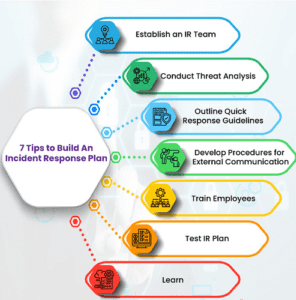
The following steps are involved in incident management in cybersecurity:

  1.     The first step involves an alert that reports an incident that has occurred. This is followed by the engagement of the incident response team, which prepares itself to tackle the incident.
  2.     Next comes identifying potential security incidents by monitoring and reporting all incidents.
  3.     Based on the outcome of the previous step, the next step is responding to the incident by containing, investigating, and resolving it.
  4. Finally, every incident should be documented with its learnings and key takeaways.

Also, check out the following tips for security incident management:

  1.  It is imperative for every organization to ensure a mature and fool-proof incident management process that implements the best practices for a comprehensive plan.
  2.   Make sure your incident management plan is equipped with supporting policies that include well-laid-out guidance on the detection, reporting, assessment, and response of the incidents. A checklist should be prepared, putting down the actions based on the threat. The incident management plan should also be continuously updated as per requirement, especially with regard to lessons learned from previous incidents.
  3.  Creating an Incident Response Team (IRT) plays an instrumental role in working on clearly defined goals and responsibilities. It will also be entrusted with functional roles such as finance, legal, communication, and operations.
  4.  Incident management procedures can go quite a few notches higher with regular information security training and mock drills. These go a long way in boosting the IRT’s functionality and keeping them on their toes.
  5.   A post-incident analysis after any security incident can make a considerable difference in teaching you a thing or two about successes and failures. This helps a lot in making necessary adjustments to the program and incident management processes as and when required.

What More You Need

In incident management in cybersecurity, collecting evidence and analyzing forensics is always highly recommended, which is an integral part of incident response. You need the following things for the same:

  • A well-defined policy can effectively assimilate evidence while ensuring its accuracy and sufficiency to be admissible in a court of law.
  • The incident response should be such that it can employ forensics as required for analysis, reporting, and investigation.
  • The IRT personnel must be well-trained in cyber forensics and functional techniques. They should also have some knowledge of legal and governance issues. You can visit our training centers in Mumbai, Thane, Pune, Chennai, Bengaluru, Delhi, and Gurgaon for cybersecurity training online

In a nutshell, a robust incident management process can reduce your recovery costs and potential liabilities and, above all, minimize the damage to the victim, not only at a personal level but also at the organizational level. 

If you’re looking for cyber security training online, contact us through chat support. 

Learn Computer Vision: What is Hyberbolic Image Segmentatioan?

Learn Computer Vision: What is Hyberbolic Image Segmentation?

Currently, we carry out optimization at the pixel level in Euclidean embedding spaces for segmenting images. We do this through linear hyperplanes (2D visualization). Keep reading to clear your concept for the Artificial Intelligence Course regarding a key alternative for image segmentation that is done in hyperbolic space. 

Computer Vision is one of the most exciting topics covered in Artificial Intelligence and Machine Learning Certification. This field allows systems and computers to retrieve important information from digital visuals like images and videos. Based on the received data, computers process information to make suggestions to the user. 

If we were to simplify the concept, computer vision tries to make computers view images and videos the way humans do. Today, the advancement in deep learning and neural networks has made these systems exceed human performances in some aspects like object detection. 

Today, spherical and Euclidean embeddings dominate the most-used tasks of computer vision like image retrieval and image classification. 

On the other hand, Hyperbolic Image Segmentation is one of the latest standards for segmenting images. It offers multiple practical benefits like: 

  • Uncertainty estimation
  • Boundary information
  • Zero-label generalization 
  • Increased performance in embeddings of low-dimension

Why do we use Hyperbolic Image Embeddings? 

In Natural Language Processing (NLP) tasks, hierarchies are ubiquitous. The widespread presence of these tasks motivates the use of hyperbolic spaces in this field. This is because hyperbolic spaces inherently embed tree graphs and other types of hierarchies with minimum distortion. 

While retrieving an image, you will notice that an overview picture of something can be mapped to the closeups of many unrelated pictures. These pictures might have a wide range of dissimilarities in their details. 

Furthermore, let’s consider classification tasks. For such tasks, an image that contains representations from many classes is generally connected to images that possess the representatives of those classes in insulation. Thus, the process of embedding such a dataset, which contains composite images, into a continuous space is said to be similar to hierarchy embedding. 

There are also some tasks where generic images are used. These images could be related to obscure images because they lack much information. For example, if face recognition software is run over an image that contains a blurry face, the software could match the unclear image with the high-resolution images of many different people. 

There are several inherent hierarchies in NLP that go beyond to reach the visual region. For instance, you can use hierarchical grouping to visually represent different species of plants. 

Collectively, using hierarchical relations in AI increases the demand for hyperbolic spaces for output embedding. As the volume of Euclidean spaces expands, the resulting expansion is polynomial in nature. However, the expansion of hyperbolic spaces is exponential. This results in the generation of continuous tree analogues. 

This information makes it possible to conclude that the unrevealed hierarchy of visual information can be captured by the expanding hyperbolic output embedding. 

Get an Industry-Ready Artificial Intelligence and Machine Learning Certification

During the certification course you will get the insights of the artificial intelligence and machine learning concepts, latest trends and much more to achieve success in the field.  You can become a part of this global institute by joining our centers in cities like Mumbai, Pune, Lucknow, Chandigarh, Hyderabad, Kolkata, etc. Get in touch with our team by emailing info@imarticus.com to know more about the programs.