High Ticket Sales vs. Low Ticket Sales: Definition, Examples and Best Practices

Achieving business success can be difficult despite the wide availability of sales and marketing strategies. Overlooking the potential benefits of minor adjustments in marketing strategies leads to unnecessary challenges for entrepreneurs looking to scale their businesses. Optimised marketing and sales strategy can ultimately lead to effortless growth and a higher ROI. 

Two frequently considered business models are high ticket and low ticket sales, each with advantages and challenges. Understanding the differences between these models is vital to make informed decisions driving growth and achieving financial goals.

So, which business model holds the key to scaling a business? 

This blog will describe high ticket and low ticket sales in detail, offer illustrative examples, and discuss how a sales & marketing leadership programme can help elevate a business’s overall marketing strategy.

Understanding High Ticket Sales and Low Ticket Sales

High ticket sales refer to luxury products or services sold at premium prices. These items typically cost over $1,000 and require personalised attention, follow-up, and longer sales cycles. While high ticket sales offer advantages like higher profit margins, increased brand prestige, and deeper customer relationships, they also have drawbacks such as longer sales cycles, a smaller customer pool, and higher risk.

In contrast, low ticket sales involve cheaper products or services with a price tag under $100. These sales require less effort from the seller, resulting in quicker sales cycles and a larger customer pool. Low ticket sales offer advantages like a more extensive customer base, lower risk, and faster sales cycles. However, they have lower profit margins, limited prestige, and often result in more transactional customer relationships.

Which is the Best?

Considering your target audience, strategy, and revenue goals is crucial when deciding which approach is better for your business. 

High ticket sales work best for businesses with higher profit margins, exclusive positioning, and personalised customer relationships. They are ideal for catering to a niche market willing to invest in premium products or services. 

On the other hand, low ticket sales are more suitable for businesses looking to reach a broader customer base, achieve faster sales cycles, and offer more affordable options. They work well when targeting price-sensitive consumers and focusing on high-volume sales.

The choice between high ticket and low ticket sales depends on the business goals, target market, and value proposition of the products or services. Some businesses can even adopt a hybrid approach, offering a mix of high and low-ticket items to cater to different customer segments and maximise revenue potential.

High Ticket Sales vs Low Ticket Sales 

High Ticket Sales Low Ticket Sales
Definition Includes high-cost and luxury products/services usually sold for high prices Includes cheap products/services with comparatively lower price tags
Price Range Usually over $1,000 Usually under $100
Customer Pool A smaller pool of potential buyers due to a higher price range A larger pool of potential buyers due to a lower price range. Mainly impulse buyers
Profit Margins High (80-150%) Comparatively low (20-40%)
Risk Higher risk Lower risk 
Sales Cycle Longer sales cycle as it requires more consideration from customers. Shorter sales cycle as it requires less consideration.
Inventory Replenishment Rate Comparatively low as they sell few ‘expensive’ items Comparatively high as they sell a lot of ‘cheap’ items
Brand Upliftment Elevates brand to a more exclusive level, appealing to high-end customers May not carry the same level of brand value to its customers
Customer Relationships Requires more attention and personalisation, leading to deeper customer relationships More transactional relationships with customers
Revenue Impact Each sale can result in a significant revenue boost. More sales are needed to achieve the same revenue boost.
Suitable For For a scalable online business and ideal for higher revenue goals Easier to start and operate and suitable for mass sales
Competitors Industry best, bigger companies  Numerous small and big companies

Low Ticket vs High Ticket Sales – Best Practices

Follow these best practices for effective implementation of high ticket sales and low ticket sales:

High Ticket Sales

  • Identifying the target audience: Define your buyer persona and gain a clear understanding of their motivations, pain points, and needs. It will help customise your approach and establish connections with potential high-value clients.
  • Building your reputation: Establish your expertise and reputation in online groups and communities relevant to your industry. Engage in valuable conversations and position yourself as a trusted authority.
  • Filtering prospects: Use strong filters to focus your efforts on qualified leads with the potential to become high-value clients. It will save considerable time and resources.
  • Empathy and relationship building: Approach high ticket sales with empathy and prioritise building relationships over immediate sales. Understand the client’s needs and provide personalised solutions.
  • Follow-up: Implement a follow-up process to nurture relationships and stay top-of-mind with potential clients. Persistence and consistent communication can help close high-ticket deals.
  • Training your team: Equip your sales team with the necessary skills and knowledge to effectively engage with high-value clients. Provide training on consultative selling and relationship-building techniques.
  • Focus on nurturing: Once a high-ticket sale is made, prioritise nurturing the relationship with the client. Offer exceptional service and support to ensure client satisfaction and foster loyalty.

Low Ticket Sales:

  • Value proposition: When marketing low-ticket sales, it’s crucial to highlight the value and benefits your products or services offer. Communicate how they fulfil customer needs.
  • Effective marketing channels: Opt for marketing channels like email, organic search, and social media to generate leads efficiently for your low-ticket offerings.
  • Addressing customer concerns: Identify and resolve potential customers’ doubts or worries about your low-ticket offerings. Provide reassurance and emphasise your products or services’ value and quality.
  • Customer satisfaction: Showcase testimonials or case studies from satisfied customers who have chosen your low-ticket offerings. Highlight the positive experiences and outcomes.
  • Upselling opportunities: Explore possibilities for offering additional products or services to low-ticket customers, increasing their overall spending and potentially introducing them to higher-ticket offerings.
  • Streamlined sales process: Streamline the sales process for low-ticket offerings, minimising friction and ensuring a seamless and user-friendly purchasing experience.
  • Scalability: Focus on the scalability of your low-ticket sales model by automating processes and leveraging systems to handle larger volumes of transactions efficiently. 
  • Diversify revenue streams: Consider diversifying your revenue streams by offering complementary low-ticket products or services that align with your target audience’s needs and interests.

Conclusion

Entrepreneurs can succeed in sales strategies by developing leadership skills and understanding effective sales and marketing techniques. Excel in sales and marketing roles and focus on leadership development with Imarticus Learning’s Executive Management Programme in Sales & Marketing Leadership, offered in partnership with IIM Lucknow. This IIM L executive programme provides a comprehensive understanding of sales and marketing principles, helping professionals transition to leadership roles. 

For more information, visit Imarticus Learning today!

Budgeting for Your ACCA Journey: 5 Tips to Manage Course Fees Effectively

So, you’ve set your sights on becoming an ACCA superstar and embarking on an exciting journey toward a promising career in accounting and finance. Congratulations on taking this bold step! 

Navigating the financial obstacles of earning the ACCA certification might be intimidating, but do not worry! We are here to offer professional advice on properly managing your course expenses while you pursue your ACCA certification.

The Association of Chartered Certified Accountants was established in 1904 and is the international professional accounting organization and has 240,952 members and 541,930 prospective members. 

The ACCA’s main administrative office is in Glasgow, while its headquarters are in London. Through a network of more than 110 offices and centers spread across 51 nations, ACCA offers staff development through 346 Approved Learning Partners (ALP) and more than 7,600 Approved Employers globally.

Learn five budgeting strategies to help you succeed in your quest without hurting your pocket as you learn how to save money on ACCA studies.

What are Effective budgeting strategies for the ACCA journey?

Tips to save money on ACCA studies:

  • Plan Ahead and Set Realistic Goals

“Rome wasn’t built in a day,” and similarly, your ACCA qualification won’t come overnight. It’s crucial to chart out a realistic study plan and set achievable milestones. Start by researching the course fees, exam costs, and additional materials you may need. Take note of the total expenses and divide them throughout your ACCA journey. 

  • Embrace the Power of Budgeting

Budgeting might not sound like the most exciting activity, but trust us. It’s a game-changer! List down all your income sources, whether from part-time work, allowances, or other means. Then, identify your essential expenses like rent, groceries, and utilities. Whatever’s left can be allocated to your ACCA fund. Every penny counts, so even that occasional latte or movie night should find a spot in your budget.

  • Seek Out Flexible Learning Options

Flexibility is the name of the game when managing your ACCA course fees. Thankfully, the world of education has evolved, and various learning options are available. While the traditional classroom setup can be beneficial, it may only fit some people’s schedules or budgets. Consider exploring online courses, which often come at a more affordable price and allow you to study at your own pace. Some providers also give pay-as-you-go models, which allow you to pay for a module at a time and are more convenient for your pocketbook.

  • Tap into Scholarships, Grants, and Discounts

We get it; the ACCA journey can be expensive, but remember that financial aid options are available! Watch for scholarships, grants, or bursaries that can help lighten the load. Many institutions and organizations offer financial assistance to aspiring accountants. Additionally, ACCA sometimes provides fee waivers or discounts for certain categories of students. So, research, be bold, and inquire about any available financial support.

  • Develop Smart Study Habits

Creating wise study habits is one of the best strategies to manage school costs efficiently. You may shorten the time to finish each exam by preparing methodically and successfully, saving you time and money. Establish a study routine that promotes steady advancement and prevents last-minute cramming. Utilize the practice examinations and study guides ACCA offers to the fullest to increase your chances of passing. Consider participating in online forums or study groups to network with other students and learn from their experiences. You can make every dollar spent on your ACCA journey count by tackling your study with dedication and attention.

Why is financial planning essential for ACCA?

Financial preparation is essential for ACCA students since it affects their overall performance and academic progress. Remember, the ACCA qualification is a solid investment in your future. So, even though budgeting might sometimes feel tough, stay motivated and focused on your goals. You’ll conquer the ACCA journey with dedication, hard work, and smart budgeting and emerge as a successful finance professional.

 ACCA students should engage in financial planning for the following reasons:

  • Effective Budgeting: Financial planning enables students to develop a thorough budget that considers all their sources of income and outlays. 
  • Optimal Resource Management: Budgeting aids students in making the most of their available funds. Students can find cost-cutting tactics and investigate accessible possibilities for study materials and resources by carefully arranging their spending. 
  • Financial Stress is Lessened: The ACCA curriculum demands students’ commitment and concentration. Students can lessen the financial burden that may interfere with their education by having a sound financial plan. 
  • Long-term Financial Success: Financial planning instills in ACCA students sound money management practices that go past their time in school. 

The Final Words

Managing the association of chartered certified accountant’s fees effectively involves planning, budgeting, and staying determined. Embrace the journey enthusiastically and remain open to exploring different options to make it affordable. Remember, getting good grades isn’t everything; you must also develop the knowledge and abilities to position yourself for a fulfilling job.

The ACCA certification is unquestionably a smart investment in your future, opening the door to a wide range of interesting career possibilities and differentiating you in a crowded employment market. Although managing your finances might be difficult, keep your motivation high and your attention on your objectives. 

When feeling overwhelmed, take a deep breath, picture your goals, and continue. You will succeed in your ACCA journey with dedication, hard work, and wise budgeting, launching you into a prosperous financial professional.

A 100% placement guarantee is included with the ACCA, even after completing the first two levels. Whether it’s an internship or a placement, the candidate is guaranteed success or gets their money back.

So, are you ready to take on the challenge and make your mark in finance? Start your budgeting process, enroll in your desired ACCA course, and let this exciting journey begin. Your future financial success awaits you, so go out there and make it happen!

Go forth and conquer! Your ACCA adventure awaits!

Business Process Optimisation: How to Improve Operations and Management?

A business process is a series of connected tasks within an organisation that aims to achieve a specific goal or produce a desired output. It involves performing steps in a particular order to transform inputs into valuable outputs. Business processes are crucial for an organisation’s functioning and growth, ranging from simple tasks to complex workflows that involve multiple departments.

global senior leadership programmeIf you want to become an influential leader and know how to improve the process of a business then you have stumbled across the right read. Keep on reading to learn more about how to optimise business processes, operations and management.

What a Business Process Entails

A business process in the most simple of definitions is a set of sequential tasks which when performed creates value. Below are the components of a business process:

Inputs

Inputs are basically the resources that necessitate the initiation and execution of the process. Inputs can vary depending on the nature of the process. Let’s say that you own a construction company. Your inputs may include raw materials, tools, and other technology that is used in the construction process.

Activities

These are the individual tasks or steps that need to be performed within the process. Activities contribute to achieving the overall objective of the process. It may involve multiple participants or roles within the business. 

For example, in the customer service process, activities can involve answering customer inquiries, resolving complaints, and providing product support.

Flow

The activities are organised and connected in a logical sequence or flow. This ensures that the process moves smoothly from one step to another, with dependencies and relationships between activities being properly managed. 

Let’s take an example of a dropshipping business. The flow can include receiving an order, processing it, picking the items from inventory, packing them, and shipping them to the customer.

Controls

Controls are the mechanisms that are put in place. These mechanisms ensure that the process is executed accurately and efficiently. They include rules, guidelines, policies, quality checks, and approval mechanisms that govern how the process is carried out.

So in a financial business, controls can involve verifying and approving expense reports, purchase orders, or budget requests according to predefined rules and policies.

Outputs

The outputs of a business process are the results or outcomes that are generated by completing the activities. These outputs can be tangible or intangible, and they should align with the goals and objectives of the process and the organisation.

If you own a marketing business, then the outputs can include increased brand awareness, lead generation, and customer conversions resulting from the campaign.

How to Improve Business Operations

Improving business operations is an ongoing effort. It involves identifying areas for improvement and implementing strategies to optimise efficiency, productivity, and overall performance. Here are a few ways through which you can improve business operations:

Identify the areas where you can improve

To identify areas for improvement, assess your current operations. Look for inefficiencies, bottlenecks, or challenges. Analyse processes, gather feedback from employees and customers, and conduct performance evaluations.

Set your goals

Define specific and measurable objectives for operational improvements. Align these objectives with your business goals. Address the identified areas for improvement.

Some common examples of objectives can be increasing your production efficiency. You can target this by reducing the average processing time by 20% within the next quarter. Or, improving customer satisfaction ratings by achieving a minimum of 90% positive feedback within six months.

Invest in technology

Technology plays a big part in improving a business’s operations. Evaluate and invest in suitable solutions that streamline operations, enhance collaboration, and improve data management. This may involve implementing project management software, CRM systems, or ERP systems.

Measure the performance

Implement metrics and KPIs to measure operational improvements. Regularly monitor and analyse data. Identify trends, track progress, and make data-driven decisions. Enhance operations based on findings, and try to better the areas your business lacks.

Use your customer’s feedback

Gather feedback from customers to understand their expectations, pain points, and areas for improvement. Use this feedback to tailor your operations to better meet customer needs and enhance their experience. Customer satisfaction is the backbone of any business.

How to Improve Business Management

Improving business management involves enhancing leadership, and overall organisational effectiveness. Here are a few pointers to do so:

Improve communication

Foster open communication between managers and employees, as well as among teams and departments. Encourage active listening and clear instructions. Promote regular feedback and information sharing. Closing the communication bridge is beneficial for the growth of every business.

Offer professional development

Offer training programs, workshops, and learning opportunities. Encourage skill enhancement and knowledge growth. Foster employee ownership of professional development. This will let your employees upskill themselves, and be a better asset to your company.

Create an environment for innovation and creativity

Encourage managers and employees to think creatively, and experiment with new ideas. Let them propose new solutions to challenges. Embrace calculated risks and view failure as a learning opportunity for your company’s employees.

Conclusion

Mastering business process optimisation is key to making your business thrive in the long run. Even if you have the best product in the market and the most skilled employees in their domain, it is highly unlikely that your business will increase the revenue it generates without a proper business process.

If you do want to become an influential leader and push yourself to the next level, then Imarticus Learning has you covered with leadership courses from IIM. Imarticus has collaborated with the best, and brings to you the Global Senior Leadership Programme. This IIM Lucknow Leadership Programme is designed to unleash your potential as a leader. So what are you waiting for? Enrol now.

Factors To Consider For Choosing The Right Product Management Certification Course

Benefits of Product Management certification course

Are you looking to boost your career in product management? Do you want to stand out from the competition and be recognized as an expert in your field? If so, then a Product Management certification course might be just what you need. In today’s competitive job market, having a certification is essential. It can give you the edge you need to land that dream job or get that well-deserved promotion.

best product management course

A Product Management certification course prepares you to become a successful product manager. This course provides a complete understanding of various aspects of product management. These include market research, product development, pricing strategies, and marketing. By completing this certification, you gain credibility. Thus, enhance your career prospects in the field of product management. The benefits of taking a Product Management certification course are plenty. You gain expertise in a high-demand field. This increases job opportunities and earning potential. The course teaches you to effectively manage and launch successful products in the market.

Let’s explore some key factors to consider for a product management course.

7 factors to consider before enrolling in a Product Management certification course

Before enrolling in a Product Management certification course, there are several factors that you should consider. These factors will help you determine if the course is the right fit for your goals and needs.

1. Reputation and accreditation

Research the reputation and accreditation of the certification program. Look for programs that are recognized and respected within the industry.

2. Curriculum and course content

Review the curriculum and course content to ensure that it covers the necessary skills and knowledge you need to develop as a Product Manager. Look for courses that provide a comprehensive understanding of product development, strategy, and marketing.

3. Instructor Expertise

When choosing where to learn product management, it’s crucial to thoroughly investigate the qualifications and experience of the instructors. It’s not enough for them to simply have theoretical knowledge – you want to learn from professionals who have real-world experience in product management. This will ensure that you are gaining practical insights and learning from their successes and failures in the field. Look for instructors who can provide examples of their past projects, achievements, and industry recognition, as this will help validate their expertise and enhance your learning experience.

4. Flexibility and convenience

Consider the format and schedule of the course. Determine if it fits with your current commitments and lifestyle. Online courses may offer more flexibility, while in-person courses may provide more networking opportunities.

5. Support and resources

Find out what kind of support and resources are provided during the course. Look for programs that offer mentorship, community forums, and additional learning materials.

6. Cost and value

Evaluate the cost of the certification course and compare it with the value it will bring to your career. Consider the return on investment and whether the course is worth the financial commitment.

7. Alumni network and job placement

Research the alumni network and job placement opportunities provided by the certification program. A strong network and job placement support can enhance your chances of finding a job or advancing in your current career.

The Product Management certification course you choose should align with your career goals. By considering the above factors, you can make an informed decision.

Elevate your career with the ultimate product management certification course

When considering a product management course, there are a few factors to keep in mind. Look at the course curriculum. Make sure it covers essential topics like market research and product development. Consider the qualifications and experience of the instructors. You want professionals who have real-world experience in product management. Also, think about the course format. Do you prefer in-person classes or online learning? Choose a format that suits your learning style and schedule.

Investing in a product management certification course enhances your credibility. It also opens doors to new opportunities and a higher earning potential. Imarticus Learning offers a wide range of learning programs designed specifically for young professionals like you. We have an easy-to-use interface and expert-led courses. Don’t miss out on this opportunity to invest in yourself and take your career to the next level. Visit our website today and start your journey toward success.

What can I do with a supply chain management degree?

In the dynamically transforming world of commerce, a career in supply chain management offers an exciting blend of strategic problem-solving, analytical skills, and management prowess. Graduates from a supply chain management course find themselves at the crossroads of an intricate global network, managing a wide array of activities from procurement to logistics, thereby making tangible impacts on the businesses they work with.

best supply chain management and analytics training

With the burgeoning complexity of international commerce, supply chain management has emerged as a crucial field, accelerating demand for skilled professionals. With a degree in supply chain management, one can navigate through this industry, sculpting an intriguing and rewarding career in logistics and supply chain management.

The Evolution of Supply Chain Management: A Historical Perspective

Understanding the evolution of supply chain management helps appreciate the complexity and importance of the field today. 

The early 20th century saw the core focus on production. With that, companies aimed at enhancing manufacturing efficiency. This era was characterised by mass-production models, as exemplified by Henry Ford’s assembly line. During this period, supply chain activities were largely fragmented, and logistics was viewed as a necessary but non-strategic expense.

Post World War II, there was a shift towards a market orientation, where understanding customer needs and providing value became the focal point. Businesses started recognising the significance of managing distribution and logistics to meet customer demands effectively. Still, the overall supply chain perspective remained functionally siloed, with each department focusing on optimising its operations without much regard for the broader system.

The late 20th century heralded a new era with the advent of Information Technology. Companies began to see their supply chains as an integrated process, where coordination across different functions was key to achieving overall efficiency. Alongside this, various waste reduction and continuous improvement strategies like JIT (Just in Time) and TQM (Total Quality Management) also took birth.

With the dawn of the 21st century, the supply chain management field witnessed exponential growth in its complexity and strategic importance. Globalisation led to lengthier and more intricate supply chains, demanding better coordination and visibility across all levels. While we were adjusting to the new normal, e-commerce giants like Amazon emerged, completely revolutionising consumer expectations from businesses. The newfound appetite for speedy, affordable, and efficient delivery has skyrocketed, exerting considerable pressure on companies to meet these amplified demands.

The freshest shift in supply chain management is deeply connected to the arrival of advanced digital technologies like AI, machine learning, big data, and blockchain. This surge of technological advancements has sparked the beginning of an exciting new journey in the realm of supply chain management, unfolding an array of promising prospects for the times ahead.

Charting Your Career Path

A supply chain management degree unlocks a multitude of potential career paths, each with unique roles and responsibilities. You might find yourself stepping into the shoes of a Supply Chain Analyst. 

In this role, you’d immerse yourself in the meticulous review and enhancement of supply chain processes, skillfully using quantitative data as your compass to guide insights and shape strategic decisions. Alternatively, you could take on the mantle of a Logistics Manager or Operations Manager. These roles place you at the heart of daily supply chain operations, where your responsibility lies in maintaining the smooth running of operations and ensuring efficient and timely deliveries, all while keeping a vigilant eye on cost management.

If strategic roles interest you, you might gravitate towards becoming a Supply Chain Consultant or a Supply Chain Manager. These roles involve a strategic overview of supply chain processes, optimising performance, reducing costs, and ultimately driving value for businesses. 

As your experience grows, you could even work your way up to become a Director or Vice President of Supply Chain Management, playing a pivotal role in shaping a company’s direction and success.

Leveraging the Right Course

Taking the right supply chain management course is crucial in developing the necessary skills and knowledge to excel in this industry. A well-structured course provides both the theoretical and practical grounding required to navigate the dynamic landscape of supply chain management.

One course that stands out is the Professional Certification in Supply Chain Management and Analytics by IIT Roorkee, offered in collaboration with Imarticus Learning. This globally recognised certification offers a comprehensive curriculum, expert-led teaching, and real-world industry projects, providing a holistic and impactful learning experience.

Building a Future in Logistics and Supply Chain Management

A career in logistics and supply chain management promises diversity and exciting challenges. With roles spanning across industries like retail, manufacturing, healthcare, and technology, a degree in supply chain management could lead you anywhere in the world.

As businesses increasingly prioritise sustainable practices, there is a rising demand for supply chain professionals capable of creating and implementing green logistics strategies. This presents opportunities to influence companies’ environmental footprints while driving cost savings and efficiency.

Conversely, with the surging emphasis on digital transformation, an array of roles dedicated to the management and application of advanced technologies in supply chain management is becoming increasingly prevalent. These technologies, encompassing AI, machine learning, and blockchain, create a rich confluence of technology and supply chain management, paving the way for innovation and revolutionary change.

In conclusion, possessing a degree in supply chain management is akin to holding a versatile key capable of unlocking a myriad of career opportunities. Opting for a globally recognised course like the one offered by IIT Roorkee ensures you are well-armed with the necessary skills and insights to flourish in this ever-changing field. 

Setting off on a career journey in supply chain management offers not only a diverse range of challenges to conquer but also a chance to make a significant contribution to the global economy.

Exploring Diverse Principles of Management

In today’s globalised and interconnected world, the concept of diversity and inclusion has become much more critical than ever for business enterprises. According to a recent survey, as much as 57% of recruiters feel that their talent acquisition strategies are designed specifically for attracting diverse candidates. 

However, that being said, creating a diverse and inclusive workforce is not just about checking boxes but includes fostering an environment wherein everyone feels valued and respected.

What is Workplace Diversity and Inclusion?

Workplace diversity and inclusion refers to the practice of creating a work environment that embraces and values individuals from various backgrounds, experiences, as well as perspectives. However, when you take a closer look at this concept, you will realise that diversity and inclusion are actually quite different from each other and do not mean the same thing. 

Simply put, diversity refers to the presence of individuals with varied backgrounds, perspectives, and characteristics, within an organisation. It encompasses a wide range of factors, including, but not limited to, race, ethnicity, sex, age, nationality, and socio-economic status.

On the other hand, inclusion signifies creating a work environment where all individuals, irrespective of their differences, feel welcomed and valued. It primarily focuses on promoting a sense of belonging for every employee in an organisation and ensures that every voice is given due importance and consideration. 

If an organisation is aiming to truly offer an inclusive work environment, they need to implement policies and practices that promote fair and unbiased hiring, opportunities for the professional development of all employees, and diversity recruitment.

Diversity and Inclusion Best Practices

Listed below are some of the best and essential practices that every organisation must implement in order to promote a diverse and inclusive workplace.

Establish A Sense Of Belonging

Fostering a sense of belonging is essential for a workspace to be inclusive and cohesive for all its employees.  Unconscious bias and cultural competency should be the main topics of discussion throughout these sessions, which should also promote candid conversations to clear up any misunderstandings or concerns. 

Equal and Fair Treatment of All Employees

Fairness is yet another crucial prerequisite for employees to feel valued and respected. More often than not, unfair salaries or undue advantages to employees of different backgrounds can create an unhealthy workplace culture. 

 Conduct Regular Diversity Audits

Conducting audits on a regular basis helps keep track of progress, identify potential areas for improvement, and hold the organisation accountable for diversity and inclusion goals. In addition to this, it also helps to understand the effectiveness of diversity initiatives.

Promote Diversity In Hiring

This includes expanding the talent pool through targeted outreach, implementing bling resume screening processes to prevent the occurrence of unconscious bias, and partnering with diverse organisations. In addition to this, interviewers must also be trained in inclusive interviewing techniques that focus on skills and qualifications rather than cultural fit. 

Conclusion

If you wish to explore more about such practices or simply enhance your people management skills, you can check out multiple strategic HR management courses that are available online.

Such IIMA management courses are specifically designed for business managers and emerging senior HR professionals who wish to advance their careers in this field. Additionally, with the IIM A management course, you also get to explore multiple benefits, such as access to masterclass sessions and professional certifications, among others.

5 Effective Digital Onboarding Practices For Your New Hires

Companies cannot afford to lose time in lengthy onboarding processes today. They need their new hires to adapt to their job roles and company culture at the earliest. That’s why most organisations adopt digital onboarding now. But, what is technical onboarding? Digital onboarding refers to the onboarding process that is completely done online. Thanks to the technical and security tools, onboarding can be done from anywhere at any time using any device with an internet connection. This article will cover some best practices for the digital onboarding of new hires.

Create a Standard Onboarding Process

Analyse the current onboarding process and look for areas which require improvement. Ask for feedback from staff to understand the issues that they faced during their onboarding. Paperless onboarding is more efficient as the training content can be repurposed.

corporate training

Once the organisation understands what works for them and what doesn’t, create a standard onboarding program using that information. Automating onboarding processes will be of great help to employees in their initial days. Companies can streamline the onboarding process using automation tools. This way, employees can easily fill out paperwork, provide digital signatures and follow training tutorials. It saves their time. It will also lighten the burden on the IT team. With a FAQ page in place, they do not have to worry about taking care of the basic issues that new hires will face.

Engage New Employees

Lack of feedback is one of the biggest concerns of organisations trying to develop an efficient onboarding system. Request both new and existing employees to give their feedback on the onboarding program. Analysing their feedback is important while designing the right onboarding program for the organisation. Ask them which tools they find user-friendly, which ones helped them understand their job role and organisation better and if they need any additional information. Then, use this information to simplify and update the onboarding system.

Personalise Onboarding as Much as Possible

Every candidate has their unique needs and so does their job role. Their learning style will also be different from each other. Customise their learning program based on these factors and give them the support they need in these early days. While some benefit from watching videos, others might need virtual meetings and digital documentation to understand better. Give them the freedom to choose which type of learning material and learning style they want to follow.

Assign a Mentor

Digitising onboarding doesn’t necessarily mean instructors or mentors are of no use. Having a mentor is important especially if the company has hybrid teams or remote employees. New hires will have so many concerns and doubts about their job role and company in the initial days. It’s important that they talk to an experienced person and clear their mind. Find a senior member in the organisation who is well-informed, empathetic and friendly to mentor the new hires. This mentor will then guide the new employees in their tasks and roles. They will also help them understand the company culture better.

Set Expectations and Track Performance

With the help of automation tools, companies can create a checklist or a timeline to complete tasks. Tracking the progress of employees is important to know where they stand. Make sure the timelines are clearly communicated in the onboarding process. There are several analytical and reporting tools that can monitor and analyse the activities of new employees. This way, organisations can understand how well they are meeting their expectations, what are their strengths and which areas they need to improve. Conduct weekly or bi-monthly meetings to check in on them and guide them to improve performance.

Key Takeaway

Any company looking to onboard its new hires remotely and quickly will benefit from the digital onboarding program. So, it would be a wise choice to invest in one without wasting further time.

To learn more about the role of technology in onboarding, visit Imarticus Learning.

Unveiling Capital Markets Explored: Navigating the Landscape of Investments and Funding

Capital markets allow individuals, companies, and governments to trade financial assets such as stocks, bonds, and commodities. In investment banking, the importance of capital markets is enormous as they play an important role in facilitating the flow of funds between investors and entities in need of capital. Investment banks also assist in raising funds through initial public offerings (IPOs), bond issuances, and other securities transactions, contributing to economic growth and corporate expansion.

Let us move forward with an in-depth analysis of the crucial investment banking fundamentals. We aim to offer comprehensive insights while exploring a range of relevant investment banking courses suitable for prospective candidates seeking to pursue this field.

What is Capital Market?

In investment banking, capital markets are financial markets where long-term debt and equity-backed securities are traded. These markets act as essential pathways for funds to flow between banks, investors, businesses, governments, and individuals. The main purpose of capital markets is to facilitate the transfer of wealth from savers to entities that can use it for long-term investments or projects.

Let us learn more about the structure of the capital market:

Primary Market vs. Secondary Market

The primary market, (or the new issues market), is the platform where companies publicly offer new stocks or bonds for the first time, often through an initial public offering (IPO). To facilitate these transactions, companies enlist Investment banking firms to review the securities and create comprehensive prospectuses that outline important details, including price.

Strict regulations exist in the primary market to ensure transparency and investor protection. Companies need to file statements with regulatory bodies like the Securities and Exchange Commission (SEC) and go through an approval process before becoming public. However, small investors may need more support to participate in the primary market. The primary focus is often on selling available securities quickly to meet volume requirements. 

In contrast, the secondary market consists of regulated venues, such as the New York Stock Exchange and Nasdaq, where previously issued securities are traded among investors. Issuing companies do not directly participate in secondary market transactions.

Within the secondary market, two categorisations exist auction and dealer markets. In auction markets, buyers and sellers congregate in a centralised location and publicly declare the prices at which they are willing to buy or sell securities. The New York Stock Exchange operates based on this method. On the other hand, dealer markets rely on electronic networks for trading. This is where most small investors typically participate.

To proceed with investment banking, financial modelling, it is crucial to analyse the important elements of capital marketing.

Types of Capital Markets
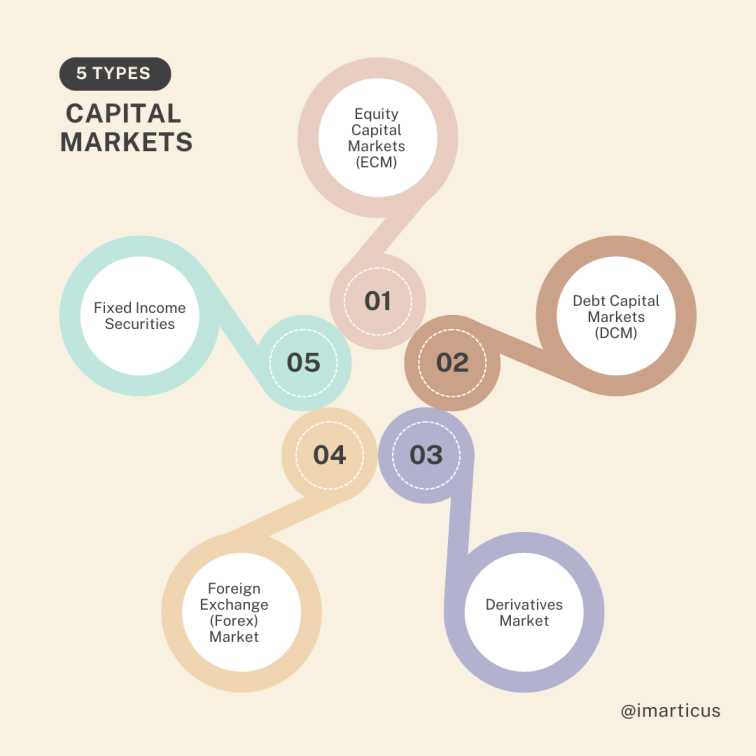
Types of Capital Markets

Let us learn about the different features of the capital market as well as the important types of capital markets that investors, organisations and governments deal with.

Equity Capital Markets (ECM)

Equity Capital Markets (ECM) cover a range of financial activities related to the insurance and secure trading of equity securities.

Initial Public Offerings (IPOs): Initial public offerings occur when a private company offers its shares to the public for the first time, becoming a publicly traded entity. Through an IPO, the company raises capital by selling shares to investors, who can then trade them on the secondary market.

Follow-on Offerings: These arise when an already publicly traded company issues additional shares to increase its capital. These offerings can take diverse forms, such as a seasoned equity offering (SEO) or a rights issue.

Rights Issues: The company provides current shareholders the chance to buy more shares at a lower price. This helps the company raise capital from its existing shareholders while allowing them to keep their ownership stake in the company.

Private Placements: These involve the sale of securities to a selected group of investors, usually institutional investors or accredited individuals, bypassing the general public. Private placements allow companies to raise capital without undergoing a public offering.

Equity-linked Securities: These hybrid financial instruments combine characteristics of both debt and equity. Equity-linked securities offer investors the potential for equity-like returns while possessing certain debt-like traits. For example – convertible bonds, exchangeable bonds, and warrants. 

Investment banking services work closely with companies, offering advice on the optimal timing and structure of IPOs, managing follow-on offerings, structuring rights issues, arranging private placements, and overseeing the issuance of equity-linked securities. 

Debt Capital Markets (DCM)

Debt Capital Markets (DCM) involve raising debt capital through various financial instruments and activities. Here’s an overview:

Bonds: Debt securities issued by entities to raise capital, representing a loan made by investors. Bonds have different features such as fixed or variable interest rates, varying maturity dates, and credit risk levels.

Commercial Paper: Short-term debt instruments used for meeting funding needs, typically issued at a discount by corporations, with a maturity of less than a year.

Syndicated Loans: Large loans provided by a group of lenders (syndicate) to finance projects or acquisitions. Risk and administration are shared among lenders, with loan terms structured by investment banks or financial institutions.

Convertible Bonds: Bonds that grant bondholders the option to convert them into the issuer’s common stock at a predetermined price. They offer the potential for equity participation while receiving fixed-interest payments.

High-Yield Debt (Junk Bonds): Bonds issued by companies with lower credit ratings carry higher default risks but also higher yields.

In Debt Capital Markets (DCM), investment banking firms assist companies in raising debt capital, providing advisory services, underwriting, structuring, and distributing debt securities to investors. 

Derivatives Market

Derivatives offer opportunities for risk management, speculation, and portfolio diversification. Investors, corporations, and financial institutions use them to manage exposure, protect against losses, or exploit market opportunities. However, proper investment banking training can aid in a successful transition and mitigate possible market risks. 

Options: Derivative contracts that provide the right, but not the obligation, to buy (call option) or sell (put option) an underlying asset at a predetermined price (strike price) within a specified period. Options offer flexibility for hedging, speculation, or generating income.

Futures: Agreements to buy or sell an underlying asset at a predetermined price on a future date. Unlike options, futures contracts require both parties to fulfil the agreement. Futures are commonly used for hedging in commodities and financial markets to manage price risks.

Swaps: Contractual agreements between two parties to exchange cash flows or financial instruments based on predetermined terms. Interest rate swaps, the most common type, involve parties exchanging fixed and floating interest rate payments to manage exposure. Currency swaps and commodity swaps are other types.

Forward Contracts: Agreements between two parties to buy or sell an asset at a specified price on a future date. These contracts are customised and traded over-the-counter (OTC). Forward contracts provide flexibility in terms of contract terms and settlement.

Hedging Strategies: Using financial instruments such as options, futures, or swaps is a way to protect against potential losses caused by unfavourable price movements in an underlying asset. Hedging helps individuals or businesses reduce risks associated with changes in interest rates, exchange rates, commodity prices, or other market factors.

Foreign Exchange (Forex) Market

The Forex Market is the largest and most liquid financial market globally. Participants include banks, commercial companies, central banks, investment management firms, hedge funds, and retail forex dealers. 

Important elements include:

Spot Market: It’s where immediate currency transactions take place at the current market price (spot rate). This is the most common form of foreign exchange trading.

Forward Market: Involves trading currencies for future delivery at a predetermined exchange rate through forward contracts. It helps manage currency risk and hedge against fluctuations.

Currency Swaps: These agreements involve exchanging interest payments and principal amounts on loans denominated in different currencies. Currency swaps help manage interest rate risk and obtain favourable borrowing terms.

Currency Options: Derivative contracts that give the holder the right, but not the obligation, to buy (call option) or sell (put option) a specific currency at a predetermined price within a specified period. Currency options provide flexibility for hedging or speculation.

Exchange Rate Risk Management: Strategies and techniques used to mitigate the impact of exchange rate fluctuations on financial transactions. This includes hedging instruments like forward contracts, currency swaps, and currency options.

Fixed Income Securities

Fixed Income Securities are investment instruments representing loans made to issuers (governments, corporations, or municipalities). They pay fixed interest over a specific period and return the principal at maturity. Mitigating risks requires proper investment banking skills.

Treasury Bonds: These are long-term fixed-income securities provided by the U.S. Department of the Treasury. They have durations of 10 to 30 years and are secure investments supported by the U.S. government.

Corporate Bonds: Debt securities issued by corporations to raise capital. Investors lend money in exchange for periodic interest payments and the return of principal at maturity. Corporate bonds carry varying levels of risk based on the issuer’s creditworthiness.

Municipal Bonds: Issued by state and local governments or agencies to fund public infrastructure projects. They can be tax-exempt and come in general obligation and revenue bond types.

Mortgage-Backed Securities: Represent ownership in a pool of residential mortgage loans. Investors receive cash flows from mortgage payments, providing exposure to the housing market.

Asset-Backed Securities: Backed by pools of assets like auto loans, credit card receivables, or student loans. Investors gain access to diversified income streams.

Difference Between Money Market and Capital Market

Here are the differences between the money market and the capital market:

Duration: Money market deals with short-term borrowing and lending, while capital market focuses on long-term investments.

Instruments: Money market involves instruments like commercial paper, while capital market includes assets like stocks and bonds.

Purpose: Money market addresses short-term liquidity needs, while capital market supports long-term funding and growth.

Risk and Return: Money market generally offers lower returns with lower risk, whereas capital market returns can be higher but with potentially higher risk.

Participants: Money market participants are often banks and financial institutions, while capital market involves investors, companies, and governments.

Market Maturity: Money market instruments have shorter maturity periods, while capital market securities have longer durations.

Regulation: Money market is closely regulated to maintain stability, while capital market has comprehensive regulations to protect investors and ensure transparency.

Example: Money market could involve trading short-term certificates of deposit, while capital market may include buying shares of a company’s stock.

Capital Market Functions and Real-world Examples

Let us learn about the important features of capital markets with the help of capital market examples.

Diversification Opportunities: Capital markets enable investors to diversify their portfolios by investing in a range of assets, like Google’s parent company Alphabet issuing bonds to raise capital.

Efficient Allocation of Resources: Companies can secure funding for growth projects, such as Amazon issuing stocks to finance expanding its distribution network.

Risk Management: Investors can hedge risks using derivatives like options contracts, exemplified when a farmer uses futures to lock in a price for their upcoming crop.

Access to Capital: Start-ups can raise funds for innovation, as seen with Uber going public to gain capital for its global expansion.

Global Connectivity: International companies can access funds globally, as demonstrated by Japanese automakers issuing bonds in the United States.

Transparency and Regulation: Capital markets are regulated, ensuring fair and transparent transactions, exemplified by the Securities and Exchange Commission overseeing companies’ financial reporting.

Long-Term Investment: Investors can engage in long-term strategies, like pension funds investing in government bonds to secure future retiree payments.

Price Efficiency: Efficient markets quickly reflect information, as seen when a company’s stock price adjusts rapidly to news about its earnings report.

Liquidity for Investors: Investors can sell shares in exchange for cash, illustrated when a retiree sells stocks to cover living expenses.

Funding Public Projects: Governments raise funds for public projects by issuing bonds, allowing citizens to invest in their country’s development.

Investment Banking in Capital Markets

Investment banking services play a prominent and vital role in the functioning of capital markets. Within investment banks, specialised divisions known as capital markets groups focus on offering a wide range of services revolving around the issuance and trading of securities in these markets. Such Investment banking skills are crucial for companies looking to raise capital and investors seeking opportunities to buy or sell securities in an efficient and regulated environment.

Here’s an overview of the components:

Underwriting Securities Offerings: Underwriting involves an investment bank assisting a company in raising capital by issuing stocks or bonds. Among the most sought investment banking careers, the underwriter commits to purchasing the securities from the issuer at a certain price and reselling them. This mitigates the risk of not selling directly to investors. The underwriter determines the offering price, assesses market demand, and ensures legal and regulatory compliance.

Pricing and Allocation Strategies: Pricing strategies determine the offering price based on market conditions, investor demand, and the issuer’s financials. Allocation strategies distribute securities fairly and efficiently, considering investor demand, regulatory requirements, and issuer preferences. Comprehensive investment banking training can help you learn the nitty-gritty of market price speculation.

Book Building Process: Underwriters determine the IPO price through book building. Institutional investors submit bids for shares and prices. The underwriter evaluates these bids to determine the final offering price. Book building is an efficient way to price securities.

Syndicate Management: In more extensive offerings, a syndicate is formed to share risk and responsibility. The lead underwriter or book runner leads the syndicate in marketing and distributing securities. Syndicate management includes structuring the offering, coordinating investor roadshows, managing the order book, and allocating shares to investors.

Capital Market Instruments

In investment banking, Capital market instruments are diverse financial instruments traded in capital markets. Here’s an overview:

Stocks: Represent ownership in a company, with potential capital appreciation and dividends. Traded on stock exchanges.

Bonds: Debt instruments issued by governments, corporations, etc. Investors lend money in exchange for interest payments and principal returns. Influenced by interest rates, credit ratings, and market conditions.

Derivatives: Financial contracts deriving value from an underlying asset or benchmark. Examples include options, futures, forwards, and swaps. Used for hedging, speculating, or gaining exposure. Can be complex and involve risk.

Mutual Funds: Investment vehicles pooling money from multiple investors, investing in a diversified portfolio managed by professionals. Offers diversification, professional management, and liquidity.

Exchange-Traded Funds (ETFs): Similar to mutual funds, providing intra-day liquidity. Can track various indexes, sectors, commodities, or investment strategies. Offers flexibility, diversification, and potentially lower costs compared to traditional funds.

Capital Market Regulation and Compliance

Capital market regulation and compliance are crucial for maintaining the integrity and stability of financial markets. Key entities include:

Securities and Exchange Commission (SEC): The SEC is responsible for regulating and enforcing federal securities laws in the US. It aims to safeguard investors, ensure fair markets, and promote capital formation.

Financial Industry Regulatory Authority (FINRA): FINRA, authorised by Congress, regulates broker-dealers in the US. It establishes conduct standards, administers licensing exams, performs exams and surveillance, and resolves investor-broker disputes.

Dodd-Frank Act: The Dodd-Frank Act was enacted following the 2008 financial crisis with the goal of improving financial stability, transparency, and accountability, while also safeguarding consumers. It introduced regulatory changes including derivatives regulation, the establishment of the Consumer Financial Protection Bureau (CFPB), and the Volcker Rule.

Basel III: Basel III refers to a set of global banking regulations developed by the Basel Committee on Banking Supervision (BCBS). The objective of Base III is to strengthen banks, enhance risk management, and promote stability in the global banking system through the implementation of stricter capital, liquidity, and leverage standards.

Market Abuse Regulations: These regulations aim to prevent market manipulation, insider trading, and other fraudulent activities. Investment banking services play a vital role in maintaining market integrity and investor confidence.

Capital Market Trends and Developments

Capital market trends and developments significantly shape the financial landscape. Key trends and developments include:

Sustainable and Green Financing: This involves financial products and services supporting eco-friendly and socially responsible initiatives. The growing focus on integrating environmental, social, and governance (ESG) factors in investment decisions drives the demand for sustainable investment opportunities. Green bonds and sustainability-linked loans are popular green financing instruments.

Fintech Innovations: Financial technology innovations are changing the financial services industry. Developments in areas such as artificial intelligence, blockchain, and digital payments are transforming different parts of capital markets, making them more efficient, accessible, and transparent.

Special Purpose Acquisition Companies (SPACs): SPACs garner substantial attention as publicly traded companies established to acquire or merge with other companies within a specified timeframe. They provide an alternative path to going public, bypassing the traditional IPO process. The SPAC market experienced some slowdown in 2022, with lower volume and underperformance of completed mergers.

Alternative Trading Systems: These platforms offer an alternative to traditional stock exchanges for securities trading. ATSs facilitate electronic trading outside of exchanges, promoting liquidity, broader access, and lower transaction costs. Buyers and sellers can connect directly through ATSs

Initial Coin Offerings (ICOs) and Cryptocurrency: Initial Coin Offerings (ICOs) are used to raise funds for projects that are based on blockchain technology. They allow the issuance and sale of digital tokens or cryptocurrencies in order to raise capital. Although ICOs have become popular in recent times, they have faced regulatory scrutiny due to concerns related to investor protection and fraudulent activities.

Alternatively, digital currencies like Bitcoin and Ethereum are continuously transforming, garnering attention from institutional investors and the establishment of regulations for their trading and safekeeping.

Conclusion

The capital markets are currently facing challenges and uncertainties, including economic slowdown, regulatory changes, and volatility. However, it’s important to acknowledge that there are opportunities for growth and investment. To navigate the capital markets effectively, individuals should adapt to regulatory changes, focus on quality investments, and stay informed about market trends.

Wandering how to get started with an investment banking course

Well, Imarticus Learning is here to help!

With a Certified Investment Banking Operations Professional training program, Imarticus presents you with a great opportunity to learn or level up your investment banking skills.

Wait, there’s more! How about investment banking internships with the top recruiters? 

Yes! Imarticus Learning makes sure that, along with honing up your skills with the robust investment banking course, you’re awarded an investment banking certification to make things a bit easier for your investment banking career journey. 

What are you waiting for? Get in touch!

FAQs

Is capital markets a good career?

Capital markets offer a great career for professionals as well as freshers who are looking for opportunities in the domain of investment banking.

What are the benefits of the capital markets?

Capital markets provide opportunities for organisations to raise funds for growth and expansion, while offering individuals a platform to invest and potentially earn returns on their investments.

Who controls the capital market in India?

The Securities and Exchange Board of India (SEBI) regulates and controls the capital market in India.

Decoding Financial Modelling: Building Insights for Informed Strategies

Financial modelling can be a vast term for those indulging in it for the first time. However, it is extremely beneficial and holds a vast amount of scope for enthusiasts. An investment banking course can be the right fit for professionals looking to upgrade in this field. 

At the same time, it encompasses multiple areas such as historical data processing, assumptions, and forecasting the financial future. 

Although financial modelling involves a multitude of options, it is always advisable to experiment and go for the best model for one’s business. When it comes to investment banking, financial modelling offers a clear pathway to calculate and predict a business’s finances. 

Although the modelling styles may differ, it all comes down to making informed decisions on areas such as the allocation of budget, and resources. The primary goal of investment banking, however, remains planning for the near and far future.

But how does one know if they’re cut out for financial modelling? Buckle up to understand how an investment banking course can benefit you. Additionally, you can invest in financial modelling to reap the best benefits.

What is Financial Modelling? 

Financial modelling includes reasoning and planning for the future based on current records and market conditions. It includes all facets of investment including allocation of budget, assigning different models, and predicting an output.

Financial modelling is a vital measure when it comes to planning out a proposed project. Through financial modelling, companies can benefit from previously-tested models of forecasting profit. At the same time, it can act as a soothsayer for new companies joining the market.

Let’s say a company is planning to invest in stocks but lacks the tools to do that. Financial modelling can prove to be essential at such a juncture. With financial modelling, executives can easily predict the outcome of a specific action as well as work towards the same thing. 

To understand more about the intricacies of this job, opt for certification in investment banking.

Purpose and Importance of Financial Modelling in Investment Banking 

Financial modelling is the perfect fit when it comes to investment banking. A career in investment banking can be rewarding depending on the multitude of projects at hand. Remember, that it includes decision-making, valuation, forecasting, capital budgeting, and investor relations. Here are just some of the reasons why they go hand in hand.

  • Valuation: When valuation is in the picture, it is easier to predict for companies to move forward with a clear-cut picture of their past performances. 

In a situation where the company is planning to invest in further outcomes, it is best to start with the valuation itself. But how does financial modelling help with valuation? 

It incorporates different variables like financial statements, and growth projections, concerning market conditions. In turn, companies can negotiate with definite figures.

  • Forecasting: It is no suspense that financial modelling can aid in forecasting investment returns in no time. Forecasting essentially helps out with a list of things such as projecting revenue, cash flows, and expenses. Apart from this, other important metrics are implemented for predicting future outcomes. 
  • Scenario analysis: Scenario analysis involves the prediction of an occurrence in the future marked by existing trends. It tells the investors about the areas in which their company is making a notable difference. 

This is ideal when assessing problematic situations and coming up with contingency plans. Imarticus’s Investment banking courses deal with troubleshooting as part of their curriculum.

Key Concepts in Financial Modelling

One of the advantages of going for investment banking internships is that it prepares you for the key concepts surrounding the job. The fundamental concepts of financial modelling include creating a process for determining expenses and earnings. These are further divided into these models:

Time Value of Money (TVM): The Time Value of Money concept constitutes one of the primary models of investment banking. The idea of TVM lies in the trend that a note worth 1$ in the market will transform multiple-fold more in the upcoming years. 

It is a popular principle in finance and is used to represent the present value of future cash flows and calculate loan repayments. Additionally, it serves as an essential testament to investing the right way.

Forecasting and Projection Techniques: Banking courses teach about the various types of techniques used by investment bankers in financial modelling including forecasting and projections models. 

These models include the straight-line method, simple linear regression, multiple linear regression, moving average, time series analysis, regression analysis, scenario and sensitivity analysis, and the Monte-Carlos simulation technique.

Discounted Cash Flow (DCF) Analysis: DCF analysis focuses on a popular technique that estimates future cash inflows and discounts them to their present-day value. It starts by estimating the revenue, expenses, and capital expenditures after which it exercises the weighted average cost of capital (WACC) or the capital asset pricing model (CAPM).

Sensitivity Analysis: Sensitivity analysis involves the part where the key figures in the financial model such as interest, and exchange rates are taken into account. These are then run using multiple scenarios with different sets of variables to determine the possible outcome of a model. A career in banking can require more of this type of analysis.

Scenario Analysis: Scenario analysis is another technique in financial modelling that determines the overall impact of a market condition on the business’s future. This technique involves enabling different scenarios to understand the financial results. 

The scenario analysis method helps professionals determine the impact of potential outcomes while making informed decisions at the same time. To do scenario analysis, one has to identify the key variables and change the assumptions with different financial models.

Monte Carlo Simulation: The Monte Carlo model is a computational simulation technique involving the usage of statistics to analyse complex systems. Its main objective is to rely on random events rather than calculated ones. For the Monte Carlo model to work, the numbers have to be randomised and chosen by an automated system and are repeated multiple times. 

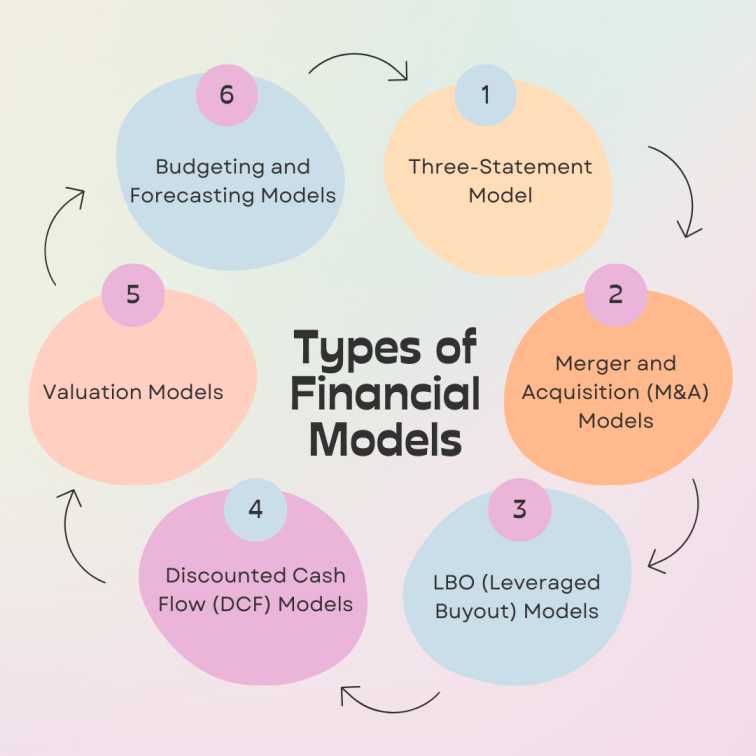
Types of Financial Models 

Types of Financial Models 

Financial models can be separated using multiple factors some of which include financial planning and analysis. Others include valuation, forecasting, risk management, and merger & acquisitions. Here are our top picks for the financial models currently in use globally.

Three-Statement Model: The three-statement financial model is a model that predicts the outcome of financial statements like income, cash flow, and balance sheets. 

Starting with income statements, it overlooks the revenues, expenses, and net income over a certain period. The balance sheet offers an overview of the company’s financial position at any given period while showcasing the company’s assets and liabilities. 

The cash flow statement provides a tracking of the cash inflows and outflows in a specified time as well.

Merger and Acquisition (M&A) Models: To understand how mergers and acquisitions work, several models need to be understood. These include the Comparable Company Analysis (CCA), Discounted Cash Flow (DCF) model, merger consequences analysis and Leveraged Buyout(LBO) analysis. Others include transaction multiples analysis, accretion/dilution analysis, break-even analysis, and sensitivity analysis.

LBO (Leveraged Buyout) Models: The LBO model of financial analysis falls under the merger and acquisition model. It undertakes the analysis of the balance sheet, and the company’s inflows and outflows to determine the overall impact. 

The LBO model works with historical financial statements, purchase price and financing structure, debt schedules, and operating assumptions.

Discounted Cash Flow (DCF) Models: Discounted cash flow, as discussed above, is a financial model that offers valuation for a company by investigating future cash flows. It does so by discounting them from the current price. Its main tenets include forecasting future cash flows, determining the discount rates as well as the future cash flows, and calculating the terminal value.

Valuation Models: Financial modelling is made easier using valuation models such as the Comparable Company Analysis (CCA), and Precedent Transaction Analysis (PTA). 

Although both models are used in evaluating the value of the company, CCA primarily focuses on comparing financial metrics with other companies. On the other hand, PTA examines historical mergers or acquisitions to determine the current valuation of the company.

Budgeting and Forecasting Models: Several types of budgeting and forecasting models 

exist for appropriate prediction of the company’s future. 

These include but aren’t limited to traditional budgeting models, rolling forecast models, zero-based budgeting models, driver-based budgeting models, and Monte Carlo simulation. With these models, investment banking careers look bright for enthusiasts.

Building a Financial Model 

Working with a financial model is the first way to move towards building a successful company and establishing its rapport. An investment banking course with placement can teach about the various duties related to the job.

Data Collection and Assumptions: The first step to establishing a financial model is to collect all relevant data and make appropriate assumptions about the future. These include gathering past financial statements —income, cash flow-inflow and outflow, and balance sheet. Establishing these three helps give way to the entire process.

Setting Up Historical Financial Statements: After setting up data collection and making assumptions, it is now time to gather it and place it in sections. These should be done with the historical financial statements with the required format and structure for a clear presentation.

Projecting Future Financial Statements: Once the setting up process is established, companies can then move to a future financial activity. In doing so, the historical data, and assumptions are compiled to calculate the future revenues, cash flows, and all other expenses. The main idea of projection is to measure factors such as customer demand, competitive trends, and pricing.

Implementing Growth Drivers and Key Metrics: This is the part where growth drivers come into the picture. Several types of drivers are incorporated — new products, market share expansion, cost reduction techniques, and geographic expansion. 

Incorporating Debt and Equity Financing: It is seen in most cases that companies often rely on both debt and equity financing to fund their growth. Given the impact that these two can create, they can be beneficial to the growth drivers. Furthermore, businesses can easily access their capital structure, shareholder returns, and interest expense.

Calculating Valuation Metrics: Valuation metrics are one of the most-talked factors when it comes to investment banking. Some popular validation metrics include price-to-earnings ratio (P/E ratio), price-to-sales ratio (P/S ratio), and enterprise value-to-EBITDA (EV/EBITDA ratio). An investment banking certification teaches about the different metrics which can be utilised for better outcomes.

Financial Modelling Best Practices

Financial modelling can be a crucial set of tools and techniques for businesses. However, with time, it has been proven that finding the right financial modelling can require rigorous detailing and adherence. Here are some key points for finding the most effective model for any business:

Consistency and Clarity in Formulas and Formatting: Use only clear and consistent formulas throughout the chosen model. Go for cell references instead of hardcoding values, and other related calculations. Lastly, use straightforward labels and headings for easier navigation.

Using Sensitivity Tables and Data Tables: Sensitivity and data tables are two things that can be implemented to allow quicker access to different variables. Companies can utilise these tools for overall versatility and robustness.

Avoiding Circular References: Circular references are essentially going around in loops with no action. This occurs when the formulas keep referring to their cells thereby resulting in an infinite loop. It is best to maintain clarity by identifying and resolving circular references throughout the financial model.

Properly Structuring Input and Output Sections: One sign of a good structuring format is to separate both inputs and outputs according to the financial model. Input sections include things like revenues, costs, growth rates, and interest rates. On the other hand, output sections include results based on inputs.

Error Checking and Debugging: Financial models ideally include error-checking at multiple points. This is done in multiple regards —input values, and error alerts on incomplete and incorrect formulas.

Documenting Assumptions and Methodology: Clear documentation paves the way for faster presentation and access to the financial model’s activity. This includes retaining source data, the rationale used behind assumptions, and all of the formulas and calculations used through the model.

Excel Tips and Functions for Financial Modelling 

Some of the Excel tips and functions for understanding how financial modelling works are discussed below. Keep in mind that these can be highly efficient for making the most out of financial models.

Essential Excel Functions 

The essential Excel functions used in most financial models are:

  • SUM: The SUM function allows you to add a range of cells without manual counting. 
  • IF: The IF function allows for better logical testing. In return, it returns values for each outcome.
  • VLOOKUP: VLOOKUP allows users to search for a value in a particular column and return a corresponding value from a different column.
  • INDEX-MATCH: Like VLOOKUP, it is a combination of functions for generating the value in a certain range.

Advanced Excel Functions for Modelling 

Investment banking fundamentals include advanced Excel functions which are mentioned below with their functions:

  • NPV: To calculate the net present value of an investment or project by discounting future cash flows
  • IRR: To calculate the internal rate of return
  • XNPV: For calculating the net present value of cash flows that occur at irregular intervals
  • XIRR: To calculate the internal rate of return of cash flows that occur at irregular intervals

Data Validation and Auditing Tools

The different data validation and auditing tools included are:

  • Data validation: To ensure that the data meets certain criteria
  • Conditional formatting: For applying instant formatting to cells based on specific criteria
  • Error checking: For in-built error-checking provided by Excel; for additional troubleshooting

Excel Add-ins for Financial Modelling

Some essential Excel Add-ins for financial modelling include:

  • Solver Add-in: For finding the best possible values for different variables
  • Analysis ToolPak: For performing complex calculations and statistical analysis
  • Power Pivot: For creating data models and performing advanced data analysis

Financial Modelling for Different Industries

Financial modelling is a crucial aspect of valuation and forecasting in multiple industries. One of the best things about financial modelling is that it can be used in almost all industries because of its multidimensional functions. Let us learn more about how it is used in various industries with some financial modelling examples in different domains.

Technology and Startups: Startups rely on financial modelling for understanding the pattern and trends they must adapt to apart from relying on it for tracking balance sheets. Investment banking firms look for startups in the same way they do for larger tech companies.

Real Estate and Property Development: The real estate and property development business is outgrowing the current market. As a professional working in the real estate department, it is ideal to go for financial modelling to detect and analyse cash flows, RPIs, and net income. 

These financial models for property development involve various factors ranging from financing options, and rental rates to occupancy levels.

Energy and Utilities: Energy and utilities are one such area where financial modelling is effective. Starting with the financial impact held by rising energy prices, production volumes, and capital expenditures, it moves forward with ROIs and energy infrastructure projects.

Healthcare and Pharmaceuticals: The healthcare sector seeks financial modelling in terms of financial viability presented by drug development, healthcare services, and clinical trials. These financial models can trace costs related to research and development costs, patent life, reimbursement rates, along with demand forecasts.

Retail and Consumer Goods: Financial modelling can be of great help to retail and consumer goods in that it helps with assessing inventory management, and maintaining optional strategies throughout various activities.

Careers in Financial Modelling

Financial modelling plays a significantly large role in making informed decisions. Let’s discuss how one can make a potential career out of financial modelling in multiple fields.

Financial Modelling Roles in Investment Banking: The crux of investment banking is financial modelling. As a result, investment bankers use it to analyse and evaluate financial data related to corporate finance transactions. 

Financial Analyst and Financial Planning Roles: The roles and responsibilities of a financial analyst and financial planner go hand in hand. Both of these roles require generous functioning of forecasting, valuation, and developing strategies.

Financial Modelling for Private Equity and Venture Capital:

Private equity firms and venture capital funds heavily rely on the financial modeling and evaluation of the viability of projects as well as for assessing ROIs.

Financial Modelling in Corporate Finance and Strategy: In the corporate finance sector, financial modelling can aid analysis of different situations including forecasts.

Conclusion 

Financial modelling can be extremely beneficial to those looking for an enriching experience when it comes to the investment banking market. 

The market is never too dull for an investment banker as it encompasses several unique experiences surrounding market trends and changing statistics.

Now that we have established the importance of financial modelling, let’s move over to the investment banking training offered by Imarticus Learning for finance graduates. The Certified Investment Banking Operations Professional course incorporates some of the most sought-after parameters in investment banking.

For instance, it encompasses chapters focusing on risk management, regulatory compliance, valuation, and trade life cycles within the financial models. The USP of this program is that it relies on a practical approach as opposed to a strictly theoretical approach.

Go for the program today and become an investment banker today!

FAQs

What is 3-way financial modelling?

Three-way financial modelling involves creating a comprehensive spreadsheet that integrates the income statement, balance sheet and cash flow statement, the three main financial statements, to project a company’s future financial performance and position.

How can I do financial modelling?

To start financial modelling, you can start gathering financial data that is available and build spreadsheets that link income, balance, and cash flow, and then analyse the results to make informed business decisions. You will also need to learn data visualization in Excel as well as the fundamentals of accounting. 

What is financial modelling for MBA?

Financial modelling for MBA involves learning how to use quantitative techniques for analysing and projecting a company’s financial performance, thus aiding in decision-making and strategy formulation.

Which tool is used for financial modelling?

Excel is one of the most used tools for financial modelling. It is great for data visualisation as well.

Which is better CFA or financial modelling?

This truly depends on your career goals. CFA is more recognised for investment and financial analysis, while financial modelling offers specific skills in projecting financial scenarios, financial feasibility and analysing business situations.

Does MBA teach financial modelling?

Yes, but it depends on the type of MBA the student is going for. For example, an MBA in marketing might not cover financial modelling but an MBA in Finance will cover the principles of financial modelling.

What Is IIM Indore’s Unique CFO Program? | Business Of Life

Staying stagnant in a finance career and reaching the level of CFO are two very different things. Many feel stagnant in their current roles after a few years of experience. It’s mainly because they lack the skills and commitment to climb the ladder. But you have to work hard to become CFO of a premier organisation.

We need to invest continuously in building skills. It’s essential to have the acumen for the top job. IIM Indore’s CFO Program can help us achieve these with its modern curriculum and top-quality faculty. Part of the Indian Institute Of Management Courses family, this one has been designed for working executives with at least five years of experience looking at upskilling to move up the corporate ladder.

Here is what’s unique about the IIM Indore CFO program:

What is IIM Indore CFO Program?

chief financial officer training

The CFO Program from IIM Indore is a specialised postgraduate certification program designed to help working executives in finance and help them learn advanced concepts to boost career growth and find better growth opportunities in the corporate world.

The program is designed to help finance professionals reach the level of CFO in a premier organisation. The elaborate curriculum, industry interface and the IIM alumni status make it one of the best financial markets certification courses available.

What is unique about the IIM Indore CFO program?

There are quite a few salient features that make the IIM CFO Program a unique offering. The unique points about the CFO program from IIM Indore are as follows:

IIM Indore Alumni Status

One of the unique features of this specialised program for finance professionals is the IIM Indore executive education alumni status that comes along with it. We can access the IIM Indore’s campus library and get an IIM Indore email id through the lifetime alumni membership. IIM Indore is one of the two Triple Crown accredited IIMs and has consistently achieved top ranks in prestigious national and global rankings. Students also get to spend at least three on-campus days at IIM Indore.

Forward-looking curriculum

The curriculum of this course has been designed by experienced IIM faculty members that have spent decades in the industry. The course covers both traditional and modern finance concepts to provide basic to advanced-level learning to emerging CFOs. The curriculum includes important concepts like capital budgeting, valuation, capital structure and risk management. At the same time, it also covers modern business concepts like fintech, talent management, finance leadership and strategic thinking.

Peer learning and networking

The best part about this course is that it gives enough peer learning and networking opportunities to interact with fellow learners and build a strong network as part of the program. These opportunities help the learners build meaningful relationships and help them get to a platform where the network developed as part of the course can help us further in our careers even after course completion. The peer network can help us explore new pathways or grow in the same job with additional opportunities.

Industry interface

The course is not just about theoretical learning. It also includes several masterclass sessions from industry experts. These masterclass sessions are important because they help get real-world insight into the real financial world. The industry experts conducting these masterclass sessions are successful professionals and can provide useful advice and guidance for building a successful finance career. These sessions can prove to be priceless as it offers an attractive opportunity to learn the latest concepts from the best in the industry.

What can we gain from IIM Indore’s CFO Program?

We can explore better career opportunities by completing the CFO Program from IIM Indore. Rather than getting stuck in career progression, the CFO Program helps us learn advanced finance concepts that help us reach top management and achieve the dream of becoming a CFO.

Besides the better career opportunities, the CFO Program from IIM Indore helps improve learning. As the finance world has been revolutionised with technology, this program helps us learn conceptual and practical frameworks for fintech, financial leadership, strategic thinking, and talent management.

The mix of practical and theoretical learning helps provide the right balance along with the strong network of a peer group that helps achieve new milestones.

Conclusion

Opting for the CFO Program from IIM Indore can be a momentous decision in our professional journey. As the course offers weekend classes and follows a flexible learning approach, it suits working professionals looking to upskill and learn new concepts.

IIM Indore has partnered with Imarticus Learning to offer this top-quality learning experience to the students. It is ideal for working executives who want to power up their finance careers with the best learning experience.