
Blockchain: The Numerous Career Prospects It Offers, And Skills Required To Build A Successful Career

The market for blockchain experts is booming. Since the arrival of Bitcoin, blockchain has been an attractive technology for companies all over the globe.

 

How to become a Blockchain DeveloperFrom healthcare to finance, companies in nearly every industry are looking to apply blockchain and get ahead of their peers.

The following article will shed light on various issues related to this technology such as what is blockchain technology, how does blockchain works, how to become a blockchain developer, and much more.

What is blockchain? How does blockchain work?

Blockchain is a particular kind of database. It stores information in blocks and whenever new information is added to the blockchain, it is entered into a new block. While a traditional database has one owner of the information, a blockchain stores information with multiple users, which makes a huge difference.

Whenever a new block is added to a blockchain, it is given the exact timestamp. One of the biggest highlights of blockchain is it offers decentralization. This means a central authority doesn’t have control or ownership over a blockchain network. Instead, all the users share authority and ownership.

Every node in such a network has a complete record of the data. This allows the system to function smoothly even if one node gets disrupted. That’s because if a node will get corrupt or disrupted, other nodes will have the necessary data to continue the process.

One of the most popular applications of blockchain is Ethereum.

What is Ethereum blockchain?

Ethereum is a popular cryptocurrency that uses smart contracts for completing transactions. To understand what is Ethereum blockchain, you should be well-acquainted with Hyperledger and smart contracts. You can learn about them while preparing to become a blockchain developer

How to become a blockchain developer?

Now that you know what is blockchain technology, we can discuss the process of becoming a blockchain developer.

Blockchain developers are responsible for building blockchain-based solutions for their organizations. They are familiar with the fundamentals of blockchain, cryptocurrencies, and their applications. The demand for blockchain developers is on the rise because this technology is relatively new but has many applications in various industries. Companies want experts who can help them build and maintain blockchain-based solutions.

To kickstart your career in this field, you should get a blockchain course. A course in this subject will help you study its various concepts and test your knowledge through projects and assignments.

A Blockchain online training would also let you study directly from industry experts so you can resolve doubts quickly and avoid getting stuck on complex topics. Another advantage is that completing a blockchain course would certify you as an expert in this subject.

Recruiters are always on the lookout for certified professionals in this sector because certification shows the person is highly skilled and well-acquainted with the subject.

Conclusion

Blockchain is certainly a revolutionary technology. It has made a huge impact on the finance and tech industries and companies are actively working towards utilizing it further.

how to become a Blockchain developer?There’s a bright scope for blockchain developers in India. If you’re interested in becoming a blockchain developer and want to learn what is blockchain, check out this blockchain course offered by Imarticus.

Related Article:

https://imarticus.org/how-imarticuss-future-learning-program-carved-a-career-in-fintech-industry-an-interview-with-abhilash-chatterjee/


How Fintech Ensures about Your Security of Transactions In The Digital Era?

Introduction

Fintech companies are witnessing major growth nowadays because they are disrupting traditional banking services. People can now get banking services just from their smartphones and there is no need to visit a physical bank. The recent coronavirus outbreak has also forced people to adopt the digital method for payment/transactions.

People can now shop, book rides, and do many things with the help of fintech services. They also have access to their financial records more than ever due to fintech companies. The risk of hacking & fraud is also associated with fintech services and fintech players have to ensure that they secure their user’s transactions.

Let us how fintech ensures the security of transactions. 

How does Fintech Work?

Fintech services can be availed via smartphone. One can download the mobile application through which fintech services are provided. Each fintech user has a unique ID and bar code. By using the two-factor authentication system, one can make payments to others. Some fintech applications also use Bluetooth for connectivity.

In the case of online bank transfers, the transferred money is encoded in multiple layers before it goes on the internet, and when it is received by the recipient’s bank, the information is decoded and is deposited in the receiver’s bank as currency. Fintech also provides online insurance and loan facilities.

Technologies like artificial intelligence, machine learning have helped in collecting the financial data of any user and analyzing it. Once you apply for a loan online, your credit history & credit score will be checked via smart back-end algorithms and if you are eligible, your loan request will be passed.

The online transfers also provide confirmation mails & calls on the successful transfer of money to notify both the parties i.e. the receiver & the sender. Many independent agencies like Automated Clearing House (ACH) also help in securing financial data transmission via online medium.

Security Measures in Fintech Services

The security measures adopted by fintech companies to secure the transactions are as follows:

  • Data encryption is a key feature in fintech services. They encrypt data using symmetric or asymmetric means of encryption and it is decoded at the receiver’s end. If somehow some hacker/fraud tries to access the data in between transactions, the hard encryption makes it impossible to access sensitive information like account number, banking password, etc. The most used encryption techniques by fintech firms are the Advanced Encryption Standard (AES), Rivest-Shamir-Adleman (RSA), Triple Data Encryption Standard (TripleDES), Twofish, etc.
  • Management of third-party services is very necessary to enhance the security of transactions. For example, one can book a cab using some fintech application and the payment will be automatically deducted from your e-wallet on the completion of your ride. The firm needs to have a strong interface so that third-party services are secure. The interface and architecture must be very secure.
  • Fintech firms use pair programming to ensure quality coded mobile applications. A messy and buggy code is very easy to hack.
  • Secure identity verification & authentication is ensured by fintech firms. They use various approaches like Role-based Access Control (RBAC), Password Expiration, Session Timeout system, etc.
  • Meaningful data is turned into random strings via tokenization which helps in increasing the security of data. It is an important process used by fintech firms to secure their users’ data.

Conclusion

If you are thinking to start a Fintech career, you must be aware of the security processes because security is the main aspect of fintech services. The sensitive information of clients should be preserved in all circumstances. This was all about the security measures in fintech services.

The 5 Most In-Demand Skills In The FinTech Industry!

If there is one field that is growing at a rapid pace and which also has a lot of scope for students in India, it is fintech. Short for financial technology, it has revolutionized the way we manage our finances in a short span. Whether it is small-scale investments or corporate finance, fintech has managed to provide better solutions like mobile banking, wallets, UPI, and other IT-driven financial services.

This is the same reason why a fintech career is one of the most sought-after paths for aspiring students today. But with that aspiration comes the question of specialization. What skills to master? And what fintech courses to take?

Fintech online certification course in IndiaHere’s help in the form of a starter guide about the 5 most in-demand skills in the industry.

1.      Strong Understanding of Programming Languages

Knowing the basics of coding and having a working knowledge of at least one major programming language is essential to even enter the world of fintech.

And when you do enter, just knowing a language is not enough. A fintech career requires you to innovate in that language and come up with solutions to modern problems. This is only possible if you know the language (or languages) inside out.

Fintech certification courseSome of the most common languages used in fintech are JavaScript, Python, and SQL. You can learn more about them through easily available fintech courses online.

2.      Mathematical and Analytical Skills

You have to be very sharp with numbers.

Some people have a natural way with numbers and that is expected in any student who wants to make it big in the fintech industry. In addition to accountancy and bookkeeping skills, you also need to be strong with charts and graphs and mathematical analysis. Tech tools involved in fintech are extremely useful and knowing how to use them even more critical.

3.      Blockchain Skills

An intermediate-level expert in blockchain has a better chance of nailing a fintech job interview than a financial expert. Why?

Because fintech companies are looking for talent who have a bend with technology. Since blockchain is considered the next big thing in online security and privacy, experts in the subject are in demand.

This makes blockchain a hot skill and something that you should study on the side as you prepare for your fintech career.

4.      Cybersecurity Skills

Another in-demand skill for your fintech career is related to cybersecurity. This is obvious because security is one of the most crucial aspects of fintech. A company creates a mobile wallet app, and one of the most important things it needs to ensure is the safety of its users’ private information.

With the constant threat from hackers looming, companies need to make sure that their products are secured with top-notch technology. This is where your cybersecurity skills come into play.

Knowing existing security standards such as the FIDO alliance, two-step verification, strong authentication, and other related concepts then becomes paramount.

5.      Machine Learning and Deep Learning

Last on the list is machine learning, which is one of the most in-demand tech skills in general. The world is still trying to make communication between computers and humans free-flowing, and having one more expert getting involved in it is a welcome move.

If you are a finance student, it would be good to expose yourself to such tech concepts as you try to build a fintech career in India.

The recent change in the high school education framework of India further makes fintech an appealing path. This is because students can now take two more years to decide on their interests and start focusing on specific employable skills from early on. Start now and enroll in a fintech course today.

Everything You Need To Know About Forensic Accounting!

Forensic Accounting refers to the application of financial skills to resolve disputes of fraud and misconduct of finances in business. It is an integration of accounting, investigation, and auditing with a sound knowledge of business and legal systems. The scope of Forensic Accounting includes:

  1. Designing an accounting process for the verification of data.
  2. Looking for an unusual development in accounts for any possible frauds.
  3. Continuous surveillance of transactions of a variety of businesses.
  4. Performing a routine schedule of audit processing.

Need for Forensic Accounting

These days almost no domain is left untouched by frauds, dishonesty, corruption, money laundering, etc. Forensic Accounting is a field that checks all these activities.

Criminal Investigation: Forensic Accountants prepare detailed reports of financial implications in case of fraud. It helps the police and the investigating authorities in examining the case in detail.
Financial Analysis course with placement in Iindia
Dispute Settlement: Forensic Accounting professionals help resolve disputes in business communities. They settle intellectual property infringements, liability claims, etc.

Professional Negligence: In the case of employee negligence leading to non-compliance with auditing and accounting standards, Forensic Accountants examine the loss through quantification.

Detection of Fraud: Forensic Accountants detect fraud by tracing the papers and other activities of the employees of the company. They tactfully devise strategies to find out the truth.

Forensic Accountants – Skills and Qualifications

Forensic Accountants are very important professionals for every organization. From public to private, every entity needs to ensure that they comply with the governance codes and establish transparency in their systems. Forensic Accountants help in this cause by maintaining fair accounting and detecting any misconduct.

Due to the nature of their tasks, Forensic Accountants can find employment in Banks, Multinational corporations, Police forces, Freelance, Insurance companies, and even government agencies, etc.

To be a Forensic Accountant, one needs to do a bachelor’s or master’s degree in Accountancy. A diploma in banking and finance can also provide the necessary qualification required to build a substantial career in this field.

Financial Analysis course with placement in IndiaCommerce graduates can also pursue a career in Forensic Accounting with a financial accounting course.

A Chartered Accountant with experience in accounting and auditing also makes for an eligible candidate for a Forensic Accountant.

To become successful in the Finance career, one should first work under an expert Forensic Accountant as it will provide them with insights about this career. The necessary skills required for the role of Forensic Accountant are:

  • Analytical aptitude
  • Attention to details
  • Communication skills
  • Persistence
  • A knack for finding loopholes
  • Compliance with ethical code of conduct, etc.

Forensic Accounting in India

As India is a country where monetary frauds and scams are common in business organizations, RBI has made Forensic Accounting audits mandatory for all banks. A Serious Fraud Investigation Office (SFIO) has been established which has boosted the growth of this sector and enhanced job opportunities. With the growing online frauds and cyber-security breaches, the demand for Forensic Accounting professionals is increasing.

The income in this field is also quite lucrative. The average salary of Forensic Accounting professionals is around INR 984,533 according to payscale.com.

One can find jobs in this sector through related titles like Fraud Analyst, Risk Analyst, Fraud Investigator, Anti-Money Laundry Analyst apart from the usual Forensic Accountant title. The salary incentives grow with the number of years of experience in this field.

Conclusion

Given the present scenario of financial irregularities in the country, Forensic Accounting has a very bright future. Also, the lack of qualified and experienced Forensic Accountants in India makes this a very valuable career for students to pursue.

Related Article:

https://imarticus.org/what-is-a-financial-analyst-course/

Lets Learn about Consumer Behavior Mapping Techniques In FinTech And Digital Banking

Introduction

With the internet and focus on digitization, the fintech (financial technology) industry is also evolving. One of the massive changes that have emerged in this industry is the use of digital transaction portals. The entire BFSI sector has transformed, integrating modern cutting-edge technology with Digital banking solutions to meet the evolving needs of customers. A prime observation noticed among modern customers is that they are increasingly moving towards transactional mobility. This demand has compelled the BFSI industry to form an all-round interaction with the customer and provide banking services using the power of Financial Technology.

Need for Consumer Behavior Mapping

Due to mobile phones being accessible all around the world, consumers have more access to information and diverse services. This naturally means that there is more competition among financial institutions as they try to improve their customer base.

In the current digital world, a customer can choose from a diverse variety of financial services, and since there is no limit on providers, they can also mix and match their financial service providers. Also, there can be difficulty in identifying whether a customer is demanding a financial service online or not since many customers do not actively choose a financial platform based on their need but on a need demanded by another service provider.

It is clear that the current customer base is more technologically educated and information-savvy. Hence, it is important that innovative ways are used to understand the customer thoughts, the trends in the market and understanding the reasons behind a product decision. Analyzing financial behavior and tying it with a range of demographics can help in understanding trends in customer behavior. While big data analysis can be a great way to understand this trend, traditional methods like interviews, online surveys, offline studies can help too. 

Fintech and the changing financial scenario 

In 2020, the world almost stood still with the COVID-19 pandemic. As most physical forms of transactions came to a halt, the fintech market emerged strongly. By automating financial services and improving on digital customer experience, banks and financial institutions were able to interact with customers and provide them the necessary services even during a COVID-impacted scenario.

Indian banks started integrating Blockchain, Cloud Computing, RPA, Data Science and Analytics, AI, and Machine Learning to understand customer requirements and upgrade their services to provide the best experience to them. Implementing advanced financial technology in several banking areas can help build and retain a strong customer base.

After all, Fintech relies a lot on customers and how they interact with Banking services. As future customers become more tech-savvy, fintech will continue to evolve and its role will be stronger in the financial systems of our country and the world as a whole.

EndNote

As Fintech becomes a part of our lives, BFSI industries should start adapting to the changing scenario and understand ways to map customer behavior. Mr. Mujib Mundewadi has been kind enough to offer a 2-hour long Masterclass on the topic.

He has had around 25 years of experience in the banking sector and has worked with investment negotiation, financial structuring, cross-border taxation solutions, and finance strategy too. MBA aspirants, BFSI professionals, Finance Management and New Age Banking aspirants, Fintech aspirants, and consumer Behavior Enthusiasts can attend this Masterclass.

Let’s involve and invest in such a valuable lesson on fintech and customer behavior mapping. Register Now.

Become a Financial Analyst with NMIMS PGP IN NEW AGE BANKING – Batch Launch!

In today’s date, knowing every aspect of finance is a necessity, not a luxury. From running a financially stable household to running a huge company of your own, everyone needs to be able to understand at least a bit of finance. And on top of it, if someone is an expert at the subject, a successful banking career is waiting for them just around the corner.

Who is a Financial Analyst?

If we say it in an easy way, financial analysts are the forecasters and advisors of the financial services industry. Financial analysts have a strong base in financial accounting, and on a regular basis, they go through tons of financial data of the companies they work for, predict financial findings of the market and the company, and help them make the proper financial decisions.


It includes decisions about investing their money in the right place, selling or buying stocks of the company, certain marketing decisions within the company, and more.

Why Choose a Career Being Financial Analyst?

We all know that getting a satisfying job after your graduation is not an easy task. But the financial industry is ever-growing and one of the most lucrative jobs here is being a financial analyst. With more and more companies and products launching in the market every day, they all require analysts to recommend them the right way to go financially and that’s why the job opportunities are vast in this area, and opportunities to grow in the job are there too.

It also helps to think that being a financial analyst means they are almost at the center of all the financial decision-making in the industry, or in the market. Also, as a bonus, financial analysts earn quite a satisfying amount of money whether they’re in a senior or junior position. You can get promising job opportunities at investment banks, insurance companies, sell and buy-side firms, and even banks.

About the NMIMS PGP in New Age Banking Course

NMIMS, along with Imarticus, have come up with an excellent course model which looks absolutely perfect for whosoever is opting for a banking career or wants to become a financial analyst. They are providing a dual certification just within 24 months with the course.

First, there is a course of 11 months PGP in New Age Banking and second, there is a 2-year course of Global Access PGDBM in Banking & Finance Management.

New Age Banking Course

In the New Age Banking course, students will not only learn the technical side, such as Financial Accounting, Marketing, Business Law, Commercial Banking System, Foreign Management, or Strategic Management but also they’ll be able to put their theory learnings to practicality with real-life problem-solving maneuvers. The course also assures great placements.

Conclusion

People studying for a career in the BFSI (Banking, Financial Services, and Insurance) industry should definitely opt for a job as a financial analyst. The job might not be easy but it certainly can be satisfactory for the finance-loving people out there and nothing can prepare them better for the world out there in the market than the course provided by NMIMS PGP in New Age Banking.

How The Fintech is Transforming Everyday Life?

What is Fintech?

The Finance industry has undergone some massive transformations to improve the delivery of financial products and services to customers. The evolution within the financial services industry has been nothing less than phenomenal. One of the most impactful developments in this segment is the Fintech sector that has totally revolutionized the banking and finance industry.

Fintech is the amalgamation of finance and technology that helps to overcome all the challenges of the traditional banking sector. Fintech is among the most rapidly growing industry and the Best Fintech Course in India is in huge demand in the contemporary.

Fintech career

The Fintech industry is all about leveraging cutting-edge technology to solve traditional banking problems and help with financial inclusion. It is generally used by businesses to manage their day-to-day financial operations and processes.

It initially denoted the use of technology on the backend of financial institutions but slowly developed into a new segment altogether that is more effective in providing financial solutions to businesses and individuals. From retail banking to fundraising and investment management it includes all major aspects of banking and financial services.

Impact of Fintech on everyday life

Now that we have a fair idea as to what the Fintech segment is all about, let’s delve deeper into how Fintech is transforming everyday life.

Easy banking solutions

Gone are the days where people used to take a day off to conduct their banking-related activities. Long queues are a thing of the past and now one can easily avail all the banking features from the comfort of their home using their smartphones. Fintech has simplified banking and changes the way we operate altogether.

From making online payments for e-commerce purchases to availing loans with just a few clicks, Fintech has simplified our lives by transforming the banking segment. Personal banking-related services have been much more efficient and convenient to avail. You can even check your financial data at any time of the day.

Blockchain & Cryptocurrency

Cryptocurrency will shape the future of the finance and banking industry. The core technology at the heart of cryptocurrency is blockchain. Blockchain first became evident to the world when Bitcoin was introduced. Blockchain has other significant uses in the finance industry related to security and other purposes.

A cryptocurrency is a form of digital money that uses cryptography to secure transactions. Digital currency makes the transfer of wealth far easier between two parties. The highly decentralized nature of blockchain makes it almost impossible for users to cheat the system and carry out any fraudulent transactions.

Affordable investment advisors

The Fintech industry uses cutting-edge technology to overcome traditional financial challenges. Traditionally the investment advisory services were limited to high net worth individuals and businesses. A major reason for this was the high-fee structure of investment advisors.

The growth in the Fintech sector has made Robo-advisors more accessible and affordable to provide advisory related services by using sophisticated algorithms. Robo-advisors have shown significant improvement and perform equally well. In the coming future, more companies will deploy Robo-advisors to provide investment guidance to customers on a large scale.

Fintech is among the most rapidly growing industries as the demand for Fintech products and services is on the rise. Fintech provides a better way to do financial transactions and also does it economically saving time and money both for the customers.

Fintech careers are among the most sought-after career options in the contemporary and the demand for Fintech professionals will continue to grow in the near future.

One can opt for a Fintech course from reputed institutions like Imarticus Learning and gain practical knowledge and skills to excel at the job.

Fintech Career

Imarticus Learning also provides a job assurance to the candidates with the top players in the industry.

Coronavirus Fears Accelerate Wealth-tech Innovation! How?

Introduction

Wealth-tech is one of the trending sectors in recent days. It is wealth management through digital solutions. Wealth management is being done with the help of technology and it gives better results and accuracy. It also helps in faster analysis & research.

Market forecasting can also be done more accurately with the help of wealth tech services. The recent coronavirus outbreak has slowed down the growth of many industries but it will not slow down the growth of wealth tech services. Let us see how wealth tech services are predicted to grow despite the recent Covid-19 outbreak.

How will the Wealth-tech Sector Grow?

The reasons which will help in the growth of wealth tech innovation despite the coronavirus outbreak are:

  • Wealth-tech has influenced automation in wealth management services. New-age technologies like artificial intelligence, data analysis, machine learning have helped in the growth of Wealth-tech services. People can now automate the wealth management services and they don’t even require a professional to physically manage the processes.
    Wealth Management coursesIt can all be done by smart & intelligent applications. The digital platform can be easily managed by wealth managers from a remote location too. All they need is a system and the client’s requirements. This also helps in adopting more efficiently with the new work from home culture.

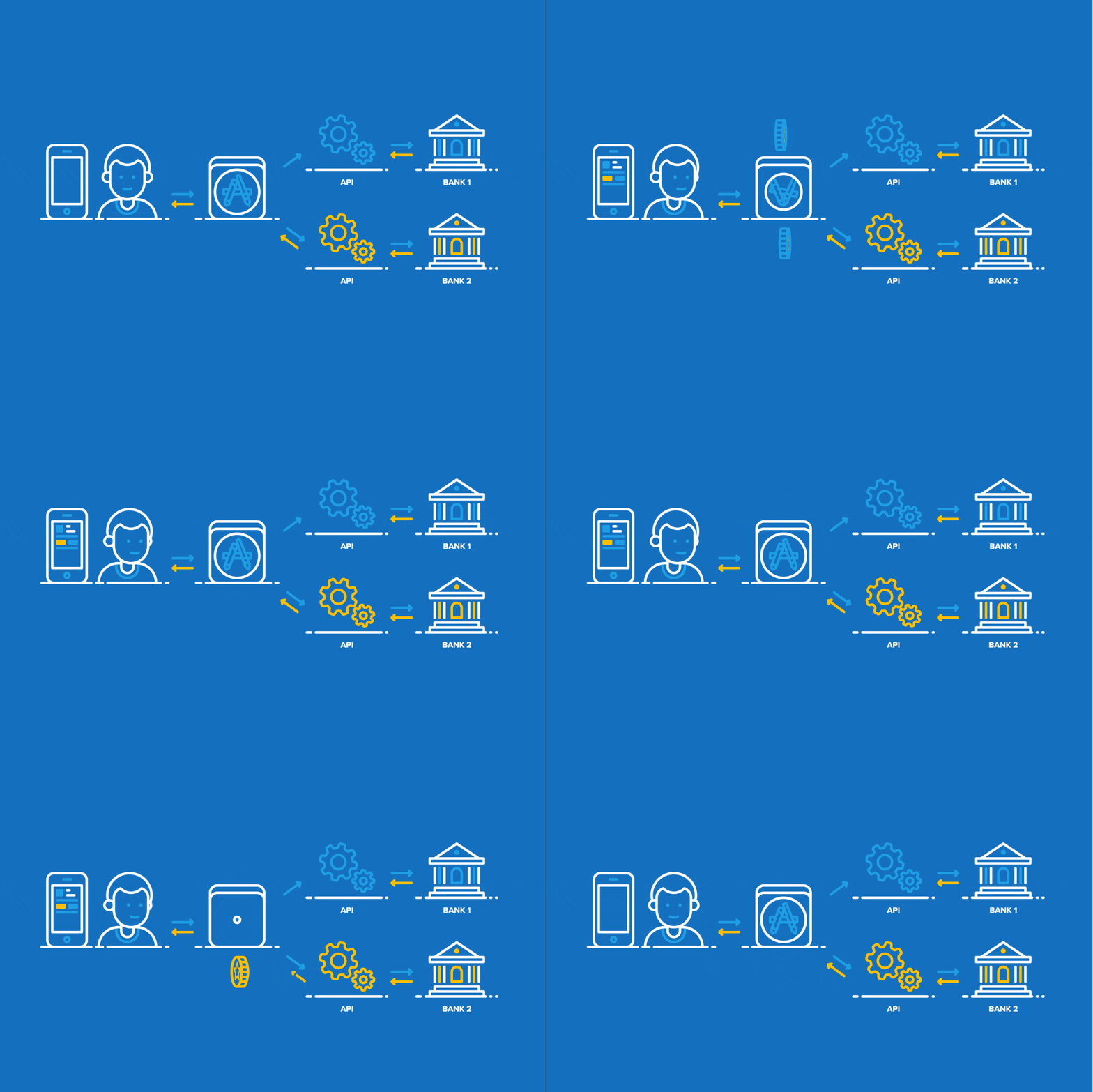
  • This pandemic has forced companies/firms/HNI clients to opt for digital wealth management services. If it wasn’t for the pandemic, they still would have been taking traditional wealth management services. It won’t be a hyperbole to say that this pandemic is a blessing in disguise for the wealth tech sector. The employees are also shifting rapidly towards digital platforms.
  • Wealth-tech extends its services to smaller companies as well. The digital tools & services can be used by small scale companies that would have been neglected otherwise.
  • Wealth-tech also helps in cost optimization. Smart applications provide data-driven solutions to wealth management problems and reduce the cost of hiring wealth management professionals for the same. Companies can just use smart digital solutions and can easily manage their wealth.
  • HNI or Ultra HNI clients are also happy about the wealth tech services as they can now talk to their wealth manager from a remote location too. The social distancing norms have been introduced due to this ongoing pandemic. Wealth-tech helps in taking advantage of its services while following the social distancing norms.
  • Market volatility & uncertainty is expected to grow because of the ongoing pandemic. It such times, you don’t want wrong forecasting information so that you end up investing in a loss generating venture. The digital wealth tech solutions are proving to be more accurate than traditional methods. The data analysis & forecasting is more robust & on point via the digital mediums. This will help clients in opting for wealth tech services to know about the trends.
    Data Analysis
  • It is expected that AUM (Assets Under Management) sector will grow from $74.3 trillion in 2018 to $145.4 trillion in 2025 with an impressive CAGR (Compound Annual Growth Rate) of 8.8%. The asset management under wealth management is also shifted to online channels and clients are loving this innovation as it helps them to get more accurate details in less cost. It reduces paperwork and the amount of hard work an individual has to put in to go through all the assets & financial resources of any particular individual.

Conclusion

If you are thinking of building a Wealth Management Career then perhaps this is the right time to step in with all the innovation going around.

You can learn more via the Wealth Management Courses available on the internet. This was all about how the coronavirus outbreak will accelerate the growth of the wealth tech sector.

What Is Fintech in Banking?

Understanding Fintech in General

Fintech can be explained as the use of cutting edge technology to provide solutions in the financial domain to increase customer satisfaction and bring more convenience to the final users.

This evolution within the financial industry aims to introduce new tech-savvy financial products and services most of which helps to automate repetitive processes that earlier required human intervention.

The digital world is fast-paced and the use of the internet has transformed every industry. To cater to the needs of an aggressive customer base, the evolution within the financial domain was indispensable. The collective approach towards problem-solving in the financial services domain using technology has produced a spin-off that has been coined as Fin-tech.

Fintech in the Banking domain

Fintech is totally on the verge of disrupting the consumer banking industry. The disruption is inevitable given the simplicity of services in the traditional form of banking which can now be rendered very conveniently through the use of technology.

If you look closely the technological advancements have also changed the financial procedures and the way these institutions function.

Let’s look contextually into some of the major aspects of banking that the Fintech has redefined.

Credit Services 

Fintech has expanded the horizons when it comes to providing loans. Some of the prominent Fintech companies have taken upon themselves to bring more transparency and ease in the borrowing process by eradicating unnecessary documentation and other loopholes. They aim to simplify the process of obtaining financial aids for businesses and individuals.

Payment Services

Not much long ago, payment transfers and related services was a challenge for the customer. From long queues to limited banking hours and whatnot, it was a painful experience. Today a service or a product is not just limited to providing a solution but providing a memorable experience for the customer.

Keeping the customer experience in mind the Fintech companies have revolutionized the payment services segment totally. Payment using smartphone applications and the internet is the norm today, thanks to the harbingers of the Fintech revolution.

Wealth Management Services

Fintech training has redefined the way people are saving and investing their hard-earned money.

There are companies like Robinhood whose mission is to reduce the income inequality that prevails in society by providing commission-free trading and investing platform.

Today people want what’s best for them and not a general best seller, realizing this gap Fintech companies are catering to customized investment solutions for people looking to invest their money.

How is it changing the banking domain?

Let’s see how the banking sector has been transformed drastically with the advent of Fintech companies in the context of digital & mobile banking services.

Digital Banking

One of the best things about the digital space is that it is not constrained by geographies. This feature alone has helped many banks to expand their customer base in multiple territories without having to invest in building a brick and mortar outlet. Other than this the services are available for the 21st-century consumers who don’t sleep, meaning 24*7 has been the norm.

Mobile Banking

With the proliferation of e-commerce and food-tech companies, the consumers needed a more convenient method to do the transaction. Realizing this need the Fintech companies have designed mobile banking solutions that just require your smartphone and bank details to start a transaction. Problem solved!

Conclusion

Fintech has totally changed the banking industry for good. Mobile banking and digital banking services have mended the follies of traditional banking services. Focusing more on the customer experience aspect the Fintech companies are boosting the customer satisfaction level to new heights making them more loyal and committed to the service providers.