What Is A Cluster Analysis With R? How Can You Learn It From A Scratch?

What is Cluster analysis?

Cluster means a group, and a cluster of data means a group of data that are similar in type. This type of analysis is described more like discovery than a prediction, in which the machine searches for similarities within the data.

Cluster analysis in the data science career can be used in customer segmentation, stock market clustering, and to reduce dimensionality. It is done by grouping data with similar values. This analysis is good for business.

Supervised and Unsupervised Learning-

The simple difference between both types of learning is that the supervised method predicts the outcome, while the unsupervised method produces a new variable.

Here is an example. A dataset of the total expenditure of the customers and their age is provided. Now the company wants to send more ad emails to its customers.

library(ggplot2)

df <- data.frame(age = c(18, 21, 22, 24, 26, 26, 27, 30, 31, 35, 39, 40, 41, 42, 44, 46, 47, 48, 49, 54),

spend = c(10, 11, 22, 15, 12, 13, 14, 33, 39, 37, 44, 27, 29, 20, 28, 21, 30, 31, 23, 24)

)

ggplot(df, aes(x = age, y = spend)) +

geom_point()
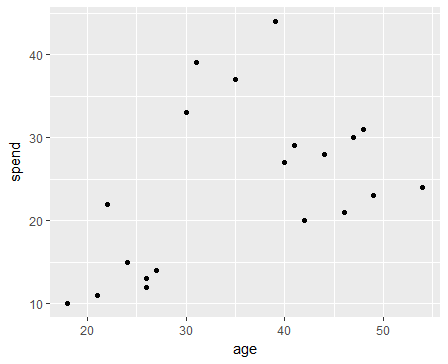
In the graph, there will be certain groups of points. In the bottom, the group of dots represents the group of young people with less money.

The topmost group represents the middle age people with higher budgets, and the rightmost group represents the old people with a lower budget.

This is one of the straightforward examples of cluster analysis. 

K-means algorithm

It is a common clustering method. This algorithm reduces the distance between the observations to easily find the cluster of data. This is also known as a local optimal solutions algorithm. The distances of the observations can be measured through their coordinates.

How does the algorithm work?

  1. Chooses groups randomly
  2. The distance between the cluster center (centroid) and other observations are calculated.
  3. This results in a group of observations. K new clusters are formed and the observations are clustered with the closest centroid.
  4. The centroid is shifted to the mean coordinates of the group.
  5. Distances according to the new centroids are calculated. New boundaries are created, and the observations move from one group to another as they are clustered with the nearest new centroid.
  6. Repeat the process until no observations change their group.

The distance along x and y-axis is defined as-

D(x,y)= √ Summation of (Σ) square of (Xi-Yi). This is known as the Euclidean distance and is commonly used in the k-means algorithm. Other methods that can be used to find the distance between observations are Manhattan and Minkowski.

Select the number of clusters

The difficulty of K-means is choosing the number of clusters (k). A high k-value selected will have a large number of groups and can increase stability, but can overfit data. Overfitting is the process in which the performance of the model decreases for new data because the model has learned just the training data and this learning cannot be generalized.

The formula for choosing the number of clusters-

Cluster= √ (2/n)

Import data

K means is not suitable for factor variables. It is because the discrete values do not produce accurate predictions and it is based on the distance.

library(dplyr)

PATH <-“https://raw.githubusercontent.com/guru99-edu/R-Programming/master/computers.csv”

df <- read.csv(PATH) %>%

select(-c(X, cd, multi, premium))

glimpse(df)

Output:

Observations: 6,259

Variables: 7

$ price  <int> 1499, 1795, 1595, 1849, 3295, 3695, 1720, 1995, 2225, 2575, 2195, 2605, 2045, 2295, 2699…

$ speed  <int> 25, 33, 25, 25, 33, 66, 25, 50, 50, 50, 33, 66, 50, 25, 50, 50, 33, 33, 33, 66, 33, 66, …

$ hd     <int> 80, 85, 170, 170, 340, 340, 170, 85, 210, 210, 170, 210, 130, 245, 212, 130, 85, 210, 25…

$ ram    <int> 4, 2, 4, 8, 16, 16, 4, 2, 8, 4, 8, 8, 4, 8, 8, 4, 2, 4, 4, 8, 4, 4, 16, 4, 8, 2, 4, 8, 1…

$ screen <int> 14, 14, 15, 14, 14, 14, 14, 14, 14, 15, 15, 14, 14, 14, 14, 14, 14, 15, 15, 14, 14, 14, …

$ ads    <int> 94, 94, 94, 94, 94, 94, 94, 94, 94, 94, 94, 94, 94, 94, 94, 94, 94, 94, 94, 94, 94, 94, …

$ trend  <int> 1, 1, 1, 1, 1, 1, 1, 1, 1, 1, 1, 1, 1, 1, 1, 1, 1, 1, 1, 1, 1, 1, 1, 1, 1, 1, 1, 1, 1, 1…

Optimal k

Elbow method is one of the methods to choose the best k value (the number of clusters). It uses in-group similarity or dissimilarity to determine the variability. Elbow graph can be constructed in the following way-

1. Create a function that computes the sum of squares of the cluster. 

kmean_withinss <- function(k) {

cluster <- kmeans(rescale_df, k)

return (cluster$tot.withinss)

}

2. Run it n times

# Set maximum cluster

max_k <-20

# Run algorithm over a range of k

wss <- sapply(2:max_k, kmean_withinss)

3. Use the results to create a data frame

# Create a data frame to plot the graph

elbow <-data.frame(2:max_k, wss)

4. Plot the results

# Plot the graph with gglop

ggplot(elbow, aes(x = X2.max_k, y = wss)) +

geom_point() +

geom_line() +

scale_x_continuous(breaks = seq(1, 20, by = 1))

What is a Scrum Master Course?

Almost 75% of companies are reported to use Agile methodology and approaches one way or the other. These companies successfully adopted agile methods to drive profits and save time. It is essential to learn, understand and implement agile approach wherever necessary.

Scrum:
Scrum is one of the ways how the agile approach can be taken forward. Scrum is a framework that helps teams to work efficiently and collaborate freely. Scrum helps in encouraging groups to self-organize while working on an issue, learn through new experiences and continuously improve efficiency. Scrum is not only useful in software development, but the ideas of Scrum can be implemented in other industries as well.

What is Scrum?
In the Scrum framework, the critical aspect is speed; hence there is Backlog of implementable product/service enhancements. In each Sprint planning (generally 14 days) the upgrades that are on priority and need are taken forward and worked on. Each day of that sprint “Daily Scrum” meetings take place where the project updates are discussed, and issues are addressed. This is continued in every sprint, and the cycle continues.

To handle all these efficiently, a Scrum Master is needed who will contribute, promote and support the team.

Scrum Master:
Scrum Master is the member of a Scrum Team who is responsible for the team to follow the scrum framework. Scrum Masters help them pursue this by training them on the Scrum theory, practices, rules and values. The Scrum Master works in servant-leadership style where it is necessary to provide service to others, promote community behavior, holistic work approach, shared decision-making power.
Scrum Master also helps in communicating the information that is needed in the daily scrums to the people outside the Scrum. They are also responsible for driving the conversations to maximize the impact during the scrum meetings.

There are various roles a scrum master usually plays. They provide services to the
1. Product Owner: Scrum Master helps the product owner by ensuring that the team understands the product owner’s goals, product domain scope. They will help in understanding product planning, ensure product owner to arrange product backlog for efficiency. They will also help in providing the addition of new enhancements in the Backlog.
2. Development Team: Scrum Master helps the development team to produce high-value products, removing any obstacles in team’s progress, facilitating failed scrum events and rescheduling the same. They are also helpful in coaching the team to self-organize and cross-function. They are also useful in deploying the Scrum Framework in teams that don’t follow the same.
3. Organization: A Scrum Master plays a significant role in coaching and training organizations to adopt Scrum. They help in planning Scrum adoption within the organization, helping individual employees to understand/implement Scrum, Increasing efficiency through meaningful changes in the process.

Scrum Master Course:
A Scrum Master has umpteen responsibilities, which we have seen above when it comes to an efficient application of the Scrum Framework. A Scrum Master Course is essential to achieve this training to be an effective Scrum Master. This course will help you get the holistic approach on how to implement the Scrum Framework Effectively. Scrum Master Course opens up avenues to new job opportunities not only in the IT industry but also in many diverse sectors. A Scrum Master course is helpful for any employee/Professional who is interested in working in an agile environment.
Scrum Master Course also helps in becoming an Agile Coach which opens up more opportunities. A Scrum Master Certification is useful not only for new career opportunities but also to boost the growth in the career trajectory.

What Are The Resources to Learn Data Science Online?

What is Data Science?
In the modern digital era, data is at the heart of every business that relies on the use of technological solutions to boost customer experience and increase revenue. The decision-making process has changed after the advent of data science. Businesses no longer work on assumption; they are using complex data analysis to obtain valuable insights about the market and consumers. So what exactly is data science and how does it work to further business objectives?

Well, data science can be simply explained as a discipline that deals with data collection, structuring and analysis. It involves the use of the scientific process and algorithms to obtain valuable insights from seemingly irrelevant pieces of information. Big data is at the centre of data science. Let’s delve deeper into why you should consider learning data science.

Why Learn Data Science?

The demand for data science professionals is ever increasing as more and more companies are deploying data science to obtain deeper insights.

Data Science Course OnlineThe demand for data science course online is also growing as more individuals are lured in towards the lucrative career prospects offered by this industry. There are numerous reasons to learn data science in the contemporary landscape.

The first and foremost is the outstanding remuneration offered to data science professionals. This is partly because data science is still in its nascent stage and there is a scarcity of trained professionals in this industry.

However, the demand for data science professionals by companies is on an upward trend.


In addition to this, the role played by data science professionals is very crucial for businesses as it involves analysing valuable company data to obtain insights and make predictions regarding the market.

Let’s explore how you can easily get trained for data science online.

Resources to Learn Data Science Online
Online learning is the new norm, the benefits of this method of learning is enormous. Moreover, the online courses are designed in such a way that it caters to specific training needs of individuals and there is no irrelevant content included in the courses. It is also feasible for people who are already working at a job and have limited time to learn a new subject. Here are a few resources that can help you learn data science online with ease and in a limited budget.

Google’s Machine Learning Crash Course

The machine learning technology is being extensively used by companies to cater to a growing audience base. Google’s Machine Learning Crash Course is designed for everyone; it doesn’t require you to have any prerequisite knowledge regarding the subject. Even people who have some knowledge in the field can opt for this course as it focuses on important concepts like loss functions, gradient descent, etc.

In addition to this, you will also learn about presenting algorithms from linear regression models to neural networks. The course learning materials include exercises, readings, and notebooks with actual code implementation using Tensorflow.

In addition to this crash course, you will also have access to a plethora of learning materials on data science and AI. These learning materials include courses, Practica, Guides and Glossary.

Imarticus Learning’s Data Science Prodegree

If you are looking to make a professional career in the field of data science then the data science course offered by Imarticus Learning is surely the best way to learn data science. The best thing about this course by Imarticus is that the knowledge partner for this course is KPMG.

This data science course takes a comprehensive approach towards learning data science and covers topics such as R, Python, SAS Programming, Data visualisation with Tableau, etc.

Data Science And Machine Learning Course with iHUB DivyaSampark @IIT Roorkee

Data science is a competitive field and to be successful you need to master the foundational concepts of data science. Imarticus Learning has created a 5-month data science program with iHUB DivyaSampark @IIT Roorkee. It will equip you with the most in-demand data science skills and knowledge that will help you to pursue a career as a data scientist, business analyst, data analyst and data manager. It features a 2-day campus immersion program at iHUB Divyasampark @IIT Roorkee and is delivered by top IIT faculty through live online training. Through this program, you will also get an opportunity to showcase your startup idea and get funding support.

In addition to this, the course trains individuals using industry sneak peeks, case studies and projects. The capstone projects allow individuals to work on real-world business problems in the guidance of expert project mentors. Upon the successful completion of this course, you will also receive a certification by Imarticus learning in association with Genpact. In addition to all this, you will receive interview preparation guidance and placement assistance.


What Business Problems Do Agile Analysts Solve?

Analysts play an important role in solving business problems and ensuring business continuity. From choosing the right investment opportunity to the right marketing strategy, analysts help in making strategic business decisions. There are many types of analysts that work in the industry like financial analysts, agile analysts, sales analysts, etc.

Each type of analyst has its roles and responsibilities that help in the growth of a business. Young enthusiasts always look for business analyst certification courses that can help them in becoming successful analysts. Let us know about the role of agile analysts and how to become one.

Role of agile analysts 

The primary aim of an agile analyst is to solve any problem faced by the business that can hamper its continuity. However, let us delve deeper to find out the specific job responsibilities of an agile analyst. The roles of agile analysts are as follows:

  • An agile analyst evaluates the current IT system and infrastructure in the organisation. Most organizations are digitally transforming and it is necessary to have the right technology to complete business processes.
  • An agile analyst is not only concerned with the technology used within the organisation. It also tries to enhance the communication between shareholders and the production teams. Businesses should produce services and goods as per the demands of customers and investors. Agile analysts help businesses in meeting the expectations of customers and shareholders.
  • Agile analysts focus on the result of a project or a venture. They are not worried about maintaining every single detail about the project as they see the project as a whole. Agile analysts make sure that the employees have the suitable resource to complete a project on time.
  • Whenever market disruptions occur, a company has to adjust to the changes for maintaining continuity. Agile analysts help companies in adjusting to changes and steering through market challenges. For example, the recent COVID pandemic fuelled the demand for expert agile analysts that could ensure business continuity.

How to become an agile analyst?

How to start a business analyst career when you have no idea of the industry practices? Well, business analyst certification courses can help in learning the job skills of an agile analyst. Unfortunately, physical institutions do not offer a certification course for business analysts.

They offer a complete degree program in which agile analysis can be a subject. If someone has no time to go through the entire degree program, they cannot learn agile analysis. Also, the recent pandemic has led to the suspension of physical classrooms.

In these times, students are choosing EdTech platforms to learn business analytics. You will have to choose an industry-oriented online course to learn business analytics.

Imarticus Learning offers a complete PG Program for Agile Business Analysts that can help you in learning industry skills. The benefits of opting for the PG program by Imarticus are as follows:

  • Imarticus will provide strong placement support to kickstart your career as an agile analyst. You can choose to pay for the PG program after being placed.
  • The PG program is endorsed by IIBA (International Institute of Business Analysis). Not only will you gain a globally recognizable certificate but also learn from industry experts.
  • You will work on numerous practical projects and business role-plays during the PG program for a better learning curve.
  • You will learn quickly via case studies and peer-to-peer discussion in this PG program.

Conclusion

Business analysis is essential in the current scenario when market disruptions are hard to predict. Besides searching ‘how to start a business analyst career’ on the internet, start learning job-relevant skills. Start your PG program with Imarticus now!

Must-haves of an Average Machine Learning Certification to Become a Machine Learning Architect

ML (Machine Learning) is one of the most popular modern-day technologies. You must be aware of the applications of data science in retail, e-commerce, education, and many other industries. New-age technologies like ML and AI (Artificial Intelligence) form the base of data science operations. Many companies around the world have invested in adopting an ML strategy for their organization.

ML job roles like machine learning architect are widely popular among young enthusiasts. Young enthusiasts look for artificial intelligence and machine learning courses that can help them in launching a successful career. Read on to know about the must-haves of an ML certification course.

Importance of learning machine learning

The importance of learning machine learning in 2021 are as follows:

  • More and more businesses are inducing automation in their daily operations. Manual labor is being replaced by automated machines in the industry. However, for designing intelligent machines and algorithms, ML skills are required. The demand for skilled ML engineers is expected to increase exponentially in the coming years.
  • ML is a versatile modern-day technology used by many public sectors and industries. Smart ML algorithms are used in the regulation of public services like transportation, legal, healthcare, and education.
  • Since ML is a modern-day technology, there is a shortage of skilled ML architects/engineers in the industry. ML job roles in the industry offer lucrative salaries to ML professionals because of the expertise they bring to the table.
  • Machine learning is usually not used alone for industrial processes. Machine learning is coupled with other technologies like AI and deep learning to enhance productivity. You can also learn other new-age technologies by choosing a machine learning certification course.

Where to look for a machine learning certification course?

Colleges in India don’t provide a machine learning certification course. Generally, machine learning is a subject in any particular semester of a traditional degree program. Students cannot go through the entire college degree program if they just want to learn ML.

artificial intelligence and machine learning coursesOnline training is the best means of learning machine learning and AI. Also, online training is more accessible considering the scenario of the COVID pandemic.

Must-haves of an ML certification course

Want to become an ML architect? Choose an ML course that offers the following:

  • Machine learning is implemented for industry processes with the aid of several tools and technologies. Choose a machine learning/artificial intelligence course that covers tools/technologies like Pandas, Spyder, Colab, TensorFlow, NumPy, OpenCV, Python, and Jupyterhub.
  • The machine learning/artificial intelligence course should be endorsed by a reputed institution or EdTech platform. There is no point in wasting your money on an ML certification that is not recognized globally.
  • Besides covering the basics of machine learning and artificial intelligence, the online course should also cover other technologies that are used together. For example, technologies like deep learning and NLP are used with AI/ML.
  • Besides offering theoretical classes, a machine learning course should also provide an opportunity to work on real-life projects. Artificial intelligence and machine learning courses should also offer practical learning to enthusiasts.

 Which is the perfect course for ML enthusiasts?

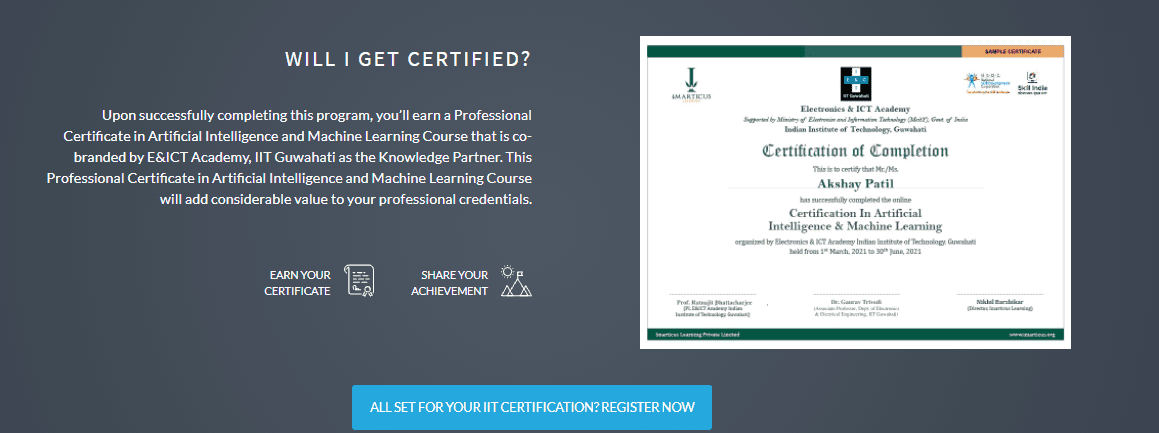
 The Certification in Artificial Intelligence and Machine Learning by Imarticus Learning is the perfect ML course in 2021. This course is endorsed by IIT Guwahati, one of the top institutes in the country. This course will follow an industry-oriented syllabus that will help in knowing about the common industry practices. You can also opt for a demo class before choosing the ML certification course.

best artificial intelligence and machine learning courses from E&ICT Academy, IIT GuwahatiIn a nutshell

Getting an ML certification can boost your chances of getting placed in some of the top companies. You will also be in demand for the coming years by gaining an ML certification. Start your ML/AI certification program now!

What is the role of a supply chain analyst in managing uncertainties in a supply chain?

A supply chain involves a network that connects a firm and its suppliers in order to manufacture and deliver a certain product to the end-user. This network consists of many activities, individuals, entities, information, and resources. The supply chain also symbolizes the stages necessary in getting a product or service from its initial state to the consumer. A supply chain management career has become a dream for many young students.

supply chain management coursesA supply chain analyst plays a critical role in the design and execution of large-scale initiatives. A supply chain analyst gathers and processes data in order to improve the supply chain system. He/she works to improve employee performance and reduce the expenses of project-related commodities.
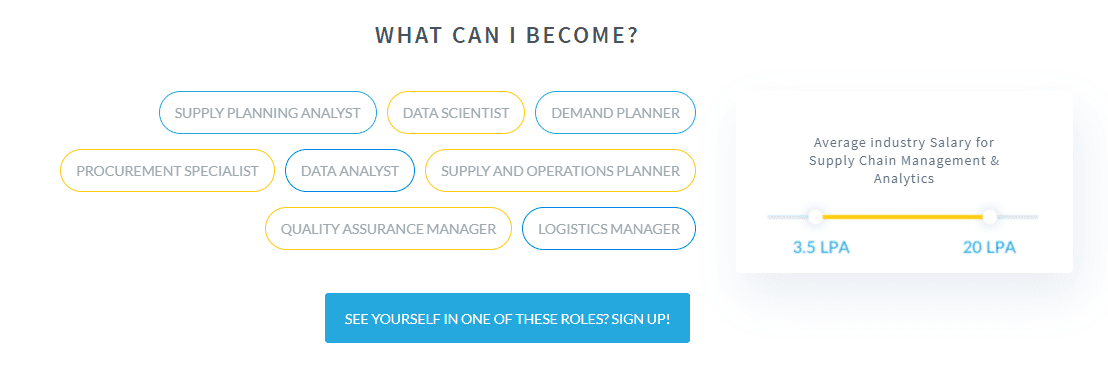

A certified supply chain analyst is the point of connection for many significant purchases made outside the firm for projects. He/she conducts market research and negotiates with corporate representatives to guarantee that the parent company receives the greatest price available. He/she is aware of the inventory on hand and proactively manages what is being used to assist other team members by ensuring they have the necessary tools.

What is the job of a certified supply chain analyst?

  • Create and develop techniques for gathering and managing supply chain data
  • To improve business revenue, research potential partners and seek out best-price contracts
  • Maintain a professional and friendly connection with contractors while supporting corporate aims and values
  • Contribute to the enhancement of a positive image and cross relationships with business partners and suppliers
  • Examine and evaluate collected data to identify problem areas in the supply chain process and devise ways to enhance it

How does an analyst manage uncertainties?

  1. Mitigating risk will look extremely different based on a variety of supply chain-related elements. Look for specific weaknesses in the supply chain, such as sole-source vendors or centralized inventory. New software and other technology tools are now available to assist you in determining the origins of your risk.
  2. In some circumstances, the consequences of an unforeseeable global calamity can be exacerbated because businesses have focused too long and too hard on cost-cutting measures and efficiencies. However, the same tactics that can make a supply chain run more efficiently and cost-effectively, such as sole-source suppliers, can also lead to longer, larger, and more significant interruptions. Balance your need for protection against unpredictability with your desire for improved efficiency.
  3. A supply chain analyst creates a list of what-if scenarios that he/she can guide the team through in a simulated supply chain disruption crisis. These tests are critical dry runs of situations that are very likely to occur in the future, and they can provide invaluable insights into how much crisis management work they should focus on.
  4. Although it is critical to have particular procedures in place in case of large-scale supply chain disruptions, it is also critical for supply chain managers to consider risk and uncertainty when making all decisions. Considering the effects of changes on risk management is critical to protecting against disproportionate losses caused by uncertainty, especially when deploying new technology, working on supplier development, or boosting overall efficiency.

Conclusion:

Companies are putting supply-chain risk management back on the menu in a more uncertain environment. Cybersecurity threats are becoming more destructive. A proactive approach paired with a strong risk-management culture will be a game-changer for businesses, assisting them in avoiding and managing future supply chain breakdowns.

For students wondering what to do after graduation, a supply chain management career might be the right start. A supply chain management online course will help you get closer to your dream career. There are great supply chain management online courses that you must check out!

supply chain management courses

What are the Job Roles of an AI and ML Specialist?

In today’s data-driven world, the highest demanding and relevant jobs have got to be that of an AI and ML specialist. Most major industries now rely heavily on artificial intelligence and machine learning to optimize their business better.

It helps them to detect the clients’ needs and cater to them accordingly. It even helps them to look after their employees’ well-being, which in turn makes them more productive and loyal to the company. This is possibly the best time to do an AI and machine learning course if you are worried about your future.

artificial intelligence and machine learning coursesThis is one job that will never go out of positions as most sectors these days need an AI and ML unit in their teams. If you are confused about which institute would be better for your career, then you do not need to look very far. Like always, Imarticus Learning has come through with one of the best AI and ML certificate courses that will immediately give you that extra edge over others.

However, the question remains about what having these jobs entails? Here, we have tried to give accurate job descriptions for artificial intelligence and machine learning specialists in detail. Please, read through it to learn more about it.

Artificial Intelligence Specialist

There are a variety of aspects to an AI specialist’s job. However, all of these meet at a certain point. That is, they develop computer software to comprehend different situations through hypotheses. They test these hypotheses by comparing them to the workings of the human mind. All of these are done through cognitive stimulation.

They also use this to enhance the opportunities and suggestions provided by and inside of a variety of different industries. This is versatile enough to be applicable in any major industry that deals with clients. The job roles of an AI specialist can be any, but not limited to, the ones following:

  • Software analyst: Using AI to debug or check the performance of software
  • Data security engineer: Safeguarding a company’s intra network and internetwork as well as data governance and data integrity
  • Research scientist: Extracting, designing, analyzing, and comprehensively preparing data using AI predictive analysis and another forecasting
  • AI developer: Develops AI systems and integrates existing software with AI systems
  • IoT engineer: Developing IoT-based devices and integrating AI software and processes in them
  • Cloud specialist: Empowering data with cloud systems

 Machine Learning Specialist

This is a profession dedicated to developing algorithms that can adapt to or learn from the available data to make helpful suggestions and predictions. Some of the job roles are:

  • Machine learning engineer: Involved in sourcing data, creating the machine learning model, and implementing it
  • Machine learning architect: Setting up, integrating, and maintaining machine learning components according to the requirement
  • Data engineer (data modeling specialist): Involved in data modeling and ensuring data can be used for machine learning
  • Machine learning developer: Involved in programming and setting up machine learning systems like forecasting and predictive modeling
  • Automation engineer: Automating processes using ML
  • Deep learning engineers: They work with complex datasets to power up neural networks using deep learning and ML
  • Artificial neural network specialist: Creating neural networks and ensuring that the system has the ability to make decisions mimicking human beings.AI and ML courses

There are many benefits to an AI and machine learning specialist’s job. The major ones being, you will never go out of a job. This is also a high-paying job, so you will never have to think about the salary input being less than your performance output. So, do check out Imarticus Learning’s AI and ML certificate course to give your career the necessary boost.

AI and ML courses

Use of Data Analytics in Improving Working Capital Management

What is working capital management?

Working capital is an organization’s utilization of money to cover its daily needs, such as paying for raw materials, supplies, and salaries. The term can also be applied to individuals. Working Capital Management is defined as “managing cash flow so that it fulfills all the business needs”.

For example, if you have $10 in your wallet but need $100 worth of groceries today, your working capital would be negative $90. Working capital management takes care of the flow of funds within the organization. It ensures that funds are available to meet short-term obligations without having to borrow or sell assets. It’s essential for all businesses because it affects the growth and the profits of the company.

Without sufficient working capital, companies will fail before utilizing their full potential. Working capital management is a critical function for every company. Whether you are operating in the manufacturing or service industry, managing your working capital will impact your ability to grow and succeed.

How does it help the organizations?

Data analytics can help organizations measure how much money they need for their working capital based on their current situation. This way, they can improve their working capital management by minimizing risks such as overinvesting or underinvesting in one area while neglecting others.

There is a need for both MSMEs and large manufacturers to remotely manage their supply chain, cash flows, etc. This has led to a rapid and massive shift away from manual processes. This is where automation comes into play – Accounts Receivable Automation (ARA) was developed as an alternative solution by many companies who needed more control in this area of their business while still managing all aspects with less workforce. These systems allow businesses to deal directly with suppliers and it drastically cuts down processing between payments and delivery.

Application in the real world

In the past few years, the use of Data Analytics has been steadily increasing as a way for organizations to understand their customers better and identify trends.

In today’s world, data analytics is indispensable as it facilitates the efficient working of an organization. The proper recording and analysis of every activity related to the manufacturing cycle of the products help in having visibility of the processes.

Data Science Course

One particular area where Data Analytics can be applied is in examining customer payment patterns, such as when customers pay or don’t pay on time. For example, one company found that because of the customers who paid late, they were losing roughly about $21 million annually due to delayed payments from other clients. It also examined the reasons as to why people pay late. They came up with several insights like cash crunch during month-ends, etc. that stopped them from making these payments.

Using a company’s balance sheet and cash flow statement, a financial analyst can determine when the business has excess funds and also the times when they need more money. This analysis can then be used to establish an appropriate financing strategy that balances the company’s needs with its ability to repay the debt over time. Data Analytics makes the entire process smoother and better.

Conclusion

To maintain change, it is imperative to differentiate between noise and signal. This is done by developing measurable, granular  KPIs that are monitored strictly. Carefully analyzing historical data can provide valuable insights into managing networking capital by quickly finding and dealing with emerging issues.

Contact us today if you want to be well equipped when it comes to dealing with such situations. With a digital analytics course, implementing these tactics in your business becomes easier.

With a data science course, you become aware of the techniques that go into it. The course comes along with a placement opportunity so that you’re all set to apply your business analytics knowledge in managing operations.

What is the Difference Between a Business Analyst and Business Intelligence?

When the business analysis markets are expected to hit the 20 billion mark and considering that business analytics actually makes the business five times faster, better informed and effective, it gets a little confusing when people mix up the terms “BA-Business Analytics” and “BI- Business Intelligence” and use them interchangeably when the two areas are really different.

Let us explore how we can define the two areas and what their differences really are.

A Brief Definition:

By definition BA means the technology and approach behind the data analysis where one can establish trends and gainfully cull insights into business data with the ultimate goal of boosting the planning, efficiency and productivity of a business’s future goals and performance.

It is a Why- approach to business needs. The Business Analyst depends on the use of the predictive models, specific data sets and statistical analysis to justify why a business decision needs to be taken based on predictive analysis of future performance parameters.

BI refers to the analysis of the same business data on a wider scale and with large volumes of unstructured data and focuses on the how and what- approach to business needs involving what and how you can use and mine raw data, the tools required for OLAP, querying, data management and reporting etc, to align and draw out the business performance goals and stimulators based on both prescriptive and predictive analysis.

You can learn all of these by doing a Business analyst course.

The Differences Table:

Here are some of the key differences explained below.

1. BI reports analyzed data as against BA which uses technology and tools to perform data operations.

2. BI uses current, past and historical data in comparison to BA where past data is used to gain foresight or extract insights. Both have the same goal of increasing productivity, efficiency and use data to achieve business results.

3. BI is the method or process whereas BA comprises of inputs from BI to arrive at the visualized and extracted information.

4. BI provides insights drawn from the data in use while BA is the process of working on the data and arriving at solutions for the use of Big Data in use.

5. BI appears to be a part of BA which effectively uses information management, data warehousing, business applications, security measures, and risk mitigation.

6. BI uses a combination of predictive and statistical analysis and modelling in comparison to BA which works on huge data volumes to analyze, retrieve, publish and make reports on it.

7. BI uses sets of structured data drawn from applications like the ERP or financial software applications while BA cleans and works with unstructured data while transforming the data into valuable meaningful data for BI.

8. BI normally is restricted to dashboards with a user-interface in comparison to BA which relies on a vast armoury of tools and software applications.

9. BI uses the same format and a sub-set of data for insights while BA works on the raw data to transform it into various databases to draw out trends and foresight.

10. BI roles like executives, analysts, and managers use pivot tables, reports and the dashboards while BA analysts use past BI reports and capacities to help get tasks done with the required BA information.

11. BI is about Big Data access and control over data while BA focuses on handling the data

12. BI focuses on effectively running the business process while BA brings transformational changes to make the enterprise’s processes more effective and productive.

13. BI is a subject in the field of the ever-popular BA.

14. BI uses tools like for analysis in real-time, data-reporting, Mapping Analysis, OLAP and Dash-boards in comparison to BA tools like requirement and use-case, user stories, data, SWOT analysis, predictive modelling and such.

Conclusion:
Let us now elucidate on the table to sum up our differences. No, Business Analytics and Business Intelligence are different and should never be used interchangeably. The field of BA is vast and with growing data and the need for BI is increasing and encompassing all processes and all fields.

To be a good Business Analyst one needs to learn business analytics too and it goes without saying that to be a good BA analyst BI is essential. The debate ends when the needs and end goals are met through doing a Business analyst course. So, here’s to analyzing, using and predicting insights well using both BA and BI. All the best!

How Machine Learning Systems Can Streamline Healthcare Disbursement Setups?

The ripple effects of the COVID19 pandemic have been felt across industries at several levels. The healthcare industry wasn’t spared either, with essential healthcare workers moving to the frontlines to deal with the emergency. As a result, many organizations saw their back-end operations, such as appointment bookings and disbursement trackers, floundering.

However, there is a silver lining in this situation– it’s that technology has speedily been integrated into systems. Telehealth software has seen a surge in demand so as to prevent risks of exposure; healthcare disbursements are next on the list to be made easier.

Healthcare disbursements are traditionally tricky and convoluted processes; the pandemic has put further amounts of strain on the system and caused frustration, delays, and errors. However, machine learning in healthcare is a step forward in fixing disbursement delays.

Here’s how:

  • Moving from Checks to Digital Disbursements

A majority of disbursement systems around the world rely heavily on cheques and other outdated methods. However, this has become a point of friction at this time considering courier services have shut down and deliveries are very delayed. In such a scenario, the use of digital reimbursement options, bolstered by machine learning, is tempting.

Providers can facilitate faster payouts through DTC (direct-to-consumer) payments. By shifting the process online, providers will also be able to keep track of all patient and consumer data on one server. Machine learning can be used to pull up the relevant information, create automated disbursement setups, and ensure the consumer receives their disbursement digitally. The reduced reliance on paper payment processes will lessen the load on healthcare finance systems as well as get disbursements out to the right people in a flash.

  • Addressing Glitches in Systems

Several reports talk of misplaced cheques, incorrect deposit information, and several such kinks in telehealth and digital healthcare solutions being used today. Machine learning can be leveraged to iron out these kinks because, especially during a healthcare crisis, such errors can have a snowball effect on consumers and providers alike.

Providers who use machine learning systems to manage delays will be able to maintain strict records of past and future payouts. The system can be trained to collect the right deposit information as well as cross-verify with other records if required. The reliance on an automated system, in this case, equals to a lesser reliance on outdated methods of payout tracking.

  • Simplify User Experience

Claiming payouts and processing them can become a nightmarish experience for both patients and healthcare providers alike. Machine learning systems effectively reduce quite a number of manual steps which, in turn, saves time, money, and efforts. Machine learning can be leveraged to extract critical information from healthcare contracts, estimate how much is owed, and prepare the right documentation in time for a payout.

For patients, too, the process of claiming payouts become simpler. They will no longer have to fill out a myriad of forms and move from office to counter over days. Instead, by automating certain processes from the providers’ ends, patients can be called in only to verify details if necessary and to provide any other physical documentation the healthcare provider may need.

Conclusion

The healthcare industry will most likely see a surge in the adoption of machine learning and artificial intelligence. This will be across the board– from handling disbursements to automating admissions and discharges. Therefore, students who are interested in pursuing an artificial intelligence career would do well to explore this niche and develop the right skillset for it.

You can do this by enrolling in a machine learning course that focuses on the healthcare system, or take on related projects that could leverage your portfolio when it comes to it. The current strains on healthcare providers worldwide have exposed significant cracks in the system that machine learning could most likely fix.