So, you’ve completed your BCom degree, and now you’re standing at the crossroads of your career. Shall you opt for further studies, jump into a job, or pursue a professional study-or something else? If you are considering a career in accounting and finance, you are indeed on the right page! This field boasts stability, ripe salaries, and wonderful opportunities for growth. With so many career choices, though, it is confusing where to begin. This blog will take you through the top career options, skills required, certifications, and professional advice to get started.
Why Account and Finance as a Career?
Accounting and finance are the pillars of every company. Organizations depend on trained professionals to look after budgets, audit financial statements, and make sure that companies are compliant with regulations. These are the reasons why account and finance careers are extremely rewarding:
High Demand: All sectors require accountants and finance experts, ranging from startups to multinationals.
Competitive Salaries: Highly qualified experts receive good compensation packages, with the chance of quick salary advancement.
Growth Potential: As one gains experience and gets certified, career advancement is quick, and one’s ranks increase with greater responsibilities and compensation.
Global Opportunities: Most of the jobs have international work opportunities, enabling experts to work in different economies.
Job Stability: Financial professionals never go out of demand since organizations always have financial management requirements.
Career Choices: There are multiple specializations one can enter within the career line, i.e., from being a forensic accountant to being an investment banker.
Entrepreneurial Opportunity: Individuals can go ahead and initiate business, consulting practices, or advisory services after becoming proficient with their finance-related expertise.
Best Careers in Finance for BCom Graduates
If you’re wondering what roles align with your degree, here are some of the best careers in finance for BCom graduates:
Ensuring financial accuracy and regulatory compliance.
How to Make a Career in Accounting
To start your career in accounting, you would require a mix of education, skill, and practical experience. It goes like this:
Build a Strong Educational Base
Complete your BCom with an employer’s specialization in Accounting or Finance.
Pick up strong technical knowledge in areas involving financial reporting, auditing, and taxation through coursework and self-study.
Focus on the financial laws and compliance requirements, which are important for accountants.
Continue with Professional Certifications
Certifications lend credibility to your candidacy. Consider the following:
CA (Chartered Accountant): This is best suited for taxation and audit roles since it will provide you with wider experience in financial management as compared to the others.
ACCA Course (Association of Chartered Certified Accountants): Globally recognized and lets you work anywhere from England to Australia.
CPA (Certified Public Accountant): Great if you aspire to a career in US-based finance.
CFA (Chartered Financial Analyst): If you are more inclined toward investment banking, asset management, and financial research.
Get Practical Experience
Try for internships and entry-level positions in Finance.
Working in real-world accounting projects, including a financial analysis and audit report, can help refine your expertise.
Familiarize yourself with relevant accounting software such as Tally, SAP, QuickBooks, and Microsoft Excel, which are used in the industry.
Attend workshops and other training sessions to stay abreast of changes in financial technologies.
Stay Abreast of Latest Trends in the Industry
Keep current with the financial market updates, regulatory changes, and updates to accounting standards such as IFRS and GAAP.
Keep on doing online courses like blockchain in finance and those on artificial intelligence-driven accounting solutions.
Network with finance communities and participate in networking events to meet with industry professionals.
Skills Needed for a Successful Career in Finance
For one to be great in the accounting and finance career, one requires both technical and soft skills:
Taxation Laws – Knowledge of GST, income tax regulations, and corporate tax structure.
Auditing Standards – Ensuring that requisite financial rules and regulations are complied with, noting these when it comes to risk management and fraud.
Data Analysis – Extracting, formatting, and producing graphical representations using programs such as Excel, Python, or Power BI.
Risk Management – The ability to analyze financial risks and build strategies to minimize them.
Financial Modelling:– Creating models with the responsibility of forecasting future business performance.
Soft Skills:
Analytical Thinking – Interpreting financial data and deriving meaningfully insightful conclusions.
Communication Skills – Explain complex financial concepts to clients and stakeholders as well as to those who have no knowledge of finance.
Attention to Detail – Accuracy in financial reporting, tax filings, and audit records.
Problem-Solving Ability – Seeking a solution to operational and financial challenges.
Time Management – Completing a number of concurrent projects within demanding time periods are possible within a fast-paced environment.
Ethical Judgment – Practicing fairness and honesty while making financial choices and reporting.
Acquiring these skills will create a solid basis for a prosperous long-term finance and accounting career.
Industry Updates and Salary Trends
Automation & AI in Accounting: Firms are embracing AI-driven accounting solutions.
Rise of ESG Reporting: Environmental, Social, and Governance (ESG) reporting is emerging in the mainstream.
Globalization of Accounting: International certificated professionals such as ACCA are highly sought after.
Accounting and finance careers are secure and lucrative.
Getting certified in CA, CPA, or ACCA Course can enhance your chances.
Acquiring technical and analytical skills is essential for career advancement.
Keeping yourself updated with financial sector trends will make you stand out.
Practical experience obtained through internships is crucial in becoming job ready.
FAQs
What are some good career options available to BCom graduates in finance?
A Chartered Accountant, Financial Analyst, Investment Banker, Management Accountant, Tax Consultant, and Auditor.
How to pursue a career in accounting after BCom?
Experience through internships, professional certification such as CA or ACCA, and constant update with the latest industry standards.
Is ACCA a suitable choice for finance professionals?
Yes, the ACCA course is recognized internationally and provides access to international career opportunities.
How to create a career in accounting after BCom?
Self-assessment and aptitude for accounting tasks
Internships with respectable firms
Further professional qualifications – CA or ACCA
Staying current on industry standards.
What are the basic skills required in an accounting and finance career?
Basic skills required in an accounting and finance career would include financial reporting, auditing, taxation, data analysis, and communication.
Which is more preferable: CA or ACCA?
CA is India-specific, whereas ACCA course is internationally accepted. Decide according to career ambitions.
What should finance professionals learn about software?
Tally, SAP, QuickBooks, and Power BI are must-knows for accounting and finance professionals.
Is CFA preferable to ACCA?
CFA is best suited for investment banking, whereas ACCA is more accounting-oriented.
What is the future of accounting careers?
Automation and AI will revolutionize accounting, but trained professionals will never be obsolete.
How do I remain current on finance trends?
Follow financial news websites, online courses, and network with finance professionals.
Conclusion
Enter a career in accounting and finance post BCom degree, an adventurous ride with full of possibilities. Gaining experience, acquiring the apt skill sets, and acquiring appropriate certifications will enable you to build a fulfilling career. You may be a Chartered Accountant, Financial Analyst, or Investment Banker – the field of finance is full of possibilities for growth. Be inquisitive, learn constantly, and take bold strides into the world of finance!
So, you have finished your BCom degree, and now you are asking yourself what’s next? The opportunities in accounting and finance would blow anyone’s mind. Good news? It opens doors to some of the most lucrative careers in finance. Whether you want to be a Chartered Accountant, a Financial Analyst, or a professional ACCA, plenty of choices await your bid. In this guide, we’ll outline the best accounting, finance opportunities, skills, and how you can encase your dream job.
Why Account and Finance Is a Great Career to Pursue
The account and finance industry is amongst the most stable and lucrative lines of work in the world. Here’s why it is a great career option:
Great Demand: Every company requires financial experts, providing constant job prospects.
Global Opportunities: Finance jobs are needed in all sectors, which means you can work anywhere globally.
Highly Paid Salaries: Finance professionals tend to get high salary packs and bonuses.
Career Development: With more certifications, promotions, and various career options, opportunities are endless.
Best Career Prospects After BCom
BCom opens a wide range of career opportunities. Some of the best career opportunities after BCom are mentioned below:
Job Role
Average Salary (INR)
Job Scope
Chartered Accountant (CA)
8-20 LPA
Auditing, Taxation, Financial Management
Financial Analyst
5-12 LPA
Market Research, Investment Planning
Investment Banker
10-25 LPA
Mergers, Acquisitions, Portfolio Management
Management Accountant
6-15 LPA
Cost Management, Budgeting, Business Strategy
Tax Consultant
5-10 LPA
Tax Planning, Compliance, Advisory
Auditor
4-9 LPA
Compliance Checks, Financial Accuracy
Job Opportunities After BCom: Salaries & Growth
If you’re looking for stable and high-paying jobs after BCom, consider these lucrative fields:
Banking and Financial Services
Bank Manager
Risk Analyst
Credit Analyst
Investment & Wealth Management
Portfolio Manager
Mutual Fund Advisor
Financial Planner
Corporate Finance & Accounting
Cost Accountant
Budget Analyst
Accounts Payable/Receivable Manager
Taxation and Auditing
Income Tax Officer
GST Practitioner
Internal Auditor
How the ACCA Course Can Enhance Your Career
The ACCA course (Association of Chartered Certified Accountants) is a great choice for BCom graduates who desire international recognition and a competitive edge in the job market. Here’s why it is a great choice:
Global Acceptance: ACCA-qualified professionals have the opportunity to work in more than 180 countries, one of the greatest desired certifications to work abroad or for multinational firms.
Greater Potential for Salary: ACCA-qualified professionals usually earn much more than their non-certified colleagues. It becomes a bargaining tool for salary hikes and career progress.
Diverse Career Paths: ACCA certification opens up different industries and roles; might be in auditing, taxation, consultancy, corporate finance, investments, or even entrepreneurship.
Flexibility in Exam Structure: The ACCA exams are flexible so that students can study and sit the exams whenever they wish during full-time work. So one can earn experience working while pursuing professional qualifications.
Global Networking Opportunities: Membership in the ACCA exposes you to a global, localized underground group of finance professionals where networking and career building becomes possible.
Essential Skills for Accounting and Finance Jobs
Several attributes may be essential to pursue a career in accounting and finance. Some of the most important skills required for success in this realm are as follows:
Analytical Thinking: These professionals must analyze financial data, detect trends, and make informed decisions from numerical data. A strong analytical mind is helpful for analyzing risks, optimizing investments, and making decisions based on evidence.
Attention to Detail: Accounting and finance professionals deal with complicated fiscal records, tax computations, and regulatory filing. A minor error at times can be detrimental to the business. The integrity of numbers is winsome for precision.
Tech Proficiency: These days, it’s very beneficial to be competent with the use of financial tools such as Excel, SAP, Power BI, QuickBooks, and Tally. Knowledge of financial modeling and data analytics will also give an edge to a professional.
Communication Skills: Finance professionals should be adept at such basic tasks as communicating financial insights, reports, and strategies in a clear-cut, understandable way to stakeholders, clients, and business leaders. The ability to make complex financial concepts more understandable is a nice skill to have.
Regulatory Awareness: It is an absolute necessity to keep up with the latest news on tax laws, corporate finance regulations, and industry standards to stay compliant and game legal. These professionals should constantly educate themselves on the latest trending fiscal policies and changes in the regulatory arena.
Problem-Solving Skills: Problem-solving skills come in handy in the realm of finance, wherein another example could refer to financial irregularities settlements, maximizing tax strategies, or minimizing risks.
Time Management: Financial professionals usually juggle many tasks, such as audits, tax returns, and investment planning, under extremely tight deadlines. Good time management allows them to successfully complete more than one project at a time, too.
Certifications That Can Boost Your Job Opportunities
Boost your job prospects after BCom by getting these certifications:
Certification
Advantages
ACCA
Worldwide recognition, greater salaries
CFA
Best suited for investment banking & portfolio management
CPA
Suitable for accounting professionals who want to work in America
CMA
Management accounting orientation
FRM
Best for risk management professionals
FAQs
What is the best job after BCom?
The best job after a BCom degree largely depends on the interests and skills of the graduates. Other considerations are relevant to an aspiring career, such as job seriousness, growth perspective, and opening opportunities towards several segments in finance in far-off countries. Generally speaking, options available include various careers in Chartered Accountancy, Financial Analysis, and Investment Banking among others because such careers come with much greater earning potential, growth factors, and industry respect.
Is pursuing ACCA after BCom a good career option?
Yes, ACCA is seen as one of the best careers after completing a BCom degree due to the global recognition it gets as well as the international job opportunities with better pay packages. They offer courses in auditing, taxation, financial consulting, and working in investment sectors. ACCA is seen as being versatile and rewarding for finance graduates.
What is the average salary for finance jobs in India?
Average salaries for finance jobs in India depend on the experience level, job role, and industry. Freshers usually earn between INR 4 and 6 LPA, while an experienced professional in a managerial position or investment banking may earn over INR 20 LPA and lay the groundwork for even more in the future.
Do I need an MBA for finance jobs?
You do not have to do an MBA to get a finance job. There are many professionals who have built their careers successfully on certifications like CFA, CPA or ACCA. Aside from the skills and knowledge you might study while working toward an MBA, you could be ahead in the race in finance and accounting just by having the above certifications.
How do I land a job in investment banking after doing my BCom?
To land a job in investment banking after graduating with a BCom degree, one should go for CFA certification, polish internship experience from various financial institutions, work on analytical skills, and build a strong network in the industry. Detailed knowledge of financial markets, methods of valuation, and investment strategies are also immensely important.
Which accounting jobs are among the highest-paid?
Some of the extremely high-paying accounting jobs include CA, CFO, and Financial Controller. These jobs require higher-level financial expertise and industry experience, along with additional certification that guarantees lucrative salary offerings along with adequate career growth opportunities.
Which industries hire the most finance graduates?
Industries that hire other finance students include the banking, consulting, fintech, and corporate finance fields. Companies from these fields look for skilled professionals whose responsibilities include risk management, investment analysis, financial planning, taxation, and compliance. Thus, finance graduates tend to be highly demanded in the job market.
Can you get jobs with BCom outside India?
Yes, a BCom degree gives the chance of access to jobs worldwide, especially in addition to it reading for ACCA or CPA, generally accepted international certifications. This enhances employability capacity and allows professionals to work internationally, i.e., Europe, Middle East, USA.
Are internships important for finance careers?
This builds a strong base to start off upon in finance and helps gain practical and industry know-how experience; at the same time, they afford establishing networks. These experiences are highly valued in recruiting, hence internships are an important ingredient of one’s career growth.
Which software skills must I learn to enter these finance jobs?
Strong financial software skills are crucial for successful careers in finance. A finance candidate needs to learn:
Financial modeling and data analysis in Excel
Business intelligence in Power BI
Enterprise resource planning in SAP
Accounting and bookkeeping in QuickBooks
Being familiar with these tools can create an edge for a finance professional in the job market.
Key Takeaways
Accounting and finance careers provide good pay and job security.
You can increase your chances of employment through additional certifications such as ACCA.
The finance industry provides various career avenues after BCom.
Financial experience through internships and training in financial tools can provide a competitive advantage.
Networking and ongoing skill development are key to being successful in this career.
Conclusion
A BCom degree is the first to embark on the journey of glory in the financial world and the golden key to innumerable opportunities-thereafter-unfolding in this booming industry. All one needs to consider is the right career path and certification with relevant skills. Be it investment banking, corporate finance, or taxation, a world full of possibilities awaits you. Start learning more about Finance which would be a befitting step towards a successful career in this domain!
Mere having a BCom degree will not help you get your dream job in accounting and finance. One must need to have excellent communication skills, and your ability to confidently answer accounting and finance interview questions.
Hence, a thorough interview preparation is a must.
Interviews are always stressful if whether you are applying for entry-level roles or even if you are an experienced professionals. The interviews keep getting tough based on your years of experience.
This blog will give you a guided approach to achieving mastery over commonly asked BCom interview questions, accounts and finance interview questions with answers, as well as interview questions in finance.
The roles in accounting and finance are highly specialised and technical requiring you to have an in-depth understanding of financial principles, analytics skills and attention to detail.
Employers mostly test potential candidates with technical knowledge, problem-solving abilities and their ability to understand the industry trends. Therefore, preparing for accounting interview questions and finance interview questions is important.
Why Are Accounting and Finance Interviews Challenging?
The roles in accounting and finance are highly specialised and technical requiring you to have an in-depth understanding of financial principles, analytics skills and attention to detail. Employers mostly test potential candidates with technical knowledge, problem-solving abilities and their ability to understand the industry trends. Therefore, preparing for accounting interview questions and finance interview questions is important.
As Warren Buffett once said, “Accounting is the language of business.” Mastering this language is key to excelling in interviews and securing your dream job.
Top Accounting and Finance Interview Questions
Given below are- accounting and finance interview questions which are commonly asked during an interview.
Additionally, you can find tips on how to answer them effectively:
1. Explain the difference between financial accounting and managerial accounting
Well, this is a common BCom interview question that tests your foundational knowledge.
Financial Accounting:
The preparation of financial statements for external stakeholders like investors and regulators is termed financial accounting.
Managerial Accounting:
It deals with internal reports that can help the management to make informed decisions.
Extra Tip: If you want to stand out, try answering with the help of an example. E.g. How financial accounting actually helps in tax filing and how managerial accounting aids in budgeting.
List the basic accounting principles
Ans: The basic principles of accounting include:
– Revenue Recognition Principle
– Matching Principle
– Cost Principle
– Full Disclosure Principle
Explain the difference between accounts payable and accounts receivable
Ans:
Accounts Payable
Accounts Receivable
Money owed by the company to suppliers.
Money owed to the company by customers.
Recorded as a liability in the balance sheet.
Recorded as an asset in the balance sheet.
Extra Tip: This question tests your ability to differentiate between critical financial functions.
What is the importance of a balance sheet and how do you analyse it?
Ans: This is a classic accounts and finance interview question and answer that evaluates your analytical skills.
Balance Sheet: A snapshot of a company’s financial position at a specific time, showing assets, liabilities, and equity- is a balance sheet.
Analysis: Look at key ratios like the debt-to-equity ratio and current ratio to assess financial health- is analysis.
Extra Tip: Mention how you could use- the balance sheet to identify trends or potential risks.
The term working capital- explain the same.
Ans: Working capital is company’s current assets minus current liabilities. It is usually used to measure short-term liquidity and operational efficiency.
(Current assets- current liabilities= working capital)
Extra Tip: Always relate this to the practical scenario of managing cash flow while explaining it to the interviewer to make a great impression.
How do you handle discrepancies in financial statements?
Ans:
Identify the Issue: Thoroughly review the statements to pinpoint the discrepancy.
Trace the Source: Cross-check records, transactions, and supporting documents to locate the error.
Consult Relevant Stakeholders: Collaborate with the team or department responsible for the data.
Rectify and Reconcile: The error is corrected, and balances are matched.
Prevent Recurrence: Implement checks, controls, or automation to avoid similar issues in the future.
Extra Tip: This accounting interview question is asked because it assesses your problem-solving skills and attention to detail.
How one stay updated with changes in – accounting standards?
Ans: I update myself with changes in accounting standards by following professional bodies such as IFRS and GAAP, attending webinars, and pursuing certifications such as the ACCA course, which gives a deep insight into global accounting practices.
For more interview questions, check out this blog.
How to Prepare for BCom Interview Questions
Fresh BCom graduates face many challenges. In addition to theoretical knowledge, you need to present your practical skills. Here are some tips:
Brush up on Accounting Fundamentals Revise concepts such as journal entries, trial balances, ledgers, and financial statements. These are common areas for accounting interview questions.
Revise journal entries, trial balances, ledgers, and financial statements. These are some of the most common areas accounting interview questions arise from.
Focus on Problem-Solving Skills Questions like “How would you manage discrepancies in financial records?” are common during the accounts and finance interview questions and answers rounds.
Learn from Industry Standards Courses like the ACCA course make you aligned with global accounting practices, thereby strengthening your resume and interview preparation.
Advanced Accounting and Finance Interview Questions
For roles that goes beyond entry-level i.e. if you are a professional, then the following accounting and finance interview questions are majorly asked:
1. What are deferred taxes, and how are they recorded?
Answer: Deferred taxes arise due to differences in accounting income and taxable income. These are recorded as assets or liabilities in the balance sheet.
2. Significance of a cash flow statement- explain
Answer: The cash flow statement will help stakeholders make informed decisions by providing insights into inflows and outflows of cash of the company, hence building knowledge about the liquidity position.
Steps to evaluate the financial health of a company
Answer:
– Analyse the balance sheet- to check the debt levels.
– Assess the income statement- to check the profitability.
– Review the cash flow statement- to check the liquidity.
Role of software in accounting, please explain.
Answer: Tally, QuickBooks or SAP are used to – ease and simplify bookkeeping, financial reporting and tax compliance.
Note: This is one of the most commonly asked BCom interview questions
Top Behavioral Interview Questions
Behavioral questions will test how you react to pressure. Here are some illustrations:
1. Can you give an example wherein you resolved a discrepancy in finances?
Answer: Share a STAR-based (Situation, Task, Action, Result) story emphasising your problem-solving abilities.
2. How do you manage multiple tasks when deadlines are tight?
Discuss strategies for time management and provide some examples from your academic or internship experiences.
Common Pitfalls to Avoid in Accounting and Finance Interviews
Not Preparing Enough Mere memorising answers to theoretical accounting interview questions is just not enough. If you want to ace the interview and get the job, practice mock interviews to build confidence.
Lack of Industry Knowledge This can be easily termed as a rookie mistake, but it is extremely important to stay updated with industry trends like the adoption of AI in accounting or blockchain in finance. Stay updated with trends such as the adoption of AI in accounting or blockchain in finance.
Weak Communication Skills Explaining technical concepts in layman’s terms is crucial for roles requiring client interaction.
The Role of ACCA in Advancing Your Career
The ACCA course is a world-recognised qualification which prepares students with advanced accounting and finance skills. Its emphasis on financial reporting, audits, and taxation will make it the perfect choice for BCom graduates looking to enhance their expertise.
As the famous investor Benjamin Graham would say, “The best investment you can make is in yourself.” Pursuing an ACCA course not only boosts your knowledge but also makes you more employable in a competitive job market.
Want to know everything about ACCA course, check out this blog.
FAQs
What are the most common accounting and finance interview questions? The most common accounting and finance interview questions include topics like financial statement analysis, budgeting, and accounting principles.
How can I prepare for bcom interview questions in accounting and finance? Focus on core topics like journal entries, trial balances, and taxation, and practice frequently asked bcom interview questions for better preparation.
What is the best way to answer accounts and finance interview questions and answers? Use a structured approach: explain the concept, provide an example, and relate it to the job role for clear and confident responses to accounts and finance interview questions and answers.
How important is knowledge of accounting standards for finance interview questions? It’s crucial to understand accounting standards like IFRS and GAAP, as they often form a key part of finance interview questions.
Does pursuing an ACCA course help in answering accounting interview questions? Absolutely! The ACCA course equips you with global accounting knowledge, making it easier to tackle complex accounting interview questions.
What are some technical accounting and finance interview questions after BCom? Technical questions might include calculating financial ratios, analysing cash flow, or explaining double-entry bookkeeping.
What soft skills are assessed in accounts and finance interview questions and answers? Communication, problem-solving, and analytical thinking are often evaluated alongside technical knowledge during accounts and finance interview questions and answers.
How can I excel in finance interview questions for freshers after BCom? Build strong fundamentals, stay updated with market trends, and practice answering situational finance interview questions confidently.
Conclusion:
After BCom, preparing for an accounting and finance interview requires both technical knowledge and practical exposure with the necessary confidence. Emphasise the most common BCom interview questions along with industry-related topics provided above and train yourself to answer questions perfectly.
To drive career opportunities even more, consider ACCA courses, which are recognised worldwide, with a curriculum that is in line with international standards. This can easily separate you in the competitive job market. Additionally, choosing Imarticus Learning for your ACCA preparation is beneficial because it is India’s 1st and only authorised prep provider for World’s Top 4 Certifications in Accounting & Finance
As Warren Buffett rightly said, “The more you learn, the more you earn.” So, invest time in mastering these interview questions and pave the way for a successful career in accounting and finance.
When you hear that a Certified Management Accountant (CMA) earns ₹20–30 LPA, the first thought that hits is usually, “Is that for real, or is it just the top 1%?” Fair question. Because in a world where salary numbers float around like Instagram reels, it’s easy to lose track of what’s typical and what’s exceptional.
Here’s the real story – the CMA Certification isn’t just another fancy credential to add next to your name. It’s a qualification that changes how companies see you. From someone who “handles accounts” to someone who drives strategy and profitability. And that shift is what reflects in your paycheque.
According to the IMA Global Salary Survey 2023, CMAs around the world earn about 58% more than their non-certified peers!
In India, the difference is becoming impossible to ignore. A fresher might start around ₹7–10 LPA, but with a few solid years of experience, the same role can easily touch ₹20 LPA or more – especially in finance, consulting, and analytics-heavy industries.
Numbers alone don’t tell the full story. Behind every salary range lies a mix of skills, choices, and opportunities. Things like where you work, what tools you know, and how well you understand the business beyond balance sheets play a crucial role in how much you get compensated.
Did you know IMA surveys reveal CMAs from India are relatively young, with one-third being 26 years old or younger?
In this blog, we’ll unpack all of that. You’ll see how the CMA qualification actually translates to better pay, which roles pay the most, where CMAs are in demand, and how India compares to the rest of the world.
If you’ve ever wondered whether pursuing the CMA is worth your time and investment, this guide will help you make that decision with clarity. And maybe, a little bit of inspiration. With that, let’s dig in!
What Is CMA?
Finance has its fair share of fancy titles; well, CMA is one of them. I often come across students curious to know what is CMA and more than that, they are curious about its salary.
To start with, the full form of CMA is Certified Management Accountant. It’s a qualification from the Institute of Management Accountants (IMA) in the US. People in finance sometimes call it the “gold standard,” which is a fancy way of saying it’s pretty respected around the world.
But honestly, what matters is what a CMA actually does. A regular accountant usually records what happened. A CMA goes a step further. They look at the numbers and ask, “Okay, so what’s next?” They help a business plan smarter, make decisions, and grow sustainably. It’s more about strategy than just bookkeeping.
To get certified, you have to pass two challenging exams of the US CMA course designed by the IMA. These cover things like planning, performance, analysis, and strategic decisions. Basically, the stuff companies deal with every single day. It’s very practical, not just theory from a textbook.
The qualification is recognised in over 170 countries, so it’s not limited to India. If you ever want to work abroad, this travels with you. According to a 2023 IMA salary survey, professionals with CMA credentials earn around 21% more globally. Not just because of the certificate, but because it shows you can think like a financial leader.
At the end of the day, CMA isn’t just a badge for your résumé. It’s something that can shift your career forward in finance, accounting, or management. Not to forget, wherever you choose to work.
“Accountants explain the past. CMAs shape the future.”
Why does the CMA Certification have Value?
Before we discuss salaries, it’s worth understanding what makes the CMA credential valuable in the first place.
The Institute of Management Accountants (IMA) reports that globally, CMAs earn about 21% higher median compensation than non-certified professionals.
This isn’t just because of the certification itself – it’s because CMAs are trained to think beyond accounting. They connect finance with strategy, decision-making, and business growth. That ability tends to attract better roles, more responsibility, and, naturally, better pay.
What is the CMA Salary in India Like?
Your job title really matters when it comes to CMA salary because it shows how much responsibility you carry. A Financial Analyst might earn less than a Finance Manager or CFO, even in the same company. The higher up you go, the more decisions you make, the bigger budgets you handle, and the more people rely on you, and that naturally comes with better pay.
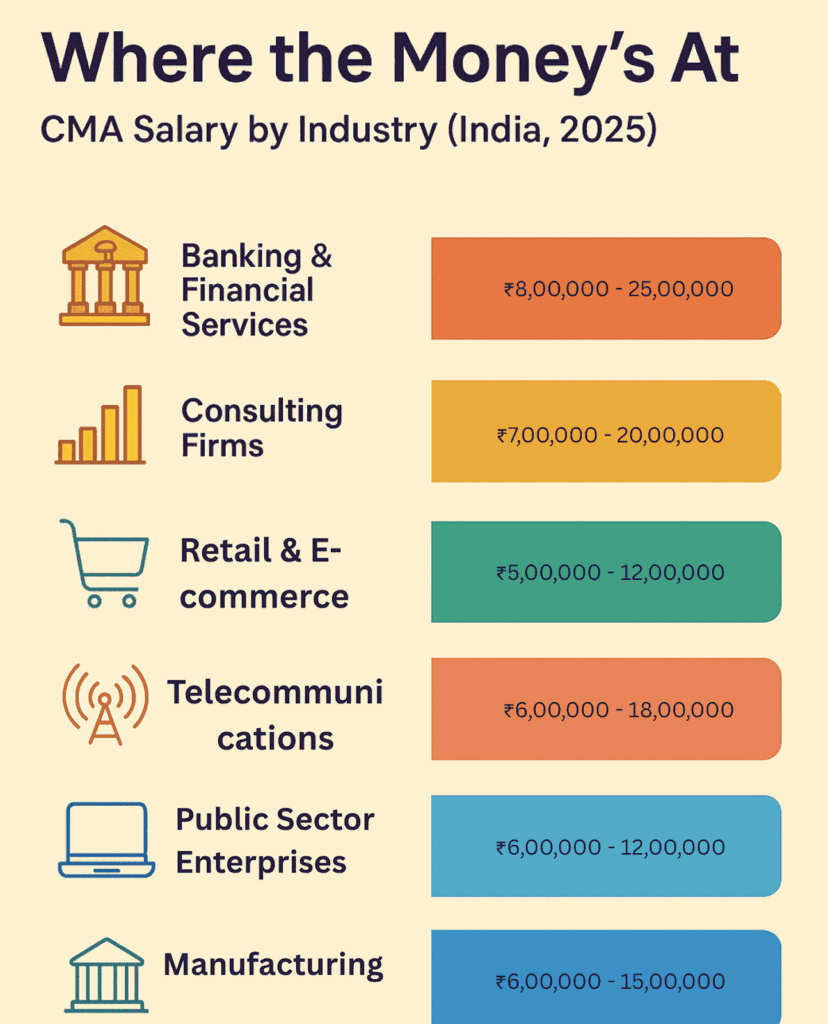
Here is a snapshot of what is in store for CMA salary in India classified across industries. We’ll look into the details in the ahead sections.
There are also a few professional attributes that directly contribute to your success as a CMA:
Getting your hands in other teams pays off: The CMAs I’ve seen grow fastest don’t just stick to accounting. They work with sales, operations, or strategy teams and start seeing how the whole business ticks. That understanding? It makes you way more valuable and, naturally, your salary reflects that.
Tech skills are your secret weapon: Knowing Power BI, Tableau, or SAP isn’t just a “nice to have.” It lets you turn boring spreadsheets into insights that actually guide decisions. Companies notice that, and they pay for it.
Global experience changes the game: If you get to work with international teams or understand standards like IFRS or US GAAP, your pay jumps. And sometimes you even earn in dollars without leaving India.
How you communicate matters: Being able to explain your numbers clearly, influence decisions, or guide your team can make a huge difference.
With that being said, now let’s get into the salary range for CMAs in India. It depends on experience, industry, and location. But here’s a broad snapshot of what professionals are earning with a CMA certification according to their experience level:
Experience Level
Typical Salary
Common Roles
0–2 years
₹3–5 LPA
Cost Accountant, Junior Analyst
3–7 years
₹8–15 LPA
Management Accountant, Financial Analyst
8+ years
₹15–30 LPA
Finance Manager, CFO, Business Controller
For most professionals, the average range tends to hover between ₹6–15 LPA, depending on company size and sector.
“IMA says the average base salary for members in India is $21,626.”
Average CMA Salary by Role
When it comes to CMA salary for freshers and experienced professionals, your job role makes a bigger difference than most people realise. It’s not just about the number of hours you put in, but what you’re responsible for and how much the company depends on your decisions.
Two CMAs working in the same office can be on completely different pay scales if one is crunching numbers for reports and the other is making strategic decisions that shape the business. The higher your role influences outcomes, the more you get paid.
So, job roles often define not only your responsibilities but also how the organisation values your contribution. Here is a table showing various CMA Salaries in various roles:
Role
Average Salary Range
Typical Responsibilities
Cost Accountant
₹4–8 LPA
Cost analysis, budgeting, variance analysis
Management Accountant
₹7–14 LPA
Internal reporting, business decision support
Financial Analyst
₹6–12 LPA
Forecasting, planning, trend analysis
Finance Manager
₹10–18 LPA
Strategic finance, team management, and compliance
The pattern is straightforward: the closer your role is to business decision-making, the higher the compensation tends to be.
“Today’s CMA is expected to be as fluent in data storytelling as they are in cost analysis. Those who keep learning don’t just earn more; they lead more.”
Average CMA Salary by Industry
Not every industry pays CMAs the same, and honestly, where you work can make a bigger difference than how many years of experience you have. Consulting firms, tech companies, and manufacturing giants often pay more because they want CMAs who can solve problems, drive strategy, and actually influence outcomes. Choosing the right industry doesn’t just affect your paycheque; it shapes the kind of work you do, the challenges you face, and how fast your career can grow.
Different industries reward the CMA skill set differently. Here’s how the pay distribution typically looks:
Industry
Average Salary Range (Per Annum)
Manufacturing
₹6–15 LPA
Consulting Firms
₹7–20 LPA
Banking and Financial Services
₹8–25 LPA
Retail & E-Commerce
₹5–12 LPA
Telecommunications
₹6–18 LPA
Public Sector Enterprises
₹6–12 LPA
CMAs working in financial services and consulting often earn more because those roles rely heavily on analytical decision-making and risk evaluation: two areas where CMAs are trained to excel.
Also, it is very interesting to note that Global MNCs and consulting firms such as Deloitte, PwC, EY, KPMG, Accenture, Genpact, IBM, Cognizant, and Amazon count as top employers for CMAs in India. These companies value CMAs for their analytical and decision-making capabilities across finance and operations.
How CMA Salary in India Compare Globally?
One of the questions I get asked all the time is, “Do CMAs in India really make as much as those abroad? ” It’s a fair question. When you scroll through LinkedIn and see American CMAs talking about six-figure salaries, it’s hard not to wonder where CMA Salary in India stands.
The latest IMA Global Salary Survey (2023) gives us some perspective. On paper,
CMAs in the Americas are way ahead, with an average base salary of around $130,000
Professionals in the Middle East, Africa, and India (MEAI) region earn an average of $33,000, with total compensation nearing $39,000
(Source: IMA Global Salary Survey 2023)
Now, let’s be honest, these numbers can be intimidating at first glance. But here’s what many people forget: a salary in the US or Europe doesn’t stretch nearly as far as it does here. Rent, healthcare, insurance, taxes; they eat into that paycheck fast. A CMA earning ₹25–30 lakhs in India can live a genuinely comfortable life, own a home, and maybe even save more than someone abroad earning three times that on paper. So, while the nominal figures look different, the lifestyle parity is closer than you’d think.
Something else I’ve noticed – younger professionals are getting ahead faster with the CMA. Ten years ago, you’d probably need a decade of experience before being trusted with strategy or cost optimisation. Today, I see 27-year-olds leading performance reviews or managing P&Ls because their CMA training has equipped them to think beyond ledgers. It’s not an exaggeration to say that the qualification accelerates your timeline both in skills and in opportunity.
So yes, the dollar numbers might differ. But the value of being a CMA in India today? It’s absolutely world-class.
For a wider perspective, the IMA Global Salary Survey 2023 shared some telling figures:
Region
Base Salary
Total Compensation
Mean
Median
Mean
Median
Americas
$129,961
$120,000
$153,874
$132,000
AsiaPac
$36,985
$26,092
$44,548
$29,686
Europe
$104,369
$90,661
$124,024
$98,298
Middle East/ Africa/India
$32,878
$16,000
$39,583
$19,200
All
$69,427
$45,873
$82,670
$54,398
So yes, Indian compensation is modest compared to global standards, but the purchasing power parity makes the Indian CMA route far more cost-effective. Moreover, with many global companies operating finance hubs out of India, that pay gap is gradually narrowing.
This and some more are covered in this video:
Factors Impacting CMA Salary
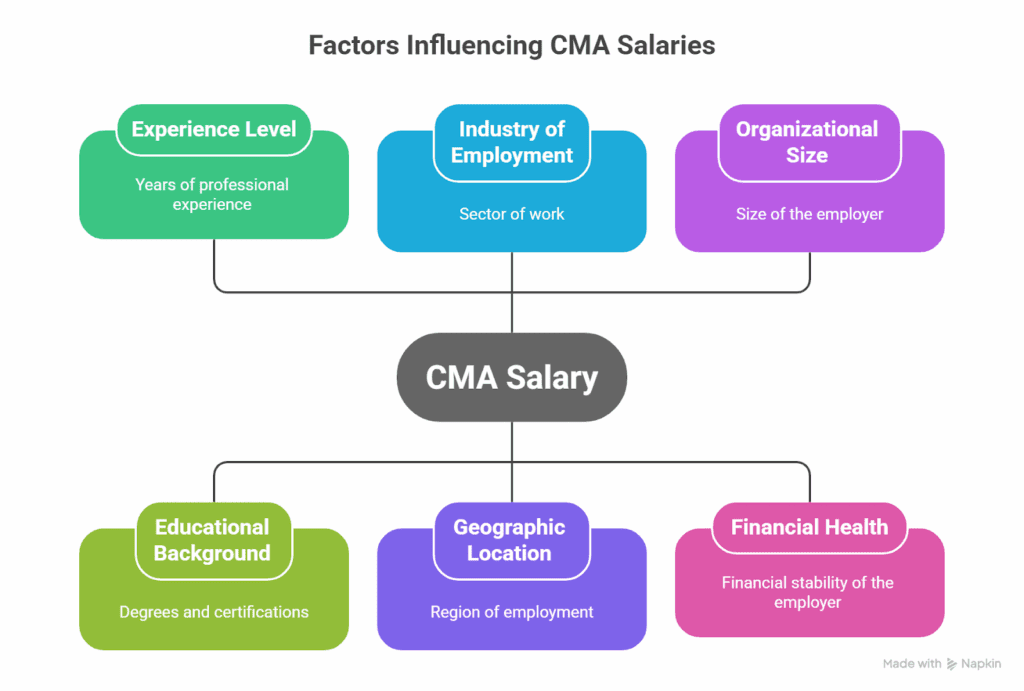
Two people can have the same qualification, but if one is just punching numbers and the other is helping the company figure out where to grow or how to save money, their pay is going to be completely different. It’s the impact you make that counts.
Let’s say, for example, the industry you’re in, the size of the company, even the city you live in, all of that matters. And don’t sleep on the little things: how you explain your numbers to non-finance folks, how you get people to actually listen, how you lead your team. Those are the things that tip the scale. Hit these right, and your salary starts showing what you’re worth.
Honestly? The CMA certificate alone doesn’t do it. It’s what you do with it. How you show up, the problems you solve, the way you make people sit up and take notice.
Here are a few factors that will make you push your career boundaries:
Experience & exposure: The first couple of years can feel slow and messy. You’re learning the ropes, making mistakes, and figuring out office dynamics. But if you dive in, try new projects, and actually learn the business, things change fast. Suddenly, people trust you with bigger work, and that reflects in your pay.
Industry choice: Finance-heavy companies, consulting gigs, or analytics-driven firms tend to reward CMAs quicker because they value people who can think beyond the spreadsheets and actually guide decisions.
Skill additions: Tools like Power BI, Tableau, or SAP are the difference between reporting numbers and telling the story behind them.
Certifications & Education: Combining CMA with a degree in finance or another qualification like CFA strengthens your profile.
Performance & Negotiation: Clear documentation of your business impact during appraisals can make a real difference.
Essentially, CMA gives you the foundation – how you build on it decides your trajectory.
Why Are CMAs Paid More?
Imagine two finance professionals walking into a boardroom pitch. One arrives with a general accounting degree, the other carries the CMA credential. The second is more likely to be asked, “What’s your view on cost levers and business strategy?” rather than “Can you just do the bookkeeping?”
That difference in perceived value is exactly why CMAs command higher pay. Below, I unpack the mechanics behind this value.
Cutting costs the smart way: A CMA isn’t just pinching pennies. They know where the business can save without hurting growth, and where it’s worth spending to make more. I have heard numerous stories where CMAs suggest tiny process changes that end up saving companies big bucks every year – and that’s the kind of thinking that gets noticed.
Turning numbers into decisions: Anyone can create reports, but a CMA takes those numbers and turns them into advice that matters. Should the company launch a new product? Is that pricing tweak going to help profits or hurt them? CMAs answer those questions – and management listens because their insights carry weight.
Keeping things smooth globally: If a company works internationally, mistakes are expensive. CMAs know the rules and make sure the company doesn’t trip over compliance issues. That alone saves businesses millions and is why CMAs are so valuable.
And here’s something people often miss: the soft skills matter just as much. A CMA who can explain numbers clearly, mentor juniors, and influence decision-making becomes indispensable. They’re not just accountants; they’re the people businesses lean on to make smart, confident decisions.
That’s the real reason CMAs command higher pay, because they change the way a company thinks about money and strategy.
A Typical Career Path for a CMA in India
When I look at the trajectory of a CMA in India, it feels like climbing a ladder where each rung not only brings more responsibility but also significantly better compensation. The CMA credential doesn’t just make you an accountant; it positions you as a strategic finance professional who can influence business decisions.
Here’s how a typical career path unfolds:
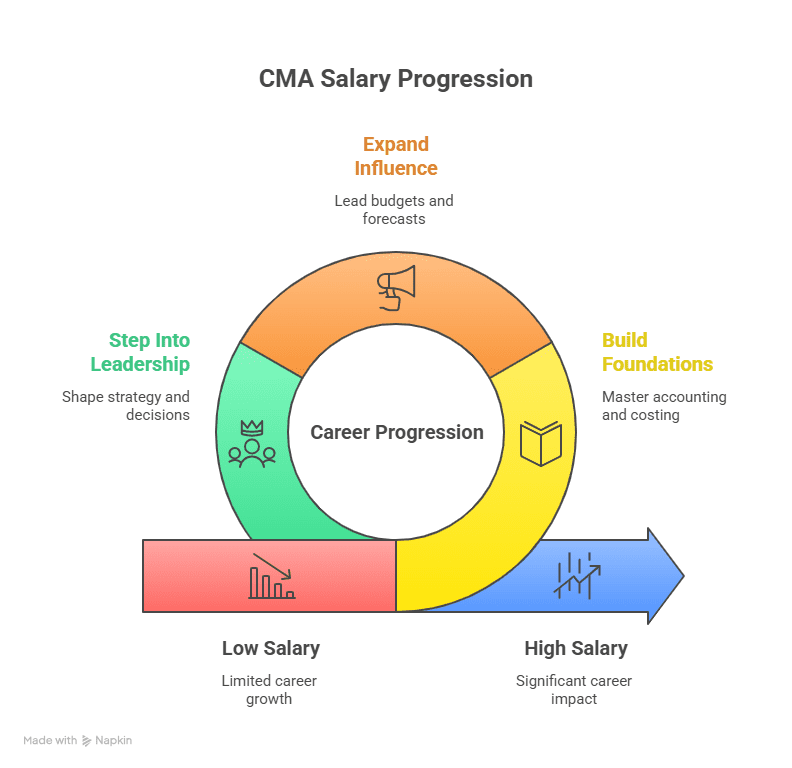
Stage 1: The Rookie (0–3 years)
You’ve just landed your first CMA job, and honestly, it can be overwhelming. Reports, audits, budgets – there’s a lot of number-crunching, and at times, it feels repetitive. But here’s the thing: this is where you start picking up the little things others miss. Patterns, trends, quirks in the data: that’s your training ground. Pay? Around ₹3–5 LPA. It’s not huge, but the experience you’re building is what sets you up for everything ahead.
Stage 2: The Strategist (3–7 years)
By now, you’re not just handling numbers, you’re using them. Advising managers, spotting ways to cut costs without hurting growth, and helping decide on pricing or product moves. You’re connecting the dots between finance and the bigger business picture. Salaries now jump to ₹6–10 LPA, but the best part is how much more interesting your work becomes. You actually start feeling like what you do matters.
Stage 3: The Executive (7-12 years)
If you’ve made it this far, congratulations, you’re a business leader now. CFOs, Finance Directors, global roles, this is where CMAs really get to see the full picture. You’re overseeing finance, strategy, and growth all at once. The pay from here is usually ₹12–15 LPA, sometimes even in dollars if you take on international roles.
Stage 4: The Leader (12+ years)
You’re mentoring juniors, presenting your insights to higher-ups, and influencing key business decisions. Companies pay well for this kind of thinking; pay can go beyond ₹20 LPA, and the satisfaction comes from knowing your voice really counts in the boardroom.
To help you understand better, below is a table classifying the CMA Salary based on experience level:
It’s a gradual climb. Most professionals see meaningful acceleration between years 3-7, the stage when they start contributing strategically rather than just executing tasks.
Understanding How CMA Salary Increases Over Time
CMA salaries don’t rise in a straight line. In those early days, most of your time goes into figuring things out; closing endless reports, double-checking numbers, trying to understand how the pieces fit together. Some days feel repetitive. But that’s the stage where you quietly build the foundation. The small skills that end up making a huge difference later on.
Over time, as you start handling real projects and speaking up in decisions that actually shape the business, people start to notice. And when your impact grows, your pay usually follows. The CMAs who stay curious and push themselves a little each time usually see their salaries rise naturally, because they’ve built it, brick by brick.
Here are a few realistic ways that help build your earnings over time:
No matter where you are in your CMA journey, certain habits make a real difference in building a meaningful career. A few key principles to remember across all stages would be:
Be Proactive: Look for opportunities beyond your routine tasks.
Invest in Learning: Technical skills and soft skills both matter.
Show Impact: Always link your work to business outcomes.
Be Patient but Strategic: Growth takes time; deliberate actions compound over your career.
FAQs about CMA Salary
Below are some of the frequently asked questions about the CMA Salary.
What is the average CMA salary in India right now?
The average CMA salary in India really depends on experience. Freshers usually start around ₹3-5 LPA, but as you gain experience and take on bigger roles, it can go beyond ₹10 LPA. Industry, company, and city also make a difference, with sectors like banking, IT, and consulting often paying more. Basically, the CMA helps you move into higher-paying, strategic roles.
How much does a CMA’s salary increase compared to a non‑certified professional?
CMAs usually earn noticeably more than non-certified finance professionals. Surveys suggest that, on average, a CMA salary is about 21% higher. This premium comes from the strategic and analytical skills that CMAs bring to the table. Companies value their ability to turn numbers into actionable business insights, which is why CMA certified professionals often get better pay and faster career growth.
Can a CMA earn ₹1 lakh per month in India?
Yes, definitely, and quite a few do. Once you’ve got a couple of years of experience under your belt, say around 2-4 years, hitting the ₹1 lakh-per-month mark isn’t a stretch. Most fresh CMAs in India start somewhere around ₹6-10 LPA, but as you grow into analytical or decision-making roles like a Financial Analyst, Cost Manager, or Business Controller, your pay can climb into the ₹12-15 LPA range or more. It’s really about how quickly you apply what you’ve learned, and how strategically you position yourself in the organisation.
Is the US CMA in demand in India?
Absolutely, more than ever before. With so many global firms moving their financial and strategic operations to India, CMAs have become incredibly valuable. Companies want professionals who understand the “why” behind numbers; someone who can analyse, plan, and advise. That’s where US CMAs shine. You’ll find names like Deloitte, EY, Accenture, Genpact, Amazon, and PwC among the biggest recruiters.
Which industries pay the highest CMA salary in India?
The highest CMA salary is usually topped by Banking, consulting, tech (finance roles in IT firms) and big manufacturers; they value the strategy + cost management skills CMAs bring.
What is the average CMA salary package in Big 4 firms?
In Big 4 firms like Deloitte, PwC, EY, and KPMG, CMA salary packages in India range from ₹8–15 LPA for mid-level roles, depending on your experience and performance. Senior professionals or managers with global exposure can even earn upwards of ₹20 LPA.
Is CMA tougher than CA?
Not really. The CA exams have a much lower pass rate, around 13-18% (as per ICAI May 2025 results), while the US CMA average global pass rate is about 45-50% according to the IMA. CA demands mastery over a broader syllabus, including audit, taxation, and law, whereas CMA focuses on management accounting and financial strategy, making it more specialised and comparatively easier to clear with the right preparation.
You know, over the last ten years in finance, I’ve seen careers change in ways I never really expected. And honestly, the CMA isn’t just a certificate you put on your wall; it’s more like a mindset. It turns someone good with numbers into someone who actually understands what those numbers mean for a business. It helps you go from just reporting data to making decisions that really matter.
If you look at salaries and roles, here in India and abroad, it’s clear that CMAs aren’t just earning more. They’re earning differently. Their pay reflects something you can’t just teach: the ability to take numbers and turn them into insight that actually drives results.
What’s really interesting is how CMAs are redefining career stability. AI and automation are shaking up accounting, but the demand for CMAs is actually going up. Why? Because no matter how smart AI gets, there’s one thing it’ll never replace is good old human judgment.
They don’t get the story behind the numbers. They can’t walk into a meeting, read the mood, and say, “Yeah, this looks solid on paper, but give it six months and it’s going to hurt.” That mix of logic and gut instinct; that’s where CMAs shine.
“Automation can do the work, but it can’t think, it can’t decide, and it can’t really understand.”
I’ve seen it happen up close. People who once doubted themselves, wondering if they’d ever move beyond routine accounting, have completely changed their careers through the US CMA. Fresh grads who used to sit quietly in meetings now lead planning discussions. Mid-career folks stuck doing the same month-end tasks have gone on to manage global portfolios, influence CEOs, and even step into CFO roles.
The CMA doesn’t just change your payslip. It changes how you see yourself. It gives you the confidence to speak up, the credibility to be heard, and the clarity to say, “I know what I bring to the table”. It’s not just about passing an exam. It’s about learning to think like a finance leader.
So here’s my take: if you’re ready to put in the work, stay curious, and see finance as both a science and an art, the CMA will open doors you didn’t even know existed.
👉 And if you’re planning to start this journey, the US CMA course by Imarticus Learning in collaboration with KPMG in India is a solid place to begin. The program blends conceptual depth with real-world application, and more importantly, it’s structured to help you stay employable, not just certified.
In today’s fast-paced era- businesses that fail to adapt to change risk becoming obsolete. In today’s fast-paced era, a business which fails to adapt to change and innovation is at high risk of becoming stable or non-existent. Here comes a disruptive innovation that redefines industries and creates opportunities for new market leaders. However, you must be wondering what exactly is this disruptive innovation and how it is shaping the future of business. In this blog, we will explore what disruptive innovation is. Its meaning, examples and theories while exploring how organisations can help through effective business models and educational programmes.
What is Disruptive Innovation?
As described by Harvard professor Clayton Christensen in the middle of 1990,
“Disruptive innovation is a process where a new product or service challenges established businesses by offering simpler, more affordable, or more accessible solutions”.
So, it works by targeting niche markets, improving its quality and performance, and later appealing to the mainstream.
Understanding the Disruptive Innovation Theory
According to disruptive innovation theory, innovation has the potential to transform an industry. It postulates that businesses should focus on customers’ needs while watching out for new technologies. The theory further stresses the finding of market opportunities that traditional players would generally miss.
Christensen’s work helped companies like Netflix and Amazon define growth opportunities as they were defining new industries. But what does this theory mean in the real world? Let’s explore this.
Disruptive Innovation Examples
1. Netflix vs. Blockbuster
One of the most quoted disruptive innovation examples- Netflix. This (Netflix) firm began as a DVD rental service and by providing affordable on-demand streaming services, it was able to disrupt the entertainment industry. The giant in this industry, Blockbuster- was unable to change its strategy, which resulted in its downfall.
2. Uber in Transportation
Uber transformed the taxi business into a disruptive innovation business model based on technology, using convenient, cost-effective, and user-friendly rides. Traditional taxi services were unable to compete with this innovation.
3. Airbnb in Hospitality
Airbnb disrupted the hospitality industry by creating a platform where people could rent out their homes, giving travellers unique and budget-friendly options. This innovation reshaped consumer behavior and challenged hotel chains around the world.
4. Tesla’s Affordable EVs
Tesla began by making high-end electric cars but later shocked the mass automobile market by manufacturing affordable electric cars supported by a robust infrastructure for charging stations.
Here’s how to stay ahead in the ever-evolving landscape of digital marketing.
The Role of Disruptive Innovation Business Models
A disruptive innovation business model is the only way to unlock the full potential of disruptive technologies. It is about thinking differently about value propositions, operational processes, and customer engagement strategies. Let’s break it down:
Element
Description
Example
Value Proposition
Offering unique value at lower costs or with greater accessibility.
Spotify’s freemium model
Technology Leverage
Using emerging tech to deliver innovative solutions.
AI in personalised education
Customer Focus
Prioritising underserved or ignored customer segments.
Flipkart Targeting Rural India
Scalability
Building infrastructure for rapid growth.
Cloud services like AWS
A general management programme can help leaders learn how to design and implement such business models effectively.
How Businesses Can Embrace Disruptive Innovation
Culture innovation
The corporations should promote this culture among staff to give space for testing such new ideas for the creation and development of some new ideas. Then, encourage teamwork and risk management.
Quote: “Innovation distinguishes between a leader and a follower.” — Steve Jobs
Employee Education and Training
Leaders need to skill up so that they can manage the complexities of the modern business. A general management programme may offer executives knowledge of emergent trends, strategic thinking, and leadership skills that will drive innovation in various businesses.
Engage Agile Methodologies
Agility determines the tempo at which any firm can respond quickly to changing conditions in the market. For example, startups make use of minimum viable products before scaling an idea.
Partner with Innovators
Innovation can be sped up by working with startups or technology providers. For instance, the traditional banks are partnering with the fintech companies to improve customer experiences.
Monitor Industry Trends
Keeping up requires constant learning of market changes. The disruptive innovation theory urges businesses to expect changes instead of reacting to them.
Here’s how you can elevate your leadership journey — check this out!
The Impact of Disruptive Innovation on Industries
Retail Industry
E-commerce platforms such as- Amazon and Flipkart have changed the face of traditional retail. Online shopping, coupled with competitive pricing, has changed consumer expectations.
Education Sector
Edtech platforms such as Coursera and Khan Academy have made quality education accessible to everyone across the globe. Their disruptive innovation business models leverage technology to offer affordable courses.
Healthcare
Telemedicine and wearable devices are changing the face of healthcare delivery. Patients can now get medical advice from anywhere, reducing costs and improving outcomes.
Manufacturing
Additive manufacturing, also known as 3D printing, is disrupting traditional production processes, enabling customisation and reducing waste.
Challenges in Implementing Disruptive Innovation
However, much is offered by disruptive innovation; implementation becomes difficult sometimes, and businesses might face many challenges:
Resistance to Change: Employees and various stakeholders resist the adoption of new methods.
Resource Constraints: Small companies are usually short of capital in making the case for scaling such innovative ideas.
Regulatory Hurdles: Innovators usually face barriers in the legal and regulatory arena.
Market Uncertainty: The consumer adaptation rates can be quite unpredictable.
However, through proper training via a general management programme, leaders can overcome these challenges.
The Future of Disruptive Innovation
The scope of disruptive innovation will expand with further evolution of technology. AI, blockchain, and quantum computing are emerging technologies that will redefine industries further.
Stat: A McKinsey report says AI could add as much as $13 trillion to the global economy by 2030, in which disruptive innovation will play an important role in this transformation.
Quote: “The best way to predict the future is to create it.” – Peter Drucker
How a General Management Programme Can Help-
A general management programme is extremely valuable for professionals looking to lead in a time of disruption. Topics include strategic leadership, innovation management, and digital transformation, among others, so participants are empowered to drive change.
Watch the video to discover 5 reasons to join IIM Ahmedabad’s 21st General Management Programme in Dubai.
FAQs
What is disruptive innovation, and how does it impact businesses? Disruptive innovation refers to new products or services that transform industries by offering more affordable, accessible, or efficient solutions, challenging established businesses.
Can you share some disruptive innovation examples in different industries? Examples include Netflix revolutionising entertainment, Uber redefining transportation, and Tesla reshaping the automobile sector with affordable electric vehicles.
How does disruptive innovation theory explain market transformation? The theory suggests that businesses should focus on emerging customer needs and leverage new technologies to create competitive advantages.
What are the key components of a disruptive innovation business model? A disruptive innovation business model focuses on affordability, accessibility, scalability, and leveraging emerging technologies like AI and cloud computing.
How can companies embrace disruptive innovation for long-term success? Businesses can stay ahead by fostering a culture of innovation, adopting agile methodologies, partnering with startups, and enrolling in a general management programme.
What challenges do businesses face when implementing disruptive innovation? Challenges include resistance to change, resource constraints, regulatory barriers, and market uncertainty, which require strategic leadership to overcome.
How does a general management programme help in navigating disruptive innovation? A general management programme equips professionals with strategic thinking, leadership skills, and insights into emerging business trends to drive innovation.
What is the future of disruptive innovation in business? Technologies like AI, blockchain, and quantum computing will continue to fuel disruptive innovation, reshaping industries and creating new market opportunities.
Conclusion
Disruptive innovation is no longer a buzzword—it’s a reality shaping the future of business. By understanding- what is disruptive innovation, learning from disruptive innovation examples, and leveraging a robust disruptive innovation business model, companies can navigate the complexities of modern markets. Enrolling in ageneral management programmeby IIM Lucknow can empower leaders like you to embrace this change and thrive in a rapidly evolving world.
In today’s competitive business world, it takes a lot more than just number-crunching to solve financial challenges; it takes looking ahead, remaining flexible, and having a real financial strategy in place. Do you run an early-stage business or head an international conglomerate? It may not matter that much because getting finance right all the time matters. So what are the vital financial strategies?
Key Takeaways
Financial strategies are important for business stability and growth.
An organized check list of financial planning strategy guarantees a holistic approach.
Be abreast with trends such as AI, ESG, cryptocurrency, etc.
Real-life examples demonstrate the importance of adapting strategies to changing market conditions.
Upskilling employees with courses like the Applied Finance Course can significantly enhance financial outcomes.
What is Financial Strategy?
A financial strategy is a plan for financial management of the business to achieve its goals. Its coverage includes budgeting, investment decisions, risk management, and long-term financial planning. A business with no sound plan stands a genuine risk of developing financial instability and losing out on myriad businesses in the market.
Key Components of a Financial Strategy:
Budgeting and forecasting
Cash flow management
Investment planning
Debt and equity management
Beyond the setting of financial objectives, a financial strategy consists of outlining actionable steps for achieving the defined goals in the face of risks and possible market shifts. Sustainable growth is especially supported when aligning your financial plan with other business objectives. For instance, an expansionary startup might target venture capital while focusing on optimizing cash flows to operate on a daily basis. A successful corporation would consider investing in new technologies to gain a competitive advantage.
Successful financial strategies also consist of periodic review and updates that reflect the shifting economic conditions. It could be responding to inflation, changes in consumer demand, or technological innovation. Flexibility is the bottom line. An effective financial strategy allows businesses to take advantage of opportunities and overcome threats. It will stabilize and thrive for the long run.
Benefits of the Financial Planning
A good plan would make an efficient allocation of resources, prevent any folly, and best facilitate growth. In the end, it gives the business leaders respect to make decisions they believe best, retain the confidence of its stakeholders, and be ready to deal with shocks delivered by different aspects of economic uncertainty.
Key Financial Strategies for Business Leaders
Business leaders must adopt specific strategies to stay competitive and resilient. Here are the top financial strategies:
Prioritize Cash Flow Management:
Cash flow is the lifeblood of any business. Ensure timely invoicing, monitor expenses, and maintain a reserve for emergencies.
Use Technology for Financial Planning
Utilize budgeting software or ERP systems to make financial processes streamlined and gain real-time insights.
Diversify Revenue Streams
Relying on a single income source is risky. Explore new markets or develop additional product lines.
Embrace Data-Driven Decision-Making
Analyze financial data to predict trends, risks, and informed decisions.
Employee Upskilling Invest in Employee Upskilling
Upskill your employees through training programs like Applied Finance Course, thereby enhancing the overall financial acumen of your organization.
Financial Planning Strategy Checklist
A financial planning strategy checklist ensures that your approach is structured and thorough. Here’s a comprehensive checklist:
Step
Details
Assess Current Finances
Review income, expenses, and debt levels.
Set Financial Goals
Define short-term and long-term objectives.
Create a Budget
Allocate funds for various business activities.
Plan for Contingencies
Establish an emergency fund.
Monitor Progress
Regularly review financial reports and KPIs.
To make sure you are getting the most out of your checklist, each of the steps should be made unique to meet the individual needs of your business. For instance, in assessing current finances, check for some external factors like market trends or competitor performance. Setting financial goals should include both quantitative targets such as growth percentages in revenue and qualitative objectives such as improved customer satisfaction. Equally important is the budgeting process, ensuring there is consideration for unexpected expenses like legal fees and equipment repair, to avoid disruption.
Further along lines of these are preparedness plans. After you have made an emergency fund, specify what unfolding events could befall your business, and outline in detail particular responses intended to deal with the emergency. For instance, should a key supplier raise the prices, think about alternative vendors or negotiate for bulk discounts. Monitoring progress should not be limited to analyzing financial reports. Incorporate regular meetings during which the team can share new insights and adjust thrust lines accordingly. This way, the checklist will be transformed into a living document, a reference for dynamic and responsive financial planning to deal with any changes.
Latest Trends in Financial Strategy
Be at the forefront with these emerging trends:
Sustainable Finance: Companies are now incorporating Environmental, Social, and Governance (ESG) factors into their financial planning.
AI in Financial Forecasting: AI tools are transforming the way business enterprises predict their financial outcomes.
Cryptocurrency Adoption: Business firms are increasingly embracing digital currencies for their transactions and investments.
FAQs
What is financial strategy, and why is it important?
A financial strategy is a roadmap for managing finances to achieve business goals. It ensures efficient resource allocation and risk mitigation.
How can businesses improve cash flow?
Timely invoicing, expense monitoring, and maintaining an emergency reserve are key strategies.
What is a financial planning strategy checklist?
It’s a step-by-step guide to structuring your financial approach, including budgeting, goal-setting, and monitoring progress.
Can technology enhance financial strategies?
Yes, tools like ERP systems provide real-time insights and streamline financial processes.
What is a financial strategy example in real life?
A retail company optimized its supply chain and diversified revenue streams, increasing profitability.
How can leaders stay updated on financial strategy trends?
Follow high-authority websites and attend industry seminars or enroll in an Applied Finance Course.
Why is employee upskilling important in financial planning?
Upskilling improves organizational financial acumen and decision-making.
How do sustainable finance practices impact strategy?
They align business goals with ESG factors, improving long-term viability.
What is the position of AI in financial strategy?
AI improves the accuracy of forecasting, risk assessment, and decision-making.
Do cryptocurrencies play a role in business financial planning strategies?
Yes, they are a new source of investment and way of transactions.
Conclusion
Mastering financial strategies is no longer optional for business leaders—it’s a necessity. By understanding what financial strategy entails, leveraging a robust checklist, and staying updated on trends, leaders can steer their organizations toward sustainable growth. Remember, the key lies in adaptability, informed decision-making, and continuous learning. Ready to elevate your financial planning game? Start today!
Are you keen to make a name for yourself in the world of finance? Entering the doors of investment banking reveals you to the world of high-risk ventures, high rewards, boundless opportunities, and pending excitement! You are introduced to a career with strategic insight and a dynamic, challenging exploration office that is more than just making a dime but affecting decisions that have a major bearing on businesses and the economy as a whole.
What is Investment Banking?
Investment banking is a very specialized area of the vast financial services industry, catering to the need for capital for corporations, governments, and other entities. It plays a major intermediary role in the economy by facilitating large transactions while imparting advisory services on strategy. Investment bankers were sometimes perceived as architects of financial deals, helping ease the way through complex financial mazes.
The investment banking sector is divided into two major divisions: corporate finance and capital markets. Corporate finance involves providing advice on mergers and acquisitions (M&A) and on raising capital and restructuring companies. Capital markets focus instead on underwriting and distributing securities, namely stocks and bonds. This bifurcation allows the investment banking sector to provide comprehensive solutions per client needs.
Throughout the lifetime of any transaction, the financial marketplace is inherently dynamic, and investment bankers ensure that they remain abreast of the momentary trends and keep their ears close to the ground for any regulatory shifts. They may undertake, for instance, robust modelling and analytical work using more advanced financial modelling programs to gauge risk and opportunity. The successful extraction of actionable insight from large blocks of data quickly becomes the centerpiece of staying on top of their profession.
Key Responsibilities of an Investment Banker:
Investment bankers have several responsibilities varying based on their specific roles within an organization. One of these is coordinating mergers and acquisitions. In doing this, they conduct elaborate due diligence, value the target companies, and then negotiate appropriate terms in line with their clients’ strategic objectives.
Capital raising is another significant responsibility: investment bankers are responsible for helping clients issue securities in order to raise funds for expansion or operational purposes. This task requires an extensive understanding of the market conditions and sentiments of investors. Underwriting also falls under their domain, in which they ensure the right pricing of securities and their sale to the correct investors.
Besides, investment bankers are required to ensure that their clients adhere to a wide array of regulations applicable to financial deals. These include drawing up all relevant documentation for an IPO and adhering to the guidelines of the SEBI. The depth of their experience in such areas is essential to ensuring the successful execution of the deals.
Is Investment Banking a Good Career?
Considering a career in investment banking often leads to the question: is investment banking a good career? The answer largely depends on individual preferences and career aspirations. For those who thrive in high-pressure environments and seek substantial financial rewards, investment banking can be an excellent choice.
One of the main attractive factors for this career is high earning potential. The salaries are competitive even at the entry-level of an analyst position and can grow to significantly high amounts with experience and promotions within the firm. Professional development and networking opportunities in investment banking are also unparalleled.
However, there is a particularly demanding nature to the job. Working through most hours, especially during peak deal-making periods, causes stress. Tight deadlines and high stakes make it hard for some people to handle. Hence, candidates need to weigh all these considerations and then go ahead to determine whether their personal goals may be achieved in such a career in investment banking.
The Investment Banking Career Path
The investment banking career path usually follows a well-defined hierarchical progression from internships to senior management positions.
Position
Description
Duration
Salary Range (INR per annum)
Analyst
An entry-level role suitable for recent graduates. Responsibilities include financial modelling, creating presentations, and assisting senior bankers.
2-3 years
₹8,00,000 to ₹12,00,000
Associate
Typically promoted from an analyst position or recruited from MBA programs. Involves more client interaction and managing analysts.
3-4 years
₹15,00,000 to ₹30,00,000
Vice President (VP)
A mid-level role with substantial client responsibilities. Oversees the work of associates and analysts.
3-5 years
₹30,00,000 to ₹60,00,000
Director/Executive Director
A senior-level position focused on client acquisition and executing deals. Responsible for managing large teams and multiple projects.
Several years
₹60,00,000 to ₹1,00,00,000
Managing Director (MD)/Partner
The highest executive role responsible for setting strategic direction, acquiring key clients, and leading major transactions.
N/A
₹1,00,00,000+
*The list is subject to change based on market conditions, performance, company size, location, experience, and role.
Important Skills for an Investment Banking Career
To succeed in an investment banking career, there are a few skills that are a must. Analytical skills are most important; investment bankers have to analyze complex financial data to make decisions that will be helpful to their clients. They use complex financial modelling techniques to project future performance based on historical data.
Communication skills also have to be good, as an investment banker needs to put ideas forward effectively so that a client or colleagues can understand what are the consequences and effects of these financial strategies being undertaken. Great interpersonal skills enable establishing long-lasting relations with the client, thus gaining future business.
Attention to detail cannot be overlooked in investment banking. The slightest mistake in financial modelling or documentation can have greatly damaging repercussions for not just the banker but his or her client. Therefore, meticulousness is important at every stage of deal execution.
Finally, effective time management skills are essential due to the fast-paced nature of the industry. Investment bankers often juggle multiple projects simultaneously, requiring them to prioritize tasks efficiently while maintaining high-quality work standards.
Typical Roles in Investment Banking
Investment banking offers different roles that appeal to various skill sets and career aspirations within the industry. Starting as an analyst, the individual would generally be responsible for research tasks, creation of detailed reports, and assisting senior staff in financial modelling efforts. Analysts are usually recent graduates eager to learn about the intricacies of investment banking.
They will eventually move up to the associate position, which carries more responsibility, and in that position, they will handle the client’s communication more directly, supervising analysts and gaining experience in deal structuring.
Advance further up the ladder leads to roles like VP or even MD. VPs will manage teams, strategically ensure managed client relationships, and efficiently execute deals. MDs play an executive leadership role, forming the “up-and-down” leadership of firms while being responsible for key client relationships.
Each role in this chain is unique but is designed towards the similar aim of bringing the best service that would propel client success while ensuring growth for the individual within the firm’s framework. While these professionals move through these roles, there is greatly learned that will mold their career futures in the finance industry. This added text provides more coverage to these sections without losing the blog on how to become successful in investment banking.
Building Your Network
Your investment banking career will advance significantly through your networking activities. Here are effective ways to do that:
Attend industry conferences and seminars.
Join relevant professional organizations.
Take advantage of LinkedIn to network with professionals in the field.
Frequently Asked Questions
What do I need to become an investment banker?
You’ll need a bachelor’s degree in finance, economics, or a similar major. Ideally, you might also have an MBA. Additionally, an investment banking course with placement assistance can be a strong start to a career in the field.
How important are internships?
Internship experience is invaluable. Interns often are invited to become full-time employees.
What is the work environment like?
Expect to spend long hours in a fast-paced, high-pressure setting.
Are there opportunities for advancement?
Yes, as you gain experience and demonstrate your performance, you can rapidly rise through the ranks.
What types of industries does the investment banker tend to serve?
They represent most sectors, including tech, health, and consumer products.
Do investment bankers work around the world?
Yes, many investment banks are globally active and therefore provide an opportunity for international work assignments.
How should I prepare for an interview?
Study common interview questions, practice financial modelling, and stay updated on market trends.
What are some common exit opportunities?
Many bankers transition to private equity or hedge funds after gaining experience.
Is certification necessary?
While not mandatory, certifications like CFA can enhance your credentials.
Conclusion
Investment banking is both difficult and rewarding. Such a career can be pursued with strong grounding in the industry landscape, from the development of skills to networking. Watch this informative video on building a career in investment banking. Whether it’s a recent entrant or a seasoned veteran, the trail through investment banking can open incredible avenues that shape the future of finance.
In today’s fast-paced and evolving business environment, organizational change is not just inevitable—it’s a necessity. Whether driven by technological advancements, market dynamics, or customer expectations, change is the key to staying competitive. However, for any transformation to succeed, it requires strong leadership. Senior leaders hold the power to shape, implement, and sustain this change, ensuring their organizations remain resilient and forward-thinking.
Today organizational change is no longer a choice but it is a necessity. This constantly changing business environment be it a technological advancement, or market dynamics of customer expectations change is the only solution to stay ahead of the competitors. However, for any transformation to be successful, it needs powerful leadership. It is the senior leaders who have the power to shape, implement, and sustain this change in their organizations so that they stay resilient and forward-thinking.
This blog addresses how leadership at the senior level can champion organizational change, why organizational change management is essential, and different types of organizational change while emphasising what programs like the IIM Leadership Program can do for leaders to lead their organizations more effectively.
What Is Organizational Change?
Organizational change: is a process of altering processes, structures, or strategies within a company to improve efficiency, adapt to market conditions, or meet specific goals. This can include technology, culture, workforce, or leadership changes. As Mahatma Gandhi rightly said, “Be the change that you wish to see in the world.” For organizations, this means initiating and embracing transformations that bring about progress.
Understanding what organizational change is helps leaders frame their approach and set clear objectives for their teams. Senior leaders must view change as a journey that requires foresight, communication, and adaptability.
The Role of Senior Leaders in Organizational Change
Setting the Vision
A clear vision leads to change. It is a responsibility of senior leaders to define the “why” factor behind every single change and it should be linked to organisational goals. A well-defined vision is like a guiding star so that everyone in the organization is on the same page and understands the purpose and direction of transformation.
E.g. During digital transformation, senior leaders should outline how embracing new technologies will benefit the customer experience, reduce operational costs or unveil new revenue streams.
Effective Communication
Communication is the backbone of organizational change management. Leaders must openly communicate the benefits of change while responding to employee concerns. According to McKinsey, 70% of change programs fail because of employee resistance. This can be reduced through proactive communication.
Pro Tip: Use multiple platforms—town halls, emails, or intranet updates—to share updates and foster engagement.
Building a Culture of Trust
Uncertainty is often the initial reaction to change. The way to counteract this is by building a trust culture among employees. The more employees are encouraged and feel valued, the easier it is for them to accept change. Harvard Business Review points out that organizations with a high level of trust will outperform their peers 2.5 times.
Empowering Middle Managers
Middle management helps bridge the gap between top leadership and staff. Fully preparing them for change builds that cascade across the organization. Executive leaders may send their managers to leadership programs, such as the IIM Leadership Program, which covers strategic decision-making, people management, and development into leadership excellence.
Types of Organizational Change
To drive change effectively, leaders must understand the various types of organizational change. Each type requires a tailored approach.
Type of Change
Description
Example
Structural Change
Altering organisational hierarchy, roles or reporting lines.
Flattening hierarchies to increase agility.
Technological Change
Implementing new tools, software or systems.
Adopting AI-driven analytics.
Cultural Change
Shifting organizational values, beliefs or practices.
Promoting a diversity and inclusion mindset.
Strategic Change
Pivoting business strategies to align with market demands.
Entering a new geographical market.
People-centric Change
Changing workforce dynamics through hiring, layoffs or reskilling.
Upskilling employees for automation.
Understanding these types of organizational change allows senior leaders to anticipate challenges and align their strategies accordingly.
Organizational Change Management: A Structured Approach
Sustainable change is the essence of organizational change management. Because change involves multiple factors and a structured framework addressing the human, technical and operational aspects of the overall transformation.
Here are the key steps:
Assessing Readiness Before implementing change, leaders must assess the readiness of their organization. This involves identifying potential roadblocks, such as employee resistance or skill gaps.
Developing a Change Plan
A plan that outlines the steps, resources and timelines needed to achieve the outcomes. The IIM Leadership Program involves identifying potential roadblocks, such as employee resistance or skill gaps.
Engaging Stakeholders
Stakeholder buy-in is crucial. Senior leaders must basically involve employees, customers and other key players early in the process to ensure alignment.
Training and Reskilling It is always that change always requires new skills. Senior leaders should invest in training programmes to prepare themselves for the workforce for new roles and responsibilities.
Monitoring and Adapting Continuous feedback and monitoring help leaders identify areas of improvement. Adjusting strategies based on real-time insights ensures the change remains relevant.
Quote to Reflect On: “Change is the law of life. And those who look only to the past or present are certain to miss the future.” – John F. Kennedy
The Importance of Leadership Development Programs
The IIM Leadership Program plays a critical role in equipping senior leaders in order to effectively handle organizational change management. Such programs often focus on:
Strategic thinking and decision-making
Building resilience in the face of change
Enhancing communication and team management skills
Driving innovation to stay ahead in competitive markets
Leaders who enrol in such programmes and take the training via such programmes are always better positioned to manage the complexities of transformation ensuring long-term success.
Challenges in Driving Organizational Change
Despite its importance, driving organizational change comes with challenges:
Resistance to Change Employees often fear the unknown. Leaders must address their concerns, emphasizing the benefits of the transformation.
Lack of Resources Insufficient budget, tools, or expertise can derail change initiatives. Strategic planning helps overcome these hurdles.
Ineffective Communication Miscommunication can create confusion, leading to resistance. Clear and consistent messaging is essential.
Failure to Sustain Change Many organizations struggle to embed change into their culture. Leaders must reinforce new behaviors and processes.
Case Study: A Successful Transformation
A global financial services firm recently embarked on a digital transformation journey. Using organizational change management, the company was able to:
Automate and increase productivity by 25%.
Reduced customer response time by 40%.
Enhanced employee engagement by 30%.
What proved important was that the leadership team committed to communication, training, and stakeholder engagement.
Latest Stats on Organizational Change
70% of change initiatives fail, primarily due to a lack of employee engagement. (Source: McKinsey)
Companies that invest in employee training during change see a 60% improvement in adoption rates. (Source: Forbes)
Organizations with clear communication strategies are 3.5 times more likely to succeed in change initiatives. (Source: Gartner)
These statistics underscore the importance of leadership, planning, and communication in driving successful change.
FAQs
What is organizational change? Organizational change is the process of altering a company’s structure, processes, or culture to improve efficiency, adapt to market conditions, or meet specific goals.
Why is organizational change management important? Organizational change management ensures that transformations are implemented smoothly, addressing human, technical, and operational factors for sustainable success.
What are the types of organizational change? The types include structural, technological, cultural, strategic, and people-centric changes, each requiring a tailored leadership approach.
How can senior leaders drive organizational change effectively? Senior leaders can drive change by setting a clear vision, communicating effectively, building trust, and empowering middle management to cascade the transformation.
What is the role of the IIM Leadership Program in driving change? The IIM Leadership Program equips senior leaders with strategic decision-making skills, resilience, and effective communication strategies to lead organizational change successfully.
How do leadership development programs help in organizational change management? These programs enhance leadership skills, resilience, and the ability to manage change, preparing leaders to handle the complexities of transformation.
What are the common challenges in driving organizational change? Key challenges include employee resistance, lack of resources, ineffective communication, and the difficulty of sustaining change in organizational culture.
The Future of Organizational Change
In a world that is in a constant state of change, adaptation will be a source of competitive advantage. Programs such as the IIM Leadership Program prepare senior leaders for navigating complexity, driving innovation, and making a sustainable impact. As leaders grasp organizational change management and understand types of organizational change, they are poised to place their organizations on the road to long-term success.
Closing Thought:
“The greatest danger in times of turbulence is not the turbulence—it is to act with yesterday’s logic.” – Peter Drucker
It is, therefore, clear that senior leaders who invest in leadership development and a culture of trust will create an organization able to navigate this changing world by embracing a structured approach and leading through transformational change. Be it reskilling the workforce, embracing new technologies, or reframing strategies, success is founded in visionary leadership.
Today, the evolution of technology has rapidly opened the doors for both innovation and risks making cybersecurity one of the most sought-after professions to pursue after completing your high school or maybe graduating in some cases, today. Honestly speaking, the path to becoming a cybersecurity expert may seem to be daunting at first but as Alexander the Great rightly said, “There is nothing impossible to him who will try” and with the right guidance, tools and dedication it is possible to achieve this goal in less than a year.
Cybersecurity protects organisations from the ever-growing threat of cybercrime. In this blog, your will we will guide you on how you can build your career in cybersecurity and become a cybersecurity expert in less than a year.
Why Choose Cybersecurity as a Career?
With everything going digital cybersecurity is not just a niche IT role it is cybersecurity is an extremely critical and fundamental business function. According to industry experts, the demand for global cybersecurity professionals is growing exponentially and there are millions of job openings for the same.
“Security is not a product, but a process.” – Bruce Schneier
Some of the advantages of a Career in Cybersecurity
High Demand Career: A significant skills gap in the current professionals ensures steady job availability.
Diverse Roles: From ethical hacking to network security, the field offers a variety of specialisations for you to choose from.
Global Opportunities: Skills in cybersecurity are needed worldwide, ensuring career mobility.
With the increase in cyberattacks, the need for well-trained professionals has been more higher than ever. The path to becoming a cybersecurity expert is somewhat difficult but also rewarding because it offers opportunities to make a significant impact. Here are some of the myths about cybersecurity- check this out.
Roadmap to Becoming a Cybersecurity Expert in Less Than a Year
Let’s understand the roadmap to becoming a cybersecurity expert in less than a year step-by-step. This roadmap will help you understand how to find the right cybersecurity program, and certifications and ultimately gain practical experience.
STEP 1: Understanding the Basics of Cybersecurity
First, you need to understand the basics before diving into specialised fields. Domains like network security, data encryption, ethical hacking etc are a part of cybersecurity. Understanding the foundational concepts is the first step towards becoming proficient.
Learn the Fundamentals:
Read books like “The Basics of Hacking and Penetration Testing” by Patrick Engebretson to learn more about cybersecurity. You can also start with the basics of networking, operating systems and programming.
Take Comprehensive Courses:
Enrol in beginner-friendly programs like postgraduate programs in cybersecurity and gain an in-depth understanding and knowledge about the program.
Familiarise Yourself with Cybersecurity Terminology:
Learn all about important terms like malware, phishing, firewall and encryption.
Understand the Importance of Cybersecurity:
Learn how cybersecurity careers are shaping the digital landscape.
Step 2: Enroll in a Comprehensive Cybersecurity Course
A well-structured cybersecurity course can fast-track your learning process. Look for courses that offer hands-on training, real-world scenarios, and mentorship from industry professionals.
Features to Look for in a Cybersecurity Course:
Hands-on labs and simulations.
Access to tools like Wireshark, Metasploit, and Kali Linux.
Certification preparation for exams like CompTIA Security+, CEH, and CISSP.
A cybersecurity career guide often highlights the importance of certifications as they validate your skills and enhance employability. Opting for a course tailored to industry requirements ensures that you’re job-ready in less than a year. Just like our postgraduate program in Cybersecurity.
Step 3: Obtain Key Certifications
Certifications are a critical part of the path to becoming a cybersecurity expert. They validate your expertise and open doors to high-paying roles.
Recommended Certifications:
Certification
Focus Area
Duration to Prepare
CompTIA Security+
Fundamentals
1-2 months
Certified Ethical Hacker (CEH)
Ethical Hacking
2-3 months
Certified Information Systems Security Professional (CISSP)
Advanced Security Management
3-4 months
CompTIA Security+: Ideal for beginners, it covers basic cybersecurity principles.
Certified Ethical Hacker (CEH): Focuses on identifying and fixing vulnerabilities.
Certified Information Systems Security Professional (CISSP): Advanced certification for seasoned professionals.
These certifications play a vital role in advancing a cybersecurity career in India and globally. At Imarticus Learning we have partnered with EC-Council to integrate their Certified Ethical Hacker Practical certification with this program. If you opt for it, this certification will help you impress your future employers. You will also get iLabs to practice on hundreds of cybersecurity problems for Ethical Hacking. *EC-Council *CEH | Practical Exam Certification cost is not part of the program
Theory alone isn’t enough; practical experience is crucial. Many cybersecurity courses provide hands-on labs to simulate real-world challenges. Additionally, consider internships, freelancing, or participating in bug bounty programs to gain experience.
Ways to Gain Hands-on Experience:
Internships: Many companies offer internships for beginners in cybersecurity.
Bug Bounty Programs: Platforms like HackerOne let you test your skills while earning rewards.
Labs and Simulations: Engage in simulated attacks and defense mechanisms to hone your expertise.
Practical exposure is vital for building confidence and understanding the intricacies of cybersecurity careers.
Step 5: Explore Specializations
Cybersecurity is a vast field with numerous specializations. As you progress, consider focusing on an area that aligns with your interests and career goals.
Popular Specializations:
Ethical Hacking: Penetration testing to identify vulnerabilities.
Network Security: Protecting networks from unauthorized access and threats.
Cloud Security: Safeguarding data and applications in cloud environments.
Incident Response: Handling and mitigating cyber incidents effectively.
A cybersecurity career guide often emphasizes the importance of specialization as it helps you become an expert in a specific domain.
Step 6: Build a Portfolio and Network
Showcas your skills through a portfolio and building a professional network can significantly impact your career prospects.
Steps to Build a Strong Portfolio:
Document your projects, including the tools and techniques used.
Showcase certifications and achievements.
Participate in hackathons and capture-the-flag (CTF) competitions.
Networking with industry professionals can provide insights, mentorship, and job opportunities in the cybersecurity career in India and abroad.
Additionally, check out some of the skills you need to master as a cybersecurity expert.
Step 7: Apply for Job Positions
Once you have gained the skills and certification it is time to apply for the job. Security Analyst, Junior Penetration Tester, and SOC Analyst can be the starting points to apply for entry-level job positions.
Make your resume highlighting relevant skills and certifications relevant to cybersecurity.
Prepare yourself for technical interviews by reviewing common cybersecurity scenarios.
Use platforms like LinkedIn and Naukri to get the job.
Entry-level roles often serve as a stepping stone toward advanced positions in cybersecurity careers and with our premium job assurance program this is for sure possible.
The cybersecurity sector in India is growing rapidly. According to the report published in Times Now– AI And Cybersecurity To Drive 1 Million Job Opportunities In India By 2030. This is due to digital transformation and increasing cyber threats. Companies in sectors like IT and e-commerce are constantly and actively seeking highly skilled cybersecurity professionals.
If you’re planning to pursue a cybersecurity career in India, the time is ripe to capitalise on the growing demand.
FAQs
How can I start a career in cybersecurity in India? To start a cybersecurity career in India, begin by understanding the basics of cybersecurity, enrolling in a comprehensive cybersecurity course, and obtaining key certifications like CompTIA Security+ or Certified Ethical Hacker (CEH).
Is cybersecurity a good career choice? Yes, cybersecurity is an excellent career choice. It offers high demand, competitive salaries, diverse roles, and global opportunities, making it a sought-after profession for tech enthusiasts.
What is the best cybersecurity course for beginners? A well-structured cybersecurity course that covers hands-on labs, tools like Wireshark and Kali Linux, and certification preparation for exams such as CEH or CISSP is ideal for beginners.
How long does it take to become a cybersecurity expert? With dedication and the right training, you can become a cybersecurity expert in less than a year by following a structured learning path and gaining practical experience.
What are the top cybersecurity careers to pursue in India? Cybersecurity careers in India include roles like Security Analyst, Penetration Tester, SOC Analyst, and Ethical Hacker, all of which offer promising growth and salary opportunities.
Why is a cybersecurity career guide important? A cybersecurity career guide helps you navigate the vast field of cybersecurity, understand industry trends, choose the right specialisations, and make informed career decisions.
How do certifications help in the path to become a cybersecurity expert? Certifications validate your skills, enhance employability, and open doors to better opportunities. They are crucial for building a strong cybersecurity career in India and globally.
Conclusion:
Well, as Robert Collier said, “Success is the sum of small efforts, repeated day in and day out” hence, in conclusion, the path to becoming a cybersecurity expert may seem challenging, but with structured learning, practical exposure, and the right guidance, it is possible to achieve success in less than a year. Cybersecurity careers offer immense opportunities, both in India and globally, with a demand for skilled professionals only set to rise. By following this comprehensive cybersecurity career guide, investing in a high-qualitycybersecurity course, and gaining hands-on experience, you can build a rewarding cybersecurity career in India or beyond. Remember, success comes from continuous learning and persistent effort — start your journey today and unlock a world of possibilities.
Did you know? Today, since the world is going digital, Cybersecurity is one of the fastest-growing fields. Since it is one of the fast-growing fields, the demand for skilled professionals is rising every single day. Therefore, understanding the top cybersecurity jobs and salary trends becomes essential if you are looking to make a career in the same field. In this blog, you will explore the various career opportunities within cybersecurity, their potential earnings, and how you can advance in this field. We will also discuss key trends that are shaping the future of cybersecurity and the latest salary data.
An explosion of new opportunities and challenges with the advent of the digital age. Businesses that continue to put their investments in digital transformation keep demanding more people in cybersecurity positions. The demand for professionals with expertise in protecting sensitive data that is vulnerable to cyberattacks, therefore, rises. As one of the crucial and rewarding professions today, cybersecurity jobs have emerged.
Top Cybersecurity Jobs in 2026
Cybersecurity jobs span various specialisations, each requiring specific skill sets. Below, we’ll cover the top roles in the industry, their responsibilities, and their salary trends for 2026.
– Cybersecurity Analyst: A cybersecurity analyst plays a crucial role in identifying and defending against potential cyber threats. They use advanced tools to monitor systems, detect breaches, and mitigate risks.
Cybersecurity Analyst in India:
Level
Average Salary Per Year
Entry-level
₹4,30,000
Mid-level
₹7,50,000
Professional
₹9,50,000
(Source: Ambition Box)
– Penetration Tester (Ethical Hacker): Ethical hackers are employed to discover and exploit vulnerabilities in a company’s systems before malicious hackers can. This is one of the most exciting and rewarding cybersecurity jobs.
Penetration Tester in India:
Level
Average Salary Per Year
Entry-level
₹5,10,000
Mid-level
₹9,80,000
Professional
₹20,60,000
(Source: Ambition Box)
– Chief Information Security Officer (CISO): The CISO is the head of information security in a company. They supervise a group of cybersecurity professionals who ensure that all digital assets are safe and intact.
Level
Average Salary Per Year
Entry-level
₹23,40,000
Mid-level
₹37,70,000
Professional
₹35,60,000
(Source: Ambition Box)
– Network Security Engineer: They design and implement a secure network infrastructure protect the data and systems from any outside threats.
Level
Average Salary Per Year
Entry-level
₹5,80,000
Mid-level
₹8,70,000
Professional
₹10,60,000
(Source: Ambition Box)
– Security Architect: Design and build secure systems and applications whereby security features are put in at the design level. It is a very technical senior role.
Level
Average Salary Per Year
Entry-level
₹17,70,000
Mid-level
₹24,30,000
Professional
₹32,70,000
(Source: Ambition Box)
Cybersecurity Specialisation Salaries
While cybersecurity is fast changing, individuals can specialise in any of these fields, all with their problems and benefits. The salary scale for these specialisations reflects this increased demand in niche areas.
– Cloud Security Specialist: With cloud computing on the rise, these cloud security experts are highly in demand. They will ensure that their cloud environments are secure and, at the same time, compliant with the industry standard.
Level
Average Salary Per Year
Entry-level
₹8,30,000
Mid-level
₹18,80,000
Professional
₹20,00,000
(Source: Ambition Box)
Incident Response Specialist: These professionals manage data breaches and security incidents. They deal with responses to cyberattacks and minimise damage.
Level
Average Salary Per Year
Entry-level
₹5,10,000
Mid-level
₹8,70,000
Professional
₹12,50,000
(Source: Ambition Box)
– Cyber Forensics Expert: Cyber forensic experts investigate cybercrimes, collect evidence, and assist law enforcement in criminal cases related to digital security breaches.
Level
Average Salary Per Year
Entry-level
₹6,00,000
Mid-level
₹10,40,000
Professional
₹16,50,000
(Source: Ambition Box)
Check out the reel to know some of the common cybersecurity myths.
Top Trends in Cybersecurity for 2026
Cybersecurity continues to be very complex and advanced as we enter 2026. Here are some of the most pressing trends in this space.
Artificial Intelligence in Cybersecurity Artificial intelligence and machine learning have been highly leveraged lately in predicting, detecting, and responding to cyber threats. With such technology, fast decisions can be made with automatic response capabilities to everyday security incidents.
Quote: “Artificial intelligence is no longer just a trend in cybersecurity. It’s becoming a necessity in tackling evolving threats.”-John Doe, Cybersecurity Expert
– Zero Trust Security Model: With zero trust models where no entity from outside or even within the network has any basis of trust, modern security architecture would not be able to do without it.
Looking to fortify your business, check out the shorts here.
– Cloud Security: In the cybersecurity course of cloud migration by businesses, robust security measures for the cloud are needed. The requirement for cloud security experts is very high to mitigate the risk and ensure the protection of data.
– Cybersecurity Automation: Cybersecurity automation helps respond to threats in a quicker time frame. Automated systems help in faster detection of attacks and initiation of countermeasures as compared to manual processes.
– Regulations and Compliance: As concerns over data privacy are growing, organisations are striving to meet the new regulations set by GDPR and CCPA. It requires professionals who can work on compliance and risk management.
Want to become a future cyberdefender?-
The Importance of a Cybersecurity Course
In order to stay ahead in the competition and make a career out of it, pursuing a cybersecurity course is really the only way to break into the field and progress along your professional path. With the cybersecurity course from Imarticus Learning, you will not just learn about cybersecurity but also get 100% job assurance.
In the Postgraduate program in Cybersecurity, you will get:
100% Job Assurance
Industry-approved Curriculum
Career Services
Get Mentored by Industry Experts
Experiential Learning Approach
Get EC-Council CEH Practical Certification & iLabs
FAQs About Cybersecurity Jobs
What are the top cybersecurity jobs in 2026?
The top cybersecurity jobs include Cybersecurity Analyst, Penetration Tester, CISO, Network Security Engineer, and Security Architect.
What is the cybersecurity average salary in India for entry-level jobs?
Entry-level cybersecurity jobs in India offer salaries ranging from ₹6,00,000 to ₹12,00,000 per year, depending on the role.
Which cybersecurity specialisation pays the highest salary?
Specialisations like Cloud Security and Incident Response offer some of the highest salaries, with professionals earning up to ₹28,00,000 per year. What are the top trends in cybersecurity for 2026?
Top trends include the rise of artificial intelligence in cybersecurity, the adoption of the Zero Trust Security Model, and the need for cloud security experts. How can I start a career in cybersecurity jobs?
Pursuing a cybersecurity course with 100% job assurance, like the Postgraduate Program in Cybersecurity from Imarticus Learning, is an excellent starting point. What is the demand for cybersecurity professionals in India?
The demand for cybersecurity professionals in India is rising rapidly as businesses focus on protecting sensitive data.
Why should I take a cybersecurity course?
A cybersecurity course equips you with industry-approved skills, mentorship, and certifications like EC-Council CEH, essential for advancing in cybersecurity jobs. What is the cybersecurity specialisation salary for mid-level roles?
Mid-level cybersecurity specialisation salaries range from ₹13,00,000 to ₹20,00,000 annually, based on expertise and role.
Conclusion
As cyber threats continue to evolve, so do the demands for skilled cybersecurity professionals. By 2026, the global cybersecurity workforce is expected to grow significantly to address the increasing sophistication of cyber attacks. Roles such as ethical hackers, security analysts, incident response specialists, and security architects are becoming essential in every industry, from healthcare to finance, government, and beyond.
The rise of emerging technologies like artificial intelligence and machine learning is also creating new career paths in cybersecurity. For example, professionals with expertise in AI-driven security tools or those specialising in blockchain security will be in high demand. Additionally, certifications such as Certified Information Systems Security Professional (CISSP) or Certified Ethical Hacker (CEH) will be even more valuable, providing candidates with a competitive edge.
In terms of salaries, cybersecurity professionals can expect lucrative pay, with many positions offering six-figure incomes due to the high level of expertise required. Investing in a cybersecurity course is a smart move to build the foundation for a thriving career in this vital field.