In today’s fast-paced and ever-evolving business landscape, the role of innovative leadership is more crucial than ever. Leaders who embrace innovation can inspire and shape the next generation of entrepreneurs, driving economic growth and societal progress. This article delves into the essence of innovative leadership, and its impact on Innovative Entrepreneurs, and explores the types of innovation in entrepreneurs. We will also provide insights into the definition of innovation in entrepreneurs.
Understanding Innovative Leadership
Innovative leadership is the ability to inspire and drive change through creative thinking and problem-solving. It involves recognising opportunities, taking calculated risks, and fostering a culture of innovation within an organisation. Innovative leaders are not only visionaries but also enablers who empower their teams to think outside the box and challenge the status quo.
The Role of Innovative Leadership in Entrepreneurship
Innovative leadership is instrumental in shaping Innovative Entrepreneurs. Entrepreneurs who are guided by innovative leaders are more likely to develop unique business ideas, create new markets, and drive technological advancements. These leaders provide the necessary support, resources, and mentorship that help entrepreneurs navigate the complexities of the business world.
Encouraging Risk-Taking and Experimentation
Innovative leaders understand that failure is an integral part of the innovation process. They encourage their teams to take risks and experiment with new ideas without the fear of repercussions. This approach fosters a culture where employees feel safe to innovate and contribute creative solutions.
Providing Vision and Direction
A clear and compelling vision is essential for any entrepreneurial venture. Innovative leaders articulate a vision that aligns with the organisation’s goals and inspires their teams to strive for excellence. They provide direction and set the course for the future, ensuring that everyone is working towards a common objective.
Fostering a Collaborative Environment
Innovation thrives in a collaborative environment where diverse perspectives are valued. Innovative leaders promote teamwork and collaboration, encouraging employees to share their ideas and work together to solve complex problems. This collaborative approach leads to the development of more comprehensive and innovative solutions.
Definition of Innovation in Entrepreneurs
The definition of innovation in entrepreneurs encompasses the creation and implementation of new ideas, processes, products, or services that add value to the market. Innovation in entrepreneurship is not limited to technological advancements; it can also involve business model innovation, process improvements, and unique marketing strategies.
Key Attributes of Innovative Entrepreneurs
Creativity: Innovative entrepreneurs possess a high level of creativity, enabling them to generate novel ideas and solutions.
Adaptability: They are flexible and adaptable, capable of responding to changing market conditions and emerging trends.
Resilience: Innovative entrepreneurs are resilient and can persevere through challenges and setbacks.
Visionary Thinking: They have a clear vision for the future and can foresee opportunities that others may overlook.
Types of Innovation in Entrepreneurs
There are various types of innovation in entrepreneurs that drive business growth and transformation. Understanding these types helps entrepreneurs identify areas where they can innovate and gain a competitive edge.
Product Innovation
Product innovation involves the development of new products or the improvement of existing ones. This type of innovation focuses on enhancing the value proposition offered to customers. Examples include the introduction of new features, design improvements, or the creation of entirely new products that meet emerging customer needs.
Process Innovation
Process innovation refers to the implementation of new or significantly improved production or delivery methods. This can include changes in techniques, equipment, or software that enhance efficiency, reduce costs, or improve the quality of products and services. Streamlining processes and adopting new technologies are common examples of process innovation.
Business Model Innovation
Business model innovation involves redefining the way a company creates, delivers, and captures value. This type of innovation can lead to the development of new revenue streams, customer segments, or distribution channels. Entrepreneurs who successfully innovate their business models can disrupt traditional industries and create new market opportunities.
Marketing Innovation
Marketing innovation focuses on developing new marketing strategies that improve the way a company promotes and sells its products or services. This can include innovative advertising campaigns, unique branding approaches, or the use of new digital marketing techniques. Effective marketing innovation helps entrepreneurs reach a broader audience and build stronger customer relationships.
Organisational Innovation
Organisational innovation involves changes in business practices, workplace organisation, or external relations. This type of innovation aims to improve the overall efficiency and effectiveness of the organisation. Examples include adopting new management structures, implementing flexible work arrangements, or fostering a culture of continuous learning and development.
Impact of Strategic Leadership Programs
Strategic leadership programs, such as the CEO course play a vital role in developing innovative leaders. These programs equip executives with the skills and knowledge needed to drive innovation and lead their organisations toward success.
Enhancing Strategic Thinking
Strategic leadership programs focus on enhancing strategic thinking capabilities. Participants learn to analyse complex business environments, identify opportunities for innovation, and develop long-term strategies that align with their organisational goals. This strategic mindset is crucial for fostering innovation and ensuring sustainable growth.
Building Leadership Skills
Leadership programs provide executives with the tools and techniques needed to lead effectively. This includes communication skills, conflict resolution, and team management. By building strong leadership skills, executives can create an environment that supports innovation and encourages employees to contribute their best ideas.
Encouraging Continuous Learning
Continuous learning is a key component of innovation. Strategic leadership programs emphasise the importance of staying updated with the latest industry trends, technological advancements, and best practices. Executives who embrace continuous learning can inspire their teams to do the same, leading to a culture of innovation and improvement.
Networking and Collaboration
Leadership programs provide opportunities for networking and collaboration with other executives and industry experts. These interactions can lead to the exchange of ideas, best practices, and innovative solutions. Building a strong professional network is essential for staying competitive and fostering innovation within an organisation.
Conclusion
Innovative leadership is the driving force behind the success of Innovative Entrepreneurs. By fostering a culture of innovation, encouraging risk-taking, and providing clear vision and direction, innovative leaders can shape the future of entrepreneurship. Understanding the definition of innovation in entrepreneurs and the various types of innovation in entrepreneurs is crucial for identifying opportunities and staying competitive in today’s dynamic business landscape.For those aspiring to become strategic leaders, programs like the Executive Certificate Programme for Strategic Chief Executive Officers by IIM Raipur provide the necessary skills and knowledge to drive innovation and lead their organisations to success. By investing in strategic leadership development, executives can unlock new opportunities, inspire their teams, and make a lasting impact on their industries. Innovative Entrepreneurs and business leaders alike can benefit from the expertise and insights gained through this comprehensive program, shaping the future of entrepreneurship and driving sustainable growth.
How to delete my Facebook account? If you are struggling with this question and are not sure how to go about it, you are not alone. Whether you want to remove a page you no longer use or you are closing down a business, deleting a Facebook page can be confusing.
Facebook is a buzzing social media platform that is not just meant for personal interactions but can play a crucial role in the promotion of a business, organisation, or brand. However, there are times when you want to close a business or are planning to start anew with a fresh image or brand name and your existing page does not meet your requirements.
This is where the question of how to delete Facebook page might cause you trouble. Fortunately, this blog will provide you with simple and easy-to-follow steps on how to delete FB account permanently.
Deleting vs. Deactivating
When you are going through the steps of deleting your Facebook page, FB also provides you with the option of deactivating your page. This is a great feature as it allows you to choose which option works best for you.
The difference between deactivating and deleting a page is that deleting your Facebook will permanently remove your access to the page’s data after a predetermined period, including your shared photos as well as any associated messages. On the other hand, when you deactivate a Facebook page it becomes invisible or unavailable to the public and in case you change your mind you can restore complete visibility later.
Important Steps to Take Before Deleting Your Facebook Page
Before we delve into the process of how to delete Facebook page, you need to keep the following points in mind.
Consider Deactivation: This is a good option if you are not completely sure about deleting and losing complete access to your page. Deactivation will hide your page from the public and you can easily reactivate anytime if you want.
Save or Back Up Your Data: This is a crucial step to follow because you will lose all access to your data permanently once you delete your page. If you want to keep any of your videos, messages, or photos you can download your Facebook data before deletion. You can easily do so as Facebook provides you a great tool to export your information so that you can access it later.
Inform Your Followers: This is optional but it is still a smart thing to do if your page has a substantial following. You can do this by posting a farewell message. In case you are creating a new page or going to another platform, you can also direct them to the new platform or page where they can stay connected.
How to Delete Facebook Page on Your Desktop?
To delete your Facebook page to which you have access with full control you need to follow the below given steps:
Step 1 Log into Facebook and click on your profile photo in the top right
Step 2 Now click on the See all Profiles option,and select the page you want to switch to.
Step 3 Now click on your Page photo in the top right
Step 4 You will see the Settings and Privacy option, click on Settings
Step 5 Click on the options of Access and Control option in the left menu
Step 6 You will see the Delete Page option. Click Continue and follow the steps. Facebook may ask you to re-enter your password.
Once you have submitted your request to delete your Facebook page, your page will be deactivated immediately. It will only be permanently deleted after 14 days. In case you want to activate your page within the given time frame, you can reactivate your page to cancel deletion.
How to Delete FB Account Permanently On Mobile Phone?
In case you want to delete your Facebook page from your phone, follow the below-given steps:
Step 1 Open the Facebook app on your phone and select the menu button (three horizontal lines) in the bottom right corner (Android) or the top right corner (iPhone)
Step 2 Select the option “Pages” from the menu and choose the page you want to delete
Step 3 Now go to the “Access Settings & Privacy” option by clicking on the three horizontal lines in the bottom or top right corner of your device.
Step 4 Now navigate to Settings”> “General”> “Remove Page” and follow the prompts to choose “Delete Page” and confirm deletion
Conclusion
Deleting a Facebook page may sound confusing but it is not a complicated process. By following the above-mentioned steps, you can easily delete your Facebook page that you no longer need.
In the tech-savvy world of today, social media platforms and digital channels are now potential business spaces that connect organisations with existing and potential consumers. This scenario is creating a constant need for skilled for professionals who understand the field of digital marketing. If you are looking for digital marketing courses that can help you build a career in the field then Imarticus Learning offers you up-to-date digital marketing and MarTech courses with IIT Roorkee. This course is perfect for aspirants who want to learn the fundamentals of digital marketing including social media, SEO, and affiliate marketing from a premier institution.
Choosing between CA vs ACCA is rarely a simple academic decision. It’s the moment you decide the kind of finance professional you want to become, the countries you might one day work in, the boardrooms you hope to step into, and the expertise you want to be known for. The two qualifications don’t just differ in syllabus or exam structure; they shape entirely different professional identities.
Across India today, this decision has become even more important. Global capability centres are expanding their teams at a record pace, Indian corporates are strengthening their finance and compliance functions, IFRS is becoming central to multinational reporting, and AI-driven analytics is reshaping what finance jobs look like.
In the middle of this shift, students are trying to decode one essential choice: “Should I take the deep statutory path of CA or the globally mobile, analytically rich route of ACCA?”
The truth is that both qualifications open powerful doors, but the doors open in very different directions. One prepares you to master India’s financial backbone; the other positions you for a world where finance teams collaborate across borders and make decisions from real-time data.
This guide breaks down CA vs ACCA in a way that goes beyond surface-level comparisons. You’ll understand how each qualification impacts your daily professional life, what industries value each one, how salaries progress over time, and where long-term growth truly lies, in India and across global markets.
What is CA?
The CA (Chartered Accountant) qualification in India is administered by the Institute of Chartered Accountants of India (ICAI). It covers several levels:
Foundation → Intermediate → Final, with mandatory articleship (typically 3 years) for practical training.
The exam syllabus spans accounting, auditing, corporate law, taxation, strategic financial management and more. Given its Indian regulatory framework, the CA route is especially suited if you plan to practise audit, tax or consultancy focused on Indian statutes.
What is ACCA?
Before choosing between CA vs ACCA, it helps to understand what is ACCA in the first place. The ACCA qualification, officially known as the Association of Chartered Certified Accountants, was designed to meet the demands of a world where finance doesn’t pause at national boundaries.
Its structure across Applied Knowledge, Applied Skills, and Strategic Professional stages isn’t just academic layering; it mirrors how real organisations expect finance talent to evolve: from understanding fundamental accounting logic to managing global reporting frameworks to eventually guiding business decisions.
In the broader CA vs ACCA conversation, the ACCA course stands out as the route for those who see their career stretching beyond Indian statutory roles, or for those who want to work in global capability centres, Big Four international teams, FP&A functions, or finance transformation projects. It’s the qualification built for a world where the finance office is no longer a single room in one city: it’s a digital, interconnected ecosystem spread across continents.
Learning Structure: Overview of CA vs ACCA
Feature
CA
ACCA
Global Orientation
India-centric
International; recognised in 180+ countries
Exam Levels
Foundation → Intermediate → Final
Applied Knowledge → Applied Skills → Strategic Professional
Exemptions
Limited
Extensive, based on academic background
Primary Reporting Focus
Indian GAAP, Ind AS, Indian Tax
IFRS, global audit & reporting
Flexibility
Fixed exam cycles
Modular exams, quarterly sittings
Watch this video to delve deeper into ACCA and understand the full scope of this global qualification:
Syllabus, Exam Structure and Completion Time
One of the first factors in comparing CA vs ACCA is how long it takes, how many exams you face, and how structured the journey is.
CA Structure
Foundation (for those without a prior commerce degree/12th Commerce stream) → Intermediate → Final.
Practical training (articleship) for 3 years is mandatory during or after the Intermediate level under a practising CA.
The pass rates are quite challenging: for example, the May 2025 attempt of ICAI’s CA Foundation Group 1 recorded only ~14.17% pass rate. (CAclubindia)
Because of its depth and Indian statutory focus, the time to clear all levels commonly ranges from 4 to 5 years (or longer), depending on how quickly each exam is cleared and how articleship aligns.
ACCA Structure
Adaptive path: if you already hold a relevant degree, you may be eligible for exemptions.
Final affiliate conversion ~3,877 of 90,707 entrants (March 2025)
Global recognition orientation
Primarily India (with some reciprocity)
Globally recognised (180+ countries)
Global Recognition & Geographic Mobility
When evaluating CA vs ACCA, a key dimension is global mobility: Will your qualification open doors abroad? Will multinational companies recognise it?
CA Recognition
In India, the CA is a highly respected credential. For example, ICAI reports that in its campus placement season, the highest domestic CA salary offered reached INR 23.70 lakhs per annum; international postings reached up to INR 49.20 lakhs.
Outside India, while the CA qualification has value, recognition for signing audit reports or practising may become complex without additional local certification or membership reciprocity.
ACCA Recognition
ACCA is present in over 180 jurisdictions, offering strong global portability. For example, recent commentary states that ACCA offers “global recognition, high salaries … and flexible exams” in 2025.
Survey data from ACCA’s “Global Talent Trends 2025” shows increasing demand for ACCA professionals in shared services, global business services and multinational finance centres.
For someone targeting finance roles in the UK, UAE, Singapore or other global hubs, ACCA provides a clear edge in recognition and mobility.
Implication for you → If you plan to stay and practise in India (audit/tax/consultancy), the CA route offers strong relevance. If your dream is working in a global business services centre, a multinational corporation, or relocating abroad, ACCA may give you better mobility.
Cost of Certification & Time Investment
The investment you make in time, money and effort is significant for both CA vs ACCA.
CA Cost Elements
Registration, study materials, exam fees, plus practical training period (often paid modest stipend).
Articleship period typically earns you a stipend; typical amounts quoted in older data were Rs 5,000-8,000 per month, rising if in a Big 4 environment.
Since CA takes longer to complete, you spend more time studying instead of working full-time, which increases your overall opportunity cost.
ACCA Cost Elements
Fees include registration, annual subscription, exam fees, study materials and revision courses.
No fixed paid articleship for all countries; practical experience requirement (PER) has flexibility with employer reports.
Example figures: In India, fresh ACCA affiliates may start at ₹3–7 lakh per annum, but the cost of studies varies by institute, region and exemptions.
Because the route can be shorter, the time-investment cost may be less.
Considerations
When calculating cost, include: course fees + exam fees + study material + exam attempts + opportunity cost of working full-time vs studies.
Also consider: employer sponsorship, exemptions (for ACCA), ability to study while working (important for CA articleship, which is full-time). You can budget your ACCA journey with a few strategic considerations too.
In practical terms, if you’re a fresh graduate aiming to choose between CA vs ACCA, you may estimate the total investment (in years + cost) as:
CA: ~4-5 years + articleship + fixed cost annuities
ACCA: ~2-3 years (if you qualify for exemptions) + flexible practical experience + variable cost (ACCA Course Duration)
Entry Requirements and Strategic Fit for India-Based Students
Next, let’s think about how CA vs ACCA fit if you are based in India (e.g., Mumbai, Delhi, Bangalore) and want to plan strategically.
CA Entry Requirements
Often commerce background is beneficial, though not strictly mandatory.
You register for Foundation (if no prior commerce degree or 12th commerce background) → then Intermediate → then Final.
You must complete articleship (3 years), typically during or after Intermediate, with audit/tax firm exposure.
If you pass Intermediate and complete articleship, you proceed to CA Final.
The time commitment and full-time dedication required mean less flexibility for working full-time while studying.
ACCA Entry Requirements
ACCA eligibility offers exemptions if you hold relevant degrees (e.g., B-Com, BBA, etc) or have completed certain papers.
You can join as a full-time student or while working; the practical experience requirement is 36 months, but can often be gained while working part-time or full-time.
Because of the modular structure and global exam windows, you can pace your studies faster or slower depending on your working schedule.
Strategic Fit for India-Based Aspirants
If you live in an Indian metro and aim to join a “Big Four” audit firm (e.g., Deloitte, PwC, Ernst & Young, KPMG) in India and aim for the audit/tax track, CA gives deep local relevance.
If you’re already working (say in finance, shared services or multinational with global exposure) and want flexibility, ACCA allows you to study while you work, and sets you up for global mobility.
Consider your career horizon: Do you foresee staying in India and practising domestically? Or do you want to move abroad, join a multinational FP&A, or work on IFRS? Your answer will guide which is better for you in the CA vs ACCA decision.
This video discusses both CA and ACCA in detail and tells you which one to pursue as per your career goals:
Early Career Salary Snapshots: India Focus
Early career salaries often influence a student’s decision more than anything else. Understanding ACCA employability and how CA vs ACCA salary is for the initial years helps you set realistic expectations and plan your financial growth.
The salary curve for both qualifications starts differently but evolves in unique ways depending on industry, city, and global exposure. Here’s a simplified comparison to show how freshers typically begin their journey in India.
Strong (work while studying boosts early earnings)
Important takeaway: In India, while fresh salary for CA may be slightly higher compared to ACCA, over time, ACCA’s global role potential and CA’s steep growth in Indian practice both offer high ceilings. Your strategic choice should align with your destination and pace.
Realities of Pass Rates & Difficulty: CA vs ACCA Difficulty
A crucial dimension in any CA vs ACCA comparison is how tough the exams are, the pass rates and what that means for your preparation strategy.
CA Pass Rate Realities
The May 2025 session of ICAI’s CA Foundation Group 1 recorded only ~14.17% pass rate.
For CA Intermediate and Final levels, the pass percentages can also fall into low double-digits (typically under 20%), reflecting the rigour and high standards.
Due to its depth of prescribed law, accounting, audit and high importance of articleship experience, many candidates take multiple attempts, which extends duration and cost.
ACCA Pass Rate Realities
The March 2025 sitting of ACCA had 90,707 entrants, 102,076 exams completed and 3,877 students reached affiliate status (became ACCA members). (ACCA Global Pass Rates)
While ACCA doesn’t always publish pass rates in the same way as ICAI, the modular structure, frequent exam windows and global infrastructure make progression more flexible.
Commentators in 2025 note that “ACCA vs CA difficulty” in India is increasingly viewed as more manageable for many working professionals.
Factors influencing difficulty
CA difficulty arises from: breadth of syllabus, mandatory articleship, strict pass-criteria (40% in each subject & 50% aggregate)
ACCA difficulty factors: while the global standard is high, modular exams allow pacing; employer support and exemptions reduce load.
Working while studying: ACCA offers more flexibility; CA often demands full-time commitment.
Preparation strategy: For CA, multiple attempts are common; for ACCA, strategic planning and employer mentorship help.
Understanding CA vs ACCA Career Evolution
Before committing years of study and financial investment, it helps to visualise what your day-to-day life could look like once you earn either qualification. The CA vs ACCA career paths differ not just in geography but in the type of work you take ownership of, the teams you collaborate with, and the way your expertise grows over time.
A qualification is more than an exam. It’s a professional identity you carry into meeting rooms, boardrooms, client discussions and cross-border projects. Understanding what that identity unlocks is crucial.
CA Career Paths in India
CAs are trained deeply in Indian accounting, auditing and taxation frameworks. That foundation allows them to build a strong presence in the Indian corporate ecosystem.
Typical roles for fresh CAs include:
Internal auditor in large corporations
Statutory audit associate in Big Four firms
Direct tax consultant or indirect tax specialist
Corporate finance analyst
Risk and advisory associate
Articleship-track conversion roles in mid-sized audit firms
Mid-career roles often include:
Audit manager or senior manager
Tax practice lead
Chief Accountant or Controller
Financial Reporting Manager (Indian GAAP & Ind AS)
Compliance and governance lead
Senior positions available to experienced CAs:
Partner in audit/tax practice
CFO of mid-sized or large enterprises
Director of Risk, Finance, or Governance
Practice head in consulting firms
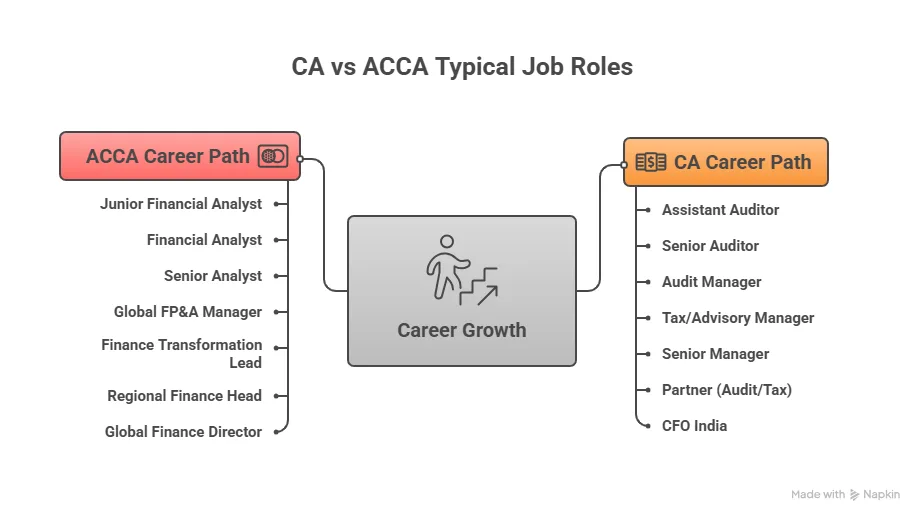
These roles rely heavily on an in-depth understanding of Indian statutes. If your goal is to build a long-term career rooted in India’s regulatory and business environment, these CA ACCA career paths clearly illustrate why CA remains powerful domestically, whereas you can work in 180+ countries with ACCA. The following visualisation shows a few typical CA ACCA job roles:
ACCA Career Landscape in India and Abroad
The ACCA network extends across 180+ countries, with strong demand in global business services, multinational finance teams, and shared service centres. Employers value ACCA members for their IFRS knowledge, business analytics capability, and strategic finance exposure. The following represent the ACCA career opportunities globally:
Typical roles for fresh ACCAs include:
Financial analyst in multinational corporations
GL, AR, AP roles in global shared service centres
Associate roles in FP&A teams
Junior management accountant
Audit and assurance associate (international standards)
Global senior roles ACCA professionals often grow into:
Regional finance manager
Senior FP&A manager (often in the UK, UAE, EU, or SE Asia)
Global process lead in finance transformation
Senior auditor in international audit practices
There is noticeable upward mobility for ACCA professionals in markets where IFRS and cross-border accounting are the norm. If your ambitions include working in international offices or specialised areas such as ESG reporting, ACCA builds the foundation for that path.
CA ACCA Career Paths: Sector-wise Mapping
Banking and Financial Services
In banks and NBFCs, CAs often lead audit, credit risk and regulatory functions. ACCA professionals find strong ground in treasury, analytics and IFRS reporting roles.
Big Four and Consulting
Both CA and ACCA professionals work here, but their roles differ. CAs take on statutory audits, GST advisory and tax practice; ACCAs largely enter assurance, process consulting, IFRS reporting, due diligence and global shared services teams.
Corporate Finance
CAs are trusted for Indian regulatory filings, internal controls, and statutory compliance. ACCAs often handle budgeting, financial modelling, consolidation, and global intercompany reporting.
FMCG, Tech, Manufacturing & Startups
CAs strengthen compliance, internal audit and financial control functions. ACCAs lead FP&A roles, MIS reporting, data-oriented finance work, and multi-country consolidation.
This distinction is crucial when making a CA vs ACCA comparison for long-term planning. Your preferred industry and how globalised it is will influence your best choice.
Understanding CA ACCA Benefits Beyond Exams and Pay
When weighing CA ACCA benefits, most students focus on salary or exam difficulty. But the real value comes from the kind of capital: intellectual, global, regulatory, analytical, that the qualification injects into your career.
Here is a deeper look at the benefits that often get overlooked in competitor blogs.
Benefits of pursuing CA
Deep trust and credibility in India’s corporate ecosystem
Strong demand in traditional sectors like banking, consulting, real estate and manufacturing
Authority to sign audit reports in India
Well-defined progression track for those inclined toward entrepreneurship in audit or tax practice
Strong government and PSU career pathways
Benefits of pursuing ACCA
International recognition across 180+ countries
Strong demand in global business service centres in India (a rapidly expanding sector)
Familiarity with IFRS, financial planning and analytics
Flexibility to study while working full-time
Multi-country employability without needing country-specific recertification in many roles
These CA ACCA benefits influence your journey differently depending on where and how you want to work. A student with aspirations in global finance transformation would lean toward ACCA, while a student who wants to open a tax firm in India would lean toward CA.
Understanding the ROI of Both Qualifications
Instead of simply comparing CA vs ACCA salary, it is helpful to evaluate the return you earn on each year invested in the qualification.
Time Investment
CA: 4 to 5+ years commonly
ACCA: 2 to 3 years on average
Early Payback Window
CA: Students start earning during articleship (stipend) but substantial payback begins post-qualification
ACCA: Many students work full-time while studying, so payback begins earlier
Relative Early Career Pay
CA starting salary trend: INR 7 to 10 lakhs per annum
ACCA starting salary trend: INR 4 to 8 lakhs per annum
Opportunity Cost Difference
Because ACCA completion is quicker for many (with exemptions), the earnings gap over the first 5 years may sometimes narrow more than students realise.
A student who completes ACCA in 2.5 years and works throughout may accumulate more early professional experience than a CA student still in the long exam cycle. Meanwhile, the CA student often overtakes in salary after qualification due to domestic demand. This is why CA vs ACCA salary comparisons depend heavily on the timeline you choose.
Industry Demand Trends for CA vs ACCA
India’s finance ecosystem is evolving. These trends help you understand where each qualification stands.
Global Capability Centres (GCCs)
GCCs such as those built by Deloitte, Standard Chartered, HSBC, Wells Fargo and Amazon have accelerated hiring of ACCA-trained professionals because of IFRS familiarity and global process expertise.
Audit and Tax Practice
CAs remain irreplaceable for statutory audit, GST advisory and specialised Indian compliance services. This is an area where CA retains unmatched authority.
Digital Finance & Analytics
Companies implementing SAP S4/HANA, Oracle Fusion or advanced MIS systems prefer ACCA professionals for FP&A and forecasting roles because they fit more naturally into a data-oriented finance environment.
Regulatory Shifts
With global IFRS convergence and cross-border financial structures, ACCA’s relevance continues to grow. At the same time, increasing Indian regulatory complexity boosts the need for CAs.
Overall industry data shows that hiring trends are not about which qualification is universally superior, but about which one aligns with the sector’s dominant financial framework.
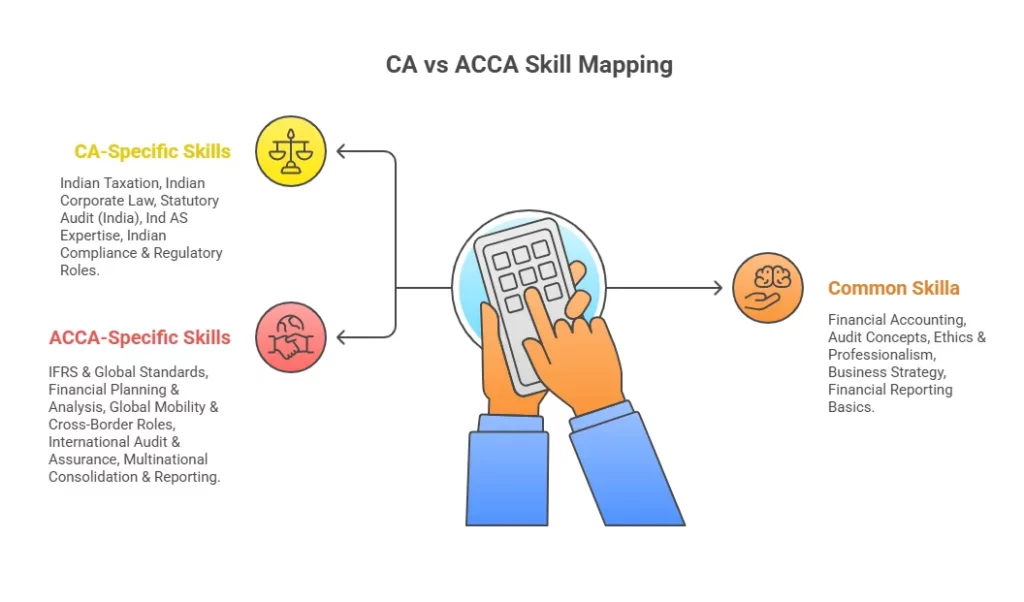
This visual will help you understand the difference between CA and ACCA skills. You can also see what common skills keep both the qualifications aligned:
Here are scenarios Indian students commonly face, along with insight on which qualification suits each:
Scenario 1: You want to build a long-term tax, audit or advisory practice in India. Better suited: CA
Scenario 2: You aim for multinational finance roles or want to work in the UK, UAE, Singapore or EU finance teams. Better suited: ACCA
Scenario 3: You want to pursue finance transformation, FP&A, MIS or financial modelling roles in global capability centres. Better suited: ACCA
Scenario 4: You enjoy deep technical accounting, Indian law, and the challenge of multi-layered audits. Better suited: CA
Scenario 5: You value flexibility and prefer modular global exams rather than a high-pressure, high-stakes Indian exam format. Better suited: ACCA
Scenario 6: You plan to eventually transition into a CFO role in India. Both overlap, but CA has a slight domestic advantage.
Scenario 7: You want international audit exposure rather than Indian audit exposure. Better suited: ACCA
These scenarios help you interpret the CA vs ACCA comparison through everyday decision-making rather than abstract pros and cons. Also, here are some strategic key considerations and questions you can ask yourself if you’re at that juncture of deciding between either of the qualifications.
Where do you want to work: India-based audit/tax practice or global finance in a multinational?
How soon do you want to finish? Are you okay spending 4+ years vs aiming for 2–3 years?
How flexible must your studies be: Can you study while working, or does the route expect full-time study?
How important is global mobility? Do you want to relocate or stay domestic?
What’s your starting salary expectation? Do you prioritise early salary or later global ceiling?
How comfortable are you with difficult pass rates? Are you ready for those odds and investment?
How Recruiters View Each Qualification
A large part of your journey depends on recruiter perception. Understanding employer sentiment provides clarity beyond surface-level comparisons.
What Recruiters Value in CAs
Mastery of Indian corporate, tax and audit laws
Reliability in compliance-heavy roles
Commitment and resilience are reflected in rigorous exam preparation
Fit for audit firms and PSUs
Analytical depth in Indian GAAP and Ind AS
What Recruiters Value in ACCAs
IFRS-driven reporting expertise
Understanding of global processes and enterprise systems
Ability to work in multinational and cross-border environments
Comfort with quarterly exam pacing (signalling continuous learning)
Fit for FP&A, finance transformation, MIS and global reporting roles
Recruiters often place value not on which qualification is “superior”, but on which one aligns with the financial systems their companies use.
Long-Term Growth and Salary Trajectory (beyond early career)
While early salary data is important, strategic candidates think in decades, not months.
CA Long-Term Growth Patterns
Rapid upward salary movement after 2 to 3 years of post-qualification experience
Strong potential for partnership roles in audit/tax
CFO roles in Indian corporations, manufacturing companies, and newly listed firms
Opportunity to build your own practice or consultancy
ACCA Long-Term Growth Patterns
Strong global earning potential
Rapid movement into FP&A management, finance transformation and consolidation roles
Easy cross-border movement across IFRS jurisdictions
Senior roles in global shared service centres and regional headquarters
Your long-term goals matter. For many students deciding between CA vs ACCA salary potential, the ceiling depends heavily on where they want to settle professionally. This video discussed the CA vs ACCA salary prospects at length:
Why Many Students Attempt Both Over Their Career
A rapidly emerging trend in India is dual-qualification professionals: CAs who pursue ACCA for global mobility, and ACCAs who later study Indian taxation or corporate law modules.
Reasons include:
Expanding their global relevance
Accessing both Indian and international opportunities
Building credibility for multi-jurisdictional finance roles
Increasing employability in multinational companies operating in India
This trend shows that CA vs ACCA isn’t always a strict either-or decision.
Deep-Dive Decision Framework: Choosing Between CA vs ACCA With Clarity
Most students don’t struggle because the syllabus is confusing. They struggle because the decision itself is overwhelming. The qualification you choose influences your pace of career acceleration, the kind of teams you end up working with, and the way employers interpret your career potential. So instead of simply evaluating CA vs ACCA salary or ACCA vs CA difficulty, it helps to break this choice into real decision factors.
Below is a structured framework designed from industry experience and conversations with hiring managers in Big Four firms, multinational finance teams and CFO circles. Treat it like a map.
A. Your Learning Style
Structured, high-intensity exam cycles: You may naturally prefer the CA structure, where preparation builds in blocks and each attempt demands deep focus.
Flexible, modular learning with quarterly exam windows: If your learning rhythm works better with modular exams, ACCA may suit you.
B. Your Work Environment Preference
Client-facing audit, taxation and compliance-heavy roles: CA aligns extremely well with this environment.
Team-based global reporting, forecasting, analytics and finance transformation: ACCA professionals thrive in these structures.
C. Your Geographic Aspirations
Building a long-term career rooted in Indian regulations: CA is strongly suited for this track.
Exploring cross-border finance or relocating for global roles: ACCA gives your profile an international advantage.
D. Your Time Horizon
You are willing to invest 4–5+ years for a deep India-focused credential: CA fits this timeline.
You prefer to complete your qualification faster, often within 2–3 years: ACCA offers that pacing, especially with exemptions.
E. Your Long-Term Ambition
Indian corporate leadership or practice ownership: CA builds a powerful foundation for leadership in India.
Senior roles in multinational organisations or global capability centres: ACCA aligns naturally with this trajectory.
FAQs on CA vs ACCA
This section answers the most frequently asked questions students have when comparing CA vs ACCA, covering career growth, salary potential, global opportunities, exam structure, and long-term prospects, so you can make an informed and confident decision.
Can ACCA earn more than CA?
In the CA vs ACCA landscape, earning potential depends heavily on where the professional works. In India, fresh CA salaries typically begin higher because of domestic statutory demand. However, ACCA members often see strong salary acceleration in MNCs, GCCs and international markets where IFRS-based reporting is essential. Over the long term, ACCA professionals working abroad may earn more than CAs working in India. The deciding factor is location, role type and industry rather than the qualification alone.
Is ACCA closing in 2026?
There is no official indication that ACCA is closing in 2026, and the CA vs ACCA comparison remains fully relevant for future cohorts. ACCA continues to expand its footprint in India and globally through partnerships with employers, universities and finance capability centres. If you are planning to begin ACCA now, you can do so with confidence that the qualification will remain globally recognised beyond 2026.
Is ACCA valued in India?
ACCA has gained substantial traction in India’s multinational finance ecosystem. India’s growth in shared service centres, finance transformation hubs, and IFRS-aligned reporting teams has pushed demand for ACCA members upward. Industries such as IT services, consulting, tech product companies, banking and global capability centres now hire ACCA professionals actively.
With structured guidance, exam-specific mentoring and industry-aligned training, Imarticus Learning helps students prepare effectively for ACCA and build the skills required for these fast-growing global finance roles.
Can ACCA convert to CA?
While you cannot directly convert ACCA to CA, your ACCA background helps significantly if you eventually wish to pursue CA. Many subjects overlap conceptually, particularly in accounting, finance and audit. In the CA vs ACCA comparison, CA requires clearing ICAI-specific exams and meeting statutory articleship criteria.
Is ACCA difficult than CA?
The ACCA vs CA difficulty discussion depends on the kind of academic experience a student prefers. CA is known for lower pass rates and a highly concentrated examination structure, making it one of the most rigorous qualifications in India.
ACCA also requires discipline, but its modular exam structure, quarterly exam windows and globally aligned syllabus make it more manageable for many working professionals. Imarticus Learning provides ACCA-focused training that makes navigating the syllabus and exam strategy more efficient and confidence-driven.
What is the 7-year rule for ACCA?
The 7-year rule applies to ACCA’s Strategic Professional exams. Once a student passes their first Strategic Professional paper, they must complete the remaining Strategic Professional exams within seven years. When discussing CA vs ACCA, this rule often surprises students, but it exists to ensure that professionals qualify with current, relevant knowledge.
Can ACCA earn 1 crore?
Yes, ACCA professionals can earn 1 crore or more depending on their role, geography and industry. ACCA members often reach this level in global finance leadership, regional FP&A roles, finance transformation consulting, and multinational management positions, especially in the UK, UAE, Singapore and Europe.
Senior Indian roles in global capability centres also reach this bracket. Achieving this range depends on experience, leadership and role complexity rather than qualification alone.
Can I finish ACCA in 2 years?
Yes, many students complete ACCA in approximately 2 to 2.5 years, especially if they receive exemptions for Applied Knowledge and Applied Skills levels. In the CA vs ACCA comparison, ACCA’s modular structure and quarterly exam availability allow faster completion than CA.
Students who plan their exam timeline, balance work and study effectively, and maintain consistent financial exposure are the ones who typically finish within this window. Imarticus Learning helps students accelerate their ACCA journey and stay on track for a faster qualification timeline.
How much does ACCA cost in total?
In India, the total ACCA cost ranges widely depending on exemptions, study materials and coaching preferences. When compared within the CA vs ACCA cost equation, ACCA is generally higher in direct fees but often faster to complete.
Students typically spend between INR 2.5 to 3.5 lakhs over the full qualification, excluding optional coaching. The return on investment is often positive for students who enter global roles, FP&A teams or international audit pathways.
Can I get ACCA for free?
ACCA is not available for free, and this is an important factor when evaluating CA vs ACCA. However, students can reduce costs through scholarships, partial fee waivers, university affiliations, or employer sponsorships, especially in multinational companies with strong finance learning budgets.
ACCA occasionally offers discounted registration or exam fee campaigns, but the qualification itself still requires paid components such as exams, books and annual subscriptions.
How many exams are in ACCA?
ACCA consists of up to 13 exams across Applied Knowledge, Applied Skills and Strategic Professional levels, although many Indian students receive exemptions for several papers based on prior qualifications. In the CA vs ACCA comparison, ACCA’s modular exam system is often more flexible, and each paper is attempted individually. With exemptions, a student may end up writing as few as 7 to 9 exams.
Is ACCA expensive in India?
Relative to CA, ACCA is considered more expensive in India due to its exam fees, global subscription charges and optional training modules. Within the CA vs ACCA context, students choosing ACCA often weigh the higher upfront cost against faster completion time and international mobility benefits. Many candidates find the cost worthwhile because ACCA opens doors to multinational finance roles and geographic flexibility.
Conclusion: Bridging Your Future With the Right Qualification
Every student has a unique trajectory, even if the question seems universal: Which is better: CA or ACCA?
CA continues to be a powerful route for those who envision their future in India’s statutory, audit and tax ecosystem.
ACCA, on the other hand, aligns more closely with the way finance roles are evolving today: interconnected teams, IFRS-driven reporting, global capability centres, and cross-border mobility.
Students who want their careers to grow beyond geographical boundaries, participate in multinational finance functions, or build expertise that stays relevant in a global economy often find the ACCA pathway naturally expanding their opportunities.
No matter which route you choose, your decision should come from clarity, not confusion. That clarity is what sets strong careers apart.
And if the latter aligns with your aspirations, the ACCA course prep offered by Imarticus Learning has a structured, industry-aligned preparation ecosystem, complete with expert faculty, mentorship, guided study plans and real-world application support, to help you progress confidently from your first exam to global career readiness.
In a changing marketplace, it is crucial to stay relevant for a successful business. Considering this, business analytics can offer valuable insights to a company to beat competitors. When used effectively, it can prove to be a powerful tool for business growth.
Considering the increasing demand for business analytics professionals, one can pursue this lucrative career option by enrolling in a reputable course like IIM Calcutta Senior Management Programme in Business Analytics. Read ahead to learn more about business analytics and how data analytics influences business decisions.
Understanding Business Analytics
Involving a process of collecting, organising, analysing, and interpreting data, business analytics helps gain insights to make informed business decisions. Featuring statistical and quantitative analysis, it can be applied to different aspects of business that include sales, finance, marketing, operations, and customer service. Data analysis of various areas of business can help organisations identify trends, patterns, and correlations to make decisions, optimising their business processes.
Further, business analytics uses data mining, machine learning algorithms, data visualisation and predictive analytics to process and analyse large volumes of data. It helps improve the competitiveness and profitability of businesses in today’s data-driven environment. For instance, analysing customer data can not only help improve customer retention, but also increase sales.
How data analytics influences business decisions? Answering this question, business analytics helps identify opportunities for expansion, make strategic decisions about resource allocation, predict future outcomes and improve overall performance.
Business Analytics Types
The following are some of the most common types of business analytics that businesses use to gain key insights:
Descriptive analytics: Involves analysing historical data
Diagnostic analytics: Includes analysing data to learn why something happened in the past
Prescriptive analytics: Uses data and insights to make decisions about future actions
Predictive analytics: Involves analysing data to make predictions for future
Spatial analytics: Includes analysing geographic data
Text analytics: Involves analysing unstructured data like customer feedback and social media posts
Business Intelligence vs. Data Science
Business intelligence (BI) involves the process of collecting, analysing, and presenting data to support decision-making. It focuses on sharing data summary in the form of reports and dashboards.
On the other hand, data science involves different techniques like statistical analysis, machine learning, and data visualisation to gain insights from data. It typically focuses on analysing large and complex data sets, such as text data, image data, and social media data.
Notably, business analytics and data science are related to using data to extract insights for effective decision-making. But, they differ in their focus and techniques. Also, it is to be noted that though related, business analytics and business intelligence are distinct concepts.
Business Analytics Essentials
The following are some essentials of business analytics:
Here are the reasons for adopting business analytics:
Get insights that help make data-driven decisions to effectively achieve goals, improve efficiency and optimise business operations
Gain a competitive advantage by identifying opportunities and risks
Identify areas for improvement for enhanced performance
Better understanding of customers to meet their needs and increase satisfaction
Mitigate risk by predicting potential outcomes and reducing the odds of negative consequences
Benefits of Business Analytics
The following are the benefits of using business analytics tools:
Eliminate guesswork and reduce potential financial loss
Reveal vulnerabilities in processes and improve security
Optimise customer outreach
Spot risk factors and take preventive measures
Conclusion
In today’s day and age, the business landscape has become data-driven. This makes it essential for managers across different business operations to acquire analytics skills. The valuable insights gained as a result of analysing vast amounts of data can not only help tackle different challenges effectively, but also make informed business decisions, enabling growth.
If you want to elevate your senior leadership game, then pursue the IIM Calcutta Senior Management Programme to scale heights in your career. For further details, please connect with Imarticus Learning.
Debt Capital Markets (DCM) is a dynamic market in which firms, governments, and organisations raise funds by selling debt securities to investors. It promotes large-scale economic growth, investment, and stability.
DCM refers to various financial products, including bonds, loans, and commercial paper serving a specific function. The process entails thorough preparation, review, and coordination among numerous parties, such as investment banks, underwriters, and legal consultants.
Individual and institutional investors alike carefully weigh risk and reward before engaging in DCM activity.
Explore deeper into the world of the Debt capital market in India and learn about its procedures, important stakeholders, regulatory frameworks, and vital role in defining the country’s financial environment.
If you are looking for a career in investment banking or take up an investment banking course, keep reading to learn what is debt capital markets and the varied frameworks of Debt Capital Markets.
What is Debt Capital Markets
The Debt Capital Market (DCM) is a crucial part of the financial market in which companies raise capital by selling debt securities to investors. Bonds, notes, and other fixed-income instruments are examples of debt securities. DCM promotes cash flow from investors seeking to lend money to issuers in need of capital to support their operations or projects, such as firms, governments, and financial institutions.
It issues the terms and conditions of the debt instrument in DCM, including maturity dates, repayment schedules and interest rates. These debt instruments are purchased by institutional investors and mutual funds in exchange for periodic interest payments.
DCM is crucial for the financial ecosystem as well as its importance in banking and finance courses as it allows firms to raise capital for governments to finance public initiatives. It enables investors to analyse and manage risks via debit instruments of various credit grades.
Key Terms for Understanding Debt Capital Markets
While establishing a career in banking and finance and looking for investment banking courses online, aspirants must have an understanding of what is debt capital markets and the key terms for debt capital markets. They are:
1) Bonds
Understanding the complexity of bonds is critical for participants in the debt capital market because it allows them to make informed investment decisions, manage their money effectively, and navigate the financial environment. Bonds are often classified depending on their issuer, credit rating, maturity date, and interest payment arrangements. Bonds can also be purchased and sold on the secondary market, where prices vary depending on market circumstances and investor mood.
2) Fixed Income Markets
Fixed-income markets are an essential component of debt capital markets. These marketplaces make trading various financial securities, such as bonds and treasury bills, possible. Investors buy these securities in exchange for regular interest payments and the return of principle when they mature. Fixed-income markets serve an essential role in funding governments, businesses, and other entities, allowing them to raise cash while providing investors with a stable income stream.
3) Interest Rates
Interest rates are crucial in debt capital markets as they are the agreed-upon interest rates at which borrowers agree to repay their loans over time. These rates are scrutinised by investors because they have a direct impact on the perceived value of debt instruments. Interest rate variations are significantly affected by central banks, economic circumstances, and reliability, making them a crucial driver in the dynamics of debt capital markets.
4) Primary Market
For organisations looking to raise money through debt instruments, the primary market is an essential environment in the overall structure of the debt capital markets. It serves as the initial point of issuance when debtors sell bonds or other debt securities to investors. This stage includes the underwriting and distribution methods that allow organisations to get the necessary money. The ability to navigate the primary market effectively is critical for successful borrowing endeavours
5) Secondary Market
The secondary market acts as a crucial platform for investors to buy and sell pre-existing debt instruments. Investors trade bonds and other debt instruments, resulting in liquidity and price discovery. The characteristics of this market have a substantial impact on the pricing and yield of debt instruments, making it an important component for both issuers and investors in the debt capital markets.
Debt Capital Markets Vs. Equity Capital Markets
While trying to understand what is debt capital markets, one must be clear about knowing the distinctions between debt capital markets and equity capital markets. These two important types of capital markets are two of the primal systems to study in a banking and finance course.
This is one of the primary principles to study in an investment banking course.
Aspects
Debt Capital Markets
Equity Capital Markets
Purpose
To raise capital via debt securities.
To raise capital via equity shares.
Ownership
No requirement for ownership.
Ownership transfer required to shareholders.
Risks to Issuer
Fixed interest payment rates, hence low risks.
No fixed payments, higher risks.
Voting Rights
No voting rights.
Voting rights only for shareholders.
Liquidity
Higher priority.
Lower priority in case of bankruptcy.
Repayment
Periodic interest payments.
No mandatory repayment scheme.
Risk to Investors
Lower risks and predictable returns.
Higher risks for potential dividends.
Returns
Fixed payment rates on interest.
Dividends and capital gains.
Regulatory Environment
They are regulated by government agencies.
It is regulated by both government and stock exchange agencies.
Exist Strategy
Flexible for exit.
Flexible exit only through stock trading.
Debt Capital Market in India
Let’s discuss about the role of the debt capital market in India’s economy. DCM plays a crucial role in the financial environment of India. Financial institutions like SEBI and RBI raise capital through debt securities, contributing to a substantial expansion of DCM over the years.
DCM provides a variety of investment options, including corporate, municipal and government bonds, resulting in transparency and accessibility among investors. This has further improved as a consequence of regulatory reforms and the development of electronic trading platforms. Furthermore, credit rating companies offer beneficial assessments of debt issuers, allowing for informed investment decisions.
Mutual funds, insurance firms, and individual investors seeking consistent returns and portfolio diversification are among those who invest in the debt capital market in India. The growth of the DCM illustrates India’s commitment to nurturing a vibrant financial ecosystem while serving the financial demands of its expanding economy. Conclusion Debt money Markets (DCM) are a significant financial platform for funding money via debt securities. DCM plays an important role in global finance, offering stability and opportunity for both issuers and investors, thanks to its extensive variety of products and expanding investor interest.
Check out Imarticus Learning’s Certified Investment Banking Operations Professional course or CIBOP course to learn what is debt capital markets and build your career in investment banking with 100% job assurance. You can have 0-3 years of work experience to take up this investment banking course. This banking and finance course will upscale you and place you in big companies.
The process of planning and executing a project is a world in itself. Here, ideas transform into reality with the support of investment. There’s a cost attached to every step of execution. Even the most carefully planned projects face problems during this stage. This is when risk management comes into the picture. It wouldn’t be an understatement to call it a factor responsible for the success of any project.
You are expected to foresee pitfalls and prepare strategies to navigate them. Especially to establish a career in investment banking, you must have a solid understanding of this concept. Keep reading to explore the importance of risk management and the complex world of project planning.
What is risk management?
Innovation, business ventures or financial undertakings have in-built risks. If left unattended, these risks can waste resources. They can also derail the project’s progress. Here’s when risk management saves the day!
Risk management is a systematic process. Through it, you can identify, analyse, and control potential risks to the project. By implementing effective risk management practices, organisations can navigate challenges. Also, they can increase their chances of achieving their goals. Thus, understanding the importance of risk management is crucial for ensuring the success and sustainability of any venture.
Performing risk management involves the following steps.
Assess the likelihood and impact of risks.
Develop strategies to mitigate risks.
Track the effectiveness of these strategies.
What is theimportance of risk management?
Prima facie, risk management helps in anticipating potential risks. During the planning phase, you must assess probable risks. By working on this, you can avoid potential failures and costly delays.
Keep reading to explore other benefits offered by risk management.
Decision-making process: As you can see, risk management carries a structured approach. This arrangement improves your decision-making capability. It gives you the knowledge to deal with uncertainties that obstruct the success of your project. By managing risks, companies make better decisions. They are also prepared to look for alternative solutions while optimising project timelines.
Team confidence: Another benefit of this process concerns the team. When there is a backup plan for things that might not go as expected, it helps the team stay positive and happy. In a positive environment, your subordinates will perform in a good mood. This will help in completing the project within the deadline.
Investment protection: Another importance of risk management lies in protecting investments. It prepares the project for success. This not only preserves the project’s integrity but also safeguards the reputation of the stakeholders involved. For any given project, stakeholders can be clients, regulatory bodies, employees, and investors.
Risk management reduces uncertainties in your project. Thus, it ensures success. With this, you can enhance transparency and build stronger relationships with stakeholders. You can do this by considering their concerns during the risk assessment.
Improving communication: Any strong risk management framework depends on communication between departments. In the initial stage, you will need inputs from different departments. This will help you understand the project’s complexities. Moving on, this cooperation helps in clarifying roles, dividing responsibilities, and enhancing the coordination of the overall project.
How to perform risk management?
Begin by performing risk identification. Once that is done, start assessing its probable impact. It is important to know the likelihood of these risks occurring. The next step is to collaborate with stakeholders. Implement one or more mitigation strategies from the following.
Process changes
Contractual arrangements
Resource allocation
Insurance contracts
Contingency plans
You must regularly monitor risks and control them. As a last step, maintain documentation of risks, their assessments and mitigation plans.
Start a career in investment banking
Risk management is a structured process. It identifies, assesses, and mitigates risks that carry the potential to derail a project from its objectives. Through this process, you can ensure the efficient utilisation of resources and protect your investment from failure. Learn more about the importance of risk management with our industry-recognised certification.
Imarticus Learning is a leading educational platform that offers investment banking courses with job-specific curricula. Explore our Certified Investment Banking Operations Professional program for your career growth in the world of investment banking!
Cybersecurity is a term you hear often, but what does it really mean, and more importantly, what does cybersecurity protect?
In a recent KPMG survey of 500 CEOs, 18% said that cybersecurity risks would be the biggest threat to their company’s growth. This is an increase from 10% last year. Whether you’re a business owner, a student, or just someone using the internet, understanding cybersecurity is essential.
Let’s dive into the various aspects of cybersecurity, why it’s crucial, and how it shields our digital world.
What is Cyber security?
Cybersecurity is the term encompassing the procedures and tools used to defend networks, systems, and data against cyberattacks, which can take many different forms, from hacking attempts to data breaches and other cyber threats. Essentially, cybersecurity is the digital shield that guards against unauthorized access and damage to your digital assets.
Cyber security involves using technology, strategies, and practices to prevent or lessen the impact of cyberattacks. It aims to protect individuals and organizations’ systems, applications, devices, sensitive data, and financial assets from threats like viruses and costly ransomware attacks.
Cyberattacks can disrupt, damage, or destroy businesses, with the costs to victims continually increasing. These trends offer significant business benefits and human progress but also create more opportunities for cybercriminals to exploit.
Security teams, often stretched thin, are focusing on developing comprehensive cybersecurity strategies using advanced analytics, artificial intelligence, and automation to combat cyber threats more effectively and reduce the impact of cyberattacks.
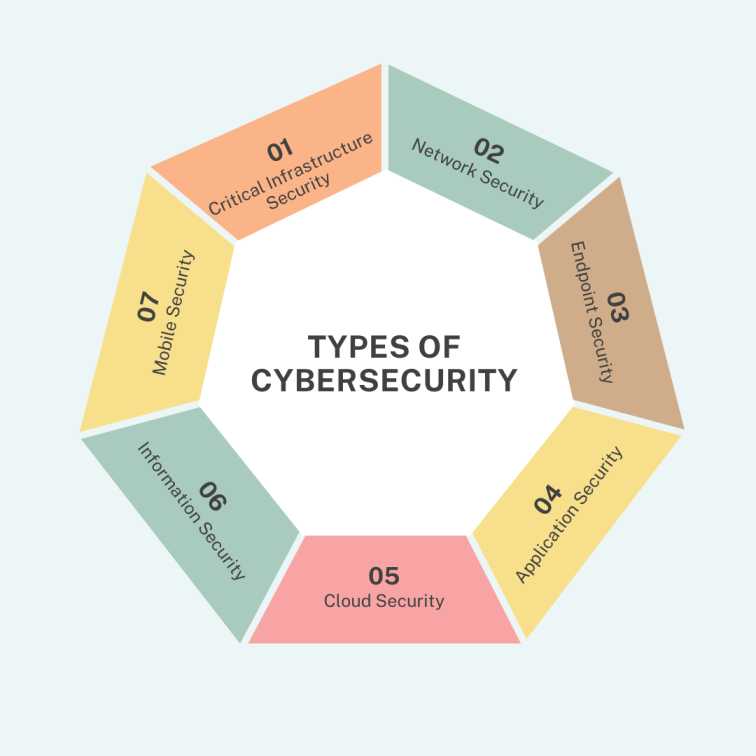
Types of Cybersecurity (Cybersecurity Domains)
A strong cybersecurity strategy protects all parts of your IT setup against cyber threats and cybercrime. Here are the main areas it covers:
Critical Infrastructure Security
This protects the essential computer systems, applications, networks, and data that society relies on for national security, economic health, and public safety. In the U.S., the National Institute of Standards & Technology has created a cybersecurity framework to guide IT providers. The Cybersecurity and Infrastructure Security Agency also offers additional guidance.
Network Security
Network security stops unauthorized access to network resources and detects and prevents cyberattacks. It also ensures that authorized users can access the resources they need securely and quickly.
Endpoint Security
Endpoints like servers, desktops, laptops, and mobile devices are common entry points for cyberattacks. Endpoint security protects these devices & their users from attacks and also safeguards the network from threats originating from these endpoints.
Application Security
Application security protects programs running both on-premises and in the cloud. It prevents unauthorized access to applications and their data and also stops hackers from exploiting design flaws. Modern development practices like DevOps and DevSecOps include security measures from the start of the development process.
Cloud Security
Cloud security protects an organization’s cloud-based services and assets, such as applications, data, storage, and virtual servers. Cloud security follows a shared responsibility model: the cloud provider secures the services and infrastructure, while the customer protects their data and other assets in the cloud. The specifics can vary depending on the cloud services used.
Information Security
Information security involves protecting all important information—whether digital files, paper documents, physical media, or even spoken words—from unauthorized access, use, or changes. Data security, which focuses on protecting digital information, is a key part of InfoSec and the main focus of cybersecurity efforts.
Mobile Security
Mobile security includes various technologies and practices to protect smartphones and mobile devices. This can include mobile application management (MAM) and enterprise mobility management (EMM). Recently, mobile security is often part of unified endpoint management (UEM) solutions, which manage and secure multiple devices (mobile, desktops, laptops) from a single platform.
What Does Cybersecurity Protect?
Now, let’s delve into the core question: what does cybersecurity protect?
Here are the main areas cybersecurity aims to safeguard:
Personal Data
Personal data includes any information that can identify you as an individual, such as your name, address, Social Security number, or financial details. Cybersecurity measures protect this sensitive information from being accessed, stolen, or misused by malicious actors.
Financial Information
Financial data, including credit card numbers, bank account details, and transaction records, are prime targets for cybercriminals. Cybersecurity helps protect this information from being stolen, ensuring that your finances remain secure.
Intellectual Property
Protecting intellectual property such as patents, trade secrets, & proprietary information is crucial. Cybersecurity measures prevent competitors and hackers from accessing and exploiting this valuable information.
Operational Data
This includes any data related to the day-to-day operations of a business, such as client lists, supply chain information, and internal communications. Cybersecurity ensures that these operations run smoothly without interruptions from cyber attacks.
Government and Military Information
National security depends heavily on cybersecurity to protect sensitive government and military information. Unauthorized access to this data could have difficult consequences for a country’s safety and stability.
What are the Common Cyber Threats?
Understanding what cyber security protects also involves knowing the types of threats it guards against. Here are some common cyber threats:
Malware
Malware, or malicious software, includes viruses, worms, trojans, and spyware. These malicious programs can steal, encrypt, or delete sensitive data, disrupt operations, and more.
Phishing
Phishing attacks utilize deceptive emails, texts, or websites to deceive people into divulging private information like credit card numbers, usernames, or passwords.
Ransomware
A type of malware that encrypts a victim’s data and demands payment (ransom) for the decryption key. This can cause significant disruptions and financial loss.
Denial of Service (DoS) Attacks
DoS attacks aim to overwhelm a system, server, or network, rendering it unavailable to users. This can severely impact business operations and services.
Analysts specializing in cybersecurity are essential in defending companies from online attacks. They assess security concerns, keep an eye out for network breaches, and create plans to fend off cyberattacks.
The Final Words
In a period where digital threats loom large, cybersecurity stands as the frontline defender of our personal and professional lives. By safeguarding personal data, financial information, intellectual property, and critical infrastructure, cybersecurity ensures the smooth functioning of our interconnected world.
As cyber threats evolve, staying informed and vigilant is crucial. By understanding and implementing robust cybersecurity measures, we can protect our digital assets and contribute to a safer digital landscape for everyone.
Advanced Certificate In Cybersecurity & Blockchain With E&ICT Academy IIT Guwahati
Imarticus Learning, in collaboration with E&ICT Academy IIT Guwahati, offers an Advanced Certificate in Cybersecurity and Blockchain. This cyber security analyst coursedelves into the dynamic worlds of cybersecurity, cryptography, and blockchain, mirroring industry practices. The curriculum is your roadmap to mastering critical skills & preparing you for a secure and innovative future.
A cyber security analyst course is designed to equip individuals with the knowledge & skills needed to identify, prevent, and respond to cyber threats. These courses cover various topics, including network security, ethical hacking, cryptography, and risk management. By taking such a course, individuals can prepare for a career in the growing field of cybersecurity.
The curriculum developed by IIT Guwahati professors and industry experts concentrates on networking principles, ethical hacking, vulnerability analysis, blockchain, and general network security. Participate in immersive, hands-on lab sessions & learn to utilize tools such as VMware, Kali OS, Wireshark, Nessus, Nmap, and more. This practical experience demonstrates your proficiency in cybersecurity techniques and methodologies.
Take the next step in your cybersecurity career with Imarticus Learning’s Advanced Certificate in Cybersecurity and Blockchain. Arm yourself with the know-how to defend against online attacks, utilize encryption to secure data, and discover how blockchain is revolutionizing a number of industries.
Enrol now and secure your future in the dynamic world of cybersecurity!
In today’s business environment, the role of senior management is more critical than ever. Understanding what senior management is and how it influences organizational success can provide valuable insights for both aspiring leaders and established executives. This blog will delve into the significance of senior management, detailing their roles, responsibilities, and how they drive organizational success.
What is Senior Management?
Senior management refers to the top tier of an organization’s hierarchy. These are the high-level executives and leaders responsible for making strategic decisions & guiding the overall direction of the company. Senior managers typically include roles such as the CEO, CFO, COO, and other top executives. Their primary focus is on long-term planning and setting the strategic vision for the organization.
The Importance of Senior Management Roles
As businesses grow quickly, they can become chaotic if not properly managed. Senior management professionals are crucial in these situations because they oversee all areas of the business and plan for the future. Their main job is to handle this chaos and provide the leadership needed for the company to succeed.
Senior managers also have a key leadership role, improving their expertise in specific areas and guiding the organization. These roles and responsibilities depend on the company’s size, goals, strategy, budget, and the manager’s experience.
Senior manager face many challenges because their roles are constantly changing. One major challenge is generating enough revenue, as they make the most important management decisions. They must also focus on improving company performance, setting long-term goals, and effectively managing teams.
Their responsibilities include overseeing each department, planning for the future, and keeping communication strong with the team. Balancing these tasks can be tough, and there’s always pressure to perform well.
Skills Needed for Senior Management
To be a successful senior manager, a variety of skills are necessary. You need a deep understanding of your industry and strong business knowledge to run day-to-day operations effectively. Good business management skills and relevant experience are also important for growth.
Senior managers must have exceptional leadership abilities to guide their teams and inspire others by setting a good example. Being well-organized and managing time and resources efficiently helps in handling the complexities of the role. Delegation is key, and being a team player promotes a positive work environment.
Senior managers also need strong decision-making, problem-solving, and analytical skills to handle high-pressure situations. Good communication is essential, as they interact with different parts of the business and stakeholders. Mentoring skills are also important for guiding younger professionals and helping them grow.
Senior Management Roles and Responsibilities
Understanding senior management roles and responsibilities is crucial for appreciating their impact on organizational success.
Let’s break down some of these key responsibilities:
Strategic Planning and Vision Setting
One of the responsibilities of senior management is to set the strategic vision and long-term goals for the organization. This involves identifying market opportunities, forecasting future trends, and formulating strategies to achieve organizational objectives. Senior managers work closely with other departments to ensure that the company’s vision is aligned with its operational activities.
Decision-Making
Senior management is tasked with making high-stakes decisions that can affect the entire organization. These decisions often involve substantial investments, mergers and acquisitions, and strategic shifts. Effective decision-making requires a deep understanding of the market, financial insight, and the ability to anticipate potential risks and benefits.
Resource Allocation
Allocating resources efficiently is another critical responsibility of senior management. This includes managing budgets, investing in new technologies, and ensuring that human resources are utilized effectively. Proper resource allocation helps the organization achieve its goals while maintaining financial stability.
Leadership and Team Management
Senior managers are responsible for leading and motivating their teams. They set the tone for organizational culture and work environment, and their leadership style can significantly impact employee engagement and productivity. By fostering a positive work environment, senior managers can drive team performance and ensure that the organization operates smoothly.
Stakeholder Communication
Effective communication with stakeholders, including investors, customers, and employees, is essential. Senior management must ensure that stakeholders are informed about the company’s performance, strategic initiatives, and any significant changes. Transparent communication helps build trust and maintains positive relationships with all parties involved.
Why Senior Management is Essential for Organizational Success?
Senior management plays a key role in shaping an organization’s future and ensuring its success. Here’s why their role is so critical:
Direction and Strategy
Senior management sets the strategic direction of the company, which provides a roadmap for all other departments. Without a clear strategy, an organization can lack focus & direction, leading to inefficiencies and missed opportunities.
Crisis Management
During times of crisis, senior management is responsible for making quick decisions to navigate the company through challenging situations. Their experience and leadership are crucial for managing risks and mitigating potential damage to the organization.
Innovation and Growth
Senior managers drive innovation by fostering a culture of creativity and encouraging new ideas. They invest in research and development, explore new markets, and seek out growth opportunities. Their capability to adapt to changing market conditions is vital for sustaining long-term success.
Organizational Culture
The culture of an organization is often shaped by its senior management. Leaders who prioritize a positive work environment and employee well-being can enhance job satisfaction and retention. A strong organizational culture contributes to overall productivity and success.
Performance Measurement
Senior management is responsible for monitoring and evaluating the organization’s performance. By setting key performance indicators (KPIs) & analyzing performance data, they can also identify areas for improvement and make necessary adjustments to achieve organizational goals.
Senior Manager vs. Senior Management
While “senior management” refers to the entire group of top executives, a “senior manager” is an individual within this group. Senior managers typically oversee specific departments or functions, such as finance, marketing, or operations. They play a crucial role in executing the strategic plans set by the broader senior management team and ensuring that their department’s goals align with the company’s overall objectives.
The Final Words
For those looking to advance in their careers, a Senior Management course can provide valuable insights and skills. These courses are designed to equip senior executives with the tools and knowledge needed to excel in their roles. They cover a range of topics, including strategic management, leadership, and decision-making, helping participants enhance their capabilities and drive organizational success.
Imarticus Learning: The Senior Management Programme in Business Analytics
To stay competitive in today’s data-driven world, senior managers need advanced skills in business analytics. The Senior Management Programme in Business Analytics by Imarticus Learning offers a comprehensive solution for experienced executives.
The program covers all four types of analytics—descriptive, diagnostic, predictive, and prescriptive—empowering senior managers to make informed decisions based on data. Participants will engage in six real-world AI projects across various domains, such as healthcare, operations, marketing, and finance, gaining practical experience in applying analytics to real business scenarios.
Attending the Senior Management Programme in Business Analytics will provide you with the knowledge and abilities to use data to inform strategic choices, allocate resources as efficiently as possible, and spur creativity. The goal of this program is to give senior managers the know-how they need to expand sustainably and obtain a competitive advantage in the fast-paced business world of today.
Ready to enhance your analytical skills and drive organizational success?
Explore the Senior Management Programme in Business Analytics at Imarticus Learning and unlock new opportunities for growth!
In today’s fast-paced world, businesses need to stay ahead of the curve to remain competitive. One way to achieve this is by understanding artificial intelligence in finance. The application of Artificial Intelligence in finance is changing the industry, offering innovative solutions and significant benefits to businesses of all sizes.
According to the McKinsey Global Institute (MGI), generative AI adds between $200 billion & $340 billion in value annually to the global banking sector. This represents an increase of 2.8% to 4.7% of total industry revenues, primarily driven by enhanced productivity. This post explores the various ways AI in finance is being used, the benefits it brings, and how businesses can harness its potential.
Understanding Artificial Intelligence in Finance
Artificial intelligence examines the model of human intelligence in machines that are programmed to think & learn like humans. In finance, AI is used to analyze data, predict trends, automate processes, and make more informed decisions. By utilizing AI, financial institutions can enhance their services, improve efficiency, and deliver better customer experiences.
The journey of AI in fintech is a story of continuous integration and transformative impact. From its early stages to becoming a key element of financial technology, AI has significantly changed the way financial services operate.
Historical Perspective: From Traditional Banking to AI-Driven Solutions
The advent of fintech marked a shift from traditional banking methods to more digitalized solutions. However, the introduction of AI has accelerated this transformation, ushering in a new era of intelligent financial services.
Initially, AI in fintech focused on automating routine tasks. Over time, its role expanded to include more complex functions such as fraud detection, customer service, and financial advisory, driven by advancements in machine learning and data analytics.
Key Applications of AI in Finance
Fraud Detection and Prevention
One of the most critical applications of AI in finance is fraud detection and prevention. AI systems can easily analyze large volumes of transactions in real time, identifying patterns and anomalies that may indicate fraudulent activity. This also allows financial institutions to detect and prevent fraud more effectively, protecting both the business and its customers.
Algorithmic Trading
AI algorithms can process vast data faster than any human, making them ideal for trading. Algorithmic trading uses AI to analyze market data and execute trades at optimal times, maximizing profits and minimizing risks. This application has revolutionized the trading industry, providing traders with a significant competitive edge.
Credit Scoring and Risk Management
AI is transforming credit scoring by providing more accurate and comprehensive assessments of borrowers. Traditional credit scoring methods rely on limited data points, but AI can analyze a broader range of data, including social media activity and transaction history. This results in more accurate credit scores and better risk management.
Personalized Banking
AI enables banks to offer personalized services to their customers. By analyzing customer data, AI can provide tailored financial advice, product recommendations, and customer service. This approach enhances the customer experience and builds stronger relationships between banks and their clients.
Regulatory Compliance
Financial institutions must comply with numerous regulations, which can be complex and time-consuming. AI can streamline compliance processes by automating tasks such as data collection, reporting, and monitoring. This also reduces the burden on compliance teams and ensures that institutions remain compliant with the latest regulations.
Benefits of AI in Finance
Improved Efficiency
AI can automate routine tasks, freeing up employees to focus on more strategic activities. This improves efficiency and productivity, allowing financial institutions to operate more effectively.
Enhanced Decision-Making
AI provides financial institutions with deeper insights and more accurate data analysis, enabling better decision-making. Businesses can also make informed decisions that drive growth and profitability.
Cost Reduction
By automating processes and improving efficiency, AI helps financial institutions reduce costs. This includes reducing operational costs, minimizing fraud losses, and optimizing resource allocation.
Competitive Advantage
Adopting AI provides financial institutions with a significant competitive advantage. By staying ahead of technological trends, businesses can easily differentiate themselves from competitors and attract more customers.
Future Trends in AI and Finance
As AI technology continues to evolve, more financial institutions will adopt AI to enhance their operations and services. This will also lead to increased competition & innovation in the industry. AI will enable financial institutions to perform more advanced data analytics, providing deeper insights and more accurate predictions. This will drive better decision-making and more personalized services.
AI and blockchain technology can work together to provide more secure and transparent financial transactions. This integration will enhance trust and reduce fraud in the financial industry.
The Final Words
As the finance industry continues to embrace artificial intelligence, the opportunities for innovation and improvement are limitless. Financial institutions can not only enhance their efficiency and decision-making but also provide a superior customer experience. The integration of AI with other emerging technologies like blockchain promises to revolutionize the sector further, offering more secure and transparent transactions.
Early adopters of AI will be well-positioned to stay ahead of the curve and also benefit from lower costs, more productivity, and a considerable competitive advantage. Artificial intelligence (AI) is a crucial tool for companies hoping to succeed in the current financial landscape as it continues to advance and have an increasing impact on the finance industry. AI is not just a fad in finance; it is a revolutionary force that is changing the sector. Through comprehending and utilizing AI’s potential, companies can open up new avenues for growth and success over the long haul. In order to set the stage for a more intelligent and effective financial future, it is now appropriate to investigate and invest in AI solutions.
Discover Your Potential: Chief Finance Officer Specialisation Certificate
Through IIM Lucknow’s Global Senior Leadership Program, the Chief Financial Officer Specialization Certificate helps aspirational business executives obtain the coveted C-Suite position in finance. It gives prospective CFOs the tools they need to develop creative financial plans, overcome challenges, make wise choices, and inspire great performance. With the help of this CFO certification, you can enter a world that will change for the better and rise to the position of CFO with unwavering competence and confidence. Participants in this leadership training gain an insider’s understanding of the CFO’s daily activities. It provides a thorough explanation of the tactical and strategic facets of the Chief Financial Officer position. The experiential learning component of this CFO specialization is its best feature. Take advantage of secure environments to put your acquired knowledge to use by taking part in realistic simulations provided by Imarticus Game Studio, which helps tackle genuine issues and develop capabilities as a C-Suite Business Leader.
Participants in this CFO certification enjoy the entire spectrum of advantages available to IIM Lucknow Executive Education Alumni. These benefits include alumni updates, access to events both on and off campus, involvement in local alumni chapters, and the distinguished distinction of being executive alumni of IIM Lucknow. A high-end, two-day conference in Dubai is part of this program. Aspiring CFOs must take advantage of this opportunity to network with experts in the finance industry and gain insights into developing trends, best practices, and industry standards.
Are you ready to transform your career and become a leader in the finance industry? Enroll in the Chief Finance Officer Specialisation Certificate at IIM Lucknow’s Global Senior Leadership Programme (GSLP) through Imarticus Learning today. Equip yourself with the skills and knowledge to drive exceptional performance and achieve your career aspirations.
Become a CFO-Ready Leader with Imarticus Learning!
Risk management skills involve identifying, assessing, and controlling risks arising from operational activities and business processes. It aims to protect an organisation’s capital and earnings by minimising potential losses.
And why not? Every organisation wants to protect its bottom line and safeguard its future. This article will explore 10 steps to solidify your risk management skills.
1. Understand Risk management
Developing a clear understanding of what is risk management is crucial. This means understanding the different risk types and the various methods to mitigate or manage these risks.
Once you understand the basics well, acquiring risk management skills and practising this knowledge is essential.
Your business is prone to many risks, but some of the most common include the following:
Operational risks include supply chain disruptions, data breaches, and natural disasters. Financial risks include market volatility, interest rate changes, and credit risks. Compliance risks include things like regulatory changes and data breaches. Reputational risks include things like negative publicity and customer churn. Identifying risks that affect your business and taking measures to mitigate them can help protect your business from potential losses.
3. Understand How to Measure and Assess Risk
Identifying the factors contributing to risk in your specific industry or field is important. After recognising these factors, you must create a system for measuring their impact. This may involve setting up processes and procedures to mitigate potential risks, or it may simply be a case of increasing your awareness of them.
Once you have a way to measure risk, assess it by looking at all the factors contributing to the risk and making an informed decision about managing it.
4. Develop a Risk Management Plan
Use your risk management skills to develop a risk management plan that involves identifying and analysing each risk’s potential impact. You can only develop strategies for mitigating or eliminating each risk when you’re aware of it. Top investment banking certification programs can teach you how to develop an effective risk management plan.
5. Implement the Risk Management Plan
Implementing the risk management plan will ensure that your plan is effective and that potential risks are minimised.
To implement your plan, you’ll need to:
Assign responsibility for each risk.
Develop policies and procedures for managing risks.
Train employees on the policies and procedures.
Monitor risks on an ongoing basis.
Adjust the plan as needed based on changes in the business or environment.
6. Monitor and Review Risk Management Processes
You can follow these simple steps to monitor risk management processes effectively:
Stay current on changes in the business world that could affect your risks.
Ensure that you clearly understand all the risks associated with your business.
Have a plan for dealing with risks, and ensure all employees are aware of it.
7. Customise Risk Management Plan
Regularly reviewing and updating your risk management plan ensures that it remains relevant and effective.
Understand your business goals and objectives. What are you trying to achieve?
Identify the risks associated with achieving those goals. What could go wrong?
Evaluate the likelihood and impact of each risk. How likely is it to happen, and what are its consequences?
Develop strategies for dealing with each risk.
8. Communicate the Plan to all Stakeholders
Communicating the risk management plan to all stakeholders is important.
You need to define what the risks are and how they need to be managed. This information needs to be communicated to all stakeholders for feedback.
You must make adjustments before implementing the plan and reviewing the results based on the suggestions.
9. Train Employees
A good risk management plan will help to protect your business from potential legal liabilities and financial losses.
Some steps that you can take to train your employees include:
Providing them with a copy of your risk management policy.
Conducting regular training sessions on proper risk management procedures and following up.
Keeping employees up-to-date on any policy changes.
10. Audit your Risk Management System Regularly
By regularly auditing your risk management system, you can identify weaknesses and take steps to improve your risk management skills.
To evaluate the effectiveness of your risk management plan, consider how well it has helped you to identify and understand risks and put in place controls to manage them.
Conclusion
Risk management skills are critical for any business professional.
Understanding what is risk management and following the ten steps outlined in this article can solidify your risk management skills and help your organisation avoid costly mistakes.
Imarticus Learning’s Investment Banking Certification program will provide the skill sets necessary for you to gain an advantage in the investment banking field.
You can find out more about this Investment Banking Course online or by visiting their training centers in Mumbai, Thane, Pune, Chennai, Bengaluru, Delhi, Gurgaon, and Ahmedabad, or by contacting us via chat.