Top 10 Emerging FinTech Trends to Watch in 2025

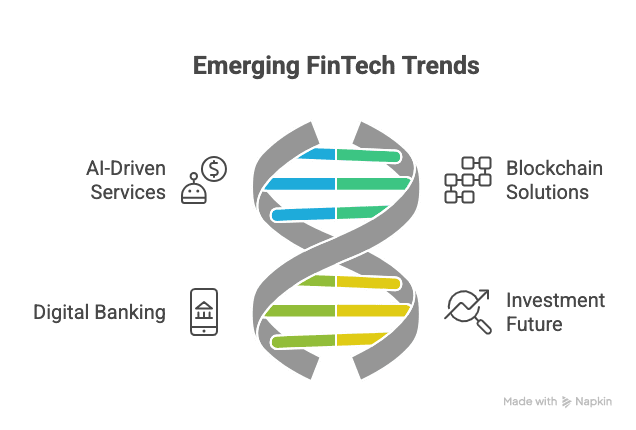
The world of financial technology is developing at the speed of electricity, and if you blink the eyelid, you can simply miss the next large innovation. As we step in 2025, the pace of change in fintech is only intensifying, how we interact with banks, investment, transactions and money. From AI-operated financial services to blockchain-driven solutions, the future of finance is more clever, sharp and more accessible than ever.

Whether you are a technical enthusiast, a finance professional, or just one is curious about how your daily financial life is changing – it is necessary to understand these emerging fintech trends. So, let’s dive into the top 10 developments that shape digital banking, investment future & beyond in 2025.

Financial technology

Table of Contents

  • AI in Financial Technology Redefines Banking
  • Blockchain in Financial Services Goes Mainstream
  • Rise of Embedded Finance and Invisible Banking
  • Open Banking Goes Global
  • Digital Banking Future: Hyper-Personalisation
  • Cybersecurity Technologies Secure Fintech
  • Fintech Innovations 2025: DeFi Becomes Popular
  • Real-Time Payment Transforms Transactions
  • Green Fintech and Sustainable Finance Take Off
  • RegTech: Using Technology to Simplify Compliance
  • Key Takeaways
  • FAQs
  • Conclusion

AI in Financial Technology Reshapes Banking

Artificial Intelligence is not longer science fiction -it’s become reality that is now transforming financial technology industries. AI transforms industry operations by enhancing efficiency and security while improving decision-making processes through its capabilities in real-time fraud detection and automated customer support. 

The year 2025 will witness AI-driven fintech systems controlling services ranging from robo-advisors to tailored banking solutions. 

AI Applications in Fintech (2025)

Application AreaImpact
Fraud DetectionReal-time anomaly detection and prevention
Chatbots & Virtual Assistants24/7 personalised customer service
Credit Risk AnalysisImproved loan decisions using AI models
Investment AdviceRobo-advisors offering tailored portfolios

Blockchain in Financial Services Goes Mainstream

Blockchain technology has long been associated with cryptocurrencies yet its actual capabilities in financial technology reach well beyond Bitcoin and Ethereum. The year 2025 will witness blockchain technology becoming an essential component of financial services to deliver secure, transparent, and efficient transactions. 

Financial institutions experience operational transformation through complex interactions of smart contracts with decentralised finance systems and blockchain-based identity verification technologies. Governments and international banks are embracing blockchain for cross-border payments, settlement, and fraud avoidance.

Long-Term Benefits of Blockchain in Financial Services:

  • Improved speed and transparency of transactions
  • Lower costs for cross-border transactions
  • Improved security and data integrity
  • Automation of lending and investing using smart contracts
  • KYC and identity management with blockchain

Emergence of Embedded Finance and Invisible Banking

Picture purchasing groceries, hailing rides, or taking out loans—albeit in your favorite apps—without ever going to a bank website. This is the beauty of embedded finance, which one of the most viable fintech trends to watch in 2025.

Embedded finance brings financial technology together in non-financial platforms, making banking services an imperceptible and seamless process for the user. That movement is rapidly transforming e-commerce apps, ride-hailing, and even social media pages.

Examples of Embedded Finance in 2025:

  • In-app Buy Now, Pay Later (BNPL) facilities
  • Digital wallets within ride-sharing apps
  • Micro-insurance products offered as add-ons with purchases
  • Investment facilities within e-commerce platforms

Open Banking Goes Global

Open banking is continuously acquiring land, and in 2025, it is ready to become a global criteria. This movement allows consumers to safely share their financial data with third -party providers, unlocking more competitive and individual services.

The combination of financial technology and open API is promoting innovation in borrowing, payment and budget applications. One of the hallmarks of the future of digital banking, it enables consumers to gain control of their financial information.

How Open Banking Is Good for Consumers:

  • Improved loan and credit opportunities
  • Consolidated financial views across accounts
  • Smooth changing of financial providers
  • Competitive pressure for innovation

Explore more on open banking advancements

Future of Digital Banking: Hyper-Personalisation

Generic banking experiences are becoming increasingly obsolete. Thanks to AI and Big Data, the future of digital banking is all about hyper-personalization-about each individual customer analog products, services and experiences.

In 2025, banks and fintech will take advantage of the future analysis to estimate the needs of customers and give relevant solutions in real time. From customised savings plans to bespoke credit offers, or proactive financial guidance, banking will be more human than ever.

Hyper-Personalisation in Action:

  • AI-powered financial advice
  • Personalised loans and credit offers
  • Personalised budget and savings tools
  • Real-time spending alerts

Cybersecurity Solutions Protect Fintech

With fast expansion in financial technology comes heightened vulnerability to cyber-attacks. As more finance goes online, protecting valuable financial information is essential. Luckily, cybersecurity is keeping up with the menace.

In 2025, expect to see biometric authentication, advanced encryption, and AI-powered threat detection become standard across fintech platforms. Security isn’t just a priority—it’s a competitive differentiator.

Key Cybersecurity Trends in Fintech:

  • Biometric authentication (facial recognition, fingerprints)
  • Behavioural biometrics for fraud prevention
  • AI-based threat detection and response
  • Decentralised identity management

Fintech Innovations 2025: DeFi Gains Traction

Decentralized Finance (Defi) has been one of the most disruptive Fintech innovations. 2025 will be witnesses. By removing middlemen such as banks and brokers, DEFI allows users to borrow, lend, trade and earn interest through blockchain-based protocols.

While DEFI faced regulatory obstacles in its early days, 2025 is likely to look at more mature, safe and widely adopted decentralized platforms. This could democratise access to global financial services.

Why DeFi is Transforming Finance:

  • Peer-to-peer lending without the need for intermediaries
  • Decentralized exchanges for asset trading
  • Stablecoins for low-cost, borderless transactions
  • Yield farming and staking for passive income

Real-Time Payments Revolutionize Transactions

Instant gratification has become a norm in finance. Real-time payments-dissemination of immediate money between payments and businesses-a new standard in financial technology.

In 2025, the real -time payment will be extended globally, which will be inspired by the progress in consumer demand, regulatory support and payment infrastructure. This will again apply how we transact, from everyday purchase to large corporate transfer.

Benefits of Real-Time Payments:

  • Instant fund transfer 24/7
  • Enhanced business cash flow
  • Speedier payroll processing
  • Improved customer experience

Discover more about real-time payment trends

Green Fintech and Sustainable Finance Rise

Stability in the finance world is no longer optional. In 2025, Financial Technology is playing an important role in running the environment, social and government (ESG) initiative.

Green Fintech includes platforms that promote moral investment, carbon footprint tracking and durable banking practices. As consumers and investors demand more accountability, expects of solid finance solutions.

Examples of Green Fintech in 2025:

  • Eco-friendly investment platforms
  • Carbon offset tracking tools
  • Digital banks with sustainable practices
  • Green bonds and impact investing alternatives

RegTech: Making Compliance Easier with Technology

As the fintech grows, the regulator is a burden. Enter Regtech-Technology that streamline compliance, reporting and risk management for financial institutions.

In 2025, AI, machine learning and automation will help to comply with the Regtech solutions firms operated by automation and without slowing down innovation. It is necessary to balance development with consumer protection in financial technology location.

RegTech Applications in 2025:

  • Automated anti-money laundering (AML) monitoring
  • Real-time regulatory reporting
  • AI-driven risk assessment
  • Compliance with changing global regulations

Key Takeaways

  • Financial technology is revolutionizing banking, payments, investing, and more.
  • Financial technology AI is boosting personalisation and risk management.
  • Blockchain in financial services provides security, transparency, and efficiency.
  • New fintech trends such as embedded finance and DeFi are revolutionising user experiences.
  • Hyper-personalisation and open banking drive the future of digital banking.
  • Fintech innovations 2025 are real-time payments, green fintech, and RegTech.

FAQs

1. What is financial technology?

Financial technology, or fintech, is the application of digital software and tools to provide financial services in an efficient, secure, and convenient manner than is possible traditionally.

2. What will be the impact of AI on financial technology in 2025?

 AI will transform financial technology by facilitating real-time fraud detection, individualised banking, improved credit risk evaluation, and smarter investment tools.

3. What is the position of blockchain in financial services?

Blockchain provides secure, open transactions and smart contract automation and lowers costs and increases efficiency in financial services.

4. Emerging fintech trends to monitor include:

  •  Embedded finance
  •  DeFi
  •  Real-time payments
  •  Green fintech
  •  Hyper-personalisation in banking

5. What does the future of digital banking look like?

 Digital banking is one of the future hyper-recommendations, open banking, AI-managed recommendations and non-friction financial services.

6. What is Defee and why does it matter?

Defi, or decentralized finance, cuts middlemen from financial services, allowing colleagues to pay, lend and trade with colleagues with the help of blockchain technology.

7. What is Regtech?

Regtech implements new techniques such as AI and automation to make regulatory compliance, reporting and risk management easier for financial institutions.

8. How are the revolution in real -time payment transactions?

Real -time payments provide immediate fund transfer, business increases cash flow, customers fastening and daily transactions.

9. What is Green Fintech?

Green Fintech encourages permanent funds through digital banks with environmentally friendly investment platforms, carbon monitoring equipment and moral policies.

10. How can I establish a career in fintech?

You can create a fintech career through education relevant to the field like the MBA in Fintech offered by Imarticus Learning, which prepares you with needed skills in AI, blockchain, and digital finance.

Conclusion

Financial Technology is working with landscape innovation, and promises to be a historic year for the 2025 sector. From AI-Interacted Capitalization to Blockchain successes, these trends use our money, management and development.

For those wishing to stay ahead in this fast-paced industry or pursue a career, understanding these trends is just the first step. In fact, consider enrolling in MBA in Fintech from Imarticus Learning, which is designed to equip a state -of -the -art skills for tomorrow’s fintech landscape.

Be informed, be favorable, and be prepared for an exciting future in financial technology.

Ethereum Vs. Ethereum Classic: Differences You Should Know About!

If you have been following the developments in cryptocurrency or planning to enrol for an Ethereum course, there is a very less chance that you have not heard about the Ethereum Vs. Ethereum Classic discourse. The hard fork that led to the creation of a new chain was a result of a huge attack on the Decentralized Autonomous Organization (DAO), a venture capital fund that was created to decentralize the cryptocurrency transactions and to automate the functions. The DAO was developed on the Ethereum platform.

This smart contract automates the cryptocurrency transactions based on a set of pre-determined conditions. Everything was working smoothly until the notorious attack on DAO happened in 2016, stealing $50 million, leaving the traders in absolute shock. Though the incident happened because of a fault in the structure of DAO, it sparked a lot of debates and eventually, resulted in a hard fork. Thus, the Ethereum was split into two branches. While the new branch retained the name Ethereum, the old one took up a new name, Ethereum Classic.

Now that you have an overview of what is what, let us look into some fundamental differences between Ethereum and Ethereum Classic.

Difference Between Ethereum and Ethereum Classic

The proposal for a hard fork sparked an ideological difference, as many people believed that the new chain challenged the fundamental idea of the Ethereum being immutable. Both Ethereum and Ethereum Classic share some functional similarities. However, there are some fundamental differences that set them apart. There are marked differences in some of the main features, but the more striking ones appear on the philosophical and moral aspects. Lets us look at the differences one by one.

Differences in Philosophy

One of the founding ideas of blockchain was that it should be immutable. This is because the supporters believe that if a blockchain allows people to make changes according to their wish, that could lead to fraud. However, the new branch, Ethereum, does not advocate that. The Ethereum community members believed that a hard fork is necessary to serve justice.  Ethereum devalued the stolen tokens and refunded those who had invested in those Ethers.

Differences in Value

Ethereum values almost 15 times than the Ethereum Classic. This is because Ethereum successfully garnered the support of many leading names in the crypto community. Also, it receives regular updates. Ethereum Classic has a lesser value compared to Ethereum, but recently, it managed to attract the backing of some prominent names.

Enterprise Ethereum Alliance (EEA) is a support group formed by more than 200 market leaders such as Microsoft, Wipro, Intel, Accenture, JP Morgan, Thomson Reuters, Credit Suisse along with many start-ups and subject matter experts. They are all bound by a common factor; all of them believe in the potential of blockchain.


Differences in Potential and Features

The growth potential of Ethereum Classic is debatable. On the contrary, Ethereum is looking at a promising future. Looking at its rapid growth, experts are postulating that Ethereum could become the first cryptocurrency to reach the $10,000 mark after Bitcoin. Ethereum enjoys a higher hash rate than Ethereum Classic. As mentioned earlier, Ethereum keeps updating on a regular basis, but Ethereum Classic cannot access those updates.

There is a surge in the carer opportunities related to Blockchain. Needless to say, the technology industry has undergone tremendous change after the introduction of blockchain. Many fortune-500 companies are coming forward to espouse blockchain to support their growth. This underlines the career potential of blockchain and Ethereum, which is largely untapped. Check out the Ethereum courses offered by Imarticus if you are looking for a good Ethereum training in Fintech.

What if you would like to switch your career towards Blockchain?

There has been an incredible advancement in the evolution of Blockchain technology over the past couple of years. In various sectors in society, from healthcare, education, logistics, industrial supply chains and more, Blockchain has been adopted and implemented in industries.

Due to its use cases and positive reviews, Blockchain-based pilot projects have been part and parcel of the global scenario and possibly the dawn of a new technological revolution. If you are looking to pursue a Blockchain career, there could possibly be no better time than this.

What is Blockchain technology?

Blockchain is a data recording database that is both encoded and dispersed with working similar to computerized records of transactions, contracts or even money. Blockchain technology is mostly useful to protect the transfer of confidential documents like contracts, money, property and more without any third party like a government or a bank interfering in the same.

Once information is stored and encrypted inside a block, it is not possible to change it or tamper with it. The most important and highly useful feature of Blockchain is that it can be accessed across multiple computers.

How to start a career in Blockchain

A fairly new technological segmentation itself, Blockchain careers might not be your run-of-the-mill jobs. In today’s day, technical skills make for a much stronger ground than a candidate’s educational background. Although you can start off as a novice, it will be an added advantage if you have or a similar professional field.

It is not absolutely essential to have a formal education and you can easily start by signing up for a professional Blockchain course. A course in this field can turn out to be highly useful for you if your goal is to master topics in the cryptocurrency space.

Most professional courses teach you the working of the Blockchain platforms along with a solid understanding of the basics, essential vocabulary, key concepts, along with important tools like docker, truffle and more. The main goal of any professional course is to help you understand the A-Z of Blockchain technology and how to implement it in the real world.

Most importantly, a certificate Blockchain course will also teach you how to prepare your own sample Blockchain application, or how to build an actual Blockchain use case later on in the near future.

Most courses on Blockchain technology cover the essential ideas of cryptography and how it is related to Blockchain, and in case you’ve already worked as a developer, engineer or tester, you have an added advantage. Additionally, the course may teach you more about required programming languages like Go, Solidity, or Simplicity, that you may need to develop a Blockchain application.

Blockchain career options

With a bright and evolving future, Blockchain is playing a crucial role in everyday lives. Careers in Blockchain have been and will change the professional world in terms of technology, and before you completely seal the deal, here are a couple of career options you can pursue in Blockchain once you’ve gained professional knowledge in this field.

  • Blockchain Developer
  • Blockchain Quality Engineer
  • Blockchain Designer
  • Blockchain Legal Consultant
  • Blockchain Project Manager

Conclusion

Careers in Blockchain technology are making uproars in the technical world in terms of scope and advancement with top companies looking to hire professionals with an in-depth understanding and working knowledge in this arena.

Cryptocurrency has already changed the face of the world economy in terms of security and the bigger picture looks good. So, think about where your interest lies, conduct basic research about the possibilities and challenges you may face. Once you’ve made up your mind, go for it!

What are the profitable and developing career paths in the fintech industry?

Fintechs are start-ups offering financial services and banking products in business competition with the banking and financial institutions.  Many of them operate globally and account for sizeable portions of the industry services in finance, banking, and insurance sectors.

With Fintech industries becoming hugely popular the numbers of career paths in Fintech industry that open up are huge, especially for finance and computer science background aspirants.

Appropriate skills required.
The emerging technology of today which helped revolutionize the fintech sector is of blockchain technology. To be recruited the appropriate job skills will be required. We list below such skills to develop in order to make a lucrative start of your career in the fintech sector.

  • Java: This is popular with investments, banking, and financial sectors. There is a huge dearth of skilled programmers and team members, and for obvious reasons, the payouts can be very good.
  • C#: The analytics and risk team, offshore developers, C# programmers will be needed to build tools for RWA calculations used in the financial and banking sectors.
  •  Murex: Most financial sector jobs need broad-based skills that include language proficiency, technical skills and familiarity with Murex to be on strategy teams. The analytics development and integrations with Murex will also be required of Quants.
  • Python: This is the favorite of the fintech, banking, insurance and nearly all sectors with money transactions.
  • Finance/ Business analyst: Banks are redoing their technology strategy and implementing new projects based on blockchain technology and user experience. Security, audits, back office reporting, predictive analysis, and compliance regulations are increasing creating a demand for those who can upgrade, tweak and implement transitions to the latest technology.

Developing career paths.

1. Blockchain Developer
The need for blockchain developers and experts is growing exponentially. Enterprise developers, Ethereum network-based payment solutions, smart contracts, and distributed developments will spur the demand for developers and analysts.
2.  Apps Developer
The markets of the Fintech sector has seen scaling upwards market growth in mobile and digital payment solutions, personal finance solutions and mobile app development. This has pushed up the demand for young Fintech app developers.
3. Financial and Data Analysts
Increasing numbers of startups and the fascinating growth of technology in the financial sector means unstoppable demand for financial and data analysts.
4. Product Manager
Such managers will be in high demand in the encryption, security, online identity, and cryptography areas. Knowledge of Scrum, Agile and such evolving team performance tweakers will become essential.
5. Compliance Aces
Compliance experts, compliance analysts, and compliance officers for financial companies will be crucial to ensure regulatorily, and compliance targets are met.
6. Cybersecurity and Risk Analysts
Risk management, compliance, and regulatory experts will be sorely needed.
7. Analysts for Quantitative analysis
The ‘Quants’ drive complex big financial models based on data-driven emerging technology to make those financial, banking, hedge fund, and securities trade successful, fast, secure and risk-free. Cloud computing, quantum computing, AI, AR, and predictive analysis are good algorithms for your career.
8. Culture Evangelists.
Retention of skilled candidates becomes a daunting task with the increasing supply-demand gap. The HR department, event managers, and culture advisors will be in demand.
9. Manager-Business Development 
These managers are crucial to the growth of startups and Fintech organizations.
10. Data Specialist
Data scientists, data analytics managers, financial data analysts are required in large numbers with the ever-increasing amounts of data.
Do a fintech course in Banglore to start your career off on the right note.

How Fintech Moved Successfully from Normal to Pandemic New Normal?

Fintech was expected to earn great profits in the year 2020. Unexpectedly, due to global pandemic, a paradigm shift could be seen in the functioning of fintech all over the globe.

Although it hasn’t been an easy task for many companies to survive in these testing times, the brighter side shows that for some industries, this scenario has proven to be a bit beneficial.

Unlike other sectors or industries where daily operations used to take place manually, fintech is web-based and does not require any physical interaction. This has been the sole reason that has worked in the favour of fintech in such challenging times.

The successful shift of fintech during the new normal

There are specifically some sectors where fintech operations have accelerated. Some of the positives are discussed below:

  • Continual functioning of Banking Sector

Out of all the industries, banking has been the only one that functioned without any disruption. However tough the times were, banks functioned and transactions took place.

Banking and FinanceIt has widely been seen that people have very positively accepted fintech as their new normal. Unlike the usual times where people used to visit banks for even their balance inquiries, people nowadays have gained trust in the applications and portals under fintech.

Some companies worked without involving cash transactions and only accepted digital money. Usage of portals like PayPal gained popularity during the pandemic.

  • Ease in Regulations

This time has proven somewhat beneficial for fintech as there are many organizations which have adopted the policy of cashless transactions. Considering this, the government and the authorities may lower the regulations that are imposed on the fintech companies for their collaboration with these aspiring organizations.

By working hand in hand, directly or indirectly there is going to be a surge in the usage of fintech tools.

  • Retaining Cash

Considering the current scenario, people have nurtured the habit of keeping cash reserves with them. In such a situation, they tend to make use of fintech companies whether they are in favour of it or not.

banking and FinanceTo illustrate, earlier many amazon orders were booked with cash on delivery but people want to have their limited cash reserves with them and hence are paying online.

  • Dip in the number of lenders

Owing to coronavirus widespread, many money lending companies have restricted the lending capacity considering the current scenario of non-payment by the existing borrowers. They claim to restart lending activities with the uplifting of the coronavirus restrictions. In such a situation, fintech corporations are still operating widely in the market and people can borrow some money using fintech.

Not only the money, but fintech has also collaborated with various big and small companies for providing emergency and necessity items to the people. People, on the other hand, have accepted the involvement of fintech corporations in their day to day operations and they are satisfied by that to a great extent too.

Conclusion 

With a great demand for fintech in the present world, a stable and rewarding fintech career can be planned by gaining professional knowledge and fintech training through renowned institutions like Imarticus. One must always grab the opportunity as it comes your way.

Cryptocurrency Careers that Will See High Demand in the Future


Over the last year or two, cryptocurrency has spread like wildfire through the interwebs, evolving from a once unknown form of payment to one that’s preferred and advocated for by thousands across the globe.

Bitcoin and other forms of cryptocurrency are more than just a buzz today, they’re facilitators of job creation in a newly burgeoning payments industry. Blockchain fanatics, rejoice, the job market is opening up– Indeed reported that job postings with keywords including ‘bitcoin’ and ‘cryptocurrency’ have shot up by a whopping 621% since 2015. A cryptocurrency career is one of the most sought out types today, with Indeed seeing a 1,065% growth in searches for these jobs.

Cryptocurrency-related jobs range from miners and data scientists to developers and blockchain experts. But these are the careers and jobs that are likely to see very high demand in the future:

Blockchain Engineer

Since blockchain is the system that enables the existence of cryptocurrency, blockchain engineers will be in high demand in those sectors and industries looking to hire for cryptocurrency systems. Blockchain engineers have the power to build new applications, even new currency modes for use in the crypto-world. They can either choose to focus on developing the technology itself or concentrate on the elements that interact with the system on varied scales, including currency or protocols.

ICO Developer

ICO means Initial Coin Offerings and is a fund-raising technique that enables startups to sell their crypto-tokens in exchange for other cryptocurrency or fiat currencies. It’s considered a boon for many startups looking to immediately raise capital but not wanting to deal with the taxes and charges that come of raising and transferring funds in regular currency. An ICO developer helps to form the new currency and form a platform for distribution and trading.

Security Architect

Cryptocurrency systems, in general, are much harder to hack into when compared to traditional financial transaction systems. That said, cyberattacks are increasingly growing sophisticated, which means no system is 100% safe. A security architect is usually tasked with protecting the company and its blockchain or other technology from external threats and exploitation of vulnerabilities. They also help to prevent and offset financial transactions and fraud. Knowledge of information technology and web development is crucial to land such a job, as is attention to detail and solution-building skills.

Technical Writer

Cryptocurrency is not for the techies alone, contrary to popular belief. Companies looking to create newer types of cryptocurrency are often looking for technical writers to write creative content that will attract investors and customers. These types of content could range from blog articles to whitepapers and pitch decks. Technical writers may also need to liaise with marketing and branding departments over the digital and offline promotions in the pipeline.

Conclusion

Despite a rocky first few steps, blockchain and cryptocurrency are alive and well in today’s world and fast gaining exposure. A cryptocurrency course will enable fresh graduates and current employees to upskill and delve into the industry while it’s still in its nascent stages. A deep intellectual curiosity and the ability to deal with changing times are perks, too!

Who provides the blockchain certification and how long is it valid for?

Who provides the blockchain certification and how long is it valid?

Blockchain is a term that refers to the peer-to-peer transaction of the digital assets created to support a crypto-currency called bitcoins. In today’s era of continuously advancing technology, blockchain has a wide range of applications including healthcare, government, finance, manufacturing, and distribution resulting in huge demand for blockchain professionals. 

Blockchain is not a single technology but an architectural principle that requires a piece of specialized domain knowledge. This domain knowledge can be acquired with the help of online training courses and certifications available in this technology. Certified professionals have an additional advantage of validating their knowledge.  Presently, there is a huge demand for certified blockchain professionals in the market.

A certified blockchain professional is required to have profound domain knowledge of the technology so that he/she can build blockchain-based applications for businesses. Once a person has acquired the domain knowledge, they must be very clear with the type of certification. A check on the pre-requisites of a particular course is also a must. When a person is confident with the mentioned criteria, he/she can take up the course to become a certified professional.

Most of the e-learning websites offer courses on blockchain specialization but they are not very holistic. Therefore, choosing the right course is very important. Some of the preferred courses for blockchain certification and specialization are listed below.

Blockchain Council

Blockchain council offers a wide range of blockchain certification courses for individuals who not only want to expand their knowledge but also want to apply it to solve real-world problems. The various types of certifications offered by the blockchain council are certified blockchain experts, certified blockchain architects, certified blockchain and HR professionals, etc. These certifications are valid for a lifetime.

Cryptocurrency Certification Consortium(C4)

C4 offers certification to individuals who have already established some kind of expertise in blockchain technology. It provides certification in fields like certified bitcoin expert and cryptocurrency security standard auditor.

IBM Developer Works

IBM offers certification courses for strengthening the basic building blocks of blockchain technology as well as for getting deep knowledge about the concepts. The certification contains an open badge that lets people share the authenticity and validity of the certification.

Edureka’s Blockchain Online Course[MOU1] 

Edureka offers online certification to individuals as product managers, solutions architects, support professionals, project managers and software developers who want to get a basic as well as in-depth knowledge about blockchain technology. The certification requires some pre-requisites such as a basic knowledge of networking and Linux operating systems. These certifications are valid for a lifetime.

RMIT University

RMIT is Australia’s first university that offers a course on blockchain technology. It is developed in collaboration with Accenture and the largest fintech hub of Asia named Stone and Chalk. It is an 8-week long course dedicated to both the theoretical and practical aspects of blockchain technology.

Conclusion

Blockchain has revolutionized the trade of digital assets. Through its concepts of validation and verification, it creates a strong trust amongst unknown peers, resulting in huge demand for a blockchain career. Online courses have made it possible for individuals to increase their practical as well as theoretical knowledge about technology. A further contribution and boost to an individual’s career are provided by the certifications through online training and courses in blockchain technology.


What Projects are Included in the Blockchain Training Course?

What Projects are Included in the Blockchain Training Course?

Popularized by the Bitcoin cryptocurrency platform, blockchain has been making the rounds recently. Introduced as a triple ledger system for the administration of Bitcoin cryptocurrency, blockchain is now being applied to all aspects of a business.

Many students and professionals are aspiring for a lucrative career in blockchain. With a high potential to change how business is executed, there is a surge of interest towards blockchain in recent days and many institutes in India offer blockchain training courses.

Projects in Blockchain Training Courses

A blockchain training course offers real-time, real-world, industry-based projects.

Most of the projects teach you how to develop a blockchain, deploy cryptocurrency on the blockchain that has been developed, and how to set up an ICO on the cryptocurrency.

Listed below are examples of some industry-based projects offered in a Blockchain training course:

  • Project for Verification of User Identity

This is a project where you learn to develop a smart contract to verify the identity of the user before allowing to access the application.

  • Project for Finance Company Business Network

This project helps you understand how to use Hyperledger Composer to create a business network for a finance company, to test it and to place it on a cloud platform like IBM Bluemix.

  • Project for Healthcare Insurance

This project is designed to help you understand how to use blockchain to automate the processes in the health insurance domain and to improve it. You will learn to develop a business network that aids the patients to opt for health insurance from the health insurance provider.

  • Project for Rating Movies

Blockchain can be used in the entertainment industry too. This project teaches you to create an application and create a smart contract for a decentralized movie rating. You will also learn to test the application on a local blockchain network.

  • Project for Banking

This project demonstrates how blockchain is used in a banking application. In this project, you will create a simple smart contract for a bank that allows the customers to perform bank transactions such as depositing money into the bank account, withdrawing money from the account, checking the account balance, and deploying it on a test net-like Ropsten network.

  • Project to Create a Network for Animal Tracking

You can have a blockchain career in the farming industry as well. This project is to help the farming regulatory body to create a network that helps track the animals on the farm and the movements of animals between farms.

  •  Project for developing a Smart Contract to Design a Digital Token

This is to help you learn how blockchain is used in the financial industry. You will be assigned to design your own digital token that can be utilized as an asset, currency or share and to develop a smart contract to issue it.

  • Project for a Decentralized Marketplace

The challenge is to create a smart contract that helps avoid the issues of the centralized markets and to develop a decentralized marketplace application.

  •  Project for a Multichain Stock Exchange

In this project, you will bring in optimization to the stock exchange which is otherwise expensive and centralized. The solution is to create a stock exchange model that helps to decentralize and simplify the multichain system and to make it faster, secure and transparent.

Conclusion

The projects mentioned above are some examples to understand how blockchain can be used for different industries. While some courses give you specific industry-based projects, some allow you to use your imagination and knowledge to come up with new ideas. The essence is that if you aspire for a blockchain career, you need to understand how blockchain works and how you can incorporate it into different industries.


How Fintech is Transforming The Financial Industry?

How Fintech is Transforming The Financial Industry?

The digital industry has made huge advancements in the last two decades. Now, every industry is using these new technologies to integrate their process with highly sophisticated systems to get better results. Even in the Financial Industry, we are seeing a huge shift in the use of smartphones and PCs for banking, investment and even digital currencies such as cryptocurrencies.

Fintech, short for Financial Technologies, are the latest changes and enhancements offered to the customer to ease their financial services. In India, a country with a billion people, these financial changes have resulted in better customer experiences altogether.

International-level Fintech Courses are offered at Imarticus Learning for students to have rich experience in this new style of banking. The staff uses the latest curriculum to offer their expertise and build a strong foundation for students in this comprehensive financial course.

Many companies have come up with unique products like mobile wallets, cash cards, etc, where consumers don’t need to carry cash to buy things. Consumers can easily send a digital confirmation of sending money to merchants rather than sending paper money. Even the Indian government has offered its support with the emergence of UPI (Unique Payment Interface), an instant real-time payment system which allows the direct bank to merchant transactions using their personalized credentials and an internet-accessible device.

Now stock markets are accessible to internet-based devices. Investors can trade online using these sophisticated platforms smoothly. They can observe the behaviours of the foreign exchange in keeping with their investment to make changes with just clicks on their smart devices. Custom alerts are there as notifications for your specific funds and stocks. Now, robot advisors provide investment assistance using machine learning algorithms with minimal human intervention. Consumers with little or no information about the market funds use these automated systems for assisting them for building their investment portfolios.

Fintech is also quite helpful in assessing underserved customers and small businesses with effective financial services. Automated offers are generated to these customers for affordable loans, keeping the costs for loan processing to a minimum. This was possible only with the analysis of large data using machine learning programs to find consumers with positive activities. Fintech training is now a prerequisite for modern professionals for applying for the best jobs in the financial sector.

The e-commerce industry has gained the most with consumers now using online activities for checking and buying through an online payment gateway. Debit cards, credit cards, and electronic wallets have eased the process of financial transactions. Consumers get an OTP message for each transaction they carry out on their devices keeping a double check on their financial activities. With Fintech in the future, consumer fingerprints and unique eye retinas can further increase the speed of verification.

The International Monetary Fund(IMF) and the World Bank have collectively presented Bali FinTech Agenda on October 11, 2018, consisting of 12 specific policy elements as government guidelines and guidelines to central bank authorities to apply rapid advances in financial technology.

These Fintech Courses are the need of the day. Top finance companies are now hiring individuals with skills and experience in these new technologies, they are better equipped to understand these concepts and carry forward these changes to the future. Fintech has completely changed the way people used to do banking. It offers a unique experience for consumers to manage their financial transactions.

Imarticus Learning is a leading institute in real-time Fintech training for imparting education in this industry with the highest standards. Students who are interested to know more can contact Imarticus education counselors for more information.

What Are The Fintech Trends That You Can’t Ignore?


The fusion of technology with finance brings out the perfect recipe for the exponential growth of the economy. The Fintech industry is setting new heights of what can be achieved through technology when applied prudently. Adaption of Fintech technology is the need of the hour. The Fintech technology not only provides a way to record the transactions securely but also provides convenience and cuts the time taken to process a transaction on a massive scale.

Saving time and securing data are the two by-products that have a lot of impact on our daily functioning. The adaption of Fintech is growing exponentially, in the present scenario the penetration of this technology has been on very deep levels, improving the lives of people in the remote locations as well.

Changes in the financial landscape

Fintech has dramatically improved the financial industry in many aspects. The big players are focusing on customer experiences which lagged earlier before the Fintech start-ups started setting shops in the neighborhood. Most of the banks and financial institutions are coming up with their tech-savvy financial innovations, technology has been a big contributor to employment in this domain.

Artificial Intelligence continues to innovate and evolve the Fintech domain, the Fintech courses are developing a new commerce interface with the help of AI to help ease the banking experience. Robo-advisors and voice feature in banking seems to be catching up with bots being designed to handle and provide the customer with the relevant information online.

The entrepreneurial bug has been a major contributor to the Start-up Ecosystem. With the increase in the number of start-ups in different domains, the need to finance the operations has been immense. Helping those with fund scarcity from investors, the Fintech companies are their go-to guide for financial help. Providing the small and medium-sized businesses with financial aid in their endeavor the Fintech companies are propelling the wheel of the economy.

Banks have started focusing on providing loans and other credits to millennials instead of just well-established individuals. The millennials contribute a substantial amount to the spending economy. The growth of digital wallets and UPI payment methods have helped to ease the cumbersome process of monetary transactions.

Contextual banking has caught up by the storm, the contextual banking model is focused on providing the banking and related services at the right time and the right place to the customer based on the data gathered on customer preferences. This is a major trend in the Fintech domain helping to target the right customer with required services for better revenue generation.

Fintech adoption

The general customer awareness regarding the Fintech Industry is at an all-time high. The rate of adoption on a global scale is more than 60%, people in remote areas who didn’t have bank accounts in the first place have adopted this payment method just because of the convenience it provides when compared to traditional methods of banking and carrying out monetary transactions.

In a world where people have started spending on experiences rather than goods or services, we cannot put a cap on convenience in terms of possibilities and people’s willingness to pay for the same. The applications of Fintech is beyond bounds every new day witnesses a new possibility since we are in the early stage of adoption of the Fintech tool.

Business to Business (B2B) payment system has got a push recently in the Fintech domain, earlier the services were designed to cater to the needs of Customers and not businesses. The B2B payment module is a lot more complex and tied with cumbersome paper formalities, the goal has been to automate the manual process and make it simpler just as for the individual consumers. In addition to this, the focus is also on making B2B lending hassle-free.

Big financial institutions are getting on-board in this Fintech revolution either through a strategic partnership or through investment in the same. Artificial Intelligence plays a crucial role in creating a more robust Fintech space and adding a lot more to this evolution of finance and technology fusion.

Conclusion

The future of Fintech companies will witness an unprecedented level of growth and evolution will follow in the financial domain as it has been linked with technology which is ever-evolving for the better. The general trends show high adoption and acceptance rate for this domain, Individuals, as well as business houses, have decided to hop on this revolutionary technology given the benefits it holds.

For more details, you can also visit – Imarticus Learning and can drop your query by contacting our Live Chat Support system.