
Financial Modelling Certification: Revealing the key drivers for your career

Financial modeling has become one of the most coveted skills in finance. There is a huge demand for financial modeling professionals. You can take up a financial modeling certification course if you want to make a career in finance. The course also helps several CFA applicants who wish to get into finance. 
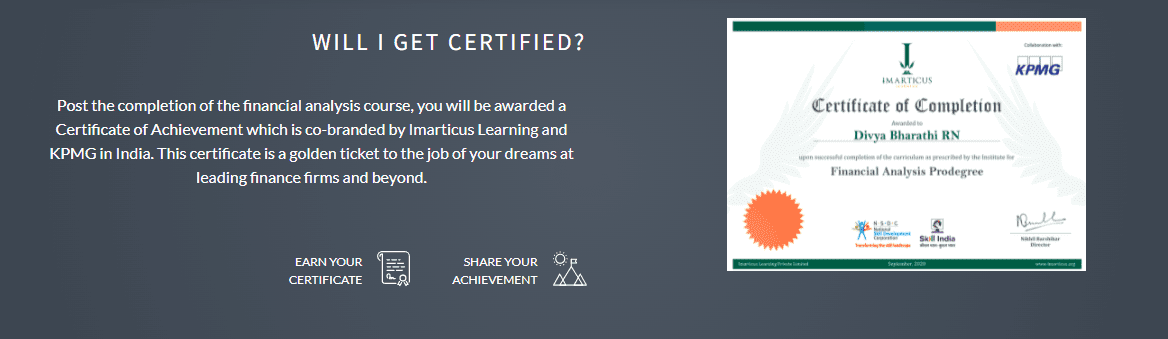
financial analyst certification courseImarticus also provides the best CFA course in India. You can also take up a CFA course as it will give you dual benefits. You will get to learn about CFA as well as financial modeling. 

Areas of use of Financial Modelling

Financial modeling is being used in all kinds of industries. Some of the popular sectors in which they are used are:

  • Investment banking institutes
  • Equity Research companies
  • Credit Rating Agencies

Several career opportunities will open up for you if you take a financial modeling course. With a financial modeling course, you will learn several skills like mergers and acquisitions, DCF modeling, ratio analysis, etc. 

Financial Modelling Jobs:

You might get several jobs if you take up a financial modeling course. These jobs are only for people who have the technical know-how of things that work in the fintech space. With the growth of fintech and other financial institutions, there is a massive demand for people who know financial modeling and handle such cases. Some of the career opportunities that will open up for you are as follows:

  • Financial Analyst
  • Cryptocurrency trader
  • Market Research Analyst
  • Equity Analyst

The list above is not exhaustive. There are several other opportunities too. The job title for these opportunities might differ from company to company. 

Importance of Financial Modelling

Financial modeling has become one of the most important aspects of businesses when it comes to the corporate sector. These models are essential tools brought to use to make critical business decisions. A financial model also finds a considerable place in analyzing any risk involved in business decisions.

Financial modeling can also be made to prepare different types of financial statements. Various online businesses are now dependent on financial modeling for their process optimization.

Uses of Financial Modelling

There are several uses of financial modeling. Some of the uses are:

  • Several financial models are used to make business decisions in the finance industry. These models are incorporated to analyze the business based on which the decisions can be taken. 
  • It also acts as an essential tool that can help in incorporating various business ideas. Along with the ideas, you can also analyze the risks associated with a particular business. 
  • The financial modeling techniques can also be used to represent a valid financial scenario for the company. Based on this particular dashboard, different decisions can be taken to understand the company’s financial position. 
  • Using financial models, you can also analyze a company’s economic performance. Understanding these models and tools is very important for the financial perspective of things.

A certification in financial modeling will teach you about every technique that goes into building models, which helps make business decisions.

Conclusion

We at Imarticus provide several financial modeling courses for people who aspire to make a career in finance. With our financial modeling course, students become equipped with skills that help them make business decisions. Financial models are used to make business decisions, and our courses give students an in-depth insight into how these models work.

We have a certified investment banking operations professional certificate course that deals with financial modeling and everything else that the topic encompasses. There are several other courses too that cover the basics of financial modeling. You can get enrolled in any of these courses if you are interested in making a career in financial modeling. 

5 Fintech trends that will completely change banking

The banking industry is changing, and the change is happening fast. Technology has changed many aspects of our lives, and now it’s changing how we manage money. Trends are emerging that will completely transform the way people use a bank. The following five trends are just a few examples of what you need to know about to stay ahead in this competitive world!

1. The increasing popularity of mobile payments

As many people are now using their phones for everyday transactions, the demand for mobile-friendly banking services will continue to grow. 

Already, several fintech startups are offering innovative mobile payment solutions. Some of these include:

  • Apple Pay
  • Samsung Pay
  • Google Wallet
  • Venmo
  • Zelle

These services allow users to make payments using their phones by simply scanning a QR code or tapping their phone against a contactless reader.

2. The rise of peer-to-peer payments

Peer-to-peer (PTP) payments are transactions between two individuals without the involvement of a financial institution.

PTP payments have surged in popularity in recent years, as people have become increasingly comfortable with the idea of transferring money electronically. Services like Venmo and Zelle have made PTP payments faster, easier, and more convenient than ever before.

Shortly, we can expect to see even more widespread adoption of PTP payments as people look for ways to avoid paying high transaction fees.

3. The growth of blockchain technology

Blockchain is a distributed ledger technology that allows secure, transparent, and tamper-proof transactions. It can revolutionize the financial sector by making it easier and faster to transfer money worldwide.

Already, several startups are using blockchain technology to create innovative banking solutions. Some examples include:

  • Ripple
  • Marquise Technologies
  • BitPesa

We can expect to see even more blockchain-based banking solutions in the years ahead.

4. The rise of Robo-advisors

Robo-advisors are automated investment services that provide users with low-cost, algorithmically determined portfolio management advice. Instead of relying on human brokers and financial advisers to make decisions for them, Robo-advisors invest their clients’ money using a predetermined set of rules. 

Robo-advisors have been growing in popularity in recent years as more and more people become aware of their benefits. We can expect to see even more Robo-advisors enter the market soon.

05 . The increasing demand for financial literacy

In the past, most people relied on their financial institutions to teach them about personal finance. Financial institutions have realized that they need to educate their customers about money matters and turn to fintech startups for help.

Discover More With Fintech Programs Online with Imarticus Learning

The ONLY Financial technology course covers every vital industry component. At the same time, it also provides hands-on experience with popular technologies, including APIs, Blockchain, Cloud Computing, AI, Machine Learning, RPA, IoT, and Big Data. This course will improve your Fintech certification expertise by providing students with hands-on training from industry professionals, real-world case studies, technology projects, and meaningful interactions with FinTech industry leaders and entrepreneurs.

Course Benefits for Learners:

  • Every participant needs to work on a forward-thinking FinTech initiative, which can signify a paradigm change in corporate processes.
  • The course’s dynamic, real-world application of what students have learned will immerse them in the FinTech world while giving a unique insight into today’s business issues.
  • Impress employers & showcase skills with Financial Technology courses recognized by India’s prestigious academic collaborations.

How to land high-paying investment banking jobs in 2022

Investment banking is a field that is as high-paying as it is demanding. It comes with many benefits, but there are certain things you need to master. And, one of them is networking. This especially comes in handy if you are looking forward to working in a specific firm. If there are alumni of your institution who work there, then connect with them. Another approach can be through LinkedIn. You need to connect with people there who work in that firm or can introduce you to someone who does. Also, you need to build a resume that no one can refuse. 

Above all, to get into an investment banking career, it is important to do a proper investment banker course. Thankfully, Imarticus Learnings is here to your rescue with its CIBOP course. This will give you amazing exposure with great placement support. This in turn will give you the necessary boost needed in your career. Here, we are going to talk about what investment banking jobs entail, how much you can expect as salary, and also the requirements you need to meet to become one. Keep reading to learn more.

What Does an Investment Banker do?

Essentially, an investment banker’s job is to advise companies on corporate-level transactions. For example, mergers and acquisitions on a large scale. What this means is that they collaborate with the marketing and sales teams to promote and sell companies. They also need to find potential clients and make sure that the deals go through smoothly. Another part of their job is to suggest the best terms and accurate timing for capital gains and then sell that idea to the investors efficiently. In short, you need to be a master in many domains to be good at this. And, being good at this is the only way to land a high-paying job. 

How Much Salary can you Expect?

On average, an analyst gets about $85-$95k, which, of course, increases with time and experience. And, if you are one of the luckier few who have what it takes to be a managing director, then you can expect an average salary of about $400-$600k. 

Tips to Get a High-paying Investment Banking Job

There are a few things you need to ace to bag a high-paying job in this field. 

  • Prepare for the interview well: several rounds of interviews are conducted before choosing a candidate. Mostly, the questions focus on problem-solving, behavioral, and technical aspects. So, prepare for that thoroughly.
  • Master technical skills: You need to be on top of skills like financial modeling, excel, valuation and accounting. Once you have these mastered, the road becomes much smoother.
  • You need to have amazing attention to detail.
  • Competitive overachievers are always appreciated.
  • You need to be actually interested in the deals instead of just following the market trends.
  • Reading, writing, speaking and mathematical skills are a must.

Investment banking jobs need a specific kind of training before you can actually get into an investment banking career. Check out Imarticus Learnings’ investment banking course and make yourself ready for the big break.

Keeping up with digital lending trends in 2021-2022

Digital lending is the practice of banks and other organizations like credit unions offering improved consumer experience. This is usually for borrowers who require access to specific products within a certain time frame. Digital lending is constantly evolving and newer trends are being introduced. To learn these trends, one can opt for a credit risk analyst course.

The CRU course from Imarticus Learning can assist students in learning about the newest developments in digital lending platforms. 

Trends in Digital Lending

Following are a few trends in digital lending that have been seen in the past year and will continue to influence the industry. 


  • Tech-Powered Underwriting


Legacy credit systems usually use limited data pools to calculate the credit score. This is why the systems often fail to detect potential risks and are not able to quantify them. Therefore, to avoid such errors, there is a need to introduce and use technological solutions.

Advancements in technology have enabled professionals to streamline processes involved in underwriting and automate specific tasks so that credit scores can be calculated more accurately and all risks are quantified. Those who wish to learn credit risk underwriting should choose a course that includes this trend of tech-powered credit underwriting. 


  • Enhanced Efficiency Through Partnerships


Inaccurate credit score and risk analysis, and underwriting, there is a need to source from different data points. For this, businesses will have to partner with third-party processors, technological firms, government companies, credit bureaus, and even FinTech organizations. Such partnerships help to provide more data and assist with various processes like credit scoring, ID scanning, verification, and digital and thus allow the business to become more efficient. 


  • Organizational Transformations


In digital lending, the central concepts or the power centers were the credit, risks involved, and operations. However organizational transformation within the sector is focusing on technological advancements and data. As underwriting and digital lending processes become automated, these are likely to become the new power centers of organizations within the industry. 


  • New Industry Regulations


One of the benefits of digital lending is the current regulations that enable it to become more mainstream. These new regulations do not just focus on consumer protection, but offer validity and credibility to digital lenders, allowing them to be practicing professionals in the field. This trend will continue to grow in the coming years, as digital lending becomes recognized as a part of the financial industry. 

Understanding Credit Risk Underwriting for Digital Lending

To learn credit risk underwriting and understand how it influences the latest trends in digital lending, one can choose the Credit Risk and Underwriting Prodegree from Imarticus Learning. The Credit Risk and Underwriting Prodegree is a course that is open to freshers as well as working professionals. It is in collaboration with Moody’s Analytics.

This credit risk analyst course from Imarticus Learning includes an industry-oriented curriculum that has been created by experts who understand the current business needs as well as the upcoming trends. Students will learn about the country’s credit landscape and understand how the new trends in digital lending will affect and benefits the industry.

The course also includes modules that teach loan assessment and financial analysis. Since Imarticus Learning collaborates with Moody’s Analytics for this course, the certification offered is industry-level and will help students land rewarding jobs in their areas of interest and expertise.

The Credit Risk and Underwriting Prodegree from Imarticus Learning will be an online course. But students will be able to interact with instructors, ask questions and participate in discussions or interactive sessions. This will also help them build the necessary soft skills that will allow them to sit for interviews. 

The Credit Risk and Underwriting Prodegree will teach the benefits of digital lending and students will obtain practical knowledge in the field. This will help them secure jobs in leading organizations and even transition to a lucrative career.

Beyond the spreadsheet: A career transition from sales to investment banking operations

Transitioning from sales to investment banking (IB) can be quite hard to do. Especially, when as a sales analyst it is already presumed that you will be completing a two-year term. So, if halfway through your first year you declare that you will be moving to investment banking, then it will raise certain questions about your sincerity and work ethics. There is, however, a more practical problem related to it.

That would be the lack of training as an investment banking analyst. Since the training programs required for a sales analyst and investment banking analyst are completely different, the transition would be hard to make. And obviously, the teams within the IB department will look for a candidate who already has proper training. So, they will be reluctant to take you on. 

In this situation, the best thing to do would be to wait and complete your two-year term as a sales analyst. In the meantime, you can do a proper course that will help you prepare for your investment banking career path. Now, there are a lot of institutions in India that provide short-term investment banking courses. Imarticus Learnings is a leading one among them.

With its CIBOP course, you will not only get tremendous exposure but also placement support that will put you leagues ahead in your career in investment banking. Here, we are going to discuss the way to become an investment banker in detail. 

Way to Become an Investment Banker

There are a few steps you need to follow that will help you to land better jobs and get ahead in your career. 

  • Build connections: This is the primary thing you need to follow for a career in investment banking. Especially, if you want to work in any specific firm. If you know someone working there, like college alumni, then make sure to talk to them and learn about the internal processes. If not, then LinkedIn is your best friend. Find people there or find someone who can introduce you to someone working there. This will help you a lot in the long run.
  • Build a good resume: Interviewers look for past interest and experience with finance in your resume. Try to join finance clubs or other banking-related activities in your institutes. This will make your resume even more appealing.
  • Prepare extensively for the interview: Notably, interviews mostly revolve around technical, problem solving, and behavioral questions. So, the thing that will probably help you best is if you prepare for said questions beforehand. Questions asking to introduce yourself and why do you want to work in investment banking are common behavioral questions.Now what matters is how much of a good answer you can provide. You should aim to prepare a few personal stories that can get reused and restructured to answer all of these. Technical questions are where your skills are tested. So, prepare early for questions related to DCF, LBO, and other technical aspects.

At the end of it, the best thing you can do for yourself is to learn from the best to prepare for your investment banking career path. So, do check out Imarticus Learnings’ CIBOP course to get ahead in your career in investment banking.

Understanding global securities settlements and reporting in investment banking operations

Conceptually speaking, global investment banking is an activity focused on obtaining and intermediating resources for the sale of companies, mergers, and acquisitions, issuing shares for the entry of new investors (traditionally carried out on stock exchanges), placing debt bonds in the market, or for the development of new companies or projects. In countries such as the United States, the United Kingdom, and those belonging to the European Union, investment banking has also been associated with the trading of securities in the capital markets.

Securities settlement systems (SSSs) are a fundamental component of the infrastructure of international financial markets. Over the last years, the volumes of trading and settlement have grown significantly as securities markets have developed to be an increasingly imperative channel for intermediating streams of resources between creditors and debtors, and because investors are being able to manage their portfolios of securities more dynamically, in part because of declining transaction costs. Cross-border trading and settlement volumes have grown particularly fast, reflecting the increasing integration of international markets.

best investment banking courses with placement in IndiaAny disruption in securities settlement has the potential to spill over to any of the payment systems used by the SSS or to any payment system used by the SSS to transfer collateral.

In the securities markets themselves, market liquidity depends critically on confidence in the safety and reliability of settlement arrangements; traders may be unwilling to trade if they have significant doubts about whether the transaction will actually be settled. 

Thus, in order for investment banking to be able to carry out its intermediation and resource management activity, it develops basic services and activities to identify the financial situation of the companies it supports. These activities are financial analysis and diagnosis, company valuation, and financial advisory services, the main one being the financial structuring of projects. These services are the same as those provided by financial consultancy firms.

In addition, some investment banking firms also specialize in the comprehensive development of the company’s strategic process vis-à-vis third parties. For example, if a company wants to sell a shareholding, the investment banking firm prepares a booklet for the sale of these shares, indicating the details of the activities to be carried out by the interested agents in order to purchase the shares. This is the importance of reporting in investment banking.

Why an Investment Banking Career? 

Global Investment Banking professionals are among the highest-paid in the world, but with this great reward comes enormous responsibility. To be able to work in this field, you need to have many competencies and skills in concepts like global securities settlements and good reporting practices. In fact, the investment banking sector will deal with responsibilities such as the financing of companies through debt or equity, as you will decide things like whether to buy or sell companies or parts of it, risk hedging, or joint ventures.

Why Imarticus for investment banking courses in India?

In Imarticus we offer CIBOP Certified Investment Banking Operations Professional courses in India for everyone that needs to start from the basics of an Investment Banking Career. Visit our site today to start a career in global investment banking operations, and learn more about the importance of well understanding global securities settlements and reporting techniques in this field.  

Conclusion

To succeed in an Investment Banking Career, professionals must acquire and demonstrate a multidisciplinary profile with extensive financial knowledge. Concepts and skills such as global securities settlements and reporting must be well mastered. At Imarticus, we offer you the possibility to take online investment banking courses in India. Enroll today and start your Investment Banking Career.

Emerging markets: India and the pyramid of opportunities in Investment Banking and Fintech post MBA

Fintech and investment banking (IB) are the domains that are booming these days. Fintech is reinventing the way regular operations in some major businesses happen. Along with it, due to its vast operationality in every sector, it also offers numerous job opportunities.

On the other hand, investment banking is booming because of changing market trends and the merger and acquisition solutions that are required to solve them. IB also provides restructuring advisory and helps establish connections among clients, investors, and lenders. 

Further, fintech and IB are leading when it comes to job opportunities in India. Considering this, it is the golden time to do an MBA in fintech or an MBA in investment banking for people who want to get ahead in their careers. Imarticus Learnings offers an MBA in fintech course with JAIN online MBA. These will not only hone your skills but also give you a tremendous amount of exposure. Here we are going to take a look at the job opportunities in both these fields in detail. Keep reading… 

Applications of Fintech 

There are a lot of ways in which fintech helps companies grow. So, here is a list of the major fields where fintech graduates are high in demand:


  • Data science: Data scientists are high in demand these days. They help firms out in ways that are hard to beat. 


  • Technology services: As technology is the backbone of the fintech industry, there are a lot of areas where this course comes in to help. This is why there are lots of opportunities for the same here.
  • Operations: There are roles in the field that require in-depth market knowledge, and management and communicative skills. Fintech graduates come to good help in these situations and are in very much demand.
  • Information security and risk management: As fintech in some aspects quite similar to regular financial services, things like information security are highly prioritized. This is why experts in this field are in demand.
  • Customer service: Fintech graduates are hired regularly to help solve some serious issues and make things run smoother.

Other than these, the IT sector, HR departments, legal, finance, and procurement teams are fields where there are tremendous opportunities for fintech graduates.

Opportunities in Investment Banking

There are a few major roles that MBA in investment banking graduates perform and are in high demand. 

  • Analysts: Their job is to create pitch books, i.e. a slide deck of recommendations to suggest to clients. They also perform live deals.
  • Associates: They work for VPs, SVPs, and even MDs. While analysts arrange the underlying materials, associates check the accuracy and quality of the work.
  • VPs: They lead the execution of a deal and work as a link between seniors and juniors.
  • SVPs: They are MDs in the making as long as they prove that they can bring in new business. 
  • MD: They are responsible for generating deals that pay for the salaries and bring in new businesses.


As a lot of domestic and international fintech and IB companies are opening up their businesses in India, the job demand is supposed to climb off the charts from next year. Prepare for it now with Imarticus Learnings’ MBA in fintech program in collaboration with JAIN online MBA.

Pros _ Cons- Is It Worth Becoming an Investment Banker

Investment banking is probably one of the top-level jobs all over the world. It is a perfect blend of high pay, long working hours, excellent people’s skill, fierce competition and much more. When it comes to deciding a career path, various factors determine the choice. Knowing that an investment banking career could be a very challenging yet interesting career option, in the long run, some confusing questions are bound to occur in mind.

best investment banking courses with placement in IndiaThe most important one being ‘is it worth becoming an investment banker?’. Or ‘what could be the pros and cons of investment banking?’.



Thankfully, at Imarticus, we offer investment banking certification courses falling under the CIBOP program, which can boost your career path. 

Pros of Investment Banking

  • When you would start your career as an investment banker, you would receive a high joining bonus which would make you want to work more in this field.
  • Extensive networking with large enterprises and their people is also a trait of an investment banker. You can have the opportunity to connect with the people in big firms up to a very personal level as well. This opens the gates to building your network of people.
  • Every day is a new day in the life of an investment banker. You would get the opportunity to learn many different subjects from your manager, colleagues, and even customers. Not just an expert in investment banking, you would develop many other skills like financing, taxing, accounting, and of course people’s skills.
  • It can also teach you the skill of becoming a multi-tasker. Since you work with and for multiple people at the same time, you learn to prioritize your tasks in an effective manner.
  • Nonetheless, an investment banking career is a high-paid job. You would get outstanding compensations and bonuses for your work throughout the year.
  • Since everything is online, most of the work can be done from home. If your enterprise approves this, then you can work comfortably and efficiently at home. 

Investment Banking Course

Cons of Investment Banking

  • Intense performance competition in investment banking has begun to affect personal lives as well. There is a shotgun every day at the head of an investment banker to give his career-best performance every single day. If not, there would be many others in line as a replacement.
  • Long tedious working hours would put your work-life balance at stake. You might need to do overtime as well to meet the target annual goals which might be very exhausting. Sometimes, even during your vacation or weekends, you cannot avoid customer calls and might need to work more than 15 hours a day.
  • Some customers can be very difficult to handle and it can be challenging to work with them and understand their needs. They might put up false and unrealistic goals in front of you.
  • There is always an element of fear attached to investment banking in terms of job security. During difficult financial times, it might become very difficult to find another job in case your current employment contract ends or if you are fired from the company in case they do not have enough funds to support you. 

Conclusion

So after having read extensively the pros and cons of investment banking, what should you choose? Although it depends on you and your interests, you can be sure of the Investment Banking Certification course offered by Imaticus.

These investment banking courses would help you become a successful investment banker in the future and would teach you the ways and tricks of handling all the above-mentioned cons like a professional. 

Are financial modelling skills indispensable to investment banking professionals

Are financial modelling skills indispensable to investment banking professionals?

To work in investment banking, you need to demonstrate that you have a range of skills and knowledge that are differentiated or in demanding careers, such as financial modelling skills. Moreover, the investment banking sector deals with the financing of companies through equity or debt. This includes work such as buying and selling companies in whole or in part, IPOs, joint ventures, or risk hedging.

To achieve this, investment banks must work directly with the management of the companies involved, as well as with investment funds or public financing facilities. This requires people who want to work in investment banking to have a multidisciplinary profile with extensive financial knowledge, agility in financial modeling, and good interpersonal and communication skills. Here we tell you 7 reasons why financial modelling skills are indispensable to investment banking skills.

What is financial modelling? 

The term financial model refers to an abstract-mathematical version of a company’s financial reality in a set of spreadsheets.

A model is thus a mathematical, simplified, and idealized version of the reality of a company. The model works out simple versions of real factors and translates them into spreadsheets that facilitate the execution of mathematical calculations on the data.

The purpose of a financial model is to represent reality as simply as possible while still being a realistic reflection of the company’s situation, and thus to enable the company’s financial statements to be projected on the basis of current and historical data.

Here are the 7 main reasons why financial modelling skills are indispensable to having investment banking professional skills

  1. It allows you to give a transparent picture of the overall situation of a company.
  2. It helps to project the impact of any changes in the company’s structure or business.
  3. Since financial models are designed taking into account historical data in addition to the structural situation, the model allows for the definition of scenarios with variables that reflect changes in the entire structure depending on their value.
  4. It is an integrated planning system that contains the profit and loss accounts, the balance sheet, and the calculation of capital flows with their respective dependencies. In this way, the model makes it possible to project the development and consequences of a change scenario for any given decision. This is an indispensable tool when making decisions affecting the structure of a company, as it makes the impact of any decision transparent.
  5. All companies need a business plan to organize themselves, but from the moment external financing comes in, whether, through credit or investment, the financial model becomes an essential planning tool.
  6. Investors only invest their money if they are convinced that the company will be able to repay loans and interest in the future, thus providing a return on their investment, which is why a transparent, complete, and correct presentation of the financial situation, especially the projected income, capital, and liquidity situation, is indispensable.
  7. Apart from their use in all matters relating to financing, financial models are also used for business management.

Why Imarticus for a CIBOP online course?

Financial modelling, i.e. the design and planning of a financial model, is mainly used in the preparation of a business plan or in the representation of a company’s financial structure. The aim is to translate the reality of the company into an abstract model that provides a transparent picture of the overall situation of a company. 

In Imarticus we offer Certified Investment Banking Operations Professional courses for those who need to start from scratch. If you have any questions, please do not hesitate to contact us to have more information on investment banking courses.

Here Is How to Perform Scenario Analysis of a Financial Portfolio with Python

Here Is How to Perform Scenario Analysis of a Financial Portfolio with Python

The finance sector is constantly trying to predict future scenarios to make impactful and positive decisions. Scenario analysis can help generate important insights from financial portfolios that allow professionals to understand future conditions and what might affect or cause them. As a chartered financial analyst, you will be able to implement Python packages and simulate scenarios. To acquire the necessary skills, you can enroll in a financial analysis course. Imarticus Learning offers a Financial Analysis program to students who are interested in the finance industry. 

Completing Scenario Analysis of Financial Portfolio with Python

If you learn financial analysis, you will undertake the scenario analysis process for financial portfolios using Python. While performing scenario analysis with Python, you will have to implement the Monte Carlo simulation. 

When you start scenario analysis of a financial portfolio, you will need to collect all relevant data. You can install a data library like finance and download the necessary information on stock prices. Now, once you have that, you will have to find out the daily close price of each stock.

To do this, you need to calculate the price “p” from a specific day “t” till the day “t+1”. You can use the pct_change method when you have Python and quickly get the formula for this calculation. You will then need to understand the composition of the portfolio and the loop that will provide the daily stock returns and fill the Pandas Data Frame. 

Once you have the returns, you can begin the Monte Carlo simulation of a single stock. A financial analyst course online with an updated and holistic approach to financial studies will help you apply this simulation. Suppose you want to simulate “x” days, then you need to find stock and obtain the returns time series of that stock. Make sure that you have the original returns time series. Then, you need to randomly but uniformly select “x” values with replacement. You can then complete the simulation with a single line of code.  

When you need to perform a scenario analysis of a financial portfolio, you will need to get the returns and weights of each stock in the portfolio. Using these, you have to find the weighted sum of all the stock returns. You can use a returns data frame to calculate and then perform the simulation. 

Gain Industry Certification in Financial Analysis

Financial institutions need to have a fair idea of what to expect in the future as the industry functions on accurate analysis and predictions. To learn financial analysis and perform scenario analysis, you will need to have industry-oriented training. Imarticus Learning’s Financial Analysis Prodegree is a great place to start. 

The course is ideal for freshers and working professionals who are looking to change careers and enter the financial industry. The Financial Analysis Prodegree course from Imarticus Learning is in collaboration with KPMG. Therefore, as a student, you will have access to the best industry training to prepare you for the finance sector. You will also get to know the current situations and develop job-related skills that will make you a valuable employee in the future. 

Since the curriculum is designed for students to launch successful careers, it includes several interesting and relevant topics. You will learn financial analysis, modeling, equity research, financial statement analysis, valuation, and transaction execution. You will become a chartered financial analyst and can explore numerous careers in the finance industry. 

best financial analyst coursesAfter completing the financial analyst course online, you can go into private equity, investment banking, or corporate finance. Imarticus Learning offers essential toolkits that help students develop skills and experience to work in the industry.