
Cybersecurity Careers: Skills, Certifications and Job Opportunities

Cybersecurity is crucial in the modern digital era. Companies worldwide are putting more emphasis on cybersecurity due to the growth in cyberattacks and data breaches to safeguard their priceless assets. This has increased the demand for cybersecurity specialists, opening up many work prospects for people with the necessary qualifications. 

According to the University of Maryland, 2,244 daily hacker attacks occur every 39 seconds. This blog is for you if you’re considering a cybersecurity career path or want to grow in your current position. The abilities and credentials required for success in cybersecurity, as well as the present employment market and the most promising career options, will all be covered in this post. Let’s start now!

What is cybersecurity?

Cybersecurity aims to protect your digital information from those seeking to harm you. This covers safeguarding anything from your private information, such as your social media accounts and emails, to the private information of major corporations and governmental bodies.

Cybersecurity is similar to placing a digital lock on your data to prevent cybercriminals from stealing it or using it for nefarious purposes. To defend against dangers like viruses, malware, hacking, and phishing assaults, many tools and approaches must be used.

The field of cyber security is expanding and yet requires qualified personnel. Industry analysts predict the worldwide cybersecurity industry will increase from $170 billion in 2017 to $202 billion in 2023.

There has been a growth in the need for cybersecurity employment. By 2023, there will be more than 1 million open positions in the field of cybersecurity, but fewer than 400,000 people will have received cybersecurity training. The field of cyber security is constantly growing. In 2023 and 2025, respectively, it is predicted to expand by 11% and 20%. The median annual income for this fast-paced job is $81,000.

How to start a career in cybersecurity?

Qualified individuals must fill entry-level, mid-level, and advanced-level positions in the expanding cybersecurity field. Over the next five years, demand for cybersecurity professionals will increase by 18%.

Cybersecurity is essential for any organization that relies on IT systems to store, process, or transmit sensitive information. Cybersecurity helps prevent data breaches, identity theft, ransomware attacks, denial-of-service attacks, phishing scams, and other cyber threats that can cause financial losses, reputational damage, legal liabilities, or even physical harm.

Protecting computer networks and data against unwanted access, use, or destruction is the focus of the cybersecurity sector. Professionals in cybersecurity come in a wide range of specialties and skill sets. Entry-level cybersecurity jobs require a high school diploma or the GED equivalent and some on-the-job training.

An associate’s degree in computer science or a closely related discipline, one year of professional experience, plus a few specialized education courses are needed for mid-level roles. A bachelor’s degree in computer science, three years of experience, and specialized education courses are necessary for advanced-level roles.

What are some of the skills required for a career in cybersecurity?

Cybersecurity professionals need technical and workplace skills to perform their duties effectively. Some of the technical skills include:

Technical and practical skills are necessary for cybersecurity experts to carry out their jobs successfully. Among the technical abilities are:

  • Scripting: Scripting is a sort of coding that lets you use languages like Python or PowerShell to automate processes and develop tools. You may become more productive, save time, and improve your talents as a cybersecurity analyst by using scripting.
  • Networking: The cornerstone of cybersecurity is networking. You must comprehend how networks function, how data moves across servers and devices, how protocols and standards work, and how to protect network connections and devices.
  • Database: Most of the data is kept and retrieved through the database. You must be able to use languages like SQL to query databases, find and use database vulnerabilities, and safeguard databases from unwanted access.
  • Forensics: Digital evidence from cyber events is gathered, examined, and presented. To recover lost or encrypted data, track harmful activity, locate attackers, and preserve evidence for legal uses, you must be familiar with forensic tools and procedures.
  • Penetration testing: Penetration testing mimics actual cyberattacks on the networks or systems of a business to find and exploit weaknesses. You must understand how to use frameworks and tools for penetration testing, engage in ethical hacking, and present your conclusions and suggestions.

The Final Words

The need for qualified people is greater than ever as cybersecurity expands quickly. Any firm seeking to safeguard its digital assets may find you to be a useful asset if you have the necessary training and credentials. This industry has several work options, from security analysts to penetration testers, each with unique difficulties and rewards.

Information security careers can be ideal for you if you have a strong enthusiasm for technology and want to change the world. You can aid in preventing cyberattacks and defending yourself against digital dangers if you have the necessary skills and expertise. 

The cybersecurity certifications by Imarticus Learning are designed to equip you with the essential knowledge and skills required for a promising career in the field of cybersecurity. Through the cybersecurity program by IIT, roorkee, you will gain expertise in networking and information security basics, ethical hacking, cloud security, application security, and incident handling. Developed in collaboration with CEC, and IIT Roorkee, this program will provide you with the latest security tools and techniques highly sought after in the industry.

So why are you still waiting? Today, start along the path to a rewarding career in cybersecurity!

The Importance of Data Security and Privacy for Individuals and Businesses in the Digital Age

Data security and privacy are most important than ever in the technology-driven society we live in today because of the explosion in the volume of data being created and exchanged.

The preventative steps taken to stop illegal access, theft, or damage to electronic data are data security. In contrast, privacy entails preventing the collection, use, or sharing of someone’s personal information without that person’s agreement. 

Both data security and privacy are crucial for both individuals and companies since a breach of either may have serious repercussions, such as monetary loss, legal liability, reputational harm, and loss of confidence.

This blog will discuss the importance of data security and privacy for individuals and corporations. We will examine the dangers and repercussions of data breaches, discuss best practices for data protection, and offer advice on negotiating the complicated regulatory environment around data privacy.

What are data security and privacy?

The process of protecting data against illegal access, use, alteration, disclosure, or destruction is known as data security. Data security in cloud computing seeks to thwart hostile actions that might jeopardize the integrity and confidentiality of data, including data breaches, cyberattacks, fraud, and identity theft.

Customers used financial applications a trillion times in 2019, and Forbes predicted that number would increase considerably in 2020.

Individuals and organizations have the right to determine how their data is gathered, utilized, shared, and preserved. Data privacy goals are respected for data ownership, permission, openness, and responsibility. Complying with the rules and regulations that control data protection is another aspect of maintaining data privacy.

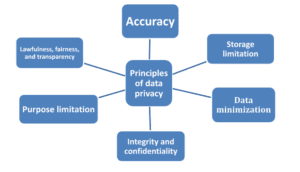
The General Data Protection Regulation GDPR Compliance of the European Union outlines the six data privacy principles. These principles are: 

pg cybersecurity course

Why are data privacy and security crucial for individuals?

You produce and consume a lot of data daily in the digital age. Additionally, you keep your data on external devices like your laptop or smartphone and cloud services. Your information is important to you and others who might wish to utilize it for their gain. For instance, hackers could seek to steal your information to access your accounts, pass themselves off as you, or sell it on the dark web.

If your data is not private and secure, you risk suffering catastrophic repercussions like:

  • Identity theft: If your identity is stolen, someone else may use it to defraud people or commit crimes in your name.
  • Financial loss: If someone gains access to your credit cards or bank accounts, they may withdraw money or make illicit transactions.
  • Reputational harm or blackmail: If someone posts private or humiliating information about you online, it might hurt your reputation.
  • Loss of trust: When someone misuses your data without your knowledge or consent, they undermine your trust in online services or platforms.
  • Loss of freedom: If someone restricts your online access to information or services based on your data profile, they may do so to the detriment of your freedom.

Cybersecurity Best Practices for Small Businesses

October is recognized worldwide as Cybersecurity Awareness Month (CSAM).

As a result, in the digital era, an individual who values data security and privacy rights:

  • You must know how internet companies acquire, utilize, share, and keep your data.
  • Be cautious about the data you disclose online and with whom you share it.
  • Use encryption software and strong passwords to prevent unwanted access to your data.
  • You should frequently upgrade your software and hardware to address any security flaws.
  • You should check your privacy preferences and settings across various platforms and services to ensure they align with your expectations.

The Importance of Data Privacy for Businesses

In the digital era, information security has grown more crucial for enterprises. Protecting consumer and employee personal information is essential for businesses, given the rise in data breaches and cyberattacks. Failure to do so may result in money, legal responsibilities, and reputation losses.

The effect it may have on a company’s reputation is the reason why data privacy is vital for enterprises. A data leak may significantly damage a company’s reputation and erode consumer and stakeholder confidence. This may result in a drop in revenue, trouble finding new clients, and harm the company’s reputation.

Additionally, organizations are required by law to safeguard customer information under several privacy regulations. Heavy fines, legal action, and other penalties for breaking these rules may be imposed.

Businesses may suffer serious financial consequences as a result of data breaches. Investigations, legal expenses, and consumer notification can all significantly add to the rehabilitation cost. Additionally, corporate losses brought on by reputational harm might result in large revenue losses.

The Final Words

Data security and privacy are crucial for individuals and enterprises in the digital era. Numerous advantages have resulted from the ever-increasing use of technology, but it has also introduced new dangers and difficulties, particularly when safeguarding sensitive data. 

People may defend themselves against identity theft, fraud, and other cybercrimes by implementing efficient data security and privacy safeguards, and organizations can protect their reputation, clients, and financial stability. Maintaining vigilance and proactively securing sensitive data as the digital environment changes are critical. 

The PG Program in Cybersecurity, developed by Imarticus Learning in partnership with industry leaders, seeks to provide future cybersecurity professionals with the finest learning experience possible. You will graduate from this comprehensive 6-month program with the abilities and know-how needed to succeed in positions like cybersecurity analyst, penetration tester, incident handler, and SOC team member.

MongoDB vs. MySQL in Web Development

Having robust databases is one of the major characteristics entailing DevOps development. Whether conducting online transactions or streaming your favourite movie, robust databases have made us all dependent on them. 

Database management systems are now making our lives easier. Database management is now the pinnacle of backend development. This has made the jobs of full stack developers easier and has also encouraged technological dependency. 

However, developers are often torn in the decision-making process of which database to use for backend development. Be it MongoDB or MySQL, the debate has been continuing for decades. 

In this article, let’s do a comparative background check on MongoDB and MySQL; which is better, which provides a much more agile database and many other important details. 

What are MongoDB and MySQL? 

MongoDB is a popular open-source database that is a compound of MySQL and other robust databases. It creates and stores documents in a binary JSON file or a Javascript Object Notion. MongoDB can seamlessly transfer data between servers to different web applications at ease. Using MongoDB is the correct choice when the user requires robust storage capacity with speed. 

MySQL on the other hand is an open-source database with RDBMS characteristics. Built by Oracle Corporation, the database focuses on storage in a tabular format. The database is compatible with different kinds of operating systems like Linux, Windows, Apple, FreeBSD and Unix. 

MongoDB and MySQL: Similarities and Differences 

Both being open source databases, MongoDB and MySQL there are certain similarities as well as differences between the two. Let’s find them out to improve backend development. 

Similarities 

As mentioned above, being open-source databases, both are remotely similar to one another. They are: 

  • Both are database management systems or DBMs. 
  • Both save data on a computer system or network laying the foundation for different web applications. 
  • Both databases support Python, Java, Node.js and Server-side PHP. 
  • Both MongoDB and MySQL enable organisations to modify, deploy, and distribute different cloud-based applications. 
  • For both databases, the code is free to use for anyone and easy to distribute as well. 

Differences 

Despite all the similarities MongoDB and MySQL possess, there are several differences between both databases. They are: 

  • MongoDB is a document-based, non-relational database management. On the other hand, MySQL is a table-based system with an open-source relational database. 
  • MongoDB is made to supplant MySQL for seamless working. MySQL on the other hand is itself searchable and accessible with other data sets. 
  • MySQL has a rigid architecture which suffices business entities adequately. MongoDB, on the other hand, does not have a rigid architecture and can be used for individual user interfaces and commercial purposes. 

MongoDB and MySQL: One-on-one Comparison 

MongoDB and MySQL are the most robust open-source databases that have made lives easier for decades. However, an underlying difference between both lies. People often fall into a dilemma about the correct decision. Here is a one-on-one comparison between the two. 

Feature MongoDB  MySQL 
Data Structure  Stored in unrelated JSON documents.  Stores individual records in forms of credit in a tabular format. 
Schema  The database does not require any prior schema.  Requires a schema definition for the database to organise in a tabular format. 
Languages  Supports a JSON Query language for seamless database management.  Only uses Structured Query Language or SQL. 
Foreign Key  MongoDB is not accustomed to the usage of foreign keys, hence it is not supported.  Is a much more flexible open-source database supporting foreign keys. 
Replication  Facilitates sharding as well as replication.  Supports only master-slave replication and master replication. 
Scalability  Scaled both vertically as well as horizontally.  Scaled only vertically. 
Joint Operations  MongoDB is not well-versed in joint operations.  MySQL is very flexible and supports joint operations. 
Performances  MongoDB is only optimised for written performances.  MySQL is flexible and hence can be optimised for high performances across multiple tables. 
Risks  Due to the absence of schema, there are no chances for severe attacks.  Prone to different kinds of SQL injection attacks. 
Community Support  There are more than 177,000  repositories and 923,000 committed on GitHub for MongoDB. These numbers are subject to increase from time to time.  There are almost more than 222,000 repositories with around 7 million commits on GitHub for supporting MySQL. These numbers are substantially increasing day by day. 

When to use MongoDB and MySQL? 

MongoDB and MySQL are both one of the best open-source database management systems as per industrial standards. However, both of these are used for commercial purposes and both are real winners in the business field. However, the choices we make among these two would solely depend upon our project needs and goals. Let’s see those. 

When to use MySQL?

MySQL is a very flexible open-source database management system that can enhance business growth.  They are: 

  • If one is starting a business, MySQL is a great tool since the database is non-scalable. 
  • If the database structure is rigid and not prone to change, MySQL is the ultimate choice. This is because MySQL has a fixed schema. 
  • If someone has a high transaction rate either individually or commercially, MySQL would be a fit choice. 
  • If data security is one of the top priorities, MySQL comes in handy in such situations. 
  • If one is looking for better database support other than MongoDB, MySQL can help one out with its flexibility. 
  • If one is working with legacy applications requiring multi-row transactions and has a clear and structured schema, MySQL is the optimal choice. 
  • If one is looking for finding solutions to common problems, MySQL can be termed as a viable option. 

When to use MongoDB? 

Despite its rigid data structure, MongoDB is also a viable option in certain cases. How? Let’s find out. 

  • If one is looking for high data availability with automation and instant data recovery, MongoDB is the optimal choice. 
  • If one is working with an unstable schema and looking for ways to lower the cost of schema migration, MongoDB is the correct choice. 
  • If one’s services are cloud-based, MongoDB would be very feasible in that case. 
  • If one wants to speed up their business development, MongoDB seems like a viable option. 
  • While working with real-time analytics, IoT and mobile applications, MongoDB would be a great choice to segregate structured and unstructured data that has rapid growth potential. 

Conclusion 

For being a full stack developer, one has to keep in mind the credibility of both MongoDB and MySQL. Making a viable option for DevOps development is an elementary skill in being a backend developer or a full stack developer. 

If you are looking for a feasible programme for learning backend development, check out Imarticus Learning’s Full Stack Developer Pro Course. You can get guaranteed job opportunities through robust real-world solutions. You can learn special skills in end-to-end development, data structuring, Java programming and other important features. 

Unveiling the power of data structures and algorithms: 5 real-world applications

The fundamental units of programming in the field of computer science are data structures and algorithms. They are the foundation for software development and are crucial for producing successful and efficient applications. 

data structure in computer science is a framework for managing, organizing, and storing data that is often selected to allow quick data access. A data structure, or algebraic structure about data, is more specifically a collection of data values, the connections between them, and the functions or operations that may be performed on the data.

full stack development course

So what is data structure and algorithm, and how do they function in practice? This blog post will explore the impact of data structures and algorithms: 5 real-life examples.

These examples highlight how data structures and algorithms are used in real-world scenarios. Thus, whether you’re an experienced coder or just getting started, be ready to explore the limitless opportunities made possible by these potent tools.

What are some real-world applications of data structures and algorithms?

Application 1: Sorting Algorithms in E-commerce

Sorting algorithms can sort items by price, name, or any other criteria you want to apply. For instance, if you’re looking for something specific on Amazon and want it at the top of your results page, sorting algorithms will help you achieve this goal faster than manually searching through all pages.

A sorting algorithm is a technique for arranging many things in a certain order, such as alphabetically, from highest to lowest value, or from shortest to longest distance. Input lists of items are used as the basis for sorting algorithms, which then apply certain operations to those lists to produce sorted arrays as output. 

Application 2: Graph Algorithms in Social Networks

Graphs are used to represent relationships between people or objects (nodes). Social networks like Facebook use graphs, and many other companies want to understand their users better by analyzing their online connections.

Due to the enormous quantity of data that social networks produce daily, graph algorithms that are particularly tailored to evaluate and extract information from these networks have been created. 

Application 3: Hashing Algorithms in Cybersecurity

Hashing functions take an input value such as an email address or password and return a fixed-length output called hash value which represents only one possible input value. However, it cannot be reversed back into its original form without knowing its original input value beforehand because there are many possible outputs given any single input value.  

Application 4: Navigation Systems

Large data sets, including many types of information, such as roads, highways, structures, and landmarks, make up maps. A navigation system must swiftly and effectively obtain and interpret pertinent information to navigate this sea of data. 

Data structures and algorithms are helpful in this situation. Navigation systems can locate the optimum route, determine the trip duration, and even offer real-time traffic updates by efficiently structuring the data and employing optimized algorithms.

Google Maps, Waze, and Apple Maps are examples of navigational systems that use data structures and algorithms. To store and manage map data, these apps employ a range of data structures, including graphs, trees, and hash tables. For instance, Google Maps represents the road network as a graph, with each node being an intersection and each edge denoting a road segment. Google Maps can determine the quickest route between any two spots on the map by utilizing graph algorithms like Dijkstra’s algorithm.

Application 5: Image and Video Processing

Image and video processing software may use these matrices to perform various interesting operations, including cropping, resizing, and adding filters. For instance, when you apply the “blur” filter to a picture, the program employs a particular algorithm that performs a mathematical operation on each pixel.

Adobe Photoshop, GIMP, and Adobe Premiere are examples of image and video editing applications that use data structures and algorithms. To store and handle picture and video data, these applications employ a range of data structures, including arrays and matrices. For instance, Adobe Photoshop employs a data structure known as a layer stack to enable users to add and edit various picture components independently.

Ending Note

This post has examined the best real-world uses of data structures and algorithms. We’ve seen how they may be useful for everything from image processing and navigational systems to financial analysis and healthcare. However, these are only a handful of the numerous available applications.

Data structures and algorithms will undoubtedly continue to play a crucial role in determining how we interact with the world around us as technology develops. Hence, it’s important to take the time to comprehend the strength and potential of these amazing tools, whether you’re a programmer, a data analyst, or someone interested in technology.

Your ability to create complete programs, including data structures and algorithms, will be enhanced by taking the Full Stack Developer Pro course from Imarticus Learning. This in-depth, 6-month curriculum will teach you both front-end and back-end programming, giving you the technical expertise needed for a fulfilling career as a full-stack web developer.

What are the different types of Cyber Attacks?

Our life has become more comfortable with the usage of various digital devices and the internet. The Internet has come to us with a boon for this fast pacing world. However, there is also a flip side to this. 

Even though the internet is responsible for bringing positive changes in our lives, it also comes with the huge challenge of information security. Hence, cyber-attacks become more frequent. Therefore, it becomes important to understand the nature of those cyber attacks. 

cybersecurity courses

In this article, let’s learn about the nature and types of cyber attacks that might threaten our data and how these attacks can be prevented. You can also learn about a career in cybersecurity by learning the basis of cyber attacks. 

What is a cyber attack? 

To put it in simple words, cyber-attacks are unauthorised network access that harms information security. When an outsider tries to enter your private data, it is called a cyber attack. The person who attacks is called an attacker or a hacker. 

Cyber attacks cause data tampering that result in data manipulation and data loss. On a commercial level, organisations incur several financial losses with customer trust being hampered alongside immense reputational damage. 

This is when the need for implementing cybersecurity comes in. Cyber security helps in safeguarding these networks in the computers and other different components from any unauthorised access. 

Cyber attacks: Why and how do they take place 

Cyber attacks are generally criminally and politically motivated to leak information security. Cyber attacks sometimes are also targeted to bring a feeling of achievement or thrill among the hackers. 

When politically motivated, cyber attacks happen to harm the image of a particular state of government in front of the public. Other pretentious intentions are why cyber attacks take place. Here are some of the reasons why: 

Financial Gain: Cybercriminals launch a maximum of cyber attacks on commercial entities for financial gains. They steal sensitive data like employee personal information and credit card numbers to blackmail the companies and gain money in return. 

Disruption and Revenge: This occurs specifically to show chaos, confusion and mistrust among individuals or commercial entities. Cybercriminals take such actions as an act of revenge against them. They want to publicly embarrass these entities and damage the reputation of the organisation. 

Cyber Warfare: This occurs as a basis of international threats by different government entities around the world. Cyber Warfare is a tactic that executes attacks against other countries based on ongoing political, economical and social scenarios. 

Types of cyber attacks

With the evolving technology, cyber-attacks are now not that simple. There are now different types of cyber-attacks that have evolved through time that can threaten your data. Let’s read those.

Malware attacks: These are one of the most common types of cyberattacks. Malware is conferred to malicious viruses like ransomware, trojans, worms and spyware. Malware disguises itself as legitimate software and breaches the network by breaking its weak firewall. 

Phishing attacks: This is one of the most popular types of cyber attacks in this decade. This is a special attack done by social engineers where hacker impersonates themselves as a trusted contract and sends fake emails. Through these attacks, the attackers access some or all confidential data and other account details and even install malware. 

Password attack: In this type of attack, the hacker tends to crack the victim’s password by incorporating various tools like Hashcat, John the Ripper and Cain. Password attacks are mainly characterised by brute force attacks, dictionary attacks and keylogger attacks. 

Man-in-the-middle attack: A man-in-the-middle attack or MITM is an eavesdropping attack. The attack takes place when the attacker attacks among two-party communications where the attacker hijacks the session between the host and the client. 

SQL injection attack: An SQL attack or a Structured Query Language injection cyber attack occurs on a website specifically a data-driven website when the attacker modulates a query of the SQL. Malicious code is injected through a vulnerable website search box, enclosing private and crucial information on the server. 

Denial of service attack: This is a significant threat to commercial entities. In this scenario, the attackers target different systems and servers and often flood them with traffic. It tends to exhaust the resource of the system as well as its bandwidth. This results in overburdening the servers with several requests making the websites slow or shit down. 

Insider threat attacks: In this case, the individual within an organisation hacks the server. These threats are subjected to tremendous damage. These threats are very rampant in small businesses. 

Cryptojacking: This is closely related to cryptocurrency. These take place when attackers access the victim’s computer to mine cryptocurrency. They infect the website or manipulate the victim to click on a malicious link. Hackers tend to use JavaScript code for this. 

Zero-day exploit: This happens during the announcement of network vulnerability and there is no solution to vulnerability in certain instances. The vendors notify the victims of the vulnerabilities making the user aware. 

Watering hole attack: In this case, a particular group of an organisation is attacked via the targeted websites used in this targeted group. They are either identified closely by group or via guessing. The malware then spreads by the hackers infecting the systems and thereby targeting the attacker’s personal information. 

How to curb cyber-attacks? 

Cyber attacks are now very common not only in commercial entities but also in individuals. Hence, cyber security specialists are constantly developing new methods to curb these threats to ensure user safety. Here are some ways one can curb cyber attacks if they are seeking a career in cyber security

  • Changing the passwords regularly and using passwords with strong alphanumeric values. Try not to keep the same password twice. 
  • Updating the operating systems and applications regularly to ensure primary prevention from cyber attacks. This would help in eliminating vulnerabilities that hackers often tend to exploit. 
  • Use different types of firewalls and other network security tools with intrusion prevention systems.
  • Use a VPN frequently to ensure data safety. VPN helps to encrypt the traffic between the server and the device.
  • Securing the WiFi networks and avoiding using WiFi networks without a secure VPN. 

Conclusion

The concept of cybersecurity is not brand new. It has been evolving for quite some time. Hence, cyber security experts are now coming up with new ways to curb cyber attacks. 

If you are interested in pursuing a career in cyber security, check out Imarticus Learning’s Advanced Cyber Security Course from IIT Roorkee. IIT cyber security courses offer extensive courses and change the path of learning. IIT cyber security course is a hybrid learning course which is easier for even working professionals to pursue this course without any issues. 

To know more, check out their website right away! 

Angular Vs. React for Frontend Development

Front-end development has revolutionised the way we approach web development, causing a paradigm shift in the dynamic of this field. By leveraging cutting-edge web technologies, front-end development has become much more than just a method to design web pages. It now encompasses a wide range of disciplines, from user experience design to performance optimization, accessibility, and responsive design.

The shift to client-side processing is one of the most major changes front-end development has made to web development. With each page request in the early days of the web, the entire page would refresh since server-side processing was the norm.

However, with the emergence of front-end frameworks like React, Vue.js, and Angular, a full stack developer can now build highly interactive web applications that function like desktop applications. This, in turn, has led to a marked improvement in the user experience of web applications.

Angular and React are the two most widely used UI frameworks in the domain of front-end development. Read on to know more about what these frameworks are and how they differ.

What is Angular?

Angular is a TypeScript-based open-source front-end web application framework developed by Google. Angular offers a variety of tools and features that make it uncomplicated to write scalable, manageable, and testable code, enabling developers to construct sophisticated online apps.

Features of Angular

  • TypeScript: Angular is built with TypeScript. TypeScript adds features like static typing, classes, and interfaces, making it easier to build deployable applications. 
  • Two-way data binding: Two-way data binding is a programming concept that allows changes made to a data model to automatically update the view or user interface, and vice versa. In other words, when a user modifies a value in the user interface (UI), the associated data in the model is changed, and the UI is updated to reflect the changes in the model data. 
  • Templating: Angular’s templating capability enables developers to specify the structure and content of the user interface of a web application using HTML and Angular-specific syntax. 

Features of React

  • Virtual DOM: React controls the state of a web application via a virtual DOM (Document Object Model). The virtual DOM is a lightweight approximation of the actual DOM that effectively changes the view without compromising application performance. 
  • JSX: React makes use of JSX, a JavaScript syntax extension that allows developers to write HTML-like code within their JavaScript files, making it easier to construct and maintain UI components. 
  • Unidirectional Data Flow: The unidirectional data flow design pattern in React stresses the movement of data in just one way, from parent to child components. In other words, data in a React application flows from top to bottom of the component hierarchy. In this pattern, the top-level component, or “parent,” sends data to its child components via “props” (short for “properties”). This data is sent to child components via properties and may be used to render their own UI.

Angular vs React

Although both Angular and React are used for front-end development, there are unique features to both these frameworks that make use in different scenarios. Down below are listed the aforementioned:

Architecture

Angular follows a Model-View-Controller (MVC) architecture. An Angular application is divided into three interrelated components: the model, the view, and the controller.

The model component is in charge of the application’s data, which is carried out via services that deliver data to components. Services may be injected into other components, allowing for scalable and maintainable systems that keep data and business logic separate from the user interface.

The view component is in charge of user interface rendering, which is accomplished using components, which are reusable building pieces that encapsulate a portion of the user interface.

The component class, sometimes known as the controller component, processes user input and supports communication with other components and services. It is in charge of creating the component’s logic, which includes event handlers, data retrieval, and manipulation.

React, on the other hand, follows a component-based architecture. This makes it easy to create reusable building blocks for the user interface. Each component has its unique set of properties and a state that can be used to render the output.

React uses a syntax extension called JSX as mentioned before, which enables developers to write HTML-like code in their JavaScript files. This property of React makes it easy to create and manage user interfaces using familiar syntax.

Despite the fact that it is not part of the React design, many React apps employ the Flux architectural pattern to handle data. The Flux pattern divides data into stores and modifies the data using actions. Components can monitor store changes and adjust the user interface accordingly. This pattern helps to organise the flow of data through an application and makes complicated data structures less difficult to maintain.

Learning Curve

Angular’s learning curve is higher than React’s. Because of its complexity, Angular is a full-fledged framework with a high learning curve, whereas React is a library that is easy to learn and use.

Performance

React is quicker and more effective than Angular thanks to its virtual DOM. Because Angular uses a real DOM, performance issues might arise when working with huge apps.

Conclusion

Ultimately, the choice between Angular and React is determined by project needs, development team expertise, and personal preference. While each framework has benefits and drawbacks, they are both viable solutions for front-end development. Developers may select the framework that best meets their needs to construct dynamic and interactive online apps, thanks to Angular’s extensive set of tools and capabilities and React’s simplicity and scalability.

If you are contemplating becoming a full-stack developer, you have to master an array of skills, front-end development, back-end development, DevOps development, test-driven development and more. The materials to develop these skills are vast and the learning path might seem overwhelming. This is why Imarticus Learning is offering the Full Stack Developer Pro programme.

This all-in-one programme will teach you everything you need to excel in the field of full stack development. 

And that’s not all, Imarticus Learning offers you a guaranteed job assurance upon completing this programme. So what are you waiting for? Click here and enrol now! 

Role and responsibilities of the cybersecurity analyst

A cyber security analyst is a person who understands the ins and outs of a company’s IT infrastructure, including all of its applications, servers, networks, and more. They protect this infrastructure from cyber threats such as viruses, malware, and hackers.

cybersecurity courses

Do you know the demand for a cybersecurity analyst is rising these days? 

Yes, the demand for cybersecurity professionals is indeed at its peak. It’s not just due to the rise in cyber attacks but also because people are becoming more aware of their digital security and looking for methods to protect themselves.

So, if you are excited about learning this field, this post is for you. This post will explore the role and responsibilities of a cybersecurity analyst and provide a few tips on how to become one.

Roles and responsibilities of Cyber Security Analyst

A qualified cyber professional with a focus on network and IT infrastructure security is known as a cybersecurity analyst. The cybersecurity analyst works diligently to foresee and stop these assaults by deeply understanding malware, cyberattacks, and cybercriminals’ actions.

If we talk about the roles and responsibilities of a cybersecurity analyst, there are several key areas in which they operate to keep a company safe from cyber threats. 

  • Risk Assessment: One of the primary duties of a cybersecurity analyst is to conduct risk assessments. These assessments are designed to identify potential vulnerabilities, threats, and risks to the organization’s systems and data.

To do this, the analyst analyzes internal and external factors that could impact the security of the organization’s systems. This also includes evaluating potential threats from hackers, malware, and other cyber attacks and identifying any weaknesses in the organization’s security systems.

  • Security Monitoring: A cybersecurity analyst monitors the organization’s security. This involves tracking user activities, analyzing network traffic and system logs, and detecting suspicious activities that may indicate a cyber threat.

Analysts watch for any unusual or unauthorized activity—such as attempts to access restricted areas or systems and changes in system settings.

  • Data Protection: Cyber Security Analyst also plays a crucial role in protecting an organization’s data. They must implement and maintain data protection measures to guarantee the integrity, confidentiality, and availability of information.

The analyst also develops and implements security policies and procedures, such as access controls and encryption, to protect the organization’s data. They perform regular backups and disaster recovery planning to ensure the organization can recover its data in case of a cyber-attack or other calamity.

  • Research and Development: A cybersecurity analyst must stay current on security trends and research new technologies. They will also need to recommend solutions based on their findings. As a result, they should have strong analytical and problem-solving skills and a detailed understanding of how technology works to identify potential issues before they become problems.

Now that you know cybersecurity roles and responsibilities, it’s the right time to discuss some tips on becoming one.

Tips on How to Become a cybersecurity analyst

If you’re interested in becoming a cybersecurity analyst, there are several essential steps you can take to get started:

  • Get an education: A degree in cybersecurity, computer science, or a related field can provide a solid foundation of knowledge and skills. It is a great choice to get started in the field of cybersecurity. If you don’t have a degree, numerous online courses can help you learn cybersecurity fundamentals and build your skillset.
  • Stay up-to-date: Cybersecurity is constantly evolving, so it’s important to stay current on the latest threats, trends, and technologies. Not only can this help you to develop new skills, but it will also give you a better understanding of how the industry works. As an analyst, staying up-to-date on current trends will ensure that your reports are accurate and relevant.
  • Create Network: Don’t forget to create a network. You must Attend industry events, join professional organizations, and connect with others in the cybersecurity community to learn from their experiences and expand your opportunities. We assure you that you will learn more from those you meet at industry events rather than bookish knowledge.
  • Obtain certifications: Certifications play a paramount role in the industry. It is a must for every professional in this field to obtain certifications from credible organizations to get a decent job.

So, by following these tips, you can start your journey toward a career as a cybersecurity analyst.

The Final Note

So, whether you are a starter or a pro, it is important to understand the importance of cybersecurity. The field has changed drastically over the past few years and continues to grow daily.

Imarticus Learning offers a full-time cybersecurity course designed to help individuals secure high-paying jobs in the cybersecurity industry. This program has been developed in partnership with industry experts to deliver optimal learning outcomes to those who aspire to become cybersecurity professionals.

What Are Malware, Ransomware and Spyware?

Malware, Ransomware and Spyware are malicious programs(code or viruses) that invade your device for illegal access. Their main purpose is to either extract data the attacker desires or corrupt the files making them inaccessible. All three viruses interfere with the device’s information security and can block any outside user from ever accessing it again. 

Malware

Malware is a short abbreviation for ‘Malicious Software’ which is a virus planted on one’s device to steal sensitive information. Any program on a device that harms its performance, network or servers is Malware. 

Malware is typically spread through various means, such as email attachments, infected websites, or compromised software. Once installed on a computer or network, Malware can perform a variety of harmful actions, such as stealing sensitive data, disrupting operations, and hijacking resources for malicious purposes.

Ransomware

Ransomware is a virus designed to deny access to a computer system or data until a ransom is paid by the victim. Ransomware works by encrypting the victim’s files or locking their computer, effectively rendering them inaccessible. 

The victim is typically notified of the ransom and given a deadline to pay it, usually in the form of a digital currency such as Bitcoin, in exchange for the decryption key that will unlock their files. In some cases, the attacker may threaten to delete or publish the victim’s data if the ransom is not paid. It’s a basic hijackers tool, a virus that blocks the files on a device until the ransom is paid. 

Cybercriminals block your access to your files and won’t let go unless you pay the desired sum. Until the desired sum is paid, the files are held hostage.

Spyware

Spyware is a type of Malware that is designed to monitor a user’s computer activity and collect personal information without their knowledge or consent. Spyware can be installed on a computer through a variety of means, such as through infected software downloads, malicious email attachments, or vulnerabilities in the computer’s operating system.

Once installed, spyware can monitor a user’s web browsing activity, log keystrokes, record passwords, and even capture screenshots of the user’s desktop. The collected data is then sent back to the attacker, who can use it for various malicious purposes such as identity theft, financial fraud, or targeted advertising.

Precautions Against Malicious Attacks and Malware

  • To protect against Malware, it’s important to use antivirus and anti-malware software. Keep software and operating systems up to date, be cautious when opening email attachments or clicking on links, and avoid downloading software or files from untrusted sources. Regular backups of important data can also help mitigate the damage caused by a Malware attack.

  • To protect yourself against Ransomware attacks, it is important to take several precautions. Keep your software up to date, use reputable antivirus software, and regularly back up your data. Be cautious when opening emails from unknown senders and use strong, unique passwords for all of your accounts. 

Educate yourself and your staff on how to identify and avoid ransomware attacks, including safe email practices and how to recognise phishing scams. By taking these steps, you can help to reduce the risk of a ransomware attack and protect your data and systems from harm.

  • Spyware can be difficult to detect and remove, as it is designed to operate covertly and avoid detection by antivirus software. It is important to take steps to protect against spyware, such as using reputable antivirus and anti-spyware software. Be cautious when downloading software or clicking on links, and regularly scan for possible threats and remove any detected threats.

Problems Caused by Malware, Ransomware and Spyware

Malware, Ransomware and Spyware are malicious software that are specifically designed to cause harm to computer systems, networks, and devices. Let us discuss the potential problems caused by these types of software.

Problems caused by Malware:

  • Can slow down or crash computer systems and networks
  • Can allow unauthorised access to systems and networks
  • Can steal personal and sensitive information such as passwords and financial information

Problems caused by Ransomware:

  • Can encrypt important files and demand payment for their release
  • Can cause financial losses for individuals and organisations
  • Can disrupt business operations and result in lost productivity

Problems caused by Spyware:

  • Can be used to steal identities and commit financial fraud
  • Can be difficult to detect and remove, and may require professional assistance
  • Can compromise the privacy and security of individuals and organisations

Cyber Security as a Future Resolve

Cyber Security is becoming an increasingly important area of focus for individuals, organisations, and governments alike. As we rely more and more on technology to conduct our daily lives, the risks associated with cyber-attacks are also increasing. Therefore, Cyber Security is seen as a future resolution to address these risks and protect against cyber threats.

As technology continues to advance, the importance of Cyber Security will only continue to grow. By investing in Cyber Security measures and promoting cyber awareness, you can help to protect against cyber threats and ensure a secure and trustworthy digital future.

At the moment the IIT Cyber Security course is the most in-demand option for students. A career in Cyber Security through Imarticus will open the doors of success for you.

Conclusion

In conclusion, Malware, Ransomware, and Spyware are malicious and pose significant threats to computer systems, networks, and devices. Overcoming these viruses require skills in Cyber Security and these skills are offered at Imarticus.

Imarticus offers the IIT Cyber Security course which can help you acquire the knowledge to deal with these kinds of cyberattacks easily. This course of 6 months will educate you enough to stand your ground against any cyberattack and protect your organisation’s devices and networks with ease. To know more about this course, check out Imarticus.

Performance-driven Accounting

Performance-driven accounting is a management accounting approach that focuses on identifying and measuring key performance indicators (KPIs) critical to an organisation’s success. This approach involves analysing and interpreting financial and non-financial data to monitor and evaluate performance against established goals and benchmarks.

certified management accounting course

Performance-driven accounting can play a significant role in risk management by providing valuable insights into an organisation’s performance and identifying potential risks before they become significant issues.

If you want to learn about performance-driven accounting, this blog is for you. To become a Certified Management Accountant (CMA), enrol in the US CMA Course.

What is Performance-driven Accounting?

Performance-driven accounting is an accounting methodology that goes beyond traditional accounting methods that only focus on financial metrics, such as revenue, expenses, and profits.

Performance-driven accounting can provide valuable insights into an organisation’s performance and help ensure that financial reporting is accurate, relevant, and useful for decision-making.

How does Performance-driven Accounting function?

The following are the key steps in the process of performance-driven accounting:

Define performance metrics: The first step in performance-driven accounting is to identify and define the performance metrics that will be used to evaluate an organisation’s performance. These metrics can include both financial metrics (such as revenue, expenses, and profits) and non-financial metrics (such as customer satisfaction, employee engagement, and product quality).

Collect data: Once the performance metrics have been defined, the next step is to collect the data needed to evaluate an organisation’s performance. This may involve collecting financial data from accounting systems, as well as data from other sources such as customer surveys, employee engagement surveys, and product quality testing. Collecting data is an essential component in decision analysis.

Analyse performance: Once the data has been collected, the next step is to analyse the performance metrics to evaluate an organisation’s performance. This may involve comparing financial results to industry benchmarks, analysing trends over time, and identifying areas of strength and weakness.

Develop action plans: Based on the analysis of performance metrics, organisations can develop action plans to improve performance. These action plans may involve changes to operational processes, marketing strategies, product development, or other areas of the organisation.

Monitor progress: Finally, organisations must monitor their progress toward achieving their performance goals. This may involve ongoing data collection, periodic performance reviews, and adjustments to action plans based on changes in the business environment.

Communication and collaboration: Effective communication and collaboration are essential for performance-driven accounting. This involves sharing financial data with relevant stakeholders, such as management, investors, and employees, and working together to identify opportunities for improvement.

Embrace technology and automation: Performance-driven accounting can be made more efficient and effective by using technology and automation. Organisations should consider using accounting software, data analytics tools, and other technologies to streamline their accounting processes and improve data analysis.

Overall, performance-driven accounting provides organisations with a more comprehensive view of their performance, enabling them to make more informed decisions and take action to improve their operations and achieve their goals.

By leveraging performance-driven accounting for risk management, businesses can make better-informed decisions and reduce their exposure to financial risks. This can help improve overall performance and create long-term value for the business and its stakeholders.

Shortcomings of Performance-driven Accounting

While performance-driven accounting has many benefits, it also has some potential shortcomings. Here are some common shortcomings of performance-driven accounting:

Overemphasis on financial metrics: Performance-driven accounting can sometimes place too much emphasis on financial metrics, such as revenue growth, profit margins, and return on investment (ROI). This can lead to a narrow focus on short-term financial results at the expense of longer-term strategic objectives.

Incomplete data: Performance-driven accounting relies on accurate and reliable data, but sometimes organisations do not have complete data sets, which can lead to incomplete analysis and decision-making.

Inaccurate or misleading data: Inaccurate or misleading data can lead to incorrect decision analysis. This can happen if data is not collected correctly if there are errors in the accounting system, or if the wrong data is used.

Limited scope: Performance-driven accounting may not capture all relevant factors that impact an organisation’s performance, such as social and environmental factors, employee satisfaction, and customer loyalty.

Resistance to change: Organisations may resist implementing performance-driven accounting if it requires significant changes to existing accounting processes or if there is a lack of buy-in from stakeholders.

Ethical concerns: Performance-driven accounting can create ethical concerns, such as manipulating data or incentives to achieve desired results, which can compromise the integrity of financial reporting.

To address these shortcomings, it is essential to adopt a balanced approach to performance-driven accounting that takes into account both financial and non-financial factors and emphasises transparency and ethical conduct.

Future of Performance-driven Accounting

The future of performance-driven accounting is likely to be driven by technological advancements, increased use of data analytics, and the growing importance of sustainability and environmental, social, and governance (ESG) factors in decision-making.

Technological advancements, such as artificial intelligence (AI) and machine learning (ML), will enable organisations to collect and analyse data more efficiently and accurately. This will enable organisations to identify trends and insights that were previously difficult to detect, leading to more informed decision-making.

The use of data analytics will also play a crucial role in the future of performance-driven accounting. Organisations will increasingly rely on data to measure and evaluate their performance, identify areas for improvement, and make decisions about future investments.

The growing importance of sustainability and ESG factors will also shape the future of performance-driven accounting. As stakeholders place greater emphasis on these factors, organisations will need to incorporate them into their performance metrics and reporting.

Overall, the future of performance-driven accounting will be characterised by a greater focus on data-driven decision-making, the use of advanced technologies, and a more holistic approach to measuring and evaluating organisational performance that takes into account financial, non-financial, and ESG factors.

Conclusion

In conclusion, performance-driven accounting is a strategic approach to accounting that focuses on providing real-time financial information to drive decision-making and improve business performance. It differs from traditional accounting by placing a greater emphasis on forward-looking data, KPIs, data-driven decision-making, integration with other business functions, and value creation.

By adopting a performance-driven accounting approach, businesses can gain a competitive advantage by making more informed decisions and improving overall performance. By aligning financial performance with other business functions, businesses can optimise their resources and create long-term value for their stakeholders.

If you want to become a certified management accountant (CMA), Imarticus Learning’s US CMA Course is for you. Get a chance to master accounting and finance, and download the brochure for further details.

Visit Imarticus Learning to know more about the US CMA Course, and propel your career in this field.

Why Full Stack Developers Must Learn MongoDB

Full stack development refers to the complete programming of a website or application. A full stack developer creates both the client-side (front end) and server-side (back end) of software applications providing customers with a smooth and responsive user interface. 

Full stack developers are in high demand amongst businesses, organisations and all imaginable sectors, making it a lucrative career option. More than 20,000 full stack developer job vacancies are currently available in India. Amongst the many programming languages, a full stack developer must know MongoDB.

Read on to learn why a detailed knowledge of MongoDB is necessary for full stack developers.

MongoDB – An Overview

MongoDB is a NoSQL JavaScript-based document database designed to build versatile internet applications on the software’s user and server sides. MongoDB is integral to the most popular MERN and MEAN technology stacks, built on the model-view-controller (MVC) architectural pattern.   

Why is it necessary for full stack developers to learn MongoDB?

Full Stack Developer Course

MongoDB is a must-learn topic for prospective candidates wanting to be full stack developers. Listed below are a few reasons explaining why it is so necessary – 

Easy installation and open-source database 

MongoDB is an open-source product with an easy installation process. Setting up a MongoDB cluster can be easily achieved with the help of MongoDB Atlas. 

Wide support base

MongoDB stores and reproduces data in a document format, making it accessible in any language. It is compatible with data structures native to those languages.

Schema-free database 

MongoDB is a schema-free database. Any document type can be edited easily with MongoDB. A user can easily store different types of data together. MongoDB uses BSON data format, which is derived from JSON. 

Flexibility in design

MongoDB is an excellent choice for web designers. The designer is free to write new data at any point in time, keeping the system intact. No downtime is needed if a schema change is required for the site. 

Robust analytics

Indexing in MongoDB makes accessing documents easier. It performs complex data analytics with minimum coding. It is a gem in response to complex querying with the help of its Query API. 

Easier scale-out and distribution of data

With MongoDB, scaling is easy. This is to add more resources to your server and share the workload horizontally. These processes quicken the work processes and help big business houses run smoothly. 

Developer data platform on cloud base

Being a complete developer data platform, MongoDB has much more to offer to its users than just being a database. MongoDB Atlas is a cloud product of MongoDB, with several services under its hood.

MongoDB Charts provides us with an easy user interface with eye-catching visualisation tools. Performance Advisor suggests ways to optimise the database, while MongoDB Query API runs a text-based search engine.

Professional support

An aspiring full stack developer can always rely on the MongoDB helpline or support system. MongoDB has a huge chunk of documentation or ready-made tutorials available as open-source materials. MongoDB University is a library of contact and easy-to-understand courses. MongoDB offers paid tutorials as well. 

Better performance compared to traditional RDBMSs

Traditional RDBMSs (relational data base management systems) use joint operations. Whereas, MongoDB uses a document model, where queries may be solved much faster pulling back necessary information to the database on a single call. It has an unmatched performance through its insertMany and updateMany functions. Indexing makes access to documents much easier and faster. 

Other skill sets required for being a full stack developer

Besides front- and back-end development, a full stack developer must have a knowledge of development languages, servers, basic design capabilities, and algorithms and data structures

It is desirable for a full stack developer to transform into a DevOps developer so that a complete knowledge of development and operation is acquired. Software developers or interns often need to use a common internet hosting server, where they may see and edit each other’s projects. This service is provided by GitHub, which they should master.     

Conclusion

MongoDB has a wide application base. E-commerce product catalogues, blogs, mobiles and social networking sites extensively use MongoDB. In full-stack development, it is primarily useful for its extensive storage capacity and seamless access to data. Other reasons which make it an ultimate choice for a full stack developer are its speed and performance, query response and excellent helpline. If full stack development is your calling, then a full stack development course is the right choice for you.

The Full Stack Developer Pro Course at Imarticus can boost your career towards a bright future. The course is of 6 months and offers placement support.