Did you know enrolling for these online MBA courses gets you a whole host of exclusive benefits?

We live in a time when everybody desires an MBA! It has become a norm, and people make that choice without fully understanding why. That is most likely why business schools ask the same question in their MBA applications and interviews.

 While it is extremely important to figure out why you want to pursue it as a career after graduation, it is equally important to enrol yourself somewhere reliable. There are many courses that promise you a lot of perks, but end up delivering nothing. Those of you who are unable to go for a full-time MBA course should consider distance learning MBA programmes.

Here are two of the best online MBA courses that will help you shape a good career:

 MBA in Fintech:

  1. This FinTech MBA online course includes all the key components of FinTech as well as provides you hands-on experience with leading technologies, including API, Blockchain, Cloud Computing, AI, Machine Learning, RPA, IoT and Big Data.
  2. On enrolling to this JAIN Online MBA in FinTech, you will be given access to five professional courses on LinkedIn. Each course is meant to broaden your understanding of essential FinTech components through an easy online learning experience, boosting your ability to comprehend complicated FinTech subject matter during the main MBA course.
  3. This JAIN Online MBA in FinTech learning experience is given using the four quadrants strategy, resulting in optimal learner engagement. Each quadrant has 120 hours of learning, two-way live online classes, pre-recorded lectures on their Learning Management System (LMS), student conversation forums on the LMS, comprehensive e-content & printed material for in-depth comparisons, self-study tasks, case studies, et al.
  4. This MBA in Investment Banking & Equity Research includes significant student mentoring programmes. One can take advantage of the weekend Virtual Mentoring Sessions while simultaneously attending doubt resolving sessions with lecturers during live lectures or on the Learning Management System discussion boards.
  5. Along with feedback on Resume Writing and Interview Prep, they offer a specialised Corporate Relations Team to help one find the ideal career path. The Corporate Relations Team provides regular feedback on the CV and social media profiling, as well as 1-on-1 Mock Interview Sessions.

MBA in Investment Banking:

 This distance learning MBA course, just as the aforementioned course, grants you a host of benefits which include:

  1. This Investment Banking MBA Programme covers every key facet of the industry. This course helps you learn Accounting, Financial Analysis, Economics & Markets Principles, Investment Banking Operations, and a lot more.
  2. As part of this forward-thinking programme, you will have ongoing access to the university’s lab environment, allowing you to put theory into practice.
  1. Following completion of your Investment Banking MBA, you will receive exceptional career support and job placement options from both JAIN University’s Relations Team and Imarticus Learning’s specialised Placement Team.

Conclusion:

 These two are one of the best online MBA courses you’ll find, and both of them are acknowledged by the UGC. They give you a whole bunch of benefits which you can enjoy while juggling between your work as well as academics. If you are looking for a lucrative career after graduation, then give this a shot!

 

What Is A Cluster Analysis With R? How Can You Learn It From A Scratch?

What is Cluster analysis?

Cluster means a group, and a cluster of data means a group of data that are similar in type. This type of analysis is described more like discovery than a prediction, in which the machine searches for similarities within the data.

Cluster analysis in the data science career can be used in customer segmentation, stock market clustering, and to reduce dimensionality. It is done by grouping data with similar values. This analysis is good for business.

Supervised and Unsupervised Learning-

The simple difference between both types of learning is that the supervised method predicts the outcome, while the unsupervised method produces a new variable.

Here is an example. A dataset of the total expenditure of the customers and their age is provided. Now the company wants to send more ad emails to its customers.

library(ggplot2)

df <- data.frame(age = c(18, 21, 22, 24, 26, 26, 27, 30, 31, 35, 39, 40, 41, 42, 44, 46, 47, 48, 49, 54),

spend = c(10, 11, 22, 15, 12, 13, 14, 33, 39, 37, 44, 27, 29, 20, 28, 21, 30, 31, 23, 24)

)

ggplot(df, aes(x = age, y = spend)) +

geom_point()

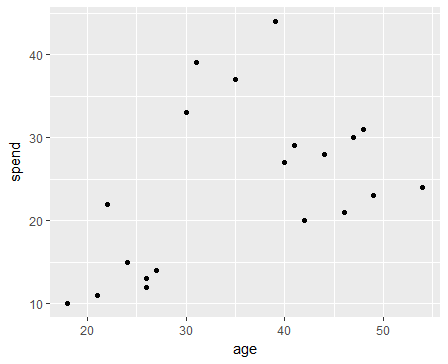
In the graph, there will be certain groups of points. In the bottom, the group of dots represents the group of young people with less money.

The topmost group represents the middle age people with higher budgets, and the rightmost group represents the old people with a lower budget.

This is one of the straightforward examples of cluster analysis. 

K-means algorithm

It is a common clustering method. This algorithm reduces the distance between the observations to easily find the cluster of data. This is also known as a local optimal solutions algorithm. The distances of the observations can be measured through their coordinates.

How does the algorithm work?

  1. Chooses groups randomly
  2. The distance between the cluster center (centroid) and other observations are calculated.
  3. This results in a group of observations. K new clusters are formed and the observations are clustered with the closest centroid.
  4. The centroid is shifted to the mean coordinates of the group.
  5. Distances according to the new centroids are calculated. New boundaries are created, and the observations move from one group to another as they are clustered with the nearest new centroid.
  6. Repeat the process until no observations change their group.

The distance along x and y-axis is defined as-

D(x,y)= √ Summation of (Σ) square of (Xi-Yi). This is known as the Euclidean distance and is commonly used in the k-means algorithm. Other methods that can be used to find the distance between observations are Manhattan and Minkowski.

Select the number of clusters

The difficulty of K-means is choosing the number of clusters (k). A high k-value selected will have a large number of groups and can increase stability, but can overfit data. Overfitting is the process in which the performance of the model decreases for new data because the model has learned just the training data and this learning cannot be generalized.

The formula for choosing the number of clusters-

Cluster= √ (2/n)

Import data

K means is not suitable for factor variables. It is because the discrete values do not produce accurate predictions and it is based on the distance.

library(dplyr)

PATH <-“https://raw.githubusercontent.com/guru99-edu/R-Programming/master/computers.csv”

df <- read.csv(PATH) %>%

select(-c(X, cd, multi, premium))

glimpse(df)

Output:

Observations: 6,259

Variables: 7

$ price  <int> 1499, 1795, 1595, 1849, 3295, 3695, 1720, 1995, 2225, 2575, 2195, 2605, 2045, 2295, 2699…

$ speed  <int> 25, 33, 25, 25, 33, 66, 25, 50, 50, 50, 33, 66, 50, 25, 50, 50, 33, 33, 33, 66, 33, 66, …

$ hd     <int> 80, 85, 170, 170, 340, 340, 170, 85, 210, 210, 170, 210, 130, 245, 212, 130, 85, 210, 25…

$ ram    <int> 4, 2, 4, 8, 16, 16, 4, 2, 8, 4, 8, 8, 4, 8, 8, 4, 2, 4, 4, 8, 4, 4, 16, 4, 8, 2, 4, 8, 1…

$ screen <int> 14, 14, 15, 14, 14, 14, 14, 14, 14, 15, 15, 14, 14, 14, 14, 14, 14, 15, 15, 14, 14, 14, …

$ ads    <int> 94, 94, 94, 94, 94, 94, 94, 94, 94, 94, 94, 94, 94, 94, 94, 94, 94, 94, 94, 94, 94, 94, …

$ trend  <int> 1, 1, 1, 1, 1, 1, 1, 1, 1, 1, 1, 1, 1, 1, 1, 1, 1, 1, 1, 1, 1, 1, 1, 1, 1, 1, 1, 1, 1, 1…

Optimal k

Elbow method is one of the methods to choose the best k value (the number of clusters). It uses in-group similarity or dissimilarity to determine the variability. Elbow graph can be constructed in the following way-

1. Create a function that computes the sum of squares of the cluster. 

kmean_withinss <- function(k) {

cluster <- kmeans(rescale_df, k)

return (cluster$tot.withinss)

}

2. Run it n times

# Set maximum cluster

max_k <-20

# Run algorithm over a range of k

wss <- sapply(2:max_k, kmean_withinss)

3. Use the results to create a data frame

# Create a data frame to plot the graph

elbow <-data.frame(2:max_k, wss)

4. Plot the results

# Plot the graph with gglop

ggplot(elbow, aes(x = X2.max_k, y = wss)) +

geom_point() +

geom_line() +

scale_x_continuous(breaks = seq(1, 20, by = 1))

What is the difference between supervised learning and unsupervised learning in Software Engineering?

Software engineering is a discipline of engineering concerned with creating software products based on scientific concepts, methodologies, and procedures. Certification in software engineering encompasses a broader range of activities such as communication, IOT networking, pre-and post-delivery support, and so on.

It is most essential to learn the difference between supervised and unsupervised learning in software engineering. This blog post will highlight few significant differences between both.

What is Supervised Learning?

Supervised learning is a task that learns from labeled training data. Training example has input variable (x) and output value(y). A supervised learning algorithm tries to find a function that maps the input variables to correct outputs. In an optimal scenario where there are no errors in the training dataset, a supervised learner can learn an exact mapping between x and y.

What is Unsupervised Learning?

Unsupervised learning is a task that discovers hidden patterns in data without the need for labels or predefined categories of items to be identified. Unlabeled data can take many forms: images and sounds often have pixel intensities and spectra, respectively; web pages contain words and text, etc. Unsupervised learning is just the opposite of supervised learning. Both input and output values are known (although not necessarily correct).

The main differences between supervised Learning and Unsupervised Learning:

The main differences between supervised Learning and Unsupervised Learning are:

Data with labels: The usage of labeled datasets is the critical difference between the two methodologies. Supervised learning algorithms use labeled input and output data, whereas unsupervised learning algorithms do not.

Accuracy: While supervised learning models are more accurate than unsupervised learning models, they necessitate human interaction to identify the data correctly.

Dependency: A supervised learning model, for example, can forecast the length of your commute based on the time of day, weather conditions, and other factors. But first, you’ll have to teach it that driving in rainy weather takes longer.

Unsupervised learning models function independently to uncover the structure of data. It’s worth noting that validating output variables still necessitate human intervention.

Complexity: Supervised Learning is a straightforward learning method usually calculated using languages like R or Python. You’ll need robust tools for working with vast amounts of data in unsupervised learning. Unsupervised learning models are complex because they require a training set to obtain the results.

Goals: The purpose of supervised learning is to predict the results of new data. You know what to expect from the start. The purpose of an unsupervised learning algorithm is to derive insights from enormous amounts of further data.

Application: Spam detection, sentiment analysis, weather forecasting, and pricing forecasts are just a few of the applications for supervised learning models. On the other hand, Unsupervised Learning is well suited to anomaly detection, recommendation engines, customer personas, and medical imaging.

Why Enroll in SCBI Program at Imarticus Learning

With a rigorous training schedule devised by industry professionals, a student will master new-age software engineering technologies, including Cloud, Blockchain, and IoT networking.

software engineering coursesThe certification in software engineering course will help manage students’ real-world challenges, understand software design fundamentals, and learn vital skills.

The software engineering certificate course allows students to gain practical experience by working on various projects inspired by prominent corporations and real-life scenarios.

Some course USPs:

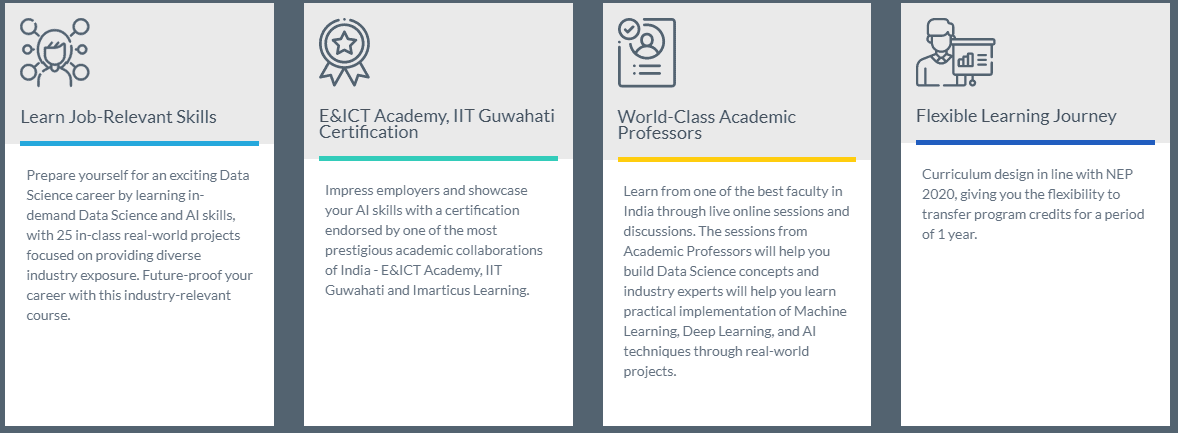
  • The Software engineering certificate course lets the students learn job-relevant skills that prepare them for an exciting Software Engineering career.
  • Impress employers & showcase skills with a certification endorsed by India’s most prestigious academic collaborations – E&ICT Academy, IIT Guwahati, and Imarticus Learning.
  • World-Class Academic Professors to learn from through live online sessions and discussions. This will help students understand the practical implementation with real industry projects and assignments.

Contact us through the Live chat support system or schedule a visit to training centers in Mumbai, Thane, Pune, Chennai, Bengaluru, Hyderabad, Delhi, and Gurgaon.

What is a Scrum Master Course?

Almost 75% of companies are reported to use Agile methodology and approaches one way or the other. These companies successfully adopted agile methods to drive profits and save time. It is essential to learn, understand and implement agile approach wherever necessary.

Scrum:
Scrum is one of the ways how the agile approach can be taken forward. Scrum is a framework that helps teams to work efficiently and collaborate freely. Scrum helps in encouraging groups to self-organize while working on an issue, learn through new experiences and continuously improve efficiency. Scrum is not only useful in software development, but the ideas of Scrum can be implemented in other industries as well.

What is Scrum?
In the Scrum framework, the critical aspect is speed; hence there is Backlog of implementable product/service enhancements. In each Sprint planning (generally 14 days) the upgrades that are on priority and need are taken forward and worked on. Each day of that sprint “Daily Scrum” meetings take place where the project updates are discussed, and issues are addressed. This is continued in every sprint, and the cycle continues.

To handle all these efficiently, a Scrum Master is needed who will contribute, promote and support the team.

Scrum Master:
Scrum Master is the member of a Scrum Team who is responsible for the team to follow the scrum framework. Scrum Masters help them pursue this by training them on the Scrum theory, practices, rules and values. The Scrum Master works in servant-leadership style where it is necessary to provide service to others, promote community behavior, holistic work approach, shared decision-making power.
Scrum Master also helps in communicating the information that is needed in the daily scrums to the people outside the Scrum. They are also responsible for driving the conversations to maximize the impact during the scrum meetings.

There are various roles a scrum master usually plays. They provide services to the
1. Product Owner: Scrum Master helps the product owner by ensuring that the team understands the product owner’s goals, product domain scope. They will help in understanding product planning, ensure product owner to arrange product backlog for efficiency. They will also help in providing the addition of new enhancements in the Backlog.
2. Development Team: Scrum Master helps the development team to produce high-value products, removing any obstacles in team’s progress, facilitating failed scrum events and rescheduling the same. They are also helpful in coaching the team to self-organize and cross-function. They are also useful in deploying the Scrum Framework in teams that don’t follow the same.
3. Organization: A Scrum Master plays a significant role in coaching and training organizations to adopt Scrum. They help in planning Scrum adoption within the organization, helping individual employees to understand/implement Scrum, Increasing efficiency through meaningful changes in the process.

Scrum Master Course:
A Scrum Master has umpteen responsibilities, which we have seen above when it comes to an efficient application of the Scrum Framework. A Scrum Master Course is essential to achieve this training to be an effective Scrum Master. This course will help you get the holistic approach on how to implement the Scrum Framework Effectively. Scrum Master Course opens up avenues to new job opportunities not only in the IT industry but also in many diverse sectors. A Scrum Master course is helpful for any employee/Professional who is interested in working in an agile environment.
Scrum Master Course also helps in becoming an Agile Coach which opens up more opportunities. A Scrum Master Certification is useful not only for new career opportunities but also to boost the growth in the career trajectory.

What Are The Resources to Learn Data Science Online?

What is Data Science?
In the modern digital era, data is at the heart of every business that relies on the use of technological solutions to boost customer experience and increase revenue. The decision-making process has changed after the advent of data science. Businesses no longer work on assumption; they are using complex data analysis to obtain valuable insights about the market and consumers. So what exactly is data science and how does it work to further business objectives?

Well, data science can be simply explained as a discipline that deals with data collection, structuring and analysis. It involves the use of the scientific process and algorithms to obtain valuable insights from seemingly irrelevant pieces of information. Big data is at the centre of data science. Let’s delve deeper into why you should consider learning data science.

Why Learn Data Science?

The demand for data science professionals is ever increasing as more and more companies are deploying data science to obtain deeper insights.

Data Science Course OnlineThe demand for data science course online is also growing as more individuals are lured in towards the lucrative career prospects offered by this industry. There are numerous reasons to learn data science in the contemporary landscape.

The first and foremost is the outstanding remuneration offered to data science professionals. This is partly because data science is still in its nascent stage and there is a scarcity of trained professionals in this industry.

However, the demand for data science professionals by companies is on an upward trend.


In addition to this, the role played by data science professionals is very crucial for businesses as it involves analysing valuable company data to obtain insights and make predictions regarding the market.

Let’s explore how you can easily get trained for data science online.

Resources to Learn Data Science Online
Online learning is the new norm, the benefits of this method of learning is enormous. Moreover, the online courses are designed in such a way that it caters to specific training needs of individuals and there is no irrelevant content included in the courses. It is also feasible for people who are already working at a job and have limited time to learn a new subject. Here are a few resources that can help you learn data science online with ease and in a limited budget.

Google’s Machine Learning Crash Course

The machine learning technology is being extensively used by companies to cater to a growing audience base. Google’s Machine Learning Crash Course is designed for everyone; it doesn’t require you to have any prerequisite knowledge regarding the subject. Even people who have some knowledge in the field can opt for this course as it focuses on important concepts like loss functions, gradient descent, etc.

In addition to this, you will also learn about presenting algorithms from linear regression models to neural networks. The course learning materials include exercises, readings, and notebooks with actual code implementation using Tensorflow.

In addition to this crash course, you will also have access to a plethora of learning materials on data science and AI. These learning materials include courses, Practica, Guides and Glossary.

Imarticus Learning’s Data Science Prodegree

If you are looking to make a professional career in the field of data science then the data science course offered by Imarticus Learning is surely the best way to learn data science. The best thing about this course by Imarticus is that the knowledge partner for this course is KPMG.

This data science course takes a comprehensive approach towards learning data science and covers topics such as R, Python, SAS Programming, Data visualisation with Tableau, etc.

Data Science And Machine Learning Course with iHUB DivyaSampark @IIT Roorkee

Data science is a competitive field and to be successful you need to master the foundational concepts of data science. Imarticus Learning has created a 5-month data science program with iHUB DivyaSampark @IIT Roorkee. It will equip you with the most in-demand data science skills and knowledge that will help you to pursue a career as a data scientist, business analyst, data analyst and data manager. It features a 2-day campus immersion program at iHUB Divyasampark @IIT Roorkee and is delivered by top IIT faculty through live online training. Through this program, you will also get an opportunity to showcase your startup idea and get funding support.

In addition to this, the course trains individuals using industry sneak peeks, case studies and projects. The capstone projects allow individuals to work on real-world business problems in the guidance of expert project mentors. Upon the successful completion of this course, you will also receive a certification by Imarticus learning in association with Genpact. In addition to all this, you will receive interview preparation guidance and placement assistance.


Ecosystems of Smart Technologies like Cloud, Blockchain and IoT in New-age Software Engineering

In this technological era, new technologies are disrupting the traditional ways of software development. Software engineers create applications according to user requirements. Nowadays, businesses need software applications that incorporate new-age technologies like cloud and blockchain.

Many software development companies are facing a shortage of engineers that are experts in new-age technologies. As a result, they cannot fulfill the software requirements of their clients. Young aspirants who want to build a successful career as software engineers should be familiar with new-age technologies. Read on to know more about new-age software engineering.

Role of cloud in software engineering

Many software engineers are shifting to the cloud for better data storage solutions. Cloud ecosystems for software engineering are highly scalable. With the cloud, software engineers can scale any portion of an application with ease. Businesses also outsource their application requirements to cloud software engineers to slash costs. Businesses spend a lot on computing requirements and physical data storage solutions that can be stopped with cloud-based software engineering.

Cloud offers great compatibility with additional resources. Virtual machines and databases can be quickly created via cloud-based software engineering. Businesses don’t have to rely on a physical data centre to host application software. With the cloud, one can host application software from anywhere in the world. Cloud also allows businesses to deploy codes and databases with ease via automated builds. Software engineers that know cloud computing can earn a lucrative salary in today’s scenario.

What is blockchain software engineering?

Blockchain ecosystems are used by software engineers to create next-gen software applications. Blockchain is a decentralized technology that can create an irreversible sequence of data. Blockchain offers transparency in data transfer along with maintaining security standards.

Blockchain developers create software applications that offer high transparency in data transfer. Any record in the database of application software can be viewed easily if it is developed using blockchain. Data can easily be transferred between peer-to-peer networks with blockchain.

Businesses prefer blockchain-based applications as their data will be replicated and stored in numerous systems. A blockchain-based software application will check the requirements before processing a validation. The records of the software application will be highly secure with blockchain and can be viewed by anyone. Along with better data transfer, a software application will also be highly secure with blockchain. Blockchain developers will be in huge demand for the coming years for new-age software development.

Use of IoT in software engineering

IoT (Internet of Things) is making headlines due to smart sensor devices in the market. Many businesses need software applications that are compatible with IoT. IoT-based software engineers can make automated decisions and save time. With IoT, the communication between software applications can be enhanced. From data processing to intuitive user interfaces, IoT has a huge role in new-age software engineering.

How to learn new-age software engineering?

Young aspirants can go for an online certification in software engineering offered by a reputed EdTech platform. Imarticus Learning is offering a Certification in Software Engineering for Cloud, Blockchain, and IoT that can be beneficial for young enthusiasts. This course is offered by Imarticus in collaboration with the E&ICT Academy from IIT Guwahati. All the aspects of cloud, IoT, and blockchain for software engineering will be discussed in this course. Students will also learn via real-life projects related to new-age software engineering.

Conclusion

Software engineering can be more productive with new-age technologies like cloud and blockchain. An industry-oriented certification in software engineering can help young aspirants in learning more about new-age technologies. Imarticus provides excellent placement support for its software engineering course. Start your new-age software engineering course now!

Explore Continuous Professional Development with This Most Sought-After Business Administration Program

Business operations and administration are currently thriving. Students who wish to become professionals in these fields can invest in a BBA program. These programs offer specializations in FinTech, banking, general management, equity research, financial modeling, and more. After BBA, programs like a Master of Business Administration can ensure that students gain enough knowledge to continuously excel in their careers.

Ensure Career Growth and Development

In the field of business, growth is achievable, but employees need to strategize properly. There are certain aspects that help to improve in their roles, try new positions, and excel in their field. Here are a few strategies and techniques that can help in professional development.

  • Networking

Building a network is one of the most basic and important steps in advancing one’s career. Students can begin interacting with industry experts who can guide them and help them find new ideas. Staying connected is necessary for every aspect. As employees, it is important to attend industry events and interact with other participants.

  • Mentorship

Mentorships help to understand professional roles and advance quickly in the field. Academic mentors help students recognize their potential and areas of interest. In the professional sphere, employers can organize mentorship programs for new employees or candidates who are preparing for new opportunities.

  • Industry Expertise

For students who wish to excel in a particular field, it is necessary to understand the industry completely. Every industry requires specific skills and knowledge. This helps to improve communication and provides a better understanding of all processes involved in the industry.

  • Develop Leadership Skills

Leadership skills are essential if one wants to excel in the field of business. The best way to ensure the development of such skills is to take on more responsibilities. Candidates and employees should be vocal about their skills and how they can use them for the business to function better. If employers see managerial and leadership skills, it will help employees rise up the ranks faster.

  • Ask for Performance Reviews

Constructive criticism and performance reviews matter in every field. Mentors assist in this aspect. As students, reviews help to understand which areas need more attention. In the workspace, constructive feedback allows employees to assess their skills and improve. Proper reviews in a professional space help employees figure out a plan that will help them achieve certain goals.

  • Educational Advancement

Businesses are changing the way they function and candidates need to stay focused on the new trends. The easiest way to do this is to invest in advanced educational skills. Furthering one’s education helps in self-improvement. It also aids in introducing new practices, handling hardware and software applications, and proves an employee’s worth to the employer.

To learn and excel in the above-mentioned aspects, a BBA online course can help. Institutes like Imarticus Learning assist students in developing the necessary skills that will benefit them as professionals.

How Can a Business Administration Program Help in Professional Development?

The commercial field is extensive and has multiple scopes for advancement. A business administration program allows students to understand every aspect of business operations. Imarticus Learning offers a BBA in Banking and Finance which provides practical knowledge and hands-on experience. Students who graduate can go on to complete a Master of Business Administration degree.

The program incorporates new technologies like Big Data, IoT, Cloud Computing, Machine Learning, AI, RPA, API, and Blockchain. The unique program also provides career support. Students learn all relevant skills that will help them become better professionals and use the necessary new-age technologies in every aspect of the business.

BBA in Finance and Banking from Imarticus Learning provides a curriculum that is approved by industry experts. The institute also offers industry partnerships. Students can benefit from this holistic approach towards business development and go on to steadily advance in their profession.

Roles of a Certified Investment Banking Operations Professional in Mergers & Acquisitions

Investment banking has become one of the most coveted fields when it comes to making a career. There are several career opportunities in Investment Banking. You can now take up several investment banking courses with placement.

With a certification, you become a certified professional in Investment Banking and its operations. While all the related fields are essential, some areas are more lucrative than others. Mergers & Acquisitions is one such field.

Role of a Certified Investment Banker in Mergers and Acquisitions

 A certified professional has a lot of value when it comes to Investment Banking. If a person wants to get into Mergers and Acquisitions, certification is very important as it adds to the person’s credibility. Nowadays, there are investment banking courses with placement. You can take them up to become a certified investment banking operations professional or an investment banker. There are several roles that an accredited investment banker plays:

  1. Valuation

 Currently, several companies are expanding by acquiring smaller companies. This calls for calculating the fair value of the company. This can only be done by a certified Investment Banking professional. These people are experts in calculating the worth of the business.

  1. Understanding the Buyer-Seller Dynamics

 During a merger and acquisition deal, the professional needs to study the market and then recommend the way forward to both the buyer and the seller. Several strategic ideations have to be done before the deal is finalized. All of these ideations are done by a certified investment banker. Also, a qualified professional is needed to prepare the Selling Memorandum, which is a detailed sales document.

  1. Financing Provision

 In any merger and acquisition deal, a lot of money is involved. The funds can be arranged either by selling shares or by debt financing. All of these complexities are handled by a certified Investment Banker. An investment banker also advises the parties to use any other securities present in the market. They are also called market makers as they are involved both with the seller and the buyer. Only an investment banker can analyze the price that will work for the new issues in the market. 

  1. Financial Modelling

 Financial Modelling is vital to value debt and equity during mergers and acquisitions. Several valuation methods are needed during a merger and acquisition. A certified professional in Investment Banking is equipped to perform financial Modelling.

There are several other roles of a certified investment banking operations professional. There are several career opportunities in Investment Banking that individuals can explore. You can explore and decide your niche.

 Relevant Skills Required to Become a Certified Investment Banking Operations Professional

A professional involved in mergers and acquisitions is expected to be skilled enough to perform varied roles. Some relevant skills and knowledge that is expected from a certified professional are:

  • A relevant degree to substantiate that the person will perform all the functions needed during a merger and acquisition.
  • At least a Bachelor degree from a recognized school or university
  • Should have the ability to work in a fast-paced and a dynamic environment
  • Should have strong communication skills
  • Should have an analytical bent of mind
  • Must have a solid logical reasoning skill

 Conclusion

Imarticus Learning is known to provide professional courses in Investment Banking. If you opt for these courses, you will become well-versed with what goes into becoming a successful investment banker who can manage mergers and acquisitions without any hassle. A certified Investment Banking Operations Professional is expected to be abreast with everything that goes around in the industry. Only then he can ace the job he is into.

What Business Problems Do Agile Analysts Solve?

Analysts play an important role in solving business problems and ensuring business continuity. From choosing the right investment opportunity to the right marketing strategy, analysts help in making strategic business decisions. There are many types of analysts that work in the industry like financial analysts, agile analysts, sales analysts, etc.

Each type of analyst has its roles and responsibilities that help in the growth of a business. Young enthusiasts always look for business analyst certification courses that can help them in becoming successful analysts. Let us know about the role of agile analysts and how to become one.

Role of agile analysts 

The primary aim of an agile analyst is to solve any problem faced by the business that can hamper its continuity. However, let us delve deeper to find out the specific job responsibilities of an agile analyst. The roles of agile analysts are as follows:

  • An agile analyst evaluates the current IT system and infrastructure in the organisation. Most organizations are digitally transforming and it is necessary to have the right technology to complete business processes.
  • An agile analyst is not only concerned with the technology used within the organisation. It also tries to enhance the communication between shareholders and the production teams. Businesses should produce services and goods as per the demands of customers and investors. Agile analysts help businesses in meeting the expectations of customers and shareholders.
  • Agile analysts focus on the result of a project or a venture. They are not worried about maintaining every single detail about the project as they see the project as a whole. Agile analysts make sure that the employees have the suitable resource to complete a project on time.
  • Whenever market disruptions occur, a company has to adjust to the changes for maintaining continuity. Agile analysts help companies in adjusting to changes and steering through market challenges. For example, the recent COVID pandemic fuelled the demand for expert agile analysts that could ensure business continuity.

How to become an agile analyst?

How to start a business analyst career when you have no idea of the industry practices? Well, business analyst certification courses can help in learning the job skills of an agile analyst. Unfortunately, physical institutions do not offer a certification course for business analysts.

They offer a complete degree program in which agile analysis can be a subject. If someone has no time to go through the entire degree program, they cannot learn agile analysis. Also, the recent pandemic has led to the suspension of physical classrooms.

In these times, students are choosing EdTech platforms to learn business analytics. You will have to choose an industry-oriented online course to learn business analytics.

Imarticus Learning offers a complete PG Program for Agile Business Analysts that can help you in learning industry skills. The benefits of opting for the PG program by Imarticus are as follows:

  • Imarticus will provide strong placement support to kickstart your career as an agile analyst. You can choose to pay for the PG program after being placed.
  • The PG program is endorsed by IIBA (International Institute of Business Analysis). Not only will you gain a globally recognizable certificate but also learn from industry experts.
  • You will work on numerous practical projects and business role-plays during the PG program for a better learning curve.
  • You will learn quickly via case studies and peer-to-peer discussion in this PG program.

Conclusion

Business analysis is essential in the current scenario when market disruptions are hard to predict. Besides searching ‘how to start a business analyst career’ on the internet, start learning job-relevant skills. Start your PG program with Imarticus now!

Must-haves of an Average Machine Learning Certification to Become a Machine Learning Architect

ML (Machine Learning) is one of the most popular modern-day technologies. You must be aware of the applications of data science in retail, e-commerce, education, and many other industries. New-age technologies like ML and AI (Artificial Intelligence) form the base of data science operations. Many companies around the world have invested in adopting an ML strategy for their organization.

ML job roles like machine learning architect are widely popular among young enthusiasts. Young enthusiasts look for artificial intelligence and machine learning courses that can help them in launching a successful career. Read on to know about the must-haves of an ML certification course.

Importance of learning machine learning

The importance of learning machine learning in 2021 are as follows:

  • More and more businesses are inducing automation in their daily operations. Manual labor is being replaced by automated machines in the industry. However, for designing intelligent machines and algorithms, ML skills are required. The demand for skilled ML engineers is expected to increase exponentially in the coming years.
  • ML is a versatile modern-day technology used by many public sectors and industries. Smart ML algorithms are used in the regulation of public services like transportation, legal, healthcare, and education.
  • Since ML is a modern-day technology, there is a shortage of skilled ML architects/engineers in the industry. ML job roles in the industry offer lucrative salaries to ML professionals because of the expertise they bring to the table.
  • Machine learning is usually not used alone for industrial processes. Machine learning is coupled with other technologies like AI and deep learning to enhance productivity. You can also learn other new-age technologies by choosing a machine learning certification course.

Where to look for a machine learning certification course?

Colleges in India don’t provide a machine learning certification course. Generally, machine learning is a subject in any particular semester of a traditional degree program. Students cannot go through the entire college degree program if they just want to learn ML.

artificial intelligence and machine learning coursesOnline training is the best means of learning machine learning and AI. Also, online training is more accessible considering the scenario of the COVID pandemic.

Must-haves of an ML certification course

Want to become an ML architect? Choose an ML course that offers the following:

  • Machine learning is implemented for industry processes with the aid of several tools and technologies. Choose a machine learning/artificial intelligence course that covers tools/technologies like Pandas, Spyder, Colab, TensorFlow, NumPy, OpenCV, Python, and Jupyterhub.
  • The machine learning/artificial intelligence course should be endorsed by a reputed institution or EdTech platform. There is no point in wasting your money on an ML certification that is not recognized globally.
  • Besides covering the basics of machine learning and artificial intelligence, the online course should also cover other technologies that are used together. For example, technologies like deep learning and NLP are used with AI/ML.
  • Besides offering theoretical classes, a machine learning course should also provide an opportunity to work on real-life projects. Artificial intelligence and machine learning courses should also offer practical learning to enthusiasts.

 Which is the perfect course for ML enthusiasts?

 The Certification in Artificial Intelligence and Machine Learning by Imarticus Learning is the perfect ML course in 2021. This course is endorsed by IIT Guwahati, one of the top institutes in the country. This course will follow an industry-oriented syllabus that will help in knowing about the common industry practices. You can also opt for a demo class before choosing the ML certification course.

best artificial intelligence and machine learning courses from E&ICT Academy, IIT GuwahatiIn a nutshell

Getting an ML certification can boost your chances of getting placed in some of the top companies. You will also be in demand for the coming years by gaining an ML certification. Start your ML/AI certification program now!