Intro To Tensorflow For Deep Learning Courses

Intro To Tensorflow For Deep Learning Courses

Deep learning uses artificial neural networks to teach computers how to learn from data. This approach differs from other types of machine learning – it is not just about finding patterns in data, but understanding the meaning behind those patterns.

Deep learning systems can be trained to perform image recognition, speech recognition, and text analysis tasks. They are increasingly being used for tasks such as automated driving, where they can help vehicles navigate safely through complex road conditions. 

The significance of deep learning is that it allows machines to learn without being explicitly programmed for every possible situation they may encounter. Deep learning is a subset of artificial intelligence (AI) that allows computers to learn without being explicitly programmed. It’s a powerful technology that has been used to develop computer vision, speech recognition, and natural language processing systems. 

Deep learning builds upon previous machine learning methods by using multiple layers of neural networks to learn patterns in data automatically. To achieve this, deep learning algorithms must be trained on a large volume of data with labeled examples. This will help them determine which features are relevant to making accurate predictions about the outcome. 

Deep learning has been around for about 30 years, but it has gained steam in recent years with the advent of tools like Google’s TensorFlow, an open-source framework for deep learning. Deep learning uses artificial neural networks, which are computer programs designed to mimic the way neurons in the brain fire and communicate with each other. The neural network can be trained using large sets of data, and once it has been trained, it can then be used to predict or classify new data.

Deep learning differs from traditional machine learning in that it allows computers to grasp new information by processing large amounts of data at once instead of using rules-based algorithms.

The significance of deep learning is hard to overstate. It’s already being applied in fields as diverse as medicine, transportation, and finance. It is expected to become more ubiquitous as researchers continue to figure out how it can be used to solve problems that have long proved difficult for humans alone.

Deep learning refers to algorithms that use one or more hidden layers of neurons between input data and output data. These algorithms are also known as “deep neural networks” (DNN). Deep learning has been very successful in some application areas, such as image recognition, speech recognition, natural language processing, and reinforcement learning. 

Now that we know what deep learning is, let us understand its implications with Tensorflow.

What is Tensorflow? 

TensorFlow is a library for machine learning and deep learning, providing a high-level API built on top of low-level routines that implement the actual neural network computations.

The high-level API allows us to express our model in a declarative style.

In TensorFlow, we can create models from scratch or use existing ones as building blocks. We can then train them with data, validate their behavior, and even deploy them to production seamlessly.

Tensorflow is open-source software developed by Google that implements the TensorFlow deep learning framework. Deep learning and TensorFlow are closely related because deep learning relies heavily on TensorFlow and its capabilities. Tensorflow was created to help developers build and train artificial neural networks that can learn how to identify objects or voices based on their visual characteristics or sound patterns.

The system is currently used in many of Google’s services, such as Google Translate and Google Photos. TensorFlow is also used by other companies, like Dropbox or Twitter.

It emphasizes automatic differentiation, which allows for defining complex models in a short time. TensorFlow supports CPU and GPU computation, making it a good choice for researchers who want to take advantage of the latest GPUs with CUDA support.

TensorFlow is a flexible and easy-to-use system that can run on a single computer or across multiple computers in a cluster. TensorFlow was originally developed to support distributed training of machine learning models, but it also has non-distributed applications such as data analysis and visualization.

So far, neural networks have proven very effective at solving problems in many fields, from computer vision and speech recognition to stock market predictions. Neural networks are designed to imitate how the human brain processes information and learns from the data we provide it.

To learn more about TensorFlow and its application in artificial intelligence and machine learning, enroll in the best course offered by Imarticus learning. Get the best course guidance and execution strategies to kickstart your data career. Contact us through chat support, or visit us at our offline stores in major cities across India.

Why are management development programs competitive differentiators in 2022?

Why are management development programs competitive differentiators in 2022?

The role and importance of personnel training have never been sufficiently acknowledgedevelopment programsd. This seems set to change.

Increasingly, employees value the avenues for Learning and Development (L&D) provided in an organization to be a key factor in their choice of a business to work for.

The competition for top talent is intense and is set to heat up further. A recent study found that in 2022 and onwards, L&D and management development programs are set to provide businesses with competitive differentiation across industry sectors.  

The key findings of the study include:

  • A majority (67%) of HR teams have been provided with an enhanced L&D budget in 2022
  • Nearly half (46%) of businesses have specific training programs for fresh inductees
  • A significant majority (77%) of HR managers plan to pursue life skills training within the next year
  • 42% of HR managers plan to run customized programs for the re-entry of former employees

The findings of the study, specific to employees, include:

  • There is a high level of satisfaction (75%) among employees about L&D programs in their organizations
  • More employees(76%) are likely to continue in organizations that offer opportunities for continuous learning
  • Many(55%) employees felt that additional training would help them improve their performance
  • 38% of employees opined that training needs to be aligned with the responsibilities of their roles
  • Nearly half the employees, in addition to workplace training, nearly half the employees also pursued training through outside agencies


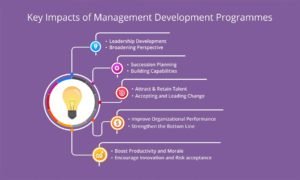
It is quite evident from the study findings that corporate learning and development programs are slowly gaining their deserved place in the spotlight. The availability of management development programs is a key benefit sought by current and prospective employees. Management development programs provide competitive differentiation, and this trend is poised to gain further momentum.

Personalization of L&D

Modern workplaces are global and are characterized by diversity in races, genders, religions, regions, sexual orientations, etc. A cookie-cutter approach to training would not work in such circumstances. For example, if an online sales training course were to be conducted. In that case, the millennials and Gen-Z might be comfortable with digital tools for delivering training, but the older lot might feel intimidated. Progressive organizations recognize this and are personalizing training based on the generation to which the employees belong.

Impact on Retention

According to the above study, most employees (76%) said that learning opportunities would motivate them to continue working for the organization. Training benefits the organization because trained employees with higher skill levels will deliver superior work. Training also benefits the employees by elevating their professional standing due to their enhanced skill level resulting from workplace training.

Increased Effectiveness

For training to be effective, it needs to be relevant to the employee’s role, needs continual updates, the curriculum developed needs to incorporate employee inputs, and should be broken into shorter sessions.

When employees have a say in the curriculum, training is not delivered just to tick some boxes. Allowing employee participation signals that the organization truly cares for the employees’ opinions. As the study found, if the employees perceive training to be ineffective, they will seek training outside the organization, which could adversely impact retention.

Final Thoughts

Increasingly, businesses are partnering with specialized L&D service providers such as Imarticus Learning. Such partnerships provide cost savings, increased efficiency, and a significant competitive advantage.

corporate training and development programsImarticus has trained, through its corporate leadership development programs, over 35,000 professionals from leading firms such as IBM, KPMG, Genpact, Moody’s Analytics, Motilal Oswal, etc., to name a few.

Managed learning services partnerships are on the rise. Such specialized services help businesses stay current with the developments in their industry and gain a competitive edge in today’s hyper-competitive business environment.

How a Training Program can Refine Your Capital Markets Knowledge

How a Training Program can Refine Your Capital Markets Knowledge

Introduction 

The capital market is an important contributing factor to the sustainment of an economy. This blog explains the importance of capital marketing courses and their role in the life of young aspirants who aspire to be inside the capital market. Initially, the definition of capital market is given along with the types of capital markets. Apart from that, the five main instruments of capital marketing are explained, and the importance of capital marketing courses and PGDM courses in financial management are given at the end.

What is the capital market? 

Capital markets are where savings and investments are traded between buyers and suppliers. It refers to the trade-off between the suppliers such as the banks, investors, and those seeking the capital- organizations, government institutions, or individuals. These are venues where the exchange and trade of capital occur between suppliers of the capital and those who demand the capital. The capital can be funds, shares, stocks, bonds, etc. Capital markets generally seek to improve the transactional efficiency in a market. 

Capital marketing occurs when the suppliers and users of the capital exchange fund. The suppliers are the institutions (government or private) like pension funds or retirement funds, charitable funds, insurance funds, and other non-financial companies. The users of the funds are purchasers (home or motor vehicles), government organizations that invest in infrastructure and operating expenses, and other non-financial firms. The capitals that are sold are equities (like stocks) and debt securities(such as bonds). Capital markets act as a link between the investors and traders or savers, providing them with a place to exchange securities

Types of Capital Market 

Capital markets are broadly classified into primary & secondary markets. 


  • Primary markets: Primary markets involve new securities in the trade-off. Companies that sell their Initial Public Offerings(IPO) trade in Primary Markets. The trading activities and other issues in Primary markets are subject to strict rules and regulations. Companies must not only file their statements under Security Exchange Commission (SEC) and other security agencies but also wait for their approval. They can go ahead with the proceedings further, only if the SEC approves their statements. The main functions of primary markets are origination, underwriting, and distribution. 


  • Secondary Markets: Secondary markets are where previously issued securities are traded off in the market. The security agencies and the SEC generally oversee the trade happening in secondary markets. The main functions of the secondary markets are: offering liquidity to investors, active trading, telling you the value of security, etc. Most small investors participate in secondary markets. 

Instruments traded in the capital market 

The five most important instruments traded in the capital market are : 

    • Equities: refer to an investment in the company’s equity stock, after which the investor becomes a shareholder of the company. 
    • Derivatives: They are financial instruments whose values depend on the underlying assets. 
    • Exchange-traded Funds: Financial resources of investors used to buy shares, bonds, derivatives, etc. 


  • Debt securities: These are major financial assets whose owners are entitled to a stream of interest payments. 


  • Foreign exchange instruments: Foreign exchange instruments are financial instruments represented in foreign markets that consist of currency agreements and derivatives. 

Capital markets are one of the important factors that contribute to the economy. Trading capital among different ventures, firms, and investors keeps the economy running. However, one should have a clear understanding of the capital markets. There are capital marketing courses that will prove to be of extreme help if you are looking to understand how the capital market runs. 

Capital marketing courses will boost your knowledge of capital markets as these markets finance the economy and provide financial and economic stability. They form the most vital part of economies based on the market. 

To stand out tall and successful in the capital market, it takes a high level of skill, knowledge, training, and experience to understand how the market runs, due to which capital marketing courses are essential. 

Courses like PGDM in Finance Management will help you sustain yourself in the capital market. Capital marketing courses will also teach you mathematical, financial, and economic theories related to the capital market. 

Apart from these courses, you can sharpen your knowledge of important financial products such as equity and derivative products, fixed income products, and foreign exchange by undergoing capital marketing courses. 

The capital markets’ professional certificate that you will get after completing the courses will carry a vast weightage and importance in the capital market. We, at Imarticus, provide advanced courses collaborating with IIM Lucknow, one of the leading institutions in India. Our advanced management program will give you a clear understanding of the market and strengthen your skills. 

Visit our website here- Imarticus for an application to make your dream come true. Or you can connect with us through our centers and chat support. If you want to understand more about the program in person, please visit our training centers in Mumbai, Thane, Pune, Chennai, Bengaluru, Delhi, and Gurgaon. 

Power up with a micro-credential in data analysis with a tableau course in 2022

Power up with a micro-credential in data analysis with a tableau course in 2022

Like W. Edwards Deming once said, “Without data, you’re just another person with an opinion.” Data is the future and the driving force of today. They say knowledge is power and data is knowledge. It is the information that reforms civilizations and fabricates unfathomable technology, propelling whoever uses the insights data extracts strategically into leading positions.

It is the fuel that is running the world today and building a scientifically maneuvered tomorrow. Data hold answers to the most complex disciplines and gives you the power to back your opinion with evidence-based analysis. In a world continually engaged in cutthroat competition, data is the only differentiator. The interpretation of data is a powerful instrument that steers every decision that is made today. 

What is data analysis?

Data analysis is a systematic approach governed by logical and statistical techniques that help in the extraction of insights via gathering, modeling, and inspecting data to pilot informed conclusions and factually accurate decisions. It helps you collect relevant information and identify the pain points to come up with viable solutions depending on your field of work. 

What is a micro-credential?

If you are someone who wants to upskill without devoting the time and cost it needs to commit to a full degree, then micro-credential is an option that will most definitely interest you. Devised to provide you with the resources be it theoretical or practical, micro-credentials cater to your specific requirements to advance your skills. Micro-credentials act as independent credentials adding to your academic merit. 

What is tableau

Tableau is an intuitive, visual analytics computerized program that helps in easing the process of analysis by converting big data into simpler and more accessible forms. It turns complex data into a smaller version that is easily comprehensible and gives accurate insights into the small data at the same time. 

With data at our fingertips, the influx of it has been high and businesses around the world need a system that is easier to operate while giving an interactive experience to the users. It has become instrumental in inspecting data all while giving a deep intuitive understanding of it. 

Why Tableau 

This visual tool has become an integral part of corporations and its easy-to-use design has propelled companies to expand their business using this software. Not only is it detail-oriented but also gives you an in-depth knowledge of the steps you need to take to augment your project. 

The success of corporations today depends on data visualization and examination. These prerequisites present your opportunities to practically apply your skills and create a promising career. As businesses expand, the inflow and need to explore and interpret larger numbers of data will increase. 

Tableau career prospects

Here are the diversified career options you can choose from after completing the course:

  • Data analyst
  • Business intelligence analyst
  • Tableau consultant
  • Business intelligence manager
  • Business analyst
  • Business intelligence developer

Why choose a micro-credential in data analysis with a tableau course 

From the complexities of linear regression to linear discriminant analysis, the tableau course covers all the essentials you need to transform you into an expert in this field. 

  • Higher employability – As the world advances, data has become the oil that drives the corporate world into expansion. The demand for analysts to collect, clean, model and inspect data to give viable solutions in tandem with their augmentation plans has become a necessity. The program comes with guaranteed job interviews  opportunities apart from transforming you into an adept data analyst. Certification in data analytics course also helps you in upskilling and venturing into your own line of innovation.

  • Job-relevant skills – The course familiarizes you with theoretical as well as practical knowledge that ensures you develop job-relevant skills. Mentored and guided by industry experts and professionals, you get to participate in real-world case studies and projects.

  • Extensive support – The course focuses on the development of every single individual enrolled in the program and assists them every step of the way from preparing them for placements, workshops, mock interviews, and providing expert career guidance. 

Conclusion

Our micro-credential in data analysis with a tableau course covers the crux of the topic as well as its complexities of it so that you can provide real-time solutions to clients and establish a successful career in this profession. As someone proficient in developing tableau and extracting detailed cognizance from it, you can aid businesses excel and creating futuristic solutions for corporate problems. 

6 technologies to modernize your Learning and Development Programs

6 technologies to modernize your Learning and Development Programs

The recent rise in demand for online methods in work, education, and business has led to radical changes in technology to facilitate these transitions. Organizations are now using new and innovative methods and technologies to work remotely without affecting employee productivity or business continuity.  

Modernization 

training and developmentMost learners today are of the ‘Y or Z’ generation – those who have grown up with the Internet, have access to school, and are early adopters of new technologies. They expect to learn through high-tech platforms.

Technology has rapidly changed the type of skills that are critical to employee and company success and the success of today’s Learning and Development (L&D) programs.

Gradually, L&D professionals are taking advantage of their cross-functional skills, from designing, launching, and managing their programs, from data analysis to digital marketing.

Here are six technologies to make the education and development industry our institution to meet the challenges of modernization.

[1] Video-rich courses

Video content is a more efficient and convenient option in online training programs. Videos transmit a lot of information in a very short period of time. This trend marks a sudden increase in the online streaming space through the new millennium. New training technologies, tools, increased network bandwidth, and wider access to the Internet have enabled organizations to create key-shaped and attractive learning modules. Advanced video-based training programs can also be used in traditional and mixed settings. Learners who are accustomed to video conferencing training tools expect video-based content. 

[2] Mobile learning

The widespread adoption of mobile phones and smart devices is encouraging organizations to take advantage of mobile learning technology to train their employees. Mobile learning has become the most traditional means of reaching out to extended employees, who are more technology-savvy and digitally connected. Mobile learning enables students to take small-scale courses without being limited to a specific time and place, leading to higher absorption and retention rates of knowledge. 

[3] Automation and adaptive learning

The analytics features provided in the Learning Management System (LMS) make it easy to automatically identify learners’ preferences and needs and customize their e-learning experience accordingly. Algorithmic solutions evaluate the user’s knowledge and automate the objectives of the skills learning process. LMS vendors and content developers are adopting a large number of automated measures to create new curricula and teaching materials, reducing the cost and development time involved in the traditional process.

[4] Virtual environment

The virtual environment and the use of virtual training coaches, called avatars, influence the mood of the traditional classroom online social interaction in training. Virtual Media is an interesting platform for young students, where they can create their own avatars in the form of cartoons, create their own goals, and collaborate with other learners.

[5] Big Data.

More and more educational activities are taking place digitally. Data facilitates the management, tracking, and reporting of training activities. LMS is integrated with big data analytics tools, institutions can capture student usage patterns, skills, behaviors, learning outcomes, curriculum effectiveness, and many other features and help create personalized training courses based on facts and data insights.

[6] HTML 5 based design

HTML5, the latest version of HTML, is compatible with all browsers, platforms, and devices, including thousands of years of use of mobile and smart gadgets. This web technology makes it easy to adapt to a variety of device features and is quick to implement interactive and engaging learning content. The capabilities of offline storage and data management add new dimensions to the various ports and courses that respond to student expectations.

Summing up

Millennials are expected to grow by more than 75% of the workforce by 2025, which requires the modernization of L&D programs. To modernize your corporate training through streamlined methods and technology, accept more of the above six-pointers than the traditional pattern of curriculum development.

Learn Financial Analysis: A Comprehensive Guide To Trading Methods And Applications

Learn Financial Analysis: A Comprehensive Guide To Trading Methods And Applications

All of us want to make money in the stock market, to grow our wealth as quickly as possible. Stock trading and investing to make monetary gains require hard work. Two main aspects of stock trading and analysis include fundamental and technical analysis. You can learn about financial analysis through financial modeling, financial analysis, or chartered financial analysis courses at Imarticus Learning.

Fundamental analysis involves a detailed study of the financials of the company to determine the intrinsic value whereas technical analysis involves the study of historical prices of the stock through chart patterns to project the future price and the trend in stock prices.

What is Financial Analysis?

Financial analysis is the holistic study of the financial position of the company, including past trends, ratio analysis, and cash flows of the company to determine the solvency, liquidity, financial strength, and intrinsic value of the company. When you do a financial analysis of a company or a stock, it should be able to help you determine whether undertaking an investment in a particular company is worthwhile.

It helps you choose the best possible investment opportunities. It involves the study of the balance sheet, profit and loss accounts, cash flow statements, and ratio analysis. You can opt for a financial modeling course or a chartered financial analyst’s course to hone your skills in financial analysis.

Uses of Financial Analysis 

Financial analysis can be divided into two components—corporate financial analysis and investment financial analysis.

Corporate Financial Analysis 

  • Forecasting economic trends in the company/stock. 
  • Companies use financial analysis to enable them to determine future trends in financial policy, long-term budgeting exercises, peer comparison, etc.
  • Project identification teams also use financial analysis to make a comparative analysis of cash flows and return to determine the most investable project. Measures like internal rate of return and net present values form an integral part of financial analysis. Financial modelling courses can help you build your skills in this area.
  • Improve working capital management by improving the efficacy of collection of receivables/payables management, etc.

Investment Financial Analysis 

There are two popular approaches to doing financial analysis:

Top-down going from the macro to micro: This starts from analyzing major economic trends in the economy including  GDP growth, the future direction of interest rates, inflation, exchange rates and currency trends, movement of the economic policy, looking at sectoral trends or factors that accelerate or impede the growth of the industrial sector, and then cherry-picking the industrial sectors poised to perform very well in the economy. 

After the macro analysis, the next step is drilling down to the micro. Looking at specific companies in the selected industrial sectors, conducting ratio analysis and financial analysis of the selected companies, and doing both intra-firm and inter-firm analyses to finally choose the best investment opportunities. 

Value-based investing:  This is going from the bottom to the top. Selecting a company based on its intrinsic value and validating all other assumptions about the macro aspects affecting the company. If the stock markets are particularly choppy, it is always better to use a value-based approach to pick your stocks.

In both the above strategies, analyzing past performance using ratio analysis and other financial analyses is key. Per-share ratios such as price-earnings, price/book value, price to sales, price to enterprise value, leverage ratios like debt/equity, debt to total assets and interest coverage ratios, return ratios like return on equity, return on assets, gross profit margin, net profit margin are all important and can be used in the analyzing the past trends as well as in peer comparison. 

All of the above analyses help in determining the intrinsic value and whether the company is overvalued or undervalued compared to its long-term historical averages. Ratios such as dividend payout ratio and the earnings per share growth help determine whether the company is growing at a sustainable rate and whether it can maintain its growth momentum. 

Technical analysis: Technical analysis is based on the presumption that the current stock price reflects the intrinsic value and charting historical prices of shares will help project the future share price momentum. Various techniques such as bar charts and candlestick charts are used to portray the chart patterns. Various studies interpret different chart patterns to decide whether the stock is likely to give a breakout on the upside or the downside. This helps decide the price point of stock at which you should enter. 

Both fundamental and technical analyses should be used in conjunction with each other and not in isolation. Also, you must be aware that market sentiment depends on macro-economic trends influencing the economic policy of the country and also the impact of central bank action around the world. 

Recently, all central banks around the world raising interest rates due to excessive inflationary pressures in concert has turned market sentiment bearish. This has resulted in large falls in both the indices as well as stock prices.

Key Takeaways 

Doing financial analysis before undertaking any investment activity is very important as it is your hard-earned money at stake. Poor judgment calls or poorly done homework means significant portfolio losses. If you are a beginner in stock markets, learn both fundamental and technical analysis.

Only when you are proficient in both should you take stock of investment decisions or decisions to build your portfolio. Don’t delay. Register for a financial analysis course, a financial modeling course, or a chartered financial analysis course today. It is the difference between growing your wealth and losing it. 

Visit Imarticus Learning to learn more. Contact us through chat support, or walk into any of our training centers situated in Mumbai, Thane, Pune, Chennai, Bengaluru, Delhi, and Gurgaon. 

Cloud Computing: What’s The Ideal Scenario For Using Edge Computing Solutions?

Cloud Computing: What’s The Ideal Scenario For Using Edge Computing Solutions?

The Banking and Financial Service Industry (BFSI) has been evolving with emerging technologies. The adoption of modern technology has become of prime importance for customer satisfaction, security, and transparency. 

Several technologies, such as Artificial Intelligence (AI), cloud, and 5G, combined with edge computing, have endless opportunities in the fintech industry. Though these latest solutions are available in the market, there are very few experts who can work with these technologies. 

Edge computing is still evolving, and one needs to have a complete understanding and awareness of the steps followed while handling edge computing solutions; otherwise, banks and financial institutions may have to undergo unwanted events. 

BFSI industry deals with various money-related operations and processes. Implementing fintech can be a big step for any bank and financial institute. But, these institutes prefer to adopt modern fintech to maintain their competitiveness, brand recognition, and the top position in the market. Suppose you are interested in being part of the contemporary and advanced BFSI and making a lucrative career in it. In that case, you need to learn the fundamentals of BFSI and develop your skills for fintech solutions

A Career in Fintech

If you have a background in finances and want to experience professional growth in BFSI, fintech is the best option in today’s modern world. Though the banking sector is one of the early adopters of technology, it is still facing issues in making its services faster and more efficient. Modern fintech solutions are still emerging with new technologies that put BFSI under pressure to keep its data safe and secure. Thus, experts must work on available solutions to protect infrastructure from vulnerabilities. In addition, it offers enthusiasts enormous opportunities to make a career in fintech.

To start with, you need to learn the fundamentals of BFSI and fintech in the BFSI sector. The modern banking landscape is dynamic and includes a complex financial services value chain. Imarticus Learning Pvt. Ltd. offers a Professional Certification in Fintech. This course covers the fundamentals of the BFSI and develops participants with the required skills in the digital transformation of BFSI organizations. This online Fintech Program includes three basic modules:

  • Introduction to BFSI and Fintech: Modern banking landscape, financial services value chain, and interaction with the bank, case studies, and group project
  • Cloud computing and API economy: Introduction to cloud computing and critical evaluation, API economy, open APIs and connected businesses, and the art of building robust, secure and scalable APIs
  • Digital transformation and RPA: Business process reengineering, robotic process, and intelligent automation, process mining, and process optimization

After these core modules, the course also covers pro modules for in-depth knowledge and skill development, including:

  • Payments- consumer and wholesale: Introduction to payment ecosystem, innovation in consumer and retail payments, and innovative products
  • Use of technologies in payments and new business model: Use of new technologies like blockchain, cryptocurrencies, IoT, big data, AI, ML and Bots, and hybrid payment products 
  • Lending- consumer and wholesale: Regulatory framework, social media, dynamic credit rating, risk management, SME/MSME lending 
  • Use of technologies in lending and new business model: DeFi in lending innovation, data science tools, and ML for data mining/ cross-sale

These modules provide a complete understanding of changing the BFSI sector with technology and how one needs to be dynamic while aspiring for a career in BFSI. But, to start working on real-world problems in the BFSI sector, you need to be prepared for real-world challenges and how these challenges can be overcome. 

To ensure BFSI career aspirant is ready to start full-time work in fintech, Imarticus Learning’s online fintech program participant works on a group project and an open-book case-study-based evaluation as a mandatory requirement for the certification. Thus, you will be ready with a theoretical base and practical knowledge to help BFSI organizations transform their businesses. 

The online fintech program opens the door for your career with various opportunities such as regulatory affairs counsel, chief product officer, digital transformation manager, blockchain strategy manager, robotic process automation project manager, design thinking specialist, chief information security manager, cloud infrastructure architect, process automation lead developer, etc. 

Thus, if you are interested in making a career in any of the departments of BFSI with fintech, such as insurance, IT project, service, baking, and financing, Imarticus Learning is the only institute offering a 100% online fintech program with in-depth exposure in the theory and practical sessions. Contact the Imarticus webpage or visit one of its training centers in Mumbai, Thane, Chennai, Pune, Delhi, Bengaluru, and Gurgaon for more information. 

7 little changes that will make a big difference: Credit risk certification in India

7 little changes that will make a big difference: Credit risk certification in India

Objective: A high growth career in Credit Risk

Financial markets provide some of the most rewarding careers across sectors. One such area in which careers are being made is the huge lending industry. In the lending industry, credit risk management expertise provides a plethora of job profiles such as operational risk manager, risk analysis researcher, enterprise risk management lead, credit analysis associate, and insurance underwriting, among other high growth profiles.

However, it is not so easy to get an entry into this industry, and if you are already in credit risk management, job mobility and promotions are a huge problem.

The effective way of making a career in credit risk

There are many ways to get into these roles or pursue a promotion in them. Going for one of the reputed credit management courses can help you reach this goal. Credit risk certification that is recognized by the industry can solve some key problems and make it possible to attain the goal of having a thriving career in credit risk management. Pursuing the best credit risk certification in India can make all the difference to your work profile. 

7 ways in which a credit risk certification makes a difference

Here are 7 key ways in which a credit risk certification makes a comprehensive difference for you in your career goals:


  • Strategic overview of the lending landscape.


Going through one of the reputed credit risk management courses will enable a credit analysis professional to get a strategic view of the lending industry. For an ambitious professional, who sees himself rising up the corporate ladder, it is necessary to develop a strategic perspective. Having a broad view of the market is what is expected of key decision-makers.


  • Fintech opportunities


Several major fintech companies have come up in recent years. They have created massive job opportunities and provide an option to those who are looking to switch job profiles. One of the best ways to catch the attention of recruiters is to have a certification that shows knowledge of the area in which one is seeking a role. 


  • Valued certification


When a credit risk certification comes with a tie-up with a global institution like Moody’s Analytics, it has demonstrated value in the job market. It also enhances prospects within one’s current organization. A certification communicates knowledge and intent to employers all over the world. Moody’s is a globally renowned financial institution. 


  • Comprehensive curriculum


A self-learner can be lacking in confidence because of having missed out on working in some key aspects of the industry. For example, someone in sales could feel intimidated by due diligence. But going for certification takes a professional through a comprehensive curriculum where the fundamentals of each key segment are taught. 


  • Live interactions with experts


Undergoing a course gives the opportunity to interact with experts and go deeply into every section one is truly interested in. It is a proven method of learning wherein a participant gets an outlet to express his doubts and get them cleared. These are also opportunities to get mentors for one’s career.


  • Upskilling for digital technology


Joining one of the credit risk management courses online fulfills the dual role of providing skills in the credit risk domain, as well as in digital technology. If you have been off academics for a long time, you would be feeling the need to reorient yourself to fit into a digital-first world. Credit risk management courses by modern institutions such as Imarticus teach you tools relevant to the technology-driven lending industry. 


  • Learning at an affordable duration


There are many credible educational programs to go through, but these are usually of 1-2 years duration. While they carry legitimacy in the industry, this is a huge investment in both time and money. Credit risk management courses online give your knowledge legitimacy in a much shorter duration. 

Conclusion: Credit Risk Certification is the definite solution

Credit management courses online can create tremendous value for any finance professional who wishes to join the segment. There are many reasons, such as the collaboration with Moody’s Analytics, that makes this one of the best credit risk certifications in India. 

Imaritcus brings deep learning, relevant today, to all their courses. This makes the engagement meaningful and transformative for their participants. The credit risk certification course, Imarticus offers is readily accepted by the industry.

Within a short duration, it reorients the participant, provides learning of fundamentals, and makes a professional savvy in the technology era – features that would be it the best credit risk certification in India. Getting a certificate through the institute includes placement assistance and contacts to navigate into the industry. 

Ace your career with a machine learning course with placement in 2022

Ace your career with a machine learning course with placement in 2022

Machine learning no longer remains an emerging field of AI, it has become a critical gear driving corporations across the globe now. Machine learning across all industries has become an indispensable prerequisite. With demand for machine learning increasing with each passing day, now would be the time for you to take into consideration a career in this field. 

Machine learning and data science

Machine learning in correlation to data science has been dominating the industry for a while now. So, how does machine learning help you? Machine learning dissects complex big data automatically. Machine learning automates the procedure of the exploration and inspection of data and is capable of predicting unforeseen data-backed judgments in real-time sans manual labor.

The data inserted is processed within seconds without the need for human involvement. Machine learning aids the fabrication of data models in a mechanized way and is further developed to formulate real-time predictions. This is how and why machine learning is an instrumental aspect of data science. 

Best way to learn machine learning

Machine learning can be complex but with the assistance of subject specialists and industry leaders, you can master the skills required to transform you into an ML expert. 

  • Leading-edge ML & AI Curriculum – Go for a course that is designed to provide you with relevant resources and a curriculum that makes you industry-ready. With an increase in demand for AI and ML professionals, opt for a course that will future-proof your career in this field. Your certification plays a significant role in endorsing your skills and having a world-class certification that is recognized globally is an asset you need to elevate your career. 
  • Campus immersion – As they say – your peers and teachers play a crucial role in molding and influencing you. Choose a course that helps you explore beyond the known and participate in opportunities that help you learn from an expert faculty and innovative peers. Having real-time interaction is an integral segment of mastering your practical skills. 
  • Participate in real-life scenarios – Indulge, explore, examine and analyze the problems ML and AI Engineers face while pursuing this job. Get a deeper understanding of real-world problems and learn how to address them by mastering job-relevant skills and the guidance of industry specialists. Get familiar with AI and ML integrated data science and acquire a critical competitive edge in the corporate world. 
  • A portfolio that stuns – Choosing a suitable course and specializing in the subject is the first step to success but the only way it will be etched in stone is if you have an impressive portfolio to validate your proficiency. Select a course that allows you to explore multiple relevant projects and work on them to gain real-time expertise. A supportive faculty that ensures that you get to handpick datasets best suited to your interests, lets you create an impressive GitHub project portfolio, and is an added advantage in enhancing your resume. 

Best Machine Learning certification 

The best Machine Learning certification is the one that gives you an insight into the real-world job scenario and provides you with cutting-edge resources to enable you to develop skills to your maximum potential, guided and mentored by industry leaders and subject experts. 

IMarticus’s certification in AI & ML has been designed to encourage the highest quality of learning outcome in collaboration with E&ICT Academy, IIT Guwahati. It is an extensive program spread across a tenure of 9 months and will help you boost your career in the fields of Data Science, Data Analyst, Machine Learning Engineering, and AI Engineering. This certification course has been specifically curated to enhance your rudimentary skills in AI and leverage them into carving a lucrative career for yourself. 

  • Real-world projects
  • Expert guidance
  • Diverse projects
  • Job relevant skills
  • Certification from E&ICT Academy
  • Flexible learning experience

Conclusion

Stand out of the crowd with an experience crafted to provide you with top-quality education standards and transform you into the most coveted AI & ML specialist. 

The 5 secrets of work place etiquette

The 5 secrets of workplace etiquette

Etiquette Background

There are many ways of greeting each other respectfully at work. Americans will shake hands, the Japanese will bend forward, Indians join both hands, and Eskimos will rub noses!

Not surprising that these simple acts of goodwill may have unintended consequences in workplaces that follow a certain etiquette – rules of communication and interaction in a civilized manner. Let us first delve into the state of the industry before we discuss etiquette in its workplaces.

State of the industry

In 2022, post vaccinations, the world seems to be gradually returning to a hybrid workplace after the prolonged global turmoil caused by the pandemic. Everyone across the industry seems to be in transition, given that the impact of the pandemic and the stage of recovery varies significantly across different industry sectors.

Impact on global organizations

Irrespective, some of these transitions seem likely to be permanent changes in states across all industries:

  • Workplaces are transitioning from full-time offices to a hybrid combination of offline (work from the office) and online (work from home), substantiated by a curated remote work survey
  • Employees are transitioning through a spur in attrition coupled with a changing workplace that emphasizes diversity, equity, and inclusiveness, and re-defining workplace etiquette standards
  • Customers are transitioning to the virtual world of consumption as reflected in the spurt of digital transactions on telemedicine, streaming entertainment, education, corporate development and training, food delivery, and more

workplace etiquetteOrganizations already adapting to technology and automation disruptions are now required to accelerate their pace of adaptation, especially for employees, by prioritizing and implementing the best corporate training programs.

How we help

We imbibe five secrets of workplace etiquette into all our training programs for finance, analytics, technology, or marketing.

  • Self-Discipline

Workplaces involve people working together towards common goals by investing time, effort, and money. Charity begins at home. When every employee is self-disciplined, it adds value to improvements in employee productivity, organization efficiency, and effectiveness. 

Examples:

  • Reporting to work on time, prepared with an action plan of to-do’s
  • Preparing well and in time for internal and external meetings
  • Being well-organized about work desk items, computer data, calendar schedules, points of discussion, and other responsibilities
  • Making and maintaining a clean, uncluttered work desk at all times
  • Elegant Demeanour

It is all about being courteous, humble, empathetic, trustworthy, and respectful at your workplace. The secret lies in visualizing yourself from the eyes of others and validating if:

  • Your attire is apt for formal, semi-formal, and informal occasions
  • Your body language, odour, and actions are suitable
  • You are taking good care of people visiting you or your colleagues
  • You are not using foul language, slang, or cuss words
  • Effective Communication

An organization’s success relies significantly on effective communication and collaboration between people – within internal functions or with external customers, partners, and suppliers. Examples:

  • Remembering the names and greeting/introducing people appropriately
  • During meetings, keep your mobile ringer silent, listen attentively without interrupting and have your say subsequently
  • Hearing out people patiently if you tend to disagree and inviting them to reflect on a different (your) point of view
  • Writing letters and emails that are crisp, well-articulated, polite as well as checked for grammar and spelling
  • Excusing yourself out of a conversation when required politely
  • Proactive Participation

Etiquette associated with team success is about being meaningfully cooperative, proactively participative, and innovative. After all, workplaces are grounds for teamwork and team play! “If you want to run fast, run alone. If you want to run far, run together.”   This African proverb captures the essence of this workplace etiquette.

  • Policy Adherence

To be fully aware of the workplace rules, policies, ethical and moral standards, and corporate values and make conscious efforts to adhere to them. It gives a lot of credibility and character to an organization that follows its policies.

Why choose us?

Global organizations have trusted Imarticus Learning to customize training programs tailored for every organization’s needs. They are delivered engagingly by industry experts using content packed with knowledge. We use an experiential methodology to implement training. Our training outcomes are measurable and bring impact to make your organization future-ready. We are a name that has been trusted world-over by hundreds of organizations.

Conclusion

There is no accomplishment so easy to acquire as politeness, and none more profitable.” – George Bernard Shaw.

workplace etiquetteAt Imarticus Learning, the essence of this quote is often a part of our Corporate Management Training. It captures the opportunity of developing workplace etiquette, whose absence can cause harm to everything from employee career to business performance.

Everyone in an organization must embrace the five secrets of workplace etiquette. Hi, five!