Warehouse Design and Optimisation

Storage plays an important role in every commercial activity. The early years of industrial growth lacked efficiency towards the utilisation of resources like space, product handling, stocking the products, and other operations. Post World War II, the scenario started changing when the managerial departments began to focus on improving efficiency by creating a supply chain design, which led to the concept of warehouses. 

Modern warehouse layouts include conventional mechanised systems that operate with labours and handling pieces of equipment working together to improve productivity. The other form of modern warehouse design is using automated systems, where the primary target is reducing labour and investing in equipment. 

A well-designed warehouse paves the way to success. optimising your warehouse design helps in the enhancement of workflow and increases overall profitability. 

Layout and Design of a Warehouse

global chief supply chain management course

The layout of a warehouse is a graphical representation that plans the distribution of authorised external and internal spaces of the facility and initiates a supply chain strategy formulation. Warehouse design layouts are made during the remodelling operations, expansions of existing space, or acquisition of a new warehouse. The typical elements of a Warehouse layout are:

  • Exterior and Interior space outlines
  • Number of floors
  • Installations and stationary equipment
  • Important sections and passages
  • Storage spaces

Using and optimising warehouse design layouts have gained importance with time, becoming an important aspect of a company’s global strategies. Therefore, accurate planning and incorporation of optimised layouts are vital for warehouse designs. 

What are the Factors that Affect Warehouse Design? 

The final layout of a warehouse needs to maintain the company’s storage conditions. Some of the factors that have to be considered when you are planning a warehouse design are as follows:

  • Flow of goods: The stock inflow and outflow has to be smooth, depending on the product type. 
  • Product rotation: Easy replacement and transportation of goods inside the inventory.
  • Satisfactory stock levels: There must be a balance between customer demands, storage costs and undertaken commitments. 
  • Effective storage conditions: The layout of a warehouse design depends on the weight, volume, perishability and other aspects of the products meant for stocking. 
  • Equipment and machinery handling: Analysis of the available tools, management of technical resources and quantity of machinery have to be kept on the record while designing the layout.
  • Human resources: The presence of appropriate human personnel is necessary to ensure the efficiency of the warehouse, hence authorised sections for their capacity also need to be included in the layouts. 

Types of Warehouse Design

Effectivity of a warehouse layout depends on improving the supply chain design and accelerating the workflow, which can vary based on the characteristics of the stock. There are several design techniques in use for creating warehouse interiors. The basic categories of warehouse designs are:

    • U-flow: This category includes the inflow and outflow ways in the same section of the facility. 
  • T-flow: Here, the receiving and shipping sections are located on the same side, but the inflow and outflow passages lie opposite each other. 
  • Straight line flow:  In this case, the loading and unloading sections are positioned farthest away from each other. 

Benefits of Warehouse Design Optimisation 

Optimisation of warehouse design improves the usage of space, boosts productivity and enhances profitability. An optimised warehouse design can help in improving the traffic flow and reducing stock losses.

How to Generate Maximum Efficiency from Warehouse Design Optimisation

You can attain satisfactory outcomes through an accurate supply chain strategy formulation. If you want to optimise your warehouse design, you can go for these simple tips.

  • Collect data on the receiving and shipping area activities
  • Monitor the assembly and special handling areas with accuracy
  • Conduct a quality inspection of every task
  • Record the reserve storage, cross docking and forward picking procedures to identify problematic patterns. 

Things to Consider When You are optimising a Warehouse Design 

Before working on the optimisation of a warehouse design layout, you have to create a plan that ensures effective results. A few factors to consider are:

  • Prioritising the major objectives and operations 
  • Significant planning for anticipated growth drives
  • Separating and labelling all sections of the space based on their functionality and importance
  • Maintaining an optimisation scan on a regular basis 

Challenges in Warehouse Design Optimisation 

Most of the issues that can rise in warehouse optimisation are connected to management errors, lack of transparency and inefficiency. The five major issues you can face can be listed as follows. 

  • Inventory Accuracy: Lack of stock records and negligence towards warehouse interiors
  • Inventory Location: Slow backups in dock scheduling and loading processes due to inaccurate insight into the warehouse location 
  • Space Utilisation and Layout: Unmanaged storage systems and stock racking increases the demand for space and labour
  • Unbalanced modulation: The stocking and shipping operations get biased monitoring based on productivity standards 
  • Redundant processes: Unnecessary repetition of process increase inefficiency

If you are interested in building your expertise, you can look for an online Operations and supply chain officer certificate course.

Recommended Practices in Warehouse Design Optimisation

A key factor in the optimisation of warehouse designs is automation. It can achieve quicker picking, packing and shipping operations. Another important aspect is maintaining the assigned spaces and optimising the positions by prioritising every product according to its usage.

Conclusion 

A warehouse is a structured and planned space that controls and manages a company’s merchandise and stores them. 

Necessary objectives for smooth workflow design

While designing the layout of a distribution centre or warehouse, you have to prioritise managing factors such as speed of the pickers, stocking requirements, visibility and organised placements of products, controls in cost, profitability through maintenance and capacity of the space. The potential references of a company’s needs that can affect a warehouse design are the primary objectives behind creating the layout. 

If you find interest in warehousing stocking, you can join a Operations and supply chain officer certificate course to gain professional experience. Imarticus is offering an executive certificate programme for Chief Supply Chain and Operations Officers that can assist and lead you in learning more about supply chain design and management. 

What are the Benefits of the IIM Lucknow Sales Management Program

Benefits of the IIM Lucknow Sales Management Program

Are you ready to take your career in sales to soaring heights? Have you been looking for the ideal course to help you reach your full potential and rule the sales industry? Look nowhere else! 

Welcome to the prestigious Indian Institute of Management Lucknow Sales Management Program, a world of possibilities!

The need to master the art of sales is more than ever in today’s fiercely competitive corporate environment. And that’s exactly where the Sales Management Program at IIM Lucknow shines like a jewel. Imagine a life-changing experience that equips you with a vast toolkit to succeed in the dynamic world of sales, not simply sales abilities.

This blog reveals the alluring advantages of the Sales Management Program. Every training element is designed to mold you into a sales genius, from developing your persuasion skills to learning about customer behavior.

What is the IIM Lucknow Sales Management Program?

Before diving into the IIM Lucknow Sales Management benefits, let’s briefly understand the IIM Lucknow Sales Management Program.

The Indian Institute of Management Lucknow (IIML), a magnificent addition to the esteemed IIM family of management schools, graced the realm 1984. It evolved from the mesmerizing tapestry of India’s historic educational environment. 

IIM Lucknow has woven various inspirational stories throughout its existence, changing many lives via the everlasting imprints of its teachers, alumni, and unflinching support personnel. These committed individuals have shone brightly, illuminating the paths of aspirant minds and kindling sparks of brilliance like magnificent stars in the night sky.

The business leadership program will help you enter the world of excellence. Working people who wish to develop their sales and marketing abilities will be able to realize their full potential thanks to this life-changing event. Get ready to embark on an amazing professional development journey painstakingly designed to catapult your career to new heights!

This program is designed for ambitious individuals who want to expand their skill set or start a new sales and marketing business. Prepare yourself for a challenging and rewarding experience that will go above to help you hone your skills.

Prepare to be engrossed by a dynamic fusion of real-life case studies, energizing projects, and thought-provoking interactive conversations as you go further into the curriculum. You will actively use what you study and see directly how knowledge has transformational potential. Knowledge won’t be a passive experience.

You will receive a distinguished certificate of accomplishment from IIM Lucknow upon completing this mind-blowing experience, which is prized by businesses involved in sales and marketing. You’ll be welcomed with open arms for your newly gained talents, putting you on the path to unmatched success.

But that’s not where the adventure ends! This program offers a fantastic chance to connect with like-minded people from other sectors. 

How does the IIM Lucknow Sales Program enhance sales skills?

Achieving career success after completing theIIM Lucknow Sales Program is a defining moment in a professional journey. The program’s demanding curriculum and exposure to the business give you the skills and information you need to succeed in the cutthroat world of sales.

Advantages of enrolling in the IIM Lucknow Sales Leadership course

Beyond the classroom, this program’s many benefits include access to a huge network of contacts that gives participants access to powerful leaders, elite businesses, and possible partners. This exposure promotes professional development and personal growth, providing a sense of self-assurance and purpose essential for sales industry achievement.

Additionally, by focusing strongly on experiential learning and real-world simulations, graduates will emerge as flexible and resilient professionals prepared to meet the difficulties a changing business environment presents. The curriculum sharpens strategic thinking and decision-making skills by fusing theory with real-world application, allowing participants to affect their businesses significantly.

  • Expert Faculty and Industry Insights 

One of the most significant advantages of this program is that it is delivered by experienced faculty members who deeply understand the sales industry. Their expertise and insights are invaluable as they provide real-world examples and case studies, making the learning experience practical and relevant.

  • Holistic Sales Training 

The program’s curriculum is carefully crafted to cover all aspects of sales. From understanding customer behavior to mastering negotiation skills, the course leaves no stone unturned. As a result, you gain a well-rounded education, making you a versatile and competent sales professional.

  • Networking Opportunities 

During the program, you will have the chance to interact with fellow students, alumni, and industry experts. This networking opportunity benefits your career, opening doors to potential job offers, partnerships, and valuable connections in the sales domain.

  • Soft Skills Development 

Successful sales professionals not only possess technical knowledge but also excellent soft skills. The program emphasizes honing communication, persuasion, and presentation skills, enhancing your overall effectiveness in the sales process.

  • Practical Projects and Internships 

The Sales Management Program at IIM Lucknow includes hands-on projects and internships with renowned companies. These practical experiences allow you to apply your learning in real-world scenarios, boosting your confidence and competence as a salesperson.

  • Career Advancement 

Upon completing the program, you become equipped with the skills and knowledge sought after by top employers. This significantly enhances your career prospects, enabling you to access higher-level job opportunities and accelerate your growth in the sales field.

The Final Words

Enrolling in the IIM Lucknow Sales Management Program can be a game-changer for your sales career. From top-notch faculty to holistic training and networking opportunities, the program offers everything you need to thrive in the competitive sales landscape. If you aspire to become a successful sales leader, consider taking this transformative journey with IIM Lucknow.

Imarticus Learning’s specially crafted curriculum for high-potential executives, those dazzling stars with a proven track record of management ability who aspire to reach the pinnacles of business leadership, welcomes you to the transforming journey.

This exceptional curriculum stands out for its distinctive experiential methodology, a dynamic blend of case studies and simulations selected from the esteemed Wharton Interactive, the forward-thinking StratX, and the ground-breaking Imarticus Game Studio. By using this immersive technique, you’ll immerse yourself in actual situations and learn how to formulate strategies.

5 Top Strategies for Effective Brand Marketing

Imagine having a strong brand that attracts attention, impacts, and persuades customers to pick your goods or services above your rivals. Right, that sounds like a dream. Now is the moment to make that dream a reality!

The foundation of brand strategy is trust, which must be earned over time. It must be made by regularly presenting a coherent message across all digital and physical media.

According to a Lucidpress survey, 24.5% of marketers agree that inconsistent branding causes customers to get confused, and 18.6% think it can damage a brand’s trust and reputation.

chief marketing officer course

Brand awareness is fueled by cohesiveness, which enables you to set yourself apart from rivals and foster client loyalty. Utilize the power of visual communication to establish a consistent brand image.

In this blog article, we’ll go into brand marketing and explore five excellent tactics that can help you become Chief Marketing Officer, taking your brand to new heights.

If you’re prepared to maximize your brand’s potential and forge a lasting bond with your target market, fasten your seatbelt and prepare for an exciting trip!

The Power of Branding

Your brand is more than your logo, chosen color scheme, or memorable tagline. It is a living embodiment of your company’s core principles, purpose, and distinctive brand. It’s what distinguishes you from the many rivals in your sector.

An effective brand does more than just market goods or services; it arouses feelings, creates loyalty, and increases trust. It becomes an integral part of their life, gaining a particular place in their hearts.

So, how do you transform your brand into a magnetic force that draws in your target audience? The answer lies in these five proven strategies we’re about to unveil.

What are the Top Brand Marketing Strategies?

The term “branding techniques” describes the strategies companies employ to create and market their brand identity in a way that appeals to their target market. Developing a distinctive brand name, designing an eye-catching logo and typeface, building a brand voice and message, developing a brand personality, and applying consistent branding across all marketing channels are all branding approaches.

  • Define Your Brand Identity

Defining your brand identity is the initial step in building a successful brand marketing plan. Your brand identity sets you apart from others and shapes the perception of your business in the minds of consumers. Identify your brand’s core values, mission, and unique selling points. 

Create a brand narrative that appeals to your customers and reveals the character behind your goods or services. To create a powerful and memorable brand image, your brand identity should be consistent across all channels and marketing initiatives.

  • Know Your Target Audience Inside Out

Understanding your target audience is crucial for successful brand marketing. Conduct thorough market research to identify your ideal customers, their needs, preferences, and pain points. Use this knowledge to tailor your marketing messages to speak directly to your audience. 

Create buyer personas to humanize your target customers and guide your marketing strategies. When you know your audience, you can craft content that resonates with them and sparks an emotional connection.

  • Leverage the Power of Storytelling

Humans are wired to connect through stories, so use storytelling as a powerful tool in your brand marketing efforts. Share authentic and compelling stories about your brand’s journey, customer experiences, and your products or services’ impact on people’s lives.

 Your stories should evoke emotions, inspire action, and create a community around your brand. Whether through blog posts, social media, or video content, storytelling captivates your audience and leaves a lasting impression.

Brand storytelling is a potent marketing strategy that entails creating and disseminating a tale that appeals to buyers’ emotions. It emphasizes telling a fascinating tale about the brand rather than just advertising goods or services.

  • Embrace Social Media Engagement

Social media plays a central role in brand marketing in the digital age. Utilize popular social media platforms to engage with your audience actively. Be present, and respond to comments, messages, and reviews promptly. 

Create shareable content encouraging your followers to spread the word about your brand. Social media is a valuable communication tool and a platform to showcase your brand’s personality and build a loyal community of brand advocates.

  • Collaborate with Influencers

Influencer marketing has become a game-changer in brand promotion—partner with influencers who align with your brand values and have a substantial following in your niche. 

Influencers can introduce your brand to a wider audience, increase brand awareness, and establish trust among their followers. Choose influencers who can authentically promote your brand and create engaging content showcasing your products or services.

Brand Marketing Trends 2023

  • Attracting high-paying clients through marketing with a book and a speech: This pattern implies that companies use thought leadership through books and speaking engagements to position themselves as authorities in their field.
  • Strategic planning to encourage growth: Brand managers mainly emphasize strategic planning to promote growth in 2023. Understanding consumer demands, market trends, and how to use technology to achieve goals are all included in this.
  • Fostering stronger, more beneficial relationships between consumers and brands: As societal and economic demands increase, marketing executives use smarter marketing approaches and strategies to forge stronger bonds with their firms’ consumers.

The Final Words

Effective brand marketing goes beyond just promoting products or services. It involves creating a unique and compelling brand identity, understanding your audience, and engaging them through authentic storytelling and social media presence. 

By implementing these five top strategies, your brand can forge a strong emotional connection with customers, stand out from the competition, and achieve long-term success. 

Imarticus Learning is a state-of-the-art CMO training program for high-potential developing leaders and those aiming to become Chief Marketing Officers. Mid-level to senior-level marketing professionals may grasp fundamental marketing principles thanks to this extensive training.

The insightful curriculum is designed to encourage the development of future business leaders by building and refining strategic, operational, and technology leadership abilities. The online CMO course participants work to advance their vertical careers, lead international business initiatives, and accomplish their organization’s business goals.

So, don’t wait any longer—start building your brand marketing strategy today and watch your business flourish like never before!

Financial Analysis: Unveiling the Power Behind Informed Decisions

In today’s competitive landscape, industries and companies face the need to take calculated risks and ensure that their decisions are financially sound, regardless of the outcomes they encounter. This is where the power of financial analysis becomes invaluable. Financial analysis serves as an essential tool for businesses, enabling them to evaluate their financial health, identify development opportunities and make strategic decisions with foresight.

best bcom course from rathinam college

By bridging the realms of accounting with investment banking, financial analysis plays a vital role in linking the intricacies of financial data to the success and long-term growth of companies. In this article, we will delve into the significance of financial analysis and explore how it empowers companies and investors to make optimized decisions that align with their goals.

What is Financial Analysis? 

By identifying the strategic link between the different financial components such as the income statement, balance sheet and cash flow statement, financial analysis firmly establishes an entity’s financial assets and liabilities.

Economic trends are evaluated, financial parameters are set, long-term company activity plans are developed and possible investment possibilities are identified through financial research. The career of a Financial Analyst is indeed a sound choice for aspirants holding a degree in any graduate program for commerce.

Objectives of Financial Analysis?

Studying and conducting the financial analysis is necessary for a business for the reasons listed below:

1. Evaluate the Earning Capacity: 

The purpose of financial analysis is to determine whether or not the company is making enough money. Profitability ratios are used to assess an organisation’s earning potential.

2. Evaluate Solvency:

The financial analysis makes an effort to ascertain the company’s short- and long-term solvency. The liquidity situation of the term is a matter of great interest to creditors. Ratio analysis is useful in figuring out whether a company is fully solvent.

3. Measure Management Effectiveness:

The financial analysis makes an effort to evaluate the management’s operational effectiveness. Such analysis is useful in analysing the suitability of the management’s chosen financial policies.

4. Budgeting and Forecasting 

Analysing past financial records is essential in making predictions. Based on the prior performance evaluation, it enables the organisation to forecast and create budgets.

Types of Financial Analysis

Financial statement analysis is carried out utilising a variety of methods, tools, and approaches. A few of them include:-

Comparative Financial Statement Analysis (Horizontal Analysis)

A comparison of the various financial accounts from year to year is provided through comparative analysis. It contrasts the company’s internal performance. The baseline is chosen to be one year. Then, for each consecutive year, each account is assessed about this baseline, producing a percentage that makes it simple to see which accounts are expanding and what accounts are contracting.

Common-size Financial Statement Analysis (Vertical Analysis)

Benchmarking, peer comparison, and internal performance assessments may all be made using vertical analysis. When doing a vertical analysis, each item in a given statement is expressed as a proportion of another item. In addition, vertical analysis is used to compare financial statements across firms, emphasising significant disparities that may be further examined, with those of competitors or the industry as a whole.

Financial Ratio Analysis

Because they offer both in value, percentage, or ratio between two or more figures, they are the most often used financial analysis approaches or instruments. By carefully examining each component of each ratio, the reader can spot circumstances or patterns by using financial ratios to help reveal them. Financial ratios are frequently expressed in this method of financial analysis as a mathematical connection that involves multiple quantities. 

Regression analysis 

A statistical technique used to identify and gauge the relationships between variables. The dependent variable often has a relationship with one or several different independent variables. In the context of financial statement analysis, the dependent variable could be, for example, sales, and it is necessary to evaluate its connection with the independent variable, for example, an element like Gross Domestic Product.

How Does Financial Analysis Aid Companies and Investors?

Financial analysis is essential in assisting businesses and investors in their decision-making processes and allowing them to more confidently and precisely navigate the complexity of the financial landscape. Let’s examine this in more detail-

Investing in Shares

For investors who wish to purchase or hold shares of a company, financial analysis is crucial. Investors may make wise investment selections by examining a company’s financial records and performance. Investors evaluate a company’s revenue, growth prospects, and financial stability through financial statement analysis. Investors may discover businesses that are expected to produce strong returns on investment using this methodology while avoiding hazardous businesses.

Giving credit

When granting credit to firms, financial statement analysis for business is important. Lenders can determine a firm’s creditworthiness and determine the risk associated with lending by performing a financial study of the company. Lenders can use this information to decide whether to extend credit, the amount to extend, and what conditions they want to impose.

Identifying areas for improvement 

Financial analysis will help companies in recognising patterns and trends that will help in locating which areas need improvement or have suboptimal performance. Making strategic decisions, allocating resources effectively, and enhancing operations are all made possible by these insights.

Assistance in accounting with investment banking 

Financial analysis becomes a crucial part of due diligence when businesses are looking for finance. The study aids investment bankers in assessing the transaction’s possible risks and financial sustainability. Investment bankers use financial analysis to evaluate the company’s cash flows, ratios, and financial statements to make sure the transaction fits the investor’s goals and risk tolerance.

Conclusion

The convergence of financial analysis, and accounting with investment banking is crucial for enabling businesses and investors to successfully negotiate the volatile financial landscape. To determine a company’s value, analysts use a variety of essential financial factors, including revenue growth, profitability, cash flow, and return on investment.

Analysts can use these metrics to assess a company’s financial performance and assess its prospects for long-term profitability. The use of financial statement analysis tools also helps companies to assess their financial performance against that of their rivals and industry standards. This study provides revealing details on the company’s position in the market and competitive advantage.

If you want to learn more and get yourself in this field, enrol yourself in the graduate program for commerce by Imarticus and get a lead in your career. 

An Overview of Corporate Learning Solutions

The industry needs are changing every day and so is the case with rising competition. In this situation, upskilling employees is the only way for organisations to survive in the competitive market. This article discusses the importance of corporate learning and its benefits.

What is Corporate Learning?

Corporate learning is like school for people at work. Its goal is to help workers understand and adapt to changes in the business world. This is not just about following rules or learning how to use the software. It’s much more than that. Corporate learning is about creating an environment where employees feel free to try new things and share their ideas. It encourages employees to learn new things, apply this learning, and share it with their co-workers. It’s all about creating a workplace where learning is a part of the culture.

Why is corporate learning so important?

Investing in the training and growth of employees is key to a company’s success. It helps employees learn and get better at their jobs, which helps the company reach its goals. Corporate learning also considers the personal goals of the employees. It gives them the tools and opportunities they need to do well. With good training, every employee can plan their own career and set reachable goals. Besides learning new skills, they also gain a clear vision for their work life, which motivates them to work harder. When employees are happy in their jobs, they’re more likely to stay with the company. This improves employee retention.

Benefits of Corporate Learning in The Workplace

Promotes adoption of new technologies and methods

By implementing corporate learning solutions, organisations can adopt new models, processes and technologies. The competition in today’s business world with the arrival of new innovations in technology is increasing. To keep up with the increasing business needs, companies have to upskill their workforce consistently. This way, employees can make use of the latest technological developments to create innovation in processes and products.

Keep pace with industry changes

As mentioned above, business needs are evolving with the changes in the rules and regulations of the industry. Businesses need an efficient training program in place so that they can continue to develop. Companies can stay ahead in competition only by having up-to-date knowledge about their industries.

Improves job satisfaction and employee retention

When employees sense that their organisation is willing to invest in them and provide them with resources to improve their skills and knowledge base, they will feel motivated. This will improve job satisfaction and morale within the organisation. When they are satisfied with their job role and receive the training necessary for career advancement, employees will not leave the organisation.

Increases scope for internal promotions

Companies can fill in internal promotion positions when they have trained employees within the organisation. Hiring a new talent on short notice can be an expensive affair. Also, as the employee is well-acquainted with the company’s culture and processes, they can get to work immediately.

Attracts high-calibre talent

When an organisation sets an example by prioritising employee training and development, they attract the attention of top talents. Most job seekers today are looking for an organisation that helps them grow. From a company’s perspective, attracting quality talent while retaining skilled employees is the best outcome they can gain from corporate learning programs. This will give companies the much-needed competitive edge.

Key Takeaway

Business processes are evolving and it’s crucial to update the workforce with the latest information and skills. Most employees today prioritise professional development and want to stay at a company that allows for their growth. The benefits organisations will gain by investing in an efficient corporate learning program is also immense. To learn more about corporate learning solutions, visit Imarticus Learning.

Trading Desks and Market-Making Activities in Investment Banks

Trading desks are physical locations of departments within an organisation or a banking institution where securities, like currencies, commodities, bonds, and shares, are traded to ensure liquidity in the market. The purchase or sale of such securities helps facilitate an organisation’s or a client’s trade in the market. It can be considered a money-making activity since it helps increase market liquidity. 

Trading desks are highly beneficial to firms. They help the firms analyse transactional costs, formulate favourable trading strategies, and assist in counterparty identification. They also help clients structure their financial products, identify opportunities, and ease entity-investor agreements, increasing the scope of market liquidity. The trading desks earn commissions for the services provided. 

This blog discusses how trading desks work in investment banking and how they facilitate market-making activities. 

The Working of Trading Desks 

Traders with different financial instruments meet in a trading room, also known as a trading floor. A trading floor has multiple trading desks occupied by licensed traders. Each trader deals in specific investments like bonds, currencies, equity, commodities, etc. The desks have service layers facilitating the purchase and sale of securities. 

The traders are chosen based on their past performance records. Traders determine the most suitable strike prices for the clients with the help of market makers and electronic trading mechanisms. The trading personnel gathers relevant data from the salesperson, suggests the most suitable trading strategies, receives client orders, and executes the trade per the investors’ goals and objectives. 

Types of Trading Desks 

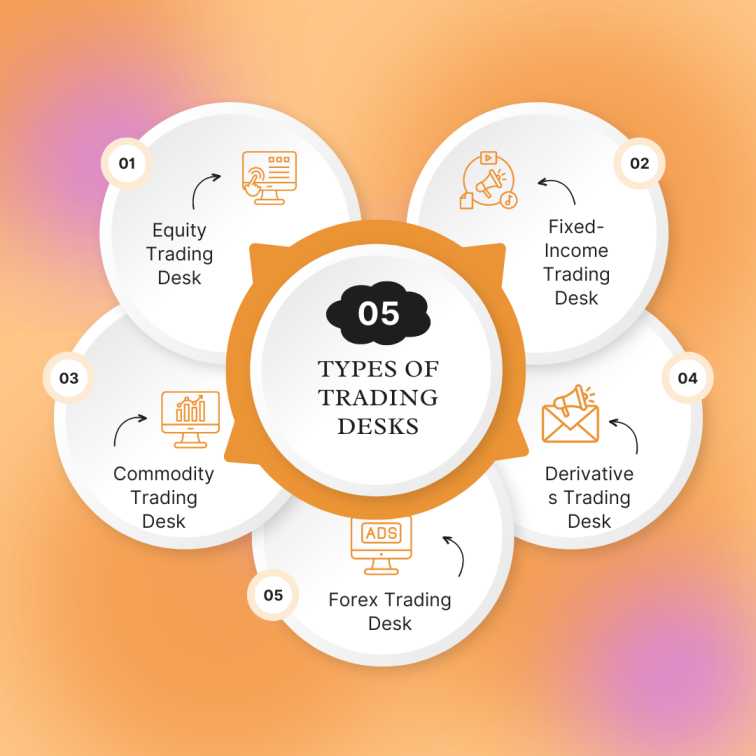
Types of Trading Desks

The different kinds of trading desks are as follows:

  • Equity Trading Desk: The equity trading desk facilitates and manages an enormous trading range. The traders working on the sell side of the desk suggest the most suitable options to clients based on information derived from the analysts’ research. The trading desk may be classified into two categories — one, enabling trade for hedge fund clients and the other, offering trade facilities to institutional clients. 
  • Fixed-Income Trading Desk: Fixed-income securities are bonds with a specific income stream. One such example of a fixed-income security is the US Treasury Bonds. A fixed-income trading desk helps in the execution of trades concerning these securities. 

Fixed-income trading desks also trade credit default swaps, derivatives that can act as insurance in case of a bond default. Fixed-income trading desks can be divided further based on the risk associated with the bond being traded. 

  • Derivatives Trading Desk: This kind of trading desk deals with the trading of derivatives such as options, swaps, forwards, and futures. However, the assets that derivatives trading desks deal in are complicated and can often lead to massive losses or gains. 
  • Forex Trading Desk: Large-scale investment banks often have a forex trading desk. The traders at the forex trading desk usually have to deal with the spot exchange rates of foreign currencies. They may also have to participate in proprietary trading activities. 
  • Commodity Trading Desk: This desk deals in commodities like gold, agricultural products, crude oil, etc. The desks can be categorised into soft and hard commodities.

It is entirely at a firm’s discretion to subdivide these categories into smaller parts based on the kind of security being traded. 

Benefits of Trading Desks

Listed below are the benefits of trading desks. 

  • Low cost: Training desks can provide services to multiple customers simultaneously, helping reduce the cost otherwise spent on training, operation, and software. Professional managers are appointed to take training in the different market segments on behalf of the clients. The trading activities are improved through the experts’ technical expertise and valuable insights. 
  • Advanced technology: The activities are monitored using the latest technology. It helps eliminate the human factor in trading activities and reinforces discipline. 
  • Skill and expertise in a specific domain: Managers working at trading desks will likely acquire expertise, experience, and knowledge in managing portfolios. It helps hone their efficiency and allows them to identify trading opportunities more proficiently. 
  • Monitoring brokers’ performance: Trading desks can also help investors track broker-dealers’ performance, helping them identify the best-performing brokers for every security class. 

Limitations of Trading Desks 

Trading desks have associated drawbacks apart from the benefits too. Trading desk operations often lack transparency with respect to activities like performance evaluation, strategy improvement, analysis, etc. 

Also, the services provided by trading desks are not free. Clients have to pay an amount as a commission for trading activities. 

Conclusion

Building investment banking skills and expertise is crucial to establishing a career in investment banking. Develop an in-depth knowledge of trading desks and other aspects related to investment banking with Imarticus’ Certified Investment Banking Operations Professional programme. 

Ideally suited for finance graduates with 0-3 years of work experience, this investment banking course will take you through the fundamentals, preparing you for roles like market analyst, financial analyst, investment banking associate, and financial market advisor.

Visit Imarticus Learning to learn more about this certification in investment banking.

Green Finance and Sustainable Investing in Investment Banking

Investors ensure financial success by using various strategies for building and diversifying their financial portfolios. Green finance and sustainable investing in investment banking are increasingly attracting the attention of investors and businesses alike. 

Before we dive into the details of green finance and sustainable investing, their features, and advantages, let us understand what these terms mean. 

What is Green Finance?

Climate change is probably this century’s most defining economic and political issue and is here to stay for a while. Investors, governments, individuals, and businesses are taking action to combat the climate issue, particularly decarbonisation techniques. 

Green finance refers to investments or loans which promote environmentally-positive activities. This includes the construction of green infrastructure, purchasing eco-friendly goods and services, etc. Green finance is a mainstream phenomenon now protecting from ecologically destructive services and products. 

What is Sustainable Investing in Investment Banking?

Sustainable investing refers to different practices where investors and businesses look to achieve financial returns and promote long-term social and environmental values. 

Investors make better investment decisions and generate comprehensive analyses by combining environmental, social, and corporate governance (ESG) insights with conventional investment approaches. 

Sustainable investment in investment banking sees that business firms are judged not based on financial profits but on how and what they contribute to society. 

Understanding the ESG Factors in Sustainable Investing

The sustainability impact of an investment is evaluated using ESG factors. A typical ESG score consists of the following factors:

  • Environmental 

This includes the impact of a company on the environment. It includes water use, conservation, waste, carbon footprint, and clean technology that it creates and uses in its supply chain. 

  • Social

This is how a company or a business impacts society and how it calls for social change and good. Analysts keep a close watch and examine the stances and involvement of the business on various social issues. 

These issues include community engagement, human rights, employees’ health and safety, and racial diversity within inclusion and hiring programmes. 

  • Governance

Here we will see how a company or an exchange-traded fund (ETF) is ‘governed’ or managed to bring in positive change. 

This includes reviewing executive compensation and diversity, management and governing board quality, overall transparency and disclosure, shareholder rights, corporate political contributions, and anti-corruption. 

Along with ESG factors for sustainable investing, investors can also use other additional strategies. Some of them are as follows:

  • Impact Investing

Impact investing implies targeted investments aimed at solving environmental and social problems. Community investing is an integral part of impact investing. 

This capital is directed to underserved communities and individuals. Businesses working with clear environmental and social purposes also receive financing from impact investing. 

  • Activist Investing

Activist investing is purchasing company equity to change how it operates. Moral values often guide investment decisions or social or environmental causes that companies and their leaders believe in or think deeply about. 

For instance, individuals caring about global warming might show interest in a company that drives environmental change. 

Benefits of Green Finance

Undoubtedly, green finance brings environmental and economic benefits and advantages to everybody. It successfully transitions to a low-carbon society, resulting in socially inclusive growth. 

Let us take a look at some of the benefits of green finance.

  • Helps in adding business value

Businesses have a portfolio that they have to maintain and enhance. Green finance helps in enhancing the portfolio value of a business. Along with offering a green edge, the business can draw the attention of more environmentally-concerned customers and investors. 

  • Encourages the development of environment-friendly infrastructure and the spread of technologies

Governments create and develop infrastructure in most developing countries to improve long-term resource management. There are also attempts to channel the money from private sectors into local green markets. This step in investment banking provides a competitive edge to the business. 

  • Improves economic prospects 

Governments of countries promoting green financing help in protecting societies from resource scarcity. They build and encourage local markets for renewable sources of energy. They also work towards entering new markets, which have high employment potential. 

Conclusion

If you are looking to move up in your career in investment banking, you must learn the skills of green finance and sustainable investing. These new trends are taking the investment banking industry by storm, and their benefits for the economy, society, and environment at large cannot be overlooked. 

A professional investment banking course will pave the way for you to become an investment banker who is highly successful. Imarticus Learning offers a Certified Investment Banking Operations Professional programme for interested candidates. This certification in investment banking is ideal for finance graduates with 0-3 years of working experience. 

Along with a interview guarantee, the course offers live training modules, experiential learning, job-specific skills, extensive career support, and globally-accredited certification. A plethora of job opportunities open up on completion of the course. 

Visit Imarticus for further details.

Hedge Fund Strategies and Investment Banking Partnerships

Hedge funds are supplementary assets actively managed and frequently used as risky investing tactics. They raise money from investors and invest in securities or other assets to earn favourable returns. Hedge fund investing requires authorised investors to have a substantial minimum net worth or investment, and they charge higher fees than traditional investment funds. This blog will explore hedge fund strategies and investment banking partnerships.

Hedge funds are not regulated as rigorously as mutual funds and usually have greater discretion than mutual funds to explore investments and methods that can raise the risk of investment losses. They usually combine with investment banks to gain access to funds and insights. Investment banks can give hedge funds access to various financial goods and services, including funding, dealing, and research. In return, hedge funds can supply investment banks with a source of income through fees and charges.

Hedge Fund Strategies

Hedge funds employ strategies to insulate themselves against volatility in the stock or securities markets and earn a return on a small amount of operational capital without compromising their whole budget. The following are some of the most popular hedge fund strategies:

  • Long/Short Equity Strategy: The most popular hedge fund strategy is the long/short equity approach. Equity hedges in the public markets balance long and short holdings, increasing return while lowering risk. The three main classifications are market neutral, long-short, and short-long positions.
  • Market Neutral Approach: This strategy involves holding long and short positions in various assets to build a market-neutral portfolio. It indicates that the portfolio is more susceptible to the performance of specific assets and less susceptible to market risk.
  • Merger Arbitrage: This tactic entails investing in businesses involved in mergers and acquisitions. The aim is to profit from the price discrepancy between the purchase and market prices once the merger or acquisition is complete.
  • Convertible Arbitrage: With this tactic, one can buy convertible instruments like preferred shares or convertible bonds. The aim is to profit from the price discrepancy between the convertible instrument and the underlying stock.
  • Capital Structure Arbitrage: This tactic involves purchasing several of the same company’s securities, including stocks, bonds, and options. The goal is to gain from the price differential between the two securities.
  • Fixed-Income Arbitrage: With this strategy, one can profit from potential arbitrage opportunities in securities tracking interest rates. A savvy fund manager will take advantage of the fact that equities would become proportionately cheaper than bonds.
  • Global Macro Strategy: By concentrating on wagers on interest rates, sovereign bonds, and currencies, this hedge fund strategy aims to profit from big economic and political shifts in prominent nations.

Common hedge fund strategies vary on the fund management, including equities, fixed-income, and event-driven goals. Hedge fund strategies use a variety of investments, like equity and debt securities, currencies, commodities, derivatives, and real estate, and employ an extensive spectrum of risk tolerance and investing principles.

Benefits of Hedge Funds and Investment Banking Collaborations

Collaborations between hedge funds and investment banking can offer several benefits:

  • Diversification: Hedge fund co-investments can significantly increase the diversification of conventional portfolios. Co-investing can allow investors to focus on certain exposures and risk/return profiles matching their investment goals not existing in their portfolios.
  • Attractive returns: Investors know the mutual advantages of the closer cooperation made possible by co-investing, which results in attractive returns.
  • Increased returns: Hedge funds can concentrate their assets, use leverage, or engage in other strategies with the potential to increase returns.
  • Career prospects: Both investment banking and hedge funds provide excellent career options, substantial salaries, and alluring exit strategies.

Predictions for the Future of Hedge Funds

The future of hedge funds is a topic of interest for many investors and analysts. Here are some predictions regarding the future of hedge funds:

  • Adaptation to changing market conditions: Hedge funds showed resilience and adaptability in the face of market volatility and disruption brought on by the COVID-19 epidemic. Hedge funds will develop further as they adjust to declining costs, rely more on technology, and offer greater accessibility to regular investors.
  • Better performance: Hedge funds performed well despite a poor public image; however, allocations were cut from over 40% in 2018 to barely 23% in 2020. Since hedge funds are actively managed, future performance can exceed expectations.
  • Increased assets under management: Assets under management are predicted to expand significantly in 2023, driven by the largest increase in the preceding ten years.
  • Significant potential for reinforcement: The performance of hedge funds can be considerably enhanced by the Post-Modern Cycle.

Conclusion

Investment banks use hedge funds to make money through fees and commissions, underwrite offers, and provide research and analysis for investment choices. With more investment options entering the market, a career in investment banking right now can offer great employment opportunities. 

Knowing about strategies such as hedge funds is important in order to become an investment banker.

The Certified Investment Banking Operations Professional (CIBOP) course, designed by Imarticus Learning, offers excellent insight into the industry. This investment banking course provides an in-depth understanding of complex financial products and their trade life cycles, operational risk, and treasury and clearing divisions within an investment bank. Check out Imarticus Learning to kickstart your career in investment banking.

Debt Capital Markets and Syndicated Lending

Debt capital markets (DCM) and syndicated lending are two basic ideas in investment banking. DCM is a marketplace for firms and governments to buy and sell debt to earn cash or profit, whereas, in syndicated lending, a group of lenders distributes funds to a borrower under a single credit facility arrangement. This blog will cover detailed insights into these two corporate finances.

Debt Capital Markets

DCM sections of investment banking corporations support developing and selling debt securities for clients. Debt capital markets operate like the investment world comprising of issuers and buyers. The issuer sells a security for profit while the buyer purchases it to funds their goals. The DCM securities are bonds rather than a firm’s shares or stocks.

Types of Debt Capital Market Instruments

Some popular forms of bonds transacted in debt capital markets are corporate bonds, government bonds, and Credit Default Swaps. Firms and governments use debt capital markets to raise long-term funding for expansion or sustenance. 

The debt capital market is a market where diverse organisations issue debt via bonds and loans to raise cash for growth, acquisitions, expansion, or diversification of funding sources. The fixed-income markets in DCM contain the following categories of borrowers and instruments:

Borrowers: Sovereign governments, semi-government and supranational organizations, financial institutions, and corporations.

Instruments: Debt capital market instruments (bonds and loans) varying in terms, risk profile, and conditions.

These instruments are issued to obtain funds for different goals such as paying down debts, supporting infrastructure upgrades, continuing current operations, increasing product lines, or establishing new locations.

Roles of a Debt Capital Markets Banker

Investment banks have debt capital markets units that deal with businesses, financial institutions, and governments to issue fixed-income instruments. They oversee the creation, structure, execution, and syndication of numerous debt-related products. 

DCM bankers must understand the fixed-income market and know where credit spreads are, current deals being offered, and market movements. One can become a debt capital markets banker after passing specific license courses and regulatory tests.

Syndicated Lending

A syndicated loan is granted to a borrower by two or more banks, known as participants, controlled by a single loan agreement. The loan is usually administered by one bank, the agency bank, on behalf of the syndicate member. 

Syndicated loans are issued by a collection of lenders that combine to credit a major borrower, such as a firm, an individual initiative, or a government. 

Each lender in the syndicate provides part of the loan amount, and they all share in the lending risk. The responsibility of each lender is restricted to their portion of the overall loan. 

Advantages and Purpose of Syndicated Lending

Syndicated lending primarily aims to distribute the risk of a borrower default across numerous lenders, banks, or institutional investors, such as pension funds and hedge funds

Syndicated loans are also employed in the leveraged buyout market to support significant business deals. Some advantages of a syndicated loan include reduced time and effort needed in getting the loan, access to a bigger pool of cash, and the opportunity to share risk across numerous lenders.

Secondary Market for Syndicated Loans

The secondary market for syndicated loans is a market where shares of syndicated loans can be sold after origination, altering the makeup of the syndicate. Here are some significant aspects concerning the secondary market for syndicated loans:

  • Efficient risk sharing: It provides more efficient geographical and institutional risk sharing. Large US and European banks originate loans for emerging economies, subsequently syndicated to other banks and non-bank financial entities.
  • Investors: The syndicated loan market draws various investors, including collateralised loan obligation structures (CLOs), mutual funds, hedge funds, pension funds, brokers, and private equity organisations.
  • A major source of funding: It is a major source of financing for many big and medium market enterprises in the US.
  • Secondary trading: Secondary debt trading indicates one investor acquiring debt on the secondary loan market from another investor, who may have become a lender upon origination. Shares of syndicated loans can be exchanged in the secondary market, altering the composition of the lending syndicate.

Conclusion

A thorough understanding of DCM and syndicated lending is essential for individuals looking to build a career in investment banking and other financial services. Sound knowledge of the concepts can help individuals land lucrative jobs at premium banking institutions.

The Certified Investment Banking Operations Professional (CIBOP) programme by Imarticus Learning aims to transform individuals into investment banking operations specialists by teaching them the principles of financial markets, investment banking, and operations. This investment banking course is internationally accredited and industry-aligned, incorporating trading simulations and case studies to ensure practical learning. This certification in investment banking is designed to provide a comprehensive understanding of debt capital markets and syndicated lending.

Equity Research and Investment Banking Recommendations

Equity research and investment banking are crucial in helping investors make informed decisions. Equity research provides insightful analysis and recommendations on stocks, while investment banking provides consultation services for capital raising and mergers and acquisitions

This blog will explore the importance of equities research and investment banking and help prospective finance employees gain a thorough understanding of these areas.

Understanding Equity Research

Equity research focuses on fundamental factors such as financial performance, industry trends, and competitive landscape. Here are a few key aspects of equity research:

  • Fundamental Analysis: Equity research analysts thoroughly analyse a company’s financial statements evaluating the company’s general health, profitability, and financial performance. They assess important measures, including profit margins, return on equity, and sales growth. This helps them understand the company’s financial stability. Analysts also consider the management team, the company’s position in the industry, and the marketplace it operates in. 
  • Valuation Techniques: Analysts employ various valuation techniques to estimate a stock’s fair value. They also perform discounted cash flow (DCF) analysis estimating the present value of a company’s future cash flows. It considers factors like growth and discount rates. 
  • Sector Research: Analysts conduct in-depth research on industry trends, regulatory changes, and macroeconomic factors that impact a company’s performance. They analyse market dynamics, competitive forces, and emerging trends within the sector. This helps them understand the opportunities and challenges a company may face and stay updated on industry developments and macroeconomic indicators.

The Role of Investment Banking

Investment banking is essential to the financial ecosystem, bridging the gap between businesses and capital markets. Investment bankers execute transactions and offer strategic advice to businesses, governments, and other organisations. Here are some key areas where investment bankers excel:

  • Capital Raising: Investment bankers play a crucial role in assisting companies with raising capital. They advise on the optimal capital structure, helping determine the appropriate debt and equity financing mix. Investment banks connect businesses with potential investors through private placements or public offerings. They guide the offering’s pricing, timing, and structuring, ensuring the company’s capital-raising objectives are met while maximising investor interest.
  • Mergers and Acquisitions (M&A): Investment bankers facilitate Mergers and Acquisitions transactions. They assist clients in identifying suitable acquisition or merger targets, conducting valuation analyses, and negotiating deal terms. Investment banks provide strategic advice on deal structuring to maximise synergies and shareholder value. They also conduct due diligence to assess the financial and legal aspects of the target company, helping mitigate risks associated with the transaction.
  • IPOs and Secondary Offerings: Investment banks manage taking a company public through an initial public offering (IPO). They guide companies through the regulatory requirements, ensure compliance, and coordinate with underwriters and legal advisors. Investment banks also handle secondary offerings, assisting companies in issuing additional shares to raise capital or enable existing shareholders to sell their holdings. They help determine the offering price, optimise timing, and execute the transaction, ensuring favourable terms for their clients.

Benefits of Equity Research and Investment Banking Recommendations

Equity research and investment banking recommendations offer several advantages to investors:

  • Informed Investment Decisions: Equity research and investment banking recommendations provide investors with a comprehensive and detailed analysis of stocks and investment opportunities. Thorough research, including fundamental analysis and valuation techniques, helps investors gain valuable insights into a company’s financial health, growth prospects, and intrinsic value. A clearer understanding of the rewards and dangers of particular investments supports these choices. It could involve purchasing, promoting, or keeping stocks.
  • Risk Management: Equity research is vital in identifying and assessing potential risks associated with specific stocks or sectors. Detailed analysis of financial statements, industry trends, and the competitive landscape helps identify company performance risk factors. This information facilitates informed decision-making and effective management of their portfolios. For instance, investors can diversify their holdings, adjust exposure to specific sectors, or implement risk mitigation strategies. 
  • Access to Expertise: Investors get access to industry experts possessing deep knowledge and experience in evaluating investment opportunities. These professionals thoroughly know the markets, sectors, and economic variables affecting investment choices. They can provide specialised guidance, unique insights, and access to information that may not be easily available to individual investors. 

Challenges and Limitations

While equity research and investment banking recommendations provide valuable guidance, there are a few challenges and limitations to consider:

  • Bias and Conflicts of Interest: Analysts may face conflicts of interest or bias due to pressure from investment banking divisions, leading to potential inaccuracies in their recommendations.
  • Market Volatility: Rapid market changes and unexpected events can make it challenging for equity research analysts and investment bankers to predict stock performance accurately.
  • Regulatory Compliance: Both equity research and investment banking are subject to strict regulatory guidelines to maintain transparency and protect investor interests.

Conclusion

Equity research and investment banking recommendations are essential tools for investors looking to navigate the complex world of finance. Investors must rigorously assess advice, considering any potential biases and constraints. 

Enrol in the Certified Investment Banking Operations Professional course by Imarticus Learning to establish yourself better in equity research and investment banking. The investment banking course offers guidance from industry experts with industry-recognised certification to boost your CV. A certification in investment banking can help you a lot if you are looking for a career in investment banking or a career in banking.