IT training: The most effective programmes for upskilling IT staff

Transform your team’s tech expertise

In today’s rapidly evolving digital landscape, staying ahead of the curve is essential for any business. IT training for employees has become the secret sauce to ensuring that your team remains competent and competitive. Whether you are a business leader or a working professional, understanding the power of professional employee tech training is key to thriving in the tech-driven world.

Why does IT training matter?

corporate training

In an era where technology underpins every facet of business operations, having a tech-savvy workforce is non-negotiable. From cybersecurity to data analysis and cloud computing, IT influences every aspect of business So, investing in corporate IT skill development through strategic training programmes is the smartest move your company can make.

Benefits of professional employee tech training

  • Enhanced skills and employability.
  • Job security in a tech-driven world.
  • Increased workplace productivity.
  • Improved problem-solving abilities.
  • Staying current with evolving technology.
  • Valuable industry certifications.
  • Foster adaptability and innovation.
  • Personal growth and confidence boost.

Choosing the right IT training programme

  1. Identify skill gaps

The first step is to recognise the skill gaps within your IT team. This can be done through assessments and surveys. Once you’ve pinpointed the areas that need improvement, you can tailor your training programme accordingly.

  1. Customised training

Look for programmes that offer customisation. Generic training may not meet your specific needs. Tailored programmes can focus on the exact skills your team requires, ensuring maximum efficiency.

  1. Hands-on learning

Practical, hands-on experience is crucial in IT. Programmes that provide real-world scenarios and opportunities to apply knowledge are highly effective.

  1. Certifications

Many professional employee tech training programmes offer industry-accredited certifications. These not only validate your team’s skills but also boost their confidence and credibility.

  1. Flexible learning

Your team has their work schedule. Opt for programmes that offer flexibility, such as online courses or evening classes, to accommodate their needs.

  1. Track record

Investigate the track record of the training provider. Read reviews and ask for referrals to ensure the programme is reputable and effective.

Popular IT training programmes

  1. Cybersecurity boot camps

In an age of increasing cyber threats, having a skilled cybersecurity team is paramount. Cybersecurity boot camps can quickly upskill your team in this critical area.

  1. Cloud computing training

With the growing importance of cloud technology, training in AWS, Azure or Google Cloud can significantly enhance your IT team’s capabilities.

  1. Data analytics and machine learning courses

Equip your team with the ability to harness data for insights and decision-making. Data analytics and machine learning courses are invaluable in today’s data-driven world.

  1. Coding and programming courses

Even non-developer IT professionals can benefit from understanding coding and programming basics. These skills enable better communication with developers and faster problem-solving.

  1. IT project management

Effective project management is crucial in IT. Specialised training in this area can ensure that your projects are delivered on time and within budget.

Elevate your team’s tech game today

In today’s fast-paced tech world, investing in IT training for employees is a strategic move for business leaders and managers. It is not just an option, but a necessity. It’s the key to ensuring that your IT staff remains skilled, relevant and competitive. With the right corporate IT skill development programmes, your team can stay ahead of the curve and drive your company’s success.

So, why wait? Start upskilling your IT staff today! Empower your team with the best professional employee tech training programmes. Explore the comprehensive courses offered by Imarticus Learning. Unlock the full potential of your IT staff in just a few clicks!

Risk Management in Capital Markets

Risk management is a fundamental part of capital markets that includes recognising, analysing, and reducing risks from trading activity. Risk management aims to reduce losses and enhance revenues by predicting future hazards and making efforts to prevent or mitigate them. Completing an investment banking course with an investment banking certification can open doors to lucrative job opportunities. This blog will explore the different aspects of risk management in capital markets and popular risk management strategies.

Understanding Capital Markets

Capital markets are essential to the financial sector, where funds and investments are transferred between providers and people in need. They are made of main and secondary markets, the most prevalent being the stock and bond markets. Capital markets assist individuals with ideas to become entrepreneurs and help small firms develop into huge corporations.

The issuing of securities is crucial to capital markets, where businesses wishing to raise money issue debt or equity securities that be traded. money markets refer generally to the sections of a financial system that deal with raising money via investments or exchanging investments with other investors. These venues may include the stock market, the bond market, and the currency and foreign exchange (forex) markets. Understanding financial markets is vital for anyone interested in investing, and tools like investment banking courses online are available.

Risk management within the world of capital markets comprises the systematic process of discovering, analysing, and successfully managing risks related to trading activity. Diverse sorts of risks exist, spanning market risk, credit risk, operational risk, and liquidity risk. 

Types of Risks in Capital Markets

Types of Risks in Capital Markets

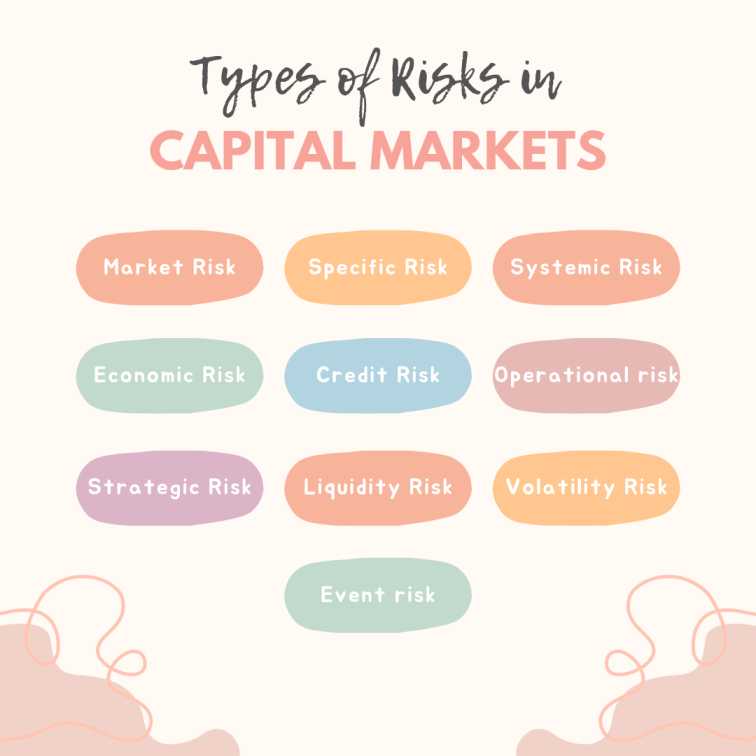
There are various types of risks in capital markets, and some of the most important ones are:

Market Risk: It refers to the possibility of incurring losses due to factors that affect the overall performance of investments in the financial markets. It is the risk of losses in positions arising from movements in market variables like prices and volatility.

Specific Risk: Unlike market risk, specific risk is limited to a single business or industry. Specific risks are directly tied to the performance of a given asset and may be minimised by investing in diversification. A firm declaring bankruptcy, leaving its shares worthless to investors, is an example of unsystematic risk.

Systemic Risk: A systemic risk happens within a business or collection of firms and can potentially ruin an entire industry, sector, or economy. 

Economic Risk: Economic risks are among the most critical to consider. Economic dangers include interest rate risk, inflation risk, exchange rate risk, and sovereign debt risk.

Credit Risk: The threat of loss due to a borrower’s failure to make payments on any loan is called credit risk. This risk is relevant primarily to bonds or other fixed-income investments.

Operational risk: The danger of loss from inadequate or failed internal processes, people, and systems, as well as external occurrences, is referred to as operational risk. 

Strategic Risk: Strategic risk is the chance of financial loss due to faulty corporate decisions or the failure to execute a successful business plan. 

Liquidity Risk: The threat of loss stemming from an inability to sell an investment quickly enough to prevent a loss is known as liquidity risk. 

Volatility Risk: Volatility risk is the danger of loss induced by price swings in the market. This risk is especially applicable to stock and other equity investments.

Event risk: The danger of loss induced by unexpected events such as natural disasters, political upheavals, or terrorist attacks is known as event risk. 

Mitigating Risks in Mergers and Acquisitions

Mergers and acquisitions (M&A) can be risky, but there are ways to mitigate those risks. Here are some of the most common risks and ways to address them:

Overpaying for the target company

  • Conduct a thorough valuation of the target company.
  • Consider using earnouts or other contingent payments to align incentives.

Weak due diligence practices

  • Conduct comprehensive due diligence, including financial, legal, and operational reviews.
  • Involve experts in the due diligence process.

Integration challenges

  • Develop a detailed integration plan early in the process.
  • Involve key stakeholders from both companies in the planning process.
  • Be transparent about the integration timeline and set realistic expectations.

Cybersecurity risks

  • Require a security assessment of the target firm.
  • Ensure the target firm has appropriate cybersecurity policies and procedures in place.

Compliance risks

  • Conduct due diligence on compliance risks, including HR and payroll compliance.
  • Take a proactive role in managing compliance risks during the M&A process.

Adaptive Risk Management

Adaptive risk management is a strategic approach to risk management that involves continuous monitoring, evaluation, and adaptation of risk management practices to changing circumstances. It aggregates risk data associated with users and activities, analyses business risks, and provides mitigation advice. Using innovative algorithms, adaptive risk management services redefine loss control and risk review processes. 

Trust by design is an adaptive risk management approach that builds risk intelligence into key processes and systems. It evaluates how programs respond and manage risks by learning and adapting to the changing environment. Adaptive risk management starts with a conceptual view of risk, focusing on consequences and uncertainty, and adapts to changing circumstances.

The ability to effectively apply adaptive risk management techniques is a highly sought-after skill in a career in banking and finance, which is why taking a banking course is an excellent choice for aspiring professionals.

Conclusion

Risk management in capital markets is indispensable to successful trading and investment strategies. Market participants can better navigate the complex and ever-changing financial landscape by identifying, assessing, and effectively managing risks in the market, credit, operational, and liquidity categories.

Imarticus Learning offers a Certified Investment Banking Operations Professional (CIBOP) programme that is internationally accredited and designed for careers in investment banking‘s capital markets operations division. The program is best suited for learners with under three years of experience in the industry. The banking and finance course covers all the areas relevant to investment banking operations and incorporates trading simulations and case studies to enable practical learning. The curriculum is industry-aligned and supported by the industry. Upon completing the investment banker course, learners gain a professional certificate that adds substantial value to their jobs and helps them progress in their careers in investment banking.

Customer Experience Training (What It Is & Why You Need It)

The experience people have when interacting with a brand determines whether they will make the purchase or not. It is based on this experience that they decide whether they would like to avail of their services in the future as well. In fact, when the customer experience is great, they will encourage other people to shop from the same brand.

However, poor customer experience will make customers leave negative reviews and shop from the brand’s competition. This is a nightmare for any business owner. That’s why businesses are investing in customer experience training programs now.

Why is customer experience so important?

Customer experience is all the ways people interact with a brand, from finding out about it to buying something, getting help, and even recommending it to others. How people feel at each of these stages can change what they think and say about the brand, online and in person. Making these experiences better can make customers stick with the brand and help the business earn more.

What is customer experience training?

Corporate Training

Customer experience training is the process of building and improving the knowledge and skills of employees in customer service so that they can interact with customers properly. The aim is to equip them with skills to strengthen support experience and customer satisfaction. Since training is an ongoing process, both new and existing employees take part in this program. The training includes different processes such as process training, product training, soft-skills training, customer support software training, etc.

Why customer experience training is important?

Customer service is all about doing things to help customers. How employees talk to customers and solve their problems really matters. A good customer experience training program helps companies talk to customers better, avoid misunderstandings, and answer more quickly. This makes the whole customer experience better.

There are many benefits that companies can gain through customer experience training. This includes:

1. Improved customer service skills

Through customer experience training programs, employees can improve existing skills and acquire new ones. Generally, customer experience training programs focus on improving listening, communication, problem-solving and other organisational skills. It gives employees an understanding of the standard process of handling customers.

2. Increased customer and employee satisfaction

Often, trained employees can resolve customer issues at the first point of contact. This will increase customer satisfaction and retention. When employees communicate with customers in a good manner, it increases their appreciation for the brand. This appreciation is the foundation of customer loyalty. Customer experience training also improves employee satisfaction. They will better understand the impact of their role within the organisation and feel motivated to do better. This will increase employee engagement. Thus, they become more efficient and better equipped in handling customers.

3. Rise in profits

When employees know that the organisation is investing in their growth, they will get motivated. This will increase their productivity. They achieve the goal of satisfying the customers. And, when customers are happy, they will make more purchases. Thus, this will increase company profits.

Key Takeaway

Customer experience is what distinguishes organisations that flourish from those that fail. Every interaction that employees have with customers impacts the business profits. That’s why businesses must invest in customer experience training.

Visit Imarticus Learning to learn more about customer experience training ideas and programs.

Land Your Dream Job with a Product Management Course

Do you have a passion for creating products that solve real problems and provide value to users? Do you want to work in a dynamic, exciting field combining technology, business, and design? Do you want to learn the skills and tools to make you a successful product manager?

If you answered yes to any of these questions, this blog post is for you. In this post, we will give you a broad view of product management, explain its significance, show you how a product management course can prepare you for your dream job, and tell you about the prospects of product management. 

What is product management, and why is it important?

Product management is the process of creating, developing, and delivering products that meet the needs and expectations of customers. It involves planning, researching, designing, testing, launching, and maintaining products that solve real problems and provide value to users. 

Making ideas a reality is the art of product management. People adore the process of taking a concept and making it come true. It involves identifying the needs of your consumers, developing a solution to address them, and then commercializing that solution.

The innovative thinkers and problem-solvers who make this happen are product managers. They are the ones that generate fresh concepts, solicit input, and refine designs until they are perfect. They collaborate with engineers, designers, and other key players to make the product a reality.

A job in product management may be demanding yet rewarding. It’s an opportunity to truly change the world by developing items that people adore. 

A product manager manages a product’s entire lifecycle, from ideation to launch to growth. Product managers have various roles and responsibilities depending on the context and the organization.

Some of them are:

  • Visionary: A product manager defines and communicates the vision and strategy of the product. They articulate the product’s value proposition, target market, positioning, and roadmap.
  • Researcher: A product manager conducts user research and market research to understand the pain points, preferences, behaviors, and motivations of customers. They also keep track of the industry’s trends, competitors, and best practices.
  • Planner: A product manager plans and prioritizes the features and tasks for product development. They create and maintain a backlog of user stories, epics, and tasks that align with the product vision and goals.
  • Collaborator: A product manager collaborates with various stakeholders across different teams and functions. They work with designers, engineers, marketers, salespeople, support staff, executives, customers, partners, and vendors to ensure alignment and coordination.
  • Leader: A product manager leads and motivates the product team. They provide direction, guidance, feedback, support, and recognition to the team members. They also manage expectations, resolve conflicts, negotiate trade-offs, and make decisions.
  • Advocate: A product manager advocates for the customer and the product. They represent the voice of the customer in every stage of the product development. They also champion the value and benefits of the product to internal and external audiences.

Significance of Product Management

Product management is a significant field as it directly impacts the success and growth of a product and an organization. 

Product management can help achieve various benefits, such as:

  • Customer satisfaction: Product management can help create products that satisfy customer needs and expectations. Product managers can better understand customer problems and preferences by conducting user research and gathering feedback. Product managers can also enhance customer satisfaction and loyalty by designing user-centric solutions and delivering high-quality products.
  • Competitive advantage: Product management can help create products that stand out. Product managers can develop unique value propositions and positioning strategies by identifying market opportunities and gaps. Product managers can differentiate their products from competitors by innovating new features and functionalities.
  • Business growth: Product management can help create products that drive business growth. By defining clear goals and metrics, product managers can measure and optimize the performance and impact of their products. By analyzing user behavior, feedback, and data, product managers can identify opportunities for improvement and growth. Product strategists can generate awareness, adoption, and revenue by effectively launching and marketing their products.

Tips and tricks to ace your product manager interview

  • Understand the Role:

  • Research and understand the key responsibilities of a product manager.
  • Be familiar with the product development lifecycle and your role at each stage.
  • Know the Company:

  • Thoroughly research the company, its products, culture, and recent developments.
  • Understand how the company’s products align with your skills and experiences.
  • Practice Behavioral Questions:

  • Prepare examples for behavioral questions that demonstrate your problem-solving, teamwork, and leadership skills.
  • Structure your answers using the STAR method (Situation, Task, Action, Result).
  • Highlight Your Skills:

  • Emphasize market research, data analysis, communication, and project management skills.
  • Share stories that showcase your ability to prioritize tasks and make tough decisions.

How Can a Product Management Course Prepare You for Your Dream Job?

A product management course can prepare you for your dream job by teaching you the essential skills and tools to become a successful product manager

A product management course can help you:

  • Learn the fundamentals: A product management course can help you learn the fundamentals of product management, such as what is a product, what are the stages of product development, what are the responsibilities and roles of a product manager, etc.
  • Develop your skills: A product management course can help you develop your skills in various domains, such as analytical skills, communication skills, creativity skills, technical skills, business skills, etc.
  • Use various tools: A product management course can help you use various tools that facilitate and support your work, such as project sintomasdelsida.org management tools, product management tools, user research tools, analytics tools, design tools, etc.
  • Work on real projects: A product management course can help you work on real projects that give you hands-on experience and exposure to the product management process. You can also apply what you learn to solve real problems and create products you can showcase in your portfolio.
  • Get feedback and guidance: A product management course can help you get feedback and guidance from experienced mentors and instructors who can help you improve your work and overcome your challenges. You can also learn from your peers and network with other aspiring and practicing product managers.

Future Prospects of Product Management

Product management is a field that has a bright future. The U.S. Bureau of Labor Statistics projects that from 2021 to 2031, the employment of computer and information systems managers, which includes product managers, would increase by 16%, outpacing the average for all occupations.

The demand for product managers is driven by the increasing need for organizations to create and deliver innovative and user-friendly products in a competitive and rapidly changing market. Product management is also a field that offers various opportunities for career advancement and personal growth.

As a product manager, you can:

  • Work in different industries: Product management is a field that applies to different industries such as technology, e-commerce, education, health care, finance, entertainment, etc. You can work in an industry that matches your interests and passions.
  • Work on different products: Product management is a diverse and dynamic field. You can work on different types of products, such as physical goods, services, software, platforms, or combinations of these. You can also work on different stages of products, such as new, existing, or legacy products.
  • Work in different roles: Product management is a flexible and adaptable field. You can work in different roles, such as product owner, strategist, designer, product marketer, etc. You can also work at different levels, such as junior product manager, senior product manager, product director, product vice president, etc.

The Final Thoughts

Product management is a field that is exciting, rewarding, and challenging. The discipline of product management has endured over time. It had existed ever since the early stages of industrialization when companies had to find how to make goods that consumers desired and needed. But ever since then, there has been a steady change in the ideas, methods, and environments around product design, development, testing, and implementation.

To land your dream job as a product manager, you must prepare by learning the essential skills and tools to make you stand out. A product management certification can help you achieve this goal by teaching you the fundamentals of product management, developing your skills in various domains, using various tools that facilitate and support your work, working on real projects that give you hands-on experience and exposure, and getting feedback and guidance from experienced instructors and mentors.

Imarticus Learning IIT Product Management Course will help you start a career in product management. IIT Roorkee’s 5-month live program will give you all the knowledge you need to succeed as a product manager.

You’ll master the complete product lifecycle, from conception to development to go-to-market. You’ll also learn how to collaborate with engineers, designers, and other key players to make your ideas a reality.

Imarticus Learning will provide you with more than just the course material; they’ll also help you achieve. You will have access to a network of career coaches, mentors, and industry experts who will support you every step of the journey.

So, if you’re ready to launch your career in product management, Imarticus Learning is the place to start. Enroll today and take your first step towards a bright future in product management.

Top 5 CMO programs of 2023

If you’re a marketing enthusiast who wants to take your career to the next level, you might wonder what it takes to become a Chief Marketing Officer. A CMO is the head of the marketing department in an organization, responsible for overseeing the strategy, planning, execution, and evaluation of all marketing activities. A CMO is also a key executive team member, collaborating with other leaders to align the marketing vision with the overall business goals.

chief marketing officer course

But becoming a CMO is not a walk in the park. It requires skills, experience, and education to set you apart. Enrolling in Chief Marketing Officer Programs in 2023 is one of the best ways to acquire these credentials.

A CMO program is a specialized course that teaches you the essential knowledge and competencies needed to succeed as a CMO. It covers marketing analytics, digital marketing, branding, customer experience, leadership, and innovation.

How to Get the Most Out of Your CMO Training Program?

Many CMO programs are available in the market, but not all are created equal. Some are more comprehensive, relevant, and reputable than others. To help you choose the best one for your needs, we have compiled a list of the top CMO training programs of 2023

These programs are based on the following criteria:

  • Curriculum: The program should cover the core topics and skills required for a CMO role in today’s dynamic and competitive environment.
  • Faculty: The program should be taught by experienced and qualified instructors with real-world expertise and insights in marketing.
  • Accreditation: The program should be accredited by a recognized body that ensures the quality and standards of the education.
  • Flexibility: The program should offer flexible options for learning, such as online, hybrid, or self-paced formats, that suit your schedule and preferences.
  • Reputation: The program should have a good reputation among employers, alumni, and industry peers, as well as positive reviews and feedback from previous students.

Roles and Responsibilities of a CMO: Navigating the Marketing Maze

The Chief Marketing Officer, or CMO, is the captain of the marketing ship. They are the maestro of a grand symphony, orchestrating the harmonious interplay of instruments known as marketing channels. Their role resembles a tightrope walker, balancing creativity and data-driven strategies, never letting one tip the scales too far. The CMO is a storyteller, a bard weaving tales that resonate with the audience, building a brand’s mythology. 

Now, let’s delve deeper into the responsibilities of a CMO:

  • Master of Strategy:

A CMO is like a chess grandmaster, always thinking several moves ahead. They craft marketing strategies that encompass everything from brand positioning to market penetration. They determine the best channels, messaging, and timing to ensure their brand’s message hits home like a bullseye on a dartboard.

  • Brand Whisperer:

A CMO is the brand’s keeper, like a guardian of a precious treasure. They ensure that the brand’s essence, values, and image remain consistent across all touchpoints. Just as a gem cutter carves a diamond to reveal its brilliance, a CMO shapes the brand’s perception in the eyes of the audience.

  • Data Sorcerer:

In the age of Big Data, a CMO wields analytics like a wizard’s staff. They gather and interpret data to make informed decisions, turning numbers into marketing gold. It’s like alchemy, turning raw data into actionable insights that drive growth.

  • Creative Visionary:

A CMO is an artist painting marketing campaigns with vibrant colors and bold strokes. They inspire creativity in their teams, breathing life into ideas and concepts. It’s like conducting an orchestra, harmonizing the talents of designers, writers, and marketers into a symphony of engagement.

  • Customer Advocate:

Like a knight in shining armor, a CMO defends the customer’s interests. They champion customer-centric approaches, ensuring every marketing effort resonates with the audience. It’s like forging a trusty sword, sharp and reliable, to cut through the noise and reach the hearts of consumers.

Now that we’ve unfurled the sails and charted the course through the sea of CMO responsibilities, it’s time to set our sights on the next treasure on this journey – the significance of getting a CMO certification.

Significance of Getting a Certification: The X Marks the Spot

In marketing, a certification is like the “X” on a treasure map, marking where untold riches of knowledge and expertise lie buried. But what makes getting certified so significant?

  • Staying Ahead in the Game:

The marketing landscape is a whirlpool of change. Trends come and go like waves crashing on the shore. Getting certified is like having a surfboard, allowing you to ride those waves skillfully and confidently. It keeps you ahead of the curve, always ready for the next big thing.

  • Building Credibility:

Imagine you’re in a dark forest and come across a guide who holds a torch, leading the way. A certification is your torch in the marketing wilderness. It illuminates your knowledge and skills, building Credibility among peers, employers, and clients. The badge of honor says, “I know what I’m doing.”

  • Expanding Your Toolkit:

A CMO certification is like adding new tools to your marketing toolbox. It equips you with the latest strategies, tactics, and techniques. It’s like upgrading from a basic map to a GPS, ensuring you stay aware of the marketing maze.

  • Networking Opportunities:

Picture a bustling marketplace where traders gather to exchange goods and ideas. That’s the marketing world; a certification is your entry ticket to this marketplace. It opens doors to networking opportunities, connecting you with fellow professionals, mentors, and industry leaders.

  • Confidence Booster:

Certification isn’t just about what you know; it’s about how you feel. It’s like a suit of armor that bolsters your confidence. With a certification in your pocket, you approach challenges with the poise of a seasoned captain navigating stormy seas.

What are the Top CMO Programs in 2023?

Chief Marketing Officers (CMOs) are at the forefront of determining a company’s performance in a constantly changing environment. The position of a CMO is constantly changing, necessitating a broad skill set that combines strategic thinking, technological know-how, and an in-depth comprehension of market dynamics.

1. Post Graduate Certificate Programme For Emerging Chief Marketing Officers

Imarticus Learning’s ground-breaking IIM Indore CMO program, carefully created for future marketing leaders and forward-thinking Chief Marketing Officers, will set you on a transforming path. This outstanding program will give the next generation of business executives substantial strategic, operational, and technical expertise. This transformational event gives marketing professionals in mid- to senior-level positions the skills to understand key marketing ideas. 

2. Executive Certificate Programme For Strategic Chief Marketing Officers

With Imarticus Learning’s innovative curriculum, designed for aspiring Chief Marketing Officers and rising executives with great potential, immerse yourself in the cutting edge of CMO training. Future company leaders may develop and improve their strategic, operational, and technology leadership abilities with the help of this comprehensive program. It’s a transformational journey to give mid- to senior-level marketing professionals the necessary knowledge of fundamental marketing ideas.

3. Post Graduate Program In Digital Marketing

This program offers a unique job assurance guarantee beyond traditional education. You get access to a fantastic opportunity—10 guaranteed interviews with over 500 top-tier partner organizations actively seeking Social Media, SEO, Content Marketing, and Digital Marketing professionals. It’s your golden ticket to a world of career possibilities.

4. Advanced Certification In Digital Marketing And MarTech By IIT Roorkee

In this age of digital metamorphosis, enterprises look to technology and digital avenues as their compass to navigate the vast sea of existing and potential consumers. The relentless march of technological progress fuels an insatiable demand for adept professionals who can dance gracefully through the intricate rhythms of digital marketing, constantly evolving and always adapting.

5. The Professional Certification Program In Product Management With CEC, IIT Roorkee

The CEC, IIT Roorkee, has meticulously tailored the Professional Certification Program in Product Management for aspiring young professionals who aspire to embark on a rewarding journey into the realm of Product Management. Through IIT Roorkee’s thoughtfully crafted curriculum, participants will gain mastery over the complete product lifecycle, covering everything from development and positioning to pricing and deployment.

Conclusion: Charting Your Course to CMO Excellence

In the marketing world, the role of a CMO is nothing short of legendary – a captain, a storyteller, a data sorcerer, and a creative visionary all rolled into one. They use their strategy tools, brand guardianship, data interpretation, creativity, and customer advocacy to navigate the marketing maze with finesse.

But even the most skilled sailor needs a map, a compass, and a destination in mind. That’s where CMO certification courses come into play. They are your guiding star, treasure map, and confidence booster, ensuring you sail smoothly through the ever-changing tides of marketing.

So, if you’re setting your sights on becoming a CMO or advancing your marketing career, remember these are the highly rated CMO Programs for career growth in 2023. They are your key to unlocking the treasure chest of knowledge and expertise. They are your ship, ready to carry you to new horizons of success in the vast sea of marketing.

As you embark on your journey, armed with the knowledge of CMO roles and the significance of certification, may your sails billow with ambition, your compass always point true north, and your treasure map lead you to the riches of marketing excellence—fair winds and following seas, fellow marketing adventurers. 

The world of CMO awaits, and it’s time to set sail!

Your Ultimate Guide to Media Planning

The traditional means of advertisement have given way to trendy digital marketing in today’s businesses. For fruitful business development, meticulous planning and a detailed exercise must be done in the present day.

The entire gamut of activities, from content finalisation to reaping the benefits of investment in a digital marketing process, is termed media planning. This planning process is dynamic and widely varies with product or business types. 

What is media planning?

Media planning is discovering why, when, where and how a specific business content should be presented to its target audience. Media planning also deals with the choice of media platforms depending on their comparative capacities to bolster audience reach.

The essential components of media planning are as follows – 

  • Extent and the presentation mode of the content.
  • Frequency of content sharing, including date and time.
  • The latest trends in the market.
  • The budget of digital marketing.
  • Selection of the right media channel for advertisement.

Read on to learn more about media planning.

Types of Media Planning

Broadly there are three types of media planning. They are as follows – 

1. Paid media planning

The best method of media planning for a new product or a brand, it heps brands seek focused attention from a targeted audience. As the name suggests, it is a pay-per-click advertising method. 

2. media planning

Those business houses with an established digital platform for their group companies use this media planning. The management tends to publish a new product or service over their established platform. The group company wishes to leverage the organisation’s image for new product advertisements. 

3. Earned media endorsements

Earned media publicity means the leverage a brand earns or achieves from external channels through its performance. These are essentially customer reviews, feedback etc., which the brand gathers outside its publishing house. Based on the comments received, companies take earned media feedback seriously and tend to improve its quality. 

Benefits of Media Planning

In today’s era of online shopping platforms, reviews on products are a common phenomenon. When a businessman wishes to survey or research a new product, huge amounts of data are readily available for a similar product.

The key benefits of media planning are – 

– Establish process

Media buying is complicated, and proper media planning and advertisement always get it on track. Thus, an advertisement’s day, time, duration, platform and frequency must be benchmarked for a successful return. 

– Budget tracking

Media planning helps the business house track the budget and the return on investment at any point in time. This, on the other hand, helps to decide upon any changes to the existing plans.

– Audience segmentation and analysis

Resonance with a targeted audience is a key function achieved by media planning. The set process also takes a deeper dive into the analysis activity of the said function. 

– Optimization and testing

Over a period, a media planner always uses the available data to find out what has worked for the purpose intended, what has not and what might have worked if applied in a slightly modified manner. These adaptive changes in media planning ultimately help optimise the buying experience.

– Return on investment

Return on investment (ROI) is the goal for all commercial operations. In this case, media planning helps support this goal. 

Objectives of Media Planning

Objectives of media planning are always in line with the organisation’s business goals. The ultimate purpose is to generate a handsome return from an optimised investment through long-term sustainable growth. The objectives of media planning are as follows – 

  • Improving collaboration between cross-functional teams to develop and share media content.
  • All broadcasting processes and media publications should be improved and streamlined.
  • The day, date, time and frequency of media publication must be fine-tuned to ensure the content reaches its targeted audience smoothly.
  • The publication’s content must be fine-tuned occasionally to suit the targeted audience’s latest trends and thought processes.
  • Enough time should be administered to a media campaign to reach the intended audience with its desired impact. 

Conclusion 

Media planning is an important function in digital marketing today. Advertisers choose their preferred platforms based on the nature of the products they wish to sell or, more accurately, based on the audience for whom the product is designed. Thus the role of a media planner is an extremely lucrative career option in today’s world.   

The Post Graduate Program in Digital Marketing at Imarticus can guide your dream in the field. Avail the advantage of project-based learning, hands-on training in marketing tools and industry-recognised certifications. Visit the official website for further details.        

What’s different in CFO’s online course by IIM Indore?

In today’s rapidly evolving business landscape, the role of a Chief Financial Officer (CFO) has transformed into something far beyond crunching numbers. Aspiring CFOs must now possess a unique blend of skills, knowledge, and strategic thinking to navigate the complex world of finance effectively. 

If you’re an ambitious individual eyeing the prestigious CFO position, fret not, for the Indian Institute of Management Indore (IIM Indore) has introduced a groundbreaking online finance course that can nurture your financial expertise and transform you into a seasoned CFO. 

The IIM in Indore, a newcomer to the IIM family, has swiftly established a reputation as a leader in management education. The sixth member of the IIM group to be established, the IIM in Indore soon ascended to one of India’s most prestigious business schools. Evidence of the Indore Institute of Management’s rising stature is the institution’s designation as one of national importance in 2017.


This post will take you on a journey to discover the most sought-after skills in aspiring CFOs, delve into the unique features of the IIM Indore online courses, and show you how this transformative CFO certification can turn your aspirations into reality.

Exploring the World of CFO Programs

The goal of a CFO program is to provide finance professionals with the education and training necessary to become effective chief financial officers (CFOs). Financial analysis, budgeting, forecasting, risk management, and strategic planning are just a few of the subjects that these programs frequently address.

Numerous institutions, including colleges, business schools, and trade organizations, can provide CFO programs. They can last from a few weeks to months and occur in person or online.

Most CFO schools require applicants to hold a bachelor’s degree in accounting, finance, or a closely related discipline. However, the qualifying criteria for CFO programs vary. Some programs could also demand that applicants have specific years of financial industry experience.

The prestigious position of Chief Financial Officer (CFO) in a business or organization is paramount. The CFO is also responsible for a wide range of crucial duties, including but not limited to financial planning, expert risk management, meticulous record-keeping, and the distribution of financial reports that shed light on the company’s financial situation. The CFO is entrusted with the crucial responsibility of overseeing the financial world.

The chief financial officer’s responsibilities in some sectors go beyond accounting since they also include data analysis. Some illustrious CFOs even follow the honorific CFOO, which denotes their dual function as Chief Financial and Operating Officer.

Finance directors (FD) worldwide regard the CFO as superior in the hierarchy, representing a significant rung on the ladder before reaching the coveted CFO post. The renowned Chief Executive Officer (CEO) and the astute Board of Directors are the organization’s top-ranking officers, to whom the CFO, in turn, reports. The CFO frequently sits at the boardroom table, demonstrating their important position within the business hierarchy.

In the dynamic tapestry of India’s corporate environment, the CFO occupies a notable place as a Key Managerial Personnel (KMP) by default, especially inside listed firms. A tribute to their crucial role in financial management is that their name appears on the revered pages of the Annual Reports.

Which skills are covered in the CFO program?

Most Sought-After Skills in Aspiring CFOs

  • Navigating the Financial Maze

Imagine embarking on an exhilarating treasure hunt armed with a map filled with complex financial statements, cash flow projections, and balance sheets. Aspiring CFOs must master deciphering this financial maze like a skilled adventurer navigating a dense jungle. Understanding these financial documents and their implications is crucial for steering an organization’s financial ship.

  • Strategic Vision

Every great captain needs a vision of their destination, and aspiring CFOs are no different. Beyond dealing with numbers, they must develop a strategic vision for the organization, plotting the course for future success. This skill resembles a seasoned chess player thinking several moves ahead, anticipating challenges, and capitalizing on opportunities.

  • Risk Management

Risk is an ever-present companion in the world of finance. CFOs must be adept at identifying, assessing, and mitigating risks. Think of them as tightrope walkers with a safety net, always prepared for the unexpected while maintaining balance and poise.

  • Effective Communication

Like skilled storytellers, CFOs must convey complex financial information that resonates with their audience, whether it’s the board of directors, shareholders, or employees. They should be able to paint a vivid picture with numbers, much like a masterful painter does with colors on a canvas.

  • Leadership and Team Building

A CFO is not a lone wolf but the leader of a financial pack. They must inspire and lead their team to success, fostering a culture of collaboration and innovation. This is akin to a conductor orchestrating a symphony, ensuring every instrument plays harmoniously.

What are the Unique features of the IIM Indore Program?

  • A Blend of Theory and Real-World Application

The best online CFO training program by IIM Indore bridges the gap between theory and real-world application. It doesn’t just inundate you with financial theories; it immerses you in practical scenarios and case studies, making you swim confidently in the sea of finance.

  • Mentorship by Seasoned CFOs

Picture having Jedi masters guiding you on your path to becoming a financial Jedi. IIM Indore’s program provides mentorship from seasoned CFOs who have weathered financial storms and emerged victorious. They share their battle scars, wisdom, and real-life experiences, turning you into a Jedi Knight of finance.

  • Cutting-Edge Technology Integration

In the age of AI and big data, CFOs need to harness the power of technology. IIM Indore’s program equips you with the latest tools and technologies, transforming you into a financial wizard who can conjure insights from data, much like a magician pulling a rabbit out of a hat.

  • Networking Opportunities

Think of networking as forging alliances with fellow adventurers in finance. IIM Indore’s program provides ample networking opportunities, connecting you with a diverse community of like-minded individuals, mentors, and industry experts. It’s like joining an exclusive club of financial explorers.

  • Strong emphasis on ethics and social responsibility: 

IIM Indore’s curriculum lays a heavy focus on ethics and social responsibility. Students are expected to attend classes in these subjects and are urged to participate in community projects and events.

  • Active research culture: 

The professors at IIM Indore are actively involved in research across various fields. This research atmosphere allows Students to study under and work with top professors.

How Will This Program Transform an Aspirer into a Practicing CFO?

  • Knowledge Infusion

Imagine your mind as a sponge thirsty for knowledge. The IIM Indore program pours a steady stream of financial wisdom into your sponge-like brain. You absorb financial concepts, strategies, and insights like a sponge soaks up water, expanding your knowledge base exponentially.

  • Confidence Boost

Remember the first time you rode a bicycle without training wheels? The program at IIM Indore builds your confidence in handling complex financial scenarios. You’ll find yourself navigating through challenges with the assurance of an experienced cyclist cruising down a hill.

  • Strategic Mindset Development

Think of your mind as a chessboard where you learn to strategize every move meticulously. This program transforms you into a strategic thinker who can see the bigger picture, anticipate market shifts, and make calculated moves, much like a chess grandmaster planning their next checkmate.

  • Practical Experience

You can read about swimming all day, but you’ll only truly learn when you dive into the water. IIM Indore’s program offers practical exposure through internships and real-world projects, permitting you to apply your knowledge in the field and gain invaluable hands-on experience.

  • Soft Skills Enhancement

Becoming a CFO is not just about numbers; it’s also about people skills. The program hones your communication, leadership, and negotiation skills, turning you into a charismatic leader who can rally teams and win over stakeholders.

Conclusion – Charting Your Course to CFO Excellence

In the pursuit of the CFO role, you require more than just a calculator and an accounting textbook. You need a comprehensive understanding of finance, a strategic mindset, and the ability to navigate the complex and ever-changing business landscape. IIM Indore’s online CFO program offers a unique blend of theory and real-world application, mentorship from seasoned CFOs, cutting-edge technology integration, and unparalleled networking opportunities.

This program doesn’t just infuse knowledge into your mind; it transforms you into a confident, strategic thinker with practical experience and exceptional soft skills. It’s the journey of a financial adventurer, a chess grandmaster, and a charismatic leader all rolled into one.

Imarticus Learning and the esteemed IIM Indore are launching the Postgraduate Certificate Programme for Emerging CFOs. This revolutionary 151-hour curriculum, designed specifically for individuals with more than five years of business experience, provides an intensive journey through the complex worlds of finance and management. This innovative curriculum, directed by the famous IIM Indore faculty, is your ticket to rising to the coveted CFO post, equipped with a toolkit of strategic brilliance, analytical proficiency, and cutting-edge technology sophistication.

So, if you’re ready to embark on this exhilarating journey from aspiring CFO to practicing CFO, don’t hesitate to explore the IIM Indore program. It’s your ticket to becoming the CFO you’ve always dreamed of being, confidently navigating the financial maze and leading your organization to new heights.

Decision Analysis: How CMAs contribute to effective management?

Financial analysis and number crunching are only a small part of decision analysis. It is an art that calls for acute attention to detail, strategic thought, and the capacity to deal with ambiguity. As a CMA, you develop decision-making skills that enable you to solve complex issues and design a strategy that will bring you success.

Unlocking an organization’s potential requires effective management. And CMAs, equipped with their knowledge of decision analysis, are crucial in advancing strategic objectives, maximizing resources, and guiding companies toward long-term prosperity. Your influence as a CMA extends beyond financial reports and spreadsheets and includes influencing the direction of your company.

CMAs excel in technical and analytical areas and have great problem-solving capabilities. They possess the capacity for critical and creative thought. Because of this, they are significant assets for any business seeking to improve its decision-making.

In this post, we will explain the US CMA certification, why decision analysis is crucial for organizational success, and how the US CMA training prepares you to master this skill. Let’s get started!

What is the US CMA certification?

The US CMA certification stands for Certified Management Accountant. This internationally recognized certificate validates your knowledge of management accounting and finance. 

To earn the US CMA certification, you must pass two exams covering 12 topics: financial planning, performance management, cost management, risk management, and ethics. You must also have a bachelor’s degree and two years of relevant work experience.

The Institute of Management Accountants USA (IMA USA) is a shining example for aspirant management accountants worldwide. Two international organizations offer the CMA Certification, and IMA USA is the premier organization for management accounting specialists. Students can obtain tutoring for CMA USA from only approved partners of IMA USA, guaranteeing that only the most talented individuals get the instruction they need to be successful.

Professionals with CMA (USA) certification may be found in businesses of all sizes, sectors, and all kinds. They are the backbone of the world economy, offering vital information and analysis to support commercial decision-making. 

IMA USA is the starting point for a successful management accounting career. The CMAs (Certified Management Accountant) certification is the best option for you if you have a strong passion for business and money and a desire to change the world.

The (IMA) Institute of Management Accountants offers the US CMA certification, a professional association with more than 125,000 members worldwide. The IMA provides various resources and benefits for its members, such as networking opportunities, career development, continuing education, and advocacy.

Decision Analysis: A critical component in the training of a CMA

The job of a Certified Management Accountant (CMA) in the changing world of management goes beyond figures and spreadsheets. It explores the complex process of decision-making, where accuracy and creativity collide. 

Under the guise of “Decision Analysis,” there exists a realm where CMAs design successful management plans. The compass that directs CMAs through the maze of complexity in contemporary business contexts is decision analysis. They can better analyze complex issues and weigh risks and results with extreme care. CMAs are strategic visionaries, not just figure-crunchers. Strategic planning and raw data are separated by decision analysis. 

CMAs get priceless insights by examining financial data in the context of corporate goals. This process involves spotting patterns, trends, and outliers that help businesses move away from gut instincts and toward evidence-based approaches.

Risk management is crucial in the choppy waters of business. CMAs who are skilled in decision analysis are also skilled risk navigators. Businesses can make thoughtful decisions that reduce vulnerabilities and optimize rewards by quantifying and evaluating the risks of different courses of action. This strategic boldness distinguishes between prospering and just existing.

Why is decision analysis important for organizational success?

Decision analysis evaluates and chooses alternatives based on their expected outcomes and risks. It involves identifying the problem, defining the objectives, gathering and analyzing data, generating and evaluating alternatives, and selecting and implementing the best option. 

Decisions based on data and analytics are called data-driven management decisions. This decision-making style is gaining popularity in firms of all sizes because it enables managers to make more informed and objective judgments.

Decision analysis is important for organizational success because it helps managers to:

  • Align their decisions with the strategic goals and vision of the organization
  • Optimize the use of resources and maximize value creation
  • Reduce uncertainty and manage risk effectively
  • Enhance communication and collaboration among stakeholders
  • Improve accountability and transparency
  • Monitor and evaluate the results and learn from the feedback

What role do CMAs play in implementing efficient management strategies?

Individuals who complete US CMA training are given the information and abilities to master decision analysis. The CMA (Certified Management Accountant) test measures a person’s skill in several accounting and financial management areas and includes decision analysis as a crucial component.

Candidates learn about several decision-making methods, such as quantitative and qualitative analysis, cost-volume-profit analysis, and risk management, through CMA training. They learn to weigh alternatives, consider pertinent information, and take wise judgments in various business situations.

Decision-making analysis is included as a distinct domain in the test syllabus for the CMA program. Candidates must demonstrate their understanding of decision analysis methodologies and principles. Understanding ideas like incremental analysis, pertinent costing, and the use of financial models to assess prospective outcomes are part of this.

Candidates are assisted in gaining a thorough grasp of decision analysis through the training materials and tools available in the CMA program. They learn to evaluate pertinent facts, consider financial ramifications, and effectively express their conclusions. The curriculum also stresses the need to have a broad perspective, use technology to analyze data and comprehend the financial effects of company decisions.

cma salary in india

Individuals acquire the information and abilities required to master decision analysis by completing the US CMA course. They can analyze intricate business situations, weigh their choices, and make strategic judgments based on risk analysis and financial considerations.

How can a US CMA present the best way of implementing any decision?

Once you have decided based on your analysis, you must communicate it effectively to your stakeholders and implement it successfully.

 A US CMA can present the best way of implementing any decision by following these steps:

  • Explain the rationale behind your decision: You should provide a clear and concise summary of your decision problem, objectives, criteria, alternatives, evaluation process, results, and recommendations. You should also highlight the benefits and risks of your decision and how they align with the organizational goals.
  • Address any concerns or objections: You should anticipate potential questions or challenges from your stakeholders and prepare appropriate responses. You should also acknowledge any limitations or uncertainties in your analysis and explain how you plan to overcome them.
  • Provide an action plan: You should outline the steps and resources needed to execute your decision. You should also assign roles and responsibilities to your team members and stakeholders. You should also specify the timeline and milestones for your project.
  • Solicit feedback and support: You should invite your stakeholders to share their opinions and suggestions on your decision and action plan. You should also seek their commitment and buy-in for your decision. You should also express your appreciation and recognition for their contribution.
  • Monitor and evaluate the outcomes: You should track the progress and performance of your project against your objectives and criteria. You should also collect and analyze data on the impact of your decision. You should also report any issues or deviations from your plan and take corrective actions if needed.

The Final Words

Effective decision-making is crucial for success in today’s complicated and dynamic corporate environment. By giving businesses the data-driven insights and analysis they need to make wise decisions, CMAs play a crucial part in this process. A comprehensive range of financial and management accounting concepts, as well as statistical analysis and decision-making methodologies, are covered in CMA training. 

The US CMA certification is a valuable credential demonstrating your management accounting and finance proficiency. Decision analysis is one of the key skills you will learn as a US CMA. Decision analysis is essential for organizational success because it helps you to make optimal choices based on data and logic. 

The US CMA training prepares you to master decision analysis by teaching various topics and tools to apply in different situations. As a US CMA, you can also present and implement your decisions effectively and efficiently. 

Individuals who complete the CMA program at Imarticus Learning open doors to possibilities inside Fortune 500 companies, enabling them to start careers in management and accounting worldwide. Additionally, students are prepared to interact with renowned figures in the financial industry, accounting companies, consulting firms, and international organizations working in various business sectors.

The CMA program at Imarticus Learning includes a thorough pre-placement boot camp and assistance for improving resumes and developing interview skills. They provide soft skill training, assistance with job placement, and guarantee access to interviews with reputable businesses.

How Indian universities can harness data analytics to ensure student success

Evolving educational landscape and how data analytics has emerged as a powerful tool

At its core, the mission of education remains unaltered: to facilitate learning and empower individuals. However, the method to accomplish this age-old mission is undergoing a technological metamorphosis. In today’s result-centric world, data analytics is revolutionising the education industry by transforming data into actionable insights. Institution are trying their best to succeed and gain top rankings, making the education industry a highly competitive market. Gone are the days when institutions relied on manual processes and traditional ways to run the business.
Data analytics is the process of collecting and examining data to draw valuable insights to make informed decisions. Implementing data analytics in education helps in multiple ways. Not only does it improve your institution’s administrative processes, but also enhances the learning experience of students. Making it ideal for Indian universities to set themselves up for both institutional and student success. Data-driven decision-making helps in improving overall academic outcomes and higher education quality.

How can data analytics solve the challenges that students face and enhance their learning experience?

Students can encounter several challenges at university. Be it learning how to effectively manage time, transitioning into university life or learning the art of studying effectively. There is a steep learning curve academically and personally for each student. Academically, data analytics has changed the learning ecosystem. Earlier, traditional tests and exams were the only means to analyse student performance. With data analytics, institutions can collect student data from various sources through data analytics tools. These sources include student information systems, interviews, surveys and other assessment activities.
This data can be tracked and analysed to learn the strengths and weaknesses of each student. It gives insights into their academic skills, response time to answer questions from different subject areas, questions they don’t answer etc. Teachers and mentors can use this information to provide meaningful feedback and offer extra support for students to improve in areas they lack. This way, institutions can create a better learning environment for students to flourish.

How can you apply data analytics in your university?

Indian universities can now perform data-driven decision-making using data analytics. Institutions can use data analytics tools to compile student information like enrollment year and chosen classes into individual profiles. They can also collect data on their learning behaviour such as their areas of interest and the pace at which they learn. By examining these data, you can learn what is going well and what areas need improvement.
For example, institutions can employ several AI/ML tools to monitor student actions, learning patterns and their progress. These tools can automate administrative tasks, thereby freeing educators to focus more on teaching. They can also facilitate adaptive learning programs that automatically adjust difficulty levels based on individual student performance. AI algorithms can analyse vast amounts of data to identify trends that can predict student outcomes, helping institutions to intervene before a student falls behind. Moreover, machine learning algorithms can suggest customised reading materials and resources based on individual learning styles and needs, further promoting personalised learning and student engagement.

Monitoring individual student performance

By combining data from various sources, institutions can evaluate the performance of students on multiple levels. They can set and track educational goals for each student on specific subjects. Based on the insights from the analysis, teachers can identify any possible learning gaps and design a personalised learning experience.
For instance, let’s assume a student is struggling with a specific topic. Here, the teacher can allocate more time for them to understand that topic. A new teaching method also can be introduced to help the student learn better. The teacher can also plan future learning assignments to enhance the student’s knowledge and skills.

Disaggregating student performance by selected characteristics

Disaggregating student performance data means looking at the achievement results by breaking them down into smaller subgroups. These subgroups can be based on different characteristics such as major, ethnicity and year of study. Disaggregating these data can help in identifying the underlying trends of student behaviour.

Data analytics enables you to dive deeper into teaching and learning outcomes. It highlights the issues that pertain to each subsection. By understanding learning gaps, you can plan your improvement strategies.

For example, factors like bias and privilege can have a huge impact on students’ learning experience. By disaggregating data based on demographic characteristics, you can ensure that the students’ results are not disproportionately determined by factors like their age, race and gender. You can make sure that your course is equally available for all students through careful analysis.

Identifying outliers for early intervention

To create an inclusive and effective learning environment, it’s essential to consider not just the majority of students but also those who exhibit unique or atypical learning behaviours – often referred to as outliers. These outliers may engage differently with learning materials, exhibit uncommon study habits, or face specific challenges that are not as prevalent among the general student population. They might be extremely gifted in certain areas or face unique obstacles that warrant special attention.

The advantage of identifying these outliers early on is manifold. Early intervention allows educators to tailor personalised learning experiences that cater to these unique needs and circumstances. This approach ensures that all students, regardless of where they fall on the learning spectrum, receive the targeted support and resources they require to succeed.

Predicting potential for optimal achievement

Predictive analytics seeks to identify difficulties that may arise in the future. Universities can employ data analytics to identify students who have the potential to excel. Teachers can then utilise specific tools or fascinating projects to push these students and help them achieve their maximum potential.

Preventing attrition from a course or programme

Data analytics can aid in identifying the top reasons why students leave the university before completing their course. You can use this information to improve areas that need attention and boost retention rates. Institutions can implement predictive analytics to locate at-risk students. The same will help you in understanding their personal risk level. With this information, educators can provide them with the required support. For instance, you can identify a student whose grades are falling before it gets too low using predictive analysis. If this particular student has been struggling for a while due to certain stressors, you can offer them the needed help.

Identifying and developing effective instructional techniques

Ineffective instructions can lead to poor grades. Students will become less interested in studying and develop a negative attitude towards education. Data analytics can help institutions in improving the delivery of instructions. By examining the student performance data, universities can identify the areas where students are struggling. They can change their instructional design to meet the needs of each student better.

Analysing standard assessment techniques and instruments

When universities check out how well students do in different tests and activities, they can figure out what subjects they’re good at and where they need to do better. Data analytics helps get this information and guides them in making the tests better. So, the tests end up showing how much students have actually learned.

Testing and evaluation of curricula

Data analysis is crucial to determining whether the teachings are making a difference. When universities look at how students are doing in different classes, they can see what parts of their programmes are strong and where they could do better. This enables them to continuously develop learning materials that improve student engagement.

Unleashing the power of data for a brighter educational future

Data analysis is revolutionising education. Institutions uncover invaluable insights into student learning patterns, enabling effective guidance. By carefully looking at student enrollment and course completion rates, you can make your strong points even stronger and work on your weak spots. This proactive strategy enhances engagement, elevates retention rates and attracts new students. Predictive analysis empowers institutions to foresee challenges, facilitating strategic planning. Data’s transformative role in education is undeniable, optimising experiences and outcomes for all stakeholders.

3 Key Takeaways

  1. Data analytics boosts personalised learning, enhancing academic outcomes and student engagement.
  2. Predictive analysis identifies at-risk students early, enabling timely intervention for higher retention.
  3. Real-time insights empower universities to continually optimise curricula, resources, and instructional techniques.

How can an IIT digital marketing certification course aid you to reach the top of your career?

A Complete View of the IIT Digital Marketing Certification Course

Before diving into why the IIT digital marketing certification course is a game-changer, let’s take a moment to understand the comprehensive nature of this program.

This IIT digital marketing certification course is meticulously designed to give participants a deep understanding of the ever-evolving digital landscape.

The curriculum covers a wide spectrum of topics, from search engine optimization (SEO) to social media strategies, content marketing, to data analytics, ensuring that students graduate with a holistic grasp of digital marketing techniques.

Digital marketing uses the Internet and other digital marvels like desktops, mobile marvels, and other digital realms to magnify the visibility of goods and services.

It is like the avant-garde artist of the marketing industry. How brands and companies choreograph their tech-savvy maneuvers on the marketing stage has been orchestrally revolutionized by its progress during the dynamic 1990s and 2000s.

  • Embark on a Digital Odyssey with IIT’s Marketing Mavericks!

Greetings, fellow Internet explorers! Are you prepared to go on a voyage that aims to explain the mysterious world of digital marketing? Look no further than the revered classrooms of the IIT Digital Marketing Certification Course, where creativity, imagination, and knowledge meld to produce a success-driven symphony!

  • Navigating the Digital Environment

Imagine yourself navigating the constantly-changing online landscape while equipped with the compass of information. The IIT course provides nuggets of knowledge that turn you into a digital mapper, from the wide-open lowlands of Search Engine Optimization (SEO) to the lofty peaks of Social Media Marketing (SMM).

  • Blast Off with Branding Brilliance

Put on your branding boots and launch yourself into the brand-building stratosphere. Learn how to build a brand identity that has a magnetic pull that rivals that of a black hole and will draw customers in like a strong gravitational force. In the art of storytelling, where each pixel and post says volumes about the spirit of your business, let your imagination go wild.

  • The Mesmerizing Metric

They are the stars that will direct your ship safely over the difficult waters of digital marketing. However, there is no need to worry because the IIT course turns these data into compelling stories. Learn how to read analytics, and you’ll be able to direct your tactics toward the success costs more precisely.

Advantages of Enrolling in an IIT Digital Marketing Certification Course

Benefits of an IIT Digital Marketing Course

Students can gain from taking IIT’s digital marketing courses in several ways, including:

  • IITs have a reputation for offering top-notch education, which is also true of their digital marketing programs. 
  • The basics of digital marketing will be covered, along with more complex subjects like social media marketing, (PPC) pay-per-click advertising, and search engine optimization (SEO).
  • IIT’s digital marketing courses give students practical experience utilizing digital marketing tools and technology in addition to academic understanding. 
  • A successful career in digital marketing requires this hands-on experience.
  • Since IITs have close links to the sector, industry leaders frequently guest lecture in their courses on digital marketing. 

 7 Reasons Why You Should Enroll in the IIT Digital Marketing Certification Course

  • Cutting-edge Curriculum: 

The course curriculum is curated by industry experts and academicians, ensuring it remains up-to-date with the latest trends and developments in digital marketing

  • Practical Learning: 

The program strongly emphasizes hands-on experience. Participants can immediately apply theoretical concepts to practical scenarios through real-world projects, case studies, and simulations.

  • Networking Opportunities: 

Being part of the IIT certification course provides access to a diverse network of fellow learners, industry professionals, and experts. This network can also be invaluable in terms of collaborations and career opportunities.

  • Industry-Recognized Certification:

 An IIT certification carries immense weight in the professional world. It’s a testament to your expertise and can open doors to new job roles and promotions. A group of knowledgeable IIT faculty members who have worked in digital marketing for many years are teaching the course. They will impart their knowledge and experience to you and assist you in acquiring the abilities required to thrive in this industry.

  • Personalized Guidance: 

With a low student-to-faculty ratio, participants receive personalized attention and guidance from instructors. This fosters a conducive learning environment and ensures that doubts are addressed promptly.

  • Adaptability and Agility:

 The digital landscape is also known for its rapid changes. This course equips you with the skills to adapt to these changes seamlessly and stay ahead of the curve. You will receive an IIT Digital Marketing Certification after finishing the course. This certification can help you improve your career in digital marketing by demonstrating to potential employers your abilities and expertise.

  • Soft Skills Development:

 Effective communication, leadership, and problem-solving are vital professional skills. The course integrates soft skills training to enhance your overall professional growth.

How Can an IIT Digital Marketing Certification Course Help You Advance Your Career?

The journey toward a successful career is often paved with continuous learning and growth. The IIT digital marketing certification course acts as a catalyst in propelling your career to new heights. 

As organizations increasingly rely on digital platforms to engage with their audience, individuals with specialized digital marketing skills are in high demand. This course equips you with the technical know-how and the strategic mindset required to create and execute effective digital marketing campaigns.

Have you ever longed to learn the mysterious techniques of SEO?

You get what you want! 

The IIT Digital Marketing Certification shows you how to whisper sweet nothings into Google’s ear while guiding you through the maze of algorithms. Get ready for your website to rise through the ranks of the search results like a knight on a heroic journey.

The training sharpens your ability to create fascinating material that rivals a dragon’s treasure cache. You can create anything: blog entries, movies, infographics, you name it. Enroll in the program and join a guild of like-minded experts in digital marketing. This network is a lot more than simply a collection of LinkedIn contacts.

Upon completion of the course, you’ll be well-equipped to:

  • Develop and implement data-driven digital marketing strategies.
  • Improve website search engine optimization to increase online presence.
  • Produce interesting material that appeals to target markets.
  • Examine data to assess the success of marketing initiatives.
  • Use social media tools to increase brand recognition and consumer engagement.
  • Keep up-to-date with market developments and adjust to new technology.

The Final Words

The IIT digital marketing certification program is a life-changing experience that equips you with the abilities, information, and network required to succeed in the constantly changing digital environment. This course gives a tactical advantage, whether you’re a fresh graduate hoping to jump-start your career or a seasoned professional trying to stay relevant. 

The advantages are numerous, from the carefully crafted curriculum to the networking possibilities and industry-recognized accreditation. Accept the chance to become an expert in digital marketing by earning an IIT certification, and watch as your career soars to new heights.

As you embark on this journey: Your job will fill a major portion of your life, and the only way to be fully fulfilled is to perform what you feel is excellent work. And doing outstanding work is only possible if you enjoy what you do.

Are you prepared to take control of your career and investigate the almost endless opportunities that lie ahead in the field of digital marketing? Become certified in digital marketing with IIT to put yourself on the road to success!

Businesses rely on technology and virtual channels to build relationships with their present and potential customers in this digital transformation era. The development of technology has created a constant need for knowledgeable professionals skilled not just in digital marketing but also in the ability to assimilate new information quickly. “Imarticus Learning” enters the picture here. 

They provide a cutting-edge course in digital marketing and MarTech in association with the prestigious IIT Roorkee. This course, geared at those who aspire to achieve digital prominence, reveals the fundamentals of digital marketing, including the social media symphony, SEO tale, and affiliate marketing wonder, all taught by the torchbearers of education.

Keep in mind that every successful journey starts with a single step. Take that action right now and watch your career soar to new heights.

that action right now and watch your career soar to new heights.