A Guide to Sales for Leaders: Market Strategy, Distribution, and Strategic Channel Choices

Sales play a vital role in driving success for business leaders. It’s not just about selling, but also understanding customer needs, creating effective strategies, and building meaningful relationships. Sales is the lifeblood of an organisation, ensuring its financial health.

Strategic decision-making revolves around sales, market strategy, distribution, and channel choices. Market strategy focuses on product positioning, assessing competition, and tailoring offerings for target audiences. Distribution strategies determine how products reach consumers through various channels like retail, e-commerce, and logistics solutions. Choosing the right channels involves considering direct sales forces, partnerships, and digital platforms.

This blog will provide a comprehensive view of sales with market strategy, distribution, and channel choices. If you’re someone looking for a career in this field and want to join a comprehensive sales & marketing management program, understanding sales and its connection to market strategy is crucial for your leadership journey.

Crafting a Winning Market Strategy

A successful business relies on a strong market strategy, which forms the foundation for entering, establishing, and growing in the marketplace. The primary step in developing this strategy involves conducting robust market research and analysis. This includes gathering and analysing information about market conditions, consumer behaviour, and industry trends to gain a comprehensive understanding of the business environment.

Market Research and Analysis

Effective market research and analysis are essential for developing a robust business strategy. It is crucial to identify your target audience and create ideal customer profiles to gain a deep understanding of their demographics, preferences, and buying behaviour. This knowledge empowers you to tailor your marketing and sales strategies to resonate with your target market effectively.

In addition, conducting a thorough competitor analysis is vital. This involves identifying your direct and indirect competitors, analysing their strategies, and identifying their strengths and weaknesses. Obtaining this information provides a competitive advantage, allowing you to differentiate your offerings and excel in the market.

To stay ahead, it is crucial to stay informed about market trends and industry insights. This proactive approach helps identify emerging opportunities and potential threats, enabling you to quickly adapt your strategies to evolving market dynamics. By incorporating this comprehensive approach to market research and analysis, you pave the way for significant growth and success in your business.

Setting Clear Sales Goals

Understanding your market, audience, and competition is vital, but it’s just the start. The next important step in your sales strategy is setting clear, strong sales goals that adhere to the SMART framework. SMART goals are specific, measurable, achievable, relevant, and time-bound.

Being specific means clearly stating what you want to achieve, while measurability involves defining measurable indicators of success. Goals should be achievable yet aspirational, and they must align with your overall business objectives. Each goal should also have a defined timeline for completion.

However, setting goals alone is insufficient. A dynamic sales strategy requires effective mechanisms for measuring and tracking progress. Regularly evaluating your performance against these SMART goals allows you to celebrate milestones, identify areas for improvement, adapt strategies as needed, and maintain momentum toward your objectives. This ongoing process of analysis and adjustment forms the foundation of a resilient and results-driven sales strategy.

Developing a Unique Value Proposition

Crafting a unique value proposition (UVP) means effectively communicating the practical and distinctive value your product or service offers customers. It should clearly distinguish you from competitors and answer the question, “Why should I choose you?”

Your UVP serves as a guiding light, helping customers understand how your product or service meets their needs, delivers exceptional benefits, and surpasses other options in the market. It’s not just about highlighting features but expressing the unique benefits that resonate with customer pain points, aspirations, and desires.

Differentiation is key to creating a compelling UVP. To stand out in a crowded marketplace, your product or service needs to offer something unique that competitors can’t or won’t provide, like innovative features, superior customer service, or a distinctive business model.

When communicating your UVP, it’s crucial to be clear and concise. It should be a memorable statement that encapsulates the essence of your product or service’s unique value. This message should be consistently reinforced across all marketing and sales platforms, from your website and social media channels to email campaigns and sales pitches.

Remember, your UVP is not a one-time statement. It evolves over time as your business, market, and customers change.

Crafting an Effective Distribution Strategy

Crafting an effective distribution strategy requires a deep understanding of your product, your target customers, and the market at large. It’s about ensuring that your product reaches the consumer at the right time, in the right place, and in the condition and quantity needed. A well-structured distribution strategy can greatly enhance your business reach, visibility, and profitability.

Understanding Distribution Channels

Understanding distribution channels forms the backbone of a successful distribution strategy. In its most basic form, a distribution channel signifies the route a product follows from its production source to the eventual consumer. It’s essential to note that this journey often involves several intermediaries, including but not limited to retailers, wholesalers, and distributors.

Distribution channels come in various forms, each with its unique benefits and potential challenges. These channels can be broadly categorised into direct, indirect channels, and hybrid channels. Here’s a quick explanation of the channels.

Direct channels refer to the direct sale of products to customers, either through the producer’s online store or a physical retail outlet. This direct approach bypasses intermediaries, providing more control over the sales process and potentially leading to increased profit margins.

Indirect channels involve third-party intermediaries like distributors, wholesalers, or brokers. They connect manufacturers with retailers who sell the product to consumers. While they can expand product reach and distribution efficiency, using indirect channels may result in reduced control over sales and potentially lower profit margins due to intermediary fees.

Hybrid channels offer a strategic combination of direct and indirect channels, resulting in wider market reach and improved penetration. This approach involves selling products directly to consumers while also utilising intermediaries to target different market segments. By leveraging this approach, businesses can maximise their sales potential and effectively cater to diverse customer needs.

The selection of the appropriate distribution channel is a strategic decision that can significantly impact a business’s success. Factors such as the nature of the product, the target market, the competitive landscape, and cost considerations all play crucial roles in this decision-making process. Essentially, businesses aim to identify the most effective and efficient way to place their products in their customers’ hands. Understanding distribution channels and making informed choices on channel selection are thus key to achieving this goal.

Creating a Distribution Channel Strategy

Creating a distribution channel strategy is a crucial aspect of any business’ sales operations. This strategy guides the process of moving products from the manufacturer to the consumer, ensuring that the product is available to the customer when and where they need it. The first step in this process is identifying the right distribution partners. These could be wholesalers, retailers, or even direct-to-consumer sales platforms, depending on the nature of your product and target audience.

Once suitable partners have been identified, the next step is channel management and relationship cultivation. This involves maintaining open lines of communication, aligning goals, settling conflicts, and ensuring that all parties involved are satisfied with the arrangement. The effectiveness of channel management can greatly impact the success of your distribution strategy.

The final step in crafting a distribution channel strategy involves managing distribution logistics and supply chain management processes. This includes the storage, transportation, and delivery of goods. Efficient supply chain operations ensure that products are delivered to customers in a timely manner, a factor that can significantly enhance customer satisfaction and loyalty. Therefore, companies should focus on optimising their logistics and supply chain management as part of their overall distribution strategy.

Evaluating Distribution Performance

Evaluating the performance of your distribution strategy is crucial to guarantee its efficiency and effectiveness. This assessment involves analysing key metrics that offer valuable insights into the success of your strategy. These metrics encompass various factors that illuminate different aspects of your distribution efforts. They include:

Sales Volume: The sales volume reflects how well your distribution strategy is performing in generating revenue. A steady increase in sales volume is a positive sign, but remember to consider other metrics for a comprehensive view.

Market share: Market share measures your brand’s presence and influence in the target market. A growing market share indicates effective competition with other industry players.

Growth rate: The growth rate shows the momentum of your distribution strategy. A positive growth rate means an expanding customer base or increased product consumption.

Customer satisfaction: High customer satisfaction indicates efficient product delivery, meeting customer expectations, and providing a positive experience. Use customer feedback and surveys to gauge this metric.

Continual improvement and optimisation are key to distribution success. This means regularly monitoring and adjusting your strategy based on discussed metrics. Critical analysis of distribution channels, streamlining processes, and eliminating inefficiencies are all part of this ongoing optimisation. It helps your company become more agile and resilient, able to withstand market fluctuations.

Adapting to market changes is also crucial for a successful distribution strategy. The market is constantly evolving due to consumer behaviour, technology advancements, and competitor activities. Keeping your distribution strategy flexible and responsive is essential. Regular evaluations and prompt adjustments ensure that your strategy remains effective and relevant in a rapidly changing market.

Strategic Channel Choices

Direct distribution channels may seem appealing at first, but they may not always be the best choice for businesses in various sectors such as finance, food and beverage, and medical devices. These industries are often subject to regulations that dictate how their products or services are delivered to the end user. In this discussion, let’s explore different distribution channels and how to assess their suitability for your marketing strategy.

Retail Distribution: Positioning your product in a retail outlet can be a powerful strategy. However, it’s important to understand that getting shelf space in major chains like Walmart or Target is not as simple as making a request. These chains typically source their products from distributors and wholesalers, which means there are multiple channels to navigate. While retail distribution is advantageous for businesses that sell physical products, it’s crucial to be aware of the intense competition, especially when vying for space in a large retail chain.

Direct Marketing: This approach involves directly engaging with potential consumers, providing them the chance to buy without any intermediaries. These strategies typically include product catalogues, marketing calls, or direct sales. It is important to note that managing direct marketing might require more effort and resources. By adopting this approach, businesses can establish direct connections with customers, enhance customer loyalty, and gain valuable insights for future marketing efforts.

Dealer Network: This option is particularly advantageous for businesses that lack a large or experienced sales team or those that offer specialised products. For example, insurance companies heavily rely on a network of brokers to sell their policies. This approach allows them to reach a wider customer base and ensure their offerings are accessible to a diverse range of customers.

Website Store: This online platform is available to both business-to-consumer (B2C) and business-to-business (B2B) brands. It provides startups with the opportunity to directly connect with consumers, while also allowing established businesses to discover new sources of revenue.

Wholesale Distribution: Wholesale distribution, despite its involvement in lengthy channels, can bring about substantial advantages when aligned with compatible partners. Wholesalers typically procure and sell products in bulk to retailers, while distributors offer a broader range of services. This collaboration can be beneficial for businesses as it provides a simplified and efficient means of reaching a wider customer base. By leveraging the expertise and resources of wholesalers and distributors, companies can streamline their operations, improve market reach, and optimise their overall distribution strategy.

E-Commerce Site: Online marketplaces such as Amazon and Etsy have gained significant popularity as platforms for sellers of physical goods. These platforms offer a wide range of consumer reach and helpful tools, allowing businesses to connect with users who have high purchase intent. In other words, these platforms provide sellers with access to a large number of potential customers and convenient features to facilitate their sales.

Value-Add Resellers (VARs): Value Added Resellers (VARs) buy inventory from companies and enhance or bundle it with their own services. This collaboration can assist businesses in accomplishing goals like expanding market presence or securing recurring revenue from a VAR buyer. In other words, by partnering with VARs, companies can leverage their expertise and resources to gain a competitive edge in the market and generate steady income streams.

Choosing the appropriate distribution channel is a crucial strategic decision that takes into account the nature of the product or service, the target audience, and the company’s available resources. It’s important to carefully consider these factors in order to effectively reach customers and deliver value.

Finding the Right Balance for Businesses

Most businesses combine direct and indirect channels in their sales and marketing strategy. For example, a craft brewery may work with distributors, wholesalers, and retailers, while also selling directly to customers at an on-site website. Similarly, agricultural producers can sell their products at farmer’s markets and work with distributors at the same time.

When developing a distribution strategy, it’s crucial to consider different combinations of direct and indirect channels. However, it’s important to avoid conflicts and understand the requirements of each channel. Also, don’t overwhelm yourself, especially if you’re just starting out. If you plan to introduce new channels, do it gradually and set performance standards and expected costs. Remember that industry-specific factors will influence your decision-making process.

Conclusion

The success of a sales organisation greatly depends on the synergy of sales strategies. It involves taking a holistic approach by combining different sales methods, tactics, and technologies into one seamless system. As sales leaders, understanding and implementing this synergy can result in increased profitability, improved customer relationships, and a competitive edge in the ever-changing market. Remember, achieving strategic synergy lies in integrating strategies, not just selecting them. Therefore, continuous learning, adaptation, and innovation should be central to a sales leader’s approach.

Are you looking to start a career in this field? Or looking for a sales and marketing management program to upskill?

Imarticus Learning is the perfect place for you!

The Executive Management Programme In Sales & Marketing Leadership, conducted in collaboration with IIM Lucknow, is designed for ambitious executives who have demonstrated strong managerial skills and aspire to become business leaders. This program enables participants to enhance their leadership capabilities and effectively navigate organisations.

The IIML sales leadership program utilises experiential learning methodologies, incorporating case studies and simulations from renowned institutions such as Wharton Interactive, StratX, and Imarticus Game Studio. The program’s primary focus is on fostering a deep understanding of sales and marketing, strategic thinking, effective people management, and execution skills.

Are you ready to get started? Contact us today!
Engineering and Modelling Data for ML-Driven Systems

A key component of data-driven research and engineering is designing and modelling data for ML-driven systems. Understanding the significance of developing and modelling data for ML-driven systems is crucial, given the expanding use of machine learning (ML) in many industries.

A subset of artificial intelligence (AI) known as machine learning involves teaching computer experts to learn from data and form conclusions or predictions. Since ML-driven systems are built and trained on data, the ML model and algorithm must also be adjusted when the underlying data changes. To become a data analyst, enrol in a data science course and obtain a data analytics certification course.

Data Engineering

Data engineering is designing, creating, and maintaining the infrastructure and systems that enable businesses to gather, store, process, and analyse vast amounts of data. Data engineers are responsible for building and managing the pipelines that carry data from multiple sources into a data warehouse, where data scientists and analysts can convert and analyse it.

Techniques for Data Cleaning and Preprocessing

Data cleaning and preprocessing are key techniques in data engineering that comprise detecting and rectifying flaws, inconsistencies, and missing values in the data. Some typical techniques for data cleaning and preprocessing include:

  • Removing duplicates
  • Handling missing values
  • Standardising data types
  • Normalising data Handling outliers
  • Feature scaling

Tools for Data Engineering

There are numerous tools available for data engineering, and the most often used ones vary depending on the firm and the particular demands of the project. Some of the most prominent data engineering tools include:

Python: It is a powerful and easy-to-use programming language commonly employed for data engineering projects.

SQL: A language used for managing and accessing relational databases.

Apache Spark: A distributed computing solution that can rapidly process enormous volumes of data.

Amazon Redshift: A cloud-based data warehousing system that can handle petabyte-scale data warehouses.

PostgreSQL: An open-source relational database management system.

MongoDB: A NoSQL document-oriented database.

Apache Kafka: A distributed streaming infrastructure that can manage enormous volumes of real-time data.

Apache Airflow: A programmatic writing, scheduling, and monitoring platform.

Talend: An open-source data integration platform.

Tableau: A data visualisation programme that can connect to multiple data sources and build interactive dashboards.

Data Modelling

Data modelling is developing a visual representation of a software system or sections of it to express linkages between data. It entails building a conceptual representation of data objects and their connections. Data modelling often comprises numerous processes, including requirements collecting, conceptual design, logical design, physical design, and implementation.

Data modelling helps an organisation use its data efficiently to satisfy business demands for information. Data modelling tools aid in constructing a database and enable the construction and documenting of models representing the structures, flows, mappings and transformations, connections, and data quality. Some standard data modeling tools are ER/Studio, Toad Data Modeler, and Oracle SQL Developer Data Modeler.

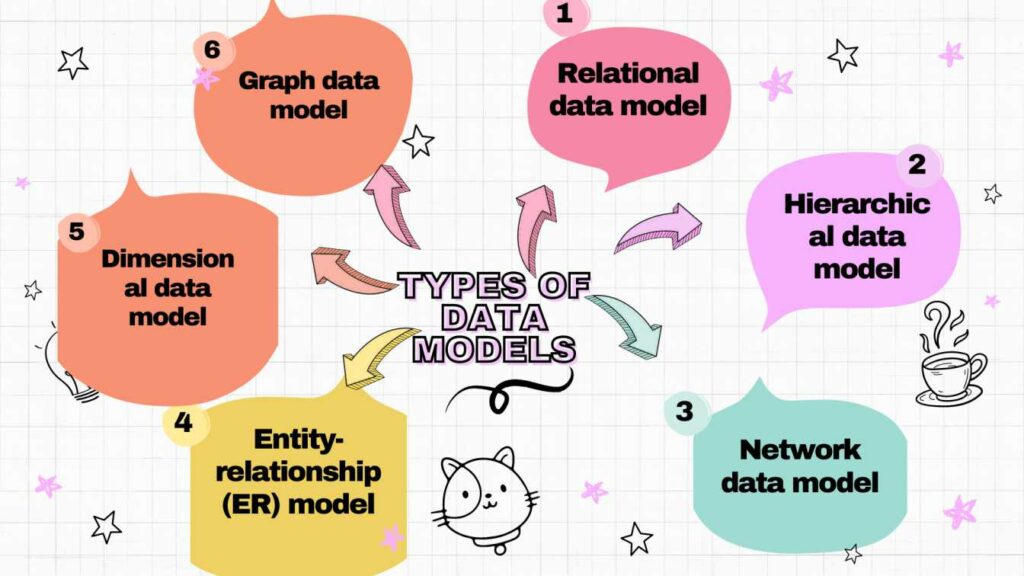
There are several types of data models used in data modelling. Here are the most common ones:

types of data models

  • Relational data model: This paradigm groups data into “relations” tables organised in rows and columns. All the rows or “tuples” have a series of connected data values, and the table name and column names or characteristics explain the data.
  • Hierarchical data model: This model represents one-to-many relationships in a tree-like structure. It is useful for displaying data with a clear parent-child connection.
  • Network data model: This model is similar to the hierarchical model but allows for many-to-many relationships between nodes. It is handy for representing complex data relationships.
  • Entity-relationship (ER) model: This model represents entities and their relationships to each other. It is effective for describing complex data relationships and is often used in database architecture.
  • Dimensional data model: This model is used for data warehousing and business intelligence. It organises data into dimensions and metrics, allowing for easier analysis and reporting.
  • Graph data model: This model represents data as nodes and edges, enabling complicated relationships to be easily expressed and evaluated.

Machine Learning

Machine learning is a discipline of artificial intelligence that focuses on constructing algorithms and models that allow computers to learn from data and improve their performance on a specific job. Machine learning algorithms utilise computer technology to learn straight from data without depending on a predetermined equation as a model.

Machine learning may be roughly classified into two basic types: supervised and unsupervised. Supervised learning includes training a model using known input and output data, enabling it to make predictions for future outputs. In contrast, unsupervised learning identifies latent patterns or underlying structures within incoming data.

Machine learning starts with data obtained and produced to be utilised as training data. The more info, the better the tools. Machine learning is highly adapted for scenarios involving masses of data, such as photos from sensors or sales records. Machine learning is actively applied today for various purposes, including tailored ideas on social networking sites like Facebook.

Integration of Data Engineering, Data Modelling, and Machine Learning

For data science initiatives to be successful, data engineering, data modelling, and machine learning must all work together. Data modelling guarantees that data is correctly structured and prepared for analysis, whereas data engineering creates the infrastructure and basis for data modelling and machine learning. Machine learning algorithms leverage data from data engineering and modelling to extract insights and value from data.

Examples of how data engineering, data modelling, and machine learning may be coupled include as follows:

  • Data engineers’ creation of data pipelines allows for the training and prediction of machine learning algorithms using data.
  • In addition to ensuring that the data is appropriately arranged and displayed, data modelling may be used to develop a model that accurately reflects the data utilised by machine learning algorithms.
  • Data analysis and insight-providing capabilities of machine learning algorithms may be used to enhance data engineering and data modelling procedures.

Conclusion

The success of ML-driven systems is based on the engineering and modelling of data used in these systems. While smart data modelling enables the development of strong machine-learning models that can make accurate predictions and generate insightful information, effective data engineering ensures that the data is clean, relevant, and accessible.

Imarticus Learning provides a Postgraduate Program in Data Science and Analytics that is meant to assist learners in creating a strong foundation for a career in data science or a career in data analytics. The data science training curriculum is 6 months long and includes Python, SQL, data analytics, machine learning, Power BI, and Tableau. The data analytics course also provides specific programmes to focus on various data science employment opportunities. Upon completing the data science course, learners receive a data science certification from Imarticus Learning.

Investment Banking Regulations in India: A Comprehensive Overview

Investment banking is a pillar of contemporary financial services, supporting investment, company growth, and wealth generation. Investment banking operations have expanded dramatically in India, a fast-rising economy with a thriving financial industry. Investment banks contribute to the nation’s economic growth and dynamism through financing securities involving mergers and acquisitions and conducting initial offerings to the public.

However, with tremendous financial strength comes immense accountability, and investment banking operations necessitate a strong regulatory framework to protect the security and reliability of the financial sector. The regulatory framework for investment banking in India is complicated and dynamic, reflecting the desire to strike a fine balance between encouraging innovation and protecting the needs of clients.

In simple terms, this detailed analysis guides India’s maze of investment banking regulations. It emphasises the crucial function of regulation in ensuring financial security and investor trust while cultivating a robust investment banking sector. As we explore the complexities of India’s investment banking legislation, we hope to provide readers with a thorough grasp of this essential aspect of the country’s financial environment.

Regulatory Authorities in Investment Banking

The function of regulatory agencies in monitoring and regulating the activities of the investment banking industry is essential. Several regulatory authorities in India are in charge of overseeing various parts of investment banking services. The following are the primary regulatory agencies involved:

Securities and Exchange Board of India (SEBI)

Officially known as the Securities and Exchange Board of India, SEBI serves as the paramount regulatory body responsible for India’s finance industry. Its jurisdiction extends to a wide spectrum of functions:

  • SEBI supervises and governs stock exchanges, providing equitable and open trading procedures. It establishes and upholds market laws to avoid fraud and manipulation of the markets. 
  • The major concern of SEBI is to protect the interests of investors. Preserving investor interests requires corporations and market facilitators to make disclosures, be transparent, and use fair practices.

Regulatory Framework

SEBI is governed by the SEBI Act of 1992, which authorises it to regulate India’s securities markets. Furthermore, it gets its jurisdiction from the Act’s different rules and directives. 

Reserve Bank of India (RBI)

RBI operates as the nation’s central bank, holding a substantial mandate in managing and evaluating nationwide investment banking activities. Let’s dive deeper into its role!

Monetary Policy: The Reserve Bank of India formulates and enforces financial regulations that impact inflation, the flexibility of the financial sector, and the range of services offered by investment banks.

Prudential standards: To guarantee financial viability and handle risks, the RBI established prudential guidelines and norms for banks and financial firms, including those involved in investment banking.

Investment Banking Prudential Standards:

The RBI has established prudential standards for banks and financial companies engaged in investment banking. To alleviate the risks connected with investment banking activities, these guidelines include adequate liquidity regulations, risk management recommendations, and exposure restrictions.

Ministry of Finance

The Ministry of Finance is a major branch of government in India that is in charge of the country’s financial and economic concerns. It is vital in shaping investment banking regulations:

Fiscal Policy: The Ministry of Finance creates and executes fiscal strategies that affect investment banking activity. Taxation, tax incentives, and allocations of funds all have an impact on the investment climate.

Government Securities: The ministry oversees the issuing and handling of securities issued by the government, which are essential components of the Indian economy. Government bond offerings are frequently attended by investment banks.

Regulatory Framework for the Banking Sector

Under the Banking Regulation Act of 1949, the Reserve Bank of India (RBI) governs the Indian financial sector. A few key features of the banking laws are discussed below.

Priority industry lending

The priority category includes micro and small businesses, as well as projects in food production, learning, housing, and financing to less privileged populations. The funding target for domestic commercial lenders and foreign banks with over 20 locations is 40% of adjusted net credit to banks.

New bank licence requirements

According to the new requirements, firms requesting a licence must have a track record of achievement of at least ten years, and the bank must be administered by a non-operative financial holding corporation (NOFHC) completely controlled by the organisers. 

Conclusion

India’s investment banking sector is positioned for continued growth and development. Recent advancements and reforms have resulted in regulatory changes that affect the markets and financiers. Understanding these regulations while predicting future patterns and problems is crucial for both authorities and industry participants, a skill set that can be developed through an organised Investment Banking Course.

Explore the Global Landscape of Investment Banking Regulations with the Imarticus Certified Investment Banking Operations Professional Programme. This course aims to teach you about the banking industry, handling risks, and complying with regulations. Furthermore, it provides the understanding and skills required for a successful, qualified interview with the best firm.

Be prepared to become a CFO with an online course

Be prepared to become a CFO with an online course

A Chief Financial Officer(CFO) is an executive-level employee who reports directly to the Chief Executive Officer(CEO). They are responsible for monitoring and overseeing the financial health of the company, managing its assets and liabilities while preparing financial statements and reporting to external parties. If you’re thinking about becoming a CFO someday, an online course can help you get there sooner rather than later.


A well-curated online CFO Course will allow you to become a CFO at your own pace from anywhere in the world. It will also help you gain or refresh your accounting knowledge, which is a necessary skill for any job as a CFO.

Whether you’re opting for an entry-level position as an accountant or exploring other career options after gaining some experience in that field, taking an online course can help put you on the right path as you work towards becoming a CFO.

What does a CFO do?

The CFO reports to the CEO and is responsible for all aspects of a company’s financial function. The job of the CFO is complex and demanding, requiring the ability to manage an organization’s financial information, whether in a private partnership or public ownership.

A CFO is responsible for smoothly running accounting, banking, and cash management. They also review and act on reports from other finance professionals in departments such as Treasury, Taxation, Payroll and Human Resources. They also implement strategies to avoid future risks created by any tax legislation changes.

They help define and set accountancy policies and practices, which means they’re involved in and are accountable for reporting financial data to regulators (for example, producing annual reports). They also take part in strategic management of the business by having input into decisions on how an organization makes its money and what it does with it (e.g., capital expenditure, mergers, and acquisitions, borrowing, etc.) Working with external auditors and tax consultants, they ensure compliance with the UK, US, and international regulations.

Benefits of being a CFO

The CFO position is not just an accounting department function. The CFO plays a crucial role in influencing company strategy. Today’s CFOs focus on business planning and process changes, including innovation and improvement initiatives. That’s why the CFO role has emerged from focusing on compliance and quality control to business planning and process changes. In doing so, they are a strategic partner to the CEO.

The advent of internal funds has led to a transformation of the CFO role. Businesses provide added value beyond their traditional financial outcomes – for example, your company. You’re ahead of the curve in many ways, but there’s still room for growth, which must be constant.

Accounting skills you’ll need to become a CFO

To become a CFO, you will need a minimum of analytical, risk assessment, innovation management, leadership, business intelligence, strategic, and communication skills.

Analytical skills: Accounting is all about problem-solving using calculations and figures.

Risk assessment skills: Accounting is a priority, especially in financial risk management.

Innovation management skills: There will be a need to look beyond the norm and identify more cost-effective ways of doing things.

Leadership skills: As a CFO, you work closely with senior leadership teams and staff and develop future leaders in your organization.

Business intelligence: You will need a solid understanding of business, particularly how it relates to finance. Keep on top of key market developments for your industry and know your competitors inside out.

Strategic skills: In introducing financial development plans, you need to be forward-thinking when making decisions.

Communication skills: You must be able to convey information clearly and concisely in many different formats

Conclusion

In the past few years, we have seen a steady rise in the demand for Chief Financial Officer (CFO) candidates. The need for an effective CFO has never been more pronounced. Being a CFO is a full-time job with opportunities, risks, and many responsibilities. Degree programs are expensive and time-consuming, and you might have to trade between studies and paid work.

You can take the strategic CFO course online or at your convenience. Whether you need to study from home or at work, it hardly matters. You can learn on the go if that’s your thing. Online courses open new possibilities for managers to get ahead in their careers. Can you imagine how convenient it would be if you had an online course that would prepare you for being a CFO? Hence, attending a Chief Financial Officer online course is in your best interest to accentuate your resume and to add to your skills. 

What are the Uses of Financial Analysis?

What are the Uses of Financial Analysis?

The financial analysis basically indicates the usage of financial data to assess the performance of a company and recommend how things can be improved in the future. The primary role of a financial analyst is to work in an excel sheet used for analysing historical data and accordingly make projections based on their perception of how the company will perform in the near future.

Four important types of financial analysis in an organization

1) Based on the material used :
(a) External analysis – This analysis is performed by people who are not directly associated with the firm and don’t have right to access the in-house accounting records of the company.
b) Internal analysis – This analysis is conducted by people who have permission to handle the in-house accounting records of a firm.

2) Based on modus operandi :
(a) Horizontal analysis – This refers to the evaluation of finance related data of a firm for many years. The figures in this type of analysis are reflected horizontally across many columns.
(b) Vertical analysis – This indicates the study of the connection of the different items reflecting in the financial statements in an accounting period.

3) Based on entities involved :
(a) Inter-firm analysis – This deals with the assessment of financial data of particular firm with its competitors in the same industry for a similar time frame.
(b) Intra-firm analysis -This analysis includes the assessment of the performance of a firm in for a definite period of time.

4) Based on the objective of analysis or time horizon :
a) Short-term analysis – This calculates the firm’s liquidity position, i.e. the ability of the company to meet its present needs.
(b) Long-term analysis – This involves the study of a firm’s capacity to meet the repayment schedules and interest costs in the long-term. Factors like profitability, solvency and stability are measured with the help of this analysis.

Different Uses of Financial Analysis

The various uses of financial analysis are as follows:

  •  Analysis of financial statements – Whenever a firm is interested in investing in a small business, the financial analysts then examines its past and present financial statements. The idea here is to determine the probable weaknesses and problem areas if any,to be discussed with the other company owners.
  • Ratio analysis – This helps in comparing values within the company against other companies and the industry every year. It includes the liquidity ratio, debt ratio, etc. Business owners and management teams might use ratio analysis in their day-to-day planning to measure where they stand in the industry. If the ratio analysis shows that the company has more debt than other businesses in the same industry, the owner might be encouraged to pay off or reduce some loans.
  • To analyse future performance – Financial analysts assist small businesses in their future planning. This planning involves the evaluation of the company’s income statement, balance sheet and cash flow statement. This helps in interpreting the trends and identifying the strengths and weaknesses. By following the trends of the general economy the analyst can estimate how well the company will be able to fare in the coming years. Accordingly, they can plan the equipment to be purchased and take other initiatives.
  • Making investment decisions – Expert financial analysts are able to make investment decisions and recommend ideas based on sound reasoning. Every company should have dedicated financial analysts who would keep a watch over the strengths and weaknesses of the company and advise the management accordingly. In some cases, they can also hire the services of financial consultants on a periodic basis.

Conclusion

Apart from financial managers, people from other walks of life can use financial analysis for their benefit. A credit manager can use it to examine the basic financial ratios of a prospective customer to decide whether to extend the credit limit. A security analyst uses it to help assess the investment value of securities.

For a banker the tools of financial analysis aids in deciding whether to sanction loans. Similarly, unions use it for evaluating the position of certain employers and students analyze it to determine their career opportunities.


Why soft skills matter: The importance of developing emotional intelligence in the workplace

Introduction

If you’re looking for ways to develop your soft skills, look no further! Here are some tips to get you started on the right path.

In today’s changing workplace, soft skill development has become vital for career success and personal growth. Soft skills matter because they can help you to succeed in your career.

Soft skills are personal attributes and behaviours that enable people to interact effectively with others in the workplace. These skills include:

  • Emotional intelligence (EI)
  • Communication
  • Teamwork
  • Adaptability
  • Problem-solving
  • Leadership

In this article, we will discuss why soft skill development matters. We will also cover the importance of developing EI in the workplace.

Importance of soft skill development

Soft skills allow people to build strong relationships with colleagues, clients, and stakeholders.

  • Effective communication skills are required for effective teamwork, problem-solving and decision-making.
  • Strong people skills aid in conflict resolution, effective negotiation, and the development of trust with others.
  • People with adaptability and flexibility can respond to changing corporate settings and job positions.

Emotional Intelligence for career success

One of the most important soft skills is emotional intelligence. It refers to a person’s ability to understand and manage their own and others’ emotions.

EI involves a range of skills, including:

  • Self-awareness
  • Self-regulation
  • Empathy
  • Social skills

These skills are required for effective workplace communication, leadership, and collaboration.

But, people may face many common obstacles when developing soft skills, such as:

  • Time constraints
  • Resistance to change
  • Lack of resources

How to develop soft skills and EI?

1. Enrol in a soft skill development course or workshop

Developing EI requires practice and self-reflection. These programs offer practical tools and strategies for improving EI, such as:

  • Mindfulness practices
  • Active listening
  • Conflict resolution techniques

These programs provide opportunities for people to practice these skills in a safe and supportive environment.

Here are some things to consider when exploring soft skill development courses

Corporate Training

Whether you’re looking to improve your communication skills, build your team-working abilities, or enhance your leadership skills, there’s a soft skill development course out there for you. But with so many options available, it can be tough to know where to start.

Here is a list to narrow down your search.

  • Look for courses that apply to your profession or sector, and your ambitions and hobbies.
  • Consider the course format, whether it is in-person, online, or a combination of the two. Choose the one that best fits your learning style and time constraints.
  • Investigate the instructor or facilitator of the course. Ensure that they have applicable soft skill development experience and knowledge.
  • Examine whether the course provides an opportunity for practice and feedback. It must offer resources and methods for continuous learning and development.
  • Check if the course offers opportunities for practice and feedback. It must provide resources and tools for ongoing learning and development.

2. Through self-evaluation

This involves taking the time to understand one’s own emotions, triggers, and behaviours, as well as those of others.

Self-awareness allows people to see their strengths and flaws. This may help to develop strategies for improving communication and relationship skills.

Regular self-reflection can help to identify areas for improvement. People can create personal and professional growth goals.

Here are some tips to implement self-initiatives for developing soft skills.

  • Conduct a self-assessment to identify areas of strength and weakness.
  • Seek input from colleagues, managers, and mentors to gain an outside perspective.
  • Evaluate past experiences. Identify instances where strong soft skills were demonstrated. Determine the areas where improvement is needed.
  • Use online assessments and tools to gain a better knowledge of soft skill strengths and flaws.

Wrapping note

Soft skills and EI are essential for workplace success and personal growth. Companies may establish stronger teams and generate business success by prioritising employee soft skill development.

Developing these skills requires practice, self-reflection, and a willingness to learn and grow. Soft skill development courses and workshops provide individuals with practical tools and strategies for enhancing their EI and communication skills. So why wait? Start developing those soft skills today!

Imarticus Learning is an ed-tech that provides courses in finance, analytics, technology, and management. Their courses teach practical skills that are useful in today’s fast-paced business environment. These courses are designed to be relevant to industry needs and help people and companies stay ahead. Visit Imarticus Learning today.

Everything about key segments in financial markets

Everything about key segments in financial markets

Understanding how any financial market works is one of the most critical aspects. This helps us anticipate future trends and better understand and make trading decisions. In this post, we will try to show you one of the most exciting ways of getting an overview of what makes up a specific segment — key segments in financial markets.

An Overview of the Financial Market

Financial markets encompass any location or mechanism allowing buyers and sellers to trade financial instruments such as bonds, shares, foreign currencies, and derivatives. Financial markets promote the interaction of individuals needing capital and those with money to invest.

Markets offer to finance companies so that they may recruit, develop, and grow. They grant funds to the government to assist in constructing new roads, schools, and hospitals. 

What are key segments in the financial market?

Key segments are the most critical parts of the financial market. They include primary and secondary markets.


  • Primary Market


It is where new securities get sold to investors for the first time. This is also known as an initial public offering (IPO), which occurs when a firm sells shares to the public.

This type of investment helps to improve a company’s value, allowing an investor to achieve exceptional returns through a trade sale, buyout, recapitalization, or IPO.

Individual investors have generally had limited access to these possibilities. Previously, one had to fulfill the standards of an accredited investor before taking on the risk of investing in private markets. 


  • Secondary Market


The secondary market is where the securities get traded after they are issued. The security’s issuer or another party (such as a broker or dealer) sells it to an investor who buys it to resell it at a higher price later. Investors can also buy and hold stocks directly from issuers, known as “buying on margin.”

The securities traded on exchanges are listed securities because their prices are published publicly; thus, anyone can find out who owns them and how much each owns them at any given time. 

This information makes it easy for investors to decide whether they want to buy into certain stocks before making an investment decision themselves!

Learn investment banking courses with Imarticus Learning


Students may launch a career in financial markets with the Certified Investment Banking Operations Professional program. This investment banking certification course will provide students with the knowledge and abilities needed to excel in banking operations, treasury, and clearing services at all stages of production. Strategic planning and financial management, financing, and valuation of investment prospects are all included in the investment banking course syllabus.

Course Benefits for Learners:

  • Students will learn financial services, including handling complex securities and derivative products and their trade-life cycles.
  • Students may be able to acquire the help they require to begin their careers in investment banking.
  • After finishing the money market course and financial markets training, students will get an industry-recognized certificate.

Contact us through chat support, or drive to one of our training centers in Mumbai, Thane, Pune, Chennai, Bengaluru, Delhi, Gurgaon, or Ahmedabad.

A Quick Way to Solve a Problem with Trade Capture in Trade Life Cycle

In the economic market, “Trade Capture” means booking / capturing the trade into the structure used within the financial organization. At times, this may arise multiple times based on the intricacy of the trades and the capacity of the systems to be able to capture the economic, non-economic, and static details depending on the deal.
The rewarding trade capture within a trading system occurs when the trade facts are sent to the back office instantly, through an interface for operational processing. Most of the time, the trade details are recorded manually by the traders, when an STO (Securities Trading Organisation) does not have a trading system. This requires either collection by or distribution to the middle office or settlement department for operational processing. In such conditions, the traders are required to manage their trading positions manually, keeping it trendy with any latest trades.
The entire steps from the stage of order receipt and trade execution to the trade settlement are known as the “Trade Cycle”. This can be categorized into various stages as listed below.
Front Office
The front office, commonly referred to as the Trading Floor, performs two main function –

  • Trade Capture

The trade gets initiated in the front office using the trading app, in accordance with the retail price of the instrument. Still, the buyer will have an opportunity to cite an offer to the selling party. The trade gets executed, only if the counterparty agrees to the trade details and is willing to enter the deal. Once the trade gets executed, it gets captured using a Trade Capture system, which gives the go-ahead to all the necessary trade information and assigns a trade confirmation number or a trade reference number. This number is unique and used for all the upcoming trade events such as amendments, cancellation and so on. This unique number indicates the booking confirmation and is sent to both sellers and buyers as an acknowledgment.
Middle Office
The Middle Office plays a very important part of the exception management. At this stage, three important steps are accomplished such as –

  • Validation
  • Booking
  • Confirmation

By using the Order Management System (OMS), the tradesman works on the deal and the trade gets enhanced by the static data such as the Standard Settlement Instructions (SSI), Custodian Details, City Holidays, Special Instructions and so on. These static data details are vital for the execution and settlement of the trade. The allocation of the trade happens in the Middle Office, gets published in the Back Office, and finally considered live and operational.

Back Office
The Back office is considered the “backbone” of the entire trade life cycle. It mainly performs three vital functions such as –

  • Clearing
  • Settlement
  • Accounting

This stage covers the significant operational activities such as record keeping, order confirmations, trade settlement, and regulatory reporting. Most of the time, the back office tasks are deployed to low-priced sources for its specific management activities, with a view to reducing the company costs, thus increasing their productivity by delivering better operational value.
The next activity soon after the trade execution is to capture the entire trade details, regardless of the base it is recorded without any hindrances. The trade which is executed initially is captured in the front office where the primary details of each Asset Management in trade are being recorded.

Conclusion
The complete Trade Life Cycle is a jumble of complex functions where the trade undergoes a stream of several events. There is a lot of manual involvement in all these events and this increments the time spent for processing and settlement of various functions.


Financial Ratio Analysis: Navigating Different Types of Ratios

Ratios offer significant value to organisations aiming to track company performance. By comparing ratios over time or against industry benchmarks, stakeholders can identify trends, strengths, weaknesses, and other areas that might require attention. From performance management and strategy alignment to investor confidence and performance evaluation, financial ratio analysis can help an organisation in multiple ways.

With that being said, mentioned below is a detailed article exploring the various types of ratios and their fundamental role in the field of accounting and financial modelling.

What Is Financial Ratio Analysis?

Financial Ratio analysis can be defined as a quantitative method used to evaluate a company’s financial performance and health by examining the relationships between various financial data in its financial statement. It involves calculating and interpreting a variety of financial ratios, which are key indicators of different aspects of a company’s operations, profitability, efficiency, and liquidity.

Financial ratios can help to identify financial risks and vulnerabilities. For example, high debt ratios may indicate a risk of insolvency, whereas low liquidity ratios denote difficulties in meeting short-term obligations.

Different Types Of Financial Ratios

Some of the most commonly used ratios in financial modeling include,

Liquidity Ratios

Liquidity ratios are financial indicators utilised to assess a company’s capacity to fulfil its immediate financial commitments by leveraging its readily available liquid assets. These ratios assess the company’s ability to convert assets into cash quickly without facing any significant loss in value. A few examples of such liquidity ratios are,

Current Ratio – The current ratio stands as one of the most commonly employed metrics for assessing liquidity. It is determined by dividing current assets by current liabilities.

Quick Ratio – Also referred to as an acid test, quick ratio is a more conservative measure of liquidity. The formula for the same involves removing inventory from current assets because they may not be easily converted into cash.

Cash Ratio – The cash ratio primarily focuses on a company’s cash and cash equivalents in relation to its current liabilities.

Solvency Ratios

Commonly referred to as financial leverage ratios, solvency ratios are financial indicators used to assess a company’s enduring financial stability and its capability to fulfil long-term financial commitments. These ratios offer a comprehensive view of a company’s capital makeup and its ability to service long-term debt obligations. Solvency ratios serve as a crucial parameter for investors and management to gauge the financial health and risks associated with the organisation’s long-term debt management.

A few examples of such solvency ratios include,

Debt-Equity Ratios – Debt-equity ratios compare the company’s total debt to its shareholder’s equity. It measures the proportion of a company’s financing that comes from debt relative to equity.

Debt Ratio – Much like the debt-equity ratio, the debt ratio represents the total debt as a proportion of total assets. This calculation entails dividing the total debt by the total assets.

Interest Coverage Ratio – This ratio is used to assess a company’s ability to cover its interest expenses with its operating income.

Profitability Ratios

Profitability ratios convey how well a company can generate profit in relation to its revenue, assets, equity, or other financial measures. These ratios provide insights into a company’s operational efficiency, effectiveness, and overall profitability. They not only help to identify areas of strengths and weaknesses in an organisation’s performance but also facilitate the decision-making process for improving profitability.

Investors and analysts use several profitability ratios to assess a company’s financial performance. A few examples of the same include,

Gross Profit Margin – This indicates the remaining percentage of sales revenue after you deduct the cost of goods sold (COGS). It denotes how efficiently a company produces and sells its products.

Operating Profit Margin – Also known as operating margin or return on sales, this ratio highlights the percentage of sales revenue after deducting COGS and operating expenses.

Return On Assets – Return on Assets (ROA) is an indicator of how efficiently a company utilises its assets to generate profit. It denotes the return on investment for all assets owned and financed by debt.

Apart from these, there are also several other types of financial ratios used by organisations. Such include efficiency, coverage, and market prospect ratios, among others.

Conclusion

Financial ratios serve as a concise way to communicate complex financial information. They help to bridge the gap between investors and management by providing a common language to discuss a company’s financial health. In addition to this, financial ratios also facilitate the strategic planning process. 

Management can make more informed choices by understanding the financial implications of strategic decisions. If you wish to know more about financial analysts or simply wish to advance your career in finance, you can refer to multiple online finance certification courses.

One such among them includes the Financial Analysis course offered by Imarticus. Besides extending valuable insights from market leaders, this financial analysis course brings forth innumerable advantages, including unique real-world case studies, hands-on training by industry experts, an industry-approved curriculum, and more. 

Imarticus Learning Reviews – Students Experience

Imarticus Learning owes its existence to Mr. Nikhil Barshikar’s (M.D –Imarticus Learning) vision of providing trained technical personnel of international class who would act as leaders in the Banking, Analytics & technology space globally.
Imarticus has been in existence since the last 2 years, and is going strong. With a vision to bring positive changes in aspirants’ lives, we have successfully trained and placed thousands of students within their desired career paths.
As a Student Relationship Manager and a Counselor at Imarticus, it’s a delight to hear what the students feel about the change we brought into their lives. Here are a few reviews given by our students.
Balbir S : Staff is wonderful. Tremendously supportive. I would like to thanks them from the bottom of my heart. While at interview the confidence developed in me by Imarticus was most satisfying. Selected or not i knew i had given my best with confidence. The knowledge and HR training gained was the main reason. Just want to thank Imarticus for every thing.
Jinesh D:  Experience was great, with regards to knowledge, what we learnt we are applying. The knowledge we gained was in depth.
Amit S: It has been an amazing learning experience. Orking on live projects and following guidelines set by major companies while implementing these projects have definitely been one of the major points of this course. Thank you imarticus.
Amita S: Being in Imarticus was a great experience nice exposure to the finance domain. Learning process actually transforms your personality and train you for the corporate world.
Viraj K: It was a great time in Imarticus with high quality professors. It was great here, learning Java, Advanced Java, Communication Skills and the most important Investment Banking. Geeting an awesome knowledge about IB was superb here. Love to be in Imarticus.
Sudarshan B: If you really want to learn the concept of Investment Banking then Imarticus is the place to be. The kind of knowledge that you obtained by the end of the course takes you to a different level all together. With practical learning you are also groomed so as to be readily accepted by the industry. One also gets opportunity to interact with distinguished industry people thanks to our super faculty you are well taken care of
Olson P : The knowledge has help me a lot. Helping me to know more in depth due Imarticus input.
We sincerely thank all the students for taking their time out to send us a note of appreciation. This just motivates us to continue spreading the joy of pursuing aspirations.

-Sohail Merchant
Student Relations Manager
Imarticus Learning