Behavioral finance is the study of economic affairs and psychology. Behavioral finance shows how an investor makes emotional financial decisions contrary to conventional business decisions. Unlike traditional finance, behavioral finance shows how emotional biases and human feelings are incorporated into decision-making.
An important feature of behavioral finance is the impact of psychological bias on investment decisions. Understanding behavioral finance bias is crucial for implementing business decisions in an organisation. Read on to gain a deeper insight into financial bias.
What is behavioral finance?
Behavioral finance is an amalgamation of psychology and economic matters. It is important to evaluate the impact of emotional bias on financial decision-making. While traditional finance assumes rationality of business decisions, behavioral finance acknowledges the irrationality of decisions based on biases. Primarily, behavioral finance biases revolve around five key concepts:
Mental accounting refers to the tendency of individuals to allocate resources for particular purposes.
Emotional gap refers to the inclination to make decisions based on strained emotions.
Herd behaviour refers to how an individual tends to mimic the financial behaviour of most individuals. Herd behaviour is quite prevalent in the stock market.
Self-attribution refers to the inclination of an individual to make decisions with excessive reliance on one’s expertise. The bias of overconfidence lies at the root of self-attributive behavioral finance.
Anchoring refers to the association of a spending level with a particular reference.
An exploration of the psychological factors that affect business decisions
Cognitive factors have a significant impact on investment outcomes. A few key psychological factors that influence business decisions are described below:
Overconfidence bias
Investors often tend to overestimate their predictive power and knowledge while making business decisions. Overconfidence bias compels investors to execute frequent trades leading to the incurrence of risks. For example, an investor may ignore a market downturn and continue trading despite the risks leading to poor portfolio performance.
Loss aversion
Investors often prefer avoiding losses to attaining equivalent profits. The loss aversion theory suggests that the pain of incurring a loss is more impactful than the pleasure of acquiring gains. For example, an investor may decline to sell a deteriorating stock hoping that the price of the stock may rebound.
Confirmation bias
Investors tend to extract information that confirms the existing beliefs of the investor despite contradictory evidence. Such investors tend to focus on positive news updates about a particular stock while ignoring the associated risks. Ignoring the signs of deteriorating market trends often results in poor investment decisions and losses.
Regret aversion
Regret aversion refers to an irrational fear of making regrettable investment choices leading to avoidance of making decisions. Regret aversion bias goes beyond fiscal loss to emotional discomfort. Investors tend to avoid the sale of collapsing assets fearing that they may regret the business decision. This leads to wasted prospects of portfolio diversification.
Bias of fear and greed
Fear and greed often influence value investing and behavioral finance decision-making in an organisation. Emotional investing causes poor decision-making in stock trading. Fear and greed trigger volatile market trends and stock crashes.
Mental accounting
Mental accounting is a behavioral pattern of treating assets differently based on the source of the assets. Instead of assessing the overall financial state, investors make random business decisions based on the source of the stock. Mental accounting often leads to irrational decision-making in business. For example, an investor tends to be traditionalist about retirement savings while spending money thoughtlessly from a different account.
Recency bias
Recency bias makes an investor prioritise recent market patterns over historical data. Stockholders generally tend to give more importance to short-term market development and make flawed decisions. For example, an investor may chase current market trends and incur losses due to neglect of historical market patterns.
Anchoring bias
Shareholders often feel inclined to rely on a particular piece of market information while ignoring other factors. This piece of market information is considered an anchor. Investors often skip rudimentary market analysis and choose to stick to their anchor bias for making business decisions. For example, a stockholder may hold onto an asset until the asset process reaches a past peak price while simultaneously ignoring current market patterns.
Herd bias
Herd bias is one of the most prominent biases that investors harbour. Shareholders tend to imitate the behaviour of a larger group of investors while neglecting appropriate analysis of the market. Herd behaviour creates a bandwagon effect in which stockholders tend to follow generic trading patterns instead of conducting independent evaluations. Such a bias often results in market crashes and asset bubble formation. For example, purchasing a booming asset without assessing the company incurs huge losses when the asset bubble bursts.
Availability bias
Availability bias refers to a behavioral tendency to give undue importance to news and personal experiences. Such a bias can compel investors to waste profitable opportunities depending on what is readily available in their minds. Such investors tend to invest in assets based on success stories while neglecting an evaluation of the assets.
Conclusion
Psychological factors like herd mentality, overconfidence, and emotional biases have a great impact on business decisions. Behavioral finance recognises the infusion of emotions and business decisions. Awareness of psychological influences helps in avoiding investment errors and making rational decisions.
What is the role of psychological factors in behavioral finance?
Behavioral finance deals with the impact of psychological factors on investment decisions. Psychological factors explain the inconsistent patterns of the stock pattern including sudden hikes and drops in the price of stock.
What is behavioral finance and the psychology of investing?
Behavioral finance refers to the recognition of biases that contribute to irrational and unpredictable decision-making by investors. Emotions like greed and fear drive the investment decisions of stockholders.
What are the factors influencing financial behaviour?
The factors that affect financial behaviour include financial planning, financial literacy, financial socialisation, and financial skills.
What is the role of Behavioral finance in investment decisions?
Behavioral finance demonstrates how different stockholders assess and react to market trends and data to drive business decision-making.
Structured finance refers to a fiscal lending instrument companies use to stay afloat amid financial complications. Implementing structured finance allows companies to develop financial solutions for addressing financial risks.
Structured finance involves reconfiguration and regrouping of capital into collateral reserves. It also involves the establishment of strategies for risk mitigation for shareholders and issuers. Read on to learn more about structured finance.
Primary aspects of structured finance
Structured finance involves multiple components as discussed below:
Pooling of financial assets
Financial assets including mortgages, loans, and receivables are summated to develop a big pool of assets. This pool of assets may provide the collateral for the issued reserves.
Tranching of securities
Companies often divide securities into tranches of different levels of risks and returns. The tranches enable catering to various degrees of risk tolerance.
Asset securitisation
Asset securitisation relates to the conversion of illiquid financial assets into cash reserves. Companies may sell the cash reserves to shareholders. The securitisation process further involves the isolation of assets from the balance sheet of the issuer.
Contribution of finance departments to the organisation of complex funding solutions
The finance department is responsible for developing and implementing solutions for structured finance. By leveraging strategies and instruments of finance, the finance department develops funding solutions. The developed solutions are in alignment with market patterns and organisational requirements.
The products bear a complex nature and thereby necessitate efficient organisation and execution of structured funding solutions.
How finance departments contribute to the organisation of complex financial solutions is described below:
Assessing financial needs
Identification of the financial needs of the organisation is the first step to the development of complex financial solutions. Finance departments assess the present and imminent fund requirements based on market dynamics, expansion strategies, and operational expenditure.
The assessment determines the kind of structured finance solution that would meet the needs of the organisation. For example, an organisation that is expecting rapid development may use securitisation to transform receivables into liquid cash flow. In another example, a company dealing with liquidity problems may choose to issue low-risk tranches of securities.
Designing of the structure
Upon identification of financial requirements, the subsequent step is to focus on creating an efficient finance organisation structure. Designing the organisation structure of finance department requires the determination of relevant funds for pooling. It also requires the selection of an optimised securitisation procedure and a tranche progression to attract different investors.
Further, the finance team needs to coordinate with legal advisors to maintain compliance with various regulations. This necessitates an in-depth understanding of the organisation structure of the finance department and the legal importance of the structuring.
Management of risks
Risk management is a critical aspect of the finance department structure. Finance experts analyse liquidity risk, market risk, and credit risk to develop strategies for risk mitigation. It is important to enrol oneself in financial services courses to implement risk management strategies in an organisation.
For instance, an organisation may implement credit enhancement policies to boost the credit approximation of securities. Monitoring of asset performance and market trends regularly enables the finance department to modify risk management strategies for various risk profiles.
Cooperation with investors
Collaboration among shareholders is essential for the development of a finance organization structure. The finance department collaborates with investment bankers for the structuring and allocation of assets. The finance department also collaborates with legal advisors and rating agencies for compliance with regulatory frameworks. Further, the finance department coordinates with rating agencies for the analysis of credit scores of securities.
Addressing the challenges
Financial departments of organisations deal with market risks and regulatory amendments. It is important to stay up-to-date on changing regulations to avoid legal complications. Market trends that impact asset performance and investment require the financial teams to remain alert in their approach.
Conclusion
Finance departments shoulder the crucial responsibility of organising elaborate funding solutions through structured finance. As financial exchanges expand, the flexibility and expertise of finance departments become essential for developing innovative financial solutions. Finance professionals may be able to gain more insight into the intricacies of structured finance by pursuing a course in the Advanced Management Programme In Financial Services And Capital Markets at Imarticus.
The course features live lecture sessions and masterclasses by top-tier industrialists of the country. For more information, one may read about collateral management and financial risks on the official website of Imarticus to understand the concepts of structured finance more clearly.
Frequently Asked Questions
How to organise the finance department structure?
The finance department structure may be organised by assessing the capabilities of the finance team members and establishing distinct roles and responsibilities for each member.
What is the strategic goal of the finance department?
The primary objective of the financial department is to devise financial strategies that would enable the growth and development of the organisation.
How can the finance department contribute to the success of an organisation?
The finance department must analyse business data and make strategic decisions about investment and organisational expansion for success.
How do you optimise a finance department?
The finance department may be optimised by embracing digitisation, ensuring data accuracy, and mitigating security risks.
A diverse workplace has been a theoretical utopia for a long time. However, as our workplaces slowly shrink into the palm of our hands and simultaneously branch out to recruit top talents from all over the globe, diversity becomes an important aspect of employee satisfaction and employer branding.
With 60% of the workforce attesting to the role of diversity in propelling their team ahead of their competitors, Diversity and inclusion in the workplace have become pivotal factors in Gen-s picking their workplace.
What is Diversity in the Workplace?
Diversity in the workplace refers to unbiased employment and benefit schemes within an organisation. A diverse workspace is one where employees of all cast, creed, abilities, gender, nationality, socioeconomic status, sexual orientations and other aspects feel valued for the work they bring to the table.
A diverse workplace is easier to create in theory than implement in practice. Different involuntary biases take the stage during unbiased hiring methods and promoting inclusivity among employees. Therefore, organisations today are focusing on effective strategising to build a truly diverse workplace, keeping in mind the limitations and hurdles of the status quo as compared to the utopian ideology.
Different Types of Diversity in the Workplace
Diversity isn’t one-dimensional. When you actively engage in inclusive recruitment practices, you realise how intricate the concept of diversity is. Here are certain types of diversity that often interfere with each other’s domains:
Internal diversity
This comprises characteristics that are inherent to a person such as their race, abilities, ethnicity, linguistic fluencies, gender, and sexual orientation. These are characteristics that haven’t been influenced by any external factors.
External diversity
Aspects that are beyond internal characteristics are classified as external diversities. These include socioeconomic factors, religious affiliations, marital status, and so on. These are factors that can change over time, hence they’re external factors.
Organisational diversity
This refers to the diversity within the company, i.e. the organisational hierarchies, the job positions, the seniority levels, and so on. Being a company that promotes organisational diversity means that all employees, of all salary and seniority levels, are treated equally and respectfully.
Worldview diversity
This kind of diversity encompasses the differences in opinions, practices, and beliefs people have inculcated from their experiences in the world. The inclusion of this diversity aspect makes sure that multiple viewpoints are available at the table during crucial decision-making processes.
To understand more about different types of diversity and learn about the many classifications of this intricate concept, enrol in Imarticus Learning’s HR analytics course in collaboration with IIT Roorkee to learn from industry experts.
Steps to Incorporate Diversity in the Workplace
Strategic hiring practices are essential to promote diversity in the workplace. The workplace culture must be refined and revamped to fit modern diversity strategies. Read this strategic human resource planning blog to learn more about such effective strategies and their effects on the hyper-digitised workplace in the post-pandemic era.
Now, moving on to some ways that you can use to effortlessly weave in diversity schemes within your workplace:
Blind hiring
Blind hiring is a recruitment practice where identifiable information like name, gender, ethnicity, and age is concealed from the hiring process. Now, this significantly reduces, and even negates unconscious bias allowing for a bird-eye focus on skill set, merit, and experience.
Training and awareness programs
Implementing regular training and awareness programs is crucial for building an inclusive work environment. These programs should mainly aim at educating employees about unconscious bias, cultural competency, mutually respectful interactions, and so on.
Training sessions can range from workshops to seminars that draw both short and long-term goals to teach employees the art of interaction and resourceful communication with their co-workers from different backgrounds or with different experiences.
Feedback channels
Creating open and accessible organisational feedback channels encourages communication between employees and the authorities. This not only allows employees to express concerns, share suggestions, and provide input on workplace diversity initiatives but also builds on the employer branding initiatives as a whole.
Mentorship programs
These programs aim to pair less experienced employees with more seasoned professionals within the organisation. On the one hand, it provides guidance and support to the newbies regarding the company culture, it also helps the senior management connect and learn newer methods from the new hires.
A diverse mentorship program promotes the inclusion of individuals from underrepresented groups by giving them access to resources and leadership opportunities.
Creating Employee Resource Groups (ERGs)
ERGs are voluntary groups led by employees that promote diversity and foster a sense of belonging. ERGs can be formed around shared characteristics such as gender, race, or cultural background.
These groups provide a platform for employees to connect, share experiences, and support each other. ERGs play a key role in raising awareness about diversity issues and can serve as a resource for management to gain insights into the concerns of various employee communities.
Wrapping Up
Incorporating diversity in the workplace is more than just a social responsibility, it has now transformed into a metric for success. Organisations embracing diverse perspectives are reported to create teams that reflect the resilience of multiple viewpoints and the seamless integration of varied opinions.
To learn more about inclusive hiring practices and DEI techniques, head over to Imarticus’ Human Resource Management and Analytics Program, in collaboration with IIT Roorkee and kickstart a career in HRM today.
Frequently Asked Questions
How do we define diversity in the workplace?
Diversity in the workplace refers to the presence of people from different backgrounds, cultures, and identities within an organisation.
What are the benefits of diversity in the workplace?
Benefits of diversity in the workplace include increased creativity, improved problem-solving, better decision-making, and enhanced cultural understanding.
What is the impact of diversity in the workplace?
The impact of diversity in the workplace can be positive or negative, depending on how it is managed. Positive impacts include increased innovation, improved employee satisfaction, and enhanced reputation. Negative impacts can be increased conflict and decreased productivity if not handled effectively.
What is diversity and inclusion in the workplace?
Diversity and inclusion in the workplace are interrelated concepts. Diversity refers to the presence of differences, while inclusion refers to creating a workplace where everybody will feel valued and respected.
As humans, we can understand emotions from texts. Sentiment analysis is one such part of NLP that dives into this aspect albeit fulfilled by machines. In this blog, we’ll cover this topic, why it’s important in NLP, and how businesses use it to read human emotions from data like tweets, reviews, and more.
Whether you’re a beginner or looking to brush up on your knowledge, this guide has something for everyone. Ready to get started? Let’s learn how to decode sentiment together!
What is Sentiment Analysis?
NLP Sentiment analysis, a subfield of NLP, is key to understanding the emotional tone of a text. Whether it’s reviews, social media posts, or customer feedback, this technique gives you public opinion.
This analysis is usually done using Python. Python has many libraries like NLTK (Natural Language Toolkit), VADER, and TextBlob that make the analysis accessible even for a beginner.
The Basics of Sentiment Analysis
The analysis is used to determine if a given text is positive, negative, or neutral. It’s used in many industries to analyse customer opinions, predict market trends, or even monitor brand reputation.
The sentiment analysis tools primarily include:
Lexicon-based: Uses predefined dictionaries of words that have been assigned a positive, negative, or neutral score.
Machine learning-based: Models are trained on labelled datasets to classify the sentiment of text.
To gain a better idea of this, opt for AI and ML courses that elaborate vastly on sentiment analysis tools.
Setting Up the Environment
Before we start, you need to set up your Python environment. Install the required libraries NLTK, TextBlob, and VADER.
Here’s how you can do that:
bash
pip install nltk
pip install textblob
pip install vaderSentiment
Also, don’t forget to import some additional libraries such as pandas and matplotlib for data manipulation and visualisation:
bash
pip install pandas matplotlib
Data Preprocessing: Cleaning the Text
Text data is often messy and contains noise like punctuation, stop words, and special characters. Cleaning the data is an essential first step to ensure accurate analysis.
Here are the steps:
Convert to lowercase: Makes the text uniform.
Remove punctuation and special characters: Cleans up the text.
Tokenisation: Breaks the text into individual words or phrases.
Stopword removal: Removes common words (e.g., “and,” “the,” “is”) that don’t contribute much to the sentiment.
Here’s how to implement this in Python using NLTK:
import nltk
from nltk.corpus import stopwords
from nltk.tokenize import word_tokenize
import string
# Download the stopwords package
nltk.download(‘stopwords’)
nltk.download(‘punkt’)
# Sample text
text = “The product is really good, but the service was terrible!”
# Convert to lowercase
text = text.lower()
# Remove punctuation
text = text.translate(str.maketrans(”, ”, string.punctuation))
# Tokenisation
words = word_tokenize(text)
# Remove stopwords
filtered_words = [word for word in words if word not in stopwords.words(‘english’)]
print(filtered_words)
Lexicon-Based Sentiment Analysis
Now that our data is clean, we can apply this analysis using lexicon-based approaches. Python libraries like VADER and TextBlob make this task easy.
Using VADER
Here’s an example of using VADER:
from vaderSentiment.vaderSentiment import SentimentIntensityAnalyzer
# Initialize the VADER sentiment analyzer
analyzer = SentimentIntensityAnalyzer()
# Analyze sentiment of a sample text
text = “The product is awesome but the service was terrible!”
Compound: A single value representing the overall sentiment.
The compound score ranges from -1 (most negative) to 1 (most positive).
Using TextBlob
Here’s how to implement sentiment analysis using TextBlob:
from textblob import TextBlob
# Sample text
text = “The product is amazing but the service was horrible!”
# Create a TextBlob object
blob = TextBlob(text)
# Perform sentiment analysis
sentiment = blob.sentiment
print(sentiment)
Output:
bash
Sentiment(polarity=0.1, subjectivity=0.9)
Polarity: Ranges from -1 (negative) to 1 (positive).
Subjectivity: Ranges from 0 (objective) to 1 (subjective).
Machine Learning Techniques
While lexicon-based methods are simple and effective, they may not always be accurate, especially when analysing complex texts or industry-specific jargon. Here’s an example of using scikit-learn to implement machine learning-based sentiment analysis:
from sklearn.model_selection import train_test_split
from sklearn.feature_extraction.text import TfidfVectorizer
from sklearn.linear_model import LogisticRegression
from sklearn.metrics import accuracy_score
# Sample dataset
texts = [“The product is amazing!”, “I hate this service”, “It’s okay, not the best”]
Sentiment analysis in Python is easy and works well with the right tools and libraries. While lexicon-based methods like VADER and TextBlob are easy to use and work well for simple tasks, more advanced use cases require machine learning-based approaches.
For professionals looking to use AI strategically an executive programme in AI for Business is the way to go. These programs offer leaders the knowledge to use AI in decision-making, customer insights, and competitive strategy.
Grow your business by mastering AI technologies like sentiment analysis today!
Frequently Asked Questions
What is sentiment analysis?
Sentiment analysis is a technique in natural language processing (NLP) that classifies emotions or opinions in text as positive, negative, or neutral.
Why should we use sentiment analysis?
It helps businesses understand customer feedback, monitor brand reputation, and predict trends by reading public sentiment from reviews, social media, and other data sources.
What are the methods used in sentiment analysis?
Lexicon-based and machine-learning models are used, with tools like VADER, TextBlob, and more advanced machine-learning algorithms.
How accurate is NLP sentiment analysis?
Accuracy depends on the model and data quality. Lexicon-based methods are simpler while machine learning models are more precise.
The definition of a small business is considered as a business with an annual turnover of $10 million by the IRS. These companies, that are trying to grow from scratch on their own, have their hands full of managing operations, employees, and finances.
Amidst all these responsibilities, there are taxes that itself is a complex topic and can be overwhelming. However, no matter what a business does, it is crucial to understand tax compliance well to secure its financial health.
What are Some Taxes for Small Businesses?
Determining the exact number of taxes for small businesses is difficult as it varies depending on several factors, including location, business structure, and industry. A Certified Public Accountant shares their expertise to find these tax obligations, file returns, and identify potential tax savings opportunities.
Here are some common types of taxes that small businesses might encounter:
Income Tax: This is the most common type of tax for businesses, based on their net income.
Sales Tax: Companies that sell tangible goods or services within the state are likely required to collect and remit sales tax.
Employment Taxes: These include Federal Insurance Contributions Act (FICA) taxes (Social Security and Medicare) and federal unemployment tax (FUTA).
Property Tax: Businesses that own property are subject to property tax.
Excise Taxes: Certain industries, such as alcohol, tobacco, and fuel, may be subject to excise taxes.
What is Tax Compliance?
In simple terms, tax compliance for small businesses means confirming that a business adheres to all tax laws and regulations. This includes
Filing the appropriate federal, state, and local tax returns on time. The specific forms of taxes here depend on specific business structures.
Accurately calculating and paying the correct amount of taxes based on the business income and expenses.
Maintaining detailed records of all financial transactions for tax compliance. This means the documents of income, expenses, receipts, invoices, and bank statements.
Why is Tax Compliance Important?
Tax compliance is a vital aspect of running a successful small business. Failure to comply with tax laws can have serious consequences, including penalties, interest charges, and damage to the business’s reputation.
The IRS and other tax authorities conduct audits to verify the accuracy of a business’s tax returns. During a tax compliance audit, tax officials may examine the organisation’s financial records, interview employees, and request additional information. Combating tax compliance is important to:
Avoid penalties and interests
Non-compliance with tax laws can lead to significant penalties and interest charges. As per the Income Tax Act of 1961, penalties for tax evasion range between 100% to 300% of the tax for undisclosed income. These penalties can be substantial and are quick to corrupt the profits of a business that is hardly established.
Maintain a positive reputation
Tax compliance can prevent a business from damaging its credibility and reputation. If a business is found to have engaged in tax evasion, it can be difficult to regain the trust of customers, suppliers, and investors.
Better financial health:
Proper tax planning can achieve greater profits and minimise tax liabilities. An appropriate understanding of the tax laws applied in the business advantages deductions and credits to reduce the tax burden. This can also free up more cash for reinvestment in the business.
Understanding Tax Compliance Audits
A tax compliance audit is a thorough examination of a business’s financial records to verify the accuracy of its tax returns. Tax authorities conduct these tax compliance audits to gather data to ensure that firms comply with all applicable tax laws and regulations. There are several types of tax audits, including:
Correspondence Audit: This is the least invasive type of audit and typically involves a written request for additional information or documentation.
Office Audit: This type of audit is conducted at the tax authority’s office and involves a more in-depth examination of the financial records.
Field Audit: This extensive audit involves a tax agent visiting the company premises to examine the records and ask questions.
In such cases, when a business lacks an understanding of tax compliance and looking for an improvement in financial management, CPA courses come in handy. The US CPA course by Imarticus will help you develop skills to interpret tax laws and regulations and prepare accurate tax returns. Not only that, it also eases identifying potential tax savings opportunities and develops effective tax planning strategies.
Tax compliance audits can be very detailed and exhaustive, so the preparation should include organising all financial records, including bank statements, receipts, invoices, and tax returns. Moreover, a qualified tax professional can facilitate the audit process and protect the business’s interests. They can also prepare the records and answer the questions of the tax authorities on behalf of the firm.
Wrapping Up
Tax compliance can be a serious issue when it comes to smaller businesses. In most cases, they neglect and suffer with heavy penalties and fines. To avoid these situations, effective tax planning is needed. It is not only about minimising tax liability but also about assuring the business’s financial stability and growth.
Frequently Asked Questions
What are the penalties for not getting accounts audited under Section 44AB?
If a company fails to get its accounts audited or furnish an audit report as required by Section 44AB, it may face a penalty of 0.5% of its total sales, turnover, or gross receipts, or Rs 1,50,000, whichever is higher.
What are the penalties for non-compliance with TDS regulations?
Individuals who deduct or collect tax at source are required to obtain a TAN. Failure to do so can result in a penalty of Rs 10,000. If a company or organisation fails to file TDS or TCS returns on time, they may face a penalty of Rs 200 per day for the delay, up to the amount of the TDS or TCS.
What is the difference between Tax Evasion and Tax Avoidance?
Tax evasion is the illegal act of deliberately underreporting income or overstating deductions to avoid paying taxes. It is a serious offence and can result in severe penalties, including fines and imprisonment. Tax avoidance, on the other hand, is the legal use of tax laws and regulations to minimise your tax liability.
What are the benefits of using tax planning software?
Tax planning software can be a valuable tool for small businesses. It can help with tracking the profits and expenses, calculating your tax liability, identifying potential deductions and credits, and filing tax returns electronically on behalf of the firm.
Having a business plan is great, but not knowing how to execute it, is the problem. The success of your business will depend on your ability to execute this plan. To do so, employing an effective strategy can make the process more efficient.
With effective strategy implementation, a well-crafted business plan can be converted into actionable steps. In this process, a road map is created on what has to be done to achieve the said goals.
Let’s understand what strategy implementation is, how it is done, and why it is necessary.
What is Strategy Implementation?
It can be defined as the steps towards executing a plan to reach the desired goals. Strategy implementation involves transforming a planned strategy into actions that support the organisational resources, structure, and culture.
The process is different for every company, but the objective of implementing a strategy is to complete tasks more efficiently and gain a competitive edge.
Why is Strategy Implementation Important?
The strategy implementation process is important as it requires companies to take action instead of simply brainstorming ideas. The employees are a part of this process, making it a great team development tool. The process demands clear communication and the proper tools for facilitating the strategy.
Strategy Implementation Steps
Here are the steps involved in the strategy implementation process:
Step 1: Set clear strategic goals
The most important part is to clearly define the goals and the steps which will help accomplish them. You could use visual aids like a PowerPoint presentation to paint a picture of the goals and what they will look like once achieved.
The clearer the vision, the easier the rest of the strategy implementation will be. Your employees will understand what they are working towards.
Step 2: Include your team
To keep your team engaged throughout the implementation process, you will have to create focus and drive accountability. Define the roles of your team members. Consider hosting a separate meeting to explain the responsibility of each team member.
Make sure your team can openly communicate with you if they face challenges in the process. Trust that your team will execute their part according to the plan.
Step 3: Execute the plan
Now that you have explained the strategy implementation process and assigned roles, it’s time to execute the plan. However, without the right resources, it won’t be possible. Allocate the necessary strategic budget for your team to put the plan into action.
For the first few days or weeks, allow your team to make progress. Set a deadline and ask for a progress report. It will help everyone understand their strengths and weaknesses. It will also make any necessary changes that will help streamline the process.
Step 4: Monitor the process
Ask your team for frequent updates. This helps maintain accountability and transparency among the employees. You could monitor the individual performance of your team members to ensure they are doing their part and identify any problems. Also, make sure you appreciate good work, it keeps the team motivated.
Strategy implementation is a big undertaking with its fair share of obstacles. Here are some common issues in the strategy implementation process:
No precaution: Not addressing potential challenges that might arise can cause problems. Even though it’s impossible to predict every challenge that might appear, but planning for potential issues can help save time and energy.
Resistance to change: Stakeholders or employees may resist strategic changes. It could be because of fear or uncertainty. Overcoming the resistance will require you to communicate your vision and make them realise the benefit of the process.
Resource constraints: Lack of sufficient resources can cause issues in strategy implementation. These could be in the form of limited staff, budgetary constraints, or insufficient technology.
Insufficient support: It is important to reinforce a company culture of accountability and support. This makes your team members feel they are not alone in the process. A team supporting one another has an advantage over a team working independently.
Poor coordination: Successful strategy implementation demands alignment between different departments and teams in the organisation. Lock of coordination can result in duplicated efforts, conflicting priorities, or disjointed actions.
Conclusion
Introducing new goals in an organisation is a complicated process. It is even more difficult to put into action the plan you have developed. For a seamless implementation of a new strategy, it is important to clearly communicate the objectives with your team.
Strategy implementation requires every team member to do their part. The steps listed above will help you successfully implement the vision you have.
Every good leader should be able to put a plan into action. If you want to enhance your professional career, check out the General Management Program in Dubai by Imarticus. It has been curated for professionals to boost their employability and learn managerial skills.
Frequently Asked Questions
How to ensure that strategic implementation is occuring at the right pace?
You will not be able to micromanage the entire strategic implementation process. Create a detailed plan for each task, including specific milestones, timelines and performance metrics. These plans will serve as a road map and make it easier to track progress.
What external factors can affect the implementation of the strategic plan?
Strategy implementation can be affected by external factors like changing market landscape, inflation, or technological advancements. Organisations need to be adaptive and agile to navigate through such challenges.
How important is communication in executing a strategic plan?
Communication is key. It promotes collaboration and alignment in the team. It ensures that all team members understand their contribution in the context of the larger picture.
Can organisational culture influence strategy implementation?
The values, norms, and culture of an organisation can influence the strategy implementation process. If the company’s culture doesn’t support the desired changes it can hinder with the process of implementation.
Diversity and inclusion in HR is no longer a trend but a strategic requirement. Organisations valuing diversity and inclusion see increased innovation, improved employee morale, enhanced brand reputation, and greater financial success.
In this article, I will discuss some of the most effective diversity and inclusion strategies in HR for 2024 as well as some actionable recommendations beyond the surface-level discussions found in many other strategies.
What is Diversity and Inclusion in HR?
Initiatives for inclusion and diversity must be incorporated into every facet of HR. Recruitment and selection, performance management, training and development, and pay and benefits are all included in this. Organisations must also create a culture of inclusion where all employees feel valued and respected.
While diversity and inclusion often conjure images of race, gender, and ethnicity, they encompass a much broader spectrum. The various elements of diversity must be recognised for an organisation’s long-term success. There are many of these elements such as age, sexual orientation, socioeconomic situation, cultural background, impairment and many more. Unique experiences and challenges might arise from the intersection of an individual’s numerous elements of identity. Initiatives that support inclusion and diversity must take this information into consideration.
Employers must be aware of the distinct experiences and difficulties that workers from diverse backgrounds could encounter. In order to make the workplace inclusive of all employees, they must also take action.
Here are the top inclusive workplace strategies:
Create a diverse workforce. This means recruiting and hiring individuals from all backgrounds.
Train for unconscious bias. This helps employees become aware of their own biases and avoid discriminatory decisions.
Implement discrimination-prevention policies and procedures.
Create a culture of inclusion. This means creating a workplace where all employees feel valued and respected.
Analyse the accomplishment of programs promoting inclusion and diversity. Metrics like financial success, staff happiness, and employee turnover can be tracked to achieve this.
Get feedback from employees. Conduct surveys and focus groups to get feedback from employees on their diversity and inclusion experiences.
The Business Case for Diversity and Inclusion in HR
Let us first discuss why diversity and inclusion are essential in the workplace.
Innovation and Creativity
Diverse teams are more innovative and creative than homogeneous teams. This is because diverse teams bring a wider range of perspectives and experiences to problem-solving. They are also more likely to challenge the status quo and come up with new and innovative ideas.
A study by McKinsey found that top companies for racial and ethnic diversity are 35% more likely to have above-average financial returns than those in the bottom quartile. The study also found that top companies for gender diversity are 15% more likely to have above-average financial returns.
Employee Engagement and Retention
Diversity and inclusion are also linked to higher employee engagement and retention. Employees who feel inclusion and self-value are more likely to be attached to their work and to stay loyal to their organisation.
A study by Deloitte found that 73% of millennials believe diversity and inclusion is important to their career success. The study also found that 67% of millennials would leave their current job if they felt their organisation was not committed to diversity and inclusion.
Enhanced Brand Reputation
A commitment to diversity and inclusion can also positively impact an organisation’s brand reputation. Consumers are increasingly likely to support brands that are seen as being inclusive and equitable.
A study by Cone Communications found that 83% of consumers would switch brands if they found out that the brand was not socially responsible. The study also found that 67% of consumers would pay a premium for products and services from companies that are committed to diversity and inclusion.
Creating a Culture of Diversity and Inclusion
Top-level leadership must champion diversity and inclusion initiatives actively and set a positive example. Leaders must also communicate the importance of diversity and inclusion to all employees.
A study by McKinsey found that companies with a CEO who is a woman are 35% more likely to have above-average financial returns than those with a CEO who is a man. The study also found that companies with a CEO who is from a racial or ethnic minority are 40% more likely to have above-average financial returns.
Inclusion in HRM Policies and Practices
Organisations must also implement policies and practices that foster a more inclusive workplace. This includes things like flexible work arrangements, parental leave policies, and mentorship programs.
A study by Catalyst found that companies with inclusive policies and practices are more likely to attract and retain top talent. The study also found that these companies are more likely to be innovative and successful.
Unconscious Bias Training
Unconscious bias training can help employees to become aware of their own biases and to avoid making discriminatory decisions. This training is essential for creating a more inclusive workplace.
The study by McKinsey also found that unconscious bias training can lead to a 20% increase in diversity and inclusion. The study also found that unconscious bias training can lead to a 10% increase in employee engagement.
Wrapping Up
By implementing inclusion and diversity HR practices, organisations can create a more inclusive and equitable workplace. This can lead to increased innovation, improved employee morale, enhanced brand reputation, and greater financial success.
If you wish to become an expert in HR management and strategies, enrol in IIT Roorkee’s Human Resource Management And Analytics programme offered in collaboration with Imarticus Learning. This holistic HR analytics course is curated and supported by IIT Roorkee’s CEC department.
Frequently Asked Questions
What is the difference between diversity and inclusion?
Diversity refers to the presence of a variety of people within a group or organisation. Inclusion refers to creating a sense of belonging and respect for all employees, regardless of their background.
Why is diversity and inclusion important in the workplace?
Diversity and inclusion can lead to increased innovation, improved employee morale, enhanced brand reputation, and greater financial success.
How can organisations promote diversity and inclusion?
Organisations can promote diversity and inclusion by creating a diverse workforce, providing unconscious bias training, implementing policies and procedures to prevent discrimination, and creating a culture of inclusion.
In India, a percentage of us need to pay a share of our income to the government. This is known as income tax. These funds are used for administrative and development purposes.
Taxpayers are always looking for opportunities to reduce their tax liability. Tax planning is necessary if you are looking for ways to optimise and reduce your tax burdens legally. It will help you improve your financial health and add to your savings.
But what is tax planning and how can you save on taxes while remaining legally correct? In this blog, we’ll talk about different ways in which you save taxes and also share some tax-saving investment options.
What is tax planning?
It is a process of planning your finances in a way that reduces your tax liability while remaining compliant with tax laws. It involves analysing your income, expenses, investments, and other relevant financial areas to identify opportunities and strategies.
The goal of this process is to reduce your tax liabilities by optimally using tax rebates, exemptions, and benefits. With smart tax planning strategies 2024, you can:
Reduce overall tax liability
Increase savings and investments
Accomplish long-term financial goals
Comply with tax laws and avoid penalties
Top 10 tax savings instruments and strategies
There are several instruments that you can use to your advantage to maximise tax savings. Here is a list of some of the most popular tax-saving strategies:
PPF
The Public Provident Fund (PPF) is a popular investment tool for tax savings. To start, you need to open an account PPF account at either your nearest bank or at the post office. Contributions to this account earn you a guaranteed rate of interest. Under Section 80C, you can claim up to Rs.1.5 lakhs of tax deduction in a financial year.
Life insurance plan
It is a great tool for not only tax exemptions but also securing your family’s future. Policyholders are provided tax benefits on the premiums paid. Just like a PPF, a life insurance plan under Section 80C offers up to Rs.1.5 lakhs of deduction.
Fixed deposits
Tax saver fixed deposits can fetch your tax deductions under Section 80C. You can claim up to Rs.1.5 lakhs of deduction. Such FDs have a lock-in period of 5 years. However, TDS applies to the interest earned. The interest rate generally ranges between 5.5% to 7.75%.
ULIP
Unit-linked insurance plans are long-term investment options that allow you to choose debt funds, equity funds, or both. You have the freedom to switch between funds according to your financial goals. Investing in ULIPs allows you to save taxes under Sections 10(10D) and 80C.
Senior Citizen Savings Schemes
The SCSS is a tax-saving tool specifically designed for senior citizens. It offers tax benefits under Section 80C of up to Rs. 1.5 lakhs. Senior citizens invest in this scheme and their investments are deducted from their taxable incomes. This helps to reduce their overall tax liability.
National Saving Certificate (NSC)
It is a fixed deposit scheme offered only by the post office. One advantage of NSC over bank fixed deposits is that it offers higher returns for tax saving options under Section 80C. It also has a lock-in period of a minimum of 5 years. The longer the period you invest, the higher returns and tax benefits you will earn.
New pension scheme
Any Indian citizen between the age group of 18 to 60 can participate in this scheme. It has a low-cost structure and is flexible, making it a popular tax-saving instrument. In this scheme, you need to invest at least Rs. 6000 annually – paid either totally or in instalments throughout the year. You can claim benefits up to Rs. 1.5 lakh under Section 80C.
Tax-saving mutual funds
Also called Equity Linked Savings Scheme (ELSS), these mutual funds qualify for tax benefits. Such mutual funds invest in stock markets and are ideal for investors with medium to high-risk appetites. Investments towards this scheme are covered under Section 80C up to a maximum of Rs. 1.5 lakhs.
Health insurance
These medi-claims offer tax benefits under Section 80D. Senior citizens get tax benefits for insurance premiums of up to Rs. 20,000 and others are offered Rs.15,000.
Capital guarantee plans
These tax-saving investment options return your initial capital at maturity, offering financial security. This low-risk investment option returns around 9 to 15% p.a. You can claim tax benefits under Section 80C and 10(10D).
Tips to effectively save tax bills
Most people are not aware of areas where they can claim tax benefits. Here are a few tax tips 2024 to reduce your tax liabilities:
You can tax benefits of a home loan of up to Rs. 1.5 lakhs on the principal amount and Rs. 2 lakhs on the interest paid.
Invest in NPS and EPF for retirement. Investment increases your deduction under Section 80C.
For a maximum of Rs. 10,000 in your savings account, interest earned is tax-free.
NRIs who have an NRE bank account get interest on their fixed deposit amounts which is tax-free income.
Summing up
Every year, paying taxes takes up a large chunk of your income. Hence, taxpayers are always searching for options to legally reduce their tax liability. You can maximise tax savings using the tax management tools and strategies listed above.
Do you want to make a career in finance? Then, let me tell you the Certified Public Accountant Course by Imarticus is perfect for you. Learn all tools needed for accounting and auditing. Become a valuable part of the financial industry with guidance from top-notch mentors in this programme.
Frequently Asked Questions
Why should I plan my taxes?
Planning your taxes efficiently can help you contribute to your retirement plans, make tax deductions, and take advantage of tax credits. You can claim tax returns while being legally correct.
What are some types of tax planning methods?
Even though the goal of the process is straightforward, there are many ways you can approach it. Some popular tax planning methods are – purposive tax planning, structural tax planning, permissive tax planning, etc.
Building and maintaining a stable economy is a challenge for any nation at any stage of development. It requires a combination of economic strategies based on the circulation of money in the economy. Employment ratio, profits, investments, and the population’s spending intent are major factors influencing these strategies. Monetary policy is a key tool for governments and central banks to manage economic stability and growth. It directly influences interest rates and, in turn, affects broader economic conditions.
This guide aims to break down the various monetary policy effects on a nation’s economic growth.
What is monetary policy?
Monetary policy involves measures implemented by a central bank to regulate the money supply and its rate of expansion within an economy. These efforts focus on achieving key macroeconomic goals like curbing inflation, reducing unemployment, and promoting economic development. Central banks like the Federal Reserve in the U.S. or the Reserve Bank of India use various tools to implement these policies.
Monetary policy can be broadly classified into two categories:
Expansionary Monetary Policy: This policy increases the money supply to stimulate economic activity.
Contractionary Monetary Policy: This policy decreases the money supply to control inflation and reduce overheating in the economy.
Aspiring CFAs can enrol in a CFA course to better understand the complexities of monetary policy, which is crucial for making informed investment and advisory decisions.
Key Tools of Monetary Policy
Central banks use several tools to implement monetary policy, each influencing interest rates and economic activity:
Open Market Operations (OMOs): OMOs involve buying or selling government bonds to control liquidity in the market. When a central bank buys bonds, it injects money into the economy, lowering interest rates. Conversely, selling bonds reduces the money supply and raises interest rates.
Discount Rate: The discount rate is the interest rate at which commercial banks borrow from the central bank. Lowering the discount rate encourages banks to borrow more, increasing the money supply and lowering interest rates. Raising the discount rate has the opposite effect, reducing borrowing and raising interest rates.
Reserve Requirements: The reserve requirement is the portion of deposits that commercial banks must hold in reserve and not lend out. Reducing reserve requirements allows banks to lend more, increasing the money supply and reducing interest rates. Increasing the reserve requirements tightens the money supply and raises interest rates.
Impact of Monetary Policy on Interest Rates
Interest rates are one of the primary channels through which monetary policy influences the economy. Here’s how the process works:
1. Influence on short-term interest rates
Central banks control short-term interest rates directly through their policy rates (such as the Federal Funds Rate in the US). When the central bank lowers its policy rate, it becomes cheaper for banks to borrow money. This, in turn, leads to lower interest rates for consumers and businesses, stimulating borrowing and spending.
2. Influence on long-term interest rates
While central banks have less direct control over long-term interest rates, their policies still influence them. Lower short-term rates generally signal lower future inflation expectations, which can drive down long-term interest rates as well. This makes long-term borrowing, such as for mortgages or business investments, more affordable.
3. Relationship between interest rates and inflation
There is an inverse relationship between interest rates and inflation. When interest rates are low, borrowing increases, leading to higher consumer spending and business investment, which can drive up inflation. On the other hand, higher interest rates discourage borrowing, reducing spending and inflation pressures.
How Monetary Policy Drives Economic Growth
Monetary policy can have profound effects on economic growth by influencing various components of the economy. Here’s a closer look at the mechanisms through which it works:
1. Stimulating business investment
Lower interest rates reduce the cost of borrowing for businesses. This encourages companies to invest in new projects, expand operations, and hire more employees. Increased business investment can drive economic growth by boosting productivity and increasing the capacity of the economy.
2. Encouraging consumer spending
When interest rates are low, consumers find it cheaper to borrow money, whether for mortgages, car loans, or credit card spending. Increased consumer spending stimulates demand for goods and services, which can lead to higher economic output.
3. Reducing unemployment
Expansionary monetary policy, characterised by lower interest rates and an increased money supply, can help reduce unemployment. Lower borrowing costs make it easier for businesses to expand and hire more workers. Higher employment levels, in turn, lead to greater consumer spending, further fueling economic growth.
4. Managing inflation
Inflation management is a critical aspect of monetary policy. By adjusting interest rates, central banks can either stimulate economic growth (if inflation is low) or cool down an overheating economy (if inflation is too high). Lowering interest rates encourages spending and investment, which can raise inflation. Conversely, raising interest rates curbs excessive demand, helping to bring inflation under control.
The Risks of Poorly Managed Monetary Policy
While monetary policy can be a powerful tool for stabilising the economy, it carries risks if mismanaged:
Hyperinflation
If a central bank implements excessively expansionary policies and keeps interest rates too low for too long, it can lead to hyperinflation. Hyperinflation occurs when inflation spirals out of control, eroding the value of money and causing economic instability.
Economic Recession
On the other hand, overly contractionary monetary policy, characterised by high interest rates, can stifle economic activity and lead to a recession. When borrowing becomes too expensive, businesses and consumers may reduce spending, leading to lower demand, lower production, and higher unemployment.
Asset Bubbles
Expansionary monetary policy can sometimes lead to asset bubbles if cheap credit leads to speculative investments in markets such as housing or stocks. When these bubbles burst, they can lead to severe economic downturns.
The Role of Expectations in Monetary Policy
Expectations play a critical role in how monetary policy impacts interest rates and economic growth. If businesses and consumers expect future inflation, they may adjust their spending and investment behaviour accordingly. Central banks, therefore, closely monitor inflation expectations and often communicate their monetary policy intentions to influence these expectations.
For example, if a central bank signals that it plans to raise interest rates in the future to combat inflation, businesses might reduce borrowing and investment in anticipation of higher borrowing costs. Consumers might also curb spending, expecting higher prices or more expensive credit.
Conclusion
Monetary policy is crucial for policymakers to strike the right balance to ensure long-term economic stability. Businesses must correctly analyse and interpret these policy changes, interest rates, and inflation trends to adjust their financial moves. This will enable them to take the lead in the race instead of reeling from its effects.
Do you want to play a central role in the financial structure of your company or in any corporate organisation? Then, the Chartered Financial Analyst programme by Imarticus is your calling. The course will allow you to explore diverse finance-related career roles. Enrol now!
Frequently Asked Questions
Give an example of a monetary policy.
The best illustration of monetary policy is the RBI’s Repo Rate. The RBI increases the repo rate to control inflation, making borrowing costlier for banks, which reduces the money supply and helps stabilise prices.
How often does monetary policy change?
Monetary policy typically changes several times a year, often quarterly or at specific intervals, depending on economic conditions and central bank decisions to manage inflation and economic growth.
What is the golden rule of monetary policy?
The golden rule of monetary policy suggests that governments should borrow only to fund investment and not current spending. This ensures sustainable economic growth and financial stability.
What are the different instruments of monetary policy?
Some of the instruments of monetary policy are the bank rate, cash reserve ratio, repo rate, reserve repo rate, and statutory liquid ratio.
When I meet people who are curious about building a CMA Career, I often sense a similar pattern. They know the credential is respected. They hear about global mobility, sharper analytical skills, and strong roles in finance. Yet they rarely see the full landscape that shapes how a CMA grows over time. I want to discuss that landscape in a way that speaks to students, mid-career professionals, career switchers, and even senior leaders who want to sharpen their strategic finance lens.
The world of management accounting shifts fast. Businesses expect finance talent to solve problems with numbers, operations, technology and foresight. A CMA stands right in the middle of that expectation.
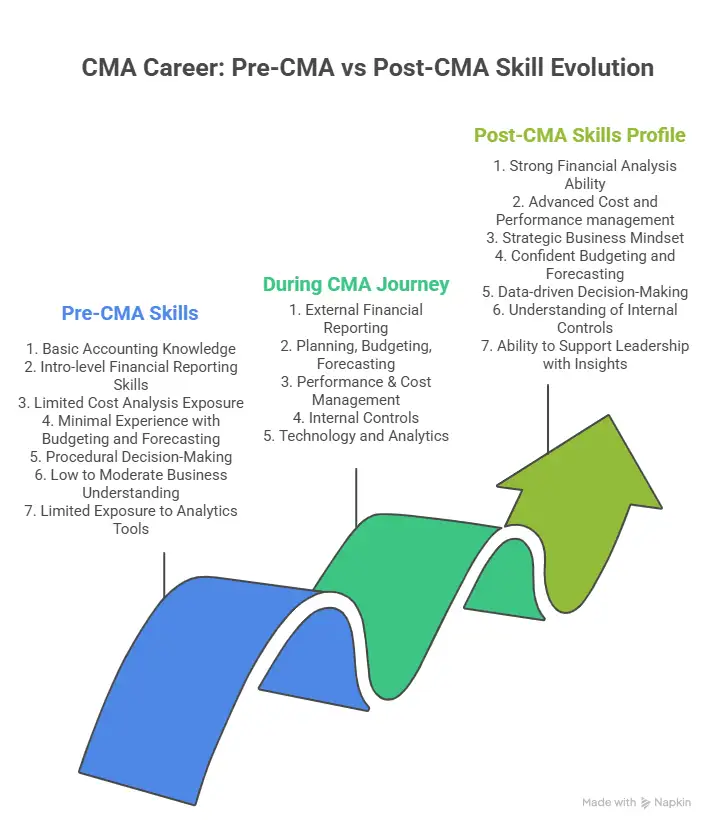
The learning from the US CMA course pushes you to see a business as a living system. You start connecting cost flows, decisions, risks, and long-term plans. That is why a CMA Career remains relevant even as tools, markets and industries change.
As you read further, I will break down how CMA career options unfold in real workplaces, the skills that grow with each stage, the roles that open up across industries, and how the qualification shapes long-term financial leadership potential.
You will also see the salary patterns, job pathways, and practical examples that show how the CMA translates into daily decision-making. By the end, you will have a clear view of what this journey looks like from start to senior roles, and what it can mean for your future in finance.
Understanding CMA as the Foundation of Your Finance Journey
A strong CMA Career starts with a simple understanding ofwhat is CMA and how it changes the way you interpret financial information. The certification offered by IMA blends analytics, planning, cost insights, and strategic thinking into one learning track. It is designed for people who want to work beyond traditional accounting roles and contribute to business decisions at a deeper level.
CMA at a Glance
This table offers a simple snapshot of what the CMA course stands for, what it covers, and why it supports a strong CMA Career pathway for learners and working professionals.
2 Papers: Part 1 (Financial Planning, Performance, Analytics) and Part 2 (Strategic Financial Management)
Eligibility
Bachelor’s degree (can enrol as a student and submit the degree later), plus a work experience requirement for certification
Exam Duration
Each exam is 4 hours with MCQs and essay scenarios
Course Duration
Typically, 6 to 9 months of preparation, depending on the schedule
Career Relevance
Builds skills for roles in FP&A, corporate finance, cost analysis, management accounting, and strategic decision making
Global Recognition
Accepted in 170+ countries and valued across multinational corporations
To understand this better, I’ll break the journey into three layers. These layers form the foundation for every role and decision you take as a CMA. They also shape the CMA career opportunities that open over time.
1. The Market Forces That Shape a CMA Career
Every profession evolves with its environment. For CMAs, the environment is a blend of digital transformation, global finance standards, increasing regulation, and data-driven decision-making practice. This pattern reveals a simple truth. Companies reward the blend of analytical and managerial ability. They treat CMAs as drivers of clarity.
Many candidates still wonder, is CMA a good career for the next decade? I believe it is, for one reason. The role keeps expanding. A CMA today works closely with decision makers. They advise on pricing, supply chain, costing, capital allocation, profitability models, and scenario plans. These tasks demand financial discipline and strategic understanding. That blend plays a major role in shaping the scope of CMA USA roles.
A CMA Career also thrives because companies want professionals who understand risk. Businesses face unpredictable shifts. Currency fluctuations, rising input costs, new competitors, talent shortages, regulatory changes and sudden technology jumps. Each shift hits margins. A CMA steps in to build cost structures that survive these shocks. The ability to solve using numbers and logic is a central driver of CMA career prospects.
2. Skill Foundations Behind Strong CMA Career Prospects
People often think the US CMA course is only about costing and financial analysis. That is a narrow view. The learning builds a system of thinking. This system shapes the CMA jobs in a powerful way. Let me break the core skill foundations into simple, relatable ideas.
a. Decision Framing
A CMA learns how to frame a decision. I do not only look at numbers. I check the structure of a problem. I map the drivers behind it. Most business issues are not only financial. They are operational and behavioural too. This wider lens allows a CMA to support leadership teams with clarity.
b. Quantitative Logic
The numbers in management accounting are not random. They reveal patterns. A CMA develops the ability to spot these patterns quickly. For example, when sales rise, but cash flow stays tight, a CMA looks at receivables cycles, production delays, or discounting patterns. This ability makes your career after CMA both versatile and stable.
c. Forecasting
Businesses move on forecasts. CMAs get trained to build them with precision. I like to think of forecasting as storytelling with numbers. You take past trends, insert new assumptions and convert them into realistic expectations. This is one skill that keeps your CMA career future-ready.
d. Ethical Reasoning
IMA’s ethics framework is a major part of the training. Ethics protects the quality of decisions. It helps companies build trust. A finance leader without ethics cannot grow long-term. This is one of the most underrated CMA Benefits.
e. Technology Adoption
Automation is changing finance. A CMA learns to use analytics tools, dashboards, ERP systems, and data modelling platforms. These tools allow faster analysis and easier reporting. This is why global firms continue to invest in CMAs for new-age finance roles.
3. Industries That Create Strong CMA Career Opportunities
A CMA Career does not restrict you to one industry. The skill set travels well across sectors. Each industry has its own flavour of costing, risk and financial planning. This variety opens wide career options.
Manufacturing
The roots of management accounting sit deep in manufacturing. If you enjoy understanding how products are made, this sector builds a strong foundation. Costing, variance analysis, overhead allocation and capacity planning remain major tasks. The CMA career prospects in manufacturing stay steady because companies always aim to improve unit economics.
Technology
Tech firms operate with rapid change cycles. A CMA helps them evaluate new features, pricing strategies and expansion plans. The focus is often on managing the cost of scaling. Forecasting and decision modelling become daily tasks.
Banking and Financial Services
This sector values risk analysis and portfolio-level thinking. A CMA contributes to budgeting, planning, regulatory reporting and risk scenarios. The roles link financial analysis with decision support.
Consulting
If you enjoy solving diverse business problems, consulting creates interesting CMA career opportunities. Clients expect you to diagnose issues quickly. The variety strengthens your judgment.
Retail and e-commerce
These businesses run on thin margins. A CMA monitors pricing, supply chain costs, returns management and promotion effectiveness. The insights help companies stay profitable in competitive markets.
Healthcare
Hospitals face complex regulations, insurance cycles, and cost structures. CMAs bring control and transparency. They set up dashboards for doctors, departments, and supply teams.
Shared Services and GCCs
India has become a hub for global capability centres. These centres need stable financial planning talent. The scope of CMA USA has grown here due to the global nature of reporting and analytics.
People often assume that only commerce graduates move into a CMA Career, but the entry pathways are far wider. The qualification is designed to help diverse backgrounds build a shared foundation in cost management, planning, and performance analysis, which is why the CMA ecosystem attracts such a wide mix of professionals, as illustrated below:
A Simple Way to Visualise CMA Career Options
Below is a table that I often use when explaining the spread of roles. It helps candidates see how their skills convert into real positions. This table also shows how the CMA adds value to your career as your experience grows.
The table maps career stages to common roles and the type of responsibilities that define growth.
Corporate Controller, Director of Finance, CFO Track Roles
Enterprise strategy support, capital planning, stakeholder communication
This progression is not fixed. Many CMAs pick unique journeys. Some join startups. Some join Big 4 consulting teams. Some build domain expertise and move into leadership faster. This flexibility is what makes a CMA Career resilient.
Did You Know?
CMAs report 21% higher median total compensation than their non-certified peers. (Source: IMA Global Salary Survey)
The Multi-Level Role Structure in Modern CMA Careers
A CMA Career does not have a single fixed ladder. It looks more like a set of clusters. Below is a breakdown of how the career after CMA evolves through typical internal steps.
Role Cluster 1. Analytical Foundations
These roles work closely with data and processes.
Financial Analyst
Cost Analyst
Budget Analyst
Pricing Analyst
Professionals in this stage sharpen the art of clear measurement. They create models, reconcile data, and build scenario views. These are the years when many people develop strong habits that stay with them.
Role Cluster 2. Planning and Operations
These roles are where strategic insight begins to grow.
FP and A Specialist
Operations Accountant
Plant Controller
Business Analyst
Planning teams need someone who can hold the story behind numbers. A CMA uses concepts from the US CMA course to produce meaning, not just figures. This is where CMA jobs in India begin to widen.
Role Cluster 3. Leadership and Control
These roles lead teams and shape big decisions.
Finance Manager
Cost Controller
Divisional Controller
Risk and Governance Lead
People in these positions gain a seat at the leadership table. Their skill lies in turning what looks complex into a simple direction. This stage offers a strong CMA career scope for professionals ready to lead teams.
Role Cluster 4. Strategic and Executive Roles
These roles include decision makers at the top.
Head of Finance
Strategy Lead
CFO Track Roles
Global Controller
The CMA career path can move into senior leadership because financial clarity is a key requirement for long-term business stability. CMA salary also depends on the experience level and can be compared with the lens of verified vs non-certified peers.
Understanding Career Progression Through a Practical Table
This table shows how skills grow at each stage and how responsibilities expand over time. The description below prepares the reader for what to expect.
How CMA Skills Translate Into Career Stages
Stage
Skill Focus
Typical Output
Career Impact
Early Analyst
Measurement and cleanup
Reports, reconciliations, spreadsheets
Builds reliability
Mid Planner
Forecasting and modelling
Plans, budgets, dashboards
Influences decisions
Control Lead
Governance and discipline
Policies, metrics, control systems
Strengthens operations
Strategic Leader
Direction and clarity
Long-term plans, board inputs
Shapes business goals
Professionals often move across stages at different speeds. What remains common is the understanding that clean financial thinking is valuable across every team. To give you a better perspective on the depths of roles, this video explains the value of CMA as a global certification:
How the Scope of CMA USA Expands Career Reach
Many professionals search for roles across borders. A CMA does not guarantee a job abroad. It makes the profile relevant across global teams and enhances readiness for multinational settings.
The value comes from three practical strengths.
Strength 1 | Standardised Skills: Companies across countries know the CMA curriculum. They know what a candidate can deliver. This helps with mobility and also makes remote roles possible.
Strength 2 | Cross-Functional Fit: A CMA works closely with operations, supply chain, technology, or marketing teams. That gives global managers confidence that the hire can adapt to different cultures.
Strength 3 | Financial Storytelling: Global firms need professionals who can explain numbers without jargon. This is one of the largest CMA career opportunities today because companies run teams across several locations.
1. Case Style Examples for Clarity
These small illustrations help readers picture the skills in action.
Example: Manufacturing Planning A new FP&A analyst joins a plant finance team. The plant manager faces rising input costs. The analyst builds a simple model that shows how a small change in batch size reduces cost. The manager adjusts operations. Margins improve. This is a typical win for someone building a CMA Career in manufacturing.
Example: Technology Product Finance A tech firm wants to introduce a new subscription plan. A CMA maps the revenue and cost cycles. The team uses the insights to adjust pricing. The launch meets targets. This is common in US CMA career paths linked to digital firms.
Example: Retail Inventory Review A retail chain struggles with stockouts. A CMA studies SKU-level patterns. They discover that one category drives most misses. The buying team adjusts orders. Sales improve. This is how CMA career options appear in commercial teams.
Compensation reflects how organisations value strategic finance talent. The ranges discussed in the video show how salaries evolve from analytical positions into decision-support and leadership tracks.
The Middle Career Pivot in a CMA Career
A CMA can move from a pure finance role into planning or strategic work. This pivot often happens between years three and seven. It allows professionals to break out of low-growth roles. Many mid-career professionals use the US CMA course for this pivot. It offers confidence and structure.
Some people shift from accounting into analytics. Some enter the supply chain. Others move into global reporting. The common thread is the ability to read information with discipline and precision.
Below is a short list of pivot-friendly skill sets.
Skills That Support Mid-Career Transitions
Mid-career professionals often reach a point where technical experience alone no longer drives growth, and this is where CMA-aligned skills create the bridge to strategic and higher-impact roles.
Ability to map cost flows
Comfort with large data sets
Understanding of process gaps
Clarity in business storytelling
Steady forecasting habits
These skills open doors in many companies. They also support remote and hybrid roles.
Did you know?
Many Fortune 500 firms list CMA as a preferred credential for planning and analysis roles. These companies operate in complex, fast-moving environments, so they prioritise professionals who can link financial data to business decisions with clarity.
Role Transition Table for 5 to 10 Year Window
This table helps you visualise the evolution of responsibilities.
Years of Experience
Typical Roles
Key Contribution
Type of Growth
0 to 3
Analyst roles
Clean data, fast models
Skill building
3 to 6
Planning roles
Forecasts, budgets, insights
Influence building
6 to 10
Control or managerial roles
Governance, leadership, systems
Team building
10 plus
Strategic roles
Vision, long-term plans
Enterprise impact
The Role of Ethics and Decision Support in CMA Careers
Ethics is often underestimated. A CMA cannot function without a strong ethical grounding. Businesses trust professionals who protect shareholder value. They need people who question assumptions and use sound judgment.
CMA skills teach you to apply ethical standards in daily work. They know how to avoid conflicts of interest. They know how to structure reviews. They know how to protect sensitive information. These habits help them earn seats in important rooms.
Before completing the CMA course duration, most skills sit in separate pockets. As you go through the CMA modules, those pockets start connecting. After earning the credential, this way of thinking becomes natural, helping you link data to decisions and contribute with confidence to long-term planning.
CMA Career Options Across Remote Work Models
Remote work has created new forms of CMA career opportunities. Many global teams run analytics, reporting, and planning work from India. A CMA brings discipline and reliability to these roles. A few patterns have emerged.
Remote FP&A Pods: Companies hire analysts to support monthly closings and forecasts from remote locations.
Controller Support Pods: Firms set up small teams for reconciliations, audits, and controls.
Project-Based Models: Short-term assignments for pricing, modelling, or business case reviews.
These pathways show that the CMA career path can support flexible and family-friendly work models.
Understanding Value Creation in a CMA Career
A CMA creates value by improving clarity. They show teams where money comes from and where it goes. They help leaders understand cost structures. They support growth decisions. This is true across small and large companies.
The simple loop of measure, interpret, guide, and follow through defines the CMA mindset. It is one of the core CMA Benefits that stays relevant throughout the career.
Where Imarticus Learning Fits in the Journey
Learners who want to build a strong US CMA career need structured preparation. Imarticus Learning provides live classes, doubt clearing, simulation tests, and job readiness support. These elements help professionals become industry-ready.
Industry-Led US CMA Program: The US CMA program at Imarticus is industry-led and co-created with KPMG in India, offering real-world case studies and a joint certification that gives your resume a competitive edge.
Gold Learning Partner of IMA, USA: Imarticus Learning is a Gold Learning Partner of the Institute of Management Accountants (IMA), USA, which ensures alignment with global industry standards and high-quality program delivery.
Expert Faculty and Structured Teaching: The course includes monthly webinars, live sessions with industry practitioners, and structured teaching designed to build strategic financial skills, performance management capabilities, and analytical judgment.
Money-Back Guarantee: Imarticus offers a money-back guarantee, refunding 50% of the course fee if you do not pass the US CMA exams; a strong confidence signal in the quality of training and support.
Internship Opportunity with KPMG in India: High-performing learners become eligible for a hands-on internship with KPMG in India, a rare opportunity that brings professional exposure and global working experience.
Pre-Placement Bootcamp & Career Assistance: Students gain access to a pre-placement bootcamp, resume support, interview training, and assured interview opportunities with leading firms, making the transition into a CMA Career smoother.
This section addresses the most frequently asked questions learners and professionals ask when exploring a CMA Career. It brings clarity to job roles, salary expectations, exam difficulty, and long-term growth possibilities so you can understand how the CMA pathway supports strong, future-focused career decisions.
What jobs can I get after CMA?
A CMA Career opens doors across finance, accounting, strategy, and operations. After completing the US CMA course, you can work in roles that shape planning, reporting, forecasting, performance measurement, process controls, and cost optimisation. These responsibilities sit at the heart of high-impact positions such as Financial Analyst, Management Accountant, Cost Strategist, Business Planner, Budget Specialist, Plant Controller, and FP&A Analyst. For structured guidance for these roles, Imarticus Learning provides clarity and training aligned to industry expectations.
Is CMA a good career choice?
For anyone who wants a finance profession built on analysis, structured thinking, and company-wide visibility, a CMA Career is a strong choice. It suits people who enjoy reading business scenarios, interpreting numbers, and joining the dots between commercial actions and financial consequences. The role of a CMA blends financial control with decision impact, which means your work reaches managers, business heads, and even board-level teams. There is also strong global mobility because the CMA credential is recognised across 170+ countries.
Can CMA earn 1 lakh per month?
Reaching earnings of 1 lakh per month is a realistic milestone within a mature CMA Career, especially for those who build experience in FP&A, costing, controlling, and business partnering roles. Salaries vary by industry, city, and job complexity, yet the earning graph tends to rise steadily because CMAs manage decisions that influence budgets and profitability. As experience grows, performance responsibilities expand, and salary growth follows.
What does a CMA do?
A CMA Career revolves around turning business numbers into direction, clarity, and action. CMAs analyse cost structures, build forecasts, evaluate risks, assess investments, and prepare management reports that shape decisions. In many organisations, CMAs act like the bridge between finance teams and operational managers because they translate financial language into practical recommendations. The mix of skills built through the US CMA course helps professionals move into jobs that sit close to strategy and business development.
How hard is the CMA exam?
The CMA exam challenges candidates on applied thinking, which means the questions test reasoning and interpretation. Many students describe the difficulty as balanced and fair once they build a method of studying concepts along with numerical practice. The test expects you to connect theories with practical situations, similar to workplace finance decisions. The best way to reduce the challenge is to follow structured learning support at Imarticus Learning, where the content is broken into digestible topics with guided problem-solving.
How many months to pass the CMA?
A focused learner can complete the entire journey in about 12-18 months, depending on work schedules, study patterns, and exam windows. Many candidates choose to prepare for each section over four to six months. This duration balances concept learning with revision cycles and mock tests, which help align with real exam patterns. Imarticus Learning supports students with planned study calendars so the timeline stays predictable.
Do Big 4 hire CMA India?
Yes, the Big Four firms recruit CMA candidates and working professionals for finance transformation, risk advisory, costing, performance consulting, and shared service operations. These teams rely heavily on structured financial evaluation and reporting, which fits the CMA skillset. A CMA Career inside the Big Four often begins with analytical roles and later progresses into specialist or leadership tracks in advisory or controllership support.
Can I pass the CMA on the first attempt?
Many candidates pass the exam on their first attempt when they use a structured study plan that blends concepts, numerical practice, and mock testing. The CMA exam rewards understanding rather than memorisation, so understanding linkages between topics is important. Imarticus Learning helps candidates move through topics logically and revise efficiently. Success in the first attempt becomes realistic when consistency is maintained across weeks of study.
Is CMA a qualified accountant?
Yes, a CMA is a qualified accounting professional with a specialised focus on management accounting, planning, analysis, and decision support. A CMA career covers cost analysis, planning systems, performance measurement, budgeting, reporting, and internal controls. The qualification sits at the intersection of accounting and strategy, which gives employers confidence in a CMA’s ability to support and improve organisational decisions.
The Future You Can Build with a CMA Career
A CMA career allows individuals across professional life stages to find a steady and upward-moving path in finance. Students discover a structured entry into analysis and planning. Working professionals use it to shift into roles that offer visibility and responsibility. Entrepreneurs rely on it to read their own financial signals with sharper judgment. Companies value it because CMAs understand how business choices influence money and performance. Across roles such as costing, forecasting, planning, risk evaluation, investment analysis, and reporting, the CMA identity supports long-term relevance.
As industries adopt analytics, automation, and global workflows, the ability to interpret data and shape financial direction grows more important. This is where the CMA benefits become visible for someone building a sustainable, future-ready profession. Whether the goal is a local leadership role, a global finance position, or a diversified career after CMA, the qualification strengthens clarity, confidence, and decision-making.
Anyone who wants structured guidance for this journey can explore CMA course prep with Imarticus Learning, where the curriculum, support, and methodology are aligned with industry expectations. A CMA is more than a credential. It is a way of understanding the financial heartbeat of a business and shaping decisions that determine its future.