
Facing the real challenge while an examination? Check this interesting format of SP Jain’s Fintech program.

Are you looking for a job in the Indian Fintech industry? Fintech exams for recruitment or certification can be tough and you need to have the required skills to crack it. There are many online certification courses on the internet but many of them do not provide an in-depth learning curriculum.


The SP Jain’s Fintech program provide by Imarticus Learning will provide you industry-oriented learning. It will help you in building a successful career in the fintech industry. Read on to know more about the interesting format of SP Jain’s fintech program.

Fintech Career

 Course Overview


The Professional Certification in Fintech is provided by Imarticus & SP Jain School of Global Management. Along with in-depth coverage of fintech aspects, this course will also provide you experimental learning. This course comes in two formats i.e. CORE Modules & PRO Modules.


The CORE Modules will cover various tools & technologies used in the fintech sector. The PRO Modules include the topics covered in CORE Modules plus extra learning. Let us see the detailed curriculum of both modules.


CORE Modules
Fintech Career


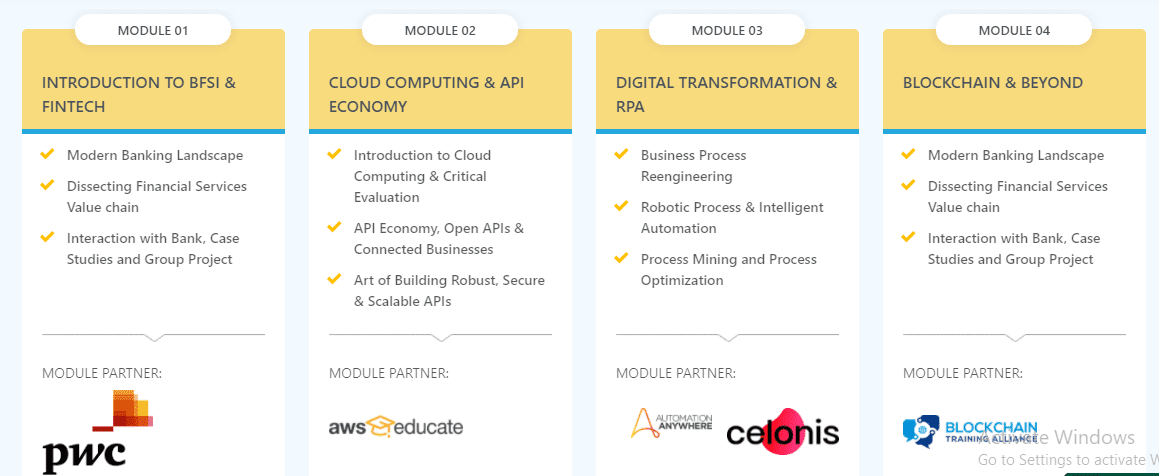
The topics covered in the CORE Modules are as follows:


• Introduction to BFSI & Fintech – You will go through various case studies to understand the modern banking landscape. You will also get to work on a group project under this module.


• Cloud Computing & API Economy – Recruiters in the fintech industry look for candidates who are experts in modern-day technologies like cloud computing, big data analysis, etc. You will learn about APIs, open APIs & connected businesses. You will learn about API management in the fintech industry.


• Data Transformation and RPA – RPA (Robotic Process Automation) is used to automate many processes in the fintech industry. This course will help you in learning about process mining & optimization. It will also cover various aspects of business process reengineering.


• Blockchain & Beyond – This topic in CORE Modules will cover the usage of blockchain in the current fintech industry. You will also learn about various tools & applications used to provide fintech services to consumers.


PRO Modules
Fintech Course


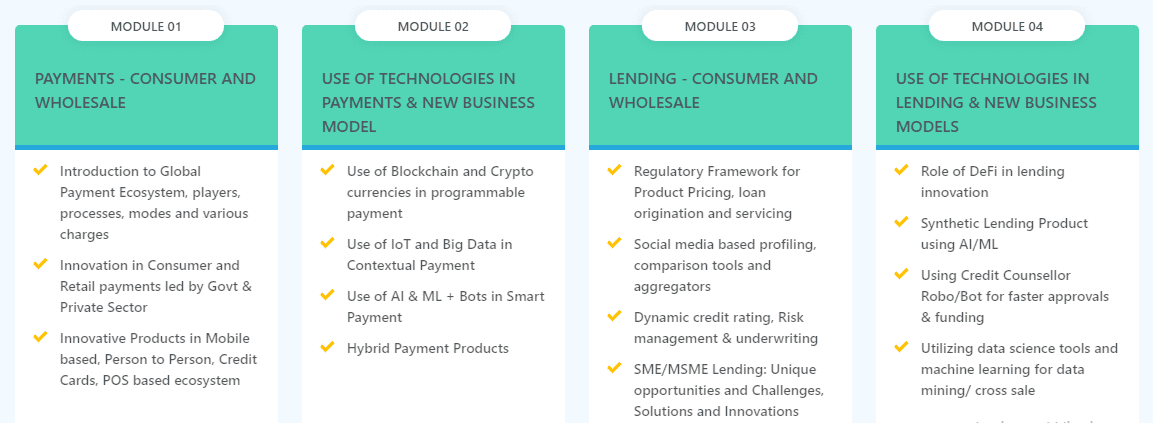
The topics covered in PRO Modules (140 hours) are:


• Payments – Consumer & Wholesale – You will get to know about modern-day payment practices. This module will also help you in understanding various innovations in the payments & lending market led by the government/private sector.


• Use of Technologies in Payments & New Business Model – You will get to know about programmable payment systems. This module will cover various aspects like the use of AI/ML bots, cryptocurrency management, hybrid payment products, IoT in fintech, etc.


• Lending – Consumer and Wholesale – This sub-module covers various aspects of the fintech industry like social media-based profiling, comparison tools, regulatory frameworks, SME/MSME lending. You will get to know about the innovations in the lending/loan industry.


• Use of Technologies in Lending & New Business Models – This sub-module will focus on the use of data science & machine learning for cross-selling. It will also teach you about synthetic lending products using AI/ML & DeFi lending.

 Benefits of the SP Jain’s Fintech Program

• You can get your hands on the Project: Paradigm shift under this course. It will help you in working on a visionary fintech business idea/project.


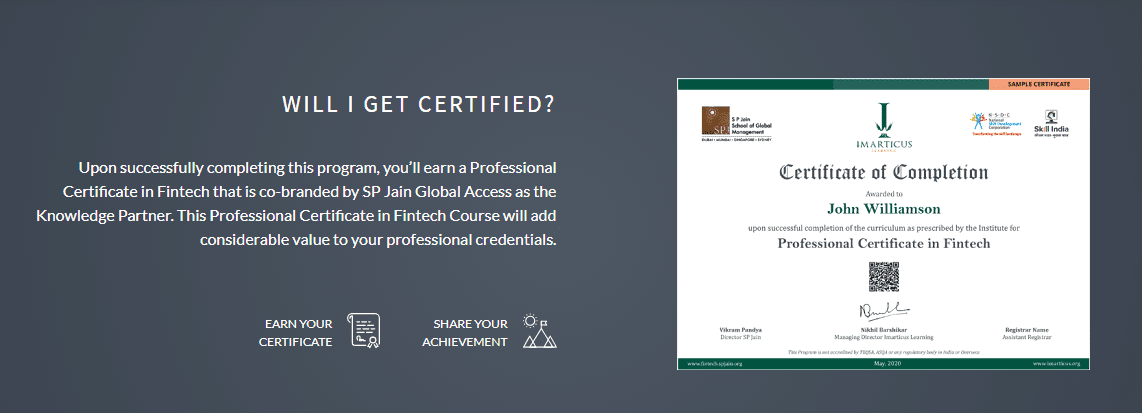
• Your final examination will be open-book and you will have to make business decisions in this simulated test as a CXO. Upon the completion of the course, you will be handed the fintech certificate.
Fintech Career

• You will also get to be a part of the Singapore Immersion Program and can meet fintech professionals from more than 140 different countries.


• You will be a part of the Perpetual Learning Program (PLP) giving you lifetime access to webinars from various industry experts.


• You will also gain access to the SP Jain’s laboratories along with becoming an alumnus of the SP Jain School of Global Management.


In a Nutshell


The in-depth course curriculum of SP Jain’s fintech course will help you in learning the practices in the fintech industry. You will also learn about the role of modern-day technologies in fintech. You can download the course brochure from the Imarticus website.

You will be able to know the operations involved in digital banks. Start your fintech course now!

What Are Some Fintech Companies?

The Basics of Fintech

At the very core of any technological evolution is a determination to provide something better than what already prevails in the market. Can you think of any industry that is not influenced by technology? I am wondering it’s very hard to think of one. Fintech is the short form of Financial Technology, meaning the use of technology in the financial domain to provide better finance-related services over tthe traditional methods.  

The Fintech industry comprises companies and start-ups that are focused on providing solutions to various problems that exist in the industry. The bottom line of using cutting-edge technology in the financial domain is to provide more efficient services that could work in conjunction with our fast-paced world, ultimately increasing customer satisfaction. Let’s dig more into the players in the Fintech industry who are revolutionizing how people use banking and financial services.

Players in the Fintech Industry

Some of the key players in the Fintech domain are mentioned below.

Ant Financial 

One of the major global players in the Fintech industry is based in China. Established in October 2014, Ant Financial Services Group is on a mission to bring inclusive financial services worldwide. It is also the official operator of Alipay, the digital payment portal by the Alibaba group for its e-commerce platform.

Xero

Xero is one of the fastest-growing software as a service (SAAS) provider worldwide that already has more than 2 million subscribers. Founded in the year 2016 in New Zealand, it aims to provide accounting solutions for small and medium business enterprises through its cutting edge software technology. Xero has also backed the title for the World’s Most Innovative Growth Company in 2014 & 2015 by Forbes.

Avant

Founded in the year 2012, Avant is one of the key players in the Fintech domain. Originally registered as AvantCredit, Avant is a Chicago based Fintech firm that provides online credit solutions for customers. On a mission to eradicate the obstacles in the borrowing process and minimize the cost of borrowing for individuals, Avant brings more transparency to the whole system through its revolutionary technology. 

Tala

Tala is a game-changer in the Fintech domain for providing micro-loans through its smartphone application. Founded in the year 2011, Tala has a customer base like no other, it provides credit facilities to people in the remotest parts of the world. On a mission to expand financial access and choices to billions of underserved people worldwide, Tala is using technology for the best! 

PayPal

One of the most prominent players in the industry, PayPal was the harbinger of the Fintech revolution. With a customer base of more than 277 million active users, PayPal believes in empowering individuals and businesses to connect and prosper in the globalised economy through its digital financial services platform. It adds value by enabling individuals and merchants to indulge in monetary transactions in multiple currencies worldwide.

Stripe

Stripe is a US-based Fintech company that was founded in the year 2009. It uses its software technology to provide payment solutions for individuals and business owners that help to receive and make payments online. Stripe has built a customer base in the e-commerce domain by catering to the payment solution needs of the online business owners.

Robinhood

Robinhood is a US-based Fintech firm that provides investment solutions through its mobile and web applications. It was founded on the core principle of increasing participation of people in the finance industry through commission-free access to investing. Robinhood is a fast-growing company that already has a customer base of more than 6 million active users, a major percentage of which belongs to the millennial population.


How is Fintech spilling Opportunities for the Agricultural Sector?

The fintech sector is a rising industry that has come to define the contemporary era. The term “fintech” refers to financial technologies and encompasses digital innovations in payments, lending, insurance, and investment management. One of the primary reasons for this growth is that these companies offer better solutions than traditional financial institutions.

The Scope of the Fintech Industry?

The Fintech sector is a fast-growing industry that has been evolving rapidly since the word was first coined in 1999.

  • The Fintech sector is revolutionizing the way we do business. It will be difficult for banks to compete with this new wave of technology that has come about in recent years.
  • There are many opportunities in the agricultural industry, but it’s essential to know where you stand on your current level of technological development before taking any steps forward.
  • India’s fintech market is the world’s fastest-growing- 67 percent of the more than 2,100 fintech entities in operation have been set up in the last five years. India’s fintech market is valued at US$31 billion, which is projected to grow to US$84 billion by 2025.
  • The fintech transaction value size is projected to grow to US$138 billion by 2023 from US$66 billion in 2019.
  • According to a Boston Consulting Group report, Indian fintech companies will reach a valuation of US$150-160 billion by 2025, becoming thrice more valuable in the next five years.

Evolution of Fintech: Opportunities for Agricultural Sector

Fintech is now looking at opportunities to serve agricultural sectors and farms across India, which can potentially transform rural life by providing access to affordable credit and insurance products- two things that we take for granted but are often inaccessible without significant wealth or connections. Here is how Fintech is assisting Agricultural Sector:

  • Easy Loans for Farmers: The agricultural sector needs to borrow money frequently. With Fintech, there are no middlemen, the efforts of the fintech sector to make direct loans are consistent.
  • Direct Connections: Farmers have better opportunities to establish direct connections with lenders & other institutions for better operations. This change can potentially stabilize the sector.
  • Ongoing Payment Model: Instead of paying large payments for equipment & tools, farmers can now use various ongoing payment programs. People can better organize finances more efficiently by paying for what is used, skipping problems arising from conventional payment models.
  • Affordable Financial Services: Financial services are becoming more accessible to farmers. Some companies are focusing on this aspect to bring a greater variety of financial tools & utilities.
  • Better Insurance: The availability of crop insurance plans for farmers is shaping the sector in a better manner.

Grow your Career with Imarticus Learning:

Imarticus Learning has collaborated with prestigious universities to enhance robust Fintech Training courses. Enroll in MBA FinTech, which covers every paradigm of cutting-edge New Age FinTech solutions. The curriculum is designed to provide students with in-depth exposure to critical elements of the FinTech domain.

This program covers every critical aspect of FinTech via hands-on training with prominent technologies such as API, Blockchain, Cloud Computing, AI, Machine Learning, RPA, IoT, and Big Data. This program enables students to apply what they learn while dealing with real business scenarios & problems.

Some Course USP’s:

  • UGC Entitled Online Degree Programs
  • NAAC ‘A’ Graded University with Graded Autonomy Status
  • Top Ranked University in India – NIRF & QS World Rankings
  • Program Delivery follows the prescribed four quadrants approach from UGC
  • Learning Hours and Credits at par with Full-Time Classroom Programs
  • Innovative Programs Accredited by Global Professional Bodies

If you want to skyrocket your FinTech career prospects by transforming into a FinTech expert, your search ends here, and a spectacular FinTech learning journey begins. Contact us through the Live Chat Support system.

How Blockchain is Enabling Secure Payment Through dApps?

Blockchain technique has introduced new horizons to more than one aspect of the corporate industry. Blockchains are basically a record of transactions made through cryptocurrencies arranged in blocks. It is completely secure in a way that hacking is almost impossible as all the transactional information is visible to all the parties involved in this loop.

But, where is it all stored? This is where dApps come into play. These apps are open-sourced and decentralized applications that are responsible for the transactions being made in the blockchain system. Below are the key aspects of dApps, how they actually work as well as the benefits of their use. Please go through the whole thing to get a better idea.

 dApps: The key aspects

dApps are in their infantile stage so there are a lot more evolutions to be witnessed as time goes. Here are a few key aspects that we have managed to observe in their nature as of yet:

  • Open-source platform: There are no specific governing bodies supervising the system. All the conditions are decided by the mutual confirmation of customers. The code of conduct is visible to all the parties involved for verification.
  • Decentralized system: All the records of all transactions are stored in the blockchain system. This means that no single party can capitalize their control on the system which ensures further safety.
  • Safety measures: The community partaking in dApps follows a specific set of algorithms to verify value proof. Such as Proof of Work as well as Proof of Stake.

 How do they work?

There are mainly three types of dApps we have observed as of yet. Here we are going to explain how each type works:

  • Type 1: The dApps of this category are known for having their own blockchain system. Bitcoin or its equivalent cryptocurrencies that have an internal blockchain system belong to this category.
  • Type 2: This dApps category works by making the Type 1 blockchain system it’s base. These are mostly protocols and use tokens to function properly. Such as the Omni Protocol. The main advantage is no involvement of any middleman.
  • Type 3: This category works by utilizing the protocol of the Type 2 category of dApps. Its main work is altering data servers as well as centers with the system resources of customers. It is autonomous which helps to create censorship-free apps and websites. A good example is a SAFE Network. It uses the Omni Protocol to issue Safecoin that is necessary for its function.

 The benefits of dApps

 There are, of course, reasons why dApps are getting more popular by the day. Here we have listed a few of them:

  • They are decentralized which makes them extremely secure and hack-proof. There is no possibility of any single party capitalizing their control on it.
  • They ensure a lot faster transactions as there is no mediator app for the transactions to go through.
  • They also ensure more anonymity and verified information as all the parties involved can check the details by logging in to the blockchain system.

 Blockchains are gaining more and more popularity daily, and because of that now Apps have joined the bandwagon. This is why new Blockchain courses all over the world as well as in India have been introduced.

Blockchain coursesImarticus Learnings as usual have come up with a marvelous Fintech MBA program that offers a Bitcoin course as well as Blockchain technology courses. If you are looking to prosper in your career, then this is just the chance for you.

Skills and Tools Which Are Required in Fintech Industry

FinTech which stands for Financial Technology is a rapidly growing but highly expansive field. FinTech’s areas of interest are many such as Net Banking, Cryptocurrency, Insurance, Trade, Application Design, and Online wallets. Since this interdisciplinary field is so widespread, it entails professionals from a wide variety of disciplines within its folds. A software designer and an accountant both can work in the field of financial technology, as this field caters to a large set of skills.

Some of the most sought after skills and tools in FinTech Course

● Cybersecurity expertise: One of the main threats that the FinTech industry faces is malware infections and hackers. If a financial technology system is infected and its data gets breached then, the corporation can face penalties; hence people who can secure the computer systems from virus invasion and prevent a breach of privacy are of great value in FinTech.

Machine learning and Artificial Intelligence: FinTech works heavily with artificial intelligence. This field needs people who have apt statistical knowledge and instincts. One needs continuous analysis and study of data in FinTech. A candidate who knows how to use the machine learning to add, edit, remove, and study statistics will always be a useful addition in the FinTech industry. A person is needed to be proficient in Hive, SQL, and Pig. They are also expected to know how to work with toolkits like Weka, Python, NumPy, and MatLab.

Soft Skills: The nature of FinTech industry is highly collaborative. A person is required to work closely with people who come from different backgrounds. This makes it necessary for a worker to have soft skills like teamwork, the ability to work in a group and be amicable. This industry also requires people to be highly open to ideas, edits, and suggestions so a person who is not receptive to feedback will not be a good fit for this industry. People with soft skills help in team-building and communicating ideas. They are useful in managing human resources and resolving conflicts that might arise in different groups due to the dense presence of workers from different disciplines.

What are the challenges and questions of the FinTech industry?

Like all industries in the world, FinTech also has its share of problems and challenges. FinTech is a relatively new industry; hence its challenges are still being explored. But over the years, government regulations and breach of data are the two main challenges faced by FinTech companies.These restrictions and lack of government support prevent these innovative companies from establishing themselves due to legal and bureaucratic hurdles. These problems are particularly harmful to start-ups than established companies.

Another major challenge that surrounds FinTech is that of hacking and breach of privacy. In the world of Big Data, information is gold, and hence hackers and cybercriminals are always on a lookout for profitable data. The breach of security by hackers or malware infection in FinTech brands does not just ruin the credibility of the company but it also leads to fines and penalties.
Some of the strictest penalties for FinTech corporations are made by the European Union (EU). All FinTech companies that are practicing in the European Union are mandated to adhere to the GDPR guidelines that deal with privacy and data protection. Any FinTech company that fails to protect the data of its users can face up to 20 million euros in fines or give up 4 per cent of their annual turnover in penalty. To prevent any intrusion by hackers, FinTech institutions end up splurging a copious sum of money into developing firewalls and other security systems such as anti-viruses. Not just money but time is also spent in ensuring that the information base is secure from all kinds of Trojans, malware, and snooping.

Conclusion

Contrary to popular belief, FinTech is not completely run by engineers or bankers only. Even people who are not particularly tech-savvy can work here in a highly collaborative space. In this cabalistic and digitalized world, by taking a Fintech Course you will be able to understand the immersion of financial technology which is in almost all kinds of fields and disciplines around the urban world.

Career Paths for Cryptocurrency Enthusiasts

Cryptocurrency investments have increased over the past few years. Nowadays, people want to learn about cryptocurrency and invest even more. Cryptocurrency is based on machine learning and algorithms that software developers maintain and develop. There are multiple entrepreneurship and career opportunities revolving around this ever-growing industry.

What is the Best Career Path for Cryptocurrency Enthusiasts?

Cryptocurrency enthusiasts can opt for various careers and even change streams. After completing a cryptocurrency course, aspirants can find jobs in the following fields.

  1. Financial Analysis

Financial analysts analyze current and historical data based on cryptocurrencies. The insights generated from these analyses help people understand where they should invest. Financial analysts also provide investment strategies to clients. They also evaluate risks and assess the economical, social and political climate to find out the correct value of cryptocurrencies. To become a financial analyst, candidates need to have a professional certification in FinTech or an MBA with specialization in FinTech or new-age finance.

  1. Security Engineering

Cryptocurrency companies need to protect all assets from third-party attacks. Therefore, they spend significant resources on ensuring the use of the best security measures available. Security engineers can develop the necessary systems that will protect the company’s as well as the clients’ data and all digital assets. Candidates who have a degree in computer science are usually eligible and some companies might ask for certain specializations.

  1. Crypto Content Creation/Writing

Potential investors need to understand what cryptocurrency is and how beneficial it can be. Only then will they invest in it. Crypto content creators or writers provide detailed information related to cryptocurrency platforms, trends, use, Blockchain technology.

To become a crypto content creator or writer, candidates need to have a complete understanding of what cryptocurrency is. They should know their topics well and create unique content. The delivery of the content should be apt as well. The target audience needs to stay interested in the content. The content is responsible for investors finding the idea of investing in cryptocurrency more lucrative.

  1. Software Development

For cryptocurrency to stay relevant, software developers are essential. Software developers develop algorithms and use machine learning to create interactive interfaces. They also improve the security aspects of cryptocurrency platforms. In developing easily accessible platforms and interfaces, cryptocurrency companies are able to connect better with their potential clients and find more investors. To become a software developer and work with cryptocurrencies, aspirants need to have a master’s degree in a related field. They should also have adequate knowledge about natural language processing and data structures.

  1. Business Development

Even though cryptocurrency has seen growth in recent times, companies that deal with cryptocurrency and Blockchain still need to be developed. These companies require business developers who understand the condition and value of cryptocurrencies across industries. They should also be able to create channels for cryptocurrency use in sectors like healthcare, tourism, and retail, among others. Business developers working with cryptocurrency companies assess the market conditions and set up partnerships that are beneficial in the long run.

How Can a FinTech Course Help Cryptocurrency Enthusiasts?

The advancement of cryptocurrency is centered around the financial sector and how it is perceived by investors. Therefore a FinTech course can definitely help. Imarticus Learning has FinTech courses where students can learn the use of current technologies like Cloud Computing and Blockchain.

Professional certification in FinTech from Imarticus Learning can help a student understand the industry and learn how cryptocurrency is relevant to the implementation of FinTech.

best Fintech certification courses in IndiaThe program is in partnership with industry giants and this allows students to create essential contacts. Students will also get FinTech community access and work on 6 real-world projects. They can base these projects on cryptocurrency and develop a holistic approach towards the subject.

Nowadays, FinTech has a huge scope and since people are responding well to cryptocurrency, it is also a great career opportunity. Students who have an interest in finance and are enthusiastic about crypto can choose Imarticus Learning’s course to further their careers.

Want to Start a Fintech Career? Here’s Your Ultimate Guide!

In this day and age, everything is technology-based. Our lives now depend on it on such a level that we’re using technology on a daily basis to do even the smallest of chores. We’re using smart cooking technologies to make breakfast in the morning and using smart lights (working on voice commands) before going to sleep.

Hence, it’s very natural that the finance industry has turned to technology and advancement too. We’ll see how the Fintech course is taking over the financial services industry by storm.

Fintech Certification CourseWhat is Fintech?

The word Fintech means ‘financial technology’. Fintech applies to any technology that helps in the advancement or automation and use of services in the finance industry.

It ranges from customers using net banking services or internet money transfer systems to handling crypto-currencies for personal users or big companies or using certain software to operate complicated tasks for big banks or organizations.

The word Fintech was first mainly applied for back-end technological jobs in banks and prominent financial organizations. Since that time, the meaning of the term has certainly broadened much more. It now includes customer-based usage of technology in the financial area too. Now, even blockchain, artificial intelligence, and data sciences have been introduced along with the technologies that already exist.

Why Choose Fintech?

Human lives have become faster. People are opting for technological options that don’t require them to go to banks in person or go ask for that financial advice anymore. Everyone is looking for options that they can use ‘on the go’. That is why, every day, companies are trying to find new ways to make our lives easier by innovating more and more apps in the financial area.

The industry has come up with crypto-currencies, which don’t even require any third party to make transactions, and this feat of advancement is not going to stop here. It is disrupting the traditional finance industry too as can be seen from the survey.

Big tech firms like Amazon, Facebook, and Google are trying to make leaps in the Fintech industry. In 2019, it reached $111,240.5 million growing at 7.9% CAGR, and is expected to reach $158,014.3 million by the year 2023 at 9.2% CAGR. Hence, anyone looking for a career in finance should definitely try their hands at the Fintech course to have a glowing career in this ever-growing industry.

Fintech Jobs

For a person who is deciding on a Fintech career, there are plenty of lucrative jobs in the market. Some of these jobs are:-

Developers: Fintech depends on the apps and developers are the main people in the industry as they look out for all the features of these products at all times. They make sure that the products always work properly.

Data Scientists: As everything works on the internet in Fintech, there are tons of data generated. Data scientists work through them and derive information and secure them.

UI/UX Designers: As Fintech has become customer-based, it’s important for the apps to be user-friendly and attractive. That is the job of UI/UX designers. They make the apps easier to use.

Cybersecurity Specialist: Fintech companies deal with personal data from their customers, which have to be secured from hacking. So, the importance of cybersecurity specialists is essential for them.

Cloud Management: Most internet-based products, nowadays, are cloud-based and Fintech companies are not exceptions. Cloud managers oversee everything related to cloud management, including cybersecurity over a certain cloud.

Imarticus Course on Fintech

Imarticus Learning along with S P Jain School of Global Management has come up with a perfect Fintech course for all the aspiring students. The course provides a hands-on learning experience in important technologies required for Fintech, such as AI, API, Blockchain, Machine Learning, and Cloud Computing. They are also taught to put their theoretical learning into real-life scenarios to make them ready for jobs in the real world in the future.


Conclusion

Fintech is not the future where one can shine – it’s already here. It’s already a part of our everyday lives. So, to become a part of it, Imarticus can certainly make people ready for that dream job of theirs in the Fintech career.

A look at Foundations and Applications of Fintech Specialization!

Fintech is a relatively new term that is used for a whole host of emerging technologies that help consumers and financial institutions in re-innovating the financial space for improved and faster processes. The industry has seen phenomenal growth largely because it has leveled the playing field between small players and traditional big banks and financial institutions.

Fintech application development runs on a foundation of data science, artificial intelligence, machine learning, and blockchain, each of which has seen massive innovation and transformation in recent times.

Today, it covers a slew of products and services. Mobile banking apps, online wallets, financial literacy services, and digital currency are familiar examples.

According to Outlook, one out of every three people avails at least one of these applications on a daily basis. Because of its disruptive innovation and explosive growth, Fintech has become a coveted industry for professionals from a wide range of backgrounds from engineering to marketing.

In this article, we will take a look at the foundations and applications of fintech specialization. We will also cover the basics of a career in fintech and what the best fintech courses in India entail.

A look at Fintech applications

Research says that India has boomed into the fastest-growing ecosystem when it comes to fintech application development.

Some of the most common types of fintech applications here are:

Digital payments

Digital banking is a more convenient and cost-effective way of making transactions without using traditional methods. People are shifting over to mobile wallets instead of credit cards as we speak.

Investment and Wealth Management

Wealth Management and investment solutions allow people to keep track of their financial assets and manage their financial portfolio in a single application on their phones which can then be accessed from anywhere in the world.

Lending/loan

Fintech has made applying for loans as simple as clicking a button on your phone. Money lending solutions have made credits transparent and accessible to the non-affordable population.

Trading

Online trading apps have made investing in the market, monitoring risks in real-time, and sharing knowledge simple and easy.

InsurTech

Insurance companies are also embracing digital solutions to provide a better customer experience without the need to go through tedious processes of filling out lengthy applications.

So, what is a fintech professional? They are people who hold a job in the core areas of fintech application development. Product managers, data scientists, cloud management, full-stack developers, UI/UX designers are some of the most common roles in which people are hired in this industry.

What you need to know about pursuing a career in Fintech

With the fintech industry growing at an unprecedented rate, the demand for talented fintech professionals is also expected to grow. If you display skillsets relevant to any of the above roles, then a career in fintech is a smart option.

However, companies expect a fundamental knowledge of the functional aspects of fintech in their candidates. Some of the areas where the demand for knowledge is likely to increase are:

  • Blockchain
  • Data Science
  • Cryptocurrency
  • Software and mobile application development
  • AI, Machine Learning, and Deep Learning
  • Cybersecurity

Many reputed schools are known for offering some of the best fintech courses in India. These courses are economical, flexible, and convenient and add to your repertoire of proficiencies needed to bag a high salaried opportunity in this sector. Most of these courses are designed for working professionals which means that they can be completed online, parallelly with a day job.

Conclusion

When you are looking to become a fintech professional an overall understanding of the core of fintech areas along with deep technical knowledge in at least one of them becomes crucial. To build a holistic knowledge base of the essentials of fintech, a Professional Certificate Course in Fintech is the one for you.

You could also build an aptitude for management positions in Fintech enterprises by enrolling in an MBA in Fintech degree.

What is Ethereum Blockchain?

If you keep tabs on areas such as banking, investment, cryptocurrency over the last decade, you may be familiar with the term “blockchain”, essentially a digital ledger-keeping technology behind cryptocurrency. Likewise, when you are familiar with cryptocurrency, you may hear of Ethereum, the second-largest cryptocurrency in the market after bitcoin and most actively used in blockchain.

Let’s dig and learn more about the topics – what is blockchain, what is blockchain technology, how does blockchain work, how to become a blockchain developer, what is ethereum blockchain, etc.

What is Blockchain and How Does Blockchain Work?

Blockchain is a database system that stores data in a way that makes it very difficult to hack the system. Blockchain gathers new information in a group called block, and once the block storage is full it is chained onto the previous block. Blockchain can be used to store various kinds of data but mostly used to keep a ledger for a transaction.

Blockchain was initially invented to keep track of all Bitcoin transactions. In cryptocurrency use-cases, blockchain works in a decentralized way and decentralized blockchains transactions are recorded with an irreversible cryptographic signature called the hash. The decentralized databases, managed by multiple participants are known as Distributed Ledger Technology (DLT).

What is Blockchain Technology?

Blockchain technology is a structure to store transactional data, called a block in multiple databases, called a chain, in a network connected through peer-to-peer nodes. All the transactions recorded in this ledger are authenticated by hash, safeguarding from tampering. Blockchain relies on key technologies such as cryptographic keys and a peer-to-peer network containing a distributed ledger.

Blockchain technology uses hash encryption to secure the data, depending mainly on the SHA256 algorithm. In blockchain technology, data entry to the ledger is called “mining”. Mining involves the generation of hash for a specific transaction.

By all means, blockchain ensures a higher level of security and can support various industries like finance, supply chain, manufacturing. Blockchain founders are working towards the expansion of blockchain technology and influence in various industries. Judging by the success, blockchain could rule the future digital world.

How to Become a Blockchain Developer?

Blockchain developerBlockchain technology is still in its nascent phase. High demand, lucrative pay scale, and opportunity to work in cutting-edge technology are few notable reasons that make this career path worthwhile.

To become a blockchain developer, you should start with blockchain concepts, ideas, and architecture. Learn decentralization, the use of consensus in the blockchain.

Become familiar with glossaries and principles of blockchain. Learn cryptography, related algorithms and solutions, and blockchain ecosystem. Be familiar with real-time use cases.

Chartered Financial Analyst courseTo start coding, beginners are recommended to start with Solidity. Learn to create simple blocks, blockchain, implement genesis block, add the block to the chain, validate, and perform a test run. Subsequently, proceed with advanced features like Smart contracts, build the decentralized applications.


Many institutes offer quality courses on blockchain such as Imarticus Learning’s premier FinTech certification course that is offered in collaboration with SP Jain School of Global Management. This course teaches you multiple cutting-edge technologies including blockchain using hands-on training from industry experts, real-world case studies, and projects.

What is Ethereum Blockchain?

Ethereum is a blockchain platform with its cryptocurrency called Ether or Ethereum. It uses its programming language, Solidity. It is decentralized and is an open-source blockchain with a smart contract facility. Ether, the native cryptocurrency of Ethereum is the second-largest cryptocurrency after bitcoin by market share.

Ethereum is the most widely used blockchain. If we compare bitcoin to Ethereum, bitcoin is just a cryptocurrency, where Ethereum is a technology with its cryptocurrency. Both bitcoin and Ethereum operate on blockchain but Ethereum is far more robust.

Related Articles:

Career Opportunities In Blockchain And Skills Required To Increase Job Prospects!

How Do You Get The Blockchain Certification Online?

What Is Blockchain Developer Salary?

What Is A Blockchain Course?

Robotic Process Automation (RPA) and How is it Used in FinTech Today?

RPA (robotic process automation) is a robust solution that allows businesses to automate processes. It’s widely popular in different sectors but you might wonder, “What are the uses of RPA in Fintech?”

To help you find the answer, we have prepared the following article:

What is Robotic Process Automation?

RPA online training in FintechRobotic process automation, RPA in short, is a technology that simplifies building, deploying, and managing robots that mimic human actions. These robots interact with software and digital systems just like humans do.

RPA training allows you to build robots that can recognize what’s shown on a screen, enter information, identify data, navigate a system, and perform various other activities. These solutions automate specific tasks in your business that will allow you to enhance your productivity and efficiency.

Use of RPA in FinTech

Robotic process automation offers a ton of advantages to businesses regardless of their industry. It allows them to reduce their operation costs, improve their efficiency, and make the organization more manageable.

In FinTech, there are many use cases of RPA.

  • Banks use RPA to increase their operational visibility and improve their data security. RPA allows them to improve their compliance implementations and make them more efficient.
  • In accounting, RPA automates customer credit monitoring, sales quotation generating, distributing invoices, and doing necessary follow-ups.
  • Accounts payable can utilize RPA in processing vendor invoices, responding to inquiries, managing the various payments, and cross-checking invoices with the purchasing orders.
  • RPA can simplify the KYC process by optimizing the nitty-gritty tasks of the verification process. They can also gather all the relevant data through optical character recognition.
  • RPA can help in intercompany reconciliations. It can automate checking different orders and transactional data. The bots can also approve the matching orders automatically and alert the necessary parties if they found any inconsistencies.

Become a FinTech Professional

RPA has a ton of advantages but it’s a relatively new technology. That’s why the demand for RPA (robotic process automation) experts is constantly on the rise. Finance companies want professionals who are skilled in this field and can implement the necessary solutions effectively.

To become an expert in RPA for the finance sector, you should look for Fintech courses in India. Taking one of the best Fintech courses in India will help you learn the necessary skills quickly through experts and mentors.

There are many options for Fintech courses in India. You should choose one that teaches you the latest skills and concepts such as blockchain, cloud computing, machine learning, and many others. Learning skills like blockchain and cloud computing will help you stay on top of the industry trends and accelerate your career growth.

Look for online Fintech certification programs in India as they allow you to learn safely from home without compromising with the quality.

RPA has become a necessity for modern finance companies if they want to keep up with the competition. If you want to learn about RPA in the context of Fintech, you should enroll in one of the Fintech certification programs available online.

Learn more about the best Fintech courses in India with Imarticus Learning.