Why Python for Data Science is Easy to Learn for Beginners?

Why Python for Data Science is Easy to Learn for Beginners?

Python is one of the most popular programming languages for data science. Python offers many advantages that make it easy for beginners, including its user-friendly syntax and powerful libraries. In this blog post, we’ll explore why Python is an excellent choice if you’re new to data science and want a language that’s both fun and effective for getting started.

Why is it easy to learn Python?

  1. Python’s Simple, Clear Syntax

If you’re new to programming or coming from a different language, learning how to code in Python can be straightforward. It has a clear syntax that is often more readable than other programming languages, making it easy to understand. Moreover, Python does not have any mandatory declarations or keywords, which means it doesn’t require a lot of boilerplate.

  1. Python’s Powerful Libraries for Data Science

Python has several libraries for data science, including NumPy, Pandas, and Scikit-Learn. These libraries make it easy to work with datasets, do scientific calculations, and build machine learning models. In addition to these libraries, Python has an extensive collection of modules for specific purposes. Many data science projects are built with libraries included in the standard distribution of Python, making it even easier to work with them.

  1. Community Support for Data Science in Python

The vast majority of courses on data science use Python as the teaching language. It means that if you’re new to data science, there are more resources available for learning python than for other languages.

Though many beginners find it easy to learn Python programming basics, data science often requires a deeper understanding of Python’s application in practice. For example, you need to know which algorithm will work best for the problem at hand with machine learning projects. Python has an active community of users who continually contribute to its success by contributing to open source projects and data science-related blog posts.

Is it possible to learn python training for beginners?

Absolutely! While working in Python requires more effort than in other languages, many online resources help you get started with data science in Python.

There are also plenty of books, courses, and tutorials available that will guide you through topics such as machine learning algorithms, visualization tools, and statistical concepts. As you can see, there are lots of reasons why Python is an excellent choice for beginners.

Learn Data Science with Imarticus Learning

A postgraduate program is for corporate experts to help students master real-world Data Science applications from the ground up and construct strong models to provide business insights and forecasts. The program is for graduates and early-career professionals (0-5 years) who want to grow their careers in Data Science, the most in-demand job skill. With this program’s job assurance guarantee, students may take a significant step forward in their careers.

Some course USP:

  • This Data science courses with placement assurance aid the students to learn job-relevant skills that prepare them for an exciting career.
  • Impress employers & showcase skills with a certification endorsed by India’s most prestigious academic collaborations.
  • World-Class Academic Professors to learn from through live online sessions and discussions. It will help students understand the 360-degree practical learning implementation with assignments.

Contact us through the live chat support system or schedule a visit to training centers in Mumbai, Thane, Pune, Chennai, Bengaluru, Delhi, and Gurgaon.


What Are The Resources to Learn Data Science Online?

What is Data Science?
In the modern digital era, data is at the heart of every business that relies on the use of technological solutions to boost customer experience and increase revenue. The decision-making process has changed after the advent of data science. Businesses no longer work on assumption; they are using complex data analysis to obtain valuable insights about the market and consumers. So what exactly is data science and how does it work to further business objectives?

Well, data science can be simply explained as a discipline that deals with data collection, structuring and analysis. It involves the use of the scientific process and algorithms to obtain valuable insights from seemingly irrelevant pieces of information. Big data is at the centre of data science. Let’s delve deeper into why you should consider learning data science.

Why Learn Data Science?

The demand for data science professionals is ever increasing as more and more companies are deploying data science to obtain deeper insights.

Data Science Course OnlineThe demand for data science course online is also growing as more individuals are lured in towards the lucrative career prospects offered by this industry. There are numerous reasons to learn data science in the contemporary landscape.

The first and foremost is the outstanding remuneration offered to data science professionals. This is partly because data science is still in its nascent stage and there is a scarcity of trained professionals in this industry.

However, the demand for data science professionals by companies is on an upward trend.


In addition to this, the role played by data science professionals is very crucial for businesses as it involves analysing valuable company data to obtain insights and make predictions regarding the market.

Let’s explore how you can easily get trained for data science online.

Resources to Learn Data Science Online
Online learning is the new norm, the benefits of this method of learning is enormous. Moreover, the online courses are designed in such a way that it caters to specific training needs of individuals and there is no irrelevant content included in the courses. It is also feasible for people who are already working at a job and have limited time to learn a new subject. Here are a few resources that can help you learn data science online with ease and in a limited budget.

Google’s Machine Learning Crash Course

The machine learning technology is being extensively used by companies to cater to a growing audience base. Google’s Machine Learning Crash Course is designed for everyone; it doesn’t require you to have any prerequisite knowledge regarding the subject. Even people who have some knowledge in the field can opt for this course as it focuses on important concepts like loss functions, gradient descent, etc.

In addition to this, you will also learn about presenting algorithms from linear regression models to neural networks. The course learning materials include exercises, readings, and notebooks with actual code implementation using Tensorflow.

In addition to this crash course, you will also have access to a plethora of learning materials on data science and AI. These learning materials include courses, Practica, Guides and Glossary.

Imarticus Learning’s Data Science Prodegree

If you are looking to make a professional career in the field of data science then the data science course offered by Imarticus Learning is surely the best way to learn data science. The best thing about this course by Imarticus is that the knowledge partner for this course is KPMG.

This data science course takes a comprehensive approach towards learning data science and covers topics such as R, Python, SAS Programming, Data visualisation with Tableau, etc.

Data Science And Machine Learning Course with iHUB DivyaSampark @IIT Roorkee

Data science is a competitive field and to be successful you need to master the foundational concepts of data science. Imarticus Learning has created a 5-month data science program with iHUB DivyaSampark @IIT Roorkee. It will equip you with the most in-demand data science skills and knowledge that will help you to pursue a career as a data scientist, business analyst, data analyst and data manager. It features a 2-day campus immersion program at iHUB Divyasampark @IIT Roorkee and is delivered by top IIT faculty through live online training. Through this program, you will also get an opportunity to showcase your startup idea and get funding support.

In addition to this, the course trains individuals using industry sneak peeks, case studies and projects. The capstone projects allow individuals to work on real-world business problems in the guidance of expert project mentors. Upon the successful completion of this course, you will also receive a certification by Imarticus learning in association with Genpact. In addition to all this, you will receive interview preparation guidance and placement assistance.


What Skills Are Needed to Be A Data Scientist?

A career in data science is highly attractive owing to its payment structure, job opportunities, and future career prospects. There is any number of Data scientist courses that you can find and that makes you qualify for the job.
The major criteria for this career are a few skills that one can easily master through the right path.

These skills could very well be different from any former experience in the career thus far. Developing these skills will help the recruiters to identify you as the best option for what they are looking for!

Programming language
A strong knowledge base of any major programming languages such as Python, R, or SQL is the foremost requirement to be an expert in data science. No matter what the company or the job profile is, this is one field of expertise that is non-negotiable.

Statistics
Statistics hold more value in data science since it helps to deal with the raw data of the companies. It helps with the evaluation, designing, and making decisions in the later stages.

Deep learning
This machine learning technology enables computers to work like the human brain.

Data Science CourseAn enormous amount of data is managed through computing power to make it possible. A career in data science, especially that in the automobile and AI industry requires this particular skill.

Working with unstructured data
Data science is mainly about the gigantic amount of data from various sources. The vast majority of this data is in a raw and unstructured format. A skilled data analyst can easily go through them to find and identify what they are looking for to make it useful.

Appetite for problem-solving
Simply looking at the data is not what makes the analyst skillful. It also calls for the right appetite to identify the problems underneath and finding the ideal solution as well. For which the analyst needs to have the drive for problem-solving and look in the right areas.

Data visualization
This is the skill that enables a data scientist to identify and decode the raw data into an identifiable visual to use it to convey. This skill enables the analyst to see what the data is useful for with the help of the various data visualization tools.

Communication skill
It comes next to the visualization part. The visualized data needs to be explained in a simple and well-constructed plan to the stakeholders. AT this juncture, the analyst must have strong communication skills to convey the key points and make them believe in the same. Polishing communication skills would be an added advantage to improve career prospects.

Familiarity with data science tools
Data science involves various types of tools to help with data processing. An analyst must have a fairly good idea about the working of most of the tools. Since each type of data requires different tools, it is highly imperative to be on familiar terms with these tools. Most of them are pre-programmed, so you just need to know how to use them in the proper way.

Intuition
Last but not the least, having a strong intuition on what to look for, how to use it, and which tool needs when to get the best result out of the data analysis happens to be the strongest point of being a successful data scientist.

Conclusion
Most of these skills are covered in the Online data scientist course in India available from various sources online or otherwise. What needs more work would be on soft skills which also have an equally important role in a successful career. A career in data science does not have refined eligibility criteria, instead, it mainly depends on these acquired skills.

Top Career Options in Data Science!

Data Science is an emerging and yet established interdisciplinary filled that makes use of objectively led processes, methodology, systems, and carefully curated algorithms to study data. This file is very close to and often overlaps with Big Data and Data Mining.

By careful study of the Data Science Course, this field aims to extract important information and patterns that can be used for a number of decision making, information gathering, and data collection tasks.

Where is Data Science Used? 

Data Science is being used by a myriad of fields ranging from state-sponsored departments, the police, military, private companies, NGOs, marketing experts, researchers, and customer service support groups around the world. Most recent and successful technologies such as face recognition are a product of data science innovation. Cookies that online retail stores and online publications use are based on this field too. Data science has entered almost every aspect of our digital lives in a short span of time.

What are some of the jobs that Data Science has?

Here is a list of top Data Science Career Options in Data Science that are shaping our future:

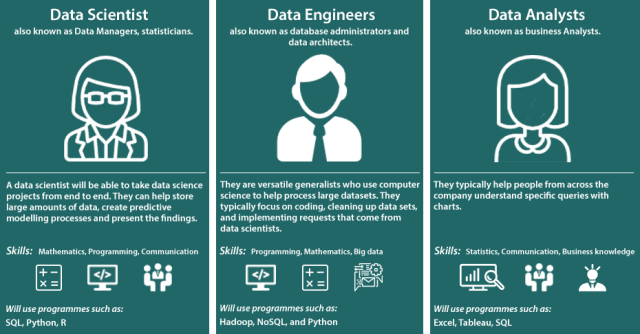
  • Data Scientist: This is a highly sought after job in the field of Data Science. A data scientist is expected to study all big and small data that has been gathered. They are also supposed to form the recommender systems and organize the data for analysis. All major corporations like Facebook, Google, Microsoft, Twitter, etc. employ data scientists. This job is better suited for people who are good at mathematics and coding.
  • Machine learning engineer: A machine learning engineer is entrusted with the job of making data funnels that aid in software creation. They also construct the appropriate and suitable algorithms needed for problem-solving. The machine learning engineers study the systems and its prototypes by running regular tests. They experiment with different problem-solving techniques and modify the current operating steps to improve the current methodology and quality of work. Machine learning engineers are highly paid.
  • Business Analyst: A business analyst tests data by keeping in mind the requirements of the business house it is serving. One does not have to be specifically from a technical field to perform this job. A business analyst has knowledge about industries like telecom, finance, logistics, marketing, and retail.These people are well informed about government and legal policies related to financial technology. A business analyst helps a company find out what information they need to enhance the company’s consumer behavior, marketing strategies, and relationship with its customers.
  • Data Analyst: Like the name suggests data analysts are responsible for primarily web tracking, testing, and operating big and large data sets. They use a mix of statistical tests and interdisciplinary methodology made up of qualitative and quantitative tools to study big data.They have to pick relevant patters and form conclusions based on a set of figures available. A good data analyst is equipped with the number of fact-finding and statistical tests that can be applied to a varied set of data packs depending on the availability of the information. A capable data analyst will be perceptive and informed about which tool and method have the best probability of revealing the most reliable information.

Conclusion

Data Science is one of the most expansive and quickly growing fields in the world. There has been a steep rise in several Data Science Coursetakers in the last few years. The reason for this recent increase in popularity is the number of jobs that have emerged in this area. Since data science is multidisciplinary, people from different subjects and work fields can collaboratively work in it.

Don’t Miss These Comprehensive Questions To Ace Data Science Interview!

109 common data science interview questions to remember

 Data science interviews are often considered to be difficult and it might be difficult for you to anticipate what questions you will be asked. The interviewer can ask technical questions or throw you off guard with questions you hadn’t prepared for.

To pursue a full-fledged Data Science Career, it is important for you to be up to date on an array of questions that might be asked during the interview, ranging from programming skills to statistical knowledge, or even field expertise and plain communication skills.

Here is a segmentation of the various categories along with the list down of the possible questions you can expect in each category as an interviewee during a data science interview.

Statistics

As an interviewee, it is essential for you to be prepared on statistical questions since statistics is considered to be the backbone of data science.

  • What are the various sampling methods that you know of?
  • Explain the importance of the Central Limit Theorem.
  • Explain the term linear regression.
  • How is the term P-value different from R-Squared value?
  • What are the various assumptions you need to come up with for linear regression?
  • Define the term- statistical interaction.
  • Explain the Binomial Probability Formula.
  • If you were to work on a non-Gaussian distribution, what is the dataset you would use?
  • How does selection bias work?

Programming

Interviewers may ask completely general questions on programming to test your overall skills or may try and test your knowledge on big data, SQL, Python or R. Listed are a couple of questions that may turn out to be relevant for you to crack that interview like a pro.

  • List the pros and cons of working with statistical software.
  • How do you create an original algorithm?
  • If you were to contribute to an open-source project, how would you do it?
  • Name your favorite programming languages and explain why do you feel comfortable working in them.
  • What is the process of cleaning a dataset?
  • What is the method you would take for sorting a large list of numbers?
  • How does MapReduce work?
  • What is Hadoop Framework?
  • If you are given a big dataset, explain how would you deal with missing values, outliners and transformations.
  • List the various data types in Python.
  • How would you use a file to store R objects?
  • If you were to conduct an analysis, would you use Hadoop or R, and why?
  • Explain the process using R to splitting a continuous variable into various groups in R.
  • What is the function of a UNION?
  • Explain the most important difference between SQL, SQL Server, and MSQL?
  • If you are programming in SQL, how would you use the group functions?

Modeling

While a Data Science Course will teach you the basics of modeling, at an interview you may be asked technical questions like building a model, your experiences, success stories and more.

  • What is a 5-dimensional data representation?
  • Describe the various techniques of data visualization.
  • Have you designed a model on your own? If yes, explain how.
  • What is a logic regression model?
  • What is the process of validating a model?
  • Explain the difference between root cause analysis and hash table collisions.
  • What is the importance of model accuracy and model performance while working on a machine learning model.
  • Define the term- exact test.
  • What would you rather have; more false negatives than false positives and vice versa?
  • Would you prefer to invest more time in designing a 100% accurate model, or design a 90% accurate model in less time?
  • Under what circumstances would a liner model fail?
  • What is a decision tree and why is it important?

Problem Solving

Most interviewers will try and test your problem-solving ability during a data science interview. You may be asked trick questions or be subjected to topics that evoke your critical thinking abilities.

Listed are some questions that will help you prepare for an upcoming interview.

  • How would you expedite the delivery of a hundred thousand emails? How would you track the response for the same?
  • How would you detect plagiarism issues?
  • If you had to identify spam social media accounts, how would you do so?
  • Can you control responses, positive or negative to a social media review?
  • Explain how would you perform the function of clustering and what are the challenges you might face while doing so.
  • What is the method to achieve cleaner databases and analyze data better?

How To Create An Image Dataset and Labelling By Web Scraping?

Every data science project starts with data. We need to acquire a huge amount of data to train our machine learning models. There are various ways to collect data. Surfing websites and downloading the structured datasets present on them is one of the most common methods for data collection. But there are times when this data is not enough. Certain problem statement datasets are not easily available on the web. And to deal with this situation, we need to create our own datasets.

In this article, we will discuss the method of creating a custom image dataset and labeling it using Python. First, let us talk about acquiring images through web scraping.

Web Scrapping

Web Scraping refers to the process of data scraping from websites. It surfs the world wide web and stores the extracted data in the system. Beautifulsoup is one of the most popular Python libraries for image scraping. The requests library requests the essential webpage.

How To:

When we go to the developer tool by clicking on a picture on the webpage, there displays a format starting with images.pexel.com/photos after which a number is listed, which is unique for every photo. One can get a similar image using the regex (regular expression).

Using this method, our images get scrapped. We can also print the links if we want to see those links and make a directory of them. After this, we will download the images. Once the process is complete, you can see the scrapped images through the specified path where images are stored.

Labeling

After scrapping and storing the images, we need to classify them through labeling. Labeling software is used for this purpose. It is a pip installable annotation tool. It provides two annotations YOLO and PASCAL VOC.

How To:

You can open the labeling software using the command: (base) C:\Users\Jayita\labeling

There will be specified options on the left-hand side of the screen. On the right-hand side, you will see the image file information. Select ‘Open dir’ to see all images. Press ‘a’ to view the previous image and ‘d’ to view the next image.

To get the annotations, draw a rectangular box and press ‘w’. A window will pop up to store the image’s class name. Once you are done with drawing the box and labeling the image, it’s time to save it. To generate the annotations, you need to store the image in PASCAL VOC or YOLO format.

One can learn about this in detail in a data science course. Web scrapping and labeling is not a hard process once you understand the basics of it. You need to be careful while scrapping a website and obey the rules so that you do not harm the website you are scrapping. Take time to consider your requirements and research accordingly to find a suitable website for this process. For example, if you plan to develop a model for fashion, then online shopping websites should be on your scrapping list.

Learning web scraping and labeling is important if you want to build a data science career in the future. It will provide you with a deep understanding of image datasets. You can use these techniques to increase the data in situations where available data for a project is less. You can apply this process to multiple classes if they share the same folder and get the desired results.

What is The Salary Of A Data Scientist?

One of the biggest drivers of data science as a career in India is its earning ability. In India alone, the average annual pay of a data scientist (analyst) is upwards of INR 8 lakh. This can definitely vary depending upon the location, the type of the job, and the employer.

While you can improve the chances of earning a higher salary by signing up for a data science course, it is a good idea to look at how the remuneration looks like through the cycle of a data science career.

Hierarchy of Salaries of a Data Scientist

This is a quick look at how your salary will grow as you gain more experience and get trained for a data science career.

  • Beginner – An entry-level data scientist from a reputed institution can look at earning upwards of INR 5 lakh a year. This is a better salary compared to those that engineering graduates receive in India. Here, as a beginner, your goal should be to gain more hands-on experience in your specific field to demand a better salary. For example, a data science training course can improve your chances by 2x.
  • Analyst With 1-4 Years of Experience – Although there is a possibility that your data science salary can touch the INR 10 lakh mark in this period, it will depend on your projects and overall work experience. This is a good time to shift from your existing employer and look at greener pastures.
  • Professional – This is when you achieve more than 10 years of experience. Here you can dictate a salary in the range of INR 15 lakhs to INR 25 lakhs. With several credentials and projects in your name, you can really carve out a prosperous life for yourself and your family. This is also where you can think of spending some time on research.

Just remember that when you start off, make sure you are well trained for a data science career. As a fresher, your academic qualifications will play a vital role during interviews. A data science training course that will help you choose a specialty and make it a focal point is the way to go.

Promotions and Salary Hikes in Data Science

As with every other professional field, a promotion in a data science career is entirely dependent on performance. However, a salary hike of 30% to 50% can be expected. Again, this will be influenced by how well you perform in your role, but given that skilled data scientists are hard to find in India, you can be optimistic.

In any case, if you don’t feel you are professionally growing in your current company, you can always look at upskilling or switching jobs. A data science training course can make you a potential candidate then.

As noted above, getting trained for a data science career can boost your earning and promotion capabilities. While data scientist intrinsically is a well-paying job, a training course in the field will do no harm.

Why is Data Science a Good Career in 2021?

Being a data scientist is only growing in demand over 2021 and is showing no signs of slowing down. It is estimated that around 11.5 million jobs in data science will be created by 2026 in the US. But, why is that the case? This article seeks to answer that very question.

  1. Use in Companies

Due to the ever-growing base of Big Data, every company is looking to utilize all available information to have a massive competitive edge.

Data Science CareerA data science career under a company is a frontier-field that finds new ways to better one’s products and services after utilizing past stores of information and/or case studies.

This work hence involves finding various avenues of data and finding new ways of processing and drawing conclusions from that data.

  1. Use in Studies

Being a form of study that is still in its nascent stages, a data science career may not be motivated by finding profit for a certain industry but also increasing the ambit of human knowledge. One might also work on designing a data science course from others to learn from.

  1. Proper Pathway

While being a data scientist requires a lot of work, the exact path to such a goal has been charted time and time again. There is a great degree of resources available now to become proficient in various aspects related to the data sciences. Other than doing a basic data science course, one may partake in learning various related fields like programming and big data processing from various online platforms (e.g. Imarticus learning).

  1. Demand Doesn’t Slack

The demands for data sciences have also increased due to the new atmosphere generated by Covid-19 and the near-worldwide lockdown because of it.

Data Science Roles

It has been studied that 50% of the data science organization showed no slow-down and have seen growth. This requires one to find new ways to collect data, as well as use that data to aid in multiple projects. These may involve helping set up new modes of businesses, and helping older businesses change their plans to suit their new circumstances. Furthermore, it may aid in improving a range of services on a global level.

  1. Diverse Skillsets

It is easy to switch into being a data scientist incorporating your present skillset. Whatever your present occupations and/or interests may be, it can lend an avenue to collecting data on that specific domain.

Data Science TrainingThey can complement these skills with learning standard data sciences’ skills. Former data analysts may also expand on their present sphere of knowledge to become data scientists, with relative ease.

  1. An Expanding Field

In 2021, a lot of past data science models are up to open-source scrutiny. Hence, even in this new field of human knowledge, one can have a sizable understanding of multiple avenues of collecting and processing data. Their entry into data sciences will work to expand on this field of knowledge.

In conclusion, one can see that it is indeed highly fruitful to be a data science in this present day and age. One can channel his/her present skillset into this occupation as well and aid a burgeoning field of human growth and knowledge.

Why Data Security Should Be a Top Priority?

Data science has revolutionized how businesses utilize information and leverage it to achieve their objectives. Businesses in the contemporary heavily rely on the use of data and analytics to obtain valuable insights about the market, customer base, competitors, etc.

Decision-making is not random in the modern digital age; it involves complex analysis and data churning to make outcomes more favorable and predictable.

best data science courses in India Data science training has gained new heights in the past decade and there is a growing demand for professionals in this field, making the data science career one of the most sought after and rewarding ones.


Today, data stored by companies is not just some random piece of information that no one looks at twice, it has gained a new significance and is kept confidential. Cybersecurity is a concern in the modern digital era, where data is not less than fuel for businesses.

Cybercrime has also gained momentum with the growing demand for data by businesses. Data security should be a top priority for businesses in the light of recent cybercrimes that has affected both small and large businesses. One can easily opt for a data science course from reputed organizations like Imarticus Learning and learn all about this discipline.

 Data Security a Necessity

Data security entails protecting vital digital information from theft or corruption.  Data security ensures that your confidential information is safe and secure and could not be altered by any other party.

Businesses also hold personal information related to their customers and protecting it is a necessity for the longevity and growth of the business. Let’s delve deeper into why data security should be a top priority for businesses.

  • Potentially Unwanted Program (PUP)

Data security is not just needed for large organizations but even the smaller ones need it to keep their confidential information secure. Potentially Unwanted Programs, popularly termed PUPs are one of the major data security threats that affect small businesses. Small businesses generally receive complimentary bundle software with the purchase of new tools.

At times, some spyware could get installed while working on these software packages if not sorted out properly. The consequences could be complete system slowdown, hacking, etc. One can easily avoid these PUPs by installing software from reliable sources only and inspecting the installed ones from time to time.

  • Increase in Data Breach Damages Reputation

Data breaches can turn out to be very costly for businesses. It can lead to a decrease in sales volume and also impact an organization’s reputation negatively. People will be more reluctant to trust a brand that has had cases of a data breach in the past and they won’t be comfortable availing products or services from these organizations.

A famous example of a data breach that resulted in a huge loss was Target’s 2013 breach, the profits decreased by more than 40% in the last quarter due to this event.

  • Hampers Productivity

Data breach not just hampers the reputation of an organization but also has other major consequences. It also leads to a reduction in productivity as it disrupts the whole process and systems in place that effectively integrate everything. Addressing and resolving the breach issue takes a little time but making things normally takes more than that and this causes a chain reaction of reduced productivity which adds to further losses for a business.

Python Developer Salary in Terms of Job Roles

What is Python?

The second most liked Programming language in the world, Python is one of the widely used term in the web-development world.

Who are Python Developers?

The web-developers who design and code the software applications with the help of Python language are referred to as Python Developers.

Roles and responsibilities of Python Developers

 Python Developers as Data Scientists

Major businesses in today’s world require tools and skilled people for the data-related tasks such as data collection, data cleaning and processing.

Python Programming Course with Data ScienceData Scientists are the programmers who do these tasks for the organizations. Data Scientists gather a large quantity of data and convert it into a useful form, followed by recognizing data-analytics solutions for organizational growth.

Data Scientists encourage the data-driven approach in organizations to deal with complex business problems.

 Artificial Intelligence

In AI Python Developers create and implement the required Machine Language algorithms. They analyze the success and failure of the algorithm and rank them according to their performance for future use. Training and Retraining ML algorithms is one of the key tasks performed by Python Developers.

Salaries of Python Developers in India

The changing focus of the organizations on data-driven solutions is resulting in a manifold increase in the salaries of the Python Developers. In the coming years the demand for AI-skilled people will increase, and hence the salaries.

Major IT giants like Google, YouTube, Amazon etc. are adopting Python-driven systems and hence, manifold increases in the salaries of the Python Developers.

Python Programming Course with Data scienceThe entry level salary of a Data Scientist is approximately INR 500,000 per annum (Source: payscale.com) Data scientists with 5-9 years of work experience gets +100% more salary in India. With the experience and refinement of the skill, the salary of Data scientists shows exponential growth.

 An entry-level engineer who develops the ML Algorithms earns the average salary of approximately INR 700,000 annually. With further experience and refinement of the skills, the average salary of the Data Scientist shows exponential growth.

Factors affecting the Salaries of Python Developers

Job location: Considering the increasing demand of Python Developers, not only in India, the faster salary growth is visible in UK and in US.

Location

Approximate Average Salary in INR

Gurgaon

700,717

Bangalore

669,787

Delhi

600,000

Mumbai

579,728

Chennai

540,131

Hyderabad

475,000

UK Python Developer annual salary

£67,000

US Python Developer annual salary

$117,000

Experience:

Python Developer

Approximate Salaries in INR

Entry Level Python Developer

427,293

Med-Level Python Developer

909,818

Experienced Python Developer

1,150,000

Refined Skills:

Mere understanding of the Python is of no use, till is integrated with the problems and solutions. How one uses the well-known Python tools define the person’s skill set, which is a determiner of the salary.

Job Role:

Python Developer

Approximate Average Salary in INR

Data Scientists

700,000

ML Engineer

670,000

DevOps Engineer

660,000

Software Engineer

500,000

Web Developer

300,000


Python Programming Course with Data ScienceShould know more interesting things about Python programming training and Python career.