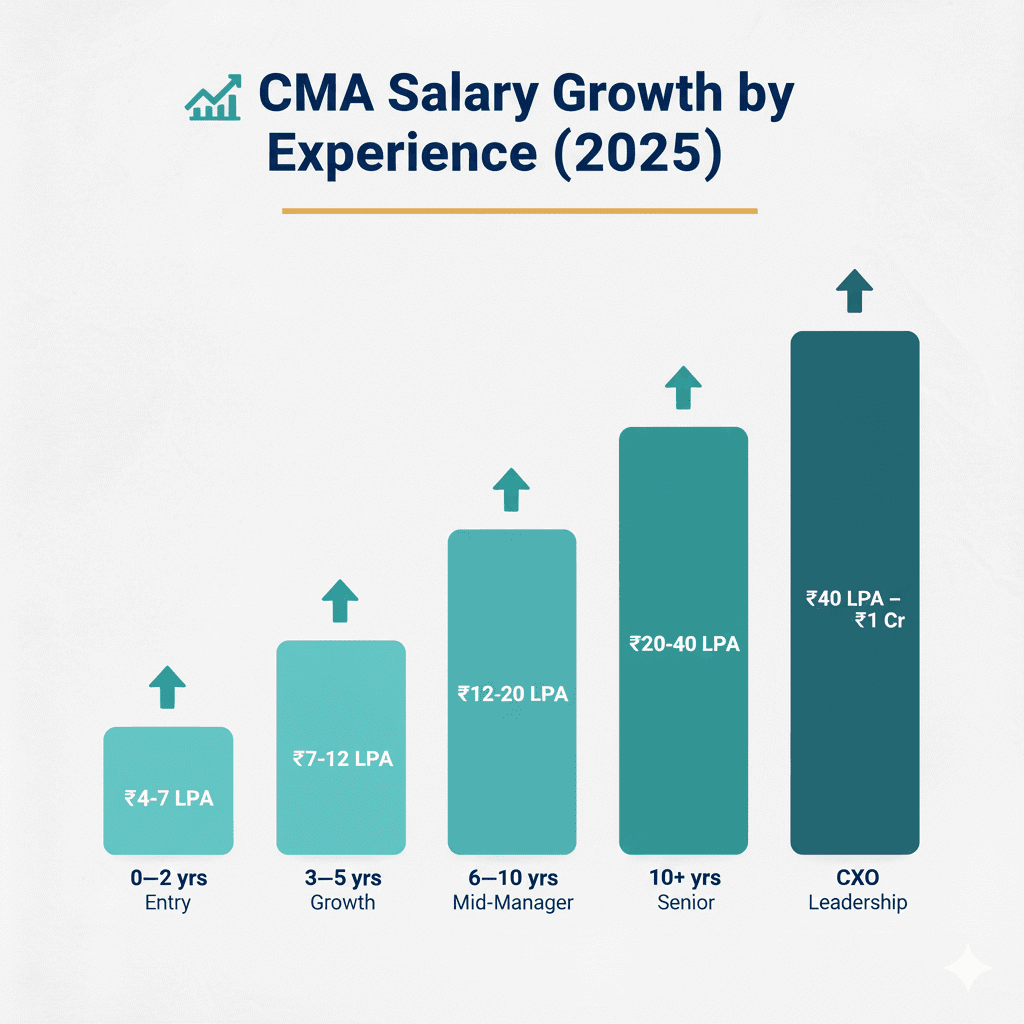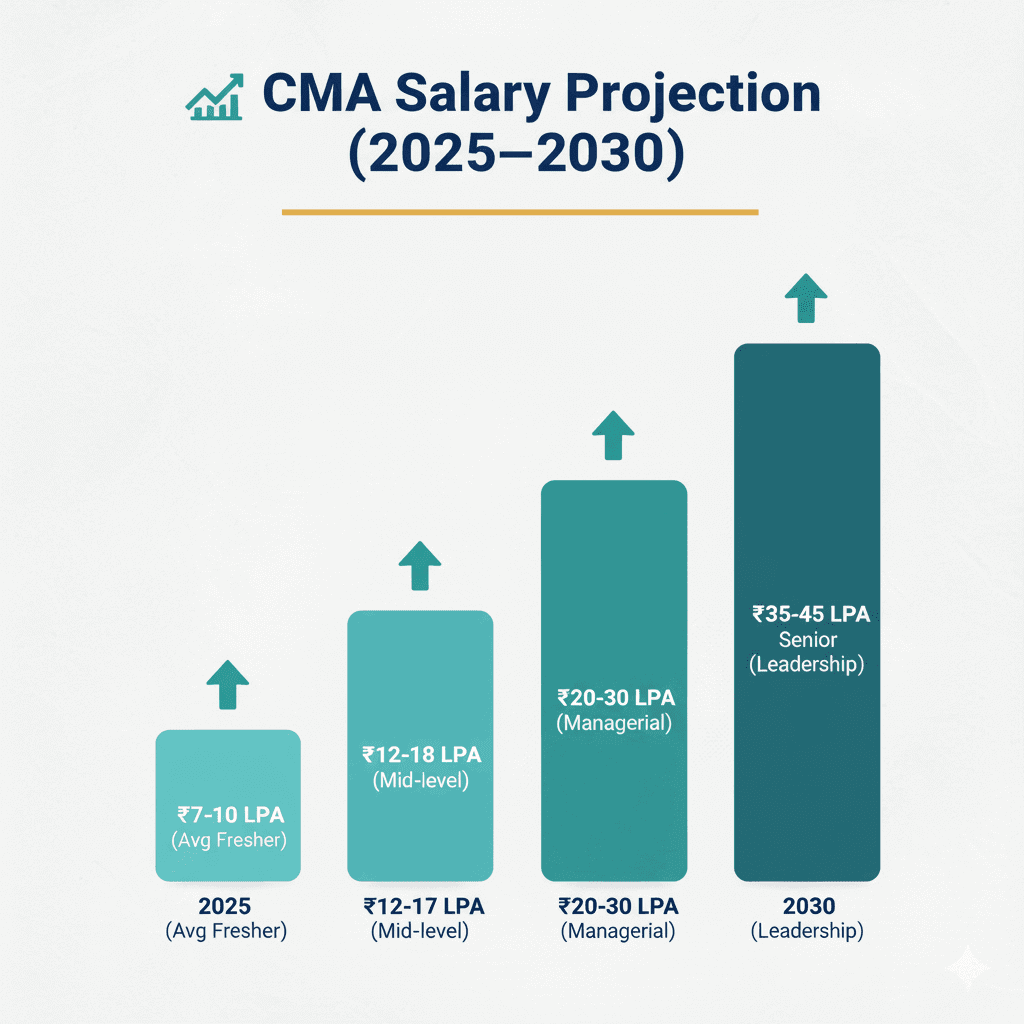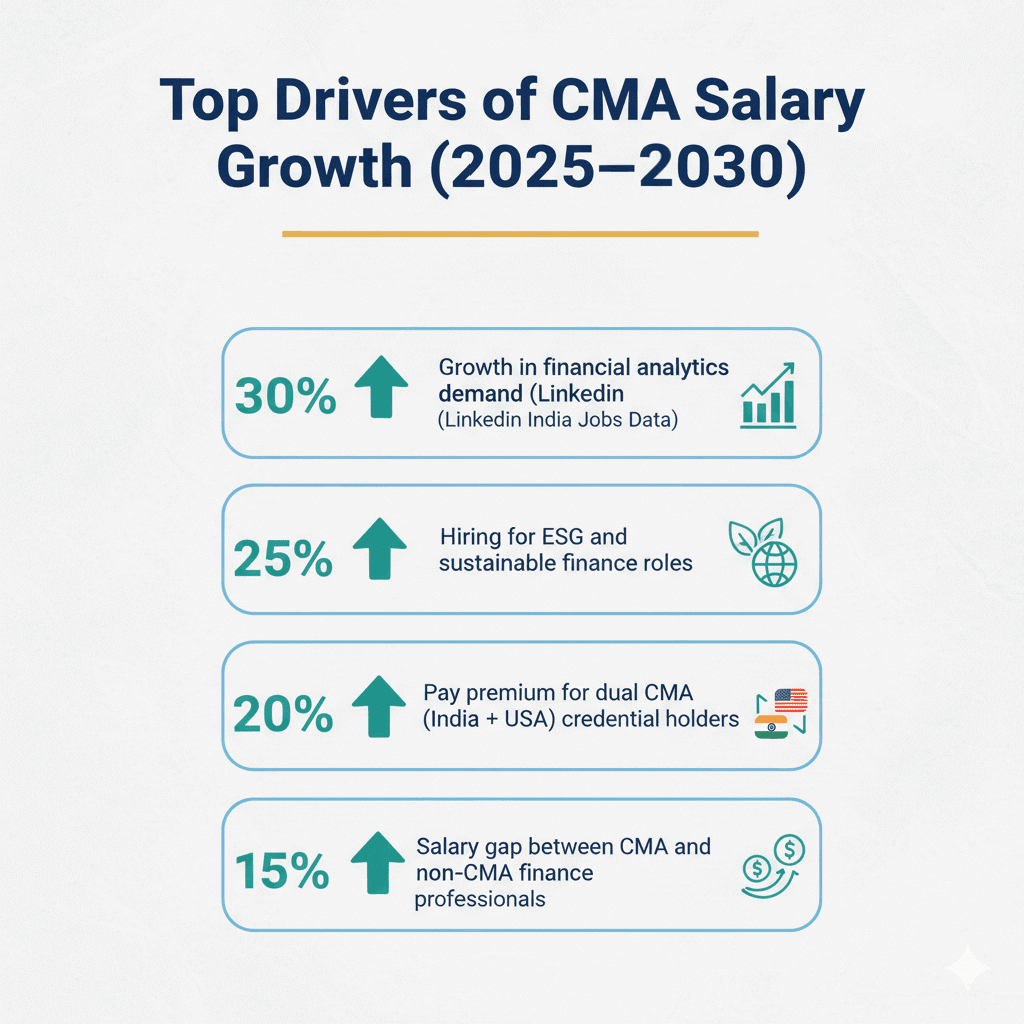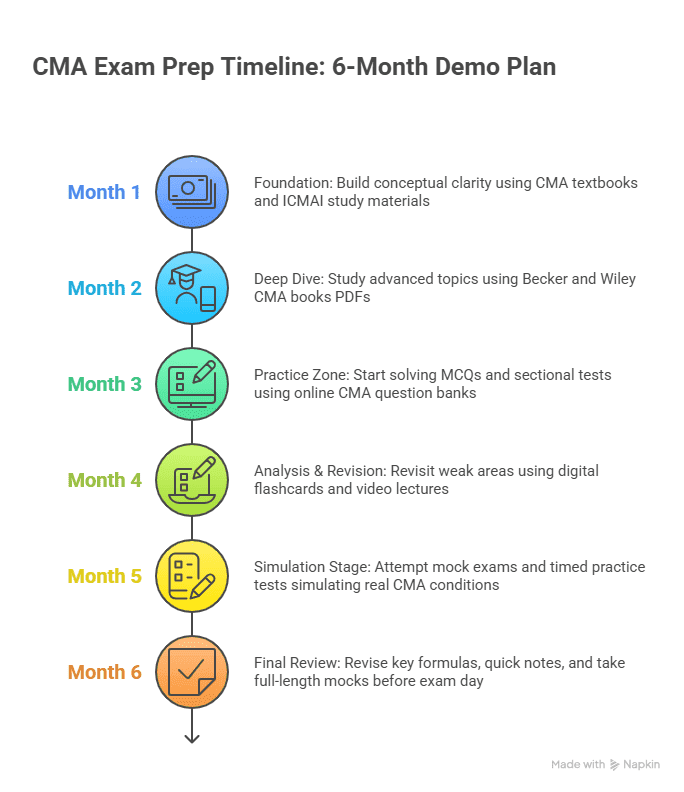
Being cost-conscious is an effective way to stay profitable and efficient in today’s competitive business environment. Cost management generally involves planning, controlling, and optimising the business expenditures of any organisation so that a company stays within its budget and maximises value. Its main idea does not relate to reducing costs but is rather a knowledge of where to allocate resources efficiently in the long term.
Here, we examine the fundamentals of cost management as well as its applicability to organisations. We then turn our attention to cost management models and activities. Whether you are a business practitioner, studying in the CMA program, or simply interested in reviewing information related to the financial management area, this book should provide you with a good feel for cost management.
What is Cost Management?
Definition of Cost Management
When people ask, “What is Cost Management?” at its core, cost management refers to the process by which an organisation can estimate, allocate, and then control business operation costs. It is fundamentally about having a systematic approach so that expenses are not beyond the budget while meeting the business objectives efficiently.
Role of Cost Management in Business
Cost control is very significant in every business, regardless of its scale or type and the nature of its business. It enables enterprises to prepare financially so as not to incur unnecessary costs and ensure that all the activities they engage in, are in line with the strategic goals of the organisation.
Why Cost Management Is Important?
Cost management is vital to any business since it controls cost and maximises efficiency, thereby increasing the profitability level. By tracking and optimising costs, firms can ensure efficient resource allocation and prevent financial waste while keeping themselves sustainable in the long term. So when someone asks, “Why Cost Management is important?”, it’s because good cost management increases profitability, improves decision-making and allows businesses to be professionally effective in today’s competitive, dynamic market environment.
Why Businesses Require Cost Management
With increased globalisation, demand is set in the marketplace for products and services offered with a quality value at a low price. Proper cost management helps an organisation become viable, and enable growth to achieve its optimum stature.
Benefits of Effective Cost Management
Higher profitability
Better decisions
Resource optimization
Increased competitiveness
What are the Components of Cost Management?
Cost Planning
Cost planning is the process of estimating possible costs that may occur in the future and setting up budgets that correspond with such costs. It ensures that an organisation’s departments will have a clear understanding financially.
Cost Control
Cost control is the practice of tracking expenditures in order to take corrective action so that they do not exceed the planned limitations.
Cost Reporting
Periodic reporting allows business organisations to follow up on financial performance, compare costs with the budget, and take corrective measures.
Types of Costs in Business
Fixed Costs
Those expenses which are independent of levels of business activity, and can be quoted as rent, salaries, and insurance.
Variable Costs
Variable costs are those that fluctuate with the level of the goods or services being generated, including raw materials and labour inputs.
Direct and Indirect Costs
Direct costs can be traced to specific products or services, but indirect costs, like utilities or administrative expenses, cannot be traced to specific outputs.
Strategies for Cost Management
Short-term versus Long-term Strategies
Short-term plans focus on cost reductions, but long-term strategies aim for long-term growth through efficient operations.
Optimization of Operations
This involves eliminating unnecessary process inefficiencies, minimising waste, and improving supply chain effectiveness in cost management.
Strategic Budgeting
Budgeting is a core function in cost management. It provides a financial framework to guide the business organisations. Budgeting allocates resources designed to accomplish corporate goals.
Techniques for Cost Management
Budgeting
Budgeting helps estimate income and expenses and provides a framework that guides the management of finance activities.
Activity-Based Costing (ABC)
This is due to the fact that cost allocation in ABC is based on the activities provoking the costs and hence puts a more realistic face to cost allocation.
Lean Management
Lean management is an elimination of waste and an optimal efficiency technique, which can lead to significant savings over time.
Role of Technology in Cost Management
Automation in Costing
Automation allows businesses to observe expenses as they happen, reducing possible human errors and thus enhancing cost efficiency.
Tools and Software
Many cost management software solutions make a business track, analyse, and report the costs so that its managers can make better decisions.
Cost Management in Various Industries
Manufacturing
Production process optimization in manufacturing and cost control in the supply chain are matters of concern for its manufacturing cost management.
Service Industry
Labour costs and efficiency in providing services are concerns in the case of cost management for the service industry.
Retail Business
A retail business is concerned with the management of inventories and operational efficiency to check the costs going into the activities and enhance profitability.
Obstacles in Applying Cost Management
Resistance to Change
The employees and management may resist the adoption of new strategies for cost management and fear disruption or additional workload.
No Real-Time Data
In a business context where real-time data is not utilised, decisions become challenging and quite complex to make while incurring overruns of cost
How Cost Management Affects Profitability
Proper cost management improves profitability as resources will ensure that all unnecessary expenses are kept at bay. Allocation of all resources will be maximised since this is an avenue for cutting costs without compromising on quality or performance.
Role of CMA in Cost Management
What is a Certified Management Accountant (CMA)?
A CMA is the financial planner, analyst, and cost controller for an organisation. His managerial expertise in cost management supports the achievement of cost plans through responsible budgeting by the business.
Skills to Become an Effective CMA
A CMA needs essential skills that are based on analytical capabilities, techniques for cost management on budgeting, and suitability in applying strategies for cost management.
Cost Management in US CMA Course
Key Concepts Taught in US CMA Course Curriculum
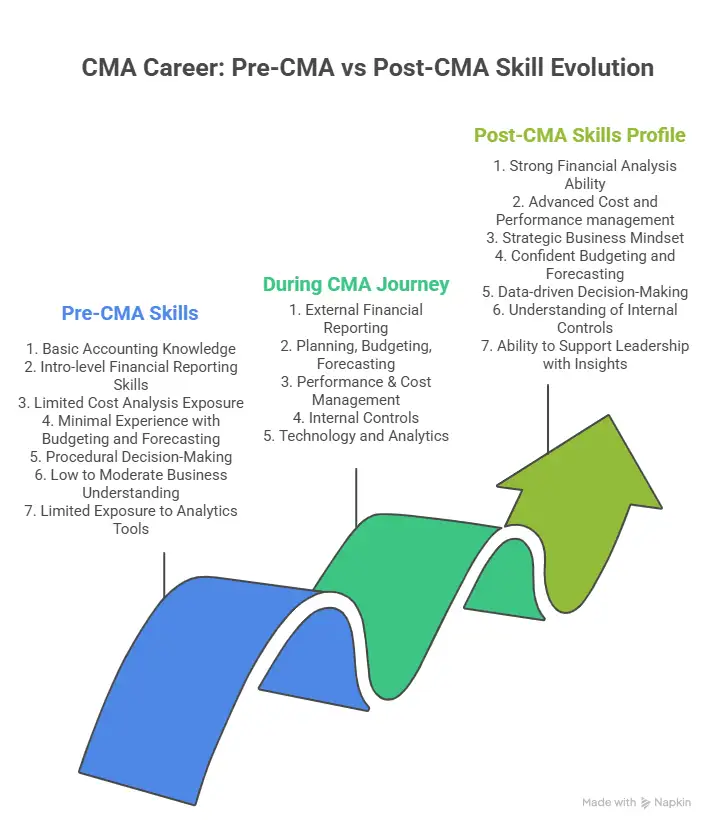
The CMA program teaches students the most important skills in cost management, namely budgeting, cost control, and financial reporting.
Practical Use for Professionals
Implementation of the concepts amalgamated by the program in real life will help the professionals positively change the financial condition of their organisations.
US CMA Course at Imarticus Learning
The US CMA course by Imarticus Learning is an internationally accepted management accounting certification accredited by the Institute of Management Accountants, USA. These courses are completed in 6–8 months by providing advanced accounting, finance, business, and analytics skills to learners. The program also offers a money-back guarantee wherein in case students fail all their CMA exams, they will get a 50% refund.
Imarticus is the first and only training entity in India to be authorised by top certifications such as CMA USA, ACCA UK, and CPA USA. Unlimited study material includes books, practice papers, and live classes using Surgent, the internationally acclaimed content provider that boasts a 95% pass rate at the exams. This course also incorporates expert mentoring and soft skills training.
Imarticus graduates are absorbed in key account-handling positions by global giants such as J.P. Morgan, IBM, and Deloitte, thus acting as the gateway to global opportunities. The course prepares candidates for roles like management accountant, financial controller, and internal auditor with salaries ranging from INR 6.5 to 10 LPA.
Its access provides interview preparations, placement assistance, and full learning journeys from the basics of accounting to advanced practical skills like financial modelling and MS Excel. This program is suitable for commerce graduates, MBAs, or any aspiring financial professional looking to take their career in management accountancy one step further.
Future Trends in Cost Management
Digital Transformation
Future cost management has been observed in advanced technology, including AI and big data analysis, promising a more precise, efficient, and controlled cost.
Cost management in its sustainable perspective
The sustainability considerations are surfacing in cost management. Businesses have been concentrating on reducing environmental impacts as these activities continue to remain profitable.
Conclusion
Cost management is about holding costs under control, but it is also a strategic tool that has helped businesses grow more sustainably while staying ahead in the competitive market. Understanding these fundamental concepts, strategies for cost management, and techniques for cost management would help businesses make better financial decisions and ensure long-term sustainability.
Choosing a professional qualification is easier when you understand what it prepares you to do. CMA stands out because it builds the kind of financial thinking companies rely on today. The CMA syllabus does not focus only on accounting or costing. It brings together analysis, strategy, compliance, technology, taxation, and operational insight in a way that reflects how modern businesses actually function.
Whether you come from a commerce background or you are exploring finance for the first time, the CMA journey feels structured and purposeful. Each level strengthens a different part of your skill set. You begin with commercial fundamentals, progress into analytical and regulatory concepts, and eventually learn how to interpret financial signals that guide organisational decisions. This progression is what makes the CMA USA syllabus both challenging and rewarding.
The demand for professionals who understand cost behaviour, performance metrics, financial reporting logic, and strategic decision-making has grown across industries. Manufacturing, FMCG, IT services, consulting, banking, logistics, and even emerging sectors like clean energy look for talent that can convert numbers into meaningful business insight. The syllabus has been designed with this demand in mind.
If you are planning to explore the full structure of the CMA syllabus, understand what each level builds, and see how different subjects connect to real roles in finance, this guide walks you through it in a clear, organised manner. It is built to give you clarity, not complexity, so you can approach your preparation with direction instead of doubt.
What Is CMA and Its Syllabus Framework
There is a certain kind of finance professional who does more than record numbers. They decode the story behind those numbers, understand how business behaviour shifts in response to economic forces, and guide decisions that influence an organisation’s future. When students begin exploring what is CMA, they often discover that this qualification was created precisely for this breed of professionals. Offered by the IMA, CMA is not just a credential. It is a framework for developing financial intelligence at a managerial level.
Management accountants operate in environments where clarity matters more than complexity. They interpret patterns, evaluate strategies, and support leaders during moments when decisions cannot rely on instinct alone. The CMA Syllabus is built to cultivate this style of thinking. It does not simply teach accounting or costing. It trains you to move from understanding data to shaping decisions, from knowing numbers to influencing outcomes.
The structure of the syllabus reflects this evolution. This section explains the full structure of the CMA course so that every reader can visualise the path ahead. Before opening a study module, you should know what the exam is trying to build in you as a finance professional. These CMA course details also help you see how the syllabus is intentionally layered.
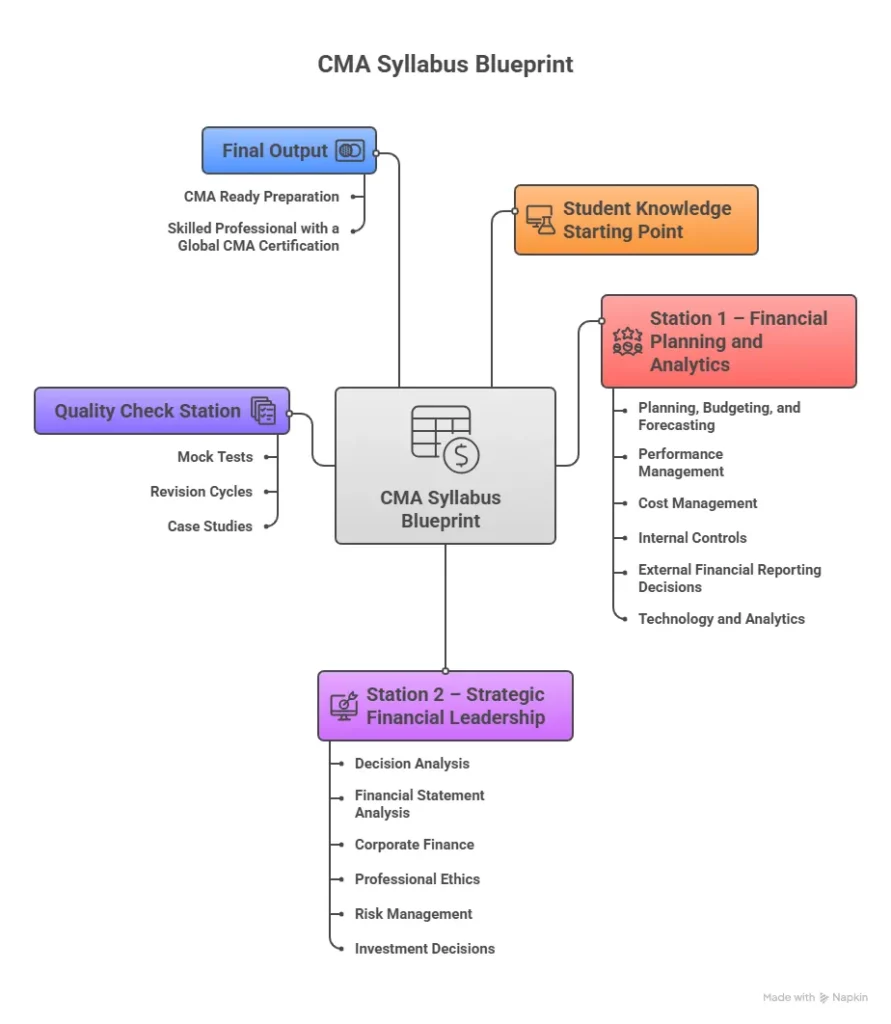
The US CMA syllabus created by the Institute of Management Accountants (IMA) revolves around strategic financial leadership in modern business ecosystems.
Whether you choose the Indian CMA or the US CMA, your long-term career trajectory benefits from mastering both analytical and managerial skills. This is why the structure of the CMA syllabus feels intense, yet beautifully coherent when approached with a plan.
The US CMA Syllabus: A Global Lens on Strategic Finance
This section provides a comprehensive view of the CMA USA syllabus, which is globally recognised and aligned with real-world managerial finance. The US CMA pathway is compact, rigorous, and frequently chosen by professionals seeking international roles.
The US CMA exam consists of two parts. Both parts test professional judgement, analytical discipline, and the ability to interpret business scenarios.
US CMA Exam Overview
The US CMA exam is structured to test applied finance rather than rote learning. It contains multiple-choice questions as well as essay-type business scenarios. The passing score is 360 out of 500.
Candidates often pursue the US CMA alongside full-time jobs because the syllabus focuses on managerial outcomes, not memorisation.
US CMA Part 1 Syllabus: Financial Planning and Analytics
This section lays out the US CMA Part 1 syllabus, explaining what each area teaches you and why organisations value these skills.
US CMA Part 1 – Topic Areas and Weightage
This table shows how the syllabus is distributed across topic clusters, allowing candidates to allocate study time smartly.
Topic Cluster
Weightage
Skill Area Developed
Planning, Budgeting, and Forecasting
20%
Ability to design budgets and forecast performance.
Performance Management
20%
Measuring organisational effectiveness through KPIs.
External Financial Reporting Decisions
15%
Understanding GAAP-based reporting logic.
Cost Management
15%
Identifying, analysing, and controlling organisational costs.
Internal Controls
15%
Ensuring process and financial integrity.
Technology and Analytics
15%
Exposure to data analytics and modern tech tools.
This part is practical. Budgeting, forecasting, and cost management are exactly the tasks finance teams perform in industry roles.
US CMA Part 2 Syllabus: Strategic Financial Leadership
Here, we explore the US CMA Part 2 syllabus, the section of the course that tests real decision-making expertise.
US CMA Part 2 – Topic Areas and Weightage
This table highlights how the topics develop the financial leadership mindset required for senior roles.
Topic Cluster
Weightage
Skill Developed
Decision Analysis
25%
Evaluating choices using quantitative and qualitative factors.
Financial Statement Analysis
20%
Interpreting financial health and forecasting futures.
Corporate Finance
20%
Capital structuring, risk, and long-term financial planning.
Professional Ethics
15%
Ethical thought process in sensitive business situations.
Risk Management
10%
Identifying and managing organisational vulnerabilities.
Investment Decisions
10%
Selecting and evaluating investment opportunities.
Together, Part 1 and Part 2 represent the essence of the CMA USA syllabus, turning candidates into strategic value creators.
Why the US CMA Syllabus Matters Globally
The US CMA syllabus is recognised worldwide because it teaches the kind of financial thinking companies use daily. It focuses on:
Strategic decision-making
Performance analysis
Risk evaluation
Internal controls
Technology-driven finance
Data interpretation
The US CMA syllabus is structured around exactly these capabilities.
Where You Use US CMA Knowledge
Here are practical, bite-sized examples:
Planning budgets for a hospitality chain expanding into new cities
Evaluating risk before launching a new consumer product
Interpreting cash flows for a start-up seeking investors
Assessing cost behaviour when production volume changes
Comparing two investment proposals during a board presentation
These situations happen across real companies. The US CMA syllabus exists to prepare you for them. The following visual gives an overview of the US CMA levels and the subject areas.
Study Techniques That Make the CMA Syllabus Easier
Every year, I meet students who tell me the same thing. The syllabus feels long when you look at it on paper. The trick is to stop staring at the list and start understanding how the topics behave. A topic behaves the way a financial problem behaves in real life. It sits inside a structure, it interacts with another concept, and it layers itself across multiple situations. The moment you see this, preparation starts becoming intuitive.
This part focuses on the deeper methods for absorbing the CMA course subjects. You will learn how to cluster topics, how to revise in cycles, how to use industry examples to anchor your concepts, and how to track your progress using data-driven methods instead of guesswork.
Designing a Preparation Framework Around the CMA Syllabus
Students often start their preparation by opening the first page of a module and reading like a storybook. The syllabus is not meant to be consumed this way. It helps to design a structure first. Consider this section your blueprint. It shows how you can use the natural flow of the syllabus to create a preparation system that scales with your progress.
Three-Phase Study Loop
The three-phase loop is a system based on how the brain creates long-term memories.
Input Phase You read the concept, understand related examples, and write down short notes.
Association Phase You link the concept with related CMA syllabus topics. This creates mental clusters.
Application Phase You solve questions, attempt mock scenarios, and practice cross-topic problems.
Repeating this loop across the CMA syllabus creates high retention.
Why Topic Clustering Changes Everything
Topic clustering is the habit of grouping syllabus areas based on their behaviour. Here are clusters you can begin with.
Cost Behaviour Cluster: Marginal costing, variance analysis, budgeting, standard costing.
Regulatory Cluster: GST, IT Act provisions, Companies Act, and audit requirements.
Strategic Cluster: Business strategy, risk management, analytics, investment decisions.
Clustering also prepares you for integrated case-based questions that appear in the higher levels of the CMA syllabus.
2. How to Build a Weekly Study Plan Around the CMA Syllabus
This section breaks down the process of creating a realistic weekly timetable that is aligned with the CMA syllabus structure. Instead of giving rigid hours, this guide teaches you how to adapt your schedule based on your attention span, your exam month, and your mastery of fundamentals.
Weekly Structure Template
Below is a simple and flexible pattern you can use.
Day 1 and 2 Heavy theory topics such as laws, accounting standards, and audit fundamentals.
Day 3 and 4 Numerical topics such as costing, financial management, and analytics.
Day 5 Revision of whatever was completed in the past four days.
Day 6 Mixed question bank practice, including old questions and unit tests.
Day 7 Light revision through podcasts, concept videos, or flashcards.
How to Allocate Study Hours Without Burning Out
If you are preparing for the Indian CMA and the US CMA exam together, do not mix topics from both syllabi on the same day. The frameworks differ and require separate mental spaces. To begin with, understand the CMA eligibility criteria and the syllabus in detail to develop an approach that works best for you. A good rule is to follow a 60 to 40 balance for the Indian CMA first, then adjust as you get closer to your US CMA attempt.
Watch this video to prepare yourself to ace the CMA exams with a mock interview. Check how far you’ve come in the preparation journey and what aspects still need to be tightened:
A Structured Look at CMA Syllabus Focus Points
As you work through the CMA pathway, certain subjects naturally take up more space in your preparation than others. Some topics appear repeatedly across levels, some grow deeper as you progress, and a few become central to the way you think about costing, finance or strategy.
This section pulls those patterns together so you can see how the syllabus distributes its focus, how each stage builds on the one before it and where your study energy will create the most impact over time.
US CMA Part 1: Financial Planning, Performance and Analytics
Part 1 sets the foundation for how finance teams plan, measure and interpret business activity. It brings together the areas you will use most often in day-to-day roles, from budgeting and forecasting to performance tracking, cost behaviour and analytical tools. The following breakdown helps you understand how these topics connect and why they form the core operating layer of the US CMA syllabus.
Planning, Budgeting and Forecasting ████████████ 20%
Performance Management ████████████ 20%
External Financial Reporting ████████ 15%
Cost Management ████████ 15%
Internal Controls ████████ 15%
Technology and Analytics ████████ 15%
Key takeaway: Part 1 is evenly distributed across six major buckets. Planning, performance and reporting form the bulk of exam focus, with analytics and controls gaining importance in recent years.
US CMA Part 2: Strategic Financial Management
Part 2 moves deeper into the strategic side of finance, where decisions carry long-term consequences and require a broader understanding of how businesses grow, invest and manage risk. The topics in this section shape your judgment as a future finance leader, connecting financial analysis, corporate strategy and ethical reasoning into one cohesive skill set.
Decision Analysis ██████████████ 25%
Financial Statement Analysis ██████████ 20%
Corporate Finance ██████████ 20%
Professional Ethics ███████ 15%
Risk Management █████ 10%
Investment Decisions █████ 10%
Key takeaway: Part 2 shifts into judgment-heavy topics. Decision analysis dominates, supported by financial statement insights and corporate finance. Ethics, risk and investment decisions complete the strategic framework.
Why CMA Candidates Struggle and How to Solve It With the Syllabus Itself
There are predictable challenges students face across the CMA syllabus. This part explains those hurdles and shows how using the syllabus and the content specification outlines provided by IMA as a navigation tool helps you move past them.
Common Struggles and Their Solutions
Struggle 1: Feeling lost between accounting and cost accounting Solution: Keep a journal where you write the similarities and transitions. For example, cost allocation feels easier when you recall how overheads behave in financial accounting.
Struggle 2: Getting stuck in taxation Solution: Use tax flow diagrams. Draw how income enters different heads or how GST flows through the Input Tax Credit.
Struggle 3: Weak retention of formulas Solution: Create a formula wall. Write formulas on sticky notes and update them every week.
Struggle 4: Panic during mock tests Solution: Practice with time pressure. Set a 30-minute timer for 20 questions. This trains your brain to stay calm in the real exam.
These strategies work across both the Indian CMA and the CMA USA syllabus, especially because both exams expect you to think, not memorise.
Real-World Applications of CMA Syllabus Topics
This part shows how different syllabus topics of CMA appear in the real world. Students often understand better when real scenarios are explained. These examples also improve your retention during revision.
Everyday Corporate Illustrations
Budgeting and Forecasting FMCG brands like Hindustan Unilever frequently forecast demand across 30 to 40 product lines. The budgeting section of the US CMA Part 1 syllabus mirrors these real workflows.
Transfer Pricing Global companies such as Amazon manage internal prices between warehouses, manufacturing hubs, and retail units. CMA students learn this under management accounting and international tax.
Variance Analysis Automobile plants track the variance between planned labour hours and actual labour hours. This becomes vital for cost control.
Investment Decisions Banks and private equity firms use capital budgeting techniques to decide whether an investment is financially sound. Students encounter these techniques in Part 2 of the US CMA syllabus and in the final level of the Indian CMA.
Internal Controls According to the ACFE 2024 Fraud Report, weak internal controls contribute to More than half of occupational frauds occurring due to a lack of internal controls or an override of existing internal controls. (Source) This shows the practical power of internal controls, a topic covered in both the Indian CMA syllabus and the US CMA course syllabus.
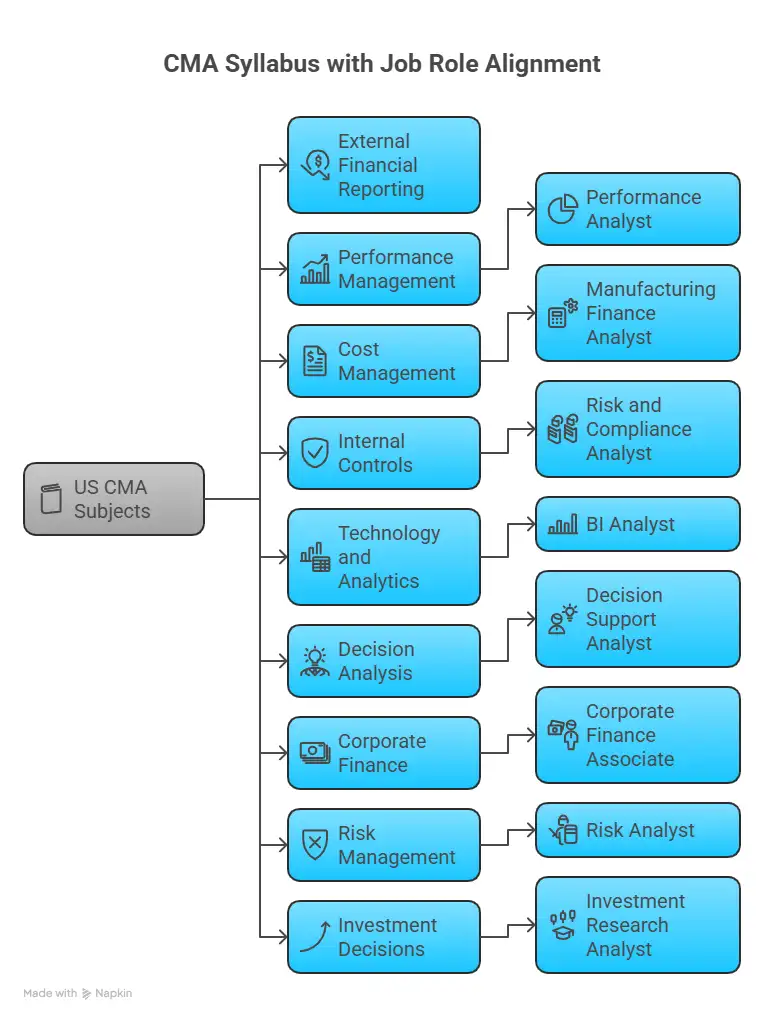
Here is a visual that shows a relation between the focus subjects of the US CMA and what job roles or skills it prepares you for:
Turning the CMA Syllabus Into a Career Advantage
This section covers how you can convert your understanding of the CMA syllabus into career capital. You will read about the CMA course benefits and what recruiters value in candidates who understand the logic behind the subjects.
Why Employers Value CMA Candidates
They have strong cost control discipline.
They understand regulatory boundaries.
They can analyse financial statements with an integrated perspective.
They know how to build budgets and forecast business scenarios.
They think like problem-solvers, which senior finance roles require.
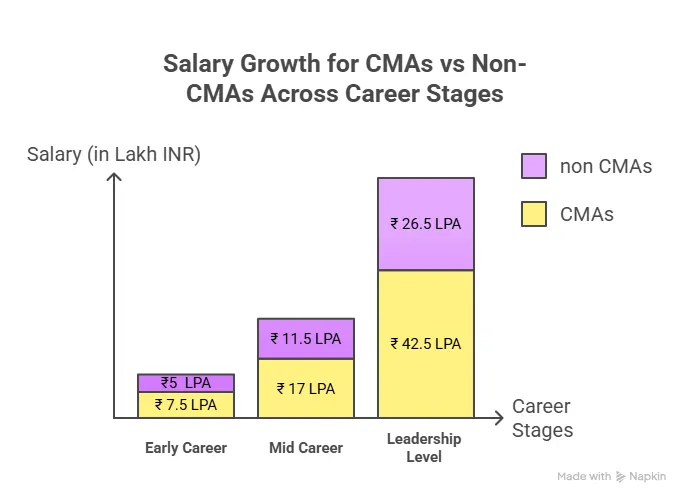
According to a salary survey by IMA in 2023, US CMA professionals reported a median global salary that was approximately 21% higher than non-CMA peers. (Source)
This is why many students eventually combine both the Indian CMA and US CMA credentials. Mastery of the CMA Syllabus across both pathways builds the confidence to handle complex roles in FP&A, audit, taxation, analytics, and financial leadership.
And if you’re still wondering if CMA is worth a bet, the time, money, and resources, here is a video that explains this in detail:
How to Use Mock Tests and Analytics to Track Syllabus Mastery
Mock tests become valuable only if you know how to interpret them. A low score is not a failure. It is a data point. This section explains how to track your improvement scientifically.
Five-Step Analysis Routine
Identify topics with recurring mistakes.
Compare mistakes with your topic clusters.
Review conceptual gaps using short notes.
Redo the same questions after seven days.
Use a score tracker to monitor your improvement every week.
Sample Performance Tracker
This table helps you observe patterns in your own progress without needing any special software.
Week
Percentage Scored
Topics Paused
Topics mastered
Notes
1
42 percent
Accounting Standards, Budgeting
Basic Maths
Increase revision frequency.
2
57 percent
GST, Variance Analysis
Budgeting
Needs more problem-solving.
3
64 percent
Financial Reporting
Variance Analysis
Better conceptual clarity.
4
72 percent
Transfer Pricing
Taxation
Close to exam-ready.
With this system, students feel in control of their preparation. Smart tracking gives more peace of mind than blind revision cycles.
Anchor Points for High-Retention Revision
Use these anchor methods across the CMA syllabus.
Flashcards for definitions and formula-heavy chapters
Flow diagrams for tax and audit subjects
Mini case studies for costing and strategic management
One-page summaries for economic laws and company law
Weekly 60-question drill from mixed subjects
These small steps create a strong revision culture that helps you stay grounded through the preparation journey.
A Revision Map for US CMA Attempts
This part gives you a combined map to revise the CMA USA syllabus, especially for students who plan to take both pathways over their career.
US CMA Revision Map
Use a 30-day block for each part of the US CMA exam.
For the US CMA Part 1 syllabus, rotate between performance management, external reporting, and internal controls.
For the US CMA Part 2 syllabus, assign longer blocks for decision analysis and financial statement interpretation because these topics influence essay-type scenarios.
Keep 20 per cent of your time for pure question solving and mock exams.
When you combine these two revision maps, your conceptual clarity strengthens across both qualifications.
Career Pathways That Open Up Through the CMA Syllabus
This section outlines the career opportunities that align with the CMA syllabus. These roles may vary across sectors, but they share one common thread. Employers trust CMA candidates because they understand both financial logic and managerial reasoning.
Popular Job Roles After CMA
Cost Accountant
Business Analyst
FP&A Analyst
Internal Auditor
Tax Associate
Financial Reporting Specialist
Investment Analyst
Risk Analyst
Strategy Consultant
Operations Finance Specialist
Industries That Actively Hire CMA Candidates
Manufacturing
FMCG
Consulting
Banking and financial services
Energy and infrastructure
Technology and IT services
Pharma and healthcare
Logistics and supply chain
The CMA syllabus builds a combination of cost analytics, corporate reporting, taxation, business strategy, and financial interpretation. This multi-disciplinary exposure makes candidates useful across industries and functions.
How Imarticus Learning Supports Students Through the CMA Syllabus
This part explains how structured mentorship helps you navigate the CMA syllabus more confidently. Imarticus Learning provides a blend of instructor-led sessions, practical case studies, and exam-focused problem-solving workshops that align perfectly with the CMA course design.
How Mentorship Improves Exam Readiness
You gain access to structured notes that reduce reading time.
Expert faculty help simplify difficult chapters like decision analysis, audit, and taxation.
Live doubt-solving sessions speed up your learning significantly.
Mock exams are designed using the latest pattern across both the Indian CMA and the CMA USA course syllabi.
Placement assistance and soft-skill training help you transition smoothly into finance roles.
For many learners, the biggest advantage is the accountability created through continuous guidance and personalised study plans.
FAQs on CMA Syllabus
This section brings together the most frequently asked questions students have while navigating the CMA Syllabus. Each answer is designed to give you clarity on the qualification, the learning journey, the exam structure and the career outcomes connected to it.
What is the syllabus for CMA?
The syllabus for CMA is a structured framework that develops your accounting, costing, taxation, strategic management, and financial decision-making skills. It has two parts in the US CMA pathway. When students study CMA with the right sequence and revision cycles, they gain a strong command over financial reporting, cost optimisation, tax compliance, and business strategy. Many candidates rely on structured coaching through Imarticus Learning to navigate the entire CMA syllabus efficiently using curated notes, mock tests, and faculty-led guidance.
Is the CMA exam difficult?
The CMA exam is considered challenging because the syllabus is broad and blends theory with numerical application. The syllabus is designed to test your ability to interpret business data and make financial decisions, which is why regular revision and conceptual understanding matter more than memorisation. Students who follow a structured plan, especially under mentors at Imarticus Learning, often find the CMA exam manageable because they learn how to study CMA in smart phases.
Is CMA hard or CS?
CMA focuses heavily on costing, finance, taxation, analytics, and strategic decision-making. CS revolves more around corporate laws, compliance frameworks, corporate secretarial work, and governance. Students who enjoy numbers, analytics, budgeting, and financial interpretation often find CMA more intuitive. On the other hand, learners who prefer detailed legal reading might find CS suitable. Ultimately, choosing between the two depends on your interest areas.
Is CMA difficult than CA?
CA has a wider academic depth and a larger number of papers, while CMA is built around cost analytics, corporate finance, taxation, and strategic decision-making. Students who enjoy practical financial reasoning generally find the CMA syllabus comparatively accessible because the exam pattern focuses on applied understanding. Difficulty also depends on your preparation strategy. With structured coaching from Imarticus Learning, many students find that CMA becomes manageable through guided practice.
What is the CMA salary?
CMA professionals earn attractive salaries because companies value analytical skills, cost optimisation expertise, and strong financial judgment. According to the IMA Global Salary Survey 2023, the global median total compensation for CMAs is about $86,955, while professionals in the Americas region report a median total compensation of $163,932. In regions like India, the Middle East and Africa, CMA professionals earn an average total compensation of around $39,583.
What are the 4 types of accountants?
Across the industry, the four major types of accountants include financial accountants, cost accountants, management accountants, and tax accountants. Each type corresponds to a particular set of functions within the CMA. For example, cost accountants work with costing principles, budgeting, and variance analysis, which are important parts of the CMA syllabus at intermediate and final levels. Management accountants apply decision-making tools and analytics. Tax accountants work with direct and indirect taxes. Financial accountants apply corporate reporting concepts.
What are 5 careers in accounting?
There are many career paths available once you complete the CMA. Five popular roles include FP&A analyst, cost accountant, internal auditor, corporate reporting specialist, and financial analyst. Each of these roles uses a different segment of CMA. With structured training from Imarticus Learning, students transition smoothly into these finance careers.
Shaping the Road Ahead for Your CMA Goals
As you reach the end of this guide, take a moment to recognise how much clarity you now hold about the CMA pathway. The CMA syllabus is not just a set of papers and chapters. It is a professional development structure that sharpens your financial judgment, builds your analytical stamina, and prepares you for the kind of decisions that shape real organisations. Every topic you cover strengthens a different part of your thinking. Every revision cycle you complete makes you more confident in handling complex financial situations.
Preparing for CMA is a long-distance effort, and the learners who thrive are the ones who approach the syllabus with a calm structure rather than pressure. You now understand how each level fits into your growth, how topic clusters interact, how the Indian and US CMA pathways open doors across industries, and evaluate the CMA course duration to plan your study timelines realistically and balance work, education, and personal commitments. With the right support system, consistent practice, and the study methods outlined across this three-part guide, you can turn this preparation phase into a rewarding journey.
If you ever feel the need for structured guidance, industry-aligned training, or curated learning support, Imarticus Learning offers a supportive environment where mentors walk with you through every stage of the CMA course.
Use everything you have learned here to move confidently toward your CMA goals. Your skill set is already taking shape. All that remains is steady progress and the commitment to keep showing up for yourself every day.
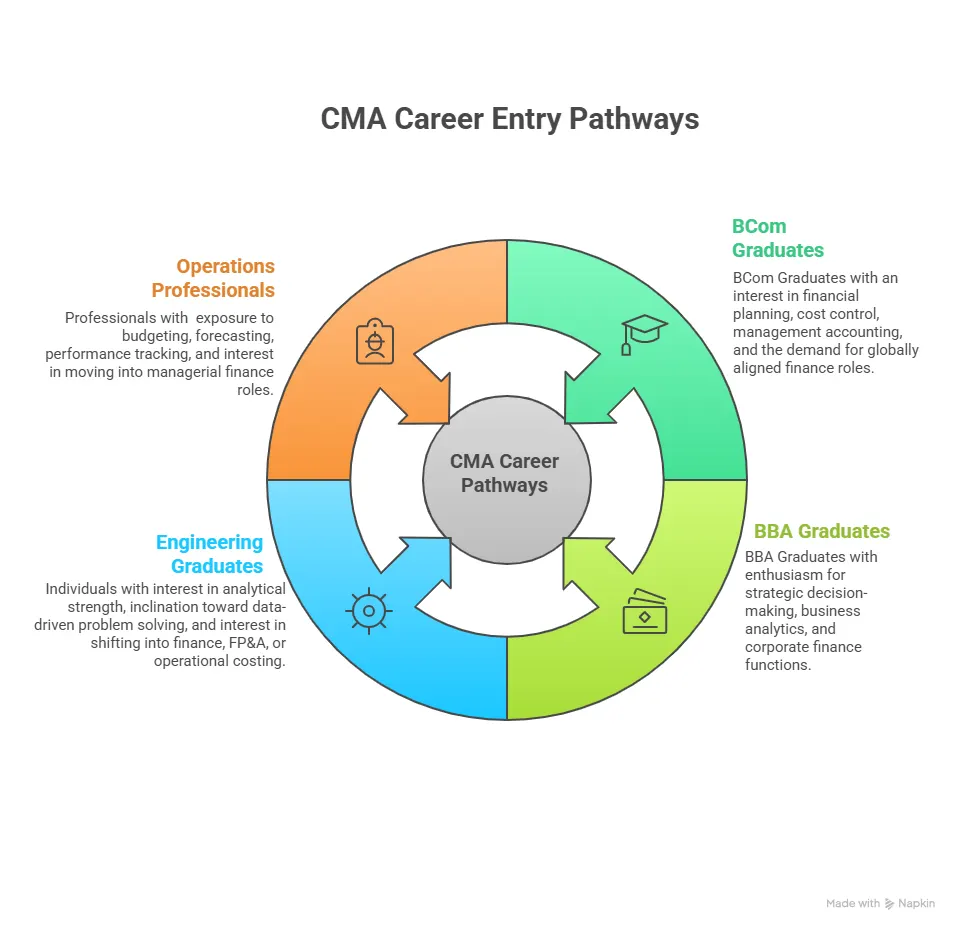
If you want to make a mark in the financial and accounting world, then being a Certified Management Accountant (CMA) is the way to go. To be a CMA, you are required to register with the Institute of Management Accountants (IMA) and enrol in the CMAprogramme. Also, it must be noted that CMA certification provides unique professional benefits that regular bachelor’s degrees don’t. Read ahead to know about the reasons why you should get your CMA USA certificate now!
Enhance Financial Skills and Knowledge
With a thorough and diligent knowledge of management accounting processes, CMAs perform more specialised tasks than included in a general accountant’s job description. They are responsible for performing budget analysis and planning, making key investment decisions and risk management.
Career Advancement
If you enjoy managing and mentoring others, then CMA certification can be a fast track to manager-level roles. Demonstrating your knowledge of financial planning and management processes, it helps a professional stand out amongst other accountants for new roles.
Get Credibility
Having CMA certification not only speaks volumes about your skills but also solidifies your status of being a versatile accountant. Certainly, earning a CMA distinguishes you from others in the field, adding increased credibility to your other qualifications.
Global Recognition
Holding acclaim around the world, CMA certification is amongst the few accounting credentials that are recognized across international borders owing to its global relevance. Professionals with this universal accreditation are highly respected in the accounting and finance world. If this interests you, then you can enrol in a reputable CMA certification course to begin your journey.
Better Understanding of a Business
Whether it is a regional business or a multinational company, this certification will help you contribute to larger business objectives. By analysing external trends and figures, CMAs prepare data in a digestible way for executive boards and other important company personnel. Also, they have a deeper understanding of a company’s financial workings.
Higher Earnings
It is observed that CMA-certified professionals earn around 60% more than their non-certified counterparts across the world. With an average of Rs 6 lakh offered per annum in India, a Certified Management Accountant earns somewhere between Rs 1.4 lakh and Rs 20 lakh annually.
International Appeal
Pursuing a college degree can land you a good job in the finance or accounting sector, but if you want to bag opportunities in another country, then having CMA certification, which is recognised worldwide, is necessary. This is because CMAs are known to have the same level of expertise, irrespective of the country they are working in. And, this makes CMAs preferable for employers.
Industry Opportunities
As financial and accounting functions are available everywhere, CMAs can add value to any industry. From alternative energy, technology and artificial intelligence domains to healthcare and transport sectors, CMAs enjoy endless career development opportunities in varied fields globally.
Plethora of Positions
CMA-certified professionals can successfully work as financial analysts, operations managers and vice presidents. Also, they can offer services in different business functions such as management finance, sustainability, and technology. Besides bringing opportunities to build a career, this flexibility also enhances professional satisfaction.
Great Future Scope
As business organizations or industries are extending to a brighter world, the job outlook for CMAs is growing. According to IMA, new CMAs grew 17% globally since 2019.
Conclusion
Earning a CMA certification provides a boost to professionals at all stages of their careers. CMA-certified professionals not only have unique and substantial skills and knowledge, but also enjoy access to different career paths. If you want to be a CMA, then connect with Imarticus Learning to pursue a well-reputed CMA certification course in India.
Cost management is the backbone of sustainable business growth. In today’s fiercely competitive market, organisations must meticulously optimise their spending to safeguard profitability and fuel expansion.
By combining data-driven insights, technological advancements, and strategic thinking, businesses can achieve significant cost savings, enhance operational efficiency and ensure a sustainable competitive advantage.
Planning and implementing cost management strategies are crucial components of a management accountant’s job. In this article, we will explore ten innovative cost management strategies that transcend traditional approaches.
1: Data-Driven Cost Intelligence
Data-driven cost intelligence transcends traditional spreadsheet-based methods by harnessing advanced analytics and artificial intelligence. This sophisticated approach enables the discovery of concealed cost patterns and pinpoints opportunities for optimisation.
Through the meticulous examination of historical data and prevailing market conditions, predictive cost modelling generates forecasts of future expenses. Armed with these insights, organisations can proactively implement strategic measures. To facilitate swift responses to escalating costs, real-time cost visibility dashboards offer continuous monitoring of expenditure. Data-driven cost intelligence is essential for most modern cost management strategies.
2: Employee Engagement for Cost Savings
Employee engagement is a powerful catalyst for cost reduction. By illuminating the company’s financial objectives and the direct influence of individual actions, employees become empowered cost stewards. A robust reward system incentivises the generation of cost-saving ideas, fostering a collaborative environment where innovation thrives.
Cultivating a culture of frugality is essential. By instilling a mindset of resourcefulness and waste minimisation, employees become active participants in optimising operational efficiency and reducing expenditure.
3: Supply Chain Optimisation with Blockchain
Blockchain technology offers a transformative approach to supply chain management. By creating an immutable and transparent record of all supply chain transactions, blockchain eliminates hidden costs and enhances visibility.
Smart contracts, self-executing digital agreements, automate contract terms and payments, reducing manual errors and accelerating processes. Moreover, blockchain’s ability to analyse vast amounts of data enables the early detection of potential supply chain disruptions, allowing for proactive risk mitigation strategies.
4: Digital Transformation for Cost Efficiency
Digital transformation is a powerful tool for driving cost efficiency. By automating routine tasks through Robotic Process Automation (RPA) and Artificial Intelligence (AI), organisations can significantly reduce labour costs. Cloud migration offers a flexible and cost-effective IT infrastructure solution, often resulting in substantial savings compared to traditional on-premises systems.
Data-driven decision-making is essential for optimising resource allocation and avoiding costly mistakes. By leveraging advanced analytics, businesses can gain valuable insights into operations, identify inefficiencies, and make informed choices to enhance profitability.
5: Strategic Outsourcing and Partnerships
By concentrating on core competencies, organisations can optimise resource allocation and enhance operational efficiency. Outsourcing non-core functions effectively reduces overhead costs. Strategic partnerships foster collaboration, enabling shared investment in resources and risk mitigation.
To ensure optimal outcomes from outsourcing arrangements, implementing a robust vendor performance management system, complete with key performance indicators (KPIs), is crucial. This systematic approach guarantees that external partners align with organisational goals and deliver expected results.
6: Dynamic Pricing and Revenue Management
Dynamic pricing involves adjusting product or service prices in real-time based on factors like demand, competition, and customer behaviour. Data analytics play a crucial role in optimising pricing strategies. Personalised pricing tailors offers to individual customers based on their preferences and purchasing history. Revenue forecasting utilises historical data and market trends to predict future income, enabling effective resource allocation.
If you wish to become a management accountant, you can enrol in a solid CMA program such as the CMA USA course by Imarticus.
7: Sustainable Operations and Cost Reduction
Sustainable operations focus on minimising environmental impact while reducing costs. Energy efficiency initiatives, such as implementing energy-saving technologies and optimising processes, contribute to lower utility bills.
Waste reduction programs, encompassing recycling and process improvements, conserve resources and reduce disposal costs. Collaborating with eco-friendly suppliers strengthens the supply chain’s sustainability and can lead to cost savings through reduced environmental impact.
8: Cash Flow Management and Optimisation
Effective cash flow management is vital for business sustainability and is an essential component of most business cost control techniques. Accelerating receivables through strategies like efficient invoicing and proactive collections improves cash inflow. Negotiating favourable payment terms with suppliers extends the payment cycle, optimising cash outflow. Minimising overdraft and interest fees requires careful management of bank accounts and credit lines.
9: Risk Management and Insurance Optimisation
Proactive risk management safeguards business continuity. Comprehensive risk assessments identify potential threats and enable the development of mitigation strategies. Regularly reviewing insurance coverage ensures adequate protection while optimising costs. Transferring certain financial risks through hedging or insurance can provide financial security.
10: Continuous Monitoring and Improvement
Sustained cost management strategies require ongoing evaluation. Regular cost analysis uncovers trends and identifies cost-saving opportunities. Benchmarking against industry standards reveals areas for improvement. Agile expense management strategies adapt to changing market conditions and ensure financial resilience.
Wrapping Up
By strategically implementing these cost management strategies, businesses can unlock substantial savings, elevate profitability, and outmanoeuvre competitors. Using holistic cost reduction strategies by blending data-driven insights, technological advancements, employee empowerment and strategic alliances is pivotal for enduring success.
By harnessing the power of data analytics and AI, organisations can uncover hidden cost inefficiencies, optimise resource allocation, and make data-informed decisions. Simultaneously, cultivating a cost-conscious culture among employees fosters a collective commitment to efficiency and innovation.
Strategic partnerships and outsourcing can streamline operations, reduce overhead, and access specialised expertise. Ultimately, a well-executed cost management strategy empowers businesses to thrive in a competitive landscape by maximising operational efficiency, enhancing financial performance, and driving sustainable growth. If you wish to become a US CMA, you can enrol in Imarticus Learning’s US CMA course.
Frequently Asked Questions
How can I determine which cost management strategies are best for my business?
Conduct a thorough assessment of your business operations, identify key cost drivers, and analyse industry benchmarks. This will help pinpoint areas for improvement and select the most suitable cost management strategies.
What role does technology play in effective cost management strategies?
Technology is a cornerstone of modern cost management strategies. Tools such as AI, machine learning, and automation can streamline processes, enhance data analysis, and enable predictive modelling for optimised cost control.
How can I engage employees in cost-saving initiatives?
Foster a culture of cost awareness by communicating the company’s financial goals clearly. Implement reward systems for cost reduction strategies, provide training on cost management, and empower employees to make informed decisions.
What is the importance of continuous monitoring in cost management?
Continuous monitoring is essential for identifying cost trends, measuring performance, and making timely adjustments. By tracking key metrics and benchmarking against industry standards, businesses can stay ahead of cost challenges and ensure long-term success.
If you’re looking into the CMA course fees, you’re probably wondering how much this prestigious finance qualification will set you back and, more importantly, whether it’s worth it. The Certified Management Accountant (CMA) course is one of the best investments you can make if you see yourself leading financial strategy, managing costs, or taking on senior leadership roles in finance.
When you first look at the CMA course fees, it might feel like a big number – and that’s completely normal. But what you may not realise yet is how that investment can multiply – not just in your salary, but in your confidence, career clarity, and global opportunities that follow. The truth? While the fees can feel like a significant upfront commitment, the career returns and global recognition often make it a game-changer.
This blog breaks down everything about CMA course fees in India for 2025, explores the return on investment, and unpacks career growth opportunities waiting at the end of the journey.
“The CMA deals with all the relevant areas of financial management and is a perfect complement to the strategic way we expect our professionals to perform.” – Stephen Cosgrove, CMA Vice President & Corporate Controller, Johnson & Johnson.
What is CMA?
Let’s start from the basics by understanding what is CMA. The CMA certification signals advanced abilities in financial accounting, enterprise finance, and strategic planning.
The Certified Management Accountant (CMA) is a globally recognised qualification that equips you with the skills to manage, analyse, and strategise business finances. It’s not just about crunching numbers – it’s about interpreting them to drive smarter decisions and stronger profits.
In India, the CMA course is offered by the Institute of Cost Accountants of India (ICMAI), and it’s considered one of the most powerful finance certifications for those aiming for leadership roles in corporate strategy, management accounting, and business finance.
The CMA trains you to be a strategist and a trusted advisor who plays a key role in shaping your company’s future profitability.
Why Choose the CMA Course in 2025?
Every year, thousands of commerce and finance students in India – and increasingly, working professionals, MBAs, and career-pivoters – choose CMA for one simple reason: it’s a ticket to modern, global, business-focused leadership.
Think of the CMA as your backstage pass to the world of strategic finance, opening doors not just in India, but across 170+ countries, from multinational corporations to fast-growing startups. It’s a qualification that speaks the universal language of business.
But the real magic isn’t just in the qualification. It’s in what the CMA trains you to do: think like a strategist, spot cost leaks before anyone else, guide corporate decisions, and become the go-to financial advisor in any organisation.
In a world where businesses don’t just need accountants but strategic thinkers who can drive growth, the CMA helps you stand out – not just for what you know, but for how you think, analyse, and lead. It’s more than a course; it’s a transformation that sets you apart in the global finance landscape.
CMA Course Structure in India: Your Career Blueprint
The CMA in India, awarded by the Institute of Cost Accountants of India (ICMAI), unfolds in three key phases:
CMA Foundation: Your entry point into the world of business laws, accounting, and business mathematics.
CMA Intermediate: A deep dive into cost accounting, indirect taxation, operations management, and more – split into two groups.
CMA Final: This is where you transform from an analyst into a strategist, mastering financial reporting, corporate laws, and even electives for specialisation.
It’s not just book learning. The course is structured to build real-life skills, prepping you for boardroom decision analysis and strategic financial leadership from day one.
CMA Course Fees in India 2025: Level-wise Cost Breakdown
Let’s address the number one question: What exactly are the CMA course fees? Here’s the data, direct from ICMAI:
Level
Registration Fee (INR)
Application Fee (INR)
Total (INR)
CMA Foundation
₹6,000
₹12,000
₹18,000
CMA Intermediate
₹22,000
₹2,400 (both groups)
₹24,400
CMA Final
₹25,000
Included
₹25,000
Total
₹67,400
These fees cover your core registration and exam applications. If you opt for coaching, study materials, or mock tests, factor in an additional ₹20,000–₹50,000 depending on your provider and how deep you want to go with your prep.
Real Example: The Actual Expenses
Take the case of Ankit, a CMA student from Delhi. Like many commerce graduates, he started his CMA journey with big dreams but a tight budget. His total outlay looked something like this – around ₹18,000 for Foundation, ₹24,400 for Intermediate, and ₹25,000 for Final, plus another ₹30,000 for coaching and test prep. It wasn’t an easy investment to make, but he viewed it as a step toward long-term growth.
Now, professionals with similar CMA credentials often start their careers at ₹7-8 LPA, especially when joining top consulting or finance firms – proof that the right investment in yourself really can pay off.
Torn between CMA (US) and an MBA? Before spending years and lakhs on an MBA, see why the CMA gives you faster ROI, global recognition, and leadership-ready skills – all in under a year. 🎥 Watch now to see how CMA (US) outpaces the MBA and how Imarticus Learning helps you get certified smarter and faster:
US CMA Course Fees: The Global Track
If your eyes are set globally, or you dream of working with MNCs, you may also be considering the US CMA from the Institute of Management Accountants (IMA).
Fee Type
Student (USD)
Professional (USD)
Equivalent INR (Approx)
IMA Membership (per annum)
$49
$295
₹4,000-₹24,000
CMA Exam Entrance Fee
$225
$300
₹18,000-₹24,000
CMA Exam Fee (per part, two parts)
$370 x 2
$495 x 2
₹60,000-₹82,000
Total (full program)
$1,014
$1,585
₹85,000-₹1.6 lakh
Note – INR conversion mentioned is approximate and based on current exchange rates.
US CMA course fees cost between ₹1.2-₹2 lakh, including learning resources, significantly higher than the Indian CMA course fees, but with a global employer pull, a higher pass rate (45-50% vs 16-20% in CMA India), and exam flexibility.
Becoming a CMA instantly connects you to IMA’s powerful global network of over 1,40,000 accounting and finance professionals – a community that opens doors to international opportunities and lifelong career growth.
Want to know how long the US CMA takes and what you’ll actually study? Take a look at our detailed guide on the US CMA Programme Duration, Fees & Syllabus – it breaks down everything you need to plan your journey confidently.
⚡Quick Summary: The CMA course fees in India range from ₹67,000 to ₹1.2 lakh (ICMAI) or ₹1.2-2 lakh for the US CMA, depending on registration timing, study materials, and coaching options.
Application Fees, Session Windows & Hidden Costs
Application windows: Indian CMA exams are conducted twice yearly – June and December.
US CMA windows are:
Jan-Feb,
May-June,
Sept-Oct.
Extra costs: Paying late? Add ₹500-₹2,500. Need to re-sit an exam? Budget another ₹3,000-₹10,000 per subject. Coaching and mock tests range widely.
Materials: Some materials, such as study texts and institute journals, are included; others, like advanced revision kits or test series, are extra but often critical.
CMA India vs US CMA Course Fees
Choosing between CMA India and US CMA often comes down to your career goals – whether you’re aiming for strong local recognition or a globally mobile finance credential. Here’s a quick side-by-side comparison to help you decide which path fits your ambitions best:
Feature
CMA (India)
CMA (US)
Exam Body
ICMAI
IMA
Levels
3
2
Total Fees
₹67,000-₹1.2 Lakh
₹1.2-₹2 Lakh
Average Salary
₹7-10 LPA
₹12-18 LPA
Still wondering which one’s right for you? Our detailed guide on the US CMA vs the India CMA breaks down the differences in depth – from syllabus and exam structure to global recognition and career outcomes – so you can make an informed choice before enrolling.
Smart Tips to Plan Your CMA Course Fees
You don’t have to pay the full course fees all at once or alone. Here’s how to stretch your money wisely:
Register early – save up to ₹10,000 with early-bird windows.
Go digital – ICMAI’s e-study materials are cheaper and updated faster.
Apply for student discounts or merit-based scholarships.
Use Imarticus’s zero-cost EMI plan to spread the cost easily.
Join peer groups for shared coaching and mock test resources.
Scholarships, Waivers, and Payment Flexibility
Yes, you can manage the costs!
Scholarships: ICMAI offers diversity, merit, and need-based scholarships for Indian CMA aspirants. US CMA candidates can apply for student discounts through IMA, reducing exam fees by 50% or more.
Instalment payments: Most leading coaching brands (including Imarticus) break fees into zero-cost or low-cost EMIs, so you can spread the financial bite over the year.
Employer support: Forward-thinking finance teams may partially/fully reimburse course or coaching fees if you sign a retention bond.
Not sure if you qualify yet? Check your eligibility before you spend a rupee on fees – this helpful breakdown explains exactly who can apply for CMA and will give you clarity on prerequisites, timelines and more.
“The CMA allows people to get a better job or a different job because it symbolises an element of proficiency, integrity, and competency in various areas important to the finance and business environment.” – Tony Caspio, Vice President, Strategic Programs & Global Equipment Supply Chain, Sealed Air Corporation.
What Do You Get for These Fees? ROI, Recognition & Career Value
The big question: “Is the investment really worth it?” Absolutely – and here’s why. When you invest in the CMA, you’re not just paying exam fees; you’re buying credibility, global recognition, and access to higher-paying opportunities across industries.
The CMA isn’t an expense – it’s an accelerator. It transforms how employers see you and how you see yourself – as a finance professional who can think strategically, lead confidently, and make data-driven business decisions that matter. In short, the CMA gives back far more than it costs – in salary growth, career stability, and international mobility.
CMA India salaries: On average, fresh CMAs earn ₹7-10 LPA, and experienced CMAs or those in urban hubs can reach ₹15-25 LPA or more, especially with consulting, MNCs, or leadership positions, and senior CMAs earn ₹20 LPA or more.
US CMA salaries: The IMA’s 2023 report shows US CMAs earn 24% more than their non-certified peers. The international acceptance often means salary offers of ₹12-18 LPA for candidates with strong communication and analytical skills.
Average salaries: Fresh Indian CMAs earn ₹7-10 LPA; seasoned professionals can command ₹15-25 LPA or more. US CMAs typically enjoy a salary bump of 58% over non-certified peers.
“While the highest CTC has been recorded at ₹19.7 LPA, the average package for CMA qualified students was around ₹10 LPA.” – ICMAI Placement Report, 2023
Career acceleration: Nearly 80% of CMAs move into management roles within two years of qualifying, according to industry stats.
Future-proof skills: The CMA is regularly updated with the recent inclusion of analytics & technology modules and gives you practical leadership, not just accounting theory.
Want to dive deeper into what CMAs actually earn in India? Take a look at this detailed salary guide about
A 2024 LinkedIn review showed CMAs (India/US) thriving in EY, KPMG, HUL, ITC, Amazon, and even startups – doing everything from corporate strategy and risk roles to financial control. The versatility of the CMA is its real USP. Some top employers include: EY, KPMG, Deloitte, HUL, ITC, Amazon, PwC, and high-growth startups.
Career Outcomes
80% job placement: Nearly four out of five Imarticus CMA graduates land interviews in global finance, FMCG, or consulting companies within six months.
Roles: Think Financial Analyst, Cost Manager, Risk Analyst, Corporate Treasurer, and even CFO. The Big Four, major banks, advisory firms, and Indian unicorns all aggressively hire CMAs.
Global mobility: US CMA, in particular, allows Indian professionals to shift to Singapore, the Middle East, Europe, or the US with minimal credential hurdles.
According to the IMA 2023 Salary Survey, professionals with a CMA earn approximately 21% higher median total compensation than those without the certification – a clear indication that the CMA pays off, literally.
How Imarticus Learning Helps You Ace the CMA
Let’s talk preparation, because passing CMA isn’t just about paying the fees – it’s nailing the exam, getting job-ready, and feeling confident every step of the way.
Imarticus US CMA in collaboration with KPMG Features:
250+ live faculty-led training hours by industry leaders and CMA-holders.
Full suite of CMA-approved study materials, including Surgent CMA resources, mock tests, and flashcards.
Structured doubt clearance with guaranteed mentor access.
Resume and interview prep bootcamps, with direct links to MNC recruiters.
Zero-cost EMI payment plans and a money-back guarantee if you don’t pass.
Placement bootcamps and ongoing skill workshops.
Confused between CMA (US) and CPA (US)? You’re not alone – both are powerful global credentials, but the right one depends on where you see your career going. This video breaks it all down for you: from job roles and salaries in Canada to which one fits better for Big 4 firms or corporate finance.
FAQs About CMA Course Fees
Got questions about CMA course fees before you take the plunge? You’re not alone – from payment flexibility to eligibility and employer support, these are some of the most common doubts future CMAs have. Whether you’re curious about upfront costs, scholarships, or how to make the CMA journey smoother and more affordable, here’s a quick, frequently asked questions guide to help you plan smart and invest confidently in your finance career.
How much does the CMA course cost in India?
The total CMA course fees in India usually range from ₹1.2-₹1.8 lakhs, depending on how you plan your journey. If you go the self-study route, the costs are lower, but enrolling with a premium institute like Imarticus Learning gives you expert guidance, mock tests, and real-world prep support that make every rupee worth it.
Do I need to pay all CMA course fees upfront?
Not always, you don’t have to pay all your CMA course fees upfront. Imarticus Learning offer flexible EMI and instalment options that make your journey easier on the wallet. This way, you can focus on mastering the syllabus, not stressing over the payment schedule.
Is the US CMA more expensive than the Indian CMA?
Yes, the US CMA course fees might cost a bit more – usually around 1.5 to 2 times higher – but the payoff is worth it. You gain global recognition, a streamlined exam structure, and access to higher-paying international roles. You’re not just paying more – you’re investing smarter in a globally respected career.
Does the CMA course fee include study materials?
When you register with IMA, you’ll get official digital study materials. But Imarticus Learning takes it a step further – offering upgraded content, mock exams, and one-on-one mentorship designed to help you actually master the concepts and pass with confidence.
Do you have to be a commerce graduate to do CMA?
Not at all! You don’t need to be a commerce graduate to pursue the CMA – engineers, science grads, arts students, and MBAs are all welcome as long as you’ve completed your 10+2 and graduation. In fact, many CMA rankers come from non-commerce backgrounds. With Imarticus Learning’s structured CMA training, even career switchers find it easy to build a strong finance foundation and excel in the exams.
What happens if I fail a subject?
If you fail a subject, don’t worry – you only need to pay the re-application fee for that specific paper, usually around ₹1,200-3,000, not the entire CMA course fees again. It’s designed to keep your progress on track without burning a hole in your pocket.
Is the CMA course fee refundable if I fail or reschedule?
No, the CMA exam fees are non-refundable – but here’s the good part: you only need to reapply for the specific part you missed. With Imarticus Learning’s guidance, most students clear the CMA on their first try and save on repeat costs.
How can I reduce my CMA course fees?
Start early, apply for IMA scholarships, and go digital to cut down on extra costs. You can also save more by joining Imarticus Learning’s bundled programs that include everything – classes, materials, mentorship, and support – at one smart price.
Is there any scholarship or financial aid for CMA students?
Yes! IMA offers scholarships that can reduce your CMA fees by up to 70%, and Imarticus Learning helps eligible students apply for them successfully. It’s a great way to make your CMA journey more affordable without compromising on quality learning or career outcomes.
Do employers sponsor CMA?
Yes, more and more employers are stepping up to sponsor the CMA today. Leading MNCs, finance firms, and even tech giants often reimburse part or even the entire course fee for professionals pursuing the US CMA. It’s their way of investing in skilled finance talent that brings real value to the business.
Is the CMA worth the money?
Absolutely. CMA-certified professionals earn around 21% more than non-CMAs (according to IMA’s 2023 survey), and that premium only grows with experience. The ROI is undeniable – your investment in the CMA pays off quickly through better roles, global exposure, and faster career growth.
Wrapping Up: Is the CMA Course Fee Worth the Investment?
Choosing CMA isn’t just about the fees – it’s about building a strong career, future-ready skills, and global recognition.
If you’re ready for:
Leading business decisions, not just executing them.
International job opportunities across sectors.
An average salary bump of over 58% compared to peers.
Flexible, professional training that fits real working lives.
Every rupee you invest in CMA with Imarticus Learning quickly pays off through global recognition and career growth. At Imarticus Learning India, our CMA course fees are structured to be affordable without compromising on quality. With expert guidance, easy EMI options, and placement support, we make pursuing CMA in India simple and globally recognised.
Don’t let fees hold you back – every rupee you invest in the CMA builds a foundation for a decade of growth. At Imarticus Learning, we’ve seen it first-hand: learners who once hesitated now lead finance teams across Big 4s and MNCs. Still have questions? Imarticus counsellors will walk you through every stage – eligibility, fees, career mapping, and more. Take action today and make “CMA” the three letters that drive your career forward.
When a company reports record profits or nails a major acquisition, the headlines usually celebrate the CEO or investors. Rarely does anyone mention the quiet professionals who shaped those financial strategies behind the scenes.
Those people are often CMAs. They’re the invisible architects of corporate decision-making. Professionals who don’t just record what happened, but help define what should happen next.
That’s exactly where the CMA Certification (Certified Management Accountant) steps in.
In 2025, the global demand for CMAs hit a new record, especially across India, the UAE, and Singapore, where multinational firms are scaling finance operations post-AI disruption. According to the IMA’s 2023 Global Salary Survey, CMA-certified professionals earned 58% higher salaries than their non-certified peers.
So, if you’ve been wondering things like:
Is the CMA certification really worth it in India? What are its actual benefits and downsides? Should I choose the US CMA or the Indian CMA?
You’re asking the right questions. And that’s exactly what we’ll unpack in this article – what the CMA Certification really is, how it compares with other qualifications like CA and CPA, how much it costs, the career paths it opens, and yes, whether it’s genuinely worth your time, money, and effort.
What Is the CMA Certification?
The CMA Certification is awarded by the Institute of Management Accountants (IMA), USA, a globally recognised body with over 150,000 members in 150+ countries.
Unlike CPA or CA, which focus heavily on accounting compliance, CMA focuses on strategic financial management, budgeting, analytics, cost management, and decision-making.
Here’s a Simple Example:
Imagine two professionals working in a company –
Rahul, a CA, prepares the company’s financial statements and ensures they meet all legal and tax requirements.
Sneha, a CMA, takes those statements and says, “Our operating costs are 12% higher this quarter because our logistics expenses spiked in the north zone. If we shift part of our distribution to a third-party partner, we could save ₹80 lakh annually.”
Rahul ensures compliance, while Sneha drives profitability.
That’s the essence of what is CMA and what they do; they don’t just crunch numbers, they shift one’s mindset from compliance to profitability and strategy that move a business forward.
Aspect
CMA USA
CA (India)
CPA (US)
Focus
Management & Strategy
Auditing & Taxation
Accounting & Regulation
Duration
6-12 months (flexible)
3-5 years
1.5-2 years
Exam Parts
2 parts
3 levels
4 parts
Global Recognition
🌎 High
🇮🇳 National
🌎 High
Ideal Career Path
Corporate Finance, FP&A, CFO roles
Accounting, Audit, Tax
Audit, Compliance
Watch this video that breaks down the real benefits of the CMA-US certification: what job roles it opens up and whether it’s the right career move for you.
A Brief Look at Tangible Returns: Career & Global Mobility
When you invest your time and effort into a certification, the real question isn’t just “what’s the salary?” – it’s “how far can this take me?” The CMA certification answers that in clear, measurable ways. On average, professionals with the US CMA credential earn 35–50% higher salaries than their non-certified peers in India, and up to $100,000+ globally, according to the IMA Global Salary Survey.
But beyond the paycheque, it’s the quality of roles that changes. CMAs move from routine accounting to decision-making positions in
FP&A
Corporate Finance
Business Strategy
Within five years, many transition from analyst roles to managerial or controller-level positions, a leap that usually takes others nearly twice as long.
But the real magic of the CMA lies in what it unlocks beyond borders. Think of it as a global passport for finance careers. While Indian CMAs largely work within domestic regulations, the US CMA gives you mobility – recognition in 100+ countries, and access to roles across MNCs, Big Four firms, and tech-driven startups worldwide.
Employers value CMAs because they think like business partners, as professionals who understand numbers and the narrative behind them. In short, CMA doesn’t just grow your income; it expands your map.
CMA in India: Is It Worth It?
If you’re in India, here’s the truth: the CMA US credential is gaining massive traction.
In 2025, companies like Accenture, Deloitte, and Amazon actively hired CMA-certified analysts for FP&A, cost control, and business partnering roles.
Why It Works in India:
Indian companies are now more global. They need people trained in US GAAP, IFRS, and analytics.
CMA brings international credibility, unlike CMA India, which has more local recognition.
With India’s CFO market expanding by 22% YoY, CMAs are preferred for strategy-aligned finance roles.
In this video, get an honest rundown of the challenge level of the CMA (US) exam, real-talk on how much effort it takes, and why it’s entirely achievable if you’re committed.
CMA Advantages and Disadvantages
Like any qualification, the CMA has its pros and cons. It’s not a golden ticket that guarantees success, but if your goals align with what the CMA certification benefits, it can really speed up your career growth.
There is more than one reason to get your CMA certification. The good part? It can open doors to global opportunities, better pay, and roles where you’re part of real business decisions, not just managing numbers. But it’s also demanding. You’ll need to put in serious study hours, stay consistent, and build a solid understanding of finance to get through the two exams.
Before jumping in, it’s worth taking a balanced look at what makes the CMA such a strong career move, and where it might not be the perfect fit for everyone.
Advantages of CMA Certification
✅ Global Recognition: Accepted in over 100 countries. ✅ Career Mobility: Move from accounting to management roles easily. ✅ Faster Completion: Can be done in under a year. ✅ Salary Uplift: Significant jump in compensation and leadership exposure. ✅ Future-Proof Skills: Aligns with data-driven finance and automation trends.
Disadvantages of CMA Certification
❌ Costly: Average total cost can reach ₹3 lakh with coaching. ❌ Challenging Exam: Global pass rate hovers around 45-50%. ❌ Less Relevance for Non-Finance Roles: If you’re shifting to marketing, tech, or HR, CMA adds little value.
The CMA Journey: Course Structure and Fees
The CMA Certification is built for professionals who want to move from accounting to strategic finance. It’s a two-part program that tests how well you can apply financial data to real-world business decisions.
What’s interesting is how compact yet globally rigorous it is: most candidates complete it within 12–18 months, while balancing full-time jobs. The standout factor is the return on learning: the CMA syllabus builds the bridge between accounting and management, a combination that directly translates into higher-value roles like FP&A, business finance, and strategy.
CMA Course Overview
The CMA exam is divided into two parts, testing both operational and strategic expertise.
Part
Topics Covered
Weightage
Part 1: Financial Planning, Performance, and Analytics
Cost management, budgeting, variance analysis, data analytics
The CMA certification course fees range from $1,000 to 2,000 in 2025. That’s around ₹85,000 to ₹1.6 lakh, depending on exchange rates. You’re paying for IMA membership, entrance fees, and the two exam registrations. They don’t take it all at once. You pay in stages as you register for different parts.
Component
Fee (USD)
Equivalent (INR)
IMA Membership (Annual)
$145
₹12,000
Entrance Fee
$280
₹23,000
Exam Registration (2 parts)
$830
₹69,000
Study Materials & Coaching
$1,000–$2,000
₹80,000–₹1.6 lakh
Total Estimated Cost
$2,000–$3,500
₹1.7–2.9 lakh
CMA Salary in India and Abroad: What’s the ROI?
You really start to see the benefits of a CMA certification once you enter the job market. In India, CMAs are partaking in key business discussions and shaping strategy. From multinational companies to consulting firms and startups, employers are looking for professionals who can read the story behind the numbers and turn it into action. This is reflected in the CMA salary in India.
The difference shows up in the pay, too. As per the IMA Global Salary Survey, CMAs in India earn around 58% more than those without the certification. Mid-level professionals usually make between ₹12–20 lakhs a year, while senior positions can cross ₹30 lakhs. The global picture is just as strong. CMAs in the US typically earn between $90,000 and $120,000, and in the UAE, salaries often fall in the AED 250,000–300,000 range.
Region
Average Annual Salary (2025)
Source
India
₹14-24 LPA
IMA Salary Survey 2025
USA
$90,000-$110,000
Glassdoor
Middle East
$60,000-$80,000
PwC Gulf Salary Guide
Singapore
SGD 120,000
Michael Page Salary Report
📈 A CMA in India typically earns 35–50% higher than a non-certified finance professional in the same role.
US CMA vs Indian CMA: Which One Should You Choose?
The US CMA prepares you for global roles where strategy, performance, and decision-making take centre stage. The Indian CMA, on the other hand, is rooted in cost control, compliance, and financial accuracy within Indian regulations.
Think of it like this. The US CMA helps you understand why a company performs the way it does, while the Indian CMA focuses on how to make that performance more efficient. Both paths lead to respected careers, but they cater to very different goals.
Here’s a simple breakdown to help you see the difference clearly:
Parameter
US CMA
CMA India
Governing Body
IMA (USA)
ICMAI (India)
Recognition
Global
National
Exam Parts
2
3
Focus
Management & Analytics
Cost Accounting
Duration
6-12 months
2-3 years
Ideal Career
MNCs, Corporate Strategy, FP&A
Indian PSUs, Cost Audit
🎯 If your career goal is to work in MNCs, startups, or abroad, choose the US CMA. If your interest lies in Indian public enterprises or domestic accounting, CMA India may fit better.
Is CMA Worth It After CPA, CA, or MBA?
If you already hold a CA, CPA, or MBA, CMA adds strategic and global depth.
After CA: CMA brings management orientation and analytics capability.
After MBA: Strengthens your financial decision-making credibility.
After CPA: Adds the strategic finance layer to an accounting background.
💬 As a mentor, I often tell my students that CA gives you the foundation, but CMA gives you the direction.
CMA Certification: Exam Pattern and Difficulty Level
Each exam part has 100 MCQs + 2 essay scenarios, testing your ability to think, not memorise.
Focus on decision analysis and ethics; most overlooked but high-weightage areas.
Real-World Career Examples: Where CMAs Work
CMA professionals are found in diverse sectors like tech, manufacturing, BFSI, and consulting.
Industry
Roles for CMAs
Top Employers
IT & Tech
FP&A Analyst, Business Controller
Amazon, Microsoft, TCS
Manufacturing
Cost Controller, Plant Finance Head
Larsen & Toubro, Siemens
Consulting
Financial Strategist, Risk Consultant
Deloitte, PwC, EY
Banking & FinTech
Treasury Analyst, Product Finance
HDFC, Razorpay, Paytm
CMA Salary Growth Over Time
The true value of the CMA Certification unfolds over time, not in the first payslip, but in the career trajectory it builds. Most CMAs don’t start at sky-high salaries; they grow into them. The certification acts like a career multiplier. The deeper you go into management decision-making, the steeper your salary curve becomes.
Experience Level
Average Salary (India)
0–2 years
₹8–12 LPA
3–5 years
₹14–20 LPA
6–10 years
₹25–35 LPA
10+ years
₹40 LPA+ (CFO/Controller roles)
👉 CMAs often move into senior finance roles within 4–5 years, compared to 7–8 years for non-certified peers.
Why Choose Imarticus Learning for the US CMA Course?
When you decide to pursue the US CMA certification, who you learn with matters just as much as what you learn. At Imarticus Learning, you’re not just signing up for exam preparation; you’re entering a full‐fledged launchpad built for global finance roles. Here’s what you will get from this course:
Industry-Aligned Curriculum: Imarticus has partnered with KPMG in India and uses globally recognised content (via Surgent) with an 83 % pass-rate backing.
Money-Back Guarantee: They stand behind their program. If you don’t clear both CMA exam parts under their terms, you’re eligible for a 50 % refund of the course fee.
Placement & Career Support: Beyond the exam, there’s a pre-placement boot camp, resume/interview prep, and assured interview opportunities with global firms, giving you hands-on career launch support.
High-Impact Modules: Real-world case studies (23 curated by KPMG), live expert sessions, tailored materials aligned with global roles, not just exam “drill”.
Global Recognition, Local Relevance: Imarticus is India’s first & only authorised prep provider for top finance credentials (US CMA, US CPA, ACCA, etc.).
Clear Career Outcomes: Salary ranges and job roles are laid out (e.g. ₹8 LPA–₹18 LPA for entry‐level CMA roles in India) so you have realistic expectations.
FAQs on CMA Certification
When it comes to the CMA Certification, it’s natural to have practical questions. How long does it take to complete? What are the costs involved? What kind of jobs and salaries can you expect? And how does it compare to other finance qualifications?
This section answers these questions clearly and directly. It’s designed to give you real insight into the certification, its benefits, and challenges, so you can decide if it aligns with your career goals without any confusion or guesswork.
What is a CMA Certification?
CMA is a Certified Management Accountant. It’s from the Institute of Management Accountants in the US. Covers financial planning, cost management, performance tracking, and business strategy. You’re not just doing bookkeeping, you’re helping companies make decisions using financial data.
For Indians in finance, a US CMA gets you into international jobs. Corporate finance, FP&A, strategy roles. Two exams total. Amazon, Deloitte, and Accenture hire CMAs because they connect finance to business outcomes.
Is CMA higher than CA?
Different things. CA is tax, audit, and compliance. Statutory stuff. CMA is management accounting, planning, and strategic decisions. Depends on what you’re after.
Globally, CMAs do strategy. CAs do technical accounting and tax. Some Indians do both. If you want CFO roles or international finance leadership, CMA has more management weight.
Which is higher, CPA or CMA?
Neither’s higher. CPA is external auditing, tax, and financial reporting. Compliance focus. CMA is internal – cost control, performance, and financial analysis. They work together in companies. CPA makes sure things are legal and accurate. CMA focuses on making money and strategy.
Corporate finance or FP&A? CMA’s better. Public accounting in the US? Need a CPA. Lots of CFOs have both.
What is CMA in salary?
India: ₹8–24 lakhs depending on experience and company. Senior CMAs in MNCs can hit ₹30+ lakhs. Globally, it averages $100k, often with 20% bonuses.
IMA data shows CMAs earn 58% more than people without it. Pretty good ROI.
Is CMA hard to pass?
Yeah, it’s hard. Two exams. Financial reporting, performance management, cost control, and strategy. Pass rate around 45–50%. Same ballpark as CPA or CFA. It tests how you think, not what you memorise.
With Imarticus Learning’s expert-led CMA prep, students get structured study plans, practice mocks, and guided mentoring, making the journey smoother and far more achievable within 6–9 months per part.
Is CMA a government job?
No. It’s a credential. But it helps you get finance jobs in the government or private sector. Some PSUs like BHEL, ONGC, Railways, hire CMAs for cost accounting, budgeting, and audit.
CMA India (ICMAI) is separate. US CMA mostly gets you private sector work in multinationals. Not a government job itself, but it opens doors in both sectors.
How many years to complete CMA?
12–18 months usually. Two exams, so it depends on how hard you work. Working people often finish in a year, doing 10–12 hours weekly. Exam windows are flexible, so you can work around your schedule.
IMA gives you three years max. Structured programs help people finish faster.
Who is eligible to do CMA?
Anyone with a bachelor’s degree (in any stream) can pursue the US CMA certification. You can even start the exams before graduating and complete the two years of relevant work experience later.
For Indian students, this flexibility is a big plus — especially with the CMA program in collaboration with KPMG in India offered by Imarticus Learning. The structured guidance helps you meet eligibility requirements, prepare effectively, and build real-world finance skills along the way.
Which degree is best for CMA?
No specific requirement, but commerce, accounting, finance, and economics help. B.Com, BBA Finance, MBA give you a base. Engineers do fine if they’re decent with numbers and willing to learn.
Experience matters more than the degree. BBA Finance plus CMA gets you into FP&A or business analysis. CA plus CMA is a CFO track.
How many exams are in CMA?
There are two parts.
Part 1: Financial Planning, Performance, Analytics Part 2: Strategic Financial Management
100 multiple choice plus two essays each. Take them in any order. Three windows yearly: Jan–Feb, May–Jun, Sep–Oct. Most finish both in a year.
A quick way to get a global credential without years of study.
Is CMA in demand?
Yes. India’s seen a 25% demand increase. Companies want data-driven decisions, so they need CMAs for FP&A, cost control, finance management, and CFO positions.
EY, KPMG, Deloitte, Genpact, and Amazon all hire US CMAs. They want people who link accounting to strategy. Financial planning keeps showing up as a critical skill. Demand’s growing.
Is CMA tougher than MBA?
Different. CMA is technical, finance, analytics, and strategy-heavy. For people good with numbers. MBA is broader. Marketing, HR, operations, plus finance.
Lots of people do both. MBA for leadership, CMA for finance depth. CMA is two exams versus two years, but more concentrated. CMA’s harder on finance specifics, MBA’s wider. Both together can get you to senior management or the CFO faster.
Bringing It All Together
Here’s the honest mentor take: CMA isn’t for everyone, but if you love strategic thinking, want to lead business decisions, and are ready to invest a few months of effort, it’s absolutely worth it.
It bridges the gap between accounting and strategy, data and decision, and India and the world.
💡 So, whether you’re a fresh graduate or mid-level finance professional, 2025 might be your best time to pursue the CMA certification.
When you study the companies that survive market shocks, expand into new regions, or maintain consistent profitability year after year, there’s a common thread: they know how to handle their costs. Not in the simplistic sense of “spend less” but in the disciplined way of aligning every financial decision with strategy. That discipline has a name – cost management strategies.
Not dry calculations. Not endless spreadsheets. It’s the art of connecting every rupee, dollar, or euro to a decision that matters. And when you’re preparing for the US CMA course, this isn’t a side chapter you gloss over. It’s one of the central lessons that will define how you think as a finance professional.
A core topic examined in this course is cost management approaches, which is the fundamental focus of managerial accounting. Cost management is not simply a tool for budgeting; rather, it provides professionals with an opportunity to assess performance levels, allocate resources effectively, and create sustainable value for the organisation.
In this article, we will delve into the significance of cost management in the CMA journey, explore its impact on career investment, and share success stories that highlight its effects.
What are Cost Management Strategies?
You’ve heard about the US CMA course. And now, you want to know what cost management strategies are in it? I will break it down for you with easy tidbits to understand.
Cost management strategies are the game plans businesses use to control and optimise their expenses. That budget plan you heard about, or the expenses sheet your colleague was worried about, or the resource allocation meeting everyone was scrambling about at work. Everything boils down to this.
However, the point is not always about cutting costs. Experienced cost managers make smarter decisions, improve efficiency, and boost profitability. As a cost manager, your role is to ensure that every rupee spent is going to add value to the organisation.
The following are some key cost management strategies:
Budgeting: A cost manager develops detailed budgets that guide expenditures and investments to the organisation.
Cost Reduction: They help in finding and removing unsolicited expenses to increase profitability.
Cost Control: You will hear them monitoring expenses to ensure costs stay within budgeted amounts.
Cost Optimisation: Cost Managers make continuous improvement of processes and resource allocation to achieve the best value for money.
Activity-Based Costing (ABC): They have toallocate costs to particular products or services based on the actual activities that require them. This goes to accurately identify high-cost areas.
Value Engineering: Another tenet of their role as cost managers is to analyse functions to achieve the optimal performance at the lowest cost.
Outsourcing: You will see a cost manager delegating non-core activities to external specialists to reduce costs. This is a sustainable approach financially for many organisations.
Technology Adoption: One of the holy grails for cost managers to follow would be incorporating advanced technologies to streamline operations and reduce costs.
Zero-Based Budgeting: You might think of it as justifying all expenses from scratch, rather than basing them on previous budgets.
Process Improvement: Cost Managers simplify workflows to eliminate inefficiencies and decrease costs.
Strategic Sourcing: A Cost Manager has to select suppliers based on cost, quality, and reliability to optimise procurement.
You can help your organisation by understanding and implementing these strategies to manage its costs effectively, ensuring financial health and supporting long-term growth.
What is the US CMA Course?
The US CMA certification is a worldwide recognised certification offered by the Institute of Management Accountants (IMA) that prepares experts in finance for superior knowledge in financial planning, analysis, control, decision-making, and professional ethics.
Unlike alternative certifications of finance-heavy theory, the US CMA course is founded first upon teaching practical application, and here it prepares professionals to execute applications in the workplace. The subject range is broad, including:
By integrating cost management into its core modules, the US CMA ensures that learners not only understand accounting numbers but also how to use them strategically to drive business growth.
Why Cost Management Strategies Matter in the US CMA Course
The phrase cost management strategies might sound straightforward, but in the context of CMA, it represents a powerful set of practices that help professionals optimise financial performance.
The reasons for its centrality are the following:
Strategic Decision-Making– You, as a CMA professional, are trained to look at costs in much detail, ensuring the identification of inefficiencies in the processes and providing recommendations that maximise profitability and assist in developing long-term competitive advantage.
Accurate Performance Evaluation– Through variance analysis and other tools, cost management helps businesses compare actual outcomes with planned budgets. This allows CMAs to spot deviations early and recommend timely corrective actions.
Planning and Budgeting– Cost management allows businesses to assess actual outcomes against the planned budget using variance analysis and additional tools. Without this, CMAs are unable to detect variances quickly and recommend appropriate actions in a timely manner.
Value Creation- CMA professionals, rather than being focused on cost-cutting, use cost management to make better allocation of resources so the business is creating value for stakeholders while still being cost-effective.
The Role of Cost Management in a Global Economy
When I look at the global economy today, it honestly feels like being on a bullet train. It’s fast, it’s unpredictable, and if you blink, you miss the next stop. What I’ve noticed is that the businesses that actually thrive aren’t the ones just chasing growth, but the ones that keep a tight handle on costs-whether that’s across different countries, through new tech, or even during a crisis. Cost management has really evolved into a strategy for survival and expansion, not just a “finance exercise.”
Manufacturing: Lean Costing as an Efficiency Engine
In manufacturing, every bit of waste is like a leak in the ship; it slowly sinks margins. That’s where lean costing comes in. It’s about cutting the fluff and doubling down on the activities that truly add value.
Lean Manufacturing: Toyota nailed this years ago. By building lean into its DNA, they turned efficiency into a culture. To this day, competitors are still trying to copy what Toyota does naturally.
Automation: I picture this as robots on assembly lines or machines doing precision tasks that humans just can’t match. Sure, the investment up front stings a bit, but the long-term payoff-lower labour costs, higher accuracy, and consistency-makes it a no-brainer.
Services: Process Costing for Smarter Pricing
Services are trickier because you’re not dealing with raw materials-you’re dealing with time, people, and processes. That’s why I love process costing. It gives you the clarity to see which services are actually profitable and which ones are draining you.
Healthcare: Hospitals do this all the time-allocating expenses to departments so they can price services more fairly and figure out what’s eating into budgets.
Financial Services: Banks use process costing to work out what it really costs to process loans or maintain accounts. That way, they’re not underpricing just to stay competitive.
It’s kind of like splitting a dinner bill with friends-you’re not covering someone else’s share if all you had was a salad. You only pay for what you actually ordered.
Technology: Cloud-Based Cost Tracking for Real-Time Control
Tech is moving at lightning speed, and the old-school budgeting approach just can’t keep up. That’s why I think cloud-based cost tracking is such a lifesaver- it gives you real-time visibility and lets you adjust spending on the fly instead of waiting for quarterly reports.
Cloud Computing: Take AWS, for example. It doesn’t just rent servers. It shows you exactly how much you’re spending down to the last gigabyte, so there are no nasty surprises in your IT bills.
AI Integration: And AI takes this a step further by spotting patterns, flagging inefficiencies, and even predicting where costs might spike. Gartner says early adopters of AI in cost management could slash IT expenses by up to 20% by 2026. That’s huge.
The Bigger Picture
When I connect the dots, the story is pretty simple: cost management has shifted from being about “cutting” to being about “growing smarter.” Whether you’re running a factory, a hospital, or a data centre, the playbook is the same- know where value is created, cut the noise, and make quicker, sharper decisions.
And this is exactly where the CMA course shines. It trains you to apply cost management strategies in real-world, global markets. That’s why CMAs are in such demand at multinational companies. They’re the people who can take all these principles-lean costing, process costing, cloud-based tracking-and actually make them work across industries and countries.
The CMA course ensures candidates are trained in applying these principles to global markets, making them invaluable assets to multinational corporations.
To provide a clearer understanding, here’s a table summarising the application of cost management strategies across different sectors:
Sector
Strategy Applied
Key Benefits
Manufacturing
Lean Costing
Waste reduction, improved margins
Services
Process Costing
Accurate pricing, profitability analysis
Technology
Cloud-Based Cost Tracking
Real-time insights, dynamic budgeting
Global
Adaptive Cost Strategies
Mitigation of tariff impacts, reshoring benefits
Best Practices in Cost Management Strategies
When I first came across cost management strategies, I also thought it would be all about trimming budgets and cutting corners. But it’s really not that. It’s about getting smart with money. Knowing what’s worth spending on and what’s just draining resources. Once I understood that, the whole thing made way more sense.
And the best part? It’s not just about looking back and saying, “Well, that went over budget.” It’s about staying ahead of the curve, so you can make better calls before the money’s already gone. A few practices really stuck with me:
Activity-Based Costing (ABC) – This one feels like detective work. You trace costs back to the activities causing them, and suddenly you see exactly where things are bloated or inefficient.
Variance Analysis – I used to think this sounded boring, but it’s actually pretty eye-opening. You line up what you planned versus what actually happened, and it tells you where things went off track (or where you did better than expected).
Budgeting and Forecasting – To me, this is like having a roadmap. It gives you direction, but it’s flexible enough that if something changes, you can adjust without losing sight of the bigger goal.
Cost-Benefit Analysis – Honestly, this is just the “is it worth it?” test. Simple, but so many businesses skip it and end up spending on stuff that doesn’t really deliver.
Risk Management in Costs – This is basically carrying an umbrella. Most days you won’t need it, but when it pours, you’ll be glad you had one.
What I like about these methods is that they don’t feel like number-crunching for the sake of it. They make you think differently about money. It’s not about penny-pinching – it’s about making every rupee or dollar actually matter.
And seeing how companies like Unilever and Nestlé are using the same strategies-not just to cut costs but to cut waste and meet sustainability goals-was a bit of a lightbulb moment for me. It’s proof that smart cost management isn’t just good for profits. It’s how you build a business that lasts.
These advantages in the US CMA for cost management strategies train you to anticipate challenges, question assumptions, and guide strategy with precision. In essence, mastering them turns cost management from a routine task into a framework for smarter, more informed leadership in any finance or accounting role.
Did you know global leaders like Unilever and Nestlé are tying cost management with sustainability?
This helps them reduce energy consumption and waste. And the best part? It not only cuts costs for them but also meets ESG targets, creating long-term business value.
Career Opportunities After The US CMA Course
The US CMA course is designed for finance professionals who want to use numbers to shape business decisions. That’s why CMAs often find themselves in roles where finance and strategy meet.
Here’s a way to picture it: a company is like a living body. Money flows through it the way blood flows through veins. Some flows keep the system alive; others quietly leak out. CMAs are trained to spot these leakages (in terms of money, obviously), understand where resources truly add value, and recommend actions that keep the whole system healthy.
This is exactly why CMAs step into roles that go far beyond traditional accounting. They bring skills in cost control, financial planning, and performance analysis that directly support decision-making at the leadership level.
As a CMA, you’re influencing business outcomes. You become the professional who can answer questions like: “Which projects will deliver maximum value for the investment?”, “Where can efficiency improvements free up resources for strategic initiatives?”, and “How do we structure financial decisions to manage risk without stifling innovation?”
By mastering cost management strategies, candidates open the door to roles that require both technical and strategic expertise.
Career Role
Focus Area
How Cost Management Strategies Apply
Corporate Strategist
High-level corporate strategy and decision-making
Uses cost insights to shape organisational priorities, optimise resource allocation, and guide long-term strategy.
Global Finance Professional
International finance and cross-border operations
Applies standardised cost management practices to compare financial performance globally and make informed investment decisions.
Tech-Driven Finance Expert
Leveraging emerging technologies for finance
Integrates AI, analytics, and blockchain to forecast costs, improve efficiency, and enhance data-driven decision-making.
Risk Management Specialist
Identifying and mitigating financial risks
Anticipates potential cost overruns, evaluates risk exposures, and implements proactive strategies to protect organisational financial health.
These roles ensure that CMAs remain at the cutting edge of financial leadership.
Imarticus is a Gold Learning Partner with IMA, and the CMA course here is designed in collaboration with KPMG in India. That means you’re not just learning “book theory.” You’re picking up practices and case studies that companies are already using around the world.
Learning That’s Hands-On
This is the part I like most. Instead of just memorising, you get to:
Work on 20+ case studies and simulations (reviewed by KPMG experts).
Compete for internships with KPMG India if you’re among the top performers.
Join live sessions and webinars that keep you updated on what’s actually happening in finance right now.
Career Support That Feels Personal
And then there’s the career side. Imarticus helps with placements in finance, consulting, and tech, but it doesn’t stop there. You also get mentorship from people who’ve been through the CMA journey themselves — people who can tell you what really works in the real world.
A Certification That Carries Weight
At the end, you don’t just walk away with a CMA qualification. You also get a joint certification from Imarticus and KPMG India. On a resume, that’s a strong signal that you’ve been trained with both academic rigour and industry insight.
Cost Management Strategies: Future Trends
The world of cost management is changing faster than ever, and the US CMA course reflects this shift by preparing professionals to think ahead, not just account for the past. Today, costs are influenced by technology, global operations, and social responsibility, meaning that the way organisations track and optimise expenses must evolve as well.
Global interconnectedness and shifting stakeholder expectations. Every decision, from supply chain choices to workforce deployment, carries a ripple effect that traditional methods fail to capture. Forward-thinking CMAs are being trained to anticipate these ripple effects, integrate multidimensional cost considerations, and align financial insights with broader business goals.
Here are some trends shaping its future relevance in CMA training:
AI-Powered Forecasting: Machine learning tools are redefining how budgets are planned and risks are assessed.
Sustainability Costing: Integrating environmental and social costs into financial decision-making.
Real-Time Analytics: Cloud-based tools providing instant access to cost data.
Global Standardisation: Harmonisation of international accounting standards for cost reporting.
By mastering these cost management strategies, CMA professionals are preparing themselves not just for today’s roles but also for the future of global finance.
FAQs on Cost Management Strategies
Got questions about how cost management strategies really work in the real world? Here are some of the most frequently asked questions answered in a simple, practical way to help you understand why they matter.
What are cost management strategies?
Cost management strategies are really about being smart with money, not stingy. They’re the methods companies use to plan, monitor, and adjust how funds are spent so that every rupee or dollar is working toward business goals. It’s like having a roadmap for expenses, knowing when to invest more and when to pull back.
Why are cost management strategies important?
Cost Management strategies matter because money disappears quickly without a plan. No company, no matter how big, has endless resources. I’ve seen how strong cost management strategies make sure money goes into things that actually push the business forward instead of just draining cash.
And it’s not just me saying this. A Deloitte survey found 88% expect to pursue cost improvement over the next 24 months, regardless of whether their revenues are increasing or decreasing. That tells me it’s become a survival skill, not just a finance function.
What is the work of cost management?
Cost management can be seen as being part watchdog and part strategist. It’s about keeping a close eye on where money flows, spotting waste before it snowballs, and redirecting resources to areas with the highest impact. It’s less about penny-pinching but more about shaping smarter business decisions. The Harvard Business Review nailed it when they said that effective cost management helps companies not just survive but actually grow stronger.
What is the salary of a cost manager in India?
The salary for cost managers in India is pretty attractive because the role directly impacts profits. If you’re starting out, you can expect something in the ₹5–7 LPA range, but with 5–10 years of experience, it jumps to ₹12–20 LPA.
At senior levels in big firms or MNCs, ₹25 LPA and beyond is not unusual. According to Glassdoor, the demand is strong, and honestly, that makes sense. Companies will always pay well for someone who protects their bottom line.
How to become a cost manager?
If I were starting from scratch, I’d begin with a degree in finance, accounting, or business. Then I’d add a professional edge with a certification like the US CMA, since it dives deep into cost management strategies for business decisions.
From there, I’d get hands-on experience in budgeting, planning, and cost analysis roles. The more you practice turning numbers into insights, the more valuable you become. Because analytical skills + problem-solving = your best friends on this journey.
What are the 4 stages of cost management?
I think of it as a loop:
Planning: laying down budgets and setting the rules of the game.
Estimation: using data (and a bit of forecasting instinct) to predict costs.
Control: keeping expenses in check and fixing things when they go off course.
Analysis & Reporting: looking back at what happened, finding patterns, and learning for the future.
It’s not a one-time checklist- it’s a cycle that keeps repeating. That’s why PMI calls it a best practice in project cost management strategies.
How do CMAs use cost management strategies?
If I were a CMA (or when I think like one), I’d use cost management strategies to help leaders make better calls. That could mean flagging a product that’s eating more cash than it brings in, or showing how to optimise operations without hurting quality.
IMA research actually highlights how CMAs are becoming key decision-makers because they mix financial expertise with strategy. That’s a powerful combo.
Are cost management strategies useful for all industries?
Oh, 100%. I’ve seen them work everywhere. Factories use them to cut production costs, hospitals to make better use of staff and equipment, IT companies for project budgets, and banks to keep operations lean.
Basically, if there’s money moving, cost management strategies can sharpen the edge. McKinsey even points out that businesses that adopt cost strategies often become more competitive overall, not just cheaper to run.
What role does technology play in cost management today?
Technology is a game-changer in cost management. With AI and analytics, I can see spending in real time, spot hidden leaks, and even forecast problems before they hit.
Automation also saves time on the boring stuff, which frees managers to focus on strategy. And this isn’t just hype-Gartner predicts that AI-driven cost optimisation could slash operating costs by up to 30% in the next few years. That’s massive, and it shows why tech is now at the heart of modern cost management strategies.
When I think about the US CMA course, what really stands out to me is how practical it is. Sure, it’s a finance certification, but at its core, it’s teaching you cost management strategies that you’ll actually use in real business situations.
And honestly, cost management isn’t just about cutting expenses-it’s about asking the right questions: Where is the money going? Which activities are really worth it? How can we stretch resources without compromising growth? That’s the kind of thinking the CMA pushes you into, and along the way, you pick up tools like activity-based costing, budgeting, forecasting, and even tech-driven ways to manage costs better.
The cool part is that these skills don’t lock you into one industry-you can take them anywhere. For me, it feels less like memorising formulas and more like developing a mindset: looking at numbers not as numbers, but as decisions, trade-offs, and opportunities.
So if I had to sum it up? Learning cost management strategies through the CMA isn’t about tweaking spreadsheets-it’s about learning how to think smarter with money. And that’s a skill every finance leader, in any industry, needs.
👉 If you’re looking to explore these strategies in more depth and understand how they’re applied in real-world scenarios, the US CMA course by Imarticus Learning offers a structured pathway to do so, with practical insights and guidance from industry experts.
CMAs don’t waste resources chasing every opportunity. They focus on the projects that truly matter. With the skills one gains as a CMA, one can evaluate options and choose the ones that deliver the most value and impact.
Every company comes across exciting opportunities, but picking the right ones really matters. They typically have to utilise their resources efficiently to choose the option that is best for them. That’s why choosing the right projects is crucial. This is where project selection methods for CMAs come in.
A CMA uses these methods to make smarter, more strategic decisions by carefully evaluating costs, benefits, and long-term goals. CMAs guide companies to invest in projects that truly drive growth and success. Pursuing the Certified Management Accountant (CMA) course, or as it is also known, the US CMA course, equips you with the skills to evaluate and choose projects effectively.
In this guide, we’ll break down the essential project selection methods for CMAs and explain how they can be used in real-world scenarios.
What is Project Selection?
Project selection is the process of assessing the projects with the right tools to ensure they align with your strategic goals and deliver the best performance. This assists you in selecting projects following a hierarchy of priorities.
Project selection happens at the start, when ideas are considered. Every method focuses on two main factors: benefits and practicality. Benefits and practicality are the two factors on which every selection technique is founded. A list of advantageous effects serves as the project’s advantages.
Taking up a project can be done for various reasons, such as economic benefit, social and cultural value, or even to fulfil commitments from prior agreements. The possibility that a project will succeed is what feasibility means in this context. All undertakings include risk, and some are incredibly complicated.
Any project’s feasibility can be established, but it requires time and thorough investigation.
This procedure will be part of the project initiation stage’s feasibility research. To master these decision-making techniques and financial models, CMA project selection training helps you gain both theoretical knowledge and practical application skills.
Check out everything you need to know about the CMA Exam.
Why should you learn Project Selection Methods?
Project Selection Methods can help you enhance financial projects and revenue generation. However, the use cases are not limited to project management, but come with a broader scope of application, right from running large-scale businesses efficiently to managing funds in a new startup.
Suppose you start a new venture on a digital platform with limited tools and infrastructure. These project selection skills will enhance your ability to set the brand from scratch.
When you have a strong understanding of project selection methods, it helps you to optimise costs by choosing the right vendor, the best delivery method, inventory management and everything that is necessary to make the business profitable.
Project selection methods give you the ability to run businesses efficiently, scale them to bigger heights, and empower your decision-making capabilities as a professional.
Who is a CMA?
Using their expertise in management accounting, Certified Management Accountants (CMAs) assist any business in making thoughtful decisions. They are analytically savvy strategic thinkers who use their abilities to increase the overall success of the business they work for. CMAs are employed by businesses, governmental agencies, and other industries.
Most CMAs work in management positions and may go by the titles of:
Financial Planner
Financial Analyst
Corporate Controller
Cost Accountant, or
Chief Financial Officer
As a CMA, one has to fulfil several responsibilities, such as:
CMA professionals aren’t just random cost or management accountants who crunch numbers. Their role is more dynamic and involves:
Strategic decision-making to grow the business.
Leaders who automate and analyse data for forecasting.
Give financial and ethical guidance to the board members.
A Certified Management Accountant uses cost-benefit analysis, discounted cash flow, net present value, and internal rate of return techniques for project selection. These techniques allow you to make informed financial decisions that drive business success. These techniques are part of any CMA preparation program designed to help you apply theory in real-world finance.
Every business has more ideas than it has resources. The tough part isn’t finding projects – it’s deciding which ones are actually worth the time, money, and people it’ll take to pull them off. And here’s the kicker:
According to the Project Management Institute, companies waste over 11% of their investment because they bet on the wrong projects. That’s like throwing away one in every ten rupees.
Michael Porter, the Harvard strategist, summed it up well: The essence of strategy is choosing what not to do.” In other words, success often comes down to saying “no” more than saying “yes.”
Think of project selection criteria like choosing which outfit to buy when you only have enough money for one. You wouldn’t just pick the trendiest one, but rather you’ll think about which one will last longer, which one you’ll wear the most, which one fits you well and what you really need.
Companies do the same with projects. They look at the criteria like cost, profit, risk, and how well a project matches their bigger goals. These criteria make sure the company’s money and time go into the project that gives the best value now and also helps it grow stronger in the future.
How Companies Decide Which Projects to Back
Project selection criteria help businesses choose projects that deliver the most value, balancing costs, optimising risks, and achieving long-term goals to ensure smart, strategic decisions.
What They Check
Plain-English Meaning
Why It Matters
Quick Example
Strategic Fit
Does this move us closer to our big goals?
Keeps the company focused, not distracted.
A renewable energy firm focusing on solar R&D.
Cost & Budget
Can we afford it without breaking the bank?
Avoids over-commitment and financial strain.
Sticking to CAPEX limits for a product upgrade.
Expected Returns
What’s in it for us — money, reach, or impact?
Make sure it delivers real value, not vanity.
Automating tasks to cut future costs.
Risk Level
What could go wrong?
Reduces the chances of expensive mistakes.
Not expanding into a politically unstable market.
Resources on Hand
Do we have the people, skills, and tools right now?
Prevents delays and overwork.
Hiring cybersecurity staff before launching e-banks.
Speed of Results
How soon will we see benefits?
Matters when competitors are moving fast.
Rolling out a digital wallet before Diwali season.
Future Growth Potential
Can this grow with us, or will it hold us back later?
Ensures today’s project doesn’t become tomorrow’s dead weight.
Choosing cloud over old-school servers.
💡 The real trick? It’s never about one single factor. The “cheapest” project might fail if it doesn’t align with the company’s vision. The “highest ROI” project might backfire if risks are ignored.
As Greg Horine, author of Project Management Absolute Beginner’s Guide, puts it: “The best project isn’t always the one with the biggest payoff — it’s the one that balances opportunity with fit and risk.”
So, when companies run through these criteria, they’re not just picking what looks good today. They’re betting on what will make them stronger tomorrow.
Top Project Selection Methods Every CMA Must Learn
As a CMA, you have several responsibilities, such as financial reporting, decision-making, etc. One of the crucial responsibilities is project selection. Listed here are the top project selection methods.
Cost-benefit Analysis
Imagine you’re buying a car. You could get a fancy model that costs ₹20 lakh but barely improves your daily commute, or a reliable car for ₹10 lakh that saves you fuel, maintenance, and time. Which one truly gives you value?
Cost-benefit analysis is a procedure where the project’s investment costs are lower than its benefits. As a result, the current worth of the inflow divided by the present value of the outflow is determined using this method. The highest ratio projects are chosen because they are expected to yield a greater return than the rest.
As a CMA, your job is to spot projects that give your company real value — not just look shiny on paper.
McKinsey found that organisations that systematically use BCA in project selection are 33% more likely to prioritise projects that deliver sustainable ROI. It’s not just number-crunching — it’s about making smarter, strategic bets.
Cost-benefit analysis is a way to weigh a project’s total costs against the benefits it’s expected to bring. It helps CMAs figure out if the investment is really worth it. Projects with a higher benefit-to-cost ratio are preferred.
Cost-Benefit Analysis Case
Let’s assume you can spend ₹50 lakh on a new machine.
It saves money and helps you make more things each year.
If the extra money it makes is bigger than the cost, it’s a good choice – much better than just fixing the old one.
Project
Cost
Expected Benefit
B: C Ratio
Recommendation
New automated machine
₹50L
₹70L/year
1.4
Go ahead
Manual upgrade
₹20L
₹15L/year
0.75
Skip
Tip for CMA: As a CMA, don’t just calculate the ratio. Think long-term: does the project align with strategic goals? Are there hidden costs? BCA is your first filter — not the only one.
Scoring Models
Let’s take an example of choosing which movie to watch on a Friday night. You rate each one for storyline, cast, duration, and reviews. The one with the highest total score wins. That’s essentially a scoring model for projects.
A scoring model lets you rank projects based on multiple criteria — strategic fit, cost, risk, potential benefit, etc. Each criterion is weighted by importance, and the total score tells you which project to pick first.
Scoring models are utilised when the project manager or project selection committee creates a list of project criteria and rates each according to relevance, importance, and priority. This presents a more impartial inspection of the undertaking.
When you’re done, you can rank the projects from best to worst; the project at the top will be the most beneficial and easiest to complete.
Scoring Models Case
Imagine a company has many app ideas.
They give points for things like “Will people want it?” and “How much will it cost?”
A CMA helps make sure the points are fair.
The app with the most points is the one the company should make first.
Project
Strategic Fit (30%)
Cost (20%)
ROI (30%)
Risk (20%)
Total Score
Mobile App
8
7
9
6
7.7
Website Upgrade
6
9
7
8
7.4
Tip for CMA: Even if the app is slightly more expensive, its higher strategic and ROI scores make it the better pick. Weigh the criteria thoughtfully. A project might look great financially, but could misalign with strategic goals. Scoring models help you see the full picture.
Payback Period
Think of buying a coffee machine at home. If it costs ₹5,000 and saves you ₹1,000 a month, you know it ‘pays for itself’ in 5 months. That’s the essence of the payback period for projects.
Payback period measures how quickly a project recovers its initial investment. Shorter payback periods are preferred when cash flow is tight or when fast returns are needed.
The payback period is the ratio of total cash to average cash per cycle. It is the amount of time required to recoup the project’s costs. A basic approach for choosing projects is the payback period. The payback period, as its name implies, considers the payback time frame for an investment. The amount of time needed for an investment’s return to cover its initial cost is called the payback period.
The project payback period (payback period = price of project / average yearly cash inflows) is a tool for estimating the ratio of total cash to average cash period.
Payback Period Case
Suppose a store wants to save money.
One idea is new lights costing ₹10 lakh that save ₹2 lakh each year.
Another idea is a new cash register for ₹8 lakh that saves ₹1 lakh a year.
The lights pay back faster, so they’re the smarter choice if you want quick savings.
Project
Cost
Annual Savings
Payback Period
Recommendation
New Lights
₹10L
₹2L
5 years
Go ahead
Cash Register
₹8L
₹1L
8 years
Skip
Tip for CMA: Use payback period for quick decision-making, but combine it with ROI or NPV for long-term strategic choices.
Net Present Value (NPV)
Would you rather get ₹1 lakh today or ₹1 lakh in 5 years? Clearly, today’s money is worth more. NPV accounts for this difference when evaluating projects.
NPV subtracts the present value of costs from the present value of future benefits. A positive NPV indicates a project will generate more value than it costs.
The project’s net present value is computed as part of this process for choosing the most appropriate project. The current value of the cash inflow minus the current value of the cash outflow is the NPV.
As you select a project, make sure the NPV is favourable. The projects with the highest NPV ought to be chosen.
Even while NPV considers the project’s potential value in years to come, it has several restrictions. First, it does not mention the project’s gains and losses. Second, there is no commonly employed formula for figuring out discounted prices. A US CMA course often uses real-world case studies to show how NPV helps companies make smarter investment decisions.
NPV Case Imagine a pharmaceutical company is choosing between two drug development projects.
One that costs ₹200 crore with a ₹250 crore earning potential, giving ₹50 crore extra.
The other costs ₹150 crore with projected earnings of ₹160, which is ₹10 crore extra.
Even though the second is cheaper, the first one creates much more value, so it’s the smarter choice.
Project
Cost
Expected Future Returns
NPV
Recommendation
Drug A
₹200 Cr
₹250 Cr
₹50 Cr
Go ahead
Drug B
₹150 Cr
₹160 Cr
₹10 Cr
Skip
Tip for CMA: NPV is powerful because it captures long-term value. Always double-check assumptions for discount rates and cash flow projections.
Discounted Cash Flow (DCF)
Money loses value over time — ₹1 today buys more than ₹1 five years from now. DCF adjusts future cash flows to today’s value to make fair comparisons.
DCF evaluates whether a project is worth it after accounting for inflation, risk, and the time value of money. High DCF means the project creates real value today.
This approach accounts for inflation or the likelihood that the same amount of money now won’t be valued the same amount in the future. Therefore, while determining the cost of investment and the return on investment of any potential project or project proposal throughout the project life cycle that you intend to carry out, you must consider the discounted cash flow.
DCF Case
Imagine you get ₹1 crore after 10 years.
It doesn’t feel like the same as ₹1 crore today because money loses value over time.
A CMA uses a method called DCF to figure out how much future money is really worth today, so you can see if a big project is really a good idea.
Project
Future Cash Flow
Discount Rate
Present Value
Decision
Factory Expansion
₹50 Cr in 5 yrs
10%
₹31 Cr
Approve
New Store Launch
₹40 Cr in 5 yrs
10%
₹25 Cr
Skip
Tip for CMA: Use DCF when long-term projects are involved. It’s especially useful for capital-intensive or multi-year investments.
Internal Rate Of Return
IRR is like the interest rate your money earns on a project. If it’s higher than your minimum required return, it’s a winner.
IRR tells you the annualised rate at which NPV equals zero. A higher IRR means better returns relative to the investment.
This method addresses the interest rate where the net present value is zero. (That is when the present value of the outflow is equal to the flow’s present value.) This can also be referred to as the annualised beneficial compounded rate of return or the discount rate that results in a zero net present value for all of your investment’s cash flows.
IRR is the rate that tells you when a project will start really paying off. It helps you spot which projects will give the best returns and set the company up for long-term success. CMAs use IRR to quickly compare investment options and prioritise those exceeding the company’s required rate of return.
This approach helps you pick the project that will give the company solid financial gains now, while also setting it up for long-term success.
IRR Case
Imagine you have two startups to invest in.
One could earn 25% extra each year, the other 18%.
If you want at least 20% extra, you’d pick the first one.
A CMA helps figure out which choice gives the best return.
Project
IRR
Required Rate
Decision
Startup A
25%
20%
Go ahead
Startup B
18%
20%
Skip
Tip for CMA: IRR is a quick comparison tool, but be careful with projects with uneven or non-standard cash flows.
Economic Model
EVA shows whether a project actually creates wealth above its cost of capital — not just profit on paper.
EVA, or Economic Value Added, is an indicator of performance that determines the return on capital while calculating the value an organisation creates. It can also be described as a net profit after subtracting taxes and capital expenses.
EVA = Net Profit – Cost of Capital.
Projects with higher EVA generate more real value, even if profits are lower. When a project manager is given several projects, the one with the highest Economic Value Added is chosen. The EVA is never expressed as a percentage but rather in numerical terms.
EVA Case
Suppose there are 2 Units.
Unit P has a net profit of ₹50 crore, but its capital cost is ₹45 crore. Its EVA is ₹5 crore.
Unit Q has a net profit of ₹40 crore, with a capital cost of only ₹25 crore. Its EVA is ₹15 crore.
A CMA using EVA would recognise that Unit Q, despite having a lower absolute profit, is generating a higher return above its cost of capital.
This helps allocate resources to truly value-creating segments.
Unit
Net Profit
Capital Cost
EVA
Decision
P
₹50 Cr
₹45 Cr
₹5 Cr
Skip
Q
₹40 Cr
₹25 Cr
₹15 Cr
Approve
Tip for CMA: EVA is ideal for strategic capital allocation. It highlights value creation beyond simple profit figures.
Compare Project Selection Methods
Let’s take a closer look at the different project selection methods and see how each one helps CMAs to choose the right projects with confidence.
Method
What is it?
Best Used
Key Benefit for CMAs
Cost-Benefit Analysis
For comparing the total project costs with its benefits.
For projects with clarity, quantifiable costs and benefits.
Helps to determine overall financial viability; helps prioritise high-return projects.
Scoring Models
It ranks projects based on weighted criteria like market demand and feasibility.
When multiple, complex projects need objective comparison.
Provides a balanced, multi-factor evaluation beyond just financials.
Payback Period
Time required to recoup initial investment.
For projects prioritising quick returns or with cash flow constraints.
Simple and quick assessment of short-term liquidity.
Net Present Value (NPV)
It’s the present value of cash inflows minus the present value of cash outflows.
For long-term projects where the time value of money is a crucial factor.
Quantifies the actual value added to the company in today’s terms.
Discounted Cash Flow (DCF)
Valuing future cash flows in today’s money.
For long-term investments, the valuation of companies/projects.
Accounts for inflation and the opportunity cost of money over time.
Internal Rate of Return (IRR)
Discount rate where NPV equals zero.
Comparing projects with different initial costs or cash flow patterns.
Shows the percentage return a project is expected to generate.
Economic Model (EVA)
Net profit after taxes and cost of capital.
For assessing the true economic value created by projects/units.
Highlights projects that generate returns above their cost of capital.
Remember, no single method works for every project. CMAs often use two or three together. For instance, you might check the payback period for short-term viability, then run an NPV analysis for long-term impact. Think of it as using both X-rays and MRIs before a surgery — one tool gives clarity, but together, they give confidence.
FAQs About Project Selection Methods
Here are some frequently asked questions to help you better understand project selection methods:
What is the purpose of using project selection methods?
The purpose of using project selection methods is to help businesses and professionals systematically evaluate potential projects to identify the most financially and strategically viable projects to align projects with organisational goals.
CMAs use it for optimising available resources efficiently, which minimises the project risks, maximises returns and revenue, and supports decision-making backed by data-driven reports. In short, these methods ensure that the projects undertaken deliver the highest value and best performance for the company.
Who uses project selection methods?
Professionals responsible for project decisions use project selection methods. Some professionals who use project selection methods are:
Certified Management Accountants (CMAs) – to make informed financial and strategic decisions.
Project managers and selection committees – to evaluate, rank, and choose projects objectively.
Business leaders and financial analysts – to allocate resources efficiently and maximise returns.
Which project selection method is best?
There isn’t any particular best project selection method. CMAs choose based on project type and goals, using Payback Period for short-term projects and NPV or DCF for long-term ones, often combining methods for smarter decisions.
Why should CMAs learn project selection methods?
Project selection methods basically help CMAs make smarter decisions backed by data. They show you how to keep costs in check, get the best returns, and choose projects that really support the company’s bigger goals.
What is an Economic Value Added (EVA) approach?
EVA basically tells you if a project or business is really making money after covering taxes and the cost of the money invested. It’s a way to see if the project is truly adding value to the company. Projects with higher EVA are preferred, as they create more value above their financing costs. It helps CMAs allocate resources to segments that truly generate value, even if absolute profits are lower.
Can project selection methods be applied beyond corporate finance?
Yes. Project Selection Methods can be used beyond corporates in startups, digital ventures, government projects, NGOs, and anywhere resource allocation and investment decisions are critical. The principles help optimise decisions for inventory, vendors, delivery methods, and overall business profitability.
How can I gain hands-on experience with these methods?
Enrol in a CMA course, such as Imarticus Learning’s program. Courses provide case studies, simulations, and practical exercises to apply project selection techniques in real-world scenarios.
The bottom line when discussing the financial advantages of any project is a higher return on investment (ROI), which is produced by effective project selection. The project selection process includes evaluating the advantages and viability of your project ideas. Understanding these project selection methods becomes much easier under guidance.
As a CMA, it is essential to understand the concepts of decision analysis and financial reporting properly.
Are you ready to build your CMA career?
Join Imarticus Learning’s Certified Management Accountant course today and gain hands-on training in project selection methods to get a head start in your career. This CMA preparation program has been created for anyone who wants to build a successful career as a Certified Management Accountant.