
What are Capital Markets? And how do they work?

The capital market plays an important role in the economy of any country. The investors and the businesses they invest in, both benefit from capital markets.

Investment banking also plays a very important role as it facilitates transactions between the supply and demand in the capital markets. Here are some answers you may seek to understand the capital markets better. 

What is Capital Market?

In the simplest of terms, capital markets are platforms that facilitate the transfer of capital or savings from investors who want to employ their investments to businesses that need the excess capital to finance various projects.

How is Capital Market related to Investment Banking?

Investment banking goes hand in hand with capital markets. Capital markets consist of a lot of technicalities like debt capital markets, leveraged finance and equity capital markets that only an investment banker can understand and deal with.

Investment bankers know the market of their products inside out; and if you’re interested in becoming one of them, then you can apply for any investment banking course after graduation.

How do Capital Markets work?

Capital markets allow the free exchange of wealth and are the basis of a free-market economy. They work by bringing buyers and sellers together so that they can trade in currencies, bonds, stocks and other financial assets. 

Who benefits from Capital Markets?

The capital market helps small businesses and entrepreneurs to grow into big companies. It also helps people to save and invest to secure their future. The capital market training allows individuals to make personal gains by leveraging the profit-generating potential of larger entities. 
Capital Market coursesWhat is the difference between a primary market and a secondary market?

The capital market is divided into two categories – primary market and secondary market. The primary market deals with new stocks and securities whereas the secondary market deals with existing securities which have been previously issued.

What Financial Instruments are used in Capital Markets?

The different financial instruments that can be used in capital markets include –

  • Stocks
  • Bonds
  • Forex (Foreign Exchange)
  • Commodities
  • Derivatives

How to make a career in Capital Markets?

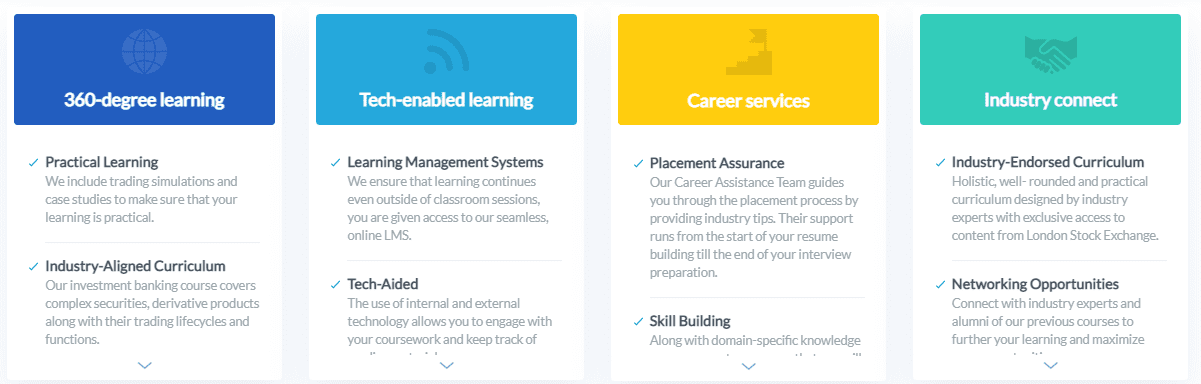
There are many investment banking courses online that one can pursue to make a successful investment banker and work right in the capital markets. To pursue one of the best investment banking courses after graduation, you can apply for the Post Graduate Program in New Age Banking and effectively start or boost your career prospects in the domain. You can check out this certificate in investment banking course details here.
Capital Market courseWhat is the difference between capital markets and financial markets?

Although they may seem the same and there are overlaps, capital markets and financial markets are fundamentally distinctive. Financial markets are broader in range and encompass various businesses and organizations exchanging contracts, securities and assets with each other.

On the contrary, capital markets are primarily used to raise and increase funding for projects and operations of a company. To understand this distinction better, you can check out the certificate in investment banking course details and enrol.

Conclusion

Capital markets help businesses, investors and the government, and they need investment bankers to guide them. Investment banking courses can be pursued online to understand the dynamic of capital markets and make a lucrative career in the domain.

Related Article:

https://imarticus.org/trade-life-cycle/

How to Get into Venture Capital?

Introduction

Finance has become the new popular area for interesting career fields and options. It has started getting all eyeballs from individuals all over the world. A career in Finance comes in with a lot of growth opportunities but most importantly these jobs have come into huge demand because there is a lot of money associated with these career options.

What is Venture Capital?

Venture Capital is not a new term in the field of Finance. It is a kind of Private Equity fund where the money is invested in businesses, usually in early start-ups and emerging businesses. These companies are perceived to have huge growth potential as these companies usually come up with solutions to the problems the world doesn’t have an answer for right now. In such cases, huge bits of companies are created based on the market value of the company (which is calculated by approximation and keeping the future performance elements in mind).

These chunks are then bought by the investors who believe in the vision and the growth trajectory of the company and are also affirmative that they will earn heavy returns on their investment. The whole deal about venture capital is that invests in a company who are really early at starting their operations and have started quite recently. Venture Capitalists are also known as angel investors at times as they invest in companies that are too young and do not have access to various financial markets where they can raise funds.

These investors tend to invest in companies that have a unique idea and show tendencies that they can manage the business and its subsidiaries quite well. Popularly, not only these investors invest money in such companies but also help these companies in their growth and scaling activities which shortens the gap between their investment and earning returns.

How to flourish into the Venture Capital sphere?

Getting into venture capital requires a series of steps. Venture Capital companies provide huge amounts of investments to emerging businesses to facilitate their growth and efficiently eliminate any bottlenecks in the way of scaling of the business. Venture capitalists make smart investments. Getting into Venture Capital is not everyone’s cup of tea. Some of these venture capitalists are multi-billionaires and millionaires.

To become a venture capitalist, the first prerequisite would be to have a surplus fund for investing in businesses. This is different from investing into shares or bonds of listed companies as there an individual is looking out for momentary gains, therefore the amount of investment is not huge and on the other hand, if an individual is a venture capitalist, he invests a substantial amount of money to help the company build a name in the market and also participates in the growth plan of the company.

A venture capitalist must be good at his communication as he is funding a concern. Also, they will have to work with top professionals which brings in the requirement of staying in touch with the current business surroundings.

You can become a venture capital if you have a prior entrepreneurship experience. With the help of this experience, it will be easy for you to come on terms with the other business you are planning to invest in. Also, for getting into venture capital, one must have a good know-how of investment banking and how the financial instruments work.

A capital market course would give you the necessary insights. Your venture capital career will be propelled once you know how to position the companies you are investing in and keep a tap on their journey. For being a venture capitalist, you will have to have an open mind. There is no single go-to strategy but you can better by investing more and learning from those experiences.

How Do I Become a Risk Management Consultant?

What is Risk management?

Risk management is the process of analyzing risks related to finances involved in a company. It also includes micro-managing other risks associated with any business concern which might impact the overall health of the company. The business environment is uncertain hence understanding how a business will do in the future is also uncertain. Therefore, efficient risk management also means efficient forecasting of the future results and the factors which might affect the company in multiple ways. With good management of risks, loss by the way of uncertainties can be minimized to a very large extent.
Risk management is quite challenging as the risks which have not been encountered by the company yet have to predict and strategies have to be formulated to come out of such a situation safe and sound. Therefore, these activities cannot be performed by regular individuals but by those who have an area-specific knowledge and are also well versed with the tools of predicting the unseen and managing the risks associated with it efficiently and effectively.

Who can become a risk manager?

A risk manager is someone who has in-depth knowledge of how to manage the unforeseen risks associated with any particular business. Various risk management courses are available in the market which will provide a quantitative as well as a qualitative approach of dealing with companies and helping them out in predicting the future and manage the multiple risks associated with it.
People who have the mind for analyzing the shortfalls and coming up with alternative solutions are the right people for this job. It requires both an analytical as well as a creative bent of mind to become a risk manager as it involves analyzing the problem and then coming up with various new and innovative techniques to tackle and come out of those problems.

How can someone become a risk management consultant?

Risk consultants have expertise in finance, business, analytics, mathematics and all other factors which are the primary indicators of the general health and functioning of any business entity. These professionals analyze and predict the occurrence of a mishap and come up with strategies to overcome them. Such risks include losses due to policy changes, death of a member from the higher management, loss of property, a slowdown of revenues, closure of any revenue channel, etc. Various consultants have different specialization in different sectors of the economy like healthcare, pharmaceuticals, industrial goods, commercial goods, etc.
The first step of becoming a Risk Management Consultant is to get a bachelor’s degree. Only a graduate can keep his foot forward if he has an interest in taking the path of a risk management consultant. Thereafter, the individual must go for an entry-level job which should be closely related to risk management. Usually, these individuals start as finance trainees, insurance trainees or something similar. This job will help you in understanding the basics of the corporate world hence prepping you up for your career in risk management.
With more and more exposure, trainees are made to analyze and do specific researches which in turn broadens their perspectives. The next step is to become an Associate Actuary. One can do this by gaining certification through CAS or SOA. This degree will grant a professional status to risk management consultants. To become eligible for this certification, one has to pass in a series of examinations and participate in various seminars. After the above certification, one can opt for fellowship certification. This requires you to work for another 2-3 years. Along with this, an individual will have to get himself registered with federal government agencies. After all this, the individual is all set for his career in risk management. He can operate independently or as a corporate risk management consultant.

Everything You Need to Know About Trade Validation and Enrichment in Trade Life Cycle

Everything You Need to Know About Trade Validation and Enrichment in The Trade Life Cycle

The development of technology results in the rapid development of the trading landscape.

There are no messengers anymore. Instead, we have letters. In place of the stock ticker, there is a television. 

Innovative technology accelerated the trade lifecycle process.

The workflow of a trade order from the time it is created is known as the trade life cycle. Front office, middle office, and back office activities make up the Trade Life cycle.

As a result, every element, from data storage and communication to online banking, has affected how the current market works.

A specific trade is executed in a market from the other side of the world in the wink of an eye.

Introduction to Trade Life Cycle

The Trade life cycle can be seen from different angles. The Trade Life Cycle can be seen as the interaction between the buyer and the seller. However, it can be divided into trading and operational activity.

Front Office: Frequently referred to as the trading floor, the front office primarily conducts the tasks of trade capture and trade execution.

Middle Office: The Middle Office in the Trade Life Cycle is crucial to the management of exceptions.

Back Office: The “backbone” of the entire commerce life cycle is, in a sense, the back office.

Trade Enrichment in Trade Life Cycle

Trade Enrichment refers to an enhancement of something valuable to improve efficiency. It adds specific trade data to the basic trade detail to allow Downstream processing.

Trade figuration

Calculating trade cash values is known as trade figuration. It entails figuring out the net value of a securities transaction.

Selection of relevant custodian details

STOs engage local agents to exchange securities and cash on their behalf to decrease the risk of being without securities and cash and to interchange securities and cash.

Issuing Settlement instructions (For example, by SWIFT or fax)

When a trade is settled, both parties involved in the transaction receive their respective payments. It is, therefore, a two-way process.

Reporting of trade

It entails informing stock market regulators of trades. Reporting of trade is required. It is carried out to improve market transparency.

Trade Validation in Trade Life Cycle

Soon after the completion of execution and enhancing trade, the next step is establishing certain measures. This is known as Trade Validation. In this Trade validation and enrichment in Capital Market, the process inspects if the received trade information in the back-office systems coincides with the front-office records.

It takes a lot of preparation and follow-up for a trade to actually happen.

To gain a greater grasp of trading, it is necessary to comprehend the full transaction lifecycle or the series of events and procedures that take place when a trade is made.

Know More about Special Trades

Special trades – includes validation of certain trades such as

  • That is deemed to be large
  • Trades in a specific market
  • Trades with a specific counterparty
  • Trades with prior value dates
  • Trades with prices outside a specified range
  • Trade setting on a Free of Payment (FOP) basis

Exception handling

Few trades may require editions or have to be cancelled. In such instances, they are sent back to the front office. If any trade is not resolved within the stipulated period, it may be escalated to a more skilled member of the middle office.

Conclusion

Once you have a firm grasp on the life cycle of a trade, you may use it to learn more about investment banking’s global markets section. You will gain knowledge of the various facets of the trade life cycle and the jobs accessible to those seeking to make a career in this field.


Ways Trade Execution Can Improve Your Capital Market Business!

What exactly is Trade?
Trade is the exchange of items between two or more parties backed up by purchasing power. In a layman’s language, buying and selling of products and services are known as Trade.

What are Capital Markets?
Capital market is the kind of financial market where securities such as long-term debt, equities, etc. are traded frequently. This is a volatile market as the value of these securities and the interests and dividend rates involved with them keep fluctuating.

The capital market is further broken down into two categories: Primary Market & Secondary Market. The primary market is the capital market where new securities are bought and sold and the Secondary market is the one where the already issued securities are exchanged by various investors and companies.

Trade Execution and the Capital Market 
Whenever there is an exchange, trade comes into the picture, even in case of financial instruments. Financial instruments are heavily traded all around the globe every second. And with such exchange of securities, the trade aspect has to be clearly defined and should not be eclipsed by the volume of transactions. The capital market runs on the game of exchange. Such exchanges are facilitated by smooth trade execution, Asset Management Allocation, and a well-versed post-graduate diploma in Banking and Finance.The trade life cycle has to be optimized and every step has to deliver some value to make the process smooth and glitch-free. Mentioned below are the stages of the Trade Life cycle and how their execution leads to improvement in the capital market business.

  • Order Initiation

The order is initiated when the stocks of various companies are made to float in the market. Such a process can be called as “Security Existence Awareness”. Then an individual buyer or a company shows its intention to buy particular security with the help of their registered stock brokers. The brokers perform the buying and selling function for their respective clients in exchange for a small fee. After the order is placed, the brokers process the transaction, delivers the security or collect the money and transfer the benefit to his client.

  • Order Processing and Managing Potential Risks

A capital market is a place with fluctuating value. And with fluctuation, risks dawn in. To process the order, the broker must have a clear picture of the funds residing in his client’s account and also of the securities the client is interested in. If both the scenarios fall in line, the broker generates the receipt and processes the orders. If any default on the part of the client, the broker will have to keep a window up for such loopholes and manage the associated risks carefully. Also, the broker has to recover the additional charges from their clients efficiently.

  • Order Matching and Trade conversion

On the verification of what is required by the client, the particular securities are sent to exchange for verification of various details and allotment of the respective securities. The brokers charge a brokerage for executing the security trade function effectively and efficiently. The receipt of the order confirmation is then sent to the client and the details of the client are recorded by the broker for the allotment of a unique customer ID.

An agency that is commonly known as the custodian then intervenes in the settlement of any security deal. The custodian receives the details of the order from the exchange. This includes details like the type, price of the security, etc. This is done to make the custodian aware of an upcoming securities exchange. It is the job of a custodian to validate the details of the transaction and then show a green flag to the broker. This complicated process can be made much easier by proper capital market training.

  • Trade Settlement and Clearance

The trade is then settled after 2 days of a valid transaction. This is commonly known as a T+2 settlement. The clearance provider then informs the restrictions of the particular transactions which is followed by the settlement of balances. The securities are then allocated to the client in his DMAT account and the share value is credited to the companies raising capital. After completion of such a transaction, it is recorded by the Exchange offices.

A Beginner’s Guide to Asset Management Allocation in Trade Life Cycle!

What is trade?
Trade is an exchange of items within or outside the country. Trade has two elements: Buying and Selling. The catalyst which makes this buying-selling process hassle-free is money. In earlier times, people used to exchange the goods they have for the commodities which were owned by other people but today, you cannot separate money from trade.

Trade, as we know, is a process. And as every financial process involves a lot of assets, trade also makes use of the same. People who are trained with a proper PG Diploma in Banking and Finance can do this asset allocation with a lot of ease.

Stages in the Trade Life Cycle
In a globalized economy, trade is a continuous process. Exchanges take place now and then. Mentioned below are the prominent steps involved in the trade life cycle. With capital market training, you can understand each step involved with much more ease.

  • Sales

The process of Sales starts when there is a demand for a good or service. It starts with the seller and ends with the buyer. By this process, a client is acquired and then is provided by multiple buying options
E.G.: Various investment avenues that are available with an Investment banker. Such investment tools are curated according to the needs of the investor and then presented to him in the form of Hedge funds or mutual funds to the client.

  • Trade Initiation and Execution

Once the investor or the buyer selects the product or service he likes and places the order with the seller, the process of trade begins. Trade begins when there is a monetary exchange and even if the buyer asks the seller to give various quotes for his product (As in the case of huge deals). As soon as the order is placed by the buyer and it gets accepted by the seller, the trade is said to be executed.

  • Trade Capture

The real challenge starts once the order has been placed. It percolates down to several channels that use various assets to get the job down. Assets such as a bank, commodity, etc. have to be allocation right and quick to deliver the trade experience smoothly.

This process can be made efficient by proper Asset Management courses. Trades are then recorded in the whole operating system and are also brought into the Risk management system which will help in reducing risks associated with a particular deal and maximize value.

  • Trade Validation and Enrichment

The trade is then validated by several teams and various sets of parameters. Various stable and dynamic parameters are considered and are validated before the actual trade takes place. Assets such as currency have to be allocated and depreciation sand appreciation parameters have to be brought into the picture.

  • Trade Confirmation

This step is one of the most important steps of the Trade Life cycle. Various confirmations are made by both the parties in terms of delivery and payment of the products or services involved in a trade settlement. All of this is done at least a day before the settlement takes place. This provides a window to both the parties to make necessary changes to the trade deal.

  • Trade Settlement

This is the step where the commodity or the service gets delivered to the buyer. The buyer gets the required in exchange for cash. Also, buyers get security in exchange for cash. If the case is of derivatives, a particular currency is also delivered in return for some other currency.

  • Reconciliation

This step involves the bookkeeping and recording of transactions to meet the necessary accounting details of both the buyer and the seller. This also involves vouching, matching ledger accounts, etc. With effective training in the Certificate course in Banking and Finance and various asset management courses, this process can be made much easier and convenient to implement.

Bank Innovation Through Collaboration, Its Better Together..!!

Bank Innovation Through Collaboration, Its Better Together..!!

Bankers have used a number of strategies to gain competitive advantage the chief weapons being localization and scale of operations. Do you know that in the US of the 7,000 odd banks only 1.5 percent of the players command control over 75 percent of the deposits and 81 percent of the loans? GDPR and PSD2 are all set to transform the banking industry by empowering the customer with multi-dimensional power over their personal data in 2018.

The future of banks and their success is to reply to the regulatory and technological disruptions through a strategy aimed at value-added relationships with fintech enterprises, e-commerce platforms, and companies like Amazon, Google, Facebook and more. This will ensure they still get multivariate data for their systems to carry out their functions while they offer their clientele a more holistic improved experience since the regulations will check the growth of banks. The capital market course shows that the well-run and capitalized new-age midsize and small banks are among the survivors in the race for survival and staying competitive.

Will the mere strategies of being local and scale of operation in cashing in on local markets be sufficient for banks to survive? Let’s explore why it’s different now.

The Commodity trap:

The same basic model of banking has survived for centuries now. Banking had become an essential service that had no real threat of substitution, till it was at disrupt just 5 to 10 years ago when tablets, smartphones, broadband connectivity and other concepts of AI, data analytics and ML slowly and surreptitiously crept into our lives. The banking disruption in banking is only just beginning and it appears to have fallen into a commodity trap.

The essential features of a commodity trap as defined in the book by Beating the Commodity Trap authored by Richard D’Aveni and applicable to the capital market course state that the concept applies where,

  • Business insights and process knowledge are distributed widely as in a bank with many branches.
  • The moving of products from the manufacturer to producers occurs with very low costs as in the banking services and charging of high fees for sub-par customer service.
  • The lifecycle of product s is short before a newer version replaces it.

The Collaborative Advantage:

The banking industry is burdened by regulations and compliance measures that focus on mitigating and avoiding risks. Established enterprises prefer to protect their territories of customers rather than collaborate and better the customer’s journey. And the time has come for the risk-averse banking sector to open its doors to collaborations with vendors, customers, and even other banks to stay afloat and make a bid to increase their customer bases. Managing the past results and protecting their revenues will lead nowhere if the focus on future outcomes is overlooked.

The regulators have a point in reinforcing compliance and this is especially good in the areas of credit underwriting and capital management. But, risks will have to be taken in small doses of improving customer experiences, innovating with new products customized on needs of clients, and bringing in new on par services like the leading ASIPs and PSIPs to counter the falling into the commodity trap.

It’s Better Together

Innovation in the banking sector should move towards more collaboration, beyond a single business line, and should include a more brainstorming capital market course for new ideas inside the bank. Events from the likes of Finovate, Bank Innovation, Innotribe, and NextBank prove the smaller firms globally have no legacy systems or models to protect and are hence more innovatively involved in newer products and services. The National Science Foundation’s Business Research and Development Survey show that large firms (with more than 25,000 employees) spent less than 40 percent in R and D which is down by 30 percent for the period 2001-2008.

The Bank Innovators Council is akin to the “FinTech” incubators and even when they do not have the same forums its good to go with an old African proverb that states when you want to go quickly you walk alone and fast. But if you need to go far buttressing the point that innovation badly needs the banks to introduce idea connectors, network enablers and such measures on a war footing.

In conclusion:

While innovation may be frightful to risk-averse banks it has the potential to lead to effective collaborations, generate revenues and better customer service and interactions.  If you would like to learn all about the remedial measures being taken up by banks it is time to do a capital market course at Imarticus Learning where the future of emerging technologies is well-taught and packaged with career-ready skills.

Passenger Vehicles Sales Drop For 9 Months In A Row

 
Tata Motors was supposed to launch its Altroz premium hatchback brand in mid-August. But a flurry of critical happenings forced it to defer, considering that every car launch in India is a 4000-crore gamble. The decision might seem like Tata Motors’s prerogative, but what it also highlights is a hint at the current state of the passenger vehicle market of India. In more critical words, it is a tiny example of the causes and effects of the great Indian passenger vehicle slump of 2019.
The question then is: what is happening with the auto industry and why?
To answer that question in the simplest way possible, there arises a need to cover all the aspects of the event. Let’s have a quick look.
What is Happening with the Auto Industry?
Historical and current data by the Society of Indian Automobile Manufacturers (SIAM) show that in July 2019 sale of passenger vehicles across categories (two-wheelers and four-wheelers) dived by about 19% compared to the same period in 2018. This is a very steep fall.
The worst affected is the passenger vehicle segment which registered an annual drop of 31% compared to 2018 even as the industry saw government intervention through restrictions involving the Bharat state emission standards. Earlier in 2019, the BJP-led central government had mandated that only BS-VI-compliant vehicles will be allowed for sale in India from April 2020, hinting at a possible goodbye to the older BS-IV versions. This drop is the steepest since December 2000.
While experts have attributed the cause to multiple factors, what this slump has further resulted in is what is controversially described as ‘fear-mongering’ on the part of the industry players. Job cuts in lower-tier cities, deep discounts, and new model launches failing to attract the potential buyer, and sluggish stock market forms the circular loop of both causes and effects, which can only be simplified by taking a look at the possible cause of this slump. Or causes.
What Caused this Slump?
While the Goods and Services Tax (GST) introduced in 2017 helped improve overall passenger ownership numbers, it began to experience a sharp decline sometime in early 2018. What exactly caused it?
Increase in fuel prices (in major metropolitan cities like Mumbai), higher interest rates, and a major hike in vehicle insurance costs were the major factors, as reported by The Hindu. The flood situation in states like Kerala also had an adverse impact in the third quarter of the 2018-2019 fiscal.
It further reported the effects of the IF&LS crisis as it tied the slump in sales in rural areas to the decline in trust with non-banking finance companies (NBFCs). In rural India, NBFCs are trusted more than actual banks. This was further accentuated by the high inventory pile-up among dealers and manufacturers.
In December 2018, the industry set off the alarm, putting its final rays of hope on the Lok Sabha elections in early 2019. The old government regained its power and nothing changed.
What perhaps is the often-neglected cause but one which has the highest weight is the combination of the BS emission standards as well as the unanimous heralding of electric vehicles. Any wise person buying a car today wants to drive it for at least a few years. And what with fuel prices refusing to go down and government standing outside everyone’s door with the emissions placard, she wants to ensure that her future private commute is ensured as well as insured with low maintenance costs.
The new BS emissions mandate comes into effect on April 2020. So, naturally, the dilemma of buying a car before or after the due date has put off a lot of discerning buyers. More of them are holding off their purchases due to one reason or the other.
Lastly, what is interesting is also the rise in growth of pre-owned cars sales. Compared to the figures in 2018, the sales for used cars grew by 12% as reported by The New Indian Express on June 2019. If one looks at the features of cars launched in the last year and compares it with those that were launched five years ago, nothing much has changed.
With the young population making wise choices when it comes to finances, thanks to increased awareness of financial literacy in the nation, they no longer need a car, let alone a new car. Taxi-cab aggregators, despite their occasional newsworthy actions, are still going strong, thanks to the young India who does not yet believe in owning a car when all it does is take him from point A to point B. Which is what he wants.
What’s Going to Happen?
In August 2019, economist and former vice-chairman of the NITI Aayog thinktank Arvind Panagariya wrote a critical analysis of the auto industry slump. He criticized the industry for waiting on the government to bail them out as he also observed the decline as not cataclysmic.
What he suggested were the industry players to keep patience and use their former profits to club the gap in this ‘phase’ even as the nation moves on to a financial market that looks favorable to consumerism.
Although the slump has triggered losses in the form of large layoffs (about 10 lakh jobs at risk) by almost all companies, there is still hope that the performance will improve in the coming months. The industry has made a demand for a reduction in GST to 18% from the current rate of 28%, but there does not seem to be a clear resolution on that front even as the government ponders over it.
This could well be a phase for the industry, as noted by experts and some auto manufacturers alike, but when that ‘end’ will be cannot be guessed, especially during the high level of uncertainty in the Indian financial and consumers market.
Influential events like the recent revocation of Article 370 will take time to subdue, and only then can one even expect to see a change, as one analyst commented on the promise of anonymity. So, the best course of action is to just wait and watch.

What Are Some Technologies That Can Prove Beneficial For Retail Banking?

What Are Some Technologies That Can Prove Beneficial For Retail Banking?

Financial institutions annually spend huge amounts running into billions of dollars a year on upgrading technology and undertaking system integration work. This is not a fad but an essential for their survival. But, in comparison to the newer banks and the capital market courses the technology of the new age is not only nimble and lightweight but is also more adaptable and faster than the older banks’ legacy systems.

Some areas where technology definitely impacts the banking services can briefly be summarized as below.

A. Customer authentication: Imagine a dual-control process with multi-factor authentication taken care of in a bank. It is possible only when the technologies keep pace with the customer demands and is possible only with the application of the latest developments in big data analytics, AI and ML.

B. Data Security: Data is being generated by the fraction of a second and its sheer volumes are nowhere better known than in retail banking. Storage of data is another sector where banks need to tread carefully because of the increased KYC norms. Innovations in cybersecurity, cloud storage, and such areas are not only essential but mandatory for compliance or regulatory norms and to gain customer trust, loyalty and confidence. Such futuristic technologies suitable for retail banking can be learned in Capital Market Courses.

C. Legal and KYC requirements: With financial markets tightening the noose around fraudulent investors and borrowers the regulatory environment is much more stringent than ever before. The bank’s documentation, its process, and technology have all been under regular scrutiny in recent times. It would be impossible if not for Regtech innovators and technology stepping in to make it feasible.

D. Integration with legacy technology: Banks are big acquisition businesses and this means mergers of legacy technology of the two entities. When such legacy systems are to be transitioned to a newer uniform technological platform it involves huge costs. Technology can definitely help integrate the legacy systems at reduced costs and without changing the existing infrastructure.

The areas and developments that will see changes:

Citing a 2018 outlook report from SIFMA there are four trends that will definitely see benefits and change in retail banking. They are:

1. AI will aid and enhance the processes of decision-making and investments.

2. Automatic processing and AI will see a huge change.

3. Blockchains and capital market courses will lead to technological innovations to make retail banking and the capital markets more investor-friendly and efficient.

4. Data security and protection will increase in importance.

How do the banks benefit?

According to the experts, bankers, analysts, consultants, etc that spoke to The Financial Times, the top 5 areas that have the potential to be successfully transformed by blockchains are

Settlement and Clearing:

The bank network is a tangled network of securities, investments, and loans that need to be recorded, settled and cleared on a daily basis. And, this costs billions of dollars annually to run. Accenture says that this area of settlement and clearing could save investment banks up to USD 10bn if they use blockchain technology for efficient settlement and clearing operations.

Payments:

Payments systems from the central banks globally are moving to explore blockchain technology and shifting payments system processes to blockchains and issue digital tokens that can be used on the stock markets and cashed in at the central banks. Commercial banks also have pushed forward with their own projects instead.

Trade finance:

LCs, trade finance, bills of lading, etc are still paper-transactions sent through post or fax globally. According to the R3 MD, Charley Cooper, this is an obvious area where banks can benefit from blockchains.

Customer Identity Verification:

Lenders are in reality trusted custodians of investor’s money and regulators will hold the banking agents responsible for authentication of records and checking the customer’s identity. This area is a vital banking-risk that blockchain-processing can easily overcome. It is an era of start-ups in the KYC blockchain-enabled systems. Some of them are Blockstack, Cambridge Blockchain, Credits, and Tradle.

Syndicated loans:

It takes a long 19 days for US companies to raise syndicated funds from banks. Early repayments and foreclosures are still done on paper. To address the efficiency of this area Credit Suisse and 19 similar-minded financial institutions formed a work-consortium with the blockchain enablers to put the syndicated loans Synaps on a blockchain framework.

Conclusions:

Taking capital market courses at Imarticus Learning can help you learn and reskill on such futuristic technologies for retail banking. Hurry and enroll. For more detailed information regarding this and for further career counseling, you can also contact us through the Live Chat Support system or can even visit one of our training centers based in – Mumbai, Thane, Pune, Chennai, Banglore, Hyderabad, Delhi, Gurgaon, and Ahmedabad.

What Is The Function Of Retail Assets In Capital Markets?

By retail assets, one means the products that are sold. In terms of the capital market, these could be the products of the equity and debt capital markets. Hence one needs to understand the very basics of the capital market to understand its retail assets. Let us start.

Understanding the terminology:

Doing capital market courses can be very useful to get the big picture of the capital markets. The term capital market is the place where securities in the form of various instruments like a bond, stocks, etc can be exchanged by the capital needy borrower and the capital-rich investors.

They comprise the foreign exchange-FOREX market, the bond markets, and the stock markets. The major markets are London, New York, Hong Kong, and Singapore, NSE, NASDAQ, BSE, etc. which are normally found in nearly all financial centers.

The Capital Market courses classify the capital market as secondary or primary markets. The bonds and the stocks are the most popularly known instruments. The financial analyst in the capital markets is the bridge and seeks to make these transactions efficient in the capital market where the borrowers needing capital and the lenders with surplus capital can both exchange securities transparently.

Capital markets deal with capital suppliers including private investors, institutions offering instruments related to their savings and investments in life insurance companies, pension funds, non-financial companies, and charitable institutions and foundations which have surplus cash to invest.

The capital-needy users of the funds are motor-vehicle and home purchasers, governments using funds for building infrastructure projects, non-financial companies, and those seeking capital investment or operating expenses in firms/organizations. Thus capital markets sell both debt and equity securities. The capital markets operate on electronic platforms through online transactions.

Both capital markets and investment banking cover equity and the debt capital market. Capital markets use investor investments and savings serving as a channel between firms needing capital and suppliers who have capital. The capital lending entities include institutional and retail investors while those needing the capital are governments, businesses, and laymen.

Equities are actual ownership of the company stock certificates and the returns on it depend on whether the company makes a loss or profit. Debt securities such as bonds, debentures, etc are IOU’s that bear a fair interest rate higher than that offered by banks. When companies go public they sell IPOs to large institutions like banks, institutional investors like hedge funds, mutual funds, etc.

If the stock is sold to the investor it is called a primary market and the secondary market sells those shares and stocks that come up for trading or reselling existing security. The secondary market is overseen by the SEC. Ex: NASDAQ. This provides investors with a regulated ecosystem and reason to invest in the capital markets.

Different types of Retail Banks:

Retail banks can be of three types. They are:  

  • Commercial Banks
  • Investment Funds
  • Credit Unions

All these banks offer services related to retail banking and provide almost similar services. Their products include: 

  • Savings accounts
  • Checking accounts
  • Mortgages
  • Credit cards
  • Debit cards
  • Personal loans.

Why do a course?
Here are the top reasons for doing capital market courses.

1. Staying updated with technology changes:
Today’s business world needs a good understanding of the working of businesses and compliance with political and regulatory issues. It goes beyond the reading and understanding balance sheets, compliance issues or regulatory measures and reporting.

Data analytics, capital market courses, Deep-Learning systems, and predictive-forecasting are helping make investment decisions and strategies evolve with knowing the exact outcome of the impact of such decisions. All available data and allied technologies are now being used and the financial data is no longer disparate from business data.

2. Skill-set development:
The focus of Capital Market Courses at present on the skill development of personnel for banking and capital markets. The obvious outcomes they will look for are to include customer-facing processes, a deep understanding of business requirements, proficiency in predictive forecasting tools, change, and soft-skills management and understanding and creating financial models for the capital market decisions.

3. The good payouts:
FAs in the capital market according to Indeed make an average of USD 65-110k. They also receive great bonuses, perks, and incentives that total to almost being equal to their earnings. In essence, payouts and lucre are huge incentives in career-making decisions.

Conclusion:
Doing a course from a reputed Academy like Imarticus has several advantages besides certification which works as a true measure of your practical skills. On a concluding note, remember that at Imarticus Learning you can do capital market courses tailor-made for capital markets which cover the comprehensive syllabus with plenty of hands-on experience that is sure to give your career a huge head-start!

For more details in brief and for further career counseling, you can also search for – Imarticus Learning and can drop your query by filling up a simple form on the site or can contact us through the Live Chat Support system or can even visit one of our training centers based in – Mumbai, Thane, Pune, Chennai, Banglore, Hyderabad, Delhi, Gurgaon, and Ahmedabad.