
Facing the real challenge while an examination? Check this interesting format of SP Jain’s Fintech program.

Are you looking for a job in the Indian Fintech industry? Fintech exams for recruitment or certification can be tough and you need to have the required skills to crack it. There are many online certification courses on the internet but many of them do not provide an in-depth learning curriculum.


The SP Jain’s Fintech program provide by Imarticus Learning will provide you industry-oriented learning. It will help you in building a successful career in the fintech industry. Read on to know more about the interesting format of SP Jain’s fintech program.

Fintech Career

 Course Overview


The Professional Certification in Fintech is provided by Imarticus & SP Jain School of Global Management. Along with in-depth coverage of fintech aspects, this course will also provide you experimental learning. This course comes in two formats i.e. CORE Modules & PRO Modules.


The CORE Modules will cover various tools & technologies used in the fintech sector. The PRO Modules include the topics covered in CORE Modules plus extra learning. Let us see the detailed curriculum of both modules.


CORE Modules
Fintech Career


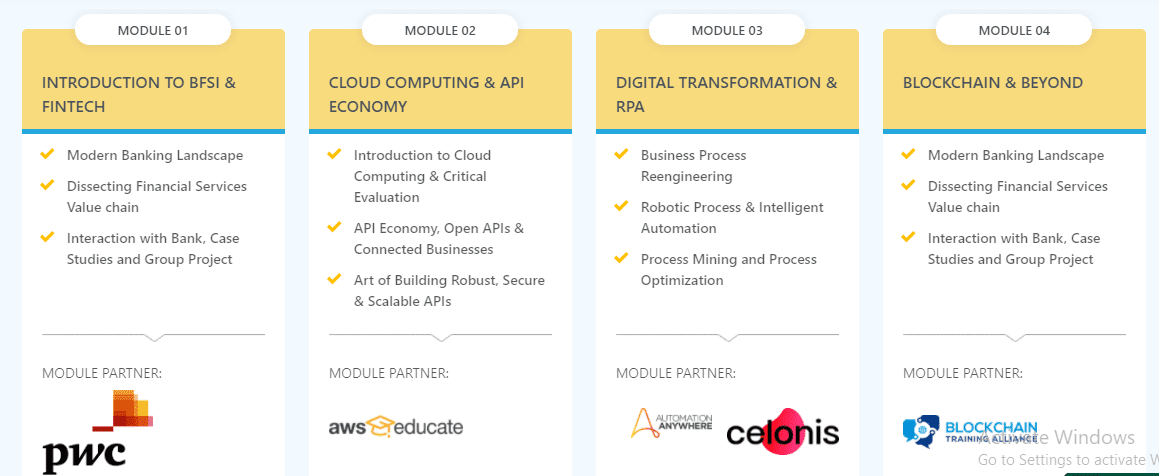
The topics covered in the CORE Modules are as follows:


• Introduction to BFSI & Fintech – You will go through various case studies to understand the modern banking landscape. You will also get to work on a group project under this module.


• Cloud Computing & API Economy – Recruiters in the fintech industry look for candidates who are experts in modern-day technologies like cloud computing, big data analysis, etc. You will learn about APIs, open APIs & connected businesses. You will learn about API management in the fintech industry.


• Data Transformation and RPA – RPA (Robotic Process Automation) is used to automate many processes in the fintech industry. This course will help you in learning about process mining & optimization. It will also cover various aspects of business process reengineering.


• Blockchain & Beyond – This topic in CORE Modules will cover the usage of blockchain in the current fintech industry. You will also learn about various tools & applications used to provide fintech services to consumers.


PRO Modules
Fintech Course


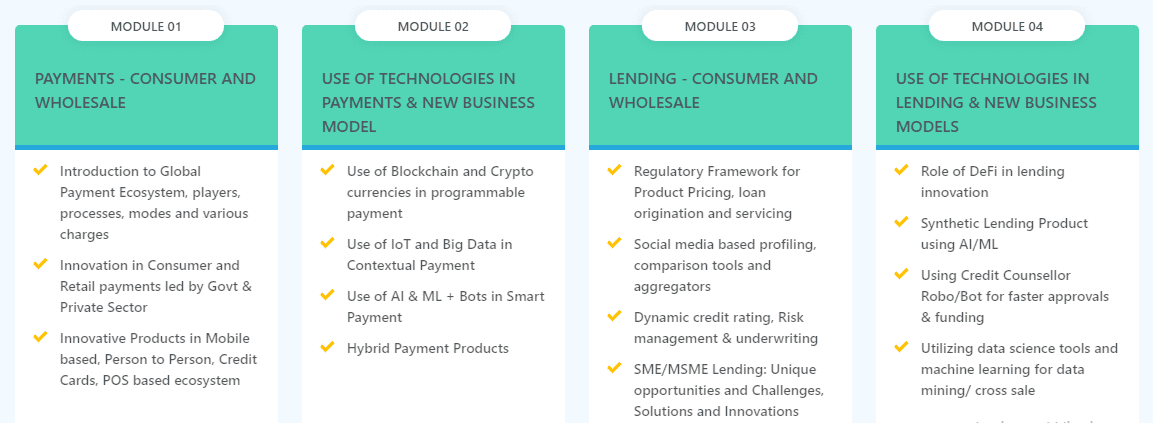
The topics covered in PRO Modules (140 hours) are:


• Payments – Consumer & Wholesale – You will get to know about modern-day payment practices. This module will also help you in understanding various innovations in the payments & lending market led by the government/private sector.


• Use of Technologies in Payments & New Business Model – You will get to know about programmable payment systems. This module will cover various aspects like the use of AI/ML bots, cryptocurrency management, hybrid payment products, IoT in fintech, etc.


• Lending – Consumer and Wholesale – This sub-module covers various aspects of the fintech industry like social media-based profiling, comparison tools, regulatory frameworks, SME/MSME lending. You will get to know about the innovations in the lending/loan industry.


• Use of Technologies in Lending & New Business Models – This sub-module will focus on the use of data science & machine learning for cross-selling. It will also teach you about synthetic lending products using AI/ML & DeFi lending.

 Benefits of the SP Jain’s Fintech Program

• You can get your hands on the Project: Paradigm shift under this course. It will help you in working on a visionary fintech business idea/project.


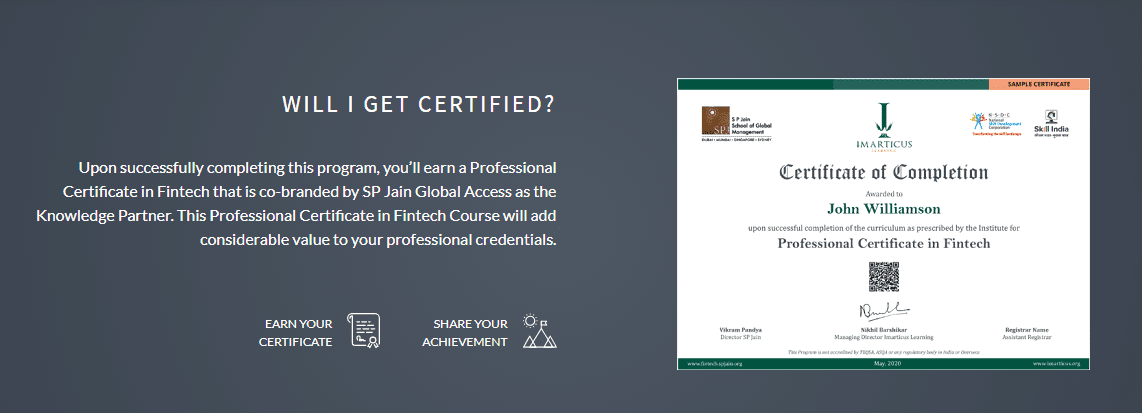
• Your final examination will be open-book and you will have to make business decisions in this simulated test as a CXO. Upon the completion of the course, you will be handed the fintech certificate.
Fintech Career

• You will also get to be a part of the Singapore Immersion Program and can meet fintech professionals from more than 140 different countries.


• You will be a part of the Perpetual Learning Program (PLP) giving you lifetime access to webinars from various industry experts.


• You will also gain access to the SP Jain’s laboratories along with becoming an alumnus of the SP Jain School of Global Management.


In a Nutshell


The in-depth course curriculum of SP Jain’s fintech course will help you in learning the practices in the fintech industry. You will also learn about the role of modern-day technologies in fintech. You can download the course brochure from the Imarticus website.

You will be able to know the operations involved in digital banks. Start your fintech course now!

The Popular Use Cases of Artificial Intelligence in BFSI

AI has revolutionized every industry and has changed the way businesses function. Everyone is finding ways to adopt AI into their work. Similarly, the banking, financial services, and insurance sector is also looking to integrate AI into their business and one major reason for doing that is the security of customers.

Customers expect banks to deliver flawless experiences and improve methods of interaction. In the last few years, banks have faced a rise in security threats which is why the banks had to come up with new ways of tightening the security because they were starting to lose clients.

A global study indicates that 85% of respondents have already implemented AI within their organizations and expect to use AI in the new use cases that come and 77% of respondents are anticipating the use of AI processes in their business in the next 2 years.

How is AI strengthening the competitiveness of banks?

Artificial Intelligence and machine learning is the future of banking as it has the power to combat fraudulent activities and improve customer service. Here are some examples of what changes AI has brought about in the banking industry –

  1. Mobile banking – Mobile apps are becoming more advanced and personalized. Banks can generate more revenue with mobile banking services than they generate from customers visiting the branches. This has also saved a lot of time for consumers and improved the quality of services provided.
  2. AI chatbots – In banking, chatbots are used to create an interactive experience for the customers. Bots can communicate with the customers and solve their queries while staying within reason and following the rules. Chatbots can also work 24 hours a day without breaks, which increases the productivity of the banks.
  3. Enhanced security – With the unlimited amount of personal data that is digitized and the number of digital frauds that are happening, it is customary for the banks to keep the client’s money and confidential information safe, and AI helps with that. They have come up with cybersecurity measures like fingerprints, iris, and voice recognition. These measures are almost impossible to forge, therefore everything is safe.
  4. Conformity – It is important to regulate data constantly. There are different processes like “Know Your Customer (KYC)” or “Anti Money Laundering (AML)” that can gather data and transactions digitally, which makes the work faster and easier. If done manually, this process can take up a lot of time. AI algorithms can integrate data very accurately and efficiently.
  5. Financial evaluation – Banks usually earn their profits through the interest they receive on loans. To keep a check that the loans are given back on time with proper interest, they have machine learning algorithms that analyze millions of data and assess whether the client is a risk or not, and then come up with a decision.

Conclusion

People are looking for exceptional services at the click of a button, they don’t want to wait for days for a transaction or money transfer. AI is not only the future of banking, it is also the present. It is advised that all financial institutions start investing in AI right now so that they can optimize their services. With the help of AI certification that is offered by AI and machine learning courses, people can make this revolutionary change in their businesses.

A Comprehensive Guide to Understand Bull & Bear Markets

When you start your investment journey, you definitely come across terms like “bull market” and “bear market”. In investment, the terms “bull” and “bear” are often used to describe the market conditions if they are increasing or decreasing in value. As an investor, it is important to learn investment banking to understand the market value as it may have major impacts on your investments.

What is a bull market?

A bull market is when the market is on the rise or expected to rise over a period of time. It also denotes high prices in the company’s shares, which makes the investors gain more confidence in the market. When the market is “bullish”, it indicates that there is a rise in the GDP and there should be positive results for weeks and months to come. The typical indicators of a bullish market are increased prices in stocks, bonds, real estate, and more.

What is a bear market?

A bear market is the opposite of a bull market. A bear market is usually indicated by almost a 20% fall in the stock market prices throughout a minimum of two months. It creates a sense of negativity amongst the investors, and they hesitate to make any kind of investment. A bearish market leads investors to sell out their stocks so that they can minimize their losses.

A bear market can have an adverse impact on the GDP of the country and could cause a lot of unemployment. An average bear market can last for up to 1.4 years or even longer.

Bull vs Bear markets and their impact on investment strategies

Bull and bear market and your investment strategies are inter-related. Your strategy highly depends on the current market conditions. However, the market does not always have to be in either condition; it can remain stagnant for a long time and can increase or decrease very gradually.

It is generally advised to invest in both markets while keeping your portfolio in mind. During a bullish market, you should consider investing at a very early stage so that when the stock prices are at an all-time high, you can sell them and earn great profits. While in a bearish market, the prices usually drop and stocks tend to lose their value, therefore, you should check your investment profile and make adjustments in your strategy accordingly.

It is also advisable to buy large stocks of blue-chip companies during this time because that will ultimately get your profile back on track in the long run and help you recover your profits. Several capital market courses will guide you through the details of both markets and how you can create an investment strategy.

Conclusion

The bull and bear market can influence your investment strategies in a great way that is why it is wise to continuously keep a track of where the market is going from day 1 of your investment. You must have a risk tolerance when you start investing and should always stick to your strategies no matter how the market at the moment is.

Always remember that whatever the condition is, you can reap the benefits of the stock market in the long term. To understand further, you can look into the investment banking courses with placements and have an idea of how the market works.

15 Most Frequently Asked MBA Interview Questions on Your Decision-making Skills

There have been some major changes in the industry with the Covid-19 pandemic. Many of the workforces were working from home during this period and many are still opting to work from home. Naturally, there is a change in management styles that requires to factor in both ‘work from home employees’ and ‘office folks’ and how to coordinate with the two.

As a result, many MBA interviews post-pandemic would focus on the pandemic, how the situation changed, and how it can affect MBA aspirants’ decision-making processes. Here are some questions that you might face regarding your decision-making skills:

Q1. Effect of COVID situation on different industries

Ans) The COVID-19 pandemic has taken the world by surprise. Every industry is affected by it, some in a good way and some bad. Do your research and see how the industry you wanted to get into was affected by this situation. Tell the interviewers how the industry is managing the situation and what your input would be.

Q2. How are you using the lockdown period for self-improvement?

Ans) When everything was under lockdown, people at home were trying to do different things to use their time productively. Show the interviewer how you used that time for some self-improvement, like doing a course, yoga, or even just doing some meditation.

Q3. Humanity is dead or alive in this pandemic?

Ans) The world is enveloped in a major health crisis and that has taken a toll on humanity. Explain how you think the coronavirus has affected humans, mentally, physically, and economically. Bring out the positive and negative of this situation and assess it on your own terms.

Q4. Are e-commerce discounts harmful to the Indian economy?

Ans) Since the beginning of the pandemic in 2020, the Indian economy has been hugely affected and everything has become online. The buyer penetration has increased by 18% and that is largely due to discounts. Explain your take on it in detail and what you think is the future of the economy.

Q5. Are salary cuts justified in the lockdown period?

Ans) Many people have lost their jobs during the pandemic. While some companies are doing the cutdown because of budget restraints, some are doing it because they don’t need so much manpower. Here, it is advised to avoid a diplomatic answer and tell them what you think. This will show them that you are opinionated and not just trying to impress them.

Q6. Has India really handled the corona crisis better than other countries?

Ans) Now, here is a question that you need to answer carefully. People want to hear your take on the corona crisis. Tell them what you think the Indian Government did right and what they could have done to handle the situation in a better way and compare it to the work of other countries.

Q7. Will digital learning surpass traditional learning?

Ans) Technology has empowered children by making them more engaged and has also expanded their horizons while traditional learning taught discipline and other values. There are both good and bad effects of technology on children. What do you think is set in the future and what would be best for children?

Q8. Explain decision-making.

Ans) Decision-making is the process of making a choice by gathering information and assessing the situation. This question will not only answer your skills when it comes to making important decisions, but it also shows what kind of person you are, especially under pressure.

Q9. What sets this MBA program apart from the others?

Ans) Show the interviewers that you have done your research. Tell them why their institute is suited best for you, be it their faculty, facilities, job placements, networking opportunities, and location. You have to tell them why this institute is the top choice for you.

Q10. Difference between a good manager and a good leader

Ans) The main difference between a good leader and a good manager is that the former has people working with him and the latter has people working for him. To be successful, one must have qualities of both in them. Tell the interviewers why you think you have both qualities and how you would drive your business to success.

Q11. What was a major decision that you took and how did you come to take that decision?

Ans) The interviewer wants to know how you handle challenging situations under pressure. So, you should come up with an answer which describes that. Pick the right challenge, discuss how you weighed your options, and tell the interviewer your final choice and why according to you it was the right decision.

Q12. One life experience you wish to change

Ans) You may have made several decisions and then wondered if it was the right one and what would have happened if you changed the situation. Pick one from those moments and analyze the situation. Explain how under other circumstances, had you changed the decision, things would change and what you learned from it.

Q13. Do you think being ethical is important in today’s world?

Ans) This answer is aimed at judging your community’s awareness. You can be diplomatic in this answer but try to be more direct. Try to keep this answer short and prepare it well in advance.

Q14. What is the one quality that all managers should have?

Ans) Do not dive into that one quality. Provide a list of qualities that according to you every manager should have and then elaborate on the one you think is the most important one. This could lead to a discussion about your values and ethics.

Q15. What did you learn from your failures till now?

Ans) Failure is the ultimate life lesson. To grow in life, you need to fail. Don’t be afraid to lay down your failures in front of the interviewers. Every mistake leaves behind learning and you need to convert that into a lesson. Rethink and find new ways to implement these lessons into strategies to achieve goals.

Decision-making is an important element of an MBA’s life, and so, you need to sharpen your skills and take the right approach to make decisions. In these questions, the interviewer is not asking for a right or wrong decision, but rather trying to gauge your approach to a problem. So, rather than being right or wrong, justify why you are approaching a specific problem in a logical manner.

5 Powerful Business Analysis Tools Aspirants Must Learn!

The term “Business Analysis” is self-explanatory. It is a system put in place by enterprises to analyze various aspects of their business. To define it more elaborately, it is a research-based practice that drives change in an organizational context by analyzing limitations and loopholes, defining needs, and guiding solutions aimed to deliver value to stakeholders. The reason why some businesses grow exponentially bigger than others is rooted in successful business analysis systems.

Business analysts often rely on software and tools to aid in the process of business analysis. There are several such tools in the market, each with its own unique features. Comprehensive knowledge of business analysis tools is often a key requirement in the recruitment of business analysts.

In this article, we list the 5 most powerful business analysis tools that are a must-learn for a successful business analyst career.

Top Business Analysis Tools

SWOT

SWOT analysis is one of the leading techniques of business analysis, which involves a strategic review of current strengths, weaknesses, opportunities, and threats. There are several SWOT analysis tools available online, but SWOT is perhaps the most comprehensive of the lot. Not only does it make SWOT analysis easy, but also provides a platform to brainstorm and collaborate among teams.

Trello

Trello is a Kanban-based collaboration tool that makes managing and prioritizing tasks incredibly easy for entire teams. Trello is a simple yet comprehensive way for business analysts to track tasks, plan projects, and chart progress. It is an extremely useful tool that every business analyst must master.

Version One

Version One is a powerful business analysis tool that also allows integration with enterprise and agile software development applications. It is expressly built to allow automation and scale-up project workspaces across teams in multiple locations.

Pencil

Pencil is a free and open-source tool that is used for prototyping and creating mockups. Prototyping is often critical for business analysts to give customers and stakeholders a visual sense of a product. Pencil allows changes and recommendations to be incorporated into the prototype to ensure the best final product.

Microsoft Visio

One of the leading project management and business modeling tools that many big businesses use is Microsoft Visio. Visio is a comprehensive business analytics solution that helps analysts create project flowcharts, schedules, use case diagrams, data models, process flows, etc.

A Career in Business Analysis

Job titles under the business analysis spectrum include business analysts, business systems analysts, requirements engineers, business intelligence analysts, data scientists, and more. Business analysts enjoy a demanded position in businesses of all shapes and sizes. This field of work comes with the guarantee of long-term stability and a lucrative remuneration.

You might be wondering – how to become a successful business analyst? The first step in pursuing a career in business analysis is to get certified. Acquiring certification not only imparts the necessary skills and training required by any business analyst but also gives the candidate a winning edge in the eyes of the recruiting company. Candidates with an MBA or a Bachelors’ degree in Business, IT, or a related field are usually preferred over others. Sound knowledge of business analysis tools is an added plus point.

Conclusion

Business analysis is a profitable career path that guarantees growth, stability, and a high salary. In order to advance your prospects of securing a business analyst role, you could consider signing up for a business analyst course such as a PG Program for Agile Business Analyst that would provide foundational training and knowledge.

What is the best approach to Data Analysis in 2021?

As time goes by the approach to any form or strategy of business changes. Even more so when it comes to data, as it is ever-changing. Throughout the years, data analytics has grown from a peripheral part of a business to an integral part of it. It is a prominent tool to not only extract and decipher past records but also predict and develop future strategies.

However, it comes with a little difficulty as most of the time, data analysts have little idea of how to execute a business. And in the same way, executives have little idea of how data analytics works and how to use it.

This is why it is important to have a basic idea of what is business analytics to give you that little edge over others. The best way to do this would be with a data analytics certification course, similar to what Imarticus Learning is providing with their new PG program. However, to make it easier, here we have compiled two successful ways that data analytics can be approached in 2021.

For the long run

In many cases, companies invest a lot in data analytics and focus on building business value around it. This includes training the employees about data analytics, developing company systems and syncing them with data analysis, and finally, discussing more data analysis initiatives. This requires a complete transformation of business values and systems.

Tackling clearly-define high-grade problems

One of the best ways to approach data analysis is by defining a high-grade problem with clear goals. When it comes to high-grade problems, the issue remains in the volume or layers in which a problem is divided. Each of these layers interplays and pile up to end up being a high-grade problem.

So, with data analytics, you can target a small subset of the problem and by getting the numbers right, you can take a sustained route towards growth. Unlike the investment model where too much time could pass before results show, this model seems clearly the best approach in 2021.

Things to keep in mind

One thing to always keep in mind is that data analytics merely show a record of how the past has been and how the future can turn out to be. It is not always possible to meet the exact expectations as the results depend on a variety of things. There are a few other things that everyone should keep in mind when it comes to data analytics, such as:

  • Data analytics need to be made a part of the main wing of a business as without being in the loop it would be impossible for the analytics team to be of any help.
  • Problems should be specified and addressed together with the executives. This will make the process of extracting and deciphering data as well as developing a proper plan to address the specified problems a lot easier on both sides.
  • Executives should have a basic knowledge of what is business analytics. It will make the communication and understanding between the two teams smoother.

 Conclusion

 The process can create disruptions as data tends to create transparency. It can be uncomfortable to face the shortcomings of a business, however, this is also the best way to form strategies to overcome those shortcomings. This is why companies need experts on their teams to help them along the way. You can enhance your skills with a proper data analytics certification course or a PG program if you wish to pursue this career.

Role of Technology in Investment Banking

Today, technology is key in turning trading strategy into trading profit. Technology enables new pricing models and products to be delivered to the market. The Investment Banking industry thrives on the flow, analysis, and interpretation of information and technology is often the edge that gives a bank a competitive advantage.

Technology spans across  Investment Banking  functions and underpins every deal that is made. When a system is unavailable, millions of dollars can be lost. So robust systems and infrastructure are more than important, they are fundamental to IB’s ability to operate & make profits.
Another challenge is the evolving regulatory burden of the financial sector. Technology has to do more than keeping up; it has to drive the changes and developments necessary to keep IB’s ahead of the competition.
IB’s rely on advanced technologies in the front office to enable high-speed and high-frequency trading. Until now, the upfront benefits from this activity have been so enormous that the complexity and inefficiency of post-trade processes and systems have often been overlooked.
This is changing at a fast pace. The highest performing investment banks are now using their front-office technologies in bold, innovative ways as a source of competitive advantage for the whole business. By concurrently enabling interdependent business functions, such as risk management, settlement and financial reporting, these technologies are transforming the way organizations ‘think’, ‘react’ and ‘operate’.

There are a number of reasons for the change in this trend:

  • Management requires integrated, proactive technology infrastructures that can anticipate the impact of new market and regulatory developments and adapt to the same.
  • Technical leaders are under mounting pressure to get a return on their massive investments in technology by using these assets to drive down costs, as well as increase revenues (traditionally the principal focus for front-office technologies)
  • This increasing emphasis on ROI means Technology leaders need to develop flexible IT systems/assets, that, by adapting to business change, can appreciate in value over time.

Understanding complex technology is one aspect, but a firm grasp of business problems is also essential. IB technologists work closely with the sales, trading floor, middle office operations to develop the software that enables them to make the split-second decisions or use their creativity and initiative to enhance state-of-the-art front-to-back systems and databases. Whatever the task may be, IB technologists work in a fast-moving environment where solutions move from concept to implementation in weeks and months rather than years.


10 Marketing Mistakes You are Doing That Might Crash Your Business!

Marketing is a tedious job with responsibilities like building a brand and at the same time bringing in more leads for the business. It is important in the beginning as well as when the business is flourishing. The most important marketing strategy is digital marketing which is also the most effective one.

Even a simple SEO course online will provide the basic details on digital marketing. The smallest of mistakes here could be proven costly for the entire business. Here are the 10 most common mistakes that you should avoid.

Not having a website is the primary mistake. People search the online platform first before they find a physical business. So it is necessary whether the business is big or small, local or national.

Ignoring SEO and relying too much on paid Ads should never be done. Every SEO course online insists that you have a proper strategy and rank high on Google to bring more leads.

Not knowing about marketing and simply hiring people to do work for you is not the right way. Enroll in the best digital marketing course, be aware of what it is all about, and then recruit others to the work. Relying too much on social media will not bring in more leads. Social media is just a small part of marketing. Pay enough attention to the other aspects as well.

Spending too much time on promotion than on your site is one of the most common mistakes. Promotion works only when you have quality content and a smooth functioning website to go with it.

Always focusing on new customers will lead to neglecting the existing customer. In fact, it is the returning customers that hold more leverage over new customers.

Not keeping tabs on competitors is another mistake to be avoided. When you learn digital marketing, you will see that finding out what your competitors do is important so that you can learn to do the same or avoid their mistakes, as applicable.

Replicating the trends is an effective way to go, but simply copying the exact methods will not work for you. You need to make changes to suit your business.

Targeting the wrong audience: The biggest need to properly learn digital marketing is to target the right audience for your business. It helps you target a specific group of people rather than going the general way.

Not having a clear-cut marketing plan will lead you to waste your time and money. A proper plan with an affordable budget for the right expenses can show better success.

Importance of digital marketing course

A digital marketing course will help you understand the ins and outs of this marketing method so you make minimal mistakes. Even after undergoing a course, you may still make mistakes, not even the best digital marketing course can make you perfect.

Learning this marketing method through top-rated courses such as the PGP in Digital Marketing will get you a clear picture about the various marketing methods, how the top brands are doing their marketing, etc. Moreover, it allows you to work on some strategies on your own to have real-time experience.

The bottom line

The success of a business is not having a perfect marketing plan, but having an effective plan with fewer flaws or mistakes. It also depends on the right strategy with the social media platform and optimizing both on-page and off-page SEO on the website. Successful digital marketing is a collective effort of all these factors.

How new banking strategies make managing finances easy for millennials and Gen-Z

Millennials and Gen-Z together share a larger segment of world demographics. With this shift, millennials and Gen-Z have become the largest driver to bring in the shift in consumer behavior and hence the technology. The financial service providers with digital setup need to undergo a transformation in order to remain up to date.

To drive the transformation, the financial institutions to come up with innovative approaches with the focus on transforming the traditional banking system. In order to be at par with the startup standards, there is a need for traditional banking systems to take up the new growth opportunities considering the consumer habits and expectations of Gen-Z and millennials. This shift in banking financial needs is going to open up new career dimensions for students.

To build a successful career in banking and finance-related services you can learn how to innovate and adapt the strategies by enrolling yourself to build a successful career in banking and finance-related services you can learn how to innovate and adapt the strategies by enrolling yourself in a postgraduate diploma in banking and finance or various certificate courses in banking and finance. Postgraduate diploma in banking and finance or various certificate courses in banking and finance.

The diploma and certification courses in banking and finance help the students to understand the market needs and learn how to strategize the solutions to the existing problems. This article will help you understand how postgraduate diploma or certificate courses in banking and finance can help you to upskill and grow with the increasing financial needs of Millennials and Gen-Z.

Consider consumer’s emotional needs as the core of transformation

An ever-increasing number of fintech is not only focusing on digitization of the regular services but also aiming to give the real experience to the customers. For this touch screen generation, having mere services is not sufficient, the entire experience is based on what is the need of the hour. With the shift in mindset, Gen-Z demonstrates a deep desire to understand the financial services and tools to manage monetary growth.

Even for high school students, managing finances has become their need and they look for multiple ways to manage their money as compared to their previous generation. The startup culture has very well understood this need and the market is flooded with many such solutions, but the most innovative ones are the most successful ones.

Adapt for a human-like approach instead of the traditional bank like approach

To cater to human needs, it’s very important for financial institutions to produce personalized consumer-friendly content. The banking programs should be designed to give a unique experience to the customers. The use of a specific language like, ‘free’, ‘relationship’ etc. in communication adds more to the offerings. Identifying the struggle points of the customers and educating them digitally using guides and tutorials has become the dire need of the fintech

Compliances should facilitate the processes instead of blocking

Gaining the trust of the customers is one of the success metrics of financial institutions. Compliances help in building the trust of the customers. The more regulated you are, the more transparent you will be and that helps in gaining the trust of the customers. For startups, building that trust is not an easy task. If the traditional banking system is merged with the startup culture and technical advancement, the manifold growth is certain.

For many of the startups, coming up with the innovative idea becomes difficult with many compliances and that can be a roadblock. Instead of taking the compliances as a blocker and losing out on the consumer-friendly content, the institutions should take the compliances as friendly and add innovative content above them.

What is the job description of a logistics manager?

The logistics manager is an integral part of the supply chain management system. The supply chain management career is an ever-growing field that opens up plenty of job opportunities. Although the logistic manager will be mainly focusing on warehouse storage and the subsequent distribution, it is a job that can offer further growth in their career. There are several who are opting for this field as a career.

If you intend to be such a manager or are opting for a logistics and supply chain management course, you should be aware of the proper job description of the role. 

What is a logistics manager?

A logistics manager will be responsible for the overall management of the warehouse of the companies right from the planning, operating, storing, coordinating, and transporting of the associated materials. The manager would need to keep up with the inventory and the transportation until the products reach the next level in the supply chain. A manager may be responsible for a particular warehouse or multiple warehouses of a particular region as well. 

This is an area that serves as the middle in the overall supply chain. It requires a bunch of skills such as negotiation, analytical, leadership, administrative, organizing, and budgeting powers. This is where the Certificate in Supply Chain Management & Analytics helps. This course covers a wide range of program languages and tools to help candidates prepare for their responsibilities.  

Responsibilities of a logistics manager

  • Managing the warehouse includes organizing the goods, preparing proper inventory, and labeling the goods to ease the process. 
  • Preparing a proper budget for the transportation and negotiating with the carriers to transport it within the budget is another responsibility. 
  • Keeping track of both the incoming and outgoing deliveries can be a daunting task which also requires plotting the routes. 
  • A logistics manager should be aware of the latest shipping techniques to reduce the cost and maintain the goods in their proper shape and quality. 
  • It is also the responsibility of the logistics manager to have in-depth knowledge about the rules and regulations of the transportation, the ISO requirements, or the various guidelines. Managers must ensure that all the laws are properly followed by everyone under them until the goods reach the next level. 

The Certification in Supply Chain Management & Analytics course trains the candidates in the departments such as metrics, planning, designing, coordinating, sales and operations, etc. 

How to qualify to be a logistics manager

The primary requirement for starting a supply chain management career is to find a quality logistics and supply chain management course such as the SCM. Anyone with a Bachelor’s degree can apply for such a course.

Having at least 2 years of experience in the SCM field would be an added advantage. The candidate should have strong knowledge about supply chain, distribution, management, inventory, etc, along with exceptional skills in communication and analysis. A keen eye to observe the minute details would be a huge advantage as the manager is responsible for the daily operations as well as the employees’ performance. 

Conclusion

The role of a logistics manager is demanding as every day comes with a new challenge. It can be exciting or exhausting. This demanding job is not suitable for all. But those who are enthusiastic about such responsibilities can find it exciting. Those who like to solve problems will find such a job description thrilling. If you are among those, enroll into SCM now to have a stimulating career ahead.