
6 tips to become a winning chartered Financial Analyst

A financial analyst examines data carefully in order to spot opportunities or to assess the results of corporate actions or investment suggestions. Within a corporation, they can work in both junior and senior roles, and it’s a specialization that frequently leads to further opportunities.

What is a Financial Analyst?

Financial analysts analyze financial data and apply what they learn to assist businesses in making choices. Their research is frequently used to guide investment decisions for businesses. They frequently suggest a plan of action, such as selling or purchasing a company’s stock, depending on the company’s overall performance and prospects.

An analyst must be up to date on current events in the field in which he or she works, as well as be able to create financial models that can forecast future economic situations for a variety of factors.

Financial analysts do not all analyze stock or bond markets or assist their companies in making investments. Companies may also engage an analyst to evaluate the cost-effectiveness of various marketing strategies using numerical data.

6 Tips to Become a Winning Chartered Financial Analyst

1 – Financial analysts must be careful in acquiring macroeconomic data as well as data on particular organizations, specifically examining their financial fundamentals through balance sheets. Analysts should read extensively on their own time to remain current with financial news. The Economist, The Financial Times, and The Wall Street Journal, as well as financial websites, are common sources of information for analysts.

2 – Junior analysts who master PowerPoint presentations, databases, and spreadsheets, as well as other software tools, have the best chances of succeeding. Senior analysts who put in significant hours, create interpersonal ties with superiors, and mentor junior analysts are the most effective. Analysts who are promoted learn to improve their interpersonal and communication skills by giving impressive written and oral presentations to senior management.

3 – Analysts typically communicate with one another as coworkers while reporting to a portfolio manager or other senior management position in terms of inter-office procedure. In three to five years, a junior analyst can advance to the position of senior analyst. Senior analysts who want to develop their careers can work as portfolio managers, investment bank partners, or senior managers in retail banks and insurance companies. Some analysts work as financial consultants or investment advisors.

4 – Financial analysis is a large area with several career and paths job titles to choose from. Analysts who work for the following companies fall into three groups in the financial industry:

  • Companies that work on the buy-side (investment houses that manage their funds).
  • Companies that work on the sell-side
  • Financial institutions

Regional and local banks, insurance firms, real estate investment brokerages, and other data-driven businesses may hire financial analysts. A financial analyst might possibly provide value to any organization that routinely makes crucial decisions regarding how to spend money.

5 – As an analyst, you’ll probably be traveling a lot. Some analysts go on on-site visits to businesses to get a firsthand look at how they operate. Analysts also regularly attend conferences with peers who specialize in the same area.

Analysts learn how to use spreadsheets, relational databases, and statistical and graphical software in the office. These tools are used to provide suggestions to top management and to create extensive presentations and financial reports that contain predictions, cost-benefit analysis, and trend analysis. Analysts are also responsible for interpreting financial transactions and ensuring that papers adhere to regulatory requirements.

6 – The requirements to work as a financial analyst are less rigorous and well-defined than those for many other high-paying jobs. Unlike law and medicine, there are no educational requirements that must be met throughout the profession. Whether or not you need a license is determined by a variety of circumstances, including your company and employment tasks.

Conclusion

Strong quantitative abilities, expert problem-solving skills, reasoning competence, and well above communication skills are required for a successful job as a financial analyst, regardless of degree. At Imarticus we offer a chartered financial analyst course and several financial modeling courses that will help you develop all the skills you require tolearn financial analysis. Come and visit our website today to obtain more information.


How a machine learning course will transform your resume in 2022?

An artificial intelligence (AI) technology that trains computers to learn and better itself based on experience without being explicitly designed is termed Machine learning (ML). It is a set of computer programs trained to retrieve and use data. Machine learning enables computers to observe the data and provide a result without any human intervention or observation.

Machine Learning with Python

AI is the machine intelligence that leads to the practical solution to the problem, and machine learning takes AI technologies a step further by employing algorithms to examine data, learn, and make intelligent conclusions. 

For AIML, the program developers use the programming language python because it has many libraries and frameworks to make coding easy, and it also saves time.

Thus, machine learning is all about application, and if you know python, you can grasp machine learning fast. To implement anything, you should know how to code it.

Machine Learning Course

At Imarticus, we offer you an extensive program to become a data scientist, data analyst, machine learning engineer, or AI engineer, and, by becoming analytics, you can build machines and systems that will react as humans do.

In the Data analytics certification, we will teach the technique to create a machine learning model that will accurately work to give suitable and best outcomes. We will develop your analytical abilities to choose the correct algorithm as per the model compatibility and your requirement.

The first requirement of a machine learning model is data collection and its interpretation. Therefore, at Imarticus, we give you the knowledge of data manipulation, analysis, and visualization. 

As analytics, you learn to extract ideas from your team, choose proper tools, use a machine learning framework, and stay up to date with the latest development. 

The key responsibilities of analytics are:

  • Collect data, study, and then convert it into data science prototypes
  • Research for the appropriate machine learning tools and algorithm
  • Build a machine learning application that will meet the industry requirement
  • Choose the correct data and the visualization methods
  • Perform machine learning tests
  • Execute statistical analysis from the test results.
  • Set the model for accurate results

Machine Learning Resume

Your resume is your introduction and first impression for recruiters, but writing perfect codes and preparing a good model may not get you your dream job. You have to delve deeper.

Furthermore, if you want to survive in the job market, you should not only have the skills, but you should also know how to endorse these skills to your name. Furthermore, you should have an exceptional and organized resume. Hence, you must include the following points in your resume:

  • You are a certified machine learning engineer
  • Briefly mention your projects and your contribution
  • Describe your work experience in one-liner points
  • List down every information in reverse chronological format
  • Prepare a summary of your resume while highlighting your contributions

 Machine learning has a promising future, and these professionals are high in demand. At Imarticus, we know this so, the expert mentors will give you a practical understanding of AIML. They will help you to develop skills to unlock lucrative career opportunities. 

What attracts business enterprises to credit risk analyst courses?

Businesses have many different areas in which they can specialize. One area that has become increasingly popular in recent years is credit risk analysis. This field involves studying and assessing the risks of lending money to businesses and individuals. 

Due to the importance of this task, many business enterprises are now turning to credit risk analyst courses to learn the necessary skills. This blog post will discuss why businesses get drawn to this type of training.

The increased demand for credit risk analysts in the business world

According to the U.S. (BLS) Bureau of Labor Statistics, job growth in this field will be around five percent from 2019 to 2029. In India, the average salary for a Credit Risk Analyst is 10,58,589 rupees.

Businesses need to ensure that their employees access the latest relevant training. These courses provide in-depth knowledge about the various aspects of this field, and they are therefore becoming a progressively popular option for businesses.

What are businesses looking for in their credit risk analysts?

Credit risk analyst courses are significant in the business world. The reason is that technology keeps changing and expanding. Businesses have to keep up with this change to continue to grow. That is why their employees must attend these courses. Credit risk analysts are vital in the decision-making process for lending money.

For a business to be successful, the credit risk analysts must possess these skills:

Analytical Skills

The ability to analyze data is essential in this field. Credit risk analysts need to examine financial statements and assess the risks associated with lending money.

Critical Thinking Skills

Credit risk analysts also need to be able to think critically. They need to identify potential problems and come up with solutions.

Organizational Skills

This skill is vital for credit risk analysts to stay organized and keep track of all the information they collect.

Communication Skills

The ability to communicate effectively is also vital in this field. Credit risk analysts need to explain their findings and make recommendations based on their analyzed data.

Why will credit risk analyst courses be in high demand in 2022?

Credit risk analyst courses are essential in the business world because of the technology. Technology is constantly changing, and businesses must keep up with this change. That is why their employees must attend these courses.

In 2022, there will be a high demand for credit risk analysts because of the global economy. The global economy is overgrowing, and businesses need to keep up with this change to grow.

Discover Credit risk Management Courses with Imarticus Learning

The only credit analyst courses globally teach students about the lending environment, credit underwriting, legal and regulatory requirements, and the impact of new-age technologies.

Course Benefits for Learners

  • The industry-focused practical curriculum adheres to globally accepted standards and includes recent global trends and best practices.

  • Learning technique consists of 145 hours of live lectures, five case studies, and social learning.

  • After finishing these credit risk management courses, students will get awarded an industry-recognized Certificate of Excellence in credit risk and underwriting

Closer to the edge: Why we must take advantage of software engineering certificate course

The field of software engineering is constantly changing, and with new changes come new opportunities. That’s why it’s essential to make sure you’re keeping up with the latest advancements by taking advantage of certificate courses in software engineering. 

Such courses can provide you with the skills and knowledge needed to stay ahead of the curve in this rapidly evolving industry and allow you to take your career in new directions. This blog post will explore some advantages of a software engineering certificate course.

What is a software engineering certification course, and why do you need one?

A software engineering certification is an industry-recognized credential that demonstrates your proficiency in the field of software engineering. Earning a certification can help you differentiate yourself from other job candidates, boost your career opportunities, and increase your earning potential.

best software engineering coursesIt is beneficial for your career because it can make you more marketable as you communicate with developers and understand their products.

The benefits of getting certified as a software engineer:

  • You’ll be able to prove your skills to potential employers.
  • Your certificate will show that you have a strong foundation in the basics of software engineering.
  • You’ll learn best practices for working with software developers and teams.
  • Certification can help you advance your career as a software engineer.
  • Certification can help you increase your salary.

Tips for choosing the right certification course for you:

Here we list the factors you should consider when selecting a certification for software engineering:

Career goals: What do you want to achieve with a certificate? Do you want to move up the corporate ladder or change careers altogether? Choose a certification that aligns with your aspirations and goals.

The industry in which you work: Not all certifications are created equal. If you work in a specific sector, there may be certifications that are specific to that industry. Make sure you research and find the proper certification for your field.

Your level of experience: Not all certificates are for beginners – some require significant expertise in software engineering before you can earn them. Make sure you choose a certification that makes sense for your experience level.

Your learning style and preferences: Think about the type of learner you are – do you learn best in a classroom setting or through self-study? Would you prefer to have lectures with homework assigned at home, or would you instead complete coursework online on your own time? Consider your learning style when choosing a certification.

The certification cost: Certifications can be expensive, so make sure you factor in the price before deciding. Some certificates may be worth the investment, while others may not be worth the money.

Discover Software Engineering Course with Imarticus Learning.

The Certification in Software Engineering for Blockchain, Cloud, and IoT curriculum provides the best learning experience for aspiring software engineers. This course covers cloud computing technologies such as blockchain and the internet of things (IoT).

Course Benefits For Learners:

  • To prepare for an exciting cloud DevOps engineer profession, study cutting-edge technologies such as cloud, blockchain, and IoT, as well as many real-world projects that will expose students to a variety of industries.
  • Students can gain practical experience working on well-known companies and current events projects.
  • Manage real-world difficulties, comprehend software design fundamentals, and develop essential skills to become a new-age software engineer.

A Complete Guide On How To Approach A Machine Learning Problem For Beginners!

As beginners in machine learning, you will want to have questions answered to common problems. Questions like how to approach, how to start, which algorithm fits best, and so on.

Common problems in machine learning for beginners

Here, we will help you resolve those problems by answering common questions:

Where can you use machine learning?

You can use machine learning for problems when:

  • Automation is involved
  • Learning from data is needed
  • An estimated outcome is required
  • Need to understand pattern like user sentiments and developing recommendation systems
  • Object required to identify or detect an entity

How to solve machine learning problems?

Here are steps to solve problems in machine learning:

  • Read data from JSON and CSV
  • Identify dependent and independent variables
  • Find out if there are missing values in the data or if it is categorical
  • Apply pre-processing data methods if there are missing data to bring it in a go to go format
  • Split data in groups for testing and training for concerned purposes
  • Spilt data and fit into a suitable model and move on validating the model
  • Change parameters in the model if needed and keep up the testing
  • An optional step is to switch algorithms to get different answers to the same problem and weigh the accuracies for a better understanding – this explains the accuracy paradox
  • Visualize the results to understand where the data is headed and to explain better while representing it

What algorithm should you use?

You need to understand what labelling is to answer this. Labels are the values we need to make an estimate. This represents the Y variable, also known as the dependent variable.

Here is a small example to help you understand this:

if

dependent_variable_exists==True:

supervised learning()

else:

unsupervised learning()

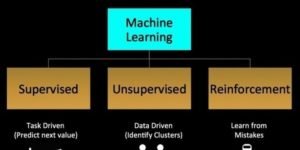
Machine Learning CourseWhile you’re learning from a machine learning course, you will understand that your supervision and training refers to supervised learning. This means that the results need to be compared by a frame. The frame here is the dependent variable. However, there is no reference for frame under unsupervised learning, which is why the name.

It is time to figure out how algorithms are served. However, it is essential to note that this is a generalized approach. The situations can differ, and so will be the usage of algorithms:

  • Numeric data for linear regression
  • Logistic regression when the variable is binary
  • Multiple category classification through a linear discriminant approach
  • Decision Tree, Naive Bayes, KNN, and Ensembles for regression and classification

Machine Learning Course

As you grow in your machine learning career, you will learn how to take random XG boost, forest, Adaboost, among other algorithms for ensembles. You can try these for both regression and classification.

Ensembles, as the name goes, refer to a group of at least two classifiers or regressors. Moreover, it doesn’t matter if it is the same or if working towards the same goals.

Building visualizations

Here are some of the things to remember when visualizing reports:

  • You can show class clustering with a scatter plot
  • Avoid scatter plot if there are several data points
  • Class comparisons can be explained through histogram
  • Creating pie charts help comparative breakdown
  • Line charts can help analyze reports with frequent deviations like stocks

If a scatter plot has too many data points, it will look clumsy. It will not be a presentable representation to show stakeholders. In such cases, you should use scatter charts.

Final thoughts

These points will help a beginner in machine learning career to become more aware of how to solve problems. You now know the essential things to do and things to avoid to get accurate results.

5 Fintech trends that will completely change how learners career choices

As we move further into the 21st century, it’s essential to stay ahead of the curve of technology. This post will discuss five fintech trends that will completely change how learners make career choices. These trends are sure to have a significant impact on the future of Finance and those who will reap the benefits!

Trend #01: The Increasing Popularity of Fintech

Fintech describes the technology used in the finance industry. It encompasses many technologies, including blockchain, AI, mobile payments, and more.

There are a few reasons for the increasing popularity of Fintech:

  • It is a very convenient way to conduct financial transactions.
  • It is often more affordable than traditional banking methods.
  • Fintech offers a wide range of services that cater to different needs.

Trend #02: Blockchain is Changing the Finance Industry

Blockchain is a database that allows for transparent,  secure, and tamper-proof transactions. The finance industry adopts blockchain due to its many benefits. 

  • It is a very secure technology, as data cannot be tampered with or changed without authorization. 
  • It is transparent, meaning that all transactions are visible to everyone involved. 
  • It is cost-effective, as there are no middlemen required.

Trend #03: Use of Finance in AI

AI is a technology that allows machines to learn and think like humans. Various industries, including Finance, use it. 

AI has many benefits for the finance industry:

  • It can help speed up the decision-making process.
  • It can help identify patterns and trends that would otherwise be undetectable.

Trend #04: The Impact of Mobile Payments

Mobile payments are a type of payment conducted using a mobile device, such as a smartphone or tablet. There are several reasons for the increasing popularity of mobile payments:

  • They are very convenient.
  • They are often more secure than traditional methods of payment.
  • They offer an extensive range of services that cater to different needs.

As mobile payments continue to grow in popularity, we can expect to see even more businesses adopting them as a payment method.

Trend #05: Emerging Payment Technologies

Many new payment technologies are emerging in the finance industry. These include:

  • Contactless payments
  • Mobile wallets
  • Paying with your fingerprint
  • Paying with your face

These new payment technologies offer many benefits, including convenience, security, and flexibility. As they continue to gain traction, we can expect to see them become more and more popular.

In conclusion, the finance industry is undergoing a significant transformation, thanks to the rise of Fintech. These five trends are just a tiny glimpse into what is to come. So stay tuned because things are about to get interesting!

Discover Best Fintech courses in India with Imarticus Learning

FinTech Courses online are a one-of-a-kind learning experience for anyone who wants to succeed in this competitive industry. With practical application skills and real-world experience, students will have all the tools needed before these opportunities fly off the shelves!

Course Benefits For Learners:

  • These FinTech certification programs will teach students how to use machine learning algorithms and blockchain tech to prepare them with the knowledge needed when leading this exciting industry. 
  • The future of Fintech is bright, and students can keep up with the latest developments by attending networking events, job boards, or webinars. 
  • Students will also have access to some fantastic resources to help them land a great new position after graduation!

Here’s why brands need to rethink their media planning and buying strategy

Advertising, marketing, and media planning have come a long way and have evolved with time. When we talk about media planning we refer to the analytical process for making decisions related to the media. It primarily involves getting something across to the target audience, be it a message or a thought at the right place and at the right time. This can only be successfully achieved using an appropriate media vehicle. 

Creative people are always working in collaboration with the media planners because it is the execution of their brain-children that often takes media planning towards the desired direction. Both media planning and creative execution are codependent on each other.

An advertiser needs a media planner to select the best media, media mix, appropriate time, and space to reap the best of the available resources that can be used to their fullest thereby reducing wasteful advertising. It primarily paves the best path to promote the advertiser’s message to the biggest number of potential consumers and the market. 

It ensures that the resources used in advertising are spent to their optimum capacity by executing their plans of action delineated to obtain media objectives.

Why Do Brands Need to Adapt to Change? 

With the ever-growing mobile market of digital advertising and promoting, many brands have indeed come up with newer strategies to promote their products and get their message out there into the world. In a digital age, brands need to adapt to the digital solution of advertising to promote their products and services to consumers who bend with the trend. The behaviors and expectations of consumers are subject to constant change and yet, many organizations still rely on the backdated and traditional ways of media planning.

This is hardly relevant and all the more ineffective and wasteful. This is the reason why the efforts of marketers are being rendered fruitless because they cater to the mindset of old customers. Efficient media planning is crucial in order to be able to identify what the modern consumer wants in real-time. If brands start accepting this, they will be able to meet the expectations of the modern crowd. It’s time for brands to bring something new in the media planning and buying strategy.

How Brands Can Adapt to Change through Digital Marketing?

Digital marketing is in vogue in the media marketing industry at the moment. Needless to say that it is a very engaging medium, be it increasing engagement on social media, a long-form article, or engaging with any website after clicking on a paid ad. All actions made by customers and visitors can be monitored in digital marketing. This will help create many forms of advertising, which are engaging thereby boosting sales and getting the brand name out there.

Digital marketing not only benefits engagement but results in more loyal customers thereby increasing business in the long run. More engagement leads to brand fame via word of mouth. A significant amount of online coverage of your brand along with customer interactions with your business results in your brand being more wholesome and trustworthy. Through digital marketing, countless brands have developed online strategies to transform even cold traffic into returning customers. Digital marketing also helps you retarget consumers via online activities.

Conclusion 

Modern brands are constantly evolving with the evolving market. It is through actively identifying the changing patterns and trends that many companies have effectively thrived. Digital marketing, therefore, is a stream with promising prospects because of its ever-growing demand. If you want to learn digital marketing and advertising, you can choose a reliable social media marketing course to give you a basic knowledge about what you are going into. 

Developing digital health care solutions with an artificial intelligence and machine learning course

In the current times, digitization is seen in every sector, and healthcare organizations are not far behind. Artificial intelligence with machine learning and algorithms is the newest aspect of the technological developments that can help to automate various processes.

If you are interested in implementing AI in healthcare, you can opt for Imarticus Learning’s artificial intelligence and machine learning course. The course includes relevant use of technology across industries, including healthcare. 

How to Implement Artificial Intelligence and Machine Learning in Healthcare? 

Artificial intelligence has various roles in the healthcare industry. If you choose to get an artificial intelligence certification, you will learn more about the following aspects. 


  • Prediction of Treatments


Artificial intelligence and machine learning can be implemented for the accurate analysis of patient information. AI solutions can analyse medical conditions and help doctors arrive at accurate treatment plans that will be beneficial to the patients. While reviewing all medical information is necessary for correct diagnosis, doing so manually increases workload and may even lead to errors. Artificial intelligence and machine learning can automate specific processes and ensure error-free treatment plans. 


  • Improvement of Workflow


From the IT infrastructure in healthcare organizations to diagnostic tasks, workflows can be automated and optimized. This will improve business processes and ensure better outcomes. All organizational tasks will be seamless and less time-consuming. 


  • Detection of Anomalies


Most healthcare organizations include digital databases and rely on workflow automation. While AI can assist in automation, it can also monitor the entire system. Failure of systems in any industry leads to loss, however, in the healthcare industry, anomalies can lead to loss of lives and not just revenue. Therefore, it is important to use artificial intelligence and machine learning tools to detect gaps within the system so that professionals can take better precautions. 


  • Introduction of Opportunities for Clinical Trials


While artificial intelligence solutions are capable of predicting treatment plans through a thorough analysis of symptoms, they can also assist in clinical trials. Artificial intelligence can be used to determine if certain patients are suitable candidates for trials. Such solutions can also help doctors predict patient responses to trials. AI and machine learning create space for safer clinical trials by ensuring that patients can withstand treatments. 

How Can Imarticus Learning’s Al ML Course Prepare You for a Career in Healthcare? 

If you wish to enter the healthcare sector and work in the digitization of healthcare solutions, then Imarticus Learning’s Certification in Artificial Intelligence & Machine Learning is a great option. Our course is in collaboration with E&ICT Academy and IIT Guwahati. So, you will have access to lectures and curricula designed by renowned academicians and industry professionals.

At Imarticus Learning, we ensure that the IIT AI ML course prepares students for a long and rewarding career in data science and machine learning engineering. You will be attending live sessions for eight hours every week and we encourage you to interact with all teachers and peers. Imarticus Learning creates opportunities for students to network and hones their soft skills while preparing for work in the industry.

To ensure hands-on experience, we offer twenty-five projects that are based on real business issues and more than one hundred assignments. 

The certificate course in artificial intelligence and machine learning at Imarticus Learning is ideal for students who have completed graduation in computer science, engineering, statistics, mathematics, science, or economics. If you have a minimum of 50%, you can enroll in our program and receive education and industry training from experts.

What Does a Money Market Analyst Do?

Money market analysts collect and scrutinize data to give an interpretation of the market to help companies make proper and informed business decisions. Some of them also analyze financial market trends so that they can help in making investment-based decisions while many others analyze financial statements of a company or the performance of a sector to help pinpoint investment potential.

One of the roles of money market analysts involves the analysis of investments and their performances in the market. They rely heavily on financial analysis, market analysis, and forecasting to determine the value or the investment opportunities of various companies. This detailed process commonly includes the analysis of a company’s profitability, earnings, revenue, outstanding debt, and sales.

Money market analysts primarily use statistical models and financial ratios to interpret data in order to help in comparing a company’s data to that of others in a specific industry. This job role also heavily depends on the use of accounting and thoroughly interpreting and reviewing the financial statements like balance sheets and income statements of a company. 

Skills required to be a money market analyst 

A money market analyst is required to be proficient with Microsoft Excel and have familiarity with data management/data queries tools such as SQL, Access, and Business Objects. Money market analysts are integral to companies as they are responsible for the collection and analysis of data. 

They are always required to have a proper understanding of how a market runs. A money market analyst should also understand the principles of the economy and have the ability to create reports of deductions and recommendations. They are more like experts in charge of running the show behind the scenes. 

Money market analyst job description

A money market analyst is crucial to any start-up or large company. Here are the roles a money market analyst is expected to fulfill:

    1. Carry out financial forecasting, operational metrics tracking, and reporting
    2. Analyze financial data (like past results) to make financial models support decisions, identify trends, perform variance and recommend suggestions for further improvement
    3. Report financial performance and prepare for leadership reviews daily
    4. Collaborate with the accounting team of a company to make sure the financial reporting is accurate
    5. Evaluate financial performance through the analysis and comparison of actual results with forecasts and plans
    6. Guide through the process of cost analysis by creating and enforcing procedures and policies
    7. Provide the analysis of forecasts and trends and further recommend the necessary actions for optimization
    8. Identify and drive improvements for processes, including the establishment of ad-hoc and standard tools, reports, and Excel dashboards
    9. Help increase productivity through the development of automated forecasting/reporting tools


  • Fulfill the roles of data mining, market research, valuation comps, and business intelligence


Money market analysts are often given the responsibility of tracking a company’s financial plan. They are responsible for the analysis of the performance of any company and also keep a track of and evaluate the market changes and the change in trends. They are not only responsible for creating forecasts, but also to calculate the variance between the said forecasts and actuals. 

All in all, the job of a money market analyst can be a handful and requires a good grasp of knowledge and skills. It is a job role that is in high demand and if you are planning to pursue your career in this sector, then you can go for a reputable investment banker course to have a better understanding of financial planning and analysis.

How blockchain is adding transparency and efficiency to supply chain management

Blockchain technology is quickly becoming one of the most important innovations in recent history. It has the power to transform every sector, from manufacturing to finance and more. Blockchain can help businesses streamline their supply chain management by providing transparency while reducing costs for all parties involved. 

This blog post will explore how blockchain benefits supply chain management and why it is essential for business owners to understand this new technology!

What is blockchain, and how does it work?

The blockchain is a technology that stores information in blocks, each block containing data of any size. Once data is stored, it can’t be changed or removed. It makes the blockchain incredibly secure and tamper-proof.

Blockchain is the world’s leading software platform for digital assets. Offering the largest production blockchain platform globally, we are using new technology to build a radically better financial system. Blockchain enables transformation across every business, government, and institution.

One of the key ways to use blockchain in supply chain management is to add transparency and efficiency. Blockchain can help businesses keep track of their inventory and get the best deals on supplies by creating a tamper-proof ledger of transactions. Additionally, blockchain can help companies save money and time by reducing the need for intermediaries.

What are some of the benefits of using blockchain in supply chain management?

The key benefits of using blockchain in supply chain management include increased transparency, reduced costs, and improved efficiency. By creating a shared ledger of tamper-proof and secure transactions, businesses can reduce the need for intermediaries and create a more efficient supply chain.

As it becomes easier for businesses to track the provenance of their products, consumers can also feel confident that they are buying ethically sourced goods. For example, if someone buys diamonds mined in South Africa on De Beers’ blockchain-based platform Tracr, they will be able to trace the provenance of those diamonds through that supply chain.

The ability to track goods from origin to end-user means a more transparent and therefore traceable product journey, enabling businesses to prove compliance with governmental regulations for food safety, quality assurance, or other aspects of their offerings. 

What challenges need to get addressed before you can widely adopt blockchain in supply chain management?

 One of the key challenges is that blockchain is still in its early stages, and many businesses are unsure how to implement it. Additionally, there are some concerns around security and privacy when sharing data on a blockchain network.

Another challenge facing blockchain in supply chain management is the lack of standardization. Because different businesses use different blockchains, it cannot be easy to transfer data between them. You could address it by developing a universal standard for blockchain technology.

Explore Supply chain Management Career with Imarticus Learning.

Supply chain management certification online is in partnership with DoMS and E-learning Centre, IIT Roorkee, and industry professionals to equip candidates interested in entering the operations and supply chain business with a cutting-edge experience.

Course Benefits For Learners

  • Supply chain management online course prepares students for jobs such as Demand Planner, Data Scientist, Supply Planner, and Supply and Operations Planner, which are in great demand.supply chain management courses


  • With a certification authorized by one of the top-ranked IITs, IIT Roorkee, students can impress employers and demonstrate their new-age SCM and Analytics abilities. 
  • Students Attend 1:1 mentorship sessions and get their questions addressed by Supply Chain Management industry leaders.