Latest cyber technologies are rapidly growing and evolving which has led to various cyber threats. After, the last pandemic more companies and organisations are steadily adopting various measures to safeguard the sensitive pieces of information that are stored in the cloud. Cyber threats like viruses, worms, malware, trojan horse, etc alter and sabotage important data.
Apart from all the foreign cyber threats, companies also have to deal with internal threats that have the potential to breach cyber security. Social engineering is another reason why the cyber security of a company is hampered.
Therefore, companies are now hiring cybersecurity and information security specialists to safeguard their sensitive data. A career in cybersecurity is in high demand as there are plenty of opportunities with alluring remunerations. Let’s dive into this article to comprehend more about this.
What is Social Engineering?
Social Engineering is a potential trajectory through which cyber hackers can easily attack a computer system. This method involves human interaction, hackers often manipulate the employees of the company and illegally extract the company’s data by breaking into the computer networks or systems. Such cyber attacks can easily trace the location of various sensitive data of a company and use them for monetary gain.
Various Social Engineering methods are used by these cyber threads or hackers to disguise their true intention as well as motive. Therefore, they easily gain the trust of various companies. Subsequently, these attackers begin to collect sensitive data and try to gain access to the entire computer system or network. At times Social Engineering techniques are used to manipulate or deceive the employees to gain the access to other networks as well.
Exploiting or manipulating the human mind is easy therefore hackers these days are widely using Social Engineering techniques to extract sensitive data or to track any loophole in the networking system of the company. These techniques can also install malware inside a computer system or network to steal data.
Different kinds of Social Engineering methods
Different types of Social Engineering methods can easily breach the security of a company. These methods have been stated down:
Phishing
Phishing is a method when a mala fide user sends a malicious email distinguished as a trustworthy or legitimate email. These malicious emails may contain links that can install malware in a system. It may also trick the employees and they might end up sharing sensitive information about the company.
Baiting
Baiting is such a method where the leaves an infected device that can be easily connected to a computer system. This device is left at such a place or position from where it is easily visible. Once the deceive gets connected to a computer system it installs malware.
Watering hole
In the watering hole process, the attacker targets a group of employees and tracks the sites they frequently visit. The attackers infect those sites with viruses or malware and successfully gain system access.
Vishing
Vishing is another name for voice phishing. In this Social Engineering technique, the attacker collects all the sensitive data and financial information over the phone from the targeted employee of a company.
What is the Internal Threat of an organisation?
The cyber security threat that comes from the core members of a company is generally referred to as an Internal Threat. It takes place when a current or a former employee or partner of a company who has the access to the system of the company with a mala fide intention uses it. There are instances when an employee may unintentionally hamper or leak the confidential data of the company which eventually affects the company adversely.
According to various reports and surveys, most data breaches are the outcome of Internal Threats. While developing a cyber security system, experts often concentrate on external threats and completely sideline internal ones. This is often done because it is difficult to identify the people who are adversely operating against the company.
Internal Threats often have extra advantages over external threats as they are already familiar with or have access to the system and networks of the company. They are well aware of the vulnerabilities of their organisation. Therefore, a company should safeguard itself from Internal Threats as well.
What are the various kinds of Internal Threats?
Several types of Internal threats may adversely affect a company. All these threats have been vividly discussed below:
Lone Wolf
A lone wolf is a well-known Internal Threat that does not work with a third party. Therefore, no third party can influence their action. A lone wolf is quite dangerous as they have access to important systems like the database administrator.
Collaborator
Unlike a lone wolf, a collaborator works with third parties to adversely harm the targeted company. The outcome of a collaborator’s action can spread sensitive data about a company or can cause turmoil in the company’s business.
Pawn
Social Engineering techniques can appoint specific employees who act maliciously against their will. This is usually done through spear phishing. These unwilling employees can end up leaking information to an attacker or can even install malware inside the company’s system.
How can organisations safeguard themselves against various Insider and Social Engineering attacks?
There are various methods through which companies can easily combat Social Engineering techniques and Internal Threats. Here are the ways how a company can keep itself secure from Social Engineering methods:
A company should conduct daily penetration testing with the assistance of the IT department. This will allow them to comprehend properly which employee needs more training and which malicious user can breach the cyber security.
Companies must organise training programmes that will aware employees of various Social Engineering techniques. This will assist the employees to safeguard themselves from such attacks.
A company should regularly update its antivirus software to detect phishing emails and prevent them from installing malware.
Here are some of the methods to safeguard a company from Internal threats:
Protection of important assets: A company should make a list of its most important assets according to their hierarchy. It may include a computer system, customer data, bank information, etc. Therefore, the asset with the most priority should receive the best security.
Enhancement of visibility: Companies should install software that will track and find out the malicious insiders. It will also continuously track their activities.
Implementation of strong policies: A company should establish a strong policy so that no employee or partner will try to leak any information to any malicious person.
Conclusion
So interested individuals who are willing to commence a career in cybersecurity or information security can enrol themselves in an excellent cybersecurity course. To make your search easier Imarticus Learning has brought their new IIT cybersecurity course. The course will be led by the experienced faculty of IIT Roorkee which will assist pupils to bag lucrative job opportunities.
Investment banking is an integral part of the finance industry. It involves providing financial advisory services to companies, governments, and institutions. Investment bankers are critical in helping businesses raise capital and manage risks.
An Investment Banking course is a specialized training program that aims to prepare individuals for acareer in finance in India. Investment banking is a financial sector that provides services to corporate clients, governments, and other financial institutions.
It involves mergers and acquisitions, underwriting stocks and bonds, and assisting clients in raising capital through various means.
Investment banking training typically covers the following:
Financial analysis
Valuation
Corporate Finance
Accounting
Risk Management
Security analysis
Individuals who take the Investment Banking certification can also acquire the skills and knowledge required to succeed in the investment banking sector. This includes skills such as financial modelling, conducting due diligence, structuring deals, and providing financial advice to clients.
Completing anInvestment Banker course can also provide individuals with networking opportunities and access to job interview services and internships. This can be crucial for individuals looking to enter the highly competitive investment banking industry.
What Does an Investment Banker Do?
Investment bankers perform various duties essential to the finance industry’s functioning.
Some of the critical responsibilities of an investment banker include the following:
Advising clients on mergers and acquisitions and initial public offerings (IPOs).
Helping companies raise capital by underwriting securities offerings.
Conduct due diligence on potential investment opportunities to assess their potential risks.
Creating financial models to analyze the impact of various scenarios on a company’s economic performance.
Provide strategic advice to clients on maximizing shareholder value.
What are the benefits of taking an investment banking course for finance professionals?
Investment banking involves working on various financial transactions requiring a diverse skill set. Investment bankers must be proficient in financial analysis, valuation, negotiation, and communication. These skills are highly transferable, and you can apply them in various roles within the finance industry.
Fast Career Growth
The investment banker course offers a clear career path with well-defined steps for advancement. Entry-level analysts can quickly progress to associate roles and vice president and director positions. Investment banking also provides excellent opportunities for networking and building relationships with influential people in the industry.
Working with Smart People
Investment banking attracts some of the brightest and most talented individuals in the finance industry. Working alongside these individuals can be a great learning experience and help one develop professionally.
Gardening Leave
Investment bankers are typically entitled to a period of gardening leave after leaving their job. This is a period of paid leave during which they are not allowed to work for a competitor. This will provide a much-needed break and allow one to explore other opportunities.
Perks for Family
Investment banking provides excellent compensation and benefits packages. This can provide financial security for oneself and one’s family.
The Career Path for Investment Banking in India
The career path of investment banking education in India is similar to that in other countries. Typically, one would start as an analyst and progress to associate, vice president, and director positions. However, the competition is high in India and requires an excellent academic record and relevant experience.
To enter the investment banking industry in India, one can follow these steps:
Obtain a bachelor’s degree in finance or business.
Gain relevant experience through internships or entry-level positions in finance or banking.
Pursue a Master’s in finance, trade, or a related field to enhance knowledge and skills.
Complete an investment banking course to understand the industry and relevant skills comprehensively.
Apply for entry-level positions in investment banking firms in India.
The Final Note
Aninvestment banker course can be a valuable investment for anyone pursuing a career in finance. It provides a comprehensive understanding of the industry, develops relevant skills, and enhances career prospects. The benefits of a career in finance in Indiainclude a versatile skill set, fast career growth, working with intelligent people, gardening leave, and perks for family.
Imarticus Learning offers a curriculum with a job interview guarantee that allows students to land a career at prestigious companies looking for investment banking specialists. Students will learn the basics of financial markets, the trade life cycle, risk management, and regulation as part of this curriculum, which will also help them prepare for a job in a reputable organization.
Contact us through the chat support system, or visit one of our training centers in Mumbai, Thane, Pune, Chennai, Bengaluru, Delhi, Gurgaon, or Ahmedabad.
Are you thinking about pursuing a business career? If so, consider taking a BBA Business Analytics course or the Bachelor of Business Administration in Business Analytics course. It could be the perfect choice for you. It is a rapidly growing field with rising demand for data analysis and business strategy experts. You’ll learn skills that can be applied to various industries, making you more versatile in the job market.
The course teaches you how to make data-driven decisions, which is crucial in today’s business world. You’ll gain practical knowledge through hands-on projects and internships. Graduates of a BBA Program In Business Analytics have high earning potential and are often sought after by top companies. So, if you’re looking to be a future business leader, a BBA Business Analytics course could be the perfect choice!
BBA Business Analytics For Future Leaders
The BBA Business Analytics course is one of the perfect choices for future business leaders. This course is designed specifically for individuals interested in the intersection of business and technology. Here are the top five reasons why BBA Program In Business Analytics is the perfect choice for future business leaders!
Analytical skills
The BBA program in Business Analytics provides the skills to analyze and use data to make informed business decisions. It helps you to understand and interpret complex data and use it to solve business problems. It involves using tools like statistical analysis and data mining to find patterns and trends in data. This can help businesses to forecast future trends and identify areas for improvement. With BBA in Business Analytics, you will learn how to collect, organize and analyze data to make decisions that can drive business growth and success. It is a valuable skill in today’s data-driven business world.
Decision making
The course teaches you how to use data to make smart business decisions. You learn to analyze data using statistical tools and make predictions based on it. In short, it helps you to identify patterns and trends in the data and use them to make informed choices. By studying business analytics, you can gain insight into customer behaviour, market trends, and industry patterns. With this knowledge, you can make strategic decisions to help your company succeed. Business analytics is essential for any business professional looking to make an impact in today’s data-driven world.
Job ready
A BBA in business analytics will prepare you for a career in analyzing business data. You’ll learn how to interpret and use information to improve business decisions. Students will gain skills in data management, programming, and critical thinking. With a BBA in business analytics, graduates can pursue careers in various industries as data analysts, marketing analysts, financial analysts, and more. This degree will give you an edge in the competitive job market and help you stand out to potential employers.
Practical experience
Students get practical experience in the real world through this program. It teaches the application of analytical skills to business problems and decision-making. This course equips students with skills in data analysis, problem-solving and communicating insights, giving them a competitive edge in the job market. The curriculum is designed to prepare students for the fast-paced business environment. The aim is to develop important skills in students through practical exercises and real-world case studies.
Taste of entrepreneurship
This course is a perfect fit if you’re interested in entrepreneurship. This course will teach you to use data to identify business opportunities and make informed decisions. With this knowledge, you can start your business and make data-driven decisions. This course will give you a taste of entrepreneurship through real-life scenarios and case studies. It is a great way to develop your business acumen and help you succeed in business. So, if you want to become an entrepreneur, the BBA program in Business Analytics is a great way to get started!
The BBA Business Analytics course is the perfect choice for future business leaders. With analytical skills, a focus on data-driven decision-making, real-world experience, and preparation for the job market, this course will set you on a successful career.
Final Thoughts
BBA in Business Analytics course offers excellent career prospects for aspiring business leaders. With skills in data analysis, business strategy, and decision-making, graduates of this course are highly sought after in the job market. Plus, it is a rapidly growing field, providing ample opportunities for personal and professional growth. So if you’re passionate about business and want to stay ahead of the curve, the BBA Business Analytics course is the perfect choice. Imarticus Learning is the perfect platform to learn business analytics. Opt for a BBA program in Business Analytics to begin your journey with analytics.
What Are The Functions Of Inventory Management In The Supply Chain
In business, inventory management refers to the production, storage, and sales of both raw materials and finalised products. It is one of the most crucial elements of the supply chain. It ensures that items are delivered in the appropriate amount, at the appropriate time, and at the appropriate price. Thus, it ensures that goods are always accessible to distributors, merchants, and warehouses. When the functions of inventory management are correctly organized, your supply chain will run smoother.
Without it, you face the risk of making a long list of errors, such as:
· Incorrect shipments
· Bottlenecks
· Out-of-stocks
· Deterioration (when dealing with perishable stock items)
· Overstocks
· Incorrect pickings
Advantages Of Inventory Management
The two key advantages of inventory management are:
Ability to fulfill incoming/open orders
Increased earnings
The following are some of the other benefits of the functions of inventory management to accelerate your Chief Supply Chain and Operations processes:
Money Saving
By understanding stock trends, you can know how much and where you have a certain item in stock. This is one of the best ways to utilize that stock more effectively. As a result, you can maintain less inventory at each location (store, warehouse) and lower inventory expenses. Along with it, it reduces the quantity of unsold stock before it becomes outdated.
Strengthens Cash Flow
When the functions of inventory management are managed correctly, your money is spent on merchandise that sells. This assists you in keeping your business’s cash flow positive.
Customer Satisfaction
One aspect of building a loyal customer base is ensuring they receive the goods they want without long waiting times.
Various Types Of Inventory Management System
Businesses use various inventory management systems depending on their processes, scope, and demands. The three basic inventory management methods are manual, periodic, and perpetual.
The manual inventory management system is the least modern way to handle inventory operational processes. In contrast, perpetual systems are the most precise and up-to-date inventory management system.
The functions of inventory management involve handling complicated business decisions like:
Reordering
Pricing
Delivering goods in response to consumer demand
All of this is largely facilitated by tracking inventory (inputs/ingredients and outputs/products) at every level, including warehousing and distribution.
Ultimately, it reduces the likelihood of a shortage or excess inventory at any particular moment. Moreover, prompt product availability contributes to consumer delight and improved sales.
Manual inventory system
This inventory management system relies on the actual counting of products. Here, data documentation is done on paper or in a spreadsheet. It is used by small enterprises that have not switched to inventory management software solutions.
Periodic inventory system
In this type of system, the inventory is counted at the end of the accounting period instead of counting instantly after each sale and acquisition. It is a really straightforward technique that works well for smaller companies that sell fewer products.
Perpetual inventory system
This inventory management system is the most advanced and uses automated software to provide real-time data points.
It updates balances as soon as any stock:
Enters a facility
Is transferred
Sold
Utilized
Discarded
This is possible with the use of handheld devices that scan product barcodes or RFID tags.
The Functions Of Inventory Management
You must have a thorough understanding of each phase in the functions of inventory management process before creating your Supply Chain Management Strategies.
This is essential for preventing errors and selecting the best inventory management system for your company.
Deliveries Of Goods To Your Location
This is the moment when raw materials/components/finished goods for manufacturers/ customers enter your warehouse for the first time.
Inspection, Sorting, And Storage
These functions of inventory management are undertaken when inventory is evaluated, sorted, and placed in its proper stock area.
This is regardless of whether you use drop shipping, cross-docking, or a different warehouse management system.
Keep Track Of Inventory Levels
This reduces the possibility of errors using cycle counts, perpetual inventory software, or physical inventory counts.
Placement Of Orders
Customers can place orders in-store or on your website.
Approval Of Stock Orders
At this point, you can send the order to your supplier, or your POS system may automate it.
Locating Items From The Stock
By using the SKU number, the required items are located, selected from stock, and dispatched to the manufacturer or client.
Updating The Inventory Levels
By using a perpetual inventory system, you can automatically update inventory and convey it to the appropriate stakeholders.
Try drawing an inventory process map to help you better understand the functions of inventory management. Then, evaluate each workflow phase to reduce out-of-stock and extra inventory.
Final Thoughts
The functions of inventory management are critical if you want to compete and provide your consumers with desired experience, whether you’re a brick-and-mortar, online, or a multi-channel business.
It is essential to implement these strategies if you want to truly succeed.
Are you aspiring to learn more about this booming field? Then the logistic management course by Imarticus Learning is appropriate for you. It covers principles of operations and supply chain management in extensive detail.
The primary objective of our course is to enlighten you with the understanding, skills, and expertise you need to understand what is inventory management, and manage logistics and supply chain operations successfully.
CMAs don’t waste resources chasing every opportunity. They focus on the projects that truly matter. With the skills one gains as a CMA, one can evaluate options and choose the ones that deliver the most value and impact.
Every company comes across exciting opportunities, but picking the right ones really matters. They typically have to utilise their resources efficiently to choose the option that is best for them. That’s why choosing the right projects is crucial. This is where project selection methods for CMAs come in.
A CMA uses these methods to make smarter, more strategic decisions by carefully evaluating costs, benefits, and long-term goals. CMAs guide companies to invest in projects that truly drive growth and success. Pursuing the Certified Management Accountant (CMA) course, or as it is also known, the US CMA course, equips you with the skills to evaluate and choose projects effectively.
In this guide, we’ll break down the essential project selection methods for CMAs and explain how they can be used in real-world scenarios.
What is Project Selection?
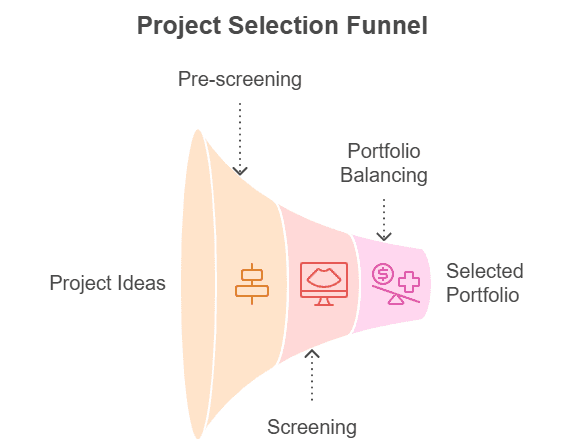
Project selection is the process of assessing the projects with the right tools to ensure they align with your strategic goals and deliver the best performance. This assists you in selecting projects following a hierarchy of priorities.
Project selection happens at the start, when ideas are considered. Every method focuses on two main factors: benefits and practicality. Benefits and practicality are the two factors on which every selection technique is founded. A list of advantageous effects serves as the project’s advantages.
Taking up a project can be done for various reasons, such as economic benefit, social and cultural value, or even to fulfil commitments from prior agreements. The possibility that a project will succeed is what feasibility means in this context. All undertakings include risk, and some are incredibly complicated.
Any project’s feasibility can be established, but it requires time and thorough investigation.
This procedure will be part of the project initiation stage’s feasibility research. To master these decision-making techniques and financial models, CMA project selection training helps you gain both theoretical knowledge and practical application skills.
Check out everything you need to know about the CMA Exam.
Why should you learn Project Selection Methods?
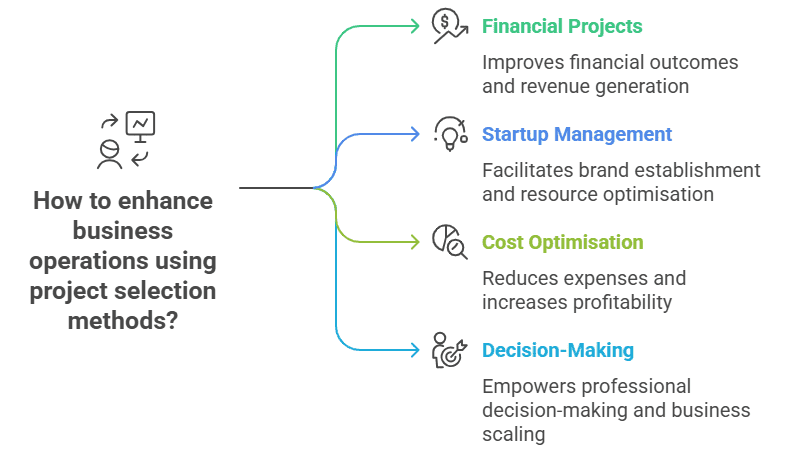
Project Selection Methods can help you enhance financial projects and revenue generation. However, the use cases are not limited to project management, but come with a broader scope of application, right from running large-scale businesses efficiently to managing funds in a new startup.
Suppose you start a new venture on a digital platform with limited tools and infrastructure. These project selection skills will enhance your ability to set the brand from scratch.
When you have a strong understanding of project selection methods, it helps you to optimise costs by choosing the right vendor, the best delivery method, inventory management and everything that is necessary to make the business profitable.
Project selection methods give you the ability to run businesses efficiently, scale them to bigger heights, and empower your decision-making capabilities as a professional.
Who is a CMA?
Using their expertise in management accounting, Certified Management Accountants (CMAs) assist any business in making thoughtful decisions. They are analytically savvy strategic thinkers who use their abilities to increase the overall success of the business they work for. CMAs are employed by businesses, governmental agencies, and other industries.
Most CMAs work in management positions and may go by the titles of:
Financial Planner
Financial Analyst
Corporate Controller
Cost Accountant, or
Chief Financial Officer
As a CMA, one has to fulfil several responsibilities, such as:
CMA professionals aren’t just random cost or management accountants who crunch numbers. Their role is more dynamic and involves:
Strategic decision-making to grow the business.
Leaders who automate and analyse data for forecasting.
Give financial and ethical guidance to the board members.
A Certified Management Accountant uses cost-benefit analysis, discounted cash flow, net present value, and internal rate of return techniques for project selection. These techniques allow you to make informed financial decisions that drive business success. These techniques are part of any CMA preparation program designed to help you apply theory in real-world finance.
Every business has more ideas than it has resources. The tough part isn’t finding projects – it’s deciding which ones are actually worth the time, money, and people it’ll take to pull them off. And here’s the kicker:
According to the Project Management Institute, companies waste over 11% of their investment because they bet on the wrong projects. That’s like throwing away one in every ten rupees.
Michael Porter, the Harvard strategist, summed it up well: The essence of strategy is choosing what not to do.” In other words, success often comes down to saying “no” more than saying “yes.”
Think of project selection criteria like choosing which outfit to buy when you only have enough money for one. You wouldn’t just pick the trendiest one, but rather you’ll think about which one will last longer, which one you’ll wear the most, which one fits you well and what you really need.
Companies do the same with projects. They look at the criteria like cost, profit, risk, and how well a project matches their bigger goals. These criteria make sure the company’s money and time go into the project that gives the best value now and also helps it grow stronger in the future.
How Companies Decide Which Projects to Back
Project selection criteria help businesses choose projects that deliver the most value, balancing costs, optimising risks, and achieving long-term goals to ensure smart, strategic decisions.
What They Check
Plain-English Meaning
Why It Matters
Quick Example
Strategic Fit
Does this move us closer to our big goals?
Keeps the company focused, not distracted.
A renewable energy firm focusing on solar R&D.
Cost & Budget
Can we afford it without breaking the bank?
Avoids over-commitment and financial strain.
Sticking to CAPEX limits for a product upgrade.
Expected Returns
What’s in it for us — money, reach, or impact?
Make sure it delivers real value, not vanity.
Automating tasks to cut future costs.
Risk Level
What could go wrong?
Reduces the chances of expensive mistakes.
Not expanding into a politically unstable market.
Resources on Hand
Do we have the people, skills, and tools right now?
Prevents delays and overwork.
Hiring cybersecurity staff before launching e-banks.
Speed of Results
How soon will we see benefits?
Matters when competitors are moving fast.
Rolling out a digital wallet before Diwali season.
Future Growth Potential
Can this grow with us, or will it hold us back later?
Ensures today’s project doesn’t become tomorrow’s dead weight.
Choosing cloud over old-school servers.
💡 The real trick? It’s never about one single factor. The “cheapest” project might fail if it doesn’t align with the company’s vision. The “highest ROI” project might backfire if risks are ignored.
As Greg Horine, author of Project Management Absolute Beginner’s Guide, puts it: “The best project isn’t always the one with the biggest payoff — it’s the one that balances opportunity with fit and risk.”
So, when companies run through these criteria, they’re not just picking what looks good today. They’re betting on what will make them stronger tomorrow.
Top Project Selection Methods Every CMA Must Learn
As a CMA, you have several responsibilities, such as financial reporting, decision-making, etc. One of the crucial responsibilities is project selection. Listed here are the top project selection methods.
Cost-benefit Analysis
Imagine you’re buying a car. You could get a fancy model that costs ₹20 lakh but barely improves your daily commute, or a reliable car for ₹10 lakh that saves you fuel, maintenance, and time. Which one truly gives you value?
Cost-benefit analysis is a procedure where the project’s investment costs are lower than its benefits. As a result, the current worth of the inflow divided by the present value of the outflow is determined using this method. The highest ratio projects are chosen because they are expected to yield a greater return than the rest.
As a CMA, your job is to spot projects that give your company real value — not just look shiny on paper.
McKinsey found that organisations that systematically use BCA in project selection are 33% more likely to prioritise projects that deliver sustainable ROI. It’s not just number-crunching — it’s about making smarter, strategic bets.
Cost-benefit analysis is a way to weigh a project’s total costs against the benefits it’s expected to bring. It helps CMAs figure out if the investment is really worth it. Projects with a higher benefit-to-cost ratio are preferred.
Cost-Benefit Analysis Case
Let’s assume you can spend ₹50 lakh on a new machine.
It saves money and helps you make more things each year.
If the extra money it makes is bigger than the cost, it’s a good choice – much better than just fixing the old one.
Project
Cost
Expected Benefit
B: C Ratio
Recommendation
New automated machine
₹50L
₹70L/year
1.4
Go ahead
Manual upgrade
₹20L
₹15L/year
0.75
Skip
Tip for CMA: As a CMA, don’t just calculate the ratio. Think long-term: does the project align with strategic goals? Are there hidden costs? BCA is your first filter — not the only one.
Scoring Models
Let’s take an example of choosing which movie to watch on a Friday night. You rate each one for storyline, cast, duration, and reviews. The one with the highest total score wins. That’s essentially a scoring model for projects.
A scoring model lets you rank projects based on multiple criteria — strategic fit, cost, risk, potential benefit, etc. Each criterion is weighted by importance, and the total score tells you which project to pick first.
Scoring models are utilised when the project manager or project selection committee creates a list of project criteria and rates each according to relevance, importance, and priority. This presents a more impartial inspection of the undertaking.
When you’re done, you can rank the projects from best to worst; the project at the top will be the most beneficial and easiest to complete.
Scoring Models Case
Imagine a company has many app ideas.
They give points for things like “Will people want it?” and “How much will it cost?”
A CMA helps make sure the points are fair.
The app with the most points is the one the company should make first.
Project
Strategic Fit (30%)
Cost (20%)
ROI (30%)
Risk (20%)
Total Score
Mobile App
8
7
9
6
7.7
Website Upgrade
6
9
7
8
7.4
Tip for CMA: Even if the app is slightly more expensive, its higher strategic and ROI scores make it the better pick. Weigh the criteria thoughtfully. A project might look great financially, but could misalign with strategic goals. Scoring models help you see the full picture.
Payback Period
Think of buying a coffee machine at home. If it costs ₹5,000 and saves you ₹1,000 a month, you know it ‘pays for itself’ in 5 months. That’s the essence of the payback period for projects.
Payback period measures how quickly a project recovers its initial investment. Shorter payback periods are preferred when cash flow is tight or when fast returns are needed.
The payback period is the ratio of total cash to average cash per cycle. It is the amount of time required to recoup the project’s costs. A basic approach for choosing projects is the payback period. The payback period, as its name implies, considers the payback time frame for an investment. The amount of time needed for an investment’s return to cover its initial cost is called the payback period.
The project payback period (payback period = price of project / average yearly cash inflows) is a tool for estimating the ratio of total cash to average cash period.
Payback Period Case
Suppose a store wants to save money.
One idea is new lights costing ₹10 lakh that save ₹2 lakh each year.
Another idea is a new cash register for ₹8 lakh that saves ₹1 lakh a year.
The lights pay back faster, so they’re the smarter choice if you want quick savings.
Project
Cost
Annual Savings
Payback Period
Recommendation
New Lights
₹10L
₹2L
5 years
Go ahead
Cash Register
₹8L
₹1L
8 years
Skip
Tip for CMA: Use payback period for quick decision-making, but combine it with ROI or NPV for long-term strategic choices.
Net Present Value (NPV)
Would you rather get ₹1 lakh today or ₹1 lakh in 5 years? Clearly, today’s money is worth more. NPV accounts for this difference when evaluating projects.
NPV subtracts the present value of costs from the present value of future benefits. A positive NPV indicates a project will generate more value than it costs.
The project’s net present value is computed as part of this process for choosing the most appropriate project. The current value of the cash inflow minus the current value of the cash outflow is the NPV.
As you select a project, make sure the NPV is favourable. The projects with the highest NPV ought to be chosen.
Even while NPV considers the project’s potential value in years to come, it has several restrictions. First, it does not mention the project’s gains and losses. Second, there is no commonly employed formula for figuring out discounted prices. A US CMA course often uses real-world case studies to show how NPV helps companies make smarter investment decisions.
NPV Case Imagine a pharmaceutical company is choosing between two drug development projects.
One that costs ₹200 crore with a ₹250 crore earning potential, giving ₹50 crore extra.
The other costs ₹150 crore with projected earnings of ₹160, which is ₹10 crore extra.
Even though the second is cheaper, the first one creates much more value, so it’s the smarter choice.
Project
Cost
Expected Future Returns
NPV
Recommendation
Drug A
₹200 Cr
₹250 Cr
₹50 Cr
Go ahead
Drug B
₹150 Cr
₹160 Cr
₹10 Cr
Skip
Tip for CMA: NPV is powerful because it captures long-term value. Always double-check assumptions for discount rates and cash flow projections.
Discounted Cash Flow (DCF)
Money loses value over time — ₹1 today buys more than ₹1 five years from now. DCF adjusts future cash flows to today’s value to make fair comparisons.
DCF evaluates whether a project is worth it after accounting for inflation, risk, and the time value of money. High DCF means the project creates real value today.
This approach accounts for inflation or the likelihood that the same amount of money now won’t be valued the same amount in the future. Therefore, while determining the cost of investment and the return on investment of any potential project or project proposal throughout the project life cycle that you intend to carry out, you must consider the discounted cash flow.
DCF Case
Imagine you get ₹1 crore after 10 years.
It doesn’t feel like the same as ₹1 crore today because money loses value over time.
A CMA uses a method called DCF to figure out how much future money is really worth today, so you can see if a big project is really a good idea.
Project
Future Cash Flow
Discount Rate
Present Value
Decision
Factory Expansion
₹50 Cr in 5 yrs
10%
₹31 Cr
Approve
New Store Launch
₹40 Cr in 5 yrs
10%
₹25 Cr
Skip
Tip for CMA: Use DCF when long-term projects are involved. It’s especially useful for capital-intensive or multi-year investments.
Internal Rate Of Return
IRR is like the interest rate your money earns on a project. If it’s higher than your minimum required return, it’s a winner.
IRR tells you the annualised rate at which NPV equals zero. A higher IRR means better returns relative to the investment.
This method addresses the interest rate where the net present value is zero. (That is when the present value of the outflow is equal to the flow’s present value.) This can also be referred to as the annualised beneficial compounded rate of return or the discount rate that results in a zero net present value for all of your investment’s cash flows.
IRR is the rate that tells you when a project will start really paying off. It helps you spot which projects will give the best returns and set the company up for long-term success. CMAs use IRR to quickly compare investment options and prioritise those exceeding the company’s required rate of return.
This approach helps you pick the project that will give the company solid financial gains now, while also setting it up for long-term success.
IRR Case
Imagine you have two startups to invest in.
One could earn 25% extra each year, the other 18%.
If you want at least 20% extra, you’d pick the first one.
A CMA helps figure out which choice gives the best return.
Project
IRR
Required Rate
Decision
Startup A
25%
20%
Go ahead
Startup B
18%
20%
Skip
Tip for CMA: IRR is a quick comparison tool, but be careful with projects with uneven or non-standard cash flows.
Economic Model
EVA shows whether a project actually creates wealth above its cost of capital — not just profit on paper.
EVA, or Economic Value Added, is an indicator of performance that determines the return on capital while calculating the value an organisation creates. It can also be described as a net profit after subtracting taxes and capital expenses.
EVA = Net Profit – Cost of Capital.
Projects with higher EVA generate more real value, even if profits are lower. When a project manager is given several projects, the one with the highest Economic Value Added is chosen. The EVA is never expressed as a percentage but rather in numerical terms.
EVA Case
Suppose there are 2 Units.
Unit P has a net profit of ₹50 crore, but its capital cost is ₹45 crore. Its EVA is ₹5 crore.
Unit Q has a net profit of ₹40 crore, with a capital cost of only ₹25 crore. Its EVA is ₹15 crore.
A CMA using EVA would recognise that Unit Q, despite having a lower absolute profit, is generating a higher return above its cost of capital.
This helps allocate resources to truly value-creating segments.
Unit
Net Profit
Capital Cost
EVA
Decision
P
₹50 Cr
₹45 Cr
₹5 Cr
Skip
Q
₹40 Cr
₹25 Cr
₹15 Cr
Approve
Tip for CMA: EVA is ideal for strategic capital allocation. It highlights value creation beyond simple profit figures.
Compare Project Selection Methods
Let’s take a closer look at the different project selection methods and see how each one helps CMAs to choose the right projects with confidence.
Method
What is it?
Best Used
Key Benefit for CMAs
Cost-Benefit Analysis
For comparing the total project costs with its benefits.
For projects with clarity, quantifiable costs and benefits.
Helps to determine overall financial viability; helps prioritise high-return projects.
Scoring Models
It ranks projects based on weighted criteria like market demand and feasibility.
When multiple, complex projects need objective comparison.
Provides a balanced, multi-factor evaluation beyond just financials.
Payback Period
Time required to recoup initial investment.
For projects prioritising quick returns or with cash flow constraints.
Simple and quick assessment of short-term liquidity.
Net Present Value (NPV)
It’s the present value of cash inflows minus the present value of cash outflows.
For long-term projects where the time value of money is a crucial factor.
Quantifies the actual value added to the company in today’s terms.
Discounted Cash Flow (DCF)
Valuing future cash flows in today’s money.
For long-term investments, the valuation of companies/projects.
Accounts for inflation and the opportunity cost of money over time.
Internal Rate of Return (IRR)
Discount rate where NPV equals zero.
Comparing projects with different initial costs or cash flow patterns.
Shows the percentage return a project is expected to generate.
Economic Model (EVA)
Net profit after taxes and cost of capital.
For assessing the true economic value created by projects/units.
Highlights projects that generate returns above their cost of capital.
Remember, no single method works for every project. CMAs often use two or three together. For instance, you might check the payback period for short-term viability, then run an NPV analysis for long-term impact. Think of it as using both X-rays and MRIs before a surgery — one tool gives clarity, but together, they give confidence.
FAQs About Project Selection Methods
Here are some frequently asked questions to help you better understand project selection methods:
What is the purpose of using project selection methods?
The purpose of using project selection methods is to help businesses and professionals systematically evaluate potential projects to identify the most financially and strategically viable projects to align projects with organisational goals.
CMAs use it for optimising available resources efficiently, which minimises the project risks, maximises returns and revenue, and supports decision-making backed by data-driven reports. In short, these methods ensure that the projects undertaken deliver the highest value and best performance for the company.
Who uses project selection methods?
Professionals responsible for project decisions use project selection methods. Some professionals who use project selection methods are:
Certified Management Accountants (CMAs) – to make informed financial and strategic decisions.
Project managers and selection committees – to evaluate, rank, and choose projects objectively.
Business leaders and financial analysts – to allocate resources efficiently and maximise returns.
Which project selection method is best?
There isn’t any particular best project selection method. CMAs choose based on project type and goals, using Payback Period for short-term projects and NPV or DCF for long-term ones, often combining methods for smarter decisions.
Why should CMAs learn project selection methods?
Project selection methods basically help CMAs make smarter decisions backed by data. They show you how to keep costs in check, get the best returns, and choose projects that really support the company’s bigger goals.
What is an Economic Value Added (EVA) approach?
EVA basically tells you if a project or business is really making money after covering taxes and the cost of the money invested. It’s a way to see if the project is truly adding value to the company. Projects with higher EVA are preferred, as they create more value above their financing costs. It helps CMAs allocate resources to segments that truly generate value, even if absolute profits are lower.
Can project selection methods be applied beyond corporate finance?
Yes. Project Selection Methods can be used beyond corporates in startups, digital ventures, government projects, NGOs, and anywhere resource allocation and investment decisions are critical. The principles help optimise decisions for inventory, vendors, delivery methods, and overall business profitability.
How can I gain hands-on experience with these methods?
Enrol in a CMA course, such as Imarticus Learning’s program. Courses provide case studies, simulations, and practical exercises to apply project selection techniques in real-world scenarios.
The bottom line when discussing the financial advantages of any project is a higher return on investment (ROI), which is produced by effective project selection. The project selection process includes evaluating the advantages and viability of your project ideas. Understanding these project selection methods becomes much easier under guidance.
As a CMA, it is essential to understand the concepts of decision analysis and financial reporting properly.
Are you ready to build your CMA career?
Join Imarticus Learning’s Certified Management Accountant course today and gain hands-on training in project selection methods to get a head start in your career. This CMA preparation program has been created for anyone who wants to build a successful career as a Certified Management Accountant.
Imagine you’re running a business and you want to save money while still getting the best goods and services possible. That’s where procurement management comes in!
Procurement management is an important part of running any business. When done well, it can help a company get the best possible goods and services for the best price, quality and quantity. This can have a big impact on how profitable and successful the company is overall.
If you’re thinking about getting into a career in procurement, you might want to know what you need to do to get started. This article is about the importance of buying things for a company and how buying things well can help a company. It will also talk about what you need to do to get started in a career in procurement.
Procurement Management Courses
Procurement management courses cover key topics needed to manage procurement in an organisation, including procurement strategy, supplier management, contract negotiation and risk management. These courses equip students with the skills and knowledge to make effective decisions and obtain quality goods and services for their organisation.
That sounds great! Isn’t it? So, what types of procurement management courses are available?
Different types of procurement management courses are available, ranging from short-term certificate courses to full-time postgraduate programmes. Some courses are offered online, while others are taught in a traditional classroom setting. This means that there are plenty of options to choose from depending on your goals and schedule.
Online procurement management courses help you learn job-oriented skills even while working. Imarticus is a top learning platform that helps students and professionals learn essential 21st-century skills. The professional certification in supply chain management & analytics is an advanced curriculum course offered by IIT Roorkee. It covers tools and languages like Microsoft Excel, Tora and Python.
Benefits of Professional Certification in Supply Chain Management & Analytics
This course is designed to help you learn new, job-oriented skills that can help you grow in your current job or even find a new job opportunity.
You’ll receive a certification from IIT Roorkee, which is recognised by many top companies. That can be really helpful when you’re looking for a new job or trying to advance in your current career.
To help you succeed, the course also includes 1:1 mentoring sessions with industry experts. This can be a really valuable opportunity to get personalised advice and guidance as you work through the course material.
Finally, the course includes a 3-day college immersion programme where you’ll learn from IIT faculty in real classrooms. This can be a great way to get hands-on experience and learn from some of the best experts in the field!
Qualification for Procurement Management Courses
Short-term courses usually have pretty minimal requirements for entry, but postgraduate programmes might require you to have a bachelor’s degree in a related field. Here are some of the qualifications you might need to consider:
High School Diploma: Some short-term certificate courses may only require a high school diploma or equivalent qualification.
Bachelor’s Degree: Postgraduate programmes may require a bachelor’s degree in a relevant field like business administration or supply chain management.
Work Experience: Some procurement management courses may require work experience in procurement or a related field.
Professional Certifications: There are several professional certifications available in procurement management, such as the Certified Professional in Supply Management (CPSM) and the Certified Purchasing Professional (CPP). These certifications can be an excellent way to demonstrate your expertise in the field and may be required for some procurement management courses.
Benefits of Obtaining a Procurement Management Qualification
There are several benefits to obtaining a procurement management qualification, including:
Getting a procurement management qualification can offer many benefits, such as helping you stand out from other candidates for procurement management jobs.
With this qualification, employers see your commitment and knowledge of the field, which can lead to a higher salary, too. According to Ambition Box, the average salary for a procurement manager in India is 11.3 lakhs per year.
Additionally, you’ll learn more about the procurement process, which can make you a more effective negotiator and manager.
Finally, procurement management courses can help you connect with others in the industry, giving you networking opportunities and potentially leading to new job prospects.
Procurement Management Course: Next Milestone
Procurement management is crucial to any organisation. A procurement management qualification can provide you with the knowledge and skills needed to manage procurement effectively. The qualifications required for a procurement management course depend on the course type. Generally, a high school diploma or bachelor’s degree in a relevant field, work experience or professional certifications may be required.
Is your company ready to deal with attacks from within? Although unpleasant, the subject must be posed in today’s digital era. While we frequently consider external threats to be the main risk to our organization, the truth is that insiders might be just as dangerous as outsiders.
Insider threats may have major repercussions, from data breaches to reputational injury, whether from a malicious employee or simply a well-meaning team member who makes a mistake.
The primary dangers and difficulties that businesses confront, as well as useful advice and tactics for reducing these risks, will all be covered in-depth in this post on insider threats to an organization.
What are insider threats?
Internal threats are malicious or careless acts committed by individuals accessing a company’s system, data, or network. These behaviors may lead to bodily hurt, financial losses, reputational damages, legal repercussions, and even data breaches.
Insiders may gain access to computer systems through valid accounts initially granted to them for work-related purposes; nonetheless, these rights might be exploited to harm the company. Insiders frequently thoroughly understand the company’s data and intellectual property and the safeguards to secure them.
The insider will find it simpler to review any security measures they know. The insider is already inside the building, frequently with direct access to the organization’s internal network. This eliminates the need for them to breach the firewalls at the organizational perimeter to access data.
Types of web threats for Organizations in cyber security:
At their most basic level, insider risks originate from within your business. End users with elevated access put your network and data in particular danger. Users may have access controls and special knowledge of internal processes and procedures that allow them to move about without arousing suspicion, making insider threats difficult to defend against.
As a result, insider assaults frequently aren’t discovered until after the breach. Three main types of insider threats to an organization:
Unintentional Threat
Negligence: By acting negligently, a person with this inside knowledge puts a corporation in danger. Careless insiders are typically aware of security and IT rules but ignore them, endangering the company. A few examples include failing to follow instructions to install security updates and upgrades, allowing someone to “piggyback” past a secured entrance, losing or misplacing a portable storage device with confidential information, and more.
Accidental: An insider of this type puts a firm in danger without intending to. Examples include accidentally accepting a virus-filled attachment in a phishing email, entering the wrong email address, and sending a secret business document to a competitor. Another example is improperly destroying private information.
Intentional Threats
The term “malicious insider” is frequently used to describe an insider acting maliciously. Threats to harm a company for personal gain or to address a personal issue are known as intentional threats.
For instance, a perceived lack of acknowledgment (such as a promotion, incentives, or coveted vacation) or firing motivates many insiders to “get even.” In a vain attempt to advance their careers, they may leak confidential information, annoying coworkers, sabotage machinery, use violence, or steal confidential information or intellectual property.
Other threads
Threats of Collusion – Collusive threats are a subclass of hostile insider threats in which one or more insiders work with an outside threat actor to undermine an organization. In these cases, hackers usually enlist one or more insiders.
Preventing Insider Threats: Best Practices for Businesses
Insider threats are not easy to detect or prevent, as they often exploit insiders’ trust and access within the organization.
However, there are some insider threat prevention strategies that organizations can take to reduce the likelihood and impact of insider threats:
Conduct background checks and security clearances for all employees and contractors accessing sensitive data or systems.
Provide regular security awareness and training programs for all employees and contractors on phishing prevention, password management, data protection, and policy compliance.
Implement a strong identity and access management system that enforces the principle of least privilege, meaning insiders only have access to the minimum amount of data and resources needed to perform their tasks.
Monitor and audit user activity and behavior on the network and systems using tools such as user and entity behavior analytics, security information and event management (SIEM), and data loss prevention (DLP).
Establish a clear reporting mechanism and a culture of trust and transparency that encourages employees and contractors to report any suspicious or anomalous activity or behavior they observe or experience.
Respond quickly and effectively to incidents or alerts involving insider threats using a predefined incident response plan outlining roles, responsibilities, procedures, and communication channels.
Conclusion
Insider risk and cybersecurity are serious and growing challenges for organizations of all sizes and industries. They can cause significant damage to an organization’s reputation, finances, operations, and security.
Therefore, organizations must adopt a proactive and comprehensive approach by combining people, processes, and technology to prevent insider threats. By doing so, organizations can protect their most valuable assets and ensure long-term success.
Imarticus Learning PG Program in Cybersecurity, developed in partnership with industry professionals, offers students interested in a career in cybersecurity a top-notch educational opportunity. This program’s six-month duration and thorough instruction will equip you for various positions, such as cybersecurity analyst, penetration tester, incident handler, and SOC team specialist.
Are you interested in learning about the duties of a Chief Marketing Officer (CMO) and how they affect a business’s success?
A senior executive, a chief marketing officer (CMO), manages a company’s marketing plans, programs, and initiatives. They are essential in developing a brand’s identity, fostering income growth, and guaranteeing client happiness.
The main duties of a CMO, the qualifications needed for the position, and the potential effects they may have on a company’s bottom line will all be covered in this blog. Whether you’re a marketing expert seeking to enhance your career or a company owner interested in the role of the Chief Marketing Officer, then this post will be helpful for you. Let’s get started!
How Does a CMO Contribute to a Company’s Success?
A C-level corporate executive known as a “chief marketing officer” (CMO) is in charge of all operations inside a company related to developing, disseminating, and delivering solutions that are valuable to clients, customers, or business partners.
The main responsibility of a CMO is to assist growth and boost sales by creating a complete marketing strategy that will boost brand awareness and provide the company with a competitive edge. CMOs are outstanding leaders who represent the customer’s voice throughout the organization to accomplish their objectives and effectively influence the public image of their firms.
A chief marketing officer is a business leader overseeing a company’s marketing initiatives. The creation and execution of marketing strategy and plans are the CMO’s responsibility. To promote the company’s goods or services, they handle all marketing facets, including market research, product development, advertising, public relations crisis management, and sales.
Salaries and pay scales
According to PayScale, the remuneration package for a Chief Marketing Officer headquartered in the US may range from a reasonable $85,000 to an amazing $315,000, which is a big variation.
Of course, several variables, such as the CMO’s degree of expertise, the location of the organization, and its size, impact this compensation range. However, on average, CMOs in the US may anticipate earning a yearly salary of about $170,000, plus attractive commissions, profit-sharing options, and incentives. Overall, it is evident that the position of a CMO entails not just great responsibility but also great financial advantages.
What Does a CMO Do?
A CMO has several duties and many hats to wear. Among the prominent ones are:
Creating and implementing the company’s marketing plan, including branding, messaging, target markets, distribution methods, campaigns, and KPIs
Taking the helm of and overseeing the marketing team may entail diverse responsibilities, including PR, events, product marketing, content marketing, digital marketing, social media marketing, and email marketing.
Determine the company’s position in the market utilizing both conventional techniques and more recent technology, such as data analytics
Identify the company’s future positioning
Create a plan to lead the company to that desired future market position, then implement that strategy.
Top-line outcomes are anticipated from the CMO’s job, with marketing initiatives increasing brand recognition, loyalty, and awareness, eventually resulting in higher sales.
Working with other departments, including sales, product development, customer support, and operations, to ensure that marketing activities and initiatives are coordinated and integrated
Examining and reporting on marketing initiatives’ success and return on investment, utilizing data and insights to enhance and boost marketing effectiveness.
What Skills Are Needed for a Successful Career as a CMO?
For a CMO to be successful in their position, they must possess both hard and soft talents. Among the crucial abilities are the following:
Marketing knowledge: A CMO must thoroughly know all marketing theory and practice facets. They must be able to develop and implement marketing strategies that produce results for the business and value for customers. They also need to be knowledgeable about the newest equipment and innovations in technology that support automation and innovation in marketing.
Leadership abilities: A CMO must be able to guide and motivate both their staff and their colleagues. They must successfully explain their vision and direction for the marketing department.
Business acumen: A CMO must have a solid understanding of the company’s goals and difficulties in running its business. They must link marketing objectives to corporate objectives and show how marketing affects revenue. Additionally, they must be capable of successfully and efficiently managing the marketing budget and resources.
Analytical abilities: A CMO must possess the capacity to gather, examine, decipher, and communicate facts and insights that guide marketing decisions. The effectiveness and (ROI) return on investment of marketing operations, and initiatives must be measured and reported. Additionally, they must be able to use data to recognize market possibilities and risks so that they may modify their marketing plan.
The Final Words
To succeed, decoding the Role of a Chief Marketing Officer calls for a special fusion of strategic thinking, great leadership skills, and in-depth marketing expertise. You may better understand the value a CMO brings to a business if you know their tasks and difficulties.
If you want to improve your abilities as a future marketing executive, you should think about enrolling in Imarticus Learning’s advanced CMO training course. The goal of this 10-month online program is to develop the strategic, operational, and technology leadership capabilities of mid to senior-level marketing professionals better to prepare them for the position of CMO.
This program gives a singular chance to exchange ideas and create useful strategies with notable faculty and a campus immersion program at IIM Raipur.
Object detection is a vital component of today’s time that incorporates various sensors and computer vision to observe and identify objects accurately. Computer vision technology is known for its flexibility and has expanded much in recent years. It has become essential to incorporate Artificial Intelligence (AI) and Machine Learning for those aspiring a career in data science. Computer vision technology is based on concepts such as CNN (Convoluted Neural Networks) and deep learning.
The real-world applications of object detection in image processing can be seen in many crucial areas of our lives, such as medical imaging, video tracking, movement detection, facial recognition, and object recognition, even in autonomous vehicles.
How Does Object Detection Work?
Object detection is a computer vision technique that aims to locate and identify objects within an image or video. Object detection also allows the detection of objects or targets from a visual feed in real-time. The process involves steps designed to recognise and label the distinct entities in the graphical data.
Benefits of Object Detection
Here are the benefits of object detection and computer vision technology:
Reliability and Accuracy: Object detection techniques and algorithms have progressed in accurately determining complicated objects and providing accuracy in various fields, including medical imaging or identifying tumours, number-plate recognition, and text detection.
Budget-friendly: Object detection is affordable and prevents fraud by automating processes and creating technical efficiency. It improves inventory management and contains errors in businesses and manufacturing units.
Safety and Security: Object detection helps strengthen safety and security by identifying and determining threats and intruders. It is crucial for public safety and vehicles, tracking fraud and intruders, detecting potential threats, and avoiding road accidents.
Efficiency: Object detection caters to automation and incorporates object recognition and identification. They enhance efficiency by diminishing manual process intervention requirements, including inventory management and quality control.
Customisation and Recommendation: Object detection accurately detects and understands activities and enables customised experiences based on user preferences.
Accessibility: Object detection caters to enhancing accessibility and inclusivity. By catching and understanding objects, applications can assist and support individuals with visual impairments, enabling them to navigate their surroundings more independently.
Real-World Applications of Object Detection
Here are some of the real-world applications of object detection:
Vehicles: Object detection is vital for cars to understand the surrounding environment and aids in determining and identifying pedestrians, traffic signals, zebra crossings, obstacles, and other vehicles. Object detection enables safe navigation in autonomous vehicles and prevents car accidents.
Surveillance and Security in Airports, Banks, Organisations, etc.: Object detection caters to image and video surveillance systems and enables safety and security in financial institutions, airports and railway systems. It detects suspicious activities of intruders or unauthorised objects and assists in securing public arenas and industries.
Retail Markets and Manufacturing Units: Object detection in image processing focuses on inventory management and recognises the product with a scanner and barcode reader in retail shops. It helps identify warehouse stock levels, track misplaced items, and determine the product’s original price.
Automation in Factories and Manufacturing Units: Object detection is used to detect defects, identify product placement, and sort objects. It assists in identifying defective components in industrial units and optimises product consistency.
Social Media Platforms: Object detection is also utilised in social media platforms to identify sensitive content and aids in determining the violation of community guidelines.
Wildlife Monitoring and Conservation: Object detection tracks wildlife species and extinct animals. It helps to monitor and establish environmental conservation strategies.
Conclusion
Object detection and computer vision technology have become a daily need and have played a more significant role in the data science industry. Object detection is a fundamental technology for healthcare diagnosis, advanced identification, and robotic interaction.
A career in data science is considered an up-and-coming field that creates successful professions worldwide. To choose a professional career in data science, you need to pursue a data science course. The Postgraduate Program In Data Science And Analytics by Imarticus is a one-stop destination for data science, data presentation, SQL programming, Excel Formulae, and Python Programming.
This data science course provides 300+ learning hours and practical exposure with the help of 25+ real-world projects. The data science training program also focuses on concepts such as computer vision technology with the help of these real-world projects.
Frequently Asked Questions
What kind of data is needed for object detection?
Ensure your dataset includes at least five images, each clearly labelled with the identified object. For instance, if the aim is to train the dataset to recognise cars, assign the “car” label to at least five images.
Which algorithm is used for object detection?
Object detection is commonly achieved through various algorithms, with popular choices including Convolutional Neural Networks (such as R-CNN and Region-Based Convolutional Neural Networks), Fast R-CNN, and YOLO (You Only Look Once). R-CNNs belong to the R-CNN family, while YOLO is associated with the single-shot detector family.
Why consider a career in data science?
Harnessing the power of data science can enhance our daily lives, redefine how we work, and enable individuals to make informed decisions, solve challenges, unearth innovations, and tackle some of the most critical global issues. A career in data science positions you to contribute actively to this transformative journey.
Accurate forecasting is crucial for organisations to stay ahead of the competition in the quickly changing business world of today. Significant insights that can inform strategic decision-making and help firms adapt to changing market conditions can be found by analysing and interpreting large amounts of data. Here, forecasting—the process of predicting future patterns and outcomes using data analytic techniques—comes into play.
We’ll delve thoroughly into the fascinating topic of forecasting in this article. You’re in the proper place regardless of your level of forecasting expertise or experience. We would like to impart some insightful knowledge to you before you enrol in a business analytics course. So let’s get started now!
What is Forecasting?
In order to produce educated predictions regarding future trends, forecasting is a widely employed strategy in the business sector. By assigning budgets and foreseeing expenses based on expected demand for goods and services, this method aids organisations in planning ahead. Businesses can improve their overall strategic planning and make better judgements by using forecasting. In order to support an organisation’s long-term growth and success,a BBA business analytics course can be extremely important.
Quantitative Techniques in Business Forecasting
Using quantifiable information like statistics and past data, quantitative forecasting focuses on projecting future patterns over the long term. This method can produce more precise forecasts about the future by analysing historical performance to find trends and rates of change. Businesses particularly benefit from this kind of forecasting because it gives them the ability to more accurately predict future demand for their products and services, helping long-term planning. Several of the most popular quantitative models that you may learn in a business analytics course are as follows:
Trend Analysis Method:
The Trend Analysis Method, also referred to as “Time Series Analysis,” is a widely used forecasting technique that relies on past data to predict future events. This method excludes outliers and gives greater weight to more recent data, making it particularly effective when there is a substantial amount of historical data demonstrating clear and stable trends. Due to its cost-effectiveness and reliability, it is considered the most common forecasting method used by businesses.
Econometric Modelling:
In order to evaluate data consistency over time and relationship significance, econometric modelling employs several regression models. It helps in foreseeing important economic changes and how they will affect a company. By using this strategy to analyse past data, businesses may make wise decisions.
Indicator Approach:
The Indicator Approach utilises leading indicators to estimate the performance of lagging indicators by examining their relationship. Lagging indicators are a type of KPI that measures business performance after the fact, offering insights into how business strategies have impacted results.
Qualitative Modelling Methods
In order to evaluate data consistency over time and relationship significance, econometric modelling employs several regression models. It helps in foreseeing important economic changes and how they will affect a company. By using this strategy to analyse past data, businesses may make wise decisions.
Market Research Model:
The market research approach calls for performing in-depth market research, which includes asking a wide range of questions of both present and potential customers as well as staff members to gain their feedback. By examining the attitude of their target market, businesses can predict the results of the introduction of a new product. This method aids in marketing success and corporate strategic direction.
Delphi Model:
A common tactic is to put together a group of specialists and request their input on a certain topic. After reviewing these estimates, businesses can provide an objective evaluation. This strategy can provide illuminating data and aid in guiding decision-making for a range of business-related challenges.
Components of a Business Forecasting System
Forecasts are utilised by businesses to formulate their strategies and plans. Engaging in business forecasting itself can facilitate proactive thinking and preparation for what lies ahead. Therefore, it holds immense significance in predicting and planning for the future. James W. Redfield has outlined the essential components of the forecasting procedure as follows:
Preparation of the Groundwork:
Before starting any procedure, it is essential to conduct in-depth research about the company you are working with, the services they offer, and the industry they serve. This means closely analysing both their past success and their prospects for future development. It’s a crucial phase, therefore you shouldn’t skip it!
Establishment of the future business:
When a company is predicting the future, looking at the data and feedback from the past might assist uncover prospective outcomes. It’s important to keep in mind that the organisation’s senior leaders provide this data, therefore they must be included in the process. As the ones ultimately in charge of ensuring that the forecasts are met, their involvement is crucial to producing an accurate projection.
Comparing the actual and estimated result:
When businesses do forecasting over a period of time, it sets a benchmark for what they expect to happen. Later, when they compare those forecasts to the actual outcomes and growth, it can help them investigate and analyse any deviations. This is especially important if there are big differences between the two. By doing this, businesses can better understand why things didn’t turn out as expected and make adjustments for the future.
Refining the Forecast process:
Once the management team becomes more adept at using forecasting to predict the future of their company, they can improve their forecasts to make them more accurate. In the event that the circumstances alter while they are evaluating, they can do this by adding new variables to their estimates. In this manner, they are able to change with the situation and make sure their forecasts are as precise as possible. Learning as they move along and constant development are key!
Selecting the Best Forecasting Technique
The best forecasting approach will vary depending on the specifics of the forecast you’re doing. The forecasting approach you use depends on the kind and extent of your forecast. There are various forecasting approaches.
An approach for predicting known as qualitative techniques is renowned for its excellent accuracy. When the forecasting window is small, such as when attempting to predict how the public will respond to a new product, it is frequently utilised. Businesses can use these methods to strengthen their product decisions by taking into account aspects like client preferences and feedback. As a result, businesses may be able to better tailor their offerings to the needs and preferences of their target market.
When companies need to swiftly assess a larger variety of data, they commonly use quantitative forecasting approaches. These methods investigate enormous data sets using statistical software programmes in a matter of minutes or seconds. However, the amount and complexity of the data that needs to be analysed can affect the cost of the analysis.
Because of this, forecasters frequently have to balance the benefits and drawbacks of each technique to decide which will produce the best accurate forecast in the shortest amount of time. In some cases, it might even be advantageous to mix various techniques to increase the forecast’s dependability. Finding the ideal balance between cost and precision is crucial!
Benefits of Business Forecasting System
Your organisation can profit greatly from having a business forecasting system. It can, for one, assist you in developing data-driven plans and in making educated judgements. You can base financial and operational choices on the state of the market at the time and projections of what the future will bring with a strong forecast.
One of the best things about forecasting is that it enables you to take a proactive rather than a reactive approach. You can set up your business to take advantage of fresh opportunities or reduce hazards before they become serious problems by anticipating prospective market developments. This might assist you in maintaining a competitive edge in your sector and staying one step ahead of the competition.
Limitations of Forecasting
Because forecasting involves speculating about the future, which is inherently uncertain, this is its main drawback. Forecasts are therefore just educated guesses. The underlying assumptions and data utilised in the models must be accurate, even if there are many ways to improve forecast accuracy.
In essence, forecasting’s primary difficulty is that it requires making predictions based on incomplete data. There will always be some degree of uncertainty and risk involved, even though we may use statistical techniques and other tools to increase the accuracy of our forecasts. In the end, we can only make the best predictions we can based on the data we have available.
Conclusion
Are you ready to improve forecasting inside your company and provide more accurate predictions? To be successful, forecasting methodologies must be used correctly and combined with the management team’s knowledge.
The effectiveness of your forecasting process depends on this partnership. Imarticus Learning’s certified BBA Business Analytics course can be of interest to you if you’re trying to improve your knowledge and abilities in forecasting with data in business.