As an accounting professional, having a solid knowledge of trial balance is imperative. Accounting errors are common in businesses and it is crucial to find them at the earliest before they cause any harm to the company. Professionals handling accounting with investment banking are well aware of such instances.
Trial balance is one of the best ways in which this problem can be handled. This balance is vital for businesses that use accrual accounting. This means that the credit and the debit amounts must match one another. In case there is a mismatch, it indicates an error in the books. With a trial balance, you can find out and get to the roots of the error in double-entry accounting books.
Understanding what is a trial balance?
A business might have different accounts. A trial balance can be defined as a statement where there is a record of the final ledger balance of the various accounts in a business. The two columns in a trial balance are debit and credit. In the final report, you can see if the debit and the credit equal one another at a given point in time. If the debits and credits do not match the trial balance, it indicates errors.
The trial balance is prepared annually during year-end. It is used for preparing balance sheets or financial statements like profit and loss accounts. The main purpose that a trial balance serves is to ascertain the mathematical accuracy of the various business transactions which are recorded in the ledgers of the company.
Common errors in a trial balance
A trial balance might have unequal debits and credits. This is due to some errors. Any graduate program for commerce lists these as some of the most common errors in a trial balance:
Transposition errors
Such errors happen when the order of two or more numbers reverses while recording a transaction. For instance, 16 gets recorded as 61 or 36 gets recorded as 63 and so on.
Errors of omission
It is evident from the name that in this error, you forget to record an accounting entry into the books.
Reversing entries
This is one of the most dangerous errors where there is a switch in the account to be credited and the account to be debited.
In case the debits and the credits don’t match, don’t be anxious. The main objective of a trial balance is to find the loophole and fix it so that you have accurate accounting books at the end of the financial year. While closing your books, preparing a trial balance is mandatory.
Preparing a trial balance
When you are looking to prepare a trial balance, you can choose from the below-mentioned three methods:
Balance method
In this method, every ledger account’s final credit/debit balance is used in the trial balance. Once you list the balance figures of all the accounts, the trial balance helps in checking the accuracy of all the transactions. This is for both the debit and the credit side. This is the most popular method for preparing a trial balance.
Total method
This method records each and every ledger account’s final credit/debit columns to the trial balance. Both columns should have the same values and be equal as this method follows the double-entry bookkeeping method.
Total plus balanced method
It is evident from the name of the method that it combines both balanced and total methods. There are four columns in the trial balance – two for the debit and credit totals of a ledger account and two for the account’s debit/credit balances.
Different types of trial balance
You are mistaken if you think business owners prepare trial balances just once towards the end of the financial year. The fact is that they prepare it many times during the accounting cycle. While closing the books, you have to use three trial balances – one each for three different stages in the cycle. This helps in balancing credits and debits always.
Let us look at the different types of trial balances:
Adjusted trial balance
In this, you can see the final balances in the general ledger accounts after you are done with adjusting entries.
Unadjusted trial balance
This displays the balances in the general ledger account before you finish adjusting the entries.
Post-closing trial balance
This is the account balance after you complete closing the temporary accounts.
The importance of trial balance in closing the books
As an individual handling accounting with investment banking, you must be well aware of the importance of trial balance in closing the books. People have a misconception that a trial balance and a financial statement are the same. They are not. The trial balance is more of an internal report.
Here are some reasons why a trial balance is important for closing the books:
Step for preparing a financial statement
Though a trial balance is not a financial statement, it is definitely the stepping stone for preparing a financial statement. The majority of accountants use this trial balance sheet as the base while preparing the final financial statement.
Implementation of the double-entry concept of bookkeeping
In trial balances, the double-entry method of bookkeeping is implemented. There is a corresponding credit entry in the credit column against all recorded entries in the debit column.
As there is the recording of all the entries from the different ledgers of the organisation, it is easy to identify and rectify errors if any.
Detailed information on accounting transactions
With a trial balance, you can make out if the account balances are extracted accurately from the accounting ledgers. Moreover, it also provides an overall view of the company’s accounting transactions. Before scrutinising the ledgers, auditors can analyse the trial balance.
Conclusion
Even though there are many solutions for detecting and rectifying accounting errors, the trial balance remains an integral part of all accounting processes. It is a crucial procedure when it comes to the closing of books of accounts in any organisation. A student pursuing commerce at the graduation level will surely learn about trial balance and its various uses and applications.
If you are interested in pursuing a graduate program for commerce, you can enrol on Imarticus Learning’s B.Com from Rathinam College of Arts & Science. This is a 3-year full-time course including leading programmes with 2 specialisations – Professional Accounting with Investment Banking and Banking & Insurance with Financial Analysis. The course provides critical insights into financial analysis, corporate finance, valuation and modelling.
A hidden tool that converts complicated data into insights, equations into plans, and uncertainty into calculated conclusions is at the core of every successful financial expert. Microsoft Excel, the unsung hero of the finance world, is a vital tool.
Imagine easily analyzing huge datasets to find hidden trends, quickly solving complex financial riddles with a few keystrokes, and producing dynamic reports that astound subordinates and superiors. Welcome to the Excel formulae and functions world, where graphs tell tales and numbers come to life.
Understanding Excel’s capabilities in-depth is not simply a choice in today’s fast-paced financial environment; it is a need. Harnessing Excel’s power may advance your career to new heights, whether you’re a budding analyst hoping to get into the financial field or a seasoned CFO running a large firm.
In this blog post, we began an exciting adventure into Excel functions and formulas, learning why they form the basis of a successful financial profession. Get ready to be enthralled by tales of spreadsheets transformed into strategic roadmaps, formulae that unlock financial insights, and functions that solve the riddles of risk and return.
Are you prepared to improve your financial skills? Buckle up as we dive headfirst into the exciting world of Excel mastery, where numbers speak and sing the harmonious tune of financial success.
Why are Excel functions and formulas crucial for a successful finance career?
MS Excel is one of the world’s most widely used software applications, especially in finance. Whether you’re an accountant analyst, auditor, consultant, or manager, you’ll need to use Excel daily to perform various tasks such as data analysis, financial modeling, budgeting, forecasting, reporting, and more.
Excel is a great tool that can handle large amounts of data, perform complex calculations, create charts and graphs, and automate workflows. It can also integrate with other applications and tools like Power BI, SQL, Python, and VBA. In short, Excel is a versatile and indispensable tool that can help you solve any finance problem and deliver high-quality results.
Due to its adaptability and familiarity, MS Excel has long been a commonly utilized tool in banking. It includes various features and capabilities that are especially well-suited for data processing, modeling, and financial analysis. It is not, however, inextricably linked to finance. A flourishing finance career is within your reach if you have strong Excel skills.
What is the role of Excel expertise in flourishing in the finance industry?
While Excel continues to be a go-to tool for many financial professionals, the sector has also witnessed the introduction of more specialized and potent applications made only for the finance sector.
Excel’s strengths in finance include its ability to create complex financial models, perform calculations, visualize data through charts and graphs, and manage large sets of financial data. Its spreadsheet structure is ideal for financial studies, forecasting, the creation of financial statements, and budgeting.
The financial sector has developed, and there are now substitutes and complementary technologies that provide more sophisticated skills, particularly for jobs involving big data analysis, risk management, algorithmic trading, and more complex financial modeling. Programming languages like Python and R, specialist financial software, and business intelligence platforms are a few of these technologies.
Excel is still a useful tool in finance, but they are still separate. The particular requirements and complexity of the task frequently influence the choice of tools.
Significance of mastering Excel functions in the finance industry
For various reasons, mastering Excel features is essential in the banking sector. Financial Modeling with Excel functions is an important tool that can be used to analyze data, create forecasts, and make informed decisions.
Excel functions enable financial professionals to examine enormous datasets swiftly, carry out intricate computations, and produce precise reports. This is essential for jobs like budgeting, financial modeling, risk analysis, and performance review.
Productivity and Efficiency: Using Excel functions proficiently allows for quicker and more accurate data processing, which cuts down on the time and effort needed for common activities. This increases output and frees financial experts to concentrate on more valuable and strategic tasks.
Financial Modeling: Excel’s powerful functions and formula capabilities are essential for creating complex financial models. These models aid in financial scenario forecasting, investment decision-making, and assessing the effects of various business strategies.
Analysis and valuation: To evaluate the allure of investment prospects and make wise capital allocation decisions, functions like NPV (Net Present Value), IRR (Internal Rate of Return), and others are crucial.
Risk management: Using Excel’s functions, scenario analysis, stress testing, and risk assessment models may all be created. These resources are essential for assessing possible hazards, comprehending their effects, and creating mitigation plans.
Portfolio Management: Finance professionals use Excel to maintain and manage investment portfolios, provide performance measures for portfolios, and assess asset allocation schemes. Techniques like VLOOKUP, HLOOKUP, and INDEX-MATCH are frequently employed for data retrieval and modification.
How do Excel skills streamline finance tasks?
A solid foundation in Excel can make your life easier and your work more efficient. Understanding the importance of Excel in finance jobs is essential for unlocking greater efficiency and accuracy in financial tasks.
Here are some of the benefits of having Excel skills for finance tasks:
Using functions and formulas to perform calculations and analysis can save time and avoid errors. Excel has hundreds of built-in formulas and functions that can help you with anything from simple arithmetic to advanced statistics. You can also create custom formulas and functions to suit your needs.
You can organize and manipulate data using filters, sorting, conditional formatting, pivot tables, and slicers. These features can help you clean, transform, summarize, and visualize your data. You can also use data validation and protection to ensure the accuracy and integrity of your data.
You can create professional and attractive reports using charts, sparklines, tables, shapes, icons, and SmartArt. These features can help you present your data clearly and engagingly, effectively communicating your message. You can also use themes, styles, and templates to customize the look and feel of your reports.
You can automate and optimize your workflows using macros, VBA, Power Query, and Power Pivot features. These features can help you perform repetitive tasks faster and easier by recording or writing code that executes a series of commands. You can also use these features to create dynamic and interactive reports that update automatically based on your data.
Excel in Finance: Empowering Financial Professionals for Data Management and Analysis
Excel is a crucial tool in the finance business since it is a powerful and flexible spreadsheet program that can be used to manage a range of financial tasks.
Financial experts use Excel to:
Excel may be used to build and maintain databases of financial data, including sales numbers, inventory levels, and financial statements. This data can be stored and organized.
Calculate finances: Excel offers a variety of built-in functions that may be used to carry out intricate financial calculations, such as figuring out interest rates, depreciation, and profit margins. This makes it simple for financial experts to quantify the financial implications of various actions fast and correctly.
Create financial reports using Excel: Cash flow statements, income statements, and balance sheets are just a few examples of financial reports that may be produced using Excel. Then, these reports may be utilized to notify stakeholders, such as investors, creditors, and management, about financial facts.
Analyze financial data: Charting and graphing features in Excel make it simple to view financial data and spot trends while analyzing it. Financial experts may find it useful to use this to pinpoint risk and opportunity areas.
Excel is a versatile tool that is also comparatively simple to use. Financial experts with various degrees of expertise should find it a suitable option. Excel is a collaborator, muse, and partner in the search for financial genius in finance; it is more than simply a tool.
It is the blank canvas on which analysts draw their plans for success and risk managers carve their barriers to ambiguity. Financial experts have a magic wand in Excel that turns data into knowledge and statistics into choices.
In the midst of this ever-shifting landscape, where algorithms hum their tunes, and AI murmurs its pledges, Excel stands resolute – a timeless bastion of reliability and solace. The progression of it from rows and columns to insights and creativity reflects the development of finance.
The Final Words
MS Excel is an inseparable tool for any finance professional wanting to succeed. Having Excel skills can help you streamline your finance tasks by saving time, avoiding errors, organizing data, creating reports, and automating workflows. Online classes and materials are also widely accessible to assist you in learning Excel at any level.
Imarticus Learning, which has engineered over 45,000 successful career transformations, proudly introduces its opulent 200+ hour Postgraduate Financial Analysis course. This program, designed for graduates with less than three years of financial industry experience, is a transformational step toward a revised career path.
When you study the companies that survive market shocks, expand into new regions, or maintain consistent profitability year after year, there’s a common thread: they know how to handle their costs. Not in the simplistic sense of “spend less” but in the disciplined way of aligning every financial decision with strategy. That discipline has a name – cost management strategies.
Not dry calculations. Not endless spreadsheets. It’s the art of connecting every rupee, dollar, or euro to a decision that matters. And when you’re preparing for the US CMA course, this isn’t a side chapter you gloss over. It’s one of the central lessons that will define how you think as a finance professional.
A core topic examined in this course is cost management approaches, which is the fundamental focus of managerial accounting. Cost management is not simply a tool for budgeting; rather, it provides professionals with an opportunity to assess performance levels, allocate resources effectively, and create sustainable value for the organisation.
In this article, we will delve into the significance of cost management in the CMA journey, explore its impact on career investment, and share success stories that highlight its effects.
What are Cost Management Strategies?
You’ve heard about the US CMA course. And now, you want to know what cost management strategies are in it? I will break it down for you with easy tidbits to understand.
Cost management strategies are the game plans businesses use to control and optimise their expenses. That budget plan you heard about, or the expenses sheet your colleague was worried about, or the resource allocation meeting everyone was scrambling about at work. Everything boils down to this.
However, the point is not always about cutting costs. Experienced cost managers make smarter decisions, improve efficiency, and boost profitability. As a cost manager, your role is to ensure that every rupee spent is going to add value to the organisation.
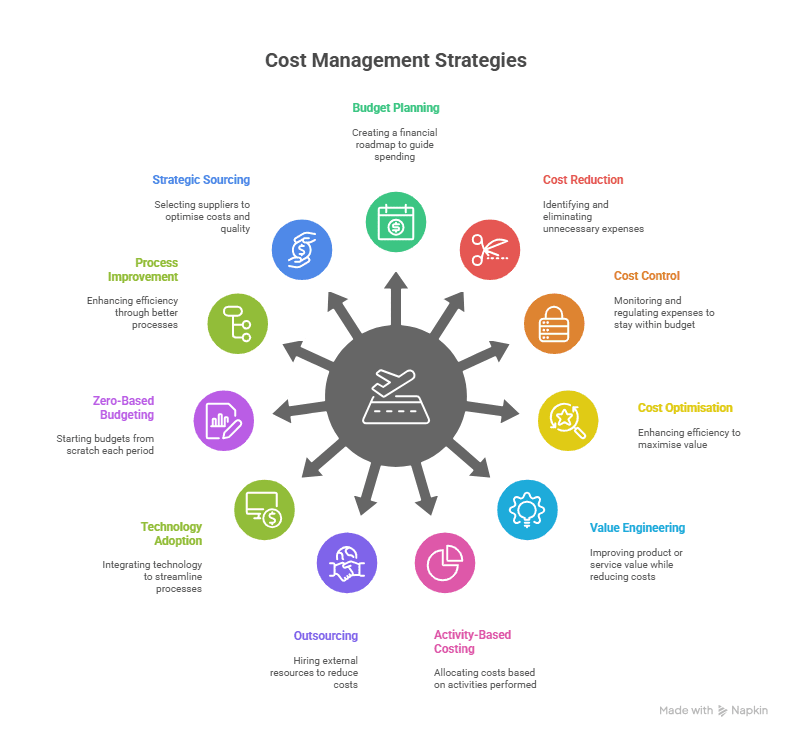
The following are some key cost management strategies:
Budgeting: A cost manager develops detailed budgets that guide expenditures and investments to the organisation.
Cost Reduction: They help in finding and removing unsolicited expenses to increase profitability.
Cost Control: You will hear them monitoring expenses to ensure costs stay within budgeted amounts.
Cost Optimisation: Cost Managers make continuous improvement of processes and resource allocation to achieve the best value for money.
Activity-Based Costing (ABC): They have toallocate costs to particular products or services based on the actual activities that require them. This goes to accurately identify high-cost areas.
Value Engineering: Another tenet of their role as cost managers is to analyse functions to achieve the optimal performance at the lowest cost.
Outsourcing: You will see a cost manager delegating non-core activities to external specialists to reduce costs. This is a sustainable approach financially for many organisations.
Technology Adoption: One of the holy grails for cost managers to follow would be incorporating advanced technologies to streamline operations and reduce costs.
Zero-Based Budgeting: You might think of it as justifying all expenses from scratch, rather than basing them on previous budgets.
Process Improvement: Cost Managers simplify workflows to eliminate inefficiencies and decrease costs.
Strategic Sourcing: A Cost Manager has to select suppliers based on cost, quality, and reliability to optimise procurement.
You can help your organisation by understanding and implementing these strategies to manage its costs effectively, ensuring financial health and supporting long-term growth.
What is the US CMA Course?
The US CMA certification is a worldwide recognised certification offered by the Institute of Management Accountants (IMA) that prepares experts in finance for superior knowledge in financial planning, analysis, control, decision-making, and professional ethics.
Unlike alternative certifications of finance-heavy theory, the US CMA course is founded first upon teaching practical application, and here it prepares professionals to execute applications in the workplace. The subject range is broad, including:
By integrating cost management into its core modules, the US CMA ensures that learners not only understand accounting numbers but also how to use them strategically to drive business growth.
Why Cost Management Strategies Matter in the US CMA Course
The phrase cost management strategies might sound straightforward, but in the context of CMA, it represents a powerful set of practices that help professionals optimise financial performance.
The reasons for its centrality are the following:
Strategic Decision-Making– You, as a CMA professional, are trained to look at costs in much detail, ensuring the identification of inefficiencies in the processes and providing recommendations that maximise profitability and assist in developing long-term competitive advantage.
Accurate Performance Evaluation– Through variance analysis and other tools, cost management helps businesses compare actual outcomes with planned budgets. This allows CMAs to spot deviations early and recommend timely corrective actions.
Planning and Budgeting– Cost management allows businesses to assess actual outcomes against the planned budget using variance analysis and additional tools. Without this, CMAs are unable to detect variances quickly and recommend appropriate actions in a timely manner.
Value Creation- CMA professionals, rather than being focused on cost-cutting, use cost management to make better allocation of resources so the business is creating value for stakeholders while still being cost-effective.
The Role of Cost Management in a Global Economy
When I look at the global economy today, it honestly feels like being on a bullet train. It’s fast, it’s unpredictable, and if you blink, you miss the next stop. What I’ve noticed is that the businesses that actually thrive aren’t the ones just chasing growth, but the ones that keep a tight handle on costs-whether that’s across different countries, through new tech, or even during a crisis. Cost management has really evolved into a strategy for survival and expansion, not just a “finance exercise.”
Manufacturing: Lean Costing as an Efficiency Engine
In manufacturing, every bit of waste is like a leak in the ship; it slowly sinks margins. That’s where lean costing comes in. It’s about cutting the fluff and doubling down on the activities that truly add value.
Lean Manufacturing: Toyota nailed this years ago. By building lean into its DNA, they turned efficiency into a culture. To this day, competitors are still trying to copy what Toyota does naturally.
Automation: I picture this as robots on assembly lines or machines doing precision tasks that humans just can’t match. Sure, the investment up front stings a bit, but the long-term payoff-lower labour costs, higher accuracy, and consistency-makes it a no-brainer.
Services: Process Costing for Smarter Pricing
Services are trickier because you’re not dealing with raw materials-you’re dealing with time, people, and processes. That’s why I love process costing. It gives you the clarity to see which services are actually profitable and which ones are draining you.
Healthcare: Hospitals do this all the time-allocating expenses to departments so they can price services more fairly and figure out what’s eating into budgets.
Financial Services: Banks use process costing to work out what it really costs to process loans or maintain accounts. That way, they’re not underpricing just to stay competitive.
It’s kind of like splitting a dinner bill with friends-you’re not covering someone else’s share if all you had was a salad. You only pay for what you actually ordered.
Technology: Cloud-Based Cost Tracking for Real-Time Control
Tech is moving at lightning speed, and the old-school budgeting approach just can’t keep up. That’s why I think cloud-based cost tracking is such a lifesaver- it gives you real-time visibility and lets you adjust spending on the fly instead of waiting for quarterly reports.
Cloud Computing: Take AWS, for example. It doesn’t just rent servers. It shows you exactly how much you’re spending down to the last gigabyte, so there are no nasty surprises in your IT bills.
AI Integration: And AI takes this a step further by spotting patterns, flagging inefficiencies, and even predicting where costs might spike. Gartner says early adopters of AI in cost management could slash IT expenses by up to 20% by 2026. That’s huge.
The Bigger Picture
When I connect the dots, the story is pretty simple: cost management has shifted from being about “cutting” to being about “growing smarter.” Whether you’re running a factory, a hospital, or a data centre, the playbook is the same- know where value is created, cut the noise, and make quicker, sharper decisions.
And this is exactly where the CMA course shines. It trains you to apply cost management strategies in real-world, global markets. That’s why CMAs are in such demand at multinational companies. They’re the people who can take all these principles-lean costing, process costing, cloud-based tracking-and actually make them work across industries and countries.
The CMA course ensures candidates are trained in applying these principles to global markets, making them invaluable assets to multinational corporations.
To provide a clearer understanding, here’s a table summarising the application of cost management strategies across different sectors:
Sector
Strategy Applied
Key Benefits
Manufacturing
Lean Costing
Waste reduction, improved margins
Services
Process Costing
Accurate pricing, profitability analysis
Technology
Cloud-Based Cost Tracking
Real-time insights, dynamic budgeting
Global
Adaptive Cost Strategies
Mitigation of tariff impacts, reshoring benefits
Best Practices in Cost Management Strategies
When I first came across cost management strategies, I also thought it would be all about trimming budgets and cutting corners. But it’s really not that. It’s about getting smart with money. Knowing what’s worth spending on and what’s just draining resources. Once I understood that, the whole thing made way more sense.
And the best part? It’s not just about looking back and saying, “Well, that went over budget.” It’s about staying ahead of the curve, so you can make better calls before the money’s already gone. A few practices really stuck with me:
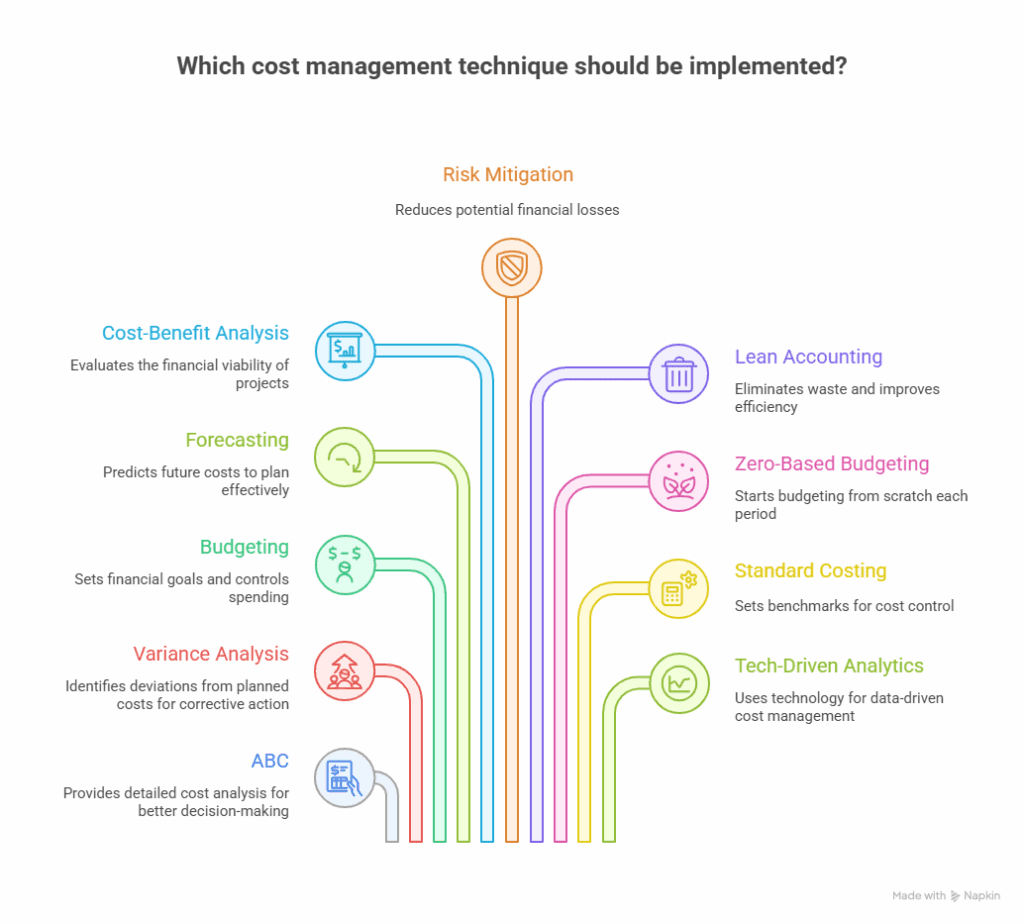
Activity-Based Costing (ABC) – This one feels like detective work. You trace costs back to the activities causing them, and suddenly you see exactly where things are bloated or inefficient.
Variance Analysis – I used to think this sounded boring, but it’s actually pretty eye-opening. You line up what you planned versus what actually happened, and it tells you where things went off track (or where you did better than expected).
Budgeting and Forecasting – To me, this is like having a roadmap. It gives you direction, but it’s flexible enough that if something changes, you can adjust without losing sight of the bigger goal.
Cost-Benefit Analysis – Honestly, this is just the “is it worth it?” test. Simple, but so many businesses skip it and end up spending on stuff that doesn’t really deliver.
Risk Management in Costs – This is basically carrying an umbrella. Most days you won’t need it, but when it pours, you’ll be glad you had one.
What I like about these methods is that they don’t feel like number-crunching for the sake of it. They make you think differently about money. It’s not about penny-pinching – it’s about making every rupee or dollar actually matter.
And seeing how companies like Unilever and Nestlé are using the same strategies-not just to cut costs but to cut waste and meet sustainability goals-was a bit of a lightbulb moment for me. It’s proof that smart cost management isn’t just good for profits. It’s how you build a business that lasts.
These advantages in the US CMA for cost management strategies train you to anticipate challenges, question assumptions, and guide strategy with precision. In essence, mastering them turns cost management from a routine task into a framework for smarter, more informed leadership in any finance or accounting role.
Did you know global leaders like Unilever and Nestlé are tying cost management with sustainability?
This helps them reduce energy consumption and waste. And the best part? It not only cuts costs for them but also meets ESG targets, creating long-term business value.
Career Opportunities After The US CMA Course
The US CMA course is designed for finance professionals who want to use numbers to shape business decisions. That’s why CMAs often find themselves in roles where finance and strategy meet.
Here’s a way to picture it: a company is like a living body. Money flows through it the way blood flows through veins. Some flows keep the system alive; others quietly leak out. CMAs are trained to spot these leakages (in terms of money, obviously), understand where resources truly add value, and recommend actions that keep the whole system healthy.
This is exactly why CMAs step into roles that go far beyond traditional accounting. They bring skills in cost control, financial planning, and performance analysis that directly support decision-making at the leadership level.
As a CMA, you’re influencing business outcomes. You become the professional who can answer questions like: “Which projects will deliver maximum value for the investment?”, “Where can efficiency improvements free up resources for strategic initiatives?”, and “How do we structure financial decisions to manage risk without stifling innovation?”
By mastering cost management strategies, candidates open the door to roles that require both technical and strategic expertise.
Career Role
Focus Area
How Cost Management Strategies Apply
Corporate Strategist
High-level corporate strategy and decision-making
Uses cost insights to shape organisational priorities, optimise resource allocation, and guide long-term strategy.
Global Finance Professional
International finance and cross-border operations
Applies standardised cost management practices to compare financial performance globally and make informed investment decisions.
Tech-Driven Finance Expert
Leveraging emerging technologies for finance
Integrates AI, analytics, and blockchain to forecast costs, improve efficiency, and enhance data-driven decision-making.
Risk Management Specialist
Identifying and mitigating financial risks
Anticipates potential cost overruns, evaluates risk exposures, and implements proactive strategies to protect organisational financial health.
These roles ensure that CMAs remain at the cutting edge of financial leadership.
Imarticus is a Gold Learning Partner with IMA, and the CMA course here is designed in collaboration with KPMG in India. That means you’re not just learning “book theory.” You’re picking up practices and case studies that companies are already using around the world.
Learning That’s Hands-On
This is the part I like most. Instead of just memorising, you get to:
Work on 20+ case studies and simulations (reviewed by KPMG experts).
Compete for internships with KPMG India if you’re among the top performers.
Join live sessions and webinars that keep you updated on what’s actually happening in finance right now.
Career Support That Feels Personal
And then there’s the career side. Imarticus helps with placements in finance, consulting, and tech, but it doesn’t stop there. You also get mentorship from people who’ve been through the CMA journey themselves — people who can tell you what really works in the real world.
A Certification That Carries Weight
At the end, you don’t just walk away with a CMA qualification. You also get a joint certification from Imarticus and KPMG India. On a resume, that’s a strong signal that you’ve been trained with both academic rigour and industry insight.
Cost Management Strategies: Future Trends
The world of cost management is changing faster than ever, and the US CMA course reflects this shift by preparing professionals to think ahead, not just account for the past. Today, costs are influenced by technology, global operations, and social responsibility, meaning that the way organisations track and optimise expenses must evolve as well.
Global interconnectedness and shifting stakeholder expectations. Every decision, from supply chain choices to workforce deployment, carries a ripple effect that traditional methods fail to capture. Forward-thinking CMAs are being trained to anticipate these ripple effects, integrate multidimensional cost considerations, and align financial insights with broader business goals.
Here are some trends shaping its future relevance in CMA training:
AI-Powered Forecasting: Machine learning tools are redefining how budgets are planned and risks are assessed.
Sustainability Costing: Integrating environmental and social costs into financial decision-making.
Real-Time Analytics: Cloud-based tools providing instant access to cost data.
Global Standardisation: Harmonisation of international accounting standards for cost reporting.
By mastering these cost management strategies, CMA professionals are preparing themselves not just for today’s roles but also for the future of global finance.
FAQs on Cost Management Strategies
Got questions about how cost management strategies really work in the real world? Here are some of the most frequently asked questions answered in a simple, practical way to help you understand why they matter.
What are cost management strategies?
Cost management strategies are really about being smart with money, not stingy. They’re the methods companies use to plan, monitor, and adjust how funds are spent so that every rupee or dollar is working toward business goals. It’s like having a roadmap for expenses, knowing when to invest more and when to pull back.
Why are cost management strategies important?
Cost Management strategies matter because money disappears quickly without a plan. No company, no matter how big, has endless resources. I’ve seen how strong cost management strategies make sure money goes into things that actually push the business forward instead of just draining cash.
And it’s not just me saying this. A Deloitte survey found 88% expect to pursue cost improvement over the next 24 months, regardless of whether their revenues are increasing or decreasing. That tells me it’s become a survival skill, not just a finance function.
What is the work of cost management?
Cost management can be seen as being part watchdog and part strategist. It’s about keeping a close eye on where money flows, spotting waste before it snowballs, and redirecting resources to areas with the highest impact. It’s less about penny-pinching but more about shaping smarter business decisions. The Harvard Business Review nailed it when they said that effective cost management helps companies not just survive but actually grow stronger.
What is the salary of a cost manager in India?
The salary for cost managers in India is pretty attractive because the role directly impacts profits. If you’re starting out, you can expect something in the ₹5–7 LPA range, but with 5–10 years of experience, it jumps to ₹12–20 LPA.
At senior levels in big firms or MNCs, ₹25 LPA and beyond is not unusual. According to Glassdoor, the demand is strong, and honestly, that makes sense. Companies will always pay well for someone who protects their bottom line.
How to become a cost manager?
If I were starting from scratch, I’d begin with a degree in finance, accounting, or business. Then I’d add a professional edge with a certification like the US CMA, since it dives deep into cost management strategies for business decisions.
From there, I’d get hands-on experience in budgeting, planning, and cost analysis roles. The more you practice turning numbers into insights, the more valuable you become. Because analytical skills + problem-solving = your best friends on this journey.
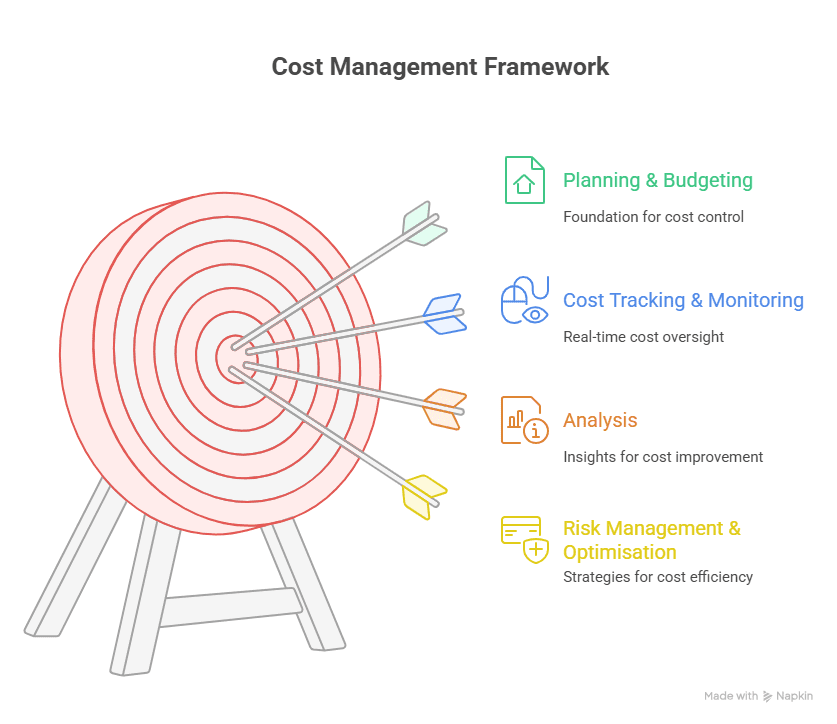
What are the 4 stages of cost management?
I think of it as a loop:
Planning: laying down budgets and setting the rules of the game.
Estimation: using data (and a bit of forecasting instinct) to predict costs.
Control: keeping expenses in check and fixing things when they go off course.
Analysis & Reporting: looking back at what happened, finding patterns, and learning for the future.
It’s not a one-time checklist- it’s a cycle that keeps repeating. That’s why PMI calls it a best practice in project cost management strategies.
How do CMAs use cost management strategies?
If I were a CMA (or when I think like one), I’d use cost management strategies to help leaders make better calls. That could mean flagging a product that’s eating more cash than it brings in, or showing how to optimise operations without hurting quality.
IMA research actually highlights how CMAs are becoming key decision-makers because they mix financial expertise with strategy. That’s a powerful combo.
Are cost management strategies useful for all industries?
Oh, 100%. I’ve seen them work everywhere. Factories use them to cut production costs, hospitals to make better use of staff and equipment, IT companies for project budgets, and banks to keep operations lean.
Basically, if there’s money moving, cost management strategies can sharpen the edge. McKinsey even points out that businesses that adopt cost strategies often become more competitive overall, not just cheaper to run.
What role does technology play in cost management today?
Technology is a game-changer in cost management. With AI and analytics, I can see spending in real time, spot hidden leaks, and even forecast problems before they hit.
Automation also saves time on the boring stuff, which frees managers to focus on strategy. And this isn’t just hype-Gartner predicts that AI-driven cost optimisation could slash operating costs by up to 30% in the next few years. That’s massive, and it shows why tech is now at the heart of modern cost management strategies.
When I think about the US CMA course, what really stands out to me is how practical it is. Sure, it’s a finance certification, but at its core, it’s teaching you cost management strategies that you’ll actually use in real business situations.
And honestly, cost management isn’t just about cutting expenses-it’s about asking the right questions: Where is the money going? Which activities are really worth it? How can we stretch resources without compromising growth? That’s the kind of thinking the CMA pushes you into, and along the way, you pick up tools like activity-based costing, budgeting, forecasting, and even tech-driven ways to manage costs better.
The cool part is that these skills don’t lock you into one industry-you can take them anywhere. For me, it feels less like memorising formulas and more like developing a mindset: looking at numbers not as numbers, but as decisions, trade-offs, and opportunities.
So if I had to sum it up? Learning cost management strategies through the CMA isn’t about tweaking spreadsheets-it’s about learning how to think smarter with money. And that’s a skill every finance leader, in any industry, needs.
👉 If you’re looking to explore these strategies in more depth and understand how they’re applied in real-world scenarios, the US CMA course by Imarticus Learning offers a structured pathway to do so, with practical insights and guidance from industry experts.
The impact of leadership characteristics extends significantly to both your personal and professional life. Within a business context, these qualities crucially impact your long-term success. They encompass a wide range of skills, from guiding employees to accomplish tasks effectively to managing project schedules and ensuring the fulfilment of business goals.
If your goal is to improve as a leader, whether in your professional or personal endeavours, developing core leadership qualities is essential.
For any business to thrive, it requires an exceptional leader who can connect the dots between various aspects, such as translating work Excel sheets into customer value proposals and aligning projected statistics with the overarching vision. Failing to prioritise leadership development can result in a substantial loss of 7% of total yearly sales for the company, as the data suggests. Hence, fostering leadership characteristics is of utmost importance.
Let’s delve into the key characteristics that define a good leader.
1) Effective Communication
Effective communication is a vital skill for a leader to proficiently express their ideas and directives to the team. It serves as a linchpin that can either result in organisational clarity and improved performance or lead to confusion and subpar outcomes.
A skilled leader understands the significance of developing their communication abilities, achieved through practices like seeking feedback from the team, actively listening before responding and tailoring the message to suit the audience’s needs.
2) Problem-solving skills
Team members will approach the team leader about problems they want to solve. A leader must be prepared with strategic guidance for whatever they are being asked for. It doesn’t mean that a leader has the answers to all questions a team may ask. It implies that a leader must be prepared with appropriate resources that assist the team in solving the problem.
If you are working as a leader and aspire to enhance your problem-solving skills, the following practices can help.
Gathering enough data and experience to provide proper guidance to the team
Asking questions yourself so that you can lead the teammates toward the right path
Offering multiple solutions for your team to implement
Being an active listener to obtain clarity
3) Personal development prioritisation
For leaders, personal development holds great significance when it comes to career growth. Being a leader, you must assess where you exist in your personal development journey and how your personal development positively impacts your organisation.
Prioritising personal development will help you connect with like-minded individuals and conceptualise new ideas for the business’ growth. As a leader, you can strengthen your personal development by taking relevant courses, attending industry-relevant conferences, pursuing senior leadership programs, and collaborating with other departments.
4) Adaptability
Challenges are an indispensable part of the responsibilities of a leader. A leader is the first person in an organisation to connect with if anything goes unexpected. Being a leader, your responses must be logical rather than emotional or impulsive. You must not feel worried or stressed when handling challenging situations. Developing adaptability in the workplace can be an exceptional tool to quickly respond to inevitable changes.
Becoming more adaptable means, you will feel more comfortable to face the changes. Whenever issues arise, team members will approach you for leadership and guidance. You can cultivate adaptability by learning to embrace change, practising mindfulness, taking risks and moving out of your comfort zone, and enhancing your problem-solving skills.
5) Actively listening
A leader should indulge in more listening activities than speaking. You must meticulously attend to organisational issues and come up with feasible solutions by actively listening to team concerns. Moreover, you must listen to individuals around you to express empathy and respect. Active listening helps to develop effective ideas, with the power to tackle any issue that may come your way.
The following practices can help you as a leader to improve your active listening skills.
Providing full attention to team members when they approach you for input or feedback
Asking questions before making a decision
Use non-verbal cues
Paraphrasing and clarifying what is said
Being mentally active in the conversations and staying away from interruptions
Conclusion
Leadership characteristics not only equip individuals with the understanding of how to effectively lead others but also nurture personal growth, communication skills, adaptability, and emotional intelligence. These characteristics are worthwhile to equip whether you aspire to work as a leader in an organisation or enhance your interactions with others.
PursuingPeople Leadership & Strategic HR Management helps you become influential leaders and foster strategic initiatives. This 11-month IIM leadership development program is specifically targeted at aspiring business managers and senior HR professionals. It imparts the learners how to develop a winning strategy through strategic HR. The executive leadership program IIM employs a practical approach with simulations from Imarticus Game Studio as well as Simulations on Human Resource Management, enabling them to emerge as versatile entities with impeccable leadership skills.
Conflicts are inevitable in any workplace. Often, they arise due to disagreements of opinions or interests; therefore, it is very important to understand how you can navigate them and resolve them effectively.
This is where conflict resolution strategies come into play. As a team leader, you must master conflict resolution strategies for maintaining a harmonious work environment and fostering productivity.
Let’s talk about a few such effective strategies that you can deploy at your workplace to resolve conflicts.
Avoid Ignoring Conflicts
Ignoring conflicts altogether, hoping that they will get resolved on their own, might seem tempting at times. Although it might be a useful approach in specific situations, such as when there is no clear solution or a frustrated party requires some time to calm down before confrontation, it is not always effective. In fact, ignoring conflicts can further lead to more significant problems down the line. Therefore, it is always advisable to address them promptly and proactively to maintain a healthy work environment.
Additionally, by acknowledging conflicts and taking the right steps to resolve them, you can foster open communication and create a stronger and more cohesive team.
Define The Problem
Defining the problem will enable you to clearly state the root cause of the conflict. This requires active listening, gathering all parties’ perspectives, and understanding their concerns. However, please note that during this stage, it is very important that you separate your personal emotions from the problem and analyse the situation in an objective manner, which will further facilitate the conflict resolution process.
Meet On Neutral Ground
Once you have figured out the root cause of the issue, you can then bring the involved parties together on a neutral ground. Such might include a conference room or a mediator’s office. Ensure that you select such an environment where both parties feel comfortable and less defensive.
Avoid using either party’s office or any other nearby location, as this can imply one side has more influence than the other which can further lead to the escalation of negative emotions.
Identify A Solution
After both parties have had their respective chances to discuss the situation, it is now time to identify what a satisfactory solution might be. In most cases, the conflict might get resolved automatically during the open dialogue session. However, if that does not happen, the responsibility of devising a solution that benefits both parties rests on your shoulders. This can be achieved through active listening, where each person’s needs, concerns, and perspectives are thoroughly understood.
Sometimes, a compromise might be necessary, but the key is finding a solution that fulfils the underlying needs and addresses the root cause.
Continue To Monitor On The Conflict
Just because a solution has been identified does not necessarily mean the conflict has been resolved completely. As a team leader, you are responsible for monitoring the conflict to ensure that the implemented solution remains effective and sustainable over time.
Keep a close eye on how the resolution is working and whether any adjustments or modifications are required. This also provides an opportunity to address any concerns or issues that may emerge, thus preventing minor disagreements from escalating into significant conflicts.
Conclusion
By proactively following the shared strategies, you can contribute to a healthier and more productive work environment. Furthermore, conflict resolution strategies also bring several advantages to the table. Such include improved communication, enhanced relationships, reduced stress, and improved employee retention and satisfaction.
If you wish to know more about such HR management strategies, check out the PeopleLeadership and Strategic HR Management program under the guidance of IIM Lucknow and provided by Imarticus. Such IIM Lucknow HR courses are specifically designed for emerging senior HR professionals who wish to advance their careers in this field. Some of the important topics included in this particular strategic HR leadership certificate program are HR operations and project management skills, HR and business partnership, and talent management, among others.
So what are you waiting for? Enrol now to unlock your full leadership potential and take your management skills to new heights!
Audit and assurance are two key tools used to examine the financial documentation of a company. It is a fast-growing sector generating huge demands for auditors and accountants. As per the Bureau of Labor Statistics, the projected employment growth for auditors and accountants is 6% between 2021 to 2031.
The global auditing market was worth $217.7 billion in 2021. By 2026 this worth is projected to soar as high as $287.2 billion. This fast pace can be accrued to sterner governmental rules and regulations and thus opens up an ocean of job opportunities. Thus, if your goal is to become an auditor, you have a range of possibilities in front of you.
But before kick-starting your auditing career make sure you are aware of why this service holds such importance for a company.
Here’s an article on auditing and assurance, which will also help you to choose a suitable ACCA course.
Audit: What is it?
Before taking an ACCA course, first, understand what audit is. It is a process that helps to evaluate the accounts in any organisation’s financial statements. It examines the financial accuracy of the company. It further ensures that the financial reports are represented fair and square, presented ethically and accurately.
Auditing examines if the financial reports follow accounting principles and standards. It scrutinises any fraud and looks for misinterpretations in the records and fund misuse. Some internal auditors work in the organisation’s audit department and keep an eye on the company’s finances. Companies also recruit external auditors for an unbiased financial statement review.
Assurance: What is it?
Assurance is an independent professional amenity offered by certified accountants. It improves the content or quality of information and thus enhances decision-making. It reduces information risk and boosts the relevance, value and transparency of information to be disclosed in the market.
This service verifies the accounting records of a company. It judges whether the records are following the principles and standards of accounts or not. This amenity further guarantees the company’s stakeholders of no financial misinterpretation in the records.
Key differences between audit and assurance
While the two services might look very similar, there are multiple differences. Read on to understand the two amenities better.
For financial record verification purposes, assurance services follow auditing. The first step is the audit, and then we move on to assurance.
External or internal auditors are responsible for conducting audits. Assurance services are exclusively offered by audit firms.
Audit works to find out financial statement misinterpretations. It looks for fund misuse, and fraudulent activities performed in the company. Assurance aids in a company’s decision-making by refining a company’s information quality.
While audit scrutinises financial record accuracy, assurance services work to analyse account entries and assess financial records.
Why are audits and assurance important for companies?
Both services are essential for a business, and here’s why.
Importance of internal audit
It ensures that a business venture is following rules and regulations.
It cross-checks the company’s financial information.
It examines the processes of the company’s operation.
It ensures the effectiveness of risk reduction procedures and policies.
Importance of external audit
Securing tax compliance
External audit ensures that your business is up for unbiased assessment. It ensures compliance with tax regulations, as the external auditor will not be wavering from delivering bad news.
Independent credibility
Auditing from an outside source, which has no relation to a company’s success or failure, ensures credibility. External auditors don’t directly work under any company and are unbothered by the company’s pressure. This ensures that the words of external auditors are more credible than those of an internal auditor.
Proper internal process criticism
Internal auditors are an intricate part of a company. Hence, it is difficult for internal auditors to provide proper criticism of the enterprise. Here’s the vitality of an external auditing organisation, which keeps a strong eye on an enterprise’s operations and offers quick criticism. Some external auditors also offer a suitable action plan to mitigate the highlighted problems.
Checks the quality of internal audit
In many organisations, internal auditors may be underqualified or do not have sufficient experience. Hence, the external auditors can keep them under watch, and cross-check their performance to ensure that audit quality is up to the mark.
Importance of assurance services
Time-saver
Creating systems takes time. However, fixing the errors after it has gone long takes more time. This is where assurance services come in, and look for errors on time. This gives the company a heads-up to rectify the mistakes early on.
Money-saver
Initially, assurance services might look costly, however, if you look way forward it saves tons of money. Preventing problems is always more affordable than indulging money in fixing errors.
Amplifies customer confidence
Once your company gets a good name for being consistent and offering quality service, customer confidence automatically comes in. With assurance service, the customers believe that they’re investing money in commodities that are worthy of the price.
For instance, quality assurance plays a vital role in the rise of the food industry. Consumers in such an industry demand safe food for consumption, and their confidence is vital for the functioning of the industry.
More revenue
Assurance services magnify profit by firstly saving the money otherwise wasted on extra materials. Secondly, a company involving assurance services tends to have an edge in the market. The customers, once assured of the product quality, willingly pay more. Thus the companies can raise the product price and push their profit margin.
Summing up
Now that you know how helpful audit and assurance services are to an enterprise, you’re one step closer to fulfilling your dream of becoming an auditor. The next step is to enroll yourself in a suitable course, to enhance your knowledge base and bag the best job in the industry.
This certification course is globally recognised and is awarded by the United Kingdom ACCA body. It is widely accepted in over 180 countries and offers attractive career opportunities. Here are a few course highlights:
Over 7500 top ACCA-approved employers
Pre-placement boot camp which offers interview preparation sessions, classes for personality development, soft skill development, etc.
Exhaustive study materials comprising practice papers, books, question banks, supplementary materials, etc.
Expert faculty with CA, Management Accounting, CPA, and FCA qualifications, who provide personalised mentoring.
Welcome to the dynamic world of leadership, where a symphony of success is produced when passion, purpose, and people come together.
Leadership is about constructing a tapestry of trust, empathy, and understanding, not about donning an authority tiara. It’s an art that calls for skill, style, and bravery. Fear not, though, for we possess the treasure map that marks the way to the pinnacle of leadership ability.
Whether you’re a seasoned manager or just starting your leadership journey, honing these essential skills will make you a more effective people leader.
This blog examines the five fundamental abilities that provide the groundwork for exceptional people leadership. These abilities are the very essence of what makes a leader tick. As your compass, we’ll help you navigate the areas of effective communication, emotional intelligence, flexibility, conflict resolution, and trust-building.
Therefore, these abilities will help you succeed whether you are an experienced team captain or an aspiring helmsman. Prepare to discover the mysteries enabling you to lead with charm and elegance.
Motivating Teams: The Importance of Leadership
The top leadership skills in 2023 will allow leaders to navigate our increasingly complex and uncertain world. In the dynamic world of American academic circles, leadership is defined as an alluring dance of social influence in which an individual skillfully enlists the support and cooperation of others to accomplish a common and morally admirable goal. Leadership ultimately manifests as an engaging power play in which one’s skill as a “leader” inspires change and advancement in the minds of the “followers.”
Leadership traits for motivating teams
There are a variety of leadership qualities that may inspire teams. The Importance of Emotional Intelligence in Leadership is the capacity to understand and manage one’s emotions, as well as the emotions of others. It is a crucial ability for leaders because it enables them to create strong bonds with their team, inspire and encourage them, and make wise choices under duress.
Among the most significant are:
Vision: A competent leader can communicate their team’s vision to others. This provides a feeling of direction and purpose for the team members.
Communication: Effective team motivation requires effective communication. In addition to listening to and addressing team members’ needs, leaders must be able to convey their vision effectively.
Empathy: Leaders with empathy are aware of the wants and worries of the people on their team. They can establish rapport and trust, which are crucial for motivation.
Trustworthiness: Team members must have faith in their captains. This calls on leaders to treat team members with integrity, fairness, and consistency.
Encouragement: Team leaders should encourage their teammates to attempt new things and take calculated risks. This demonstrates that leaders have confidence in their team members’ skills and promotes a supportive workplace atmosphere.
Leaders should recognize team accomplishments of all sizes. This demonstrates that team leaders value the effort put out by their members and encourage them to keep working hard.
What are the 5 Essential Skills for Effective People Leadership?
Effective Leadership Skills for Managing People:
Effective Communication
Communication is the backbone of an effective relationship, and in leadership, it plays a crucial role. As a people leader, you must convey your ideas noticeably and concisely. Being an active listener is equally important. Understand the thoughts, concerns, and feedback from your team members genuinely. You can establish a healthy and effective work atmosphere where everyone feels heard and respected by encouraging open and honest communication.
Empathy and Emotional Intelligence
Empathy is understanding another person’s feelings and viewpoints by placing oneself in their situation. It goes hand in hand with emotional intelligence, which involves recognizing, understanding, and managing emotions in yourself and others. Effective people leaders leverage empathy and emotional intelligence to connect with their team members on a deeper level, building trust and rapport. By acknowledging and addressing their emotional needs, you create a cohesive and motivated team that can overcome challenges together.
Adaptability and Flexibility
In today’s fast-paced world, change is constant, and as a people leader, you must be adaptable and flexible. Embrace new ideas, technologies, and methodologies that can enhance productivity and efficiency within your team. By demonstrating a willingness to adapt, you set an example for your team members, encouraging them to embrace change positively. This adaptability enables your team to navigate uncertainties and keeps them motivated even during challenging times.
Conflict Resolution
Conflict is an inevitable part of any group dynamic. As a people leader, your role is to mediate and resolve conflicts constructively. Instead of avoiding conflicts, address them promptly and fairly. Listen to all sides, and encourage open dialogue to find common ground. By effectively managing conflicts, you foster a harmonious and cooperative work environment, which leads to increased creativity and better problem-solving within the team.
Delegation and Trust-building
Successful leaders understand the importance of delegating tasks to the right individuals and trusting them to do the job. Micromanaging can demotivate team members and hinder their growth. By assigning responsibilities based on individual strengths and skills, you empower your team and show them that you have faith in their abilities. Trust-building is a continuous process that involves supporting your team, providing constructive feedback, and recognizing their achievements.
The Final Words
To become influential leaders, individuals must embrace an unending journey of self-improvement and wholehearted commitment to comprehending and uplifting their team members. You can also create a positive and motivating work environment where everyone thrives by developing strong communication skills, empathy, adaptability, conflict-resolution abilities, and trust-building.
Introducing the transformative program by Imarticus Learning – a power-packed journey to equip participants with the knowledge and prowess to master the art of human resource management in the ever-evolving business landscape. Prepare for an engaging encounter that explores a wide range of cutting-edge subjects.
This People Leadership Programcovers everything, from deciphering the complexities of job analysis and design to developing proven methods for attracting and keeping people.
Discover the alchemy of encouraging staff growth via training and development, embrace the techniques of performance management and evaluation, and explore the mystics of creating alluring compensation and benefits packages.
Remember, leadership is not about being in charge; it’s about caring for those in your charge and inspiring them to achieve greatness together. So, step up and start developing these essential leadership skills today!
With the increasing popularity of textual data over the Internet, it has become imperative to provide a definitive outline to this unstructured data, and extract information to upgrade user experience. The storage, processing, and analysis of data, is now applied to text sources like blogs, web pages, and other digital literature to detect patterns, trends, and debates. Such procedures are collectively grouped under the term text mining and text classification.
For those who wish to pursue a career in data science, they can upskill themselves by learning more about text mining and text classification techniques.
What is Text Mining?
A type of data mining, text mining involves the use of various methods and techniques to retrieve previously concealed information from unstructured textual data and find patterns that would contribute to decision-making. Several techniques from different applications of computer science, such as information retrieval, statistics and machine learning are used to process the data.
Text Mining Techniques
Information Extraction
Also known as IE, it is the most reliable form of text mining technique that involves extracting information from massive chunks of unfiltered and unsorted data that is in textual form. Let us say a text is largely unstructured and one needs to find out its meaning.
It can be deciphered via information extraction techniques whereby keywords, main features, certain entities and their interlinks are identified within the text and the newly-gained information is stored within an associated database for processing and reference in a later timeline.
Information Retrieval
Although information retrieval might sound similar to Information Extraction, the difference lies in the process of extraction of information. Unlike information extraction, where textual data is collected first, and then analysed for detecting patterns, in information retrieval, we already have a given textual parameter, such as a given set of keywords or key phrases to be detected.
For this purpose, text miners harness diverse kinds of algorithms for monitoring the behavioural pattern of consumers and gathering relevant data accordingly. Query or question-based algorithms used in popular search engines for catering to trends and for collecting relevant information based on web searches on the internet are major applications of information retrieval.
Categorisation
Under this text mining technique, free format or independent texts are allocated to predefined classes or a set of topics depending upon the inputs and outputs generated by the content. This process makes use of approaches such as dimensionality reduction and pre-processing so as to instruct classifiers in sorting the text into user-defined categories with the help of some familiar examples.
Once trained in this manner, classifiers can categorise unrecognised examples with much ease. Naïve Bayes Algorithm and Support Vector Machine Algorithm are some of the functional models used for categorisation in machine learning.
Clustering
As the name indicates, clustering sorts text documents into certain groups or “clusters” by identifying the basic structure of the arrangement of textual information. In this method, the algorithm extracts some similar patterns from the given textual data, organises them either downwards from the top or from the bottom to upwards.
Consequently, in one cluster, the assorted documents will evince an extremely high percentage of similarity and there will be high contrast among the clusters. In other words, the quality of the outcome generated by a clustering algorithm will be determined by the number of clusters generated with high intra-cluster similarity and significantly low inter-cluster similarity.
Summarisation
The primary aim of text summarisation is to reduce the length and simplify the complex details of a textual document without compromising on vital information. Using summarisation techniques for text mining, one can determine whether a text document is worth perusal for a reader.
The algorithm searches through numerous text sources, prepares their summaries and keeps the original meaning the same.
Text Classification
Text classification is a subset of text mining and it involves allocating a number of predefined labels to a certain textual information. It involves analysis of the topic, detecting the language of the text, identifying the tone and intention to filter spam or toxic data or to understand customer reviews- all to obtain critical insights about textual data. We have provided some of the most popular text classification techniques which perform the aforementioned tasks.
Types of Text Classification Techniques
Sparse Vectorisation
This is a standard approach to text classification whereby a text document gets converted into several vectors and then it is classified using machine learning algorithms like logistic regression. The process of converting a text passage into a vector can be achieved by using the term frequency-inverse document frequency.
For a set vocabulary, this algorithm will generate a one-dimensional vector corresponding to each word in the vocabulary. Every part of the vector will reflect how many times the corresponding word appears in the input textual information when compared to a group of textual passages.
Dense Vectorisation
A major flaw in the sparse vectorisation technique of text classification is that it disregards the sequence of the words in the texts, as well as the factor that many words bear semantic resemblance to each other. Furthermore, if a word is polysemous in structure, that is, it offers multiple interpretations based on context, then sparse vectorisation fails to derive the contextual differences.
In such a situation, dense vectorisation technique can be quite helpful as it helps address the aforementioned problems by mapping embedded sentences to real vector numbers with the help of a pre-trained algorithm for language representations.
Natural Language Inference
When the classes were previously unknown and there is no prior instance of training present, then natural language inference models can be employed for text classification. A text classification model which has been attuned to natural language inference will choose a text passage as the premise, and try to verify whether the premise leads to, nullifies, or provides a neutral relationship with the hypothesis defined by the class.
Conclusion
Text mining and Text classification techniques have become highly sought-after methods in various industries that rely on consumer data for providing service. From marketing to sales, financial services to healthcare, mining and classifying textual data sources using machine learning models can save a lot of time, and prevent losses.
To enhance their skills in designing data mining models and algorithms, professionals can enrol in a data analytics course or a data science course such as theImarticus Learning’s Postgraduate Program in Data Science and Analytics and take a major step towards cementing their career in data science.
When Netflix arrived, it was the first sign of doom for DVDs. Customers could watch movies from their homes without the need to travel to a DVD store and rent or buy a movie. It was cheaper than DVDs because it gave consumers access to multiple movies.
The above example of streaming analytics shows its competitive advantage over traditional systems. This blog extensively explores data streaming and analytics. If you wish to have a career in data science, a sound knowledge of data analytics is a must.
What is Streaming Data Analytics?
Data that is in a constant flow of movement is called streaming data. Any action you perform, like a transaction or watching a web series, forms an event. Monitoring of the said events comes under streaming analytics.
Streaming data analytics can assist you in making decisions. You can find out which products the consumers are buying and use this to market similar products. Data streams are called event streams, whereas streaming analytics is termed event stream processing.
Why is Real-Time Processing Important?
Streaming data analytics involves real-time processing. The continuous flow of data must be processed in real-time so that users can take action. This digital data comes from many sources, such as smartphones, IoT (Internet of Things), online transactions, social media feeds, cloud applications, emails, and wearables.
Businesses must analyse vast volumes of data to keep a competitive edge. Failure to process data in real-time might delay further action. Real-time processing helps a company to mitigate risks as soon as they encounter them.
Benefits of Streaming Analytics
Some of the many advantages of streaming analytics are mentioned below:
Business Insights
Any abnormal business event will show up on the dashboard. Flagging of the specific event is essential to detect threats automatically. This strategy can also be applied to a company’s cybersecurity to track any abnormality for immediate investigation and subsequent resolution.
Cutting losses
Streaming analytics helps mitigate and even prevent losses pertaining to social media crises, security breaches, stock exchange breakdowns, production problems, and customer churning.
Data visualisation
Companies can monitor streaming data in real-time to find KPIs (Key Performance Indicators). They can find out minute-to-minute updates of the organisation by daily data monitoring. You can monitor data such as a system’s health, financial transactions, and field assets such as vending machines.
Create opportunities
Streaming data analytics helps companies grow their customer base and cut costs. It helps gain the trust of customers and retain loyal customers. This leads to the creation of product innovations, revenue streams, and updated business models.
Analyse routine operations
Streaming analytics helps a company gain instant insight into routine operations. Businesses can find out which products the customers prefer, how many customers use your website, which transport costs you the most fuel, and even detect what machinery is likely to stop working in a week.
Discover competition
Companies are always looking to gain a competitive advantage over others. Streaming analytics helps them set benchmarks quickly and discover the latest market trends. This proves helpful against competitors who might still be using time-consuming batch analytics.
Uses of Streaming Analytics
Streaming analytics has uses in several cases with continuous data flow. Some everyday use cases of streaming data are:
Fraud detection
Troubleshooting systems
Customer activity
Location data
Artificial Intelligence and Machine Learning
Warehouse inventory management
Marketing and sale
Security Information and Event Management (SIEM)
Monitoring internal IT systems
Stock market analysis
Rideshare applications
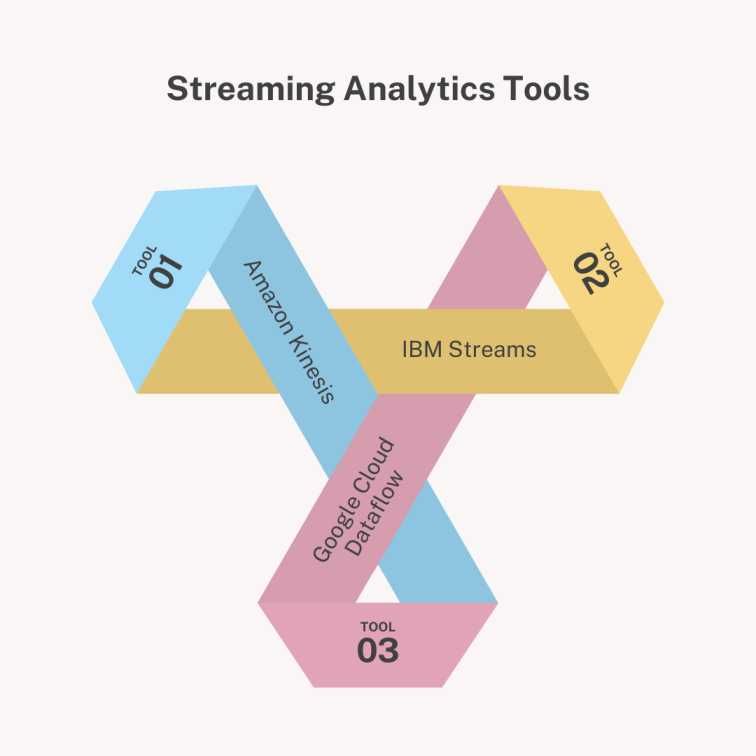
Streaming Analytics Tools
Among the vast number of streaming analytics tools available, below is a list of some of the most used ones.
1. Amazon Kinesis
This platform allows you to collect streaming data and process it in real-time. Kinesis lets you ingest audio, video, website clicks, and application logs data and analyse them. Amazon Kinesis consists of Kinesis Data Streams, Kinesis Data Analysis, Kinesis Video Streams, and Kinesis Firehose. It is flexible, allowing you to use tools as per your requirements.
2. IBM Streams
In IBM Streams platforms, you can use various streaming data such as audio, video, sensor, and geospatial. You can analyse chunks of data in real-time. Data scientists can build models where they can apply stream flows. Rich data connections, data visualisation, and development support are some of the features of IBM Streams.
3. Google Cloud Dataflow
This popular platform offers serverless architecture for streaming data. You can use Google Cloud Dataflow for full management service and automated streaming resource provision. Maximising resource utilisation and autoscaling of worker data are some features of Dataflow. Other features include dynamic work rebalancing, flexible pricing, and ready-to-use artificial intelligence patterns.
Conclusion
Streaming data analytics is the way forward. As batch processing is slowly taking a backseat compared to real-time processing, data scientists must adapt to the changes.
Consider enrolling in Imarticus Learning’sPostgraduate Programme in Data Science and Analytics to gain the first steps toward a career in data science. This data science course allows students to participate in national-level coding hackathons, boosting their resumes and helping them stand out in the competition. Data science training is crucial for becoming a data scientist or data analyst.
Detecting the possibility of cancellation or disconnection of service by a customer is known as churn prediction. Churn, or churn rate, is the quantification of the number of customers that have cancelled their subscriptions. It is calculated over a specified time period, usually on a monthly basis since most payment-oriented subscriptions have a monthly renewal scenario.
Churn prediction is crucial for most businesses given the numerous benefits of conducting the measurement, including identifying the target audience and market compatibility. Predicting customer churn and preventing the possibility of revenue loss builds up the added potential for every business. Hence, knowledge of churn rates has a significant impact on your company’s revenue generation.
You can build a career in data science by enrolling yourself in data science training on renowned platforms such as Imarticus and learn more about prediction strategies.
What Does Churn Factor Stand for?
Churn factor displays the customer churn after considering the activity frequency of consumers. A customer with a high churn factor usually represents an already churned consumer. It can be defined by simply dividing the activity frequency of a customer by the quantitative time since the last activity of the same.
Considering every activity of the consumer in context can ultimately assist in creating a powerful but uncomplicated prediction of customer churn. Using churn factor analysis, you can attain a better understanding of customer behaviour.
You can retain your customers for longer time frames upon gaining a clear perception of their behaviour and activity patterns, which can be attained by analysing the churn risk of your customers. Thus, calculating the churn factor can rapidly enhance the potential of your business.
Importance of Customer Churn Prediction
The customer churn prediction process is a necessary calculation for every subscription business. It presents a fact of business life where even the slightest changes in churn rate might cause a significant impact on the business, leading to fluctuations in revenue collection.
What is Customer Churn?
Understanding the source of consumer engagement is highly valuable in developing your retention policies. Customer churn is a major problem faced by businesses across different sectors, also known as customer attrition. Online businesses refer to a customer as churned when the latter ceases connection with the company or unsubscribes from the service.
A service declares churned consumers when a substantial amount of time has elapsed since the last activity of the customer on the website. Customer churn also includes cases where the customer retracts their subscription.
Benefits of Customer Churn Prediction
You can predict churn using an appropriate machine learning algorithm that calculates the churn risks of every single customer. The prevalent advantages of churn prediction are listed below:
It detects the accounts on the verge of getting churned and allows you to save them by adding the necessary support and suitable marketing strategies.
Provides transparent insights about the user experience.
You get to identify the major pain factors by discovering the predominant friction points in the customer experience, such as if certain consumer accounts are unhappy with the overall features.
Creates prime accounts for long-term relations, a target audience for cross-selling and upselling programmes, as well as growth opportunities in general.
Churn analysis provides better outcomes in CS playbooks by optimising the tasks.
Predictive Analysis in the Prediction of Customer Churn
What is Predictive Analysis?
The process of forecasting possible future outcomes using data analysis is known as predictive analysis. It uses machine learning, statistical computations, AI models, and data analysis to detect patterns in consumer behaviour.
Top Prediction Models in Customer Churn
The machine learning models commonly applied in churn prediction are as follows:
Logistic Regression
Decision Trees
Bayes Algorithm
Linear Discriminant Analysis
Support Vector Machines
Major Steps in Predictive Analysis that Reduce Customer Churn
Customer churn analysis is actively used by IT analysts and data scientists to assist with the customer retention of a business. You can get a quick overview of the necessary tools for churn prediction from the list below:
Calculating the Churn Rates of Your Customers: The churn rate is a key performance indicator, or KPI, where you can calculate the KPI using the simple formula stated below:
100 x (Lost consumers ÷ Total consumers at the chosen beginning time)
It is necessary to maintain the accuracy of your churn rate since customer churn prediction portrays a direct impact on the business sales cycle.
Data Integration: You can generate predictions about the future of the business using predictive analytics for data analysis.
Creating an Effective Churn Prediction Model: Upon training, you can use algorithms to point out inactive accounts and check for potential churner behaviours.
Analyse the Churn Risk Score: Churn risk scores range from 0 to 100. Customer accounts with higher churn risk scores have greater chances of churn behaviour. The high churn risk score is 76-100, medium churn risk accounts depict a score of 51-75, and the low churn risk rate is 0-50.
Consumer Segmentation: You can create well-tuned segments to form groups based on common features using machine learning algorithms.
Applying a Suitable Cloud Data Platform: It provides a marvellous solution in the execution of customer churn prediction analytics.
The Challenges in Customer Churn Prediction
The loss of consumer engagement over time, or churn rate, is one of the essential business metrics that can be tracked by the company. You can learn more about churn prediction analytics by opting for a career in data science and analytics.
Customer churn prediction includes a few obstacles, such as:
Changes in Stakeholders can alter past relations and consumer engagements.
The technique has to be accurate, which plays a critical role in the success of effective retention policies.
Revenue generation might reduce due to retention-based discounts and offers.
The predictive calculations need to be conducted on real-time data instead of static data to avoid the risks of inaccuracy.
Conclusion
Customer churn might cause a cost situation that includes losses in revenue, marketing costs, and customer replacement expenses. Reduction of the churn rates is a necessary growth factor for most online services and businesses.
You can gain a precise understanding of customer churn and other relevant topics by joining informative online tutorial programs. If you wish for a career in data science, you can opt for a data science course or a data analytics course such as Imarticus’s Postgraduate Program in Data Science and Analytics. Data analytics courses such as these can help you can learn more about predictive analytics and predictive analysis models.