
Excel for Financial Modelling: A Guide and Essential Formulae

Financial modelling in Excel is a method that involves showcasing all numbers of an organisation’s income statement, cash flow statement and balance sheet. This is done for the upcoming 5 to 10 years using Excel formulas.

With the help of these projects, stakeholders such as analysts, investors, and management can make informed business decisions, fundraisings, mergers and acquisitions. Hence, financial modelling is a highly essential tool in the business world. This blog will discuss the various formulas necessary for financial modelling in Excel.

If you want to build a career in investment banking, check out the Certified Investment Banking Operations Professional course by Imarticus. This investment banking course is ideal for beginners who want to learn the fundamentals of the financial markets.

What is Financial Modelling in Excel?

The tools used for creating the expected financial statements of a company by predicting their financial performance for the future using historical performance information and assumptions are known as financial modelling in Excel.

Financial modelling Excel is used as a decision-making tool. Company executives can use this information to calculate the costs and profits of a newly proposed project.

Financial analysts also use these to explain or anticipate an event’s impact on the company’s stocks. Internal factors like a change in business model or strategy or external factors like a change in economic regulation or policy can influence this.

Some of the top investment banking courses online are specially designed for those who want to build a career in the field.

Why do we Need a Financial Model?

A financial model can be described as a versatile tool used for various areas of finance like research, equity, credit research and investment banking. An investment banking certification can help you better understand its applications in detail. Here, we have listed some of the purposes of using a financial model:

  • Project evaluation (or project finance modelling)
  • Startup planning
  • IPO evaluation
  • Budgeting
  • M&A analysis (with an M&A model)
  • Strategic expansion and decision-making

Types of Financial Models
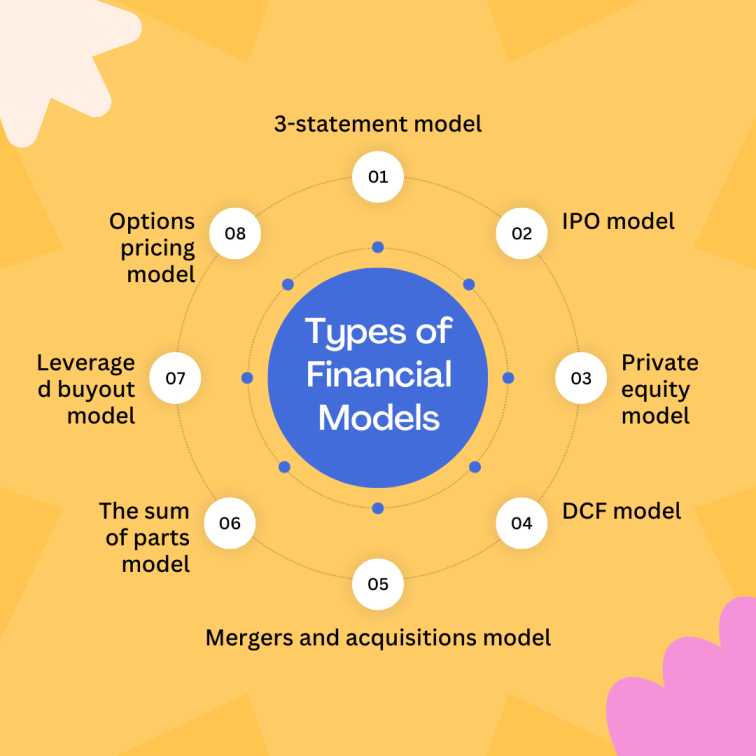
Types of Financial Models

If you want to build a career in finance, understanding the various financial models is very necessary to understand the various financial models. Enrolling in a well-structured banking and finance course can help you learn about the various types of financial models used. They have been listed here:

  • 3-statement model: In this model, a company’s balance sheet, income statement and cash flow statement are projected to understand the financial performance.
  • IPO model: This model helps determine the price at which any business will sell its shares when it initially goes public on a stock exchange.
  • Private equity model: This model is explicitly used by private equity companies to determine if any investment should be made in a company and how to make it successful.
  • DCF model: With this model, an investment opportunity’s or company’s value is estimated. It estimates how much money the business will make and how much it is worth today.
  • Mergers and acquisitions model: This model helps understand the financial impact of combining two companies and how much the new company will be worth.
  • The sum of parts model: This model is used for examining the different parts of the company and finding out the value of each part separately. Finally, all the values are added to determine how much the company is worth.
  • Leveraged buyout model: This model helps determine how much money the investors will make if they borrow money to buy a company and sell it at a higher price.
  • Options pricing model: This model helps individuals determine how much money they can make by buying and selling contracts.

Excel Formulas for Financial Modelling

As an investment banker, you must be well-versed in Excel formulas, which will help you build a robust and accurate financial model. Here, we have listed some of the most essential Excel formulas for financial modelling:

1. NPV

The Net Present Value (NPV) formula helps calculate future cash flows’ present value. It is an essential formula in financial modelling as it helps determine if any investment will be worth it based on the future cash flows it might generate.

The NPV formula is: NPV(rate, value1, [value2],…)
Rate is the parameter that stands for the rate at which future cash flows are discounted to their present values. The value parameters stand for the cash flows expected to be generated.

2. PMT

This formula helps calculate the periodic payments needed to pay off a loan or an investment. It is a vital formula used in financial modelling. It helps determine the payments needed to repay a loan over a period.

The PMT formula is: PMT (rate, nper, pv, [fv], [type])

The rate parameter stands for the rate of interest, pv stands for the loan’s present value, and nper stands for the number of periods. The type parameter stands for the payment timings, and the fv parameter stands for the loan’s future value.

3. IRR
The IRR or Internal Rate of Return formula helps calculate the return rate on any investment. It helps compare the various investment opportunities and determine which offers the best return.

The IRR formula is: IRR(values, [guess])

The guess parameter is optional, which stands for the estimate of the IRR. The values parameter stands for the expected cash flows from the investment.

4. VLOOKUP
This formula allows people to look for data from a table. It helps retrieve data from a large data set and use that in the financial model.

The VLOOKUP formula is: VLOOKUP(lookup_value, table_array, col_index_num, [range_lookup])

In these, the lookup_value parameter stands for the value which you want to look for in the table. The table_array parameter stands for the cell range which has the data. The col_index_num parameter stands for the colomn number of the data you want to get back. The range-lookup parameter stands for the type of match you want to use.

A banking course can help you better understand the parameters and applications of the financial modelling formulas.

Conclusion

Building a career in finance requires a deep understanding of financial modelling. Finance professionals always use Excel to make their jobs more accessible and more efficient. The Excel formulas for financial modelling are essential for building a practical financial model.

If you want to build a career in banking and finance, check out Imarticus’s Certified Investment Banking Operations Professional course. This investment banker course has been designed for individuals just starting their careers in the field. It is taught by experienced professionals, making you industry-ready.

7 Reasons Why You Should Invest In Cybersecurity Training Courses For Your Employees

Do you know that the first quarter of 2023 saw over six million data breaches? Yes, security lapses exposed data records worldwide! Therefore, a cybersecurity training course for your employees can help you secure your organisational data.

An employee cybersecurity training program educates the staff members about the risks of cyberattacks.

corporate training

It also teaches the protective measures to safeguard from cyberattacks and associated risks. A module for corporate cybersecurity education for staff includes topics like phishing, security breaches, and data protection. Moreover, password security and social engineering are also crucial topics. It also empowers staff members to encounter dangerous or unusual activities online.

Let us take a look at the top 7 reasons why you should invest in cybersecurity training courses for your employees.

Top 7 Benefits of Employee Cybersecurity Training Program

Here are the top 7 advantages of implementing an employee cybersecurity training program:

1. Teaches security awareness and practices

Human error plays a pivotal role in cyberattacks. Efficient and trained employees are key to sound security. Corporate cybersecurity education for staff makes them aware of valuable security principles. It helps the employees understand the concepts of data privacy and identify and respond to potential threats

 2. Threat Reduction

Employee cybersecurity training program helps reduce the risks that can otherwise lead to data breaches. These programs highlight threats from simple applications used in the workplace. For instance, email, social media, and other websites. The training also educates about social engineering attacks.

3. Improves cyber resiliency

Cybersecurity training is a key component of great cyber resiliency. Your organisation can suffer from sophisticated phishing, which cannot be tracked. This phishing can come through trusted services as well. So, arrange for an employee cybersecurity training program that combines AI-powered technology. AI makes behavioural learning easier. This will ensure that your business is safe from any kind of phishing.

4. Boosts employee’s confidence and performance

Cybersecurity training courses for your employees will instil confidence in them to deal with cyberattacks. They will know how to protect information and secure company data. All of these will lead to improved morale, job satisfaction, boosted productivity, and reduced costs.

5. Avoids downtime

Security breaches and other incidents take an enormous amount of time to be repaired. Plus, it’s a costly affair, too! If your employees are trained, they know their respective roles in keeping the business safe. They can mitigate a cyberattack, which can hinder the normal functioning of the system.

6. Retain customers’ trust

A study once revealed that a data breach impacts an organisation’s reputation. Customers hesitate in indulging in business that suffers data breaches. While a cyberattack can make you lose a lot of your potential customers, it can also pose a risk in partnering with other businesses. A cyberattack can seriously dent your company’s credibility.

So, if you wish to keep your organisation safe, choose any of the best corporate cybersecurity education for staff.

7. Lays a foundation for other technology practices

Arranging for the best cybersecurity training course for your employees is a starting point. Organisations must build other technology-safe practices over it. For instance, if your business uses a lot of IoT devices, you must focus on keeping them on separate networks. Updating your firmware to up-to-date is also important. You must also keep a check on the latest security fixes. Moreover, organisations need to regularly assess or test their employees’ efforts in handling any security mishaps.

Final Thoughts

Your employees’ role in protecting your organisation against cyber threats is supremely vital! Corporate cybersecurity education for staff motivates them, engages them, and brings a lot of positive change to an organisation. Furthermore, by arranging for a cybersecurity training course for your employees you cherish the goodwill of customers and a boost in organisational profits.

Before you go, check out some of the best learning programmes offered by Imarticus Learning. Many programmes are employee-centric that can supercharge your organisational success

Trade Life Cycle – The Process of Buying And Selling!

What is trade?

Trade is the process of buying and selling any financial instrument.

The lifecycle of a trade is the fundamental activity of investment banks, hedge funds, pension funds, and many other financial companies. There is no better way to understand the workings of a financial institution than to follow the progress of a trade through all of its various stages and all the activities performed upon it. In the financial market, “trade” means to buy and/or sell securities/financial products. 


To explain it further, a trade is the conversion of an order placed on the exchange which results in pay-in and pay-out of funds and securities. The trade ends with the settlement of the order placed.

All the steps involved in a trade, from the point of order receipt and trade execution through to settlement of the trade, are commonly referred to as the ‘trade lifecycle’.

Trading has evolved from a humble apple grower wanting a stable price for his produce come harvest time, to a complex and exciting industry comprising a significant share of the global economy, and more recently, taking a hand in saving it. 

It is the fundamental activity of investment banks, hedge funds, pension funds, and many other financial companies. There is no better way to understand the workings of a financial institution than to follow the progress of a trade through all of its various stages and all the activities performed upon it.

Just like any other product, even trade has its life cycle involving several steps, as those with a career in Capital Markets know.

All the steps involved in a trade, from the point of pre-negotiations and trade execution through to settlement of the trade, are commonly referred to as the trade life cycle. The Trade life cycle consists of a series of logical stages and steps.

What are the Steps Involved in a Trade Life Cycle?

1. Sale

  • This is a process of client acquisition in which HNIs or Institutional clients are introduced to various investment products or vehicles.
  • These vehicles or products are available with an Investment Manager or Bank by whom the client’s investments are managed.
  • The investments are collectively called Mutual or Hedge funds.


2. Trade Initiation and Execution

  • This is the process of placing an order in the market.
  • Trade Initiation and Execution can be done both in Order and Quote-driven markets.
  • This depends on the choice of a marketplace and the external platform.
  • Once the order is placed and it gets matched, the trade is said to be executed.


3. Trade Capture

  • Trades are then booked internally in an FO system for it to flow down to the operating systems.
  • It is booked in a Risk Management System (RMS)


4. Trade Validation and Enrichment

The reference data team set up the static and dynamic details which help middle office teams to validate the trade, before releasing instructions into the market.


5. Trade Confirmation 

  • This is an extremely critical step for the trade settlement.
  • Trade details and SSIs are agreed with the counterparty at bachelor schreiben lassen least a day before the settlement date.
  • Confirmation via depositories like Euro clear/DTCC


6. Trade Settlement 

This is the process of simultaneous exchange of cash versus securities for a security trade or cash versus cash for a Derivatives trade.


7. Reconciliation 

Reconciliation involves matching ledgers against statements to ensure correct accounting of all trade books.

The beauty of Investment Banking Operations, as taught in any school of investment banking, is the trade life cycle and its mechanisms akademisches ghostwriting.  It has always fascinated me to think how innovative and creative a financial institution can work to get a job done.
Whilst working through the life cycle, one must keep in mind the reason for its existence, the end result and the factors that surround it.

Steps Involved in a Trade Life Cycle

Pointers to remember:

  • The reason the market and its participants trade securities and financial instruments hausarbeit schnell schreiben, the current drivers and trends in modern securities markets.
  • The methods the trades are executed, that any financial analyst course can teach you.
  • It is very important for an organization to identify, describe and create a clear picture of the events scheduled for a trade.
  • The operations team needs to be familiar with the key terms used in the fields of trade processing and its administration
  • Understand the interaction and dependability of each department through which the trade flows.
  • Understand the role of IT, identify the gaps which IT can resolve especially Straight Through Processing techniques
  • Most importantly, what can go wrong where and what are the risks involved in every step of the trade life cycle ghostwriter bachelorarbeit kosten, be it credit, market, liquidity or operational risk.

The main reasons for the failure of a trade life cycle could be due to controls not adhered to or failure by any department of any of the people involved in the trade life cycle.


If you are looking for a Capital Markets course, or want to explore an Investment Banking Career, get to know more about the trade lifecycle through focused training and this blog could be a good starting point ghostwriting preise.

To know more about this, you can also visit – Imarticus Learning  Also can contact us through the Live Chat Support system or can even visit one of our training centers based in – Mumbai, Thane, Pune, Chennai, Bangalore, Hyderabad, Delhi, and Gurgaon.

How Can The Right Financial Planning And Analysis Course Improve Your Finance Career?

A broad view of the Finance industry

The finance industry plays a crucial role in our economy, and having a broad understanding of it is essential for anyone looking to excel in the business world.

One area of finance that is particularly important is financial planning and analysis. The financial planning and analysis course offers the skills needed to make informed decisions regarding the allocation and management of financial resources.

Whether you are starting your own business or working in a corporate environment, this course will equip you with the tools necessary to navigate the complex world of finance. In just a few weeks, you will gain a comprehensive understanding of financial planning and analysis. Read on to explore the fascinating world of financial planning and analysis.

How a well-structured financial course will prepare you for the industry?

A well-structured financial course will open doors for you in the industry. It will cover various aspects of finance, including investment strategies, risk management, and more. Let us see how a well-structured financial course prepares you for the industry:

Fundamental understanding

A good financial course will start by building a strong foundation of knowledge. It will cover basic concepts such as financial statements, budgeting, and financial ratios. This understanding is crucial as it forms the basis for more advanced topics and ensures you can analyze financial data effectively.

Practical skills

A well-structured financial course will focus on practical skills that are directly applicable to the industry. You will learn how to create financial models, conduct investment analysis, and evaluate the financial health of companies. These skills will enable you to make informed decisions and provide valuable insights to employers or clients.

Industry relevance

A financial planning and analysis course will help you keep up with the latest industry trends and practices. It will provide real-world examples and case studies to illustrate the application of financial concepts. This industry relevance ensures that you are prepared to tackle the demands of the finance industry.

Networking opportunities

Many well-structured financial courses provide opportunities for networking with industry professionals. This can include guest lectures, workshops, or networking events. Building a strong professional network is essential in the finance industry. It can lead to job opportunities, mentorship, and valuable connections.

Career guidance

A comprehensive financial course will offer career guidance to help you navigate the industry. This can include resume writing workshops, mock interviews, and job placement assistance.

What opportunities would the financial planning and analysis course provide?

The financial planning and analysis course provides various opportunities for you. This course enhances your skills for an impactful finance career. The opportunities include the following:

  • It opens doors to a wide range of career options. With this course, you can pursue roles such as financial analyst, budget analyst, or financial planner.
  • Financial planning and analysis professionals are in high demand across industries. These include banking, consulting, and corporate finance.
  • This course enhances your analytical capabilities. You will learn how to analyze financial data, create financial models, and evaluate investment opportunities.
  • The financial planning and analysis course offers networking opportunities. You will have the chance to connect with professionals already working in the field.
  • Completing the financial planning and analysis course demonstrates your commitment to professional development. This course can enhance your resume, making you more competitive in the job market.

The financial planning and analysis course offers many opportunities. It enhances career options, analytical skills, networking opportunities, and professional development. It is a valuable investment in your future success.

Best financial planning and analysis course of 2023

Looking for the best financial planning and analysis course of 2023?

Search for a course that offers comprehensive training on financial modelling, forecasting, budgeting, and data analysis. It should also include practical exercises and real-life case studies.

Ensure that the course provides ample resources and support for further learning and development. Remember to choose a course that suits your demand and skills.

When it comes to the best financial planning and analysis course of 2023, look no further than Imarticus Learning.

We offer a comprehensive and industry-relevant curriculum. We are committed to providing young professionals with the knowledge they need to succeed.

Our courses are designed and delivered by experienced professionals. Join us at Imarticus Learning and take your career to new heights. Visit our website now to learn more, and let us help you become a successful finance professional.

Costing Methods in Service Industries

The service industry is a highly competitive one. As a result, service providers are always seeking more efficient ways of operating, which will reduce their overall costs.

Determining the cost in any service industry is fundamental, as every service organisation must ascertain its business overheads. This is because, in this industry, companies provide services and intangible products.

The kind of service provided by the service sector is diverse and has its requirements and peculiarities. In this blog, we will discuss costs and costing methods in the service industry.

If you want to make your career as a Certified Management Accountant, check out Imarticus’s CMA Certified Management Accountant course. This CMA certification programme will help you excel in accounting and finance.

What is service costing?

Service costing can be defined as a kind of operation costing used by organisations that create and provide services instead of producing goods.

All costs incurred during the production of a service are added together in this cost accounting method. This is then divided by the total number of service units rendered.

Finally, the total cost has to be divided by the total units to reach the per-unit cost.

Need for service costing

Service costing is not the same as standard costing. Service costing is dependent on the rate instead of the price. Rate is the price per unit of the service which has been delivered.

The rate is determined by several factors such as equipment, machinery cost, labour wages, licenses, etc. Service costing is essential for service industries such as hospitality, aviation and transport as it helps determine the organisation’s revenue, profit and targets.

Costing methods used in the service sector

The service industry adopts one of the following basic costing methods for assigning costs to their services. These costing methods are as follows:

  • Job costing method: In this type of costing method, the cost of any particular service is obtained by giving costs to a distinct, identifiable service. A job costing method is employed in service industries such as advertising companies, accounting firms, etc.
    Activity Based Costing (ABC) can be used to assign overheads or indirect costs. There are two steps in ABC. Firstly, figuring out the cost of resources and assigning them to activities. And secondly, giving output to each action.
  • Process costing method: This type of cost accounting is employed when a business is constantly producing the same service. Processing units can also be assigned costs, which become inputs in the chain step or the product’s final value. Credit cards, postal delivery, etc., use process costing methods.
  • Hybrid costing method: Several service industry companies use a costing method, which is neither a job nor a process costing method. These companies employ a hybrid costing method, which combines elements from both these costing methods.

Ways for calculating costs

How is the cost used for cost accounting calculated? There are three primary ways – direct tracing, cause and effect and allocation.

Direct tracing: In this method, the cost is directly traced from the inputs to the outputs. This is the most challenging way of estimation as it takes a lot of time, patience and observation.

Cause and effect: In this method, the activities are linked with the resources spent. For instance, a manager cannot have their salary related to specific deliveries under his watch. This is because these individuals oversee several deliveries at once. However, if they participate in a particular delivery, a part of their salary could be attributed to the specific delivery.

Allocation: In this method, the costs are distributed according to common factors. In the previous scenario, the salary of a manager can be distributed evenly among the number of deliveries that took place under their watch.

Cost unit types in service costing

It is a complex process to calculate the cost of business operations in the service industry. This is because all the cost parameters must be considered when deciding on a suitable costing unit.

Listed below are the two types of cost units ascertained with survive costing:
Simple cost unit

A simple cost unit can be defined as employing only one parameter when measuring the service cost. Some of the service organisations and their simple cost units are:

Nature of organisation with Cost unit

Road maintenance – Per kiloliter
Water supply – Per kiloliter
Gas – Per cubic metre / per kilogram
Canteen – Per person / per meal / per staff
Boiler house – Per 1000 lbs
Street lightingv – Per lamp / per point
Private transport – Per unit / per kilometre / per passenger / per trip

Composite cost unit

Composite cost units are the service industry’s most commonly used cost units. This method combines two parameters to create a single cost unit.

Here are the various kinds of service organisations and the composite cost units:

Nature of organisation with Cost unit
Hotel  – Per room-night / per room-day / per bed-day
Hospital – Per patient-day / per bed-day
Passenger transport – Per quintal-kilometre / per tonne-mile
Electricity – Per kilowatt-hour
Boiler house – Per cubic centimetre-liter
Goods transport – Per quintal-kilometre / per tonne-mile
Theater or cinema – Per ticket-show

The formula of cost per unit

The formula for calculating the cost per unit is:

Cost per service unit = Total costs for the period / Number of service units in the period

Limitations of cost accounting

There are several benefits of cost accounting. Using this method, management can get a clear picture of the resources being used in the company by associating the costs with the outputs.

On the other hand, there are some drawbacks as well. It is a tedious process which demands a lot of time and resources. Also, this method is ideal for some service sectors, such as banks and hospitals. In contrast, cloud computing companies will find implementing a little more challenging.

Conclusion

Service costing is very important as every service industry has to ascertain its business overheads. With this, companies can ensure proper pricing of services as well as keep control over the fixed and variable costs.

Cost accounting deals with establishing the connection between inputs’ costs and the outputs resulting from them.

Are you in search of a top CMA certification course? Check out the CMA Certified Management Accountant course. This US CMA course is one of the most sought-after finance and account-certified courses by recruiters and companies worldwide.

What aspects to look for before enrolling in a data science course?

Data science courses are immersive training programmes that aim at providing the advanced knowledge and skills required to pursue a career in this field.

With the completion of a data science course, you will be equipped with in-depth knowledge of important concepts and advanced techniques used in the field. These certifications ensure that you have better chances of getting a job.

It’s crucial that you do some research before deciding to join any course. Analysing will help you understand if the data science course is relevant to your chosen field. Apart from polishing your skills, the certification will make your recruiter feel that you have some passion for the field while interviewing for the job. Getting a certification from a reputed firm will also assure them that you are capable of adding some value to the company.

In this article, let’s discuss the different aspects to look for while joining a data science course. 

Here’s how you can choose the right data science course 

Latest industry-ready curriculum

As a data scientist, you are expected to master topics such as computer science, Machine Learning, statistics and programming languages like Python.

There are data science courses available today which help you specialise in a specific data science field. Or if you are focusing on developing a particular skill set, data science courses can also cater to that need.

It’s important to talk to experts in your domain before deciding on the area and type of training you want to take up. They can assist you in choosing the appropriate curriculum updated with the latest market trends.

Also, carefully review the course content and make sure that it aligns with your career goals. Some of the topics generally covered in a data science course include:

  • Machine Learning
  • Coding
  • Python Programming
  • A/B Testing
  • Statistics
  • Linear Regression
  • Intermediate Excel
  • Databases (for eg. MySQL)

Practical learning methods 

A theoretical understanding of the subject is crucial to have a thorough understanding of the core concepts. However, remember not to spend the whole time taking notes. A practical understanding of concepts is even more important to become a data scientist. A solid data science course will equip you with the required practical knowledge and skills to tackle real-world problems. It’s these valuable skills learned through project-based training programmes that will help you in securing a job.

Flexibility

While you are researching programmes, identify the class structure that will fit your schedule. An online training programme is a convenient way to join a data science course without sacrificing your responsibilities. You can take an online programme from anywhere. The only requirement is a good internet connection. This way, you can embrace your own pace while learning. However, not many online programmes provide networking opportunities and team-building practices. You should ensure that the chosen course offers these opportunities, as they will benefit you in the future while applying for a job.

Reputation of institution

Are people you know working in the industry familiar with their organisation? Are they experts in this field? Do companies give any value to their certification? These are some of the important questions to be answered while searching for a data science course to join.

Placement reviews

When you join a training programme, one of your least expectations would be to get placed in a decent company. However, you should note that there are organisations that will not fulfil their promises. Remember to check out placement options and reviews before enrolling in any data science course. Only a reputable organisation like Imarticus Learning can provide a data science course with placement.

Key takeaway

Data science has grown to be the backbone of many industries. Today, top companies are on the lookout for people who can add skills to their organisations.

Imarticus Learning has years of experience in providing a postgraduate course in this field. The data science course will equip you with the advanced analytical skills required to grow in your profession.

It is a 6-month training programme which will be conducted online. We assure you that you will be able to develop the skills required to ace in your field by the end of the course. Ours is a job-specific curriculum which incorporates several real-world projects and case studies.

Imarticus Learning is a reputed institute which guarantees networking and interview opportunities for top graduates. Our alumni working at top organisations like Deloitte, Infosys, KPMG, Capgemini and Wipro can vouch for that.

Visit Imarticus Learning now to join the course.

Smart Contracts: The Future of Contracts and Business Deals

Ever since the inception of blockchain technology, it has revolutionised the world of finance, through many implementations, the most prominent of them being smart contracts.

With opportunities for streamlining any kind of financial transaction, these self-executing immutable contracts have established a new horizon in financial technology or fintech.

If you would like to learn more about how smart contracts work, you can consider taking up financial technology classes that specialise on Blockchain and smart contracts.

How Do Smart Contracts Work?

The term “smart contracts” was first developed by Nick Szabo in 1994 to materialise the concept of a contractual agreement where the involvement of any third party or even the government could be eliminated. A smart contract comprises a code written on a blockchain network based on conditional statements such as “If…then” or “When…then”.

Such conditional statements work as terms and conditions of the contract which the parties have to mutually agree upon. It is entirely up to the involved parties to determine how the data of the transaction will get represented, as well as to set a mechanism in place in the contract for resolving disputes.

Necessity of Smart Contracts

As opposed to contracts formulated on paper, which are quite cumbersome, smart contracts simplify business and increase efficiency. Their immense potential in revolutionising the sector of online businesses can be made possible by smart contracts because they can circumvent the complications of the traditional law for contracts.

Since smart contracts are based on blockchain technology, they are immune to any unwarranted alterations. The impregnable ledgers ensure that the number of parties involved in signing the contract is minimum, and that they have constant access to their assets. Smart Contracts are also time efficient considering that their real-time execution reflects the changes for all the stakeholders simultaneously.

Smart Contracts: Applications

Irrespective of the financial situation, smart contracts can help establish a sense of trust between two parties involved in a transaction. Multiple smart contracts are combined together to create an ecosystem in blockchain networks where many decentralised apps are designed for gaming, trading and exchanging of digital assets, and media. Here are some of the real-life situations where smart contracts are beneficial, and help shape emerging technology:

Gaming and NFT

Non-fungible tokens, or NFTs as we know them, are digital objects representing some or other aspect of the game in blockchain networks. The unique layout and the rarity of these tokens, along with their indivisible nature make them highly sought-after assets in the gaming world.

The transactions of NFTs in blockchain-oriented games are based on smart contracts, whereby you can store items purchased within the game, exchange them for a fee with other players, and even shift the NFTs to another gaming ecosystem, and the immutability of the NFT expands its value beyond the game it originated in.

Artificial Intelligence

Smart contracts can help further the cause of Artificial Intelligence and machine learning and vice versa. Combining the immutable and decentralised protection features of smart contracts with the data-processing feature of AI, programmers can create smart contracts enabled by AI. Using the technology of smart contracts, AI can independently execute its rules and regulations as well as ensure that the data meant for processing is stored in a secure environment

Healthcare

To ensure that sharing of patient information happens in a secure and safe manner, healthcare industries are increasingly adopting smart contracts into their system. For instance, automated payments of healthcare charges via smart contracts can help eliminate the possibility of overcharging.

Real estate

Smart contracts are increasingly replacing conventional legal agreements as a more viable option. It eliminates the necessity of having intermediaries like lawyers and brokers, paying whom can lead to hefty expenses, through automation. Drafting of documents and their verifications, or sanctioning mortgages can now be done via a code segment, with better data security.

Supply chains

Since smart contracts are known for transparent transactions without the interference of multiple hierarchical organisations, they can be particularly useful in complex chains of import and export. Using Internet of Things (IoT), information can be sent to the blockchain network, prompting the coded execution of events in the smart contract.

Protection of intellectual property rights

Smart contracts are also beneficial in protecting the copyright information of the creator or owner of a product. Upon purchase of a product, the code mentioning disbursement of royalties gets executed, thus outlining clarity regarding ownership and payment.

Advantages of Using Smart Contracts

Transparent mechanism

Since smart contracts function on the blockchain network, the records or documents of the executed transaction would be immutable and always available. Any chance of ambiguity that might be found in paperwork gets eliminated in smart contracts.

Independent operations

Contrary to conventional contracts being mediated and supervised by third-party agencies and individuals, smart contracts get done by the blockchain network, involving only two parties who would be signing the agreement.
Automation and efficiency

Code-operated contracts mean that the terms and conditions laid out in the said code would be automatically executed, then validating the smart contract. The entire process happens at a much higher speed than manual execution.

Cost-saving

Since third-party contacts or intermediaries are not required when executing a smart contract, the involved parties can reduce their expenses to a significant extent. This feature of smart contracts is especially beneficial in real estate and money-lending businesses.

Conclusion

Since smart contracts are codes compiled by human programmers, the possibility of error cannot be completely minimised. In that case, Artificial Intelligence can help eliminate such chances of errors.

Furthermore, the amount of transparency involved in formulating smart contracts, especially in maintaining documentation is making them increasingly popular in the fintech industry. The problem of data breaches that made consumers resist digital transactions is removed by the data security mechanism of smart contracts.

If you are planning to have a career in fintech and smart contracts, then the fintech certification course offered by Imarticus Learning will be really beneficial for you and open up dynamic employment prospects.

Artificial intelligence training: Implications for business strategy

Revolutionise business strategy with AI training for employees

In the dynamic world of business today, things are changing faster than ever before. One of the big changes is Artificial intelligence or AI. It’s like a powerful tool that can help your business do better. To make the most of AI, your team needs to know how to use it effectively. That’s where AI training for employees comes in.

Need for AI skill development

corporate training

As a business leader, you understand that success hinges on adapting to emerging technologies. AI is at the forefront of this transformation. When your team knows how to use AI, your whole business strategy can change for the better. You can make smarter decisions, make customers happier, and even do things faster and cheaper. So, if you want your business to be ready for the future, giving your team AI training is a smart move.

Incorporating AI into your business strategy requires a shift in perspective. It’s no longer a question of “if” but “how” you can integrate AI seamlessly into your operations.

AI skills development for companies: A strategic imperative

  • Competitive advantage unleashed

Embracing AI skill development positions your company as an industry leader. Those who master AI applications gain a distinct competitive edge.

  • They can automate processes, making operations more efficient.
  • They have the ability to analyse vast datasets.
  • This analytical power enables them to make informed decisions.
  • Enhanced decision-making

Corporate artificial intelligence education equips your workforce with the knowledge to harness AI’s analytical power. This leads to data-driven decision-making, minimising guesswork, and maximising profitability.

  • Cost reduction and efficiency

AI can automate routine tasks, reducing human errors and speeding up processes. This not only lowers operational costs but also enhances overall efficiency.

The employee perspective: Why AI training matters

Now, let’s consider the perspective of your employees. Offering AI Training isn’t just about business strategy; it’s also about nurturing your team’s growth. Here’s why it’s a win-win:

  • Career growth

Corporate artificial intelligence education empowers your employees with a valuable skill set. They can upskill and stay relevant in the ever-evolving job market.

  • Increased job satisfaction

Employees appreciate when their employers invest in their professional development. AI Skills Development fosters a sense of loyalty and commitment among your workforce.

  • Innovation catalyst

Trained employees are more likely to innovate, exploring new ways to implement AI in their roles. This sparks creativity and drives continuous improvement.

AI training: Tailored for your business

AI Training is not a one-size-fits-all solution. It should align with your unique business needs and goals. Here’s how to make it work for you:

  • Assess your needs

Identify which areas of your business can benefit most from AI. It could be customer service, marketing, or even product development.

  • Customised training

Seek AI skill development programmes that offer customised solutions. These programmes are designed to address your specific business challenges.

  • Continuous learning

AI is a dynamic field. Ensure your employees have access to ongoing training. Provide them with resources to stay up-to-date. Help them keep pace with the latest AI trends and technologies.

The future awaits: Embrace AI training for employees

AI training for employees is not just an option; it’s a strategic necessity. It empowers your workforce, enhances your business strategy, and positions your company for future success. It’s not about if you should invest in AI skill development for companies, but when.

Incorporating AI into your business strategy isn’t just a choice; it’s a business imperative. With AI skills development for companies and corporate artificial intelligence education, you can unlock new levels of success and propel your company to greater heights. Don’t wait; the future is already here. Embrace AI training today!

Explore the comprehensive AI skills development programmes at Imarticus Learning today and lead your industry into the future!

A Complete Guide To IIM’s Finance Courses And Its Impact On Leadership

Imagine a curriculum that empowers strategic brilliance. It enables you to create impressive corporate plans. Where numbers and balance sheets make your resume stand out from those of the competitors.

A class that transforms you into a confident finance maestro who is ready to orchestrate unparalleled financial symphonies. This can be your reality. Wondering how? Step in to discover the excellence of IIM Finance Courses.

The courses realise this dream for you through their expert-designed curriculums. In the forge of their training, you will come out as a desired finance expert with a balanced knowledge of theory and practice.

Hooked already? Read on to uncover the features of the finance courses. You’ll learn why these courses are the most desired in the industry.

How do IIM’s Finance Courses make you job-ready?

A successful finance expert has the following qualities.

  • Analytical prowess
  • Strategic thinking
  • Ability to navigate the complex global financial landscape

IIM’s Finance Courses are exclusively designed to achieve these qualities. Their primary aim is to hone your technical skills in the realm of finance. But, they go above and beyond that aim to develop your leadership potential.

At its core, a finance course flaunts a unique curriculum. It starts from the foundation of financial management. Moving on, it covers the intricate complexities of risk assessment, corporate finance, and other challenging topics.

The combined knowledge of these subjects teaches you about modern economies. With its perspective, you will gain insights into how certain decisions echo in the global markets and industries.

What are the professional benefits of IIM’s Finance Programs?

IIMs are known for their excellent training and classroom experience. They are also famous for the professional networking opportunities that students get.  You won’t be seeing these obvious benefits listed in this section.

What you will see are the lesser-known benefits of these career-redefining programs.

– Global insights: Regardless of their specialisation, a finance leader is expected to understand the global dynamics of finance. At IIMs, you learn how the following factors impact the financial markets.

  • Economies
  • Political landscapes
  • Cultural factors

– International case studies: You’ll often find international case studies in the curriculum of IIMs. They help you in dissecting complex financial scenarios.

They teach you to identify potential limitations. This knowledge equips you to create strategies that transcend borders.

– Personality development: IIMs offer a culturally diverse environment. It exposes you to an opportunity of developing cross-cultural communication skills.

This experience enables you to deal with diverse stakeholders. It supports your attempts to negotiate deals and build relationships with international partners.

How does IIM shape future financial leaders?

It all starts with a comprehensive curriculum. The syllabus of IIM’s Finance Courses incorporates modern and traditional subjects to make you job-ready.

Along with that, the transformational teaching approach of the expert faculties shapes you into a successful leader of tomorrow.

IIMs focus on real-world learning. Their teaching methodologies include case studies, workshops, and internships. With the hands-on experience of solving real-world problems, you will easily bridge the gap between theory and practice. The courses prepare you to be a leader by teaching these additional concepts.

  • Ethical considerations
  • Analytical thinking
  • Critical thinking
  • Communication
  • Soft skills

Conclusion

By now, you must’ve understood that IIMs are not just learning centres. They are the melting pot of people from different backgrounds and levels of experience. At these educational hubs, you learn your subjects. Also, you develop your communication skills and create a network of diverse professionals. The academic journey at IIM will shape you into a leader poised to excel in the corporate world.

Imarticus Learning supports your journey through online support.

Visualisation of Multivariate Data

Multivariate data visualisation is an invaluable instrument for illuminating convoluted relationships and patterns within datasets.

Researchers and analysts need to get insights, make educated decisions, and effectively convey findings.

In essence, multivariate data consists of several variables or qualities, each with its own set of values, creating a multi-dimensional puzzle.

Data scientists use a variety of visual tools, such as scatter plots, heatmaps, and parallel coordinate graphs, among others, to uncover hidden gems.

These visualisations give a complete picture of data relationships, allowing the detection of correlations, trends, and outliers, much like experienced cartographers charting unidentified territories.

This blog will delve into methodologies, best practices, and real-world applications that examine various elements of multivariate data visualisation.

If you want to have a booming career in data science or take up a data science course, keep reading to learn in detail about multivariate data visualisation.

What is Multivariate Data Visualisation?

The graphical depiction of data sets that include several variables or characteristics is multivariate data visualisation.

It is a critical tool for data analysis and exploration, allowing analysts and researchers to acquire a better grasp of complex relationships within multidimensional data.

In a nutshell, multivariate data visualisation extends data beyond numbers and tables, transforming it into accessible and informative visual representations. It enables for the simultaneous evaluation of numerous variables using charts, graphs, scatter plots, heatmaps, and other visual approaches, revealing patterns, trends, and correlations that would otherwise be buried in raw data.

Types of Visualisation in a Multivariate Analysis

Types of Visualisation in a Multivariate Analysis

Data visualisation with multivariate analysis has its classifications. While making a career in data science and analytics, this knowledge will be useful.

1. Geometric Representation

Geometric representation is an important type of visualisation in multivariate analysis. Techniques like scatter plots, parallel coordinate plots, and multidimensional scaling are utilised for transforming complicated data into geometric forms and patterns.

These visualisations enable analysts to get useful insights and make well-informed choices by allowing them to explore links, clusters, and sequences within multidimensional data.

2. Icon-Based Representation

In multivariate analysis, icon-based representation is a visual approach that uses symbols or icons to convey information about data points.

Each icon’s characteristics, such as size, colour, or structure, indicate specific characteristics entitling rapid and intuitive comprehension of complicated data links.

This form of visualisation simplifies understanding data and is suitable for expressing multivariate ideas simply.

3. Pixel-Oriented Representation

Pixel-oriented representation is a type of visualisation used in a multivariate analysis that uses individual pixels organised in a grid to represent data points.

The colour or intensity of each pixel indicates distinct features or values, allowing analysts to see patterns and variances in the collection.

This method provides a particular visual perspective, which is beneficial for studying vast and complicated datasets, where pixel-level details can reveal deep linkages and nuances.

4. Hierarchical Representation

Hierarchical representation, in multivariate analysis, organises data in a hierarchical, layered format. It uses tree diagrams or layered structures to illustrate changeable relationships.

This visual technique facilitates recognising hierarchical patterns within datasets, allowing the discovery of connections and subgroups among variables, and increasing the depth of analysis and comprehension in complicated multivariate data.

5. Hybrid Representation

Hybrid representation in multivariate analysis combines numerous kinds of visualisation methods, such as scatter plots, bar charts, and heatmaps, to offer a complete picture of complicated data sets.

This strategy improves comprehension of multiple variable interactions by harnessing the capabilities of numerous visual tools, allowing analysts to extract key insights and patterns more effectively.

Why Conduct Multivariate Data Visualisation?

While getting a data analytics course or a data science course, one might wonder what is the need for conducting multivariate data visualisation.

One might often have this as a part of their data science training. Read to know about it in a simplified manner.

  • Comprehensive representation: Multivariate data visualisation gives an extensive overview of complicated datasets, allowing analysts to comprehend subtle relationships and patterns among various variables.
  • Pattern Recognition: It facilitates the detection of hidden patterns, correlations, and trends that would otherwise be missed by numerical analysis alone.
  • Outlier Detection: Visualisation aids in the rapid identification of outliers or abnormalities in data, which is critical for quality control or anomaly detection activities.
  • Effective transmission: Visual representations make complicated data more accessible and clear to varied stakeholders by simplifying the transmission of results.
  • Decision Support: By providing facts in a simple and usable style, it enables decision-makers to make educated choices.

Steps to Apply Multivariate Analysis for Data Visualisation

While doing a data analytics certification course, the learner often comes across the methodology to apply multivariate analysis for data visualisation. They are:

Step 1: Data Preparation
Begin by collecting and cleaning the data, resolving missing values and outliers, and ensuring that it is in an analysis-ready shape.

Step 2: Variable Selection
Select the variables or qualities that are significant to the study, taking into account their influence on the research question or aims.

Step 3: Data Reduction
When working with high-dimensional data, use techniques such as Principal Component Analysis (PCA) or Factor Analysis to decrease dimensionality while keeping crucial information.

Step 4: Visualisation Methods
Based on the data and objectives, choose appropriate multivariate visualisation approaches. Scatter plots, heat maps, and parallel coordinate graphs are all popular possibilities.

Step 5: Encoding Variables
To effectively depict their relationships in the chosen visualisation, map the selected variables to visual qualities like colour, size, or location.

Step 6: Interactive Tools
Implement interactive components in the visualisations to allow viewers to dynamically explore the data and gain deeper insights.

Step 7: Pattern Recognition
Examine the visualisations for patterns, trends, clusters, or outliers in the data.

Step 8: Interpretation and Communication
Interpret the insights acquired by visualisations and successfully communicate findings to stakeholders via reports or presentations.

Step 9: Refinement
Iteratively improve the visualisations and analyses in response to feedback and new research questions, ensuring that they remain aligned with the shifting objectives.

Step 10: Documentation
To ensure transparency and repeatability, document the whole multivariate analysis process, including data sources, techniques, and outcomes.

Conclusion
Multivariate data visualisation is an essential tool for unravelling complex and significant data. It allows the researchers to extract useful insights and make informed decisions. It connects data and knowledge enabling an effective communication system in different domains. This kind of visualisation plays a significant role in exploratory data analysis and research.

Check out Imarticus Learning’s Postgraduate Programme in Data Science and Analytics to become a data analyst.

This programme will give you 100% job assurance with chances to upskill yourself. It is both for fresh graduates and early career professionals, so anyone can join this data analytics course in india with placements. Get in touch via chat support on our Contact Us page. Alternatively, visit one of our training centers in Mumbai, Thane, Chennai, Pune, Bengaluru, Delhi, Gurgaon, or Ahmedabad.

Related Posts: