Influencer Marketing: The new norm in the age of influencers

Last Updated on 2 years ago by Imarticus Learning

Consumers completely switched to digital mode during the COVID-19 lockdown. Digital consumption is the new norm. People have the power to choose who and what they listen to. Instead of brands talking to consumers, consumers now talk to each other about different brands. People tend to trust the advice of their peers, and this is the basis of influencer marketing.

What Is Influencer Marketing?

Influencer marketing is when companies use people with a huge online following to promote their products or services. These people are called influencers, and their followers are often interested in their recommendations. So, influencers share content about the products on their social media platforms. The mainstream media uses it frequently to build trust among consumers.

Market growth for influencer marketing platforms is projected to reach $24.1 billion by 2025 at a CAGR of 32%. Customer preference for video-based content on OTT platforms and ad blockers are driving the influencer marketing platform market.

How Influencer Marketing Benefits Brands

best iit digital marketing course

Collaborating with an influencer to promote products or services is just one aspect of influencer marketing. As a marketer, it is important to be different from your competition and deliver great results for your business. One way to do this is by paying attention to what customers want and need. This can help us build strong relationships with customers and drive success for the business. Read about the benefits of integrating influencer marketing into a marketing plan.

·         Increase Brand Recognition.

Influencers are trusted and respected by their followers on social media. When an influencer shares content from a brand, it can introduce the brand to a community of people who might be interested in it. This can help increase the brand’s recognition and visibility online. To get the best results from influencer marketing, it is important to create valuable content that helps the influencer’s social media presence. This way, the business and the influencer can benefit from the collaboration.

·         Up Your SEO Game.

Influencer marketing can help improve how well a brand’s website and social media profiles show up in search results. This is because it can increase the number of backlinks or links from other websites to the brand’s website. Search engines use backlinks to understand how popular and trustworthy a website is. By working with influencers, a brand can get more backlinks from the influencer’s website, social media posts, and websites of the influencer’s followers. This can make the brand’s website rank higher in search results and make it more trustworthy.

·         Boost Sales and the Bottom Line.

Influencer marketing doesn’t always result in sales that can be directly linked to the campaign, especially when the objective of the promotion is brand awareness. Influencers create such campaigns to raise public awareness of a brand so that consumers research it before making a purchase. The fact that influencer marketing increases demand for a product contributes to its high return on investment.

Influencer marketing has proven to be an essential part of the social media marketing course. As a result, it is critical to understand the nuances of influencer marketing and maximise its effectiveness.

Features of Imarticus Learning Digital Marketing Course

A digital marketing course covers an influencer marketing module. Imarticus Learning offers Advanced Certification in Digital Marketing and MarTech designed in association with IIT Roorkee. Read the unique standards of this course to place learners in the spotlight.

·         Curriculum Design.

The IIT Digital Marketing course is created by experts from the IIT faculty and industry leaders and lasts for 4.5 months. It covers a wide range of topics like social media marketing and data analytics. It teaches one how to use technology and channels like social media, email, and search to reach the target audience.

·         Pedagogy.

Learn SEO online and other digital marketing skills in the live sessions by IIT faculty members and analyse case studies of large businesses like Tata Motors. Get hands-on experience by working on live projects.

·         Campus Immersion.

Get an opportunity to visit India’s premier institute and interact with fellow learners on the IIT Roorkee campus.

Anyone can enrol for the IIT Digital Marketing Course to learn the fundamentals of digital marketing, including social media, SEO, and affiliate marketing.

Imarticus Learning: Why Choose It?

Imarticus Learning is well-known for its innovative approach to bridging the gap between academia and organisations. With over 500 trainers, including industry experts, 4000+ corporate training days, and 2800+ e-learning hours, it is set to upskill the workforce. To know more about IIT Digital Marketing Course, contact the Imarticus Learning representative now!

Top 5 Python Libraries for Data Science

Last Updated on 3 years ago by Imarticus Learning

Python is considered the most popular programming language used by data scientists on a daily basis. As an object-oriented, high-performance, and open-source language has revolutionised solving data-related problems and tasks like data frame manipulation, data visualization, and the like. It is also widely used in multiple types of Machine Learning. Python comes with numerous useful libraries for data science that developers widely use to solve issues. 

The Python community creates and maintains these libraries, which may be installed via package managers like pip. They are simply imported into Python scripts upon installation, enabling programmers to make full use of their capabilities and features.

Why Are Python Libraries Important?

Python libraries have multiple use cases and are widely used because they are:-

  • Reusable: Python libraries enable developers to reuse code developed by others to do specific tasks or address specific issues. This saves programmers a lot of time and effort because they aren’t required to write code from the scratch for each project.

  • Highly efficient: Python modules are frequently optimised for speed, allowing developers to complete complicated jobs fast and efficiently. This can result in shorter development times and improved application performance.

  • Standardised: Python libraries provide a consistent collection of tools and functions on which developers may rely. This makes project collaboration easy because everyone is utilising the same tools and methodologies.

  • Supported: Python libraries have a huge and active community that provides assistance and contributes to their development. This can assist developers in solving difficulties fast and learning from the experiences of others.

  • Innovative: Python libraries frequently provide state-of-the-art features and premium functionality that may be leveraged to develop creative apps. This can assist developers in staying miles ahead and developing solutions that satisfy changing corporate demands.

5 Most Widely Used Python Libraries 

There are dozens of readily accessible Python libraries that cover a wide variety of functionalities including data analysis, web development, scientific computing, artificial intelligence, machine learning, and others. Here is a list of the top 5 Python libraries:-

Pillow

Pillow is a well-known open-source library that enables programmers to manipulate images. It is a counterpart of PIL (Python Imaging Library) based on the OOPS concepts in programming and supports a broad range of image file formats such as GIF, JPEG, PNG, BMP, WEBP, and TIFF. It represents and manipulates pictures by using classes and objects. Developers may use Pillow to do image processing operations like cropping, filtering, resizing, and modifying colours. 

Features:-

  • Image metadata support
  • Easy conversion of image format
  • Seamless integration with different Python libraries

Applications:-

  • Image processing
  • Image enhancement
  • Image analysis
  • Image file handling
  • Web development
  • Data visualization

NumPy

NumPy (Numerical Python) is the foundational Python module used in numerical computation and comprises a strong N-dimensional array object. With around 18,000 comments on GitHub, it receives a massive amount of community support via an active group of 700 contributors. It is an array-processing general-purpose software that offers high-performance arrays (multidimensional objects), and tools for manipulating them. 

Features:-

  • Provides quick functions precompiled for numerical routines
  • Provides better efficiency with array-oriented computing
  • Encourages object-oriented strategies
  • Allows for more compact and quick calculations via Vectorisation

Applications:- 

  • Used widely in data analysis. 
  • Generates a strong N-dimensional array.
  • Formulates the foundation of different libraries like sci-kit-learn and SciPy.
  • When used with SciPy and matplotlib, it helps replace MATLAB.

Pandas

Pandas (Python data analysis) is an essential component of data science and is the most popular and commonly used Python package for data research. It is widely utilised in data analysis and cleansing and is supported by an active GitHub community of around 1,200 contributors. It is popularly used for data frame manipulation and offers quick and dynamic data structures like data frame CDs, that work well with structured data. 

Features:-

  • Fluent syntax and extensive functionality allow users to work with missing data.
  • Allows users to write their own function and execute it on a series of data.
  • A high level of abstraction
  • It includes high-level data structures and tools for data manipulation.

Applications:-

  • Data wrangling and cleansing
  • Data frame manipulation
  • ETL (extract, transform, load) processes for data transformation and storage.
  • Academic and commercial applications like statistics, neurology, and economics.
  • Time-series-specific functions like linear regression, moving window, date range creation, and date shifting.

Keras

Keras is a high-functioning neural network API that is written in Python and runs on top of various ML frameworks, like Theano, TensorFlow, or CNTK. It is a popular library that is widely used for various types of Machine Learning, neural network modules, and deep learning. This Python library supports the backends of both Theano and TensorFlow, making it a decent choice. 

Features:-

  • An abundance of prelabeled datasets that can be used to import and load directly.
  • Has a vast number of parameters and integrated layers used for building, configuring, training, and evaluating neural networks.

Applications

  • Extensive creation of predictions 
  • Easy extraction of characteristics
  • Image classification
  • Natural language processing 
  • Time-series analysis
  • Speech and audio recognition

Matplotlib

Matplotlib’s visualisations are both powerful and elegant. As a plotting library for Python, it has vast community support on GitHub with over 26,000 comments and over 700 developers. It is widely used for data visualisation because it helps generate graphs and plots. It also has an object-oriented API for embedding such graphs into applications. 

Features:- 

Can be used as a MATLAB substitute

  • Supports dozens of backends and output types, and can be used regardless of which operating system or output format is preferred.
  • Pandas may be used as MATLAB API wrappers to control MATLAB like a cleaner.
  • Low memory utilisation
  • Enhanced runtime performance

Applications:-

  • Correlation evaluation of variables
  • Display the models’ 95% confidence intervals.
  • Outlier detection 
  • Visualise data distribution to acquire fast insights.

Conclusion

To summarise, Python’s vast ecosystem of libraries covers a wide range of use cases, ranging from data analysis and data visualisation to ML and web development. With these libraries, developers have the ease of simply adding significant functionalities to their apps rather than implementing them from scratch.

Having in-depth knowledge of Python and its libraries is key to becoming an expert in this field. To learn more about Python libraries and their uses, you can consider joining a professional course. If you are looking for a reliable online program, you can join the course offered by Imarticus Learning. Their top-tier Postgraduate Program In Data Science And Analytics will give you the knowledge and skills necessary to move forward in this career field.

What are bonds and how are they traded?

Last Updated on 3 years ago by Imarticus Learning

Bonds are a type of investment instrument (or financial instrument) that allows investors to lend money to an entity, such as a corporation or a government, in exchange for regular interest payments and the promise of repayment of the principal amount at a future date. In essence, bonds represent a loan made by investors to the issuer of the bond. The investment is only possible for those who have an Investment Banking Certification.

Bonds are traded in the bond market, which operates similarly to the stock market. Bonds are bought and sold by investors, and the prices of bonds are determined by supply and demand. The bond market is an important part of the overall financial market, as it provides a way for entities to borrow money and for investors to earn interest income. 

Learning about the different types of bonds and how they are traded is an essential component of investment banking and financial services. Let us learn more.

Types of Bonds

Bonds are issued by different types of entities, and there are various types of bonds available in the market. Here are some of the most common types of bonds: 

Government bonds: These are bonds issued by governments, typically to fund infrastructure or other public projects. Government bonds are generally considered to be among the safest types of bonds, as they are backed by the full faith and credit of the government. 

Corporate bonds: These are bonds issued by corporations to raise money for business purposes, such as financing expansion or funding new projects. Corporate bonds generally offer higher yields than government bonds, but they also carry more risk. 

Municipal bonds: These are bonds issued by state and local governments, as well as other public entities such as school districts and transportation authorities. Municipal bonds are generally exempt from federal income tax and may also be exempt from state and local taxes, making them attractive to investors seeking tax-advantaged income. 

International bonds: These are bonds issued by foreign governments and corporations. International bonds may offer higher yields than domestic bonds, but they also carry currency risk and political risk, as the economic and political conditions in foreign countries can be less stable than those in the investor’s home country. 

Zero-coupon bonds: These are bonds that do not pay regular interest payments, but instead are issued at a discount to their face value and redeemed for the full face value at maturity. These bonds occur in the Derivatives market, Zero-coupon bonds can be attractive to investors seeking a fixed return without the need for regular income. 

Convertible bonds: These are bonds that can be converted into a certain number of shares at a predetermined conversion price of the issuer’s stock. These bonds offer capital appreciation if the issuer’s stock price rises, while it also provides downside protection through the bond’s fixed-income payments. 

High-yield bonds: These are bonds issued by companies with lower credit ratings, and they offer higher yields to compensate for the higher risk of default. High-yield bonds are also known as “junk bonds” and are generally considered to be a higher-risk investment. 

Understanding the different types of bonds can help investors to make informed decisions about their bond investments, based on their risk tolerance, investment goals, and other factors. Having a profound knowledge of the types of bonds can give an investor an edge in the financial markets, money market and derivatives market.

Bond Trading Methods

There are two main ways in which bonds can be traded: Over-the-counter (OTC) trading and trading on exchanges.

 Over-the-counter (OTC) trading: This is a decentralised market where bonds are traded directly between buyers and sellers. In OTC trading, there is no centralised exchange, and transactions are negotiated by dealers who act as intermediaries between buyers and sellers. 

OTC trading is common in the bond market, as many bonds are not traded frequently enough to be listed on an exchange. This type of trading is typically conducted between large institutional investors, such as banks, hedge funds, and pension funds. 

Trading on exchanges: This is a centralised market where bonds are traded on a regulated exchange. The exchange provides a platform for buyers and sellers to trade bonds, and the exchange sets the rules for trading and the requirements for listing a bond. Trading on exchanges is typically more transparent than OTC trading, as prices and trading volumes are publicly available. This type of trading is accessible to both institutional and individual investors. 

Exchange-traded funds (ETFs) are a type of investment vehicle that can be used to trade bonds on exchanges. ETFs are traded like stocks on an exchange; they teach the basics of Stock and methods of ‘Borrow and Lending’ to allow investors to gain exposure to a basket of bonds without the need to buy and sell individual bonds.

Conclusion

Bonds are financial instruments used by investors as an investment program in various markets. To invest in these investments they require Investment Banking Certification and the basics of Stock, Borrow & Lending. Amassing knowledge in the Bond industries is a great investment for the upcoming future.

If you wish to learn more about financial instruments, you can enrol yourself in the Certified Investment Banking Operations Programme by Imarticus. This programme will help you learn more about investment banking operations and how various financial instruments are traded.

This professional investment banking certification is a 150 hours course with a 100% job interview guarantee, and the average salary from this course is around 5 LPA. Over 1000 batches have already completed this course and 40,000 plus students are already employed. If you are aiming for a career in investment banking, this programme is for you. 

Career Opportunities in Business Analytics: Job Roles and Salaries

Last Updated on 3 years ago by Imarticus Learning

Data is king in the modern digital era. Every organization produces enormous amounts of data daily, essential for making wise business decisions. Here is where business analytics comes into play. 

This post will examine the numerous career options in business analytics and offer details on the job roles and salaries. This blog will be a useful resource to assist you in navigating the world of business analytics, whether you are just starting your career in Business Analytics or seeking to transition to a more profitable profession.

Why is business analytics a growing field?

Business analytics (BA) is the knowledge, tools, and procedures used in the iterative study and analysis of previous company performance to generate knowledge and direct business strategy. Business analytics is focused on creating fresh understandings of how businesses work using data and statistical techniques. 

Company intelligence, in contrast, has often focused on employing consistent measures to evaluate previous performance and direct company planning. Business analytics focuses on prediction and recommendation, whereas business intelligence focuses on description.

Explanatory and predictive modeling, numerical analysis, fact-based management, and analytical modeling are frequently used in business analytics to inform decision-making. As a result, it has a tight relationship with management science. 

Businesses may use big data analytics to aid with a variety of issues, including:

  • How can we foster greater client loyalty and satisfaction?
  • How can marketing efforts be improved to boost conversions?
  • How can we save expenses and boost productivity?
  • How do you spot emerging trends and opportunities?

Any sector or field, including banking, healthcare, retail, education, manufacturing, etc., can use business analytics. Additionally, there are other categories within which business analytics may be categorized, including descriptive analytics (what happened), diagnostic analytics (why it occurred), predictive analytics (what will occur), and prescriptive analytics (what should occur).

What are the Skills Required for Business Analytics?

You need a blend of technical, analytical, and soft abilities to succeed as a business analyst. Among the most crucial abilities are the following:

  • Data literacy: You must comprehend and work with various data kinds, including quantitative, qualitative, and unstructured data. 
  • Data visualization: Using charts, graphs, dashboards, reports, etc., you must be able to produce and convey appealing data stories. Additionally, you must be skilled in using various technologies and tools for data visualization, including Tableau, Power BI, Excel, etc.
  • Data analysis: To evaluate data and get valuable insights, you must be able to apply a variety of statistical tools and procedures. 
  • Business acumen: You must be well-versed in your industry and environment. Additionally, you must pinpoint the business issues and goals that data may help you solve or accomplish.
  • Problem-solving abilities: To use data to solve complicated and confusing situations, you must be able to think critically and creatively. 

What are the Business Analytics Job Roles and Salaries?

Business analytics is one of the world’s most in-demand and high-paying fields. 

Career in Business Analytics

Professionals utilize data to inform company decisions through the use of business analytics. Once you have the necessary skills, there are several paths you may take to become one.

  • Data Analyst: Modern organizations rely on data analysts to evaluate their operations and clients, determine how these factors have affected profits, and provide leadership counsel on how to grow the firm moving ahead. A data analyst analyzes data to discover important consumer insights and useful applications for the data.

  • Product Analyst: Product analysts do market research to assist organizations in developing marketing strategies for a product. They assess a product’s suitability and profitability by comparing it to market trends.

  • Business Intelligence Consultant: A business intelligence consultant helps companies optimize their internal business operations and data management. They evaluate the current data and analytics systems to enhance their “BI roadmap.”

  • Business Analyst: A position as a business analyst is another entry-level position in the sector. Business analysts and data analysts’ responsibilities differ despite having the same names.

  • Business Intelligence Manager: A business intelligence manager often manages this group of data scientists and engineers. They act as a liaison between senior management and the data team, delivering results in language management. They can understand and transform management requirements into detailed requests that the data team can turn into databases and analysis.

How much do business analysts make?

Business analyst salaries in India range from 2.6 lakhs to 15.5 lakhs for those with less than a year of experience to nine years of experience, with an average yearly pay of 6.8 lakhs based on 76.8k most recent earnings.

Business analysts with extensive training and expertise who command six-figure salaries may make even more money! 

Therefore, if you’re considering a profession in business analysis, be aware that it may be successful. It’s important to remember that BBA business analytics salary isn’t the only factor to consider. Additionally, you want to confirm if the position is satisfying and supports your professional objectives.

The Final Words

Business analytics may be ideal for you if you’re seeking a job that blends data analysis, problem-solving, and business planning. This industry provides limitless potential for growth and development with a range of career types and high wages.

It’s exciting to enter this dynamic and constantly changing field, whether a new graduate or a professional, because of the growing demand for talented business analysts.

Those seeking to lead the business analytics industry now have a fantastic chance thanks to a partnership with Imarticus Learning and Geeta University. The BBA in business Analytics program is designed for those students who want to learn more about analytics in-depth and use it to develop superior company strategies by combining the correct data analytics, insights, and tactics.

Therefore, stop procrastinating and get into the realm of business analytics. Who knows, you could stumble onto your ideal position and open up a world of opportunities!

What is the difference between a supply chain analytics course and a supply chain management course?

Last Updated on 2 years ago by Imarticus Learning

As the global marketplace becomes increasingly complex, efficient and effective supply chain management has become a crucial aspect of business operations. According to the latest stats, the global supply chain management market size is expected to grow from $15.85 billion in 2020 to $31 billion by 2026

As supply chain management expands across industries, professionals must stay on top of the latest SCM trends to avoid being left behind. The supply chain management sector has evolved over the years and is now a highly specialized field of study. 

From a business perspective, it’s important to have a strong grasp of how supply chain management works in order to stay ahead of the curve. To succeed in this field, professionals must have a deep understanding of both the broader concepts of supply chain management and its specific analytical tools and techniques.

This article enables you to understand the differences between a supply chain analytics course and a supply chain management course so that you’ll know which one is best for your career goals.

What is Supply Chain Management?

Supply Chain Management involves coordinating all the steps involved in delivering goods and services to customers, which is crucial for businesses to improve efficiency, reduce costs, and enhance customer satisfaction. Enrolling in a Supply Chain Management course is highly recommended to gain a comprehensive understanding of this dynamic field.

During the course, you will learn about logistic management, inventory management, transportation, sourcing, procurement, and distribution. You will also develop skills to create & implement supply chain strategies that optimize efficiency & effectiveness. This knowledge can lead to many career opportunities in the manufacturing, retail, healthcare, and logistics industries. 

Roles such as 

  • logistics manager 
  • supply chain analyst
  • operations manager
  • procurement specialist and more are available.

Pursuing a course in Supply Chain Management can equip you with the skills & knowledge to excel in this field and unlock your full career potential. Take the first step towards a successful career in Supply Chain Management with full confidence!

What is Supply Chain Analytics?

Are you curious about Supply Chain Analytics? This field uses data, statistical analysis, and mathematical models to optimize supply chain performance. It covers everything from forecasting demand and identifying trends to optimizing inventory levels and reducing costs. Supply Chain Analytics is essential to modern Supply Chain Management, and businesses use it to get ahead.

To learn how to make informed decisions & improve supply chain performance using data, consider taking a Supply Chain Analytics course. You’ll delve into data visualization, predictive analytics, machine learning, and optimization techniques. With this course, you’ll learn how to use analytical tools and software to identify patterns, make predictions, and enhance supply chain performance.

What career opportunities are available for professionals with a background in Supply Chain Analytics? The options are limitless! Graduates can work in diverse industries such as consulting, logistics, manufacturing, and technology. Popular roles include:

  • Supply chain analyst
  • Data analyst
  • Business analyst. 

Pursuing a course in Supply Chain Analytics can set you up with the skills and knowledge to thrive in this exciting field and unlock your full career potential.

Differences between Supply Chain Management Course & Supply Chain Analytics Course (SCM vs. SCA)

Supply Chain Management and Supply Chain Analytics are essential components of modern supply chain operations. While they share some similarities, there are key differences between the two fields:

Scope of Knowledge: A Supply Chain Management course provides a comprehensive overview of supply chain operations, while a Supply Chain Analytics course focuses on data analysis and optimization techniques.

Technical Skills: A Supply Chain Management course typically emphasizes strategic planning and decision-making, while a Supply Chain Analytics course focuses on technical skills such as data analysis and modeling.

Career Path: A Supply Chain Management course prepares students for various career paths, including operations management, logistics, and procurement. A Supply Chain Analytics course prepares students for data analysis and optimization careers.

Businesses always look for ways to improve operations and stay ahead of the competition. That’s why professionals who know both Supply Chain Management and Supply Chain Analytics are in high demand. By taking courses in both areas, students can gain valuable skills that are sought after across various industries.

Unlock Your Career Potential in Supply Chain Management

The digital supply chain management field offers lucrative career opportunities for professionals who stay abreast of the latest trends and developments. When seeking a job, it’s crucial to understand both supply chain management and analytics. 

That’s where the comprehensive supply chain management program offered by Imarticus Learning comes in. Developed in collaboration with IIT Roorkee, this program equips students with the practical skills and in-depth knowledge needed to excel in supply chain management roles. 

With the global supply chain management market poised for significant growth, now is the perfect time if you wish to take your career to a higher level in this exciting field.

Explain the basic principles of financial risk management

Last Updated on 2 years ago by Imarticus Learning

In today’s fast-paced and ever-changing financial landscape, managing risks has become more important than ever. Financial risks come in many forms, from market volatility to credit risks, and they can have a significant impact on an organization’s financial health.

In this article, we will delve into the basic principles of financial risk management and explore techniques to identify, measure, and control financial risks in various industries. Whether you’re an individual investor or a business owner, understanding these principles can help you make better financial decisions and mitigate potential risks.

1. Identifying and Analyzing Risks

The first step in financial risk management is to identify the risks that your company may face. This could include market risk, credit risk, liquidity risk, operational risk, and legal risk. Once you have identified the risks, you can then prioritize them based on their likelihood of occurring and their potential impact on your business.

Once you have identified the risks, the next step is to analyze them. This involves assessing the likelihood and potential impact of each risk and determining how it could affect your business. You can use various techniques, such as sensitivity analysis and stress testing, to evaluate the risks and determine their potential impact.

2. Mitigating and Monitoring Risks

After identifying and analyzing the risks, the next step is to develop strategies to mitigate them. This could include diversifying your portfolio, hedging against market risk, setting credit limits for customers, maintaining adequate cash reserves to address liquidity risk, implementing internal controls to mitigate operational risk, and obtaining insurance coverage to address legal risk. Once you have implemented your risk mitigation strategies, the next step is to monitor your risks continuously.

This involves tracking your risk exposure, assessing the effectiveness of your risk management strategies, and making adjustments as needed. Regular risk assessments and internal audits can help you stay on top of emerging risks and identify potential weaknesses in your risk management program.

3. Portfolio diversification

Diversifying your investments across different asset classes, industries, and geographies can help reduce the impact of market risks on your portfolio. It can also help you achieve a more balanced and consistent return on your investments.

Hedging strategies Hedging involves using financial instruments such as options, futures, and swaps to protect your investments against potential losses. Hedging can be an effective way to manage risks, especially for businesses that are exposed to foreign exchange or commodity price fluctuations.

4. Credit risk management

Credit risks refer to the risk of default by borrowers or counterparties. To manage credit risks, you can conduct credit analysis, set credit limits, and establish collateral requirements. You can also use credit derivatives, such as credit default swaps, to transfer credit risks to other parties.

5. Operational risk and Liquidity risk management

Operational risks refer to the risk of losses arising from inadequate or failed internal processes, systems, or human errors. To manage operational risks, you can establish internal controls, implement risk management policies and procedures, and conduct regular audits. Liquidity risks refer to the risk of not being able to meet financial obligations when they fall due. To manage liquidity risks, you can establish contingency plans, maintain adequate reserves, and manage your cash flows effectively.

In conclusion, financial risk management is crucial for individuals and organizations to achieve their financial goals and objectives. By following the basic principles of identifying, measuring, and controlling financial risks, you can effectively manage risks and mitigate potential losses. Additionally, portfolio diversification, hedging strategies, credit risk management, operational risk management, and liquidity risk management are some of the techniques that can further enhance your risk management skills.

Want to learn more?

The best way to take your first step in doing this is to visit the Imarticus platform. Imarticus Learning is a leading platform for young professionals seeking to advance their skills and knowledge in the field of finance. With a wide range of comprehensive courses in financial  management, investment banking, and more, Imarticus Learning provides a unique learning experience that combines theoretical knowledge with practical application.

By enrolling in Imarticus Learning’s finance programs, you can gain a competitive edge in the job market and enhance your career prospects. Our expert faculty and industry-relevant curriculum ensure that you receive the most up-to-date training in the field.

Whether you are looking to upskill in your current role or transition into a new career in finance, Imarticus Learning has a program that meets your needs.

Take the first step towards a successful career in finance today by exploring our finance programs and enrolling in one of our courses!

The Different Spans of Control in Financial Management

Last Updated on 3 years ago by Imarticus Learning

Every company follows a hierarchy that holds employees at different levels accountable. This creates an organisation that increases efficiency within the company. The phrase “span of control” helps to understand the number of subordinates who are supposed to report to a manager. This can also be considered equivalent to the management ratio. 

Organisations have to determine an ideal or fixed management ratio or span of control which determines the number of employees from whom a manager has to take reporting at a certain time. Based on the structure of the organisation and its requirements, the span of control can be kept wide or narrow. 

Spans of control are important for all the verticals within an organisation. They not only improve efficiency but also allow better communication within the organisation. In this article, we will be discussing the spans of control that the finance department of organisations can follow for effective financial management. 

Roles and Responsibilities in an Organisation’s Finance Department

Financial management is a process that deals with planning, directing, organising, and managing the financial activities within an organisation. Effective financial management helps to make sure that the resources are utilised correctly and that the organisation reaps the benefits in the long run. 

Just like every other department in an organisation, the finance department also has a number of players working in the hierarchy, all of whom are assigned specific roles and responsibilities. The Chief Financial Officer plays a pivotal role in setting the financial strategies and supervising the financial executives, controllers, and accountants, who are entrusted with the task of executing the day-to-day financial activities.

The hierarchy is as mentioned below: 

  • The Chief Financial Officer: He is in the topmost position in the accounting department of any organisation. The CFO reports to the CEO. 

He oversees the activities of the finance department and works towards achieving the financial goals of the organisation. He also approved the financial transactions and reports. You can learn more about the roles and responsibilities of a CFO by pursuing a CFO course online

  • Management Accountant and Financial Accountant: A management accountant’s task is to control costs, prepare budgets and cash flows, and prepare timely management reports. A financial accountant is a professional who addresses the queries of external auditors on the financial reports of an organisation before they are published. A financial accountant has to report to the CFO. 
  • Internal Auditor: The finance department of an organisation also has an internal auditor who analyses the financial transactions on a regular basis to ensure accountability and transparency within the organisation. He also keeps track of the documents and makes sure that the transactions have been documented correctly in the ledger. 
  • Credit Controller and Accounts Payable Accountant: Both these individuals report to the management accountant. The credit controller has to manage the business’s accounts receivable, which consists of the outstanding debts and the cash payments. The accounts payable accountant is responsible for processing the payments for creditors’ due payments and cash purchases. 
  • Clerks: The accounts clerks are at the lowest level of the hierarchy in the accounting department. They report to their respective sub-department heads. Their responsibilities include filing the documents, processing the outgoing invoices and dispatching them, and receiving the incoming invoices. 

Some common clerical positions are payroll clerk, accounts receivable and payable clerk, and cashier. 

These days, data has an important role to play in efficient decision-making. Therefore, organisations might also have to invest in the right kind of financial leadership, that can help to analyse data and help in data-driven financial decision-making.

Based on the requirements of an organisation, it can opt for either a wide or a narrow span of control for financial management. The kind of span of control that an organisation chooses determines the amount of time it will take to make a decision. A wide span of control results in a flat organisation structure, whereas a narrow span of control is responsible for a tall structure. 

A wide span of control in an organisation includes fewer levels. This means that a financial decision will not have to flow through multiple layers of approval and management can act faster. A wide span of control also helps to slash unnecessary costs. 

On the other hand, a narrow span of control has its own advantages in effective financial management. Although it may be bureaucratic in nature, a narrow span includes more levels. This allows room for specialised interventions and may result in better decision-making and financial management. 

Factors that Determine the Spans of Control 

There are a number of factors that determine the span of control. Some of them are as discussed below:

  • Geographical proximity: If the subordinates and the manager are geographically located far away from each other, it may be difficult for the manager to stay in regular touch with them. As a result, the span of control has to be kept narrow to keep communication smooth. 
  • Job complexity: Some tasks may be complex and require the right kind of expertise to be accomplished. If a job requires more guidance from managers and expert supervision, it is ideal to keep the span of control narrow. 
  • Skill level of employees: The span of control also depends on the level of expertise and skill possessed by the employees. Employees who are skilled and understand their work well do not require supervision all the time. In such cases, a wide span of control can ensure smooth management. 

However, if employees lack the ability and need constant supervision and guidance from the managers, the organisation has to squeeze in extra layers of professionals. 

Now that technology has helped to improve communication through cell phones, emails, and video conferencing tools, the exchange of information can take place almost instantaneously. This has made it easy for organisations to opt for wide spans of control and yet function effectively.

Conclusion 

If you are looking forward to starting a career in financial management, an online postgraduate certification programme from Imarticus Learning will help you gain an edge over your competitors. The course equips you with knowledge of financial technology, risk management, business valuation, strategic thinking, data-driven financial decision making and everything else that will ensure your financial leadership.

This CFO course is designed by IIM Indore. Designed for 12 months, this course not only prepares the learners for the cutthroat market competition but also opens up new opportunities for them. 

Imarticus Learning also offers placement support to the learners after they have completed the course. The 3-day campus immersion program also helps learners broaden their network. 

Therefore, if you are looking forward to giving your career a boost, this course might be the right choice for you.

Demystifying financial modelling using real-world models

Last Updated on 3 years ago by Imarticus Learning

In today’s fast-paced business environment, financial modelling has become an essential skill for professionals in a wide range of industries. However, many individuals find financial modelling to be a complex and intimidating topic and struggle to develop the necessary skills and knowledge.

In this article, we will explore how real-world models can be used to demystify financial modelling and provide practical insights and techniques to help you develop robust financial models. Whether you’re an experienced financial professional or just starting in your career, this article will provide valuable insights and tips to take your financial modelling skills to the next level.

Understanding the Importance of Financial Modelling

Financial modelling is a crucial tool for analyzing financial data and making informed business decisions. By developing robust financial models, you can gain insights into your organization’s financial health, identify potential risks and opportunities, and make data-driven decisions that can help drive growth and profitability.

Common Challenges in Financial Modelling

Despite its importance, financial modelling can be a complex and challenging topic. Common challenges include identifying the right data sources, creating accurate forecasts, and ensuring that your models are reliable and scalable. These challenges can be compounded by a lack of standardized practices and guidelines for financial modelling.

Benefits of Real-World Models for Financial Modelling

Real-world models can be a powerful tool for demystifying financial modelling and providing practical insights and techniques for developing robust financial models. By using real-world models, you can gain a deeper understanding of how financial data is analyzed and used in real-world scenarios, and develop the skills and knowledge needed to apply these insights to your financial modelling projects.

Techniques for Developing Robust Financial Models

To develop robust financial models, it’s important to start with a clear understanding of your business objectives and the key data sources that will be used in your analysis. From there, you can develop accurate and reliable forecasts using a range of tools and techniques, such as sensitivity analysis and scenario planning. You should also be prepared to regularly update and refine your models as new data becomes available.

Best Practices for Financial Modelling

To ensure that your financial models are accurate, reliable, and scalable, it’s important to follow best practices for financial modelling. These practices include developing standardized processes and procedures for financial modelling, establishing clear guidelines for data inputs and assumptions, and regularly reviewing and updating your models to ensure that they remain relevant and effective.

Tools and Technologies for Financial Modelling

There are a variety of tools and technologies available for financial modelling, ranging from spreadsheets like Excel to more advanced software packages like SAS and R. Each tool has its strengths and weaknesses, and the choice of tool will depend on factors like the complexity of the model and the data sources being used.

Upskilling and Training Opportunities for Financial Modelling

To further develop your financial modelling skills and stay up-to-date with the latest trends and best practices, it’s important to invest in upskilling and training opportunities. This can include attending industry conferences and events, taking online courses and training programs, and networking with other financial professionals to share knowledge and best practices. By continually investing in your skills and knowledge, you can take your financial modelling skills to the next level and become a more valuable asset to your organization. Or you can simply visit the Imarticus platform which provides all these skills through its robust courses and programs.

Financial modelling is a critical skill for professionals in today’s business environment. While it can be a challenging topic, real-world models provide a powerful tool for demystifying financial modelling and developing the skills and knowledge needed to create robust financial models. By following best practices, investing in upskilling and training opportunities, and using real-world models, you can take your financial modelling skills to the next level and become a more valuable asset to your organization.

Conclusion

If you’re looking to develop your financial modelling skills, Imarticus Learning offers a range of courses and programs which include job-assured programs, certification courses, executive programs and university degree programs. Check out their course page today to learn more about their financial programs and take the first step towards mastering financial modelling!

The Importance of Data Security and Privacy for Individuals and Businesses in the Digital Age

Last Updated on 2 years ago by Imarticus Learning

Data security and privacy are most important than ever in the technology-driven society we live in today because of the explosion in the volume of data being created and exchanged.

The preventative steps taken to stop illegal access, theft, or damage to electronic data are data security. In contrast, privacy entails preventing the collection, use, or sharing of someone’s personal information without that person’s agreement. 

Both data security and privacy are crucial for both individuals and companies since a breach of either may have serious repercussions, such as monetary loss, legal liability, reputational harm, and loss of confidence.

This blog will discuss the importance of data security and privacy for individuals and corporations. We will examine the dangers and repercussions of data breaches, discuss best practices for data protection, and offer advice on negotiating the complicated regulatory environment around data privacy.

What are data security and privacy?

The process of protecting data against illegal access, use, alteration, disclosure, or destruction is known as data security. Data security in cloud computing seeks to thwart hostile actions that might jeopardize the integrity and confidentiality of data, including data breaches, cyberattacks, fraud, and identity theft.

Customers used financial applications a trillion times in 2019, and Forbes predicted that number would increase considerably in 2020.

Individuals and organizations have the right to determine how their data is gathered, utilized, shared, and preserved. Data privacy goals are respected for data ownership, permission, openness, and responsibility. Complying with the rules and regulations that control data protection is another aspect of maintaining data privacy.

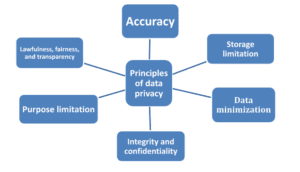
The General Data Protection Regulation GDPR Compliance of the European Union outlines the six data privacy principles. These principles are: 

pg cybersecurity course

Why are data privacy and security crucial for individuals?

You produce and consume a lot of data daily in the digital age. Additionally, you keep your data on external devices like your laptop or smartphone and cloud services. Your information is important to you and others who might wish to utilize it for their gain. For instance, hackers could seek to steal your information to access your accounts, pass themselves off as you, or sell it on the dark web.

If your data is not private and secure, you risk suffering catastrophic repercussions like:

  • Identity theft: If your identity is stolen, someone else may use it to defraud people or commit crimes in your name.
  • Financial loss: If someone gains access to your credit cards or bank accounts, they may withdraw money or make illicit transactions.
  • Reputational harm or blackmail: If someone posts private or humiliating information about you online, it might hurt your reputation.
  • Loss of trust: When someone misuses your data without your knowledge or consent, they undermine your trust in online services or platforms.
  • Loss of freedom: If someone restricts your online access to information or services based on your data profile, they may do so to the detriment of your freedom.

Cybersecurity Best Practices for Small Businesses

October is recognized worldwide as Cybersecurity Awareness Month (CSAM).

As a result, in the digital era, an individual who values data security and privacy rights:

  • You must know how internet companies acquire, utilize, share, and keep your data.
  • Be cautious about the data you disclose online and with whom you share it.
  • Use encryption software and strong passwords to prevent unwanted access to your data.
  • You should frequently upgrade your software and hardware to address any security flaws.
  • You should check your privacy preferences and settings across various platforms and services to ensure they align with your expectations.

The Importance of Data Privacy for Businesses

In the digital era, information security has grown more crucial for enterprises. Protecting consumer and employee personal information is essential for businesses, given the rise in data breaches and cyberattacks. Failure to do so may result in money, legal responsibilities, and reputation losses.

The effect it may have on a company’s reputation is the reason why data privacy is vital for enterprises. A data leak may significantly damage a company’s reputation and erode consumer and stakeholder confidence. This may result in a drop in revenue, trouble finding new clients, and harm the company’s reputation.

Additionally, organizations are required by law to safeguard customer information under several privacy regulations. Heavy fines, legal action, and other penalties for breaking these rules may be imposed.

Businesses may suffer serious financial consequences as a result of data breaches. Investigations, legal expenses, and consumer notification can all significantly add to the rehabilitation cost. Additionally, corporate losses brought on by reputational harm might result in large revenue losses.

The Final Words

Data security and privacy are crucial for individuals and enterprises in the digital era. Numerous advantages have resulted from the ever-increasing use of technology, but it has also introduced new dangers and difficulties, particularly when safeguarding sensitive data. 

People may defend themselves against identity theft, fraud, and other cybercrimes by implementing efficient data security and privacy safeguards, and organizations can protect their reputation, clients, and financial stability. Maintaining vigilance and proactively securing sensitive data as the digital environment changes are critical. 

The PG Program in Cybersecurity, developed by Imarticus Learning in partnership with industry leaders, seeks to provide future cybersecurity professionals with the finest learning experience possible. You will graduate from this comprehensive 6-month program with the abilities and know-how needed to succeed in positions like cybersecurity analyst, penetration tester, incident handler, and SOC team member.

Trends and drivers of the best fintech course in India

Last Updated on 2 years ago by Imarticus Learning

After the fintech revolution, India is witnessing enormous growth in the fintech industry at an exponential rate. The reshaping of the technology industry has become an absolute necessity as more people are indulging in the world of digital transactions, especially micro-transactions. Hence, the need and want of fintech cannot be avoided.

With global technological development, customer expectations tend to change all the time. Fintech trends are ever-evolving and multiple factors help or guide the industry to adapt to these changes. More people are registering for the best fintech courses in India as several factors keep on expanding the scope of digital transactions in this country. Read along to learn all about the trends and drivers in the fintech industry in India. 

What is Fintech? 

Fintech is the amalgamation of two words – finance and technology. It refers to those enterprises and businesses that use the technological revolution as a means of availing and accessing financial services. The term indicates a rapidly growing market that has proved to be beneficial because of innumerable reasons. Fintech caters to the needs of both customers and businesses in several ways. 

Driving Factors for the Best Fintech Courses in India

fintech course in India

Fintech courses online are a great way to know this industry better and increase your knowledge in the same. It will help you to get an upper hand over others as the various online courses will allow you to be well-equipped with the knowledge of the fintech domain. 

Certain driving factors for the adaptation of the best fintech courses in India are stated as follows:

Government Initiatives

The Indian government is working very hard to make available and accessible financial services to its citizens and budding businessmen. To achieve this, many schemes and projects have been started by the government as a stepping stone. Multiple programmes and schemes will help the government to directly or indirectly help the fintech industry reach a greater height.

The government initiatives may include the following heads:

  • Digital India campaign: It has been announced by the government for promoting technology and digital transactions in the country. It has seen a sudden growth during the time of pandemic. Multiple UPI and Aadhaar pay applications have been introduced to encourage cashless transactions.
  • Jan Dhan Yojana: This scheme has become a great success in providing financial services in India. This will help you to make easier and cashless payments.
  • Startup support programmes: The Government of India is taking several steps for supporting startups that have the potential to grow in future. The establishment of a startup scheme in India is a huge success that enables several companies to avail tax benefits.

Technological Advancement

The financial market is witnessing a sudden growth in the technological arena that includes the introduction of certain technologies such as artificial intelligence, machine learning, and blockchain. The main technological factors that are driving the growth of the fintech industry are as follows:

  • The emergence of a strong pool of talent
  • Building relations and increasing collaborations between the banks and various financial institutions and enterprises
  • Coping up with the fast pace of technological innovations

Such technological factors also give a sense of security to customers through techniques like voice recognition, biometrics, and iris scanning. 

Credit Demand

Fintech courses online will also let you know about the credit demand and details. It has been seen that the demand for credit has seen a rapid increase in the last decade. There is not enough supply of credit to fulfil the total credit demand. In this case, fintech can be very helpful for getting access to credit supply. 

There are long processes for getting credit accessibility and many people leave the process because of several inconveniences. Lengthy paperwork and challenging circumstances do not let people avail credit when it’s urgent. Fintech is there to solve this particular problem. This is a major advantage of the fintech revolution.

Large Unbanked Population

There is an unimaginable unbanked population in India especially belonging to rural areas. This is mainly because they do not have access to the traditional banking system as many of them do not have any deposits that they can make to the banks. Millions of people do not have any Aadhaar card or identification card from the government that has to be shown to the banks.

Some traditional banking options are so expensive and inconvenient that rural people cannot avail them. Fintech is here to bridge the gap between the banked and unbanked population in India. Remote financial services allow these people to better handle their finances without going to the banks every day.

Conclusion

The fintech revolution is very much a reality in India. The industry offers multiple opportunities for availing better financial services in India with several tax benefits. Such benefits may help startups and small companies to flourish. If you are enthusiastic about getting deeper insights into the fintech market, then register yourself for the fintech certification course by Imarticus to know how the industry works and become a part of it.