


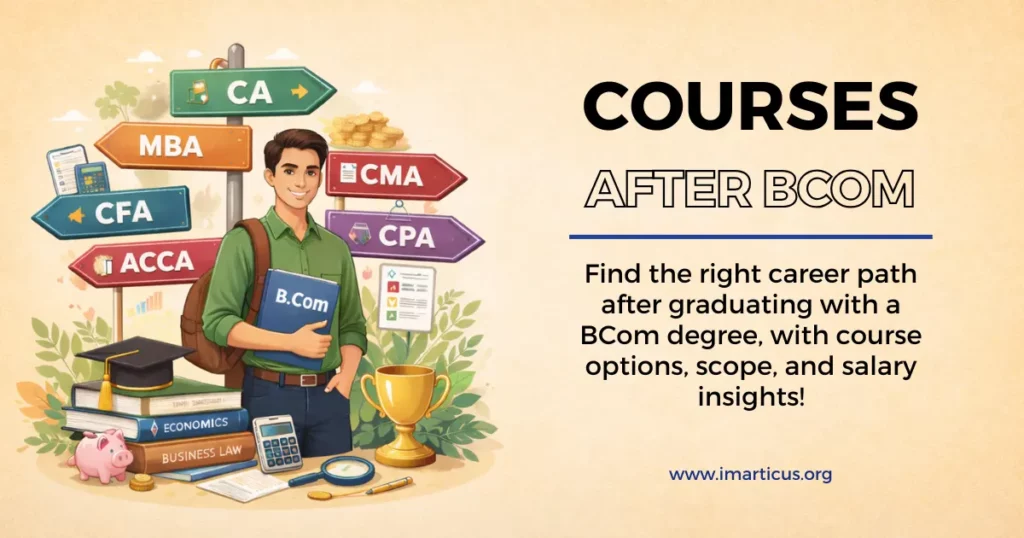
Courses after BCom with high salary potential include CA, ACCA, CFA, US CMA, CPA, FRM and MBA in Finance. These qualifications prepare graduates for careers in accounting, auditing, taxation, investment research, financial risk and corporate finance. Shorter courses in financial modelling, investment banking operations and data analytics are also worth considering for those who want to develop practical skills and apply for jobs sooner.
CA and ACCA suit accounting careers, CFA focuses on investments, while US CMA deals with financial planning and business decisions. The right course depends on your career interests, eligibility, study duration, budget and the jobs you hope to pursue. Salary growth ultimately depends on your skills, employer, experience and responsibilities, not just the qualification you complete.
I find that choosing a course after BCom is often more difficult than completing the degree itself. There is CA, ACCA, CFA, MBA, and several other qualifications. Everyone seems to have an opinion about which one is better. A relative might recommend CA, a friend may be preparing for CFA, and someone on LinkedIn will tell you that an MBA is the answer. The trouble is that these courses don’t prepare you for the same work.
Consider something as ordinary as a company’s monthly financial report. An accountant may be responsible for ensuring the numbers are correct. An auditor examines whether the records can be relied upon. A financial analyst studies those numbers to understand business performance, while someone working in risk management looks at what could go wrong.
They may all work with the same financial information, but their responsibilities are quite different. That is why I would never recommend choosing a course solely because its salary figures look attractive. Before investing your time and money, you should understand what the qualification teaches, the kind of work it prepares you for and how long it might take before you can begin earning.
Don’t Let Our Best Advice Get Buried
Add Imarticus as a Preferred Source — see more of what we publish, every time you search.

Once those things are clear, choosing the right course after BCom becomes a much more sensible decision.
Industries are changing fast. Finance is no longer only about bookkeeping. It now includes analytics, global compliance, and technology. This is why choosing the right after BCom course is more important than ever. This guide breaks down the most relevant paths you can take after BCom, from professional certifications to short-term and global options, in a way that actually connects to real careers.
Best Courses After BCom With High Salary Potential
There is no single course that guarantees the highest salary after BCom. Much depends on the field you enter and how your responsibilities grow.
For instance, two ACCA students may qualify around the same time but begin their careers in very different roles. One might work in audit, while the other joins a company’s financial reporting team. Their salaries will not necessarily be the same, even though they have studied for the same qualification.
It is more useful to compare what these courses prepare you to do before comparing salaries.
| Course | Typical Duration | Career Opportunities | Who Should Consider It |
| CA | 3 to 5+ years | Audit, taxation, corporate finance | Students interested in accounting, audit and Indian taxation |
| ACCA | 2 to 4 years | Audit, accounting, financial reporting | Students interested in international accounting and reporting |
| CFA | 2 to 4+ years | Investment research, asset management | Students interested in financial markets and investments |
| US CMA | 6 to 12 months of exam preparation | Financial planning, costing, FP&A | Students interested in corporate finance and management accounting |
| CPA (US) | 12 to 24 months of exam preparation | US accounting, audit and compliance | Students interested in US accounting and reporting |
| FRM | 1 to 2 years of exam preparation | Financial risk, market and credit risk | Students interested in banking and risk management |
| MBA Finance | Usually 2 years | Banking, consulting and management | Graduates interested in broader business and management careers |
Durations are indicative. Professional qualification requirements, examination attempts, exemptions and work experience can affect the overall completion time.
Which of These Courses Offers the Highest Salary?
A qualification can help you qualify for an opportunity, but the job itself determines what an employer is prepared to pay. An entry-level financial analyst and an experienced investment professional may both have studied CFA, yet their salaries can be very different. The same applies to CA, ACCA, CPA and other finance qualifications.
When you come across a salary figure of ₹15 or ₹20 lakh attached to a course, find out whether it refers to a fresher, someone with five years of experience or a senior professional. Without that distinction, the comparison tells you very little. I would judge salary potential alongside the work involved, career progression and the experience employers expect.
Each of these fits different career goals. These are also some of the most searched courses in finance after BCom.
Also Read: What are the benefits of ACCA?
Postgraduate And Master’s Courses After BCom
Not everyone wants to go into technical certifications. Some prefer broader business knowledge. That is where PG courses after BCom and post-graduate courses after BCom come in. These programs focus on management, leadership, and business skills.
Popular Post-Graduation Courses After BCom
- MBA
- MCom
- PGDM
- Master’s in Finance
- Master’s in Business Analytics
These are some of the best PG courses after BCom for students who want leadership roles.
Comparison Of PG Courses
| Course | Duration | Focus Area | Career Path |
| MBA | 2 years | Management | Manager, Consultant |
| MCom | 2 years | Commerce | Academic, Finance |
| PGDM | 1-2 years | Industry Skills | Corporate Roles |
| Master’s in Finance | 1-2 years | Finance | Analyst Roles |
These master’s courses after BCom work well if you want flexibility in your career.
Also Read: Can you do MCom with ACCA?
Skill-Based And Certification Courses After BCom
Not everyone wants to wait years before earning. Some want quick entry into jobs. That is where short-term courses after BCom and certification courses after BCom help. These focus on practical skills.
Popular Short-Term Courses
- Data Analytics
- Financial Modelling
- Digital Marketing
- Tally and GST
- Business Analytics
These are often completed in a few months. Many fall under 6-month courses after BCom. They are also useful as job-oriented courses after BCom.
Why These Courses Work
- Faster job entry
- Lower cost
- Industry-focused skills
Many students combine these with degrees or professional programs.
Also Read: What to expect from ACCA Classes?
How Much Can You Earn After Completing a Course After BCom?
Salary is important. For many graduates, it is one of the main reasons to pursue an additional qualification. But I would be careful about treating the salary of an experienced professional as the amount you can expect immediately after completing a course.
Consider two graduates applying for a financial analyst position.
- Both have studied financial accounting.
- One can explain the concepts well enough to pass an examination.
- The other can also work confidently with Excel, prepare financial forecasts and explain why a company’s profit has increased even though its cash balance has fallen.
- The second candidate can demonstrate skills that are directly relevant to the job.
- That doesn’t guarantee a higher offer, but it gives an employer something more substantial to evaluate.
When comparing salaries after BCom, look at the job role, required experience, city, industry and the skills expected from applicants. More importantly, consider what the role could lead to after three or five years. Your first salary matters, but your ability to take on greater responsibility will influence your earnings over a much longer period.
If you are exploring where different finance paths can actually take you, it helps to see how roles like ACCA, FRM, CFA, and CMA translate into real job opportunities and salary potential in today’s market.
Courses After BCom In India And Abroad
Your location also affects your choice. Some courses after BCom in India are well-suited for local careers. Others open global doors.
Course Popularity by Geography
| Region | Popular Courses | Key Global Benefits & Scope |
| India | • CA• CMA• MBA• CS | Strong domestic recognition and alignment with Indian corporate standards. |
| Abroad | • ACCA• CPA• CFA• FRM | Popular in countries like Canada for greater international exposure, leading to higher salaries, international roles, and better career mobility. |
Course Categories & Career Pathways After BCom
| Stream | Courses Offered | Career Opportunities |
| Accounting & Finance | • CA• CMA• ACCA• CPA• CFA | • Audit firms• Investment banking• Corporates• Consulting firms |
| Banking | • Banking Certifications• NISM Courses• MBA in Finance | • Banking sector• Financial services firms |
| IT & Tech | • Data Analytics• Business Intelligence• Excel and Power BI | • Tech roles in finance• Business analysis• Financial data reporting |
These also overlap with after BCom courses in computer. They are useful for students who want modern roles without leaving commerce completely.
Also Read: How to do ACCA after BCom?
After BCom, Which Course Is Best?
The first thing I would suggest is to look back at the subjects you enjoyed during BCom. Not necessarily the subjects in which you scored the highest marks, but those you could understand and work through without constantly feeling lost.
- If you enjoyed financial accounting, auditing and taxation, CA or ACCA may be worth considering. Both require you to understand financial information in detail, although their professional requirements and areas of emphasis differ.
- If you enjoyed studying businesses, share prices and investment decisions, CFA could be a more suitable choice. FRM, on the other hand, deals more closely with financial risk and how institutions measure and manage it.
Students who prefer budgeting, cost analysis and internal business decisions can explore US CMA. And if you’re interested in management, consulting or business leadership, an MBA could make sense. Of course, the institution you choose matters enormously here.
A Simple Way to Decide
Imagine you are offered three different tasks.
- The first involves reviewing a company’s financial statements and checking whether its accounting is correct.
- The second asks you to analyse whether a company is worth investing in. The third requires you to study why a business is spending more money than it planned and suggest ways to control those costs.
Which one would you be more interested in doing?
The first points towards accounting and audit, the second towards investment analysis, and the third towards management accounting. It isn’t a perfect career test, but it does help you think beyond course names. My suggestion is to read actual job descriptions before enrolling. Look at the responsibilities, qualifications and skills employers expect. That will give you a much clearer picture of where a course might take you.
Also Read: Why should you choose ACCA Online Courses?
Course Duration Comparison After BCom
Time is an important factor. Some courses take years. Others can be completed in months. Before you decide, it helps to compare durations clearly.
Duration Of Popular Courses
| Course | Duration |
| CA | 3-4 years |
| CMA | 2-3 years |
| ACCA | 2-3 years |
| CPA | 1.5-2 years |
| CFA | 2-3 years |
| MBA | 2 years |
| Short-Term Certifications | 3-6 months |
Students often search for details like the CA course duration after BCom or the CPA course duration after BCom before making a choice. It is also common to compare the CMA course duration after BCom in India with global certifications.
What This Means For You
- If you want depth, choose longer programs.
- If you want speed, choose short certifications.
- If you want balance, mix both.
Many students combine online courses after BCom with professional programs. This helps them build both theory and skills.
Also Read: Can you do ACCA after Graduation?
Diploma And Certificate Courses After BCom
Some students prefer shorter and more focused learning. That is where diploma courses after BCom and certificate courses after BCom help. Courses like Diploma in Financial Accounting, Certificate in GST, Diploma in Banking, etc., are some good practical and job-ready options. They are also part of courses to do after BCom.
Emerging Courses After BCom
The job market is changing fast. New roles are coming up that did not exist a few years ago. This is why exploring emerging courses after BCom graduation can be a smart move. Fields like Data Analytics, FinTech, Business Analytics, and Risk Management combine finance and technology. They are also part of modern courses in finance after BCom.
Why These Courses Matter
High demand, better salaries and building future-ready skills are the reasons why these courses are preferred. For example, earlier, accountants worked with files. Today, they work with dashboards and data tools. This shift is creating demand for hybrid skills.
Also Read: Steps To Complete ACCA
Advanced Career Pathways After BCom
Once you shortlist options, the next step is to understand where each path actually leads. Many students pick courses after BCom without knowing the real job roles attached to them. A course is only useful if it connects clearly to a career.
Career Mapping Based On Courses
| Course | Entry Role | Mid-Level Role | Long-Term Role |
| CA | Audit Associate | Finance Manager | CFO |
| CMA | Cost Analyst | Finance Controller | CFO |
| CFA | Analyst | Portfolio Manager | Investment Head |
| CPA | Accountant | Finance Lead | Global Controller |
| ACCA | Auditor | Finance Manager | Director Finance |
| MBA | Executive | Manager | Business Head |
This mapping helps you connect after BCom degree courses with real-world outcomes.
How To Choose Between Similar Courses
Many students get stuck between similar options. For example, CA vs CMA or CFA vs FRM. This confusion is common when exploring courses to do after BCom. You can get a complete understanding for each of these in the following:
- CA Vs CMA
- CFA Vs FRM
- CPA Vs ACCA
A BCom degree builds the foundation, but global finance roles today often expect specialised certifications that signal deeper expertise and wider career readiness.
Combining Courses For Better Outcomes
One course is not always enough. Many students now combine programs. This improves their chances of getting better roles.
Smart Combinations
- BCom + ACCA
- BCom + Data Analytics
- BCom + CFA
- BCom + MBA
These combinations help you stand out among others choosing similar courses after BCom in India. Imarticus Learning designs programs that allow such combinations. This helps students build both technical and practical skills.
Practical Skills That Improve Career Outcomes
A degree or certification alone is not enough today. Employers look for skills. Many students focus only on courses after BCom graduation, but ignore skills.
High-Value Skills To Build
- Advanced Excel
- Financial Modelling
- Data Analysis
- Communication
- Business Understanding
These skills are often included in online courses after BCom and short certifications.
Why Skills Matter
Imagine two candidates with the same degree. One knows Excel and data tools. The other does not. The skilled candidate gets selected faster. This is why combining certificate courses after BCom with your main program helps.
Courses After BCom Hons And Specialisations
Students from different BCom backgrounds often wonder if their path changes. The answer is simple. The options remain similar, but your base knowledge helps.
For BCom Hons Students
You already have deeper subject knowledge. This helps in:
- CA
- CFA
- ACCA
These are strong courses after BCom Hons.
For General BCom Students
You can still pursue all major options. You may need extra effort in technical areas. Many students choose diploma courses after BCom to build a strong base.
Pairing ACCA with BCom can change how early you enter the finance space, especially when you understand how exemptions reduce your load and how the paper structure builds real-world skills step by step.
Best 6 Month Courses After BCom
Not every commerce graduate wants to spend another three years studying. Some need to start earning. Others want to gain practical experience before deciding whether to pursue a professional qualification. There is nothing unreasonable about either approach. If you want a shorter route into the job market, look at courses that teach you a specific set of skills.
| Course | What You Learn | Roles You Can Explore |
| Financial Modelling | Excel, financial forecasts, valuation basics | Junior Financial Analyst |
| Investment Banking Operations | Trade processing, settlements, reconciliation | Operations Analyst |
| Data Analytics | Excel, SQL, Power BI | Junior Data Analyst |
| Tally and GST | Bookkeeping, tax compliance, accounting software | Accounts Executive |
| Business Analytics | Data interpretation, reports and dashboards | Junior Business Analyst |
Course duration can range from a few weeks to around six months, depending on the training provider. I would pay particular attention to the practical assignments.
For example, if you enrol in a financial modelling course, you should be able to build and explain a financial model by the time you finish. Knowing the definition of a cash flow statement isn’t the same as preparing one and understanding what it reveals.
Similarly, someone learning data analytics should have worked with actual datasets rather than simply memorising the functions of a software tool. A short course won’t replace professional experience, but it can give you useful skills to begin building that experience.
If you’re choosing between programmes, compare the projects, teaching quality, total fees and actual placement outcomes. Those details matter more than how quickly the certificate is issued.
Also Read: What factors matter when choosing an ACCA Institute?
Courses To Pursue After BCom Based On Industry Trends
Industries are evolving. Some skills are becoming more valuable. Understanding trends helps you pick better courses to pursue after BCom.
Current Trends
- Data-driven finance
- Automation in accounting
- Global compliance roles
- FinTech growth
These trends increase demand for hybrid skills.
What This Means For You
- Combine finance with technology
- Choose globally relevant certifications
- Focus on practical skills
This approach improves your chances across courses after BCom in India and abroad.
Also Read: Can you pursue BBA with ACCA?
Exploring Finance Courses After BCom?
When you look at courses after BCom, especially global finance options, the difference often comes down to how you are taught, not just what you study. The reason many students consider finance courses at Imarticus Learning is that the preparation feels closer to actual finance roles, not just exam patterns.
If you are considering an ACCA course after BCom, the experience can feel very different depending on how you approach it. The syllabus itself is global, but the way you prepare decides how confident you feel stepping into a role later. With Imarticus Learning, the ACCA Course prep feels more grounded in real outcomes rather than just clearing papers.
FAQs on Courses After BCom
Most students reach this stage with the same doubts in mind about outcomes, salaries, and what actually works in the real job market. These answers to the frequently asked questions cut through that confusion and help you make practical sense of courses after BCom.
Which Course in BCom Is Best?
The best courses after BCom align with your career goal rather than a universal ranking. For global finance, ACCA and CFA lead. For Indian markets, CA is hard to beat. For speed of entry, financial modelling or digital marketing work. Imarticus Learning covers ACCA, CFA, CMA USA, CPA, and FRM under one roof if finance is your direction.
What Are the Top 5 Courses after Commerce?
Among the highest-returning options are CA, ACCA, CFA, CMA, and MBA Finance ie. the top 5 courses after commerce. These five consistently produce the strongest salary outcomes and the widest career scope for commerce graduates. Imarticus Learning prepares students for four of these five qualifications with structured, placement-backed programs.
What Should I Do After Completing My Degree in BCom?
Start by identifying whether you want a professional certification or a postgraduate degree. For finance roles, explore ACCA, CFA, or CMA USA based on your geography preference. Imarticus Learning’s finance programs are a strong starting point.
Start Your Next Chapter With Courses After BCom
At some point, this stops being about options and starts becoming about direction. A lot of students keep searching for the “best” choice, hoping there is one perfect answer. In reality, what works is picking a path you can stay consistent with. When you look at courses after BCom, try to see beyond the brochure version of each option. Picture the actual work. The kind of problems you will solve. The pace of growth you are comfortable with. That is where real clarity comes from.
If your interest leans towards finance and you see yourself working with global firms, it helps to start building that direction early. Certifications like ACCA are often pursued alongside college today because they align closely with how modern finance roles operate across countries. Starting early also reduces pressure later.
What makes the journey easier is having the right structure around you. Instead of figuring everything out alone, learning environments that combine exam preparation with practical exposure can make a visible difference. That is where the ACCA Course prep with Imarticus Learning fits in, making the path far more organised and realistic.
Liked This? Follow Us Where You Already Search.
Preferred Sources is Google’s built-in follow button — no app, no login, just more Imarticus in your results.
