


A large amount of business analysts time, as well as effort, is taken up in doing important activities. These activities include understanding a client’s business as well as collecting and clearing various requirements. Being a business analyst involves building trust with higher-ups and stakeholders while also identifying clientele needs. Thus writing up supporting documents is only a small part of a business analysts job and also happens to be the most visible to the people that are not involved with the project.
A business analyst helps in bridging the gap between various representatives of business that are responsible for solving issues and various developers that are needed to understand these issues. The developer curates a solution depending on the issue.
Listed below are the various problems as well as challenges that business analysts frequently face.
Typical challenges that business analysts face
1. Misunderstanding and misconception of a business analyst’s work scope
There are often differences created between what work or activity is really vital for a business analyst to get to and the actual responsibilities that their job holds or entails. This frequently occurs when a project involving a customer that does not have experience and is thus unfamiliar with a development project.
The possible solution that can be offered in such a situation is to discuss with the client what exactly their expectations are of them as a business analyst as well as their responsibilities. This should be done before the project commences. The business analyst must make sure to explain to the customer and make them understand the meaning of all important terms including terms like wireframes, V&S documents, SRS, and many more. A large number of clients often fail to recognise the difference between a prototype, a wireframe and what is called a mock-up. These words may look similar to the client and leads them to sometimes believe that the terms are designed equally. This would thus require the application of various styles, margins, and so on which would exceed the job responsibilities of a BA. Approval of various expected deliverables, as well as their content, is thus extremely important for both the business analyst as well as the client.
2. The specifications created do not the requirements of the development team
This would include the following pitfalls:
● Vague as well as ambiguous needs and requirements
● There is a lack of understanding of the level of requirements descriptions, that would be needed for developers, by the business analyst
● Insufficient time provided for obtaining requirements and putting the document together
The easiest way to solve this situation is through thorough discussion and through the discussion, defining the necessary level of requirements description, creating a checklist, identifying insufficiency of information, etc.
3. Changing business requirements as well as needs
4. Conflicts and clashes with stakeholders and higher-ups
In the case of any conflicts arising between authority (stakeholders) and business analysts when there is a team proposing a novel approach in regards to present business processes, the team must understand why there is any resistance. The following point may give you an idea.
● There could be critical features or important needs and requirements that were overlooked by the business analyst
● There could be hesitation in discarding old working methods and resistance to study novel solutions
5. Existence of undocumented processes
With the help of a business analyst course, aspirants and people looking to succeed in the field of business analysis will be informed and educated on the ins and outs of the field. A business analysis course will equip people with exactly the resources and tools that they would require in order to succeed in a business analyst job.

 Imarticus Learning offers a range of courses in online distance MBA, which you can check out. The institute partners with London Stock Exchange to offer CIBOP, which fast-tracks students’ careers in investment banking operations.



 The finance and banking sector in the analytics market across India generated 756 million US dollars in 2017. The analytics market in India is growing rapidly. The average pay of a business analyst in India is ₹6 lakhs per year. Moreover, it goes up to ₹10 lakhs per year, depending on your experience, skills, and location.
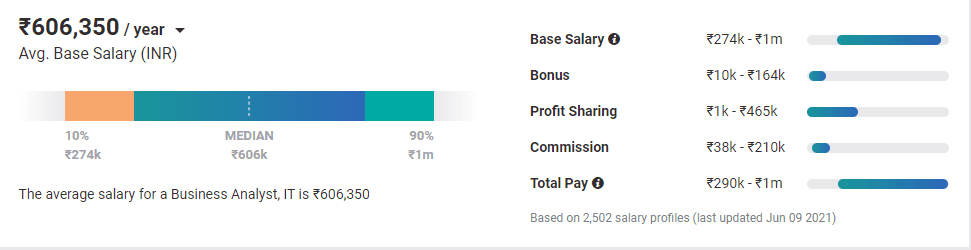 Security is a huge factor while considering a career. As a business analyst, you would have a secure career as there’s a huge shortage of talented and skilled business analytics professionals in the market.
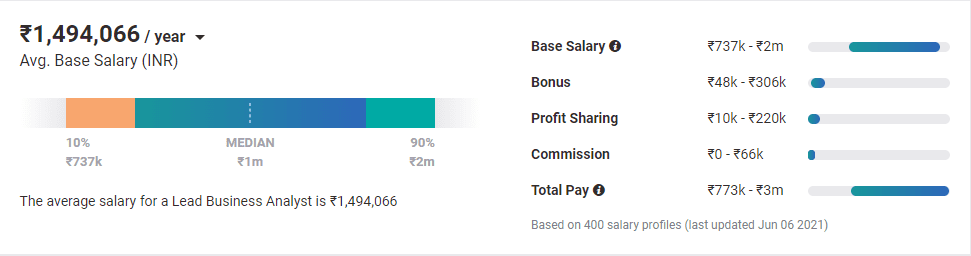 The role of a business analyst offers a lot of flexibility and independence. You’d be working at your own pace and solving complex business problems, analyzing data patterns, and formulating solutions for your organization.
 There are a lot of advantages to becoming a business analyst. It offers you numerous growth opportunities and highly lucrative pay. Business analytics is perfect for engineering students as engineers have experience in dealing with numbers and applied sciences.
 Considering these massive shifts in the status quo, it is clear that technology—especially the Internet—has been central to our evolution and adaptability in the COVID-19 era. However, it is common knowledge that a tech-driven transformation was underway long before the pandemic hit us.

 Some core competencies of a business analyst include:
 This
This 
 Business analysts play a role in recognizing and evaluating business problems and delivering solutions that optimize an organization’s value to its stakeholders and facilitate transformation in the organization.
 Now that you know what a business analyst does, let’s move on to the following part, discussing the