How can a software engineer become a blockchain developer?

As a breakthrough technology, blockchain has undoubtedly spawned a new branch of development, known as blockchain development. As a result, there are a plethora of work prospects for developers and tech aficionados. Many people look for jobs after completing a certification in Software Engineering.

best software engineering courses in IndiaThe two kinds of Blockchain Developers are:

  1. Core Blockchain Developers
  2. Blockchain Software Developers

In most cases, a Core Blockchain Developer is engaged in the design, architecture, and security of a blockchain system.

Blockchain Software Developers have their own set of responsibilities. These responsibilities have nothing to do with the system’s consensus design or architecture. Blockchain software developers use blockchain technology to build decentralized applications in the same way that a regular web developer uses the protocols and architectural structure established by a core web architect to build web apps.

As blockchain technology and its myriad applications gain popularity, a slew of new opportunities for software developers emerge. The blockchain developer is in a high-level position in the industry. However, because it is such a unique profession, the role is not as well-defined as other tech positions that have been on the market for a long time.

This is because a blockchain developer can be any software engineer who is qualified to work with blockchain technologies. Plus, since blockchain works closely with cloud systems, a Cloud DevOps Engineer training can also help in setting up the systems. A software engineer/Cloud DevOps Engineer can help in this regard.
best cloud engineering coursesHow can a software engineer turn into a blockchain developer?

Any software engineer may become a blockchain expert. Furthermore, the vast majority of blockchain specialists began their careers as programmers or software engineers. As a result, you can receive a standard software engineer education while also taking various specialist courses on blockchain technologies.

To flourish as a blockchain developer, you must be well-versed in essential programming languages utilized in blockchain projects. Javascript is one of the most often used programming languages in blockchain projects. Solidity would be another important language that will give ambitious developers a leg up.

It is one of the few languages to concentrate on because it is the language of Ethereum’s smart contracts. Python, Java, and Clojure are some major languages utilized to develop the majority of blockchain applications around the world.

Blockchain is synonymous with security. Furthermore, cryptography assures that blockchain networks are impenetrable. It is the branch of engineering concerned with active and intelligent opposition. Being a cryptography expert will improve your blockchain development skills as it will allow you to encrypt decentralized records, which in reality is the foundation of blockchain.

The ability of a blockchain developer to tinker with data structures to get desired results is critical to the project. As a result, as an aspiring blockchain engineer, you must grasp the applications of data structures in order to achieve exponential results in your future projects.

Blockchain projects also include UI design, request handling, and Application Programming Interface Management. Most of these tasks are performed by experienced engineers; however, full-stack web development knowledge will add extra points to your profile. It also gives you a tremendous head start because you will already have the skills needed to function in larger roles.

Here are some tips on the skills to acquire that have been laid down by IBM:

  1. Learning the basic database technology is useful for understanding blockchain and, in particular, data structures.
  2. Learn how to create digital assets, how to preserve them, and how to retrieve them.
  3. Gain knowledge about distributed computing, network formation, and how to interact and send data across point A to point B.

Conclusion:
As evident from this article, the job of a blockchain engineer is very much in demand these days. Hence, a certification in software engineering course might just be the right boost you need in order to bag placement in a good firm. Blockchains are also being used in IoT networking, and software engineers can help in integrating blockchain systems with IoT networking.


Data Analytics, Productivity, and Well-being: Are they interrelated?

Forms and benefits of data analytics have shifted majorly in the last few years. Major firms have also been using it as a way to decipher the habit patterns of their employees to take care of their well-being. Needless to say, their wellbeing directly relates to their workplace productivity. However, with the evolution of data analytics, data analysts also have to be able to evolve constantly.

And that is only possible when they have the proper training to adapt to situations, and that can only happen if they learn data analytics from a proper institution. Imarticus Learning has come forth with a great opportunity for people who would like to polish their skills with their new PG program with data analytics and machine learning certification.

Coming back to the impact of the well-being of employees on company productivity, studies have found that being comfortable in their workplace can make the workers about 12% more productive.

Data analysis as a tool to ensure happiness

Major firms have been trying to gather and decipher the patterns of their employees’ behavior to provide a personalized experience to them for some time now. There are a lot of ways companies have decided to approach it. Some offered wearables to their employees that will teach how much time they spend, sitting, talking, writing, or moving about. Some have chosen the company intranet to trace their online tracks.

Now it falls to the data analytics team to extract, and decipher these patterns. It is fruitful in the sense that these patterns always give indications of not only their physical health but also their mental ones. This is also a way where companies can provide personalized suggestions for their well-being. And the employees get benefitted from it in a way that impacts their daily life. As a result, they feel more loyalty towards the company.

Hurdles to jump over

There are some evident advantages of exchanging data for the betterment of the employees’ wellbeing, and in turn, increase their productivity. However, it is also a possibility that when it comes to data gathering and analysis, the employees might have some privacy concerns about them.

Which in turn, might make them unwilling to participate actively in the bandwagon. This is why, there are a few things that should be kept in mind when it comes to the interrelation of wellbeing and productivity of the workers, such as:

  • The first and most important thing is to make sure the workers consent to the exchange of data for the company’s use, as many might have privacy concerns relating to that.
  • Companies will need to have experts in the analytics team to properly extract and use the data and make it a priority for both the main wing of the business and the analytics team to prioritize the employees well being.They need to communicate properly to the workers how it benefits them and the company both at once.
  • The key is to recognize what the employees want and be able to cater to it. Otherwise, even after using data analytics to define the workers’ needs, it will be utterly irrelevant.

Conclusion

Using data analytics as a mode of communication between the employer and employee needs time and expert skills. And it can only come if you learn data analytics from a good place. Many institutes in India offer a data analytics certificate course. Imarticus Learning is one of the topmost among them, so do check out their PG program of data analytics and machine learning.

Fuelling Business Growth and Innovation with Investment Banking Operations

Investment banking is that division within the banking sector that facilitates large capital funding for corporations and governmental bodies. Common perceptions make us immediately associate investment banking with Harvey Specter like bankers assisting corporations to crack high stakes negotiations and deals. But there are massive backend operations going on at all times without which these deals would be impossible.

That is the importance of investment banking operations. An operational investment banker, more commonly referred to as an operations specialist, is responsible for ensuring efficiency, accuracy, profitability, and risk reduction vis-a-vis the clearance and settlement of transactions for the company’s clientele.

Utilizing investment banking operations to their full potential engsures infinite business growth and innovation. Which is all the more reason why operations is an extremely lucrative career path.

In this article, we discuss the ways in which business growth and innovation can be fuelled with investment banking operations as well as provide recommendations for investment banking online certification and investment banker courses in India for anyone looking to learn investment banking to improve their career prospects.

best investment banking courses with placement in IndiaFunction Of Investment Banking Operations

Investment banks offer transactional, legal, and advisory services to their high-profile clientele with complex financial needs.

Some of the activities included in the oeuvre of investment banking are underwriting, mergers and acquisitions, equity research, and asset management.

During the processing of transactions, there is a huge volume of information, products, and money that continuously flow from end to end. The smooth processing of this data falls under the jurisdiction of the operations teams which is also referred to as the back office or engine room in investment banking parlance.

Apart from providing support to client-facing departments, the operations staff also ensure the optimal functioning of IT solutions and data management systems deployed across the organization. They also oversee the regulatory requirements of a bank.

Driving Growth Potential With Investment Banking Operations

Investment banks play a pivotal role in sustaining the larger economy by adding liquidity to the financial markets. They promote business growth and aid the circulation of money in the economy thereby promoting growth. Banking operations are the dark knight of any investment bank – the heroes who hide in plain sight. Although, they perform non-revenue functions, without them the profit-making capacity comes crashing down.

Think of it as having a strong core. No matter the amount of muscles one grows in the arms or legs, without a strong core, the body is unable to support or balance them. Streamlined banking operations can save banks tons of money which can then be utilized for business growth and building innovations.

How To Be An Operational Investment Banker

There are several roles and functionalities under the banking operations of an investment bank. New entrants usually undergo extensive on-the-job training for at least one to two years that helps in the development of niche expertise.

Hiring teams in investment banks look for formal education in finance and internship or apprenticeship experiences in potential candidates. Having an investment banker online certification also adds to a candidate’s competitive edge.

Conclusion

To learn investment banking, a good place to start is to get a degree from any reputed institution in India. A Certified Investment Banking Operations Professional course from a good institution can be the best investment banker course in India that can guarantee a CIBOP degree and best job interview opportunities.

best investment banking courses with placement in IndiaIf a classroom environment seems uncomfortable in the post-Covid world then you can also consider this online Certified Investment Banking Operations Professional course that offers holistic learning in the nitty-gritty of investment banking operations.

Which Is Better For Machine Learning R or Python?

Machine learning is not a single science. It comprises a blend of fields such as analysis, recognition, prediction and decision making. There are several open-source tools available for machine learning out of which R and Python are the most demanded or rather the most popular ones. The main difference between the two languages has been seen in the fields of analysis and data science.

Both the languages provide open source tools and support from a wide variety of libraries for machine learning but because of the high degree of robustness provided by the python packages such as Scikit-learn built on numpy and Scipy, Python is preferred more for machine learning. According to a recent survey, Python had an increment in its popularity and use from 53% to 69% within two years.

Several machine learning courses aim at delivering courses dedicated to R and Python. The question as to whether an individual should learn both languages depends highly on the field of application and interest of an individual. Both languages have highly efficient ecosystems for machine learning tasks.

The difference in popularity and use is because of the comfort of an individual with the programming language, interest and application needs. Also, job opportunities can be one of the deciding factors whether an individual should learn Python or R for machine learning.

Provided below is a comparison of Python and R which could help an individual decide whether they need to learn both languages.

R:

R was developed by the statisticians primarily for analysis. The programming language is based on the mathematical calculations comprising machine learning and hence forms a really important part of the statistics involved in the project. Thus, a project which is largely dependent on statistics should use R as a programming language.

Advantages:

  • Highly suitable for data analysis and visualization.
  • Support from the libraries
  • Highly robust
  • Highly suited for exploratory work

Disadvantages:

  • Scarcity of expertise in the language due to low learning rates.
  • The algorithms in R comes primarily from the third parties and hence, it is not very consistent to build the models.

 Python:

Python came into existence in the ’80s. Today, it forms a core of the machine learning operations being performed by Google. It has extended its roots in the field of artificial intelligence as well and is being widely used in almost every possible domains whether technical or non-technical.

Advantages:

  • In contrast to R which provides support for only statistics, machine learning has extended beyond just statistics.
  • Python unlike R provides a smooth learning curve and is more consistent than R.
  • Huge support from libraries such as numpy, pandas, OpenCV, sklearn, etc.
  • Simplicity in the syntax making it easy to learn the language.
  • Highly robust models and boosting techniques.

Disadvantages:

  • Less support for statistical models due to the non-availability of suitable packages.
  • Multithreading is Pyhton is not generally preferred as it is difficult to implement.

From the above comparison, it can be seen that both the languages having their advantages and disadvantages. But the key point that differentiates them is the use and library support. R and Python in machine learning have succeeded in their way. One has left footprints in the field of analytics while the other has emerged victorious in the field of data science.

Conclusion

To choose the right language, the right strategy is needed. For a person stepping into the industry as a fresher, Python is preferred as compared to R because of its simple syntax and ease of learning.

Also, if an individual is looking for a career in the field of data science they should go for Python as the programming language and if they want to handle the huge data-related tasks such as analysis and prediction making, no doubt that R is a better choice.

R is closely related to analysis and Python is closely tied to huge tasks such as object detection, disease prediction, computer vision and so on. Hence, we can conclude by saying that an individual needs to rightly assess their needs before choosing one of them and should master only one trade.

Financial Modelling Techniques

Financial Modelling Techniques

Financial Modelling is a process by which a business generates cost-effective ideas and risk management techniques to manage the financial capabilities of a company better. It is used widely for preparing company budgeting strategy, capital structure, and during mergers and acquisitions.

Financial models are a representation of the performance of the various financial assets of any company which is in line with the economic situation in the real world. Financial Modelling includes the valuation of the company, growth forecasts, and performance forecasts of a company’s existing financial assets and spreadsheet models.

It is a representation of a company’s financial position to facilitate the effective managerial decision-making process. Financial Modelling is a complex task and requires highly skilled personnel. Therefore, financial modelling courses have become very popular.

credit risk analyst coursesFinancial Modelling Techniques

Financial Models uses Excel modeling as a way to represent a company’s past, current, and future financials.

Therefore, to be able to employ these techniques, one needs to have in-depth knowledge of Excel.

Financial Modelling techniques are an essential decision-making tool, which is widely used in the corporate world.

Let us have a look at a few of the most commonly used Financial Modelling Techniques.
Historical Data – Historical data analysis uses a forward-looking process to determine future trends effectively. This implementation of this modeling technique requires the following specific steps.

Step 1 – Determine the objective of Modelling.
Step 2 – Collect data from credible sources. The credibility of citations is significant to assure that the results reflect the real picture.
Step 3 – Perform data analysis using various statistical tools and techniques.

Assumptions – Assumptions require sense-making of the statistical analysis performed on the historical data. The statistical analysis breaks down the data into numbers. These numbers form the basis of assumptions as while forecasting and planning the financial strategy, and a company needs to be realistic in its outlook of the future.

While making assumptions, a financial manager tries to fuse the internal and external information scientifically. One might mistake assumption as guesswork, but the process is always well planned and strategic as these assumptions are the key driver of the financial performance of an organization.

Colour Coding – It is a necessary form of representation used in financial Modelling to make sure that the users of the information can understand that different values belong to other parameters. Colour coding of the cell is a widely used feature of Excel, which makes helps to indicate whether the performance of a particular parameter meets the expectation or not.

Financial Models

A financial model is a tool that helps in the decision-making of a firm. Let us look at some standard Financial models.

Three Statement Model
It uses three primary financial statements
1. Income Statement – To ascertain Profit levels of a company.
2. Balance Sheet – To ascertain the asset health, equity standing, etc. of a company.
3. Cash-Flow Statement – To see the company’s cash balance and short-term liquidity.

Ratio Analysis
This model helps to determine the current standing of a company concerning individual other companies. A financial manager prepares specific ratios like PE Multiple, PB ratios, and so on to compare financial performances.

Discounted Cash Flow Model
This model is used predominantly by investors to predict the future cash flows of companies to make an investment decision. Stock market traders also use it before they purchase shares of a company.

In today’s scenario, as managing the finances of a company is becoming increasingly complex and sophisticated, especially with the advent of automation and technological dynamism, Financial Modelling helps to make rational investment decisions.

Financial Modelling Courses, therefore, try to provide holistic knowledge to aspirants of modeling techniques that can catapult them in a high career growth trajectory.

7 Reasons Why a Distance MBA is Better than a Regular MBA

The MBA is the most sought-after graduate management degree in the world. Employers look forward to hiring more people with an MBA degree and students are enamored with it. Every year, a huge number of professionals apply to various sorts of MBA programs.

The MBA, as a generalist degree, provides you with essential management knowledge, which means you’ll gain a holistic understanding of the company across topics such as marketing, finance, and accounting, all while developing those important soft skills and leadership skills.

No matter what your experience is, if you want to develop management skills and advance your career, then MBA is the right option; whether you want to start your own business, rise within your existing firm, move functions, industries, or locations, or all three.

What is a distance MBA Course?

An Online MBA course is usually a two-year management curriculum intended exclusively for students or individuals who are unable to take up a full-time or traditional MBA degree. A variety of colleges and private institutions offer the MBA course part-time or online.

Several private and public universities in the country are stepping forward to provide the MBA degree to students via distance learning. After earning a master’s degree in business administration in any specialization, students can apply for lucrative jobs.

 Benefits of pursuing a distance MBA program

  1. What could be better than scheduling your studies and classes according to your convenience? A distance MBA is prefixed and follows a set schedule, but you can reschedule any classes you have missed.
  2. Going to college on a daily basis while also working a full-time job can become exhausting and stressful. Aside from the conflicting academic and office schedules, it is very tiresome. In the case of a distance MBA program, however, the situation is completely different. You can access the lectures whenever you want and your time spent traveling to college can be spent studying.
  3. There are numerous types of people in a country like India who have diverse financial conditions. Not all students can afford traditional MBA programs with exorbitant tuition fees. As a result, a distance MBA is ideal for students who are unable to pay expensive tuition and are looking for a low-cost and fair option. Most colleges charge modest costs for distance MBA courses, making them accessible to students from all walks of life.
  4. After obtaining an MBA through remote education, you will be qualified for any management position in a large corporation. You will be hired according to your specialization.The position and job description are also determined by the number of years of experience you have in the industry. You can apply for a variety of positions such as project manager, manager, brand manager, product supervisor, financial analyst, professor, and many others.
  5. In a traditional college, you have no choice of online classes. However, a distance MBA requires you to study online. You also do not need to be concerned about purchasing textbooks. The institute will supply you with reading material as well as online notes that you may quickly access.
  6. You can get admission anytime as there is no stipulated time within which you need to apply for admission into a Distance MBA program.
  7. There is a lot of leeway in terms of exam timing, venue selection, and online assignment submission in an online MBA course

Conclusion

The aforementioned points clearly indicate that taking up a distance MBA course is a very good option. It gives you a good deal of flexibility along with giving you a degree to kickstart your MBA career.

Translate Insights into Profitable Decision-Making with a Bachelor’s Degree in Business Administration

Businesses require a marketing strategy to bring in the biggest profits. To create a strategy that would ensure a favorable outcome, it is important to focus on data-driven decisions. A BBA degree will help students understand new-age business and how the use of the right software solutions can help to increase profits.

Generating Actionable Insights to Increase Profits in Business

Businesses deal with numerous data sources every day. Such a huge volume of data can affect many digital marketers because of the “vanity metrics” they generate. These metrics are not useful for business improvement. They simply make the brand look successful but do nothing to help the brand optimize performances to generate better outcomes in the future.

This is why there is a need for actionable insights. A bachelor in business administration finance will teach students to implement machine learning and AI to finance and business strategy and generate useful metrics. These insights are obtained from a thorough analysis of historical and current data. Brands can focus on actionable metrics and improve their services or products accordingly.

Actionable insights are focused on specific data. The data is sourced from customer interaction and experience, conversion channels, and responses to specific products or services. The data is then categorized and prioritized. The analysis of such data helps businesses make impactful decisions that will help to generate more profits. The integration of sources and the analysis of patterns and correlation in data allows brands to get the most out of their business process.

If you are looking to make a difference in the field of business, choose BBA courses that are based on new-age thinking. Imarticus Learning offers a bachelor’s degree that will allow you to focus on technology-driven business practices.

BBA online coursesHow can a degree in business administration help with profitable decision-making?


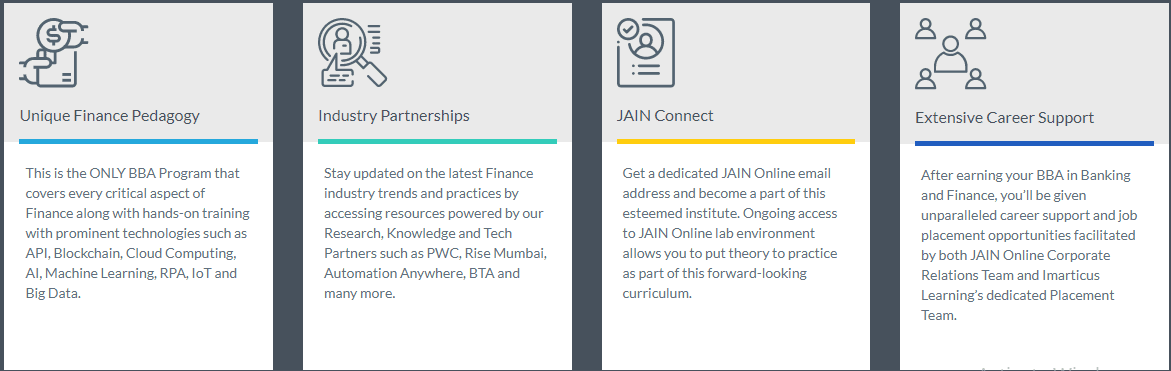
To understand and work on profitable decision-making, candidates need to complete a degree in business administration. The bachelor in business administration from Imarticus Learning teaches the practical applications of finance. The curriculum of this course is created in collaboration with several of Imarticus’s industry partners like Rise Mumbai, Automation Anywhere, and PWC, among others. Completing a BBA in Finance and Banking will allow you to learn the implementation of necessary tools to generate insights that would ensure profitable outcomes.

Bachelor in business administration finance is a specialized course. It teaches students to use Blockchain, API, AI, RPA machine learning, IoT, cloud computing, and Big Data in the critical aspects of the business industry. This is one of the best BBA courses in the country to offer finance and banking as specializations for all students.

Comprehensive knowledge of the industry is necessary to translate the metrics into profitable decisions. Imarticus Learning’s BBA course provides a holistic and unique approach towards business education. The course includes topics like FinTech, financial modeling, and equity research.

The immersive learning experience and hands-on training prepare students for industry work. Students are encouraged to interact with their peers and academicians. This helps them create and broaden their networks. Imarticus Learning also has a placement team that ensures career opportunities for every student.

A bachelor in business administration is the first step towards a lucrative career. The business sector is evolving and embracing technological solutions for profitable outcomes. The implementation of tools for the accurate analysis of data is essential in business.

The BBA course from Imarticus Learning will help aspiring candidates become experts in new-age finance, management, and business administration. This will ensure that they become valuable employees who can help translate the necessary insights into favorable decisions for a brand.

What Are the Characteristics of Big Data?

Big data is the next big wave that is shaping the corporate sector today. Big data gives an idea about the size of data but there are various aspects associated with it. It is also driven by various other factors apart from the size of data such as the sources of data, various formats in which it is available, chunking and extraction, etc.

Big data has managed to find space in all sectors of the market – technology, retail, telecommunications or any other broadly recognized field. It makes use of the available data to derive conclusions.

Need for Big Data

Organizations have huge data resources in an unstructured format. Mostly this data is stored in various devices and is never brought to any use. Data can prove to be a mega resource for the growth of any company as it can equip the company with numerous insights thus acting as the steering wheel of the company. Traditional tools such as Excel are not that efficient in extracting information and putting it to any relevant use. Big data comes into the picture here.

When you have a huge amount of data, it needs to be sorted and then classified under various heads so that the important fields can be easily recognized and brought to use. This space is getting bigger with every passing minute as we are becoming more and more data-oriented.

The volume of data is huge. With the increase in the number of internet users, more data and information are coming into circulation and this has given rise to the value data holds today. This data is produced through various channels like search engines, social media networks, business informatics, etc. It makes use of various tools to summarize information.

Learning Big Data and Hadoop can pave a great career path for someone who wants to have a career in data analytics.

Characteristics of Big Data

 The 4 Vs of Big Data characterize big data. Data needs to be classified and organized for better understanding. The 4 Vs of Big Data are:

  1. Volume
  2. Velocity
  3. Variety
  4. Veracity

These characteristics form the essence of Big Data. It gives insights on how the data should be dealt with and how can the insights from that data can be put to good use.

  1. Volume: Volume defines the size of the data which in today’s time is exploding and increasing exponentially. To be precise, this defines the quantity of data available for the extraction of information. Based on the volume of data, various tools are applied for the segregation of information.
  2. Velocity: Velocity refers to the speed in which the data is processed. The speed of data processing plays a very important role in Big data as a lot of data has to be analyzed and insights have to be drawn within a stipulated time frame, thus making the velocity of data an important feature of Big Data.
  3. Variety: Variety refers to the various types of data from which the relevant information has to be extracted. It is important as data collected from different sources are diverse in many aspects. Big Data makes use of various tools to integrate the diversified data and draw insights for the business.
  4. Veracity: Veracity refers to data accuracy and its relevance with the business information we require or the business decision that has to be made. Veracity helps in the identification of relevant information and hence saves a lot of time.

Conclusion

Big Data today has various dimensions and has opened a new world for data harvesting and extraction. With the help of the Big Data Analytics course, one could gain expertise and in-depth insight into the field.

What Is the Difference Between a Credit Analyst and Underwriter

A credit analyst and underwriter both have a very crucial role to play in an organization. Let us look at the responsibilities of each in detail to have a better understanding as to what both of these roles entail and how do they differ.

Who is a Credit Analyst?

The primary function of banks and financial institutions in the capitalist economy is to help channels funds in the economy efficiently. They help provide funds to those in need of money and also deposit additional funds saved by people by offering them an interest in their overall deposit.

While providing loans to borrowers banks and other financial institutions have to assess the profile of the candidate who is seeking the loan. This assessment is necessary to evaluate the repayment capacity of the borrower.

The assessment is needed to find out the risk associated with providing the loan to a particular borrower. Lending institutions have to reduce their risk exposure and they like to evaluate the borrower’s financial and personal information to find out whether the risk associated with loaning the amount is in the acceptable range.
Do Women Need Specialized Diets and Workouts? by Marcella Torres – Articles, from legacy VBBF website – Vegan Bodybuilding & Fitness deca water retention bodybuilding: bodybuilding training workouts
Various important information including the borrower’s income source, credit history, monthly income, repayment capacity, etc. is analyzed thoroughly before coming to the final decision of approving or denying the loans request.
Credit Risk analysts play a crucial role by evaluating the risk factors associated with the borrower.

They are responsible for collecting and analyzing all the financial and personal records of the borrower to find out whether it’s an acceptable risk for the lending institution or not. Credit analysts work in various types of establishments including banks, financial institutions, insurance companies, credit agencies, investment banks, etc.

What Does a Credit Underwriter Do?

A credit underwriter is responsible for reviewing and scrutinizing new loan applications to find out suitable borrowers who can be trusted to repay the loan amount as per the terms and conditions of the lending institution. Underwriters are responsible for identifying and providing suitable borrowers. Underwriters are primarily responsible for figuring out commercial and personal loan eligibility.

Underwriters work side by side with the loan officer and clients from the start till the loan is disbursed. They analyze and overview the loan documentation process bachelorarbeit ghostwriter kosten. Underwriters use the ‘4Cs’ method while reviewing credit applications that include Character, Capacity, Conditions & Collateral.

How do they differ?

The role of a credit analyst and underwriter might not seem very different at first glance but both are responsible for performing different functions hausarbeit schreiben lassen. These functions are related to the loan application process but it differs when you get into the details of work done by both types of professionals.

One of the major differences between a credit analyst and a credit underwriter is that an analyst is responsible for analyzing and identifying the risks associated with ghostwriter referat loaning the funds whereas an underwriter is responsible for analyzing the documents provided by the client for loan approval.

The role of a credit analyst is a little broad as it involves conducting risk analysis to see if the borrower’s profile is a suitable fit by analyzing all associated risk factors. The role of an underwriter is, however, limited to inspecting the documents provided by the client to figure out if they have all necessary documents needed by the lending party. Another major difference between a credit analyst and an underwriter is that an underwriter works closely with both the loan officer and the client throughout the loan process whereas the credit analyst works behind the scenes to assess the borrower’s financials. If you are interested in exploring more about the roles of a credit analyst and an underwriter, seeking guidance from a ghostwriter aufsatz could be beneficial to delve into a comprehensive analysis of their responsibilities and functions.

Credit risk analysts are in high demand given the importance of risk management in the financial services industry.

Credit risk analyst is also among one of the most sought-after career options for people aspiring to be successful in the financial services industry facharbeit schreiben lassen. One can easily opt for a credit risk analyst course by reputed institutions like Imarticus Learning who also provide job assurance with some of the top firms in the industry.

Also Read: How Do I Become Credit Risk Analyst 

What is the primary objective of credit risk in banks?

What is a Credit analyst’s salary?

How Can A Credit Risk Analytics course help you?

Enrol for the best artificial intelligence and machine learning course from E&ICT Academy, IIT Guwahati

The most important question to any student these days would be what to study that will tremendously benefit his/her career, and where to study it from. Numerous courses are offered by several institutions, and choosing the best option for yourself in such a scenario can be very confusing. This is why we are here to shed light on possibly the most relevant course right now.

That is, of course, the artificial intelligence and machine learning course. It is one of the most versatile courses out there that lets you work in almost any field you want. That is because all the major sectors now need the help of artificial intelligence and machine learning to optimize their business and keep the customer and employee-friendly. A lot of institutes in India provide AI ML courses. Imarticus Learning is one of the best in this field with its certificate course.

best artificial intelligence and machine learning course from IIT

However, if we are to talk about the best institute to learn an artificial intelligence and machine learning course from, then it would undoubtedly be an IIT. Here, we are going to take a look at why an AI and ML course might be one of the most relevant courses out there that will benefit your career. And, why an AI and ML course from an IIT is the best.

artificial intelligence and machine learning course from IITBenefits of an AI and ML course

Data analytics basically uses numerous tools to extract and analyze data in a way that helps to detect patterns from past records. It also analyses where the company is now and predicts where it can go from here. All of it is done through analyzing market trends, the company’s financial condition as well as the customer’s online habits. The main benefits of this course are:

  • It is one of those jobs that is applicable in any given field, from the health sector to finance to marketing. This means that you can land your dream job from the get-go or if you feel like it, then you can even change your sector without much thought.
  • It is one of the highest-paying jobs in the country right now, which, of course, means a stable future.
  • Expert reports state that in the near future, there are going to be even more positions opening up in all corporate sectors.artificial intelligence and machine learning courses from IIT

 Why IIT is the best choice

As we all know, IIT is an unparalleled choice when it comes to courses in any sector of business. There are few reasons for that, such as:

  • It teaches you deep skills that are most popularly used in AI and ML.
  • The opportunity to learn from actual corporate cases, that too from the top-level industry professionals of AI and ML.
    artificial intelligence and machine learning courses from IIT
  • Overall excellent vocational training, as students experience hands-on learning with lab-based cases related to the most high-level industry problems.
  • Another thing that IITs are most known for is excellent industrial exposure.
  • The opportunity to learn AI and ML from any IIT will immediately put you leagues beyond your peers.
  • An excellent package right from the beginning in your preferred sector.

 Conclusion

best IIT artificial intelligence and machine learning coursesThe opportunity to learn AI ML courses from an IIT is the best thing that can happen to your career. It is an academic investment that will be paying off throughout your life.

So, prepare hard enough to give yourself that edge over others. Also, do check out Imarticus Learning’s AI and ML certificate course as we have one of the best-planned courses in this field.