
How a Financial Planning and Analysis Course can Help you Become a Financial Planning Lead

Finance courses have been a top favorite for students wanting a stable career for a long time. That is true for both in and out of India. However, with the progress of the field, a lot of new courses have been introduced to the masses over the years, such as Financial Technology, Blockchain Technology, New Age Banking, Financial Modelling course, Financial Planning, and Analysis courses.

The financial planning and analysis course has gained popularity among students in a short time. This is why a lot of institutes in India offer a financial analyst course. Imarticus Learnings as always has come through with a compact Financial Analysis prodegree with job interviews offers. If you want a chance to boost up your career, then go ahead and check it out.   
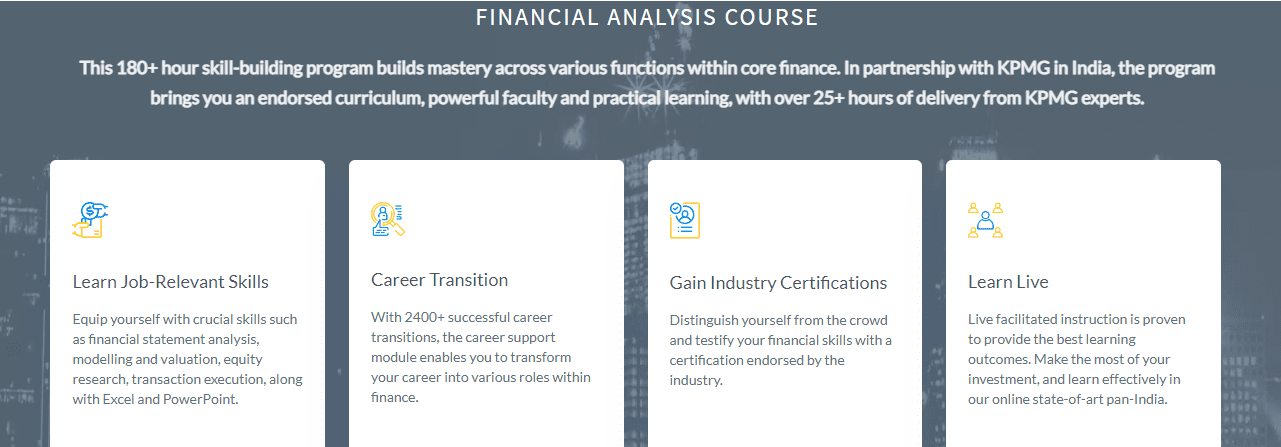
financial anlayst courseHere, we are going to talk about what financial planning and analysis courses entail, how they can help you to become a financial planning lead, and the all-around advantages a financial planning and analysis course can have over your career.

What Does a Financial Planning Course Entail?

A financial planning course basically teaches students the skillset needed to chalk out any financial situations successfully relating to today’s economic scenario. Here, we are going to discuss the objectives of a financial planning course:

  • To prepare students for real-world economic scenarios with proper case studies
  • To nurture the analytical and strategic skills needed for a financial planning career
  • To train them accordingly so that they can meet the needs of the demanding industry

How Does it Help you Become a Financial Planning Lead?

The job of financial planners basically involves chalking out the financial goals of companies or individuals and guiding them into achieving them. They are hired by financial planning firms and are one of the most in-demand as well as highest-paying jobs nowadays.

As a financial planning and analysis course provides the necessary training needed for a career in any sort of financial services, it obviously automatically increases your chance of becoming a financial planning lead. 

All-around Advantages in Your Career of a Financial Planning and Analysis Course

There are numerous advantages of a financial planning course in your career. Here are a few of them:

  • There are a lot of career options for you to choose from such as broker/dealer, investment advisor, wealth management officer, customer services, and asset management.
  • You can utilize your financial planning course in your start-up as well. It will save a lot of money to use your own skills as a financial planner instead of hiring one.
  • It is one of the most in-demand courses right now, so a stable career is guaranteed.
  • It is also one of the highest-paying jobs nowadays.

Conclusion

Just like all other corporate sectors, the finance one being possibly the most important has progressed quite dramatically in the last few years. And, to progress it even further, more and more financial planners are needed.

This is why it is the golden time to get enrolled in a financial planning and analysis course and secure your future. Imarticus Learnings is providing you with a golden opportunity to boost your career with its financial analysis course that is sure to put you leagues beyond your peers.

How will cloud, Blockchain, and IoT impact insurance?

As technology continues to advance, new opportunities arise for insurance companies. Cloud computing is one of the most recent innovations that has changed how data is stored and accessed. With the rise of Blockchain technology, people wonder if this will change how insurers operate their businesses.

Finally, with the Internet of Things (IoT), insurers can collect more data than ever before about their customers and business practices. How will these three things impact insurance? Let’s explore!

The Rise of Cloud Computing for Insurance

Cloud computing is a great way to increase the speed at which insurers can access data. Instead of having their server or an extensive database that may be prone to hacking, businesses can use cloud-based services from Amazon and Google. It allows these companies to handle all the security measures so that insurers can focus on other things. Since insurers can work faster and more efficiently, they can reduce costs and potentially increase profits.

Is Blockchain Technology the Future of Insurance?

Blockchain technology is an excellent way for users to create secure transactions without relying on a third party. This type of digital ledger system ensures that records are accurate and transparent. In the insurance industry, there are a few different ways you can use this technology.

  • You can pay out claims instantly without waiting for a third party to verify the payment.
  • Users can track their policy history from one insurer to another. It would prevent people from double-paying or having overlapping insurance plans.
  • Individuals can share their medical history with multiple companies to get better rates.

These are a few instances of how Blockchain can change how people do business in the insurance industry.

The Internet of Things Enhances Insurance Operations

With more devices connected to the internet, insurance companies can gather more data than ever before. This information can determine how likely people are to file claims or if their customers are at risk of accidents. It allows them to create better products that help people manage risks on their own. And when combined with cloud-based services and Blockchain technology, it is clear that IoT will be a critical part of the insurance industry in the future.

The advancement of technology is changing how people do business. From cloud computing to Blockchain, insurance companies can work faster and more efficiently than ever before. It may lead insurers to decrease their costs and increase profits in their businesses.

While this can be an advantage, it can also be a challenge for insurance companies. Since there is more competition, insurers must find new ways to stand out from their competitors and offer customers the best service possible.

Explore and Learn with Imarticus Learning

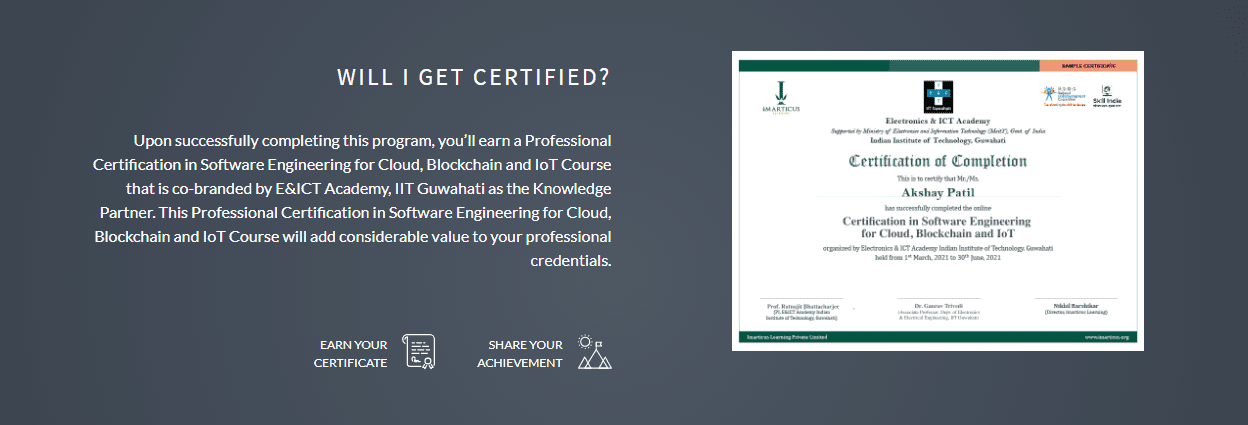
The Software Engineering certification online for Cloud, Blockchain, and IoT program collaborates with E&ICT Academy, IIT Guwahati, and industry experts to give aspiring Software Engineers the most pleasing learning experience possible. This intensive 9-month curriculum will prepare students for the new-age Software Engineer position, focusing on Cloud, Blockchain, and IoT.

certification in Blockchain, Cloud and IoTSome course USP:

  • This cloud DevOps engineer course for students is with placement assurance aid the students to learn job-relevant skills.
  • Impress employers & showcase skills with the certification in Software Engineering endorsed by India’s most prestigious academic collaborations.
  • World-Class Academic Professors to learn from through live online sessions and discussions.

Here’s Where to Find the Best Online MBA Courses!

MBA programs can help you learn how to manage your own business more effectively while also providing additional skills to make it easier to find a job in this competitive market. Whether you’re interested in starting your own business or finding a new position at an established company, the MBA degree is the key. In this blog post, we explain where to find online MBA courses.

Why should you get an MBA online?

Master of Business AdministrationJAIN MBA online certification courses is a two-year degree that will allow you to manage and grow your own business or apply your skills at an established company.

It can provide you with the tools needed to raise yourself, switch careers, or move up in an organization.

This type of program can keep more of your most and up-to-date information than a typical undergraduate or trade school, meaning that you’ll get more out of each course.

What are the profits of an online MBA degree?

  • These programs provide students with the same benefits as their on-campus counterparts, without any of the commuting hassles!
  • These flexible programs allow you to work on your degree at any convenient time, while online instructors can provide instant feedback and guidance.
  • These programs are more affordable than their traditional counterparts because they don’t require expensive classrooms or textbooks.
  • Online MBA courses can complete any time, anywhere!best online MBA courses

What’s the difference between a full-time and part-time program?

FULL-TIME MBA PROGRAM PART-TIME MBA PROGRAM
Full-time programs last two years and allow you to complete school alongside your current profession. Part-time programs typically enable students to take classes at night or on the weekends.


A full-time program is more expensive. Part-time programs are usually less expensive.
Full-time programs usually offer more flexibility for students who need to continue working alongside their studies. Part-time programs are great for professionals whose companies allow them the opportunity to attend school outside of regular business hours.


How do professionals identify if this is the correct course for them (questions to ask yourself)?

If you’re unsure whether or not receiving an MBA degree will improve your abilities and give you the skills needed to further your career, we’ve created a list of common questions that can help you decide.

  • Why do you want an MBA?
  • What are you hoping to achieve by completing this program?
  • What would your current employer think about you obtaining an MBA degree?
  • Are there classes and programs that you can take to enhance your current skills and knowledge?
  • If so, will these classes be enough to allow you to advance in your company, or should you try and get a promotion first?

Explore and Learn with Imarticus Learning

This one-of-a-kind JAIN MBA program includes hands-on training with leading technologies, including APIs, Blockchain, Cloud Computing, AI, Machine Learning, RPA, IoT, and Big Data.

Some course USP:

  • This Business Management course is with placement assurance aid the students to learn job-relevant skills that prepare them for an exciting career in MBA.
  • Impress employers & showcase skills with a JAIN MBA certification endorsed by India’s most prestigious academic collaborations.
  • World-Class Academic Professors to learn from through live online sessions and discussions. It will help students understand the 360-degree practical learning implementation with assignments.

Contact us through the live chat support system or schedule a visit to Mumbai, Thane, Pune, Chennai, Bengaluru, Delhi, and Gurgaon training centers.

Top 5 Soft Skills Every Project Finance Manager Needs

Soft skills are necessary for professional advancement. While managers need to know the subject matter of each project and be experts in their fields, they also should have certain soft skills. Soft skills are taught in most Financial Analysis courses. These skills help candidates become the best project manager that they can be. A chartered financial analyst who possesses all essential soft skills can help their teams achieve all goals. 

What Are the 5 Skills Project Finance Managers Should Possess?

There are 5 major skills that every project finance manager needs to have. These skills have been discussed below. 

  • Leadership

Leadership skills are necessary for every manager. They can only become reliable managers if they know how to lead and tackle team members. As leaders, project finance managers are responsible for introducing a vision for the team. They should motivate other team members and bring everyone up to date with how the project is evolving. Managers need to ensure buy-in from executives and provide all necessary resources to the team. 

  • Budgeting

Project managers who are dealing with financial analysis and ratio analysis should be skilled in budgeting. While working on projects, managers need to know how to introduce a budget and stay within it. At times there might be a financial constraint. If the company is dealing with financial issues, projects need to be done on a tight budget. Project finance managers need to create a budget that is not unreasonable. 

  • Time Management

Project finance managers have to deal with multiple tasks all at once. Since they are responsible for all aspects of the project, they have to pace out the tasks so that all deadlines can be met. They need to give every team member a specific time frame within which all tasks can be completed. Managers will also need to keep time aside to check and verify the work that has been done. Time management is therefore essential.

  • Risk Management

There is risk involved in every stage of financial analysis. Project managers are tasked with assessing the risks. This is an essential skill and while much of it is based on data analysis, managers need to trust their instincts as well. Project finance managers need to anticipate and manage risks effectively. By identifying potential risks, project finance managers can assist team members and clients avoid major problems. 

  • Communication Skills

Every project manager needs to possess communication skills. They need to know how to communicate with team members and other managers. It is not only verbal communication that matters but also written communication. Project finance managers who have great communication skills can easily set up partnerships and collaborate with other teams. They should also effectively communicate the status of the project with the stakeholders. 

How to Become a Skilled Project Finance Manager? 

To become a project finance manager with the best soft skills, one can opt for a financial analyst course from a leading institute like Imarticus Learning. Imarticus Learning offers a Financial Analysis Prodegree and the course is in collaboration with KPMG. Industry experts provide extensive training for a total of 25 hours and prepare students to tackle real-world situations. While the course includes several topics like ratio analysis, accounting, corporate finance, private equity and investment banking, it also ensures that students are learning soft skills. These soft skills help them get through placements and land jobs in their areas of interest. The combination of relevant expertise, hands-on experience and soft skills allow students to explore different opportunities in the financial sector. 

The chartered financial analyst course offered by Imarticus Learning is holistic and consists of a methodology that is based on projects. This trains students to deal with various tasks and develop all essential managerial skills. The degree will ensure the success of all candidates in the industry. 

5 Amazing Investment ideas for Teens and College Students

5 Amazing Investment Ideas for Teens and College Students

In this capital age, people are investing in numerous assets to generate long-term wealth. Investment is not only for HNI individuals but is for everyone. Teens and college students can also start investing at an early age. However, there are several things to consider before investing in an asset. If college students start investing from a young age, they can reap benefits later in their life. Read on to know five investment ideas for college students and teens. 

Invest in the Stock Market 

Teens aren’t retiring anytime soon and can afford to invest money for a longer period. College students have a basic understanding of the stock market and can start their investment journey. If needed, college students can take advice from their teachers or parents before investing in stocks. You can start with those stocks that charge fewer maintenance fees over time like, index funds. Try to invest in balanced stocks that offer good returns over time. The stock market is prone to high volatility and teens can afford to keep their money invested for a longer time. 

Real Estate Investment 

Many college students are making huge money via rental properties. If you are not a minor, you are allowed to buy or sell properties in your country. Many countries also allow minors to buy/sell properties accompanied by an adult. If you have ample money, you can buy a small house and then put it on rent. You can generate a fixed income every month by renting properties. You will continue to be the owner of the house and receive rent every month. However, as a house owner, you will also have to oversee the repairs every month. 

Open a Savings Account

Are you busy with your distance learning MBA and cannot research stocks? Well, if you do not have time to collect information about the stocks, you can go for a savings account. A savings account is a hassle-free way of expanding your money. Choose a physical or an online bank that offers good returns on a savings account. Make sure you don’t withdraw money continuously from your saving account and do not make impulse purchases. 

Go for Cryptocurrencies 

The future is bright for cryptocurrencies, and you can start investing early as a teen. With blockchain as its core technology, cryptocurrencies are highly secure. Cryptocurrency can be easily accessed as more and more digital platforms are emerging nowadays. You can easily buy and sell cryptocurrency via a reliable mobile application. 

Invest in Fixed Deposits 

If you want to make money with minimal risk, you can invest in fixed deposits. You will get guaranteed returns at frequent intervals by investing in fixed deposits. Young enthusiasts who want to become investment bankers should start investing early. Many students opt for distance learning MBA to upscale their investment banking skills. 

How to Learn Investment Banking?

You can join a physical institution for post graduate diploma in banking and finance. However, institutional courses will not offer hands-on learning and flexibility to students. It is why young enthusiasts are shifting towards online investment banking courses. Imarticus Learning is a reliable EdTech firm that provides the best online MBA courses. It offers an MBA in Investment Banking & Equity Research in collaboration with Jain University. This course will help in knowing job-relevant skills to build a career in the investment banking industry. 

Conclusion 

College students can start investing early to understand the importance of financial stability. You can invest in high-risk or low-risk assets to generate a substantial income over time. You can learn more about investment via the online course offered by Imarticus. Start your online MBA course now!  

Will Digital Natives Replace Consumer Brand Specialists As CMOs In The Next Few Years?

Big data and all its ensuing technologies have had an enormous impact on the world in recent years. Mining vast amounts of data and analyzing it through such statistical frameworks have yielded some very fascinating results.

These innovations have touched even the Digital Marketing field. Think of it as another facet of growing technology because, with global digitization, social media influencers have come into the limelight.

All of the changes, as mentioned above, don’t bode well with the traditional digital marketing paradigm. By traditional Digital Marketing trends, we mean the ones involving Chief Marketing Officers (CMOs) chalking out the marketing plan.

Before we understand the extent of the impact of digital natives on Chief Marketing Officers, we first need to understand who they are and what they are doing in a company.

Who are CMOS? And, what is their role?

A CMO or Chief Marketing Officer is the person whose sole aim is to direct advertisement, marketing campaigns and build its image. Traditionally, before the advent of Digital Marketing, the job of CMOs was focused solely on selling the product or the services offered by the brand.

CMOS was responsible for doing market research and created targeted ads to lure people into buying what they have to sell. Mostly, they were the persons responsible for educating ordinary people about what is being sold. They also had very limited resources initially for both marketing and data collection to improve upon their marketing.

However, in recent times, they are much more than just a glorified ads manager. Digital Marketing course has helped mold their career into something crucial.

Data Science CareerImpact of Digital Natives on CMOs:

Ever since lines of communication improved, and the internet became a household thing, ways of marketing also grew, and so did consumer awareness as opposed to buying what was being sold. They now wanted to buy what they wanted. So, the company had to adapt to these changing times.

Now, the role of CMOs is not limited to telling people what is being sold. CMOS now has to do market analysis, competition analysis, consumer segmentation, and data analysis. They do not have a static job anymore. All the customer data is being streamed in continuously, and it is their job to analyze it and act on it.

While it is true that AI and Machine Learning are the new buzzwords in the sector and have a lot of potentials to dethrone the CMOS however, it is not going to happen. There will always be the need for an individual (or a team) handling all the marketing of any brand.

The only change in a CMO’s life would be to learn how to navigate this minefield. CMOS would be the ones responsible for organically instilling machine learning into their mix, and they will remain to be the ones responsible for having the final say.

Conclusion:

With time, the Chief Marketing Officer job has changed drastically and will continue to change in the coming times. But, the need for one would never diminish. CMOS would have to adapt to the changing times and keep on devising new strategies on the fly.

Related Article:

https://imarticus.org/what-are-the-ways-to-advertise-on-digital-platforms/

Simplification Is What Most Banking and Financial Institutions Need to Address Various Challenges, but How?

In this modern era, every person is trying to harness the power of financial services. With increasing transactions and financial services, banks are looking for simplification in day-to-day operations. Numerous challenges are threatening the banking industry currently. To address those challenges, financial institutions should have a pre-planned strategy. The new-age banking landscape is complex, and banks are looking to simplify their operations for sustainable development. Simplification helps financial institutions adapt to the evolving demands of the customers. Read on to know how banks and financial institutions can simplify their operations to address several challenges.

Challenges for banks and financial institutions

Various challenges for banks and financial institutions in the current scenario are as follows:

  • The expectations of customers from banks and financial institutions have drastically increased over the years. Customers have become more aware and demanding when it comes to financial services. To enhance customer experience, financial institutions have to cater to their needs.
  • With the introduction of FinTech, customers are looking to access financial services at their fingertips. Financial institutions have to adopt technology on a large scale to provide FinTech services.
  • Earlier, there were fewer banks and financial institutions. At present, there are many banks, loan firms, FinTech firms, and other types of financial institutions. Customers can change their bank anytime they want. Banks have to provide quality services to stay ahead amidst the high competition.
  • Many investment banks are not able to fulfil the expectations of the shareholders/investors. The pressure from investors is also a challenge faced by banks nowadays.
  • The compliance regulations have become stricter and more complex. Financial institutions have to understand the complex regulations and ensure strict compliance.
  • Large amount of data is being produced by banks and financial institutions every day. Financial institutions have to make the best use of data which is also a challenge these days.

How to achieve simplification?

A step-to-step guide for banks and financial institutions to achieve simplification is as follows:

  • Start by identifying the purpose, role and target audience of the financial institution.
  • You have to choose a direction for your financial institutions. The business architecture is decided before you begin operations. For example, a financial institution can follow a sales approach or can go for multi-brand management.
  • Determine the critical business activities for your financial institution. The activities that provide a competitive advantage to the financial institution should be completed in-house. Other activities can be outsourced to boost simplification.
  • Financial institutions need to undergo a digital transformation for capabilities that are not bound by legacy issues. You will have to adapt technology to survive in this new-age banking era.
  • You will have to create a simplification roadmap for your employees. Your employees can go for banking and finance online courses to know more about new-age practices.

Which course is best for new-age banking?

The PGP in New Age Banking offered by Imarticus Learning is the best course for young enthusiasts. You can unlock career options after graduation with this banking course. Imarticus allows you to pay a part of the course fee in starting and the remaining after getting placed. The dual banking course follows two parallel learning paths and an industry-endorsed curriculum. Young aspirants looking to build a career in the BFSI industry can go for this new-age banking course.

Conclusion

Most of the online banking courses do not offer placement support. With extensive placement support from Imarticus, you can build a successful career in the banking/finance industry. For working professionals, the banking course can help in getting a 25% hike in current salary. Start PG diploma in banking and finance now!  

Looking to Upgrade Your Career in Supply Chain Management and Analytics? Find Your Path Here

Supply chain management is a useful process for any organisation that wants to boost its ROI (Return on Investment). Businesses have to keep track of their services and products in the supply chain for more insights. With more insights, businesses can take better decisions related to the supply chain. To extract meaningful insights, data analytics is used by supply chain experts. If you want to upgrade your career in supply chain management, you can go for an online course that covers the analytical aspects. Read on to know more about building a career in supply chain management and analytics.

What is SCM?

SCM (Supply Chain Management) helps businesses in understanding the flow of goods and services. All the processes that convert the raw materials into finished goods come under the supply chain. SCM enhances the transparency of day-to-day business processes and you can make better decisions. When a firm knows the cost of its supply chain processes, it can make better decisions for slashing the costs. From the movement of products to the storage of raw materials, everything comes under the supply chain.

What are the pros of SCM?

The benefits of SCM in the current business scenario are as follows:

  • Supply chain management helps in meeting the supplies as per the customer demands. SCM helps a business in steering through market challenges and fluctuating economies.
  • You can enhance your inventory system with SCM and reduce damages in storing products/services.
  • With better SCM, a business can have better relationships with vendors and distributors. Better communication between different points of the supply chain adds to overall productivity.
  • You can gain insight into day-to-day operational costs incurred by your organisation with better SCM. Cutting overhead costs is one of the major advantages of SCM.
  • With SCM, you can reduce the delays in your business processes. Customers can receive finished goods and services in less time with better SCM.
  • You can optimise the space at your sales outlets with better SCM. You can highlight products according to the demands of customers in your sales outlets.

Due to the numerous benefits of SCM, firms need expert individuals who can enhance their overall productivity. Firms are hiring individuals who have completed a supply chain management course for better results. At present, data analytics is being used heavily for the supply chain management. With data analytics, you can know the demands of the customers and can forecast market situations.

What are different job roles in supply chain management?

Job roles in the supply chain management industry are as follows:

  • Production Manager: It prepares the staff schedules and ensures all equipment is working fine.
  • Supply Chain Manager: A supply chain manager interacts with vendors and distributors to ensure continuous supply/sale.
  • Logistics Manager: The logistics manager is concerned with the supply of products/services to the customer.
  • Purchasing Manager: Major purchase contracts are overseen by purchasing managers in respective firms.

How to learn SCM and analytics?

Young enthusiasts can go for the Professional Certification in Supply Chain Management & Analytics offered by Imarticus Learning. This supply chain management online course is sponsored by IIT Roorkee, one of the premier educational institutions of the country. You get to learn from industry experts and faculty members of IIT Roorkee. Not to forget, this course provides hands-on learning with numerous real-world SCM projects.

Conclusion

At the end of the IIT supply chain management course, Imarticus will offer extensive placement support. You can kickstart your career in the industry with an online course. Working professionals can also uplift their careers by completing an SCM online course. Start your IIT supply chain management course now!  

Understanding How Indian Microfinance Institutions (MFIs) Work?

When it comes to loans, people who use banking facilities can easily apply for a bank loan. However, loans in India are also provided to people who do not have any banking facilities. Microfinance Institutions (MFIs) in India are those companies that lend small loans to people. The amount of a microloan can differ according to the country. In India, all loans below INR 1 lakh are considered to be microloans. Young enthusiasts that want to build a career in banking should know about the microfinancing scenario in India. Read on to know more about MFIs in India. 

Goals of MFIs

Microfinancing is an important concept in investment banking. You should know about microfinancing to secure a better job deal in the investment banking sector. Before understanding the working of MFIs, you should know about their goals. The objectives of MFIs in India are as follows:  

  • An MFI aims to become a financial institution that assists the growth of sustainable businesses and communities. 
  • MFIs help the weaker sections of society by providing the required resources. MFIs have a huge contribution when it comes to the development of women from weaker backgrounds. MFIs have successfully created income generation opportunities for women in India. 
  • Some of the top MFIs in India have contributed to decreasing poverty in the country. MFIs always work on faster and new ways to eradicate poverty. 
  • An MFI will create self-employment opportunities for people that can’t access the available amenities. 
  • MFIs also teach rural people beneficial skills that can help in creating income opportunities. 

As per the records of the World Bank, there are around 1.7 billion people around the world that don’t have access to banking services. These people are the target audience of an MFI. MFIs have had a major role in boosting the economy of the nation. It is why financial institutions expect their employees to know about MFIs. 

How do MFIs work?

MFIs form several groups for distributing small loans, resources, and training facilities to people. Several groups formed by MFIs that help them in functioning are as follows: 

  • MFIs form a JLG (Joint Liability Group) for distributing small loans to a group of 5 -10 people. The small loans are distributed against the mutual guarantee of each member. Every member of the group is responsible for the repayment of the loan amount. 
  • MFIs help in forming an SHG (Self Help Group). An SHG is a group of people with similar economic and social backgrounds. A non-profit organisation is formed between the people and money is collected from each individual. The money is then distributed to members according to their needs. 
  • MFIs are also involved in making loans more accessible for people from rural areas. MFIs always search for ways to provide small loans to people without any collateral. 

How to learn more about MFIs in India? 

If you want to learn investment banking then learn about all its aspects. Microfinancing is important for financial institutions that want to be recognised as a people’s bank. You can go for detailed investment banker courses offered by EdTech platforms. Imarticus Learning is a reliable source that can help you know more about MFIs and other investment banking concepts. The Certified Investment Banking Operations Professional course offered by Imarticus comes with a job assurance guarantee. You can gain industry certifications and learn with an industry-endorsed curriculum. 

Conclusion 

Online training from a reliable source like Imarticus can help you kickstart your career as an investment banker. Imarticus will provide tips and training for investment banking interviews. It will also offer investment banking case studies for a better learning curve. Choose an online course to know more about MFIs!

Is Python Difficult to Learn?

The average pay of a software programmer in India goes up to INR 10 lakh per annum. To start your professional journey in the tech field, you will need to learn a programming language.

In this article, we will look at one of the most recommended programming languages for beginners and professionals alike. You will also discover why you should learn Python and how much it is easier.

Learn PythonWhat is Python?

Python is one of the most popular programming languages in the world. It is a high-level general-purpose programming language and entered the market in 1991. Since its arrival, it has become an industry staple.

Programmers use Python in numerous industries, such as entertainment, healthcare, software, and finance. Due to its vast popularity, you will find it in the curriculum of most data science courses in India.

Why you should learn Python?

There are many reasons why you should learn this programming language. Here are some of them:

Easy syntax

If you are familiar with English, then learning Python is quite easy for you. One of the many reasons behind Python’s widespread popularity is its simple syntax. Many of its commands are derived directly from English, hence you can learn the fundamentals of programming along with learning the fundamentals of Python.

Pro tip: If you are a beginner, then you should look for an online data science course in India that covers Python. It will be much easier to learn programming through such a data science course in India.

High demand

Python ranked third in Stack Overflow’s 2020 Developer Survey. For languages that developers aren’t using but want to learn, Python took the top spot for the fourth year in a row.

Most Python developers are programmers, software engineers, team leads, DevOps engineers, and data science professionals. The demand for Python expertise is substantially high among companies, which is another prominent reason why you should learn this programming language. It is also very reliable and hence, has high popularity in the IT world.

Versatile application

Due to its vast collection of libraries, Python finds applications in various sectors, including data science, artificial intelligence, machine learning, app development, and others.

This means you can use a Python programming course to develop a mobile application as well as create a machine learning algorithm. It allows you to focus on an application’s core functioning while taking care of the common programming tasks.

Learn PythonHow to learn Python?

You know that it would be great to learn this language but where can you start. Well, the best way to start learning Python is by joining an online data science course in India. Data science courses teach you the basics and advanced applications of Python along with many related technologies.

After all, learning Python alone would not be sufficient in this cut-throat competition-ridden world. Joining a data science course in India would help you in multiple other ways. First, data science courses provide you with a step-by-step structure so you can plan your studies accordingly.

You can always check your data science course details to see how much progress you have made. On top of that, if you want to start a tech career, you can join a data science course with placement support. A data science course with placement support will help you kickstart your career right after you complete the program.

Before picking a program, be sure to check the data science course fees and other data science course details.

Learning Python is quite simple. Its easy-to-learn syntax and versatile applications make it a perfect programming language for a beginner. If you are interested in learning more about data science courses in India, then you can check out the programs offered by Imarticus.