8 powerful terms to use in affiliate marketing

What is affiliate marketing? We can define it as a strategy to market a product or service. A corporation pays third-party publishers to drive traffic or leads to its products and services in this technique. Affiliates are third-party publications with the paid commission to create new methods to promote the firm.

With increased internet use and digitalization, affiliate marketing has grown in popularity. It is a marketing scheme in which websites and bloggers link the web page. It allows you to review or discuss a product while also receiving advertising money when you buy it.

Affiliate marketing is a pay-for-performance marketing program in which we delegate selling to an extensive network of people.

Although affiliate marketing has grown into a multibillion-dollar industry because of digital marketing, analytics, and cookies, an affiliate marketing program tracks the links to bring in leads. It also is the analysis to see how many of these links convert into sales using internal analytics. At Imarticus, through the program, we help you know all ins and outs of it.

Online Reputation Management – A Course for Better Career

What is reputation management? It is the practice of altering stakeholder perceptions and public dialogue about a company and its brands. The process includes monitoring perceptions and discussions, responding to reputation threats, and proactively seizing opportunities to improve reputation.

At Imarticus with DM program, we teach how reputation management aids in the growth of your business by determining what people like and dislike about your items or services. You can make the required changes and enhancements when you understand what causes clients to ignore your offerings.

Online reputation management or ORM is the course that helps you address any negative or false comment given for your brand on social media or website. Through the digital marketing course, you will take up the role of communication manager and be in charge of making critical decisions that will affect your organization’s reputation. You will also build a strong culture that will engage your audience. 
best digital marketing coursesWhat Is SEO

Search engine optimization (SEO) is a set of techniques for improving the look and position of web pages in organic search results. The organic search is the most popular way to locate and access online content. Having a good and sound SEO strategy increases your site’s quality and the number of visitors.

Search engines use crawlers to locate the complete content on the Internet for collecting data. Then the crawler starts at a well-known online page and moves through internal and external links of other sites’ pages. The crawler can grasp what each website is about and how it semantically connects to the other pages in the search engine’s extensive database, known as an index.

When a user raises a query into the search box, the search engine employs sophisticated algorithms that consider the most accurate and relevant set of results for that query. Some examples of these organic results are the web pages with text, news stories, photographs, videos, local company listings, and other more niche sorts of content.

There are so many aspects that the search engine algorithm considers. These factors or characteristics constantly change to keep up with changing user behavior and breakthroughs in machine learning.


Short-term finance courses can catalyze your career growth

Finance encompasses banking, debit, credit, capital markets, money, and investments, among other things. It includes the oversight, production, and study of finances, banking, credit, investments, assets, and liabilities that make up financial systems and the management, creation, and analysis of money, finance, banking, credit, investments, assets, and liabilities. The FinTech courses online cover all the essential aspects of finance. 

Types of Financing

In general, financing is essential for every organization, and they require it regularly. There are two types of financing: Long-term finance and short-term finance.

As the name indicates, long-term finance is the credit given for a long period (can be anywhere between one to thirty years). Though, the financial institutions consider long-term finance as riskier and less stable.

Whereas short-term finance is the loan given for one year or less, at times, it can also extend until three years. At Imarticus, through the FAP program, we help you understand short-term finance in a better way. 

Short-term credit financing is typically for smaller amounts, and organizations pay it back more rapidly. For the financial firm, they have a lesser risk. Smaller companies generally have easy access to and desire short-term finance with whom you do business.

For short-term finance, people mainly consider any of the following instruments :

Commercial Paper:

Commercial paper has a pre-determined maturity length of 1 to 364 days. It is an unsecured promissory note that large firms issue to raise money to pay off their short-term obligations. Bank or the corporation that issues it backs it up with the promise to pay back the face value upon maturity. The sound ratings of the firms help them sell these papers at a good price.

Promissory Note:

It is a negotiable instrument in which the maker or issuer makes a written promise to pay the payee a pre-determined sum of money at a defined maturity date or upon the payee’s demand, under specific terms.

Asset-based Loan:

It is a sort of loan secured by a company’s assets. The most frequent assets used to support the loan are real estate, accounts receivable (A/R), inventory, and equipment. A single asset type or a combination of assets helps the supplied loan.

Repurchase Agreements:

Repurchase agreements are loans with a very short term. They usually mature in less than two weeks, and most of the time, they mature in just one day! Repurchase agreements are set up by selling securities and agreeing to repurchase them at a set price on a specific date.

Letter of Credit:

This document is issued to a seller of goods or services by a financial institution or a comparable party. The seller guarantees that the issuer will pay him for goods or services that he delivers to a third-party buyer.

Upon this, the issuer seeks recovery from the buyer or the buyer’s bank. The document guarantees the seller that the issuer of the letter of credit would pay the seller on time, even if the buyer fails to pay.

How Financial Technology Courses Accelerate Your Career

With financial planning and analysis course through the FAP program at Imarticus helps to understand financial services to facilitate financial operations and processes. With the FAP program, we at Imarticus help you establish a career in finance.

Discover the next step in Financial Valuation

Financial Valuation can be simply referred to as a knowledgeable estimation of the total worth of a company. Many companies make financial decisions based on what will escalate their financial valuation. High estimates of financial valuation can be advantageous due to several reasons. In the case of a private company, having a high financial valuation will make it easy for them to borrow money. However, if it is a public company, a high valuation will cause an increase in the share price and profit gaining opportunity for shareholders. If another business wants to take over the company, a high financial valuation will lead to a bigger payday for business stakeholders or owners. 

A PGDM in finance management can take your career in finance to new levels. Finance management courses usually take about 6 months to 2 years. This course will help you learn about capital markets, investment banking, fin-tech, and risk domains in detail. It is a 6-month concentrated program that is offered in collaboration with one of the leading B-schools of India, IIM Lucknow. It can guarantee top-class education for the mid-level management professionals with minimal 2 years of experience who are willing to reinitiate their career in financial services. 

An overview of capital markets course 

This capital markets course will give you an overall idea about the industry and major career opportunities. You’ll know about the buy-side, sell-side, and the most widely chosen career paths in each group. It will also promote a lot of practical knowledge while taking you through the classic day-in-life situations, enabling you to get an idea of the basic personality traits and competencies that can take you closer to success. Moreover, the course also provides you with all the information you require to assure that your career is focused and you make efficient use of time, the most limited yet valuable resource. 

On completion of this course, you’ll not only receive a capital markets professional certificate but also a profound knowledge about the structuring of the capital markets industry and how each component contributes to the smooth functioning of financial markets. Lastly, it will also help you in deciding what field or domain will be best suited for you to choose a career in. 

It includes all the fundamental, intermediary, and advanced topics related to trading and sales, asset management, and investment banking. The course also helps you learn various trading strategies which are utilized in the industry of finance and capital markets. It is perfect for students who are interested in learning about trade in various asset classes. It is entirely an online course which makes it convenient for you to take it from anywhere in the world. 

What are the learning objectives of this course?

Once you’re done with this course, you’ll be able to: 

  • Choose which capital markets career path will be best for your skillset, personality, and passion. 
  • Define the primary and secondary markets including the involvement of stakeholders and their interaction in each. 
  • Explain the sell-side and buy-side of finance, activities organized on both sides, and capital market career options offered by each side. 
  • Know what a classic day-in-life of such professionals feels like. 

Conclusion

This capital markets course is best for everyone who seeks the internet in pursuing a financial career. Regardless of whether you are undergoing your first job search after graduation or you’re looking for a transition after acquiring professional work experience in any field, this course will give you a clear picture of the various career options you can opt for. Don’t forget to get enrolled in this course for free and elevate your career in finance.

The fourth industrial revolution: The primer on Artificial Intelligence and Machine Learning courses

We are living in the fourth industrial revolution. It is a time when technology is rapidly changing and evolving. One of the most critical aspects of this revolution is artificial intelligence (AI) and machine learning (ML). These technologies impact every industry and will continue to do so in the future. If you want to stay ahead of the curve, it’s essential to understand these technologies and learn how to use them.

This blog will provide a primer on AI and ML courses. We will also discuss why it’s vital for you to learn about these technologies. 

The fourth industrial revolution is a period of rapid technological progress and digital transformation. The fourth industrial revolution brings in a new age of automation, data-driven decision-making, and intelligent machines due to innovative technologies such as artificial intelligence (AI) and machine learning (ML). 

What are the key drivers of the fourth industrial revolution?

The key drivers of the fourth industrial revolution include:

  • Rapid technological advancement and digital transformation
  • The emergence of new technologies such as AI and ML
  • Increased connectivity and interdependence among countries, businesses, and individuals
  • Shifting demographics (e.g., an aging population)
  • Increased volatility, uncertainty, and risk
  • Rising income inequality

As we stand on the brink of a fourth industrial revolution, it’s more important than ever to understand the technologies driving it. One of the transformative technologies of our time is artificial intelligence (AI). From how we work and communicate to how we travel and entertain, AI has the potential to change almost every aspect of our lives.

What is the future of AI and machine learning?

The future looks bright for Artificial Intelligence (AI) and Machine Learning (ML), with both technologies experiencing exponential growth in recent years. The applications of AI and ML are limitless, spanning across industries such as finance, healthcare, manufacturing, retail, transportation, and logistics. Businesses need to gain a strong understanding of AI and ML to stay ahead of the curve and seize the opportunities brought about by these technologies,

Fortunately, there are many courses available that can provide this essential knowledge. Here is a primer on the best AI and ML courses, perfect for those looking to get started in this fascinating field.

Discover the AIML course by Imarticus Learning:

This Artificial Intelligence and Machine Learning certification combine the E & ICT Academy, IIT Guwahati, and the best industry leaders. This 9-month course will help students prepare for data scientists, data analysts, machine learning engineers, and AI engineers.

This course will help students strengthen their fundamental AI competencies. Students can now use the Expert Mentorship service to build a practical understanding of artificial intelligence and machine learning. Take advantage of real-world projects from a variety of sectors. This course has a long way to go towards assisting you in seizing lucrative job possibilities in the hot fields of artificial intelligence and machine learning.

Course Benefits for Learners:

  • Prepare for a fascinating data science profession by acquiring in-demand data science and AI abilities with 25 real-world projects that give employers diverse industry exposure.

  • Impress employers and display your AI skills with an E & ICT Academy, IIT Guwahati, and an Imarticus Learning-endorsed certificate.

  • Students can now participate in live online seminars and discussions with one of the finest instructors in India.

Using machine learning to scale data analytics at Airbnb

Airbnb was a revolution in the hospitality industry. It allowed their hosts associated with them to set their prices for the rent from their customers.

With the help of large data resources, Airbnb uses Artificial intelligence and Machine Learning to improve its online services. The company is one of the top targets for those pursuing their Machine Learning course with placement opportunities. 

One of the major improvements made by the company is in its price settings. Earlier it was the host who set the price and now, it is still the host who decides but AI directs them towards the price that will be beneficial for both sides.

Airbnb uses the vast amount of data they gather and analytics to come up with this guidance. What changes did they do to achieve this progress? Let’s find out!

  • Price tips

Price tips are the primary feature that ‘nudges’ the host towards the desired price. This AI-powered feature constantly updates the various price ranges for each day of every month of the year. At a glance, the hosts will be able to see if their set price is suitable to garner any profits if it is enough to get the attention of the customers, or which range is most likely to get bookings, etc. If the price is shown in green, then they are good to go.

If it shows in red, then the host needs to make some changes to make it green. Prices in green will be the most suitable for clicks.

This price range depends on the days of the week, time of the year, specific neighborhood, locality, etc. Even the latitude and longitude matter. This is a result of the algorithms set by Airbnb through the available data.  

  • Aerosolve

The machine learning package that helps with the pricing is the other analytical feature of Airbnb. It handles the behind-the-scenes factors and patterns that lead to the pricing shown in the Price Tips. It helps the user to interpret the words having entirely two meanings in two localities in the right context. 

Such developments are a result of a bunch of data analysts and scientists having such a useful model. It is such usage of data analytics that people are looking for a quality Data analytics course with placement offers. 

  • big data analytics certification coursesIn-app message intent

The third important feature of Airbnb analytics is their in-app message system. Here, the queries of customers will be automatically answered appropriately by classifying the message intent. The machine ‘learns’ to understand what the customer is looking for and respond to them as needed.

It is useful for hosts and customers in different time zones. This way, there is no delay in getting the answers and the customers feel valued. The AI system can identify the queries and even give suggestions such as a link, map, or picture, to the various queries. 

Bottom Line

Airbnb achieves all of these with a few data analysts. They are also empowering their hosts so that they can make their own decisions with the help of the already set analytics. The existing hosts can find effective bookings and the company will be able to find more listings and hosts. 

If you are fascinated with these developments in technology, enroll for the Post Graduate Program in Data Analytics here at Imarticus to understand more about data analysis.

The classes are conducted by industry experts. There will be proper mentorship throughout and beyond the period of the course. You will be prepared for interviews and get assistance with placements as well. 

5 traits for a successful career as a supply chain analyst

supply chain Analytics certification through the SCM program at Imarticus helps you become an efficient Supply Chain Specialist responsible for ensuring that the company’s supply matches client demand. They are in charge of its supply networks and guarantee timely delivery and staying within budget.

Duties of A Supply Chain Analyst

Supply Chain Analysts use data gathering and analysis to increase the efficiency of supply chain operations. The job of a supply chain analyst requires meticulous attention to detail, a thorough understanding of the delivery process, and strong analytical abilities. They collect data from various departments and offer methods to improve the supply chain using interpersonal and problem-solving skills.

The duties of a supply chain analyst are:

  • Gather information about supply chain operations.
  • Analyze data to pinpoint weak areas of supply chain operations.
  • Develop and implement programmes that will improve supply chain operations.
  • Develop and maintain working connections with shippers and vendors.
  • Examine vendor operations and ensure meeting of the quality criteria.
  • Measure and report supply chain performance to management.
  • Improve service delivery by collaborating with the procurement, logistics, and IT departments.

5 Traits of An Efficient Supply Chain Manager

Your company’s supply chain is at the centre of everything the company does. Your supply chain manager is in control of the whole route of your product, from acquiring ingredients to making sure it meets client demand.

The role of the supply chain manager has progressed from being the company’s buyer or buying manager in the backroom to being an integral element of the company’s backbone. 

The manager should possess diverse skills, such as effective use of available data, planning, financial management and contract management, building strong relationships, and a good understanding of the manufacturing process, transportation system, and warehousing.

A successful supply chain manager possesses a variety of qualities and skills. It requires a good mix of hard and soft talents, which might be challenging to come by.

With the supply chain analytics course training at Imarticus, we emphasize the following five qualities of a supply chain manager:

  • Math skills and strong analytical and statistical capabilities are required to grasp supply and demand concerns with the available data.

  • The manager should have the ability to analyze orders and shipments, sales patterns, demand, and any flaws and inefficiencies using data.

  • Another trait of a supply chain manager is the technical knowledge of artificial intelligence, machine learning, the Internet of Things, analytics software and apps.

  • A supply chain manager requires soft skills for negotiating and building connections with suppliers, customers, and team members.

  •  Attention to detail for understanding the business and its environment.

Supply Chain Analytics Course 

By generating the SCM program at Imarticus, we help you train in an exciting area in high demand. This course at Imarticus takes you on a fascinating journey where supply chain analytics meets data analytics. 

At Imarticus with SCM program, our motive is to know the real-life examples of the application of supply chain onto various domains: selling, logistics, production, sourcing, and generating a powerful and significant social and economic impact. 

IIM Calcutta Investment Banking and Capital Markets course is equipping future executives with career readiness competencies

Are you a CFA, CA, CWA, CS, or MBA desirous of a career in the intriguing world of investment banking? Or, a professional employed in the corporate finance/treasury departments of a corporate/bank, or an entrepreneur and manager in the field of financial services and securities markets, seeking that magic dice that pushes you right up the ladder of growth?

Are you looking out to gain competency and mastery over? –

  • Using theoretical models of assets to value financial products like equities and derivatives correctly
  • How risk plays out in choosing a portfolio
  • How international financial markets function
  • Adverse selection and moral hazard problems on the informational irregularities within financial markets
  • Skills that are necessary to help you manage portfolios according to customer requirements

The Executive Programme in Investment Banking and Capital Services is the best program for you. You fulfill your career aspirations in the finance industry by acquiring the necessary practical knowledge as well as the technical skills essential for a finance professional.

IIM Calcutta, the globally acknowledged business school in the discipline of finance, collaborates with Imarticus, an in-demand skill training and educational organization for executive development, to bring you the IIM Calcutta Investment Banking and Capital Markets Certification course from April 2022. 

best investment banking and capital market coursesThe program delivers in-depth knowledge of investment banking and global capital markets. The pedagogy is so designed that you get an opportunity to interact with industry leaders and work on a capstone project.

The Course Gets you into Readiness as an Executive of the Future

This executive program in investment management hand-holds you through ten subjects with their contents carefully crafted to impart in-demand technical and managerial skills, effective understanding of the subject, and application in practice.

These subjects are Financial Accounting and Analysis, Financial Management and Financial Economics, as foundation modules, and, Debt Capital Markets, Equity Capital Markets, Mergers, Acquisitions and Restructurings, Portfolio Fund Management, Securities Market Research and Valuation, Securities Market Sales and Trading, and Securities Market Regulations, as seven advanced modules.

What’s more? You have two three-day campus immersions at IIM Calcutta, one each towards the beginning and end of the IIM Investment Banking course. Through these three-day immersions, you know about Fintech and Blockchain, Bitcoins and Cryptocurrencies, Financial Risk Management, Sustainability and Impact Financing, etc. from some of the best faculty in the country with diverse experiences.

Not only the knowledge, but you also gather the current global perspectives on different topics as you interact and network with peers and faculty on-campus.

You Develop Competency Skills

The IIM Calcutta Investment Banking Certification course is not only about cramming the subjects but you are also required to work on real-world projects, dissect and study cases, come out with strategies and hone your application skills. Through these, you imbibe an overview of investment banking, capital markets and gain the competencies necessary for you to function as a professional in investment banking and capital markets.

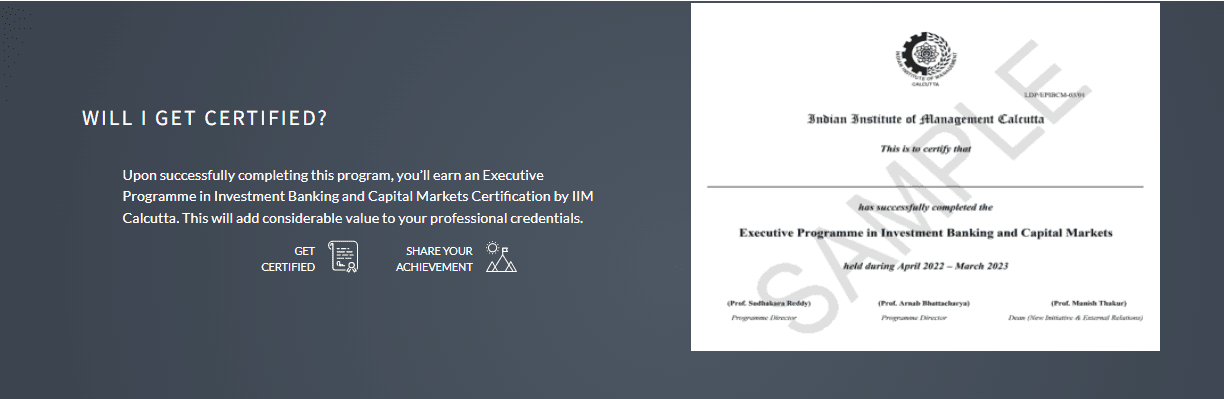
Certificate of EPIBCM From IIM Calcutta is Time-proof

Not only in the near future, but the certificate you get on successful completion of your Executive Programme in Investment Banking and Capital Markets (EPIBCM) is time-proof too. It is testimony to the commitment of one of the topmost institutes of the country of having offered and delivered to you the best possible learning experience for putting your career on the elevated track to growth.

The IIM Calcutta Capital Market course automatically gets you an IIMC Executive Education Alumni status, with access to the institution’s dedicated portal. You keep yourself updated with the latest articles, features, and happenings in your field. You are a future-ready executive, always.

5 skills you need to become a software developer

To become a software developer in 2022, you will need specific skills. This blog will discuss 5 of the most important ones. These skills include coding, problem-solving, collaboration, critical thinking, and creativity. If you want to be a successful software developer, you must develop these skills!

An Introduction to software developer

A software developer writes code to create computer programs. A common misconception is that all developers are programmers, but this isn’t true! There are two different types of software developers: front-end and back-end engineers.

Front-End Engineers (also known as web designers) focus on the design aspects of websites, while Back-End Engineers (also known as web developers) focus on functionality. The term “software engineer” can refer to either one or both types of the developer; however, most people use it interchangeably with programmers when describing their profession.

What are the skills needed for software development?

Software development requires many different skills, but the most important ones are coding, problem-solving, collaboration, critical thinking, and creativity. 

#01: Coding

Coding is transforming computer instructions into a form that a computer can understand. 

The most common types of coding languages include Java, C++, Python, PHP, and JavaScript. Most developers will use multiple languages throughout their careers because each has its advantages and disadvantages when creating projects like websites or applications for mobile devices such as smartphones or tablets.

#02: Problem-Solving

Problem-solving is the process of identifying, analyzing, and resolving problems. These include debugging code or fixing bugs in an application that causes it to crash.

You can acquire problem-solving skills through practice and experience; however, some techniques help you solve problems more effectively. These include: breaking the problem down into smaller parts, using a step-by-step approach, and asking for help from others when needed.

#03: Collaboration

It is the process of working with others to achieve a common goal. Most development teams include multiple people with different skillsets, so you must work well with others to achieve the desired outcome.

You can acquire collaboration skills through practice and experience; however, there are some techniques that you can use to help you collaborate more effectively. These include: communicating effectively, working together as a team, and respecting the opinions of others.

#04: Critical Thinking

Critical thinking is analyzing information and ideas to conclude. You can acquire necessary thinking skills through practice and experience. These include: using logic in your arguments, being open-minded, and questioning everything until it makes sense.

#05: Creativity

Creativity is the process of generating new solutions or ideas. You can acquire creativity skills through practice and experience. However, there are some techniques that you can use to help you think more creatively. These include brainstorming, using different mediums to express your ideas, and taking risks.

To be a successful software developer in 2022, you need to have the five skills listed above: coding, problem-solving, collaboration, critical thinking, and creativity. If you can develop these skills now, you will be well-prepared for the future.

Discover Software Developer Course with Imarticus Learning.

The Certification in Software Engineering provides the best learning experience for aspiring software engineers. This online software development course covers cloud computing technologies such as blockchain and the internet of things (IoT). It is the best Certification for software engineers that will prepare students for the new-age Software Engineer position, focusing on Cloud, Blockchain, and IoT.

best software engineering coursesCourse Benefits For Learners:

  • Study cutting-edge technologies like cloud, blockchain, and IoT and various real-world projects that will expose students to a range of sectors to prepare for an exciting career.
  • Students can obtain hands-on experience working with well-known firms or on current-events initiatives.
  • Manage real-world difficulties, comprehend software design fundamentals, and develop essential skills to become a new-age software engineer.

Top 8 advantages of cloud computing

Cloud computing refers to remote servers storing, managing, and processing data. For many years, this technology has only recently become popular. There are various benefits to using cloud computing, and in this blog post, we will discuss the top eight benefits that businesses can expect in 2022.

There are plenty of advantages to cloud computing, and here we will give you a quick introduction to cloud computing and its benefits.

What is cloud computing?

Cloud computing is a service that runs over the internet. You can use it to store your data and access files from anywhere in the world. Cloud computing is an excellent option for companies with large amounts of data and needs to access it remotely.

Here are the top 8 advantages of cloud computing:

#01: Flexibility: Cloud computing is a flexible solution that allows you to scale up or down according to your needs. You can use it for small projects and then switch over when it grows.

#02: Cost-effective: Cloud computing is more cost-effective than traditional IT solutions. You pay for the services you need, and you can rapidly scale up or down as your requirements change.

#03: Accessibility: Cloud computing is an excellent option for companies that need to access data from different locations. 

#04: Reliability: Cloud computing is a reliable option that will not go down during peak traffic. 

#05: Security: Cloud computing offers security to protect your data against hackers and other threats. You are confident that your information is protected when stored in the cloud.

#06: Simplicity: Cloud computing is a simple solution that does not require installing any software or hardware. You can also access it worldwide, and all you need is an internet connection.

#07: Scalability: As your business grows, you can quickly scale up your cloud computing services to meet your needs. It will save you money and time when managing your business.

#08: Mobility: Cloud computing is an excellent option for companies with remote workers who need to access data from different locations. You can use it to create a virtual work environment that allows everyone to collaborate on projects together.

Cloud computing is the best choice for businesses that want to reduce costs, increase flexibility, and protect their data. Cloud computing is the solution if you search for an economical and reliable way to store your data.

Discover FinTech Courses Online with Imarticus Learning

With a one-of-a-kind learning experience, the FinTech course provides the tools for success. With practical application skills and real-world experience before their possibilities fly off the shelf! 

best Fintech courses in IndiaWith this competitive business, learners will have all they need by getting certified through our program.

CourseBenefits For Learners:

  • These financial technology courses will provide students with knowledge and skills in applying machine learning algorithms and blockchain technology for their business needs, preparing them perfectly!
  • The future of Fintech is bright, and students can stay up to date on the newest advances by attending networking events, job boards, or webinars.
  • With this fantastic new resource, students will have access to some helpful tools that can assist them in finding their dream job after graduation!

Contact us through our chat support system, or visit one of our training sites in Mumbai, Thane, Pune, Chennai, Bengaluru, Delhi, and Gurgaon.

What’s in store for capital markets training programs in 2022?

Capital markets training programs are evolving at a rapid pace. Professionals need to stay with new advancements to keep up with the latest changes and trends.

Here, we will take insights into some of the significant changes that can occur in capital markets training programs over the next few years. Whether you are a professional or just starting in your career, these changes will be sure to impact you!

The current state of capital markets training

Capital markets training programs have come a long way in recent years. In the past, most courses focused on teaching students about the theoretical aspects of financial markets. However, thanks to the global financial crisis, there has been a shift towards programs that focus on practical skills and hands-on learning.

Today, capital markets training programs can give students the tools to succeed in their careers. These programs include a wide range of topics, including investment banking, derivatives trading, and asset management strategies.

Here are some expected changes in capital markets training programs in 2022 include:

  • A renewed focus on ethics and compliance
  • An increased emphasis on technology training
  • More experiential learning opportunities
  • Expanded course offerings to meet the requirements of a global workforce

These are just a few of the changes we can expect in capital markets training programs over the next few years. 

How will these changes impact capital market training programs?

Technology advancements will continue to drive change in the capital markets industry, impacting how training programs are delivered.

  • There will be a greater focus on experiential learning, emphasizing simulations and case studies.
  • The use of virtual reality (VR) and augmented reality (AR) can grow, providing learners with a more immersive learning experience.
  • Blended learning approaches will continue to gain popularity, with a greater focus on online and self-paced learning.

We can expect to see more gamification in capital markets training programs, as it is an effective way to engage learners and promote learning.

That’s what’s in store for capital markets training programs in 2022!

Discover capital market certification with Imarticus Learning

The Financial Services and Capital Markets course gives students a thorough grasp of investment banking and capital markets. Students will also get an advantage over their classmates by studying at IIM Lucknow’s top-tier business school!

Course Benefits For Students:

  • Study with an outcome-focused curriculum and hands-on learning approaches to develop expertise in essential domains.
  • Learners will have the opportunity to meet and engage with classmates and industry professionals as part of this program.
  • This capital markets training program is for mid-level employees who have basic financial skills but want to develop in their careers. Besides, it will provide students with vital skills and information and open possibilities for restarting a career in finance.