CPA certificate is one of the most sought-after and professional accounting certifications globally. It is a symbol of proper knowledge of accounting principles, ethical conduct, and professional competence, and hence is one of the most sought-after certificates in most sectors. But one of the most common questions asked by the fresh graduates and young professionals still remains: Is it possible to get a CPA without experience?
If you’re just starting out in your career or switching fields, the idea of securing a respected credential like the CPA without prior work experience can feel overwhelming. This blog will break it all down for you: what the CPA certificate is, the eligibility criteria, the difference between the CPA license vs certificate, and how freshers can still carve a strong professional path without traditional work experience. We will also tell you how to begin preparing yourself for your CPA certification, its numerous career advantages, and the reason why you must act now.
With proper guidance and preparation, your dream of becoming a CPA is not too far off — and Imarticus Learning, a finance learning brand that excels in training, can guide you there.
Understanding the CPA Certificate
Let’s know first.
What is CPA certificate?
Before going forward to talk whether and how you can obtain a CPA certificate without experience, let’s know what is CPA certificate first. The Certified Public Accountant (CPA) certification, as granted by the American Institute of Certified Public Accountants (AICPA), is the international gold standard for accountants. It represents competence, integrity, and adherence to the highest professional standards.
CPA License vs Certificate: What’s the Difference?
Most of us are confused between CPA certificate vs license, but it’s different. The CPA certificate will indicate that you have passed the CPA exam and you’re eligible for some education requirements, but you won’t necessarily require it to sign stamps on audits or some services. For those, you will require a CPA license, and most will involve some form of proven experience practicing in the presence of already licensed CPA.
CPA Certificate Requirements
Last but not least, here are the steps which govern the requirements on how to obtain the CPA certificate. In most cases, as you get your certificate, you will need to:
Obtain a bachelor’s degree in accounting or accounting-related (around 120 semester hours).
Pass the four Uniform CPA Exam components.
Meet special education requirements of your state, including ethics courses.
But CPA legislations differ state by state. In other states, becoming certified through the exam would entitle you to a CPA certificate, but in some others, it is tied up with licensing, i.e., experience. It is therefore more advisable to learn the rule of law prior to your state.
Can You Get CPA Without Work Experience?
Today’s question is: Can a person become a CPA with zero experience? Technically, yes – at least from a certificate-winning perspective. A few states are now awarding a CPA certificate with zero reporting requirement as to professional experience. But if an individual is going to receive the full CPA license to practice public accountancy, they will likely need to satisfy a 1-2 year experience requirement under the supervision of a licensed CPA.
All that aside, for freshers and new degree passouts, passing the CPA exam to obtain the CPA certificate is an excellent freshman CPA certificate setting your commitment towards your professional career with recruiters. Despite no work experience previously, being a CPA holder enhances your employability, earning potential, and job opportunities in India and overseas in the future.
If you are a fresher and thinking of pursuing the CPA, you would surely want to know whether it’s all the hustle without achieving the job as yet. The answer? Yes! CPA as a fresher has a number of benefits:
Competitive Edge: On your resume, when you are a CPA certificate holder, you are ahead of others if you are a fresher job seeker.
Good Salary Packages: CPAs typically get to start with salary packages that can be between about INR 12.50 to 20.50 lacs.
Global Opportunities: Having globally accepted CPA certification, you can choose to work in India as well as abroad.
Placement Support: Institutions like Imarticus Learning provide free placement bootcamps so that the fresher receives best placements.
How to Become a CPA Without Experience
Below are step-by-step instructions for freshers or anyone willing to get the CPA without experience:
Step 1: Check CPA Eligibility Criteria
Before joining, please check if you’re eligible to write the CPA in your desired state. A bachelor’s degree and adequate accounting courses generally qualify most states. Click here and check if you have required qualifications.
Step 2: Choose a Trusted CPA Training Partner
To drive your journey faster, partner with an organization such as Imarticus Learning, Best Education Provider in Finance at 30th Elets Worlds Education Summit 2024. Their US CPA course offers:
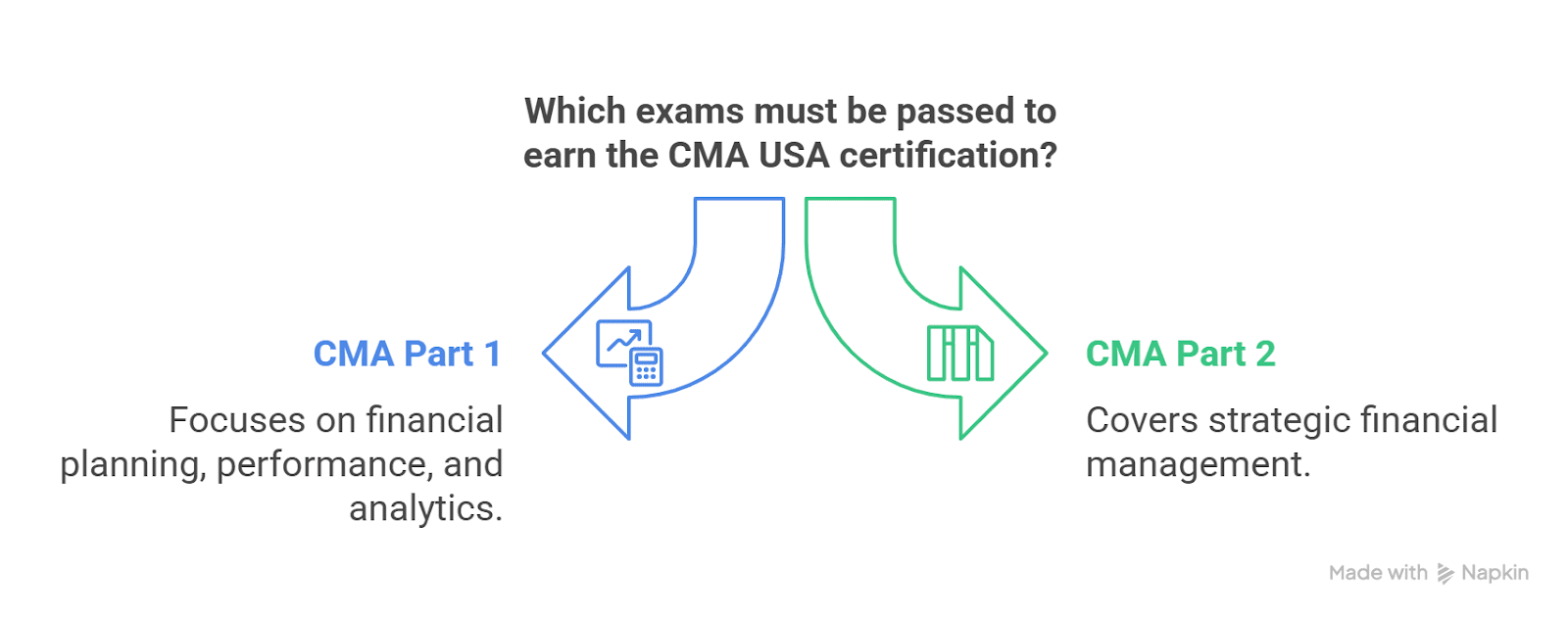
You will have to pass all four sections of the CPA exam: Auditing and Attestation (AUD), Business Environment and Concepts (BEC), Financial Accounting and Reporting (FAR), and Regulation (REG). With hard work in 12-18 months, even fresher can pass.
Step 4: Obtain Your CPA Certificate
When you receive your exam results, then you are eligible to obtain your CPA certificate. Keep in mind that the certificate itself does not make you competent to sign audit reports, but it is an achievement towards a professional life.
Step 5: Build Work Experience (Optional for License)
If you are going to buy or first employ a CPA, begin accumulating experience under a certified CPA. Though licensure right away is likely not your objective, alone, the CPA certificate is greater than a string of corporate jobs.
Benefits of the CPA Certificate Without Experience
1. Unlock Entry-Level Roles
Most Indian and multinational large companies adopt entry-level CPA certification even without complete licensure. You become career-ready for finance, tax, audit, and consulting the moment you graduate from college.
2. Global Career Mobility
CPA certificate makes you an international player for professional job positions not just in India but anywhere in the U.S., Canada, or around the world. The international prestige of AICPA opens doors worldwide.
3. Future-Proof Your Career
Prepaying for your CPA enables you to climb the corporate ladder higher despite not having work experience at first.
Frequently Asked Questions (FAQ)
1. Can I get a CPA certificate without work experience?
Yes, according to some U.S. states, nowadays it is possible to obtain the CPA certificate by passing the CPA exam and education requirements irrespective of professional experience or otherwise.
2. What is the difference between a CPA certificate and a CPA license?
A CPA certificate is that you’ve passed the exam; a CPA license is a right to do some services such as auditing or legally accounting finances. The license typically includes qualifying experience.
3. Is CPA certification useful for freshers?
Oh yes! CPA for freshers enhances employability, creates high-income jobs, and suggests commitment towards employees.
4. What are the CPA certificate requirements?
Typically, a bachelors, passing all four sections of the CPA exam, and fulfilling state-level educational qualifications is needed. Request specifics with your state.
5. How long does it take to get a CPA certificate?
With commitment, in 12-18 months you can be a CPA certificate holder. Imarticus Learning has crafted courses with concern to suit you.
6. Can you practice as a CPA without a license?
No. You cannot undertake legal work such as audit or seal of signature on financial statement unless you have the license. Nevertheless, you can look for corporate employment based on the sole CPA certificate.
7. Does the CPA certificate improve salary prospects?
Yes! In spite of lack of experience, CPA-certified applicants have better prospects of good pay packages and professional growth compared to non-certified applicants.
Conclusion: Start Your CPA Journey Today
In today’s competitive job market, waiting to gain experience before professional certifications can be hindering the growth of your career. The good news, however, is that it is very possible to become a CPA with zero experience at all and even more rewarding. Thanks to the blessings of having a dependable friend such as Imarticus Learning, you can indulge in the luxury of quality training, ample resources, and placement assistance, all aimed at making you successful sooner than later.
With a globally recognized CPA certificate in hand, you can differentiate yourself from fresher’s candidates, open doors to professional opportunities around the world, and set the stage for long-term success.
Is your target corporate finance career, taxation, consulting, or auditing, then? The key to high-profile and high-payscale careers in India and around the world is the CPA. Experience does not count – invest in yourself, save years of toil, and become a Certified Public Accountant today!
Let’s get started! Click here to check your eligibility and join Imarticus Learning today!
Why the Importance of Financial Reporting Can’t Be Ignored
CPA Accounting Expertise: Real-World Impact
CPA Skills for Success in the Job Market
Accounting and Financial Reporting: An Evolving Relationship
FAQs on Financial Reporting & CPA Skills
Key Takeaways
Conclusion
Introduction
So, you are thinking of taking up CPA as your career or probably boosting your finance. It’s really a good idea—in this era of fast-paced finance. Be it a student dreaming about global opportunities or a professional transitioning into the accounting sector, financial reporting has become a compulsory rather than an optional skill set. Within a few years, the demand for CPAs is expected to increase enormously, where companies will look for more than just theoretical knowledge – they will want a sharp, quick mind that can interpret financial data, tell a story through numbers, and convey the vision with accuracy.
This blog will help you know about the fact that financial reporting is not just another subject within the CPA syllabus – it is the backbone of CPA accounting expertise. It will break it down step-by-step.
Understanding Financial Reporting in Accounting
In an organisation, financial reporting constitutes preparing statements that reflect the financial status to the management, investors, regulators, and the general public. It manifests as transparency and accountability as well as making a significant impact on strategic decision-making by the organisation.
For anyone serious about accounting, understanding financial reporting in accounting is critical. This section dives into what it is, why it matters, and how it’s changing in today’s tech-driven landscape.
Key Components of Financial Reporting:
Component
Description
Income Statement
Shows profitability over a specific period
Balance Sheet
Provides a snapshot of financial position at a given time
Cash Flow Statement
Tracks the flow of cash in and out of the business
If you’re preparing for the CPA exam or working in the field -you’ll know that CPA financial reporting is one of the core sections tested. It requires not just knowledge, but application.
A solid foundation in financial reporting empowers CPAs to analyse data, recognise red flags, and deliver credible financial statements. Especially for candidates aiming for international roles, mastering this section can be a game-changer.
Why CPA Financial Reporting Matters:
It covers U.S. GAAP and IFRS standards
Prepares you for roles in audit, assurance, and compliance
Enhances your ability to work with multinational teams
CPA professionals are more than just number crunchers—they’re strategic thinkers. The key CPA skills needed today go beyond basic accounting. They involve technology, communication, and regulatory understanding.
Whether you’re working in India or abroad, these skills are vital for a successful CPA journey.
Top CPA Skills Required:
Analytical Thinking: For decoding complex financial data
Technical Proficiency: In tools like Excel, SAP, QuickBooks
Regulatory Knowledge: Understanding of global standards (IFRS, GAAP)
Communication Skills: To explain numbers to non-finance stakeholders
Ethical Judgment: A non-negotiable skill in financial reporting
Did You Know? According to a Deloitte survey, over 70% of CFOs expect finance professionals to have both technical and soft skills in today’s hybrid work models.
Why the Importance of Financial Reporting Can’t Be Ignored
The importance of financial reporting lies in how it guides business decisions, investor confidence, and economic stability. For CPAs, this is where you prove your value—not just in doing the math but interpreting what the numbers mean.
Inaccurate or delayed reporting can shake investor trust, cause legal troubles, or even shutter companies. This is why organisations place a premium on CPA skills for financial reporting.
Benefits of Strong Financial Reporting:
Ensures compliance with laws and regulations
Helps in budgeting and forecasting
Attracts investors and funding
Promotes internal control and audit readiness
CPA Accounting Expertise: Real-World Impact
Your CPA accounting expertise is like a toolkit—and financial reporting is one of its most powerful tools. From mergers and acquisitions to internal audits, your ability to interpret reports can shape company futures.
Multinational firms and Big Four companies increasingly demand CPAs who are fluent in global reporting standards.
Where Financial Reporting Makes an Impact:
Industry
Application of CPA Expertise
Banking & Finance
Analyzing financial health, loan decisions
Corporate Finance
Strategic planning, investor relations
Audit Firms
Ensuring regulatory compliance and accuracy
Startups
Financial modeling and pitch readiness
CPA Skills for Success in the Job Market
With globalisation and financial reforms, the finance sector is evolving rapidly. Employers seek professionals with top-notch CPA skills for success, especially those who understand financial reporting.
Financial reporting allows CPAs to work in roles that were once exclusive to foreign professionals. And with India moving closer to full IFRS adoption, the demand for these skills is only rising.
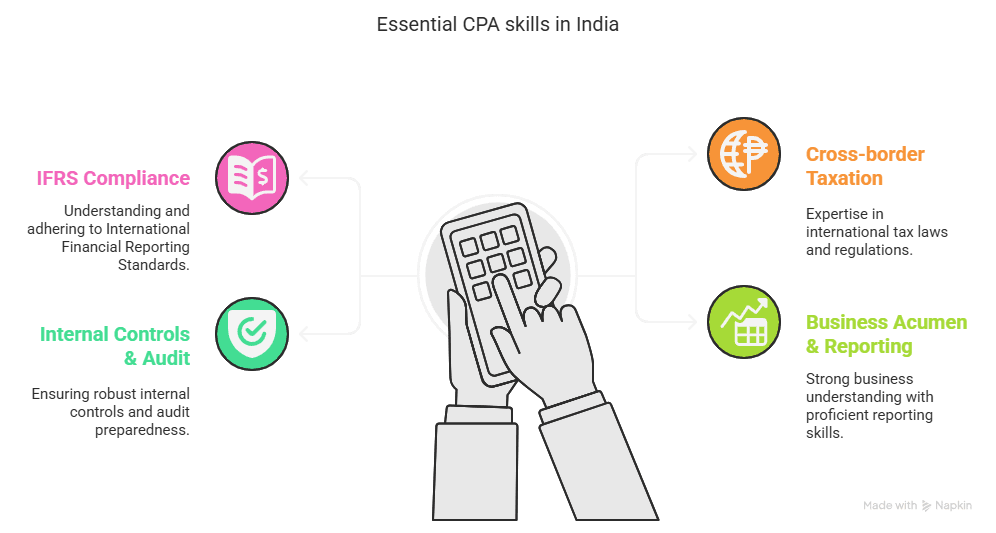
Key CPA Skills Needed:
IFRS Compliance
Cross-border Taxation Knowledge
Internal Controls & Audit Readiness
Business Acumen with Reporting Proficiency
Accounting and Financial Reporting: An Evolving Relationship
The world of accounting and financial reporting is not static. Technology, regulations, and market expectations are reshaping the landscape. As automation takes over routine accounting tasks, strategic financial reporting becomes the real differentiator.
For CPA professionals, this means upskilling and staying current with changes in reporting frameworks, AI tools, and data analytics.
Trends Reshaping Financial Reporting:
AI and Automation in statement preparation
Real-time Reporting with cloud platforms
Sustainability Reporting becoming standard
Blockchain Integration for secure ledgers
FAQs on Financial Reporting & CPA Skills
1. Why is financial reporting important for CPA professionals?
Financial reporting is important to CPA professionals.. as it establishes a system of reporting a company’s financial performance while ensuring compliance, transparency, and purposeful decision-making based on reliable information.
2. How does CPA financial reporting differ from general accounting?
General accounting focuses on recording transactions, while CPA financial reporting focuses on analysing and preparing regulated company reports or standardised statements adopted by regulators and investors.
3. Can I get a job from CPA with financial reporting skills?
Yes, many firms or MNCs employ and value CPA-certified employees who have financial reporting skills – especially those that have experience with IFRS or US GAAP.
4. Are financial reporting standards the same globally?
Not entirely—most countries follow either IFRS or GAAP, but CPA professionals must understand the nuances of both, especially in multinational environments.
5. What tools are used in financial reporting?
Common tools include Microsoft Excel, SAP, Oracle Financials, & QuickBooks – along with BI tools like Tableau and Power BI for data visualization.
6. Is CPA certification worth it for finance professionals?
Absolutely. A CPA credential boosts your credibility, expands global job opportunities, and makes you more competitive in fields like auditing, taxation, and financial reporting.
7. What are the challenges in mastering financial reporting?
Staying updated with – changing regulations, managing large data sets and interpreting complex financial events can be challenging but rewarding.
8. How often do financial reporting standards change?
Updates happen frequently. Professionals must stay current by following bodies like the IASB and FASB and taking regular CPE courses.
9. What is the future of accounting and financial reporting?
It’s moving towards real-time, tech-enabled, and sustainability-focused reporting. Skills in data analytics and automation will become critical.
10. Do all CPA exams include financial reporting?
Yes, financial reporting is a core part of the CPA exam—tested under the FAR (Financial Accounting and Reporting) section.
Key Takeaways
Financial reporting is a foundational CPA skill with real-world application.
On top are the professionals who flaunt a CPA certificate considering that there are verifiable needs all over the world regarding compliance.
The trend lines for long-term success within career models, preparing the grounds for contributing to changing understandings of accounting and financial reporting.
Specialisation in CPA financial reporting will give you an advantage in domestic and international employment scenarios.
Trends like AI, sustainability, and blockchain are replacing the way CPAs deal with reporting.
Conclusion
Financial reporting is not merely a box to tick on the CPA route; it is an avenue toward achieving credibility, career advancement, and worldwide opportunities. For finance professionals, this competency paves the way to roles that require strategic thinking coupled with technical depth. As businesses continue to grow more complicated and global, we lean on those who can interpret and simplify the numbers and then share them effectively. Make sure that whether you are getting your CPA or are in the news cycle and want to upgrade your skills, you make financial reporting your priority because it is not just a skill, it is your superpower.
CPA Course Duration is the only aspect that those ready to become Certified Public Accountants would care to consider. With its prestige and global recognition, this certification has been the desire of every new finance or accounting practitioner. Those interested are keen to know however long CPA will take them—whether it will take them to get a seat with the course or pass the exams.
In this article, we will give a complete overview of the CPA course schedule, pattern of the exam, and preparation time. You are either a working professional or a student; you should be aware of the CPA study duration and prepare accordingly for CPA preparation to be successful.
Understanding the CPA Certification
CPA (Certified Public Accountant) is globally accepted certification acquired by passers of the Uniform CPA Examination and obtaining proper experience and education requirements. CPA certification applies most importantly to the highest accounting, auditing, tax, and financial management jobs.
CPA certification is provided by the AICPA (American Institute of Certified Public Accountants) and engages candidates in successfully passing four most essential exam sections:
Auditing and Attestation (AUD)
Business Environment and Concepts (BEC)
Financial Accounting and Reporting (FAR)
Regulation (REG)
Each section is intended for personal skills and has to be prepared with a personal style of preparation and planning.
CPA Course Timeline Overview
The duration of the CPA course is generally flexible depending on individual circumstances like study time, working hours, and prior knowledge of accounting matters. Nevertheless, most of the candidates finish all four sections of the exam within 12 to 18 months.
Understanding the exam format enhances your skill to schedule it more appropriately. The four sections of the CPA exam will take 4 hours each from you, and you’ll be examined on all sections for 16 hours.
Exam Sections:
AUD (Auditing and Attestation): Cross-examines the practice of auditing, ethics, and risk.
BEC (Business Environment and Concepts): Cross-examines business governance, economics, and technology.
FAR (Financial Accounting and Reporting): Cross-examines GAAP, financial reports, and reporting requirements.
REG (Regulation): Examines United States business regulation, ethics, and taxation.
Candidates may spend up to 18 months taking all four parts after they have passed their first exam.
Focused and structured study must undergo the CPA exam. Suggested CPA exam study hours per section is:
AUD: 80–100 hours
BEC: 70–90 hours
FAR: 120–150 hours
REG: 90–110 hours
Total Study Hours: ~350–450 hours
Your CPA study routine may need to differ based on your background. Accounting graduates, for example, may have less hours needed for FAR, while finance background applicants may have additional hours needed.
Factors Affecting CPA Study Duration
1. Educational Background
Those with good academic records in finance and accounting are able to do it quicker.
2. Work Commitments
Those who work full-time do it for a longer duration as they have less time.
3. Study Resources
Utilizing hardworking CPA study materials, video lectures, and sample tests can make it quicker.
4. Exam Strategy
Forcing yourself to take consecutive exams rather than on separate days impacts overall time.
5. Personal Discipline
Adhering to daily study routine makes it quicker.
Sample CPA Study Plan
Below is a sample 12-month CPA study plan which can act as a calendar guide to your study:
Month 1–2: Application and Planning
Check eligibility and send documents
Select your study provider
Develop a 12-month exam plan
Month 3–5: FAR Preparation
Study 4 hours/day, weekdays, 8 hours/weekends
Regularly practice and take mock tests
Month 6–7: REG Preparation
Use visual aids and flashcards
Take at least 2 full-length mock tests
Month 8–9: AUD Preparation
Practice case studies and ethical questions
Weekly quizzes to test understanding
Month 10–11: BEC Preparation
IT and economics concepts reviewed once again
Simulations and writing exercises practiced
Month 12: Buffer and Final Revisions
Weaker parts re-tried
Full-length mock tests
Tips to Optimize CPA Preparation Time
Establish a daily routine and stick to it
Topic breakup into small segments
Review of progress on a weekly basis
Mobile applications for revision while on the go
Not skipping breaks to prevent burnout
CPA Study Duration vs Other Accounting Exams
Exam
Study Duration
Focus Area
CPA
12–18 months
U.S. GAAP, Tax, Audit
CMA
6–12 months
Management Accounting
ACCA
2–3 years
Global Accounting
CA
3–5 years
Accounting & Law
Compared to other members, the CPA has less time to achieve a qualification that is accepted all over the world.
Frequently Asked Questions (FAQs)
Q1: How long does it take to complete the CPA course?
Minimum 12–18 months to study the CPA course, all four sections.
Q2: How many hours should I study so that I can prepare for the CPA exam?
Most of the students read about 350 to 450 hours of all the sections.
Q3: Can it be possible to complete the CPA course in a year?
Yes, it can be done if one studies sincerely following proper study plan and schedule management, which is feasible to complete within 12 months of the CPA course.
Q4: How much time does the CPA exams take?
All four of the CPA exams are of each 4 hours, thus total 16 hours of four of them.
Q5: Is there any time limit when one needs to pass all the CPA exams?
Yes, all four need to be passed within 18 months of passing the first one.
Q6: CPA exam scheduling?
Start with the toughest subject first (most probably FAR), and schedule the rest according to your work schedule and convenience.
Q7: Can working professionals take CPAs?
Yes. 2–3 hours of study every day will enable working professionals to complete the CPA within 18 months.
Conclusion
The length of the CPA course will vary for all, but if you have a good study plan in advance and study hard, it is very likely that you will clear. A period of 12–18 months will be more than enough for most of the candidates. If you prepare well for each exam according to its level of difficulty and plan study sessions in an appropriate way, you can pass all four sections within the time frame.
Additionally, with adequate planning, you will enjoy an adequate balance of study, work, and life for the exams. Career advancement after the CPA designation is very high, job mobility in all jobs anywhere in the world is high, and respect is high in the accounting and finance field. With benefits like greater pay, leadership opportunities, and job security, it is among the most deserving finance certifications that you can attain.
Don’t forget that becoming a CPA is not a race—a marathon that involves determination, discipline, and persistence. Equip yourself with the right tools, work with tried-and-tested study materials, and keep your focus on the long-term goal. A working professional or recent graduate who has to upskill, having knowledge of the CPA course duration and planning early will be the key to success.
Start today with a strategic mindset and a well-thought-out plan, and you’ll find yourself on the path to CPA success—well-prepared and confident for the challenges ahead.
Dreaming bean-counting as a career? Hold on, there’s more to the Certified Public Accountant job description than tax forms and calculators. These financial geniuses are most often the behind-the-scenes heroes supporting businesses and navigating people through money minefields. Let’s see if this is your cup of coffee.
What Does a Certified Public Accountant Do?
Right, let’s put that stereotype of CPAs as stodgy bean-counting nerds to rest immediately
The CPA working functions are actually quite varied, as it turns out:
Sorting out tax horrors that’d make most people’s head spin
Keeping company books from cooking the books
Identifying sneaky money-saving ploys that business owners haven’t yet caught up with
Giving plain-English guidance that cuts through financial jargon
We were discussing this with a CPA buddy the other day and chuckling at how much his work has changed. He spends more time consulting clients and planning than curating numbers into spreadsheets. The AICPA doesn’t mind – about 40% of CPAs now do more advisory work than straight accounting. Not so boring after all, huh?
CPA Responsibilities: Much More Than Spreadsheets
The Certified Public Accountant duties have grown up. The calculator and receipt segregation days are behind us.
The Day-to-Day Bread and Butter
CPAs reconcile huge pieces such as:
Battling Byzantine tax codes (so you don’t lose your mind)
Being the financial detective in case there’s an audit
Taking confusing financial data and making it readable by mere mortals
Putting accounting systems in place that won’t drive people to pull their hair out
The Really Interesting Strategic Stuff
But more and more, CPAs do too:
Work their way across the books to find out where money’s being wasted
Suggest technology that gets the job done (not new and glitzy just for the hell of it)
Spot financial disasters in the making before they blow
Help companies grow without leaving financial landmines behind
Becoming a CPA: A Good Slog, But Worth It?
Achieving those three letters after your name? It ain’t exactly a stroll in the park. Certification weans out the part-timers pretty darn fast.
The Study Bit
In order to even sit for the CPA exam, you’ll need:
An accounting or equivalent degree
150 semester hours (yes, more than an average degree – no penny-pinchers here)
Specialised classes in accounting, business law, and taxation
Each state has regulations, but each demands more education than an average bachelor’s degree. It’s a marathon, not a sprint, and that’s why many of my university classmates started down the CPA track but didn’t finish them all.
The Certification Obstacle Course
The whole process is like
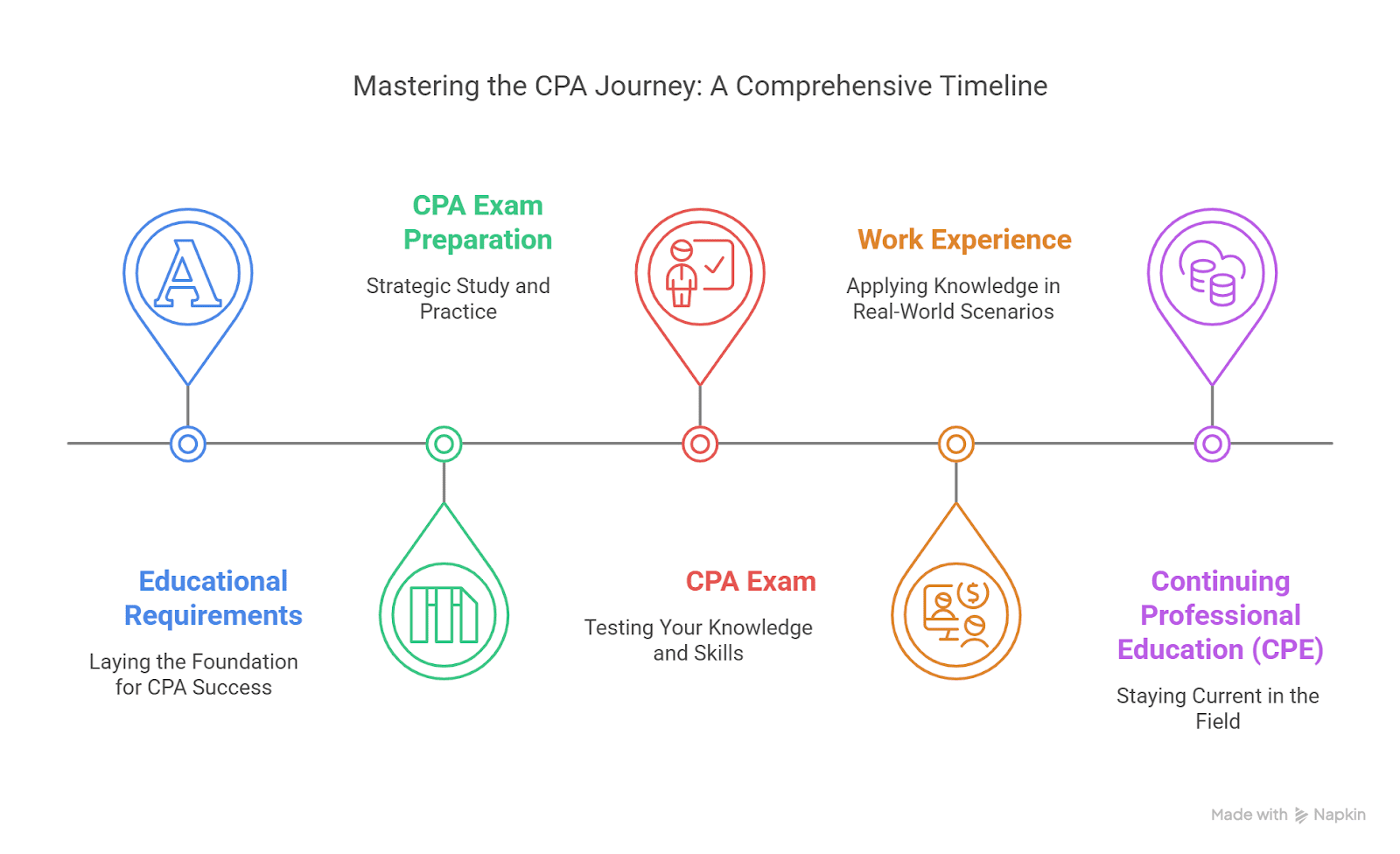
1. Filling all those boxes of education
2. Sitting and passing the four-part CPA exam (which loses around half who sit for it)
3. Picking up 1-2 years worth of experience under a actual CPA
4. Practising lifelong learning (as tax law alters more often than British weather)
Where Do CPAs Actually Work
The best thing about the CPA qualification? It’s stone dead adaptable. CPA job opportunities come literally wherever there is money changing hands.
The CPAs’ Natural Homes
Industry
What You’d Really Be Doing
Public Accounting
From easy tax returns to sneaky advisory work
Corporate Finance
Keeping the books in balance and looking for ways to make more money
Government
Not flushing taxpayer money down a rat hole
Non-profit
Stretching pennies and satisfying grant sponsors
Education
Teaching the future (while war-storrying about tax time)
Fancy Something a Bit Different?
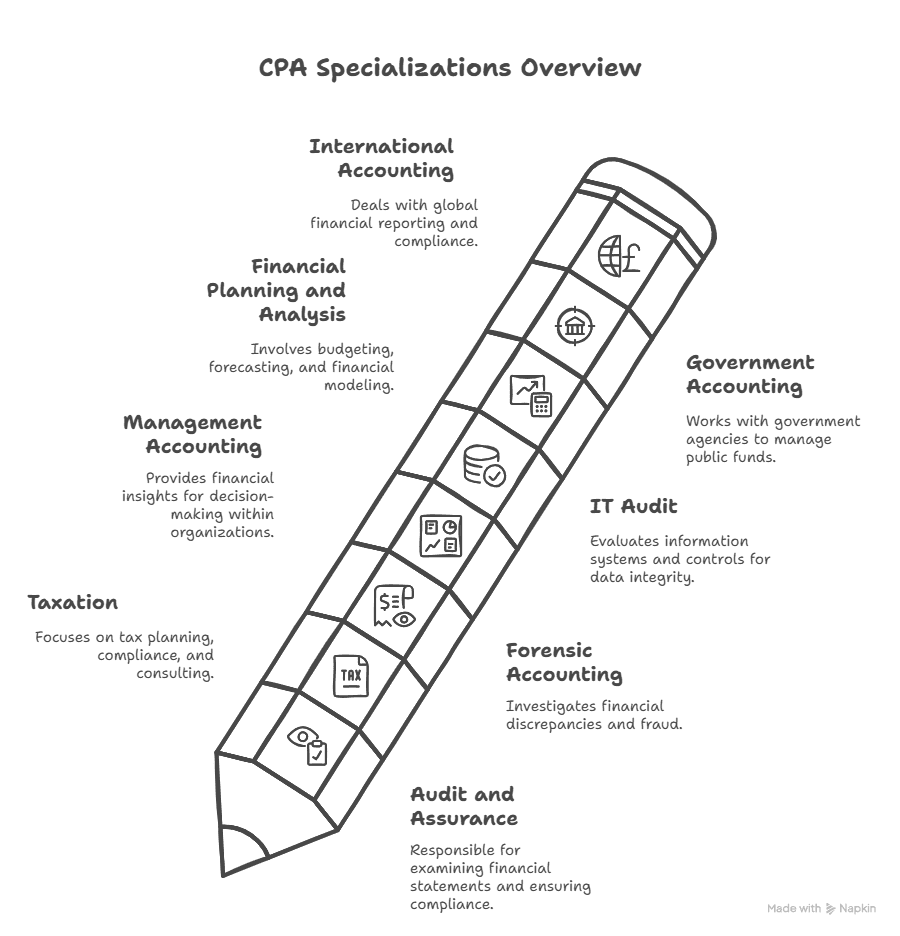
Some CPAs pursue specialty careers like:
* Forensic accounting (breaking financial crimes)
* Environmental accounting (making green profitable)
* International taxation (for those who enjoy nice, challenging puzzles)
* Information systems (where money and technology intersect in interesting ways)
Show Me the Money: CPA Salary and Growth
Now you might be willing to know how much CPAs earn, don’t you? The career prospects and CPA pay are not to be sneezed at, which is why people overcome the qualification hurdle.
Robert Half’s latest figures show CPAs earn 10-15% more than their un-certified counterparts. Over a lifetime, that’s a holiday home or private school fees.
* Top performers (13+ years): £125,000+ (partners in large firms earn an awful lot more)
They vary based on where you work, what industry you specialise in, and where your specialty is. A London City financial district CPA might be neck-deep in it, while a country practitioner might make less but be out on weekends from email.
Is CPA a Good Career?
Let’s get the good, bad, and sometimes ugly into perspective before you head straight into the certified public accountant job description.
The Absolute Positives
Recession-proof : Even when the economy’s in the dumpster, folks still need financial gurus
Options aplenty: Work for yourself, a massive company, or somewhere in between
Respect factor: Even that CPA qualification still commands a great deal of respect
Fair pay: Not startup riches, but good, steady cash
The Less Clever Bits
Getting qualified might be tough: The actual exam does have a 50% failure rate
Madness on tax return season: February-April can mean 60+ hour weeks and takeaway breakfasts, lunches and dinners
Continuous swotting: The regulations change all the time, so you’re constantly learning
Early career drudge work: Junior positions are actually soul-destroying
Remarkably, a survey by Accounting Today found 85% of CPAs actually enjoy their profession choice despite the highs and lows. They particularly enjoyed job security and that each day is different.
Would You Fit In?
The CPA career path actually appeals to people who:
* Get an odd kick out of figuring out tough problems
* Don’t mind being the voice of fiscal reason (even when nobody else will be)
* Pick up on little things that other people never even see at all
* Can take financial geek-speak and make it plain English
* Have a strong sense of right and wrong when money is involved
CPAs and Tech: Not Foes Anymore
The modern certified public accountant job description is filled with lots of technology. But rather than AI performing all the accounting, technology is transforming the way CPAs conduct business – for the most part, for the better.
Today’s CPAs employ the following on a daily basis:
* Cloud accounting software that makes older desktop software look ancient enough
* Data analysis software that identifies patterns humans wouldn’t catch
* AI for mind-numbing repetitive tasks (the work no one enjoyed doing in the first place)
* Blockchain for tamper-proof transactions
This tech revolution means less mind-numbing data entry and more interesting analysis. My CPA friend jokes that technology has saved him from getting permanent spreadsheet-induced eye damage.
Here’s a closer look at how technology is revolutionizing accounting:
Hot CPA Specialisations That Are Actually Interesting
Some of the CPA work is particularly in demand these days, with faster career growth and greater pay.
Financial Forensics
Financial sleuths find financial crime by:
* Uncovering fraud schemes (which grow more complex each year)
* Estimating damages in lawsuits and insurance claims
* Finding hidden assets in dirty divorces and bankruptcies
* Translating complex financial evidence to judges and jurors who didn’t study accounting
ESG Accounting
As sustainability moves from nice-to-have to business-critical, CPAs with Environmental, Social, and Governance accounting skills assist in:
* Imposing sustainability reporting that actually says something
* Performing ESG audits that don’t fall into greenwash
* Unraveling the increasing complexity of green rules without losing the plot
PwC reports ESG accounting professionals have experienced an 82% boost in demand since 2020.
FAQs: What People Really Want to Know About CPA Careers
Q1: How long does it take to become a CPA?
A US CPA certification requires 12-18 months of preparation
Q2: Does the CPA qualification transfer well overseas?
The US CPA is highly regarded nearly wherever you travel, although you will probably need to acclimatize to local regulation if you are keen to work overseas.
Q3: Can I work part-time as a CPA?
A3: Absolutely! There are loads of CPAs working flexible hours, especially once they’ve had some experience. Perfect if you have family or other responsibilities to take care of.
Q4: What’s the actual distinction between an accountant and a CPA?
Becoming a CPA takes further schooling, taking a rightfully tough test, supervised work experience, and continuing professional education. It’s similar to being someone who likes to cook versus being a professional chef.
Q5: How much does the CPA certification actually advance?
Robert Half found CPA-certified professionals are 15% more apt to progress to senior financial roles than those without a certificate. It’s often the differentiator between two otherwise equally skilled applicants.
Q6: Do CPAs merely sit and stare at figures all day?
CPAs nowadays require people skills because they’re playing the role of business consultants more frequently.
Q7: With all this automation, will CPAs still have jobs in 10 years?
Indeed, they do. Automation handles mundane details so CPAs can focus on more valuable advisory engagements. The BLS forecasts steady 6% growth to 2028, which is not so bad.
Q8: What about industry specialties for CPAs?
A8: Of course – some CPAs specialise in healthcare, technology, real estate, or entertainment. Industry specialisation can demand top dollar because you know the special issues.
For a no-BS guide on how to crack the CPA exam, attempt this
Conclusion: Is the CPA Path Worth the Hassle?
Role definition of certified public accountant verifies a career that is never static. It integrates technical capabilities with business skill, offering numerous career possibilities to the candidate ready to invest in the front-end sweat equity.
Key Takeaways:
1. Job Security and Flexibility – The CPA designation opens doors to employment in an unlimited array of industries and never goes out of style when the economy heads down the tubes.
2. Less Math, More Strategy – The CPA’s role in today’s day and age is more conceptual and advisory, and less compliance and math-intensive.
3. Worth the Slog – Sure, obtaining a CPA does take humongous amounts of effort to begin with, but the payoff in the long run is most definitely worth it for the majority who persevere.
Believe the certified public accountant career path is for you? Take the first step. Download our brochure or talk to one of our programme advisors about how our specialist accounting courses could be the beginning of your journey.
Financial accounting is the easiest of all the pillars of commerce and finance. You are a commerce student, an aspiring working professional who wants to be finance literate, or an exam aspirant like CFA or CPA; you must be good at financial accounting. We must be good at reading and interpreting statements and making shrewd business decisions.
But accounting scares you as it entails technical terms, regulations, and a lot of mathematics problems. But a positive attitude and pragmatic study schedule will put you at ease learning accounting principles and getting good marks in the exams. Through this manual, we will be sharing proven techniques, financial accounting study tips, and practice strategies to be a financial accounting master in a time-saving and effective way.
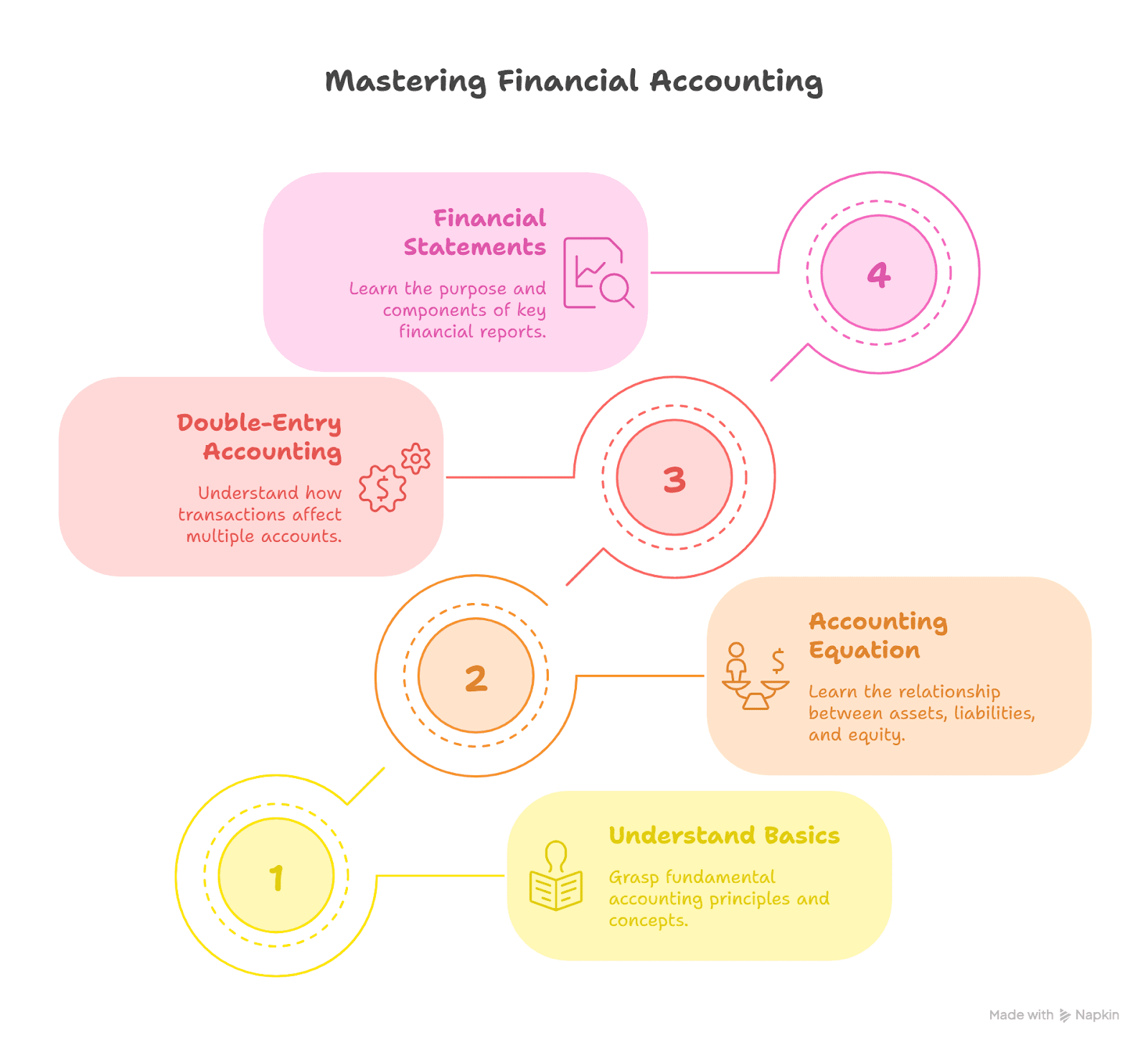
Let us learn about financial accounting first and then proceed with study procedures. Financial accounting is the process of recording, aggregating, and reporting transactions involving finances that are generated from business operations within a period of time. It entails preparing key financial statements that provide a snapshot of an organization’s financial status.
The key elements of financial accounting are:
Income Statement – Provides revenues and expenses within a time frame.
Balance Sheet – Accounts for the company’s assets, liabilities, and capital at a specific point in time.
Cash Flow Statement – Accounts for inflow and outflow of money within the company.
These accounts follow international accounting standards called GAAP (Generally Accepted Accounting Principles) or IFRS (International Financial Reporting Standards) depending on the country’s location. Knowing these basics is worth understanding as they form the basis of understanding and interpreting accounting information used for actual decision-making.
With these fundamentals, students and professionals are more keen in finance and precise in forecasting and analysis. Mastering the meaning of these statements once, even difficult account subjects are simple to prepare for the future.
Key Accounting Concepts and Principles
Accrual Principle – Expenses and revenues are incurred when they are accrued and not when the cash is paid or received.
Matching Principle – Expenses must be paired with matching revenues for the same time period.
Conservatism Principle – Under doubt, select that option which gives less profit.
Consistency Principle – Where a choice is taken in accounting, be consistent.
Going Concern Assumption – Presumes business will keep going as a going concern unless mentioned expressly.
Understanding such principles facilitates effectuating the rules effectively as well as provide regulatory-compliant brief financial reports.
Common Challenges and How to Overcome Them
Accounting finances will ever be challenging on the first try for most students. It is a blend of conceptual ideas, numerical accuracy, and challenging analytical reasoning. When all those are ill defended, it does look too daunting. Don’t worry, however-most of them might have been overcome using certain techniques and determination.
Issues and ways of avoiding them are discussed below:
Memorizing Definitions and Terms: Flashcards or a computer program like Quizlet can be utilized to memorize terms and definitions.
Learning Credits and Debits: T-accounts and transaction tables, graphical aids, can be employed to learn credits and debits.
Mastering Difficult Concepts: Break them into bits and pieces and read them in frequent intervals.
Numerical Problem Solving: Practice, practice, practice. Practice various types of problems to become confident.
Consistency: Follow a routine schedule and divide your syllabus into small chunks.
These are cut with time, patience, and determination, but it is simpler if there is proper attitude and study material. The urge is not merely to memorize but comprehend accounting in business.
Effective Accounting Study Plan
Understand the Syllabus: Highlight those areas which are marked heavier.
Plan a Timetable: Keep some days for theory and numerals practice.
Use Good Study Material: Use textbooks recommended by your school or syllabus.
Revise Regularly: Revision helps to store ideas in the long term.
Stay Updated: Keep yourself in harmony with new accounting standards developments.
How to Prepare for Accounting Exams
Accountancy exam preparation is not necessarily page-turning in your notes. It requires a strategy with timely discipline, practice, and self-testing. Go. Go. Go. Because theory knowledge and practical skills application in financial accountancy exam questions, one can only prepare sufficiently.
Here are tips that can accompany your preparation:
Practice Past Papers: Practice past papers under timed conditions.
Practice Time Management: Practice pacing yourself for different types of questions.
Mock Tests: Practice testing environment to minimize nervousness.
Textbooks: Directly quote books such as ‘Financial Accounting’ by T.S. Grewal or ‘Principles of Accounting’ by Needles and Powers.
Online Websites: Online websites such as Coursera, Khan Academy, and edX provide courses from beginner to advanced level.
Mobile Apps: Use apps such as Accounting Basics, Investopedia, and Ledger.
YouTube Channels: YouTube channels such as ‘Accounting Stuff’ or ‘Farhat’s Accounting Lectures’ are optimal for visual learning.
Tutors and Forums: Post on forum forums such as Reddit or Quora to clarify any doubts.
Real-Life Applications of Financial Accounting
Budgeting: Allows firms to prepare realistic budgets and manage costs.
Investment Decisions: Investors make investment choices based on financial statements to assess firms.
Loan Approvals: Banks approve loans based on balance sheets and profit and loss accounts.
Compliance with the Law: Good accounting allows firms to stay within the law.
Performance Monitoring: Managers track activities based on key financial performance indicators.
FAQs About Studying Financial Accounting
Q1. How to learn accounting?
Divide topics into small portions, practice regularly, and use visual and theoretical study tools.
Q2. How much time is needed to learn financial accounting?
Financial accounting can be learned in 2–3 months with regular effort.
Q3. Learning financial accounting: is it that hard?
Hard to begin with, but anyone can learn by learning it in a systematic approach and through practicing, anybody can learn it.
Q4. Must I study financial accounting on my own?
Yes, but if you possess the necessary material such as text books, internet tutorials, and practice problems.
Q5. What are some things I must learn for financial accounting exam preparation?
Journalizing, financial statement, trial balance, and depreciation.
Q6. Why are accounting principles so vital?
Very important—accounting principles govern how to account and interpret financial data.
Q7. Is there an app to learn financial accounting?
Yes, there is an app such as Accounting Basics and Quizlet that is extremely useful in practice and revision.
Conclusion
Financial accounting is a valuable skill for any person working in the investment, business, or finance sector. With periodic practice, wisely scheduled study timings, and clever study materials, it is definitely possible to become a master of this topic. Not only that, but it is also an extremely solid platform for other finance topics, and it also increases your decision-making ability along with your business capabilities.
Whatever your college exam preparation, professional courses like CFA, or perhaps an interest in learning to read the language of business even better, learning financial accounting is headed in the right direction. Put in the efforts, work hard, but always try to get to the “why” and not the “how.”.
With our economy being data-driven our reserve can actually have an impact on business results for those who are able to read numbers. With accounting skills, and increasingly more career opportunity doorways of entry, there are more geographies, functions, and industries.
CFA designation is one of the highly renowned in the financial sector. Career professionals should understand something about the CFA exam structure in order to prepare themselves accordingly. The detailed explanation provided below will make clear how each level is designed and what can be anticipated in the process.
The Three-Tier Challenge of the CFA Programme: CFA all 3 Level Details
The CFA exam format includes three consecutive levels with different formats and subjects of concentration. The strength of this credential is that it has a progressive format based on developing expertise incrementally starting from the basics to complex portfolio management strategies.
Industry research facts indicate that it takes an average of 300 hours for every level. Remarkably, no more than about 20% of the candidates who register to do the CFA program can complete all three levels to the standard of achieving charterholder status. A success like this puts the weight of authority and prestige associated with the qualification under the limelight.
Level 1: Building Fundamentals
The CFA Level 1 exam is the first step into the program, the investment concepts and tools exposure of candidates being examined here.
CFA Test Structure
Level 1 is straightforward but thorough in format:
– 180 multiple-choice questions
– Two 135-minute sessions (90 questions in each)
– Computer-based tests available several times a year
– All questions equally weighted
Subject Matter Coverage
Subject Area
Weight (%)
Focus Areas
Ethics
15–20%
Professional standards, code of conduct
Quantitative Methods
8–12%
Time value of money, statistical concepts
Economics
8–12%
Micro/macroeconomic principles
Financial Reporting
13–17%
Financial statement analysis
Corporate Finance
8–12%
Capital budgeting, corporate governance
Equity Investments
10–12%
Stock markets, equity valuation
Fixed Income
10–12%
Bond valuation, measurements of yield
Derivatives
5–8%
Basics of forwards, futures, options
Alternative Investments
5–8%
Private equity, real estate, commodities
Portfolio Management
5–8%
Fundamentals of risk management, diversification
The Level 1 exams only test knowledge and understanding. The candidates need to provide knowledge about the instruments and the concepts of investments but not on how they operate.
Level 2: Application of Investment Concepts
The CFA level-wise framework totally changes at Level 2, from acquaintance to application of investment concepts and tools.
Examination Pattern
Level 2 has a more advanced question pattern:
– 88 item sets on case-scenario-based items, multiple-choice questions
– 4-6 follow-up questions per item set with vignette
– Computer-based test in two sessions
– Greater focus on analysis and application
Content Sophistication
The Level 2 pattern of CFA exam, the topics remain the same but with growing complexity:
– Ethics still retains top weightage (10-15%)
– Financial reporting and analysis becomes more complicated
– Equity and fixed income sections are extended to higher-level valuation models
– Asset allocation and portfolio management topics get more attention
This level tests candidates’ ability to analyse scenarios and apply concepts to specific situations, requiring deeper analytical skills and a more nuanced understanding of financial principles.
Level 3: Mastering Synthesis and Evaluation
The third level of the CFA program tests candidates’ ability to synthesise all prior learning and apply it to sophisticated portfolio management and wealth planning scenarios.
– More emphasis on portfolio management and wealth planning
– Candidates’ ability to prepare and present recommendations is tested
Integrative Approach
The structure of the CFA test at Level 3 focuses on:
– Sophisticated portfolio management techniques for diverse types of clients
– More application of professional and ethical guidelines
– Advanced wealth planning strategies
– Putting all ten topic areas into realistic situations
The constructed response option demands application of concepts but also good communication of recommendations and analysis—a skill that is extremely important to investment professionals.
Strong Preparation Strategies
Understanding the CFA syllabus breakdown is indispensable, but a far greater necessity is the correct approach to preparation for each level.
Level 1 Preparation Techniques
1. Form a strong conceptual base in each topic area
2. Get familiar with the type by practicing using large numbers of multiple-choice questions
3. Give more time to ethics, which is notoriously difficult for most examinees
4. Use flashcards for memoranda type definitions and equations
Strategies for Level 2 Preparation
1. Focus on application over just memorisation
2. Familiarise yourself with tough case situations and scenarios
3. Familiarise yourself with financial statement analysis and equity valuations methods
4. Spend more time studying hard topics like derivatives and fixed income
Level 3 Preparation Strategies
1. Practice writing good quality, concise written answers
2. Emphasis on portfolio management and wealth planning principles
3. Revision of prior levels’ pertinent material as and when needed
4. Complete practice exams under timed conditions
For further details, these video resources are informative:
Recent Developments in CFA Examination
CFA Institute updates the cfa exam format from time to time according to industry trends. Few of the latest important changes are:
– Complete implementation of computer-based testing on all levels
– Implementation of more flexible windows of scheduling within a year
– Decrease in total questions on all levels
– Greater emphasis on technology and data analysis content
These revision cycles capture changing financial industry requirements and maintain the CFA program with best current professional practice.
Most Common Pitfalls and Best Solutions
Most candidates have the same issues while preparing through the CFA level-wise structure:
Timing Management
As much study is required for every level, i.e., 300+ hours, proper timing management is the key:
– Plan a structured study schedule 4-6 months before the intended exam date
– Identify topics by weightings in exams
– Plan regular review sessions to solidify learning
– Include buffer breaks to accommodate surprise interruptions
Tough Subjects
Certain subjects always turn out to be tough for candidates:
– Ethics: Get used to applying principles to cases instead of memorizing rules
– Quantitative Methods: Constant practice in calculations to be comfortable
– Financial Statement Analysis: Practice many practical examples
– Fixed Income: Master word usage and calculation techniques
Mental Toughness
The CFA journey also has mental challenges in addition to academic ones:
– Set realistic goals throughout the study phase
– Think about joining study groups for support and knowledge sharing
– Strategic breaks to stay focused and prevent burnout
– Identify and reward milestones of progress
Professional Impact Beyond Exams
Knowledge of the CFA exam pattern is useful, but the value of the qualification lies in passing exams beyond this:
– Qualifying professional experience requirement: 4,000 hours of qualifying professional experience
– Membership of the CFA Institute
– Adherence to the CFA Institute Code of Ethics
The charter provides a path to investment management, research, consulting, and corporate finance careers. Industry studies have shown that CFA charterholders earn 30-45% more than their non-charter holding counterparts in the same job.
Most Frequently Asked Questions
What are historical pass rates for each level of CFA?
Pass rates are window- and level-specific but traditionally have been 36-49% for Level 1, 40-55% for Level 2, and 50-60% for Level 3. These figures represent rising levels of difficulty in the programme.
What is the minimum duration taken to pass all three levels of CFA?
Minimum is 18 months, but most of the candidates take 2-3 years to pass all three levels working a full-time job.
Can one take CFA exams in any sequence?
No, the candidate must pass each level in sequence before moving to the next level.
Is there any restriction on attempts at each level?
There is no restriction on attempts, but each attempt is conducted after fresh registration and fee payment for the exams.
Is the CFA qualification accepted globally?
Yes, the CFA charter is accepted in over 160 countries and is considered the gold standard of investment management.
How much is the approximate cost of completing the whole CFA program?
Aside from exam fees, study guides, and possible retakes, candidates invest an estimated £2,500-5,000 along the way.
Should candidates take a shot at self-study or prep courses?
Either method works. Self-study is appropriate for well-behaved students, but preparation courses offer organisation and professional guidance. A combination of the two is pursued by most successful candidates.
Are there educational prerequisites to the CFA program?
Candidates must have a bachelor’s degree, be in the last year of a bachelor’s degree program, possess four years of work experience, or equivalent work experience plus education.
Why is the CFA different from other financial designations such as FRM or CAIA?
CFA is more generic in nature and involves investment management as a whole in general terms, whereas FRM is a risk management specialist and CAIA is an alternatives investment specialist. CFA is also widely regarded to be the most comprehensive and most prestigious of all these certifications.
Conclusion: Navigating the CFA Journey
Knowledge of the CFA exam structure gives a foundation base to any candidate pursuing the Chartered Financial Analyst designation. The program is a serious endeavor but has a monumental professional payoff.
Key Takeaways
1. The CFA program is made up of three progressively demanding levels, each with a different format and topic emphasis.
2. Level 1 tests knowledge of basic ideas by multiple-choice, Level 2 tests application by case-based situations, and Level 3 tests synthesis and judgment by constructed responses.
3. Achievement goes beyond mastery of content, it involves level-appropriate study tactics as well as habitual use over time.
Begin your career development in finance—[join an information session](https://imarticus.org/chartered-financial-analyst-certification-program/) and see how this program can guide you through the CFA exam format and toward charterholder success.
If you’re serious about a long-term finance career, you’ve probably heard this line: “CFA is the gold standard.” And for good reason. The CFA Certification (Chartered Financial Analyst) is one of the most globally respected designations in finance, recognised across 160+ countries.
But here’s the thing most people miss: CFA isn’t just about adding three letters after your name. It’s about transforming how you think about money, markets, and management.
Whether you dream of becoming an equity analyst in Mumbai, a portfolio manager in London, or a CFO steering a fintech in Bangalore, CFA opens those doors.
So, let’s cut the noise and get into what actually matters:
What jobs can you get after CFA? What salaries to expect? What industries hire CFA professionals? And yes, what to do after CFA to keep growing?
What Is the CFA Certification?
Imagine finance as an enormous city, full of skyscrapers representing investment banks, asset management firms, and fintech startups. Everyone wants to reach the top floor, where strategy, decision-making, and big money reside. The CFA Certification, short for Chartered Financial Analyst, is the elevator that takes you there. But unlike ordinary elevators, this one tests your patience, your ethics, and your depth of understanding at every floor.
To put what is CFA simply, at its core, it is a professional credential awarded by the CFA Institute that signals you’ve mastered the global language of money. Think of it as a passport to international finance, recognised in 160+ countries and trusted by employers like Goldman Sachs, Morgan Stanley, BlackRock, and many more of their stature.
Where most finance degrees give you an overview, the CFA drills deep. Across its three levels, you study everything from ethics and financial reporting to derivatives, portfolio management, and wealth planning. But more importantly, what makes the CFA so respected is not just its syllabus — it’s the mindset it builds. Passing each level feels like training for a marathon where endurance matters more than speed. Employers know this, which is why the letters CFA after your name instantly signal discipline, integrity, and analytical mastery.
To put it simply:
“An MBA can teach you to manage a business. A CFA teaches you to understand how money moves the world.”
If you’ve ever found yourself reading company reports like detective novels or wondering why markets move the way they do, the CFA Certification is your professional calling. It turns curiosity about finance into a structured, globally recognised expertise.
This video divulges why CFA has been considered a gold standard certification among finance certifications.
Why the CFA Certification Is Worth the Effort
The CFA curriculum doesn’t just teach finance; it builds decision-makers. You learn ethics, investment management, financial analysis, and portfolio theory, all through real-world application.
But here’s what makes the CFA Certification different:
CFA Advantage
Why It Matters in the Real World
Global Recognition
Over 190,000 charterholders and 160+ societies worldwide mean your credentials are valid anywhere.
Depth of Knowledge
CFA dives into valuation models, portfolio optimisation, and risk analytics – skills employers crave.
Ethical Foundation
Every CFA charterholder pledges to a code of ethics—something clients and employers deeply value.
Career Mobility
It lets you pivot between asset management, investment banking, or corporate finance seamlessly.
With CFA, you learn how to think like an investor.
The Real Career Growth Path After CFA
Now, this is where most blogs stop at just job titles. But let’s go deeper into how careers actually evolve after each CFA level.
🔹 Level I: Getting Your Foot in the Door
At this stage, your value is in your analytical discipline. You’re employable in roles like:
Junior Equity Analyst
Research Assistant
Data/Valuation Analyst
CFA Starting Salary in India: ₹6–10 LPA (source: Glassdoor India).
💬 Think of Level I as proving your commitment. Recruiters see it as your signal that you’re serious about finance, not dabbling.
🔹 Level II: Building Core Financial Expertise
Once you clear Level II, you can handle complex valuation and modelling assignments. Roles open up in:
Once you’ve earned the CFA certification, the world of finance starts to look very different. You stop seeing job titles and start seeing impact. That is how capital flows, how portfolios grow, how data becomes decisions. That’s the real power of being a CFA: you become fluent in the mechanics of money.
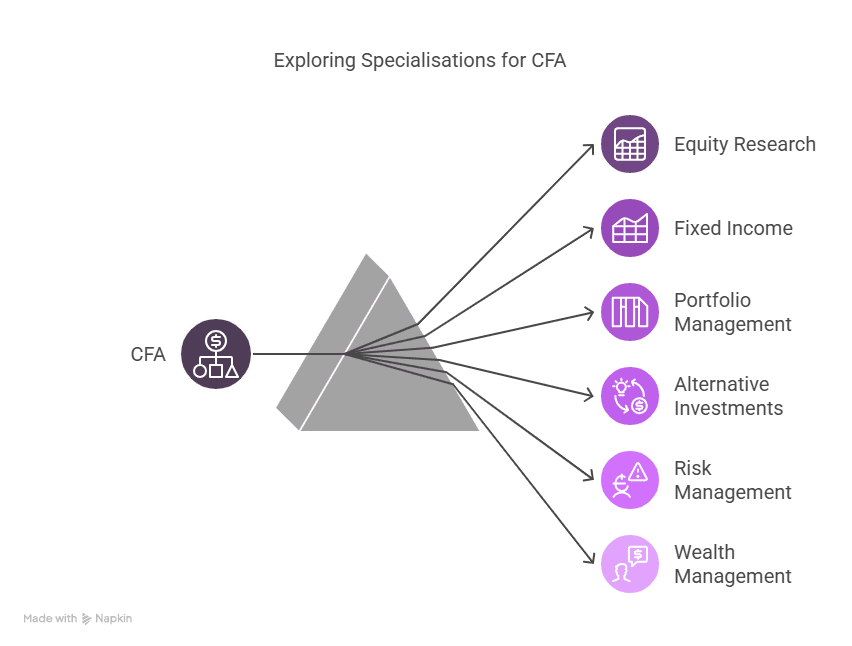
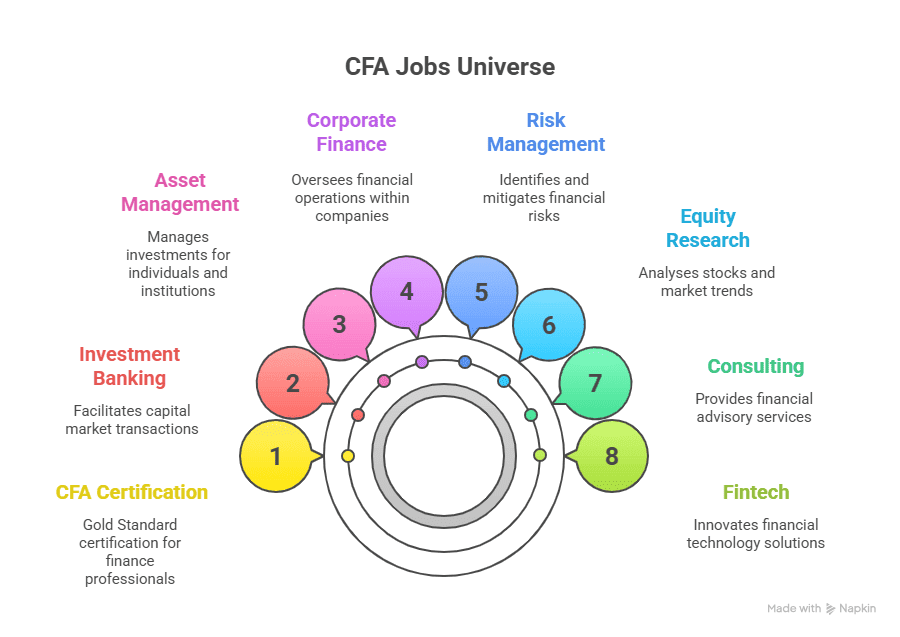
Whether your dream is to decode markets like an equity analyst, manage billion-dollar portfolios, or structure mergers that make headlines, the CFA charter opens doors across investment banking, asset management, corporate finance, fintech, consulting, and risk management. What’s fascinating is how versatile this credential is. A CFA charterholder can fit seamlessly into both Wall Street’s trading floors and a startup’s financial strategy desk.
Let’s explore real roles, their responsibilities, and average pay:
Role
Core Responsibility
India Avg Salary
Global Avg
Portfolio Manager
Designing and managing investment portfolios
₹15-40 LPA
$100K-150K
Equity Research Analyst
Evaluating company performance, writing investor reports
₹10-30 LPA
$80K-120K
Investment Banker
Structuring IPOs, M&As, and fundraising
₹20-50 LPA
$150K-250K
Risk Analyst
Assessing financial and operational risks
₹8-20 LPA
$70K-120K
Quantitative Analyst
Building mathematical models for trading
₹20-60 LPA
$120K-200K
Corporate Finance Manager
Financial planning, budgeting, and capital structuring
₹12-25 LPA
$90K-160K
CFO
Steering overall financial strategy
₹50+ LPA
$200K+
(Salary sources: AmbitionBox, CFA Institute, PwC Salary Guide 2024)
CFA Salary Growth in India
The beauty of the CFA path is that it rewards both patience and precision. Salaries don’t spike overnight – they compound, just like the investments you’ll eventually manage. Think of your career graph as a portfolio: early years are about building capital (skills and credibility), and the later years are where compounding takes effect.
Let’s break down how your earning potential grows with experience, based on LinkedIn Salary Insights and aggregated market data from major financial hubs.
Here’s how salary evolves with experience:
Experience
Typical Role
Avg Salary
0-2 years
Research Analyst
₹6-10 LPA
3-5 years
Senior Analyst / Associate
₹12-20 LPA
6-9 years
Portfolio Manager
₹25-40 LPA
10+ years
CFO / Director
₹50+ LPA
💬 Mentor’s insight: “Your CFA doesn’t automatically multiply your salary—it multiplies your credibility. Salary follows credibility.”
Understanding the Curve: What Really Drives the Jump
Salary growth in CFA careers isn’t just about seniority; it’s a mix of three multipliers:
CFA Level Progression
Each level signals a leap in your analytical and ethical competence. Recruiters often tag salary ranges to CFA milestones, for example, Level I candidates earn ~₹6–8 LPA, while Level III pass-outs average ₹18–30 LPA in investment roles.
Completing the charter can open pay brackets 30–70% higher in mid-career stages.
Domain Specialisation
Those who align their CFA expertise with niche domains like ESG investing, alternative assets, and fintech analytics often command faster salary jumps.
Example: A portfolio analyst who pivots to ESG or AI-driven investing can move from ₹18 LPA to ₹30 LPA within two years because demand is skyrocketing.
City & Industry Factor
A CFA in Mumbai or Singapore earns significantly more than one in a smaller market, often 1.5x–2x higher.
Industries like asset management, private equity, and consulting offer the steepest salary slopes, while corporate finance is steadier but slower. (Times of India Salary Report)
Best Locations for CFA Jobs
Where you base your career matters. With the CFA Certification in hand (or in progress), choosing the right city can mean 20–40% higher pay, faster growth, and better exposure. Let’s break down the top spots in India, followed by the global hotspots, and look at what the numbers and market trends actually say.
Top Indian Cities for CFA Jobs:
Mumbai – Financial capital; investment banks and AMCs cluster here.
Bengaluru – Fintech, startups, and corporate finance hubs.
Delhi NCR – Consulting and corporate HQs.
Pune & Hyderabad – Risk and analytics back offices.
Global Hotspots: If you’re considering international roles (or global exposure from India), these cities dominate CFA hiring:
New York – Global investment banking, hedge funds, and asset management powerhouse.
London – Europe’s finance hub, strong for asset management and sustainable finance roles.
Singapore – Regional headquarters for many APAC asset managers, wealth-management firms.
Dubai – Middle East hub for private wealth, family offices, and regional investment funds.
Hong Kong – Gateway to China & Asia asset flows, strong demand for CFA-qualified talent.
While precise city-specific salary data is less public, CFA Institute’s presence in these locations (offices in London, Hong Kong, etc.) shows the strategic importance.
Mentor tip: If you’re targeting a global role, try to pick up one of these locations in your career roadmap (even if it’s through a transfer or remote role) — the global mobility of the CFA Certification matters.
Career Domains That Love CFA Professionals
If you ask ten CFA charterholders where they ended up, you’ll probably get ten different answers, and that’s the beauty of this qualification. The CFA doesn’t lock you into one lane; it opens several. The trick is knowing which path fits your temperament and ambition.
For instance, if you love chasing patterns in chaos, like in stock markets, fund movements, or macro trends, then asset management and equity research will feel like home. But if you get a kick out of solving business puzzles and seeing numbers meet boardroom strategy, corporate finance, or consulting might be your calling.
Below is a table that highlights the career avenues the CFA Certification can provide. If you want to explore a notch further, this CFA Career Guide will help you with the real-world insights.
Domain
How CFA Helps
Companies Hiring
Investment Banking
Deep valuation and deal modelling expertise
JP Morgan, Goldman Sachs
Asset Management
Portfolio theory, risk-return balancing
BlackRock, ICICI Prudential AMC
Corporate Finance
Capital budgeting, M&A, cash flow management
Amazon, Deloitte, PwC
Risk Management
Quantitative and compliance frameworks
Citi, Axis Bank, HSBC
Fintech & Startups
Product pricing, data-driven strategy
Zerodha, Groww, CRED
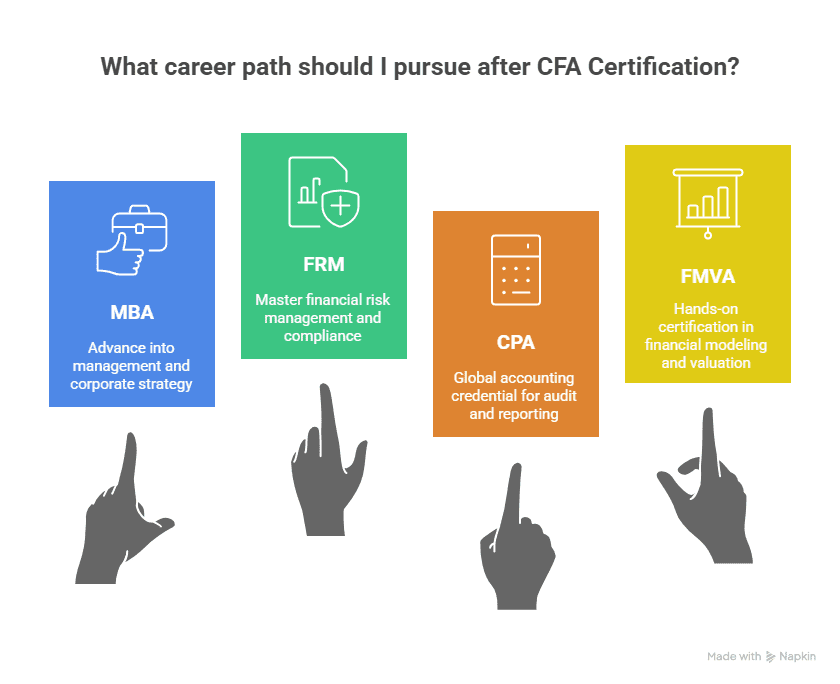
After CFA — Which Course Is Best?
Here’s the thing most people won’t tell you – the CFA isn’t the finish line; it’s the foundation. Once you’ve earned it, you’ve built a deep analytical muscle, but your next move depends on what kind of finance professional you want to become.
Think of your CFA as learning the “grammar” of finance – it teaches you to read balance sheets and markets fluently. But if you want to write your own story in the industry, you’ll often need a specialisation that gives context to your analytical depth. That’s where the “next course” question becomes strategic.
Goal
Recommended Add-on Course
Why It Helps
Move into Corporate Strategy
MBA (Finance)
Builds leadership & business acumen
Master Risk Analytics
FRM Certification
Complements CFA with quant and risk depth
Enter Accounting Roles
CPA Certification
Adds audit and reporting expertise
Excel in Valuation & Modelling
FMVA or Investment Banking Program
Makes your CFA skills job-ready
Lead Fintech or Analytics
Data Analytics / Power BI / Python
Helps you translate finance to tech
💬 Mentor note: “A CFA charter tells the world you can analyse markets. The next course you take should prove you can lead in them.”
So to give you a snapshot-
If you aim for leadership and strategic roles, an MBA amplifies your CFA by turning analytical skill into management strength.
Prefer the thrill of markets and risk? FRM sharpens your quantitative insight. Want to blend finance with accounting and corporate governance?
CPA is your route to global CFO tracks.
And for those drawn to hands-on valuation and deal-making, FMVA bridges theory with real-world finance execution.
Industry Demand for CFA Professionals
The demand for CFA-certified talent is rising fast – especially in India. According to CFA Institute India data (2024), CFA enrolments have surged by 25% YoY, driven by:
Fintech expansion
Mutual fund penetration in Tier-II cities
Global investment outsourcing
Here’s what the 2025 outlook looks like in India:
Industry
2024 Share
2025 Expected Growth
Investment Banking
30%
+18%
Asset Management
25%
+22%
Fintech
15%
+35%
Corporate Finance
20%
+16%
Consulting
10%
+12%
CFA vs Other Finance Certifications
Choosing between the CFA and other finance certifications isn’t about picking “the best”; rather, it’s about knowing which language of finance you want to speak fluently.
Think of it like this: the CFA teaches you the grammar of investments and markets, how to interpret risk, value, and opportunity. A CPA speaks the language of accountability and compliance, while an FRM deals in the dialect of uncertainty and probabilities.
Interestingly, today’s top finance leaders don’t choose one; they stack them. The head of a global asset management firm might hold both CFA and FRM; a CFO in a multinational could blend CPA and CFA. In an age where finance, data, and risk converge, it’s no longer about rivalry – it’s about synergy.
So rather than asking, “Which is better?” ask, “Which one solves the problems I want to solve?” That’s where your edge truly begins.
Certification
Ideal For
Core Focus
Duration
CFA
Investment & Portfolio Mgmt
Valuation, Markets, Strategy
2.5-3 Years
CPA
Accounting & Audit
Financial Reporting
1-1.5 Years
FRM
Risk Management
Quant, Regulation
1.5-2 Years
MBA (Finance)
Business Leadership
Management & Strategy
2 Years
CFP
Wealth Management
Personal Finance
1-1.5 Years
Watch this CFA mock interview to understand how candidates connect investment concepts, ethics, and strategy during real finance interviews; a perfect bridge between learning the CFA Certification and living it in the professional world.
FAQs on CFA Certification
If you’re exploring how far the CFA Certification can take your career, you’re not alone. From finance students to working professionals, everyone wants clarity on what happens after CFA—what jobs you can get, how much you can earn, and how the industry is evolving in 2025. Below, I’ve answered some frequently asked questions about CFA Certification career options, salaries, and the future of finance for CFA professionals.
What are the career options after CFA?
After completing the CFA Certification, you can pursue a range of high-value roles across global finance sectors. Common CFA career options include:
Portfolio Manager
Equity Research Analyst
Investment Banker
Risk Analyst
Financial Strategist
Corporate Finance Manager
Quantitative Analyst
What jobs can I get with my CFA?
With your CFA Certification, you can land roles in investment firms, banks, consulting companies, and even startups. Some of the most in-demand jobs after CFA include:
Equity Research Associate (analysing company performance for investors)
Fund Manager (managing diversified portfolios)
M&A Analyst (assisting in mergers and acquisitions)
Risk Consultant (identifying and mitigating market risks)
At Imarticus Learning, you also gain access to industry-aligned mentorship, placement support, and expert-led mentorship
Can CFA earn 1 crore?
Yes, absolutely, but not immediately. Reaching the ₹1 crore annual mark with a CFA Certification typically happens once you reach senior leadership positions such as Vice President (VP), Portfolio Manager, or CFO.
Most CFA charterholders in India start around ₹8–12 LPA, but with 8–10 years of experience and consistent performance, salaries can easily cross ₹1 crore, especially in asset management or investment banking.
Can CFA get a job in India?
Yes. The CFA Certification has seen a major rise in demand across India due to the booming investment ecosystem, fintech innovation, and mutual fund growth. CFA-qualified professionals are also valued by Big 4 consulting firms for valuation and risk advisory projects.
Top cities hiring CFA professionals include Mumbai, Bengaluru, Delhi NCR, Pune, and Hyderabad.
What is CFA Level 1 salary?
After clearing CFA Level 1, candidates typically earn between ₹6–10 LPA in India, depending on their background and skill set. Common entry-level roles include:
Junior Equity Analyst
Research Assistant
Financial Data Associate
Valuation Analyst
These roles act as stepping stones: by Level 2, professionals often double their salary potential.
Will CFA be replaced by AI?
Unlikely. While AI is automating many data-heavy financial tasks, the CFA Certification emphasises human judgment, ethical reasoning, and strategic decision-making—skills machines can’t replicate.
AI tools may assist CFAs in analysis, but they can’t replace the strategic thinking, risk evaluation, and client trust that CFA professionals bring.
Is CFA worth it in 2025?
Yes, perhaps more than ever. In 2025, with markets globalising and data-driven investing becoming the norm, CFA holders are increasingly hired in Fintech, ESG Investing, Private Equity, and Corporate Strategy, alongside traditional banking roles.
It’s not just worth it—it’s future-proofing your finance career.
Can you make $500,000 a year as an accountant?
Typically, accountants don’t reach that range, but CFA-qualified finance professionals can, especially in portfolio management, hedge funds, or investment leadership.
The CFA Certification isn’t designed for accounting roles like CPA—it’s meant for investment and financial strategy careers, where compensation can scale far beyond $500K at senior levels.
What jobs will be gone by 2030?
By 2030, repetitive financial roles such as basic data entry, bookkeeping, and low-level audit work will likely be automated. However, roles requiring judgment, ethics, client engagement, and investment strategy—the essence of the CFA Certification—will continue to grow.
Summing it Up
With the CFA certification, you start by studying markets, but by the end, you understand people: investors, clients, and economies alike. That’s what makes the CFA so powerful: it trains you to see patterns where others see numbers, to act with reason when others act with emotion.
Finance isn’t just about capital; it’s about trust, and the CFA helps you build that trust with skill, ethics, and global credibility. When you’ve gone through those long study nights, those mock exams, those “aha!” moments of connecting theory to real markets, you don’t just become a finance professional. You become someone who can interpret the rhythm of money itself.
If you’re wondering where to start or how to sustain the momentum through three demanding levels, that’s where structured mentorship makes the difference.
The CFA Certification Course in collaboration with KPMG in India, offered by Imarticus Learning, isn’t just designed to help you pass; it’s built to help you lead. You learn directly from expert mentors who bring a boardroom perspective into the classroom. Each concept is reinforced through case-driven training, practical case studies, and real-world valuation projects, so theory never stays theory for long.
You also gain the advantage of placement-driven support, joint certification, and internship opportunities with KPMG in India, giving you both academic depth and practical edge.
Passing the CFA exam is like climbing a mountain for all of those aspiring Investment Analysts. Whether analysing an equity market, or managing a very complex portfolio, there is nothing that can elevate your professional position like passing the CFA exam. But let’s face it – this isn’t your average exam. It demands intense discipline, clarity of concept, and a preparation strategy that works for you. If you’re a student or a finance professional balancing job responsibilities with CFA studies, this post is for you. Let us help you feel a little less overwhelmed and a lot more achievable in your CFA experience.
Table of Contents
CFA Exam Preparation: Understand What You’re Up Against
CFA Study Tips: Build Your Ideal Routine
Investment Analyst CFA Tips: What the Pros Recommend
CFA for Portfolio Managers: Special Considerations
How to Pass CFA Exam: A Step-by-Step Breakdown
CFA Exam Strategy: What Actually Works
CFA Success Tips: Avoid These Common Pitfalls
Key Takeaways
FAQs
Conclusion
CFA Exam Preparation: Understand What You’re Up Against
Before you dive into the textbooks, it’s essential to grasp what lies ahead. Each level of the CFA exam is different – from curriculum complexity to question patterns. Investment Analysts often underestimate the volume and depth of content, particularly when transitioning from Level I to Level II. Recognising the exam’s design helps align your study approach accordingly.
Here’s a quick breakdown of CFA Levels:
Level
Focus Area
Pass Rate (2023)
Exam Duration
I
Basic Financial Knowledge
37%
4.5 hours
II
Asset Valuation & Analysis
44%
4.5 hours
III
Portfolio Management & Ethics
48%
4.5 hours
Key CFA exam preparation insights:
The exam requires around 300 hours of study per level.
Questions are application-heavy, especially from Level II onward.
Ethics and Portfolio Management are critical scoring areas.
Consistency is key, but so is flexibility. As an Investment Analyst or someone aspiring to be one, you might already have a demanding schedule. Building an adaptable yet efficient study routine can be your game-changer.
Structure your week smartly:
Weekdays: 1.5 to 2 hours of focused study post-work
Weekends: 6-8 hours of dedicated prep
Monthly Mock Tests: Simulate exam conditions
Daily Review: Revise older material alongside new concepts
Recommended CFA study tips:
Use a spaced repetition method for formulas
Create summary flashcards for quick revision
Group study once a week for doubt clearing
Block out distraction-free zones during study time
Investment Analyst CFA Tips: What the Pros Recommend
Experienced Investment Analysts who’ve passed the CFA share recurring advice: it’s not about studying more, but studying smart. Focus on areas that truly reflect your job role or expected career goals.
What top Investment Analysts suggest:
Relate concepts to real-world financial scenarios
Focus on Equity Valuation, Ethics, and Portfolio Management
Don’t neglect Corporate Finance – often a tie-breaker
Tools that help:
Tool/Resource
Purpose
CFAI Learning Ecosystem
Conceptual clarity & practice
AnalystPrep
Practice questions
FinQuiz
Notes & summaries
Schweser
Mock tests & drills
CFA for Portfolio Managers: Special Considerations
As a Portfolio Manager, your day-to-day decision-making overlaps deeply with CFA Level III topics. This allows you to intuitively grasp several subjects, but also exposes your blind spots.
Section focus for Portfolio Managers:
Behavioral Finance
Risk Management
Performance Evaluation
Tips specifically for Portfolio Managers:
Use client case studies to apply concepts and deepen your understanding of how theoretical knowledge translates into real-world client solutions.
Create a real-portfolio case study as a revision tool so you can test your practical thinking while reviewing core topics like asset allocation and performance attribution.
Prioritise essay-type practice questions early in your prep to become more comfortable with structuring written responses that mimic the Level III exam format.
How to Pass CFA Exam: A Step-by-Step Breakdown
There isn’t one formula for success, but there is a pattern. Thousands of Investment Analysts follow this proven approach.
Step-by-step CFA exam strategy:
Assess your baseline – Start with a diagnostic mock test to gauge where you currently stand and identify areas requiring immediate attention.
Create a study plan – Break the syllabus into weekly chunks that are manageable, realistic, and take your work schedule into account.
Concept mastery first – Don’t rush into solving mocks without first establishing a strong conceptual foundation, especially in ethics and financial reporting.
Practice, practice, practice – Aim to solve over 2,000 practice questions in total, focusing on a mix of topic-wise and full-length formats.
Mock & review – Attempt at least 5 full-length mock exams under timed conditions, and spend time reviewing your errors and adjusting strategy.
Exam-day readiness – Simulate 3-4 full exam sessions in the final month to fine-tune your time management and reduce exam anxiety.
CFA Exam Strategy: What Actually Works
Not all study strategies are created equal. The CFA exam is about application, not memorisation. Adopting smart tactics gives you a clear edge.
Here are proven CFA exam strategies for Investment Analysts:
Master topic weightages: Allocate time proportionally
Follow the 80/20 rule: Focus on the 20% that gets 80% of the marks
Be brutally honest about your weak spots
Track your performance trend using Excel
Weightage Breakdown:
Topic Area
Level I
Level II
Level III
Ethics & Professionalism
15%
10-15%
10-15%
Portfolio Management
6%
10-15%
35-40%
Financial Reporting
13%
10-15%
–
Quantitative Methods
10%
5-10%
–
CFA Success Tips: Avoid These Common Pitfalls
Even smart candidates fall into common traps. Awareness of what not to do is half the battle won.
Mistakes CFA candidates often make:
Ignoring Ethics thinking it’s common sense
Starting mock tests too late
Focusing too much on one topic
Not reviewing incorrect answers
Studying passively (just reading without solving)
Bonus CFA success tips:
Use Pomodoro Technique for better concentration
Maintain a study journal to track doubts
Don’t skip post-exam analysis of mocks
Key Takeaways
Investment Analysts need tailored strategies for CFA success.
Build a consistent study routine and use reliable prep tools.
Apply CFA concepts to real-world scenarios.
Portfolio Managers must focus on essay questions and application-based areas.
Avoid common preparation pitfalls by staying self-aware and proactive.
FAQs
1. How much time should Investment Analysts dedicate daily to CFA prep?
Ideally, 1.5 to 2 hours on weekdays and 6-8 hours over the weekend works best for full-time professionals. Adjust based on work pressure and level of the exam.
2. What are the best CFA prep providers for students?
Schweser, AnalystPrep, and FinQuiz are popular among CFA candidates for their high-quality mock tests and concise notes.
3. Should I take the CFA exam while working full-time?
Yes, many professionals do. The key lies in early planning, time-blocking, and weekend deep-study sessions.
4. How can I improve retention while preparing for CFA?
Use active recall, spaced repetition techniques, and revise using flashcards or mind maps.
5. Are CFA exams different for Investment Analysts and Portfolio Managers?
No, the exams are the same, but the application and focus areas might differ depending on your role.
6. Is Ethics really that important in the CFA exam?
Absolutely. Ethics is often the tiebreaker in marginal pass/fail situations. Never neglect it.
7. How soon should I start mock testing?
Begin light mock testing after 50% of syllabus coverage. Full mocks should start 6-8 weeks before the exam.
8. Do CFA scores matter to employers?
While the pass itself is most crucial, scores can reflect consistency. However, it’s the designation that ultimately adds value.
9. What if I fail the CFA Level I?
It’s okay. Reflect on what didn’t work, change your approach, and come back stronger. Many successful CFA charterholders failed once.
10. Can CFA help me land a role as an Investment Analyst?
Yes, absolutely. It’s one of the most respected qualifications globally and is highly valued in finance job market.
Conclusion
The CFA test is difficult for sure, but it is not impossible. It will help if you see the vital advantage of being an Investment Analyst or aspiring to become one as discipline, relevance, and smart strategies. Use your experience and insight to turn theory into practice. Remember, the CFA journey is as much about mindset as it is about material. And with the right preparation, you won’t just pass the CFA – you’ll own it.
With the day-by-day, fast and fluid nature of today’s financial sector, a degree is now insufficient to remain in the running. The current professional market needs that perfect combination of theory and practicality. And that’s what makes the combination of BCom and CMA (Certified Management Accountant) emerging to be one of the most requested routes for topper finance pupils and professional corporate employees. Blending the academic acumen of a Bachelor of Commerce with the international recognition and technical expertise of the CMA designation is tactically appealing in an extremely competitive business environment.
With CMA certification of utility to 170+ nations and BCom degree being a support pillar, the combination prepares graduates to take up executive positions in corporate finance, management accounting, and strategic planning. Not just do students become job-ready but also lay the foundation for long-term worldwide career development. In this blog, we discuss the record value, career advantage, and strategic value of pursuing BCom with CMA—a radiant, future-proof pair that is poised to excel.
Why Choose BCom with CMA?
1. Dual Advantage of Academic and Professional Skills
BCom with CMA provides students with theoretical along with practical knowledge. While BCom studies the concepts of accounting, economics, and business laws, CMA instructs students in professional skills of financial planning, cost management, and analytics.
2. Early Career Readiness
By pairing CMA with BCom, you are career-ready as soon as you graduate. Employers look for graduates who can impart theoretical learning and practical expertise, and this pair delivers just that.
3. International Acceptance
CMA USA certification is recognized in more than 170 countries and is a widely regarded certification by Fortune 500 organizations, and hence it is an international passport to professional success.
What is CMA and Why Is It Important?
Certified Management Accountant (CMA) certification is provided by the Institute of Management Accountants (IMA), USA. It’s one of the most coveted certifications for financial professionals who want to specialize in management accounting and strategic financial management.
CMA emphasizes 12 core competencies, which are:
Financial statement analysis
Budgeting and forecasting
Risk management
Investment decision-making
Professional ethics
With a 58% median income increase and over 1,40,000 members globally, CMA is the career-mover to next-generation finance leadership.
BCom and CMA degree holders are in a position to secure more rewarding Finance jobs for CMA with businesses ranging from start-ups to the Fortune 500 giants. Some of the Best finance careers among those are:
Financial Analyst
Management Accountant
Cost Accountant
Budget Analyst
Internal Auditor
2. International Careers
Global recognition of CMA enables you to practice in foreign countries like the USA, UAE, Canada, and Australia without local certifications becoming necessary along with CMA.
3. Consulting and Advisory Roles
With being both professionally and academically qualified, having cleared CMA, BCom graduates can pursue consultancy as well with perseverance, providing consultancy services in finance transformation, strategy budgeting, and cost management.
BCom and CMA Benefits
Certain students prefer to do CMA after BCom as it proves to be a perfect match with their classroom teachings. Here is why combine BCom and CMA?
Already have a foundation in finance and accounting
Fewer hours spent to appear for CMA examinations
Better exposure to advanced subjects of CMA like analytics and internal controls
Exam Details for CMA
Exam Duration: Two examinations (Part 1 and Part 2)
Become CMA certified in 6–8 months with instructor-led online training.
2. Unlimited Study Material
Access to Surgent’s CMA books, MCQs, mock tests, flashcards, and revision software (95% pass rate)
3. Industry-Relevant Curriculum
Outshine CMA with MS Excel training, Advanced Excel training, and Financial Modelling training to become employable.
4. Mentorship and Career Support
Doubt-clearing sessions
Customized mentorship
Resume making and soft skills guidance
Guaranteed interviews with top employers
Money-back offer if you don’t clear the exam
FAQs: BCom with CMA Career Opportunities
Q1: Do I need to study CMA while completing my BCom?
Yes, everyone begins CMA preparation during their 2nd or 3rd year of BCom.
Q2: How much salary will I receive after BCom with CMA?
Freshers earn INR 5–8 LPA, while experienced ones receive significantly better pay outside the country.
Q3: Is CMA preferable to MBA after BCom?
If you aim to make a career in finance and accounts, CMA offers faster returns and international exposure.
Q4: Is work experience necessary for CMA?
Yes, you need to get 2 years of experience, but you can do the course and gain experience simultaneously.
Q5: Is BCom with CMA an international career opportunity?
A huge Yes! CMA is recognized in 170+ countries and widely accepted by MNCs and consultancy firms.
Conclusion
In a job market dominated by employers where the academic record of a student is not always enough, integrating BCom with CMA can make you stand out as a well-rounded, globally certified finance professional. With this combination, you are given general knowledge and technical knowledge, putting you in a very good position in such areas of financial analysis, cost management, and strategic planning. Not only does this make you the ideal candidate for the business world, but it also puts you on high-impact, high-reward career paths in any business discipline.
With just two exams and under a year of focused study, CMA provides a fast-track credential that multiplies the value of your BCom degree. And when paired with industry-backed training from institutions like Imarticus Learning, the journey becomes smoother, more structured, and outcome-driven. From unlimited resources to guaranteed interview opportunities, the support system ensures you’re not only CMA-certified but also career-ready.
So if you are truly interested in creating a financial future, BCom with CMA is not a course—it’s an investment in success globally. Take that step today and dominate the accounting and finance world with knowledge, credibility, and confidence.
CMA USA certification is your key to a global professional management accounting and finance career. Held in over 170 nations, this highly valued qualification is granted by the Institute of Management Accountants (IMA), USA. With only 6-8 months of study duration, live online training, and great placement opportunities, CMA USA is the qualification of choice for professionals who desire to be best performers in financial planning, analysis, control, and decision support.
But how many exams do you actually need to sit in order to be CMA USA certified? What’s the format of the exam, passing score, and syllabus like? This entire guide will inform you of all that and more.
What is the CMA USA Certification?
The Certified Management Accountant (CMA USA) is the premier management accounting certification globally. It verifies expertise in key areas like:
Financial planning and analysis
Strategic management
Budgeting and forecasting
Internal controls
Performance management
Provided by IMA, the credential is ideal for those who want to work with Fortune 500 firms, consulting firms, and multinationals. With 1,40,000 CMA members globally and a 58% average salary boost, it’s a game-changer certification for finance professionals.
CMA USA Exam Pattern
CMA USA Exam Structure
How many exams for CMA USA?
You need to pass two exams to earn the CMA USA certification:
Part 1: Financial Planning, Performance, and Analytics
Part 2: Strategic Financial Management
There are two sections, each a 4-hour test with:
100 multiple choice questions (3 hours)
2 essay questions (1 hour)
You may write the two sections in any order and must write both within three years of program registration.
CMA USA Test Format
Each section of the CMA test has:
100 MCQs: Core concepts and applied know-how
2 Essay Questions: Real-life scenarios
In order to move forward for the essay part, you have to attempt a minimum of 50% of the MCQs. Essay section comprises 8–10 calculation or written problems. This engages the aspirants in not only memorizing the theory but even on acquiring knowledge of how things are being put into practice in actual business practices.
CMA USA Certification Process
Just follow these simple steps:
Enroll with IMA
Become affiliated with a Certified Course Provider (say Imarticus)
Schedule and pass Part 1 and Part 2 exams
Qualify the experience and education requirement
Pass CMA USA certification
Imarticus Learning offers professional guidance, unlimited access to study materials, interview guarantees, and money-back guarantee if you fail in the exams.
Minimum Score to Score Essays: Should attempt 50% of MCQs
Exam Windows: Jan–Feb, May–June, Sept–Oct
Results Timeline: In 6 weeks from the date of your test window closure
Your pass rates are enhanced by a quality prep course, and platforms like Imarticus offer clarity sessions, practice tests, and one-on-one coaching so that you will be able to clear the standards.
CMA USA Exam Count: Why Just Two?
Compared to other finance certifications like CPA or ACCA with 4–13 exams, CMA USA’s two-part format allows completion at a fast pace without sacrificing depth highly likely. It helps candidates:
Invest in depth in crucial management accounting skills
Conserve fatigue during the exam
Enter the job market earlier
Such an effectiveness in the form of getting this certification makes CMA USA the most desired certification by professional accountants pursuing a career or even for a foreign career.
Part 1: Financial Planning, Performance & Analytics
External Financial Reporting Decisions (15%)
Planning, Budgeting, and Forecasting (20%)
Performance Management (20%)
Cost Management (15%)
Internal Controls (15%)
Technology and Analytics (15%)
Part 2: Strategic Financial Management
Financial Statement Analysis (20%)
Corporate Finance (20%)
Decision Analysis (25%)
Risk Management (10%)
Investment Decisions (10%)
Professional Ethics (15%)
Learning with Imarticus: Why It Matters?
Your partner for proper education is the key to success for CMA USA. Imarticus Learning provides:
Live Online Classes by experienced faculty having CMA, CA, CPA, and CFA degrees
In-depth Access to Resources led by Surgent, 95% pass rate
Soft Skills & Placement Training to get you interviewed
Pre-Placement Bootcamps and resume writing sessions
Money-Back Guarantee in case you do not clear the exams
With hands-on Excel training, Financial Modelling, and analytics, Imarticus prepares you, not only for an exam but also for the workplace.
FAQs: CMA USA Certification
Q1: Two exams only need to be attempted for CMA USA certification?
You need to pass just two exams—Part 1 and Part 2.
Q2: I can write both exams in the same test window, isn’t it?
Yes, if you are prepared, both can be attempted within the same test window.
Q3: How much time, on average, do I need to study?
6–8 months with planned time tables like those organized by Imarticus.
Q4: What if I perform poorly in one segment?
That is why there are re-exams.
You can take the failed section in the next convenient time slot.
Q5: Is the CMA USA certification recognized globally?
Yes, 170+ countries and major international firms use it.
Q6: What are the types of jobs that I can get using CMA USA?
Financial Analyst, Cost Accountant, Budget Manager, CFO, etc. are jobs.
Q7: Do I need to have an accounting background in order to pursue CMA USA?
You’ll require two years of management accounting or financial management experience and a bachelor’s degree, but you can prepare ahead of time.
Conclusion
CMA USA qualification is not only a qualification—t’s your gateway to a rewarding and profitable accounting and finance career in the global market. With only two exams and a 6–8 month study plan, it is a simple option compared to other multi-exam qualifications. The rational syllabus structure, worldwide recognition, and great return on investment make it a sensible option for the professionals who wish to leave their mark.
Backed by 12 core skills and deep experience of financial analysis, risk management, and strategic decision-making, CMA USA certified professionals are most sought after. With organisations all over the world appreciating its worth, the credential opens doors to Fortune 500 companies, management consulting firms, and multinational corporations.
Selecting a partner such as Imarticus Learning really benefits you. With one-to-one mentorship and unlimited access to job-ready curriculum and money-back guarantee, Imarticus ensures that you are career-ready, and not exam-ready.
It is the time to take the leap. With proper preparation, expert support, and determination, it is an easy walkthrough to pass the CMA USA exams. Invest in the future, open doors across the globe, and lead the global community of finance and accounting confidently.